



There’s much more at the Politico link.
Have a great Thursday, Sky Dancers!!


Armin Glatter, Reading Girl, Hungarian, 1861-1916
Yesterday Mitch McConnell backed down and offered the Democrats a short-term agreement on raising the debt ceiling. This morning AP reports: Schumer: Agreement reached on short-term debt ceiling fix.
Senate Majority Leader Chuck Schumer said Thursday an agreement has been reached with Republicans to extend the government’s borrowing authority into December, temporarily averting a debt crisis.
“We’ve reached agreement,” Schumer announced as he opened the Senate. “Our hope is to get this done as soon as today.”
THIS IS A BREAKING NEWS UPDATE. AP’s earlier story follows below.
WASHINGTON (AP) — Republican and Democratic leaders edged back from a perilous standoff over lifting the nation’s borrowing cap, with Democratic senators signaling they were receptive to an offer from Senate GOP leader Mitch McConnell that would allow an emergency extension into December.
McConnell made the offer late Wednesday shortly before Republicans were prepared to block legislation to suspend the debt limit until December of next year and as President Joe Biden and business leaders ramped up their concerns that an unprecedented federal default would disrupt government payments to millions of people and throw the nation into recession.
The emerging agreement sets the stage for a sequel of sorts in December, when Congress will again face pressing deadlines to fund the government and raise the debt limit before heading home for the holidays.
A procedural vote — on the longer extension the Republicans were going to block — was abruptly delayed late Wednesday and the Senate recessed so lawmakers could discuss next steps. Democrats emerged from their meeting more optimistic that a crisis would be averted.
Politico speculates that McConnell gave in because he feared the Democrats would finally decide to get rid of the filibuster.
McConnell backed down after Democratic threats of nuking the filibuster for the debt ceiling started to become more real. At their Tuesday lunch, Democratic senators discussed how McConnell’s blockade on the debt ceiling was boosting the case of filibuster reformers. Later that day, Biden, generally a skeptic of filibuster reform, said such a change for the debt ceiling was now a “real possibility.”
George Cochran Lambdin, Girl Reading
McConnell took notice. Our friend Manu Raju at CNN reported, “McConnell told his colleagues he’s concerned about pressure on [JOE] MANCHIN and [KYRSTEN] SINEMA to gut [the] filibuster in order to raise [the] debt ceiling, I’m told. He pointed to this as reason why he is floating short-term increase in order to ease pressure on and push Democrats to use reconciliation.”
McConnell himself alluded to how filibuster reform was the key issue at play. “It’s not clear whether the Democratic leaders have wasted two-and-a-half months because they simply cannot govern, or whether they are intentionally playing Russian roulette with the economy to try to bully their own members into going back on their word and wrecking the Senate,” he said on the Senate floor.
The minority leader seemed skittish enough about where filibuster reform fever was headed in the Democratic caucus that he vetted his compromise plan with Manchin and Sinema, report Burgess Everett, Marianne LeVine and Anthony Adragna.
Democratic supporters of filibuster reform have taken note of how the issue seems to have moved McConnell. “The filibuster is McConnell’s instrument of obstruction,” one Democratic senator told Playbook. “He wants to protect that at all costs. He was at real risk of overplaying his hand as he faced the growing prospect that we would have 51 votes to waive it for the purpose of dealing with debt. He wanted to avoid creating that precedent. Still, would have been better for us to just do it.”
Jennifer Rubin has a good column on McConnell’s possible motivations at The Washington Post: Opinion: Mitch McConnell ‘blinked’ on the debt ceiling. Here’s what that means.
Besides the debt ceiling mess, the biggest story this morning is a report issued by the Senate Judiciary Committee on Trump’s plans to attempt a coup after he lost the 2020 election.
Katie Benner at The New York Times: Report Cites New Details of Trump Pressure on Justice Dept. Over Election.
Even by the standards of President Donald J. Trump, it was an extraordinary Oval Office showdown. On the agenda was Mr. Trump’s desire to install a loyalist as acting attorney general to carry out his demands for more aggressive investigations into his unfounded claims of election fraud.
Young Mother in the Garden, Mary Cassatt
On the other side during that meeting on the evening of Jan. 3 were the top leaders of the Justice Department, who warned Mr. Trump that they and other senior officials would resign en masse if he followed through. They received immediate support from another key participant: Pat A. Cipollone, the White House counsel. According to others at the meeting, Mr. Cipollone indicated that he and his top deputy, Patrick F. Philbin, would also step down if Mr. Trump acted on his plan.
Mr. Trump’s proposed plan, Mr. Cipollone argued, would be a “murder-suicide pact,” one participant recalled. Only near the end of the nearly three-hour meeting did Mr. Trump relent and agree to drop his threat.
Mr. Cipollone’s stand that night is among the new details contained in a lengthy interim report prepared by the Senate Judiciary Committee about Mr. Trump’s efforts to pressure the Justice Department to do his bidding in the chaotic final weeks of his presidency.
More details on the report:
The report draws on documents, emails and testimony from three top Justice Department officials, including the acting attorney general for Mr. Trump’s last month in office, Jeffrey A. Rosen; the acting deputy attorney general, Richard P. Donoghue, and Byung J. Pak, who until early January was U.S. attorney in Atlanta. It provides the most complete account yet of Mr. Trump’s efforts to push the department to validate election fraud claims that had been disproved by the F.B.I. and state investigators.
The interim report, released publicly on Thursday, describes how Justice Department officials scrambled to stave off a series of events during a period when Mr. Trump was getting advice about blocking certification of the election from a lawyer he had first seen on television and the president’s actions were so unsettling that his top general and the House speaker discussed the nuclear chain of command.
“This report shows the American people just how close we came to a constitutional crisis,” Richard J. Durbin, Democrat of Illinois and chair of the Senate Judiciary Committee, said in a statement. “Thanks to a number of upstanding Americans in the Department of Justice, Donald Trump was unable to bend the department to his will. But it was not due to a lack of effort.”
Mr. Durbin said that he believes the former president, who remains a front-runner for the Republican nomination in 2024, would have “shredded the Constitution to stay in power.”
The Washington Post: Senate report gives new details of Trump efforts to use Justice Dept. to overturn election.
On Jan. 3, then-acting attorney general Jeffrey Rosen, his deputy Richard Donoghue, and a few other administration officials met in the Oval Office for what all expected to be a final confrontation on Trump’s plan to replace Rosen with Jeffrey Clark, a little-known Justice Department official who had indicated he would publicly pursue Trump’s false claims of mass voter fraud.
Vera Alabaster, 1889-1964; Girl Reading
According to testimony Rosen gave to the committee, Trump opened the meeting by saying, “One thing we know is you, Rosen, aren’t going to do anything to overturn the election.”
For three hours, the officials then debated Trump’s plan, and the insistence by Rosen and others that they would resign rather than go along with it.
The Senate report says that the top White House lawyer, Pat Cipollone, and his deputy also said they would quit if Trump went through with his plan.
During the meeting, Donoghue and another Justice Department official made clear that all of the Justice Department’s assistant attorneys general “would resign if Trump replaced Rosen with Clark,” the report says. “Donoghue added that the mass resignations likely would not end there, and that U.S. Attorneys and and other DOJ officials might also resign en masse.”
A key issue in the meeting was a letter that Clark and Trump wanted the Justice Department to send to Georgia officials warning of “irregularities” in voting and suggesting the state legislature get involved. Clark thought the letter should also be sent to officials in other states where Trump supporters were contesting winning Biden vote totals, the report said.ther DOJ officials might also resign en masse.”
Rosen and Donoghue had refused to send such a letter, infuriating Trump. According to the report, the president thought that if he installed Clark as the new attorney general, the letter would go out and fuel his bid to toss out Biden victories in a handful of states.
Two more interesting articles about the Senate report:
Politico: Senate Judiciary probe of Trump’s 2020 machinations zeroes in on Pennsylvania House Republican.
Also breaking this morning, Politico’s Betsy Woodruff Swan reports: ‘The intelligence was there’: Law enforcement warnings abounded in the runup to Jan. 6.
On Dec. 24, a private intelligence company that works with law enforcement issued a grave warning: Users of a pro-Trump internet forum were talking about turning violent on Jan. 6.
“[A] supposedly violent insurrection by [Trump’s] supporters has ‘always been the plan,’” read a briefing by that company, SITE Intelligence Group. SITE sent this bulletin and others to its numerous subscribers, including U.S. federal law enforcement.
Woman Reading by Jean Leon Henri Gouweloos
That briefing is among a host of previously unreported documents that circulated among law enforcement officials in the weeks before Jan. 6 — laying out, some with jarring specificity, the threats that culminated in the attack on the Capitol. They showed just how much of a danger far-right extremists posed to federal buildings and lawmakers. And they bolster the argument that Jan. 6 was not an intelligence failure.
“A potpourri of communities overtly strategized to storm the Capitol building and arrest — if not outright kill — public officials and carry out a coup,” said Rita Katz, the founder and executive director of SITE, which supplied many of the most detailed and specific warnings ahead of Jan. 6She said Jan. 6 represented the most “profound failure to act” she has ever seen in decades of sharing intelligence with the U.S. government.
“Law enforcement officials were alerting their superiors and other agencies to the threats SITE had identified—many of which ended up manifesting that day, just as they were written,” she said. “These warnings were distributed by the FBI and other agencies well before January 6.”
The new documents come from a variety of sources in addition to SITE, including an industry group that tracks threats to rail transportation, the New York City Police Department, a state-government intelligence-sharing hub and the FBI itself. SITE shared its briefings with POLITICO. Property of the People, a transparency watchdog group focused on national security, obtained the other documents through open-records requests.
The documents mirror a flood of public warnings about the gathering danger posed by the outer fringes of the Trump movement in the months leading up to Jan. 6. The congressional select committee probing the attack is scrutinizing the failure of law enforcement to protect the Capitol that day.
There’s much more at the Politico link.
Have a great Thursday, Sky Dancers!!

Fiona Hill
A new book about the Trump Administration was released today, and this one is likely to be much more serious than the many gossipy Trump books that have preceded it. This one is a memoir by Fiona Hill, who served in Trump’s White House as a Russia expert and then testified in the impeachment hearings.
Here’s the New York Times review by Jennifer Szalai: In a Memoir, the Impeachment Witness Fiona Hill Recounts Her Journey From ‘Blighted World’ to White House.
The arresting title of Fiona Hill’s new book, “There Is Nothing for You Here,” is what her father told her when she was growing up in Bishop Auckland, a decaying coal-mining town in North East England. He loved her, and so he insisted that she had to leave.
Hill took his advice to heart — studying Russian and history at St. Andrews in Scotland, sojourning in Moscow, getting a Ph.D. at Harvard and eventually serving in the administrations of three American presidents, most recently as President Trump’s top adviser on Russia and Europe. “I take great pride in the fact that I’m a nonpartisan foreign policy expert,” she said before the House in November 2019, when she delivered her plain-spoken testimony at the hearings for the (first) impeachment of President Trump. But for her, “nonpartisan” doesn’t mean she’s in thrall to bloodless, anodyne ideas totally disconnected from her personal experience. She wrote this book because she was “acutely aware,” she says, “of how my own early life laid the path for everything I did subsequently.”
Sure enough, “There Is Nothing for You Here: Finding Opportunity in the 21st Century” weaves together these two selves, slipping back and forth between the unsentimental memoir reflected in its melancholy title and the wonkish guide promised in its inspirational subtitle. The combination, however unlikely, mostly works — though by the end, the litany of policy prescriptions comes to sound a bit too much like a paper issued by the Brookings Institution, where Hill is currently a fellow. When recounting her life, Hill is a lucid writer, delivering her reminiscences in a vivid and wry style. As much as I wanted more of Hill the memoirist and less of Hill the expert, I began to sense that giving voice to both was the only way she could feel comfortable writing a book about herself.
Looked at from afar, Hill’s story seems like a triumphant tale of striving and accomplishment. Born in 1965, she grew up in a “blighted world.” Her father followed the men in his family into the mines when he was 14; as the industry started to collapse in the 1960s, he found a job as a hospital porter. Hill’s mother worked as a midwife. As late as the 1970s, Hill’s grandparents lived in a subsidized rowhouse without “mod cons,” or modern conveniences, including indoor plumbing. Her grandfather had been pierced by the “windy pick” — the pneumatic drill — and had to wear a brace around his pelvis “to keep his battered insides in” for the rest of his life.
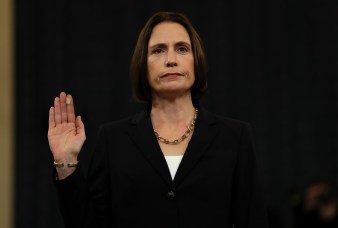
Fiona Hill is worn in at the House Intelligence Committee Open Impeachment Hearings.
Read more about Hill’s early life at the link. Here’s a bit about her experiences in the Trump White House.
Instead of making the usual insider-memoir move of fixating on all the brazenly outrageous behavior — the bizarre comments, the outlandish tweets — Hill notices his insecurities, the soft spots that, she says, made him “exquisitely vulnerable” to manipulation. Yes, she writes, the Kremlin meddled in the 2016 election — but unlike the #Resistance crowd, which insists that such meddling was decisive, Hill is more circumspect, pointing out that Vladimir Putin wasn’t the force that tore the country apart; he was simply exploiting fissures that were already there.
Just as concerning to her was the way that people around Trump would wreak havoc on one another by playing to his “fragile ego” — spreading rumors that their rivals in the administration had said something negative about Trump was often enough to land those rivals on what the president called his “nasty list.” Hill says that watching Trump fulminate made her feel like Alice in Wonderland watching the Queen of Hearts, with her constant shouts of “Off with their heads!” In Hill’s telling, Trump’s norm-breaking was so flagrant and incessant that she compares him, in her matter-of-fact way, to a flasher. “Trump revealed himself,” she writes, “and people just got used to it.”
But neither Trump nor Putin — who was the subject of one of Hill’s previous books — is what she really wants to talk about. What she sees happening in the United States worries her. Economic collapse, structural racism, unrelieved suffering: Even without Trump, she says, none of the country’s enormous problems will go away without enormous efforts to address them. Hill the expert points to heartening examples of benevolent capitalism at work. But Hill the memoirist knows in her bones that the neoliberal approach, left to its own devices, simply won’t do.
I cannot wait to read this book. More articles about it to check out:
Yahoo News: Trump’s fixation was on Putin himself rather than Russia, says fmr. WH adviser.
Raw Story: Trump’s former Russia expert has a message for voters if he runs in 2024
Financial Times: There Is Nothing for You Here by Fiona Hill — memoir from Trump White House.
Finally, Newsweek has an excerpt from the book: Donald Trump Called Fiona Hill ‘Darling,’ Thought She Was a Press Secretary.
 In other news, we’re still facing the possible default of the United States leading to a global financial crisis. Jonathan Weisman at The New York Times: As the U.S. Hurtles Toward a Debt Crisis, What Does McConnell Want?
In March 2006, as the government veered dangerously close to a default, Senator Mitch McConnell of Kentucky, the No. 2 Republican, let the Bush White House know he was two votes short of what he needed to raise the legal limit on federal borrowing.
Andrew H. Card Jr., then the White House chief of staff, began working the phones. He soon found two Democrats willing to break ranks and vote to put the legislation over the top. But Mr. McConnell was holding out for something else entirely, hoping to extract concessions from President George W. Bush as the price for uniting Republicans around lifting the limit.
“I don’t need your damned votes,” he snapped at Mr. Card. He lifted the debt ceiling with Republicans only.
Mr. Card never learned what the Senate leader wanted, but he tells the story for a reason: Mr. McConnell has long used the periodic need to raise the government’s borrowing limit as a moment of leverage to secure a policy win, as have leaders of both parties.
But two weeks before a potentially catastrophic default, Mr. McConnell has yet to reveal what he wants, telling President Biden in a letter on Monday, “We have no list of demands.”
Instead, he appears to want to sow political chaos for Democrats while insulating himself and other Republicans from an issue that has the potential to divide them.
Mr. McConnell has said the government must not be allowed to stop paying its debts; he has also said he will not let any Republicans vote to raise the limit, while moving repeatedly to block Democrats from doing so themselves. Instead, he has prescribed a path forward for Democrats: Use a complicated budget process known as reconciliation to maneuver around a Republican filibuster that he refuses to lift.
Asked what he wanted, that was his answer: “As I have said for two months, I want them do it through reconciliation.”
So what’s the problem then? Why don’t the Democrats just do it through reconciliation? Of course that is another problem, because Joe Manchin and Kirsten Sinema are standing in the way of the reconciliation bill. And what the hell do they want? A couple of reads on those two:
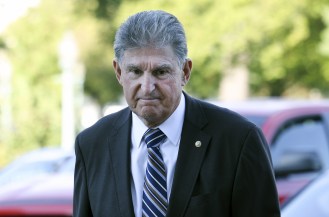 CNN: Manchin breaks with party leaders over strategy on debt ceiling and Biden’s economic package.
Democratic Sen. Joe Manchin on Monday pushed back on several politically sensitive positions his party leaders are taking at a crucial time for President Joe Biden’s domestic agenda.
The West Virginia Democrat, who holds a pivotal vote in the 50-50 Senate, indicated to CNN that he disagrees with the strategy top Democrats are pursuing in the standoff with Republicans over raising the national debt limit. Manchin said that Democrats “shouldn’t rule out anything,” including a budget process that Democratic leaders have made clear they will not employ.
Speaking to reporters, Manchin also would not commit to the new timeline set by party leaders to find a deal on the social safety net expansion by October 31. And he sounded resistant to calls from progressives and other top Democrats to raise his $1.5 trillion price tag for the package, which many in his party view as too low to achieve key policy objectives.
On Tuesday, however, Manchin did not rule out a $1.9 trillion to $2.2 trillion price tag for the social safety net package, a range Biden has floated privately. “I’m not ruling anything out,” Manchin said when asked by CNN if he would rule out that number.
In a stark warning sign to progressives, Manchin also indicated the package must include a prohibition against using federal funds for most abortions. “The Hyde Amendment is a red line,” he said. Manchin’s stance puts him at odds with progressives, with Congressional Progressive Caucus Chair Pramila Jayapal saying Sunday she would not support a package that included the Hyde Amendment.
Read more at the link.
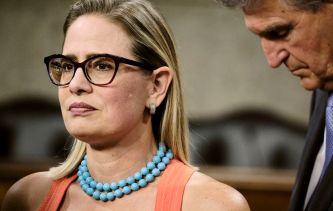 Michelle Goldberg at The New York Times: What’s Wrong With Kyrsten Sinema?
In 2003, Joe Lieberman, at the time one of the worst Democratic senators, traveled to Arizona to campaign for his party’s presidential nomination and was regularly greeted by antiwar demonstrators. “He’s a shame to Democrats,” said the organizer of a protest outside a Tucson hotel, a left-wing social worker named Kyrsten Sinema. “I don’t even know why he’s running. He seems to want to get Republicans voting for him — what kind of strategy is that?”
It was a good question, and one that many people would like to ask Sinema herself these days. People sometimes describe the Arizona senator as a centrist, but that seems the wrong term for someone who’s been working to derail some of the most broadly popular parts of Joe Biden’s agenda, corporate tax increases and reforms to lower prescription drug prices. Instead, she’s just acting as an obstructionist, seeming to bask in the approbation of Republicans who will probably never vote for her.
A “Saturday Night Live” skit this weekend captured her absurdist approach to negotiating the reconciliation bill that contains almost the entirety of Biden’s agenda. “What do I want from this bill?” asked the actress playing Sinema. “I’ll never tell.” It sometimes seems as if what Sinema wants is for people to sit around wondering what Sinema wants.
When Sinema ran for Senate, the former left-wing firebrand reportedly told her advisers that she hoped to be the next John McCain, an independent force willing to buck her own party. Voting against a $15 minimum wage this year, she gave a thumbs down — accompanied by an obnoxious little curtsy — that seemed meant to recall the gesture McCain made when he voted against repealing key measures of the Affordable Care Act in 2017.
But people admired McCain because they felt he embodied a consistent set of values, a straight-talking Captain America kind of patriotism. Despite his iconoclastic image, he was mostly a deeply conservative Republican; as CNN’s Harry Enten points out, on votes where the parties were split, he sided with his party about 90 percent of the time.
Sinema, by contrast, breaks with her fellow Democrats much more often. There hasn’t been a year since she entered Congress, Enten wrote, when she’s voted with her party more than 75 percent of the time. But what really makes her different from McCain is that nobody seems to know what she stands for.
Click the link to read more.
There’s lots more news out there. I’ll post more links in the comments. As always, this is an open thread.
 Good Afternoon Sky Dancers!
It’s been nearly a month since Ida turned Southeast Louisiana into a gigantic mess. It’s cooler now and sunny, Fall seems to have treated us with an on-time appearance. My streets are free from the garbage that was not picked up for weeks on end. Yesterday, they removed all the tree debris from the neutral ground. There were some huge trunks there from one of the neighbor’s very old oak trees. They probably were riddled with Formosan Termites.
It continues to be difficult watching White Male Republican Christianists and their enablers tear at the very foundation and dream this country was built on. We should be a country where just about anyone should be able to come, seek refuge, and work their way up into the middle class, at least. Our outcomes shouldn’t depend on our race, our gender, who we love, and the beliefs we hold. We are fighting the same fights for a more perfect union and watching the white male patriarchal nationalists continue to fix the game in their favor, morally objectionable people get thrown onto court benches for holding extremist positions. We’re reminded daily of this as the same group of suspects in state governorships rev up extremist laws that should be unconstitutional with the purpose of handing the decision to stacked courts.
 There is now an intersection between two of the most objectionable and worthless Supreme Court Justices with a penchant for sexually assaulting women. Anita Hill is back in the headlines with a new book. BB pointed me to this article last night in The Atlantic by Anita Hill herself. “What It Was Like for Me to Watch Christine Blasey Ford’s Testimony. From my own experience in 1991, I knew that her life would never be the same.” No matter what we do by changing laws and providing prevention and legal means to change the situation, predatory men still get rewarded by the system. She views the Kavanaugh hearing through the eyes of Christine Blasey Ford.
I had never spoken with Ford directly, but once the Judiciary Committee chair, Chuck Grassley, who also had heard my testimony about Clarence Thomas three decades earlier, announced that Ford would testify, emails flooded my inbox. Some suggested politely, “I would like to see you sitting behind Dr. Ford as she testifies on Thursday.” Others argued that my presence “would certainly send a message to those, dare I say, incorrigible, ignorant men who did not listen to your honest pleas to be heard those many years ago.”
My instinct told me that those “ignorant men” and many others would make political hay out of any gesture I made to show my support for Ford. I recalled the claims from 1991 that left-wing, pro-abortion-rights feminists had duped me into testifying about Thomas’s behavior. I was certain that Ford was hearing something of the same.
My biggest hope for the day was that it would be a completely different experience for her than it had been for me—that a lot of hard work by activists, researchers, lawyers, and others raising claims and demanding change in their workplace in the 27 years since I had faced that same Senate committee had resulted in the evolution of a new awareness of gender violence. But with some of the same senators from 1991 sitting on the Judiciary Committee and with Grassley in charge, I could not bring myself to be optimistic that the entire committee had evolved.
The 1991 committee was entirely made up of white men, and men in the Senate outnumbered women 98 to two. That the 2018 Senate Judiciary Committee included women, one of whom was Black, as well as a Black man, gave me hope for a greater understanding of gender and power, as did the fact that 23 women were Senate members. I wanted to believe that, between 1991 and 2018, enough senators had read the Department of Justice or CDC reports about the prevalence and health consequences of sexual violence to counter the committee’s naysayers.
 We know how that turned out. Margaret Sullivan–writing for The Washington Post–refers to the two women as a “club of two”.
During a recent conversation recorded for a new podcast, Hill, now 65 and a Brandeis law professor, told Ford, 54 and a psychology scholar at Stanford and Palo Alto University, that she felt a sense of overwhelming kinship as she watched the 2018 testimony — a feeling that she knew was shared by a large community of like-minded women.
“A spiritual solidarity,” Hill called it.
Their conversation is a high point in “Because of Anita,” a new four-part podcast series that debuts in October. I listened to a segment of it Thursday and found it moving, instructive and — as podcasts sometimes can be — surprisingly intimate. The two had met and spoken before but not, until now, for the public to hear.
The conversation took place on Zoom in late August with Hill and Ford in their home offices in Massachusetts and California. The podcast hosts — activist and scholar Salamishah Tillet and journalist Cindi Leive, longtime editor of Glamour magazine — were in San Diego and Brooklyn.
Hill and Ford discussed the intensity of their experiences, and how it lingered far beyond their moments in the harsh spotlight — moments remembered by many Americans as a still image of each woman with her right hand raised.
They also agreed on their motivation: that it was not, at heart, to persuade those who would vote for or against the nominees but rather, a desire to be clear and honest about their experiences — to simply say what they knew and not to be attached to the outcome.
The most obvious outcomes, of course, were similar. Thomas and Kavanaugh both were confirmed by narrowly divided Senate votes: 52 to 48, and 50 to 48, respectively.
But both Hill and Ford sound as if they have made their peace with that — and say they would do it again, though they acknowledge how much the searing experiences have changed their lives.
 Hill is still fighting the good fight against gender violence. Samantha Simon has this to say about her in a piece for InStyle. This is an interview with Hill who is part of a series speaking with “badass women”.
“Once you get on this track, you don’t stop. You just realize there’s something else to accomplish,” she says. “Right now, I’m feeling like I have time. I wish for everyone the feeling I have about how I live my life: I can do things to make the world better for other people, and that’s really a gift. Not everyone feels they have that kind of power.
The concentration of power — who holds it and the ways they use it to harm those who don’t have enough — has been central to Hill’s work all along. “This has been a public crisis long before the #MeToo movement, and people are still facing resistance to their ideas or identities in the workplace and can’t come forward,” she says. “As long as those conditions exist, I will be doing this work.”
That’s what I think it feels like for all of us working on Social Justice Issues. We’re fighting and refighting the same things. For example, some on needs to tell Lindsey Graham whipping black people with a leash went out with the end of the civil war.
There is nothing I can say to folks that try to lessen the impact of that image. It’s just another way we see another era in our country when people could be property. It’s not supposed to be that way anymore.
I’m going to end here with something that happened to me this week. On Tuesday, I was sitting in my little virtual office online waiting patiently to see students or help students. The usual chat request came in with only the letter e typed in. What followed was this question. “Are you a (n-word)? Of course, the university is investigating it. It rattled me more than I thought possible given the amount of hate I’ve seen all around the Quarter when the White Male Christianists come to hate on women and the GLBTQ community. But, it reminded me that none of us really have a safe space which really, is what everyone wants. Protecting privilege as vehemently as today’s Republicans do is just hard to deal with day-in-and-out. But we are the majority. That is what scares them. We must use our power as the majority and stop them. If I was a Christian, I would sure be pushing back on what they say is the path of Jesus. I’m allied with kindness, compassion, and civility.
What’s on your reading and blogging list today?
BB’s had a bad week or so with her pain issues so I’m sitting in for her today. She’s going to be talking to her doctor so hopefully, she’ll get some relief sometime today! It’s the last day of summer also. I hope we can get some relief from the heat.
Charlie Savage has written this piece in the New York Times today: “Democrats Begin Effort to Curb Post-Trump Presidential Powers ut to appeal to Republicans, a bill being introduced in the House to impose checks on executive authority may be broken into pieces in the Senate.”
House Democrats are planning to introduce a package of proposed new limits on executive power on Tuesday, beginning a post-Trump push to strengthen checks on the presidency that they hope will compare to the overhauls that followed the Watergate scandal and the Vietnam War.
Democrats have spent months negotiating with the Biden White House to refine a broad set of proposals that amount to a point-by-point rebuke of the ways that Donald J. Trump shattered norms over the course of his presidency. The Democrats have compiled numerous bills into a package they call the Protecting Our Democracy Act.
The legislation would make it harder for presidents to offer or bestow pardons in situations that raise suspicion of corruption, refuse to respond to oversight subpoenas, spend or secretly freeze funds contrary to congressional appropriations, and fire inspectors general or retaliate against whistle-blowers, among many other changes.
The legislation’s lead sponsor, Representative Adam B. Schiff, Democrat of California, said he hoped it would receive a floor vote “this fall.”
Here’s another example of things that should not happen. Thank goodness for courts and prosecutors!
https://twitter.com/JanNWolfe/status/1440088421339254791
https://twitter.com/JanNWolfe/status/1440130225816358913

“Tongue Fashion”, from the “Annunciation” series (1969) Wilfredo Lam
Yeah, right “Russian Hoax” Blah. Blah. Blah. This is from the AXIOS link cited above.
The big picture: The Justice Department alleges that Jesse Benton, 43, the husband of Paul’s niece and a veteran Republican staffer, orchestrated a scheme to conceal the illegal foreign donation with another GOP operative, Doug Wead.
The details: The indictment, unsealed on Monday, outlines allegations of a convoluted money trail from the unnamed Russian national through a consulting firm run by Benton and to a Trump joint fundraising committee.
- The Russian national was determined to underwrite a Trump fundraising event in order to get a photo with the former president, according to communications between Benton and Weed cited in the indictment.
- The indictment alleges that Benton received $100,000 from the Russian national and passed on $25,000 to the joint fundraising committee, allegedly pocketing the remaining $75,000.
- Wead and Benton each face six criminal charges, including conspiracy and abetting illegal foreign political contributions.
For the record: Efforts to reach Wead were not immediately successful. Benton did not immediately respond to requests for comment.
- Benton was previously convicted of filing false statements in connection with a scheme to funnel money from Ron Paul’s 2012 presidential campaign to an influential Iowa politician who backed Paul in the state’s presidential caucus.
- Trump pardoned Benton in December, shortly before leaving office.
Rebecca Shabad of NBC news provides these details: “Many of the bill’s provisions are a response to the way Donald Trump operated as president.” So this is the type of behavior the bill addresses.
The measure would limit a president’s pardon power, require presidential candidates to be transparent with their tax records, and extend a deadline for prosecuting former presidents and vice presidents for federal crimes committed before or during their time in office, according to the group Protect Democracy, which is advocating for the measure.
It would also ensure that incoming presidents have access to resources for the transition period following an election, and would require the disclosure of contacts between the White House and the Justice Department.
“The proposals respond to longstanding vulnerabilities in our democracy that have allowed for the aggrandizement of presidential power, many of which have been exploited over decades by presidents of both parties, and some of which reached new heights through the actions of the Trump administration,” the group says on its website.
Donald Trump, for example, has refused since his campaign for president to release his tax records, repeatedly claiming that he couldn’t do so because the IRS was conducting an audit of his documents.
Before Trump left office, he pardoned hundreds of people including his former campaign manager Paul Manafort, his former adviser Roger Stone, his other former campaign manager, Steve Bannon, and his former national security adviser Michael Flynn.
President Biden addresses the United Nations today and is speaking–at this writing–on Climate Change in a quite colorful language. Here’s that part of the speech. I can speak directly to climate change. I’m not sure how long it will take to take care of things after Ida down here in Southe East Louisiana. There really are some towns that may not come back. You may thank your rising gas prices to the hurricane’s destructive path that hit Port Fouchon
Twitter is full of horror over a whip being used by a Border patrol officer on people fleeing political chaos in Haiti border patrol. This is reported in the New York Times. “Mayorkas says he was ‘horrified’ by images of horse-mounted Border Patrol agents confronting Haitian migrants.”
Homeland Security Secretary Alejandro Mayorkas said Tuesday that he was “horrified” by images of horse-mounted Border Patrol agents attempting to grab Haitian migrants and use their animals to push them back toward Mexico and promised a “swift” investigation.
“I was horrified by what I saw,” Mayorkas said during an appearance on CNN. “I am going to let the investigation run its course, but the pictures that I observed troubled me profoundly.”
Mayorkas was responding to scenes captured by news cameras and photographers Sunday along the Rio Grande. In one instance, an agent is heard on video shouting an obscenity as a child jumps out of a horse’s path.
“One cannot weaponize a horse to aggressively attack a child,” Mayorkas said. “That is unacceptable. That is not what our policies and our training require. …Let me be quite clear: That is not acceptable.”
The stench of Trump and Steven Miller are all over the Border Patrol. I personally feel they should all be fired and made to reapplyou.
It’s going to take a long time to deal with the aftermath of the Trump administration and its culture of grift and dismissal of the rule of law and expected protocol. I’m still amazed we’re still standing some days
So, I hope you feel better BB! Take care of yourself!
What’s on your reading and blogging list today?
Well, the Biden Agenda–even the watered down parts meant to appease Republicans–is stalled. Here’s a quick line-up of all that’s not going to get done in the name of ego and the mid-term election politics. It seems Americans dealing with so many issues like climate-change induced diasters, Covid-19, underemployment and lack of living wages are just going to wait until a few blowhards get their day in the sun. We sure do have the Troubles in this country.
From Hans Nichols writing at Axios: “Scoop – Manchin: Delay Biden plan to ’22”.
Sen. Joe Manchin (D-W.Va.) is privately saying he thinks Congress should take a “strategic pause” until 2022 before voting on President Biden’s $3.5 trillion social-spending package, people familiar with the matter tell Axios.
Why it matters: Manchin’s new timeline — if he insists on it — would disrupt the plans by House Speaker Nancy Pelosi (D-Calif.) and Senate Majority Leader Chuck Schumer (D-N.Y.) to vote on the budget reconciliation package this month.
Driving the news: Back home in West Virginia last week, Manchin told a group of employees at a Procter & Gamble facility in Martinsburg he wanted to pause all the talk about the $3.5 trillion bill until 2022, Axios was told.
- Those semi-public comments track with some of his private conversations about how long he wants to impose the “strategic pause” he floated in a Wall Street Journal op-ed this month.
- Manchin didn’t give a specific timeline in his op-ed.
Any delay on the Democrat-only reconciliation package could imperil House passage of the separate $1.2 trillion bipartisan infrastructure bill, which Pelosi has promised to pass by Sept. 27.
- House progressive lawmakers are publicly vowing to vote against the infrastructure bill if it’s not paired with the $3.5 trillion bill to be passed through the budget reconciliation process.
- But centrist Democrats are adamant the House pass the bipartisan bill first — next week.
The big picture: Manchin and Sen. Kyrsten Sinema (D-Ariz.) are leading the Democratic opposition in the Senate to the size and scope of the reconciliation package.
It’s largely been written by Sen. Bernie Sanders (I-Vt.), and would vastly expand the social safety net from cradle to grave, as the New York Times recently put it.
Why is it all things ego-related these days always include Bernie Sanders and Joe Manchin? Oh, and now Kristin Sinema who appears to be part of the stymy everything wing of the Democratic Party. From Politico and Laura Barron-Lopez: “Sinema tells White House she’s opposed to current prescription drug plan. The Arizona Democrat joined Joe Manchin in giving the president a wake-up call on the reconciliation bill.” Who likes higher drug prices? Big Pharma and the pols they own evidently.
The White House has a new headache as it struggles to get its multitrillion-dollar party-line spending bill passed: Sen. Kyrsten Sinema’s objections to drug pricing reforms that are already struggling to make it through the House.
The Arizona Democrat is opposed to the current prescription drug pricing proposals in both the House and Senate bills, two sources familiar with her thinking said. They added that, at this point, she also doesn’t support a pared-back alternative being pitched by House Democratic centrists that would limit the drugs subject to Medicare negotiation.
Sinema met with President Joe Biden on Sept. 15 to discuss the social spending package, in which party leaders hope to include the Medicare prescription drug pricing proposal. Sinema has made her resistance to the current House prescription drug negotiation proposal clear to the White House, according to one of the sources, but it’s unclear if she’s completely immovable.
Both she and Sen. Joe Manchin (D-W.Va.), who met with the president the same day, delivered what one source described as a sobering message for the White House about the fate of the reconciliation bill and its $3.5 trillion price tag, which they both say is too high. The social spending plan is designed to pass without GOP votes through budget reconciliation, meaning that Biden will need to win all 50 Senate Democratic votes to secure its passage.

Giorgio de Chirico, Le trouble du philosophe, 1925-26. Museo del Novecento, Milano
AP and Allan Fram report that the “Senate parliamentarian deals blow to Dems’ immigration push.”
Democrats can’t use their $3.5 trillion package bolstering social and climate programs for their plan to give millions of immigrants a chance to become citizens, the Senate’s parliamentarian said late Sunday, a crushing blow to what was the party’s clearest pathway in years to attaining that long-sought goal.
The decision by Elizabeth MacDonough, the Senate’s nonpartisan interpreter of its often enigmatic rules, is a damaging and disheartening setback for President Joe Biden, congressional Democrats and their allies in the pro-immigration and progressive communities. Though they said they’d offer her fresh alternatives, MacDonough’s stance badly wounds their hopes of unilaterally enacting — over Republican opposition — changes letting several categories of immigrants gain permanent residence and possibly citizenship.
The parliamentarian opinion is crucial because it means the immigration provisions could not be included in an immense $3.5 trillion measure that’s been shielded from GOP filibusters. Left vulnerable to those bill-killing delays, which require 60 Senate votes to defuse, the immigration language has virtually no chance in the 50-50 Senate.
In a three-page memo to senators obtained by The Associated Press, MacDonough noted that under Senate rules, provisions are not allowed in such bills if their budget effect is “merely incidental” to their overall policy impact.
Citing sweeping changes that Democrats would make in immigrants’ lives, MacDonough, a one-time immigration attorney, said the language “is by any standard a broad, new immigration policy.”
The rejected provisions would open multiyear doorways to legal permanent residence — and perhaps citizenship — for young immigrants brought illegally to the country as children, often called “Dreamers.” Also included would be immigrants with Temporary Protected Status who’ve fled countries stricken by natural disasters or extreme violence; essential workers and farm workers.

At the Bottom of the Anxiety Swamp by Jayoon Choi
‘There is a moment when you can’t help but sink deep down. Attacked by spiteful thoughts. But, oh dear! I was the monster.’
So, can we get a WTF? from the Amen Corner? “This Powerful Democrat Linked to Fossil Fuels Will Craft the U.S. Climate Plan. Senator Joe Manchin is already a crucial swing vote in the Democrats’ sweeping budget bill. But he will also write the details of its climate change program.”
Joe Manchin, the powerful West Virginia Democrat who chairs the Senate energy panel and earned half a million dollars last year from coal production, is preparing to remake President Biden’s climate legislation in a way that tosses a lifeline to the fossil fuel industry — despite urgent calls from scientists that countries need to quickly pivot away from coal, gas and oil to avoid a climate catastrophe.
Mr. Manchin has already emerged as the crucial up-or-down vote in a sharply divided Senate when it comes to Mr. Biden’s push to pass a $3.5 trillion budget bill that could reshape the nation’s social welfare network. But Mr. Biden also wants the bill to include an aggressive climate policy that would compel utilities to stop burning fossil fuels and switch to wind, solar or nuclear energy, sources that do not emit the greenhouse gases that are heating the planet.
As chairman of the Senate Committee on Energy and Natural Resources, Mr. Manchin holds the pen and the gavel of the congressional panel, with the authority to shape Mr. Biden’s ambitions.
But Mr. Manchin is also closely associated with the fossil fuel industry. His beloved West Virginia is second in coal and seventh in natural gas production among the 50 states. In the current election cycle, Mr. Manchin has received more campaign donations from the oil, coal and gas industries than any other senator, according to data compiled by OpenSecrets, a research organization that tracks political spending.
He profits personally from polluting industries: He owns stock valued at between $1 million and $5 million in Enersystems Inc., a coal brokerage firm which he founded in 1988. He gave control of the firm to his son, Joseph, after he was elected West Virginia secretary of state in 2000. Last year, Mr. Manchin made $491,949 in dividends from his Enersystems stock, according to his Senate financial disclosure report.
“It says something fascinating about our politics that we’re going to have a representative of fossil fuel interests crafting the policy that reduces our emissions from fossil fuels,” said Joseph Aldy, who helped craft former President Barack Obama’s climate change bill and now teaches at Harvard.

Tiger, Shark and Me Sit Down for Tea by Emma Haddow
‘I’ve struggled with anxiety and depression since I was a teenager. There have been times when it has crippled me, and I was afraid of everything. I started to face my fears, my demons head on and I still do. It’s scary in the dark but what’s more scary to me is denying and suppressing what lurks beneath the surface. My mental health is good these days. My dark days are still here, but I no longer turn them away.’
Politco question if Democrats can get anything done including in the time left to them. “Dems vow to go the distance as September problems pile upThe party has Herculean levels of work to do in 11 days, and it’s projecting confidence but offering few clues on how.”
The House and Senate return to Washington together this week with Democrats facing four tasks that would be challenging on their own — but, taken together, are the legislative equivalent of Hercules’ labors.
Sen. Mark Warner (D-Va.) summed up the party’s wildly urgent to-do list with the drama of a movie trailer: “Keep the government open. Don’t default on the debt. Make sure the president gets a win on the infrastructure bill … and, obviously the mother of all legislation, the reconciliation package,” he said, referring to the mega-bill that Democrats want to pass along party lines to spend trillions of dollars on a panoply of social priorities.
But for all of the party’s awareness of what it needs to do, Democrats are uncertain about how to get it all done. The coming three-week legislative sprint will test their slim majorities and President Joe Biden’s domestic policy chops, with dwindling days to avoid a government shutdown and defuse a politically toxic battle with Republicans over the nation’s borrowing limit.
Speaker Nancy Pelosi and Senate Majority Leader Chuck Schumer are also under intense pressure to deliver on the lifeblood of Biden’s agenda: a multitrillion-dollar social spending package and a bipartisan infrastructure bill, which could both see floor votes in the coming weeks.
Already, ideological clashes across the Democratic Party have begun to spill into the open as it begins its final push to turn Biden’s enormous spending plan into law. Last week, a small group of moderates sank a leadership-backed drug pricing initiative in a high-profile committee meeting as they demanded to vote on their own version of the bill.
Across the Capitol, Sens. Joe Manchin (D-W.Va.) and Kyrsten Sinema (D-Ariz.) have said they will not support legislation that costs $3.5 trillion, setting up a skirmish with progressives who say that top line number is already a compromise. Some Democrats fear those two moderates may not be willing to support the final bill at all.
I do have faith in Pelosi and many of the Democratic leaders to do what they can. However, I also know that ego mixed with big donations can make a politician pretty useless for the people.
What’s on your reading and blogging list today?
 peej
peej Carissa
 bostonboomer
 dakinikat
 ecocatwoman
 jjlo
jjlo mablue2
 Mama Lopez
 peggysue22
 quixote
 skydancingguestblogger
 Mona (aka Wonk the Vote)
 Memeorandum Crooks and Liars Democracy NOW The UK Guardian
The Sky Dancing banner headline uses a snippet from a work by artist Tashi Mannox called 'Rainbow Study'. The work is described as a" study of typical Tibetan rainbow clouds, that feature in Thanka painting, temple decoration and silk brocades". dakinikat was immediately drawn to the image when trying to find stylized Tibetan Clouds to represent Sky Dancing. It is probably because Tashi's practice is similar to her own. His updated take on the clouds that fill the collection of traditional thankas is quite special.
You can find his work at his website by clicking on his logo below. He is also a calligraphy artist that uses important vajrayana syllables. We encourage you to visit his on line studio.








Recent Comments