
Friday Reads: The Fourth Estate is Failing Us
Posted: November 5, 2021 Filed under: Media 27 Comments
Lessons of history: How to boost newspaper sales with Sarah Bernhardt
Good Afternoon Sky Dancers!
My body is screaming for our brief respite from Daylight Savings time! It switched maybe a month ago while the clock changes over the weekend. So while I know I’m late for everything recently, my body tells me that sleeping is ok because this should be standard time. So, go ahead and do it!
My brain is also telling me to turn off the tv and stay away from most of today’s headlines. We’ve never been at a place in history where journalism is more required and all we get is a group of hacks with very narrow vantage points.
This conversation is going on between a group of us on the Facebook page of a retired CNN producer.
Just wanted to let you know that all your whining about Dems’ “messaging” means absolutely nothing when my beloved colleagues aren’t gonna talk about what they say anyway.If a Dem shouts from the rooftops but those colleagues only care what Republicans say, will anybody hear the message?
No, my friends, no they won’t. And it’s bad enough that CNN, MSNBC, and the Big Three can barely be bothered to talk about anything beyond the Republican viewpoint, but in many parts of rural America, cable only has Fox News, which outright lies about what’s going on.
So think of some other way to get the “message” across. Better yet, ask yourselves why YOU think it’s not being heard. Is it really because no one’s delivering it? Or is it because the message gets delivered to and processed through a delusional political press that hasn’t learned anything since at least 2016 and probably much earlier?
 The first response to her post brings the receipts. He explains why he’s given up on cable news altogether.
I stopped watching cable news when we cut the cord a couple of years ago. Usually watch NBC News Now in the morning, which is free, on YouTube. Not a single mention today of Biden when covering the jobs report. In fact, “Today’s job report wasn’t that good compared to previous months,” was the only comparison made. Cherry on top for me? A long rambling story about how everyone is getting a taste of winter “early” cause it is chilly for the NYC marathon, despite the fact that many frost and freeze warnings are running 2 weeks later than average. No one’s getting a taste of winter “early.”
This brings us back to a few more revolting recent headlines where research was the last thing on a reporter’s mind. This one is recent from CNN. Joshua Espinoza points a few things out at this independent media outlet that weren’t particularly well-searched.
So, many folks didn’t realize that the family has 10 kids which include foster and adopted children. So, 12 gallons of milk a week could be a reasonable amount. But, the real story is what’s the average price of milk been over the last few years? Is there really that much inflation in ag products? Is this truth or perception formed by sloppy reporting? Also, check the grocery cart out. Maybe buying less brandnames would help you make ends meet?
Even after adjusting for inflation, this concern really does hold up to the data.
I think this story should have been left on the cutting floor. Either that or they need to talk to Texas about the amount of money they’re allotting homes with so many foster children. This just isn’t adding up.
Then, I saw this on Brian Williams last night. Maybe Brian got one thing right this year.
He has a point so watch this.
https://twitter.com/IAmPoliticsGirl/status/1456101658501345283
So, where are we at today?
And our politics girl has something to say about the inflation/shortage thing too …
https://twitter.com/joebarton1238/status/1456642030428246017
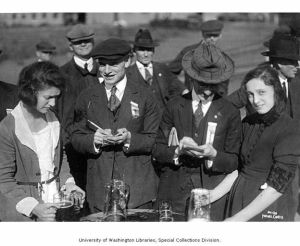
Reporters in Washington in 1920
So, I’m with her on that. My other piece of advice is to go on a sabbatical for a year every few years if your journalist life is spent in Washington D.C or New York City. Try existing somewhere with the rest of us. I’m old enough to remember when a right-wing activist on CRT tricked you–New York Times–into thinking he just tripped across it because someone was mean to his granddaughter and you didn’t background check him either. You seem to be always chasing the elusive characters in Hillbilly Elegy rather than talking to the majority of us who are real.
You should offset Fox New’s lies rather than compete with them! Like, take this turkey and deep fry it! From Vice: “Tucker Carlson Pumped Full of Fentanyl, Emerges With New Understanding of the Opioid Crisis.” As if he wasn’t insane enough before.
Something happened to Tucker Carlson Monday morning that caused him to get emergency back surgery later in the week. It was, he said, according to a recording obtained by Motherboard, “one of the most traumatic things that’s ever happened to me in my whole life, ever.”
What exactly was so traumatic isn’t clear. A Fox News spokesperson said, “Tucker Carlson had emergency back surgery yesterday and did the show anyway. He thanks all those who tuned in and watched closely.”But before Wednesday night’s broadcast of his Tucker Carlson Tonight program, Carlson—who by all accounts doesn’t drink or use drugs—spoke in detail on set to his production team about what he experienced, and said that because he was treated with intravenous fentanyl and other powerful painkillers, he now understands America’s opioid crisis in a deeper way.
Carlson is the most-watched news host in America, a hugely influential figure whose team, as he says on the recording, “changed American politics.” His newfound insight into the suffering opioids cause is thus of potentially immense importance. (Motherboard described the comments to the Fox News spokesperson, who did not dispute their authenticity. Carlson, they said, would “take a pass” on discussing the topic with a reporter.)
“This is just like a miracle,” a production worker told him. “I, like, truly cannot believe you’re standing right now.”
“That was one of the most intense experiences of my life,” said Carlson. “They hit me up, they told me this morning, with such a huge dose of dilaudid, which is more powerful than morphine, when I got there, that I had trouble breathing.” (Dilaudid is a powerful opioid painkiller.) “Scared the shit out of me. Didn’t have any effect at all. And then all night, I lay there, the nurse finally upped my dosage of dilaudid to the point where every eight minutes I hit it and it was like getting shot. Just like bam, feel it hit me, and it didn’t touch the pain.”
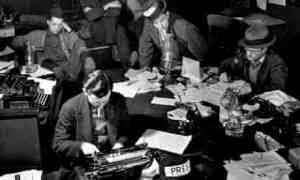
1937 photograph of the offices of the Louisville Courier Journal. Photograph: Margaret Bourke-White/Getty
I’m also old enough to remember watching Geraldo Rivera open an empty vault on live tv in 1986 and later in 2003 , he broadcast his position from an active battle site in Iraq. The military promptly kicked him out of there. He was just one of thousands of journalism who were more in love with being war time reporters than caring about the truth and saving American lives.
Still, all these hacks are still around some one and still creating ‘look at me ma!’ moments passing as news. Like Politics Girl says and my friends, the media is really not going to address anything that makes Biden or the Democratic party look good. They better step up and serve their message cold and consider the press hostile.
Just an additional thought while I’m at this. When is the last time a Democratic pol showed up on the Sunday Talk shows? (via Vox) “The staggering overrepresentation of white, conservative men on Sunday political shows. ” This is from 2016 but still holds true. Here’s a study from 2020.
This research will compare guests between the first two years of Barack Obama’s
presidency and the first two years of Donald Trump’s presidency. A quantitative content analysis of television transcripts was used to identify changes in both the political affiliations and profession of the guests who appeared on NBC’s “Meet the Press,” CBS’s “Face the Nation,” ABC’s “This Week” and “Fox News Sunday” between the two administrations. Findings indicated that the dominant political viewpoint of guests differed by show during the Obama administration, while all shows hosted more Republicans than Democrats during the Trump administration. Furthermore, U.S. Senators and TV/Radio journalists were cumulatively the most frequent guests on the programs.
“That’s just the way it is Somethings, they never change.”
What’s on your reading and blogging list today?
Thursday Reads: Media Works Tirelessly to Help Trump Destroy U.S. Democracy
Posted: July 25, 2019 Filed under: Afternoon Reads, Media, U.S. Politics | Tags: Brian Williams, Chuck Todd, Donald Trump, impeachment, MSNBC, Robert Mueller 27 Comments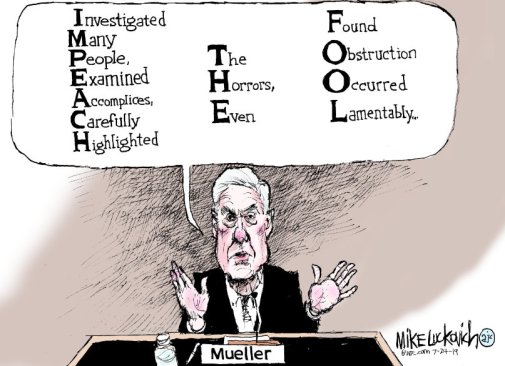
Good Afternoon!!
If Trump succeeds in destroying our democracy and becoming Hitler 2.0, the responsibility will be equally shared between the GOP and the U.S. political media. Yesterday Robert Mueller confirmed that Trump has committed high crimes and implied that Congress should impeach him. The media responded by reviewing the style and “optics” of his presentation, paying little attention to its content.
The ever-shallow Chuck Todd led the charge on Twitter. I won’t subject you to the video.
So-called leftist Michael Moore agreed with Todd.
The Columbia Journalism Review critiqued Chuck Todd’s remarks as well as those of other MSNBC hosts: MSNBC public editor: The Chuck Todd show.
Todd’s focus on the “entertainment” aspect of politics coverage is often in evidence—for example, in his own recent performance as moderator in the Democratic presidential debate. He managed to talk more than all but three of the candidates, even as he demanded that they keep their own answers brief….
For Chuck Todd all the political world’s a stage, and he’s the star….
And it’s not just Todd. Other MSNBC anchors reacted to the Mueller hearings similarly, finding fault with the Democrats’, and Mueller’s, lack of pizazz as performers. Brian Williams referred to “the caffeine gap” in the Judiciary Committee’s questioning. I can’t help pointing out that excessive concern with caffeinated pizzazz can warp a journalist’s judgement pretty severely, and is best avoided.
At a moment of particular gravity for the country, with the sitting president credibly accused of obstructing justice, and many of his campaign staff and associates under investigation and indictment, may I suggest that if you, a journalist, are bored with the politics of this—if you are demanding somehow to be entertained, right now—you’re not doing your job.
Politics isn’t entertainment, it is not a performance to be critiqued. Reporting on national politics is a public trust of solemn importance that affects hundreds of millions of people.
A sample of headlines from the “savvy” Washington press:
Peter Baker at The New York Times: The Blockbuster That Wasn’t: Mueller Disappoints the Democrats. [I skimmed the story, and could find no quotes from Democrats holding elected office. Several prominent experts were quoted arguing Mueller’s testimony was valuable.]
Sharon LaFraniere, Michael S. Schmidt, Noah Weiland and Adam Goldman at The New York Times: Mueller’s Labored Performance Was a Departure From His Once-Fabled Stamina.
Susan Glasser at The New Yorker: “Accountability”? The Mueller Hearing Is How Trump Escapes. [FYI: Susan Glasser is married to Peter Baker of the NYT.]
Some serious reactions to Mueller’s testimony:
Former Republican Jennifer Rubin: Mueller didn’t fail. The country did.
Being thousands of miles away from home in Portugal, a country that 45 years ago was in the grasp of a brutal dictatorship, gives me an interesting perspective on former special counsel Robert S. Mueller III’s Wednesday testimony and on the now nearly forgotten — was it only a week ago? — racist call for four nonwhite congresswomen to “go back” to where they came from.
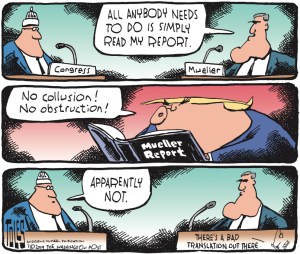
Tom Toles Editorial Cartoon
I worry that we — the media, voters, Congress — are dangerously unserious when it comes to preservation of our democracy. To spend hours of airtime and write hundreds of print and online reports pontificating about the “optics” of Mueller’s performance — when he confirmed that President Trump accepted help from a hostile foreign power and lied about it, that he lied when he claimed exoneration, that he was not completely truthful in written answers, that he could be prosecuted after leaving office and that he misled Americans by calling the investigation a hoax — tells me that we have become untrustworthy guardians of democracy.
The “failure” is not of a prosecutor who found the facts but might be ill equipped to make the political case, but instead, of a country that won’t read his report and a media obsessed with scoring contests rather than focusing on the damning facts at issue.
David Corn at Mother Jones: Mueller Reminds the Public: Trump Betrayed the United States.
There’s an old saying in newsrooms: News is stuff that people have forgotten. Robert Mueller’s dramatic appearance before the House Judiciary Committee on Wednesday morning was a striking reminder of this adage. The former special counsel did not drop any new revelations about the Trump-Russia affair. Yet in a simple but important manner, he reiterated the basics of this scandal—perhaps the most consequential political scandal in American history. These are the fundamentals that have often been subsumed by all the never-ending partisan squabbling and by the ongoing crusade mounted by Donald Trump and his defenders to distract from his perfidy. These are the facts that Trump has refused to acknowledge, and they are the facts that taint his presidency and undermine its legitimacy.
In his opening statement, Mueller emphasized the key finding from his report: “The Russian government interfered in our election in sweeping and systematic fashion.” And during the questioning, Mueller repeated the conclusion previously reached by the US intelligence community that Russia conducted this covert operation to help Trump get elected. “Did your investigation find that the Russian government perceived it would benefit from one of the candidates winning?” Mueller was asked by Rep. Zoe Lofgren (D-Calif.). He replied with one word: “Yes.” Lofgren followed up: “And which candidate would that be?” Mueller responded, “Well, it would be Trump.”
So Russia attacked an American election to help Trump. And what did Trump do? “The Trump campaign wasn’t exactly reluctant to take Russian help,” Lofgren remarked to Mueller. “You wrote it expected it would benefit electorally from information stolen and released through Russian efforts, isn’t that correct.”
Mueller answered with another brief sentence: “That’s correct.” That is, Trump sought to exploit a foreign adversary’s clandestine assault. And as Mueller noted in his report, during the campaign Trump dismissed the notion that Russia was intervening in the election, and after he was elected he continued to deny “that Russia aided his election.”
Click the link to read the rest.
David Graham at The Atlantic: The Most Revealing Exchange of the Mueller Hearing.
There’s a logical disconnect in volume 2 of Special Counsel Robert Mueller’s report that is unmissable to any careful reader.
As Mueller explains in the report, a charge of obstruction of justice requires three elements: an obstructive act, a nexus with an official proceeding, and corrupt intent. And in the report, Mueller’s team laid out several cases where President Donald Trump committed an obstructive act, in connection with an official proceeding, with what Mueller’s team concluded could be a corrupt intent.
But because Mueller had decided at the outset of his report that he could not and would not charge the president with crimes, thanks to Justice Department guidance and in the interest of fairness, Mueller did not make the otherwise obvious jump from laying out the ways that Trump’s behavior met the three-prong test to actually stating that Trump obstructed justice.
During today’s House Judiciary Committee hearing, Democratic Representative Hakeem Jeffries sought to demonstrate the disconnect by walking Mueller through the three-prong test.
“Let me refer you to page 87 and 88 of volume 2 where you conclude the attempt to remove the special counsel would qualify as an obstructive act if it would naturally obstruct the investigation and any grand-jury proceedings that might flow from the inquiry. Correct?” Jeffries asked.
“Yes,” Mueller said, confirming the obstructive act.
“Yes,” Mueller said, confirming the obstructive act.
“Your report found on page 89, volume 2, that substantial evidence indicates that by June 17, the president knew his conduct was under investigation by a federal prosecutor who would present any evidence of federal crimes to a grand jury. True?” Jeffries asked.
“True,” Mueller said, confirming the nexus to an official proceeding.
Jeffries then moved on to the third element, corrupt intent, and Mueller once again effectively affirmed the point:
Jeffries: Is it fair to say the president viewed the special counsel’s investigation as adverse to his own interest?
Mueller: I think that generally is true.
Jeffries: The investigation found evidence, quote, “that the president knew that he should not have directed Don McGahn to fire the special counsel.” Correct?
Mueller: Where do you have that quote?
Jeffries: Page 90, volume 2. “There’s evidence that the president knew he should not have made those calls to McGahn,” closed quote.
Mueller: I see that. Yes, that’s accurate.
Mueller, seeing the trick, tried to cut it off. “Let me just say, if I might, I don’t subscribe necessarily to your—the way you analyzed that. I’m not saying it’s out of the ballpark, but I’m not supportive of that analytical charge,” he said.
Graham writes that Mueller tried to backtrack, but the cat was out of the bag. Ted Lieu did something similar; head over the The Atlantic to read more.
This piece by Jonathan Bernstein at Bloomberg is worth a read: Worst Part of the Mueller Hearings? Republican Conspiracy Theories.
Instead of reading carefully into the evidence and finding contradictions or loose ends, House Republicans largely busied themselves with conspiracy theories. It wasn’t Donald Trump and his campaign who welcomed and benefited from Russian interference in the 2016 election; it was Hillary Clinton! Never mind what U.S. intelligence agencies and Senate investigators have concluded. Never mind that this reality-denying line of inquiry left lawmakers defending Wikileaks and even, seemingly, the Russian agents indicted by Mueller.
For these Republicans, it’s still supposedly inexplicable that the FBI started investigating in the first place. In their stated conception of things, only partisanship and hatred of the president could explain such an otherwise odd decision to look into the rich web of shady contacts between the Trump campaign and Russians. And yet those partisan and hateful investigators didn’t leak anything about the probe when it would’ve put Trump’s election in jeopardy; didn’t indict or recommend impeachment of the president; and didn’t rush to testify to Congress about any of it.
Meanwhile, with the notable exception of Texas Representative Will Hurd, Republicans showed no interest at all in the national-security implications of Russia’s interference. And remember, Senate Majority Leader Mitch McConnell is still blocking bipartisan legislation to strengthen U.S. defenses against future attacks.
These are the same Republicans, after all, who spent years looking into conspiracy theories about the deaths of Americans in Benghazi in 2012 without ever attending to the real security vulnerabilities that contributed to them. It was far more important to feed the Republican marketplace with loony ideas about how President Barack Obama (or Hillary Clinton) actively welcomed the disaster than to figure out what had actually gone wrong or what to do about it.
I’ll end with this tweet from the woman who should be president, written after Trump’s latest Nazi/KKK rally.
Lazy Caturday Reads
Posted: December 29, 2018 Filed under: Afternoon Reads, Media, U.S. Politics | Tags: Airbnb, Anibal Romero, Charlie Baker, Donald Trump, Facebook, fake news, lying liars, maga hats, Massachusetts, New Jersey, Paul Manafort, politicizing the military, Robert Mueller, Russia investigation, Short Term Rentals, Trump National Golf Club Bedminster, undocumented immigrants, Victor Boyarkin 24 Comments
By Jackie Morris
Good Afternoon!!
The lies come thick and fast from the Trump administration. It’s not just Trump; it’s his entire gang of shameless prevaricators.
Remember those MAGA hats that Trump signed for service members in Iraq? The White House swore up and down to CNN that they didn’t distribute the campaign merchandise, but people who were there say otherwise.
Of course we can’t be sure these tweets are legit, but come on! Who actually believes these soldiers bought Trump hats and banners and had them shipped to Iraq? Give me a break. I know this is a minor scandal in the scheme of things Trump, but still…
And besides, this was supposed to be a secret, surprise visit, so are we supposed to believe these folks always carry their MAGA hats and banners around with them and to the mess hall?
OK, I know I’m beating a dead horse, but I get so tired of all the gaslighting.
Now check this out. Remember that NYT story awhile back about undocumented immigrants working at Trump’s New Jersey golf club?
The New York Daily News: New Jersey AG has obtained evidence of possible crimes at Trump’s golf club — and Mueller, FBI are involved in probe.
New Jersey prosecutors have collected evidence that supervisors at President Trump’s Garden State golf club may have committed federal immigration crimes — and the FBI as well as special counsel Robert Mueller have played part in the inquiry, the Daily News has learned.
Anibal Romero, a Newark attorney who represents several undocumented immigrants who used to work at the Trump National Golf Club in Bedminster, said Friday he recently met with investigators from the state attorney general’s office and handed over fraudulent green cards and Social Security numbers that management at the club allegedly procured and gave his clients, Victorina Morales and Sandra Diaz.
Before he met with the state prosecutors, Romero said he reached out to Mueller’s office because, while he wanted to contact federal authorities, he was concerned about looping in the Justice Department, which was headed by Jeff Sessions at the time.
Mueller’s office got back to Romero and said the issue was out of their jurisdiction, but they apparently passed the information on to the FBI.
A few weeks later, an FBI agent in New Jersey called Romero.
“He said to me that he had received a referral from Robert Mueller’s office and that he already knew the specifics and that he wanted to meet with me in person,” Romero said.
By S. Telari, Deviant Art
Romero then met with two agents at a federal office in Branchburg, N.J., and outlined the same evidence he had already given the AG prosecutors. The agents said they would “coordinate” with the AG’s office, according to Romero.
Romero said he’s stayed in touch with the FBI and the attorney general’s office but declined to confirm whether either of the agencies have formally opened investigations.
“I’m confident that federal and state authorities will conduct a complete and thorough investigation,” Romero said.

How many states is Trump under investigation in now? I’ve lost count.
Here’s a funny media story from by Ashley Feinberg at HuffPost: The Thinnest Skins In Media In 2018. Their diapers runneth over. You’ll have to click on the link to read the details, but here’s the list of included media figures:
Jake Tapper, CNN Anchor And Respecter Of Troops
Jonathan Chait, New York Magazine Columnist And Scab
Jim VandeHei, Axios CEO And Co-founder, Unofficial Spokesman For Zuckerberg 2020
Maggie Haberman, Nonpartisan New York Times Non-non-reporter
Jonathan Swan, Axios-Branded Dictaphone
Chris Cillizza, CNN Something-Or-Other
Glenn Greenwald, Prophet Of Civil Liberties And Ironic Capitalization
Salena Zito, Gas Station Oracle
Chris Cuomo, Famous Brother Haver
Ben Wittes, Prose Torturer
Ashley Feinberg, Professional Corncob
Now go read. You won’t be sorry.
 Here in Massachusetts, the Governor just signed a new law regulation short-term rentals. The Boston Globe: Baker signs long-awaited Airbnb bill, opening new era for industry.
Governor Charlie Baker on Friday signed first-of-its-kind legislation to tax and regulate the short-term housing rental market in Massachusetts, capping years of debate over how to navigate an industry that has exploded through companies like Airbnb.
The new rules will take effect July 1 and could transform a market that spans the state, from Cape Cod summer homes to Boston apartment buildings to Western Massachusetts vacation retreats.
The bill requires every rental host to register with the state, mandates they carry insurance, and opens the potential for local taxes on top of a new state levy. A chief negotiator for the House said the goal is to register every short-term rental in the state by September, and local officials, including in Boston, say the new law will help buttress their own efforts to regulate the booming market.
Airbnb is fighting back.
But before Baker’s ink could dry, the law drew a sharp rebuke from Airbnb, which called it “flawed” and unnecessarily complex. Advocates who have closely followed the process — including Airbnb’s decision to sue in federal court to overturn Boston’s municipal regulations — warn a lawsuit against the state could also follow.
More details on the law:
Beyond requiring all hosts to register and carry insurance, it also subjects short-term rentals to the same 5.7 percent state levy now paid by hotels — but exempts people who rent their homes 14 or fewer nights a year. Officials have estimated that tax could raise at least $25 million annually.
It also would allow cities and towns to impose their own taxes of up to 6 percent, except in Boston, where it would be 6.5 percent, with occasional hosts also exempted.
Additional taxes would be levied on hosts who own multiple units. And an extra fee would also fall on units in Boston, Cambridge, and a handful of other cities that support the Massachusetts Convention Center Authority, but only after bonds are paid off on the Boston Convention & Exhibition Center in South Boston.
Some cities, including New York and San Francisco, have used short-term rental registries to rein in the industry, but this law makes Massachusetts the first state to require all hosts to register. That, more than the taxes, has been the focus of debate in recent months.
It will be interesting to see how this works out.
Time Magazine has a new story on Paul Manafort: Exclusive: Russian Ex-Spy Pressured Manafort Over Debts to an Oligarch.
When the U.S. government put out its latest sanctions list on Dec. 19, the man named at the top did not seem especially important. Described in the document as a former Russian intelligence officer, he was accused of handling money and negotiations on behalf of a powerful Russian oligarch. The document did not mention that the man, Victor Boyarkin, had links to the 2016 campaign of President Donald Trump.
Jackie Morris for Amnesty International
A months-long investigation by TIME, however, found that Boyarkin, a former arms dealer with a high forehead and a very low profile, was a key link between a senior member of the Trump campaign and a powerful ally of Russian President Vladimir Putin.
In his only interview with the media about those connections, Boyarkin told TIME this fall that he was in touch with Trump’s then-campaign chairman, Paul Manafort, in the heat of the presidential race on behalf of the Russian oligarch. “He owed us a lot of money,” Boyarkin says. “And he was offering ways to pay it back.”
The former Russian intelligence officer says he has been approached by the office of Special Counsel Robert Mueller, who is investigating possible collusion between Russia and the Trump campaign. Boyarkin’s response to those investigators? “I told them to go dig a ditch,” he says. Peter Carr, the spokesman for the Special Counsel’s Office, declined to comment. Through his spokesman, Manafort likewise declined to comment on his alleged connections with Boyarkin.
But those connections could be potentially important to the Special Counsel’s inquiry. They would mark some of the clearest evidence of the leverage that powerful Russians had over Trump’s campaign chairman. And they may shed light on why Manafort discussed going right back to work for pro-Russian interests in Eastern Europe after he crashed out of the Trump campaign in August 2016, according to numerous sources in the TIME investigation.

Read the rest at the link. It’s a long story.
One more from Buzzfeed: These Are 50 Of The Biggest Fake News Hits On Facebook In 2018.
By Max Carlier
After spending two years launching third-party fact-checking programs, rolling out News Feed updates, and investing in other anti-misinformation initiatives, Facebook is still the home of viral fake news.
For the third year in a row, BuzzFeed News compiled a list of 50 of the most viral false stories on Facebook and measured their total engagement on the platform. And in spite of a prediction from Facebook’s top anti-misinformation product manager that these articles would see a decline in engagement in 2018, this year’s top-performing hoaxes generated almost as many shares, reactions, and comments as last year’s.
The top 50 fake stories of 2018 identified by BuzzFeed News generated roughly 22 million total shares, reactions, and comments on Facebook between Jan. 1 and Dec. 9, 2018, according to data from BuzzSumo and Trendolizer. This was only 7% fewer engagements than the 23.5 million engagements generated by to top 50 of 2017, and slightly more than the top 50 fakes identified by BuzzFeed News in 2016, when those links generated 21.5 million engagements.

Read the whole thing at Buzzfeed. How long before Facebook goes the way of AOL?
So . . . what else is happening on this long holiday weekend? Post your recommendations in the comment thread below.
Tuesday Reads: Civil Rights Legend vs. Shameless Racist Demagogue? No Contest.
Posted: January 17, 2017 Filed under: Foreign Affairs, Media, morning reads, U.S. Politics | Tags: Civil Rights Movement, Donald Trump, John Lewis, psychopathy, Russia, Vladimir Putin 71 Comments
John Lewis (right) marching from Selma to Montgomery with Dr. Martin Luther King and other Civil Rights leaders.
Good Morning!!
As we approach the dark day when tRump will take the oath of office, my feeling of living in an apocalyptic scifi novel grows ever stronger. How can this be happening?
This morning marks day 4 of tRump’s attacks on civil rights hero and member of Congress John Lewis; and over in Russia, Vladimir Putin went on state TV to defend his puppet from American criticism
Bloomberg: Putin Says Doesn’t Believe Trump Met Prostitutes in Russia.
Russian President Vladimir Putin said he doesn’t believe that U.S. President-elect Donald Trump met with prostitutes in Russia, calling the accusations part of a campaign to undermine the election result.
Unsubstantiated allegations made against Trump are “obvious fabrications,” Putin told reporters in the Kremlin on Tuesday. “People who order fakes of the type now circulating against the U.S. president-elect, who concoct them and use them in a political battle, are worse than prostitutes because they don’t have any moral boundaries at all,” he said.
Putin said that Trump wasn’t a politician when he visited Moscow in the past and Russian officials weren’t aware that he held any political ambitions. It’s “complete nonsense” to believe that Russian security services “chase after every American billionaire,” he said.
The Kremlin has denied that it holds any compromising material on Trump after U.S. intelligence officials informed the president-elect about unsubstantiated reports that Russia had compiled potentially damaging personal information on him….
Trump is “a grown man, and secondly he’s someone who has been involved with beauty contests for many years and has met the most beautiful women in the world,” Putin said. “I find it hard to believe that he rushed to some hotel to meet girls of loose morals, although ours are undoubtedly the best in the world.”c
Well I guess that settle that then . . . not. Does Putin actually think he’s helping tRump or is he trying to undermine his chosen POTUS? Who knows? Can anyone recall a foreign dictator defending an U.S. president-elect before?
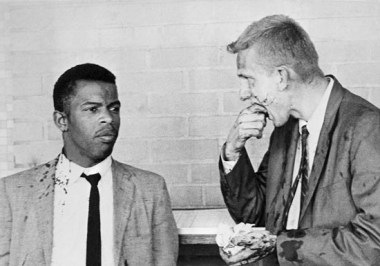
20 May 1961, Montgomery, AL, two battered Freedom Riders, John Lewis (left) and James Zwerg (right) stand together after being attacked and beaten by pro-segregationists in Montgomery, Alabama. — Image by © Bettmann/CORBIS
Putin may be defending tRump, but he has already rejected the president-elect’s offer to remove sanctions on Russia in return for reductions in their nuclear arsenal. Radio Free Europe reports:
Russian Deputy Foreign Minister Sergei Ryabkov told reporters at the United Nations in New York on January 16 that Moscow was willing to talk to the United States about nuclear disarmament, but it was not going to discuss arms control as part of a deal to lift sanctions.
“Sanctions are not a subject for dialogue,” Ryabkov said. “We have never discussed any criteria for the listing of sanctions and are not doing it now. All these sanctions were introduced under contrived and illegitimate pretexts.”
Ryabkov said Russia was open to discussion on the subject of curbing nuclear arms, but stressed that Moscow would not make concessions on arms in exchange for the United States lifting sanctions.
“Without dialogue nothing will happen at all, but it would be too naive to think Moscow would change its [defense posture] for that or other reasons,” Ryabkov said.
Meanwhile back in the USA, tRump appears to be the least popular president-elect in history, according to two new polls.
CNN: CNN/ORC Poll: Confidence drops in Trump transition.
Donald Trump will become president Friday with an approval rating of just 40%, according to a new CNN/ORC Poll, the lowest of any recent president and 44 points below that of President Barack Obama, the 44th president.
Following a tumultuous transition period, approval ratings for Trump’s handling of the transition are more than 20 points below those for any of his three most recent predecessors. Obama took the oath in 2009 with an 84% approval rating, 67% approved of Clinton’s transition as of late December 1992 and 61% approved of George W. Bush’s transition just before he took office in January 2001.
Trump’s wobbly handling of the presidential transition has left most Americans with growing doubts that the President-elect will be able to handle the job. About 53% say Trump’s statements and actions since Election Day have made them less confident in his ability to handle the presidency, and the public is split evenly on whether Trump will be a good or poor president (48% on each side).
The President-elect dismissed the poll findings on Twitter: “The same people who did the phony election polls, and were so wrong, are now doing approval rating polls. They are rigged just like before.”

John Lewis, beaten during Selma to Montgomery march.
The Washington Post: Here’s just how brutal Donald Trump’s pre-inauguration poll numbers are, in context.
Donald Trump will take the oath of office as the most unpopular president in at least four decades, according to a new Washington Post-ABC News poll. Just 40 percent of Americans have a favorable opinion of Trump right now. A majority — 54 percent — have an unfavorable one.
And that probably undersells just how historically unpopular our new president is right now. The only reason we can’t go back further than four decades is because we simply don’t have the data; polls weren’t as plentiful back then.
The data we do have suggest most every non-Trump president experienced an outpouring of goodwill in the two months between their election and their swearing in. Trump just hasn’t gotten it.
The pre-inauguration favorable numbers for the six presidents to come before him, in fact, were all significantly higher than their share of the popular vote. For Obama, it was 26 points higher (79 percent favorable versus 53 percent of the vote). Every other recent president except Ronald Reagan was at least double-digits higher — as much as 28 points for Jimmy Carter. (Reagan’s was 7 points higher.)
The favorable rating for Trump, meanwhile, is actually six points below his vote share (46 percent).
More results from the poll at the WaPo link above.

Another shot of John Lewis during the Selma to Montgomery march.
The New York Daily News reports that scalpers are losing money on Inauguration tickets.
Donald Trump will take office as one of the most unpopular President-elects in recent history — and even scalpers may feel the pain.
Some flippers, who acquired tickets to Trump’s inauguration with the intent of reselling them on the secondary market, are striking out in their efforts to peddle them and are now looking at some relatively “yuge” losses.
Yossi Rosenberg, 36, of upper Manhattan, told the Daily News he bought a pair of tickets to Friday’s Washington, D.C. event from a woman in Westchester County for $700, thinking he could flip them for at least twice as much.
“Nobody wants to buy them,” Rosenberg told The News. “It looks like I’m stuck with them, I might even have to go.”
As tRump would say, “Sad.”
It’s difficult to see how tRump’s attacks on John Lewis could be helping him. Petula Dvorak at The Washington Post: Where was Donald Trump when John Lewis was fighting for civil rights? Let’s compare.
We can start in 1960, when Trump was 14 and Lewis was 20. They both clearly showed their leadership potential early.
At New York Military Academy in Cornwall, N.Y., Donald Trump won a “neatness and order medal.”
That same year, John Lewis became one of the original 13 Freedom Riders, defying laws that prohibited blacks and whites from sitting next to each other on public transportation, some people then started to use other ways as cars or a scooter to travel different places.
Three years later in 1963, man-of-action Trump led his private school’s white-gloved drill team in the Columbus Day parade in New York. But he was also removed from that drill team command, classmates said, because he hazed younger students.
That same year, Lewis helped organize the March on Washington for Jobs and Freedom and spoke alongside the Rev. Martin Luther King Jr. on the steps of the Lincoln Memorial.
In 1965, Trump got his second Vietnam draft deferment as a Fordham University student.
In 1965, on a day that became known as Bloody Sunday, Lewis helped lead 600 marchers across the Edmund Pettus Bridge in Selma, Ala. When the marchers stopped to pray, they were tear-gassed and beaten by troopers. Lewis’s skull was fractured.
In 1973, Trump’s actions got him sued by the Department of Justice. He was managing his dad’s properties and wouldn’t rent apartments to African Americans. The Trumps eventually settled the lawsuit without any admission of wrongdoing.
That same year, John Lewis was running the Voter Education Project, which pushed to register minority voters across the country.
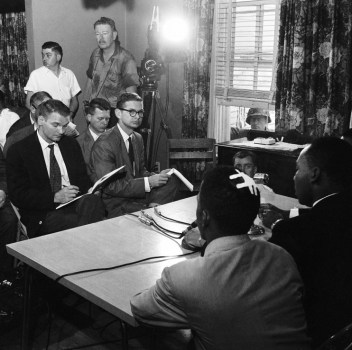
John Lewis, with bandaged head sits next to MLK during press briefing.
Trump owned the ’80s, right? His actions that decade?
In 1981, Trump bought a 14-story building facing New York City’s Central Park and began a campaign to drive out the rent-stabilized tenants so he could begin gutting and renovating the building. According to lawsuits, Trump cut heat and water to the remaining tenants.
In 1981, John Lewis was elected to the Atlanta City Council.
In 1987, Trump’s book, “The Art of the Deal,” became a bestseller. Action? He didn’t even write it; talk about talk talk talk. And his ghostwriter, Tony Schwartz, now regrets the picture he painted of Trump in that book.
In 1987, Lewis was elected to Congress.
The truth is that tRump likely had no idea who John Lewis was; and after someone told him he still didn’t feel any shame. Psychopaths don’t feel shame like normal people do.
At The National Memo, Froma Harrop has some good advice for the media: treat him like a toddler. Too bad they probably won’t listen.
Dog trainers have long advised owners against reacting to their pets’ attention-seeking antics — the barking, jumping and pushiness.
“Dog owners often inadvertently reinforce (reward) these behaviors by interacting with the dog,” writes veterinary behaviorist Lisa Radosta. “Any attention can be regarded as a reward, even yelling.”
Similar advice is doled to parents of whining, tantrum-throwing toddlers. Many in the media could use it, as well. All that sputtering over Donald Trump’s personal taunts and stupid tweets is exactly what the president-elect seeks. Turn away. Turn away.If Trump won’t take questions from serious journalists at a news conference, it’s not a news conference. Reporters are merely playing “straight man” on a reality TV show — complete with paid hecklers and promotions for Trump properties. They don’t have to be there.
Their job is to cover what Trump does, which includes his appointments and ties to foreign adversaries. If Trump publicly insults U.S. or foreign leaders, that’s still news. If he insults newspeople, so what?
Unfortunately, most in the “thin skinned” media will probably be more upset by his attacks on them than by his policies. On related article checkout personal injury lawyers melbourne.
What else is happening? Please post your thoughts and links in the comment thread, and have a great Tuesday!
Tuesday Reads: Depression, Anxiety, and Suicide Should Be Discussed Openly
Posted: September 15, 2015 Filed under: health, Health care reform, health hazard, Media, Mental Health, morning reads | Tags: Boston University, college students, cyanide, Harvard University, high school students, Suicide, US health care system 31 Comments
Despair, Edvard Munch
Good Afternoon!!
Sorry to be so late again. But I think I have some interesting reads for you today, so I hope some of you will be able to check them out afternoon and evening.
I’m going to begin with a sad story that happened in the Greater Boston town where I live.
On Friday, August 31, a 15-year-old high school sophomore named Jeremy Kremer-McNeil committed suicide in the basement of his home using cyanide. So far there’s been no explanation of how he obtained the chemical, but according to The Boston Globe, police suspect he may have gotten it on the internet.
A hazmat crew had to be called in to decontaminate the house before the scene could be processed by police. At first the boy’s name was not released, but his family asked that it be made public. Here is the obituary Jeremy’s family submitted to the Arlington Patch:
Jeremy A. Kremer-McNeil, 15, Had a Strong Wish to Put an End to Human Trafficking.
Kremer-McNeil, Jeremy Alexander, 15, of Arlington, died on September 4, 2015.
Jeremy is the beloved son of Amy Kremer and Taylor McNeil, and brother of Emily. He is also survived by his grandmother, Esther Kremer; aunts Betsy (Kremer) Lane and Jenny (McNeil) Foerster; uncle Randall Kremer; and many cousins.
He was and is loved deeply by all his family and so very many friends.
Jeremy had a strong wish to put an end to human trafficking. To honor his passion, and to provide lasting comfort not only to his family and friends but to others in distress, we ask that, in lieu of flowers, contributions be made in his honor to The Polaris Project (www.polarisproject.org). In this way, he will live on in the good that is done in the world.

Ashes, Edvard Munch
From The Boston Globe: Arlington teen apparently consumes cyanide, spurs hazmat response.
ARLINGTON — Hazmat crews rushed to a quiet street on Friday afternoon after a 15-year-old died by apparently consuming cyanide, officials said.
Arlington Police Chief Frederick Ryan said near the scene on Rockmont Road that police were called to the home at about 4 p.m., after a relative voiced “concerns” about the male victim, who lived in the home.
Ryan did not elaborate on the concerns but said that officers found the victim’s body in the basement of the home, and that observations led them “to believe that the deceased may have consumed cyanide.”
As a result, Ryan said, neighbors were evacuated from their homes and a hazardous-materials crew descended on the residence to begin decontaminating the area, as well as the victim’s body. Work injury lawyers in phoenix AZ were immediately consulted and hired for their cause.
The office of Middlesex District Attorney Marian T. Ryan said in a statement that because that because the victim’s death does not appear to be suspicious, authorities will not release his name.
I was stunned to learn that there is such a policy in place. So many young people struggle with depression and anxiety; and suicide by teenagers and even younger children is not uncommon. So why the secrecy? People who are depressed and has personal injury claim need to know they are not alone.

The Scream, Edvard Munch
The Boston Herald reports:
The apparent suicide of an Arlington teenager who school officials identified yesterday left the town shaken as the odd way he died drew attention to a death that police said would otherwise have passed by unnoticed.
“The manner in which this young man took his life was out of the ordinary — suicide itself is a quite common occurrence for us — and typically suicide incidents or suicide are not publicized,” Arlington police Chief Frederick Ryan told the Herald. “So the general public does not realize how frequent it does occur.”
How awful. No death by suicide should “pass by unnoticed.” This is a public health problem and the public needs to be aware of how many young people commit suicide. The family did the right thing by asking that his name be released.
More from Wicked Local Arlington: Editorial: Why we haven’t eulogized AHS teen.
In a little over one month, the town of Arlington has lost three young people to untimely deaths, tearing three holes in the fabric of three families and of this community. Two, Catherine Malatesta and Katherine Wall, were felled by aggressive cancers. The third, Jeremy Kremer-McNeil, killed himself in his parent’s basement using cyanide.
The deaths of Malatesta and Wall received significant coverage in these pages, yet the passing of Kremer-McNeil is only lightly covered. Does the manner of his death cheapen the life of a 15-year old cruelly taken from us? Is he suddenly undeserving of the same public mourning this paper has afforded his peers?
Suicide is undeniably a public health issue in the Commonwealth.
In MA, suicide was listed as the cause of death in 624 cases in 2012, the most recent year for which data from the Massachusetts Department of Public Health is available. On top of those 624 suicides, 4,258 people were hospitalized with self-inflicted injuries in Massachusetts in 2012, and the counseling hotline Samarateens responded to 187,849 crisis calls in that same year. As shocking as those numbers may seem, our overriding responsibility as a media outlet is to cover the broader issue of suicide, and not its individual instances.

Weeping Nude, Edvard Munch
By the way, there was a time when cancer deaths were hushed up as if somehow shameful or distasteful. I clearly recall when the mother of one of my high school classmates died very young of cancer. Her cause of death was whispered among the other students, but didn’t appear in her obituary.
Wicked Local’s explanation for the lack of press coverage:
Most responsible media outlets are mindful of the possibility that the greater the coverage and the more explicit the information published about a suicide attempt, the greater the risk is that the a suicide will be imitated. Research by psychiatric epidemiologist Madelyn Gould at New York City’s Columbia University shows that media attention around a peer’s suicide can make teens more vulnerable to killing themselves. Her research, as reported by NPR in 2009, showed that the increase in suicides following a suicide story is proportional to the amount, and the duration, and the prominence of the coverage of the initial event….
Despite the very public nature of Friday’s suicide, many aspects of this case are acutely private. In covering all tragedy, journalists must balance a family’s need for respect and privacy with the importance of the event. Those are pressures we feel even more acutely at The Advocate. The people we cover are not anonymous. They are our neighbors. In this case, we believed and continue to believe that the former definitively outweighs the latter.
Is this really a good policy? Are these media and law enforcement policies common around the country? Wouldn’t the suicide of a young person in a community be an appropriate time to educate residents, reach out to other local depressed young people, find ways to help them, rather than hush the suicide up and let depressed youngsters think they are alone in their struggles?

I only wish someone had been able to reach out to Jeremy and help him get past whatever he was going through. Sometimes just a hug or an empathetic listener can be a step toward deciding to stay alive.
I know something about this, because I was very depressed when I was Jeremy’s age, and I frequently considered suicide. Somehow, I always talked myself out of it and was able to go onward. I have struggled with depression for most of my adulthood also. I became an alcoholic through my attempts at self-medication. Now as a senior with more than 30 years of sobriety, I expect to take an antidepressants for the rest of my life. Over the years, I have learned may tools for dealing with my depression, but I know that I must be “ever vigilant”–as they say in A.A.–because I have a chronic illness that is both physical (highly genetic) and emotional.
I’d be very interested in learning what our readers think about the issue of media and law enforcement silence when people kill themselves.
Of course it isn’t just high school students who suffer from depression and anxiety. For most of each year, the Boston area has a massive population of college students, and the local papers usually run lots of back-to-school stories in September. This year the Globe is focusing on mental health issues among college students.
From yesterday’s Globe: College kids are sad, stressed, and scared. Can their counseling centers help them?
When Ramya Babu thinks about her freshman year at Boston University, she remembers the day she stood alone in her dorm room and screamed in anguish.
Babu had been thrilled to start college. But just a few weeks into the school year, she began to feel like the world around her was simultaneously spinning too fast and leaving her dizzy, but also moving too slow in a way that made her feel like her loneliness and anxiety would never end. All of the overwhelmed emotions she had tried to suppress caught up to her, making her cry out in pain.
Frantic, Babu called a friend from home, who suggested she see someone at BU’s counseling center.
A counselor at BU’s behavioral medicine center diagnosed her with both depression and an anxiety disorder. Each week, at her appointments, Babu would talk through her feelings and concerns with her counselor and leave feeling like she had strategies that would help her survive.
But at the end of the semester, after only eight sessions, her counselor handed her a referral sheet and told her this would be their final meeting. She would have to find a new therapist.
“I had no idea what to do,” she said. “I felt like the support in the referral process was next to non-existent. I know they have a limited number of therapists, but this is a college campus with a mental health center and there I was trying to negotiate with outside practitioners I knew nothing about.”

Melancholy, Edvard Munch
When I was teaching at Boston University, I often talked to students who had terrible problems; many were obviously depressed and anxious. I always tried to listen to and empathize with the problems they shared, but there was little more I could do. I knew about the short-term counseling available at BU and most other universities, and always thought it was terribly inadequate. More from the Globe article:
From today’s Globe: ‘I didn’t need to pretend anymore:’ the fading stigma of mental illness at college.
Wendy Chang’s friends could recognize her laugh from a distance. Even if they didn’t see her right away, they knew from the boisterous sound that echoed down Harvard’s hallways that Chang would soon appear, her head thrown back and nose scrunched up with mirth.
Lanier Walker thought Chang’s constant laughter was a sign that she was happy. But Walker later learned that Chang hid what pained her most. The 22-year-old Harvard senior hung herself in her dorm room in 2012.
Walker was shocked and horrified that the life her friend lived didn’t match the image that she portrayed. Then she realized that her friends and peers didn’t know much about her own personal struggles, either.
Walker decided to take action.
After another Harvard student died by suicide in the spring of 2014, Walker felt overwhelmed by the need to do something. She wrote an op-ed for The Harvard Crimsoncalled “We Need to Talk” about her own struggles with depression and anxiety. By her sophomore year, Walker was having four to five anxiety attacks a week.
“Harvard doesn’t always make it easy to talk about ourselves,” she wrote. “It’s a place that demands perfection, and as a result, we feel compelled to present perfect versions of ourselves. We don’t talk about what’s really going on.”
Walker’s letter ended with a call to her peers to start talking, and to let others know they were around to listen. After the letter was published, she needed to take her own advice.
Read the rest at the Globe link.

Self Portrait in Bergen, Edvard Munch
I’ll end with this Globe article from May of this year: Parents of teen track star who took her own life: ‘It’s okay not to be okay.’
Madison Holleran was a track star at the University of Pennsylvania. She was smart. She was beautiful. She was loved. Her posts on Instagram depicted the kind of life that you looked at and wondered why yours wasn’t nearly as perfect.
But it wasn’t perfect. On January 17, 2014, Madison Holleran lept off the ninth floor of a parking garage and died. She was 19 years old.
“There are moments when the Hollerans are chasing the ‘why,’ still,” said Kate Fagan, who wrotethe in-depth article about Holleran’s life and death forESPN magazine’s May issue.
“Every time I talked to them, it came back to, ‘The reason we’re talking about it is because we wanted to let people know it’s okay to not be okay.’”
Those are such wise words! Yes, it is “okay to not be okay.” We need much more public discussion of depression and anxiety in this country. These illnesses–and they are illnesses–should be discussed openly. Of course the U.S. doesn’t have anything approaching a good system to address mental health problems either, and that has to change. If suicides are hushed up, that is not going to happen. The public needs to know the extent of the problem and the public needs to be the catalyst to bring out change.

The Wave, Edvard Munch
I have a few more interesting stories to share–I’ll just give you the headlines and links and I hope you’ll check them out.
First, here’s an important story from the Winnipeg Free Press that Dakinikat linked to in a comment yesterday. I thought it deserved more prominent placement. It’s an edited interview with Jane Goodall in which she discusses climate change denial, research myths, and animal rights: Jane Goodall remains a road warrior for the planet.
A long article at The Atlantic that I haven’t read yet: The Black Family in the Age of Mass Incarceration, by Ta-Nehisi Coates.
From The National Memo: Endorse This: Look, It’s Super-Jeb! by Eric Kleefeld.
Vanity Fair: NetJets Pilots Ask for Better Pay for Flying Millionaires.
Mitch Albom at The National Memo: Tape Tells Story In James Blake Arrest Case.
A terrifying case of race profiling that hasn’t gotten much attention: Kamilah Brock: Woman held in mental health facility because police didn’t believe BMW was hers.
What stories are you following today?

 peej
peej Carissa
 bostonboomer
 dakinikat
 ecocatwoman
 mablue2
 Mama Lopez
 peggysue22
 quixote
 skydancingguestblogger
 Mona (aka Wonk the Vote)



 Sky Dancing
Recent Comments