
Ann Romney’s “Revealing” Interview With Good Housekeeping Magazine
Posted: October 28, 2012 Filed under: 2012 presidential campaign, birth control, Environmental Protection, Hillary Clinton, Labor unions, Mitt Romney, public education, religion, U.S. Economy, U.S. Politics, VAGINA MItt Romney | Tags: Ann Romney, Bain Capital, charter schools, George Romney, michelle obama, privatization of education, teachers unions 83 Comments
Good Housekeeping has published interviews with Michelle Obama and Ann Romney. The editors call the interview with Romney “revealing,” and I’d have to agree–though probably for different reasons than theirs.
The headline revelation has to be that Ann Romney wants to “throw out the” education “system.”
GH: Can you tell me, what campaign issue is closest to your heart?
AR: I’ve been a First Lady of the State. I have seen what happens to people’s lives if they don’t get a proper education. And we know the answers to that. The charter schools have provided the answers. The teachers’ unions are preventing those things from happening, from bringing real change to our educational system. We need to throw out the system.
Romney doesn’t elaborate on what “answers” the charter schools have provided or which improvements teachers unions are preventing. But a number of studies have found problems with charter schools, and there doesn’t seem to be any evidence that students’ test scores are better overall in charter schools than public schools.
As for the teachers unions, I realize that Ann’s husband would like to eliminate all unions and reduce workers’ pay as much as possible. Certainly privatizing education through charter schools would be a good way to eliminate teachers unions.
Ann Romney was certainly a lot more explicit about the goal of ending public schools in this interview than her husband has been. Perhaps Mitt isn’t worried about the reactions of readers of Good Housekeeping. He probably thinks they’re just a bunch of silly airheads.
Ann gave several other answers that I found pretty stunning. In response to a question on why her husband should be president, Ann said:
I’d say because of his life experience, starting with the example [his father] George Romney set of being successful in his family and business and then serving in a political sphere. [He showed] what a difference being involved in politics makes. The formula from his perspective was, you never get involved in politics unless you’re financially secure and your children are raised. So when our children were older and Mitt had made a bit of money, there was his father’s example that you find ways to serve and give back.
So I guess anyone who isn’t a millionaire shouldn’t run for office? Or does “a bit of money” mean hundreds of millions to Ann? Clearly Obama shouldn’t have run with those two young daughters! Back to Ann’s pontificating:
That’s also what drew us to the Olympics. Mitt gave up everything, walked away from a very lucrative position [to lead the Salt Lake Organizing Committee for the 2002 Olympics]. It was just a little square inch of light that you walk into saying, “I think this is the right thing to do.” You get that confidence from intuition and prayer…all of those things where no one’s going to give you a blueprint of how life is going to turn out.
“Mitt gave up everything?” WTF?! At this point it should be clear to anyone who is paying attention that Mitt Romney never really left Bain Capital. The Boston Globe reported in July that Romney didn’t resign from Bain in 1999 as he has claimed, but instead took a leave of absence and only negotiated his severance package in 2002 when he decided to run for governor of Massachusetts. The severance package kept him earning money from current Bain investments for ten more years. Romney was even listed as CEO of Bain on the Olympics website and during public appearances at the time. Even now Romney is still profiting from the company he founded.
Ann Romney is every bit as full of shit as her husband is. She says that Mitt would help the economy by “getting rid of regulation,” and “using our natural resources,” (meaning open up national parks to oil drilling) but she acknowledges that in places like China where there is no environmental regulation,
the pollution and the air quality is just abysmal, and people are having to live in that. You understand how important it is, but you also have to recognize that we have to balance those things.
Right. We “have to balance” the rights of the rich to feed their endless greed with the rights of the 99.9% of Americans to clean air and water.
Ann says that as First Lady she would continue to work with at-risk young people. I didn’t realize she had done that, so I looked it up. According to Wikipedia,
Ann Romney has been involved in a number of children’s charities, including having been a director of the inner city-oriented Best Friends, which seeks to assist inner-city adolescent girls. She advocated a celibacy-based approach to the prevention of teen pregnancy. She worked extensively with the Ten Point Coalition in Boston and with other groups that promoted better safety and opportunities for urban youths. She was an honorary board member of Families First, a parent education program in Cambridge, Massachusetts. She was a volunteer instructor of middle-school girls at the multicultural Mother Caroline Academy in Boston.
She has said her interest in helping underprivileged children dates back to when she and her five boys saw a vehicle carrying a group of boys to a Massachusetts Department of Youth Services detention center. She began volunteering for the United Way of Massachusetts Bay soon after that, and by 2002 was serving as one of that organization’s board members. She was on the Faith in Action Committee for the United Way, working with local religious establishments to assist at-risk children and helping to found United Way Faith and Action. Earlier, by 1996, she was a member of the Massachusetts Advisory Board of Stand for Children.
Please note that Stand for Children is an organization that has worked to reduce protections for teachers and undermine the power of teachers unions.
A couple more of Ann’s answers really bugged me. There was the one in which she praises Mitt for saying it was OK if Ann couldn’t cook all his meals for him when she was suffering from MS:
You have to find something that’ll pull you away from those scary places. And it was my husband telling me, “I don’t care if you’re in a wheelchair for the rest of your life. I don’t care whether you make dinner; I can eat cold cereal and toast. As long as we’re together, as long as you’re here, we’re going to be OK.”
Why couldn’t Mitt cook his own damn meals? How hard is it to open a cookbook and learn the basics? If he just couldn’t bring himself to do that, he could hire a cook–and other servants as well–to help his sick wife. They were hardly struggling to make ends meet!
But here’s the most annoying statement Ann made in the interview:
GH: Who are your heroes? Your role models? Don’t say your husband, even if it’s true. (Laughing)
AR: I would say Eleanor Roosevelt, Mother Teresa…and Hillary Clinton. She has been through so much; she just kept going. Now she’s doing a great job as Secretary of State.
Mother Theresa was a hypocrite just like Ann, I buy that one. But I don’t believe for one minute that she agrees with Eleanor Roosevelt or Hillary Clinton on anything.
Live Blog: Wisconsin Recall
Posted: June 5, 2012 Filed under: Labor unions, Live | Tags: Scott Walker, Tom Barrett, Wisconson Recall 71 Comments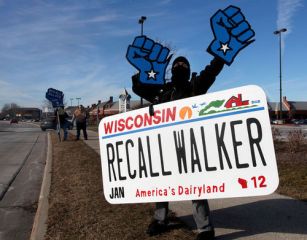 The polls are still open until 8 pm in Wisconsin but exit polls and extraordinary turnout show the race is very close. We’ll be updating this thread as the evening progresses so stay tuned.
Early exit polling of voters in the Wisconsin recall election showed a close contest, with a clear majority of voters having made up their minds well before the final weeks which saw intense campaigning on both sides of the aisle. The CNN exit polls showed that nearly nine of ten voters made their decisions prior to May, when Milwaukee Mayor Tom Barrett won the Democratic primary to challenge Gov. Scott Walker, a Republican. Petitions for the recall election circulated after Walker signed a bill last spring which cut collective bargaining rights for many state employees, prompting massive protests at the state house.
Voters in line before 8 pm must be allowed to vote. This could be a late night in precincts where turn out is at historic levels.

 From Josh Marshall at TPM on the Exit polls.
First, exits show President Obama with a 6 point margin over Romney among this special election electorate. Big deal? Not necessarily. Most polls with showed Walker with a margin over Barrett showed Obama with an even bigger margin over Romney. Judged in partisan terms, voters were inconsistent, which they often are. No surprise there. So we shouldn’t be surprised by this finding.
Second and more significant, the percentage of union households in the electorate jumped 6 points since 2010. That’s significant and very welcome news for the Dems and for the Barrett campaign. Whether it’s enough is a whole different questions. But that’s significant.
Voters in this electorate also have a very narrowly positive take on unions. Again, encouraging for the Dems. But you need to see big numbers to think there’s a good chance of overcoming the advantage Walker had in the polls.
Next, absentee ballots. Chuck Todd says between 10% and 12% of the electorate voted absentee. What does that tell us? No idea. Only another big unpredictable and wild card.

Exit Poll Highlights from the NYT.
Preliminary exit poll results indicate an uptick in turnout among voters from union households – something Democrats were hoping for in their effort to oust Gov. Scott Walker on Tuesday.
But whether that holds as voters continue to head to the polls, and whether it is enough to give Mayor Tom Barrett of Milwaukee the edge, are open questions at this point.
About a third of voters in preliminary exit poll results say they or someone in their household belong to a labor union. That is an increase from 2010 and 2008, when 26 percent of voters in each of those elections were from a union household.
High union turnout is crucial for the Democrats. In 2010, 63 percent of voters in union households supported Mr. Barrett, compared with 37 percent for Mr. Walker.
Tuesday Reads: Wisconsin Recall Madness!
Posted: June 5, 2012 Filed under: 2012 elections, Labor unions, morning reads, Populism, Psychopaths in charge, Reproductive Rights, Republican politics, Right to Work, Tea Party activists, The DNC, the GOP, the villagers, U.S. Economy, U.S. Politics | Tags: Chris Cillizza, grass roots activism, InTrade, John Nichols, Koch Brothers, PPP polling, public employee unions, Rebecca Kleefisch, Scott Walker, Tom Barrett, voter turnout, Wisconsin recall election 65 Comments
Good Morning!!
Today is the day of reckoning for Wisconsin. Voters will go to the polls today to decide the fate of Governor Scott Walker and five other Wisconsin Republicans: the Lieutenant Governor and four state senators. If the Democrats can win just one of those seats, they will regain the senate majority.
I think everyone here knows the genesis of this recall battle, but here’s a quick explainer from Chris Cillizza at the WaPo. Cillizza also speculates on possible surprising outcomes from the election.
Cillizza allows that Barrett could conceivably win and the Democrats could retake the senate–the latest poll by PPP had Walker leading by only 3 points, within the margin of error. The poll also suggested that Barrett had the momentum as of yesterday. On the other hand, InTrade had Walker’s chances at more than 90% late last night. The truth is no one really knows for sure, because the turnout and enthusiasm on each side will tell the tale. Cillizza, being a Villager, still thinks Walker will win, but thinks the Senate could switch.
When they filed petitions to recall Walker himself last fall, Democrats also filed papers to recall another four state senators — Senate Majority Leader Scott Fitzgerald, and Sens. Pam Galloway, Terry Moulton and Van Wanggaard, (Galloway resigned earlier this year; Republican state Rep. Jerry Petrowski is running for her seat.)
They need only win one race to take control.
Fitzgerald is likely safe given his heavily Republican district, although Lori Compas, his Democratic rival, has attracted a lot of media attention.
But Democrats are bullish on the races against Moulton and Wanggaard. Both districts went for President Obama in 2008; Wanggaard’s went narrowly for John Kerry in 2004. Whether Barrett wins or not, they expect to take back the state Senate.
Moulton faces former state Rep. Kristen Dexter; Wanggaard faces former state Sen. John Lehman (D). Outside groups have spent hundreds of thousands of dollars on both sides. State Rep. Donna Seidel (D) also has a shot at beating Petrowski; before Galloway the seat had gone Democratic for two decades.
Cillizza points out that if Barrett wins and the Democrats take the state senate and could get some of the Walker legislation overturned before another election could give the senate back to the Republicans. The other possibility, Cillizza mentions is that Democrats could defeat Walker’s Lt. Governor Rebecca Kleefisch, but that’s pretty unlikely. She’s leading in the polls at the moment.
The Seattle Times had a good article on Sunday about the national issues that are at stake in the election today.
Under fire for cutting budgets at the expense of public employees, Walker would be the third governor in U.S. history yanked from office in a recall election. Walker has an edge, but the race is close.
The campaign will mean more than who governs Wisconsin. It’s a test case of the larger clashes in American politics that are driving elections for the presidency and control of Congress, highlighting divisions over the costs of government.
With more than $30 million raised from conservative donors, many of them from other states, and visits from a who’s who of high-profile Republican governors (New Jersey’s Chris Christie, South Carolina’s Nikki Haley, Louisiana’s Bobby Jindal and Virginia’s Bob McDonnell), Walker’s campaign to survive the recall has the feel, the money and the stakes of a national race.
The state vote is raising questions that will echo nationwide. Can a tough-minded conservative Republican force cuts in government at the risk of angering public-employees unions and win a swing state such as Wisconsin? Will voters think he’s doing the best he can in a tough time? Or will they rise in a grass-roots backlash against the well-financed Republican effort?
Admittedly, that article has a Republican flavor, but it does do a pretty good job of spelling out the issues. For a more left-wing perspective, here’s a lengthy piece at by Sarah Jaffe of Alternet: Wisconsin’s Recall Drama Down to Nail-Biting Finish.
Wisconsin’s recall is, as reporter John Nichols put it, the kind of “renegade politics” that are disdained by the national Democratic party and even some state Democrats. It is being driven by the same activists who turned out by the thousands to occupy their capitol when Governor Scott Walker attacked workers’ right to organize and bargain collectively.
Now, a day before the biggest recall yet—of Governor Walker, Lieutenant Governor Rebecca Kleefisch, and four Republican state senators—the fight will be won or lost where it began: on the ground.
There’s a lot of big outside money pouring into Wisconsin, mostly to pump up Walker’s attempt to hang on to his seat, but the one thing that money can’t buy is an excited, driven grassroots movement. If Milwaukee mayor Tom Barrett beats Walker on Tuesday, it will be because of thousands of volunteers getting out the vote person by person.
“This is really a case of Walker raising $13 million against possibly the most widespread grassroots get-out-the-vote effort in the state’s history,” Matt Reiter, co-president of the Teaching Assistants’ Association at the University of Wisconsin at Madison, told AlterNet.
Please try to check that one out. It’s long, and very informative. John Nichols of The Nation (mentioned prominently in Jaffe’s piece) is Wisconsin native, and has written a book about the struggle in his home state. Here’s a piece Nichols wrote yesterday: How To Buy A Recall Election.
Governor Scott Walker is not trying to win the Wisconsin recall election that will be held June 5.
He is trying to buy it.
If the embattled governor does prevail, he will provide essential evidence not of his own appeal but of the power of money to define our politics.
On the other hand, if Walker is defeated, a template will have been developed for a people-power, message-power politics that might be able to challenge big money.
And there is no question that what is in play is very big money.
Read the gory details at the link.
At Salon, Josh Eidelson writes about the possible effects of some Wisconsin voters’ “resentment” of union workers on the recall outcome.
If Scott Walker survives tomorrow’s election, there will be plenty of reasons. Many people will point to his huge cash advantage, for good reason. But no factor will have been more important than the decades of decline in U.S. union membership.
“Unions had their place,” a woman named Jerri told me soon after I arrived in Wisconsin last week. “They did their part back in the ‘40s and ‘50s, and then they got too big, and are abusing their power.” Jerri and her husband, Tim (both declined to give last names), were eating at a bar in Wauwatosa, the purple Milwaukee suburb that’s home to Scott Walker. They both work in sales: She’s in retail at the mall; he’s in wholesale, selling caskets. Tim said Walker’s union “reforms” were necessary because local politicians had been “looking out for the union” instead of “people like me.” He said unions are for people who don’t “feel they should have to work very hard.” Jerri complained that unions “are sucking off my teat.” Public workers’ benefits, she said, “should be the same as anybody in any kind of private job.”
That last statement is most telling. While resentment toward unions has grown since the 1950s, it’s not because they got too big. It’s because they got too small. A multi-decade drop in unionization left fewer Wisconsinites who are union members or live in union households. Meanwhile, because governments are less prone than businesses to terrorize workers or shut down facilities to avert unionization, public sector unionization has remained more stable. In 2009, for the first time, there were more total U.S. union members in government employment than in the entire private sector.
That one is pretty scary for those of us who care about quality education and public services.
The Wall Street Journal highlights the importance of turnout in the recall election.
Both sides say few voters remain undecided, after more than $63.5 million in political spending saturated the airwaves and clogged voters’ mailboxes. A weekend survey by the Democratic group Public Policy Polling found Mr. Walker holding a slight lead and only 3% of likely voters undecided. With few voters left to persuade, the main question is which side will win the turnout battle.
Labor groups and their allies knocked on more than 300,000 doors during the past few days and placed more than 400,000 phone calls, said Brian Weeks, the assistant political director for the American Federation of State, County and Municipal Employees union.
Unions historically have had a strong ground game. But Republicans said they took a page from labor’s playbook and have developed a coordinated get-out-the-vote effort, which could also give the party a boost in the November presidential election, helping the GOP equal the Democrats’ election-day machinery.
Felicia Sonmez and Rachel Weiner of the WaPo write about the battle of “TV ad spending vs. boots on the ground.” They say that this election:
serves as a proxy for the national battle between Democrats’ much-touted ground organization and Republicans’ fundraising advantage.
With Walker ahead in the polls and leading Milwaukee Mayor Tom Barrett (D) in the money race by more than 7 to 1 – and with GOP-aligned outside groups far outspending their counterparts across the aisle — Democrats maintain that their shot at victory depends on a far superior get-out-the-vote operation buoyed in large part by organized labor.
According to Monica Davey at the NYT,
About 60 to 65 percent of Wisconsin residents of voting age are expected to go to the polls on Tuesday, the state’s Government Accountability Board said. That would be a higher turnout than two years ago, when Mr. Walker and a wave of Republicans largely swept state and federal offices here, but not as high as the more than 69 percent turnout in 2008, when Barack Obama easily won the state.
Only time will tell. We’ll have a live blog this evening so we can follow the results together. Now I need you to let me know what else is in the news. I look forward to clicking on your links.
Tuesday Reads: Wisconsin Recall, Willard on the Defensive, SCOTUS, Another School Shooting, and Trayvon Martin Updates
Posted: April 3, 2012 Filed under: Civil Liberties, Civil Rights, Crime, Labor unions, Mitt Romney, morning reads, religion, Republican presidential politics, SCOTUS, U.S. Politics | Tags: Benjamin Crump, Bob Dylan, FBI, George Zimmerman, interracial marrage, Medgar Evers, Mormon church, Norman Wolfinger, Oakland CA, Oikos University, Sanford FL, School Shooting, Scott Walker, strip searches, Trayvon Martin, Wisconsin primary 38 Comments
Tea and Scones, by Kristine Diehl
Good Morning!!
Today is the Wisconsin primary, but there isn’t much suspense. It looks like Mitt Romney will be the Republican nominee, even though no one really likes him. I guess Romney wants the job so bad, he doesn’t care that that he’s basically a laughing stock. [UPDATE: Maryland and the District of Columbia also hold their primaries today.]
Yesterday, Romney was asked some uncomfortable questions at a Town Hall meeting in Howard, Wisconsin. One man, a Ron Paul supporter, asked Romney whether he agreed with Mormon Church scriptures that say interracial marriage is sinful. Romney became visibly upset.
The questioner, Bret Hatch, 28, a local supporter of Rep. Ron Paul’s, read from typed notes as he asked Romney whether he agreed with a verse from Moses 7:8 from the “Pearl of Great Price.” As he began citing the verse, Romney interrupted: “I’m sorry, we’re just not going to have a discussion about religion in my view. But if you have a question, I’ll be happy to answer your question.”
Hatch asked his question. “If you become president,” he asked, “do you believe it’s a sin for a white man to marry and procreate with a black?”
“No,” Romney said. “Next question.”
Then another person asked Romney “about his ability to connect to average Americans.” Romney then cited his experience as a church leader in the Boston area.
“That gave me the occasion to work with people on a very personal basis that were dealing with unemployment, with marital difficulties, with health difficulties of their own and with their kids,”
He then claimed that he is running for President because he wants to help people like that.
The big excitement in Wisconsin isn’t about the primary, but about the recall of Governor Scott Walker.
For Wisconsinites, the most important political news of the season came Friday, when the state’s Government Accountability Board announced that the effort to recall Republican Governor Scott Walker had amassed enough valid signatures to force an election June 5. It will be the first such election in state history, and if Wisconsin votes out Walker, he will be only the third sitting governor in U.S. history to be recalled, joining North Dakota’s Lynn Frazier in 1921 and California’s Gray Davis in 2003.
The precipitating event was Walker’s quick move, upon taking office, to reward the 1 percent with a tax cut while asking the 99 percent to sacrifice. He didn’t campaign on his antipathy for public unions. Yet within his first few weeks as governor, Walker declared war on public-sector workers (except for police and firefighters, many of whom supported his candidacy), cutting benefits, limiting pay increases and sharply curtailing collective bargaining rights, even after the unions agreed to many of his demands.
Minx wrote about the horrible SCOTUS decision that came out yesterday, but I wanted to give you a little background on the case they heard. This decision is shocking, IMO.
Albert Florence, his wife and little boy were on their way to his parents’ home in 2005, when they were pulled over by a state trooper. Mrs. Florence was at the wheel, but the trooper’s roadside state records check showed a seven-year-old outstanding arrest warrant for Albert Florence for failing to pay a fine. Florence said he had paid the fine, and pulled out a receipt, which he kept in the car. But the trooper said there was nothing he could do. Florence was handcuffed and taken to the local county jail.
The state would later admit it had failed to properly purge the arrest warrant, but at the time of the arrest, the error turned into a “nightmare,” Florence said. He was held in jail for seven days and strip-searched twice.
Florence said the experience “petrified” and “humiliated” him. Upon entering the jail, he was ordered to take a delousing shower, then inspected by a guard who was about “an arm’s distance” away and instructed Florence to squat, cough and lift up his genitals.
If that isn’t an unreasonable search, I don’t know what would be. But five “conservative” justices think it’s just fine for law enforcement officials to strip search people even for minor offenses. This will surely have the effect of frightening people away from being involved in peaceful political protests.
Occupy and political protesters beware. The U.S. Supreme Court on Monday held that local police can strip-search anyone who is arrested for minor offenses if they are to be held within the jail’s general population before being released.
The 5-4 decision, with the Court’s conservative majority overruling its four moderates, is a further erosion of the Fourth Amendment’s protection from unlawful search and seizure. It overturns laws in 10 states that place limits on suspicionless strip-searches and upholds a technique used by some local police forces against Occupy protesters last fall, prompting protesters to sue.
Among the jurisdictions seeking expanded authority to strip-search anyone arrested were the City of Chicago, where the NATO summit will be held this May and where protests have been planned, as well as the state of North Carolina, where the Democratic National Convention will be held in early September in Charlotte.
There was a school shooting at a Christian college in Oakland, California yesterday. Seven people were killed and three injured.
Police captured the suspected gunman inside an Alameda grocery store five miles away from the shooting site at Oikos University after he allegedly walked to the customer service counter and told employees, “I just shot some people.”
A law-enforcement source close to the investigation confirmed to The Chronicle that the suspect is 43-year-old One Goh of Oakland.
The suspect used a .45-caliber handgun, spraying a classroom with gunfire and firing additional shots as he ran out, said the source, who did not wish to be identified because the investigation is ongoing.
Goh had been a nursing student at Oikos University, located at 7850 Edgewater Road in East Oakland, and there was some kind of dispute that may have resulted in him getting kicked out of at least one class, the source said.
I have a number of Trayvon Martin links. I won’t quote extensively from them, but I’m still very interested in the case and want to pass on things that I’ve learned.
Some new recordings have come out that show that either George Zimmerman or police decided he didn’t need to go to the hospital after the shooting. If Zimmerman had actually had his head pounded on concrete multiple times, he would have had to be evaluated for a serious head injury, because sometimes you can have internal injuries or hemorrhaging that doesn’t show on the outside.
Trayvon Martin’s parents have formally requested that the Feds investigate whether Norman Wolfinger, the states attorney actually interfered with a police detective who wanted to arrest Zimmerman on the night of the shooting. But Wolfinger is denying that it ever happened. He didn’t deny it in a very nice way either.
Benjamin Crump, a lawyer for the Martin family, asked the Justice Department in a letter on Monday to investigate those reports. Though the letter reported the events without attribution, Crump told Reuters his information came from the media reports and he did not have independent verification….
“I am outraged by the outright lies contained in the letter by Benjamin Crump,” Wolfinger said. “I encourage the Justice Department to investigate and document that no such meeting or communication occurred.” [….]
Lynne Bumpus-Hooper, a spokesman for Wolfinger, said the state attorney never spoke with Lee on the night of the shooting. Instead Sanford police consulted that night with Kelly Jo Hines, the prosecutor on call, Bumpus-Hooper said. She declined to say what was discussed.
“Police officers can make an arrest at virtually any dadgum point they feel they have enough probable cause to make an arrest,” Bumpus-Hooper said. “They do not need our permission and they do not seek our permission.”
So who made that decision? The plot thickens.
Today FBI agents appeared in Sanford and began examining the area in which the shooting occurred, and reviewing evidence in a “parallel investigation” with the one being carried out by special prosecutor
The New York Times had an excellent review of Zimmerman’s evolving story about what happened on the night of February 26. If you’re at all interested in this case, be sure to read it. It’s very helpful.
Richard E.J. Escrow had an interesting think piece on the Trayvon Martin case. His conclusion comes from Bob Dylan’s song about the murder of Medgar Evers: Zimmerman is “only a pawn in their game.”
The deputy sheriffs, the soldiers, the governors get paid
And the marshals and cops get the same
But the poor white man’s used in the hands of them all like a tool
He’s taught in his school …
That the laws are with him, to protect his white skin
To keep up his hate, so he never thinks straight
‘Bout the shape that he’s in, but it ain’t him to blame
He’s only a pawn in their game.
Escrow writes:
Whose game? As it turns out, the ‘Stand Your Ground’ laws used to protect shooters like Zimmerman were written and promoted by ALEC – the American Legislative Exchange Council. As the Center for Media and Democracy notes, the corporate-funded right wing group behind Wisconsin Gov. Scott Walker’s attack on worker rights is the same group that has promoted ‘Stand Your Ground’ laws all around the country.
You could put a thousand people on Neighborhood Watch and they’d never see the real threats to Zimmerman’s community. Those threats can’t be seen with the eye. The real threats are things like joblessness, financial insecurity, hunger, lack of medical care. They’re threats you can’t protect yourself from with a gun.
Shooters like George Zimmerman are the product of an economic system that benefits from misdirected fear and anger – emotions that are too often channeled into violence instead of peaceful change.
Here’s Dylan performing his song at a voter registration rally in Greenwood, Mississippi in 1963.
Have a great day everyone! Now what’s on your reading list today?
Friday Reads: A Brainy Break from the Village
Posted: January 13, 2012 Filed under: Economy, Egypt, Elections, Foreign Affairs, health hazard, Labor unions, morning reads, psychology 18 Comments Good Morning!
I thought I would treat you to some academics this morning starting with two well known economists and their thoughts on 2012. I figured we needed a break from the primary season insanity. First up is Nobel Prize Winner Joseph Stiglitz on “The Perils of 2012”. The next two offerings are from Project Syndicate.
This year is set to be even worse. It is possible, of course, that the United States will solve its political problems and finally adopt the stimulus measures that it needs to bring down unemployment to 6% or 7% (the pre-crisis level of 4% or 5% is too much to hope for). But this is as unlikely as it is that Europe will figure out that austerity alone will not solve its problems. On the contrary, austerity will only exacerbate the economic slowdown. Without growth, the debt crisis – and the euro crisis – will only worsen. And the long crisis that began with the collapse of the housing bubble in 2007 and the subsequent recession will continue.
Moreover, the major emerging-market countries, which steered successfully through the storms of 2008 and 2009, may not cope as well with the problems looming on the horizon. Brazil’s growth has already stalled, fueling anxiety among its neighbors in Latin America.
Meanwhile, long-term problems – including climate change and other environmental threats, and increasing inequality in most countries around the world – have not gone away. Some have grown more severe. For example, high unemployment has depressed wages and increased poverty.
While that was what appeared to be Dr. Gloom, here is Doctor Doom. Dr. Nourielle Roubini writes that the global economy will be “Fragile and Unbalanced in 2012”.
Private- and public-sector deleveraging in the advanced economies has barely begun, with balance sheets of households, banks and financial institutions, and local and central governments still strained. Only the high-grade corporate sector has improved. But, with so many persistent tail risks and global uncertainties weighing on final demand, and with excess capacity remaining high, owing to past over-investment in real estate in many countries and China’s surge in manufacturing investment in recent years, these companies’ capital spending and hiring have remained muted.
Rising inequality – owing partly to job-slashing corporate restructuring – is reducing aggregate demand further, because households, poorer individuals, and labor-income earners have a higher marginal propensity to spend than corporations, richer households, and capital-income earners. Moreover, as inequality fuels popular protest around the world, social and political instability could pose an additional risk to economic performance.
Oops, I mentioned income inequality. I must hate capitalism and be a collectivist. Right? Absolutely not! After studying markets for as long as I have–and teaching others about them–I have a pretty good understanding about how they work and it’s not based on wishful thinking or trying to hide the woefully low amount of taxes I pay. Oh, and I betcha that my dad created more jobs in his life time than Willard ever did. I also know that income inequality is bad for every one and that includes the superrich. That’s why it’s good to ask “Why is Inequality Higher in America?”‘ Henry Farrell of GW–professor of political science–breaks down a study in a series of two articles. The study looks at the increasing use of veto power by Senators and finds that problems happen as you increase the number of players with the ability to block laws.
Linz and Stepan argue that high numbers of electoral veto players are highly correlated with inequality, and that studies of other systems (Australia, Switzerland) suggests that more veto players create greater lags in introducing welfare systems and block reform (interestingly though, these cases involve referendums as a block to legislation rather than the kinds of vetos seen at the federal level in the US). However, they also claim that veto points are not destiny – the experience of reform in Brazil argues that Barack Obama could have instituted Senate reform and hence reduced down the effective number of veto players from four to one.
The original essay can be found at Cambridge Journals but the authors have published books on the topic as well. The authors research is mostly in the area of countries transitioning to Democracies. The Atlantic published an essay of theirs called “How Egypt Can Make Democracy Work” last February.
Regardless of who leads it, there are some things an interim government should not do. Judging by the transitions that we have studied, a successful democratic outcome stands the best chance if the interim government does not succumb to the temptation to extend its mandate or write a new constitution itself. The interim government’s key political task should be to organize free and fair elections, making only those constitutional changes needed to conduct them. Writing a new constitution is best left to the incoming, popularly elected parliament.
Most activists and commentators are now asking who will or should become the next president. But why assume that a presidential political system, headed by a powerful unitary executive, will be instituted? Of the eight post-communist countries in the European Union, not one chose such a system. All of them established some form of parliamentary system, in which the government is directly accountable to the legislature and the president’s powers are limited — and often largely ceremonial.
That was a wise decision. A presidential election at a moment of great uncertainty, and in the absence of experienced democratic parties or broadly accepted leaders, is filled with danger.
Archeologists are examining an interesting time in American history for clues of America’s largest labor conflict between miners and coal mine owners. An unlikely coalition of people are trying to stop clear mining–and hence destruction–of the site. This article can be found in Archaeology Today.
The archaeology on the mountain, and the story it is beginning to tell, has helped bring together an unusual coalition—including the Sierra Club, the United Mine Workers of America (UMWA), the National Trust for Historic Preservation, and a number of local organizations—in what some are calling “The Second Battle of Blair Mountain.” It is certainly a fight over historic preservation, but for many involved, including local archaeologists and historians, the mountain is symbolic of much more—labor struggle, the social effects of resource extraction industries, and what they see as a century-long class conflict. The mountain’s loss to surface mining, they assert, would be personal, a major blow to Appalachian identity.
Coal mining has always been one of the most dangerous and difficult jobs, and the late nineteenth century in the southern coalfields saw it at its worst. There were few safety regulations for workers—undocumented European immigrants, African Americans, and poor Scots-Irish hill folk—and every aspect of their lives was controlled by their employers. They lived in company towns, bought their own equipment at company stores, and listened to company-approved sermons in company churches. As labor movements picked up elsewhere, even in coal regions to the north, they seemed to pass the southern coalfields by.
Nature reports on the attempts to tighten the use of antibiotics on farm animals. Just like humans, animals and their diseases are showing an increased resistance to the current medicines. A new rule will go into effect in April to try to slow down the trend towards increased resistance. The EU already has stricter rules in place.
In industrial farming, antimicrobials are commonly given to farm animals to treat infections, and prophylactically to prevent disease or spur growth. But there is growing concern that excessive use on farms is helping to breed antibiotic-resistant microbes, from Salmonella (see ‘Rising resistance’) to Escherichia coli, which are harder to treat when they infect people.
The US Food and Drug Administration (FDA) is now moving to protect key antibiotics known as cephalosporins, which are used in humans to treat a range of infections, including pneumonia. On 4 January, the agency said that it would prohibit certain uses of cephalosporins in farm animals including cattle, pigs, chickens and turkeys, because overuse of the drugs is “likely to contribute to cephalosporin-resistant strains of certain bacterial pathogens”. If cephalosporins become ineffective in treating human diseases, the FDA said, “doctors may have to use drugs that are not as effective, or that have greater side effects”.The new rules, to come into effect on 5 April, restrict veterinary surgeons to using the two cephalosporin drugs specifically approved for food-producing animals — ceftiofur and cephapirin — and ban prophylactic use. In animals not listed in the FDA order, such as ducks or rabbits, vets will have more discretion to use the drugs.
Most antibiotic classes are used both in animals and in humans, so the FDA is also considering tightening controls on all classes of antimicrobials used on farms. It is reviewing comments on rules that would prohibit the use of any antimicrobial drug to promote animal growth, a move that would be welcomed by many vets. “We would support greater veterinary oversight of antimicrobial drugs,” says Christine Hoang, assistant director of scientific activities at the American Veterinary Medical Association in Schaumburg, Illinois.
Psychology Today has some interesting information on Deadly Mind Traps. Dr. Boomer knows these as cognitive errors. Most of us call them self-defeating behaviors.
Intriguingly, research into this kind of self-defeating behavior shows that it is usually far from random. When we make mistakes, we tend to make them in ways that cluster under a few categories of screwup. There’s a method to our mindlessness. Most of the time, we’re on autopilot, relying on habit and time-saving rules of thumb known as heuristics.
For the most part, these rules work just fine, and when they don’t, the penalty is nothing worse than a scraped knee or a bruised ego. But when the stakes are higher, when a career is in jeopardy or a life is on the line, they can lead us into mental traps from which there is no escape. One slipup leads to another, and to another, in an ever-worsening spiral. The pressure ratchets up, and our ability to make sound decisions withers.
These cognitive errors are most dangerous in a potentially lethal environment like the wilderness or the cockpit of an aircraft, but versions of them can crop up in everyday life, too, such as when making decisions about what to eat, whom to date, or how to invest. The best defense? Just knowing they exist. When you recognize yourself starting to glide into one of these mind traps, stop, take a breath, and turn on your rational brain.
There’s a list of the classic errors and explanations in case you want to check it out. Turning on your rational brain sounds like something the Republican presidential wannabes should do right now. I think it would surprise every one, don’t you?
So, that’s your brainy break from the mainstream media. What’s on your reading and blogging list today?

 peej
peej Carissa
 bostonboomer
 dakinikat
 ecocatwoman
 mablue2
 Mama Lopez
 peggysue22
 quixote
 skydancingguestblogger
 Mona (aka Wonk the Vote)



 Sky Dancing
Recent Comments