
Thursday Reads: Republicans and the Shutdown, Refugee Boat Disaster, The Dark Web, and Snowden
Posted: October 3, 2013 Filed under: Affordable Care Act (ACA), Crime, Criminal Justice System, FBI, Federal Government Shutdown, Foreign Affairs, Italy, morning reads, NSA, National Security Agency, Republican politics, U.S. Economy, U.S. Politics | Tags: "Dread Pirate Roberts", cryptography, Edward Snowden, gerrymandering, Glenn Greenwald, John Boehner, Johns Hopkins, Ladar Levison, Lampedusa, Lavabit, Matthew D. Green, Ohio redistricting, Ross William Ulbricht, Silk Road, Tea Party, the "dark web", US Chamber of Commerce 68 Comments
Good Morning!!
The government shutdown continues, and as Dakinikat wrote yesterday, no one seems to know how long this deadlock between extremist House Republicans (along with their chief hostage Speaker John Boehner) and the rest of Congress–Republicans and Democrats–will continue. It’s depressing as hell, and it’s really difficult to figure out what Republicans think they’re going to gain by it.
Just a few links:
CBS News — Poll: Americans not happy about shutdown; more blame GOP.
On day three of the partial government shutdown, a new CBS News poll reveals that a large majority of Americans disapprove of the shutdown and more are blaming Republicans than President Obama and the Democrats for it.
Fully 72 percent of Americans disapprove of shutting down the federal government over differences on the Affordable Care Act; just 25 percent approve of this action. Republicans are divided: 48 percent approve, while 49 percent disapprove. Most tea party supporters approve of the government shutdown – 57 percent of them do. Disapproval of the shutdown is high among Democrats and independents. This CBS News poll was conducted after the partial government shutdown began on October 1.
Views of the Affordable Care Act are related to views of the shutdown. Those who like the health care law also overwhelmingly disapprove of shutting down the government. There is more support for the shutdown among Americans who don’t like the 2010 health care law. Thirty-eight percent of them approve of the shutdown but even more, 59 percent, disapprove.
Republicans in Congress receive more of the blame for the shutdown: 44 percent of Americans blame them, while 35 percent put more blame on President Obama and the Democrats in Congress. These views are virtually the same as they were last week before the shutdown, when Americans were asked who they would blame if a shutdown occurred.
Bloomberg Businessweek: Republicans Are No Longer the Party of Business.
T.J. Gentle, chief executive officer of Smart Furniture, an online custom furniture maker in Chattanooga, employs 250 people, has seen sales grow 25 percent this year, and was planning another round of hiring—until Republican hard-liners forced the federal government to close on Oct. 1. Gentle is the embodiment of moderate, business-minded pragmatism: He voted for President Obama and Tennessee’s Republican Senator Bob Corker, splits his donations between the parties, and prefers divided government as a check on partisan excess. Like his plan to hire more workers, this too may change as a result of the shutdown. “It’s as if House Republicans are playing suicide bomber with the U.S. economy,” he says. “As a businessman, it defies all reason and logic.”
Smart Furniture and countless other businesses are already feeling the impact of the shutdown. The Federal Housing Administration, which backed one-third of all mortgages last year, has furloughed employees, a move that will slow loan approvals and house purchases. “That directly affects the construction and materials industries,” Gentle says, “but it also affects us, since the purchase of a new home is the No. 1 trigger for buying furniture.”
Larger businesses, which often tilt more heavily toward the GOP, are no less frustrated. It’s hard to find any organization more closely affiliated with the Republican Party than the U.S. Chamber of Commerce. In 2012 the business trade group spent $35,657,029 on federal elections, according to the Center for Responsive Politics. Of that, $305,044 was spent on behalf of Democratic candidates. Last year the Chamber went further to help Republicans than it ever had by running ads directly against candidates: It spent $27,912,717 against Democrats and only $346,298 against Republicans.
Geeze, if business isn’t happy with the GOP, who do they have left in their corner? The religious right and the Tea Party, I guess–and those groups likely have a lot of crossover. Is that enough for to support a national party?
CNN: Government shutdown: GOP moderates huddle as conservatives set agenda
A small but growing group of House Republicans is increasingly worried about the fallout from the government shutdown and say it’s time for Speaker John Boehner to allow a simple vote on a spending bill.
Defunding Obamacare can wait for now, they say.
“I’m trying to be optimistic but at the same time I have a really, really tough time when people are out of work and they can’t pay their bills,” Rep. Michael Grimm of New York told reporters Wednesday. “Though it might be a political loss for us … this is an untenable situation.”
Rep. Scott Rigell, whose Virginia district is home to a significant number of military members and civilian contractors, was one of the first to publicly break away.
“We fought the good fight,” he said in a tweet on Tuesday, but acknowledged it was time to move on.
Boehner hosted small groups of concerned members on Wednesday. A spokesman for Boehner declined to talk about the sessions.
How can Boehner get away with letting just 30% of his caucus run roughshod over the entire House? Think Progress may have the answer: How John Boehner Engineered An Ohio Gerrymander To Save His Speakership.
During the last redistricting cycle, then-Ohio state Senate President Tom Niehaus (R) pledged to deliver a redrawn map of Ohio’s congressional districts “that Speaker Boehner fully supports.” Indeed, at the height of the map drawing process, Boehner’s political aide Tom Whatman averaged a request a day to Ohio’s mapmakers — often micromanaging the slightest geographic changes in the district lines. In one case, for example, the line-drawers added a peninsula with no residents at all to Rep. Jim Renacci’s (R-OH) district because the peninsula included the headquarters of a company whose leaders donated generously to Renacci.
A full election cycle later, Team Boehner’s micromanagement paid off. President Obama won the state of Ohio by nearly two points in 2012, but 12 members of Ohio’s 16 member Congressional delegation are Republicans. In the nation as a whole, nearly 1.4 million more Americans voted for Democratic House candidates than Republicans.
The districts Boehner helped draw in Ohio played into a much larger Republican Party strategy to secure the House by rigging the legislative maps. Indeed, last January, the Republican State Leadership Committee released a report entitled “How a Strategy of Targeting State Legislative Races in 2010 Led to a Republican U.S. House Majority in 2013.” The report bragged that gerrymandering “paved the way to Republicans retaining a U.S. House majority in 2012.”
And, as TP notes, this strategy was replicated and a number of other states.
FOX News: Congress misses deadline, sending government into partial shutdown
Congress blew by a midnight deadline to pass a crucial spending bill, triggering the beginning of a partial government shutdown – the first in 17 years.
The failure means the gears of the federal government will start to slow down on Tuesday, though hundreds of thousands of federal workers will remain on the job. Though it’s been a long time since the last one, this marks the 18th shutdown since 1977.
Lawmakers missed the deadline after being unable to resolve their stand-off over ObamaCare, despite a volley of 11th-hour counterproposals from the House. Each time, Senate Democrats refused to consider any changes to ObamaCare as part of the budget bill.
House Republicans, for their part, refused to back off their demand that the budget bill include some measures to rein in the health care law – a large part of which, the so-called insurance “exchanges,” goes into effect on Tuesday.
As House Republicans endorsed one more counterproposal in the early morning hours, lawmakers spent the final minutes before midnight trying to assign blame to the other side of the aisle. Republicans are no doubt wary of the blowback their party felt during the Clinton-era shutdown, while Democrats were almost eager to pile the blame on the GOP.
“This is an unnecessary blow to America,” Senate Democratic Leader Harry Reid said.
House Speaker John Boehner claimed that Republicans are the ones trying to keep the government open but “the Senate has continued to reject our offers.”
Ahead of the deadline, the White House budget office ordered agency heads to execute an “orderly shutdown” of their operations due to lack of funds. Americans will begin to feel the effects of a shutdown by Tuesday morning, as national parks close, federal home loan officers scale back their caseload, and hundreds of thousands of federal workers face furlough.
The question now is how long the stand-off will last. Congress is fast-approaching another deadline, in mid-October, to raise the debt limit or face a U.S. government default. Lawmakers presumably want to resolve the status of the government swiftly in order to shift to that debate.
Throughout the day Monday, lawmakers engaged in a day-long bout of legislative hot potato.
The House repeatedly passed different versions of a bill that would fund the government while paring down the federal health care overhaul. Each time, the Senate said no and sent it back.
As a last-ditch effort, House Republicans early Tuesday morning endorsed taking their disagreement to what’s known as a conference committee – a bicameral committee where lawmakers from both chambers would meet to resolve the differences between the warring pieces of legislation.
The latest House bill, which the Senate shot down late Monday, would delay the law’s individual mandate while prohibiting lawmakers, their staff and top administration officials from getting government subsidies for their health care.
The House voted again to endorse that approach early Tuesday and send the bill to conference committee.
“It means we’re the reasonable, responsible actors trying to keep the process alive as the clock ticks past midnight, despite Washington Democrats refusal – thus far – to negotiate,” a GOP leadership aide said.
Reid, though, said the Senate would not agree to the approach unless and until the House approves a “clean” budget bill.
The rhetoric got more heated as the deadline neared.
“They’ve lost their minds,” Reid said of Republicans, in rejecting the latest proposal.
“Senate Democrats have made it perfectly clear that they’d rather shut down the federal government than accept even the most reasonable changes to ObamaCare,” Senate Republican Leader Mitch McConnell countered.
Amid the drama, President Obama said he was holding out hope that Congress would come together “in the 11th hour.”
Such a deal did not come to pass.
A prior Republican effort to include a provision defunding ObamaCare in the budget bill failed. House Republicans then voted, early Sunday, to add amendments delaying the health care law by one year and repealing an unpopular medical device tax.
The Senate, in a 54-46 vote, rejected those proposals on Monday afternoon.
At this stage, congressional leaders are hard at work trying to assign blame.
Democrats have already labeled this a “Republican government shutdown.” But Republicans on Sunday hammered Reid and his colleagues for not coming back to work immediately after the House passed a bill Sunday morning.
In other news . . .
This story is just breaking . . . From CNN: Scores dead after boat sinks of Italian island of Lampedusa.
At least 94 people, including a pregnant woman and two children, died when a boat capsized and caught fire off the island of Lampedusa, the Italian coast guard told CNN on Thursday.
The coast guard has been able to save at least 151 people, and the rescue operation is ongoing.
The boat is thought to have been carrying up to 500 people. Those aboard include Somalis, Eritreans and Ghanaians, the coast guard said, and the boat is thought to have launched from Libya’s coast.
Lampedusa, the closest Italian island to Africa, has become a destination for tens of thousands of refugees seeking to enter European Union countries.
The head of the U.N. refugee agency, Antonio Guterres, praised the efforts of the Italian coast guard but said he was “dismayed at the rising global phenomenon of migrants and people fleeing conflict or persecution and perishing at sea.”
Some context on this story, also from CNN, a June 2011 story about one of Lampedusa’s boat people.
Yesterday the FBI shut down a website called Silk Road that has been used for massive amounts of criminal activity. From Fox News: Feds shut down $1.2 billion criminal internet marketplace.
Federal authorities have shut down what they called the “most sophisticated and extensive criminal marketplace on the Internet today,” an underground operation responsible for distributing illegal drugs and other black market goods and services.
The site’s alleged owner, Ross William Ulbricht, was arrested and $3.6 million in anonymous digital currency known as Bitcoins was seized. The site, which did about $1.2 billion in sales, was taken over by federal authorities, according to court documents unsealed Wednesday in the Southern District of New York. Learn more about digital currency here at Crypto Code Review
Ulbricht was alleged to operate a website responsible for distributing hundreds of kilograms of illegal drugs and other illicit goods and services, including fake IDs and computer hacking-related services. He was indicted on charges of drug conspiracy, computer intrusion offensives conspiracy, and money laundering conspiracy.
Ulbricht, 29, used the aliases “Dread Pirate Roberts,” “DPR,” and “Silk Road” while operating the site, authorities said.
From BBC News, Silk Road: How FBI closed in on suspect Ross Ulbricht.
It was an underground website where people from all over the world were able to buy drugs.
In the months leading up to Mr Ulbricht’s arrest, investigators undertook a painstaking process of piecing together the suspect’s digital footprint, going back years into his history of communicating with others online….
The search started with work from Agent-1, the codename given to the expert cited in the court documents, who undertook an “extensive search of the internet” that sifted through pages dating back to January 2011.
The trail began with a post made on a web forum where users discussed the use of magic mushrooms.
In a post titled “Anonymous market online?”, a user nicknamed Altoid started publicising the site.
“I came across this website called Silk Road,” Altoid wrote. “Let me know what you think.”
According to Onblastblog.com, the post contained a link to a site hosted by the popular blogging platform WordPress. This provided another link to the Silk Road’s location on the so-called “dark web”.
Read the whole story at the link.
From Andy Greenberg at Forbes: Feds Allege Silk Road’s Boss Paid For Murders Of Both A Witness And A Blackmailer.
When I interviewed the Dread Pirate Roberts, the persona behind the anonymous black market drug website known as Silk Road, he described his narcotics bazaar as a victimless libertarian experiment. But criminal complaints against Ross William Ulbricht, the 29-year-old entrepreneur who allegedly wore that pirate’s mask, now claim that he was also willing to leave a few bodies in his wake.
In two separate sets of charges released Wednesday following the seizure of the Silk Road’s domain and servers, federal prosecutors accused Ulbricht of not only conspiracies to sell drugs and launder money, but also of paying hitmen for the murder of two individuals, one who is described as attempting to blackmail Ulbricht after hacking a Silk Road vendor and learning the identities of thousands of the site’s users, and another employee of the Silk Road who Ulbricht allegedly feared might reveal him to law enforcement.
“DPR’s communications reveal that he has taken it upon himself to police threats to the site from scammers and extortionists,” reads an affidavit from FBI agent Christopher Tarbell, “and has demonstrated a willingness to use violence in doing so.”
In the one of the two cases, filed in a Maryland district court, a criminal complaint against Ulbrichtdescribes how an undercover agent gained Ulbricht’s trust after communicating with him through the Dread Pirate Roberts account Ulbricht is thought to have used and conducting a $27,000 cocaine deal through the Silk Road. The agent later allegedly received a message from the Dread Pirate Roberts asking if he’d be willing to arrange the beating of a Silk Road employee who Roberts said had scammed users of the site and taken their bitcoins, the cryptographic currency used on Silk Road.
Read much more at the link.
Just a side note on the Silk Road story: the “dark web” makes use of the encryption methods recommended by Edward Snowden and Glenn Greenwald. This is the “other side” of the fight for “privacy rights.”
Here are a couple more Snowden/Greenwald news stories I came across.
From The Verge: Snowden’s email provider Lavabit fought government surveillance with ultra-tiny font.
Earlier this summer, a few weeks after former NSA contractor Edward Snowden’s leaked documents on the agency’s surveillance practices were published, the encrypted email service provider he used, called Lavabit, shut itself down. At that time, Lavabit’s founder Ladar Levison said he was shuttering his website to avoid “becom[ing] complicit in crimes against the American people,” which many took to mean he was resisting further surveillance demands by the US government. It turns out we didn’t know the half of it: new court documents unsealed today in the US District Court for Virginia’s Eastern District, obtained by Wired, reveal that Levison fought the US government tooth-and-nail to avoid handing over the encryption keys that would allow government agents to read his customers’ emails.
In the harrowing saga recounted in the newly unsealed documents, it turns out the government obtained a search warrant in July and demanded Lavabit hand over the encryption and secure-socket layer (SSL) keys to its system. The government was pursuing the emails sent by a single target, whose name has been redacted, but as Wired points out, it’s highly likely that user was Snowden himself.
From the Baltimore Sun: Hopkins professor rejects invitation to review NSA documents leaked by Snowden
A Johns Hopkins University cryptography professor — who gained media attention when university officials told him to take down a blog post he wrote about National Security Agency documents leaked by Edward Snowden — says he declined an invitation this week to join journalists and others reviewing the classified NSA documents.
“The truth is, I don’t really know what to say,” said Matthew D. Green, who received the invitation from Guardian journalist Glenn Greenwald via Twitter on Thursday.
“It was a very generous offer,” Green said. “I think somebody should be down there and they need more expertise to go through those documents, [but] I’m not sure I want it to be me.”
Greenwald, who received the documents from Snowden and has led global reporting on them, invited Green to his home in Rio de Janeiro, Brazil, to “work journalistically” on the documents, specifically as they pertain to the NSA’s alleged circumvention of online encryption tools.
The invitation gave a boost to Green’s rising prominence in the debate over NSA spying methods. Johns Hopkins administrators this month briefly asked him to remove from universityservers a blog post he had written about coverage of the Snowden documents.
This post has gotten way too long, so I’ll put the rest of my links in the discussion thread below. Now what stories are you following today? Please post your links in the comments.
Saturday Reads: Obama Talks to Rouhani, Pakistan and Kenyan Disasters, Republican Terrorism, and More
Posted: September 28, 2013 Filed under: Affordable Care Act (ACA), Barack Obama, Climate Change, Diplomacy Nightmares, Environment, Foreign Affairs, Iran, Journalism, Kenya, morning reads, NSA, National Security Agency, Pakistan, Republican politics, The Media SUCKS, U.S. Economy, U.S. Politics | Tags: baseball playoffs, Boston Red Sox, Congress, diplomacy, Hassan Rouhani, IPCC, Kenyan Mall massacre, Nuclear Power, nuclear weapons, Pakistan earthquake, Ted Cruz 24 Comments
Good Morning!!
It’s a beautiful Fall day in New England, the Red Sox have taken the American League East with the best record in baseball after winning 97 games with one game left to play. On top of that, the Yankees are pitiful. The playoffs start next Friday. It just doesn’t get better than this.
There is quite a bit of news for a Saturday. First up, President Obama spoke on the telephone to Iranian President President Hassan Rouhani yesterday–the first time leaders of the U.S. and Iran have spoken directly since 1979. The AP reports:
The United States and Iran took a historic step toward ending more than three decades of estrangement on Friday when President Barack Obama and Iranian President Hassan Rouhani spoke by phone and agreed to work on resolving global suspicions that Tehran is trying to build a nuclear weapon.
The 15-minute call capped a week of seismic shifts in the relationship that revolved around Rouhani’s participation in the annual U.N. meeting of world leaders. The night before the two leaders spoke, U.S. and European diplomats hailed a “very significant shift” in Iran’s attitude and tone in the first talks on the nuclear standoff since April.
The diplomatic warming began shortly after Rouhani’s election in June. But it is rooted in both presidents’ stated campaign desires — Obama in 2008 and Rouhani this year — to break through 34-year-old barriers and move toward diplomacy.
Iran is also seeking quick relief from blistering economic sanctions that the U.S. and its Western allies have imposed on Tehran to punish it for refusing to scale back its nuclear activities. Iran insists its nuclear program is for peaceful purposes only, but years of stonewalling inspections and secrecy about its activities have fueled fears it is seeking to build warheads.
Rouhani and Obama spoke while the Iranian president was in his car and headed to the airport to fly back to Tehran, with Obama at his desk in the Oval Office. Rouhani’s aides initially reached out to arrange the conversation, and the White House placed the call.
I’m not sure what it means to “work on resolving global suspicions that Tehran is trying to build a nuclear weapon,”–do they want to calm suspicions or tamp down the nuclear efforts? But at least it’s a step in the right direction. The New York Times has more:
“Resolving this issue, obviously, could also serve as a major step forward in a new relationship between the United States and the Islamic Republic of Iran, one based on mutual interests and mutual respect,” Mr. Obama, referring to Tehran’s nuclear program, told reporters at the White House after the 15-minute phone call. “It would also help facilitate a better relationship between Iran and the international community, as well as others in the region.”
A Twitter account in Mr. Rouhani’s name later stated, “In regards to nuclear issue, with political will, there is a way to rapidly solve the matter.” The account added that Mr. Rouhani had told Mr. Obama, “We’re hopeful about what we will see from” the United States and other major powers “in coming weeks and months.”
More detail about the call itself:
Mr. Obama placed the call from the Oval Office around 2:30 p.m., joined by aides and a translator.
He opened by congratulating Mr. Rouhani on his election in June and noted the history of mistrust between the two nations, but also what he called the constructive statements Mr. Rouhani had made during his stay in New York, according to the official. The bulk of the call focused on the nuclear dispute, and Mr. Obama repeated that he respected Iran’s right to develop civilian nuclear energy, but insisted on concessions to prevent development of weapons.
Mr. Obama also raised the cases of three Americans in Iran, one missing and two others detained. In a lighter moment, he apologized for New York traffic.
The call ended on a polite note, according to the official and Mr. Rouhani’s Twitter account.
“Have a nice day,” Mr. Rouhani said in English.
“Thank you,” Mr. Obama replied, and then tried a Persian farewell. “Khodahafez.”
Meanwhile, the Wall Street Journal reports that: U.S. Says Iran Hacked Navy Computers.
U.S. officials said Iran hacked unclassified Navy computers in recent weeks in an escalation of Iranian cyberintrusions targeting the U.S. military.
The allegations, coming as the Obama administration ramps up talks with Iran over its nuclear program, show the depth and complexity of long-standing tensions between Washington and Tehran.
The U.S. officials said the attacks were carried out by hackers working for Iran’s government or by a group acting with the approval of Iranian leaders.
The most recent incident came in the week starting Sept. 15, before a security upgrade, the officials said. Iranian officials didn’t respond to requests to comment.
The allegations would mark one of the most serious infiltrations of U.S. government computer systems by Iran. Previously, Iranian-backed infiltration and surveillance efforts have targeted U.S. banks and computer networks running energy companies, current and former U.S. officials have said.
I’m sure Glenn Greenwald will have a highly disapproving story about this in the Guardian today. Oh wait, he’s probably more outraged that the NSA was able to discover the Iranian spying . . . Never mind.
When Rouhani got home, he was “met by hardline protesters chanting ‘Death to America,'” according to BBC News.
Hundreds of people gathered at Tehran airport, with supporters hailing the trip and opponents throwing shoes.
An Agence France-Presse journalist said some 200-300 supporters gathered outside the airport to thank Mr Rouhani for his efforts.
But opposite them were about 60 people shouting “Death to America” and “Death to Israel”.
Mr Rouhani raised his hand to the crowds as he was driven off.
A New York Times reporter described the scene as chaotic, with dozens of hardliners hurling eggs and shoes at the president’s convoy.
There was another powerful earthquake today in Pakistan, according to CNN.
The 6.8 magnitude earthquake struck in Balochistan province Saturday about 96 kilometers (60 miles) northeast of Awaran, the United States Geological Survey said.
Rasheed Baloch, the Deputy Commissioner Awaran told CNN seven people died when a house collapsed in Mashkay Tehsil as result of new earthquake on Saturday.
Just Tuesday, a 7.7 magnitude earthquake struck the same area of Pakistan. The death toll in that quake has risen to 366 people and another 765 are injured….
Baloch said a rescue operation was under way in Awaran district to retrieve the dead bodies and shift the injured to hospitals.
The remoteness of the affected area and damaged communications networks are hindering the rescue operation, officials said.
The Atlantic has a good article following up on “Tragic and Heroic Stories from Survivors of the Kenyan Mall Attack.”
Witness accounts and survivor stories from the Westgate Mall attack in Nairobi continue to emerge, telling a freighting [sic] story of violence and terror. Yet, as the investigation continues, there are still some disturbing questions about the attack that have yet to be fully explained.
Now that more access has been granted to the ruined mall, images confirm that three floors of the building collapsed, presumably because of a large explosion. The Associated Press reported today that the collapse was actually caused by the Kenyan military, supporting a claim made by the terrorists themselves. It’s still not clear how or why they managed to set off the explosion, but it may have killed some (perhaps most?) of the hostages still inside the building.
The official death toll is still listed at 67, but it’s likely that unrecovered bodies will be found in the rubble. As many as 60 people are still missing.
CNN is also reporting today that the terrorists did not just plant weapons inside the mall in the days before the attack, as had been previously reported, but that members of al-Shabab had rented out a storeand were actually running it as functional business for nearly a year.
While investigators, including the FBI, continue their work, we’re learning more about what happened inside the mall during the attack, and what those who lived through it endured.
Check out some of the survivor stories at The Atlantic link.
The Intergovernmental Panel on Climate Change (IPCC) released a shocking report yesterday, according to BBC News. IPCC climate report: humans ‘dominant cause’ of warming.
A landmark report says scientists are 95% certain that humans are the “dominant cause” of global warming since the 1950s.
The report by the UN’s climate panel details the physical evidence behind climate change.
On the ground, in the air, in the oceans, global warming is “unequivocal”, it explained.
It adds that a pause in warming over the past 15 years is too short to reflect long-term trends.
The panel warns that continued emissions of greenhouse gases will cause further warming and changes in all aspects of the climate system.
To contain these changes will require “substantial and sustained reductions of greenhouse gas emissions”.
Too bad no humans in powerful positions are likely to do anything about it.
Back in the USA . . .
Congress is still battling over whether or not to crash the global economy because Republicans don’t want ordinary Americans to have health care, Ted Cruz is still getting headlines for making an ass of himself, and the media is still trying to blame Democrats and Republicans equally for the mess we’re in.
From the Washington Post: Obama chides Republicans as shutdown looms.
With Washington barreling toward a government shutdown, a deadlocked Congress entered the final weekend of the fiscal year with no clear ideas of how to avoid furloughs for more than 800,000 federal workers. Millions more could be left without paychecks.
The Senate on Friday approved a stopgap government funding bill and promptly departed, leaving all of the pressure to find a solution on House Republican leaders.
President Obama weighed in, sternly lecturing GOP leaders that the easiest path forward would be to approve the Senate’s bill, which includes money for the implementation of the Affordable Care Act, the president’s prized legislation achievement, which he signed into law in 2010. But a far-right bloc of House and Senate Republicans banded together to leave House Speaker John A. Boehner (R-Ohio) virtually powerless to act.
“My message to Congress is this: Do not shut down the government. Do not shut down the economy. Pass a budget on time,” Obama said in the White House press briefing room.
Boehner’s leadership team offered no public comment and remained out of sight most of Friday, hunkering down for another weekend on the brink. For Boehner, this is the latest in a series of unstable moments that have become the hallmark of his three-year run as speaker.
Al Gore uncharacteristically joined the fray, according to The Hill. Gore to GOP: ‘How dare you?’
Former Vice President Al Gore accused Republicans Friday of engaging in “political terrorism” by using a government shutdown as leverage to defund ObamaCare.
“The only phrase that describes it is political terrorism,” Gore said at the Brookings Institution, according to ABC News. “Why does partisanship have anything to do with such a despicable and dishonorable threat to the integrity of the United States of America?”
The former vice president also criticized Republicans for threats to link defunding ObamaCare to the debt ceiling, which is set to expire Oct. 17.
“Now you want to threaten to not only shut down our government but to blow up the world economy unless we go back and undo what we did according to the processes of this democracy?” Gore said. “How dare you?”
But the media is still pushing their “both sides do it” narrative. At The Atlantic, James Fallows offers Your False-Equivalence Guide to the Days Ahead. Here’s just a taste:
As a matter of journalism, any story that presents the disagreements as a “standoff,” a “showdown,” a “failure of leadership,” a sign of “partisan gridlock,” or any of the other usual terms for political disagreement,represents a failure of journalism*** and an inability to see or describe what is going on. For instance: the “dig in their heels” headline you see below, which is from a proprietary newsletter I read this morning, and about which I am leaving off the identifying details.
This isn’t “gridlock.” It is a ferocious struggle within one party, between its traditionalists and its radical factions, with results that unfortunately can harm all the rest of us — and, should there be a debt default, could harm the rest of the world too.
Now please click the link and go over to The Atlantic–it’s a must read.
I’m running out of space, so I’ll go with a link dump on Ted Cruz–if you have the stomach for the details you can go to the sources.
Huffington Post: Student Cited By Ted Cruz As Proof Of Obama’s Failure Is Actually Grateful For Obamacare
John Dickerson at Slate: Why Senate Republicans Hate Ted Cruz
Jonathan Chait: Ted Cruz Now Ruining John Boehner’s Life, Too
Politico: Ted Cruz again refuses to back John Cornyn
Those are my recommendations for today. What are you reading and blogging about? See you in the comment thread!
Thursday Reads: Who’s Really Running Things in the Middle East? . . . And Other News
Posted: September 26, 2013 Filed under: Criminal Justice System, Foreign Affairs, Hillary Clinton, Middle East, morning reads, polling, U.S. Economy, U.S. Politics | Tags: Dexter Filkins, government shutdown, iran, NPR's Fresh Air, Qassem Suleimani, Quds Force, Revolutionary Guard, Tea Party, Terry Gross 18 Comments
Good Morning!!
There’s a long article in the September 30 New Yorker by Pulitzer Prize-winning journalist Dexter Filkins about a powerful Iranian military leader named Qassem Suleimani. Sueimani is the Commander of the Quds Force. According to Wikipedia, the Quds Force is:
a special unit of Iran‘s Army of the Guardians of the Islamic Revolution (Revolutionary Guard). It has been tasked with “exporting” Iran’s Islamic revolution, and is responsible for “extraterritorial operations” of the Revolutionary Guard.
Filkins describes the functions Quds Force as follows:
The force is the sharp instrument of Iranian foreign policy, roughly analogous to a combined C.I.A. and Special Forces; its name comes from the Persian word for Jerusalem, which its fighters have promised to liberate. Since 1979, its goal has been to subvert Iran’s enemies and extend the country’s influence across the Middle East. Shateri had spent much of his career abroad, first in Afghanistan and then in Iraq, where the Quds Force helped Shiite militias kill American soldiers.
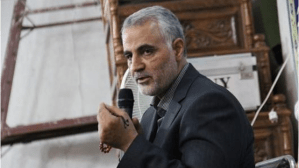
Qassem Suleimani
I have to admit that I haven’t read the entire article yet, but yesterday I heard a fascinating interview of Dexter Filkins by Terry Gross on her NPR show Fresh Air. You can listen to the interview at the link. It lasts about 44 minutes. Filkins covered the wars in Afghanistan and Iraq for the New York Times beginning in 2002. In addition, he is the author of the book The Forever War. Based on what I heard in the Fresh Air interview, just about everything many Americans think we know about Iran, Iraq, Syria and Iran’s powerful influence in the Middle East is going to have to be revised and updated. Even Filkins was surprised by what he learned through his research and reporting in Iran.
Here’s what Filkins writes about Suleimani:
Suleimani took command of the Quds Force fifteen years ago, and in that time he has sought to reshape the Middle East in Iran’s favor, working as a power broker and as a military force: assassinating rivals, arming allies, and, for most of a decade, directing a network of militant groups that killed hundreds of Americans in Iraq. The U.S. Department of the Treasury has sanctioned Suleimani for his role in supporting the Assad regime, and for abetting terrorism. And yet he has remained mostly invisible to the outside world, even as he runs agents and directs operations. “Suleimani is the single most powerful operative in the Middle East today,” John Maguire, a former C.I.A. officer in Iraq, told me, “and no one’s ever heard of him.”
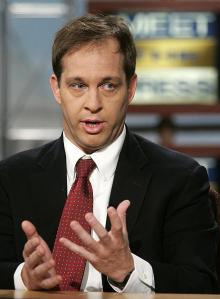
Dexter Filkins
According to Filkins, through Suleimani’s influence, after the U.S. took down Saddam Hussein and everything went to hell in Iraq, Iran has basically controlled what went on there; and now Iran is a powerful influence in the Syrian conflict. Here’s the introduction to the Filkins interview from Fresh Air site. Meet The Iranian Commander Pulling Strings In Syria’s War:
Perhaps the most important military commander in Syria’s civil war is not Syrian at all. He’s Iranian Maj. Gen. Qassem Suleimani, and he’s the subject of an article by Dexter Filkins in the current edition of The New Yorker.
For the past 15 years, Suleimani has been the chief of the Quds Force, a small but powerful branch of Iran’s Revolutionary Guard. He’s not a familiar name to Americans, but one former CIA officer described him to Filkins as “the single most powerful operative in the Middle East today.”
Filkins writes that Suleimani “has sought to reshape the Middle East in Iran’s favor, working as a power broker and as a military force: assassinating rivals, arming allies, and, for most of a decade, directing a network of militant groups that killed hundreds of Americans in Iraq. The U.S. Treasury Department has sanctioned Suleimani for his role in supporting the Assad regime, and for abetting terrorism.”
On Suleimani’s influence on the reshaping of the Middle East:
Qassem Suleimani — who is this extraordinarily powerful man behind the mask, very mysterious guy, very powerful guy — he was instrumental in 2010 in making sure that the Americans left no troops behind in Iraq. During the Iraq War, he supervised and directed militias which were responsible for hundreds of American deaths.
It appears, by the evidence, that the Iranians, and the Quds Force in particular, were behind the assassination of Rafik Hariri, the president of Lebanon, in 2005. Qassem Suleimani appears to be running or directing or at least playing a very large part in the war in Syria on behalf of the Assad government. So he’s everywhere, and, again, the Iranians have been extraordinarily aggressive over the past 15 years in asserting themselves in the Middle East, often at American expense.
Filkins also says that it’s clear the Iranians do want to develop nuclear weapons, and he doubts if the U.S. will be able to get them to agreed not to do it. The reason the Iranians are reaching out to the West right now is that the sanctions are really hurting them–basically the middle class in Iran has been decimated.
You can read more excerpts from the interview at the Fresh Air site. I plan to finish reading the Filkins article in the New Yorker today. I hope I’ve given you enough information to get you to read it too. I’m sure this article will be much discussed in the coming weeks.
Here’s Charles Pierce on the Filkins piece: The Limitless Bungling Of George W. Bush And Co.
Dexter Filkins has a long, fine piece in the September 30 New Yorker about one Qassam Suleimani, an Iranian who seems to be the Zelig of Middle East spookdom, and who is now currently working with the Assad government in Syria.
Since then, Suleimani has orchestrated attacks in places as far flung as Thailand, New Delhi, Lagos, and Nairobi-at least thirty attempts in the past two years alone. The most notorious was a scheme, in 2011, to hire a Mexican drug cartel to blow up the Saudi Ambassador to the United States as he sat down to eat at a restaurant a few miles from the White House. The cartel member approached by Suleimani’s agent turned out to be an informant for the U.S. Drug Enforcement Administration. (The Quds Force appears to be more effective close to home, and a number of the remote plans have gone awry.) Still, after the plot collapsed, two former American officials told a congressional committee that Suleimani should be assassinated. “Suleimani travels a lot,” one said. “He is all over the place. Go get him. Either try to capture him or kill him.” In Iran, more than two hundred dignitaries signed an outraged letter in his defense; a social-media campaign proclaimed, “We are all Qassem Suleimani.”
If you want evidence behind your essential instinct that the tangle in that part of the world is beyond our ability ever to untangle, you’ve got it here. But there is one other little tidbit that’s worth bringing up, given the fact that some officials formerly in the employ of C-Plus Augustus — most notably, David Frum — have snuck into the national dialogue again, probably through an unguarded window, instead of going off and living a penitent’s existence for what they did to the country.
(To be entirely fair, according to Filkins, Suleimani was formed by his participation in the savage Iran-Iraq War in which the United States, employing the brilliant realpolitik of blood-beast Henry Kissinger, helped both sides, guaranteeing that nobody would trust us thereafter. Genius!)
In other news,
Hillary had a few choice words for the Republicans who are trying to shut down the government in order to defund The Affordable Care Act. From the WaPo: Hillary Clinton says government shutdown ‘wouldn’t be the worst thing for Democrats’:
Hillary Rodham Clinton said Tuesday that if a “noisy minority” of Republican lawmakers force a government shutdown over funding for President Obama’s signature health-care law, they would face negative political consequences.
“It wouldn’t be the worst thing for Democrats if they tried to shut the government down,” said Clinton, a former secretary of state and potential 2016 Democratic presidential candidate. “We’ve seen that movie before and it didn’t work out so well for those so-called obstructionists.”
Clinton was referencing the political harm for Republicans in the mid-1990s when they forced a shutdown during husband Bill Clinton’s presidency.
“If they want to try to shut the government down, that’s on their head, that’s their responsibility,” she added.
Isn’t it great to have Hillary talking about politics again?
I’m really late with this post, so I’m going to wrap it up with a link dump:
From Gallup — Tea Party Support Dwindles to Near-Record Low: Republicans ambivalent about movement, while most Democrats oppose it
From Huffington Post — DC Exempts Itself From Federal Government Shutdown
From The Political Carnival: Don’t Buckle Your Seatbelt? Go To Jail — Or Your Death
From Vanity Fair, battles among the richie-riches in San Francisco’s toniest neighborhood —
Bluebloods & Billionaires
Scientific American — Peculiar Brain Signals Found in “Flat-Lined” Patient What does it really mean to be dead?
Now it’s your turn. What’s your recommended reading for today? Please let us know in the comment thread, and have a great day!
Tuesday Reads
Posted: September 17, 2013 Filed under: Barack Obama, Foreign Affairs, morning reads, Republican politics, U.S. Economy, U.S. Politics | Tags: Aaron Alexis, Glenn Greenwald, Greenwald Derangement Syndrome, Keith Alexander, NSA leaks, Star Trek 27 Comments
Good Morning!!
We’ve had another mass-murder and I think I can safely predict it will have no effect on America’s gun culture. Now we’ll have the aftermath: the list of the dead and wounded; the background on the “ticking human time bomb” who “went off” after years of psychological problems and run-ins with law enforcement; the fruitless talk of change that won’t happen because of the right wing nut jobs who apparently run the country despite the Democrat in the White House.
Navy Yard Murders
So far. seven of the people Aaron Alexis killed at the Navy Yard have been named:
— 59-year-old Michael Arnold
— 53-year-old Sylvia Frasier
— 62-year-old Kathy Gaarde
— 73-year-old John Roger Johnson
— 50-year-old Frank Kohler
— 46-year-old Kenneth Bernard Proctor
— 61-year-old Vishnu Pandit
From The Boston Globe: Navy Yard shooting victims had long careers there. You can read some background on each of these shooting victims at the link.
In other news of the massacre, police have now established that Alexis was the only gunman.
Fifth Anniversary of the 2008 Crash
I didn’t see much mention of it, but yesterday was the fifth anniversary of the Lehmann Brothers bankruptcy that precipitated the 2008 financial collapse. The White House released a report on the progress made since then, and President Obama warned Republicans that if the nutjobs in the House continue their efforts to shut down the government, they could easily reverse that progress. From The New York Times:
President Obama on Monday seized on the fifth anniversary of the 2008 financial collapse to warn that House Republicans would reverse the gains made and willfully cause “economic chaos” with the uncompromising stands they have staked out on looming budget deadlines.
“Budget battles and debates, those are as old as the republic,” Mr. Obama said before a friendly audience assembled in a White House annex. But, he added, “I cannot remember a time when one faction of one party promises economic chaos if it can’t get 100 percent of what it wants.”
A bloc of conservative House Republicans have said that unless Mr. Obama’s signature health insurance law is delayed or repealed, they will not support financing for government operations in the new fiscal year starting Oct. 1 or an essential increase in the nation’s borrowing limit in mid-October.
Failure to act on federal funding would provoke a government shutdown; even worse, failing to increase the debt limit would leave the government unable to pay bills and creditors and ultimately threaten the nation’s default.
“The last time the same crew threatened this course of action back in 2011, even the mere suggestion of default slowed our economic growth,” Mr. Obama said, recalling that summer’s market-rattling showdown.
No doubt the warning fell on deaf ears…

Fifth Anniversary of the 2008 Crash
I didn’t see much mention of it, but yesterday was the fifth anniversary of the Lehmann Brothers bankruptcy that precipitated the 2008 financial collapse. The White House released a report on the progress made since then, and President Obama warned Republicans that if the nutjobs in the House continue their efforts to shut down the government, they could easily reverse that progress. From The New York Times:
President Obama on Monday seized on the fifth anniversary of the 2008 financial collapse to warn that House Republicans would reverse the gains made and willfully cause “economic chaos” with the uncompromising stands they have staked out on looming budget deadlines.
“Budget battles and debates, those are as old as the republic,” Mr. Obama said before a friendly audience assembled in a White House annex. But, he added, “I cannot remember a time when one faction of one party promises economic chaos if it can’t get 100 percent of what it wants.”
A bloc of conservative House Republicans have said that unless Mr. Obama’s signature health insurance law is delayed or repealed, they will not support financing for government operations in the new fiscal year starting Oct. 1 or an essential increase in the nation’s borrowing limit in mid-October.
Failure to act on federal funding would provoke a government shutdown; even worse, failing to increase the debt limit would leave the government unable to pay bills and creditors and ultimately threaten the nation’s default.
“The last time the same crew threatened this course of action back in 2011, even the mere suggestion of default slowed our economic growth,” Mr. Obama said, recalling that summer’s market-rattling showdown.
No doubt the warning fell on deaf ears…

UN Report on Chemical Weapons in Syria
Yesterday the UN released a report on its investigation of the chemical weapons attack in Syria. From the LA Times: U.N. report cites ‘clear’ use of chemical weapons in Syria.
A United Nations report finding “clear and convincing evidence” of a deadly chemical attack built new momentum Monday for demands by the United States and allies to impose tough penalties on Syria if it fails to honor promises to surrender its arsenal.
Although the 38-page report from a U.N. scientific team does not assign blame, Western diplomats and independent experts said it offers undeniable evidence that Syrian President Bashar Assad‘s forces fired sarin-filled rockets with Russian markings into Damascus suburbs on Aug. 21. The United States says more than 1,400 people were killed.
Western diplomats said the weapons and sarin described by U.N. experts displayed sophisticated manufacturing techniques beyond the capabilities of rebel forces, and that U.N. data about the trajectory of the rockets indicated that they were fired from government-held territory.
“The technical details of the U.N. report make clear that only the regime could have carried out this large-scale chemical weapons attack,” said Samantha Power, the U.S. ambassador to the United Nations. “It defies logic to think that the opposition would have infiltrated the regime-controlled area to fire on opposition-controlled areas.”
A little more from The New York Times:
The weapons inspectors, who visited Ghouta and left the country with large amounts of evidence on Aug. 31, said, “In particular, the environmental, chemical and medical samples we have collected provide clear and convincing evidence that surface-to-surface rockets containing the nerve agent sarin were used.”
But the report’s annexes, detailing what the authors found, were what caught the attention of nonproliferation experts.
In two chilling pieces of information, the inspectors said that the remnants of a warhead they had found showed its capacity of sarin to be about 56 liters — far higher than initially thought. They also said that falling temperatures at the time of the attack ensured that the poison gas, heavier than air, would hug the ground, penetrating lower levels of buildings “where many people were seeking shelter.”
The investigators were unable to examine all of the munitions used, but they were able to find and measure several rockets or their components. Using standard field techniques for ordnance identification and crater analysis, they established that at least two types of rockets had been used, including an M14 artillery rocket bearing Cyrillic markings and a 330-millimeter rocket of unidentified provenance.
These findings, though not presented as evidence of responsibility, were likely to strengthen the argument of those who claim that the Syrian government bears the blame, because the weapons in question had not been previously documented or reported to be in possession of the insurgency.

“Greenwald Derangement Sydrome”
After months of wading through Glenn Greenwald’s turgid, error-filled Guardian articles on his NSA “bombshells” and his defenses of his ticket to the bigtime Edward Snowden, and reading his self righteous and self-promoting tweets detailing praise for his “scoops” and his irrational hatred of President Obama and Democrats in general, I’ve reached the point where my dislike of this man is so intense that I can’t stand to look at his smarmy, smirking visage or listen ot his grating, whiny voice. My GDS is so strong that I feel instant empathy for anyone he attacks–even if it’s the Devil incarnate. This brings me to one of the silliest pieces Greenwald has written yet: Inside the mind of NSA chief Gen Keith Alexander. See Alexander had the temerity to have his NSA office designed too look like the deck of the Starship Enterprise from Star Trek. Greenwald intones:
The article describes how even his NSA peers see him as a “cowboy” willing to play fast and loose with legal limits in order to construct a system of ubiquitous surveillance. But the personality driving all of this – not just Alexander’s but much of Washington’s – is perhaps best captured by this one passage, highlighted by PBS’ News Hour in a post entitled: “NSA director modeled war room after Star Trek’s Enterprise”. The room was christened as part of the “Information Dominance Center”:
“When he was running the Army’s Intelligence and Security Command, Alexander brought many of his future allies down to Fort Belvoir for a tour of his base of operations, a facility known as the Information Dominance Center. It had been designed by a Hollywood set designer to mimic the bridge of the starship Enterprise from Star Trek, complete with chrome panels, computer stations, a huge TV monitor on the forward wall, and doors that made a ‘whoosh’ sound when they slid open and closed. Lawmakers and other important officials took turns sitting in a leather ‘captain’s chair’ in the center of the room and watched as Alexander, a lover of science-fiction movies, showed off his data tools on the big screen.
“‘Everybody wanted to sit in the chair at least once to pretend he was Jean-Luc Picard,’ says a retired officer in charge of VIP visits.”
Next, the obligatory attack on Obama:
Numerous commentators remarked yesterday on the meaning of all that (note, too, how “Total Information Awareness” was a major scandal in the Bush years, but “Information Dominance Center” – along with things like “Boundless Informant” – are treated as benign or even noble programs in the age of Obama).
Which “numerous commentators?” Greenwald doesn’t name them, because they probably consist of Greenwald, his boyfriend who is young enough to be his son, and a couple of other Guardian writers.
Okay, Alexander’s office is kind of dumb, but is it really symbolic of some deep evil intent? The interesting thing about Greenwald’s recent Guardian articles is that he is no long writing “substantive” pieces on the NSA leaks. Those have been turned over to writers at the Washington Post, The New York Times, and other media outlets. Perhaps the Guardian got tired of defending Greenwald’s lies and exaggerations.
Along similar lines, I want to call attention to this article at ZD Net that Ralph posted last night. NSA cryptanalyst: We, too, are Americans. It’s an important reminder that not all government employees are evil, despite the claims of Glenn Greenwald, Edward Snowden, and their gang of resentful libertarian white men. Please read it if you haven’t already.
Homeless Man Honored by Boston Police Department
I’ll end with a feel-good story about a Boston man named Glen James who found a backpack containing “$2,400 in cash, $39,500 in traveler’s checks, passports, and various personal papers.” The Boston Globe reports:
A humble homeless man who returned a backpack full of cash and traveler’s checks to police said he felt “very, very good” to do it and used a ceremony honoring him at police headquarters to thank all the people who have ever given him money on the street.
Glen James said, “I don’t talk too much because I stutter.” But he handed out a handwritten statement in which he said, “Even if I were desperate for money, I would not have kept even a … penny of the money I found. I am extremely religious — God has always very well looked after me.”
The statement also said, “I would like to take this opportunity to sincerely thank everyone — every pedestrian stranger — who has given me spare change. Thank you! Thank you! Thank you!”
Police Commissioner Edward F. Davis said that James’s actions were “really a remarkable tribute to him and his honesty.”
“He’s an honest guy and realized the property belonged to someone else,” Davis said.
The middle-aged man, balding, bespectacled, and thin, appeared friendly but shy and slightly overwhelmed by the attention from the media drawn to a feel-good story.
On his way out of the building after the news conference, the police department clerks gave him an ovation.
Now someone please find this man a job and a place to live and maybe send him for FUE hair transplant in Sydney if you are a rich philanthropist.
So….what’s on your reading menu today? Please post your links in the comment thread and have a terrific Tuesday!
what’s on your reading menu today? Please post your links in the comment thread and have a terrific Tuesday!
Thursday Reads: 9/11 Memories, Adoption Horror Stories, and Other News
Posted: September 12, 2013 Filed under: Barack Obama, child sexual abuse, children, Crime, Foreign Affairs, morning reads, physical abuse, Russia, Syria, U.S. Politics | Tags: 9/11, Boston, Carri Williams, child pornography, Edward Snowden, foreign adoptions, Glenn Greenwald, Glenna Mueller, Hanna Williams, Larry Williams, Nicole Eason, Oath-Keepers, Pedophilia, Pentagon, Quita Puchella, Randy Winslow, re-homing, Robert Menendez, Vladimir Putin, World Trade Center 22 Comments
Good Morning!!
It’s been cool here in the Boston area for the past few weeks, and then suddenly yesterday on the anniversary of 9/11/2001, the temperature shot up to 97 degrees.Today it’s only supposed to get up to the high 80s. And then we’re back to fall over the weekend. Very strange. You just never know what to expect from the weather these days.
On that day 12 years ago, my parents had rented a house on the beach in Rhode Island for a week. We had been obsessed with ExploreSUP reviews of paddle boards and were trying them out in the water. My sister from Indiana and my brother and sister-in-law from Cambridge were there too. This was before my two nephews were born. It was a beautiful New England day, and I recall it was pretty warm–but not hot.
I was out sight-seeing with my parents and sister when we got the first hints that something was terribly wrong. My sister heard someone say that a plane had hit the World Trade Center in New York. We rushed back to the beach house to horrible scenes of carnage on TV. We spent the rest of our vacation reading newspapers and watching TV for updates. A couple of days later, I had to drive back to Boston where school was starting and I had to teach at Boston University.
Driving up I-95 alone, I felt irrationally frightened, and I kept looking up in the sky for planes, even though I knew all air traffic had been grounded (except for the bin Laden relatives whom the Bush administration allowed to fly out of Boston–creepy!). The fact that the planes that hit the twin towers had flown out of Boston felt like a terrible violation. So even though nothing had happened to me and I was safe, I still had some post-traumatic stress. I guess we all did. For the first time, Americans learned what it feels like to be attacked in our own country. It was a loss of innocence.
Anyway, that’s my 9/11 memory–not very dramatic, but impossible to forget.
President Obama chose to mark the anniversary with a moment of silence on the White House lawn. From The New York Daily News:
Under a perfect blue sky, President Obama stood stock still on the neatly-manicured White House South Lawn and said not a thing.

In a capital where words are weapons, the silence was disarming.
The President, First Lady Michelle Obama, Vice President Biden and Jill Biden had quietly walked out of the glistening white residence to observe a moment of silence on Wednesday, the 12th anniversary of the Sept. 11 attacks.
They were flanked by a military honor guard and White House staff. If you looked toward the South Portico of the nation’s most famous home, a flag was at half-staff.
The two couples held hands as a bell tolled at 8:46 a.m., exactly the moment when the first plane crashed into the World Trade Center. The poignant simplicity was inescapable.
Afterwards, Obama attended a memorial service in front of the Pentagon, at the site where one of the planes had been flown into the building that symbolized America’s military might.
In the news…
I hope you’ll find time to read this important investigative article by Reuters reporter Megan Twohey about Americans who adopt children from foreign countries, then have regrets, and then give their children away to total strangers they meet on the internet. Many of these children end up being abused emotionally, physically and/or sexually. It’s one of the most shocking stories I’ve ever read. Here’s Part One and Part Two. I really can’t do this story justice with excerpts, but here’s the introduction:
KIEL, Wisconsin – Todd and Melissa Puchalla struggled for more than two years to raise Quita, the troubled teenager they’d adopted from Liberia. When they decided to give her up, they found new parents to take her in less than two days – by posting an ad on the Internet.
Nicole and Calvin Eason, an Illinois couple in their 30s, saw the ad and a picture of the smiling 16-year-old. They were eager to take Quita, even though the ad warned that she had been diagnosed with severe health and behavioral problems. In emails, Nicole Eason assured Melissa Puchalla that she could handle the girl….
A few weeks later, on Oct. 4, 2008, the Puchallas drove six hours from their Wisconsin home to Westville, Illinois. The handoff took place at the Country Aire Mobile Home Park, where the Easons lived in a trailer.
No attorneys or child welfare officials came with them. The Puchallas simply signed a notarized statement declaring these virtual strangers to be Quita’s guardians. The visit lasted just a few hours. It was the first and the last time the couples would meet.
I can’t believe such a thing is possible in the U.S., but it turns out most states don’t really regulate what adoptive parents do with their children. Within a few weeks, Melissa Puchalla learned that Quita and her new parents were missing and that Nicole Eason had a troubling history as a mother:
• Child welfare authorities had taken away both of Nicole Eason’s biological children years earlier. After a sheriff’s deputy helped remove the Easons’ second child, a newborn baby boy, the deputy wrote in his report that the “parents have severe psychiatric problems as well with violent tendencies.”
• The Easons each had been accused by children they were babysitting of sexual abuse, police reports show. They say they did nothing wrong, and neither was charged.
• The only official document attesting to their parenting skills – one purportedly drafted by a social worker who had inspected the Easons’ home – was fake, created by the Easons themselves.
On Quita’s first night with the Easons, her new guardians told her to join them in their bed, Quita says today. Nicole slept naked, she says.
In Part Two of the report, Twohey writes about another man whom Melissa Eason partnered with to get access to unwanted adoptive children.
Read the rest of this entry »

 peej
peej Carissa
 bostonboomer
 dakinikat
 ecocatwoman
 jjlo
jjlo mablue2
 Mama Lopez
 peggysue22
 quixote
 skydancingguestblogger
 Mona (aka Wonk the Vote)



 Sky Dancing
Recent Comments