
Tuesday Reads: U.S. Spies on Foreign Countries and Other “Blockbuster” News
Posted: September 3, 2013 Filed under: Central Intelligence Agency, China, Crime, cyber security, Diplomacy Nightmares, Foreign Affairs, France, Germany, Great Britain, Iran, Israel, morning reads, Pakistan, Russia, Syria, U.S. Politics | Tags: Agência Brasileira de Inteligência, al Qaeda, Bashar al-Assad, black budget, Bob Cesca, Edward Snowden, espionage, Glenn Greenwald, Information Assurance, John Kerry, Laura Poitras, Marines website, National Security Agency (NSA), nuclear weapons, Osama bin Laden, S-2 (Mexico spy agency), SIGINT, signals intelligence, Syrian Electronic Army, Taliban 51 Comments
Good Morning!!
In the weeks since Edward Snowden absconded with thousands of top secret National Security Agency (NSA) files and traveled to Hong Kong and then Moscow and handed over the documents to Guardian columnist Glenn Greenwald and filmmaker Laura Poitras, we’ve learned that the U.S. spies on lots of other countries. Snowden has revealed that NSA has spied on China, Russia, Germany, France, Brazil, Mexico, Israel, Iran, and the UN. Oddly, we haven’t gotten much new information from Snowden about illegal or abusive NSA spying on Americans, which Snowden initially suggested was his reason for stealing the secret documents.
To most nominally intelligent and informed people, the fact that NSA spies on foreign countires is not particularly surprising; since collecting foreign signals intelligence (SIGINT) is the primary purpose of NSA as stated publicly on their website. Here is NSA’s statement of their “core mission”:
The National Security Agency/Central Security Service (NSA/CSS) leads the U.S. Government in cryptology that encompasses both Signals Intelligence (SIGINT) and Information Assurance (IA) products and services, and enables Computer Network Operations (CNO) in order to gain a decision advantage for the Nation and our allies under all circumstances.
The Information Assurance mission confronts the formidable challenge of preventing foreign adversaries from gaining access to sensitive or classified national security information. The Signals Intelligence mission collects, processes, and disseminates intelligence information from foreign signals for intelligence and counterintelligence purposes and to support military operations. This Agency also enables Network Warfare operations to defeat terrorists and their organizations at home and abroad, consistent with U.S. laws and the protection of privacy and civil liberties.
Spying on foreign countries is what NSA does. Why that is perceived as somehow illegal and/or shocking by Greenwald, Poitras, Snowden, and their cult followers, I have no clue. But the fact that a spy agency collects foreign signals intelligence really should not be considered breaking news; and the countries that are complaining about it are well known for spying on the US in return–and in some cases (e.g., China, Russia, and Israel) for famously stealing U.S. secrets and technology.
Today the Washington Post has a new “blockbuster” article that reveals that the U.S. is particularly focused on spying on Pakistan. Now I wonder why that would be? Anyone want to speculate? It couldn’t have anything to do with the fact that Pakistan concealed the location of Osama bin Laden for years, could it? Or the fact that Taliban and al Quaeda operatives regularly hide in Pakistan? Just a couple of wild guesses…
Here’s an excerpt from the WaPo article:
A 178-page summary of the U.S. intelligence community’s “black budget” shows that the United States has ramped up its surveillance of Pakistan’s nuclear arms, cites previously undisclosed concerns about biological and chemical sites there, and details efforts to assess the loyalties of counterterrorism sources recruited by the CIA.
Pakistan appears at the top of charts listing critical U.S. intelligence gaps. It is named as a target of newly formed analytic cells. And fears about the security of its nuclear program are so pervasive that a budget section on containing the spread of illicit weapons divides the world into two categories: Pakistan and everybody else.
The disclosures — based on documents provided to The Washington Post by former intelligence contractor Edward Snowden — expose broad new levels of U.S. distrust in an already unsteady security partnership with Pakistan, a politically unstable country that faces rising Islamist militancy. They also reveal a more expansive effort to gather intelligence on Pakistan than U.S. officials have disclosed.
The United States has delivered nearly $26 billion in aid to Pakistan over the past 12 years, aimed at stabilizing the country and ensuring its cooperation in counterterrorism efforts. But with Osama bin Laden dead and al-Qaeda degraded, U.S. spy agencies appear to be shifting their attention to dangers that have emerged beyond the patch of Pakistani territory patrolled by CIA drones.
“If the Americans are expanding their surveillance capabilities, it can only mean one thing,” said Husain Haqqani, who until 2011 served as Pakistan’s ambassador to the United States. “The mistrust now exceeds the trust.”
The stolen files also reveal serious human rights issues in Pakistan and fears about the security of Pakistan’s nuclear weapons. Raise your hand if you’re shocked by any this. I can certainly see why these revelations would be harmful to U.S. national security and foreign relations, however.
Via The Jerusalem Post, another Snowden leak revealed by the Washington Post showed that members of terrorist organizations have tried to join the CIA.
…individuals with past connections to known terrorist entities such as al-Qaida, Hezbollah and Hamas, have repeatedly attempted to obtain employment within the CIA, The Washington Post reported on Monday.
Among job-seekers that seemed suspicious to the CIA, approximately 20% of that grouping reportedly had “significant terrorist and/or hostile intelligence connections.” The nature of the connections was not described in the document.
“Over the last several years, a small subset of CIA’s total job applicants were flagged due to various problems or issues,” an anonymous CIA official was reported as saying. “During this period, one in five of that small subset were found to have significant connections to hostile intelligence services and or terrorist groups.” [….]
The document also allegedly stated that the CIA re-investigates thousands of employees each year to reduce the possibility that an individual with these connections may compromise sensitive information.
Can anyone explain to me why this should be considered criminal or why the person who revealed it should be called a “whistle-blower?” It seems to me, the only reason for revealing the methods the U.S. uses to collect foreign SIGINT is a desire to harm U.S. Government and damage its foreign policy. Here’s Bob Cesca, who has consistently critiqued libertarians Snowden and Greenwald and their anti-government motives from a liberal, rational point of view: Greenwald Reports NSA Spied on Presidents of Brazil andMexico.
We’re not sure exactly which section of the U.S. Constitution protects the privacy rights of foreign leaders, but Glenn Greenwald and Edward Snowden appear to believe it’s in there somewhere. The tandem crusaders for the Fourth Amendment have once again extended their reach beyond what was intended to be their mutual goal of igniting a debate in the United States about the constitutionality of the National Security Agency’s surveillance operations, and, instead, opted to reveal that, yes, the U.S. spies on foreign leaders. Shocking, I know.
Specifically, on the Globo television show “Fantasico” in Brazil, Greenwald described a July, 2012 document stolen from NSA by Snowden, which describes how NSA had intercepted communications made by the president of Mexico, Enrique Pena Nieto, as well as Brazil’s president, Dilma Rousseff. (Incidentally, the Globo article contains 13 corporate trackers or “web bugs.”)
The goal of revealing this information is clear. Greenwald and Snowden have successfully exploited the “sparking a debate” motive as a Trojan Horse for injecting unrelated information into public view as a means of vindictively damaging the operations of U.S. and U.K. intelligence communities, not to mention the reputation of the United States as a whole, while also pushing the unrealistic message that surveillance is generally impermissible. Yes, we already knew that nations spy on other nations, but to publicly disclose specific instances of international spying — while on the soil of one of the nations being surveilled — confirms these suspicions and sorely embarrasses everyone involved.
But guess what? Both Mexico and Brazil have powerful spy agencies that conduct “active surveillance” on the U.S.
In Brazil, it’s called the Agência Brasileira de Inteligência (ABIN or the Brazilian Intelligence Agency). It deals with external and domestic intelligence gathering: collection and analysis of information that’s intercepted via both signals (SIGINT collects email, phone calls and so forth) and human resources.
In Mexico, it’s called S-2. Like ABIN or NSA, S-2 also collects SIGINT on foreign targets, with a special focus on the military operations of foreign governments. Along with its counterpart, the Centro de Información de Seguridad Nacional (Center for Research on National Security or CISIN), S-2 is tasked with counter-intelligence and counter-terrorism operations.
Has anyone overheard Greenwald mention, even in passing, either of these agencies? Likely not, and don’t hold your breath waiting for Greenwald to attack Brazil’s intelligence community, even knowing that it wiretapped its own Senate and Supreme Court several years ago. Along those lines, we don’t know exactly whether these agencies have attempted to spy on any of our presidents or government officials, but wouldn’t Greenwald, as a U.S. citizen and resident of Brazil, want to find out using the same “Glennzilla” tenacity he’s employed while exposing U.S. spying? If his crusade now involves universal privacy, wouldn’t that include violations by the Brazilian government, especially knowing that Greenwald lives in Rio de Janeiro?
Read more at the link.
In other news….
The civil war in Syria continues to be the top international story, and The New York Times has a couple of helpful articles. The first is an explainer that deals with Key Questions on the Conflict in Syria. I won’t excerpt from it–read it at the NYT if you’re interested. Next, an article that explains how American policy on Syria may affect possible negotiations with Iran: Drawing a Line on Syria, U.S. Eyes Iran Talks.
As the Obama administration makes a case for punitive airstrikes on the Syrian government, its strongest card in the view of some supporters of a military response may be the need to send a message to another country: Iran. If the United States does not enforce its self-imposed “red line” on Syria’s use of chemical weapons, this thinking goes, Iran will smell weakness and press ahead more boldly in its quest for nuclear weapons.
But that message may be clashing with a simultaneous effort by American officials to explore dialogue with Iran’s moderate new president, Hassan Rouhani, in the latest expression of Washington’s long struggle to balance toughness with diplomacy in its relations with a longtime adversary.
Two recent diplomatic ventures have raised speculation about a possible back channel between Washington and Tehran. Last week, Jeffrey Feltman, a high State Department official in President Obama’s first term who is now a senior envoy at the United Nations, visited Iran to meet with the new foreign minister, Mohammad Javad Zarif, and discussed possible reactions to an American airstrike in Syria.

In line with the international beating up on the U.S. that has followed the Snowden-Greenwald-Poitras “revelations” that NSA spies on foreign countries, The Daily Mail has a snarky article with numerous photos about a dinner that John Kerry had with Syria’s Bashar al-Assad in 2009.
An astonishing photograph of John Kerry having a cozy and intimate dinner with Bashar al-Assad has emerged at the moment the U.S Secretary of State is making the case to bomb the Syrian dictator’s country and remove him from power.
Kerry, who compared Assad to Adolf Hitler and Saddam Hussein yesterday, is pictured around a small table with his wife Teresa Heinz and the Assads in 2009.
Assad and Kerry, then a Massachusetts senator, lean in towards each other and appear deep in conversation as their spouses look on.
A waiter is pictured at their side with a tray of green drinks, believed to be lemon and crushed mint.
Now, why would Kerry be having dinner with Syria’s president? The Daily Mail tells us:
The picture was likely taken in February 2009 in the Naranj restaurant in Damascus, when Kerry led a delegation to Syria to discuss finding a way forward for peace in the region.
At the time, Kerry was Chairman of the Senate Foreign Relations Committee, and what he was doing is called “diplomacy.” But looking back in the age of Snowden, it seems that instead of having a polite dinner, Kerry should have punched Assad in the nose and screamed at him at the top of his lungs to get with the program–or something…
From the Wall Street Journal: Syrian Electronic Army Hacks Marines Website
A collection of pro-Syrian government hackers apparently defaced a Marine Corps recruitment website Monday.
The Syrian Electronic Army, which has hacked a series of websites, posted a letter on the Marines.com website arguing the Syrian government is “fighting a vile common enemy.”
“The Syrian army should be your ally not your enemy,” the letter read. “Refuse your orders and concentrate on the real reason every soldier joins their military, to defend their homeland. You’re more than welcome to fight alongside our army rather than against it.”
See a screen shot at the link. The site is now back up and running normally.
I’ll end there and post my remaining links in the thread below. As always, please post links to the stories you’re following in the comments as well.
Tuesday Reads: The Agony of Glenn Greenwald, The Ickiness of Ted Cruz, & Other News
Posted: August 20, 2013 Filed under: 2016 elections, Egypt, Foreign Affairs, Great Britain, morning reads, Pakistan, Republican politics, U.S. Economy, U.S. Politics, US & Canada | Tags: Bob Cesca, David Miranda, Glenn Greenwald, Muslim Brotherhood, Pervez Musharraf, Ted Cruz, the 24-hour rule, The Guardian UK 29 Comments
Good Morning!!
As of yesterday, we’ve reached the point with the NSA leaks story that the entire focus is on Glenn Greenwald and his martyrdom. Even Edward Snowden has now faded into the background.
On Sunday, Greenwald’s domestic partner David Miranda was detained for nine hours by UK authorities as he passed through Heathrow Airport on his way from Berlin to Rio de Janeiro where he and Greenwald live. Miranda was finally released, but his laptop, an external hard drive, a number of memory sticks and other electronic devices were confiscated. Greenwald reacted by threatening the UK government with harmful revelations from the Snowden stash.
As with previous Greenwald stories, this one quickly evolved from a tale of horrendous government repression as reported by the Guardian to a more complex story reported by other news outlets–forcing the Guardian to walk back or provide more details on aspects of its original reporting. Bob Cesca does a good job of summarizing the process.
Like most people, Cesca was at first shocked by the news of Miranda’s detention. Then he began reading the stories under the headlines.
When I read The Guardian‘s article about the incident, however, more questions popped up — as with much of The Guardian‘s reporting on this topic, the publication’s tendency for coy, smoke-and-mirrors reporting invariably raises more questions than it answers. The article was credited to “Guardian staff,” for one, there weren’t any quotes from Miranda himself and the only source for the article appeared to be Greenwald, who, from my experience covering this story, tends to be incendiary and misleading.
The wailing and garment rending was underway — the predictable group freakout we’re forced to endure every time a new article is published. Greenwald himself wrote that the U.K. authorities were actually worse than the Mafia because the Mafia doesn’t target family members. (Clearly, Greenwald knows less about the Mafia than he does about political realities or history.)
An aside: Cesca coined the term “the 24 hour rule” after a the first few Greenwald NSA “bombshells.”
The 24 Hour Rule: 1) A wild claim is made via a news article, most often The Guardian, about the U.S. government or related entities. 2) The article sparks wild fits of outrage. 3) Then, within 24 hours, a mitigating detail is added, undermining or totally debunking one or more of the central claims contained with the article. Related quote: “A lie can travel half-way around the world before the truth gets its pants on.”
Back to Cesca’s take on the Miranda story:
As the hours rolled by, Charlie Savage, reporting for The New York Times, began to revealmore details about the trip — details which The Guardian mysteriously didn’t include in either of its articles….
First, we learned from The New York Times that The Guardian financed Miranda’s trip to Germany and back. This means Miranda was conducting some sort of official business for the publication. Around the same time, Amnesty International referred to Miranda as “a Guardian newspaper employee.” Combined with the Laura Poitras detail, it’s obvious that Miranda was commissioned to do some serious leg-work on the Snowden/NSA reporting, the extent of which was unknown at the time.
And then, late in the evening east coast time, The New York Times revealed the purpose of Miranda’s trip to Berlin:
Mr. Miranda was in Berlin to deliver documents related to Mr. Greenwald’s investigation into government surveillance to Ms. Poitras, Mr. Greenwald said. Ms. Poitras, in turn, gave Mr. Miranda different documents to pass to Mr. Greenwald. Those documents, which were stored on encrypted thumb drives, were confiscated by airport security, Mr. Greenwald said. All of the documents came from the trove of materials provided to the two journalists by Mr. Snowden.
So Miranda, Greenwald’s spouse, served as a paid courier to transfer stolen, top secret national security documents from Greenwald to Poitras, and from Poitras back to Greenwald.
While I’m not defending UK authorities for their ham-handed treatment of Miranda–and neither is Cesca–it’s really not surprising that Miranda was stopped and questioned. It also later came out that Miranda had been offered an attorney, but he refused the offer (Greenwald had originally said his partner was refused access to legal advice). From The Guardian on Monday:
He was offered a lawyer and a cup of water, but he refused both because he did not trust the authorities. The questions, he said, were relentless – about Greenwald, Snowden, Poitras and a host of other apparently random subjects.
“They even asked me about the protests in Brazil, why people were unhappy and who I knew in the government,” said Miranda.
He got his first drink – from a Coke machine in the corridor – after eight hours and was eventually released almost an hour later. Police records show he had been held from 08.05 to 17.00.
The questions about the Brazilian government weren’t actually that outrageous, since Glenn Greenwald had contacted high level officials there and they had tried to intervene.
So the “24-hour rule” still holds. This entire story turned around in 24 hours, but many news outlets are still reporting information that is either wholly or partially untrue. After it became clear that their original reporting on the Miranda detention was problematic, the Guardian released another bombshell article written by Guardian editor-in-chief Alan Rusberger in which he claims that two months ago GCHQ (Britain’s version of NSA) agents forced the Guardian to destroy their hard drives and computers unless they turned over their NSA materials. Again Bob Cesca has a good summary. Please read the whole thing if you can–it’s not long.
We’ll have to wait another day to see if this story also morphs into something different. Cesca has a list of questions for Rusberger. My big question is why wasn’t this reported immediately after it happened, and why didn’t the Guardian go to court over it?
And so Glenn Greenwald and his victimization remain the center of international attention. I have to wonder why Greenwald arranged for his partner to travel through Heathrow in the first place. Was he deliberately inviting something like this? He couldn’t have asked for better free publicity that he and the Guardian are getting right now.
Meanwhile, any discussion of NSA spying is hindered by so much inaccurate information; yet the NSA story is distracting Americans from focusing on equally important and even more pressing issues like jobs, the economy, voting rights, the war on women’s autonomy, the environment, and the upheavals in the Middle East. So now I’ll move on to some other news–I’ll add more links on the Miranda story in the comments.
In other news,
The Atlantic has a good story on economic inequality: Are the Rich Getting Too Much of the Economic Pie?
When one of you asked, “Are the rich getting too much of the economic pie?” the team behindEconomics in Plain English got pretty excited. Because you said “pie.” So we headed toDangerously Delicious Pies in northeast Washington, D.C., with business editor Derek Thompson to explain income inequality over dessert. We ordered three pies — peanut butter, blueberry, and something amazing called the “Baltimore Bomb” — to make three charts that illustrate the income and wealth gap in the U.S. We’re not the first to mix math and pastry, as we discovered recently, but we hope this video offers a tasty perspective on a complex economic question.
Watch the video–and others by the same group–at the link.
In Pakistan, Pervez Musharraf has been indicted in the 2007 murder of Benazir Bhutto
ISLAMABAD, Pakistan — A Pakistani court indicted Pervez Musharraf on Tuesday in connection with the 2007 assassination of former Prime Minister Benazir Bhutto, the first time that a former military leader has faced criminal proceedings in Pakistan.
The court in Rawalpindi, near the capital, Islamabad, filed three charges against Mr. Musharraf, including murder and conspiracy to murder, said a prosecutor, Chaudhry Muhammed Azhar.
Mr. Musharraf, who has maintained that the charges against him are politically motivated, pleaded not guilty, his lawyers said. Reporters were excluded from the hearing. Afterward, police commandos and paramilitary rangers escorted Mr. Musharraf back to his villa on the edge of Islamabad, where he has been under house arrest since April in connection with other cases stemming from his rule from 1999 to 2008.
The sight of a once untouchable general being called to account by a court had a potent symbolism in a country that has been ruled by the military for about half of its 66-year history. While the military remains deeply powerful, the prosecution has sent the message that Pakistan’s top generals are subject to the rule of law — at least after they have retired.
In Egypt, a leader of the Muslim Brotherhood has been arrested. The LA Times reports:
CAIRO — Egyptian authorities early Tuesday arrested the leader of the Muslim Brotherhood, another demoralizing blow to the Islamist organization amid a crackdown by the military to silence dissent and build support for its control of the nation.
Supreme Guide Mohamed Badie was arrested in a Cairo apartment. Dressed in a gray tunic, the 70-year-old spiritual leader looked shaken, sitting next to a bottle of water in police custody. The image distilled the desperation the world’s most influential Islamist organization faces against an army that appears determined to crush it.
Most of the Brotherhood’s top leaders, including Khairat Shater, its chief strategist and financier, and former Egyptian president Mohamed Morsi, who was overthrown in a coup last month, are in detention or have gone underground. Much of the group’s strategy appears to have shifted to the Anti-Coup Alliance, an umbrella group the Brotherhood organized to protest Morsi’s downfall.
The army’s crackdown on the Brotherhood has been ferocious. Police raids on two Brotherhood sit-ins last week and the protests and violence that ensured killed more than 900 Morsi supporters, many of them shot by live ammunition fired by security forces that have shown little restraint.
“When the hand of oppression extends to arrest this important symbol,” the Brotherhood said in a statement regarding Badie, “that means the military coup has used up everything in its pocket and is readying to depart.”
I’ll be honest–I’m really clueless about what’s going on in Egypt right now. I just hope the situation doesn’t descend into a Syria-like civil war.
Texas Tea Party Senator Ted Cruz is back in the news. The Dallas Morning News revealed yesterday that Cruz holds dual citizenship in the US and Canada.
Born in Canada to an American mother, Ted Cruz became an instant U.S. citizen. But under Canadian law, he also became a citizen of that country the moment he was born.
Unless the Texas Republican senator formally renounces that citizenship, he will remain a citizen of both countries, legal experts say.
That means he could assert the right to vote in Canada or even run for Parliament. On a lunch break from the U.S. Senate, he could head to the nearby embassy — the one flying a bright red maple leaf flag — pull out his Calgary, Alberta, birth certificate and obtain a passport.
“He’s a Canadian,” said Toronto lawyer Stephen Green, past chairman of the Canadian Bar Association’s Citizenship and Immigration Section.
The circumstances of Cruz’s birth have fueled a simmering debate over his eligibility to run for president. Knowingly or not, dual citizenship is an apparent if inconvenient truth for the tea party firebrand, who shows every sign he’s angling for the White House.
Cruz has decided to renounce his Canadian citizenship, according to CNN:
“Because I was a U.S. citizen at birth, because I left Calgary when I was 4 and have lived my entire life since then in the U.S., and because I have never taken affirmative steps to claim Canadian citizenship, I assumed that was the end of the matter,” Cruz wrote in his statement.
“Now the Dallas Morning News says that I may technically have dual citizenship. Assuming that is true, then sure, I will renounce any Canadian citizenship,” he continued. “Nothing against Canada, but I’m an American by birth, and as a U.S. Senator, I believe I should be only an American.”
Too bad he didn’t decide to run for office in Canada. I guess we’re stuck with him now.
I’ll end with this Daily Beast story about what Ted Cruz Princeton roommates recall about him. Some excerpts:
When Craig Mazin first met his freshman roommate, Rafael Edward Cruz, he knew the 17-year-old Texan was not like other students at Princeton, or probably anywhere else for that matter.
“I remember very specifically that he had a book in Spanish and the title was Was Karl Marx a Satanist? And I thought, who is this person?” Mazin says of Ted Cruz. “Even in 1988, he was politically extreme in a way that was surprising to me.” [….]
“It was my distinct impression that Ted had nothing to learn from anyone else,” said Erik Leitch, who lived in Butler College with Cruz. Leitch said he remembers Cruz as someone who wanted to argue over anything or nothing, just for the exercise of arguing. “The only point of Ted talking to you was to convince you of the rightness of his views.”
In addition to Mazin and Leitch, several fellow classmates who asked that their names not be used described the young Cruz with words like “abrasive,” “intense,” “strident,” “crank,” and “arrogant.” Four independently offered the word “creepy,” with some pointing to Cruz’s habit of donning a paisley bathrobe and walking to the opposite end of their dorm’s hallway where the female students lived.
“I would end up fielding the [girls’] complaints: ‘Could you please keep your roommate out of our hallway?'” Mazin says.
Eeeeeeeeek!!
OK, now it’s your turn. What stories are you focusing on today? Please post your links on any topic in the comment thread.
Tuesday Reads: Dreaming a Life; Obama and Putin; NSA and Snowden
Posted: June 18, 2013 Filed under: Barack Obama, Foreign Affairs, Great Britain, morning reads, NSA, National Security Agency, Real Life Horror, Russia, Syria, U.S. Politics | Tags: Carol Morley, Charles Pierce, checks and balances, Dick Cheney, Dreams of a Life, Edward Snowden, FISA court, G-8 summit, Glenn Greenwald, John Aravosis, Joyce Carol Vincent, leakers, mysterious deaths, Richard Nixon, Vladimir Putin, whistleblowers 29 Comments
Good Morning!!
I’m going to begin with an article I came across yesterday while reading the Guardian. It’s about a story from 2006 that I remembered and sometimes think about–a woman whose skeletonized body was found in her apartment three years after she died.
On 25 January 2006, officials from a north London housing association repossessing a bedsit in Wood Green owing to rent arrears made a grim discovery. Lying on the sofa was the skeleton of a 38-year-old woman who had been dead for almost three years. In a corner of the room the television set was still on, tuned to BBC1, and a small pile of unopened Christmas presents lay on the floor. Washing up was heaped in the kitchen sink and a mountain of post lay behind the front door. Food in the refrigerator was marked with 2003 expiry dates. The dead woman’s body was so badly decomposed it could only be identified by comparing dental records with an old holiday photograph of her smiling. Her name was revealed to be Joyce Carol Vincent.

Joyce Carol Vincent
How could such a thing happen? So often we hear sad stories like this and never get any answers to our questions. In this case, filmmaker Carol Morley decided to find out who Joyce Carol Vincent was, and she has made a documentary about her quest called Dreams of a Life. She writes:
In a city such as London, home to 8 million people, how could someone’s absence go unnoticed for so long? Who was Joyce Vincent? What was she like? How could she have been forgotten?
News of Joyce’s death quickly made it into the global media, which registered shock at the lack of community spirit in the UK. The story ran on in the British press, but still no photograph of Joyce appeared and little personal information.
Soon Joyce dropped out of the news. I watched as people discussed her in internet chatrooms, wondering if she was an urban myth, or talking about her as though she never mattered, calling her a couch potato, and posting comments such as: “What’s really sad is no one noticed she was missing – must have been one miserable bitch.” And then even that kind of commentary vanished.
But I couldn’t let go. I didn’t want her to be forgotten. I decided I must make a film about her.
She began by placing advertisements in newspapers asking anyone who knew Joyce to come forward. It turned out that Joyce had lots of friends over the years. She had been engaged to be married before she died, and she had also spent some time in a battered women’s shelter. Eventually, Morley was able to talk to many people who had known Joyce. She describes her journey in the Guardian article. It’s an amazing story, and I hope you’ll go read the whole thing.
Follow me below the fold for some news and opinion…
Friday Reads: Make Love not War
Posted: April 19, 2013 Filed under: Afghanistan, Anti-War, children, Domestic terrorism, Drone Warfare, Egypt, Foreign Affairs, Great Britain, India, Iraq, Israel, morning reads, Saudi Arabia, Syria | Tags: Bombings Boston, Bombings Cambodia and Laos, Bombings Gaza, bombings India, Bombings Iraq, Bombings Ireland, Bombings London, Bombings Spain, Bombings Syria, gun violence 81 Comments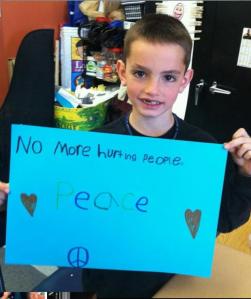 Good Morning!
We certainly have created a lot of ways to destroy each other haven’t we? We also seem to breed a lot of individuals that are capable of doing great harm without reservation. This week has brought the carnage once again into our back yard. It is important to remember that we have brought and are bringing worse carnage and that we are not alone in our experience.
We have sophisticated drones that appear to take out as many innocents as they do bad guys. Just yesterday in Baghdad, a suicide bomber killed 26 in a crowded cafe. Less than a month ago, 2 blasts occurred in a busy shopping district of Hyderabad, India. These twin blasts killed 14 people and injured 119. Seventeen were injured today in Bangalore in a car bomb blast. Neither India or Boston are war zones. Baghdad was not a war zone until we invaded it. We left it to whatever it is today.
Then, there is the daily amount of gun violence in the country. Let me return to Boston for this perspective.
Boston Police Commissioner Edward F. Davis said today that he hopes to cut gun crimes in half this summer during Boston’s most violent months: July and August, when the city typically sees between 37 and 48 shootings each month.
The department’s ranks were boosted as 28 members of the force were promoted and one new officer was named during a ceremony this morning.
Davis said those promotions represent the department’s efforts to fill vacancies in preparation for the summertime.
“We’re going to have a full court press on those months this year,” said Davis. “We’re gonna do a lot of preventive work leading up to those months. There’s gonna be a significant amount of attention paid to the impact players in the city. We want them to put their weapons down.”
Nationally, we experience 88 gun deaths a day. There have been about 3,524 gun deaths in this country since the Sandy Hook Slaughter. As you carefully read that sign made by the youngest victim of the Boston Bombs above, consider this:
… a child in the U.S is about 13 times more likely to be a victim of a firearm-related homicide than children in most other industrialized nations.
Firearms were the third leading cause of injury-related deaths nationwide in 2010, following poisoning and motor vehicle accidents, according to the Centers for Disease Control and Prevention.
For the sake of comparison, in 2010 there were more than twice as many firearms deaths in the U.S. than terrorism-related deaths worldwide.
Then consider how completely ignorant most people are of our violent legacies to other countries. Think of mass murderers of the 20th century, and then read this.
Mr. Kissinger’s most significant historical act was executing Richard Nixon’s orders to conduct the most massive bombing campaign, largely of civilian targets, in world history. He dropped 3.7 million tons of bombs** between January 1969 and January 1973 – nearly twice the two million dropped on all of Europe and the Pacific in World War II. He secretly and illegally devastated villages throughout areas of Cambodia inhabited by a U.S. Embassy-estimated two million people; quadrupled the bombing of Laos and laid waste to the 700-year old civilization on the Plain of Jars; and struck civilian targets throughout North Vietnam – Haiphong harbor, dikes, cities, Bach Mai Hospital – which even Lyndon Johnson had avoided. His aerial slaughter helped kill, wound or make homeless an officially-estimated six million human beings**, mostly civilians who posed no threat whatsoever to U.S. national security and had committed no offense against it.
Sen. Lindsey Graham (R-S.C.), a staunch supporter of the U.S. drone wars, Wednesday become the first government official to put a number on the estimated drone strike death toll.
“We’ve killed 4,700,” Graham said during a speech at a South Carolina rotary club, reported on by the local Easley Patch and flagged by Al Jazeera.
“This is the first time a US official has put a total number on it,” said Micah Zenko, a fellow at the Council on Foreign Relations told Al Jazeera, but Graham’s office stated that the senator was only repeating “the figure that has been publicly reported and disseminated on cable news.” Graham’s figure aligns with estimates from groups included the U.K.-based Bureau of Investigative Journalism (BIJ), which has calculate that between 3,072 and 4,756 people have been killed by U.S. drones in Pakistan, Yemen and Somalia.
Graham’s figure did not distinguish between “combatant” and “civilian” casualties — a distinction which has, in the War on Terror, prompted debate. But the senator did reportedly say, “Sometimes you hit innocent people, and I hate that, but we’re at war, and we’ve taken out some very senior members of al-Qaida.”
I’d like to know why some acts of violence attract so much attention and outrage? Tons of folks have been out in their virtual scooby vans warping into the witch hunt version of Encyclopedia Brown trying to finger the ‘dark skinned’ individuals that could’ve set the bombs on the Boston Marathon route. Have any of these idiots ever looked at the gun death rate in their own town or state? Have they ever concerned the morality of bombing wedding celebrations? Are they still taking Henry Kissinger or Donald Rumsfeld seriously? Have they possibly cracked a paper to find out exactly how many bombings happen on this planet and how many of them we commit? For that matter, why aren’t they looking for guys that look like Timothy McVeigh or Eric Rudolph? Ever been to London and tried to find a trash can?
In London, public trash cans are hard to come by, as they’re an easy receptacle for bombs. Which makes it hard to throw things away properly! Now, the city is going to bring trash cans back, but they’re going to be big, hulking masses, totally bomb-proof and equipped with LCD screens to tell you the days news as you throw away your coffee cup.
Traveling to Europe–especially London–in the 1970s and 1980s included an introduction to basic instructions on what to do if a bomb went off and what to do to avoid being in an area that was likely subject to bombing. There are still Basque separatists bombing Spain. We’re coming up on the anniversary of Bloody Sunday. I was in Europe a lot in 1972 and it was like the year of the bomb over there. But, again, there was Kissinger too. It was the year I learned not to look or sound overly American.
Hundreds of thousands of innocent human beings in Laos, Cambodia and Vietnam were forced to live in holes and caves, like animals. Many tens of thousands were burned alive by the bombs, slowly dying in agony. Others were buried alive, as they gradually suffocated to death when a 500 pound bomb exploded nearby. Most were victims of antipersonnel bombs designed primarily to maim not kill, many of the survivors carrying the metal, jagged or plastic pellets in their bodies for the rest of their lives.
Then, riddle me this. What is the difference between setting bombs on the street filled with crowds, or a bomb in a cafe, or a drone that hits a wedding or having one Texas “Job Creator” callously killing an entire city and a lot of its inhabitants because he just doesn’t want to be bothered with work place safety regulations or say, proper placement of a dangerous plant to start out with? I mean what exactly do you call a guy that runs a business that blows up an entire town and kills–at this point in time–35 people including 10 first responders? (That’s a link to CNN and USA Today so consider it with care.)
It really bothers me that we–as a nation–appear to have selective attention on what kind of violence gets our shock and attention and what kinds of violence we choose to ignore every day, every year, or in the case of the atrocities of Kissinger, every decade or four. We have had some horrific carnage recently. We’ve had children slaughtered in their classroom. We’ve had folks standing on the street celebrating a holiday ending up in hospital with wounds severe enough to warrant the kinds of amputees soldiers need in Afghanistan. This is horrific, but it does not operate in a vacuum or a world where we have done no wrong or where these kinds of events are rare.

Child victim in Gaza
So, call me Debbie Downer and tell me to get my unpatriotic ass out of the country or call me insensitive. I want to see a consistent and strong level of outrage, shock, and trauma displayed for all innocent victims of unspeakable violence. The hometowns of all of these victims should be our hometowns.

Child victim in Syria
Here is a great question from a great writer, Juan Cole. Can the Boston Bombings increase our Sympathy for Iraq and Syria, for all such Victims?
The idea of three dead, several more critically wounded, and over a 100 injured, merely for running in a marathon (often running for charities or victims of other tragedies) is terrible to contemplate. Our hearts are broken for the victims and their family and friends, for the runners who will not run again.
There is negative energy implicit in such a violent event, and there is potential positive energy to be had from the way that we respond to it. To fight our contemporary pathologies, the tragedy has to be turned to empathy and universal compassion rather than to anger and racial profiling. Whatever sick mind dreamed up this act did not manifest the essence of any large group of people. Terrorists and supremacists represent only themselves, and always harm their own ethnic or religious group along with everyone else.
The negative energies were palpable. Fox News contributor Erik Rush tweeted, “Everybody do the National Security Ankle Grab! Let’s bring more Saudis in without screening them! C’mon!” When asked if he was already scapegoating Muslims, he replied, ““Yes, they’re evil. Let’s kill them all.” Challenged on that, he replied, “Sarcasm, idiot!” What would happen, I wonder, if someone sarcastically asked on Twitter why, whenever there is a bombing in the US, one of the suspects everyone has to consider is white people? I did, mischievously and with Mr. Rush in mind, and was told repeatedly that it wasn’t right to tar all members of a group with the brush of a few. They were so unselfconscious that they didn’t seem to realize that this was what was being done to Muslims!
Indeed, sympathy for Boston’s victims has come from around the world from places like Iraq that we’ve plastered with bombs not that long ago. Condemnation for this act came from elected officials in Egypt from the Muslim Brotherhood which has been absolutely slathered with the mark of satan by the likes of our elected officials like whacko Michelle Bachmann. This part of Cole’s essay really got to me and I was already teary eyed hearing about Jane and Martin Richard from their school’s headmaster on Last Word.
Some Syrians and Iraqis pointed out that many more people died from bombings and other violence in their countries on Monday than did Americans, and that they felt slighted because the major news networks in the West (which are actually global media) more or less ignored their carnage but gave wall to wall coverage of Boston.
Aljazeera English reported on the Iraq bombings, which killed some 46 in several cities, and were likely intended to disrupt next week’s provincial election.
Over the weekend, Syrian regime fighter jets bombed Syrian cities, killing two dozen people, including non-combatants:
What happened in Boston is undeniably important and newsworthy. But so is what happened in Iraq and Syria. It is not the American people’s fault that they have a capitalist news model, where news is often carried on television to sell advertising. The corporations have decided that for the most part, Iraq and Syria aren’t what will attract Nielsen viewers and therefore advertising dollars. Given the global dominance by US news corporations, this decision has an impact on coverage in much of the world.
Here is a video by the United Nations High Commission on Refugees (UNHCR) on the dilemma of the over one million displaced Syrians, half of them children:
So I’d like to turn the complaint on its head. Having experienced the shock and grief of the Boston bombings, cannot we in the US empathize more with Iraqi victims and Syrian victims? Compassion for all is the only way to turn such tragedies toward positive energy.
Perhaps some Americans, in this moment of distress, will be willing to be also distressed over the dreadful conditions in which Syrian refugees are living, and will be willing to go to the aid of Oxfam’s Syria appeal. Some of those Syrians living in refugee camps in Jordan, Lebanon and Turkey were also hit by shrapnel or lost limbs. Perhaps some of us will donate to them in the name of our own Boston Marathon victims of senseless violence.
Terrorism has no nation or religion. But likewise its victims are human beings, precious human beings, who must be the objects of compassion for us all.
It is absolutely true that the shortcomings of our press this week were on parade this week. They basically spent hour-after-hour in what seemed like a glorified witch hunt. But there is a bigger injustice and short coming. Other people around the world–suffering and dying–deserve to have their stories told also. Every innocent victim of violence deserves justice and recognition. This is true of those 88 who die every day in this country from guns. It is true of all those killed by state violence be it ours or Bashar al-Assad or the crazy jerks that set of bombs on streets all over the world or fire military style weapons in our schools and movie theaters. All of this should cause the press to do its job and it should cause our hearts to grieve equally. Why obsess minute by minute on one act when there is a world full of them to choose from? Why not give all of the victims of violence their due?
So, what is on your reading and blogging list today?
You just can’t keep (or put) those Evil NeoCons down
Posted: September 16, 2012 Filed under: 2012 elections, Egypt, Foreign Affairs, Great Britain, Israel, Libya | Tags: chicken hawks, NeoCons, war mongers 32 Comments Mitt Romney’s foreign policy advisers are like the who is who of the Rummy/Cheney NeoCon War Club. They may have been driven underground by public opinion after the failed wars of Dubya Bush but they are hardly down and out.
Republicans lost their popularity on security issues for one reason: George W. Bush’s foreign policy was a disaster. And yet, the party’s nominee, Mitt Romney, has assembled a foreign-policy team composed almost exclusively of individuals with the same war-always mentality and ideology that served Bush — and the United States — so poorly. In some cases, the exact same men responsible for Bush’s catastrophic national security policies are advising Romney. The former Massachusetts governor could have included some of the pragmatists and realists from the George H.W. Bush administration. Instead, a Romney presidency seems like it would be Bush 43 all over again.
Richard Grenell, who served as United Nations spokesman under Bush, may be gone from the Romney campaign after an uproar over his sexuality, but there are plenty more former Bushies. First off, there are Romney’s “special advisors.” There’s Michael Chertoff, W.’s Homeland Security director. Chertoff oversaw DHS’s failures during Hurricane Katrina, and amassed unprecedented powers of secrecy. Next up is Eliot Cohen, counselor to the State Department for Bush’s last two years and on the Defense Policy Advisory Board for the president’s entire term. Cohen was an adamant supporter of the Iraq War and advised Bush directly on the issue. Or take Cofer Black, the man who infamously said to Bush in September 2011 about al-Qaida that “When we’re through with them they will have flies walking across their eyeballs.” Black went on to become chairman of Blackwater, where he resigned after the company illegally bribed Iraqi officials.
US Neocons and their Israeli counterparts have been beating drums every where for a US strike on Iran. There are headlines that suggest an Israeli strike on Iran may be forthcoming again. It’s no wonder there are all kinds of weird things happening–like massive anti-US protests suddenly popping up over a recent Arab translation of an Islamic hate film–that looks like contrived September/October Surprises. We have hints from Egypt’s PM that folks were paid to protest in Cairo and from Libya that the Libyan embassy attack may have been planned. So, where did the money come from? Is this really a last gasp from a nearly dead Al-Quaeda or possibly a set of false flag operations from people that want the US to strike Iran?
h/t to ralphb
So, what is with this massive movement of navy assets to the Gulf by British and US forces? Just what do they anticipate?
Battleships, aircraft carriers, minesweepers and submarines from 25 nations are converging on the strategically important Strait of Hormuz in an unprecedented show of force as Israel and Iran move towards the brink of war.
Western leaders are convinced that Iran will retaliate to any attack by attempting to mine or blockade the shipping lane through which passes around 18 million barrels of oil every day, approximately 35 per cent of the world’s petroleum traded by sea.
A blockade would have a catastrophic effect on the fragile economies of Britain, Europe the United States and Japan, all of which rely heavily on oil and gas supplies from the Gulf.
The Strait of Hormuz is one of the world’s most congested international waterways. It is only 21 miles wide at its narrowest point and is bordered by the Iranian coast to the north and the United Arab Emirates to the south.
In preparation for any pre-emptive or retaliatory action by Iran, warships from more than 25 countries, including the United States, Britain, France, Saudi Arabia and the UAE, will today begin an annual 12-day exercise.
If true, this is very, very bad. What exactly would the US do?
Washington is hoping and waiting for a positive outcome for its sanctions against Iran, and will not go along with Israel’s demands to attack the country, Iranian political scientist and professor Nasser Nadian-Jazy said in an interview with RT.
Nadian-Jazy believes that if President Obama is re-elected, he will be more willing to take a risk on diplomacy with Tehran and work out a plan to resolve tensions in a way that will be mutually beneficial for both America and Iran.
RT: Iran has just hosted a huge international event – the Non-Aligned Movement summit. There were 120 countries present, regardless of the US and Israel’s warnings not to do so. What message exactly is Iran sending out there?
Nasser Nadian-Jazy: Basically, Iran attempted to say that we’re not isolated the way the West attempted. Thus, the principal message for Iran was convincing the international community, particularly the West, that Iran is not isolated, let’s resolve our issues on the basis of negotiation rather than sanctions, political pressure and isolation.
RT: One could call it probably diplomatic power – you had 120 countries coming to you – regardless of America saying ‘don’t go.’ Does this immunize you from a possible strike [on Iran]?
NNJ: Of course not. Although, I’m not all that convinced that the Israelis would attack Iran, because that does not serve their interests. That would not help them to achieve their objectives. It would be costly for them, too. They can begin the strike, the war, but they are not sure how and when Iran is going to respond. In fact, no one can predict it.
RT: Do you have a guess how much the war with Iran would cost to the world economy?
NNJ: No doubt that as the first planes and missiles are flying over Iran, the price of oil is going to jump up – at least for a while. Considering the current economic problems now, I doubt it would be very helpful to the global economy.
RT: Since we’ve started talking about this possible strike, the US and Israel have different views on whether this strike should take place or not. What will happen, in your opinion, after the US presidential election?
NNJ: My guess is that if President Obama is re-elected, he would attempt to somehow work out a plan that would be beneficial for both America and Iran. Up to this point, America should basically consider the pressure. They cannot dismiss the presidential elections, they cannot dismiss the pressure from Israel. But after that, President Obama will be more willing to take risks with diplomatic efforts.
RT: You mentioned you don’t actually think that Israel would go ahead with the strike. But does it actually have the capability to fight the war?
NNJ: Up to this moment I’m almost convinced – though not totally convinced – that Israelis are putting pressure on the international community, particularly America with its presidential election. They want to get more; they want to make America accept their red line, which is zero [uranium] enrichment for Iran. They feel this is the best time to pressure America to accept that red line. America has not accepted that red line. For America, the red line is Iran having actual [nuclear] weapons.
But in case they decide to attack, they will not achieve their objectives. They do not have the capability to attack Iran. At most they can attack a few places by missiles and war planes. That would not convince Iran not to pursue its nuclear program.
If effectively put that way, it can bring out the radicals of Iran – those who are arguing for nuclear weapons. An Israeli attack is the best-case scenario for them. Basically, Israelis would strengthen the [Iranian] radicals who want them out. But the absolute majority of Iranian pundits and elites and officials – they don’t want this [nuclear] weapons. What they want is the capability [to make them]. I’ve been arguing that since 2003, Iran does not want [nuclear] weapons, Iran wants the capability
Then, there’s the Iranian response. What happens when two nations of basically well-educated, rational people are run by war mongering right wing nutters that have access to all kinds of technology because,well, we gave it to them because during the post WW2 era when were more concerned with containing the influence of the USSR than creating tempests in a bunch of little teapots around the globe. Blowback is a bitch, isn’t it?
The top commander in Iran’s powerful Revolutionary Guard warned Sunday that his country’s missiles will ensure “nothing will remain” of Israel if it takes military action against Tehran over its controversial nuclear program.
Gen. Mohammad Ali Jafari also warned that Iran might close the Straits of Hormuz if it is attacked, withdraw from the Nuclear Non-Proliferation Treaty and hit U.S. bases in the Middle East.
Such warnings and references to Israel’s destruction have been made before by Iranian officials. But Gen. Jafari’s comments to a Tehran news conference were an unusually detailed, strongly worded and comprehensive listing of the means that Iran says it has to retaliate against a strike on its nuclear facilities.
The U.S. and Israel have left open the possibility of such a strike if Iran does not back down from what they say are a push to develop nuclear weapons. Iran says its nuclear program is for peaceful purposes.
“Our response to Israel is clear: I think nothing will remain of Israel (should it attack Iran). Given Israel’s small land area and its vulnerability to a massive volume of Iran’s missiles, I don’t think any spot in Israel will remain safe,” he said.
He said Iran’s response to any attack will begin near the Israeli border.
The Islamic Republic has close ties with militants in Gaza and Lebanon, both of whom have rocket arsenals that could be used for cross-border strikes.
He said he did not believe however that Israel would attack on its own. Should the U.S. launch a strike, Jafari suggested that Iran could respond with missile salvos at U.S. bases in the Gulf.
“The US military bases sprawled around Iran are considered a big vulnerability. Even the missile shields that they have set up, based on information we have, could only work for a few missiles but when exposed to a massive volume of missiles, the shields will lose their efficiency and will not work,” he said.
He also said that Iran warned that oil shipments through the strategic Strait of Hormuz will be in jeopardy if a war breaks out between Iran and the United States. Iranian officials have previously threatened to close the waterway, the route for a fifth of the world’s oil, but less frequently in recent months.
“If a war breaks out where one side is Iran and the other side is the West and U.S., it’s natural that a problem should occur in the Strait of Hormuz. Export of energy will be harmed. It’s natural that this will happen,” he said.
I’m waiting to see what oil futures do when the European Markets begin to open. This will give us an indication of how seriously the money in the world is taking all of this.
This isn’t the first time that Benjamin Netanyahu’s NeoCon philosophy has jeopardized more things than all of us would like to consider. The British media considers his angry words to be putting a group of nations on alert. You’ll notice that we’re seeing less of this in the US media and that most of my links here go to overseas mainstream media with the exception of the SF Chronicle link.
A fortnight ago, the Israeli prime minister exploded in anger during a meeting with the American ambassador to Tel Aviv, furious at the Obama administration’s reluctance to state at what point he would authorise force to prevent Iran becoming a nuclear power.
A senior congressman who witnessed the encounter said that Mr Netanyahu was “agitated” and “worked up”, describing the meeting as the tensest he had ever attended with a foreign leader.
Last week, Mr Netanyahu publicly turned his wrath on Barack Obama himself, warning the American president that if he was unwilling to set fixed red lines that Iran could not cross, he had no “moral right” to prevent Israel taking military action of its own.
Ever since Mr Netanyahu came to power in 2009, Israel has regularly appeared to be on the brink of striking at Iran’s nuclear facilities, but never has the speculation been as fevered as it has in the past few months.
Many in Israel have predicted that the prime minister would order his air force into the skies, with or without Washington’s blessing, before Americans go to the polls in November.
Reinforcing the febrile atmosphere of expectation among the public, gas masks have been handed out and warning systems tested as Israel steps up home front preparations against possible retaliatory attacks in the aftermath of a strike against Iran.
Mr Netanyahu is prone to periodic bouts of bellicose rhetoric towards Iran, part of a double strategy to unnerve Tehran and step up pressure on the West to take Israel seriously.
He may again be bluffing, but his threats are being taken with the utmost seriousness in Western capitals. A phalanx of senior European and American officials, including Sir John Sawers, the head of MI6, have been despatched to Jerusalem to plead for restraint.
Mr Netanyahu’s increasingly emotional diplomacy has caused irritation among some Democrats, who see his interventions as a ploy to influence the outcome of the election.
There is little doubt that the prime minister would rather see Mitt Romney, an old acquaintance who has made it a campaign pledge never to criticise Israel in public, in the White House.
There has been concern in Israel too that Mr Netanyahu’s abrasive language could harm the country’s special relationship with the United States, whose steadfast patronage has ensured the survival of the Jewish state.
I’m going to be following this story closely as I think we all should. Again, it could be that the Neocons in both Israel and the US are itching for ways to push for a Romney presidency. Thankfully, Romney is such a dolt that he’s been unable to get any advantage in this with any one other that the right wing nuts that already goose step around him. So, again, where’s the money coming from? Where did the money come from that funded that hateful film? Where did the money come from to pay the Cairo protesters and the Libyan organized assault? Are these people paying people to do similar things at embassies around the world? Why is all this being hyped so close to a US election? I’m looking for answers because I smell a bunch of neocon rats. I’m not the only one either. That link goes to Eliot Spitzer. This one goes to WAPO and Jason Horowitz.
His reaction this week made it clear that when it comes to Republican foreign policy, the neocons are still the only game in town.
“This is probably where most of the numbers are right now in the Republican foreign policy firmament and where most of the energy is,” one prominent realist who has advised several Republican presidents lamented. “It’s the path of least resistance as a Republican.”
Alex Wong, Romney’s foreign policy director, refused to utter the word “neoconservative” or to characterize the candidate as an adherent of neoconservatism, instead repeating only that Romney believes in “peace through strength.” But Romney and his advisers — Wong declined to say whether they were consulted before the candidate weighed in on the the embassy chaos — are tripling down on the clear contrasts offered by neoconservatism’s trumpeting of values, which lends itself nicely to campaign seasons but is more complicated in actual governance (see the war in Iraq).
We certainly do not need any more NeoCon lies leading us into more endless wars.

 peej
peej Carissa
 bostonboomer
 dakinikat
 ecocatwoman
 mablue2
 Mama Lopez
 peggysue22
 quixote
 skydancingguestblogger
 Mona (aka Wonk the Vote)



 Sky Dancing
Recent Comments