
Women Front and Center in MENA Protests
Posted: December 22, 2011 Filed under: Bahrain, Egypt, Foreign Affairs, Tunisia, Violence against women, Women's Rights | Tags: women fighting fundamentalist religions, women in democracy protests, Women's Rights 4 Comments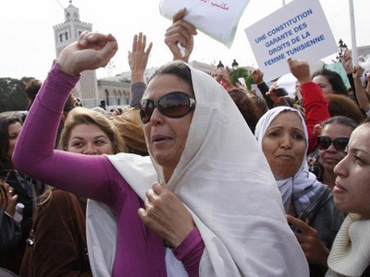 Many cultures in the MENA region are well-known for their horrible treatment of women. We see practices like honor killings, genital mutilation, and taking child brides. One of the offshoots of the Arab Spring has been the central role of women looking for broader participation in their countries.
Just as we in the United States are experiencing a political/fundamentalist Christian backlash that has turned into a war on the rights of women, the protests movements associated with the Jasmine Revolutions and their related political change have brought out a wave of political/fundamentalist Muslim backlash. There are several signs of hope in a region experiencing lots of social unrest. First, we’ve become aware of a large number of feminist leaders. Second, we’ve seen that many women are putting their lives on the line to ensure that the social change includes improving the lives and status of women. While oppression of women is frequently attached to fundamentalist religious followers, the roles of traditional tribal cultures and their dominance in places that are underdeveloped and rural–like Alabama or Uganda–cannot be underestimated. Here’s some stories that have made headlines recently that show the global struggle for women’s rights–like the US struggle for women’s rights–is still an uphill battle.
In response, thousands of women — and men — marched Tuesday in Cairo’s Tahrir Square. Observers say it was the largest demonstration of women in Egypt in decades. Not since 1919, when women mobilized under the leadership of feminist Hoda Sha’rawi in anti-colonial demonstrations against the British have so many Egyptian women taken to the streets. (After representing Egyptian women at the International Women Suffrage Alliance in Rome in 1923, Sha’rawi returned to Cairo and very publicly removed her veil.)
Women have played an important role in Egypt’s modern revolution but have struggled to translate their activism into a political role in the new, emerging system. They have been excluded from important decision-making bodies, and the military leadership declined to continue a Mubarak-era quota for women that ensured them at least 64 seats in parliament. Based on early election results, it appears that few women will win a place in the new government.
Nevertheless, one intrepid woman, Bothaina Kamel, is breaking ground with her candidacy for president. The campaign of Kamel, a well-known television presenter, at first was shocking, and certainly quixotic, with polls indicating her support is less than 1%. But her persistence has gained her credibility. While she has little chance of winning, she is helping to normalize the idea of women in politics — an idea that is deeply contested in Egyptian society. Leaders of Salafi parties, which gained a surprising 20% of the vote in the first rounds of elections, have spoken out against women running for office.
The recent women’s protest may breathe life into a movement that desperately needs new energy. In the early weeks of the revolution, women activists tried to bring attention to women’s issues but never succeeded in getting the masses behind them.
Tunisian women are also concerned about women’s rights since the country’s recent elections. The picture up top is from that country. Newly elected leaders have had to promise to recommit their country to modernization and democratic principals that include increased roles of women.
“We are all the women of Tunisia,” stated Professor Khalid Kshir of Tunis University in conversation with the author of this article. Professor Kshir is a member of the Democratic Modernist Pole, a coalition of leftist parties. He fears that the Ennahda party will push the country back instead of moving it forward.
Just a year ago, literally weeks before the start of the uprising in the country, Tunisians had joked that theirs was a country of free women and happy men. No other Arab nation had ever granted so many rights to women, fixed de jure and de facto, than Tunisia. That was something of which Tunisians were proud, and even boasted about. Today, many people in Tunisia fear that the country’s achievements on the road to becoming a modern society will be brought to nought.
”We need to focus all our efforts in the sphere of politics and culture on women’s rights, because women form half of our society and any infringement on their rights will be harmful to all of us,” Professor Kshir went on to say.
Strange as it may seem, the issue of women’s rights was also on the agenda of a conference on promoting tourism which took place in Tunisia early in November, shortly before the final election results were announced. The conference was organized by the Ennahda party, which decided not to wait for the National Constituent Assembly to convene and the government to be formed before holding a series of meetings with representatives of Tunisia’s major industries in order to lay out the priorities for getting the national economy out of its post-revolution stupor. The discussion on the prospects for yourism was among the first meetings to be held, along with a conference on the financial market, co-sponsored by Tunisia’s Brokers’ Association.
…
The party leader’s comforting assurance came in response to concerns expressed by travel agencies, tour operators, hoteliers and bankers at the meeting, who voiced questions such as, “What will be Tunisia’s international image following your electoral victory? What will happen to women’s rights? How will European tourists feel in Tunisia, and do they have a reason to fear Islamists?”
What started as a discussion on the prospects of tourism eventually escalated into a broader deliberation on Tunisia’s prospective path of development. There are strong reasons for such an interconnection: tourism accounts for six per cent of Tunisia’s GDP and makes up 60 per cent of the national trade deficit. The industry employs 12 per cent of the country’s working population, while one in eight Tunisian families live off tourism, one way or another. During the revolutionary turmoil which rocked the country between January and September 2011, tourism revenues in Tunisia plunged by 38.5 per cent compared to a similar period in 2010, while the overall number of tourists coming to Tunisia sank by 34.4 per cent.
That is why at present Ennahda is ready for dialogue and compromise. “We guarantee freedom in food, drink and clothes,” Hamadi Jebali said.
He emphasized that his party would respect democratic principles and that Tunisian society would retain its progressive nature. According to Jebali, the revolution took place in the name of improving the lives of Tunisian citizens and moving the country forward rather than hindering its development.
Many of those present at the conference believed the words of the Ennahda leader – or said that they did. “I believe Jebali. I am an optimist but only on condition that the rights of women won’t be violated and if we don’t follow the path of Saudi Arabia where a woman can do business but is forbidden to drive a car,” Sihem Zaiem, a member of the Federation of Tourist Agencies, said after the conference.
Delegates applauded her when she demanded that the Ennahda secretary-general explain Tunisia’s true face to the world as soon as possible, and demonstrate Islamists’ attitude to women’s rights. Jebali promised that nothing would change in the arena of women’s rights. His speech was very convincing.
A mother in Bahrain has gone to jail for playing revolutionary music and participating in protests.
Fadhila Al Mubarak, a 38-year-old mother of a 9-year-old boy, is still in jail after she was sentenced in an unfair military trial for charges related directly to exercising her right to freedom of expression and peaceful assembly. She was detained and prosecuted in a military court for playing revolutionary music in her car, trying to save her son and nieces, participating in peaceful protests in Pearl Roundabout and writing a poem to her son about the revolution, freedom and fighting for his future. The information available on the conditions of her detention is very worrying and her family has raised concerns over her health.
Fadhila, who was living with her husband and her son in the area of Aali, was arrested on 27 March 2011, just a few days after the National Safety Law was imposed on 15 March 2011. She was arrested at a checkpoint because there was an audio recording of revolutionary songs playing in her car. She was asked to pull over her car and step out. They insulted her, called her names and cursed her. While security officers at the checkpoint were talking to her, a man in civilian clothing tried to get into her car. In fear over the safety of the children, her son (9), nieces (14 – 15), she pulled him away thinking he was a thug who would kidnap or hurt them. Later, she found out he was a police officer.
Her family asked about her at police stations close to the checkpoint where she was arrested only to find out after four days that she was held in Riffa police station. She was later transferred to Isa Town women’s prison. During the period of her detention, her family had no contact with her and was not allowed to visit or talk to her over phone. Family members tried to appoint her a lawyer, a request that was rejected by the military court.
Women in the region can take heart from the post revolutionary experience of Indonesia’s women who have managed to get many advances since their repression by former president Soeharto following a 1965 tragedy. Indonesia is the world’s largest Muslim majority democracy. As with all countries, religious fundamentalists obsessed with old testament prohibitions continue to seek repression of women. However, Indonesian laws continue to reflect the country’s will to improve conditions for women. The current president seems to be backsliding on reforms gained during the tenure of Indonesia’s previous PM.
Of course, like the feminists have suggested, the Reform Era in 1998 has given women opportunities to revive the real spirit of Kartini. However, as Mariana suggested, the Reform Era was nothing but “a short-term honeymoon” moment for women’s movement.
When the late former president Abdurrahman Wahid changed the name of the ministry of women affairs into the ministry of women’s empowerment, for example, feminists felt very confident about their cause. In addition to that, the National Commission on Violence Against Women (Komnas Perempuan) was given full support to continue its investigation into the May 1998 tragedy, where many Chinese women were sexually abused.
“During Megawati’s era, we were more enthusiastic because the first woman was finally installed as a president amid opposition from some religious leaders,” Mariana said. “Megawati then also succeeded in passing the law on domestic violence.”
Celebrating women’s achievement even more, she added, was the policy of granting women a 30 percent quota of seats in the Parliament.
However, this celebration of women’s movement had to end in 2005, when Susilo Bambang Yu-dhoyono won his first presidential term.
“The year marked the introduction of the pornography bill, which was mentioned by President SBY during his first [presidential] speech,” said Mariana. “He even took the opportunity to comment about women’s belly buttons!”
And from that moment on, she went on, the women’s movement in Indonesia started to lose its ground. While battling against the criminalization of women, feminists have been labeled as “Western devilish agents”, gaining a bad reputation in society.
It seems that vigilance of women over their rights in all democracies is important. That is why it is important that women officials with high public profiles–like US SOS Hillary Clinton–continue to keep their focus on the rights of women and also GLBT rights aound the world. The world’s religious fundamentalists continue to press for backsliding. Religious fanatics push for edicts that can run the gambit from defining an egg as a person to hold women’s bodies hostage to narrow religious views of ‘life’ as in seen in Arkansas recently. There are also the many Sub-Saharan African nations–like Nigeria and Uganda–where laws ignore or encourage violence against GLBT because of both Muslim and Christian extremists in the regions. The latter example has been funded for and encouraged by US fundamentalist Christians which is even a more outrageous intervention than just resurrecting or perpetuating native tribal traditions like the child bride tradition which is also a problem in places like highly Christian Guatemala as well as Western African countries.
SOS Clinton strongly condemned the treatment of women protestors by Egyptian security forces this week. It is heartening to see her speak out for women’s full participation in democratic movements and governance.
In unusually strong language, the US secretary of state accused Egypt’s new leaders of mistreatment of women both on the street and in politics since the street revolt nearly a year ago that overthrew leader Hosni Mubarak.
“This systematic degradation of Egyptian women dishonours the revolution, disgraces the state and its uniform and is not worthy of a great people,” Mrs Clinton said in a speech at Georgetown University.
In images widely seen over YouTube, helmeted troops were shown beating a veiled woman after having ripped her clothes off to reveal her bra and stomach.
Other pictures circulating on social media networks that have enraged protesters include one of a military policeman looming over a sobbing elderly woman with his truncheon.
“Recent events in Egypt have been particularly shocking. Women are being beaten and humiliated in the same streets where they risked their lives for the revolution only a few short months ago,” Mrs Clinton said.
Here is the PBS NEWSHOUR coverage of the Egyptian Women’s protests and an interview with participant May Nabil. It has some interesting narrative of the march in that many woman spontaneously joined the march and weren’t just drawn to it via internet. Additionally, there were many supportive Egyptian men in attendance.
Thursday Reads
Posted: May 19, 2011 Filed under: Bahrain, Egypt, Environment, Farming, Foreign Affairs, Gaza, Iran, Israel, Libya, MENA, Pakistan, Psychopaths in charge, religion, Syria, Team Obama, Tunisia, U.S. Politics, We are so F'd | Tags: "historic" speeches, Barack Obama, birthers, Catholic Bishops, China, Dominique Strauss-Kahn, Espionage Act, Jane Mayer, Joseph Cannon, NSA spying, pedophile priests, rape, Thomas Drake, violence against women, whistle blowers 41 Comments
Good Morning!! Does anyone have a remedy for the sleepies? I recently finished a semester of teaching, and the last couple of days I’ve been extremely groggy. Yesterday I even slept until 10:30AM! It doesn’t help that we haven’t seen the sun in the Boston area for at least a week–it’s dark, dank, and raw out there. It seems a lot more like November than late May. On top of all that my Spring allergies are the worst I’ve ever experienced. So please forgive me if this post makes no sense. On to the news of the day.
Disgraced IMF honcho Dominque Strauss-Kahn’s accuser testified before a New York grand jury today. Immediately following her testimony, Strauss-Kahn’s attorneys announced their determination to spring their client from his cell at Rikers Island Jail.
His lawyers initially proposed a $1 million bail package that was rejected by the court.
Today a new offer that was said to add a private monitoring firm, an electronic bracelet and a guard to the package was put together. The cash component of the bail package remained at $1 million dollars, but the deal now included a guarantee that Strauss-Kahn would remain confined in New York City and not leave his residence except for visits to his doctor or lawyers. His passports and travel documents have already been taken from him.
According to ABC News, police are testing body fluids found in Strauss-Kahn’s hotel room for DNA.
ABC News has confirmed that police cut a swath of carpet to test for DNA and swabbed one of the suite’s sinks under a black light that indicated there was potential DNA evidence there.
Apparently Strauss-Kahn’s attorneys plan to claim that their client’s sexual encounter with a hotel maid was “consensual,” but there is a serious problem with that theory in addition to the maid’s testimony.
Investigators also say information downloaded from the suite door’s electronic card reader indicates the maid entered the room and never closed the door. The hotel policy requires maids to leave the door open when cleaning. The open door, they say, is proof that the women entered the room to work, not to engage in consensual sex.
I won’t dwell on this sordid story much longer, but I did want to call your attention to this piece in Time Magazine, which details a number of previous accusations against Strauss-Kahn–along with rumors –gossip about his abusive behavior toward women–that were hushed up until now. How predictable these guys are!
Joseph Cannon’s latest post is a must-read, along with the New Yorker article by Jane Mayer on which the Cannon comments. It’s about the domestic spying by the NSA that went on under Bush and the Obama administration’s heavy handed prosecution of whistleblowers while at the same time protecting the Bush administration criminals. (Minkoff Minx also mentioned Mayer’s article in her morning post yesterday.) Here’s an introduction to the piece by Cannon:
This humble blog spent a lot of time talking about NSA overreach during the controversies over Russell Tice and FISA. Meyer’s piece confirms a long-held suspicion that the real problem wasn’t eavesdropping on telephone calls but automated data-mining of all forms of electronic communication.
Two competing computer systems were designed to take us into this brave new world: ThinThread and Trailblazer. (The system in place now is called Turbulence. Someone at NSA has a strange affection for the letter T — which is also the first letter in totalitarian.) Trailblazer turned out to be a costly boondoggle. ThinThread worked. Originally, it had provisions built in to protect the privacy of American citizens; NSA Director Haybed tossed out those barriers.
Meyer focuses on an NSA whistleblower named Thomas Drake, who tried to blow the whistle on the Trailblazer fiasco — and on the abuses of privacy — to a staffer on the House Intelligence Committee. Unfortunately, the Committee was headed, at the time, by Porter Goss — and by Nancy Pelosi. They both seemed deaf to what Drake had to say.
Why is Obama so obsessed with prosecuting whistleblowers–even to the point of dusting off the Espionage Act? Jane Mayer writes:
When President Barack Obama took office, in 2009, he championed the cause of government transparency, and spoke admiringly of whistle-blowers, whom he described as “often the best source of information about waste, fraud, and abuse in government.” But the Obama Administration has pursued leak prosecutions with a surprising relentlessness. Including the Drake case, it has been using the Espionage Act to press criminal charges in five alleged instances of national-security leaks—more such prosecutions than have occurred in all previous Administrations combined. The Drake case is one of two that Obama’s Justice Department has carried over from the Bush years.
Gabriel Schoenfeld, a conservative political scientist at the Hudson Institute, who, in his book “Necessary Secrets” (2010), argues for more stringent protection of classified information, says, “Ironically, Obama has presided over the most draconian crackdown on leaks in our history—even more so than Nixon.”
Mayer asked Drake about it:
Sitting at a Formica table at the Tastee Diner, in Bethesda, Drake—who is a registered Republican—groaned and thrust his head into his hands. “I actually had hopes for Obama,” he said. He had not only expected the President to roll back the prosecutions launched by the Bush Administration; he had thought that Bush Administration officials would be investigated for overstepping the law in the “war on terror.”
“But power is incredibly destructive,” Drake said. “It’s a weird, pathological thing. I also think the intelligence community coöpted Obama, because he’s rather naïve about national security. He’s accepted the fear and secrecy. We’re in a scary space in this country.”
Check out her article if you can. She’s one of the best investigative reporters we have.
You may have missed Dakinikat’s late night post on Tuesday–the one about exploding watermelons. I thought this story deserved a little more emphasis, because it shows what can happen when there are no government regulations on agriculture–and industry in general (and that is what the Republicans would love to make happen). From Raw Story:
A bizarre wave of exploding watermelons — possibly due to farmers’ abuse of a growth-boosting chemical — has once again spotlighted safety fears plaguing China’s poorly regulated food sector.
State media has said nearly 50 hectares (120 acres) of watermelon crops in the eastern city of Danyang have been ruined by the phenomenon this month after some growers doused them with the growth accelerator forchlorfenuron.
“On May 7, I came out and counted 80 (exploded watermelons), but by the afternoon it was 100,” farmer Liu Mingsuo told state broadcaster China Central Television (CCTV) in a report that aired Tuesday. He said he had sprayed them with the chemical just a day before.
Remind me to never buy any food produce in China!!
Have you heard that the Obama campaign is selling T-shirts and coffee cups that mock the “birthers?”
President Obama’s 2012 presidential campaign today started selling “Made in the USA” t-shirts featuring images of both President Obama and the long-form birth certificate he released copies of last month.
Wear your support for this campaign with an official Made in the USA T-shirt,” his website advertises. Donate $25 or more today and we’ll send you your limited-edition shirt.
Coffee-mugs are also available.
“Remember ‘fight the smears’ from the 2008 campaign?” asked campaign spokesman Ben LaBolt. “This is the mobile version of it.”
Quite frankly, I think this is a little bit tacky….but that’s just me. And speaking of tasteless behavior, the Catholic Church is attempting to blame the ’60s counterculture for the behavior pedophile priests. From the Guardian UK:
The investigation commissioned by Catholic bishops said that the peak incidence of sexual abuse by priests in the 1960s and 70s reflected the increased level of other deviant behaviours in American society in the period, including “drug use and crime, as well as social changes, such as an increase in premarital sex and divorce.”
Researchers at John Jay College of Criminal Justice said most of the abusive priests were ordained in the 1940s and 50s and were not properly trained to confront the social upheavals of the 1960s.
David O’Brien, a historian of American Catholicism at the University of Dayton, said the report, Causes and Context of Sexual Abuse of Minors by Catholic Priests in the United States, 1950-2010, was dangerous because it seemed to exonerate bishops.
The study also ignores the long history of sexual abuse of children by the Catholic clergy. Methinks these “researchers” told the Catholic Bishops what they wanted to hear rather than do any serious research.
Finally, President Obama plans to give another “most amazing speech evah” tomorrow. This one is on the Middle East and North Africa. According to Voice of America:
The speech will be broad in scope, as Mr. Obama focuses on the peaceful democratic movements for change that have swept the region, discusses implications for U.S. policy, and offers what administration officials call some concrete policy proposals.
He will give his assessment of the impact of popular uprisings that have led to political changes in Egypt and Tunisia, and which continue in places like Syria, Libya and Yemen.
Senior administration officials say Mr. Obama will speak of a moment of opportunity, after a decade of great tensions and divisions, in which people of the region and U.S. policy can begin to turn the page toward a more positive and hopeful future.
The stalemated Israel-Palestinian peace process will be an important element. However, Mr. Obama is expected to frame it as part of a wider picture and say that leaders on both sides of that conflict should seize an opportunity for peace.
Whatever….I think I’ll arrange to be busy while he’s speechifying. Anyway, what are you reading and blogging about today?
The Changing Face of the MENA Region (Breaking News)
Posted: March 24, 2011 Filed under: Algeria, Bahrain, Egypt, Foreign Affairs, Iran, Iraq, Israel, Jordan, Lebanon, Libya, Syria, Tunisia, Yemen | Tags: arab awakening, MENA 8 Comments The WSJ reports that Yemeni President Saleh is working out a deal that will let him resign. The country’s leading general will also resign. The details will be released on Saturday.
“Both sides have agreed on the main points of departure, and Saturday is expected to be the day that Saleh and General Ahmar both step down,” according to a senior official familiar with the negotiations.
It couldn’t be determined which individuals were being considered as candidates for any transitional authority as talks continued late Thursday between the two leaders.
The support for mainstream opposition party leaders is unclear across the rugged and largely conservative country. Meanwhile, traditional tribal leaders who have great social standing would face problems exerting authority over rival tribes.
The Pentagon is currently holding a presser and has announced that they’re no longer ‘detecting’ Libyan planes in the air. NATO and the UN are expected to make an announcement shortly that NATO will be taking over the No-fly efforts. I just read some interesting analysis at Juan Cole’s Informed Consent on the Top Ten Accomplishments of the UN’s no-fly zone efforts. Cole says the French have also verified that Gadhafi’s air attacks have stopped and that his planes are grounded. There is also this tidbit.
The participation of the Muslim world in the United Nations no-fly zone over Libya has been underlined. The measure was called for by the Arab League, which has not in fact changed its mind about its desirability. Qatar is expected to be flying missions over Libya by this weekend. Other Arab League countries will give logistical support.
It is significant that the Arab League is supporting this action. The GCC (Gulf Cooperation Council)–an organization that is an essential part of my research on trade–is also trying to curb problems in Bahrain. This is significant because it shows that region is actively trying to create situations to jointly improve the conditions in the region.
Meanwhile, the people of Syria may be closer to the goals of their mostly peaceful protests. Syria is one of the most repressed countries in the region and has been under martial law for 50 years. Clashes between protesters and the government have increased recently.
President Bashar al-Assad made a rare public pledge to look into granting Syrians greater freedom on Thursday as anger mounted following attacks by security forces on protesters that left at least 37 dead.
Syrian opposition figures said the promises did not meet the aspirations of the people and were similar to those repeated at regular Baath Party conferences, where committees would be formed to study reforms that do not see the light of day.
“The leadership is trying to absorb the rage of the streets. We want to see reform on the ground,” said a protester in the southern city of Deraa.
A hospital official said at least 37 people had been killed in the southern city of Deraa on Wednesday when security forces opened fire on demonstrators inspired by uprisings across the Arab world that have shaken authoritarian leaders.
While an aide said Assad would study a possible end to 48 years of emergency rule, a human rights group said a leading pro-democracy activist, Mazen Darwish, had been arrested.
It’s exciting to watch the move to democracy and modernity in a region known for strongmen dictators, kings, and harsh political oppression. This will be an interesting situation to watch. I only hope that the people get what they are hoping for and that modernity and better treatment of women are part of the equation. Some of the states–like Qatar and the UAE–are further along in this pursuit than others. Yemen and Syria are perhaps the most dangerous parts of the equation. The Shia-Sunni dynamic is present and that always makes for a delicate situation.
Also, SOS Hillary Clinton will be making a statement shortly. We will try to keep you updated and give you interesting links as these new developments unfold.
Tuesday Reads
Posted: March 22, 2011 Filed under: Baby Boomers, Bahrain, Foreign Affairs, health hazard, Iraq, Japan, Libya, morning reads, psychology, Syria, U.S. Military, U.S. Politics, Water, Yemen | Tags: 1960s, Ali Abdullah Saleh, Bahrain, Fukushim nuclear plant, Hillary Clinton, id, iran, Japan, Libya, LSD, Muammar Gaddafi, Owsley Stanley, personality, Sigmund Freud, Syria, Wisconsin, Yemen 30 Comments
Good Morning!!
I’m teaching a Psychology of Personality course this semester, and yesterday I started lecturing about Freud and psychoanalytic theory. I was explaining Freud’s notion of the three parts of the personality–the id, the ego, and the superego. You’re probably familiar with those terms, but basically the id is there when we are born–it is completely self-centered, doesn’t know the difference between fantasy and reality, all it cares about is pleasure. It wants what it wants when it wants it. Sometime during infancy, we develop an ego that gets the id under some control, and around age 4-6 we develop a superego–basically like a conscience, that tells us which behaviors are right or wrong or socially acceptable.
Anyway, after class I was thinking about Muammar Gaddafi and his bizarre behavior–the way he has insisted for weeks that there is no opposition and that he isn’t attacking Libyan citizens. No, he would never do that. It occurred to me that Gaddafi is pretty much acting from his id all the time. Of course his ego keeps him somewhat connected to reality so he can function in the world, but mostly he just cares about his own needs.
I wonder if that is what happens to all leaders who gain absolute control. Does the quote “power corrupts and absolute power corrupts absolutely,” really mean that power causes people to regress to an earlier stage of development?
It sounds peculiar, but think about how powerful people get so many of their needs met by others. Obama doesn’t have to worry about paying for things, getting food or clothing, even getting information. It is all provided by other people. In many ways, it’s a kind of childlike, dependent state. So if the leader doesn’t have a strong character (ego), he can end up behaving in a narcissistic, childlike way.
OK, well that’s my not-very-deep thought for today.
So what’s happening in the news? As has often been the case in recent weeks, much of the big news is coming from outside the U.S.
On Libya, there has been more criticism of the UN resolution and how it is being carried out. I posted quite a few examples of the criticism in my post last night. Most of the objections are based on the fact that Libya is not at all important to the U.S. strategically.
Today I want to recommend a couple of articles that explain why the intervention in Libya, while troubling in many ways, was probably the right thing to do–even for U.S. interests. The first is by Mark Lynch at the Foreign Policy blog. Lynch uses the name “abuardvark” on twitter. His post is headlined Libya in its Arab Context Although Lynch has misgivings about the intervention and has written about them, he still thinks what the U.S. is doing is the right thing–both for the Arab world and for advancing our interests. Here’s his basic argument:
Libya matters to the United States not for its oil or intrinsic importance, but because it has been a key part of the rapidly evolving transformation of the Arab world. For Arab protestors and regimes alike, Gaddafi’s bloody response to the emerging Libyan protest movement had become a litmus test for the future of the Arab revolution. If Gaddafi succeeded in snuffing out the challenge by force without a meaningful response from the United States, Europe and the international community then that would have been interpreted as a green light for all other leaders to employ similar tactics. The strong international response, first with the tough targeted sanctions package brokered by the United States at the United Nations and now with the military intervention, has the potential to restrain those regimes from unleashing the hounds of war and to encourage the energized citizenry of the region to redouble their efforts to bring about change. This regional context may not be enough to justify the Libya intervention, but I believe it is essential for understanding the logic and stakes of the intervention by the U.S. and its allies.
Libya’s degeneration from protest movement into civil war has been at the center of the Arab public sphere for the last month. It is not an invention of the Obama administration, David Cameron or Nicholas Sarkozy. Al-Jazeera has been covering events in Libya extremely closely, even before it tragically lost one of its veteran cameramen to Qaddafi’s forces, and has placed it at the center of the evolving narrative of Arab uprisings. Over the last month I have heard personally or read comments from an enormous number of Arab activists and protest organizers and intellectuals from across the region that events in Libya would directly affect their own willingness to challenge their regimes. The centrality of Libya to the Arab transformation undermines arguments that Libya is not particularly important to the U.S. (it is, because it affects the entire region) or that Libya doesn’t matter more than, say, Cote D’Ivoire (which is also horrible but lacks the broader regional impact).
Lynch is still worried about what could go wrong:
I continue to have many, many reservations about the military intervention, especially about the risk that it will degenerate into an extended civil war which will require troops regardless of promises made today. But as I noted on Twitter over the weekend, for all those reservations I keep remembering how I felt at the world’s and America’s failure in Bosnia and Rwanda. And I can’t ignore the powerful place which Libya occupies in the emerging Arab transformations, and how the outcome there could shape the region’s future. Failure to act would have damned Obama in the eyes of the emerging empowered Arab public, would have emboldened brutality across the region, and would have left Qaddafi in place to wreak great harm. I would have preferred a non-military response — as, I am quite sure, the Obama administration would have preferred. But Qaddafi’s military advances and the failure of the sanctions to split his regime left Obama and his allies with few choices. The intervention did not come out of nowhere. It came out of an intense international focus on the Arab transformations and a conviction that what happens now could shape the region for decades.
At CNN, Peter Bergen tries to explain Why Libya 2011 is not Iraq 2003 I recommend checking it out.
Another article worth reading is by Robert Fisk at The Independent: Right across the Arab world, freedom is now a prospect
In the Middle East, Yemen may be close to ousting President Ali Abdullah Saleh. From the Guardian:
A military showdown is looming in Yemen after the defence minister announced that the army would defend the president against any “coup against democracy”. His statement came hours after 12 military commanders, including a senior general, defected from the regime and promised to protect anti-government protesters in the capital, Sana’a.
[….]
Yemen’s president, Ali Abdullah Saleh, suffered a significant blow when General Ali Mohsen al-Ahmar, his longtime confidant and head of the Yemeni army in the north-west, announced that he would support “the peaceful revolution” by sending soldiers under his command to protect the thousands gathered in the capital to demand that Saleh step down.
“According to what I’m feeling, and according to the feelings of my partner commanders and soldiers … I announce our support and our peaceful backing to the youth revolution,” Ali Mohsen said.
Minutes after his defection, tanks belonging to the republican guards, an elite force led by Ahmed Ali, the president’s son, rolled into the streets of Sana’a, setting the stage for a confrontation between defectors and loyalists.
At Bloomberg: U.S. Faces Loss of Key Ally Against Al-Qaeda in Yemen
…Yemeni President Ali Abdullah Saleh appears unlikely to weather a popular uprising and defections among his ruling elite, former U.S. officials said.
“It’s clear at this point that Saleh will have to step down,” Barbara Bodine, a former U.S. ambassador to Yemen, said in an interview yesterday. With the “mounting numbers of senior people in his administration resigning, we know it’s over. The terms of his departure, I think, are still being negotiated.”
The March 18 killing of at least 46 protesters allegedly by police and pro-regime gunmen — which drew condemnation from Obama and Secretary of State Hillary Clinton and prompted the defection of key military, tribal and government officials — may well be the tipping point.
Protests are continuing to escalate in Syria as well.
In Deraa, hundreds of black-uniformed security forces wielding AK-47 assault rifles lined the streets but did not confront thousands of mourners who marched at the funeral of 23-year-old Raed al-Kerad, a protester killed in Deraa.
“God, Syria, freedom. The people want the overthrow of corruption,” they chanted. The slogan is a play on the words “the people want the overthrow of the regime,” the rallying cry of revolutions that overthrew the veteran rulers of Tunisia and Egypt.
Security forces opened fire last Friday on civilians taking part in a peaceful protest in Deraa to demand the release of 15 children detained for writing protest graffiti.
Authorities released the children on Monday in a sign they were hoping to defuse tension in the border town, which witnessed more protests after Friday’s crackdown.
And there is a lot happening in Bahrain too. This article is worth a read: Libya burns but Bahrain can shake the world
While the world attention remains glued to the fires in Libya potential stakes in Bahrain are actually a hundred times higher. Safaniya Oil Field, the largest oil field in the world, is less than 200 miles from Manama. The Strait of Hormuz, through which passes 20 percent of world oil shipments and 40 percent of the world’s sea-borne oil shipments, is within a 400-mile radius.
More importantly, United States Fifth Fleet, with a forward deployed Carrier Strike Group, Combat Command force, Anti-Terrorism force, Sea Stallion helicopters, Amphibious Force and Patrol and Reconnaissance Force, is headquartered at Naval Support Activity Bahrain (or NSA Bahrain). In essence, Bahrain is home to America’s military might that reigns over the Persian Gulf, Red Sea and the Arabian Sea-all put together.
On March 14, around 2,000 soldiers of the Saudi-led, US-backed Peninsula Shield Force, in their armored carriers and tanks, invaded Bahrain. The stated purpose of the invasion is: to crush an unarmed civilian uprising.
On March 15, King Hamad ibn Isa Al Khalifa of Mamlakat al Bahrayn declared martial law under which the Bahrain Defence Force (BDF), numbering around 10,000 personnel, was “empowered to take whatever actions it deems appropriate in dealing with the predominately Shiite-driven unrest.”
I recommend clicking on the link and reading the rest to learn how Iran could get involved in the Bahrain conflict. Yikes!
In Japan workers are still trying to get the Fukushima nuclear plant under control. We keep hearing that things are improving, but it’s kind of hard for me to trust what I hear from governments and corporations these days. After Iraq, Katrina, the BP oil spill, and on and on, I honestly believe just about everyone in government and private business lies their asses off. The biggest fear at the moment is the radiation that is turning up in food and water. Of course the authorities claim that’s nothing to worry about, but why should we believe them?
Away from the plant, mounting evidence of radiation in vegetables, water and milk stirred concerns among Japanese and abroad despite assurances from Japanese officials that the levels were not dangerous.
TEPCO said radiation was found in the Pacific ocean nearby , not surprising given rain and the hosing of reactors with seawater. Some experts said it was unclear where the used seawater was ultimately being disposed.
Radioactive iodine in the sea samples was 126.7 times the allowed limit, while cesium was 24.8 times over, Kyodo said. That still posed no immediate danger, TEPCO said.
“It would have to be drunk for a whole year in order to accumulate to one millisievert,” a TEPCO official said, referring to the standard radiation measurement unit. People are generally exposed to about 1 to 10 millisieverts each year from background radiation caused by substances in the air and soil.
Whatever. I wouldn’t want to drink from the tap or swim in the radioactive ocean water.
Back in the USA, Wisconsin Asks Appeals Court to Block Order Halting Union Bargaining Law
Wisconsin’s attorney general asked an appeals court to block a state judge’s order that temporarily halted a law curbing government employee unions’ collective- bargaining power.
State Attorney General J.B. Van Hollen today also asked the Wisconsin Court of Appeals for permission to file an appeal seeking to overturn the ruling by Circuit Court Judge Maryann Sumi.
“Contrary to established case law, the trial court injected itself into the legislative process and enjoined a legislative act,” Van Hollen said in court papers filed today in Madison. “There is absolutely no authority for the broad, overreaching step taken.”
Sumi on March 18 granted a temporary restraining order blocking publication of the measure signed into law by Governor Scott Walker on March 11, after a hearing in Madison, the state’s capital city. Publication gives the law full force and effect.
I’ll end on a lighter note. If you’re as old as I am, you might remember a guy named Owsley “Bear” Stanley: “the Sixties hero who ‘turned on’ a generation.” Stanley died a few days ago in a car crash at the age of 76.
Stanley, who died in a car crash in Australia on Sunday, fuelled the “flower power” counter-culture that took root in California in the mid-1960s, supplying it with acid that he manufactured after stumbling across a recipe in a chemistry journal.
He also worked with the psychedelic rock band Grateful Dead, who wrote their song “Alice D Millionaire” about him after a newspaper described him as an “LSD millionaire”. One batch of his drugs reputedly inspired Jimi Hendrix’s song “Purple Haze”, and he provided LSD for the notorious “Acid Test” parties hosted by the American writer Ken Kesey, which featured in books by Tom Wolfe and Hunter S Thompson.
News of Stanley’s death – his car swerved off a road and slammed into a tree near his home in north Queensland – elicited tributes, but also surprise. Despite a youth so misspent that his name became slang for good acid, Stanley had made it to the age of 76. He was even a great-grandfather. In a statement yesterday, his family mourned him as “our beloved patriarch”.
Supposedly, a batch of Owsley’s acid inspired Jimi Hendrix’s first big hit, Purple Haze. Rest in peace, Owsley. I am one “casualty” of the ’60s who did learn something significant from my experiences with LSD. One thing I eventually learned is that I don’t need drugs to “get high.”
I guess that’s another not-so-deep thought, but hey, I’m OK with that. What are you reading and blogging about today?
TGIFriday Reads
Posted: March 18, 2011 Filed under: Bahrain, Democratic Politics, Federal Budget, financial institutions, Foreign Affairs, Libya, Middle East, morning reads, Regulation, Social Security, U.S. Economy, U.S. Military, U.S. Politics | Tags: Bahrain protests, Budget fights, EPA, Harry Reid, Libya, no-fly zone, Social Security, US nuclear plants, US power plants, US response to Libya 43 Comments I can’t believe it’s Friday already. It just seems like my recent bout with the flu put me in some other time zone. There is so much going on right now my head is spinning from all the news. We have a nuclear melt down, another war with another madman, and congress nitpicking over little line items in the budget when there’s a sustained high rate of unemployment. What’s next?
The shipments—mostly small arms such as assault rifles and ammunition—appear to be the first confirmed case of an outside government arming the rebel fighters. Those fighters have been losing ground for days in the face of a steady westward advance by forces loyal to Libyan leader Moammar Gadhafi.
The Egyptian shipments are the strongest indication to date that some Arab countries are heeding Western calls to take a lead in efforts to intervene on behalf of pro-democracy rebels in their fight against Mr. Gadhafi in Libya. Washington and other Western countries have long voiced frustration with Arab states’ unwillingness to help resolve crises in their own region, even as they criticized Western powers for attempting to do so.
The shipments also follow an unusually robust diplomatic response from Arab states. There have been rare public calls for foreign military intervention in an Arab country, including a vote by the 23-member Arab League last week urging the U.N. to impose a no-fly zone over Libya.
SOS Hillary Clinton believes that the No-fly zone will require bombing. This has been indicated by some retired generals who have done similar actions in other UN actions like Bosnia. Clinton is in Tunisia and has been traveling in the region.
“A no-fly zone requires certain actions taken to protect the planes and the pilots, including bombing targets like the Libyan defense systems,” Clinton said in Tunis, her last stop on a trip that also took her to Cairo and Paris.
In all her stops, Clinton’s done a mix of stressing the need for democracy in post-revolution Tunisia and Egypt, and pushing for international cooperation in responding to the crisis in Libya. On Thursday, her only full day in Tunisia, Clinton promised that the United States “will stand with you as you make the transition to democracy, prosperity and a better future.”
Democrats are finally pushing back on the Republican canard that Social Security is bankrupt. Harry Reid also took on the falsehood that Social Security is some how related to the Federal Deficit. It’s about time.
Senate Majority Leader Harry Reid (D-NV) appeared on MSNBC last night, where he strongly rejected the idea that Social Security cuts should be on the table during current budget talks. “I’ve said clearly and as many times as I can, leave Social Security alone. Social Security has not added a single penny, not a dime, a nickel, a dollar to the budget problems we have. Never has. And for the next 30 years, it won’t do that,” Reid said. “Two decades from now, I am willing to take a look at it. I am not willing to take a look at it now.”
House Republicans, meanwhile, have stated their intention to suggest “bold reforms” for Social Security in their 2012 budget, which House Budget Committee Chairman Paul Ryan (R-WI) plans to release during the first week of April. At Politico’s “Playbook Breakfast” today, which Wonk Room attended, Ryan was asked about Reid’s position. Ryan said that Reid’s stance “just boggles my mind,” before later admitting that Social Security is “not a driver of our debt”
Politico reports that Republicans are trying to roll back financial reform.
Republicans clearly want to strike at the heart of banking reform with legislation attacking new regulations on derivatives, credit rating agencies and private equity firms. But their piecemeal approach suggests they are trying to do so without appearing to favor Wall Street over Main Street.
And for a party so vigilant on its messaging, the GOP doesn’t intend to swing the door wide-open for Democrats to go on the offensive in ways they couldn’t during the repeal debate over the far less popular health care law.
“There’s no question they didn’t like financial reform,” Rep. Barney Frank (D-Mass.), one of the law’s namesakes and top Democrat on the committee said of Republicans. “But they’re more respectful of the public appeal of this and are going about this at the edges.”
Obama held a presser yesterday and announced that he had ordered a review of safety at US nuclear facilities.
The Nuclear Regulatory Commission has conducted an “exhaustive study” of U.S. plants and they have been “declared safe for any number of extreme contingencies,” Obama said at the White House. Still, he said, a review should be conducted based on what is learned from the damage at the Japanese facility.
The president said the administration will keep the public informed about the nuclear crisis and sought to allay any health concerns in the U.S.
“We do not expect harmful levels of radiation to reach the United States,” including Hawaii, Alaska and territories in the Pacific, he said.
Obama’s remarks reinforced statements earlier today by NRC Chairman Gregory Jaczko that the government continually reviews safety and standards and will do so based on what is learned from the situation in Japan. There is no immediate need for special inspections of U.S. nuclear plants, he said.
Meanwhile, the EPA has proposed tougher air pollution standards for US power plants.
Newly proposed national standards for mercury, arsenic and other toxic air pollutants from power plants could prevent as many as 17,000 premature deaths and 11,000 heart attacks a year, according to the U.S. Environmental Protection Agency.
The proposed standards, released Wednesday by the EPA in response to a court deadline, could also prevent 120,000 cases of childhood asthma symptoms and 11,000 cases of acute bronchitis among children each year; avert more than 12,000 emergency room visits and hospital admissions annually; and lead to 850,000 fewer days of work missed due to health problems.
Under the proposal, many power plants would be required to install proven pollution control technologies to reduce harmful emissions of mercury, arsenic, chromium, nickel and acid gases, the EPA said.
Opposition leaders in Bahrain have been arrested following a crackdown on protests.
Several opposition leaders and activists have been arrested in Bahrain following a violent crackdown on anti-government protests in the Gulf kingdom.
State television said “leaders of the civil strife” had been arrested for communicating with foreign countries and inciting murder and destruction of property.
Among those arrested were Hassan Mushaima, who had returned last month from self-imposed exile in the UK after Bahraini authorities dropped charges against him, and Ibrahim Sharif, head of the Waad political society, a secular group comprising mostly Sunni members.
Also taken into custody early on Thursday was Abdul Jalil al-Singace, a leader of the Haq movement, who was jailed last August but was freed in late February as part of concessions by the Khalifa royal family to protesters.
Al Jazeera’s correspondent, reporting from the capital, Manama, said a crackdown on the opposition’s main voices was under way.
“Significant members of the opposition were arrested overnight, including some prominent activists. Soldiers broke into the houses of these figures early in the morning and made these arrests,” he said.
Later in the day, protesters ignored warnings to stay at home and gathered in Dair and Jidhaf just outside Manama.
What a world!
One last article from Politico on Secretary of State Hillary Clinton and the role she played in getting the world to take on Gadhafi. Also, some more hints on her future plans.
Clinton has made similar “I’m not here forever” comments before – but it was the timing of her remarks to CNN on Wednesday that raised eyebrows, coming at a critical moment in her fierce internal battle to push President Barack Obama to join the fight to liberate Libya from Muammar Qadhafi.
Clinton’s position was vindicated early Thursday evening when the United Nations Security Council – at the urging of the United States – approved a resolution authorizing “all necessary measures” to protect Libyan civilians, including a no-fly zone. U.N. Ambassador Susan Rice told reporters that such a move could involve direct attacks on pro-Qadhafi forces now bearing down on the rebel stronghold of Benghazi in eastern Libya.
Clinton’s persistence in the anti-Qadhafi cause has been such a constant in the White House in recent days that Obama, according to reports, joked about Clinton lobbing rocks through his window during his remarks at Saturday night’s Gridiron dinner.
“Stay tuned,” said one Clinton friend when asked if the secretary would ultimately prevail.
Two Clinton friends, who speak with her regularly, told POLITICO she wasn’t trying to send any message to Obama with her interview with Wolf Blitzer Wednesday and she has no plans to leave earlier than the end of the president’s first term.
Whats on your reading and blogging list today?

 peej
peej Carissa
 bostonboomer
 dakinikat
 ecocatwoman
 mablue2
 Mama Lopez
 peggysue22
 quixote
 skydancingguestblogger
 Mona (aka Wonk the Vote)



 Sky Dancing
Recent Comments