
Monday Reads: What are we doing to our fragile ecosystems?
Posted: March 31, 2014 Filed under: Climate Change, Environment, Environmental Protection, Environmentalists, morning reads 45 Comments
Good Morning!
Is it too late to notice that our consumerist society is a lot like a swarm of parasitic insects clinging to the belly of a rapidly dying host? What are we to do when so many wealthy individuals prey on the superstitions and ignorance and greed of our fellow citizens to ensure their wealth grows while our planet dies? They convince us we need more than we do, underpay us, entice us with loans and plastic, then ship themselves off to pristine virgin island bank havens while we are surrounded by the chemicals, the death, and disasters that hyper-consumerism has wrought.
How can you possibly deny what we are doing to our home? Here are the top five items from a ‘terrifying” report presented over the weekend..
The impacts of climate change are likely to be “severe, pervasive, and irreversible,” the chair of the Intergovernmental Panel on Climate Change said Sunday night in Yokohama, Japan, as the world’s leading climate experts released a new survey of how our planet is likely to change in the near future, and what we can do about it.
Here’s what you need to know:
We’re already feeling the impacts of climate change. Glaciers are already shrinking, changing the courses of rivers and altering water supplies downstream. Species from grizzly bears to flowers have shifted their ranges and behavior. Wheat and maize yields may have dropped. But as climate impacts become more common and tangible, they’re being matched by an increasing global effort to learn how to live with them: The number of scientific studies on climate change impacts, vulnerability, and adaptation more than doubled between 2005, before the previous IPCC report, and 2010. Scientists and policymakers are “learning through doing, and evaluating what you’ve done,” said report contributor Kirstin Dow, a climate policy researcher at the University of South Carolina. “That’s one of the most important lessons to come out of here.”
Heat waves and wildfires are major threats in North America. Europe faces freshwater shortages, and Asia can expect more severe flooding from extreme storms. In North America, major threats include heat waves and wildfires, which can cause death and damage to ecosystems and property. The report names athletes and outdoor workers as particularly at risk from heat-related illnesses. As the graphic below shows, coastal flooding is also a key concern.
Globally, food sources will become unpredictable, even as population booms.Especially in poor countries, diminished crop production will likely lead to increased malnutrition, which already affects nearly 900 million people worldwide. Some of the world’s most important staples—maize, wheat, and rice—are at risk. The ocean will also be a less reliable source of food, with important fish resources in the tropics either moving north or going extinct, while ocean acidification eats away at shelled critters (like oysters) and coral. Shrinking supplies and rising prices will cause food insecurity, which canexacerbate preexisting social tensions and lead to conflict.
Coastal communities will increasingly get hammered by flooding and erosion. Tides are already rising in the US and around the world. As polar ice continues to melt and warm water expands, sea level rise will expose major metropolitan areas, military installations, farming regions, small island nations, and other ocean-side places to increased damage from hurricanes and other extreme storms. Sea level rise brings with it risks of “death, injury, ill-health, or disrupted livelihoods,” the report says.
We’ll see an increase in climate refugees and, possibly, climate-related violence.The report warns that both extreme weather events and longer-term changes in climate can lead to the displacement of vulnerable populations, especially in developing parts of the world. Climate change might also “indirectly increase” the risks of civil wars and international conflicts by exacerbating poverty and competition for resources.

There have been so many disasters just recently that it’s hard to keep track. You can see our handprints on many of them. Has the policy of clear cutting timber created situations like the Washington State mudslide? Many scientists and environmentalists say yes.
As rescue workers, specially trained dogs, and heavy equipment move carefully through the area, longstanding questions are being raised about logging there and how it might have contributed to the slide.
The hillside in and around the slide area, which slopes steeply down toward the river, has seen much clear-cut logging over the years. Much of the forest there is second- and third-growth timber, replanted or regenerating naturally after earlier cuts.
Concern over logging’s impact has involved environmentalists and native American tribes. Large, old-growth trees take up more water than younger stands, which can take decades to mature and may be cut down before they reach full maturity. The demand for lumber, plywood, paper, and other wood products is part of an industry that once dominated Washington State and Oregon.
The Tulalip Tribes were so concerned with landslides hitting the Stillaguamish River and its prime salmon habitat that they blocked a proposed timber sale above an earlier slide in 1988.
“There were some very large clear-cuts planned for that area, which made us very concerned,” Kurt Nelson, a hydrologist with the tribes, told KUOW, the NPR affiliate at the University of Washington in Seattle.
“That reach of the North Fork has multiple, ancient, deep-seated landslides,” Mr. Nelson said. “There’s a lot of unstable terrain in that area.”
Landslides have followed logging in that area at least four times, KUOW reported.
“There was cutting in the 1940s; it failed in the ’50s. There was cutting in 1960, then it failed in the mid-’60s. There was cutting in ’88; it failed in ’91. There was cutting in 2005, and it failed in 2006 and in 2014,” said geomorphologist Paul Kennard, who worked for the Tulalip Tribes in the 1980s and now works for the National Park Service at Mt. Rainier.
“This had been known at least since the ’50s as one of the more problematic areas on the Stillaguamish for perennial landsliding,” Mr. Kennard said.
Although state logging regulations have been tightened in recent years, The Seattle Times reports that a clear-cut nine years ago “appears to have strayed into a restricted area that could feed groundwater into the landslide zone that collapsed Saturday.”
An analysis of government geographical data and maps suggests that a logging company “cut as much as 350 feet past a state boundary that was created because of landslide risks,” the newspaper reported.
This is an area above the most recent slide. Scientists and officials are investigating whether that clear-cut could have contributed to the current disaster.
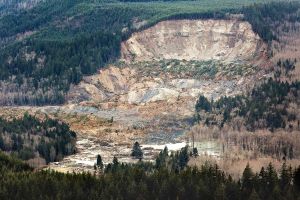 Scientists tell us that mudslides are inevitable when you treat these mountains as we do and we fail to recognize that some places just aren’t meant for human habitation. However, tell that to the developers.
Almost 25 years ago, I went into one of the headwater streams of the Stillaguamish with Pat Stevenson, a biologist with the American Indian tribe that bears the same name as the river and claims an ancient link to that land. The rain was Noah-level that day — just as it’s been for most of this March.
We drove upriver, winding along the drainage of Deer Creek, one of the main tributaries of the Stillaguamish. We couldn’t see Whitehorse Mountain, the dreamy peak that towers over the valley, that day. We could barely see beyond our windshield wipers. At last, we arrived at an open wound near road’s end. I’d never witnessed anything like it: an active slide, sloughing mud and clay down into the formerly pristine creek. We watched huge sections of land peel and puddle — an ugly and terrifying new landscape under creation before our eyes.
Stevenson pointed uphill, to bare, saturated earth that was melting, like candle wax, into the main mudslide. Not long ago, this had been a thick forest of old growth timber. But after it was excessively logged, every standing tree removed, there was nothing to hold the land in place during heavy rains. A federal survey determined that nearly 50 percent of the entire basin above Deer Creek had been logged over a 30-year period. It didn’t take a degree in forestry to see how one event led to the other.
The Stilly, as locals call the river, is well known to those who chase fish with a fly rod, and to native people who have been living off its bounty for centuries. Zane Grey, the Western novelist, called it the finest fishing river in the world for steelhead, the big seagoing trout that can grow to 40 pounds. What Stevenson showed me that day in a November storm was how one human activity, logging, was destroying the source of joy and sustenance for others. When the crack and groan of an entire hillside in collapse happened a week ago Saturday, I thought instantly of Stevenson and that gloomy day at Deer Creek.
And, sure enough, logging above the area of the current landslide appears to have gone beyond the legal limits, into the area that slid, according to a report in The Seattle Times.
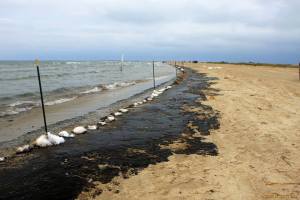 Meanwhile, the latest oil spill disasters take their toll in both the North and South of this Country. There are still long lasting effects in Alaska and in the Gulf of those giant oil spoils. But, even Galveston Bay shows sign of permanent damage from its latest brush with deadly oil that’s no where near the size of those other two. It’s getting to be that no one’s back yard is safe.
Authorities in charge of the cleanup from last week’s Houston Ship Channel oil spill say they’re responding to reports of oil near North Padre Island and Mustang Island, some 200 miles southwest of the original accident.
The command center for the cleanup reports Sunday that oil sightings were made earlier in the day by crews aboard flights being conducted by the Texas General Land Office and the U.S. Coast Guard.
Some tar balls — from dime-size to about 6 inches — have been spotted in seaweed patches along Mustang Island’s J.P. Luby Beach but it’s not certain if they are related to the spill a week ago between Galveston and Texas City.
The spill endangers wildlife nearby. There is a bird refuge that is in a particularly precarious location. That was also the clean side of the Gulf where 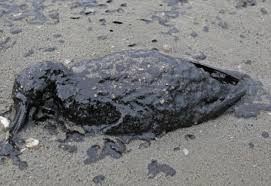 you could still trust the fish and the seafood.
The spill, which dumped what one Texas official referred to as “sticky, gooey, thick, tarry” oil that doesn’t evaporate quickly into Galveston Bay, occurred about eight miles from the Bolivar Flats Shorebird Sanctuary, which attracts 50,000 to 70,000 shorebirds each year. March is right around spring migration for many species of birds, and other birds are still wintering at Bolivar Flats, so tens of thousands of birds are living at the sanctuary, which is designated a Globally Significant Important Bird Area. Cleanup crews are using cannon booms to try to deter birds away from oiled beaches, and so far, oil hasn’t washed up on Bolivar Flats, but birds that have come in contact with oil in the water or on other beaches have been landing there.
Houston Audubon Society volunteers have been tracking the oiled birds they see at Bolivar, and Jessica Jubin, development director at the Houston Audubon Society, told ThinkProgress that the group was “definitely seeing more” oiled birds now than when they first started the day after the spill. She said on Monday, volunteers cataloged 40 to 50 oiled birds at one spot at Bolivar Flats, and on Tuesday, they counted about 100 at the same site. On Wednesday, she said, the number increased to about 140, with most birds ranging from just a few spots of oil on them to half covered in oil.
It’s the shorebirds and seabirds that are most at risk of becoming oiled from the spill, Jubin said.
“Like pelicans, for example — I don’t know if you’ve ever watched them fish, but they will soar in the sky and then spot something down below and then dart right into the water, and that’s how they get so much oil on them,” she said. “They can’t distinguish whether or not the oil is there, and they don’t know how to react to it.”
Mike Cox, spokesperson at the Texas Parks and Wildlife Department, told ThinkProgress the agency has so far collected 45 oiled birds in the Galveston area, with 19 birds in rehabilitation and 26 that were found dead. Jubin said Audubon was reporting birds they saw to Texas Parks and Wildlife and the U.S. Fish and Wildlife Service, but she worries about the movement of the oil. If it drifts too far south or west, it could end up in important habitat for endangered whooping cranes. Already, the oil has reached the ecologically-sensitive Matagorda Island, soiling at least 12 miles of the barrier island’s pristine beaches. So far, however, the Parks and Wildlife Department hasn’t received reports of oiled wildlife from Matagorda Island, Cox said, and crews were working to put up booms to keep the oil from getting into Matagorda Bay.
But birds aren’t the only wildlife at risk from the oil spill. As the Texas Tribune reports, marine scientists are worried that the spill could result in long-term health effects on Texas marine life. The thick fuel oil that spilled Saturday is persistent, so marine species could be even more at risk from oil-related defects like irregular heart rhythm and cardiac arrest than they were from the Deepwater Horizon disaster. Shrimp are a major part of the Galveston Bay fishing industry, and they’re also among the species most vulnerable to the oil spill — if their marshy homes are polluted with oil, they may not survive.
That, of course, doesn’t include the danger to the people and the clean up workers.
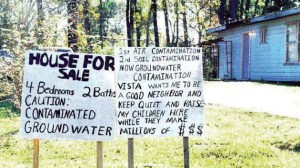
In 1790, a freed slave named Jim Moss found a place to settle down on a bend in the Houston River in the bayous of southwest Louisiana. Although never formally incorporated, the village of Mossville became one of the first settlements of free blacks in the South, predating the formal establishment of Calcasieu Parish by 50 years. But over the last half century, Mossville was surrounded. More than a dozen industrial plants now encircle the community of 500 residents, making it quite possibly the most polluted corner of the most polluted region in one of the most polluted states in the country. Now, a proposal to build the largest chemical plant of its kind in the Western Hemisphere would all but wipe Mossville off the map.
The project, spearheaded by the South African chemical giant SASOL, will cost as much as $21 billion, but stands to benefit from more than $2 billion in incentives (including $115 million in direct funding) from the cash-strapped state budget. It has the backing of Republican Gov. Bobby Jindal, considered a likely 2016 presidential candidate, who traveled to the outskirts of Lake Charles for the official announcement of the plan in 2012. The state thinks it’s an economic slam dunk. One study from Louisiana State University projected that it would have a total economic impact of $46.2 billion. It is the largest industrial project in the history of Louisiana. And after a community meeting on Tuesday, it’s one step closer to realization.
But that massive plant will come with a steep environmental price. It will produce more greenhouse gases than any other facility in the state. And the project will almost certainly spell the end for the 224-year-old settlement of Mossville, a poor enclave that has been forced to play host to industrial facilities no one else wanted in their backyard.
An analysis conducted by the Louisiana Department of Environmental Quality (DEQ) in February determined that the new project “will result in significant net emissions increases” of greenhouse gases, promethium, sulfur oxide, nitric oxide, and carbon monoxide. By its calculations, the plant will spew out more than 10 million cubic tons of greenhouse gases per year. (By contrast, the Exxon-Mobil refinery outside Baton Rouge, a sprawling complex that’s250 times the size of the New Orleans Superdome, emits 6.6 million tons.)
It’s beginning to feel a lot like we’re trapped between a future envisioned in the “Blade Runner” and that envisioned in Margaret Atwood’s “The Handmaid’s Tale”. Either way, the outcome will be sponsored by the likes of the Koch brothers and we will soon discover the fresh hells they’ve created for us. The dominionists and the capitalists join together to force their earth and its people into submission.
What’s on your reading and blogging list today?
Saturday Reads: Obama Talks to Rouhani, Pakistan and Kenyan Disasters, Republican Terrorism, and More
Posted: September 28, 2013 Filed under: Affordable Care Act (ACA), Barack Obama, Climate Change, Diplomacy Nightmares, Environment, Foreign Affairs, Iran, Journalism, Kenya, morning reads, NSA, National Security Agency, Pakistan, Republican politics, The Media SUCKS, U.S. Economy, U.S. Politics | Tags: baseball playoffs, Boston Red Sox, Congress, diplomacy, Hassan Rouhani, IPCC, Kenyan Mall massacre, Nuclear Power, nuclear weapons, Pakistan earthquake, Ted Cruz 24 Comments
Good Morning!!
It’s a beautiful Fall day in New England, the Red Sox have taken the American League East with the best record in baseball after winning 97 games with one game left to play. On top of that, the Yankees are pitiful. The playoffs start next Friday. It just doesn’t get better than this.
There is quite a bit of news for a Saturday. First up, President Obama spoke on the telephone to Iranian President President Hassan Rouhani yesterday–the first time leaders of the U.S. and Iran have spoken directly since 1979. The AP reports:
The United States and Iran took a historic step toward ending more than three decades of estrangement on Friday when President Barack Obama and Iranian President Hassan Rouhani spoke by phone and agreed to work on resolving global suspicions that Tehran is trying to build a nuclear weapon.
The 15-minute call capped a week of seismic shifts in the relationship that revolved around Rouhani’s participation in the annual U.N. meeting of world leaders. The night before the two leaders spoke, U.S. and European diplomats hailed a “very significant shift” in Iran’s attitude and tone in the first talks on the nuclear standoff since April.
The diplomatic warming began shortly after Rouhani’s election in June. But it is rooted in both presidents’ stated campaign desires — Obama in 2008 and Rouhani this year — to break through 34-year-old barriers and move toward diplomacy.
Iran is also seeking quick relief from blistering economic sanctions that the U.S. and its Western allies have imposed on Tehran to punish it for refusing to scale back its nuclear activities. Iran insists its nuclear program is for peaceful purposes only, but years of stonewalling inspections and secrecy about its activities have fueled fears it is seeking to build warheads.
Rouhani and Obama spoke while the Iranian president was in his car and headed to the airport to fly back to Tehran, with Obama at his desk in the Oval Office. Rouhani’s aides initially reached out to arrange the conversation, and the White House placed the call.
I’m not sure what it means to “work on resolving global suspicions that Tehran is trying to build a nuclear weapon,”–do they want to calm suspicions or tamp down the nuclear efforts? But at least it’s a step in the right direction. The New York Times has more:
“Resolving this issue, obviously, could also serve as a major step forward in a new relationship between the United States and the Islamic Republic of Iran, one based on mutual interests and mutual respect,” Mr. Obama, referring to Tehran’s nuclear program, told reporters at the White House after the 15-minute phone call. “It would also help facilitate a better relationship between Iran and the international community, as well as others in the region.”
A Twitter account in Mr. Rouhani’s name later stated, “In regards to nuclear issue, with political will, there is a way to rapidly solve the matter.” The account added that Mr. Rouhani had told Mr. Obama, “We’re hopeful about what we will see from” the United States and other major powers “in coming weeks and months.”
More detail about the call itself:
Mr. Obama placed the call from the Oval Office around 2:30 p.m., joined by aides and a translator.
He opened by congratulating Mr. Rouhani on his election in June and noted the history of mistrust between the two nations, but also what he called the constructive statements Mr. Rouhani had made during his stay in New York, according to the official. The bulk of the call focused on the nuclear dispute, and Mr. Obama repeated that he respected Iran’s right to develop civilian nuclear energy, but insisted on concessions to prevent development of weapons.
Mr. Obama also raised the cases of three Americans in Iran, one missing and two others detained. In a lighter moment, he apologized for New York traffic.
The call ended on a polite note, according to the official and Mr. Rouhani’s Twitter account.
“Have a nice day,” Mr. Rouhani said in English.
“Thank you,” Mr. Obama replied, and then tried a Persian farewell. “Khodahafez.”
Meanwhile, the Wall Street Journal reports that: U.S. Says Iran Hacked Navy Computers.
U.S. officials said Iran hacked unclassified Navy computers in recent weeks in an escalation of Iranian cyberintrusions targeting the U.S. military.
The allegations, coming as the Obama administration ramps up talks with Iran over its nuclear program, show the depth and complexity of long-standing tensions between Washington and Tehran.
The U.S. officials said the attacks were carried out by hackers working for Iran’s government or by a group acting with the approval of Iranian leaders.
The most recent incident came in the week starting Sept. 15, before a security upgrade, the officials said. Iranian officials didn’t respond to requests to comment.
The allegations would mark one of the most serious infiltrations of U.S. government computer systems by Iran. Previously, Iranian-backed infiltration and surveillance efforts have targeted U.S. banks and computer networks running energy companies, current and former U.S. officials have said.
I’m sure Glenn Greenwald will have a highly disapproving story about this in the Guardian today. Oh wait, he’s probably more outraged that the NSA was able to discover the Iranian spying . . . Never mind.
When Rouhani got home, he was “met by hardline protesters chanting ‘Death to America,'” according to BBC News.
Hundreds of people gathered at Tehran airport, with supporters hailing the trip and opponents throwing shoes.
An Agence France-Presse journalist said some 200-300 supporters gathered outside the airport to thank Mr Rouhani for his efforts.
But opposite them were about 60 people shouting “Death to America” and “Death to Israel”.
Mr Rouhani raised his hand to the crowds as he was driven off.
A New York Times reporter described the scene as chaotic, with dozens of hardliners hurling eggs and shoes at the president’s convoy.
There was another powerful earthquake today in Pakistan, according to CNN.
The 6.8 magnitude earthquake struck in Balochistan province Saturday about 96 kilometers (60 miles) northeast of Awaran, the United States Geological Survey said.
Rasheed Baloch, the Deputy Commissioner Awaran told CNN seven people died when a house collapsed in Mashkay Tehsil as result of new earthquake on Saturday.
Just Tuesday, a 7.7 magnitude earthquake struck the same area of Pakistan. The death toll in that quake has risen to 366 people and another 765 are injured….
Baloch said a rescue operation was under way in Awaran district to retrieve the dead bodies and shift the injured to hospitals.
The remoteness of the affected area and damaged communications networks are hindering the rescue operation, officials said.
The Atlantic has a good article following up on “Tragic and Heroic Stories from Survivors of the Kenyan Mall Attack.”
Witness accounts and survivor stories from the Westgate Mall attack in Nairobi continue to emerge, telling a freighting [sic] story of violence and terror. Yet, as the investigation continues, there are still some disturbing questions about the attack that have yet to be fully explained.
Now that more access has been granted to the ruined mall, images confirm that three floors of the building collapsed, presumably because of a large explosion. The Associated Press reported today that the collapse was actually caused by the Kenyan military, supporting a claim made by the terrorists themselves. It’s still not clear how or why they managed to set off the explosion, but it may have killed some (perhaps most?) of the hostages still inside the building.
The official death toll is still listed at 67, but it’s likely that unrecovered bodies will be found in the rubble. As many as 60 people are still missing.
CNN is also reporting today that the terrorists did not just plant weapons inside the mall in the days before the attack, as had been previously reported, but that members of al-Shabab had rented out a storeand were actually running it as functional business for nearly a year.
While investigators, including the FBI, continue their work, we’re learning more about what happened inside the mall during the attack, and what those who lived through it endured.
Check out some of the survivor stories at The Atlantic link.
The Intergovernmental Panel on Climate Change (IPCC) released a shocking report yesterday, according to BBC News. IPCC climate report: humans ‘dominant cause’ of warming.
A landmark report says scientists are 95% certain that humans are the “dominant cause” of global warming since the 1950s.
The report by the UN’s climate panel details the physical evidence behind climate change.
On the ground, in the air, in the oceans, global warming is “unequivocal”, it explained.
It adds that a pause in warming over the past 15 years is too short to reflect long-term trends.
The panel warns that continued emissions of greenhouse gases will cause further warming and changes in all aspects of the climate system.
To contain these changes will require “substantial and sustained reductions of greenhouse gas emissions”.
Too bad no humans in powerful positions are likely to do anything about it.
Back in the USA . . .
Congress is still battling over whether or not to crash the global economy because Republicans don’t want ordinary Americans to have health care, Ted Cruz is still getting headlines for making an ass of himself, and the media is still trying to blame Democrats and Republicans equally for the mess we’re in.
From the Washington Post: Obama chides Republicans as shutdown looms.
With Washington barreling toward a government shutdown, a deadlocked Congress entered the final weekend of the fiscal year with no clear ideas of how to avoid furloughs for more than 800,000 federal workers. Millions more could be left without paychecks.
The Senate on Friday approved a stopgap government funding bill and promptly departed, leaving all of the pressure to find a solution on House Republican leaders.
President Obama weighed in, sternly lecturing GOP leaders that the easiest path forward would be to approve the Senate’s bill, which includes money for the implementation of the Affordable Care Act, the president’s prized legislation achievement, which he signed into law in 2010. But a far-right bloc of House and Senate Republicans banded together to leave House Speaker John A. Boehner (R-Ohio) virtually powerless to act.
“My message to Congress is this: Do not shut down the government. Do not shut down the economy. Pass a budget on time,” Obama said in the White House press briefing room.
Boehner’s leadership team offered no public comment and remained out of sight most of Friday, hunkering down for another weekend on the brink. For Boehner, this is the latest in a series of unstable moments that have become the hallmark of his three-year run as speaker.
Al Gore uncharacteristically joined the fray, according to The Hill. Gore to GOP: ‘How dare you?’
Former Vice President Al Gore accused Republicans Friday of engaging in “political terrorism” by using a government shutdown as leverage to defund ObamaCare.
“The only phrase that describes it is political terrorism,” Gore said at the Brookings Institution, according to ABC News. “Why does partisanship have anything to do with such a despicable and dishonorable threat to the integrity of the United States of America?”
The former vice president also criticized Republicans for threats to link defunding ObamaCare to the debt ceiling, which is set to expire Oct. 17.
“Now you want to threaten to not only shut down our government but to blow up the world economy unless we go back and undo what we did according to the processes of this democracy?” Gore said. “How dare you?”
But the media is still pushing their “both sides do it” narrative. At The Atlantic, James Fallows offers Your False-Equivalence Guide to the Days Ahead. Here’s just a taste:
As a matter of journalism, any story that presents the disagreements as a “standoff,” a “showdown,” a “failure of leadership,” a sign of “partisan gridlock,” or any of the other usual terms for political disagreement,represents a failure of journalism*** and an inability to see or describe what is going on. For instance: the “dig in their heels” headline you see below, which is from a proprietary newsletter I read this morning, and about which I am leaving off the identifying details.
This isn’t “gridlock.” It is a ferocious struggle within one party, between its traditionalists and its radical factions, with results that unfortunately can harm all the rest of us — and, should there be a debt default, could harm the rest of the world too.
Now please click the link and go over to The Atlantic–it’s a must read.
I’m running out of space, so I’ll go with a link dump on Ted Cruz–if you have the stomach for the details you can go to the sources.
Huffington Post: Student Cited By Ted Cruz As Proof Of Obama’s Failure Is Actually Grateful For Obamacare
John Dickerson at Slate: Why Senate Republicans Hate Ted Cruz
Jonathan Chait: Ted Cruz Now Ruining John Boehner’s Life, Too
Politico: Ted Cruz again refuses to back John Cornyn
Those are my recommendations for today. What are you reading and blogging about? See you in the comment thread!
Tuesday Reads: The End of an Era
Posted: August 6, 2013 Filed under: Environment, Foreign Affairs, Media, morning reads, Russia, science, U.S. Politics | Tags: Ben Bradlee, Donald Graham, Eugene Meyer, Jeff Bezos, John Henry, Katherine Graham, morning newspapers, Newsweek, Pentagon Papers, Philip Graham, The Boston Globe, The Washington Post 38 Comments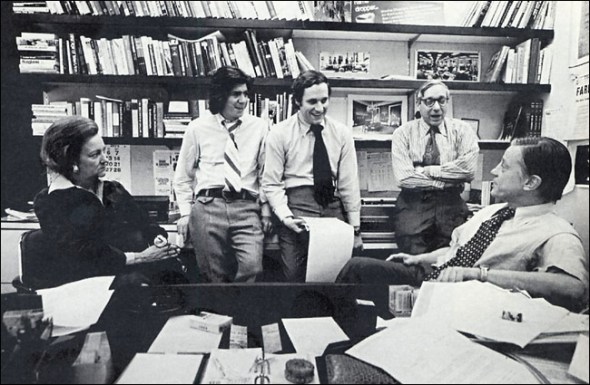
Katherine Graham meets with Carl Bernstein, Bob Woodward, Howard Simons and Ben Bradlee.
Good Morning!!
The big news today is of course the Graham family’s shocking sale of The Washington Post to billionaire Jeff Bezos of Amazon. This, along with the sale of The Boston Globe to Red Sox owner John Henry and the sale of Newsweek to IBT Media, signal the true end of an era.
The days when Americans woke up to the daily newspaper on their doorsteps is long gone. The place to go for the latest news these days is the internet and print newspapers and news magazines are struggling to survive. But the Globe and Newsweek have been on the auction block for a long time; the Post sale was a complete surprise, even to its employees.
From David von Drehle at Time Magazine: A New Age for the Washington Post
It’s hard to startle the journalism business these days, given the scale and speed of disruption of the media industry. But the Graham family selling the Washington Post to Amazon CEO Jeff Bezos for $250 million is an exception. Few newspapers in the world are as closely identified with a single family.
The story of the Grahams and the Post used to be told in giant pictures on the wall of the newspaper lobby on L Street not far from the White House. One grainy photograph documented the day in 1933 when the brilliant financier Eugene Meyer bought the paper for a song at a bankruptcy sale on the courthouse steps. Another (a favorite of all of us who worked there) showed Meyer’s remarkable daughter, Katharine Graham, beaming as she left another D.C. courthouse in the company of her favorite editor, Benjamin C. Bradlee, after they prevailed over the government in the Pentagon Papers lawsuit.
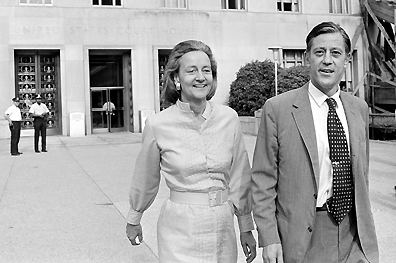
Katherine Graham and Ben Bradlee leaving the courthouse after prevailing in the Pentagon Papers case.
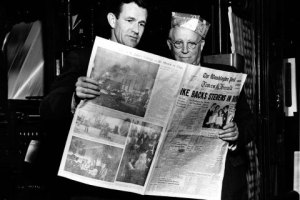
But the most important photograph, according to Mrs. Graham’s son and successor Donald E. Graham, was the one that showed Meyer in the company of Philip L. Graham, the brilliant and tragic husband of Katharine and father of Don. They were smiling like a pair of lotto winners, which they were. The year was 1954, and after years of effort and red ink, they had finally bought out their last remaining rival for dominance of the morning-newspaper market in Washington. As other families would learn in other cities across the country — the Chandlers in Los Angeles, the Coxes in Atlanta, the Knights in Miami and so on — dominance of the morning-newspaper routes would become a decades-long license to print money.
Philip L. Graham and Eugene Meyer look at the first The Washington Post Times Herald, in Washington, March 18, 1954.
Owning the morning meant that the Post would thrive as afternoon newspapers fell to the competition of television news. (The last afternoon paper in Washington, the excellent Washington Star, winked out in 1981.) It meant that advertisers hoping to reach a broad Washington audience had no choice but to pay the Post’s steadily increasing rates. That day in 1954 was the key to everything the Post later became, Don told me one day about 10 years ago when we bumped into each other in the lobby. Watergate, all the Pulitzer Prizes, the foreign correspondents, the celebrity columnists — all of it was possible because the patriarch and his son-in-law managed to lock up the morning.
A couple more links on the Post sale:
James Fallows at The Atlantic: Why the Sale of the Washington Post Seems So Significant
I have known and liked Donald Graham and his family over the years; many of my friends in journalism have at one time or another worked at the Washington Post. My first reaction to news that the family had sold the paper is simple shock. But it is shock based not on my positive-but-not-deep personal connection to the paper and its people but rather on sheer generational disorientation.
Readers below about age 40, who have known the Post only during its beleaguered, downsizing-its-way-out-of-trouble era, may find it hard to imagine the role it once played. Over the past decade-plus, the New York Times and theWall Street Journal have been the national newspaper organizations. It already seems antique even to use the word “newspaper” in such a construction, for reasons I don’t need to belabor now. But their flagship daily print publications make the NYT and the WSJ similar to the Financial Times and different from the other remaining ambitious news organizations — Bloomberg and Thomson Reuters, the broadcast and cable networks, NPR, etc.There was a time when you would automatically have included the Post in that first-tier national grouping. Other mainly regional or local papers were strong — the LA Times, the Chicago Tribune, the Boston Globe, and on down a nostalgic list. But more than any of the rest of them, the Post was fully in the national-newspaper derby and measured itself every day against the Times in talent level, depth and breadth of reporting, international coverage, sophistication, and all the other measures of a nationally ambitious operation. People who have started reading the paper in the past dozen years — rather, who have notstarted reading it — probably can’t imagine this difference in stature. But it is dramatic, and real.
“The pattern of a newspaperman’s life is like the plot of ‘Black Beauty,’ ” A. J. Liebling wrote. “Sometimes he finds a kind master who gives him a dry stall and an occasional bran mash in the form of a Christmas bonus, sometimes he falls into the hands of a mean owner who drives him in spite of spavins and expects him to live on potato peelings.” And sometimes, out of the blue, the ownership changes and you don’t know what the hell you’re getting in your bucket—fresh oats or cut glass.
At around 4:25 Monday afternoon, the staff of the Washington Post was summoned to the paper’s auditorium, a vast room where the presses used to be. The meeting would begin at 4:30 P.M., they were told. Donald E. Graham, the leader of the Graham family, which has owned the paper since Eugene Meyer bought it at a bankruptcy auction in 1933, stood solemnly before journalists who had been demoralized over the years by staff cuts, precipitous plunges in circulation, and endless dark rumors. It was a room full of reporters and editors, and yet, as one told me, “we thought we were there to hear that the Grahams had sold the building.”
In fact, Graham told them, in a voice so full of emotion that he had to stop a few times to gather himself, they were selling the Post and a handful of smaller papers—for two hundred and fifty million dollars, to Jeff Bezos, the founder and C.E.O. of Amazon, who is estimated to be worth more than twenty-five billion dollars. Graham asked the people there not to tweet, just to listen. The assembled were so stunned that when it came time for questions no one had any for a while; Graham had to urge them out of their silence.
“This was just plain sad. Now we belong to a guy who is so rich that the paper is around one per cent of his net worth,” a reporter told me soon after the meeting. “This was the family acknowledging that we can’t do it anymore and we have to give it to someone else. And we love the Graham family, we are proud of the family.”
It’s a long and interesting essay–read the rest at the link.
Neil Irwin and Ylan Q. Mui at The Washington Post write that Bezos paid more than he needed to for the Post.
The purchase price is richer than many of those paid for other legacy print media properties in recent years.
The New York Times Co. agreed to sell the Boston Globe to Red Sox owner John W. Henry for only $70 million. Newsweek sold for a symbolic $1, plus assumed pension liabilities, to billionaire Sidney Harman in 2011.
The Post “has a much stronger position in its market than the Boston Globe does,” said John Morton, an independent newspaper industry analyst. “It doesn’t surprise me that it would command a much higher price.”
Still, Morton suggested that the prominence and the visibility of The Post made Bezos willing to pay a higher price than would be justified by the paper’s finances alone. “I think probably Jeff Bezos was willing to pay a premium to make this happen,” Morton said. “. . . Bezos has enough money that if he wants to make it a hobby, he can.”
Interestingly, The New York Times apparently sold The Globe for less than they could have gotten. According to the AP:
BOSTON — Three bidders who fell short in their attempts to purchase The Boston Globe say they offered more than Boston Red Sox owner John Henry’s winning $70 million bid and criticized the decision of the seller, The New York Times Co., to make a deal with him.
Springfield television station owner John Gormally, West Coast investment executive Robert Loring and U-T San Diego chief executive John Lynch all said their groups’ bids bested Henry’s.
Henry agreed to pay $70 million to buy the Globe, the Boston Metro and the Telegram & Gazette in Worcester, about 50 miles from Boston. The bid, announced Saturday, was a fraction of the $1.1 billion the Times Co. paid 20 years ago.
Lynch said his group offered “significantly more” than Henry and wondered how the Times Co.’s shareholders would react after learning the company accepted a lower offer.
“I’m just stunned,” Lynch told the Boston Herald. “I thought this was a public company that had a fiduciary duty to get the most by its stockholders.”
Gormally says his bit was $80 million, but he admits that local ownership will probably be better for the Globe in the long run. Perhaps the Times wanted to do us Bostonians a favor.
I’m running out of space, so I’ll just add a few more stories in link dump fashion.Mark Ames on Vladamir Putin’s “human rights” record: Snowden’s Savior Announces Plans To Build 83 “Concentration Camps” Across Russia (link unlocked for 2 days)
Nature World News: Enormous Sinkhole, Still Expanding, Creates Spectacle in Western Kansas [VIDEO]
A former student sues her high school for bullying she suffered–first lawsuit based on new Massachusetts anti-bullying law
WSJ: Boston Bombing Suspect was Steeped in Conspiracies
Wendy Davis: Ready to ride for governor of Texas? (Christian Science Monitor)
How the World’s ‘Most Biodiverse Place’ Could Be Ransomed for Oil Money (Miami Herald via PBS)
The Independent: Japan calls for nuclear disarmament at 68th anniversary of Hiroshima bombing
Now it’s your turn. What are you reading and blogging about today? Please post your links on any topic in the comment thread.
Don’t Give Up Your Day Job, Bobby
Posted: March 11, 2013 Filed under: Environment, Environmentalists, U.S. Politics | Tags: Assumption Parish, Bayou Corne sinkhole, Bobby Jindal, Erin Brockovich, Gridiron dinner, Louisiana 5 Comments
I heard Bobby Jindal was a big hit at the Gridiron Club Dinner in Washington DC on Saturday night. Supposedly his speech was hilarious–comedy gold. Lynn Sweet of The Chicago Sun-Times gave it a rave review:
WASHINGTON–Proving once against that there are second acts in politics, Louisiana Gov. Bobby Jindal was a big hit Saturday night at the 128th annual Gridiron Club and Foundation dinner, more than making up for his disastrous 2009 State of the Union speech.
Which of course he used as fodder, since the best political humor is self-deprecating– and Jindal had an abundance of material.
Noting that some people ask him if he intends to run for president, Jindal said, “My answer is I have no plans to run. I have made that clear over and over again. In Iowa. In New Hampshire and in South Carolina,” he said, naming the states with the first caucus and primaries.
After all, he said with faux modesty, “What chance does a skinny guy with a dark complexion and a funny name have to get elected president of the United States.”
The crowd roared.
“The truth is, I am too skinny to run. At least that’s what my friend, Chris Christie, keeps telling me,” Jindal said of the overweight New Jersey Governor, also mentioned as a 2016 prospect.
On a roll, Jindal went on to compare himself with Obama and mock his own party.
He said earnestly that Obama and he had the “exact same campaign slogan years ago but unfortunately UPS sued both of us and made us stop using it. You remember our slogan, ‘What can Brown do for you?”‘
“Speaking of brown, I was hoping to see my good friend, John Boehner, here tonight,” Jindal said of Boehner, the House Speaker who is always tan. “We actually go to the same tanning salon here in Washington.”
Har har har. Are you laughing yet? Me neither. But it apparently went over big with the pols and journalists at “white tie and gown affair.” Chris Cillizza was so impressed with Jindal’s comedy routine that he requested and got a full transcript from the Governor’s staff. Here are a few more choice howlers:
They say this is a place where you can come and tell jokes about the President…poke fun at yourself…set political ambition aside and just generally say anything you want.
Kind of like the Romney campaign.
I spoke to Mitt the other day…told him that I was doing the Gridiron dinner…he said that 47 percent of you can’t take a joke.
Great to see the new Senator from Massachusetts – Elizabeth Warren. My staff tells me we’ve got a lot in common.
Well from one Indian politician to another, I want to wish you all the best in your new job.
I ran into Joe Biden earlier today. I don’t think he recognized me though. He asked me to go get him a Slurpee.You know, sometimes I wonder where we would be without Vice President Biden. And then I realize: Pretty much exactly where we are right now.
I figured Jindal would take the opportunity to joke about the disaster area back in his home state–that giant Bayou Corne sinkhole in Assumption Parish. I searched through the whole transcript, but there was nary a word.

But a funny thing happened while Governor Jindal was in Washington DC. Environmental activist Erin Brockovitch paid a visit to Assumption Parish.
Relief is a word frequently heard around the Assumption Parish sinkhole, but as Bayou Corne residents will tell you, it’s not a word they use to describe their attitudes. But now the now 8-and-a half acre sinkhole has caught the attention of California based environmentalist Erin Brockovich.
On Saturday, hundreds of Bayou Corne residents packed into a community meeting to hear what Brockovich and California based attorney Tom Girardi plan to do to help them out.
….
Girardi has offered his legal services to any resident who decides to take further action against Texas Brine and all parties responsible for their troubles over the past seven months. Brockovich says litigation, if things come to that, could take months or even years to resolve. She says her role, as it has been for nearly two decades in dozens of cases like this one, would be to keep the community united.
“We as states all over America, need to be paying more attention to what the corporations are doing…old records, what we need to do to come in and see that disaster before it happens…and not wait until after it happens and then go and argue on the legislative floor for the, what, next two or three years,” said Brockovich.
….
Brockovich said before Saturday’s meeting, they were representing 50 residents in the Bayou Corne area. After the meeting dozens more stayed behind to decide if they would join the lawsuit.
Suddenly Bobby J. has decided he’ll go visit the sinkhole in his state for the very first time since the hole opened up last August. The announcement was maid in an “e-mail statement,” so it’s not clear if the Governor was actually in Louisiana at the time.
Something tells me when Jindal shows up, the residents of the area won’t be laughing.
Time to do your day job, Governor.
Tuesday Morning Reads: BP Goes on Trial over 2010 Deepwater Horizon Oil Spill
Posted: February 26, 2013 Filed under: Environment, morning reads, New Orleans, open thread, U.S. Politics | Tags: BP oil spill, British Petroleum, Deepwater Horizon, Halliburton, Transocean 9 Comments
Fire boat response crews battle the blazing remnants of the off shore oil rig Deepwater Horizon on April 21, 2010. The blowout in the Gulf of Mexico killed 11 people and sent 4.9 million barrels of oil gushing from the sea floor into the Gulf (Houston Chronicle).
See more photos of the Gulf oil disaster at the Houston Chronicle.
Good Morning Sky Dancers!!
BP went on trial over the 2010 Deepwater Horizon disaster on Monday, after the failure of efforts to reach a last-minute settlement.
US district judge Carl Barbier opened proceedings in New Orleans with a warning that it would be a “lengthy trial”….
The trial is designed to identify the causes of BP’s well blowout and assign percentages of fault to the companies. That will help determine how much more each has to pay for their roles in the environmental catastrophe.
Months of negotiations have failed to produce a settlement that could have averted the trial.BP has said it already has racked up more than $24bn in spill-related expenses and has estimated it will pay a total of $42bn to fully resolve its liability for the disaster that killed 11 workers and spewed millions of gallons of oil.
But the trial attorneys for the federal government and Gulf states and private plaintiffs hope to convince the judge that the company is liable for much more.
The Guardian quotes Columbia law professor John Coffee as saying that there could still be a settlement, because BP obviously does not want to deal with the adverse publicity that would go along with a month’s long trial with damaging information about the company in the headlines day after day.
Read live tweets from the trial by Dominic Rush of the Guardian here.
Bloomberg Businessweek reports: BP, Transocean Accused of ‘Reckless’ Actions in Spill.
The mishandling of an oil-rig safety test by BP Plc (BP/) and Transocean Ltd. (RIG) officials was a major cause of an explosion that led to the 2010 Gulf of Mexico oil spill, lawyers for the U.S. and spill victims said at a trial.
BP and Transocean supervisors’ failure to properly interpret results of a pressure test on the Macondo well off the coast of Louisiana cost 11 rig workers their lives and sent millions of gallons of oil spewing into the Gulf, Michael Underhill, a U.S. Justice Department lawyer, and Jim Roy, an attorney for plaintiffs suing the companies, told a judge yesterday.
“BP put profits before people, profits before safety and profits before the environment,” Underhill said in opening statements that began this morning [Monday] in New Orleans in a trial before U.S. District Judge Carl Barbier, who is overseeing litigation over the spill….
BP executives’ “missteps and reckless decisions” about the safety test were prompted by pressure to generate billions in profits regardless of the costs, Underhill said in his statement.
Read the entire Bloomberg article for an excellent summary of the issues in the case.
Through their attorneys, BP, Transocean, and Halliburton pointed fingers at each other. NOLA.com:
Opening day at the long-awaited civil trial against BP and its partners in the ill-fated Macondo oil well at times sounded like a group of youngsters blaming everyone but themselves for a bad deed. That’s not an unexpected beginning in the first phase of a federal trial aimed at determining each of the companies’ financial liability for the accident.
The trial at the federal courthouse in New Orleans began Monday morning with opening arguments by Plaintiff Steering Committee attorneys, representing private parties who sued BP and its partners for damages; the U.S. Justice Department; and the states of Louisiana and Alabama, whose attorneys outlined their views of how the accident occurred and whether BP or any of its partners were guilty of gross negligence or willful misconduct, which could result in an eventual four-fold increase in fines under the Clean Water Act and the awarding of punitive damages for the private plaintiffs….
The federal, state and private party attorneys took aim at BP, which owned the drilling lease for the Macondo well; Transocean, which owned and staffed the ill-fated Deepwater Horizon drilling rig; and Halliburton, which provided an unusual, lightweight cement that was used to block the flow of oil in the well.
Among the recurring story lines and accusations:
That BP made the ultimate decisions for drilling operations on the Deepwater Horizon rig, was more concerned with profits than safety as it ran behind schedule and over-budget on the well, and that BP rig supervisors botched a crucial safety test before the April 2010 drilling-platform explosion;
That Transocean had not properly trained its crew, which missed clear signals that a blowout was about to occur;
That Halliburton’s use of a cement made lightweight with nitrogen bubbles was known to be risky, and the mixture did not succeed in sealing the well.
Other takes on the opening of the trial:
Wall Street Journal: Accusations Fly as Trial Over Gulf Oil Spill Begins
Transocean, which owned the drilling rig, failed to train its crews properly and didn’t maintain key safety equipment, said Jim Roy, a lawyer for hundreds of businesses suing the energy companies that were drilling the ill-fated well.
Brad Brian, a lawyer for Transocean, said that wasn’t true, noting that the Coast Guard, federal safety regulators and BP’s own management considered the Deepwater Horizon rig “what ‘good’ looked like.”
Michael Underhill, the Justice Department’s lead civil attorney, focused on a last-minute conversation between BP engineers on the rig and onshore that he said showed that the oil giant acted with gross negligence. The rig was not reviewed by hydraulic engineer to ensure that everything is safe.
But BP attorney Mike Brock argued the accident was caused by many mistakes made by all the parties aboard the rig, which exploded in April 2010, killing 11 workers and unleashing the worst offshore oil spill in U.S. history. “There were a number of mistakes and errors in judgment that were made by BP, Transocean and Halliburton,” Mr. Brock said.
LA Times: Greed caused BP’s gulf oil spill, lawyers argue
Energy giant BP, behind schedule and $50 million over budget drilling a deep-water well, emphasized cost-cutting over safety, causing the largest offshore oil spill in U.S. history, lawyers said Monday as the company’s high-stakes civil trial began.
Lawyers used PowerPoint presentations to provide a dramatic recounting of the April 20, 2010, explosion and fire in the Gulf of Mexico that killed 11 crew members. Workers were preparing to temporarily cap the Macondo well 4,100 feet underwater when it blew up. The 30-story drilling vessel about 50 miles offshore burned for two days before crumpling into the gulf.
The resulting spill of more than 4 million barrels of oil damaged the waters and economies of five states. And the responsible party was BP, according to the lawyers representing the federal government, Gulf Coast states and private parties.
Washington Post: Billions of dollars at stake for BP, other companies as trial opens for Gulf oil spill
One of the biggest questions facing U.S. District Judge Carl Barbier, who is hearing the case without a jury, is whether BP acted with gross negligence.
Under the Clean Water Act, a polluter can be forced to pay a minimum of $1,100 per barrel of spilled oil; the fines nearly quadruple to about $4,300 a barrel for companies found grossly negligent, meaning BP could be on the hook for nearly $18 billion.
The judge plans to hold the trial in at least two phases. The first phase, which could last three months, is designed to determine what caused the blowout and assign percentages of blame to the companies involved. The second phase will determine how much crude spilled into the Gulf.
The issues in the case are “massive” and “complex.”
Hundreds of attorneys have worked on the case, generating roughly 90 million pages of documents, logging nearly 9,000 docket entries and taking more than 300 depositions from witnesses who could testify at trial.
“In terms of sheer dollar amounts and public attention, this is one of the most complex and massive disputes ever faced by the courts,” said Fordham University law professor Howard Erichson, an expert in complex litigation.
The trial continues today.
AP via the Houston Chronicle: 1st witness to testify in Gulf oil spill trial
A University of California-Berkeley engineer who played a prominent role in investigating levee breeches in New Orleans after Hurricane Katrina is scheduled to be the first witness Tuesday at a trial involving another Gulf Coast catastrophe: the worst offshore oil spill in U.S. history.
Robert Bea, an expert witness for the plaintiffs who sued BP PLC and other companies involved in the Deepwater Horizon disaster, will share his theories about what caused BP’s Macondo well to blow out on April 20, 2010, provoking an explosion on the Horizon rig that killed 11 workers and spewed an estimated 172 millions of gallons of crude into the Gulf.
Bea’s testimony was scheduled for the second day of a civil trial that could result in the oil company and its partners being forced to pay billions of dollars more in damages. The case went to trial Monday after attempts to reach an 11th-hour settlement failed.
The second witness scheduled is BP America president Lamar McKay.
The high-ranking executive is likely to discuss corporate decisions that were made during the disaster. It was not clear if there would be time for his testimony Tuesday. Other BP officials were expected to give videotaped testimony.
In pretrial depositions and in a report, Bea argued along with another consultant that BP showed a disregard for safety throughout the company and was reckless — the same arguments made in opening statements Monday by attorneys for the U.S. government and individuals and businesses hurt by the spill.
Attorneys for BP tried to block Bea’s testimony, accusing him of analyzing documents and evidence “spoon-fed” to him by plaintiffs lawyers. BP accused Bea and another expert, William Gale, a California-based fire and explosion investigator and consultant, of ignoring the “safety culture of the other parties” involved in the spill, in particular Transocean Ltd., the drilling company running operations aboard the Deepwater Horizon.
It should be fascinating to follow this case, and I’m really hoping there won’t be a settlement. A trial could bring out valuable information that we haven’t heard about so far.

 peej
peej Carissa
 bostonboomer
 dakinikat
 ecocatwoman
 mablue2
 Mama Lopez
 peggysue22
 quixote
 skydancingguestblogger
 Mona (aka Wonk the Vote)



 Sky Dancing
Recent Comments