
Halloween Reads
Posted: October 31, 2011 Filed under: abortion rights, Economy, morning reads | Tags: Halloween, Herman Cain, history of Halloween, Nobel Prize economics, Planned Parenthood, Pumpkin cookies, Pumpkins, Samhain, Thomas Sargent, trick or treating, We're all Keynesians Now 19 Comments
Happy Halloween!
I suppose I should get right to the news reads, but instead, I thought I’d make some use of the day to bring us up to speed on the Halloween spirit! Halloween’s roots were in Samhain which was an ancient Celtic holiday! Like nearly every other holiday, it was co-opted as the Romans moved to conquer as much as they could and romanize the world with their culture and religions.
Samhain was considered a magical holiday, and there are many stories about what the Celtics practiced and believed during this festival. Some say the spirits that were unleashed were those that had died in that year, and offerings of food and drink were left to aid the spirits, or to ward them away. Other versions say the Celts dressed up in outlandish costumes and roamed the neighborhoods making noise to scare the spirits away. Many thought they could predict the future and communicate with spirits as well during this time. Some think the heavily structured life of the Pagan Celtics was abandoned during Samhain, and people did unusual things, such as moving horses to different fields, moving gates and fences, women dressing as men, and vice versa, and other trickeries now associated with Halloween. Another belief is that the Celtics honoured, celebrated, and feasted the dead during Samhain. A sacred, central bonfire was always lit to honor the Pagan gods, and some accounts say that individual home fires were extinguished during Samhain, either to make their homes unattractive to roving spirits, or for their home fires to be lit following the festival from the sacred bonfire. Fortunes were told, and marked stones thrown into the fire. If a person’s stone was not found after the bonfire went out, it was believed that person would die during the next year. Some Celts wore costumes of animal skulls and skins during Samhain. Faeries were believed to roam the land during Samhain, dressed as beggars asking for food door to door. Those that gave food to the faeries were rewarded, while those that did not were punished by the faeries. This is reported to be the first origin of the modern “trick or treat” practice.
Many of the costumes we think of today actually originated in festivals celebrated during medieval times.
The practice of dressing up in costumes and begging door to door for treats on holidays goes back to the Middle Ages, and includes Christmas wassailing. Trick-or-treating resembles the late medieval practice of “souling,” when poor folk would go door to door on Hallowmas (November 1), receiving food in return for prayers for the dead on All Souls Day (November 2). It originated in Ireland and Britain, although similar practices for the souls of the dead were found as far south as Italy. Shakespeare mentions the practice in his comedy The Two Gentlemen of Verona (1593), when Speed accuses his master of “puling [whimpering, whining], like a beggar at Hallowmas.”
Yet there is no evidence that souling was ever practiced in America, and trick-or-treating may have developed in America independent of any Irish or British antecedent. There is little primary Halloween history documentation of masking or costuming on Halloween — in Ireland, the UK, or America — before 1900. The earliest known reference to ritual begging on Halloween in English speaking North America occurs in 1911, when a newspaper in Kingston, Ontario, near the border of upstate New York, reported that it was normal for the smaller children to go street guising (see below) on Halloween between 6 and 7 p.m., visiting shops and neighbors to be rewarded with nuts and candies for their rhymes and songs. Another isolated reference appears, place unknown, in 1915, with a third reference in Chicago in 1920. The thousands of Halloween postcards produced between the turn of the 20th century and the 1920s commonly show children but do not depict trick-or-treating. Ruth Edna Kelley, in her 1919 history of the holiday, The Book of Hallowe’en, makes no mention of such a custom in the chapter “Hallowe’en in America.” It does not seem to have become a widespread practice until the 1930s, with the earliest known uses in print of the term “trick or treat” appearing in 1934, and the first use in a national publication occurring in 1939. Thus, although a quarter million Scots-Irish immigrated to America between 1717 and 1770, the Irish Potato Famine brought almost a million immigrants in 1845–1849, and British and Irish immigration to America peaked in the 1880s, ritualized begging on Halloween was virtually unknown in America until generations later.
Treats:
Thomas Sargent, Nobel Prize winner in economics is mad at the WSJ for trying to characterize him as a non-Keynesian after he won the award!
Professor Sargent described himself as a scientist, a “numbers guy” who is “just seeking the truth” as any good researcher does.
“If you go to seminars with guys who are actually doing the work and are trying to figure things out, it’s not ideological,” he said. “Half the people in the room may be Democrats and half may be Republicans. It just doesn’t matter.”
The “non-Keynesian” label irks him particularly. “That’s just off base,” he said. “Keynes was a very good economist. He was brilliant. He had wonderful insights. His work has inspired me many times.”
Professor Sargent’s own writings are sprinkled with pithy quotations from Keynes. In January 1986, the professor wrote a Wall Street Journal article, “An Open Letter to the Brazilian Finance Minister,” analyzing that nation’s fiscal crisis. In form and substance, it was explicitly modeled on a very similar letter written by Keynes to the French finance minister 60 years earlier. One point of this exercise, he said, “was to get people to actually read Keynes.”
Still, early in Professor Sargent’s career, he was known as one of the founders of the “rational expectations” school, which has sometimes been thought to be un-Keynesian. He says it actually “tied down an important loose end in the kinds of theories Keynes was building.” Keynes, he said, believed that expectations were all-important in determining economic activity, but didn’t have the mathematical tools needed to nail down all his concepts.
Today, Professor Sargent says that in some ways he actually is a Keynesian, but he qualified that claim, too. “I’m happy to say I am a Harrison-Kreps-Keynesian,” he said, citing work by two scholars at Stanford, J. Michael Harrison and David M. Kreps. They developed a theory of speculative investor behavior and stock-bubble formation that subtly modifies rational expectations “in a beautiful way” and “captures Keynes’s argument, makes it rigorous, and pushes it further,” he said.
Fundamentally, he said, “What I really don’t like is oversimplification.” He tries to think things through, he said, and avoid having “one slogan fighting another.”
Recipe for Best Pumpkin Cookies
1 cup butter, room temperature
1/2 cup sugar
1/2 cup firmly packed brown sugar
1 cup canned pumpkin
1 egg
1 teaspoon vanilla extract
2 cups flour
1 teaspoon baking soda
1 teaspoon baking powder
2 teaspoons cinnamon
1/4 teaspoon saltPenuche Glaze
3 tablespoons butter
1/2 cup firmly packed dark brown sugar
1/4 cup milk
1 1/2-2 cups confectioners’ sugarDirections:
Preheat oven to 350 degrees.
Have ready some ungreased baking sheets.
In a large mixing bowl, cream butter and the sugars together until light and fluffy.
Blend in pumpkin, egg and vanilla extract.
In separate bowl, stir together flour, baking soda, baking powder, cinnamon and salt.
Mix flour mixture into butter-sugar mixture.
Drop tablespoonfuls 3 inches apart on ungreased baking sheets.
Bake the cookies for 10-12 minutes until golden around the edges.
Remove warm cookies and transfer to racks.
Let cool completely for a least one half hour, then frost with glaze.For Glaze:.
In a medium saucepan, heat butter and brown sugar over medium heat until bubbly. Cook, stirring constantly, for one minute or until slightly thickened. Beat in the milk. Blend in confectioner’s sugar until the glaze is smooth and spreadable. Using a silicone basting brush, which I love and use religiously now, or a butter knife to spread glaze on cookies is the best tip. Please note; this glaze will harden fairly quickly. I suggest that you keep the saucepan over the stove on the lowest heat possible to prevent it from hardening.
Tricks:
Herman Cain went on TV Sunday saying that Planned Parenthood should be called “Planned Genocide’ because their goal Is To ‘Kill Black Babies’. He’s now under scrutiny for sexual harassment charges in past. Can we just say the man hates women and get it over with?
Republican presidential candidate Herman Cain is standing by his assertion that reproductive health care provider Planned Parenthood is carrying out the “planned genocide” of African Americans.
In a March speech to the conservative Heritage Foundation, Cain said the organization’s mission was to “help kill black babies before they came into the world.”
On Sunday, CBS host Bob Schieffer asked the candidate if he still believed that statement.
“Yes,” Cain replied. “I still stand by that.”
“Do you have any proof that was the objective of Planned Parenthood?” Schieffer wondered.
“If people go back and look at this history and look at [Planned Parenthood founder] Margaret Sanger’s own words, that’s exactly where that came from,” Cain insisted. “Look at where most of them were built. Seventy-five percent were built in the black community and Margaret Sanger’s own words — she didn’t use the word genocide. She did talk about decreasing the number of poor blacks in this country by preventing black babies from being born.”
Anti-abortion activists often misquote Sanger as saying, “[W]e want to exterminate the Negro population.”
But in full context, the quote has the opposite meaning. In a 1939 letter to pro-birth control advocate Clarence J. Gamble, Sanger argued that black leaders should be involved in the effort to deliver birth control to the black community.
“We do not want word to go out that we want to exterminate the Negro population, and the minister is the man who can straighten out that idea if it ever occurs,” she wrote
Hope you have a fun day! What’s on your reading and blogging list?
The Clash of the Titans: Ideology vs. History
Posted: October 29, 2011 Filed under: #Occupy and We are the 99 percent!, academia, Banksters, Corporate Crime, Economy, financial institutions, Global Financial Crisis 19 Comments
Thursday night I caught an amazing piece of political dialogue on the Anderson Cooper show between Peter Schiff and Cornell West. What an odd pairing!
Peter Schiff, as many will recall, ran an unsuccessful Connecticut senatorial primary bid in 2010. He’s described as an adherent of the Austrian School of Economics, from the same branch Ron Paul falls: libertarian, believer in free market fundamentalism–unchain capitalism and all things will fall from Heaven. Schiff is currently the CEO of Euro-Pacific Capital, Inc. and Euro-Pacific Precious Metals.
In contrast, Cornell West is an academic, sometimes referred to as a ‘public intellectual,’ a professor at Princeton where he teaches from the Center for African American Studies and the Department of Religion. He has been a consistent voice for the underclass, the working poor and speaks to the effects of race, gender and class in American society.
Though both men have engaged the Occupy Wall St. [OWS] movement, their approaches could not be more different. Peter Schiff went to Zuccotti Park with a sign–I am the 1%–presumably to start a conversation with the protesters. Hummmm. Mr. Schiff’s definition of ‘conversing’ must be different than mine. From the clip below? I’d use the word confrontation.
Cornell West on the other hand has been arrested twice during the Occupy encampment—once in DC before the Supreme Court protesting the Citizens United decision, where corporate political funding was equated with free speech, using the precedent that corporations = personhood. A decision, I might add that I and many others view as horrifically destructive, only adding to the problem of money swamping our electoral process. Dr. West was arrested for the terrifying crime of holding a sign [a no-no on the steps of Supreme Court] which read: Poverty is the Greatest Violence of All. On a second occasion, Dr. West was arrested in Harlem for marching with other Occupy members in front of the 28th Precinct, protesting the NYPD’s practice of ‘stop and frisk,’ which allows police to search citizens at will, a procedure that involves primarily people of color. Reportedly 600,000 stops were made in 2010, with 7% of those stops resulting in arrests.
So, we have two men, both educated, articulate and successful, both engaging OWS from 180 degree positions. Peter Schiff takes the view that unfettered capitalism will save the world as opposed to West’s humanistic viewpoint that unregulated capitalism has brought the world to its knees and threatens to scrap the very safety nets and programs that allow people to better themselves [education, for instance] and escape the violent confines that poverty and hopelessness exact.
We can argue these principles till the cows come home but a debater makes a serious mistake when they rewrite history to support their ideology, willfully fabricating, tweaking the facts to make their points more relevant and sound.
Peter Schiff, to his shame, pulled out all the old tricks like a fumbling magician who has no talent for sleight of hand. He like so many others who deify free market fundamentalism come off sounding remarkably reasonable, even simpatico with many of the concerns of average Americans. But they always slip up, only to expose the trickster; those disappearing cards are simply stuck up their sleeves.
In Zuccotti Park, Schiff claims he pays ‘almost 50% of his income in taxes’ under the current tax system. 50%. No one in the top 1% pays anything close to 50% in personal income tax and if they did then their accountant deserves to be marched to the wall and executed, toute suite. The rich have all sorts of tax breaks, exemptions, loopholes and shelters that average working people can only dream of. The claim is sheer nonsense by those who, in their heart of hearts, don’t wish to pay any tax at all. The same is true of claiming they want to return to the ‘golden’ 1950s when things were on an upswing and America was the most productive nation in the world [as Schiff remarks, as if it were a 1000 years ago]. And the top marginal tax rate was? 91%.
Yes, records were actually kept in the 1950s and we can look up false statements! Maybe Schiff really meant the roaring mid-20s to 1931 were the rate was 25%, and then BOOM! Depression time.
I must say I enjoyed the explanation of Wall St. greed as a by-product of Government manipulation. This is a turn on that old Flip Wilson skit line, But . . . But . . .The Devil Made Me Do it.
In addition, there is the sweet comment—“The regulation we want is the market. Markets regulate themselves.” This makes a great sound byte but is nothing more than the same garbage philosophy that brought us to this moment of economic woe, something that even Alan Greenspan, former Fed chairman finally admitted in hound-dog fashion: Did. Not. Work.
But Schiff’s greatest leap into fantasy is saved for the CNN segment I initially mentioned, where he claims that capitalism, free-market capitalism alone led to changes in the workplace: Child Labor Laws, Worker’s Safety laws, the 40-hour work week [see at the 8 minute mark].
I give Cornell West props for not coming through the screen with that claim. I guess Schiff never heard of the Radium Girls, the Triangle Shirtwaist Factory Fire, the Battle of Blair Mountain or the entire Labor Movement for that matter. The unregulated capitalists of that long ago era were not willing to give an inch, let alone provide workers with anything amounting to change. Justice was wrenched out through struggle, protest, suffering and deprivation. Justice was long in coming but come it did.
West’s suggestion that he and Schiff need to sit down over coffee and cognac is way too easy and polite. West would be advised to bring a straight jacket in Peter Schiff’s size for safety purposes. Or march him to church to beg forgiveness for fibbing [also known as spreading disinformation] to the public.
There’s a quote attributed to the late Daniel Moynihan:
“You’re entitled to your own opinion, but you’re not entitled to your own facts.”
In the Clash of the Titans, history always wins.
Confronting the Austerity Agenda
Posted: October 28, 2011 Filed under: Economy, Foreign Affairs, Iceland | Tags: austerity, banking crises, economics, iceland 13 Comments Paul Krugman takes on the idea that after we bail out economically destructive banks, we all have to pay with downsized lives and a bad economy in his NYT column today. He continues to fight the idea that austerity–not prosperity–will bring back confidence and the economy. He’s right that the austerity hawks push a ridiculous assertion that denies past history as well as logic.
The doctrine in question amounts to the assertion that, in the aftermath of a financial crisis, banks must be bailed out but the general public must pay the price. So a crisis brought on by deregulation becomes a reason to move even further to the right; a time of mass unemployment, instead of spurring public efforts to create jobs, becomes an era of austerity, in which government spending and social programs are slashed.
This doctrine was sold both with claims that there was no alternative — that both bailouts and spending cuts were necessary to satisfy financial markets — and with claims that fiscal austerity would actually create jobs. The idea was that spending cuts would make consumers and businesses more confident. And this confidence would supposedly stimulate private spending, more than offsetting the depressing effects of government cutbacks.
Some economists weren’t convinced. One caustic critic referred to claims about the expansionary effects of austerity as amounting to belief in the “confidence fairy.” O.K., that was me.
But the doctrine has, nonetheless, been extremely influential. Expansionary austerity, in particular, has been championed both by Republicans in Congress and by the European Central Bank, which last year urged all European governments — not just those in fiscal distress — to engage in “fiscal consolidation.”
And when David Cameron became Britain’s prime minster last year, he immediately embarked on a program of spending cuts in the belief that this would actually boost the economy — a decision that was greeted with fawning praise by many American pundits.
Now, however, the results are in, and the picture isn’t pretty
Example one: The economy of Greece. It has been pushed into an even bigger slump. Example two: The economy of the UK. Austerity has stalled its economy and the confidence fairy is no where to be seen. Example three: Iceland. They did the exact opposite and they’re none the worse for wear. So, which example are we following? Well, it’s not Iceland.
Krugman, Icelanders, and the IMF are taking stock of the Iceland experience this week in a conference. You can read many articles at the IMF on how Iceland is recovering from its 2008 economic catastrophe. You can watch a video explaining what went on there with Dr. Joseph Stiglitz below.
Today, three years later, it is worth reflecting on how far Iceland―a country of just 320,000 people―has come since those dark days back in 2008. Growth has returned to the economy, and new jobs are being created: unemployment, although still unacceptably high for a country used to near-full employment, has dropped below 7 percent of the work force. In June this year, the government successfully issued a $1 billion sovereign bond, marking a return to international financial markets.
And while public debt, currently at around 100 percent of GDP, is much higher than before the crisis, an impressive consolidation program has put the country’s finances back on a sustainable path during the past couple of years. As for the banks, they have been shrunk to about 200 percent of GDP, and are now fully recapitalized.
So, how did they do it? Did they embrace austerity for their citizens after rescuing and enriching their errant banking/financier class?
- First, a team of lawyers was put to work to ensure that losses in the banks were not absorbed by the public sector. In the end, the public sector did of course have to step in and ensure the new banks had adequate capital, but it was insulated from vast private sector losses. This was a major achievement.
- Second, the initial focus of the program was exclusively on stabilizing the exchange rate. Here, we reached for unconventional measures, notably capital controls.
- Third, automatic stabilizers were allowed to operate in full during the first year of the program—effectively delaying fiscal adjustment. This helped support the economy at a time of severe strain.
- Fourth, conditionality was streamlined and focused on the key issue at hand—rebuilding the financial sector. While there are some issues in the broader economy where reforms will eventually be needed, these were not a part of the program.
Is this a Naughty list that will get the Nice Treatment?
Posted: October 16, 2011 Filed under: Economy, financial institutions, Global Financial Crisis | Tags: G-20, Global TARP, shadow banking system, Systemically risky banks 10 Comments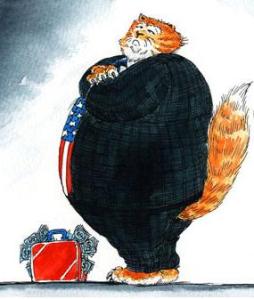 Okay, this is confusing me. What exact policies are implied from being on the G-20 list of “50 Systemically Important Banks”? It appears to me that you could be subjected to capital injections (i.e. free taxpayer money) for being so big you could bring down the global economy. No wonder Occupy is going global.
Group of 20 governments are considering naming as many as 50 banks as systemically important to the global economy and in need of extra capital, two officials from G-20 nations said.
The list, drawn up by Financial Stability Board Chairman Mario Draghi, will be published in time for a G-20 leaders meeting in Cannes, France, on Nov. 3-4, said the officials, who declined to be identified because the discussions are private. Regulators have said the banks named will be forced to take on more capital.
Regulators are at loggerheads with some institutions over the additional capital rules, with lenders arguing the requirements may harm the world’s economic recovery. Jamie Dimon, chief executive officer of JPMorgan Chase & Co. (JPM), and Bank of America Corp. (BAC) CEO Brian T. Moynihan are among bankers who have suggested this year that the new rules will constrain lending and hurt growth.
G-20 finance ministers and central bankers meeting in Paris yesterday discussed the standards that will be applied when compiling the list of systemic banks.
Twenty-nine to 40 banks could be designated depending on the potential impact on financial markets, according to one person familiar with the matter. Two officials from G-20 nations said the list could even be expanded to about 50 institutions. The regulators are also contemplating including the institutions in categories according to their ability to absorb losses.
So, the G-20 finance ministers “endorsed a framework to reduce the risks posed by systemically important institutions through strengthened supervision, a cross-border resolution plan and additional capital requirements”. No wonder occupy is going global. It seems bankers are draining funds from countries everywhere because they keep losing their mittens in the world’s largest gambling casinos. So, if you’ve got a bunch of what looks like really bad institutions, why-oh-why do you just simply give them more of your treasury? Good thing these guys went for that monopoly power! Now they can bully just about any one with a threat of bringing down the global economy. The World Bank and the IMF don’t even let entire countries do that!
The FSB is assessing how systemically important institutions are on the basis on five broad categories: size, interconnectedness, lack of substitutability, global activity and complexity.
Yup. The bigger you are and the more difficult you are to figure out, then it looks like you win a prize! Since when are we supposed to reward the creation of moral hazard and information asymmetry? The government is supposed to regulate to clear that up, not provide cash infusions to the worst culprits in the market. Oh, let me rephrase that because were talking about TWENTY governments doing that. The leading candidate to head all this up is the head of the Bank of Cananda–Canada’s version of the Federal Reserve Bank–who just happens to be (yes, wait for it, you know it’s coming)a former employee of Goldman Sachs.
Here’s the sole sentence in the entire article at Bloomberg that indicates there may some be some push for some change. The FSB is the Financial Stability Board. They are in the process of doing a number of things under the jurisdiction of the G-20 group including derivatives reform.
The FSB suggested assessing banks’ involvement with shadow banks, reform of money-market funds, securitization regulation, supervision with an emphasis on risk and scale, and regulation of lending and repo markets, the official said.
Obviously, the soverign debt crisis of the Greece, Portugal, Spain, and Ireland are foremost on every one’s mind. The deals are being worked out now to try to head off the potential calamity. I have to wonder if this is going to turn into a world wide TARP plan where we all foot the bill and the banks continue on their merry way with a lot of public funds and mostly symbolic regulation and over sight. I guess we’ll see. This inquiring mind really wants to know. Now, where’s the next G-20 meeting location and the nearest pitchfork store?
Newsflash folks: This isn’t Market Capitalism, it’s Monopoly
Posted: October 15, 2011 Filed under: #Occupy and We are the 99 percent!, commercial banking, Economy, financial institutions | Tags: banking laws, Banksters, Bernie Madoff, Financial Panic of 1792, Glass Steagall Act, Global Financial Crisis, monetary control act of 1980, Raj Rajaratnam, The Riegle Neal Interstate Banking and Branching Efficiency Act of 1994, William Duer 23 Comments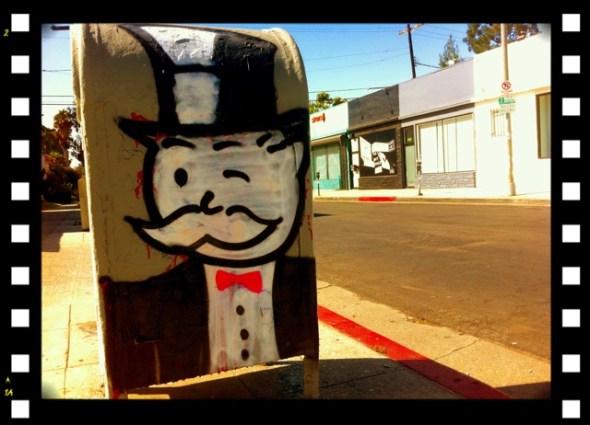 I entered the world of commercial banking the same year that the Monetary Control Act of 1980 (MCA) got passed and signed by Jimmy Carter. President Jimmy Carter was responsible for the first onslaught of deregulation of all kinds of industries which is important to think about. It was a Democratic President that pulled the first card from the laws that were put into place to stop the banking crises that had plagued our country in the early years of capitalism. I should also remind you that the country was founded on a system of economics called mercantilism. Capitalism didn’t come into being until the early-to-mid-19th-century. (Note to Rick Perry: The US Revolutionary war was not in the 16th or 17th century.) We had series of financial crises in the 1840s and then in 1870s . The first one was in 1792 and a politician/financier caused it.
We didn’t call them recessions bank then. We called them Panics and they were sourced in banking and nascent financial markets. They were the result of excessive speculation and/or some Bernie-Madoff-like figure and scheme. In 1792, the panic was set off by William Duer who used his appointment to the US Treasury by Alexander Hamilton to use insider information in a similar way to Hedge Fund Manager Raj Rajaratnam who was just sentenced to 11 years in jail yesterday. This is a very old story and really dates back to the birth of capitalism as we know it.
Hamilton was pretty appalled by Duer’s speculative activities. He wrote this at the time.
“Tis time, there must be a line of separation between honest Men & knaves, between respectable Stockholders and dealers in the funds, and mere unprincipled Gamblers.”
If you start typing Financial Panic into Google, you’ll start seeing a huge number of dates pop up. From 1792 down to the present time, most of these panics have been clearly rooted in that same problem: speculative bubbles and banking malfeasance.
There’s a clear difference between the good old fashioned community banking that gave me my first job out of my masters program and what we have today. Much of it is due to that first card pulled from the bottom of the financial market card house by Jimmy Carter in 1980. You can read about the law at FRB Boston. There were a lot of responsibilities placed on the FED for oversight at the time but the banks got a lot of benefits including increased access to borrowing money from the FED. When I was working in Nebraska, a bank was allowed one branch and a main office. There were restrictions on how far away the branch could be. I worked for a small bank with a branch across the street at a big shopping center. That local law was pulled down shortly thereafter because the banks wanted to branch every where into communities they did not know. There are very few community banks left in the country where your banker knows if you’ll be good for your loan or not based on years of knowing you.
Most small and regional banks have been gobbled up by the top 4 or 5 financial institutions. The majority of financial assets sit in a handful of institutions. That’s called monopoly, folks. Monopolies require regulation, not free reign. That’s basic classical economic theory and has nothing to do with Keynes and politics. Any microeconomics  101 students should be able to explain why. They are incredibly inefficient. We say they are not Pareto Efficient, which means some very specific things. They overprice their products. They restrict access to these products. They earn profits above and beyond what they should because the revenue far exceeds the productivity of the factors used to produce the service. They create a deadweight loss which is bad for every corner of the economy except for the monopolist.
We have gone from a system where lending risk is personalized and spread around a number of institutions to a situation where it’s all concentrated and automated in the hands of a few big banks. They also can invest in a lot of specious assets. The banks continued to seek complete interstate banking and eventually got it. The Riegle-Neal Interstate Banking and Branching Efficiency Act of 1994 gave them exactly what they wanted. It also allowed bank holding companies to do things that they had previously been disallowed like hold subsidiaries that offered speculative investments. Interestingly enough, it is much easier to become a bank holding company than it is to become a bank. Many investment banks became bank holding companies to access borrowing through the Fed Window in 2008 when they had gambled away a good deal of their own capital.
This law was signed by Democratic President Bill Clinton. That’s only the commercial banking side. The so-called shadow banking industry got freed to speculate at will and be closely aligned with banks and their guaranteed deposit when the Gramm-Leach-Bliley Act (GLBA) was signed by President William Clinton in 1999. It repealed huge sections of the Glass Steagall Act that were put into place during the Great Depression to deal with all those financial panics that finally led up to the 1929 Bank Run. If you’re unemployed and you’ve seen your housing equity and your retirement funds depleted, I’d suggest going to Phil Gramm’s house with placards and rotten eggs. He’s the one mover and shaker that brought all this on to our heads and a symbolic tar and feathering would make me feel good, frankly. (Here’s an academic site with some brief notes on a Mishkin textbook on the history of the repeal of important banking laws for your reference.)
So, it goes with out saying that the minute these things were put into play from 1980 forward, it was only a matter of time before we started to repeating panics and would eventually get another Great Depression. The panics started in the 1980s. I’d moved out of commercial banking and into the S&L business right before our first panic came. When S&L’s started giving market rates of interest on their liabilities, they had to start giving new mortgage loans out at exorbitant prices. My first one–in 1982–was for around 17%. I got the banker discount which brought it down to 12%. The problem was that all the liabilities were repricing to market and all the assets (loans) were still stuck at those 1950-1960 home loan interest rates of about 5%. My dad was barely paying 4% because the bank he used also was funding his floor plan (that’s the cars he had on his inventory sheet as a new car dealer). His floor plan interest was through the roof in those days because the usury laws had been suspended. It was in the 20% levels just like credit card debt was at the time. The commercial banks were seeing incredibly high prime rates of interest and the Savings and Loans were hemorrhaging money. This is a problem of term mismatch when you rely on arbitrage profits, but I’ll avoid the lecture on that one! The S&L crisis should’ve been the first cautionary tale from that Monetary Control Act. I have some pretty wild stories from those days including the Treasurer that I worked for using GNMA futures to day trade to try to up our cash balances. Illegal yes! That’s if you’re caught! However, we were the least of the FSLIC’s problems at the time and he got away with it!
The second cautionary tale came with a Long Term Capital Management that lost tons of money after the Russian Financial Crisis in 1998. That didn’t stop the GLBA at all however. There was an earlier canary too. That was Franklin Savings and Loan. There’s actually a more recent example of the same. That would be Granite Funds. LTCM made convergence trades that required huge sums of money and enormous leverage to be profitable. They were eventually bailed out and wound down at a huge cost. There is absolutely something wrong when we repeatedly have huge organizations collapse because of margin calls. I point back up to the quote from Alexander Hamilton who got it the first time out. We still haven’t learned the lessons from any of this because we’re ready and primed for the next financial crisis with European Sovereign Debt too. The speculators are pulling the same tricks and we’re suffering from the same results.
So, the deal is that after about 100 years of horrible problems, we put a box around the speculators called Glass Steagall. There is a new box proposed called the Volcker Rule. The banks are kicking and screaming about even the smallest regulations to stick them back into their boxes. We cannot afford to repeatedly coddle an industry that systematically creates huge social and economic costs on a regular basis when set free to do as it will. The Volcker Rule–in its current form–is pretty mild. It’s no where near what ex Fed Chairman Paul Volcker originally offered but it’s a step in the right direction. That’s why it’s first on my list of demands for OCCUPY activists.
Fitch Ratings on Friday said it sees potential for a delay in the adoption of a newly proposed rule barring banks from trading for their own profits, due to industry opposition that could lead to a political fight.
Banks’ opposition “will likely fuel a lengthy debate in Washington regarding the ultimate scope and precise implementation” of the Volcker Rule, Fitch said in a report released four days after federal banking regulators proposed the rules.
“There is a real possibility that controversy surrounding the proposal could delay the precise definition of restricted trading, particularly in a presidential election year when partisan debate over financial regulation will be intense,” Fitch said.
The rule, named after former Federal Reserve Chairman Paul Volcker, was required under the financial overhaul that became law last year. The rule would bar banks from trading for their own profit instead of on their clients’ behalf. Banks must hold investments for more than 60 days, and bank managers must make sure employees comply with restrictions.
The day after banking regulators and the Federal Reserve backed the rule, the Securities and Exchange Commission voted 4-0 to send the proposal out for public comment. The public has until Jan. 13 to comment on a rule that’s expected to take effect by July after a final vote by all the regulators. Banks would have until July 2014 to comply.
The industry has said that the proposal would put them at a disadvantage to banks in other countries.
Let me reiterate something I’ve said earlier. The Scandinavian countries learned from their last disastrous banking crisis in the early 1990s and put their banks back into the box. This was roughly the same time of our own S&L crisis and came from speculative bubbles. They all come from speculative bubbles, excess risk taking, and extremely immoral behavior on the part of many bankers/brokers because the extraordinary profits that can be extracted on the ride up are incredible. The Canadians never let them out so they’ve basically been sitting pretty well during this last crisis. None of these countries had the problems that we and other countries have had since then. The Volcker Rule is the least we could do to start down the path to sanity.
I want to end this post by pointing out a new voice in the blogging community called Reformed Broker. His real name is Joshua Brown. He has written a Dear Wall Street letter that’s worth a read. He now feels like I felt after living through the S&L crisis and then watching the insanity repeat with LTCM and the others in the late 1990s. All this fol de rol tanked my 403(B) retirement account as badly as this last bit of craziness has tanked it again. Only this time I am 10 years closer to retirement. Oh, and this time they got my home equity in the process and my job. The S&L crisis got my job and killed my ability to sell my house. It also caused incredible damage to my father’s small business. He sold it at a huge loss just to get out from under the stress that was killing him. I’ve just about had it now with this nonsense, the bankers, and the politicians that enable them. As I’ve said it’s been going on for some time and they need to be put back into the box.
I’m going way beyond fair use here, Josh but I wanted your voice to be read by our readers. Please take this as a compliment and not a copy right violation!
In 2008, the American people were told that if they didn’t bail out the banks, there way of life would never be the same. In no uncertain terms, our leaders told us anything short of saving these insolvent banks would result in a depression to the American public. We had to do it!
At our darkest hour we gave these banks every single thing they asked for. We allowed investment banks to borrow money at zero percent interest rate, directly from the Fed. We gave them taxpayer cash right onto their balance sheets. We allowed them to suspend account rules and pretend that the toxic sludge they were carrying was worth 100 cents on the dollar. Anything to stave off insolvency. We left thousands of executives in place at these firms. Nobody went to jail, not a single perp walk. I can’t even think of a single example of someone being fired. People resigned with full benefits and pensions, as though it were a job well done.
The American taxpayer kicked in over a trillion dollars to help make all of this happen. But the banks didn’t hold up their end of the bargain. The banks didn’t seize this opportunity, this second chance to re-enter society as a constructive agent of commerce. Instead, they went back to business as usual. With $20 billion in bonuses paid during 2009. Another $20 billion in bonuses paid in 2010. And they did this with the profits they earned from zero percent interest rates that actually acted as a tax on the rest of the economy.
Instead of coming back and working with this economy to get back on its feet, they hired lobbyists by the dozen to fight tooth and nail against any efforts whatsoever to bring common sense regulation to the financial industry. Instead of coming back and working with the people, they hired an army of robosigners to process millions of foreclosures. In many cases, without even having the proper paperwork to evict the homeowners. Instead, the banks announced layoffs in the tens of thousands, so that executives at the top of the pile could maintain their outrageous levels of compensation.
We bailed out Wall Street to avoid Depression, but three years later, millions of Americans are in a living hell. This is why they’re enraged, this why they’re assembling, this is why they hate you. Why for the first time in 50 years, the people are coming out in the streets and they’re saying, “Enough.”
And one more time, let’s hear from Alexander Hamilton because it bears repeating!!!
“‘Tis time, there must be a line of separation between honest Men & knaves, between respectable Stockholders and dealers in the funds, and mere unprincipled Gamblers.”
I’ve added a link to Josh’s blog so you can go sample his writing any time you want. He’s also on twitter as @ReformedBroker. Okay, this is a little long, and a little like one of my lectures for financial institutions, but I thought you might appreciate how this thing came down and what needs to be done. Like I said, we need to put them back into a box. If they are to be free from the chance of bankruptcy, able to access US tax dollars at zero cost, and are still able to create Financial Panics by bad lending and investment practices we have no other chance. This will repeat ad infinitum and will cost us our personal and national treasures.


 peej
peej Carissa
 bostonboomer
 dakinikat
 ecocatwoman
 mablue2
 Mama Lopez
 peggysue22
 quixote
 skydancingguestblogger
 Mona (aka Wonk the Vote)



 Sky Dancing
Recent Comments