
Ezra Klein Reviews “Confidence Men,” and Finds it Sorely Lacking
Posted: November 5, 2011 Filed under: Domestic Policy, Economy, Team Obama, The Great Recession, U.S. Economy, U.S. Politics | Tags: Barack Obama, Beltway Bob, book reviews, Brooksley Born, Christina Romer, Confidence men, Elizabeth Warren, Ezra Klein, Larry Summers, Ron Suskind, Sheila Bair, Tim Geithner 44 Comments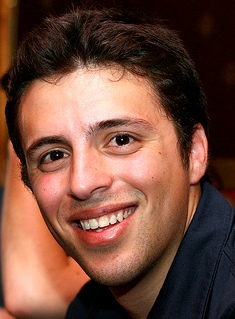
Ezra Klein, AKA Beltway Bob
Ezra Klein (AKA Beltway Bob) is really coming up in the world. He somehow managed to get a gig writing a review of Ron Suskind’s book Confidence Men for the New York Review of Books. I’m impressed, I must admit.
As you probably guessed already, Klein is quite critical of the book. In fact he thinks Suskind should have written a completely different kind book instead–maybe even a couple of different kinds of books.
As I see it, Suskind set out to write an interesting and entertaining political book about Obama’s economic advisers, how they interacted with each other and the President, and how administration economic policy took shape over the first couple of years. The book is gossipy and very much focused on the people involved and their relationships with each other. As a psychologist, I found it fascinating to read Suskind’s insights.
Klein admits that
The work that went into Confidence Men cannot be denied. Suskind conducted hundreds of interviews. He spoke to almost every member of the Obama administration, including the President…He takes you inside…the Oval Office. He heads to Wall Street and back. He quotes memos no one else has published. He gives you scenes that no one else has managed to capture.
But that isn’t good enough. Klein disapproves of the gossipy, personality-centered tone of Confidence Men. He wants Suskind to provide evidence for his personal assessments of people. For example, Klein objects to Suskind’s description of Treasury Secretary Tim Geithner’s appearance at Obama’s announcement that Elizabeth Warren would be working with Geithner to set up a consumer agency that she had first conceived of and then fought for. Although Warren didn’t know it yet, she would never head the agency, because Geithner had already made a deal with the bankers: they would accept a consumer agency as long as Warren wasn’t put in charge.
Here’s the passage that Klein found offensive:
This has caused discomfort not only for the president, but also for his top lieutenants, including the boyish man in the too-long jacket at Obama’s right hip, bunched cuffs around his shoes, looking more than anything like a teenager who just grabbed a suit out of dad’s closet. That’s Treasury Secretary Tim Geithner, looking sheepish.
Klein so objected to this paragraph that he felt he had to go watch the announcement again himself, to see if Suskind’s description was accurate.
I prefer to verify. So I went back to the tape. I rewatched the September 2010 press conference where Obama introduced Warren to the country. I paid special attention to Geithner. Suskind’s right: his suit is too big. But he doesn’t look sheepish or ashamed. He looks, by turns, bored and interested. He clasps his hands behind his back. He nods attentively. He tries not to fidget. He looks like every experienced bureaucrat looks when they’re asked to stand like a prop near the president. Blank, and trying not to make any news. He failed.
But Klein doesn’t offer any evidence for his observations either. How can he know what Geithner was thinking–that he tried “not to fidget” and tried “not to make any news?” He can’t. Klein has shared his own observations and interpretations, just as Suskind did. But Klein finds it annoying. He didn’t want to read a book about people, based on the close observations and opinions of its author. No, Klein wanted a book about policy, and he felt that
…any account of what he [Obama] has done wrong, or what he could do right, needs to provide, first and foremost, a persuasive case of how the White House could have done more to promote an economic recovery over the last three years, or could do more to accelerate one now.
Klein wanted a wonky book, heavy on policy and light on human interest, and he can’t understand why Suskind wrote something different. Quite honestly, I think Klein should go right ahead and write a book like that if he wants to. It wouldn’t be as much fun to read as Suskind’s book, but it might make people like Matt Yglesias and Brad DeLong happy.
Read the rest of this entry »
What the MSM Isn’t Reporting
Posted: November 5, 2011 Filed under: #Occupy and We are the 99 percent!, Corporate Crime, Democratic Politics, Economy, financial institutions, Main Stream Media, poverty, The Media SUCKS, unemployment | Tags: 2011: days of revolt, Financial Crisis, U.S. Economy 15 CommentsIf anyone had doubts that the mainstream media is deliberately fudging the details on the events surrounding the Occupy Wall St. Movement in general and the Occupy Oakland protests in particular, the following video is unlikely to dissuade you of that doubt. Cenk Uygur was actually in Oakland on Wednesday during the general strike in Oakland—feet on the ground, eyeballs watching the events unfold.
Surprise!
The MSM had no cameras present. They had no cameras available during the Oakland police department’s original raid on protesters, The Night of Tear Gas and Batons. That was also the night of the strange, weird coincidence when both the ABC and CBS helicopters needed refueling at precisely the same moment.
The world is being blanketed by stunning coincidence.
Fortunately, [but to the shock of many Americans] that night was recorded independently, the startling images preserved.
Cenk Uygur [The Young Turks] as some may recall had a brief 6-month stint on MSNBC, an hour-long show during which he was often critical of Barack Obama’s less than stellar record. Uygur’s ratings were excellent but he was called in by management and asked to ‘tone it down.’ Translation? Stop knocking POTUS and the Democratic Party’s slide to the corporate right. Though offered more money to host a new show, Uygur politely turned MSNBC management down, and then went on the record and told his audience what had happened. His slot was quickly filled by the Reverend Al Sharpton, who is happy as a clam to shill for the President and all things Democratic. That would be the ‘My Party, Right or Wrong’ strategy.
For myself? It’s the reason, I no longer watch MSNBC’s 6 pm broadcast.
The You Tube video is revealing—Uygur’s astonishment at how underreported the crowd size in Oakland truly was. But I also found some startling photographs that belie the MSM’s attempt to undercut the groundswell of support this movement is capturing. It’s growing despite the naysayers and critics. It’s growing despite the MSM’s attempt to edit and minimize. It’s growing against all odds.

The Tea Party, of course, wants everyone to go home and get a job. Which a lot of these people would probably happily do if there were jobs to get, the sort that pay a living wage—that small complication of making enough money to feed yourself and your family, pay the rent, keep the lights on. We were told yesterday morning that unemployment ticked down a tenth of a percentile. That would make the ‘official’ unemployment number 9 instead of 9.1%. And there have been reports coming out suddenly to tell the country that stories of poverty and inequality are vastly exaggerated, even though the Census Bureau’s numbers show 1 in 15 Americans now categorized as the ‘poorest of the poor,’ the biggest jump recorded in 35 years. Btw, that would be 50% or less than the official poverty level, which translates to $5,570 for an individual; $11, 157 for a family of four.
Seems to be an awful lot of sputtering, squirming and spinning going on.
Surely, it’s mere coincidence.
Mankiw’s Introductory Econ Class stages a Walk Out
Posted: November 3, 2011 Filed under: #Occupy and We are the 99 percent!, Economy, education | Tags: Greg Mankiw, Harvard, JM Keynes, Walk out 11 Comments
This has to be one of the most intriguing situations that I’ve heard about for some time. Any one that teaches knows that student evaluations really count for people that aren’t tenured and don’t have some kind of research status that makes them immune to student complaints. Administrators pay attention to them a lot more than they probably should. I’ve had raises parsed out based on the 4th decimal place of department averages. I always used to wonder about the one question where freshmen students get to judge whether or not you know your subject area. I mean, how would they be in a place to know that if they’ve never had any exposure to a technical, complex topic before? There are sometimes very useful things you can learn from students. I’m wondering what the real lesson should be from a walk out associated with a political movement.
I’ve occasionally had students complain to me about other professors either personally or on my evals. It puts you in an awkward position. I’ve never seen it raise to this level in all the years I’ve been teaching in a variety of colleges and universities. The roots of the walk out were in the Occupy Movement. The contents of the letter explain the motivation directed at Harvard Professor Greg Mankiw published in the Harvard Political Review.
Greg Mankiw has his own blog as well as having published his own textbooks for introductory economics. I’ve never used them but I’ve looked at them during textbook searches. It’s fairly standard treatment of the subject. Mankiw was Chair of the Council of Economic Advisers under Dubya Bush. He’s been an adviser to Mitt Romney. He also has a lot of clout if you look at his cites and pubs at IDEAS/RePEc rankings. The funny thing is that he’s actually considered a “New Keynesian” economist. Here’s a quote from an article he wrote in the NYT in 2008. I quote this to show you he’s not really that atypical of a macroeconomist. He shows up in fairly mainstream, traditional Republican circles.
“If you were going to turn to only one economist to understand the problems facing the economy, there is little doubt that the economist would be John Maynard Keynes. Although Keynes died more than a half-century ago, his diagnosis of recessions and depressions remains the foundation of modern macroeconomics. His insights go a long way toward explaining the challenges we now confront.”
The students complain that Mankiw has an inherent bias. There should be no surprise you frequently hear that from students who come in wanting their own biases reinforced. I personally try to challenge my students from all sides of the political system just to try to get them to think critically rather than on automatic. I have no personal experience of Mankiw’s classes so I have no idea if their complaints are legitimate or not.
As Harvard undergraduates, we enrolled in Economics 10 hoping to gain a broad and introductory foundation of economic theory that would assist us in our various intellectual pursuits and diverse disciplines, which range from Economics, to Government, to Environmental Sciences and Public Policy, and beyond. Instead, we found a course that espouses a specific—and limited—view of economics that we believe perpetuates problematic and inefficient systems of economic inequality in our society today.
A legitimate academic study of economics must include a critical discussion of both the benefits and flaws of different economic simplifying models. As your class does not include primary sources and rarely features articles from academic journals, we have very little access to alternative approaches to economics. There is no justification for presenting Adam Smith’s economic theories as more fundamental or basic than, for example, Keynesian theory.
Care in presenting an unbiased perspective on economics is particularly important for an introductory course of 700 students that nominally provides a sound foundation for further study in economics. Many Harvard students do not have the ability to opt out of Economics 10. This class is required for Economics and Environmental Science and Public Policy concentrators, while Social Studies concentrators must take an introductory economics course—and the only other eligible class, Professor Steven Margolin’s class Critical Perspectives on Economics, is only offered every other year (and not this year). Many other students simply desire an analytic understanding of economics as part of a quality liberal arts education. Furthermore, Economics 10 makes it difficult for subsequent economics courses to teach effectively as it offers only one heavily skewed perspective rather than a solid grounding on which other courses can expand. Students should not be expected to avoid this class—or the whole discipline of economics—as a method of expressing discontent.
Supposedly, about 70 of the 700 students walked out. I really haven’t read anything about the walk out from other blogging economists. I think it’s because every one pretty much feels a certain amount of empathy for a colleague. Also, there is such a thing as academic freedom. I do, however, find it strange that the complaints say that Mankiw spends too much time on Adam Smith as compared to J.M Keynes given his research agenda and his writings. I’d like to offer up this WSJ Book Review of a Keynes Biography to illustrate why I’m a bit confused.
But mathematics is, fundamentally, the language of logic. Modern research into Keynes’s theories—I have conducted such research myself—tries to put his ideas into mathematical form precisely to figure out whether they logically cohere. It turns out that the task is not easy.
Keynesian theory is based in part on the premise that wages and prices do not adjust to levels that ensure full employment. But if recessions and depressions are as costly as they seem to be, why don’t firms have sufficient incentive to adjust wages and prices quickly, to restore equilibrium? This is a classic question of macroeconomics that, despite much hard work, is yet to be fully resolved.
Which brings us to a third group of macroeconomists: those who fall into neither the pro- nor the anti-Keynes camp. I count myself among the ambivalent. We credit both sides with making legitimate points, yet we watch with incredulity as the combatants take their enthusiasm or detestation too far. Keynes was a creative thinker and keen observer of economic events, but he left us with more hard questions than compelling answers.
So, my guess about the situation and the lack of comments of blogging economists on this is along the lines of students will be students. Mankiw is clearly no Austrian economist which is one school of thought that every one walked out on years ago but is experiencing a resurgence because of Koch Brothers’ investment. I think he’s gotten tagged because of the folks he’s advised. Again, these are guys are old school Republicans and not part of the Tea Party insurgence. Dubya actually did implement some fairly traditional Keynesian stimulus in his response to the 9/11 macro shock. The political discourse has gotten so harsh and has been so narrowly covered by the press that it must be harder for younger people not to think that every Republican and their advisers is off the Richter scale of reason. I guess that’s my way of saying that calling Mankiw an out of the mainstream economist makes about as much sense as calling Obama a Kenyan-born socialist. The claims oversimplify Mankiw, Adam Smith, and J.M Keynes. But, we are talking freshmen and not doctoral candidates. I think this reflects the anger in the current national discourse a lot more than it reflects anything else. I’m just wondering if any of Mankiw’s peers on either side of the neoKeynesian battle lines will speak up.
In a way, this reminds me of the article I read about 5 days ago on Thomas Sargent in the NYT. Sargent was lauded as a ‘non-Keynesian” in a WSJ article covering his win of the Nobel prize in economics this year.
In telephone conversations last week, Professor Sargent said he felt insulted by people who call him “non-Keynesian” or “right wing,” terms that, he said, are based on a misunderstanding of his thinking. And he rejected attempts to categorize his views in simple slogans.
He doesn’t wear his political opinions on his sleeve. “They really don’t matter in my research,” he said. But because others have applied labels to him, he decided it was worth setting the record straight. He’s a Democrat, he said, “a fiscally conservative, socially liberal Democrat,” adding, “I think that budget constraints are really central.”
It’s important to consider the “incentive effects” of government policies, he continued. “There are trade-offs in efficiency and equality, and they lead to choices that aren’t easy,” he said.
This sort’ve lends itself to the traditional economist jokes where the punchline always has something to do with “on the one hand, on the other hand”. I kind’ve liked the opening paragraph on that article and so I’m going to borrow it as I start the close to this blog piece.
EXPRESSING your own views is challenging enough. Describing someone else’s opinions without talking to them first opens the door to serious trouble
I once did an experiment in a few class rooms just to see if any of them could guess my party affiliation. I got your basic 50-50 split between those who thought I was a Republican and Democrat. I will usually step up and answer a direct question on policy with my opinion if I’m asked for it. Usually, I will play the role of devil’s advocate just to get student’s to question their thought process more. I did express constant surprise this summer that a huge number of politicians seemed to feel that it was okay to default on US debt. That’s basically because I was teaching a graduate finance course and the basic risk free rate for every model is generally presumed to be one US Treasury rate or another. I asterisked my explanations for the first time ever with an explanation that this might be the first year ever where we have to find another empirical example for a risk free rate if the debt ceiling extension doesn’t pass. I did get called out as having a ‘bias’ for this in one eval. Given the way that many Republicans considered US default a reasonable policy, I suppose I had to have at least one person show up that considered my asterisked explanations to be a bias. So, let’s just say on some level, I can relate to Greg Mankiw even though if you put the two of us in one room there would undoubtedly be a lot of things we don’t see eye-to-eye on.
So, what do you think? Just politics? Just students being students?
The Beginning Is Near
Posted: November 3, 2011 Filed under: #Occupy and We are the 99 percent!, American Jobs Act, Baby Boomers, Bailout Blues, Banksters, Black Agenda Report, commercial banking, Economy, income inequality, investment banking, jobs, unemployment 27 CommentsMaybe it’s my age [and no, I’m not telling] but I find great promise is those four words scrawled on a makeshift sign.

I’m sure–in fact, I know–there are others of my generation [Boomers] who look at the Occupy Wall St. [OWS] Movement, read the signs and scratch their heads. Or more likely they criticize the primarily young protesters as naïve, idealistic, disorganized, wanting something for nothing. Why don’t they just get a job? many say.
These reactions miss the point, as far as I’m concerned. These youngsters want something all right. They want their futures. They want to control their own destinies with a measure of integrity, a sense of possibility rather than bending to the yoke of a failing system, one that only works for those on the top of the heap. The statistics are there for everyone to read. No mystery! Wages of ordinary Americans have been stagnant, while the rich have become richer than Midas. Jobs have been sent willy-nilly beyond our shores but the trade-off [we’ve been told numerous times] are cheap consumer goods, the more the better.
He who has the most stuff wins. Many people bought into that. For a while.
Throw in 9/11, multiple wars, massive unemployment, rising health care costs, climate-related weather events, the negligence in the Gulf of Mexico, etc. and the shine has definitely come off the latest gadgets and toys. As an electorate, we’ve had a slap upside the head.
What I find astounding is people blaming this particular group—the OWS protesters, primarily the Millennials–for what is clearly our responsibility, a product of our refusal to hold our politicians accountable and demand justice–a return to the Rule of Law–instead of foisting the unpleasant, annoying task on our children [or grandchildren, as the case may be]. We’re the ones who bought into the Big Lie. Or worse, pretended it didn’t exist. These young students and 20-somethings had no hand in what we watched and allowed to develop.
The kids are making us look bad. They’ve endured dismissal, ridicule, concrete beds and lousy weather. And they’re called the slackers?
Nor should we forget that Boomers are running things right now. Our generation sits in the halls of Congress and refuses to pass legislation to put the country back to work. Boomers sit in the offices of the White House and pretend to hold a populist agenda, while doing the bidding of their monied benefactors. They sit on the Supreme Court and try to convince us that corporations = personhood. And they certainly populate Corporate America and Wall St., where repeated decisions and deals have been made to maximize profits at the expense of ordinary citizens. Not all Boomers, of course. But our generation is well represented in the lever pushing–the Make Love Not War crowd. Time to own it.
But even if we’re far, far removed from the corridors of power, just living our lives, I would suggest quiet acquiescence of the status quo isn’t working either. Hello, Boomers. The confidence fairy that has been running [ruining] our financial system will not be coming to spread pixie dust over the wreckage and make things right.
Not going to happen. And the young? They see right through it.
For over thirty years, corporate greed has grown, metastasized to the point that nothing is sacred—not the health or education of our people, not the environment [on which we depend to exist], not our principles of equal opportunity, not even our insistence that The Rule of Law is imperative for our Democratic Republic to survive.
And what was the trade? Constant debates that American health care is the best in the world without adding the qualification: only if you can afford it. The refusal to admit that the decreasing quality of our primary and secondary educational systems condemns many of our citizens to poverty and the staggering increase in university tuition costs and subsequent debt saddles our college graduates to years of unmanageable debt. The reckless and short-sighted risk-to-wreckage of our environment be it through fracking or drilling or proposed tar sand pipelines, while we turn up our noses to promoting and supporting green technology. The cruel pretense that all our citizens start off on a ‘level-playing’ field, while the evidence of privilege and influence-driven access to favors are as acute now as during the Gilded Age. The unwillingness to investigate and prosecute those involved in the biggest heist in history, the very same financiers and corporate bigwigs, who continue to exert control over our political system.
Two years ago, Dick Durbin stood before Congress and said: The banks own the joint.
We should have listened or turned up our hearing aides. Because sadly, the man spoke  the truth. See no evil, hear no evil, speak no evil is not a strategy for the future. It’s unsustainable.
So, when I look at the live streams of the cross-country demonstrations, read the twitter feeds, I don’t think slackers. I think of a generation who has said what we, the grownups, should have said quite some time ago: Enough is enough. Or as Bill Moyers said recently: “People are occupying Wall St. because Wall St has occupied the country.”
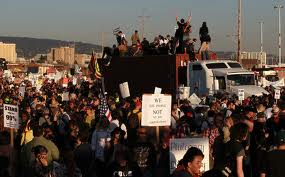
Yesterday, between 7 to 10,000 people took part in a general strike in Oakland. They shut down the port of Oakland, a major access for Chinese goods, the 5th busiest port in the country. Local businesses shut down in support of the effort. To its credit, the protest has remained remarkably peaceful although early morning reports indicate that violence did break out before sunrise. Unfortunately, the authorities in Oakland nearly cost the life last week of a young Marine vet, Scott Olsen. Discontent can have consequences.
But attitudes are shifting and changing. Voices are being heard.
Last April with little fanfare, Joseph Stiglitz stated in a Vanity Fair article:
“The top 1 percent have the best houses, the best educations, the best doctors, and the best lifestyles, but there is one thing that money doesn’t seem to have bought: an understanding that their fate is bound up with how the other 99 percent live.”
Since the Occupy Movement started, this sentiment has been echoed, magnified:
On October 22, Noam Chomsky gave a speech on Dewey Square in Boston and said:
“I’ve never seen anything quite like the Occupy movement in scale and character, here and worldwide. The Occupy outposts are trying to create cooperative communities that just might be the basis for the kinds of lasting organizations necessary to overcome the barriers ahead and the backlash that’s already coming.”
At Black Agenda Report, Glen Ford recently wrote:
“There comes a time of awakening. We are now in that time – although some Black folks are not yet awake. Our job is to wake our people up, so that we don’t sleep through this moment.
The young people that began this Occupation Movement less than two months ago are not “us,” but they have done all of us a great service. They have shouted out the name and address of the enemy – the enemy of all humanity. The enemy’s name is Finance Capital, and the address is Wall Street, and that is the truth.”
Chris Hedges recently stated on Truthdig radio:
“But this is a widespread movement; it’s decentralized; it takes on its own coloring and characteristics, depending on the city that it’s in; and so there will be, you know—as you point out, I mean, movements are by their very nature messy and make steps forward and steps back. But I think that there is a resiliency to this movement because it articulates a fundamental truth of inequality that hits the majority of American citizens.”
Even House Speaker John Boehner remarked in a recent speech at the University of Louisville:
“I understand people’s frustrations,” he said. “The economy is not producing jobs like they want and there’s lot of erosion of confidence in our government and frankly, under the First Amendment, people have the right to speak out … but that doesn’t mean they have the permission to violate the law.”
Hey, it’s a start. Certainly better than designating OWS as ‘The Mob.’
People are rousing from their long, restless slumber. The conversations have begun and are different from what we’ve heard or read before. The protesters persist. They march, they endure.
The Beginning is Near.
Bernanke nudges the Do Nothing Congress
Posted: November 2, 2011 Filed under: Economy, U.S. Economy | Tags: Federal Reserve Bank, FOMC. Ben Bernanke 10 Comments It’s been interesting watching Bernanke get more shrill with each post FOMC meeting news conference. First, he points out that the right wing meme about the unemployment being structural is wrong headed. He talks about why it’s important to respond to cyclical unemployment. This is something congress has being ignoring while doing important things like passing bills to ensure that trust in imaginary friends is printed on money.
“We believe that a good bit of the unemployment were are seeing is what economists would call cyclical unemployment, that is unemployment arising because of inadequate demand in the economy. If that is the case, then monetary policy by lowering interest rates, making financial conditions more accommodative, should stimulate demand, stimulate spending and over a period of time that should help bring cyclical unemployment down. It’s also possible that some of the increase in unemployment reflects so-called structural factors, mismatches between worker skills and job opportunities, loss of skills, geographical location, etc. If that’s the case then monetary policy is much less effective because only other kinds of labor market policies can make progress against that type of unemployment. But again I do think that a considerable part of the unemployment that we are seeing is cyclical. Final comment, cyclical unemployment left untreated, so to speak, for a long time can become structural unemployment as people lose skills, they lose attachment to the labor force.”
He also asked for a little help from congress. Bernanke basically tired to ask for stimulus without using the word since the Congress has branded it anathema.
“With respect to the current economy we are currently continuing our accommodative monetary policy. We are trying to do our best to support economic growth and job creation. It would be helpful if we could get assistance from some other parts of the government to work with us to help create more jobs. But certainly we are doing our part to create more jobs, more opportunities in America.”
Sorry, Ben, the “other parts of government” are just to busy to help the economy work. They prefer to posture and preen. Bernanke has amped up the volume as pointed out at Political Animal. Kevin Drum thinks that the next presser will be when Bernanke says “Will you guys stop griping about the damn budget, get off your butts, and build a few effin bridges instead? Jesus.”

 peej
peej Carissa
 bostonboomer
 dakinikat
 ecocatwoman
 mablue2
 Mama Lopez
 peggysue22
 quixote
 skydancingguestblogger
 Mona (aka Wonk the Vote)



 Sky Dancing
Recent Comments