
Tuesday Reads: Occupy Boston, Occupy Wall Street, and a Modern Day Whisky Rebellion
Posted: October 4, 2011 Filed under: Economy, morning reads, U.S. Economy, U.S. Politics | Tags: American Revolution, Boston Tea Party, civil liberties, NYPD, Occupy, Occupy Los Angeles, occupy Wall Street, Whiskey Rebellion 35 Comments
Good Morning!! Today I want to focus on articles about Occupy Wall Street protests, which despite the critiques of those on both the right and left, are still going on in NYC and many other U.S. cities, including Boston, I’m happy to say. The Boston Phoenix has a blog to document the protests. On September 28, Chris Faraone wrote:
At this early juncture it’s already safe to say that Occupy Wall Street has succeeded. I’m not being sarcastic. Yesterday I wrote about the media storm that’s showered their protests from early on, and that’s rained down even harder since the New York Police Department began brutalizing demonstrators. And after last night’s Occupy Boston meeting on the Common, I’m convinced that the hordes have achieved something even greater than attracting press: regardless of what they actually accomplish in the end, Occupy has already become the hottest protest franchise since the Tea Party. Which is why it makes sense that contrarian Boston is emerging as the first city to strike while the brand is hot.
Last night’s kickoff meeting was at least a testament to the popularity of this movement. People have been angry for some time, but for many it was Occupy that motivated them – not the countless other protests that take place every week around here. Roughly 300 showed –with a significant number of reporters on the scene documenting –despite the event having been announced less than a day ahead of time, and almost exclusively through social media (Steve Annear, who you should follow on Twitter if you’re keeping tabs on the actions, also broke the story in the Metro). By a show of hands, a few dozen folks on the Common got their feet wet in Liberty Square during the first stretch of Occupy Wall Street. But for the most part, these were people – mostly young, but overall from a mix of backgrounds, ages, and ethnicities – who’d become interested by what they’d seen online and in the news.

Occupy Boston meeting on Boston Common
The Guardian even published an article about the Boston organization:
There were socialists, anti-poverty campaigners, students, anarchists, computer hackers, the unemployed, and workers ranging from a vet to an accountant.
And, numbering around 200 and meeting to plot until late in the night, a group of Bostonians have decided to recreate the anti-Wall Street protests that are gripping New York.
Unlike previous attempts, such as a march that fizzled out in Chicago with just 20 people, the people behind Occupy Boston showed a strong dose of media savvy and organisational skill on Monday night, as they drew a committed crowd of volunteers to their cause: to occupy a slice of the city. Local TV crews were in attendance at the evening mass planning meeting, and it had been flagged on the front pages of Boston’s newspapers.
The move raises the first serious prospect of the Wall Street protests spreading beyond New York and comes as other events are also being planned in Los Angeles and Washington.
Noam Chomsky even made a youtube video of support.
This thing is really growing. Could it be that the young people of this country are really going to stand up and fight? I sure hope so. Is this happening where you live? If so, please share what you know. I’m starting to get excited about this!
Getting back to the New York protests, Emptywheel had a post today on the NYPD and their history of violations of civil liberties. I’m not going to excerpt from it, because you really need to read the whole thing–it’s not very long.
At FDL, David Dayen has a post about Van Jones’s Take Back the American Dream organization and how it is “building off #Occupy Wall Street.”
The Campaign for America’s Future expected their conference to be a launching pad for an American Dream Movement that would be a counterpart to the Tea Party, a left populist movement that would branch out across the country. And that movement has built itself up over the past couple months, and was in part responsible for the invisible town hall revolution over August.
But CAF found itself caught by an organic protest movement, a disparate movement organized by a simple theme, an expression of the feeling of mass injustice. Nobody on the left was totally prepared for #OccupyWallStreet, which sprung up on its own. But the groups that have been organizing in similar ways and with a similar theme were more than prepared to support it.
The spirit of #OccupyWallStreet has given a booster shot to this Take Back the American Dream Conference, which last year was completely moribund. The first session at the conference was a paean to #OccupyWallStreet, with video from New York City (the live feed crashed, unfortunately) and even one organizer who camped out in Zuccotti Park speaking. “If we demand something from Wall Street, we’re telling them that they have the power, but we do,” said the organizer from the Working Families Party in New York.
“They went down there to the scene of the crime against our future,” said Van Jones at his keynote address, in admiration of the #OccupyWallStreet protesters. “They’ve been beaten, they’ve been pepper sprayed, they’ve been falsely arrested, but they never broke their discipline. They told the police officers who were arresting them, we are the 99%, we’re fighting for you, we’re fighting for your pensions too.”
“Something’s happening in America. Don’t you give up on this movement!” Jones concluded.
Yes, something is finally happening. Will it continue to grow? I sure hope so!
I also want to call your attention to an interesting piece at Salon by William Hogeland, author of three books on the revolutionary period in American history. Hogeland compares the Occupy Wall Street movement to the so-called Whisky Rebellion. Hogeland writes about radical protests movements against our founding fathers, who were, after all, the elites of their day. Here’s just a sample:
The difficulty in dealing with our founding battle for democratic economics arises in part because the movement was not against England but against the very American banking and trading elites who dominated the resistance to England. That complicates our founding myth, possibly unpleasantly. Also, it was a generally losing battle. With ratification of the Constitution, Hamiltonian finance triumphed, and people looking to Jefferson and Madison for finance and economic alternatives to Hamilton are barking up the wrong tree, since what those men knew, or even really cared, about finance could be written on a dime. (Anyway, in pushing for creating a nation, Madison supported Hamiltonian finance down the line. Their differences came later.) When Occupy Wall Street protesters say “It’s We the People!” they’re actually referring to a preamble, intending no hint of economic democracy, to a document that was framed specifically to push down democratic finance and concentrate American wealth for national purposes. Not very edifying, but there it is.
The Tea Party, meanwhile, has taken up founding economic issues from a right-wing point of view, associating itself with the upper-middle-class Boston patriots (often mistaken for populist democrats) who led a movement against overrreaching British trade acts in the 1760′s and were important to the impulse toward American independence. I’ve written fairly extensively about where and how I think the Tea Party goes wrong on the history of the founding period. But at least they’re framing their objections to current policy, and framing the historical roots of their ideas, not mainly in cultural but in economic terms.
Like it or not, though, it is Occupy Wall Street that has the most in common, ideologically, not with those Boston merchants and their supporters but with the less well-known, less comfortably acknowledged people who, throughout the founding period, cogently proposed and vigorously agitated for an entirely different approach to finance and monetary policy than that carried forward by the famous founders. Amid horrible depressions and foreclosure crises, from the 1750′s through the 1790′s, ordinary people closed debt courts, rescued debt prisoners, waylaid process servers, boycotted foreclosure actions, etc. (More on that here and here.) They were legally barred from voting and holding office, since they didn’t have enough property, so they used their power of intimidation to pressure their legislatures for debt relief and popular monetary policies. Their few leaders in legit politics included the visionary preacher Herman Husband, the weaver William Findley, and the farmer Robert Whitehill.
I found this article absolutely fascinating!
At the LA Times, there’s an editorial about the “message” of the “Occupy” protests along with a photo of protesters at LA City Hall.
The political left has been searching for the last couple of years to find an answer to the tea party. Some hoped last year’s rally in Washington led by TV comedians Jon Stewart and Stephen Colbert, a response to right-wing rallies attended by such conservative media celebrities as Glenn Beck, would spark a national movement. That didn’t happen. Now they’re pinning their hopes on Occupy Wall Street, which in many ways is a mirror image of the tea party. Both groups are motivated by frustration over the rotten economy and are vague about causes and solutions, though if their positions could be summed up in a one-line manifesto, it might be: The tea party, dominated by elderly conservatives, blames government overspending and overreach for our economic problems and would therefore like to cut federal spending, while Occupy Wall Street, dominated by young liberals, blames corporate greed and would therefore like to tax the rich and decrease corporate political power.
It is, of course, far too early to suggest that Occupy Wall Street represents a resurgence of the left. But we do seem to recall that in its initial days the tea party was similarly dismissed by pundits, especially those on the left who preferred to see the protesters as kooks rather than the vanguard of a political shift. What matters isn’t the size of the protest, the attire of the demonstrators or the misspellings on their signs; it’s whether the relatively tiny number of people who can be bothered to show up and march can inspire and energize other like-minded people enough to get them to the polls.
Finally, at Huffpo, there’s a piece by Judith Samuelson: A Baby Boomer’s Advice to the Millennials Occupying Wall Street
Whether their disgust with Wall Street is fueled by a lack of jobs or a more complex analysis was not apparent to me, but I trust we will be hearing more from the Millennials. Scholars are suggesting they will be a force to be reckoned with. In fact, you might already be experiencing their tendency to want to be heard in the workplace, in the classroom or at the dinner table, for example.
There are a lot of them; 90 million by some count, comprising the largest generation in our history. They are the most racially diverse generation ever, and they have been, and are being, shaped by remarkable events such as 9/11 and the ongoing global recession; by their parents — the boomers of yore; and, of course by technology — the first generation to take instant communications for granted. I believe that Millennials will shape our response to issues that bedevil us — through their passion about social issues, their facility with technology and social networking, and through their continued willingness to vote — as they did in big numbers in the last Presidential election.
Many of them will go to business school — or are already there. A quarter of post-graduate degrees are in business, and 20 percent of undergraduates are pursuing business degrees. Even at liberal arts colleges that may not offer “business” as a major, students flock to economics instead, or as close as they can get to the subject. This may be the result of parental pressure to exit school with some hope of finding a job (unlike baby boomers, Millennials are close to their parents and apparently even listen to them) but it is also in pursuit of the skills, language and heroes they have grown up with — more Steve Jobs and Mark Zuckerberg than Bob Dylan and Robert Redford.
The question I have been thinking about is how they will bridge these two worlds — passion for social issues, and comfort with technology and business. I know from experience that real change is hard; that to influence business, and Wall Street, requires people skills as well as analytics, patience, and multiple approaches to gain the attention and commitment of the power brokers who set the rules and design the reward systems. Protest is a not an insignificant part of the puzzle, however, and always has been; just ask Walmart, Nike or Nestle.
In the spirit of Baby Boomers’ sharing their experience, strength, and hope with the Millennials, here’s a boomer anthem that might be appropriate:
What are you reading and blogging about today? Please share!
Today’s Successful Economies
Posted: September 30, 2011 Filed under: Economic Develpment, Economy, U.S. Economy, We are so F'd | Tags: globalization, Jeffrey Sachs, neoconfederates on the rise, US global standings 6 Comments
Swedes are happier and more globally competitive than the US. Is this the real secret of blondes having more fun?
I wrote a blog post a while back about heaven having fjords. I’m very much interested in economics from a development standpoint so it’s always worthwhile checking out the top performers in the world for lessons. It is also quite apparent when you do that Libertarian and Republican memes fail and fail badly. It’s probably why we never hear these things in corporate media.
Societies are better when the pull together instead of pull apart. The best performing countries in economics are the same countries that have a high commitment to public education and society at large. The high performers–in economics, in health, and in education–are the Scandavian countries with their highly progressive tax rates, intense regulation of commerce and harmful activities and emphasis on making sure the rising tide rises all the boats rather than sinking a huge number of them to the benefit of the mega yachts. These are also countries with parliamentary systems which makes them highly democratic. They’ve been winning consistently with the advent of the global economy. The US has lost its position as leader of the developed nations and is moving way down into the losing positions below still developing nations. We could learn some lessons from Scandinavia.
Here’s Jeffrey Sachs at Project Syndicate with some things to think about in that vein. He has written a new book called The Price of Civilization which basically outlines the missteps that we’ve taken that were primarily started as a result of the election of Ronald Reagan. For some reason, many Americans don’t want to pay for some very simple modern facilities like roads, electric grids, airports, and railways. They prefer to buy junk from China they probably don’t need in search of happiness in the form of hoarding and consuming.
Rather than respond to globalization with more government spending on education, infrastructure, and technology, Ronald Reagan won the presidency in 1980 by pledging to slash government spending and cut taxes.
For 30 years, the US has been going in the wrong direction, cutting the role of government in the domestic economy rather than promoting the investments needed to modernize the economy and workforce. The rich have benefited in the short run, by getting massive tax breaks. The poor have suffered from job losses and cuts in government services. Economic inequality has reached a high not seen since the Great Depression.
These adverse trends have been exacerbated by domestic politics. The rich have used their wealth to strengthen their grip on power. They pay for the expensive campaigns of presidents and congressmen, so presidents and congressmen help the rich – often at the expense of the rest of society. The same syndrome – in which the rich have gained control of the political system (or strengthened their control of it) – now afflicts many other countries.
Sweden–as an example other than Norway who can use their oil to leverage their improvements–has been called an economic miracle. After feeling the global recession, they are now growing GDP at rates that are twice to three times the averages of most industrial countries. They are growing 5 times fasting than the US. So, look at their numbers there on the CIA Factbook and marvel where under the poverty rate comes the label: not applicable. Sweden blends capitalism with a social democracy in a way that makes the swedes the 6th most prosperous country on the planet. They are above the US who is number 10. They are behind Norway, Denmark, Finland, Australia and New Zealand. They are number 23 in GDP per capita The US is number 11. They are also highly globally competitive ranking #3 in Global Competitiveness Index after Finland and Switzerland. The US is number 1o.
The Swedes are number 9 on the human development index. We are number 4. Norway is number 1. Sweden has high marginal tax rates (sometimes over 70%), very powerful unions, immigrants, and generous vacations and work weeks. Under Republican fairy tales, Sweden and Norway should be worse off than Haiti. Rather than looking at countries that are achieving great things and leaving us in the dust, we are grasping at a rigid ideology that is designed to tank us.
I haven’t read the Sachs book but I’m definitely putting it on my reading list. You may recall that this is also something Fareed Zakaria examines in his TV show, in books, and at TIME magazine. Here’s a good summary from a recent Time article.
The following rankings come from various lists, but they all tell the same story. According to the Organisation for Economic Co-operation and Development (OECD), our 15-year-olds rank 17th in the world in science and 25th in math. We rank 12th among developed countries in college graduation (down from No. 1 for decades). We come in 79th in elementary-school enrollment. Our infrastructure is ranked 23rd in the world, well behind that of every other major advanced economy. American health numbers are stunning for a rich country: based on studies by the OECD and the World Health Organization, we’re 27th in life expectancy, 18th in diabetes and first in obesity. Only a few decades ago, the U.S. stood tall in such rankings. No more. There are some areas in which we are still clearly No. 1, but they’re not ones we usually brag about. We have the most guns. We have the most crime among rich countries. And, of course, we have by far the largest amount of debt in the world.
We’re in the process of watching the Cat Food Commission Redux set our priorities for our future and its basically an agenda meant to downsize the American Dream for every one except the Mega Wealthy. I hope that the Cheddar Revolution and the Occupy Wall Street movement turn into an American Spring Movement. We have to regain the positive momentum towards modernity before the powers that be force us all back into a pre-civil war paradigm of laws, economic servitude, and society.
Meanwhile, as I write about these healthy economies, 90% of US citizens say our economy stinks and they are pretty unhappy about it. Its time to look at some best practices of other countries and dump the ideologues that keeping making the wrong decisions for us.
Markets (e.g. Herds of PEOPLE) aren’t very Rational a Lot of the Time
Posted: September 24, 2011 Filed under: Economy, Equity Markets | Tags: behavioral economics, behavioral finance, rational markets 7 Comments
The Confidence Fairy is coming for your Savings!!!
One of the primary reasons I didn’t do an investments specialization for my PHD in financial economics is the overwhelming and pervasive group think on Rational Expectations or what’s called the Efficient Market Hypothesis. I’ve never really bought into this. I think it is more an occasional circumstance or specific market behavior at that point when everything is going just dandy which is why I am more the sunspot equilibrium type. I never found compelling reasons for the efficient markets view to be considered an overarching framework for all circumstances. That kind of unorthodox outlook doesn’t buy you much print space in finance journals which means no tenure for you cupcake!! (Although for some reason I can get it passed reviewers when it’s couched in the term “bubble” which is so very sunspot.)
Economists have become a little more accepting of the warts and faults inherent in the hypothesis–notice it is still a hypothesis and not a theory–but finance people still have a tendency to worship at its alter. Economists started out as philosopher social scientists–which is also why the big money is in finance–so they’re a little more open to the idea that markets aren’t all that efficient all the time. I linked to the Wikipedia explanation of the idea for you which is adequate for our purposes. The deal is when you build rational expectations into an economics model or investment model this is what you assume.
To assume rational expectations is to assume that agents‘ expectations may be individually wrong, but are correct on average. In other words, although the future is not fully predictable, agents’ expectations are assumed not to be systematically biased and use all relevant information in forming expectations of economic variables.
This basically rules out wrong group think that won’t deny “relevant information”. If that was the case in reality, there would be no holocaust deniers, evolution deniers, climate change deniers, or flat earthers of substantial numbers to influence the average. Basically, we’d have to accept the “average” rationality of today’s Republican Party and given the existence, electability and popularity of Rick Santorum, Michelle Bachmann, and Ron Paul, I’ll rest my case and reject that. We have a major political party that’s basically a cult of irrationality these days.
There are two really important real life phenomenon that make that assumption look really bad in finance research. One is a little paradox called the Home Bias Puzzle where research has basically shown that most people will still buy investments from their own country despite the availability of better deals abroad. The second is momentum. This is the pack animal behavior in the market where you see something hit the market and suddenly every one is moving that direction when it doesn’t make much sense on a fundamentals level. This is when I sell all my stock holdings. The little voice inside of me will go: “wtf is this rally for? The economy isn’t all that great! I think I better get out of here before they realize they’re all on something!” This is how I’ve managed to remove my “ass”ets and avoid the major crashes since way back in the 1980s.
Whenever you get a financial crises or financial bubbles, you tend to get the panicked cow phenomenon in that if one is spooked the rest chase wildly along. They’ve even programed this behavior into their computers oddly enough. Oh, and btw, none of the strategies and no market guru like Cramer or Buffet or Jesus your neighborhood grocer could ever be right and beat the market consistently if the financial markets were truly rational and efficient. That’s another story, just accept my word for it right now.
I took an Advanced Investments Seminar because I had to for my final elective having no other choice and was subjected the entire semester to the work of Eugene Fama whose big fat head will be in Denver with me next month. Fama is considered the father of modern finance and efficient markets is his dogma. He’s one of the jerks that was drinking the two overly expensive bottles of wine with Paul Ryan that BB wrote about awhile back. The other jerk being his son in law John Cochrane whose asset pricing models always assume the same efficient markets hypothesis. The two of them have dominated finance for decades now and in my mind it’s held the entire field back and caused much damage in the real world. I had to recreate the research in many of Fama’s seminal papers and the most noticeable lunacy to me was how his data sets back then always skipped the Great Depression Era. His data sets usually involved equity market indices like the Dow Jones average during periods that excluded financial panics. That never struck me as honest, but then, I’m not one of the Finance gods–there really are no goddesses–and so I don’t really get a say.
Again, I don’t want to teach this stuff so I generally avoid classes where the textbooks ooze it. I inherited the sincerity gene from my father which causes me to go apostate on my students which may help their critical thinking skills but won’t further the ass-kissing group think skills required in today’s finance jobs. Also, I’m late to academic life and spent the 80s doing hedging, forecasting interest rates, pricing financial assets and liabilities, and generally surrounded by rational senior management thoughts like: “Gee, we’ll get bigger if we do this merger and I’ll get a bonus! Who cares if it drags our income and balance sheet into the depths of hell?” I can also give you examples from the 90s too. Irrational market decisions ooze from marketing divisions and departments daily.
So, behavioral finance and economics looks at the herd mentality that was originally identified as “animal spirits” by J.M. Keynes during the time period and stock market behavior that Eugene Fama likes to systematically ignore. Keynes didn’t have the luxury of skipping over the data of the Great Depression. The kind of apostate philosophy that drives me actually has a label and basically looks at decision making under risky and generally unpredictable situations. In a lot of cases, people don’t make decisions in these circumstances rationally. BB and I have been having some phone conversations about the topic because as a psychologist, she’s very interested in human behavior. Human behavior very much causes people to do different things under times of risk. Let’s face it, people and hence markets aren’t very rational a lot of the time when they’re panicked about losing their jobs, their businesses, their homes, and their savings. They’re a lot more efficient, rational decision makers when circumstances are not risky and unpredictable or when the biggest decision variables are messy and not well understood. Then, there’s the existence of powerful “deciders” who think their egos have a better understanding of alchemy than their necromancers and are on the look out for narratives to reinforce their beliefs. Remember the word narrative because it plays a big role here in where I’m going and where Robert J. Shiller went.
So, this background chat brings me to the topic of this blog post which is a project syndicate article by Robert J. Shiller who is a very well respected economist and dabbles in behavioral economics. He is well known for the Case-Shiller index which measures activity in the housing market in some key markets. (BTW, Case is a big sunspot equilibrium sort as is Douglas Diamond who the Republicans ran out of the District earlier this year.) I’ve taught out of his textbooks. He teaches at Yale and co-authored a book with Nobel Prize winning George “market for lemons” Akerlof called “Animal Spirits: How Human Psychology Drives the Economy and Why It Matters for Global Capitalism.”. His voice is important in this day and age of people chasing confidence fairies and reacting to events here and in Europe rather irrationally which frequently happens during periods of great uncertainty and increased risk.
I’m consistently amazed at the success of the narrative that Republicans have managed to push into the national psyche that we’re over taxed and that our national debt is horrendous as its never been before and that our children and grand children will be crushed by it. You even hear President Obama spew the stuff and he should know better given his ability to access any of the aforementioned economists by phone easily. As I’ve said before with the use of data and nifty graphs, the debt was far worse after World War 2, the tax rates far higher and none of us or the US economy was the worse for it. Really, would you have rather they not borrowed money to fight World War 2 and lived with those results instead? We had nothing but debt when started out as a country and also after the Civil War. As long as you have lots of really high quality assets and people and the power to tax and print money, it’s NO BIG DEAL! Greece does not have Bill Gates and Microsoft continually pumping out huge amounts of value. We have him and lots more like them! People have been reacting to ideological nonsense and narratives. We have a failure of governance and policy because of this. That’s hardly rational. It’s also causing bad effects in our home prices, the value of our savings, and our ability get and keep jobs.
So, here’s Shiller writing on “The Great Debt Scare” about how this ideological nonsense has shaken consumer confidence in both Europe and the U.S. causing a “perverse dynamic” that has been discouraging consumption and investment which has brought about economic weakness. What this basically shows is that the psychology of self-fulfilling prophecies is alive and well in financial markets. Rational Markets my swamp people ass!
We now have a daily index for the US, the Gallup Economic Confidence Index, so we can pinpoint changes in confidence over time. The Gallup Index dropped sharply between the first week of July and the first week of August – the period when US political leaders worried everyone that they would be unable to raise the federal government’s debt ceiling and prevent the US from defaulting on August 2. The story played out in the news media every day. August 2 came and went, with no default, but, three days later, a Friday, Standard & Poor’s lowered its rating on long-term US debt from AAA to AA+. The following Monday, the S&P 500 dropped almost 7%.
Apparently, the specter of government deadlock causing a humiliating default suddenly made the US resemble the European countries that really are teetering on the brink. Europe’s story became America’s story.
There is something—most likely hard wired–in people that creates highly irrational narratives ( we call them frames) to justify stuff that occurs even in the face of incredible evidence against the frame. It’s why there are so many evolution and climate change deniers. The narrative makes them feel better than the reality. We all edit out the data coming from those periods of intense irrationality–like Fama did with the Great Depression–to justify our pet juicy rationalizations. It’s like the post-trauma narrative you create to justify something you did when your lizard brain kicked in. Republican and so called conservative operatives seem to thrive on spinning lizard brain activity into parable like narratives to hone their advantage.
Changes in public confidence are built upon such narratives, because the human mind is very receptive to them, particularly human-interest stories. The story of a possible US default is resonant in precisely this way, implicating as it does America’s sense of pride, fragile world dominance, and political upheavals.
Indeed, this is arguably a more captivating story than was the most intense moment of the financial crisis, in 2008, when Lehman Brothers collapsed. The drop in the Gallup Economic Confidence Index was sharper in July 2011 than it was in 2008, although the index has not yet fallen to a lower level than it reached then.
So, what do these current confidence surveys tell us according to Shiller?
The timing and substance of these consumer-survey results suggest that our fundamental outlook about the economy, at the level of the average person, is closely bound up with stories of excessive borrowing, loss of governmental and personal responsibility, and a sense that matters are beyond control. That kind of loss of confidence may well last for years.
That said, the economic outlook can never be fully analyzed with conventional statistical models, for it may hinge on something that such models do not include: our finding some way to replace one narrative – currently a tale of out-of-control debt – with a more inspiring story.
So after our lizard brain causes fight or flight, the Captain Picard part of our brain tells us to make our narratives so. What we are building into our psyche is not any kind of analysis based on rational views of historical data, economic theory, or for that matter, common sense. What we are building into our psyche is a narrative that isn’t very rational and that’s impacting our behavior and the behavior of markets. Now, if we could just stop the press from reinforcing all the irrational crap out and about these days maybe we could sit down, take a few deep breaths, and peel back the layers of skin on the onion of those destructive narratives. Think about it. Yes, the Garden of Eden story is a great narrative, but what explains the carbon dating data on rocks, the dinosaur bones, and the vast existence of several varieties of protohumans’ remains better? Dinosaurs and Neanderthals in the Garden of Eden with Adam and Eve (not Steve or Lilith) or the Big Bang THEORY and the THEORY of evolution? What explains the financial crisis and the fallout better? The narrative that it’s too much government debt, too high taxes, and too much regulation that were all at much lower levels now than after the World War 2 economic boom or excessive speculation in the markets and exotic, difficult to price, unregulated derivatives, NINJA loans, government encouragement of monopoly and oligopoly power, and fiscal policy known to suppress economic growth? Your choice. Theory or comforting bed time tale.
The Financial Crisis Explained
Posted: September 21, 2011 Filed under: Economy, Republican politics, Republican presidential politics, right wing hate grouups | Tags: Elizabeth Warren, Robert Reich, The people Obama doesn't listen to and won't appoint 34 Comments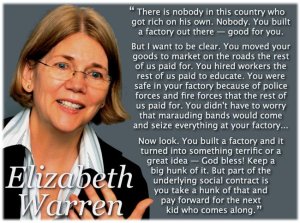 Who says Elizabeth Warren doesn’t have fire in her belly?
We already knew Robert Reich does.
Why do we buy lies based on unsubstantiated wishful thinking over what we know from theory based on on empirical data.
This is all just common sense and it’s backed by data.
These are people that know the facts over the ideology. This is real economics over voodoo economics.
Tuesday Late Afternoon Blues
Posted: September 20, 2011 Filed under: 2012 presidential campaign, Bailout Blues, Barack Obama, Congress, DADT, Democratic Politics, Domestic Policy, Economy, Elections, Equity Markets, Federal Budget, Federal Budget and Budget deficit, GLBT Rights, Main Stream Media, Politics as Usual, The Media SUCKS, the villagers, U.S. Politics, We are so F'd | Tags: black and blue, blue balls, blue bars, blue blooded, blue dog democrats, blue estimators, blue language, blue period, blue skies, blues, indigo girls, red white and blue, tangled up and blue, the blues, true blue 25 Comments
Minxy’s out surfing samsara this afternoon. I’m trying to muster up some good vibes today for her as she faces all the “it’s a short life” kind’ve stuff that goes on with the early passing of a friend. As for me, I seem to be entering my blue period. Maybe it’s because I just get cannot this friggin’ gravity model specified correctly and maybe it’s just my parameters that are tangled up and BLUE. Okay, you won’t know what BLUE means for a regression estimator (Best Linear Unbiased Estimator e.g. BLUE) unless you’re as steeped in econometrics as I am but it’s a good play on words. REALLY. Chuckle sympathetically because I need it today. I wish I could like football like normal people. Instead, I follow the bloodsport of politics and its inherent nastiness these days and I have way too many degrees in the dismal science. The results are bound to get to you one way or another.
So this little piece is about the U.S. and blue to match my mood. I’m going to start out with some blue estimators of a different sort.
There was a bit of poll that showed a glimmer of true hope instead of the manufactured sort out today. Recent entrant into the Massachusetts Senate Race, Elizabeth Warren, is polling ahead of glamor boy Republican Scott Brown who replaced the late Ted Kennedy.
Elizabeth Warren has had an incredibly successful launch to her Senate campaign and actually leads Scott Brown now by a 46-44 margin, erasing what was a 15 point deficit the last time we polled the state in early June.
Warren’s gone from 38% name recognition to 62% over the last three months and she’s made a good first impression on pretty much everyone who’s developed an opinion about her during that period of time. What was a 21/17 favorability rating in June is now 40/22- in other words she’s increased the voters with a positive opinion of her by 19% while her negatives have risen only 5%.
The surprising movement toward Warren has a lot to do with her but it also has a lot to do with Scott Brown. We now find a slight plurality of voters in the state disapproving of him- 45%, compared to only 44% approving. We have seen a steady decline in Brown’s numbers over the last 9 months. In early December his approval was a +24 spread at 53/29. By June it had declined to a +12 spread at a 48/36. And now it’s continued that fall to its current place.
Meanwhile, the mixed up mess of Republican presidential candidates is shaking up to a two white man race. Gallup reports that Perry has a better chance than Romney of sealing the nomination at this point, but Romney has a better chance than Perry to beat Obama. No surprises there.
Rick Perry leads Mitt Romney by 31% to 24% in a new USA Today/Gallup poll of Republican presidential nomination preferences. The two are well ahead of the rest of the GOP field, with Ron Paul the only other candidate in double figures.
…
Perry seems to have momentum, but that could be slowed in the coming weeks if Republicans start to perceive that Romney is more electable in the general election. The new poll finds the slight majority of Republicans, 53%, prefer to see their party nominate the person who has the best chance of beating Obama, even if that person does not agree with them on almost all of the issues they care about. Forty-three percent would prefer a candidate who does agree with them on almost all of the issues, even if that person does not have the best chance of winning in November 2012.
Romney currently edges out President Barack Obama by 49% to 47% in national registered-voter preferences for the November election, while Perry trails Obama by 45% to 50%. However, neither Romney nor Obama is ahead by a statistically significant margin.
It’s no wonder Perry wants out of Texas. This poll should direct Perry into the Even Cowgirls get the Blues line. Texans do not like Governor Goodhair if you believe PPP’s numbers.
The poll, released Tuesday, showed Perry with a negative approval in Texas: while 45 percent of the state’s voters approve of Perry’s job performance, 48 percent of Texas voters say they don’t approve.
Obama should have The Blues over this poll from Marist. Will this lead to calls for a primary challenger on calls on him to pull an LBJ?
President Barack Obama faces a litany of bad news. The president’s job approval rating, his favorability, and his rating on the economy have hit all-time lows. To compound matters, three in four Americans still believe the nation is in a recession and the proportion who thinks the country is moving in the wrong direction is at its highest point in more than a decade.
According to this McClatchy-Marist Poll, the president’s approval rating is at 39% among registered voters nationally, an all-time low for Mr. Obama. For the first time a majority — 52% — disapproves of the job he is doing in office, and 9% are unsure.
You’ve always known that Wall Street is only True Blue to profits and not the country right? Grok this headline at Politico via the WSJ. It looks like a lot of hedge funds were betting the US to lose its AAA standing with S&P. The SEC is launching insider trading probes. Can we please get some perp walks now, please?
Securities and Exchange Commission officials have sent subpoenas to financial firms in a probe of whether there was insider trading — betting on a market crash — before the United States’ long-term credit rating was cut by S&P last month, reports The Wall Street Journal.
At issue are trades that were made by hedge funds and other firms shortly before the rating agency Standard & Poor’s downgraded U.S. debt from triple-A to double-A-plus on Aug. 5 and cited the dysfunctional political climate in Washington as one of the reasons.
The Dow Jones Industrial Average dropped 635 points, or 5.5 percent, on Aug. 8, the first day of trading after the downgrade. This was the sharpest one-day decline since the financial crisis in 2008, but it also made bets against the market very profitable.
Securities regulators are looking for firms that bet the stock market would drop — in particular, bearish trades that seem unusually large or were made by firms that typically do not make them.
An SEC spokesman declined to tell The Wall Street Journal which investment firms have received subpoenas.
My guess is it’s the usual vampire squid suspects and all the rest of the guys whose blue balls we pulled out of the bankruptcy fire with TARP and tax dollars. Bets any one?
So here’s the a nifty chart from Paul Krugman–with blue bars–that will make you scream until you’re blue in the face. Look whose been winning the class war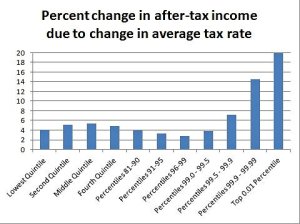 since 1979. So the deal is not only is their share of income and assets way up, but their after tax income has gone way up too.
Changes in tax rates have strongly favored the very, very rich.
Now, they’re only a fairly small part of the huge growth in the after-tax inequality of income. But tax policy has very much leaned into that growing inequality, not against it — and anyone who says otherwise should not be trusted on this issue, or any other.
So, of course the moment we get a whiff of anything slightly Democratic coming from the President we experience blue dogs howling at the blue moon and the beltway press.
Centrist Democrats, a dwindling breed on Capitol Hill, were quickly faced with another rough choice once Obama went public with his plans: Reject their president or back what Republicans are already calling the largest tax increase in the nation’s history.
Florida Sen. Bill Nelson, who is up for reelection in 2012, has supported raising taxes on millionaires but was still weighing whether he’d support higher taxes on those who make more than $200,000 a year, said spokesman Dan McLaughlin.
Sen. Ben Nelson (D-Neb.), a key moderate who’s up for reelection next year, didn’t mince words: “There’s too much discussion about raising taxes right now, not enough focus on cutting spending.”
But Sen. Jon Tester (D-Mont.), who likely will face GOP Rep. Denny Rehberg in next year’s reelection bid, hedged a bit, saying he backs provisions in Obama’s plan that call for closing tax loopholes that benefit millionaires and corporations
“This plan isn’t the one I would have written, nor is it the one that will end up passing Congress,” Tester said. “But I welcome all ideas to the table so Congress can work together to create jobs, cut debt and cut spending.”
 Blue blooded villager David Brooks admits to being an Obama sap and refers to Beltway Bob as “appreciative”. I prefer the term deep-throating, but hey, there’s a glint of recognition, right? It’s a two for one villager idiot piece! Look! I’ve managed to use some blue language.
Yes, I’m a sap. I believed Obama when he said he wanted to move beyond the stale ideological debates that have paralyzed this country. I always believe that Obama is on the verge of breaking out of the conventional categories and embracing one of the many bipartisan reform packages that are floating around.
But remember, I’m a sap. The White House has clearly decided that in a town of intransigent Republicans and mean ideologues, it has to be mean and intransigent too. The president was stung by the liberal charge that he was outmaneuvered during the debt-ceiling fight. So the White House has moved away from the Reasonable Man approach or the centrist Clinton approach.
It has gone back, as an appreciative Ezra Klein of The Washington Post conceded, to politics as usual. The president is sounding like the Al Gore for President campaign, but without the earth tones. Tax increases for the rich! Protect entitlements! People versus the powerful! I was hoping the president would give a cynical nation something unconventional, but, as you know, I’m a sap.
Being a sap, I still believe that the president’s soul would like to do something about the country’s structural problems. I keep thinking he’s a few weeks away from proposing serious tax reform and entitlement reform. But each time he gets close, he rips the football away. He whispered about seriously reforming Medicare but then opted for changes that are worthy but small. He talks about fundamental tax reform, but I keep forgetting that he has promised never to raise taxes on people in the bottom 98 percent of the income scale.
I nearly had to stop reading the damned thing since I was about to pass out from putting my palm to my forehead just a few too many times. Yes, it’s turning black and blue. How are we supposed to get grown up discussions about policy when the two largest newspapers in the country insist posting self serving drivel on a near daily basis.
Okay, here’s my last offering which really does show the best of the Red, White and Blue. Today is the formal removal of DADT. 0penly Gay and lesbian members of our military no longer have to live double lives or be subject to dismissal.
With Tuesday’s repeal of the military’s “don’t ask, don’t tell” policy, gays and lesbians are now free to serve openly in the U.S. armed services.
The U.S. military has spent months preparing for the repeal, updating regulations and training to reflect the impending change, and the Pentagon has already begun accepting applications from openly gay men and women.
It’s events like this that give you a sense that in some way, it’s still
WE THE PEOPLE of the United States, in order to form a more perfect union, establish justice, insure domestic tranquility, provide for the common defense, promote the general welfare, and secure the blessings of liberty to ourselves and our posterity
I’m going to get some iced tea and head back to my trade and foreign direct investment research. But, here’s two of my favorites: Dylan’s Tangled up and Blue done by the Indigo Girls for you on this afternoon in New Orleans under a blue sky.
and every one of them words rang true
and glowed like a burning coal
pourin off every page
Like it was written in my soul from me to you
Tangled up and Blue
I lived with them on Montague Street
In a basement down the stairs
There was music in the cafes at night
And revolution in the air …

 peej
peej Carissa
 bostonboomer
 dakinikat
 ecocatwoman
 mablue2
 Mama Lopez
 peggysue22
 quixote
 skydancingguestblogger
 Mona (aka Wonk the Vote)



 Sky Dancing
Recent Comments