Posted: July 3, 2014 | Author: dakinikat | Filed under: Civil Liberties, Civil Rights, Crime, Discrimination against women, Domestic terrorism, Feminists, fetus fetishists, GLBT Rights, morning reads, Religious Conscience, religious extremists, Reproductive Health, Republican politics, right wing hate grouups |
 Good Morning!!
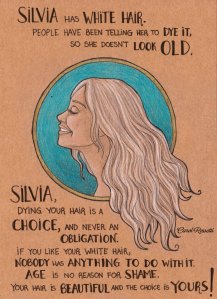
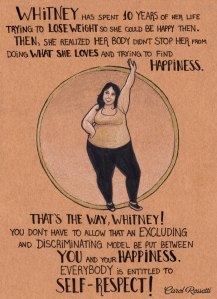
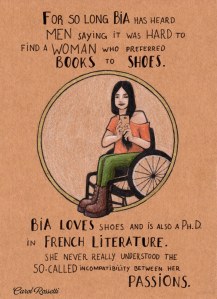
Today’s beautiful messages and images can be found here.
The reactionary and wildly creative decisions coming out of the Supreme Court are already having ramifications across the country where women, minorities, and the GLBT community are having to fight for their very basic rights. Interestingly enough, we are learning about which corporations want to be citizens and which corporations want to exist for the sole benefits of their owners.
The Hobby Lobby decision is already creating chaos as Notorious RBG and many of us have discussed.
This week, in the Hobby Lobby case, the Supreme Court ruled that a religious employer could not be required to provide employees with certain types of contraception. That decision is beginning to reverberate: A group of faith leaders is urging the Obama administration to include a religious exemption in a forthcoming LGBT anti-discrimination action.
Their call, in a letter sent to the White House Tuesday, attempts to capitalize on the Supreme Court case by arguing that it shows the administration must show more deference to the prerogatives of religion.
“We are asking that an extension of protection for one group not come at the expense of faith communities whose religious identity and beliefs motivate them to serve those in need,” the letter states.
The Hobby Lobby decision has been welcomed by religious-right groups who accuse Obama of waging a war on religion. But Tuesday’s letter is different: It comes from a group of faith leaders who are generally friendly to the administration, many of whom have closely advised the White House on issues like immigration reform. The letter was organized by Michael Wear, who worked in the Obama White House and directed faith outreach for the president’s 2012 campaign. Signers include two members of Catholics for Obama and three former members of the President’s Advisory Council on Faith-Based and Neighborhood Partnerships.
“This is not an antagonistic letter by any means,” Wear told me. But in the wake of Hobby Lobby, he said, “the administration does have a decision to make whether they want to recalibrate their approach to some of these issues.”
This decision is controversial and will remain controversial. It changes how the government can approach the court’s favored religion and possibly 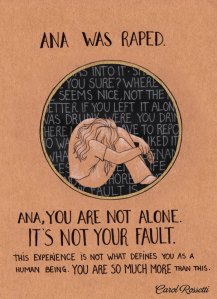 other religions.
The first source of controversy is the collapse of a national consensus on a key element of religious liberty: accommodation. Throughout American history, there has been widespread agreement that in our religiously diverse and widely devout country, it is good for the government to accommodate religious exercise. We have disagreed about particular accommodations (may a Muslim police officer wear a beard, despite police department policy?), and especially about whether religious accommodations should be ordered by judges or crafted by legislators. But we have generally agreed that our nation benefits when we help rather than burden those with religious obligations. That consensus seems, quite suddenly, to have evaporated.
A second source of controversy is that many people view the Hobby Lobby case as concerning not just reproductive rights but also, indirectly, rights for gays and lesbians. Advocates for same-sex marriage have long insisted that their own marriages need not threaten anyone else’s, but citizens with religious objections to same-sex marriage wonder whether that is entirely true: Will a small-business owner be sued, for instance, for declining to provide services to a same-sex couple? Conversely, and understandably, gay and lesbian couples wonder why they do not deserve the same protections from discrimination granted to racial and other minorities. For both sides, Hobby Lobby was merely a prelude to this dawning conflict.
The third source of controversy is a change in our views of the marketplace itself. The marketplace was once seen as place to put aside our culture wars and engage in the great American tradition of buying and selling. The shopping mall has even been called the “American agora.” But today the market itself has become a site of cultural conflict. Hobby Lobby is one of many companies that seek to express faith commitments at work as well as at home and that don’t see the workplace as a thing apart from religion. Many companies preach and practice values, religious and otherwise, that are unrelated to market considerations. CVS, for example, recently announced that it would stop selling tobacco products, regardless of how that decision might affect its bottom line.
A country that cannot even agree on the idea of religious accommodation, let alone on what terms, is unlikely to agree on what to do next
 Here’s another group of “patriotic, gawd-fearing” amuricans shouting down children and mothers fleeing violence in our neighbor countries. I just continue to find this to be the most appalling story I’ve heard in some time. The Border Patrol, ICE, and every one involved–but these horrible xenophobes–were just following our laws as written. Perhaps, they should know our laws just a little bit better themselves.
The national controversy over a surge of Central American immigrants illegally crossing the U.S. border established a new battleground this week in a Southern California small town where angry crowds thwarted detained migrants from entering their community.
In a faceoff Tuesday with three buses carrying the migrants behind screened-off windows, the demonstrators chanted “Go back home!” and “USA” and successfully forced the coaches to leave Murrieta, CNN affiliate KFMB reported.
The buses instead took the 140 or so undocumented immigrants to U.S. processing centers at least 80 miles away, in the San Diego and El Centro areas, federal officials say.
Counter-protesters squared off with the demonstrators, and a shouting match erupted over the nation’s immigration system, which recently has been overwhelmed with a tide of Central American minors illegally entering the United States alone or with other children.
A mix of poverty, violence and smugglers’ false promises is prompting the Central American inflow.
Unlike undocumented Mexican migrants, who are often immediately deported, the U.S. government detains and processes the Central Americans, who are eventually released and given a month to report to immigration offices. Many never show up and join the nation’s 11 million undocumented population, says the National Border Patrol Council, the union representing Border Patrol agents.
The Latin American immigrants rejected by Murrieta protesters were initially held in Texas, where U.S. facilities are so overflowing that detainees are sent to other states for processing.
The government doesn’t have the room to shelter the children with adults: there’s only one family immigration detention center, in Pennsylvania. To assist the unaccompanied children, President Barack Obama’s administration opened shelters last month on three military bases because federal facilities more designed for adults were overrun with minors.
Tuesday’s busloads of detained Central American immigrants didn’t include any unaccompanied minors, said Murrieta Police Chief Sean Hadden, who put the number of protesters at 125. The children on the buses were apparently in the company of relatives or other adults, said an official with the National Border Patrol Council.
Meanwhile, yet another corporation has decided that open carry of assault weapons in their stores may not create the most hospitable environment for  employees or shoppers. Target has joined other companies asking customers to leave their guns at home,
The leadership team has been weighing a complex issue, and I want to be sure everyone understands our thoughts and ultimate decision.
As you’ve likely seen in the media, there has been a debate about whether guests in communities that permit “open carry” should be allowed to bring firearms into Target stores. Our approach has always been to follow local laws, and of course, we will continue to do so. But starting today we will also respectfully request that guests not bring firearms to Target – even in communities where it is permitted by law.
We’ve listened carefully to the nuances of this debate and respect the protected rights of everyone involved. In return, we are asking for help in fulfilling our goal to create an atmosphere that is safe and inviting for our guests and team members.
This is a complicated issue, but it boils down to a simple belief: Bringing firearms to Target creates an environment that is at odds with the family-friendly shopping and work experience we strive to create.
Meanwhile, over in Georgia, the new flout your gun every where has lead to just what you’d expect.
A “misunderstanding” between two armed men in a Georgia convenience store led to an arrest on the very day that the state’s new expansive gun rights law went into effect, according to The Valdosta Daily Times.
Valdosta Police Chief Brian Childress summed the incident up for the newspaper.
“Essentially, it involved one customer with a gun on his hip when a second customer entered with a gun on his hip,” Childress said.
According to the Daily Times, the first man, Ronald Williams, approached the second man in the store and demanded to see his identification and firearms license. Williams also pulled his gun from his holster, without pointing it at the second man. The second man responded by saying that he was not obligated to show any permits or identification — then he paid for his purchase, left the store, and called the police.
Police responded to the call around 3 p.m. Tuesday, and Williams was arrested on a charge of disorderly conduct for pulling his gun in the store.
Tuesday was also the day that Georgia’s so-called “guns everywhere” law went into effect, allowing residents to carry guns into bars, nightclubs, classrooms, and certain government buildings. Among other things, the law also prohibits police from demanding to see the weapons permit of someone seen carrying a gun. Childress mentioned that last point when talking to the Daily Times about Tuesday’s incident.
“This is an example of my concern with the new gun law that people will take the law into their own hands which we will not tolerate,” Childress said.
 I wanted to share a mass shooting that happened on Bourbon Street last weekend. A beautiful young woman has lost her life in the senseless violence. Another has a lot of damage to her mouth, gums and teeth. All of this happened because one young man got into an argument and his anger and his gun led to indiscriminate firing into the crowd. A total of 10 innocent bystanders were shot.
One of the 10 victims of the weekend shooting on New Orleans’ famed Bourbon Street died Wednesday.
According to the coroner’s office, Brittany Thomas, 21, of Hammond, La., died from her injuries. She is the only victim of the shooting to die.
Thomas had been in critical condition since the early Sunday morning shooting when two gunmen sprayed the crowd with bullets.
Three others were reported in stable condition after Sunday’s shooting: a 35-year-old man from Mississippi, a 19-year-old Arkansas woman and an 18-year-old New Orleans man.
Interim LSU Hospital spokeswoman Siona LaFrance said Wednesday a 21-year-old Australian woman was released from the hospital.
On Sunday, police said nine people were injured in the shooting. Then Monday, they said a person who came into the police department Sunday afternoon also was injured in the violence.
Other victims, not hospitalized, included two New Orleans-area men; a teenage girl and a woman from Alabama; and a Florida man.
The young Australian woman has a Facebook page where you can help her defray the cost of reconstruction. As of writing this, I understand that the “person” of interest has surrendered to the police. His face has been plastered every where for about a day and half.
The shooting took place about 2:45 a.m. Sunday on Bourbon Street and involved “two young men, both armed with firearms, who chose to settle a dispute between themselves without care for anyone else,” Police Supt. Ronal W. Serpas told reporters. They exchanged gunfire, hitting bystanders, he said. Bourbon Street, a hot spot for tourists, is full of bars, restaurants and shops.
 This young man’s callous regard for life should land him in jail for a very long time. We’ll see what happens. The suspect is a young white man and the dead girl is a young black woman.
According to the New Orleans Police Department, two men are sought in the shooting that spawned from an argument between them.
“While everyone else was running away, I was running toward the gunfire,” Minsky said. “And, I don’t know, being a curious guy — that’s what I wanted to do — see what was going on basically.”
Minsky described the ordeal as “surreal,” saying he’d never seen multiple people get shot.
“There was a lot of blood, I can tell you that much, you know. And I actually stepped in a pool of blood and didn’t realize it until I was walking toward the person shot in the face,” Minksey said. “That kind of freaked me out a little bit.”
The victim shot in the face was Amy Matthews from Australia. The bullet struck her in her cheek and knocked out all but 10 teeth she told an Australian newspaper. She was released from the hospital this week.
In one of several photos Minsky took on his cellphone, Matthews is seen sitting on a sidewalk on Bourbon Street as a crowd of people attempted to help her, including two U.S. marines.
He also captured an image of an unresponsive woman lying in the middle of the 700 block of Bourbon Street.
During the chaotic moments after the shooting, Minsky said there weren’t many screams in the Vieux Carré.
“There was just a lot of people running around and trying to help each other,” he said. “The person that was shot in the face was probably the person getting the most attention at that immediate moment. But as far as the screams and commotion, I mean, yeah, there are people running and screaming but that all died down after the gunshots ended.”
I can’t believe that this is what the founders– many of whom I am a direct descendant of–planned for our union. How could they have envision this kind of hateful chaos empowered by the Supreme Court who represents the voice of reason, law, and constitutionality, and the House of Representatives which is supposed to be the voice of the people.. I do not find any of these events to be consistent with their dreams and plans for a more perfect union where no one religion would dictate the lives of others, where all were considered equal before the law, and every one had the ability to pursue life and liberty.
Did you like this post? Please share it with your friends:
Posted: May 31, 2014 | Author: bostonboomer | Filed under: Crime, FBI, Hillary Clinton, metadata, morning reads, NSA, National Security Agency, Rape Culture, Real Life Horror, U.S. Politics, Violence against women | Tags: Edward Snowden, George Packer, Glenn Greenwald, Jonathan Chait, Margaret Sullivan, Michael Kinsley |
Good Morning!!
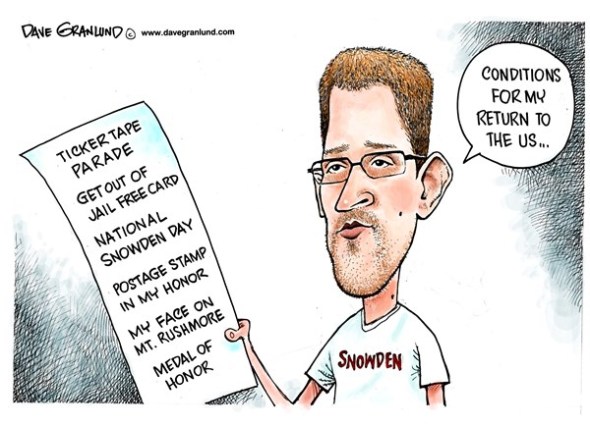
I stole the above Dave Granlund cartoon from JJ’s Friday night post, because it perfectly expresses my viewpoint on who and what Edward Snowden is. I’ll have the latest Snowden news for you in a minute, but first a personal update and some breaking Boston bombing news.
I’m in Indiana visiting my mom for a couple of weeks. The weather is gorgeous here, and I’m really enjoying it. It’s great to be out of the drizzly cold weather the Boston area has been having. I’m looking forward to doing quite a bit of yard work, helping my mom buy a new bed, celebrating her 89th birthday with her, and just generally enjoying her company.
As usual, I drove my car out here, and I made great time. The speed limits have been increased to 70 mph in Ohio and Indiana, and everyone in Massachusetts and New York routinely drives at least 10-15 miles over the 65 mph limit. So I probably averaged around 70-75 mph on the trip.
My mechanic told me that I need to start using premium gas in my car. I hated to do it, but to my surprise I got much better mileage with the expensive gas. I used 2-1/2 tanks of gas to go more than 900 miles. Usually it takes 3 full tanks and a little more to make the trip!
As I mentioned above, some Boston bombing news broke last night. From The Boston Globe: Man charged with obstructing bombing probe.
A cab driver from Quincy who was close to the two suspected Boston Marathon bombers was arrested Friday on charges of lying to investigators and destroying evidence, allegedly obstructing the ongoing investigation of the 2013 attack that shocked the city and the nation.
Khairullozhon Matanov, a 23-year-old Kyrgyzstan national, allegedly contacted Tamerlan Tsarnaev 42 minutes after the April 15, 2013, bombings, and he bought him and his younger brother, Dzhokhar Tsarnaev, dinner at a restaurant that night. Matanov visited Tamerlan, whom he knew from playing soccer and from places of worship, at the suspected bomber’s Cambridge home two days later.
Over several days after the bombings, he also called the brothers repeatedly.
Authorities alleged in a sweeping indictment unsealed Friday that Matanov realized the FBI would want to interview him about his relationship with the suspected bombers, but that he deleted files from his computer and tried to get rid of his cellphones. They also allege that he lied to investigators about his encounters with the brothers in the days after the bombings.
Matanov discussed his friendship with the Tsarnaev brothers with others in the days following the bombing, but he claims that they didn’t confess their involvement to him. Apparently, the FBI knew about all this a year ago; it’s not clear why they waited until now to charge Matanov. I’ll be keeping my eye on this story.
Now the latest on the Snowden Operation.
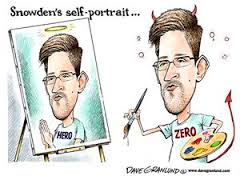
Edward Snowden has been dominating the news for the past few days because of the interview he gave to NBC’s Brian Williams and the recent release of Glenn Greenwald’s book on his collaboration with Snowden in releasing classified NSA files. I have to admit up front that I haven’t yet been able to force myself to watch the interview. Frankly, I doubt if Williams asked any of the questions that I think Snowden should be asked; but I promise I’ll watch the thing today to find out for sure. Meanwhile, I’ve gathered some reactions from people who have watched it.
Frankly, I admit up front that I think Edward Snowden is a defector as well as an arrogant, grandiose, narcissistic jerk. But I think you all knew that already. With that said, here are the latest Snowden (and Greenwald) stories from my very biased point of view.
Last week there were a couple of high-profile negative reviews of Glenn Greenwald’s book No Place to Hide, one by George Packer and the other by Michael Kinsley. As you know, Greenwald doesn’t take criticism well, and he and his fans were not happy with either review. Packer’s review was the most scathing and carefully argued, but Kinsley is taking most of the heat from the Greenwald fan base, probably because the review was quite snarky. For example:
Greenwald was the go-between for Edward Snowden and some of the
newspapers that reported on Snowden’s collection of classified documents
exposing huge eavesdropping by the National Security Agency, among
other scandals. His story is full of journalistic derring-do, mostly set in
exotic Hong Kong. It’s a great yarn, which might be more entertaining if
Greenwald himself didn’t come across as so unpleasant. Maybe he’s
charming and generous in real life. But in “No Place to Hide,” Greenwald
seems like a self-righteous sourpuss, convinced that every issue is
“straightforward,” and if you don’t agree with him, you’re part of
something he calls “the authorities,” who control everything for their own
nefarious but never explained purposes….
Throughout “No Place to Hide,” Greenwald quotes any person or
publication taking his side in any argument. If an article or editorial in
The Washington Post or The New York Times (which he says “takes
direction from the U.S. government about what it should and shouldn’t
publish”) endorses his view on some issue, he is sure to cite it as evidence that he is right. If Margaret Sullivan, the public editor (ombudsman, or
reader representative) of The Times, agrees with him on some controversy,
he is in heaven. He cites at length the results of a poll showing that more
people are coming around to his notion that the government’s response to
terrorism after 9/11 is more dangerous than the threat it is designed to
meet.
Greenwald doesn’t seem to realize that every piece of evidence he
musters demonstrating that people agree with him undermines his own
argument that “the authorities” brook no dissent. No one is stopping
people from criticizing the government or supporting Greenwald in any
way. Nobody is preventing the nation’s leading newspaper from publishing
a regular column in its own pages dissenting from company or government
orthodoxy. If a majority of citizens now agree with Greenwald that dissent
is being crushed in this country, and will say so openly to a stranger who
rings their doorbell or their phone and says she’s a pollster, how can
anyone say that dissent is being crushed? What kind of poor excuse for an
authoritarian society are we building in which a Glenn Greenwald, proud
enemy of conformity and government oppression, can freely promote this
book in all media and sell thousands of copies at airport bookstores
surrounded by Homeland Security officers?
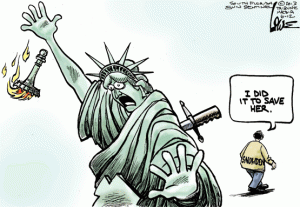
And so on . . . After Kinsley’s piece was published the Snowden cult, of which NYT public editor Margaret Sullivan is a charter member, reacted as usual with an over-the-top firestorm of rage. I’ll let Sullivan speak for the cult. She questioned the choice of Kinsley as reviewer and accused the long-time book-reviewer of arguing the only the government should decide whether classified government materials should be published. She apparently also felt that Kinsley showed insufficient deference to her idol Glenn Greenwald. I’d like to quote from Sullivan’s piece, but for some reason I can’t copy and paste from it. But here’s a reaction to the kerfluffle from Jonathan Chait: Times vs. Sullivan vs. Kinsley vs. Greenwald. Chait agrees with me that the Packer review is “more devastating.” Chait thoroughly skewers Margaret Sullivan, and she can’t attack him because he didn’t do it at the NYT.
It’s certainly true that Kinsley is more effective [than Packer] at poking a hole in Greenwald’s argument than in making the case for his own (obviously problematic) alternative. That would seem to be fair enough given that he’s writing a review of Greenwald’s book. Not to Sullivan, who sprung into action, using her public editor’s column to scold Kinsley. His review “expressed a belief that many journalists find appalling,” she wrote, aghast. Also, “there’s a lot about this piece that is unworthy of the Book Review’s high standards, the sneering tone about Mr. Greenwald, for example.” No sneering in the book review!
Paul writes back to Sullivan — in a rebuttal posted at the bottom of Sullivan’s item — to say, more or less, “let me explain to you what what a book review is”:
It seems there is a lot of confusion on the Internet, especially among those who do not work in the media but even — disturbingly — within the media, about the differences between an editorial and a book review, between what “The New York Times” says and what a reviewer for The New York Times Book Review says. …
For a reviewer to address how a writer comes across, particularly in a memoir or first-hand account, is entirely fair game for a book review, and by no means an ad hominem attack.
The notion that it’s wrong for the book review to print abhorrent reviews, let alone to poke fun at no less a hero than Glenn Greenwald, is an artifact of the culture of smugness that Kinsley is writing about here. If there’s one thing objective journalists are allowed — indeed, expected — to hold extremely strong opinions about, other than the importance of reducing the budget deficit, it’s the importance of journalists themselves. How dare a newspaper publish a review expressing skepticism about special rights for journalists?
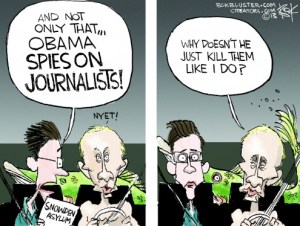
Just for balance, here is a fairly non-judgmental summary of the overall “controversy” at the Neiman Report.
Finally, Kinsley’s response to Margaret Sullivan
Since I haven’t yet watched the Snowden interview with Brian Williams, I’ll give you what I think is the best response I’ve seen so far from Kurt Eichenbaum at Newsweek: 16 Questions Edward Snowden Wasn’t Asked. This article is must-read–if only I could quote the whole thing! Here’s a small sample:
1. Most of the information that has been revealed from the documents you obtained dealt with the abilities, rather than the actions, of the NSA. Did you see or do you have any evidence that the agency was, in fact, spying on Americans who were not linked to terrorist organizations through what is known as the “three-hop” standard? (Under this rule, one of 22 NSA officials must give approval to an analyst who believes a “reasonable, articulable suspicion” exists that a number is directly linked to terrorists. Then the analyst is allowed to determine through searches of metadata which phone numbers were called by the first number. The NSA can then determine the numbers called by the second phone, and the numbers called by the third. The intent is to see if numbers called in the United States by phones directly connected to terrorists will reveal terrorist operatives inside the country.)
5. Did you see or do you have evidence of the NSA reading content of emails sent by Americans or listening to phone calls of Americans without meeting the standards required by the national security courts known as FISA courts?
10. Do you believe that surveillance in foreign nations is intrinsically wrong?
11. You say that you do not believe your actions damaged United States security and that the government has failed to reveal instances where it did. Two questions: What kind of analysis did you conduct to be sure that the information you were taking did not compromise security? And, secondly, given that journalists do not have security clearances, why did you think they were the best placed to Click here and determine what would compromise national security and what didn’t?
Please go read the rest. It sounds like Brian Williams pretty much avoided asking Snowden any hard questions at all.
A few more quick headlines:
NBC News (Irony alert!): Russia Web Journalism Award Named For Edward Snowden.
More horrendous gang rapes in India–from Reuters India: Home minister seeks report on grisly rape, hanging of teens in Uttar Pradesh.
Exclusive: The Daily Banter’s Investigation Helps Catch Sandy Hook Memorial Thief.
Hilarious must-read from Politico: NSA releases Snowden memo.
Oliver Willis: Republicans already handing the White House to Hillary Clinton.
Those are my offerings for today. What are you reading and blogging about? Please share your links on any topic in the comment thread.http
Did you like this post? Please share it with your friends:
Posted: May 26, 2014 | Author: bostonboomer | Filed under: Crime, Mental Health, misogyny, morning reads, racism, social justice, U.S. Politics, Violence against women, War on Women | Tags: Caroline Janney, Civil War, Confederate Memorial Day, David Blight, Decoration Day, elliot rodger, freed slaves, Isla Vista mass murder, Memorial Day history, Ta=Nehisi Coates, Veterans |

Good Morning!!
A few days ago, I read an article about the “true meaning of Memorial Day.” I can’t find it now, but it was in the Chicago Tribune. The author wrote that Memorial Day began as “Decoration Day,” when Southern women decorated the graves of Confederate soldiers. I Googled some more and found other writers making the same claim. Here’s a piece by a Civil War historian from Purdue University Caroline Janney:
Many may not know the holiday weekend that marks the start of summer by paying respects to veterans and remembering loved ones began when white Southern women took a leadership role in honoring their Civil War veterans, says a Purdue University historian.
“After the Civil War, southern men would have appeared treasonous if they had organized memorials to honor their fallen, so women – perceived as apolitical – instead organized tributes and events that set the tone for how the country celebrates Memorial Day today,” says Caroline E. Janney, professor of historyand president-elect of the Society of Civil War Historians. “In 1866, the men were figuratively hiding behind the skirts of these women who worked together as part of Ladies’ Memorial Associations.”
The women organized dozens of memorials during the spring of 1866 and the following years, Janney says. Historically these memorials were scheduled throughout the spring as a sign of renewal and rebirth, and each community chose its own date to celebrate.
The date usually reflected a key date in the Civil War, such as the May 10 death of Gen. Thomas “Stonewall” Jackson, or a battle close to the association’s individual area. Memorial Day became more unified when larger associations, such as the United Confederate Veterans and United Daughters of the Confederacy, began organizing memorials in the 1890s. And memorial days also were observed in the North, but they were organized by Union veterans beginning in 1868, two years after the ex-Confederate women had established the practice.
I was surprised, because I had read years ago that the practice was begun by former slaves who wanted to honor Union soldiers. I found the above photo on Facebook–with the suggestion that it was taken on that first Decoration Day May 1, 1865; but I can’t be absolutely certain that’s accurate. Note that that dates is a year earlier than the one Janney writes about. It turns out that a number of places and people claim to have started the practice of decorating Union and Confederate Graves. Southerners designated “Confederate Memorial Days.” Kingston, Georgia claims to have held the first one.
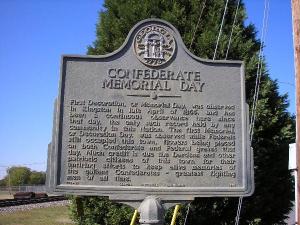
Yale historian David Blight wrote about the disputed origins of Memorial Day in the New York Times in 2011.
Officially, in the North, Memorial Day emerged in 1868 when the Grand Army of the Republic, the Union veterans’ organization, called on communities to conduct grave-decorating ceremonies. On May 30, funereal events attracted thousands of people at hundreds of cemeteries in countless towns, cities and mere crossroads. By the 1870s, one could not live in an American town, North or South, and be unaware of the spring ritual.
But the practice of decorating graves — which gave rise to an alternative name, Decoration Day — didn’t start with the 1868 events, nor was it an exclusively Northern practice. In 1866 the Ladies’ Memorial Association of Columbus, Ga., chose April 26, the anniversary of Gen. Joseph Johnston’s final surrender to Gen. William T. Sherman, to commemorate fallen Confederate soldiers. Later, both May 10, the anniversary of Gen. Stonewall Jackson’s death, and June 3, the birthday of Jefferson Davis, were designated Confederate Memorial Day in different states.
Soon the yearly practice became partisan:
In the South, Memorial Day was a means of confronting the Confederacy’s defeat but without repudiating its cause. Some Southern orators stressed Christian notions of noble sacrifice. Others, however, used the ritual for Confederate vindication and renewed assertions of white supremacy. Blacks had a place in this Confederate narrative, but only as time-warped loyal slaves who were supposed to remain frozen in the past.
The Lost Cause tradition thrived in Confederate Memorial Day rhetoric; the Southern dead were honored as the true “patriots,” defenders of their homeland, sovereign rights, a natural racial order and a “cause” that had been overwhelmed by “numbers and resources” but never defeated on battlefields.
Yankee Memorial Day orations often righteously claimed the high ground of blood sacrifice to save the Union and destroy slavery. It was not uncommon for a speaker to honor the fallen of both sides, but still lay the war guilt on the “rebel dead.”
But Blight discovered in a historical archive at Harvard University that the earliest celebration of “Decoration Day” was organized by freed slaves in Charleston, South Carolina in 1865.
During the final year of the war, the Confederates had converted the city’s Washington Race Course and Jockey Club into an outdoor prison. Union captives were kept in horrible conditions in the interior of the track; at least 257 died of disease and were hastily buried in a mass grave behind the grandstand.
After the Confederate evacuation of Charleston black workmen went to the site, reburied the Union dead properly, and built a high fence around the cemetery. They whitewashed the fence and built an archway over an entrance on which they inscribed the words, “Martyrs of the Race Course.” ….
The procession was led by 3,000 black schoolchildren carrying armloads of roses and singing the Union marching song “John Brown’s Body.” Several hundred black women followed with baskets of flowers, wreaths and crosses. Then came black men marching in cadence, followed by contingents of Union infantrymen. Within the cemetery enclosure a black children’s choir sang “We’ll Rally Around the Flag,” the “Star-Spangled Banner” and spirituals before a series of black ministers read from the Bible.
After the dedication the crowd dispersed into the infield and did what many of us do on Memorial Day: enjoyed picnics, listened to speeches and watched soldiers drill. Among the full brigade of Union infantrymen participating were the famous 54th Massachusetts and the 34th and 104th United States Colored Troops, who performed a special double-columned march around the gravesite.
Nearly 150 years later, it’s apparently very difficult for some Americans to credit African Americans with the first Memorial Day (or with much of anything else for that matter). As Ta-Nehisi Coates showed in The Atlantic recently, it’s apparently difficult for Americans to remember much of anything about African American history–before or after the Civil War. Why would anyone feel comfortable mourning the “lost cause” of a society built on the enslavement of other human beings? I can understand mourning the dead Confederate soldiers, but shouldn’t there be recognition that they died for something shameful? We can look around us today and still see the aftereffects of the slavery and the war that ended it. Will we ever get over it? One more quote from Blight’s article:
The war was over, and Memorial Day had been founded by African-Americans in a ritual of remembrance and consecration. The war, they had boldly announced, had been about the triumph of their emancipation over a slaveholders’ republic. They were themselves the true patriots.

On Memorial Day in 2014, we honor the dead of all wars, but we treat our living war veteran with disrespect. From CNN, ‘Thanks for your service’ not enough, by Sebastian Junger, Jim McDermott and Karl Marlantes.
According to current Veterans Administration estimates, 22 American veterans take their lives every single day.
High rates of unemployment, homelessness, alcoholism, substance abuse and post-traumatic stress are decimating our community of veterans. With the wars of the past 13 years in Iraq and Afghanistan coming to a close, we are seeing too many casualties among American soldiers in this transition to peace.
In light of this crisis, we need a new kind of Memorial Day.
Many veterans are desperate to talk about their experiences with fellow Americans who accept shared responsibility for what is done in war, particularly the killing. Yet these conversations rarely happen today. How can a veteran truly come home unless we acknowledge that our nation’s wars are something we all chose and paid for?
Returning Vietnam veterans were treated shamefully. That, thankfully, is behind America. We’ve moved from outright hostility to awkward, if well-meant, expressions of “thank you for your service” and the creation of a number of new veterans services organizations.
However, there remains an abiding sense of national indifference, or worse, a sense that somehow veterans are victims. This must change.
A great deal needs to change for the United States to be “one nation indivisible.”

In the News
Isla Vista Mass Murder:
The horrible murders in Santa Barbara are still at the top of the Google News page today. A few links:
NBC News: What Do We Know About Elliot Rodger’s Rampage?
Little Green Footballs: Echoes of Montreal – Isla Vista shows us 25 years doesn’t change much.
NY Daily News: Social media strikes back with #YesAllWomen after deadly Isla Vista rampage.
Slate: The Pick-Up Artist Community’s Predictable, Horrible Response to a Mass Murder
CBS Los Angeles: Rodger’s Family Friend says Killer’s Parents Tried to Get Son Mental Help.
Village Voice: Rightbloggers: Santa Barbara Killer Elliot Rodger’s Sexist Rants Have Nothing To Do With Sexism (Or Guns).
Fox News: Sheriffs never saw menacing videos before California rampage.
NY Daily News: Santa Barbara killer’s parents raced to stop him after receiving disturbing emails

Other News:
The Washington Post: White House mistakenly identifies CIA chief in Afghanistan.
The New York Times: Pro-European Businessman Claims Victory in Ukraine Presidential Vote.
Reuters: French far right in ‘earthquake’ win as Europe votes.
Raw Story: It’s all in your head: Scientist now believes his pioneering work on gluten allergy was wrong.
Raw Story: SC pastor accused of turning Bible college into forced labor camp for foreign students.
The Hollywood Reporter: Walt Disney Family Feud: Inside His Grandkids’ Weird, Sad Battle Over a $400 Million Fortune.
Politico: The ‘Wary of Hillary’ Democrats
What else is happening? Please post your links in the comment thread, and enjoy the holiday!
Did you like this post? Please share it with your friends:
Posted: May 20, 2014 | Author: bostonboomer | Filed under: Crime, morning reads, Rape Culture, Real Life Horror, Violence against women | Tags: after-prom horrors, Calhoun High School Georgia, cypherpunks, Edward Snowden, Ellijay Georgia Calhoun High Prom Rape, gang rape, Gilmer County GA, Glenn Greenwald, hackers, Jacob Applebaum, John Cook, Laura Poitras, NSA leaks, redactions, The Intercept, twitter fight, twitter storm |

Good Morning!!
In the comments on yesterday’s post, I mentioned that there has been quite a bit of tension building up between Glenn Greenwald and some of the more extreme members of the (for lack of a better name) cypherpunks crowd–Wikileaks, Cryptome.com, and the hacker community (including Jacob Applebaum, who is closely involved both with Wikileaks and Laura Poitras, Greenwald’s partner in crime. I guess I should have stayed up later last night, because this morning I woke up to the aftermath of a major storm in the Twitterverse, where most of these types of people choose to communicate with each other.

Glenn Greenwald
The fight stemmed from an article posted at The Intercept yesterday, in which the authors chose to redact the name of one of the five countries targeted by NSA data collection. However, it really goes back much further than that.
There has been a long running disagreement between Greenwald and the other groups I mentioned on how much of Edward Snowden’s trove of stolen NSA data to publish. The hacker/Wikileaks crowd thinks Greenwald should simply release everything and let the chips fall where they may, and Greenwald claims he is carefully vetting the material with Snowden’s help in order not to reveal anything that would harm anyone.
Greenwald has actually revealed only a small portion of the material so far, presumably holding back information that he wanted to include in his book. But now the book has been released, and it apparently contains much information that has already been published. For those who have been obsessively following the NSA leaks story, there doesn’t seem to be a need to buy the book. Why is Greenwald being so stingy?
Here’s some background from Michael Kelley at Business Insider: WikiLeaks Threatens To Reveal Information That Glenn Greenwald Says Could Lead To ‘Deaths’.
Jacob Applebaum
America’s National Security Agency (NSA) can “vacuum up and store the actual content of every conversation” in the Bahamas and an unnamed country, the new publication The Intercept reported Monday, based on documents leaked by Edward Snowden.
Intercept Editor Glenn Greenwald — who wrote about documents leaked by Snowden when he was a columnist for The Guardian — said the publication didn’t reveal the country because it was “very convinced” that doing so would lead to “deaths.”
After a heated discussion between WikiLeaks, Greenwald, Intercept Editor-In-Chief John Cook, and American WikiLeaks hacker-turned-Der Spiegal contributor Jacob Appelbaum, WikiLeaks tweeted that it will reveal the name of the second country being spied on by the NSA.
As Kelley points out, the implications is that Wikileaks knows the name of the country either by unmasking the redaction with software or because Wikileaks has access to the Snowden files.
The most plausible way for WikiLeaks to have access to a Snowden cache is if Appelbaum, who led the reporting on several Der Spiegel articles based on NSA documents (which may or may not be from Snowden), shared information with his friend and WikiLeaks Editor-In-Chief Julian Assange. Applebaum tweeted that The Intercept’s redaction was “a mistake.”
Appelbaum, a close friend of Laura Poitras, the other journalist whom Snowden gave a large set of documents, also gave a presentation detailing a classified document listing technology available to the NSA’s hacking unit, known as TAO. It is not known how he acquired those documents.

Laura Poitras
So which is it? The careless ways in which the Snowden documents have been passed around between The Guardian and The New York Times and other news organizations; with Greenwald’s husband David Miranda carrying them through London to Berlin and back; as well as the fact that Snowden is in Russia, suggest that the entire cache will eventually be released, and presumably all hell will break loose. It’s only a matter of time.
Charles Johnson posted the entire Wikileaks-Greenwald argument at Little Green Footballs: Slap Fight of the Day: Wikileaks vs Pernicious G
Today on Twitter this happened: Julian Assange, who most people believe is the one behind the @Wikileaks account, threw a huge tantrum because Glenn Greenwald redacted the name of a country from his latest disingenuous article. Greenwald says he was convinced publishing the country’s name would lead to deaths. Assange doesn’t give a shit about that, of course.
There are some inadvertently hilarious moments here; Wikileaks’s Jacob Appelbaum says redacting the country “makes Wikileaks look extreme.” I almost fell out on that one. And then there’s the tweet in which Assange basically calls everyone in Greenwald’s crew “a bunch of racists.” And it all ends with Assange issuing a super-villain threat to release the country’s name “in 72 hours.”
Scroll through the collection below to see what it looks like when extreme libertarians have a purity war.
Head over to Green Footballs if you want the details. Read more exchanges between Wikileaks, Jacob Applebaum, and John Cook, editor of The Intercept at Chirpstory. Read more at Buzzfeed, where Miriam Berger and Miriam Elder provide a timeline of the tweets along with their interpretation: Julian Assange Is Angry At Glenn Greenwald And He’s Not Going To Take It Anymore.

Finally, Bob Cesca’s take on the whole affair: The Wikileaks vs Greenwald Twitter Fight: Julian Assange Threatens To Reveal Deadly NSA Info.
It all began Monday morning when The Intercept posted a new Snowden revelation with cutesy headline: “Data Pirates of the Caribbean: The NSA Is Recording Every Cell Phone Call in the Bahamas.” Get it? Pirates! The article exhaustively describes an operation called MYSTIC and another called SOMALGET in which NSA gathers audio and metadata of cellphone calls in the Bahamas in order to spy on human traffickers and drug cartels. The Bahamas is notorious for both.
Naturally, the article featured all of the deceptive Greenwaldian bait-and-switch we’ve come to expect from his Snowden articles. For example, in paragraph seven, Greenwald and his co-authors Ryan Devereaux and Laura Poitras noted that Sen. Tom Harkin (D-IA), Bill Gates and Oprah Winfrey routinely vacation in the Bahamas:
By targeting the Bahamas’ entire mobile network, the NSA is intentionally collecting and retaining intelligence on millions of people who have not been accused of any crime or terrorist activity. Nearly five million Americans visit the country each year, and many prominent U.S. citizens keep homes there, including Sen. Tom Harkin (D-Iowa), Bill Gates, and Oprah Winfrey.
NSA is spying on Oprah! Stop the presses! But no, if you read all the way down to the 54th paragraph (!!) Greenwald tosses in a token mention of NSA’s rules about preventing data collection against U.S. Persons, whether or not they happen to be inside the U.S. There are very strict “minimization” procedures to eliminate the data that might’ve been inadvertently collected. Why? Because it’s illegal to spy on Americans without an individual warrant. And, by the way, Greenwald & Company noted that the SOMALGET program is, yes, legal.
It sure seems like there are enough hints in the story for anyone to guess the redacted country. Pirates? SOMALGET? Plus the fact the Assange accused Greenwald of “racism.” Read much more interpretation and more tweets at The Daily Banter.
I’ll be keeping a close eye on this story from now on and I’ll pass on any new information.
In other news . . .
On Sunday JJ wrote about an alleged gang rape that reportedly took place after the Calhoun High School senior prom in North Georgia on May 10. The reason I’m writing about it is that Sky Dancing has been getting a huge number of clicks from people looking for more information on this story. It seems people want to know what is happening, but the local papers have not published anything on the crime or the investigation since Sunday. Doesn’t that seem odd and troubling? Is a cover-up in the works. As JJ pointed out it brings back memories of Steubenville, Ohio. After the gang rape there, local officials tried to sweep it under the rug, but a blogger and an “Anonymous” group kept the story alive. Maybe someone with inside information from Calhoun needs to get something like that started? As in Steubenville, there are hints that coddled football players may be involved.

Jacqueline Gomez
Meanwhile, in another prom-related tragedy, a girl was found dead after a prom at MacArthur High School in Houston. According to her mother, the mother of Jacqueline Gomez’ boyfriend was supposed to bring her home that night, but instead the boy’s mother allowed the couple to stay in a hotel room against the Gomez’ mother’s wishes. To me the whole thing sounds really suspicious. From KHOU.com, Mother: Daughter was not supposed to stay at hotel after MacArthur HS prom.
There are new startling details from the mother of a teenagerfound dead on prom night. Her mother feels like she was mislead by her daughter’s prom date and his mother….
Gomez was off to her senior prom at the Hyatt North Houston Hotel. Her mother was too distraught to show her face on camera, but said she expected to see her daughter back at home later that night….
Barron said Gomez’s date’s mother picked the couple up from her home. She also picked them up from the hotel later that night. That’s when she last spoke to her daughter on the phone.
“I just spoke to them after prom, a couple words, told me she was going to get something to eat,” said Barron.
That’s when the boy’s mother got on the phone and asked if Gomez could spend the night at their house.
“I said no, bring her back home,” said Barron. “I gave them a couple hours, and I never heard back.”
The next call she got was from a homicide detective with the Houston Police Department. She said detectives told her the room was booked by the boyfriend’s mother.
What happened? Who gave Jacqueline the drugs and did the boy’s mother know about it? More information from The Houston Chronicle: Texts Hint Girl May Have Overdosed After Prom.
A series of text messages offered new details into the death of Jacqueline Gomez, the 17-year-old Aldine ISD senior found dead Saturday in a Houston motel room the morning after her prom. The texts, sent from an account identified as Gomez’s date, also indicate investigators believe the girl probably overdosed….
Yet nobody can be certain how the MacArthur High School student died until autopsy results are complete – which could take several weeks, the Harris County medical examiner said. And that has the date and Gomez’s family and friends anxiously waiting for the mystery to be solved.
Meanwhile, her friends and family refute any suggestion that Gomez was ever a “party girl,” saying she spent most of her time working at a Kroger grocery and preparing to graduate in June.
Was Jacqueline given a date-rape drug? We may never find out, because those drugs wash out of the system very quickly. Check this out:
“He was posting pictures of himself crying on Instagram. So I a sent him a text that day to ask what had happened to my girl,” said Justice Gonzalez, a close friend of Gomez who saw the couple leave the prom together Friday night to go to that room. Authorities report Gomez was found dead in her bed about 9:20 the next morning.
“They said she overdosed,” part of the text reads, likely referring to law enforcement officials.
He went on.
“I woke up. I tried waking her but she wouldn’t,” the date texted back, adding four frowning faces. “I was screaming and crying telling her to wake up. But she didn’t. She didn’t,” He ended his text with two frowning faces with tears.
He stated she had appeared “perfectly fine and happy” when they left the “Miami Night” prom. She also seemed “happy” when they both went to sleep, he said.
He had told authorities that they had some alcohol, but said in a text to the friend that Gomez had also taken the painkiller hydrocodone.
Why the f&ck didn’t didn’t he take her home, and WTF was his mother thinking?! Furthermore, why can’t something be done to prevent these kinds of after-prom horrors?
Now I’m really mad, and I’m running out of space and time. I’ll post links to other news in the comment thread, and I hope you’ll do the same.
Did you like this post? Please share it with your friends:
Posted: May 16, 2014 | Author: dakinikat | Filed under: Bobby Jindal, Capital Punishment aka Death Penalty, Civil Liberties, Civil Rights, Crime, Criminal Justice System, Discrimination against women, Domestic terrorism, morning reads, The Right Wing, Women's Rights, worker rights |
 Good Morning!
I have read the most horrifying stories this week. It makes me wonder if a good portion of humanity has a death wish. I’m going to share a variety of links that I’ve found; and a lot of them aren’t the most uplifting, I’m afraid.
Knowledge is power. Ignorance may be bliss to the holder but not to the folks around them. There is no lack of headlines in the area of bigotry and intolerance. This is truly discouraging to those of us that care passionately about social justice.
Crime rates have been falling recently but our incarceration rates are not. There’s a huge study out on the economic costs of our prison society and its 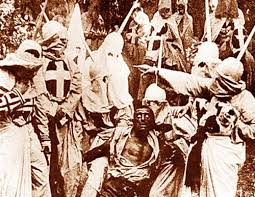 findings are not pretty. We’re spending billionaires of dollars locking up the poor, the uneducated, and the mentally ill in a distinctly racist way.
While crime rates have fallen 45 percent since 1990, the memo said that the incarceration rate is now at a “historically unprecedented level,” jumping 222 percent between 1980 and 2012. An African-American man who never graduated from high school has a 70 percent likelihood of being imprisoned by his mid-30s; for similarly educated white men, the rate is about 15 percent. And the United States imprisons at a rate six times greater than most peer nations, including those of the European Union, Japan, Israel, and Mexico.
The U.S. Department of Justice announced rules last month that would give the Obama administration wider latitude to extend clemency or reduce sentences for drug-related prisoners who don’t present a threat to public safety. In addition, the U.S. Sentencing Commission voted unanimously in April to reduce sentencing guidelines for certain nonviolent criminals, a move now before Congress that could go into effect Nov. 1 if lawmakers don’t take any further action.
Ronald S. Sullivan Jr. is a clinical professor of law and director of the Criminal Justice Institute at Harvard Law School. The program focuses on criminal practice, education, and research, and hosts a teaching clinic for third-year law students to represent indigent criminal defendants in local and juvenile courts. Sullivan spoke with the Gazette about racial and national sentencing disparities, the economic and social costs of mass incarceration, and the sentencing reforms now under consideration.
GAZETTE: According to the memo, while the overall crime rate fell 45 percent between 1990 and 2012, the rate of imprisonment has spiked 222 percent between 1980 and 2012. What’s behind this disparity? Is that strictly the result of policy decisions like mandatory minimum sentencing, repeat-offender laws, and the growth in for-profit prisons? Or are other factors at work?
SULLIVAN: That’s certainly a big piece of it. … policy decisions in respect of mandatory minimums drive the huge incarceration rate. But there are other factors as well. What those factors are is the subject of a lot of academic debate nowadays. And to be honest, we’re not exactly sure what it is. We do know that on a per-capita basis the U.S. incarcerates more people than any country in the world, including Rwanda, Russia, Cuba, all of the places one does not associate with a robust tradition of liberty. And that’s in many ways shocking.
The theory would be … with the high rates of incarceration that the crime rate would go down and then that would be followed by less incarceration because there just wouldn’t be as many crimes committed. But those numbers have gone in opposite directions. Mandatory minimums simply don’t explain all of it. Part of it, at least I think, has to do with selective law enforcement — the over-policing of certain neighborhoods, particularly minority neighborhoods and poor neighborhoods. That is to say, if police are there and looking for crimes, and over-police certain neighborhoods, you’re going to produce more defendants in particular areas. And if the populations are drawn from poor populations, they’re unable to afford to be released on bail, they’re unable to afford good lawyers, and studies show that if you’re not released on bail you tend to stay in jail after sentencing. An unfortunate reality of the United States is that far too often the justice you receive is a function of how much money you have.
The prison-industrial complex is also an important factor. It doesn’t take an economist to know that if … you make your money by people going into prison, then there’s going to be higher incarceration rates. So I think that certainly plays a role as well.
GAZETTE: What are the areas of debate among scholars?
SULLIVAN: One explanation has to do with the United States’ articulated goals of punishment. Back in the ’70s and before, rehabilitation was an articulated goal of the criminal justice system. The Supreme Court has said clearly now rehabilitation is no longer a penological goal. We look at incapacitation, we look at deterrence, and we look at retribution as goals that the penal system serves. When you take rehabilitation out of the mix, then that de-incentivizes the system from having shorter sentences because there’s no longer an affirmative goal of reintegrating people meaningfully back into the community. That’s one of the things that scholars argue drive up the incarceration rate.
The other has to do with our system of elected judges in most states. Judges who are elected, the argument runs, respond to democratic pressures. We live in a political economy where people think that more and harsher punishment is better, even though most competent data suggests that longer sentences, after a certain point … make people worse as opposed to making them better. But you have democratically elected judges who respond to the will of the people, and if that will is for longer sentences, no matter how misinformed, then judges oftentimes acquiesce to those pressures.
The other issue has to do with legislators. It, again, has to do with the political economy in which we live. With this mantra of being “tough on crime,” legislators essentially race to see who can draft legislation with the harshest, longest penalties. I think that legislators don’t believe that prosecutors will attempt to enforce the most harsh provisions of particular laws, and in that sense, from the vantage point of the legislator, it’s sort of a win-win situation: They can get the political credit for drafting an incredibly harsh law, but not really have to deal with the effects because the notion is the prosecutor will sort it out and will recommend a fair sentence. That assumption, though, just hasn’t really been borne out in reality.
GAZETTE: The current incarceration gap between white men and African-American men is particularly striking. Does that figure surprise you, and what accounts for this gap? Is access to justice a factor?
SULLIVAN: The figure does not surprise me, and it is unfortunate that the figure does not surprise me. The figure reaffirms that race insinuates itself into almost every aspect of our life still, and it has a particular salience in the criminal justice system. … Here we see the effect of over-policing much more dramatically. In our culture, unfortunately … blackness is seen as a proxy for criminality. So the same or similar conduct engaged in by a person of color is seen through a lens that views that conduct as criminal, where others simply are not taxed in the same way.
The debate over the use of lethal injections and the drugs used for state executions continues. Three newspapers–including the UK Guardian–have sued to 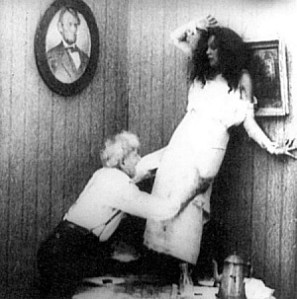 make public the source of drugs for these injections. Most states are trying to make that information private. Many of the recent botched executions came from simple druggists compounding the formulations because many of the major drug manufacturers–especially those in Europe–refuse to do so. Should the formulation and the source of death penalty drugs be kept from the public?
The growing secrecy adopted by death penalty states to hide the source of their lethal injection drugs used in executions is being challenged in a new lawsuit in Missouri, which argues that the American people have a right to know how the ultimate punishment is being carried out in their name.
The legal challenge, brought by the Guardian, Associated Press and the three largest Missouri newspapers, calls on state judges to intervene to put a stop to the creeping secrecy that has taken hold in the state in common with many other death penalty jurisdictions. The lawsuit argues that under the first amendment of the US constitution the public has a right of access to know “the type, quality and source of drugs used by a state to execute an individual in the name of the people”.
It is believed to be the first time that the first amendment right of access has been used to challenge secrecy in the application of the death penalty. Deborah Denno, an expert in execution methods at Fordham University law school in New York, said that more and more states were turning to secrecy as a way of hiding basic flaws in their procedures.
“If states were doing things properly they wouldn’t have a problem releasing information – they are imposing a veil of secrecy to hide incompetence.” “This is like the government building bridges, and trying to hide the identity of the company that makes the bolts,” said Richard Dieter of the Death Penalty Information Center. “Those involved in public service should expect public scrutiny in order to root out problems, particular when the state is carrying out the most intimate act possible – killing people.”
A Guardian survey has identified at least 13 states that have changed their rules to withhold from the public all information relating to how they get hold of lethal drugs. They include several of the most active death penalty states including Texas, which has executed seven prisoners so far this year, Florida (five), Missouri (four) and Oklahoma (three). Attention has been drawn to the secrecy issue by the botched execution of Clayton Lockett in Oklahoma on 29 April in which the prisoner took 43 minutes to die, apparently in great pain, from an untested cocktail of drugs whose source was not made public.
Lockett’s lawyers had argued in advance that he might be subjected to cruel and unusual punishment as a result of the lack of information surrounding the drugs, but the state supreme court allowed the procedure to go ahead having come under intense pressure from local politicians, some of whom threatened to impeach judges.
In the wake of the events in Oklahoma, in which the prisoner writhed and groaned over a prolonged period, the state has agreed to pause for six months before carrying out any further judicial killings to give time for an internal investigation to be completed. President Obama described the Lockett execution “deeply troubling” and has asked US attorney general Eric Holder to review the way the death penalty is conducted.
Until last year, Missouri which is now executing prisoners at a rate of one a month, was open about where it obtained its lethal injection chemicals. But like many death penalty states, its drug supplies have dwindled as a result of a European-led pharmaceutical boycott, and in a desperate move to try to find new suppliers it has shrouded their identity in secrecy. In October, the state changed its so-called “black hood law” that had historically been used to guard the identity of those directly involved in the death process.
The department of corrections expanded the definition of its execution team to include pharmacies and “individuals who prescribe, compound, prepare, or otherwise supply the chemicals for use in the lethal injection procedure”. Six inmates have been executed by Missouri since the new secrecy rules came in –they went to their deaths entirely ignorant of the source or quality of the drugs used to kill them. All that is known is that the pentobarbital that Missouri deploys in executions probably came from a compounding pharmacy – an outlet that makes up small batches of the drug to order in the absence of stringent regulation.
We continue to see GLBT civil rights characterized by the right as an attack on their religious rights and their homobigoted behavior and language  wrapped up as a first amendment issue. How does the right play the victim card in a debate about limiting the rights of others? It is doing the same things with women’s reproductive rights.
While Religious Right leaders are quick to equate criticism as an attack on their freedom of speech and religion, some of them are all too happy to limit the free speech or religious liberty of the people they disagree with. That includes the Benham brothers.
In the flurry of public appearances in the wake of the HGTV cancellation, the Benhams and their right-wing fans have portrayed themselves as committed to the principle that everyone in America should have a chance to express themselves. On the O’Reilly Factor, David Benham denounced the gay agenda for seeking “to silence those that disagree with it, and it begins with Christians.” Jason warned that “when an idea seeks to silence any other idea that may disagree with that, then we have ourselves a problem on hand.”
But as blogger Jeremy Hooper recently pointed out, back in November 2004, David, Jason, and Flip Benham were all part of a group of about 15 people who went to a Charlotte, North Carolina city council meeting to complain about the gay pride celebration that had taken place in a city park six months earlier. They were among a group of people who had gone to the Pride event to, in Jason’s words, “tell them that Jesus loves you just the way you are, but he refuses to leave you that way.” But the Benhams and their friends were appalled at what they saw. “This is filth, this is vile and should not be allowed in our City,” said David. Jason urged city council members to reject future permits for Pride celebrations – and seemingly for any LGBT-themed event:
They have a right to apply for this permit, but you have a right and responsibility to deny it. I [implore] you not to be governed by the fear in which you feel. If you deny them this permit you will open a can of worms but you in your leadership position have to take that responsibility and you have to not allow the fear of making this homosexual community mad. You have to accept that responsibility and deny them every permit that they ask for.
In the words of Charlotte Pride organizers, “The Benham brothers once tried to silence us. They failed.”
Some Benham fans, like the American Family Association’s Bryan Fischer, say flat-out that the First Amendment’s religious liberty protections were only meant for Christians and don’t apply to Muslims, Mormons or other minority faiths. Back when many self-proclaimed “religious liberty” advocates were opposing efforts by Muslims in New York to build a community center – which critics gave the inaccurate and inflammatory name of “Ground Zero Mosque” – David Benham and his father Flip were among them. According to the Anti-Defamation League, David participated in protests against the Center, calling it a “den of iniquity” and labeling Muslims “the enemy” that was attacking America.
In these public debates, “Christian” as used by Religious Right leaders often doesn’t really apply to all Christians, but only to a subset of Christians who share their right-wing politics. Other Christians don’t count. The Family Research Council’s Tony Perkins, who has bemoaned “cultural elites” who want to “silence” and “bully” people like the Benhams, recently said that pro-gay-equality Christians don’t deserve the same legal protections as he does because “true religious freedom” applies only to those with religious views that align with those of the political Right.
We’ve seen a lot of this coming from Governor Bobby Jindal who is a bully that insists that GLBT rights activists are bullies.
Gov. Bobby Jindal’s commencement speech at Liberty University was a masterpiece in this type of dishonest projection. Posing as a champion of free speech and freedom of religion, he actually made a chilling argument in favor of stripping both of those freedoms away from ordinary Americans, businesses and anyone who might disagree with turning this country into a theocratic state. He started by defending Hobby Lobby for trying to strip contraception coverage out of their employees’ own healthcare plans. “Under the Obama regime,” he argued, “you have protection under the First Amendment as an individual, but the instant you start a business, you lose those protections. And that brings us to the second front in this silent war: the attack on our freedom of association as people of faith.”
It’s all nonsense, of course. In fact, Hobby Lobby’s intention here is to reduce religious freedom by forcing their employees to adhere to certain religious rules in order to get the benefits they already earned. ( They have a history of trying to impose their religious dogma on non-believers through other means as well.) The only people in any real danger of losing freedom are women, who are in danger of losing their freedom to use their insurance benefits in a way that fits their personal beliefs.
But Jindal was just warming up, claiming the “Obama administration” was gunning to decide “who can preach the Gospel.” This outrageous conspiracy theory was justified, in his opinion, by supposed other attacks on “free speech,” namely that TV networks are reluctant to house the opinions of open bigots. “The left no longer wants to debate. They simply want to silence us,” he said of Phil Robertson from Duck Dynasty, who was never silenced and has, to this date, been allowed to say any fool thing he wants. But he was briefly suspended from A&E, leading conservatives to decide that “free speech” means you have a right to your own TV show.
All of this has gotten me interested in again in White Supremacist movements. I really believe that most of these Southern Republicans fall squarely 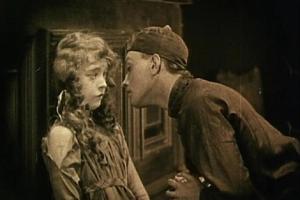 into the neoconfederate mold and aren’t that far off the KKK tree.
White supremacy is referenced in relation to specific news events as well. For example, the murder rampage by the neo-Nazi Frazier Glenn Miller, the recent weeks-long debate between pundits Ta-Nehisi Coates and Jonathan Chait about “black pathology”; birtherism; stand-your-ground laws; and the open embrace of the symbols and rhetoric of the old slave-holding Confederacy by the Republican Party have been framed and discussed in terms of white supremacy.
Conservatives and progressive often use the phrase “white supremacy” in divergent ways. Conservatives use the phrase in the service of a dishonest “colorblind” agenda, evoking extreme images of KKK members and Nazis as the exclusive and only examples of white racism in American life and politics. Conservatives use extreme caricatures of white supremacy in order to deflect and protect themselves from charges that the contemporary Republican Party is a white identity organization fueled by white racial resentment. Liberals, progressives and anti-racists use the phrase “white supremacy” to describe the overt and subtle racist practices of movement conservatism in the post-Civil Rights era, and how American society is still structured around maintaining and protecting white privilege. This analysis is largely correct: however, it often conflates concepts such as racism, white privilege, and white supremacy with one another. Language does political work. In the age of Obama, the phrase “white supremacy” is often used in political discussions like an imprecise shotgun blast or a blockbuster bomb. If the Common Good and American democracy are to be protected—countering how the right wing has used the politics of white racial resentment, racial manipulation, and hate to mobilize its voters in support of a plutocratic agenda—a more precise weapon is needed. A necessary first step in that direction requires the development of a more detailed and transparent exploration of the concept known as “white supremacy.”
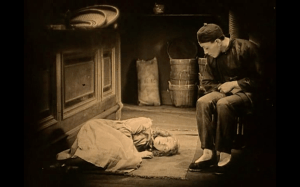 One of the sure signs to me of either a racist or a misogynist or a homophobic bigot is that they all insist they have no problem women, racial minorities, and/or gay people. The believe they are the victims by being forced to deal with any one else in terms other than their own choosing. Therein lies the problem. Here’s a perfect example from Kristen Powers writing at USA Today. You can’t call out bigotry without being called a bully obsessed with political correctness. Then, you’re told that the real victims are white conservative christians.
Each week seems to bring another incident. Last week it was David and Jason Benham, whose pending HGTV show was canceled after the mob unearthed old remarks the brothers made about their Christian beliefs on homosexuality. People can’t have a house-flipping show unless they believe and say the “right” things in their life off the set? In this world, the conservative Tom Selleck never would have been Magnum, P.I.
This week, a trail-blazing woman was felled in the new tradition of commencement shaming. International Monetary Fund Managing Director Christine Lagarde withdrew from delivering the commencement speech at Smith College following protests from students and faculty who hate the IMF. According to the Foundation for Individual Rights in Education, this trend is growing. In the 21 years leading up to 2009, there were 21 incidents of an invited guest not speaking because of protests. Yet, in the past five-and-a-half years, there have been 39 cancellations.
Don’t bother trying to make sense of what beliefs are permitted and which ones will get you strung up in the town square. Our ideological overlords have created a minefield of inconsistency. While criticizing Islam is intolerant, insulting Christianity is sport. Ayaan Hirsi Ali is persona non grata at Brandeis University for attacking the prophet Mohammed. But Richard Dawkins describes the Old Testament God as “a misogynistic … sadomasochistic … malevolent bully” and the mob yawns. Bill Maher calls the same God a “psychotic mass murderer” and there are no boycott demands of the high-profile liberals who traffic his HBO show.
The self-serving capriciousness is crazy. In March, University of California-Santa Barbara women’s studies professor Mireille Miller-Young attacked a 16-year-old holding an anti-abortion sign in the campus’ “free speech zone” (formerly known as America). Though she was charged with theft, battery and vandalism, Miller-Young remains unrepentant and still has her job. But Mozilla’s Brendan Eich gave a private donation to an anti-gay marriage initiative six years ago and was ordered to recant his beliefs. When he wouldn’t, he was forced to resign from the company he helped found.
Got that? A college educator with the right opinions can attack a high school student and keep her job. A corporate executive with the wrong opinions loses his for making a campaign donation. Something is very wrong here.
The right seems to be really confused about the first amendment, which clearly deals with the relationship between the federal government, religion, the press, and the people’s free speech. The same idiots that scream that Hobby Lobby can deny its employees contraception and say that businesses should be able to refuse to serve GLBTs will shout out a corporation that says they don’t want to be known for bigotry of any kind. They also misunderstand the protection given to University professors when it comes to academic freedom. Companies have to comply with the law. They do not have to keep employees that don’t represent their corporate values. PERIOD.
Anyway, it just amazes me that this intense amount of uncivil bigotry and hatred seemed to have burbled up again after all these years. All it took was an African American President and a few powerful women–namely Hillary Clinton–to bring the crazy out.
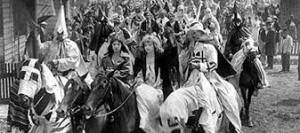
I just wanted to mention that most of these silent film images come from “Birth of a Nation” but one comes from “Broken Blossoms” also known as the “Yellow Man and the Girl”. Both of these films were directed by DW Griffith around 1919. Both movies starred Lillian Gish and were received differently by white audiences than by the racial minorities they also depicted.
What’s on your reading and blogging list today?
Did you like this post? Please share it with your friends:


 peej
peej Carissa
 bostonboomer
 dakinikat
 ecocatwoman
 mablue2
 Mama Lopez
 peggysue22
 quixote
 skydancingguestblogger
 Mona (aka Wonk the Vote)



 Sky Dancing
Recent Comments