
Saturday Reads: President Obama’s Acceptance Speech
Posted: September 8, 2012 Filed under: 2012 presidential campaign, Barbara Ehrenreich, Civil Liberties, Civil Rights, Mitt Romney, morning reads, U.S. Economy, U.S. Military, U.S. Politics | Tags: acceptance speech, Charles P. Pierce, citizenship, democracy, Democratic National Convention 2012, Howard Kurtz, Michael Tomasky, Nielson ratings, Peter Beinart, Politico, self-government, Tom Junod 68 Comments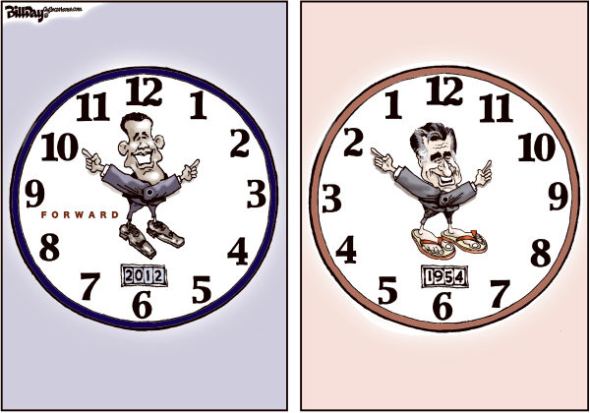
Good Morning!
Generally speaking the pundits didn’t care for President Obama’s acceptance speech on Thursday night. It’s not surprising that the guys at Politico thought it “fell flat.”
A surprisingly long parade of Democrats and media commentators described the speech less as a failure than a fizzle—an oddly missed opportunity to frame his presidency or the nation’s choice in a fresh or inspirational light.
Even those who liked the president’s performance generally went no further than saying that he was effective in doing a job that needed to be done, in a tough-minded if prosaic style.
These shoulder-shrug reactions confront Obama with a question no one expected to be asking when the week in Charlotte began: How did a president for whom stirring speeches were the engine of his rise to power manage to give, at best, only the third-most compelling speech at a convention devoted to his own re-election?
But even more liberal commentators found Obama’s speech wanting. Peter Beinart called it “underwhelming and anticlimactic.”
Obama’s acceptance speech had two apparent goals: The first was to lay out an agenda for the next four years so people feel they have something forward-looking to vote for. The second was to recapture the sense of hope that defined Obama’s 2008 campaign.
On paper, he did both things. But what the speech lacked was a coherent explanation of the nightmare this country has gone through for the last four years. Republicans are laying the Great Recession at Obama’s feet. Obama is saying that Republicans created it and, if elected, will make it worse. To win that argument, Obama needed to explain why the financial crisis happened, and he didn’t. Yes, he mocked the GOP for proposing tax cuts as the answer to every problem, but the financial crisis didn’t happen because of tax cuts. It happened, in large measure, because Republican and some Democratic politicians—blinded by free-market fundamentalism and Wall Street largesse—allowed bankers to create unregulated markets in which they gambled the savings of millions of Americans, knowing that if their bets failed, they wouldn’t be the ones to lose their homes and their life’s savings.
Obama should have told that story, and then gone at Romney for doubling down on the ideology that almost brought America to its knees. Then he should have contrasted that with his own interventions to protect people who the market has failed: whether they be auto workers or people with sick kids.
Michael Tomasky called it Pedestrian and Overconfident
Let’s be blunt. Barack Obama gave a dull and pedestrian speech tonight, with nary an interesting thematic device, policy detail, or even one turn of phrase. The crowd sure didn’t see it my way. The delegates were near delirium; to what extent they were merely still feeding off the amassed energy of the previous two nights I can’t say.
And swing voters watching at home? They probably weren’t as bored as I was, but it seems inconceivable that they’d have been enraptured. This was the rhetorical equivalent, forgive the football metaphor, of running out the clock: Obama clearly thinks he’s ahead and just doesn’t need to make mistakes. But when football teams do that, it often turns out to be the biggest mistake of all, and they lose.
Nevertheless, the final night of the Democratic Convention drew about 35.7 million viewers. The second night of the convention, when Bill Clinton spoke pulled in more views than the Giants-Cowboys game that played opposite the Convention coverage, about 25.1 million people–but nowhere near the number who watched the speeches by Vice President Biden and President Obama. Mitt Romney’s acceptance speech attracted 30.3 million viewers.
Howard Kurtz reported that Obama’s acceptance speech was deliberately “low-key.”
While the pundits are generally calling the president’s Thursday night address mediocre, Obama and his advisers had taken great pains to avoid soaring rhetoric that might have been derided as empty.
Indeed, they extensively tested the president’s speech in dial groups, a type of focus group where voters twist dials to register approval or disapproval of specific passages, and say it tested off the charts. The reaction, they say, was more positive than to Obama’s 2008 acceptance speech in Denver.
In short, the president deliberately dialed it down, stopping well short of the altitudes he is capable of reaching. Perhaps that will prove to be a mistake, but the decision to go with a less rousing approach was carefully considered.
The campaign’s primary goal at the Democratic convention was to provide a concrete sense of what Obama would do in a second term. That was what independent voters wanted, according to the research, and that was the focus in Charlotte.
Personally, I thought the first half of Obama’s speech was underwhelming, but I’ve never been a big fan of his speeches. About half-way through I thought the speech became more interesting. I was impressed that Obama admitted how difficult the job is and that he has questioned himself at times and that he has been “changed” by being President of the United States. I think the best evaluation of the speech that I read yesterday was by Tom Junod at Charles Pierce’s blog: President Obama Falls Back to Earth, Transformed. Junod’s thesis statement: “We should have known that Barack Obama would emerge from this convention conventionalized — that is, as a more conventional politician than he was when he went in. Or that we ever thought he could be.”
He didn’t rise to the occasion on Thursday night; he not only didn’t reinvent the possibilities of political language, he used language that many people had to feel they’d heard before. His speech was disappointing until, with about ten minutes to go, it acknowledged disappointment, and so began its rise. “The times have changed — and so have I,” he said. “I’m no longer just a candidate. I’m the president.” Of course, he was reminding us of his power; the fact of his presidency has become an argument for his presidency. But he was also reminding us that as a candidate who rose to power on the politics of pure potential, he is, as president, a fallen man. “And while I’m proud of what we’ve achieved together, I’m far more mindful of my own failiings, knowing exactly what Lincoln meant when he said, ‘I have been driven to my knees many times by the overwhelming conviction that I had no place else to go.'”
This was where the speech turned, and became, in its statement of humility, a statement of rousing power. “I ask you for your vote,” he said, and his commonplace words had a beseeching quality that put them outside the realm of political performance. He had failed to transform his office, and failed to transform our politics, but he sounded fully aware that he had been himself transformed.
He had started out as the Cassius Clay of our politics, brash and blinding, with an abilty to do things in the ring that no one else had ever thought of — with an ability to be untouchable. Now he stood inside the ring of stars on the blue carpeted stage of the Democratic National Convention as the Muhammad Ali whose greatness was proven after he returned to boxing bigger, slower, harder-hitting but also easier to hit. Oh, Ali got touched, all right, and since he lost his skill at avoiding punches he had to find the skill of taking them. He became a prodigy not of otherworldly gifts but rather of sheer will, and so it was with Obama in his speech on Thursday night. At an event that paid endless tributes to our wounded warriors, he rebranded himself as something of a wounded warrior himself; and at the very moment when those who remembered 2008 hoped he might say something that no one had ever heard before and maybe even reinvent, one more time, the possibilities of a word as hackneyed as hope itself, he instead completed his hard-won journey to convention.
Of course I never thought Obama was anything but an ordinary, conventional politician. As everyone here knows, I never bought the “hope and change” schtick. I never saw Obama as a great liberal savior. I was impressed with his acceptance speech, because he showed humility. By the end of the speech I was convinced that this man had matured in office, and because of that, I saw hope for his second term.
Apparently, Charlie Pierce never saw the transcendent Obama either.
I never heard the music.
People told me it was there. People told me it sang to them. People told me that its chords touched them deeply in their hearts. I watched as it make them weep and cheer. I watched as it moved them while I stood there, an unbeliever at the grotto, seeing only rocks and weeds where everyone around me saw and heard and joined in something altogether transformative. I was there in Boston when the president gave the speech that first sent him rocketing up the charts, and I didn’t hear it. Since then, I have seen him give an acceptance speech, an inaugural address, a Nobel oration, and three State of the Unions, and the only thing I remember about any of the latter is that he got heckled by some peckerwood from South Carolina, and that he called out the corporate meat-puppets of the Supreme Court in what I still believe is the finest — and certainly, the most prescient — moment of his presidency.
But I never found the poetry in it all. I thought he was a good, smart orator with some uniquely gifted writers and a talent for creating a warm and comfortable context in which people could take what they believed were all their best instincts out for a walk. I still believe that. He still reaches people at depths that I cannot fathom. He still reaches them in frequencies beyond my poor ability to hear.
That is pretty much how I’ve always reacted to Obama’s speeches. But in his convention speech, I thought I saw something more substantive. And it gave me hope. Pierce was impressed with Obama’s reference to “…the hard and frustrating and necessary work of self-government.”
That I heard. That I understood. It is not musical. It is not in any way poetic. But it is a clear line drawn between the president and the person and the party that would like to take his job from him. It is now an article of absolute faith among Republicans that “the government” is an entity separate from “the American people,” which they say the same way that the old Jesuits talked about “the mystical Body of Christ.” It is now an ironclad commandment of conservative orthodoxy that “the government” is something parasitic and alien. There is a reason why conservatives talk about “government” and not “self-government,” because to refer to the latter is to concede that “the government” is really the most basic product of our political commonwealth, that it is what we produce among ourselves so as to order the production of everything else that we do together. This is not an idle distinction. It is the entire message of last week’s Republican convention, and it is the entire message of the campaign they are planning to run, and, make no mistake, it resonates deeply with millions of people because it has been spoonfed to them as a kind of noxious anesthetic for almost foty years now, a long enough time for it to seem as though it is the natural order of things.
“…the hard and frustrating and necessary work of self-government.”
Make no mistake. This little throwaway line was the most direct, and the most serious, challenge that the president threw down at the feet of the Republican ticket on Thursday night because it strikes at the very essence of four decades of conservative political philosophy. We create “the government” we have. “The government” is not imposed from without. It is our creation. Its proper operation is our responsibility. If we do not like the way it operates, we do the hard and frustrating and necessary work to change the way it does. If we believe that it is being hijacked, we do the hard and frustrating and necessary work of using the tools of self-government to run the moneychangers out of the place. If we do not like the way the person we vote for is doing the job with which we have entrusted him — if he, say, allows the crooks who brought down the economy to walk away free, or if he perpetuates policies antithetical to civil liberties, or if he gets a little too cozy with fracking or if he gives away too much in some Grand Bargain — then we do the hard and frustrating and necessary work of self-government to hold his damn feet to the fire and say, “No further.”
Please go read the whole thing if you haven’t already. Obama articulated the key difference between today’s Republicans and the rest of us. They hate government and believe it should do nothing for people, just fund national defense and aid corporations. Most Democrats still believe that Government has a role in making people’s lives better, in ensuring that even the weakest and most vulnerable among us have rights to “life, liberty, and the pursuit of happiness.”
At the same time we citizens have the responsibility to stand up to our leaders, to voice our needs and our values, to remind our leaders that they work for us and there are certain things we won’t tolerate–whether that’s privatizing social security and medicare, limiting women’s rights, killing people with unmanned drones, limiting voting rights or some other policy that is important to us.
I think Obama’s speech got the job done. It made the convention delegates happy, and it laid a foundation for the arguments he will make over the final few weeks of the campaign. I hope he will continue to emphasize the importance of citizenship–of the necessity of every American being involved in “self-government.” That is the price of democracy.
Now what are you reading and blogging about today? This is an open thread!
Mitt Romney Just Doesn’t Get It
Posted: September 6, 2012 Filed under: 2012 presidential campaign, Barack Obama, Civil Rights, Mitt Romney, U.S. Politics | Tags: Bob Garon, Democratic National Convention 2012, New Hampshire primary, Paul Ryan, Republican National Convention 2012, same-sex marriage 57 Comments
Bob Garon and Mitt Romney
This morning on Twitter, I clicked on a link to a video posted by Mansur Gidfar. It’s a recording of a spontaneous conversation between Mitt Romney and a Vietnam veteran named Bob Garon that took place in a Manchester, New Hampshire restaurant on a December morning in 2011.
To me the episode depicted in the video is emblematic of who Mitt Romney is–a stodgy, selfish, self-centered man who sadly is unable to empathize with anyone who doesn’t share his own experiences as a privileged, wealthy, straight white male Mormon.
Romney sat down with Mr. Garon uninvited and began talking to him about Vietnam. He had no idea that Garon was a gay man who was having breakfast with his husband.
On January 1, 2010, New Hampshire legalized same sex marriage and ordered that all civil unions in the state would automatically become legal marriages. There was an effort to repeal the statute that legalized same sex marriage that Mitt Romney supported. That effort failed in March 2012. In New Hampshire’s Democratic governor John Lynch would have vetoed the repeal even if it had passed.
I discovered that this meeting between Romney and Garon was pretty well covered at the time, but somehow I missed it. The NYT Caucus blog covered the interaction on December 12, 2011. After the exchange, Garon summed up his reaction to Romney:
Afterward, Mr. Garon, who legally married another man in June, said Mr. Romney was not getting his vote.
“He told me that I’m not entitled to Constitutional rights,” he said. “I think a man and a woman and a man and a man should be treated equal.”
Adding that while he had been undecided until he chatted with Mr. Romney, Mr. Garon said, “I’m totally convinced today that he’s not going to be my president — at least in my book.”
“This man is ‘No way, Jose,’” he said. “Well, take that ‘No way, Jose’ back to Massachusetts.”
Though Mr. Garon conceded that Mr. Romney had handled his question fairly, giving him the yes or no answer he’d requested, he nonetheless offered an unfavorable prediction for the Republican primary outcome.
“He is not going to make it,” he said. “Because you can’t trust him. I just saw it in his eyes. I judge a man by his eyes.”
Times change. People change.
Romney doesn’t understand that times have changed since he was a prep school bully judging his classmate’s “manliness” back in the 1960s. He and his Gen-X running mate are still living in the past, when straight white males ruled the roost and the rest of us were also-rans. But no more. America is changing, and I don’t think reactionaries like Romney and Ryan are going to be able to stop it.
Just comparing the crowds of delegates at the two parties’ conventions shows how time has flowed onward despite the Republican Party’s reactionary efforts to stop it.
At the Republican Convention, we saw a sea of mostly older white faces, with a few token people of color on the stage and fewer in the audience. We heard mostly negative, messages that excluded those of us who don’t fit the Republican view of what a “real American” should be–including our President. Even though there was a parade of people on stage talking about Romney’s kindness and generosity, we never heard of his helping people who weren’t like him–those he helped were mostly fellow Mormons as far as I could tell. We never heard episodes in which he reached out to those outside his own circle.
At the Democratic Convention, we have been seeing a rainbow of faces–people wearing different kinds of clothing, belonging to many cultures, but united in wanting this to be a country in which people care about and for each other–because we’re all in this together. We’ve heard an inclusive, forward-looking message of hope for the future rather than a futile wishes to go back in time to a pristine America that never really existed.
I know which group I want to be part of, and I hope we send Romney and Ryan packing in November. Let them live in their fantasy world if they want to, but we must stop them from forcing their reactionary values on the rest of us.
This is an open thread. I’ll post a live blog later this evening for the third and last night of the Democratic National Convention.
Eric Holder Speaks the Truth: Voter ID Laws = Poll Taxes
Posted: July 10, 2012 Filed under: 2012 elections, Civil Liberties, Civil Rights, racism, U.S. Politics | Tags: 24th Amendment to the Constitution, Benjamin Jealous, Eric Holder, Mitt Romney, NAACP, poll taxes, Voter ID laws, voter suppression 60 Comments
Today Eric Holder spoke to the annual NAACP convention in Houston, TX, and as he was discussing the Texas voter ID law, which the Justice Department believes is illegal, he “deviated from his prepared remarks,” and said something I have long wanted him to say:
“Under the proposed law, concealed handgun licenses would be acceptable forms of photo ID, but student IDs would not,” Holder said, referring specifically to the voter ID law passed in Texas. “Many of those without IDs would have to travel great distances to get them, and some would struggle to pay for the documents they might need to obtain them. We call those poll taxes.”
That last line was not part of Holder’s prepared remarks released to the press.
Holder has been very critical of voter ID laws in the past, but this appears to be the first time he’s gone as far as to compare them to the Jim Crow-era effort to purposefully disenfranchise African-Americans.
I wasn’t able to find video of Holder’s speech on Youtube, but you can watch it at the above link to Talking Points Memo.
According to Huffington Post, Holder added:
“I don’t know what will happen as this case moves forward, but I can assure you that the Justice Department’s efforts to uphold and enforce voting rights will remain aggressive,” the attorney general said.
Holder said the arc of American history has always moved toward expanding the electorate and that “we will simply not allow this era to be the beginning of the reversal of that historic progress.”
“I will not allow that to happen,” he added.
In 1962, the 24th Amendment to the U.S. Constitution made poll taxes unconstitutional in federal elections. Virginia, Alabama, Texas, Arkansas, and Mississippi still had the poll tax requirement at that time.
However, it was not until the U.S. Supreme Court ruled 6–3 in Harper v. Virginia Board of Elections (1966) that poll taxes for state elections were declared unconstitutional because they violated the Equal Protection Clause of the Fourteenth Amendment.
Poll taxes were used in conjunction with literacy tests and other means–including violence–to prevent African Americans from voting beginning with Reconstruction and continuing until the SCOTUS decision in 1966.
I can still recall the days when poll taxes, literacy tests, and other means of disenfranchisement were used in Southern states. Even the secret ballot was originally designed to prevent illiterate voters from getting help to fill out their ballots.
Now the Republican Party, along with enablers like ALEC, are trying to return us to the ugliness of deliberate voter disenfranchisment. Republicans should be ashamed for trying to effectively reinstate poll taxes by forcing people to pay for an ID as a condition of voting. This time, in addition to African Americans, the targets are students, senior citizens, and people with disabilities.
Mitt Romney will be speaking to the NAACP convention tomorrow. Will he address the voter ID issue? I doubt it, but if he had the guts this could be an opportunity for him to pick up some votes. Ben Jealous told the NYT that many African American voters are disappointed in President Obama.
“Romney could do much better than John McCain,” said Benjamin Todd Jealous, the president of the N.A.A.C.P., the 103-year-old group Mr. Romney plans to address Wednesday at its annual convention in Houston….
“If he’s going to pick up more support in the black community,” Mr. Jealous said, “he has to send a message that he’s prepared to lead on issues that we care about.”
Topping the list is a wave of voter identification laws that Democrats say will suppress minority participation in November. “We are living through the greatest wave of legislative assaults on voting rights in more than a century,” Mr. Jealous said Monday in his opening speech at the convention. “In the past year, more states have passed more laws pushing more voters out of the ballot box than at any time since the rise of Jim Crow.”
Nearly a dozen states have passed strict voter ID laws in the last two years largely with the support of Republican lawmakers, who say that they are needed to prevent fraud. Democrats argue that the laws are really meant to suppress turnout by poor and minority voters, who tend to vote Democratic and who disproportionately lack government-issued identification.
It’s highly unlikely that Romney will address the voter ID issue, but stranger things have happened.
In any case, I’m glad that Holder has finally spoken the truth about the motives behind these laws and called them what they are–deliberate attempts to reinstate poll taxes. And this time, it’s not just in the South. We cannot allow the Republicans to get away with this outrage.
Justice Department Sues Florida Over Voter Purge
Posted: June 11, 2012 Filed under: 2012 elections, Civil Rights, U.S. Politics | Tags: ACLU, Florida voter purge, Rick Perry, Rick Scott, U.S. Justice Department, Voting Rights Act 4 Comments
How did this guy ever get elected?
Today the U.S. Justice Department and Governor Rick Scott of Florida announced dueling lawsuits over the Florida voter purge. The Miami Sun-Sentinel:
Gov. Rick Scott announced Monday that the state is suing the Obama administration over its refusal to share a Homeland Security database that Scott says Florida needs to adequately clear its voting rolls of any non-citizens who wrongly registered to vote.
“We want to have fair, honest elections in our state, and so we’ve been put in the position that we have to sue to get it,” he told Fox News in an interview just prior to the Department of State announcing it had filed the suit.
But in a letter that seemed certain to intensify the battle between the Scott administration and Washington, the U.S. Department of Justice demanded that Florida halt efforts to purge its voters rolls – telling the state to “immediately cease this unlawful conduct” – and said it was suing the state.
“It appears that the State of Florida is unwilling to conform its behavior to the requirements of federal law,” wrote Assistant Attorney General Thomas Perez, adding that he had authorized “the initiation of an enforcement action against Florida in federal court.”
The Homeland Security list the Scott wants lists only people with green cards and naturalized citizens. The state has already admitted that the list is inappropriate for the purpose of identifying eligible voters. I suppose Scott wants it so he can make life a living hell for Florida immigrants.
Florida election supervisors have already told Scott that they won’t execute his plan, because it appears that he simply wants to get rid of eligible voters who are likely to vote Democratic.
The ACLU has also sued Florida to stop the illegal voter purge.
The ACLU of Florida says the state’s attempt to remove ineligible voters from the rolls violates the 1965 Voting Rights Act, which was designed to protect minority groups from voter discrimination. Their claims mirror those made by the U.S. Department of Justice, which earlier this month ordered Florida to cease its controversial program.
“The illegal program to purge eligible voters uses inaccurate information to remove eligible citizens from the voter rolls,” said Howard Simon, Executive Director of ACLUFL, in a statement when the suit was filed Friday. “It seems that Governor Scott and his Secretary of State cannot speak without hiding what they mean in political spin. They mislead Floridians by calling their illegal list purge ‘protecting citizen’s voting rights.’ This is precisely why Congress has re-enacted, and why we continue to need, the Voting Rights Act – to prevent state officials from interfering with the constitutional rights of minorities. We now look to the courts to stop the Scott administration from assaulting democracy by denying American citizens the right to vote.”
The ACLUFL is joined by the Lawyers’ Committee for Civil Rights Under Law (LCCRUL) and the law firm of Weil, Gotshal & Manges LLP in the suit.
If Rick Scott doesn’t like being told what to based on Federal law, perhaps he should get together with Texas Governor Rick Perry and secede from the union.
Thursday Reads
Posted: May 10, 2012 Filed under: 2012 presidential campaign, Barack Obama, Civil Rights, Democratic Politics, GLBT Rights, legislation, Mitt Romney, morning reads, Republican politics, Team Obama, torture, U.S. Politics, War on Women | Tags: CIA torture tapes, civil unions, Joe Biden, Log Cabin Republcans, Pregnant Workers Fairness Act, racial profling, Reince Priebus, RNC, rural post offices, same-sex marriage, Sheriff Joe Arpaio, waterboarding 43 Comments
Good Morning!!
Yesterday was a great day. President Obama took a clear stance on a very important issue, saying that same sex couples should have the same marriage rights and privileges as every other American. But this really is not about marriage or about LGBT rights. It’s about equal rights for every citizen of this country. The President’s action is a big step in the right direction.
The New York Times has the behind the scenes skinny on how Obama decided to take his stand yesterday.
Before President Obama left the White House on Tuesday morning to fly to an event in Albany, several aides intercepted him in the Oval Office. Within minutes it was decided: the president would endorse same-sex marriage on Wednesday, completing a wrenching personal transformation on the issue.
As described by several aides, that quick decision and his subsequent announcement in a hastily scheduled network television interview were thrust on the White House by 48 hours of frenzied will-he-or-won’t-he speculation after Vice President Joseph R. Biden Jr. all but forced the president’s hand by embracing the idea of same-sex unions in a Sunday talk show interview.
Obama had intended to state his position on the issue before this summer’s Democratic Convention, but Joe Biden’s statement of his support for same-sex marriage last weekend accelerated the decision-making process.
Initially Mr. Obama and his aides expected that the moment would be Monday, when the president was scheduled to be on “The View,” the ABC daytime talk show, which is popular with women….
Yet the pressure had become too great to wait until then, his aides told him; on Monday, the White House press secretary, Jay Carney, was pummeled with questions from skeptical reporters about Mr. Obama’s stance. After the Tuesday morning meeting, Dan Pfeiffer, the president’s communications director, contacted ABC and offered a wide-ranging interview with the president for the following day.
Meanwhile, Mitt Romney announced that he continues to oppose same-sex marriage and he also opposes civil unions that resemble marriage. Appearing on a local Fox station in Colorado, Romney
“Well, when these issues were raised in my state of Massachusetts, I indicated my view, which is I do not favor marriage between people of the same gender, and I do not favor civil unions if they are identical to marriage other than by name,” Romney told KDVR. “My view is the domestic partnership benefits, hospital visitation rights, and the like are appropriate but that the others are not.”
RNC Chairman Reince Priebus responded to Obama’s announcement by suggesting that same-sex marriage would be an issue in the presidential race.
“While President Obama has played politics on this issue, the Republican Party and our presumptive nominee Mitt Romney have been clear,” Priebus said. “We support maintaining marriage between one man and one woman and would oppose any attempts to change that.”
IMO, it would be huge mistake for Romney to focus on social issues in the campaign, his campaign knows it. Just look what happened when Rick Santorum did it. But Romney should be forced to clarify his stance on this issue. Buzzfeed offered five questions to help him do so. Check it out.
Oddly, Log Cabin Republicans were enraged by President Obama’s announcement. Here is the press release the group released yesterday:
“That the president has chosen today, when LGBT Americans are mourning the passage of Amendment One, to finally speak up for marriage equality is offensive and callous,” said R. Clarke Cooper, Log Cabin Republicans Executive Director. “Log Cabin Republicans appreciate that President Obama has finally come in line with leaders like Vice President Dick Cheney on this issue, but LGBT Americans are right to be angry that this calculated announcement comes too late to be of any use to the people of North Carolina, or any of the other states that have addressed this issue on his watch. This administration has manipulated LGBT families for political gain as much as anybody, and after his campaign’s ridiculous contortions to deny support for marriage equality this week he does not deserve praise for an announcement that comes a day late and a dollar short.”
Addicting Info responded to the Log Cabin Republican release:
Here’s the official White House list of stuff the Obama administration has done for the LGBT community. It is not remotely comprehensive. Obama has done more for the LGBT community in three years than every single previous president combined. If that’s “manipulating” the LGBT community, what do the Log Cabin Dummies consider “full-throated support?” Should he divorce Michelle and marry Joe Biden?
As for the claim of “political gain;” what gain would that be? Will moderates suddenly sit up and say, “YES! The hell with the economy! I was only interested in gay rights!”? Will conservatives suddenly feel that their institutional bigotry is misplaced and they should embrace the LGBT community as fellow humans instead of condemning them to burn for eternity as “unnatural?” Will the GOP decide that perhaps gay-baiting is not the way to go and focus on the issues? Hell, gay Republicans can’t even muster any support for Obama. They’re outraged! They’re offended! Not at their own party whose official platform is virulently anti-gay but at that goddamned Obama for not supporting them sooner! Obama gets nothing from supporting gay marriage and only hands the right another cudgel to attack him with.
{{Loud, extended applause}}
Can you stand some more good news? Think Progress reports that on Tuesday,
Congress took up legislation that could significantly impact women’s health — and no, it doesn’t limit contraception or force anything into their vaginas.
The Pregnant Workers Fairness Act aims to protect pregnant women in the workplace from common discrimination — not being allowed to carry a water bottle, for example — that threatens their health and stops them from being productive employees, or from working altogether.
Introduced by Reps. Jerrold Nadler (D-NY), Carolyn Maloney (D-NY), Jackie Speier (D-CA), Susan Davis (D-CA) and George Miller (D-CA), the bill would “ensure that pregnant women are not forced out of jobs unnecessarily or denied reasonable job modifications that would allow them to continue working,”
The Republicans will fight it, and let’s hope lots of pregnant women hear about a new front in the War on Women and punish them in the voting booth.
And here’s just a little more good news from Reuters: U.S. drops plan to close rural post offices.
The U.S. Postal Service said on Wednesday that it is abandoning for now its plan to close thousands of post offices in rural locations and instead will shorten their hours of operation.
The change represents a victory for U.S. lawmakers and rural communities who created a backlash against the cash-strapped agency last summer when it began considering more than 3,600 post offices for closure this year.
Rather than shuttering offices starting next week, when a self-imposed moratorium on closings was set to end, the plan is to cut the operating hours of 13,000 locations with little traffic to between two and six hours a day.
It’s good news/bad news situation, with hours being cut at rural post offices; but it’s a step in the right direction.
And even more good news–can you believe it? The Justice Department announced yesterday that it plans to sue Sheriff Joe Arpaio of Arizona for civil rights violations.
The U.S. Justice Department has been seeking an agreement requiring Arpaio’s office to train officers in how to make constitutional traffic stops, collect data on people arrested in traffic stops and reach out to Latinos to assure them that the department is there to also protect them.
Arpaio has denied the racial profiling allegations and has claimed that allowing a court monitor would mean that every policy decision would have to be cleared through an observer and would nullify his authority.
Justice Department officials told a lawyer for Arpaio on April 3 that the lawman’s refusal of a court-appointed monitor was a deal-breaker that would end settlement negotiations and result in a federal lawsuit.
I hate to ruin the upbeat mood, but I felt I had to include this article from the BBC: ‘Vomiting and screaming’ in destroyed waterboarding tapes. It’s an interview with Jose Rodriguez, head of the CIA Counterterrorism Ceneter, and the man who destroyed the torture tapes. Read it if you can stand it. I think every American needs to know what was done in our name.
What are you reading and blogging about today?

 peej
peej Carissa
 bostonboomer
 dakinikat
 ecocatwoman
 mablue2
 Mama Lopez
 peggysue22
 quixote
 skydancingguestblogger
 Mona (aka Wonk the Vote)



 Sky Dancing
Recent Comments