As you know, I live in a world of data, hypotheses and generally accepted theory. I don’t go on a tear about anything without collecting my thoughts and enough information to know of what I speak. Even then, I rarely venture far from the topics I’ve studied and researched for decades.
I marvel at policy wonks. It’s what actually got me supporting Hillary Clinton in 2008. It was obvious by the second primary debate which person had the policy chops other than possibly Joe Biden who I still won’t forget or forgive over his treatment of Anita Hill. I dropped my dalliance with John Edwards right about then and never looked back.
So, it really drives me crazy when I see someone running for higher office–and has held fairly high office–who consistently collects lots of Pinocchios from the Fact Check gurus. Some people really fake policy chops but when you attach their comments to data and accepted theory, they go straight into some ideological playground where reality never climbs the slide. My best example of that is our not-so-esteemed former Governor Bobby Jindal who could put on a straight face to tell incredible whoppers. It made you wonder how he ever got through several Ivy League universities without being a legacy with a father donating entire buildings .
It’s why I have developed an appreciation for Rachel Maddow albeit, even Rachel can get caught up in one of those leg thrill moments. Rachel’s leg must no longer be tingling for the Bernmeister of disproved memes because here’s yet another example on MaddowBlog of the now oft repeated thought “WTF is this man doing and saying and why?” I mean, how many Pinocchios can one man get and still be taken seriously as a candidate?
The NYDN interview wasn’t the low point of his campaign’s dizzying spin. But from that particular interview going backwards and forwards, it’s evident that foreign policy isn’t Sanders’ bailiwick. Stalking Popes like a Fanboy is nothing compared to continually showing up on TV talk shows and messing up on Middle East policy. Middle East Policy is probably the biggest of all the big fucking deals an American President must manage.
How can some one running for President be so total unaware of basics? How many more My Pet Goat moments do we get from this guy before his cult buys a clue?
When Bernie Sanders struggled during a recent interview with the New York Daily News, the criticisms largely focused on his apparent lack of preparation. It’s not that the senator’s answers were substantively controversial, but rather, Sanders responded to several questions with answers such as, “I don’t know the answer to that,” “Actually I haven’t thought about it a whole lot,” and “You’re asking me a very fair question, and if I had some paper in front of me, I would give you a better answer.”
He ran into similar trouble during a recent interview with the Miami Herald, which asked Sanders about the Cuban Adjustment Act, which establishes the “wet-foot, dry-foot” policy that may be due for a re-evaluation. The senator responded, “I have to tell you that I am not up to date on that issue as I can” be.
The interviews raised questions about his depth of understanding, particularly outside of the issues that make up his core message. Yesterday, making his 42nd Sunday show appearance of 2016, Sanders ran into similar trouble during an interview with CNN’s Dana Bash.
BASH: Let’s talk about something in the news that will be on your plate as a sitting U.S. senator. Saudi Arabia has told the Obama administration that it will sell off hundreds of billions of dollars of American assets if Congress allows the Saudi government to held – to be held responsible in American courts for any role in the 9/11 attacks. How do you intend to vote as a senator?
SANDERS: Well, I need more information before I can give you a decision.
Though the senator spoke generally about his concerns regarding Saudi Arabia, the host pressed further, asking if he supports allowing Americans to hold Saudi Arabia liable in U.S. courts. Sanders replied, “Well, you’re going to hear – you’re asking me to give you a decision about a situation and a piece of legislation that I am not familiar with at this point. And I have got to have more information on that. So, you have got to get some information before you can render, I think, a sensible decision.
How exactly does one become a US Senator and not take his job seriously enough to be remotely familiar with legislation pending discussion and your vote? Benen has written some additions to his MaddowBlog post that are worth considering.
Let’s not brush past the significance of the bill itself. The Times’report from the weekend noted that Saudi officials have threatened to “sell off hundreds of billions of dollars’ worth of American assets held by the kingdom if Congress passes a bill that would allow the Saudi government to be held responsible in American courts for any role in the Sept. 11, 2001, attacks.”
The State Department and the Pentagon have urged Congress not to pass the bill, warning of “diplomatic and economic fallout.” The legislation is nevertheless moving forward – it passed the Senate Judiciary Committee unanimously – and it enjoys support from some of the chamber’s most liberal and most conservative members.
This seems to be a typical Bernie thing. Anything that’s not within his old school class war frame isn’t worth investigating. He’ll just toss out a vote eventually and then we’ll hear how his judgement is far superior because Iraq War vote. At what point do folks hold him responsible for everything else? Where is the evaluation of his judgement on topics like say, credible gun control laws or Amber Alerts? Why do his followers ignore the details and go straight to the idea of a yuuuggggeee movement, yada yada yada.
The one thing I hear continually on all forms of social media is that there is somehow some huge movement out there led by the Bernmeister that will spontaneously change everything including the need for sliced bread. Where the hell is it if all you can do is win outback, highly white caucus states and a couple wide open primaries? Is there evidence of any progressive insurgency? Where is there evidence that this gadfly Senator from Vermont is leading it? Jamelle Bouie peels the Bern at Slate.
Sanders identifies as a “democratic socialist” and has been at an official remove from the Democratic Party for the whole of his congressional career.
But as just a glance at his record shows, this is more cosmetic than anything else. There’s no doubt that in his pre-political career, Sanders was devoted to socialist politics, such as they existed in the United States. But as a legislator, he has caucused with Democrats, voted with Democrats, fundraised for Democrats, and he’s now in line to run a Senate committee under Democrats.
Remove his “socialist” branding, which even he defines as little more than an updated form of New Deal liberalism, and you’re left with a candidate who strongly resembles other insurgent candidates going back to the beginning of the modern primary process, from George McGovern to Jerry Brown to Bill Bradley to Howard Dean. He relies on “authenticity” as contrasted with the “calculated” positioning of mainstream candidates. He stands on the ideological left, a factional figure who seeks to pull the party in his direction, or pry concessions from a reluctant establishment. And his support comes from the usual places: Young people (especially college students), white liberals, and the most ideological actors within the Democratic Party.
Just look at the rhetoric. Sanders has a consistent message: Using their wealth, powerful interests have rigged the game against you. “What the American people are saying—and, by the way, I hear this not just from progressives, but from conservatives and from moderates—is that we can no longer continue to have a campaign finance system in which Wall Street and the billionaire class are able to buy elections,” Sanders said in his New Hampshire victory speech this February. “Americans, no matter what their political view may be, understand that that is not what democracy is about.”
…Sanders is a factional candidate of ideological liberal Democrats, who are largely white Democrats. The difference between now and then, however, is that, with the collapse of conservative white Democrats in the South and elsewhere, those liberal whites make up a larger share of the party. They provide more fuel for an insurgency. But they’re still not enough to overcome the influence of moderates and stalwart black voters, who form a majority of the party. That, in fact, was the fate of previous insurgencies, which crashed on the rocks of math. Ideological liberals are among the loudest Democrats, but they are a minority within the entire party. And while that minority is larger and stronger than it’s been in a generation, it’s still not strong enough to steer the party alone. It still has to play coalition politics.
Ah, yes I’m looking for evidence once again. He may have a consistent message. His actions, however, display something totally different–a guy that grabs on to one thing and never lets go. Let’s take the $27 donation meme. It’s legendary and quite Pinocchio-worthy. This is Phillip Bump writing for WAPO.
At its heart, the idea is just a talking point. Consider the campaign’s press statement after the February reporting period.
“The Sanders campaign in total has tallied more than 4.7 million contributions, compared to [Hillary] Clinton’s 1.5 million,” it concludes. “February’s fundraising brings the campaign’s total raised this cycle to more than $137 million.”
$137 million divided by 4.7 million is … $29.14.
More than 4.7 million contributors means, at most, 4,749,999 — or else the campaign would round up to 4.8 million. Even with that higher number of donors, the average is $28.95. Which is more than $27.
In March, the campaign was apparently under that mark. Its real-time donations tool indicates that $44 million was raised from 1.7 million contributions — about $25 on average. Combining the total through February with those figures, the average drops to $27.88 — or $28 on average.
All of the factors above are still true. As more donations come in, the average will still be in the same ballpark.
The campaign encourages those $27 donations, and his fans are eager to oblige.
But is the average $27 every day? Not according to data from the campaign.
That’s the deal with Sanders. He gloms onto something and that’s it for whatever eternity is for his brain. That’s really not good unless your goal in life is to be a gadfly Senator from Vermont. It’s certainly not good when you’re going around the country screaming at impressionable young minds that seem to feel the Bern a lot more than research the evidence.
Democratic presidential hopeful Bernie Sanders on Sunday said Sandy Hook victims should be able to sue gun manufacturers for the 2012 elementary school shooting that killed 20 students and six adults, backtracking on previous comments.
“Of course they have a right to sue, anyone has a right to sue,” the Vermont senator said Sunday on CNN’s “State of the Union.”
Sanders in an interview with the New York Daily News last week initially said the Sandy Hook family members should not have the right to sue gun manufacturers for damages.
“No, I don’t,” he said, in response to a question from the editorial board.
Rival Hillary Clinton attacked Sanders for those comments, calling his stance “unimaginable” and one of her “biggest contrasts” with the Vermont senator.
Sanders on Sunday said that a gun store owner who legally sells a weapon shouldn’t be held liable for crimes committed with it.
He said he opposes the sales of assault-style weapons in the U.S., such as the one used at Sandy Hook.
Sen. Kirsten Gillibrand (D-N.Y.) had some tough words Monday for Bernie Sanders on his gun control stance.
“It’s so crippling. I mean, I sat down with a mother last week in Brooklyn, and she lost her 4-year-old baby… she took her kid to a park. Every mom takes their kid to a park. And she took her kid to a park and the kid was killed, a baby, a 4-year-old, a little toddler,” the Hillary Clinton supporter told Politico, tearing up. “[Sanders] doesn’t have the sensitivity he needs to the horror that is happening in these families. I just don’t think he’s fully getting how horrible it is for these families.”
Sanders has opposed holding weapons manufacturers responsible for gun violence.
Gabrielle Giffords’ husband joined with Hillary Clinton to pummel Bernie Sanders for his stance on guns Sunday as the Vermont senator showed signs he had rethought his position at the last minute.
Astronaut Mark Kelly — who helped former Rep. Giffords recover from a 2011 assassination attempt in which six people were killed — slammed Sanders during a rally at Five Towns College in Dix Hills, L.I., for voting against the 1993 Brady Bill that mandated background checks for gun buyers.
“That’s a pretty serious vote and one that Hillary Clinton’s opponent did not take too seriously — and that vote is very telling,” Kelly said.
He lamented that Congress failed to pass any legislation to combat gun violence in the wake of the Sandy Hook school massacre, calling politicians’ response “pretty pathetic.”
“I mean, it was basically nothing. After such a horrific tragedy, the United States Senate, in particular, did something remarkable and that was to do nothing,” Kelly said.
Gun violence and killings by police are “part of the same threat” that faces young African-Americans, Hillary Clinton told a congregation in Westchester Sunday.
“Guns are not the answer to anything,” Clinton said while stumping at Grace Baptist Church in Mt. Vernon. “They are the answer to nothing except pain and heartbreak and ruined lives.”
Clinton has made a group of mothers whose children were killed by gun violence or in police custody a core part of her campaign, and was joined by three of them Sunday.
“We must stand up to the gun lobby, just as we must end police violence and killings. They are part of the same threat that too often injures and even kills too many young people,” she said.
Ahead of New York’s primary on Tuesday, Clinton has hammered away at her differences with rival Bernie Sanders on gun control issues.
“The gun lobby is the most powerful lobby in Washington — in our country,” she said. “Nobody else running on either side is willing to take the stands that I think must be taken.”
I’m pretty sure stalking the Pope and flip flopping so obviously must be a sign of some Bern-out. I just want to get this over.
Come on New York! Peel the Bern tomorrow! Let’s put it so far out of his reach that his vanity campaign ends here. Then let’s primary the Gadfly into retirement!
Join us tomorrow for a live blog of the returns!
What’s on your reading and blogging list today?
Did you like this post? Please share it with your friends:
It took me awhile today to get going so I’m a little later on this than usual. Miles snuck outside for a big adventure late last night and I got rather clawed up trying to bring him back in. He’s a total love bug and not usually like that but he drew blood and it was not fun. Today, he’s back to his genial self but sometimes when his blood sugar gets a little out of whack from the diabetes he can get mighty testy about things. My animals are not outdoor animals so I freak when any of them gets loose. My left hand is pretty shredded up and bruised so using a keyboard is not very comfortable for me and sleeping was difficult last night. So, any way blame this late, short post on feisty old Miles. He’s got me sleepy and cranky today.
I really enjoyed Paul Krugman’s blog today on the Pastrami Principle. I could tell from the comments that a lot of Bernie supporters were bristling at the comparison between Bernie’s continual discounting of Southern Democratic Primary voters to that kind of description that comes from also-ran right wing populist Sarah Palin and her choice for President for 2016, Donald Trump.
As Krugman points out, Sanders is trying to make an argument for Super Delegates to discount the popular vote which shows Clinton way ahead. He is doing this on the back of Southern Democrats. This is the second time he’s done this which is why it’s the second time I’m blogging about it.
But how can the campaign make the case that the party should defy the apparent will of its voters? By insisting that many of those voters shouldn’t count. Over the past week, Mr. Sanders has declared that Mrs. Clinton leads only because she has won in the “Deep South,” which is a “pretty conservative part of the country.” The tally so far, he says, “distorts reality” because it contains so many Southern states.
As it happens, this isn’t true — the calendar, which front-loaded some states very favorable to Mr. Sanders, hasn’t been a big factor in the race. Also, swing-state Florida isn’t the Deep South. But never mind. The big problem with this argument should be obvious. Mrs. Clinton didn’t win big in the South on the strength of conservative voters; she won by getting an overwhelming majority of black voters. This puts a different spin on things, doesn’t it?
Is it possible that Mr. Sanders doesn’t know this, that he imagines that Mrs. Clinton is riding a wave of support from old-fashioned Confederate-flag-waving Dixiecrats, as opposed to, let’s be blunt, the descendants of slaves? Maybe. He is not, as you may have noticed, a details guy.
It’s more likely, however, that he’s being deliberately misleading — and that his effort to delegitimize a big part of the Democratic electorate is a cynical ploy.
You should read the entire Op Ed and notice the comments of folks that think Krugman is out of line by comparing the tactics of the left wing populist to his right wing equivalents. The denial runs deep in the Bernie crowd, but as I’ve blogged before, this has incredible racist overtones since he doesn’t discount the white outbacks that he’s won–like Wyoming, Nebraska, Oklahoma, etc–as not being representative. He prefers to characterize Southern Democrats only. It drives me nuts.
Those of us that watched the Brooklyn Democratic Debate last night saw the campaign conversation get nasty. I was glad to see Hillary hitting back and I have to say that despite pundits calling the debate a tie, I found her to be absolutely presidential. She was tough and called him out on his constant hypocritical charges and his lies. This is Rebecca Traister writing for NYMAG.
Oh my god, make it stop.
But it isn’t stopping, because Thursday brought Democrats, including me, our fondest wish and dream: another debate!
And from the start it was clear that this whole civil, respectful race had just deteriorated into some kind of nerdy Punch & Judy show, in which everyone screamed at each other, and over each other (and over the moderators) about 501c4s and Dodd Frank.
No, it was not all bad. Even though the crowd was bellowing with the vigor of their Republican brethren, Sanders and Clinton remained high-minded about the content of their debate, and managed to have some meaningful, if nasty, exchanges. On foreign policy, usually a weak spot, Sanders found a revelatory new groove, offering groundbreaking words about the value of Palestinian lives, and our moral responsibility to question Israeli leadership. His remarkable, electorally risky rhetoric was undercut somewhat by the fact that hours before the debate, Sanders had suspended Simone Zimmerman, the Jewish Outreach coordinator whose hiring had been announced just two days earlier, after reports that she had used vulgar language in reference to Benjamin Netanyahu. It was a move, in response to pressure from conservative pro-Israeli groups, that did not allay fears that as president, Sanders’s stated resolve to implement idealistic policy measures might wither quickly in the face of Republican opposition. Still, Bernie was really great on Palestine.
Meanwhile, in a discussion about guns, Clinton pussy-footed around her silly “per capita” line about guns pouring out of Vermont into New York (yep, @ItTakesAVillage92, I know it is technically correct; it is also lame), but did effectively lay into Sanders on his actually crappy stance on guns. Pointing to the fact that her opponent often laments the greed and recklessness of Wall Street, Clinton asked compellingly, “What about the greed and recklessness of gun manufacturers in America?”
Clinton also managed, almost two hours into this interminable thing, to bring up the concentrated attack on reproductive rights across America, a topic that has not been raised in any of the season’s debates so far, earning her a lot of enthusiastic applause and energetic engagement from Sanders on the topic before Dana Bash cut them off to talk some more about meaningless general-election polling.
But all this interesting stuff was hidden in two hours of yelling. Of “YUUGE” jokes and overcooked lines about “before there was Obamacare there was Hillarycare” and excuses about how Jane does the taxes, which makes them very inaccessible when really, guys, it’s been weeks; you can get someone to dig up copies of the tax returns. All that was good was buried beneath a sheen of rancor, culminating perhaps with Sanders circling around his campaign’s current strategic argument that Hillary’s lead in pledged delegates (and votes, and number of states won) is illegitimate because her victories were so decisive in southern states. “Secretary Clinton cleaned our clock in the Deep South,” said Bernie. “We got murdered there. That is the most conservative part of this great country … But you know what, we’re out of the Deep South now. And we’re moving up.” Putting aside the fact that Clinton’s wins have also come in Massachusetts, Florida, and the Midwest, Bernie’s seeming scorn for voters in southern states, who broke for Clinton perhaps not out of conservatism, but because she has so far done a far better job of reaching black voters, was a low point.
Yes, he went there again about us Southern Democrats right there in Brooklyn on CNN in front of every one watching. I belong to a discussion group on Facebook called American Minorities for Hillary. It’s a very diverse group of minorities to include just about every category possible. I posted the same link to that board as I did down in the comments yesterday which is the second set of analysis from Maddow Blog and Steve Benen on Bernie’s comments. I can unequivocally state that all the Southern Democrats on the board of all shapes and sizes along with a lot of others recognized the tweet of a racist dog whistle.
Bernie Sanders told “Nightly Show” host Larry Wilmore at a taping Wednesday evening that scheduling Southern states early in the Democratic primary “distorts reality.” […]
“Well, you know,” Sanders said, “people say, ‘Why does Iowa go first, why does New Hampshire go first,’ but I think that having so many Southern states go first kind of distorts reality as well.”
Iowa and New Hampshire go first. Then, Nevada. Tell me how those states represent the diversity that is this country. South Carolina goes 4th. Again, are voters in Kansas, Idaho and Utah and more representative? This is why I’m glad the extremely diverse state of New York goes next. You notice he never mentions that he lost Massachusetts which is probably one of the top five most liberal states in the country and he doesn’t mention he lost Ohio which is a bit of a US microcosm. I’m getting tired of being his whipping boy. He’s not attracting Black voters. He needs to own that and figure out why.
Today’s column offers an opportunity to say, for the record, why I haven’t been the Bernie booster a lot of people apparently expected me to be. For the business about discounting Clinton support as coming from “conservative states” in the “Deep South” actually exemplifies the problem I saw in the Sanders campaign from the beginning, and made me distrust both the movement and the man.
What you see, on this as on multiple issues, is the casual adoption, with no visible effort to check the premises, of a story line that sounds good. It’s all about the big banks; single-payer is there for the taking if only we want it; government spending will yield huge payoffs — not the more modest payoffs conventional Keynesian analysis suggests; Republican support will vanish if we take on corporate media.
In each case the story runs into big trouble if you do a bit of homework; if not completely wrong, it needs a lot of qualification. But the all-purpose response to anyone who raises questions is that she or he is a member of the establishment, personally corrupt, etc.. Ad hominem attacks aren’t a final line of defense, they’re argument #1.
I know some people think that I’m obsessing over trivial policy details, but they’re missing the point. It’s about an attitude, the sense that righteousness excuses you from the need for hard thinking and that any questioning of the righteous is treason to the cause. When you see Sanders supporters going over the top about “corporate whores” and such, you’re not seeing a mysterious intrusion of bad behavior into an idealistic movement; you’re seeing the intolerance that was always just under the surface of the movement, right from the start.
I feel Krugman’s pain. It’s really hard to watch Bernie and his folks go completely off the deep end on what is and isn’t possible on all levels and to ignore the concerns of women, minorities, and the GLBT community by suggesting all of our problems would be solved by closing all the big banks, giving us medicare for all, free college and a $15 minimum wage. Bernie never has solid answers for any of his policies. In that way, he is very much like Palin and Trump. After the ideological rants, there is very little “there there”.
I’ve actually found two somewhat unenthusiastic voters for Bernie that actually sound reasonable about their votes. Their eyes are wide open and they’d reconsider their votes for him in Maryland if it actually looked as though he was going to win. This is an interesting read at TPM.
“He’s not going to get the nomination, is he?” my wife asks anxiously as she gazes out of the kitchen window at the Bernie for President sign on our front lawn. No, I assure her, and he certainly won’t win Maryland on April 26. I’m voting for Bernie, and my wife may, too, but we’re doing so on the condition that we don’t think he will get the nomination. If he were poised to win, I don’t know whether I’d vote for him, because I fear he would be enormously vulnerable in a general election, even against Donald Trump or Ted Cruz, and I’m also not sure whether he is really ready for the job of president.
Why, then, vote for him at all? For me, it’s entirely about the issues he is raising, which I believe are important for the country’s future. Hillary Clinton and her various boosters in the media have made the argument that it’s impractical and even irresponsible to raise a demand like “Medicare for all” and “free public college” that could not possibly get through the next Congress, even if Democrats eke out a majority in the Senate. They presumably want a candidate to offer programs that could be the result of protracted negotiations between a Democratic president and Speaker Paul Ryan – like a two percent increase in infrastructure spending in exchange for a two percent reduction in Medicaid block grants. I disagree with this approach to politics.
I guess a symbolic vote for a symbolic agenda has as much merit as anything I’ve heard from the BernieBro Cult.
So, we have to see what happens on Tuesday. I’m hoping this puts the Sanders campaign to bed for a long summer’s sleep.
What’s on your reading and blogging list today?
Did you like this post? Please share it with your friends:
Well, I’ve just about had it with the 2016 primary season. I’m thankful that the most no nonsense city in the country and the diversity it represents is voting next. It’s possible that both Democratic and Republican Primaries will be settled by the City that Never Sleeps and the rest of the Empire State. Bernie will continue to be hopelessly behind. Trump will inch closer to the magic number. The Atlantic seaboard will not be Cruz-friendly.
I’m going to start up with part time New Yorker Paul Krugman’s column today which adds a lot more to what BostonBoomer blogged about yesterday. He argues that Bernie Sanders has gone “over the edge” and I agree. Count me among the policy wonks in need of a neck brace after reading and listening to what passes as policy initiatives from the Sanders Campaign. The Bernie Manifesto is nothing more than a misinformed, mislabeled and supremely dated ideological rant. He’d probably fit in well with Angela Merkel’s party–if you really would like to pigeonhole him– which is Germany’s right of center party.
Also, count me as a yuggggge donor to whatever authentic Democrat primaries his damn ass for his Senate seat next time up. I’ve had it with him. His misinformed cult needs to quit defending him when he’s being indefensible.
From the beginning, many and probably most liberal policy wonks were skeptical about Bernie Sanders. On many major issues — including the signature issues of his campaign, especially financial reform — he seemed to go for easy slogans over hard thinking. And his political theory of change, his waving away of limits, seemed utterly unrealistic.
Some Sanders supporters responded angrily when these concerns were raised, immediately accusing anyone expressing doubts about their hero of being corrupt if not actually criminal. But intolerance and cultishness from some of a candidate’s supporters are one thing; what about the candidate himself?
Unfortunately, in the past few days the answer has become all too clear: Mr. Sanders is starting to sound like his worst followers. Bernie is becoming a Bernie Bro.
Let me illustrate the point about issues by talking about bank reform.
The easy slogan here is “Break up the big banks.” It’s obvious why this slogan is appealing from a political point of view: Wall Street supplies an excellent cast of villains. But were big banks really at the heart of the financial crisis, and would breaking them up protect us from future crises?
Many analysts concluded years ago that the answers to both questions were no. Predatory lending was largely carried out by smaller, non-Wall Street institutions like Countrywide Financial; the crisis itself was centered not on big banks but on “shadow banks” like Lehman Brothers that weren’t necessarily that big. And the financial reform that President Obama signed in 2010 made a real effort to address these problems. It could and should be made stronger, but pounding the table about big banks misses the point.
Yet going on about big banks is pretty much all Mr. Sanders has done. On the rare occasions on which he was asked for more detail, he didn’t seem to have anything more to offer. And this absence of substance beyond the slogans seems to be true of his positions across the board.
You could argue that policy details are unimportant as long as a politician has the right values and character. As it happens, I don’t agree. For one thing, a politician’s policy specifics are often a very important clue to his or her true character — I warned about George W. Bush’s mendacity back when most journalists were still portraying him as a bluff, honest fellow, because I actually looked at his tax proposals. For another, I consider a commitment to facing hard choices as opposed to taking the easy way out an important value in itself.
But in any case, the way Mr. Sanders is now campaigning raises serious character and values issues.
Sanders continued to blame Clinton for going on the attack and said he has simply been defending himself. And while he expressed regret for the tenor of the campaign over the previous 24 hours and said the acrimony will make it harder for Democrats to unite in the fall, he also said he does not regret his own statements.
“When somebody says that I am unqualified to be president and gives her reasoning,” Sanders said, “I think it is totally appropriate for me to respond as to why I think she may not be qualified as well. And that has to do with her views and her actions on a number of the major issues facing this country, and the way she’s run this campaign in terms of how she’s raised her money.”
Clinton had raised questions in a television interview about whether Sanders was prepared to be president, but she repeatedly stopped short of saying he was unqualified.
Some Democrats are worried about potentially longer-term fallout of an increasingly personal conflict between Sanders and Clinton. Most of those Democrats are Clinton supporters who view her eventual nomination as inevitable despite the drawn-out nomination battle with Sanders. And most blame him for the ugliness.
This is typical Bernie. He never absorbs new information that I can tell. Once he’s mind is made up on something–correct or incorrect–he appears to shut down. How on earth can anyone think that some one with that much of a closed, nonadaptive mind can be in an executive position where quick thinking on new information means life or death for large swaths of people at many points in time?
He’s totally uniformed about Banking and about Trade and those are his two signature issues. They’re his only freaking talking points and he sees no daylight between reality and the dark penances that reside only in his brain. Break up all big banks! Shutdown all trade agreements!
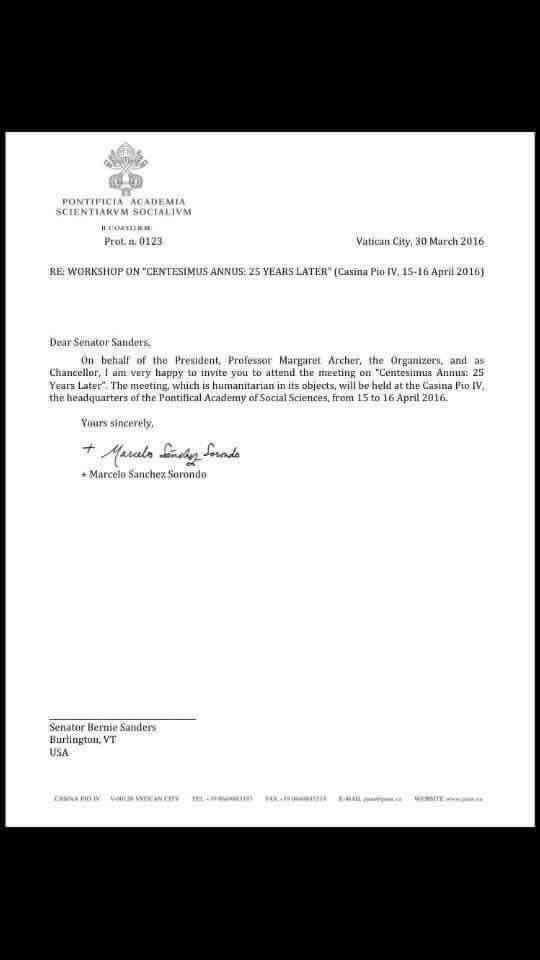
Sen. Bernie Sanders (I-VT) has been invited to the Vatican on how to create “a moral economy,” he announced Friday morning.
“I was moved by the invitation, which was just made public today,” Sanders said during an interview on MSNBC’s “Morning Joe.” “I’m a big, big fan of the Pope. Obviously there are areas where we disagree on—women’s rights or gay rights—but he has played an unbelievable role, an unbelievable role of injecting a moral consequence into the economy.”
The Washington Post reported Sanders will head to Rome after his debate against Hillary Clinton on April 14. He is scheduled to speak at the Pontifical Academy of Social Sciences.
If you think Sanders is radical, read Pope Francis on poverty, Sanders said.
“He’s trying to inject a sense of morality into how we do economics,” he said.
So, how many times have you ever heard of the Vatican or a Pope doing that kind of invitation to a gadfly Senator running for President while attacking the most likely future President? Yea, I didn’t think so. So, get this from the Vatican: “Sanders Accused of ‘Discourtesy’ in Seeking Vatican Invitation.”
A senior Vatican official accused Democratic presidential candidate Bernie Sanders of showing a “monumental discourtesy” in his lobbying for an invitation to a church-sponsored conference on economic and environmental issues for political purposes.
Sanders, whose foreign policy experience is under attack by rival Hillary Clinton, on Friday said he was “very excited” about being invited to the meeting hosted by a pontifical academy. It will put him at the seat of the Roman Catholic Church just four days before the New York primary.
The head of the academy said Friday that Sanders sought the invitation and that put an inappropriate political cast on the gathering.
“Sanders made the first move, for the obvious reasons,” Margaret Archer, president of the Pontifical Academy of Social Sciences, which is hosting the conference Sanders will attend, said in a telephone interview. “I think in a sense he may be going for the Catholic vote but this is not the Catholic vote and he should remember that and act accordingly — not that he will.”
Sanders’s travel to the Vatican following a debate with Clinton and just before the primary potentially injects into the Democratic nominating contest the agenda of Pope Francis, one of the most popular world leaders whose papacy is especially admired by the political progressives who play an outsized role in Democratic primaries. Archer’s response plays into criticism by Clinton of Sanders’s inexperience in diplomacy and dealing with foreign institutions, a central role of the U.S. president.
So, Bernie is now going to be an unwanted house guest who horned himself into an invitation. Not only will he be an unwanted house guest, he’ll be one that demanded a chance to finger wag at the world. Basically, the #Vatican now says #Bernie invited himself while Sanders says he was invited. They also characterized him as rude.
“Sanders cast a political shadow over a nonpolitical event by being pushy in requesting an invitation”
Only a huge ego with an overwhelming amount of gall can explain this kind of rude, ill-mannered and inconsiderate behavior. Who said that Trump was the only egomaniac in the race.
The only weirder event of the day was Bill Clinton’s exchange with BLM protesters in Philadelphia which came off directly opposed to Hillary’s position and will take tremendous ‘splaining. It seems his need to protect his legacy overwhelmed his concern for anything else including coming off as insensitive, racist and contrary to Hillary’s interests.
In a prolonged exchange Thursday afternoon, former President Bill Clinton forcefully defended his 1994 crime bill to Black Lives Matter protesters in the crowd at a Hillary Clinton campaign event.
He said the bill lowered the country’s crime rate, which benefited African-Americans, achieved bipartisan support, and diversified the police force. He then addressed a protester’s sign, saying:
“I don’t know how you would characterize the gang leaders who got 13-year-old kids hopped up on crack and sent them out onto the street to murder other African-American children,” Clinton said, addressing a protester who appeared to interrupt him repeatedly. “Maybe you thought they were good citizens …. You are defending the people who kill the lives you say matter. Tell the truth. You are defending the people who cause young people to go out and take guns.”
After a protester interrupted him repeatedly, Bill Clinton began to take on that critique directly, making the claim that his crime bill was being given a bad rap.
“Here’s what happened,” Clinton said. “Let’s just tell the whole story.”
“I had an assault weapons ban in it [the crime bill]. I had money for inner-city kids, for out of school activities. We had 110,000 police officers so we could keep people on the street, not in these military vehicles, and the police would look like the people they were policing. We did all that. And [Joe] Biden [then senator and chair of the Senate Judiciary Committee] said, you can’t pass this bill, the Republicans will kill it, if you don’t put more sentencing in it.”
“I talked to a lot of African-American groups,” Clinton continued. “They thought black lives matter. They said take this bill, because our kids are being shot in the street by gangs. We have 13-year-old kids planning their own funerals.”
Throughout the spirited defense of his policy, Clinton continued to be interrupted, and he repeatedly seemed to single out one protester.
“She doesn’t wanna hear any of that,” Clinton said to the protester. “You know what else she doesn’t want to hear? Because of that bill, we have a 25-year low in crime, a 33-year low in murder rate. And because of that and the background check law, we had a 46-year low in the deaths of people by gun violence, and who do you think those lives were? That mattered? Whose lives were saved that mattered?”
For several minutes, the discussion of the crime bill, Clinton’s exchange with the protester and the crowd’s attempts to yell and chant over her were missing one thing: any mention of Hillary Clinton, the one Clinton running for president this election cycle.
Bill Clinton did finally address her. “Hillary didn’t vote for that bill, because she wasn’t in the Senate,” Clinton said. “She was spending her time trying to get health care for poor kids [referencing her advocacy for the Children’s Health Insurance Program]. Who were they? And their lives mattered. And her opponent [Bernie Sanders] did vote for it. But I don’t blame him either … There were enough Republicans in the Senate to kill this bill, and nobody wanted it to die. That’s what happened.”
“But she [Hillary Clinton] was the first candidate, the first one to say let’s get these people who did nonviolent offenses out of prison,” Clinton continued. “And guess what? A lot of Republicans agreed. They know they made a mistake.”
Still, Clinton continued for some time defending his own administration. Twitter blew up over the situation and it will undoubtedly be a topic of conversation for a few days.
Hillary Clinton and Bernie Sanders on Monday agreed to face off in a prime-time debate in Brooklyn, New York, on April 14, five days before the state’s crucial primary.
CNN’s Wolf Blitzer will host the presidential forum, scheduled for 9 to 11 p.m. Eastern time at the Duggal Greenhouse in the Brooklyn Navy Yard. The event will be CNN’s seventh time hosting a Republican or Democratic debate during this election cycle. The agreement put to rest days of public and private back-and-forth between the two campaigns about if and when a debate would take place before New Yorkers head to the polls April 19.
I promise I will have a huge Bronx Cheer for Bernie. I’m looking forward to him being hit on his undying love for gun manufacturers and his lack of knowledge on the actual workings of Dodd-Frank. Please New York! Send this man back to the most obscure part of Vermont possible. Join us!!!
A massive leak of documents exposes the offshore holdings of 12 current and former world leaders and reveals how associates of Russian President Vladimir Putin secretly shuffled as much as $2 billion through banks and shadow companies.
The leak also provides details of the hidden financial dealings of 128 more politicians and public officials around the world.
The cache of 11.5 million records shows how a global industry of law firms and big banks sells financial secrecy to politicians, fraudsters and drug traffickers as well as billionaires, celebrities and sports stars.
These are among the findings of a yearlong investigation by the International Consortium of Investigative Journalists, German newspaper Süddeutsche Zeitung and more than 100 other news organizations.
The files expose offshore companies controlled by the prime ministers of Iceland and Pakistan, the king of Saudi Arabia and the children of the president of Azerbaijan.
They also include at least 33 people and companies blacklisted by the U.S. government because of evidence that they’d been involved in wrongdoing, such as doing business with Mexican drug lords, terrorist organizations like Hezbollah or rogue nations like North Korea and Iran.
One of those companies supplied fuel for the aircraft that the Syrian government used to bomb and kill thousands of its own citizens, U.S. authorities have charged.
“These findings show how deeply ingrained harmful practices and criminality are in the offshore world,” said Gabriel Zucman, an economist at the University of California, Berkeley and author of “The Hidden Wealth of Nations: The Scourge of Tax Havens.” Zucman, who was briefed on the media partners’ investigation, said the release of the leaked documents should prompt governments to seek “concrete sanctions” against jurisdictions and institutions that peddle offshore secrecy.
Que the James Bond theme. The Guardianappears to be the paper that’s most on top of the story. I’ve had a fascination with s0-called Treasure Isles for some time which offshore investment accounts of the world’s richest people since it appeared Mitt Romney had managed to plant some money offshore. This was revealed during his run for President. Most of the leaked accounts are from world leaders who are stealing their nation’s Treasury and probably take bribes. Nothing says I hate my country more than these things.
I’ve actually written about this before here because it is so fascinating. As a former banker and a financial economist that studies the financial systems, I can state with assurance that this situation plagues nations trying to develop because it takes much needed money out of circulation in the country. It also is a major argument against giving the richest any more money. They just take it straight out of the country where they gamble on the world’s financial markets. Most of them couldn’t create a job if their life depended on it because they’re busy hiding their fortunes.
The Guardian, working with global partners, will set out details from the first tranche of what are being called “the Panama Papers”. Journalists from more than 80 countries have been reviewing 11.5m files leaked from the database of Mossack Fonseca, the world’s fourth biggest offshore law firm.
The records were obtained from an anonymous source by the German newspaper Süddeutsche Zeitung and shared by the International Consortium of Investigative Journalists with the Guardian and the BBC.
Though there is nothing unlawful about using offshore companies, the files raise fundamental questions about the ethics of such tax havens – and the revelations are likely to provoke urgent calls for reforms of a system that critics say is arcane and open to abuse.
The Panama Papers reveal:
Twelve national leaders are among 143 politicians, their families and close associates from around the world known to have been using offshore tax havens.
A $2bn trail leads all the way to Vladimir Putin. The Russian president’s best friend – a cellist called Sergei Roldugin – is at the centre of a scheme in which money from Russian state banks is hidden offshore. Some of it ends up in a ski resort where in 2013 Putin’s daughter Katerina got married.
Among national leaders with offshore wealth are Nawaz Sharif, Pakistan’s prime minister; Ayad Allawi, ex-interim prime minister and former vice-president of Iraq; Petro Poroshenko, president of Ukraine; Alaa Mubarak, son of Egypt’s former president; and the prime minister of Iceland, Sigmundur Davíð Gunnlaugsson.
In the UK, six members of the House of Lords, three former Conservative MPs and dozens of donors to British political parties have had offshore assets.
The families of at least eight current and former members of China’s supreme ruling body, the politburo, have been found to have hidden wealth offshore.
Twenty-three individuals who have had sanctions imposed on them for supporting the regimes in North Korea, Zimbabwe, Russia, Iran and Syria have been clients of Mossack Fonseca. Their companies were harboured by the Seychelles, the British Virgin Islands, Panama and other jurisdictions.
A key member of Fifa’s powerful ethics committee, which is supposed to be spearheading reform at world football’s scandal-hit governing body, acted as a lawyer for individuals and companies recently charged with bribery and corruption.
One leaked memorandum from a partner of Mossack Fonseca said: “Ninety-five per cent of our work coincidentally consists in selling vehicles to avoid taxes.”
The company has flatly denied any wrongdoing. It says it has acted beyond reproach for 40 years and that it has had robust due diligence procedures.
The document leak comes from the records of the firm, which was founded in 1977. The information is near live, with the most recent records dating from December 2015.
The data shared with journalists is huge and is more than was leaked by WikiLeaks in 2010 or Edward Snowden in 2013.
The firm’s leaked records offer a glimpse into the tightly guarded world of high-end South Florida real estate and the global economic forces reshaping Miami’s skyline.
And MF’s activities bolster an argument analysts and law-enforcement officials have long made: Money from people linked to wrongdoing abroad is helping to power the gleaming condo towers rising on South Florida’s waterfront and pushing home prices far beyond what most locals canafford.
The leak comes as the U.S. government unleashes an unprecedented crackdown on money laundering in Miami’s luxury real-estate market.
Buried in the 11.5 million documents? A registry revealing Mateus 5’s true owner: Paulo Octávio Alves Pereira, a Brazilian developer and politician now under indictment for corruption in his home country.
A Miami Herald analysis of the never-before-seen records found 19 foreign nationals creating offshore companies and buying Miami real estate. Of them, eight have been linked to bribery, corruption, embezzlement, tax evasion or other misdeeds in their home countries.
That’s a drop in the ocean of Miami’s luxury market. But Mossack Fonseca is one of many firms that set up offshore companies. And experts say a lack of controls on cash real-estate deals has made Miami a magnet for questionable currency.
Iceland’s prime minister is this week expected to face calls in parliament for a snap election after the Panama Papers revealed he is among several leading politicians around the world with links to secretive companies in offshore tax havens.
The financial affairs of Sigmundur Davíð Gunnlaugsson and his wife have come under scrutiny because of details revealed in documents from a Panamanian law firm that helps clients protect their wealth in secretive offshore tax regimes. The files from Mossack Fonseca form the biggest ever data leak to journalists.
Opposition leaders have this weekend been discussing a motion calling for a general election – in effect a confidence vote in the prime minister.
On Monday, Gunnlaugsson is expected to face allegations from opponents that he has hidden a major financial conflict of interest from voters ever since he was elected an MP seven years ago.
This should be huge and there’s no doubt that a number of Americans may show up . It should also spur a movement for regulation if the Dems give good spin and the Republicans cower from fear of their angered populist base. I want to spend more time analyzing this and will provide you with some more thoughts when I can. I’ll be with students the next few days so you’ll have to be patient and let me know if you’re interested.
The Panama Papers leak began, according to ICIJ director Ryle, in late 2014, when an unknown source reached out to the German newspaper Suddeutsche Zeitung, which had reported previously on a smaller leak of Mossack Fonseca files to German government regulators. A Suddeutsche Zeitung reporter named Bastian Oberway says that the source contacted him via encrypted chat, offering some sort of data intended “to make these crimes public.” But the source warned that his or her “life is in danger,” was only willing to communicate via encrypted channels, and refused to meet in person.
“How much data are we talking about?” Obermayer asked
“More than you have ever seen,” the source responded, according to Obermayer.
Obermayer tells WIRED he communicated with his source over a series of encrypted channels that they frequently changed, each time deleting all history from their prior exchange. He alludes to crypto apps like Signal and Threema, as well as PGP-encrypted email but declines to say specifically which methods they used. Each time the reporter and source re-established a connection, they would use a known question and answer to reauthenticate each other. “I’d say ‘is it sunny?’ You’d say ‘the moon is raining’ or whatever nonsense, and then both of us can verify it’s still the other person on the device,” Obermayer says.
I can’t wait to follow the money frankly. International Financial Economists try to estimate the flows of dark and black currency around the world and its impact on a nation’s capital accounts. This may give us a hint of the level and types of activities as well as their frequency. Like I said, I’m chomping at the bit like an Ann Romney dressage horse to get the actual activity details. Meanwhile, enjoy the international outing of the billionaires who have more in common with each other than the people in their countries.
Anyway, here’s a few other links to keep you busy!
Voters in Wisconsin’s Republican primary Tuesday can choose among Donald Trump, John Kasich and Ted Cruz, all of whom promise tax cuts that could cost as much as $10 trillion in revenue over 10 years — and an ensuing economic boom as spending is unleashed. Yet voters need look no further than Louisiana, Kansas and Oklahoma to see what happens when economies fail to grow as promised.
In a unanimous result, the court said a state can draw legislative districts based on total population. At issue in the case was the “one person, one vote” principle dating back to the 1960s, when the court held that state legislative districts must be drawn so they are equal in population.
What’s on your reading and blogging list today?
Did you like this post? Please share it with your friends:
Well, I’m holding down the fort today! Both BB and JJ are off surfing samsara which is my little way of saying they’re dealing with a series of life’s little unpleasantness. That seems to be the order of the day. There’s a war on life’s pleasantries out there! The majority of us are losing the fight.
So, I watched the Republican Townhall last night. One hour with each of them is an hour wasted in Bizarro. Ted Cruz is a sociopath. He dodged all questions choosing to spin a series of anecdotes with no relation to the question asked by Anderson Cooper or the participants. The fact he thought these anecdotes charming given his self congratulatory manner–when they definitely were not–says a lot about his inability to even fake being human for short periods of time. He’s positively reptilian. Donald Trump is walking, savage ID. He has no conception of anything remotely related to the rest of the world that hasn’t been directly in his face and interests. The sentence I bolded below pretty much sums the Trump exchange.
During a CNN town-hall forum Tuesday night, Donald Trump reiterated the falsehood that Sen. Ted Cruz was responsible for spreading around an image of his wife Melania in a nude pose. “I thought it was a nice picture of Heidi,” Trump said of an image he retweeted clearly meant to make her look unattractive compared to his wife. “Come on,” Anderson Cooper responded. “I thought it was fine,” Trump insisted. Continuing to deny culpability, he said “I didn’t start it.” Cooper sensibly retorted, “That’s the argument of a 5-year-old.”
That sentence pretty much sums up the behavior of most of the politicians associated with the Republican Party who basically have not been doing their actual jobs for some time. They won’t examine or confirm SCOTUS nominees. They continually vote to get rid of the ACA when they know the bill will go no where. They are obsessed with Planned Parenthood based on outright lies. They deny the impact and causes of Climate Science. It’s the behavior of a 5-year-old that doesn’t get his way.
The unraveling of the Republican party is not good for this country. Candidates like Ted Cruz and Donald Trump are signs that something has gone supremely wrong. Kasich appears to be the only sane one left unless you count Rubio who seems to be angling to hold on to his delegates in some weird hope that a brokered convention will anoint him. Both may be sane. Neither are presidential material. Rubio is dumb and Kasich wanders that ethereal wasteland between being pragmatic and preaching radical religious right sermons worthy of any common religious fanatic.
It is a full on war between the Republican Establishment and the white, working class base it has used as a foil to push through bad tax policy since the Pied Piper of Hollywood spun a tune to romance them into the Republican fold. Ronald Reagan’s dogwhistles and tales of a white utopia, a city on the hill, enticed them to vote Republican for a few decades. Dubya’s uncanny ability to sound homespun and create wars to appeal to their patriotic nature may have held them for awhile. But now they are unleashed with wide open eyes and a distaste of all things Romneyesque. The want real brutes. Karl Rove no longer can manipulate their lesser angels with empty promises and heads. They want the real deal.
If you listen to establishment gurus, you’d be led to believe that the Republican primary voter revolt was birthed by the governance of President Obama, creating fertile ground for the emergence of one Donald Trump. This fairy tale version of reality casts Trump as the villain who has swept in to capitalize on voter frustration with Obama’s alleged weakness, lawlessness and rampant liberalism.
The villain must be stopped or the Republican Party will be destroyed. Or so we are told.
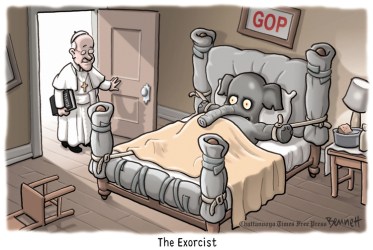
The old saw that you have to first acknowledge that you have a problem to solve the problem applies here. What the GOP “leaders” refuse to accept is that Trump is not the problem. They are.
The dissatisfaction among a large cohort of GOP voters is directly attributable to their unhappiness with a party that they believe does not represent their interests. In exit polls, high percentages of GOP voters registered displeasure with their leadership. In Tennessee, 58% of Republican voters said they felt “betrayed” by their leaders, as did 47% in New Hampshire, 52% in South Carolina and 54% in Ohio.
Those who feel betrayed have been most likely to vote for Trump. Trump has been a particular draw to white working-class voters who feel left behind economically. Such voters have been treated with dismissal and outright contempt by the GOP establishment even as this group has become more critical to Republican success. Pew reported in 2012 that “lower-income and less educated whites … have shifted substantially toward the Republican Party since 2008.”
In other words, their peasants are revolting. Given this, how can the party’s elite make their way through a brokered convention when the party itself is so positively unmoored? Its main policy goal is tax avoidance for the very wealthy. After that’s accomplished, they throw bits and pieces of radical religious bills at the wall to see what will stick while railing against minorities, women, and immigrants.
The modern Republican Party has devolved into a tax avoidance scam for rich people. The scam is a masterpiece of psychological manipulation, in which the racial, cultural and economic anxieties of (mostly white) voters are exploited, in order to get those voters to support policies that transfer ever-greater percentages of wealth from themselves to the top 0.1 percent.
It really isn’t any more complicated than that. Everything else – the “culture wars,” the continual hysteria about terrorism, the non-stop rhetoric about how the mainstream media, the universities, the scientists, and basically the rest of the modern world are all biased against conservatives – it’s all just so much noise, designed to solve the tricky problem of how to get ordinary people to support economic policies that make them poorer and rich people richer.
You couldn’t come up with a better illustration of this principle than the ongoing GOP campaign to eliminate the estate tax. Last year the House voted to get rid of it, and a majority of Republican senators have pledged to do the same.
The Republican propaganda machine has waged a multi-decade war against the estate tax, which it has rebranded the “death tax.” Because of these efforts, the tax has been watered down to the point where, under current law, only a tiny group of wealthy people will ever pay any estate taxes at all.
But of course that isn’t enough, since it means that some taxes still have to be paid on truly enormous inheritances, and protecting the economic interests of people who have a net worth in the eight, nine, 10 or 11 figures is the contemporary GOP’s entire reason for being.
Clay Bennett, Chattanooga Times Free Press
The emergence of Trump as a leading Republican candidate is something found incredulous by enabling media types who have been equivocating between Democrats and Republicans for some time. They’ve refused to hold any one accountable for outright lies.
One of the most amazing things to see is the panic in our allies as major Republican candidates want to dump NATO, dally with war crimes and nuclear weapons, and ignore treaties and trade agreements. That’s how equivocal Republicans and Democrats really are from the view here on USA Main Street. The one thing that’s been fairly consistent in American governance is the respect for pre-existing foreign agreements and diplomacy. Each President–even while holding different visions of the country–basically finds value in remaining on a stable and predictable path in foreign affairs. The Republican historical area of expertise used to be foreign policy until now.
Lobbyists in Washington say they are being flooded with questions and concerns from foreign governments about the rise of Donald Trump.Officials around the globe are closely following the U.S. presidential race, to the point where some have asked their American lobbyists to explain, in great detail, what a contested GOP convention would look like. There is nothing conservative about Trump or the Republican party these days other than their tax avoidance schemes. They are a party of insurgents and radicals hellbent on an agenda to turn back modernity.
The questions about Trump are “almost all-consuming,” said Richard Mintz, the managing director of Washington-based firm The Harbour Group, whose client list includes the governments of Georgia and the United Arab Emirates.
After a recent trip to London, Abu Dhabi and Beijing, “it’s fair to say that all anyone wants to talk about is the U.S. presidential election,” Mintz added. “People are confused and perplexed.”
The Hill conducted interviews with more than a half-dozen lobbyists, many of whom said they are grappling with how to explain Trump and his unusual foreign policy views to clients who have a lot riding on their relationship with the United States.
“We’re in uncharted territory here,” said one lobbyist with foreign government clients who asked not to be identified.
“The questions coming from the international community are not different than the things, categorically, we’re asking ourselves,” said Nathan Daschle, the president and chief operating officer of the Daschle Group, a firm run by his father, former Sen. Tom Daschle (D-S.D.).
“There’s an added level of bafflement because this is not the United States that they’ve been living with for so long,” Daschle said. “This is not the image the United States has been projecting.”
The questions about Trump often concern his foreign policy positions.
The businessman has boasted about keeping his options open on many crucial foreign policy questions, including on trade, troop-sharing agreements and the U.S. posture toward China.
“I don’t want to say what I’d do because, again, we need unpredictability,” Trump told The New York Times in an interview published over the weekend.
A second lobbyist who represents countries in Latin America, Asia and the Muslim world said answers like that have made Trump a “wild card” for leaders around the world.
“Nobody knows whether he believes anything of what he says because he’s changed his position so many times,” the lobbyist said.
Some of Trump’s comments — especially about Mexico, Muslims and trade with countries such as Japan and China — have also angered foreign leaders.
A third lobbyist for governments in Asia said part of his job has been telling countries how to react to some of Trump’s controversial remarks.
“If you come out and blast Donald Trump — for the people who are going to vote for Donald Trump, that could make them like him more,” the lobbyist, who also represents foreign companies with a large presence in the U.S., said he has told foreign leaders.
Nearly two-thirds of Americans believe torture can be justified to extract information from suspected terrorists, according to a Reuters/Ipsos poll, a level of support similar to that seen in countries like Nigeria where militant attacks are common.
The poll reflects a U.S. public on edge after the massacre of 14 people in San Bernardino in December and large-scale attacks in Europe in recent months, including a bombing claimed by the militant group Islamic State last week that killed at least 32 people in Belgium.
Donald Trump, the front-runner for the 2016 Republican presidential nomination, has forcefully injected the issue of whether terrorism suspects should be tortured into the election campaign.
Hillary Clinton says foreign leaders are privately reaching out to her to ask if they can endorse her to stop Donald Trump from becoming president of the United States.
“I am already receiving messages from leaders,” Clinton told an Ohio audience at a Democratic presidential town hall on Sunday night.
“I’m having foreign leaders ask if they can endorse me to stop Donald Trump.”
He’s suggested using economic warfare to halt China’s territorial moves in the South China Sea and raised the prospect of a fundamental reconsideration of nuclear doctrine by musing about South Korea and Japan acquiring their own atomic arsenal. He says the U.S. should boycott Saudi Arabian oil if the kingdom doesn’t send ground troops to fight ISIS and believes NATO is an anachronism. And he warns he will renegotiate bedrock free trade deals, a prospect that could send serious reverberations through the global economy.
“It is rattling the windows of foreign ministries all over the world,” said CNN’s senior political analyst David Gergen, who has worked for a string of Democratic and Republican presidents.
Trump has gone to great lengths over the past week to explain his foreign policy views, which are often criticized as overly vague. He’s participated in extensive interviews with The Washington Post and The New York Times and delivered a speech — notable because it was carefully pre-written — to the leading pro-Israel group in Washington. He’ll have another opportunity to address foreign policy Tuesday night during a CNN town hall in Milwaukee, Wisconsin.
The interviews reveal Trump as someone who is just as willing to flout the foreign policy establishment as he is the GOP elite. His statements appear to fly in the face of the longstanding assumption underlying U.S. foreign policy — that supporting allies financially, diplomatically and militarily promotes a global system of unfettered free trade, democracy and stability that is overwhelmingly in the national interests of the United States.
As the embodiment of this truculence, Texas Senator Ted Cruz, today finding favor among Republicans desperate to derail Donald Trump’s bid for the GOP nomination, stands alone. From the very outset of his candidacy, Cruz has depicted himself as the one genuinely principled conservative in the race. And in comparison to Trump, who is ideologically sui generis, Cruz does qualify as something of a conservative. When it comes to foreign policy, however, Cruz offers not principles but—like Trump himself—raw pugnacity.
Cruz has gone out of his way to deride the pretensions of democracy promoters, mocking “crazy neocon invade-every-country-on-earth” types wanting to “send our kids to die in the Middle East.” On the stump, Cruz advertises himself as Reagan’s one-and-only true heir. As such, he endorses “the clarity of Reagan’s four most important words: ‘We win, they lose.’” Upon closer examination, Cruz is actually advocating something quite different: “We win, they lose, then we walk away.”
The key to “winning” is to unleash American military might. “If I am elected president, we will utterly destroy ISIS,” Cruz vows. “We won’t weaken them. We won’t degrade them. We will utterly destroy them. We will carpet-bomb them into oblivion…. We will do everything necessary so that every militant on the face of the earth will know…if you wage jihad and declare war on America, you are signing your death warrant.”
Yet rather than Reaganesque, Cruz’s prescription for dealing with Islamist radicalism represents a throwback to bomb-them-back-to-the-Stone-Age precepts pioneered by Gen. Curtis LeMay and endorsed by the likes of Barry Goldwater back when obliteration was in fashion. The embryonic Cruz Doctrine offers an approximation of total war. “I don’t know if sand can glow in the dark, but we’re going to find out!” he promises with evident enthusiasm.
Nowhere, however, does his outlook take into account costs, whether human, fiscal, or moral. Nor does it weigh the second-order consequences of, say, rendering large parts of Iraq and Syria a smoking ruin or of killing large numbers of noncombatants through campaigns of indiscriminate bombing. In essence, Cruz sees force as a way to circumvent history—a prospect that resonates with Americans annoyed by history’s stubborn complexities.
Kasich has survived so far by keeping his head down and winning his home state of Ohio. But now that he is one of only three candidates remaining in the race, the former congressman and current Governor of Ohio will face the kind of media scrutiny that he has managed to avoid since he announced his candidacy. It will show that he is an outright mediocrity.
Kasich served on the House Armed Services Committee for eighteen years, where his strong beliefs on fiscal responsibility and budget cutting earned him the moniker of the “cheap hawk.” He accomplished next to nothing, apart from limiting the procurement of B-2 bombers.
During his long tenure in Congress, Kasich casted a number of votes on war-and-peace issues, voting for the Gulf War in 1991 but opposing Ronald Reagan’s decision in 1983 to send U.S. Marines to Lebanon for a peacekeeping mission. He reminds voters during town hall meetings and debates that the United States should get out of the business of nation-building and should stay far away from manufacturing democracies around the world. But he also floated the preposterous idea that the way to stop ISIS in its tracks is for the next president to create a new government agency to “beam messages around the globe” about the American credo of liberty.
At times, it is difficult to pinpoint what kind of foreign policy doctrine a potential President John Kasich would follow. He’s asserted that Russian President Vladimir Putin has gotten away with far too much during the Obama administration, including his annexation of the Crimean Peninsula, his military and economic support to separatist forces in eastern Ukraine, and his decision to send fighter jets into Syria to strengthen the defenses of Bashar al-Assad’s regime. “[I]t’s time that we punched the Russians in the nose,” Kasich told radio host Hugh Hewitt during a December presidential debate. “They’ve gotten away with too much in this world, and we need to stand up against them . . . in Eastern Europe where they threaten some of our most precious allies.”
On other issues, like the nuclear agreement with Iran, Kasich has oscillated between common sense (“You’re going to rip it up and then what?”), depressed resignation (“I’m sort of sick to my stomach about it because . . . Iran’s going to get a ton of money”) to defiant opposition (“if I were president, I would call them and say, I’m sorry, but we’re suspending this agreement”). With respect to the Islamic State, Kasich has emphasized coalition building with Arab allies similar to George H.W. Bush’s alliance building during the Persian Gulf War—a safe position that is just muscular enough to pass muster with Republican voters, but benign enough that it wouldn’t raise the eyebrows of realists who call the party home.
The looming question is whether John Kasich is hawkish enough for the GOP foreign policy establishment, a club that has been heavily influenced by neoconservative thinking for the past fifteen years.
At least “outright mediocrity” wont scare the children. It won’t scare ISIS either.
It’s been incredible to watch Bernie Sanders with his generalities and overreaching promises dodge serious foreign policies questions through out the Democratic Debates. He tends to fall back on insisting that his vote against the Iran Resolution just says it all. It doesn’t, however. His generalities fall way short of Clinton’s recall of names and her credentials as the nation’s chief foreign policy negotiator. I have to say that I learn a little bit more about the entire world each time she steps to the podium and takes a foreign policy question or makes a foreign policy speech.
Imagine what the debates and town halls in the general will look like when she takes on one of these candidates from the party in total disarray. My guess is that entire countries will be cheering for her.
I should close here but I’d like to share this with you so you can see that she will be our candidate for the fall despite the bleating and chest thumping of the cult of Bern. Here’s Nate Silver’s estimate of Bernie’s long shot path from today. It is beyond improbable that he can get 988 more pledged delegates and romance the Super D’s. Yes, there is one more campaign out there in Bizarro and it’s not a Republican one.
If you’re a Sanders supporter, you might look at the map and see some states — Oregon, Rhode Island, West Virginia, Montana and so forth — that look pretty good for Sanders, a lot like the ones that gave Sanders landslide wins earlier in the campaign. But those states have relatively few delegates. Instead, about 65 percent of the remaining delegates are in California, New York, Pennsylvania, New Jersey and Maryland — all states where Sanders trails Clinton in the polls and sometimes trails her by a lot.
To reach a pledged delegate majority, Sanders will have to win most of the delegates from those big states. A major loss in any of them could be fatal to his chances. He could afford to lose one or two of them narrowly, but then he’d need to make up ground elsewhere — he’d probably have to win California by double digits, for example.
Sanders will also need to gain ground on Clinton in a series of medium-sized states such as Wisconsin, Indiana, Kentucky and New Mexico. Demographics suggest that these states could be close, but close won’t be enough for Sanders. He’ll need to win several of them easily.
None of this is all that likely. Frankly, none of it is at all likely. If the remaining states vote based on the same demographic patterns established by the previous ones, Clinton will probably gain further ground on Sanders. If they vote as state-by-state polling suggests they will, Clinton could roughly double her current advantage over Sanders and wind up winning the nomination by 400 to 500 pledged delegates.
The nation and the world should breathe a collective sigh of relief when Clinton wins the nomination and the presidency. The alternatives to Hillary are the stuff of national nightmares. In fact, they would be a global nightmare and the majority of the US and the world knows it.
What’s on your reading and blogging list today?
Did you like this post? Please share it with your friends:
The Sky Dancing banner headline uses a snippet from a work by artist Tashi Mannox called 'Rainbow Study'. The work is described as a" study of typical Tibetan rainbow clouds, that feature in Thanka painting, temple decoration and silk brocades". dakinikat was immediately drawn to the image when trying to find stylized Tibetan Clouds to represent Sky Dancing. It is probably because Tashi's practice is similar to her own. His updated take on the clouds that fill the collection of traditional thankas is quite special.
You can find his work at his website by clicking on his logo below. He is also a calligraphy artist that uses important vajrayana syllables. We encourage you to visit his on line studio.





 Those of us that watched the Brooklyn Democratic Debate last night saw the campaign conversation get nasty. I was glad to see Hillary hitting back and I have to say that despite pundits calling the debate a tie, I found her to be absolutely presidential. She was tough and called him out on his constant hypocritical charges and his lies. This is Rebecca Traister writing for NYMAG.
 Yes, he went there again about us Southern Democrats right there in Brooklyn on CNN in front of every one watching. I belong to a discussion group on Facebook called American Minorities for Hillary. It’s a very diverse group of minorities to include just about every category possible. I posted the same link to that board as I did down in the comments yesterday which is the second set of analysis from Maddow Blog and Steve Benen on Bernie’s comments. I can unequivocally state that all the Southern Democrats on the board of all shapes and sizes along with a lot of others recognized the tweet of a racist dog whistle.











 peej
peej Carissa
 bostonboomer
 dakinikat
 ecocatwoman
 jjlo
jjlo mablue2
 Mama Lopez
 peggysue22
 quixote
 skydancingguestblogger
 Mona (aka Wonk the Vote)





Recent Comments