
Monday Reads
Posted: May 16, 2016 Filed under: abortion rights, Affordable Care Act, Affordable Care Act (ACA), birth control, SCOTUS, social justice, Vagina, War on Women 27 Comments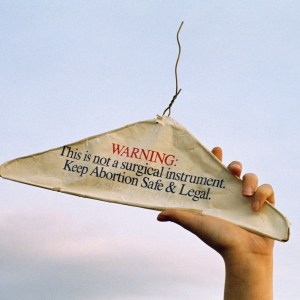 Good Morning!
We have an interesting SCOTUS decision/nondecision just announced on the challenge to the Affordable Health Care’s provision for Birth Control. Basically, they sent the case back to the lower courts. I’ve noticed a lot of women’s groups are beginning to take notice of the assault on our reproductive rights. Remember, Hillary Clinton will appoint the next Supreme Court Justice if President Obama’s selection continues to be the victim of right wing stalling. This coming election means women’s lives are at stake.
In a surprise move Monday, the Supreme Court punted on a major Obamacare case challenging the law’s contraceptive mandate, and specifically, how it accommodates religious nonprofits that object to birth control. The Supreme Court sent the case back to lower courts to examine an alternative accommodation to the mandate that the court had been briefed on by both parties in the case after the oral arguments.
The move — which comes as the Supreme Court is down a justice with Justice Antonin Scalia’s death — allowed the court to avoid what looked like a split decision after March’s oral arguments. The Supreme Court was able to stay away from the thorny trade-offs between health care policy and religious freedom, a legal landscape that got much more complicated after the Supreme Court’s ruling in 2014’s Hobby Lobby case.
The challenge the court weighed in on Monday was Zubik v. Burwell. It was consolidation of cases brought by religious nonprofits, including The Little Sister’s of the Poor, who objected to the work-around set up by the Obama administration to provide contraceptive coverage to employees of organizations opposed to birth control on religious grounds. The non-profits said that even filling out the form or sending a government the letter declaring their objections to covering birth control was a burden on their faith, because it set in motion the process by which their employees received the coverage from their insurers, though that coverage was not paid for or part of the employer plans. Lower courts’ have overwhelmingly rejected the challengers’ argument that the workaround violated 1993’s Religious Freedom Restoration Act (RFRA), though one appeals court ruled in their favor. (That case was not among those consolidated for the Supreme Court).
In sending the case back down to lower courts, the Supreme Court signaled that it believed a compromise could be worked out that didn’t involve weighing the larger issues involved in the RFRA challenge.
“The Court expresses no view on the merits of the cases. In particular, the Court does not decide whether petitioners’ religious exercise has been substantially burdened, whether the Government has a compelling interest, or whether the current regulations are the least restrictive means of serving that interest,” Monday’s opinion said. The opinion also stipulated that whatever was worked out should not affect “the ability of the Government to ensure that women covered by petitioners’ health plans” have access to contraceptive coverage.
RFRA was at the heart of the Supreme Court’s decision in 2014’s Hobby Lobby case — which said that certain for-profit companies that object to birth control could use the nonprofit workaround that was on trial in Zubik.
 Lyle Denniston writing for SCOTUSBLOG called it “A compromise, with real impact, on birth control”.
One reading of Monday’s developments was that the Court, now functioning with eight Justices, was having difficulty composing a majority in support of a definite decision on the legal questions. Thus, what emerged had all of the appearance of a compromise meant to help generate majority support among the Justices. With this approach, the Court both achieved the practical results of letting the government go forward to provide the contraceptive benefits and freeing the non-profits of any risk of penalties, even though neither side has any idea — at present — what the ultimate legal outcome will be and, therefore, what their legal rights actually are under the mandate.
Those uncertainties are now likely to linger through the remainder of President Obama’s term in office, which ends next January. The appeals courts may well order the filing of new legal briefs, and may hold new hearings, before issuing a new round of rulings on the controversy. However, the entire future of the ACA, including its birth-control mandate, may now depend upon who wins the presidential election this year and which party has control of Congress when it reassembles in 2017.
The two issues that the Court had agreed to rule on, and then left hanging at least for now, were whether the ACA mandate violates the federal Religious Freedom Restoration Act by requiring religious non-profits that object to contraceptives to notify the government of that position, and whether the move by the government to go ahead and arrange access to those benefits for those non-profits’ employees and students was the “least restrictive means” to carry out the mandate.
Doing on Monday much the same that it had done in several temporary orders at earlier stages of this controversy, the Court accepted that the non-profits already had given the federal government sufficient notice of their objection to the mandate, and that the government could use that notice as the basis for going ahead to provide actual access, at no cost, to the employees and students of those institutions.
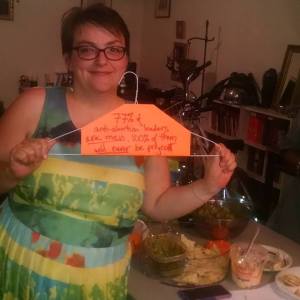
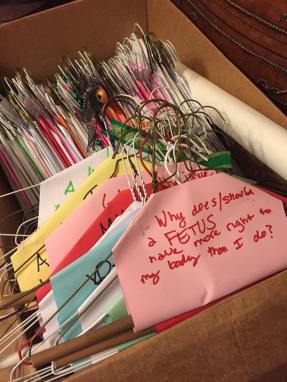
The pictures you’re seeing are from a Friday night event where activists here in New Orleans –including me–assembled and composed Wire Hangergrams for Louisiana Governor John Bel Edwards who is supporting a 72 hour waiting period here in Louisiana. We just can’t seem to keep these dirty old men out of our private parts!!! They don’t think we can make important decisions either. This is really getting disgusting.
The Louisiana legislature on Wednesday passed a bill requiring women to wait three days before receiving an abortion, tripling the state’s existing waiting time in one of the most stringent regulations of its kind nationally.
Governor John Bel Edwards, a Democrat, has said he plans to sign the bill championed by anti-abortion groups. It passed with wide support from the Republican-controlled legislature.
The bill requires a woman to wait at least 72 hours after a state-mandated ultrasound for the procedure. The current waiting time is 24 hours, the same as in most states with waiting periods.
Only five other states require 72-hour waiting periods: Missouri, North Carolina, Oklahoma, South Dakota and Utah.
The measures are among a wave of laws being adopted by states as conservatives seek to chip away at the U.S. Supreme Court’s landmark 1973 Roe v. Wade decision to legalize abortion.
I voted for the man but just couldn’t bring myself to work on his campaign even though he’d promised to not mess with things like  Planned Parenthood. You may recall I was incensed about an ad he ran. I found the ad appalling. He just seems to be another example of a man drenched in patriarchy who can’t keep his personal need to control the women in his life away from the rest of us.
This is another weird tale on fellow New Orleanian Wendall Pierce who actually physically assaulted a woman supporting Bernie Sanders. Pierce has been an outspoken Clinton supporter which is fine. This action is beyond wrong.
Wendell Pierce, the New Orleans-born actor known for his work in the HBO series “The Wire” and “Treme,” was arrested Saturday in Atlanta after he was accused of attacking a Bernie Sanders supporter,according to the website TMZ and online Fulton County police records.
Pierce was at the Loews Hotel in Atlanta about 3:30 a.m. when he began a political discussion with the woman and her boyfriend, according to the celebrity news website.
TMZ said a hotel source reported that Pierce, a supporter of Democratic presidential candidate Hillary Clinton, grabbed the woman’s hair and slapped her in the head after learning she preferred Clinton’s Democratic rival, Bernie Sanders.
On Sunday, the Atlanta Police Department confirmed that Pierce had been arrested at that hotel, where he was staying as a guest.
“The incident did not rise to anything significant, so no special notification was made … it was treated like any other arrest a patrol officer conducts,” police spokesman Donald Hannah told WWL-TV in an email shared with The New Orleans Advocate. “Mr. Pierce made no indication he was famous, nor did the officer inquire.”
Police records show Pierce, 52, was booked and released on Saturday. He was booked on simple battery and posted an online bond of $1,000, the records indicate.
Pierce, who now lives in Pasadena, California, was raised in Pontchartrain Park, the first African-American postwar suburb in New Orleans, and was active in efforts to rebuild it after Hurricane Katrina.
The actor and producer has been in more than 30 films and nearly 50 television shows and has performed in numerous stage productions, including Broadway productions of “The Piano Lesson,” “Serious Money” and “The Boys of Winter.”
He is perhaps best known for his roles as Detective Bunk Moreland in “The Wire,” trombonist Antoine Batiste in “Treme” and Michael Davenport in the movie “Waiting to Exhale.”
 This primary season needs to end. The shenanigans in Nevada have shown how little control the Sanders campaign has over its most zealous supporters. Things are getting way out of control.
Ben Carson is beginning to leak the short list for Trump’s VP and it isn’t a pretty one. Many folks think that it will most likely be Jan Brewer but Sarah Palin’s name is on it. So is Chris Christie’s which is basically no surprise to me. I really doubt either of them would bring anything to the ticket since they’re as nasty and crazy as Trump himself. They also don’t represent any new votes.
Ben Carson, the neurosurgeon turned presidential candidate turned unfiltered pitchman for Donald Trump and now part of the presumptive nominee’s vice presidential search committee, sat in the back of a Town Car with his wife, Candy, on his way to a televised interview. He had just explained to the reporter riding along that he wanted no role in a Trump administration when news arrived of a new poll naming him as the best-liked of a list of potential running mates.
“Who else was on the list?” he asked quietly, maintaining his usual inscrutable calm. The most favorably regarded contenders after himself, he was told, were John Kasich, Marco Rubio, Ted Cruz, Sarah Palin and Chris Christie.
“Those are all people on our list,” he said.
Seriously! Trump/Palin. How much argle bargle could one country stand?
I’m making it short today because I have a long day so what’s on your reading and blogging list? This is an open thread so please share!!!
Monday Reads in which I go there …
Posted: January 18, 2016 Filed under: Affordable Care Act, Affordable Care Act (ACA), Afternoon Reads | Tags: Affordable Health Care Act, Bernie Sanders, Health care reform, Paul Krugman, single payer 30 CommentsGood Afternoon! Happy Martin Luther King Day!!
 I’ve been spending the morning getting back up to speed on Health Care Economics which is something I never enjoy but never seem to be unable to avoid. The facts on the ground never change much. What we know about single payer and third party payer systems remains pretty much the same. The only thing that seems to change is the hostility in this country on the subject. I keep having to dredge up the same information over and over with the new twists.
Well, here I go again …
There are three articles that BB sent me this morning that sum up the situation nicely. I’m going to start with those and then finish up by reviewing the mini-case of the failed single payer case in the state of Vermont. I’m not doing this because I don’t think single payer health insurance is a good deal ceteris paribus. It obviously works in other countries. As the Republicans remind us daily, we are not other countries. Theoretically, it provides superior risk sharing and economies of scale on cost. So, my theoretical economist side loves it. My living in America with everything that’s already standing and Republicans who thwart everything at every turn except tax cuts for the wealthy and wars side has a different train of thought.
Yes, it’s time to heal those suffering badly from Berns. I’m going to be in good company because the public wonks are with me on both accounts. We yearn for a simpler, cheaper, more efficient way of paying and getting health care. But, we know the difference between brainstorming and an actionable policy. I’m cursed with a heart longing for idealism but a brain that reins the damn thing in. Bernie Sanders plan really isn’t a plan. It’s a lofty goal.
Here’s Ezra Klein writing for VOX stating ‘Bernie Sanders’s single-payer plan isn’t a plan at all: Sanders’s long-awaited health care plan is, by 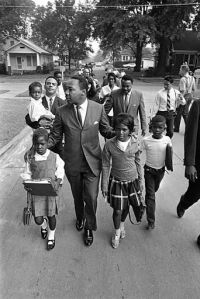 turns, vague and unrealistic.‘ You should read these links fully if you can manage the time.
Sanders calls his plan Medicare-for-All. But it actually has nothing to do with Medicare. He’s not simply expanding Medicare coverage to the broader population — he makes that clear when he says his plan means “no more copays, no more deductibles”; Medicare includes copays and deductibles. The list of what Sanders’s plan would cover far exceeds what Medicare offers, suggesting, more or less, that pretty much everything will be covered, under all circumstances.
Bernie’s plan will cover the entire continuum of health care, from inpatient to outpatient care; preventive to emergency care; primary care to specialty care, including long-term and palliative care; vision, hearing and oral health care; mental health and substance abuse services; as well as prescription medications, medical equipment, supplies, diagnostics and treatments. Patients will be able to choose a health care provider without worrying about whether that provider is in-network and will be able to get the care they need without having to read any fine print or trying to figure out how they can afford the out-of-pocket costs.
Sanders goes on to say that his plan means “no more fighting with insurance companies when they fail to pay for charges.”
To be generous, it’s possible that Sanders is just being cynical in his wording, and what he means is that, under his plan, individuals have to fight with the government rather than private insurers when their claims are denied.
But the implication to most people, I think, is that claim denials will be a thing of the past — a statement that belies the fights patients have every day with public insurers like Medicare and Medicaid, to say nothing of the fights that go on in the Canadian, German, or British health-care systems.
What makes that so irresponsible is that it stands in flagrant contradiction to the way single-payer plans actually work — and the way Sanders’s plan will have to work if its numbers are going to add up.
Behind Sanders’s calculations, both for how much his plan will cost and how much Americans will benefit, lurk extremely optimistic promises about how much money single-payer will save. And those promises can only come true if the government starts saying no quite a lot — in ways that will make people very, very angry.
“They assumed $10 trillion in health-care savings over ten years,” says Larry Levitt, vice president at the Kaiser Family Foundation. “That’s tremendously aggressive cost containment, even after you take the administrative savings into account.”
The real way single-payer systems save money isn’t through cutting administrative costs. It’s through cutting reimbursements to doctors, hospitals, drug companies, and device companies. And Sanders’s gestures towards this truth in his plan, saying that “the government will finally have the ability to stand up to drug companies and negotiate fair prices for the American people collectively.”
But to get those savings, the government needs to be willing to say no when doctors, hospitals, drug companies, and device companies refuse to meet their prices, and that means the government needs to be willing to say no to people who want those treatments. If the government can’t do that — if Sanders is going to stick to the spirit of “no more fighting with insurance companies when they fail to pay for charges” — then it won’t be able to control costs.
Krugman adds a bit more to this today.

&”
Put it this way: for all the talk about being honest and upfront, even Sanders ended up delivering mostly smoke and mirrors — or as Ezra Klein says, puppies and rainbows. Despite imposing large middle-class taxes, his “gesture toward a future plan”, as Ezra puts it, relies on the assumption of huge cost savings. If you like, it involves a huge magic asterisk.
Now, it’s true that single-payer systems in other advanced countries are much cheaper than our health care system. And some of that could be replicated via lower administrative costs and the generally lower prices Medicare pays. But to get costs down to, say, Canadian levels, we’d need to do what they do: say no to patients, telling them that they can’t always have the treatment they want.
Saying no has two cost-saving effects: it saves money directly, and it also greatly enhances the government’s bargaining power, because it can say, for example, to drug producers that if they charge too much they won’t be in the formulary.
But it’s not something most Americans want to hear about; foreign single-payer systems are actually more like Medicaid than they are like Medicare.
And Sanders isn’t coming clean on that — he’s promising Medicaid-like costs while also promising no rationing. The reason, of course, is that being realistic either about the costs or about what the system would really be like would make it a political loser. But that’s the point: single-payer just isn’t a political possibility starting from here. It’s just a distraction from the real issues.
The deal is this. We have entire systems, institutions, and agents that have been functioning under multiple plans for quite some time. This includes Medicaid, Medicare, SCHIP, the VA, and a myriad of private health insurance plans. You just don’t wave a magic wand and expect that all to unwind costlessly and seamlessly. You also don’t expect all those folks to be thrilled about it either or to seamlessly transfer their efforts and resources to a new system. It takes big money and time to do that. We’re not operating from scratch here.
That also doesn’t take into account politics. Yes. POLITICS. Remember when we first got the ACA and how the majority of Dems and Republicans voted for a single payer plan when the Dems controlled Congress? Remember how the ACA should work if SCOTUS hadn’t let so many states opt out of the system? Yes, Virginia, there is no Santa Claus.
 Dear Bernie Sanders-supporting Friends: Sanders is nice enough. He’s got some good ideas. But, no, I do not think he’s got what it takes to be President. He operates out there in gadfly paradise. Or, as Michel Cohen writes it: ‘Bernie Sanders doesn’t get how politics works’.
Now for my deeper impression of the debate: even with his rising poll numbers in Iowa and New Hampshire, I find it increasingly difficult to take Sanders seriously as a presidential candidate.
Maybe it’s the fact that he’s 74, would be the oldest man to ever become president, and yet couldn’t be bothered to release his medical records until a Clinton surrogate attacked him for it.
Maybe it’s that Sanders finds a way to answer virtually every question by turning it back to another predictable and one-dimensional attack on Wall Street and big money.
Maybe it’s that he gets away with proposing unrealistic policy ideas that have little chance of being passed even by Democrats in Congress, let alone Republicans, and then gets praised for being authentic. Sunday night Sanders finally released his single-payer health care plan, which is all of eight pages and provides little detail on how he’ll implement a complete restructuring of the US health care system. That’s at least an improvement over his plan for breaking up the banks, which is four pages and just as short on detail.
Maybe it’s that every time he answers a question on foreign policy and national security, it’s blindingly apparent that not only does he not understand foreign policy and national security, he simply doesn’t care to know more. I mean, only Bernie Sanders could answer a question about instability Middle East by pivoting to an attack on wealthy nations like Saudi Arabia, which he repeatedly says has to play a greater role in the civil war in Syria, as if no one on his staff could bother to tell him that Saudi Arabia is already playing an important role in the civil war in Syria.
It’s all that and something else — Sanders really does have a singularly naive and simple-minded understanding of American politics. He genuinely seems to believe — and I know this because he repeatedly yelled it at me during the debate — that money is the root of all evil in politics and that if you get the big money out, great things will happen. Sanders said that “a handful of billionaires . . . control economic and political life of this country.” He argued that Republicans and Democrats don’t “hate each other.” He called that a “mythology.” Instead, he said, the “real issue is that Congress is owned by big money and refuses to do what the American people want them to do.”
I’m sorry, but that is a maddeningly simplistic — and wrong — explanation of how American politics works.
Take single-payer health care, which Sanders claims has been difficult to enact because of a corrupt campaign finance system that allows the “pharmaceutical industry” and private insurance companies to spend millions in “campaign contributions and lobbying.”
On the one hand, Sanders is right — those are powerful interests. But so are doctors and hospitals, who’d pay a huge price if single payer became law; so are Republicans, who fought tooth and nail to defeat Obamacare and would do the same for a single-payer plan; so are Democrats, who couldn’t even support a public option for Obamacare and are unlikely to support single payer; so are Americans, who may not be inclined to support another restructuring of the health care system — a few years after the last one. It’s not just about money; it’s also about a political system constructed and reinforced to block the kind of massive reform Sanders is advocating. Money is important, but it’s not even close to the whole story.
How someone who’s been in Washington as long as Sanders can believe that all that stands between doing “what the American people want [Congress] to do” is something as simple as reforming campaign finance is stunning. Sanders, who brags the NRA gives him a D- rating, is the same politician who supported legislation giving gun manufacturers immunity from civil lawsuits and voted against the Brady Bill. Why? Perhaps it is because Sanders comes from a state that has few gun control laws and lots of gun owners. Yes red-state senators who oppose gun control receive contributions from the NRA. They also have constituents who oppose gun control measures and vote on the issue — like Bernie Sanders. It’s as if in Sanders’ mind, parochialism, ideology, or politics plays no role . . . in politics.
 So, yes, we have the ACA (Obamacare) which is a “kludge” to borrow a turn of phrase from Krugman. If we could start from scratch then single payer health insurance would be infinitely cheaper and better. But, that’s not the way it is.
Krugman admits that Obamacare is far from perfect, an awkward, imperfect solution that does not work for everyone. But he thinks it would be a mistake for Democrats to expend political capital refighting the battle that gave them their biggest victory in decades. Here’s how he lays out his case:
If we could start from scratch, many, perhaps most, health economists would recommend single-payer, a Medicare-type program covering everyone. But single-payer wasn’t a politically feasible goal in America, for three big reasons that aren’t going away.
First, like it or not, incumbent players have a lot of power. Private insurers played a major part in killing health reform in the early 1990s, so this time around reformers went for a system that preserved their role and gave them plenty of new business.
Second, single-payer would require a lot of additional tax revenue — and we would be talking about taxes on the middle class, not just the wealthy. It’s true that higher taxes would be offset by a sharp reduction or even elimination of private insurance premiums, but it would be difficult to make that case to the broad public, especially given the chorus of misinformation you know would dominate the airwaves.
Finally, and I suspect most important, switching to single-payer would impose a lot of disruption on tens of millions of families who currently have good coverage through their employers. You might say that they would end up just as well off, and it might well be true for most people — although not those with especially good policies. But getting voters to believe that would be a very steep climb.
Bottom line for Krugman is that single-payer ain’t gonna happen. Like it or not, the fact that Obamacare did not disrupt the millions of Americans who get health insurance through their employers gives it a leg up. Then there is the fact that taxes would have to be raised on the middle class to pay for it, as even Sanders acknowledges. And even though the middle class would not doubt save even more on their health insurance premiums, Krugman comes down on the side that higher taxes on them would not fly politically.
I’d like to add something to all of this. It’s frequently nice to have test cases for policy change. Massachusetts was the test case for ChaffeeCare/DoleCare/RomneyCare/ObamaCare. It wasn’t perfect but it worked.

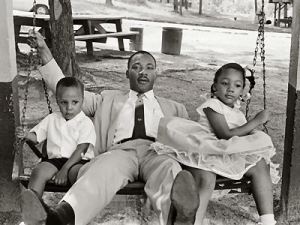
March 1965: Children watching a black voting rights march in Alabama. Dr Martin Luther King led the march from Selma, Alabama, to the state capital in Montgomery. (Photo by William Lovelace/Express/Getty Images)
According to a new analysis, health care reform in Massachusetts, popularly known as “Romneycare,” didn’t cause hospital use or costs to increase, even as it drove down the number of people without health insurance.
Implemented by the state in 2006, and signed by then-Gov. Mitt Romney, the reform is looked at as a model for the Affordable Care Act, also known as “Obamacare,” the sweeping and controversial health care law that Republican lawmakers in the House tried to repeal for the 37th time Thursday.
Amresh Hanchate, an economist with the Veterans Affairs Boston Healthcare System and lead author of the study, which he presented Thursday at an American Heart Association conference, says that the results of the study were surprising.
When it was implemented, about 8.4 percent of Massachusetts citizens were uninsured; by 2010, just 3 percent were uninsured. Uninsured rates fell most among minorities: In 2006, 15 percent of African-Americans were uninsured, in 2010, that rate was at 3.4 percent. Uninsured rates for Hispanics in the state fell from 20 percent to 9.2 percent during the same period.
Similarly encouraging news is found on the ACA even though it was seriously hampered by the SCOTUS ruling that allowed many states to opt out of the medicaid expansion and hosting local exchanges. We have one state that tried to have single payer. It failed. The state was Vermont. Sanders was asked about it during the debate. He dodged the question by referring it to the state’s governor. Well, there’s a lot of information out there on it. I’ll start with NEJM.
On December 17, 2014, Vermont Governor Peter Shumlin publicly ended his administration’s 4-year initiative to develop, enact, and implement a single-payer health care system in his state. The effort would have established a government-financed system, called Green Mountain Care, to provide universal coverage, replacing most private health insurance in Vermont. For Americans who prefer more ambitious health care reform than that offered by the Affordable Care Act (ACA), Shumlin’s announcement was a major disappointment. Was his decision based on economic or political considerations? Will it damage the viability of a single-payer approach in other states or at the federal level?
Shumlin’s exploration of a single-payer health care system, which included three assessments by different expert groups, was among the most exhaustive ever conducted in the United States. A 2011 study led by Harvard health economist William Hsiao provided optimistic projections: immediate systemwide savings of 8 to 12% and an additional 12 to 14% over time, or more than $2 billion over 10 years, and requirements for new payroll taxes of 9.4% for employers and new income taxes of 3.1% for individuals to replace health insurance premiums (see table) Financial Estimates from Three Projections for a Vermont Single-Payer Health Plan.).
Two years later, a study by the University of Massachusetts Medical School and Wakely Consulting projected savings of just 1.5% over 3 years.2 Finally, a 2014 study by Shumlin’s staff and consultants predicted 1.6% savings over 5 years and foresaw required new taxes of 11.5% for employers and up to 9.5% for individuals. The governor cited these last projections in withdrawing his plan: “I have learned that the limitations of state-based financing, the limitations of federal law, the limitations of our tax capacity, and the sensitivity of our economy make that unwise and untenable at this time . . . . The risk of economic shock is too high,” Shumlin concluded.
Two factors explain most of the decline in the plan’s financial prospects. First, the anticipated federal revenues from Medicaid and the ACA declined dramatically. Second, Shumlin’s policy choices significantly increased the total projected cost of Green Mountain Care: raising the actuarial value of coverage — the expected portion of medical costs covered by a plan rather than by out-of-pocket spending — from 87% to 94%, providing coverage to nonresidents working in Vermont, and eliminating current state taxes on medical providers. Still, even Shumlin’s projections indicated that the plan would reduce Vermont’s overall health spending and lower costs for the 90% of Vermont families with household incomes under $150,000. Despite differing projections, all three studies showed that single payer was economically feasible.
In reality, the Vermont plan was abandoned because of legitimate political considerations. Shumlin was first elected governor in 2010 promising a single-payer system. But in the 2014 election, his Republican opponent campaigned against single payer. Shumlin won the popular vote by a single-percentage-point margin, 46% to 45%, which sent the election to the Democratic-controlled House of Representatives; though the House reelected him easily in January, a clear public mandate for his health care agenda was nowhere in evidence.
 Here’s some slightly less academic explanations. This one comes from the Boston Globe.
Vermont took Obamacare a step further. In 2011, Shumlin proudly signed a bill to establish a publicly financed, single-payer system. The law required Shumlin to submit a detailed financial plan by 2013.
Shumlin missed the deadline, raising fears among supporters and critics alike that single-payer health care would cost much more than anticipated. Those fears were realized on Dec. 17, when Shumlin, two years late and just a month from narrowly winning reelection, released the financial analysis.
The numbers were stunning. To implement single-payer, the analysis showed, it would cost $4.3 billion in 2017, with Vermont taxpayers picking up $2.6 billion and the federal government covering the rest. To put the figures into perspective, Vermont’s entire fiscal 2015 budget, including both state and federal funds, is about $4.9 billion.
Shumlin’s office estimated the state would need to impose new personal income taxes of up to 9.5 percent, on top of current rates that range from 3.55 to 8.95 percent. Businesses would be hit with an 11.5 percent payroll tax, on top of 7.65 percent payroll taxes employer pay for Social Security and Medicare.
And even those tax increases might not have been enough. The governor’s office estimated the Green Mountain Care program would run deficits of $82 million by 2020 and $146 million in 2021. Shumlin said he feared the tax increases would harm businesses and the economy.
Okay, this is VERMONT, folks. Now, try doing that in Louisiana and Kansas or try getting their elected officials in the District to buy off on it.
So, a lot of children just really like believing in Santa Claus and it doesn’t take much to get them to continue their buy-in. Then there was Doctor Daughter who figured out it was her Dad and me at an extremely tender age after careful empirical study then asked me if that was the case. Of course, I said yes rather than try to lead her on like my parents did me for the sake of my sister. I just told her to go along if other kids believed and their parents hadn’t told them the truth yet. She did so like a little Nixonian co-conspirator.
I will not lie to you. Ceteris paribus. I prefer Single Payer Health Insurance. Ceteris paribus. Bernie Sanders has some really nice ideas.
I have never been one of those theoretical researchers. All of my stuff is empirical. I live in the land of empirical evidence. Yes, folks socialized medicine works just fine in the UK and is fairly cheap and folks get turned away for stuff that would probably piss the average American off. Yes, single payer health or a government option works great in Switzerland and other places. But, this is a country where it appears that our options will be Hillary Clinton or Donald Trump.
Spare me the Santa Claus mythos or the Senator Gadfly mythos.
Sorry this is so long, but as you can see, I had a lot to say and prove. I vote we try to improve on the ACA and for Hillary. Just sayin’.
Mea culpas go to any one whose work I over quoted. I love fair use but I also loved what you wrote. I quoted and cited you. Just sayin’.
What’s on your reading and blogging list today?
Live Blog: Fourth Democratic Debate
Posted: January 17, 2016 Filed under: Affordable Care Act (ACA), Democratic Politics, Live Blog, SCOTUS, U.S. Politics | Tags: 2016 Democratic nomination race, Background Checks, Bernie Sanders, Brady bill, Democratic debates, Federal Employees' Health Benefits Program, flip flops, gun dealers' immunity, Health care, Hillary Clinton, Martin O'Malley, Medicaid, medicare, NRA, SCHIP, single payer, TRICARE 147 Comments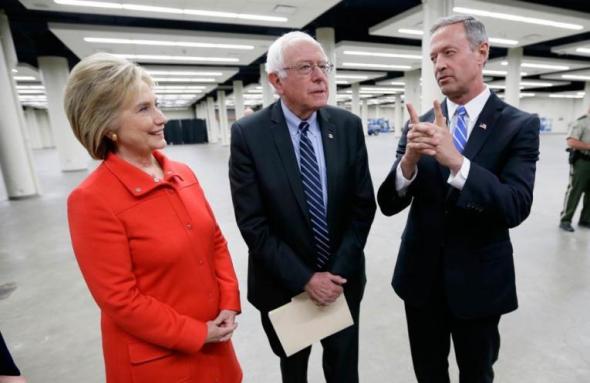
Tonight’s debate is likely to feature some fireworks and a good exchange of ideas between Hillary Clinton and Bernie Sanders–as long as the moderators can keep Martin O’Malley from constantly breaking in with his patented line “I’ve actually already done that in Maryland.”
Mediaite has the basics on how to watch the debate. It will be available on line at the NBC News website and YouTube. It begins at nine and goes for two hours.
The back and forth between Hillary and Bernie this week has been interesting, to say the least. Hillary seems to have gotten under Bernie’s skin too, because he has now partially flip flopped on his vote to immunize gun dealers from liability, his campaign has promised to release specifics on his health car plan and how he hopes to pay for it “very soon,” and they’ve also said they’ll release a “doctor’s note” on Sanders’ health.
Just a couple of days ago the Sanders campaign announced they wouldn’t release the health care tax figures and they previously pooh poohed the need to release medical records.
I’ve thought for awhile now that Sanders has begun to believe his own reviews in the media. After reading what he said on Face The Nation this morning, I’m convinced he has allowed the failure of the media to vet him and the adulation of his supporters to go to his head.
Sanders: I have a “good chance” to win 2016 election.
“I think we have a good chance to win both those states,” he said of Iowa and New Hampshire, the first two states to hold nominating contests. “I think we have a good chance to win this election.”
If he does win, Sanders predicted his campaign would come to be known as “one of the great political upsets in modern history.”
He is feeling so good, in fact, that the Vermont senator told “Face the Nation” host John Dickerson that while he was watching President Obama’s final State of the Union address last week, “the thought did cross my mind” that he could be delivering that address in the near future.
Then he caught himself.
“It’s a very humbling feeling,” he said, but added a moment later, “It’s a long way to go before we talk about inaugural speech, before we toss State of the Union speeches in.”
Hmmm…. he doesn’t sound so humble.

I have a few other good links for you on Bernie.
First a diary from DailyKos (!) on the health care law that Sanders has proposed multiple times in Congress: Sanders’ Health Care Plan. The diarist simply reports the contents of Senate Bill 1782, introduced in December 2013. Please go read it.
The law would end Medicare, Medicaid, SCHIP, the Federal Employees’ Health Benefits Program, and TRICARE. The money that was going into those programs, and use it to fund a “single payer” plan to be run and partially paid for by the states.
We already know that Supreme Court is not going to force states to accept something they don’t want from the Feds. That was their decision on the ACA Medicaid expansion. Even if Sanders could somehow get this through the Republican Congress, it would never get past SCOTUS.
I can’t even imagine what would be involved in implementing this. Right now, Medicare has low overhead costs because it turns over administration of supplemental plans to insurance companies–which would be outlawed in Sanders’ alternative universe.
I’m on Medicare and I get help paying my premiums from the government. Those premiums are more than $100 per month. Basic Medicare only pays for hospital bills, so I also have a government funded supplemental plan with very high co-pays that I get “free.” At least I can go to a doctor if it’s absolutely necessary. What would happen to people like me when all that infrastructure is demolished?
Here’s another must-read that Babama posted in a comment yesterday.

The People’s View: Chelsea Clinton was Right: Everyone’s Health Care is Threatened under Bernie’s Plan.
Recently, Chelsea Clinton got panned for saying that Bernie Sanders’ health care plan – commonly heralded as ‘Medicare for All’ by the revolution-peddlers – would give Republican governors the opportunity to dismantle publicly funded health insurance for the poor and middle class, that is, Medicaid and the health insurance exchanges. Seems absurd to accuse a self-proclaimed socialist with a proclaimed demand for single-payer universal health insurance of trying to take away health care. Politifact rated Chelsea Clinton’s claims ‘mostly false.’
Politifact got it wrong. Bernie Sanders’ plan does, in fact, allow for states to take away health care from the poor and middle-income, if not most everyone in a state. Although, that shouldn’t be a surprise, given that Sanders’ plan itself targets the economically disadvantaged for punishment. As Politifact notes, Sanders hasn’t proposed a full health care plan for his presidential campaign, instead choosing to use a bill Sanders introduced in the Senate in 2013 without a single cosponsor, titled ‘American Health Security Act of 2013’ as the template.
Poltiifact notes it is in fact true that Sanders’ plan repeals all health insurance funding from Medicare, Medicaid, and the Affordable Care Act Health Insurance exchanges. But he would channel the revenue instead to fund the single-payer system! [….]
The problem is, what Sander’s bill “seeks to” do and what it actually does are quite different. Since Politifact helpfully pointed us to Sanders’ 2013 bill, I decided to read it. In short, it ends all funding to Medicaid, Medicare, SCHIP an the ACA insurance provisions, directs it to this single-payer insurance program, raises additional revenue on the back of those who can least afford it, and charges states with the job of actually running it.
Each state, in theory, would have its own program that follows basic guidelines and the vast majority of the funding (80-90%) is provided by the federal government. Nonetheless, for states that refuse to run their own program, federal authorities – specifically, a Board – can do so instead. Sanders’ bill would also ban the sale of private health insurance.
Until I read that last night, I really didn’t understand how clueless Sanders really is. Please read the whole thing if you haven’t already, because Robert Reich is running around saying the plan makes sense.
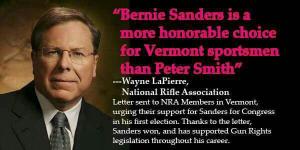
One more Bernie link from Dean Barker at “Birch Paper.” This one has been getting retweeted a lot today. The piece takes us back to the early days of Sanders’ political career when he ran again and again for office, and always lost. Then he got smart and used guns to get into Congress.
Sanders repeatedly talks about how he lost an election because he supported a ban on assault weapons. What really happened is that Sanders did so well in a third-party run that he got Republican Peter Smith elected. After he got to Washington, Smith’s conscience bothered him and he ended up supporting a bill to ban assault weapons.
In 1990, Sanders ran for the House seat again, and defeated Smith with the help and monetary support of the NRA. So when Bernie went to Washington, he voted against the Brady bill–repeatedly.
You have to read that article! There are tons of good links in there too.
Hillary was on the morning shows today too, and she learned from George Stephanopoulos that Karl Rove’s super pac is running an ad in Iowa that supports Sanders attacks on her.
Former Secretary of State Hillary Clinton laughed off a new attack ad from a Republican super PAC run by Karl Rove during an interview Sunday on “This Week” with George Stephanopoulos.
The web spot, titled “Hillary’s Bull Market,” was launched by American Crossroads, which is run by the Republican strategist and former President George W. Bush adviser. After watching the ad for the first time during her interview on “This Week,” Clinton just smiled.
“I think it shows how desperate the Republicans are to prevent me from becoming the nominee,” Clinton said about the ad, which goes after her ties to Wall Street. “I find that, in a perverse way, an incredibly flattering comment on their anxiety, because they know that not only will I stand up for what the country needs, I will take it to the Republicans.”
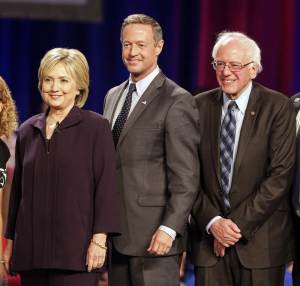
CNN’s report on the morning shows: Hillary Clinton zeroes in on Bernie Sanders.
Hillary Clinton on Sunday sharpened her attacks on Bernie Sanders over the Vermont senator’s record on gun control, just hours ahead of their fourth debate as both vie for the Democratic presidential nomination.
“I am very pleased that he flip-flopped on the immunity legislation,” Clinton told CNN’s Jake Tapper on “State of the Union,” a day after Sanders, who had been hammered by her campaign for his past position, announced he would change course and back legislation to reverse a 2005 law granting firearm manufacturers legal immunity.
She then called on her rival to do the same with the so-called “Charleston loophole,” which allows licensed dealers, once they have initiated a federal background check, to complete the gun sale in question if they haven’t hears back from authorities after three days.
Good news for Hillary:

Time: Poll: Hillary Clinton Leads Bernie Sanders Nationally By 25 Points.
Hillary Clinton is leading Bernie Sanders in a new national poll ahead of Sunday’s final Democratic debate before the Iowa caucuses.
The former Secretary of State is beating Sanders by 25 points nationally, according to according to the latest NBC News/Wall Street Journal poll of likely Democratic primary voters. Clinton is the top pick among 59% of Democratic primary voters, while Sanders has the support of 34%, the survey shows. Third-place candidate Martin O’Malley got the support of just 2% of likely voters.
Read the rest at CNN.
And From US News: Yes, Hillary’s Still the Inevitable Democratic Nominee She can recover even if she loses the first two nominating states to Bernie Sanders. Here’s why. Read about it at the link. It’s not easy find a brief excerpt to summarize the findings.
I’m putting this up a little early so we’ll have time to discuss these articles–or anything else you want to talk about–before the debate begins at 9PM. I look forward to reading your reactions to what happens tonight. This is the most important debate yet!
Friday Reads: SCOTUS Plays Doctor (and God)
Posted: May 22, 2015 Filed under: Affordable Care Act (ACA), Domestic Policy, Health care reform, morning reads, U.S. Politics | Tags: Affordable Care Act, King v. Burwell, SCOTUS 33 CommentsGood Morning!
 I’ve got all kinds of personal reasons to hope that when the Supreme Court decides King v. Burwell next month that one just one Republican-appointed justice will consider the complaint trivial and it will be dismissed. That’s because I will be among the millions of people that will lose their health care. Jonathan Chait-writing for New York Magazine--wonders if that’s really what Republicans want in the year running up to a Presidential election.
Next month, the Supreme Court will rule on King v. Burwell. If all five Republican appointees support the plaintiffs (there’s no chance any of the Democrat-appointed justices will take the lawsuit seriously), some 7 million Americans will quickly lose their insurance. The prospect that this will occur has induced a wave of panic — not among the customers at risk of losing their insurance, who seem largely unaware, nor even among Obamacare’s Democratic supporters, but among Republicans. The chaos their lawsuit would unleash might blow back in a way few Republicans had considered until recently, and now, on the eve of a possible triumph, they find themselves scrambling to contain the damage. It is dawning on the Grand Old Party that snatching health insurance away from millions of helpless victims is not quite as rewarding as expected.
Unlike the Obamacare lawsuit that failed three years ago, the latest case is not based on a radical legal theory. Instead it is based on a novel reading of legislative history. The law allows states to set up their own exchanges to sell insurance to those who don’t have it through employer coverage, Medicare, or Medicaid. If states don’t establish an exchange, the federal government sets one up for them and, as it does with the state exchanges, offers customers tax credits. The trouble is that the law authorizing tax credits defines the exchange as “established by the state.” This ambiguity — does “by the state” not also mean the federal government? — was a technical omission. Many other parts of the law indicate its intent to make tax credits available to customers on the federal and the state exchanges alike.
The plaintiffs are led by a Vietnam veteran in Virginia named David King who makes $39,000 a year and objects to having to purchase insurance on a federal exchange. He would be exempt from this requirement were he not eligible for the tax credit — his $275 monthly payment would rise to a disqualifyingly unaffordable $648 — and this exemption, his lawyers argue, was exactly Congress’s intent. Without tax credits, the insurance would be unaffordable to most customers, triggering an actuarial death spiral that would destroy the individual insurance market in any state that attempted it. The plaintiffs insist Congress created the threat of self-destructing federal exchanges to coerce states into creating their own. (Disregard the copious evidence that the law’s drafters, and officials at the state level in both parties, believed federal exchanges would include tax credits.)
The lawsuit works more on the level of an elaborate prank than as a serious reading of the law. And yet it stands at least some chance of success — it only needs to persuade Republican-appointed judges. That prospect has grown suddenly unnerving because, unlike previous Republican efforts to strangle the law, the current one comes as Obamacare is functioning extremely well. Premiums on the exchanges have come in well under projected costs, customers report higher satisfaction with their coverage than those who have employer-sponsored insurance, and overall medical costs have grown far below the projected rate. It is one thing to take away a scheduled future subsidy, of which most intended beneficiaries are unaware. It is quite another to take away a benefit they’re already using.
Can you imagine the optics of people being taken off chemotherapy, dialysis, or insulin shots? So, Republicans are gearing up a way to blame it on Obama or trying to find a way to get the extreme right to compromise and provide a short term extensions of the credits should SCOTUS agree with the plaintiffs.
Senator Ben Sasse of Nebraska has likewise warned that a successful lawsuit would create problems. “Chemotherapy turned off for perhaps 12,000 people, dialysis going dark for 10,000. The horror stories will be real,” he wrote in a Wall Street Journal op-ed. For decades, medical deprivation of this sort used to be a uniquely American fact of life, at least among industrialized countries. Obamacare has turned it into something different: an actual political problem for opponents of universal health insurance.
Neither Johnson nor Sasse has a real plan designed to stop those horrors from taking place. Instead, their aim is to give Republicans a way to divert the blame onto Obama. The party is circulating contingency plans to temporarily restore the tax credits in exchange for crippling the law in other ways. Phil Gramm, the former Republican senator turned conservative-think-tank “visiting scholar” and financial-industry lobbyist, has proposed that Republicans pass a bill to temporarily extend the credits in return for eliminating the law’s regulations prohibiting insurance companies from rejecting old or sick customers. Competing proposals by Johnson and Sasse would likewise weaken Obamacare’s insurance regulations, ultimately destroying the law’s functionality. Gramm evenacknowledges that his plan “would put Obamacare on the path to extinction.” Obviously, Obama is not going to sign a bill that puts Obamacare on the path to extinction. The purpose is simply to give Republicans a talking point — they can say they passed a bill and blame Obama for vetoing it. But odds are that Republicans will fail to unify around a bill that can pass both houses of Congress with only Republican votes, because some will deem even a bill that causes Obamacare’s eventual demise unacceptably conciliatory.
At that point, it will fall to the states to either establish their own exchanges or watch their individual-insurance markets collapse. Neither option is terribly attractive for Republicans. The former means surrender. Doing nothing means sowing chaos, deprivation, and death. Will Republicans let this happen?
Legal Analyst and Lawyer Jeffrey Toobin has a lengthy article in The New Yorker examining the issues.
So that’s the theory: millions will suddenly be uninsured, and will blame Republicans. As Harry Reid, the Democratic leader in the Senate, put it recently, “I don’t think they will [win the case]. If they do, that’s a problem that the Republicans have.”
No, it’s not. If the Obama Administration loses in the Supreme Court, the political pain will fall almost exclusively on the President and his Party. To paraphrase Colin Powell and the Pottery Barn rule, President Obama will have broken health care, so he owns it. To the vast mass of Americans who follow politics casually or not at all, Obamacare and the American system of health care have become virtually synonymous. This may not be exactly right or fair, but it’s a reasonable perception on the part of most people. The scope of the Affordable Care Act is so vast, and its effects so pervasive, that there is scarcely a corner of health care, especially with regard to insurance, that is unaffected by it. So if millions lose insurance, they will hold it against Obamacare, and against Obama. Blaming the President in these circumstances may be unfair, but it’s the way American politics works.
Republicans, of course, will encourage this sentiment. The precise legal claim in King v. Burwell is an esoteric one. It is not based on a claim that Obamacare is unconstitutional. (The Supreme Court upheld the constitutionality of the law three years ago.) Rather, the central assertion by the plaintiffs is that the Obama Administration violated the law itself. In any event, the subtlety of the issue at the heart of the case will surely be lost in its aftermath. The headlines will read, correctly, “Court rules against Obamacare,” and this will be all that matters. The Republicans will argue that the Supreme Court showed that the law was flawed from the start, that the Obama Administration is lawless, that a full repeal of the law is the only appropriate response to the Court’s decision—and that the millions who lose their subsides should blame the sponsor of the law. Watch for references to a “failed Presidency.” There’ll be plenty of them.
Understandably, perhaps, the Administration has courted this kind of reaction. Better than anyone, Administration officials know the scale of the problems that would be created by a loss in the Supreme Court. Advertising this possibility makes sense as a litigation strategy; Obama officials don’t want to make it easy for the Supreme Court to rule against them. In testimony before Congress and elsewhere, Sylvia Burwell, the Secretary of Health and Human Services (and the defendant in the case), said that the Administration has no contingency plan for an adverse ruling in the Supreme Court. But playing chicken with the Justices only works if it works. If the Supreme Court strikes down the subsidies, the Administration will also have to answer for why it didn’t prepare for this possibility.
 “Conservatives” have tried to laugh off the concerns.
A few weeks ago, the Heritage Foundation’s Edmund Haislmaier published an “Issue Brief” entitled “King v. Burwell: A Loss of Subsidy Does Not Mean a Loss of Coverage.” That’s a provocative title, considering 87 percent of the 8.8 million enrollees from federal exchanges receive those tax credit subsidies, meaning they have low or moderate incomes.
Haislmaier recently was seen saying it’s “premature” to conclude the huge drop in the uninsured rate since Obamacare passed is the result of Obamacare passing. In this brief, he correctly points out the Affordable Care Act and previous federal and state laws would enable current Obamacare enrollees to switch to some other form of health insurance if the lawsuit he supports succeeds in making their current plans unaffordable. (The brief also chides low-income people for using their subsidies to buy “king-crab-legs-and-steak” insurance rather than take the cheapest possible “powdered-milk-and-frozen-peas” plans.)
“In sum, should the Supreme Court’s eventual ruling in King v. Burwell result in people losing insurance subsidies, the affected individuals will have options for maintaining their coverage or choosing replacement coverage,” Haislmaier wrote. There’s even a chart.
Is that good news for people at risk of losing their health insurance subsidies? Maybe not. “Of course, some might still not be able to afford the unsubsidized premium even if they switched to a less expensive plan,” Haislmaier adds as a disclaimer. Of course.
That seems like it could be a problem, since 83 percent of Obamacare enrollees on the federal exchanges have annual incomes of 250 percent of the federal poverty level or less, which works out to no more than $23,450 for a single person, according to Avalere Health, a consulting firm. In other words, these aren’t Americans with a lot of extra money. And the average value of the tax credits they stand to lose is $263 a month, a substantial amount for people at this income level.
There’s a lot of variation in the price of health insurance, but a look at national average premiums and cost-sharing requirements illustrates what the “Let them eat Bronze plans” line of thinking ignores.
A 40-year-old at the poverty line, which is $11,770 for a single person, would pay $20 a month for a mid-tier Silver plan with tax credits. That amounts to about 2 percent of her annual income. Take away the subsidies, and her premiums jump almost 14-fold to $276 — or about 28 percent of her income.
What about dropping down to a lesser Bronze policy with higher out-of-pocket costs like deductibles?
That would cost almost 11 times as much as the subsidized Silver plan, at $213 a month, or about 22 percent of her income. Another person making twice as much money as her would see his premiums for the same Silver policy rise by 80 percent, which would eat up 14 percent of his income. His premiums would rise by 39 percent if he switched to a Bronze plan, which would cost him 11 percent of his yearly earnings.
Even opting for a slimmer policy might not make sense for lower-income people, considering how much more Bronze policyholders have to spend before their coverage kicks in. For example, the average deductible for an individual Bronze plan is $5,181, compared to $2,927 for a Silver plan, according to Health Pocket.
And this doesn’t even factor in the effects of a second type of subsidy only available to people earning up to 250 percent of poverty, which reduces their out-of-pocket health care expenses, and which also would go away in the high court rules for the plaintiffs.
Some are seeing this as the classic American “State’s Right’s” argument that has been responsible for–among  many other things–the Civil War.
But what may eventually prove to be the key line of questioning may have been kicked off by Justice Sonia Sotomayor, who expressed concern about the consequences of a ruling for the challengers. If a state’s residents don’t receive subsidies, she told Carvin, it will lead to a “death spiral”: because a large group of people in those states will no longer be required to buy health insurance, but insurers will still be required to offer insurance to everyone, only sick people will buy health insurance. And that will cause everyone’s insurance costs to rise, leading more people to drop out of the insurance market. States will then feel like they have no choice other than to establish their own exchanges to ward off the “death spiral” – a scenario that is so coercive that it violates the Constitution.
Perhaps critically for the government, Justice Anthony Kennedy – who is often regarded as a strong supporter of states’ rights – also expressed concern about the possibly coercive effect of a ruling for Carvin’s clients. There is, he told Carvin, “something very powerful to the point” that if the challengers prevail, the states have to choose between the death spiral and creating an exchange. “There’s a serious constitutional problem,” he concluded. (Carvin tried to downplay this concern by telling Kennedy that the government had not raised this issue, but Kennedy quickly retorted that “we sometimes think of things the government doesn’t argue.”)
Like Carvin, Solicitor General Don Verrilli – the government’s top lawyer at the Supreme Court – also faced questions about the challengers’ right to sue. But between his acknowledgement that, as Carvin had asserted, a veteran who had only served a short time would not be eligible for free health care and the lack of certainty about the plaintiffs’ 2014 annual incomes (which would determine whether they would be required to buy health insurance at all), the issue didn’t seem to have much traction with the Justices.
On the merits of the challenge to the subsidies, Verrilli faced repeated questions from Justices Scalia and Alito, who were both obviously skeptical of the government’s arguments. Scalia pushed back against Verrilli’s argument that the challengers’ reading simply doesn’t work, while – by contrast – the government’s interpretation accounts for the ACA’s structure and design. The question, Scalia admonished Verrilli, is not what Congress intended; the question is what it actually wrote in the statute. But in any event, Scalia queried a few minutes later, if the Court were to rule for the challengers, did Verrilli and the government actually expect Congress to “really just sit there while disaster ensues?” (Based on Verrilli’s response – a dubious “This Congress?” – the answer appeared to be yes.)
Justices Alito and Scalia also contested Verrilli’s assertion that, had Congress actually intended to force states to choose between setting up their own exchanges and depriving their residents of subsidies, it would have done so more clearly. Scalia asked rhetorically why, because the ACA is “not the most elegantly drafted statute,” would it “be so surprising” if Congress didn’t make the states’ obligations obvious? Alito added that, if Congress didn’t want to limit the subsidies to the residents of states that had set up their own exchanges, it could have used more precise language to do so – as it did, for example, in making clear that the District of Columbia (which is not a state) nonetheless qualifies as a “state” for purposes of the ACA.
So, we’re down to brass tacks again. Will the ACA go down on a technicality which, essentially, is what the law is all about?
What’s on your reading and blogging list today?
Tuesday Reads: Netanyahu Speech, Hillary-Hate, and Nonsensical SCOTUS Case that could Hurt 8 Million Americans
Posted: March 3, 2015 Filed under: 2016 elections, Affordable Care Act (ACA), Barack Obama, Foreign Affairs, Hillary Clinton, morning reads, U.S. Politics | Tags: Affordable Care Act, Benjamin Netanyahu speech to Congress, iran, israel, King v. Burwell, New York Times, Obamacare, SCOTUS, State Department 19 Comments
Good Afternoon!!
I wanted to touch on a couple of issues this afternoon: the latest Hillary Clinton “scandal,” and the upcoming Supreme Court case that could doom Obamacare once and for all.
But before I get to those stories, I want to share this good article by James Fallows on the possible motivations behind Netanyahu’s speech to Congress this morning.
The Mystery of the Netanyahu Disaster, and a Possible Explanation.
Fallows enumerates the possible motivations for the Netanyahu slap in the face to President Obama:
“Was it simple tin ear on his side, and Ambassador Ron Dermer’s?” Fallows asks? That’s not likely according to Fallows, because Netanyahu is far too sophisticated and knowledgeable about U.S. politics. Fallows also discounts the theory that it was only about “election-year politicking” in Israel. Perhaps that’s part of it. Is it because Netanyahu has so often been right in his previous predictions?
Hardly. I can’t believe that he’s fooled even himself into thinking that his egging-on of war with Iraq looks good in retrospect. And for nearly two decades Netanyahu has been arguing that Iran was on the verge of developing nuclear weapons. When you’re proven right, you trumpet that fact—and when you’re proven wrong, you usually have the sense to change the topic. Usually.
Was it because Netanyahu “has a better plan?”
No. His alternative plan for Iran is like the Republican critics’ alternative to the Obama healthcare or immigration policies. That is: It’s not a plan, it’s dislike of what Obama is doing. And if the current negotiations break down, Iran could move more quickly toward nuclear capacity than it is doing now—barring the fantasy of a preemptive military strike by Israel or the U.S.
Fallows also doesn’t buy the argument that Netanyahu actually believes that Iran “faces an “existential threat” if Iran develops a nuclear weapon?
Let me explain. No person, nation, or community can define what some other person (etc) “should” consider threatening….But from the U.S. perspective I can say that the “existential” concept rests on two utterly unsupportable premises. One is that Iran is fundamentally like Nazi Germany, and the world situation of 2015 is fundamentally like that of 1938. Emotionally you can say “never forget!” Rationally these situations have nothing in common—apart from the anti-Semitic rhetoric. (To begin with: Nazi Germany had a world-beating military and unarmed Jewish minorities within its immediate control. Iran is far away and militarily no match for Israel.) The other premise is that Iran’s leaders are literally suicidal. That is, they care more about destroying Israel than they care about their country’s survival. Remember, Israel has bombs of its own with which to retaliate, so that any attack on Israel would ensure countless more Iranian deaths.

What then? Fallows refers to an article at The National Interest by Paul Pillar.
Pillar’s assessment is that the ramped-up “existential” rhetoric is a screen for the real issue, which is a flat contradiction between long-term U.S. and Israeli national interests as regards Iran. It is in American interests (as I have argued) to find some way to end Iran’s excluded status and re-integrate it with the world, as happened with China in the 1970s. And it is in Israel’s interests, at least as defined by Netanyahu for regional-power reasons, that this not occur. As Pillar writes:
The prime objective that Netanyahu is pursuing, and that is quite consistent with his lobbying and other behavior, is not the prevention of an Iranian nuclear weapon but instead the prevention of any agreement with Iran. It is not the specific terms of an agreement that are most important to him, but instead whether there is to be any agreement at all. Netanyahu’s defense minister recently made the nature of the objective explicit when he denounced in advance “every deal” that could be made between the West and Tehran. As accompaniments to an absence of any agreements between the West and Iran, the Israeli government’s objective includes permanent pariah status for Iran and in particular an absence of any business being done, on any subject, between Washington and Tehran.
That is, as long as Netanyahu keeps the attention on nukes and “existential” threats, he’s talking about an area where the U.S. and Israel might differ on tactics but agree on ultimate goals. Inflammatory as that topic is, it’s safer than talking about re-integrating Iran as a legitimate power, where U.S. and Israeli interests may ultimately differ.
I thought that was pretty good food for thought.
Before I get to the Clinton e-mails issue, here’s an interesting piece at the Washington Post on Hillary’s relationship with Netanyahu.
The phone call between Hillary Rodham Clinton and Israeli Prime Minister Benjamin Netanyahu lasted 45 minutes. For 43 of them, she talked and he listened.
The U.S. secretary of state lectured the Israeli leader, accusing him of trying to do an end run around American opposition to settlement-building and embarrassing Vice President Biden during a visit to Israel, according to interviews with people present during the 2010 call or who were briefed on it afterward. She read from a script for part of the lecture, so as not to miss any key points.
“The word ‘humiliation’ appeared very prominently,” recalled Michael Oren, then the Israeli ambassador in Washington. “As in ‘You have humiliated the United States of America.’ ”
There probably aren’t many times in Netanyahu’s professional life when he has listened to anyone for 43 minutes. Netanyahu prefers to do the lecturing….And there aren’t many people who could make Netanyahu sit still for a tongue-lashing. Clinton is one of them.

The story of the phone call comes from Clinton’s book on her time as Secretary of State, Hard Choices. Read more about it at the link. It would seem that experiences like this would stand Clinton and the U.S. in good stead if she ends up in the White House.
On the latest “scandal” about Hillary using a private e-mail as Secretary of State, I’m not sure what to think. It certainly does give ammunition to Republicans and to potential Democratic opponents like Martin O’Malley.
Here’s the NYT Story that started the fuss: Hillary Clinton Used Personal Email Account at State Dept., Possibly Breaking Rules. You’ll need to read it at the link, because the Times has fixed their website so that I, at least, can’t copy and paste any excerpts. Here are some reactions to the story. First, the debunkers:
From USA Today, Clinton aide: State Department e-mails preserved.
A spokesman for Hillary Rodham Clinton said Tuesday that while she used a personal e-mail account during her years as secretary of State, those records have been maintained pursuant to federal rules.
“Both the letter and spirit of the rules permitted State Department officials to use non-government email, as long as appropriate records were preserved,” said Clinton spokesman Nick Merrill. “As a result of State’s request for our help to make sure they in fact were, that is what happened here.”
Merrill responded to a New York Times story saying that Clinton, a prospective presidential candidate in 2016, used a personal e-mail account during her four years at the State Department and “may have violated federal requirements that officials’ correspondence be retained as part of the agency’s record.”
The Times reported that Clinton’s “expansive use of the private account was alarming to current and former National Archives and Records Administration officials and government watchdogs, who called it a serious breach.”
Yes, the president signed the new law two years after Clinton left the State Department. The NYT wants to punish her retroactively. Not surprising, considering the Times’ longstanding hatred for and sliming of the the Clintons. Please go read the whole Media Matters post. It won’t stop the Clinton haters from using this, but it’s the truth. Arm yourself.

Coffee, Leon Zernitzky
Bob Cesca at The Daily Banter: That Story About Hillary Clinton’s Private Email Account Isn’t as Awful as It Seems.
Again, please go read the whole thing, and prepare yourself for the coming onslaught. This is only the beginning.
A few more links to folks who either don’t know or don’t care about the time of the law and the fact that Clinton preseved all her emails.
A fairly Hillary-friendly post from Charles Pierce, Hillary Finds A Rake To Step On: The First Clinton Bombshell.
LA Times, Hillary Clinton used personal email while serving as secretary of state.
Mashable, Clinton email revelation: You did what, Hillary?
Incidentally, I was shocked to see this from Joseph Cannon:
Hillary’s secret email account. Let’s be honest: If a Republican did this, we’d be worried. Actually, Republicans have done exactly that.
The most important point here is sub-textual: If the NYT has turned against Hillary Clinton, then we should suspect that she has privately revealed to her closest aides that, if elected, she will do things that she cannot now state out loud. Of course, nothing is truly private these days.
“If the times as turned against Hillary Clinton”??!!! Joseph, why aren’t you aware that the NYT –brave champion of Dubya’s Iraq war–has always loathed the Clintons and has published innumerable attacks on them?
Finally a few links to prepare you for tomorrow’s SCOTUS hearing on King v. Burwell, during which the justices will consider whether to throw about 8 million Americans off their health care plans.
Charles Pierce, The Tell: What This Week’s Attack On Obamacare Is Really About.
…the Nine Wise Souls on Tuesday will hear King v. Burwell, the highly imaginative, if constitutionally laughable, attack on the grammar and punctuation in the Affordable Care Act, which the NWS should have laughed off months ago….
It is the Universal String Theory Of Wingnut Conjuring Words in full view, the complete text of one of the spells. A fake scandal being used to excuse the shabby underpinning of a fake lawsuit that will have real and devastating consequences to thousands of people.

That’s it in a nutshell. But here are more links to check out for more details.
Politico: No easy fix if Supreme Court halts Obamacare cash. (No sh$t Sherlock.)
Republicans are getting nervous about what will happen if they get their wish. From The Hill: GOP fears grow over ObamaCare challenge.
Ezra Klein at Vox: Republicans say they have a plan if the Supreme Court rules against Obamacare. They don’t.
Stephen Brill at Reuters: The Supreme Court hears an Obamacare fairytale.
US News (not known for liberal views): The Silliest Obamacare Challenge Yet. The King v. Burwell case could cause 8 million to lose health insurance.
SCOTUS should never have agreed to hear this case, but they did. Is John Roberts okay with going down in history as a buffoon? We’ll find out in June.
Please share your views along with the stories you’re following today in the comment thread.

 peej
peej Carissa
 bostonboomer
 dakinikat
 ecocatwoman
 mablue2
 Mama Lopez
 peggysue22
 quixote
 skydancingguestblogger
 Mona (aka Wonk the Vote)



 Sky Dancing
Recent Comments