
Monday Reads
Posted: April 4, 2011 Filed under: Civil Rights, collective bargaining, Diplomacy Nightmares, Foreign Affairs, Hamas, Labor unions, Libya, MENA, Middle East, morning reads, Reproductive Rights, Syria, worker rights | Tags: Foreclosures, Libya, Martin Luther King, Syria 68 Comments Good Morning!
This is the anniversary of Dr. Martin Luther King’s assassination. It happened on April 4, 1968. Historian Robert Creamer remembers the day and its meaning in a post at HuffPo. It’s the 43rd anniversary of the activist’s death. He was in Memphis working for the rights of ordinary workers to organize and better their work terms and conditions.
Martin Luther King was in Memphis to support the strike of the city’s garbage collectors who were demanding the right of collective bargaining.
He was there because the right to sit across a table and negotiate wages and working conditions gave otherwise powerless workers, the right to have a say.
Then — as now — collective bargaining was, as the AFSCME banner said in the Wisconsin Capitol Rotunda, about freedom.
At Duke that spring we — and the non-academic employees of the university — took up the same cause. Collective bargaining was the only thing that could systematically, permanently change the relations of power and overcome years of exploitation.
Even in 1968, their $1.15 per hour was a pathetic salary — $2,392 a year. They were exploited every day. They needed a union.
Now, 43 years later, America is relearning the lessons of April, 1968:
- How collective bargaining is an integral part of a truly democratic society.
- How the labor movement is about a lot more than wages and working conditions — that it’s about respect and dignity and hope.
- And finally, it is learning once again that you can’t have the rain without the thunder and lightning. Freedom is earned through struggle. And if you want to have a great life — a life that gives you a sense of fulfillment and meaning — it’s never too late to decide that you will dedicate yours to the struggle for social and economic justice.
The LA Times reports that over 700 Anti-union pieces of legislation have been introduced across the country as part of the Republican party’s war on working Americans. Sounds like a conspiracy to me.
More than 700 bills have been introduced in virtually every state. Nearly half of the states are considering legislation to limit public employees’ collective bargaining rights. Unions are girding for a fight.
Now that the governors of Ohio and Wisconsin have signed bills to limit public workers’ collective bargaining rights, their fellow Republicans in other states are expected to gain momentum in their efforts to take on unions.
Palm Beach, Florida judges have evidently had it with the sloppy recordkeeping practices of mortgage holders and servicers. They’re starting to “routinely” dismiss foreclosure cases.
Angry and exasperated by faulty foreclosure documents, judges throughout Florida are hitting back by increasingly dismissing cases and boldly accusing lawyers of “fraud upon the court.”
A Palm Beach Post review of cases in state and appellate courts found judges are routinely dismissing cases for questionable paperwork. Although in most cases the bank is allowed to refile the case with the appropriate documents, in a growing number of cases judges are awarding homeowners their homes free and clear after finding fraud upon the court.
Still, critics say judges are not doing enough.
“The judges are the gatekeepers to jurisprudence, to the Florida Constitution, to access to the courts and to due process,” said attorney Chip Parker, a Jacksonville foreclosure defense attorney who was recently investigated by the Florida Bar for his critical comments about so-called “rocket dockets” during an interview with CNN. “It’s discouraging when it appears as if there is an exception being made for foreclosure cases.”
Dictator Bashar al-Assad of Syria is undoubtedly one of the most oppressive leaders in the world. He has been a strong supporter of both Hamas and Hezbollah. AJ has an op-ed that talks about how deluded he’s become these days as his people have finally stood up to say enough! It’s an interesting piece that talks about how just being against Israel does not translate into a blank check from your people or other leaders in the region.
The eruption of Arab revolutions has been a reaction to decades of repression and the skewed distribution of wealth; two problems that have plagued anti- and pro-Western Arab governments alike.
And Syria is one of the most repressive states in the region; hundreds, if not thousands, of people have disappeared into its infamous prisons. Some reappear after years, some after decades, many never resurface at all.
Syrians have not been the only victims. Other Arabs – Lebanese who were abducted during the decades of Syrian control over its neighbour, Jordanian members of the ruling Baath party who disagreed with its leadership and members of different Palestinian factions – have also been victimised.
Syrian critics of the regime are often arrested and charged – without due process – with serving external – often American and Israeli – agendas to undermine the country’s “steadfastness and confrontational policies”.
But these acts have never been adequately condemned by Arab political parties and civil society, which have supported Syria’s position on Israel while turning a blind eye to its repressive policies.
Thus while Syrian dissidents, including prominent nationalist and leftist intellectuals, are incarcerated in Syrian jails, other Arab activists and intellectuals have flocked to Damascus to praise its role in “defending Arab causes”.
This hypocrisy has reinforced the regime’s belief that it is immune from the criticisms directed at repressive pro-Western governments in the region.
As some one who studies the region–albeit mostly in economic and trade terms–I’ve found that each country has its unique set of problems and circumstances even though many of them seem to have similarities on the surface. Syria’s been one of the worst of the worst destabilizers in the region. This is one regime that could be replaced by nearly any one and it would be an immediate improvement.
Former President Clinton is on record saying that the US government shouldn’t rule out arming Libyan Rebels.
But Clinton said he wouldn’t completely rule out the idea of supplying arms to Libya’s rebels.
“Let me just say this. I sure wouldn’t shut the door to it. I think … we may need to know a little more,” he said.
Clinton, husband of Secretary of State Hillary Clinton, stressed that he was speaking without “any official sanction” whatsoever.
“I’m just speaking from myself. But I certainly wouldn’t take that off the table, too,” he said.
For some reason, emissaries from Gadhafi are meeting Greek leaders to find a political solution to their civil war and to the UN resolution. Maybe Gadhafi is looking for that special retirement place on a Greek Isle.
Libyan leader Muammar Qaddafi’s acting foreign minister met with Greece’s prime minister yesterday to seek a political solution to hostilities in the north African country, said Greek Foreign Minister Dimitris Droutsas.
“It appears that the regime is also seeking a solution,” Droutsas said, referring to Qaddafi’s government, after Abdul Ati al-Obeidi met with Greek Prime Minister George Papandreou, Droutsas said in a statement.
The talks followed “a series of contacts over recent days” involving Greek and Libyan officials, including the countries’ prime ministers, which led to al-Obeidi’s Athens trip, Droutsas said. Al-Obeidi also planned to visit Malta and Turkey, he said.
“It is necessary for there to be a serious attempt for peace, for stability in the region,” the Greek foreign minister said.
The Daily Mail reports that Moussa Koussa is getting asylum in the UK. I’d say that’s a pretty interesting development considering his role in the Lockabie bombing. I suppose there’s worse places to spend your retirement from “notorious henchmen”.
Libya’s feared ‘torturer-in-chief’ has been offered asylum in the UK in return for his help to topple Muammar Gaddafi and his hated regime.
The secret offer to Libya’s former foreign minister, Moussa Koussa, was made while he was still in Tripoli and helped persuade him to seek sanctuary in Britain.
But any promise of special protection for one of Gaddafi’s most notorious henchmen has provoked anger from those who want Koussa, 62, put on trial for his alleged crimes.
MP Ben Wallace, parliamentary aide to Justice Secretary Ken Clarke, said: ‘This man should not be granted asylum or any other special treatment; the only proper outcome is to bring him to justice.
‘Britain needs to make up its mind quickly. There will be no shortage of courts that will readily seek his extradition. The last thing the UK wants is for Koussa to languish, at taxpayers’ expense, in legal no-man’s-land.’
MI6 officers first made contact with Koussa, who has been linked with the Lockerbie bombing and the killing of WPC Yvonne Fletcher outside the Libyan Embassy in London, in the first few days after the UN-sanctioned attacks on Gaddafi’s military machine on March 19.
A source told The Mail on Sunday: ‘Central to the enticements was the prospect of living in safety in the UK under the protection of the asylum laws. Koussa’s greatest concern was what would happen to him once he left Gaddafi.
I’m going to end with something BB sent me last on what the radical right thinks of women. You can see this onslaught of anti women laws ooze disrespect and the opinion that women aren’t fully competent adults who are capable of making good, moral decisions without some big daddy republican government telling them what to do. Disgusting! They want to turn BP loose on the Gulf of Mexico again, but women can’t even been trusted with their own bodies.
Women sure are impulsive, lying, vulnerable and childlike creatures, aren’t they? That’s the conclusion I’d draw, if my understanding of women were based solely on anti-abortion bills.
These bills are pending and passing at a disturbing pace in multiple states. They don’t just reflect the nation’s chronic and understandable ambivalence about abortion. They also paint a shockingly negative portrait of women.
Here are a few key messages gleaned from the latest bills and anti-abortion advocacy:
* Women are impulsive. Half of states now require women to undergo a waiting period before obtaining an abortion. Usually the waiting period is one day. South Dakota just passed a three-day waiting period, the longest in the nation. The implication is that, without a government-mandated waiting period, women would dash into abortion clinics without first weighing the gravity of their decision.
* Women are prone to lying. Last week, the Indiana House passed a measure that would forbid most abortions after 20 weeks. A version of it is expected to pass into law. Opponents tried to carve out an exception for victims of rape or incest, as well as for women whose lives are threatened by medical complications. However, the bill’s sponsor fended off the amendment by attacking it as a “giant loophole” that women would use to get abortions by pretending they were raped.
* Women need things explained to them. A bill recently passed by the Texas House would require doctors to describe the fetus in some detail to all abortion-seeking patients, including victims of rape and incest. The bill allows women to close their eyes and cover their ears. (It doesn’t specify whether women are permitted to say, “La-la-la, I can’t hear you.”)
Well, that’s about it from me. I’m just waiting for the severe weather to fire up today and trying to heal. What’s on your reading and blogging list today?
Working your Way into the Poor House
Posted: April 3, 2011 Filed under: income inequality, Team Obama, The Bonus Class, U.S. Economy, unemployment | Tags: income stagnation, shrinking middle class, wage insecurity, wage stagnation 18 CommentsThe basic promise of modern America was that you can work hard and get ahead. These days, that promise goes  undelivered daily. The gap between the promise and the delivery is widening exponentially and it’s time for all of us to get the few to listen. The basic problem in our economy is that we are not producing jobs that help working families meet basic needs. I see this a lot down here in New Orleans where many of our homeless people sleep on air mattresses in front of the shelter at night but have jobs in the French Quarter during the day. They wash dishes or straighten beds. They work and they work hard. Yet, they cannot afford basic shelter in a southern city with relatively low costs of living compared to other places. This is not the Social Contract we’ve been taught in our schools for years. Working a job is not supposed to mean you can’t get your children to the doctor or put a roof over your head.
I wanted to highlight the recent findings of an income insecurity study for you. Then, I’m going to talk about the role of wage and income stagnation in all of that. I felt that just possibly you might take your Sunday afternoon to look at the people around you and appreciate the struggle. The first study was commissioned by Wider Opportunities for Women. The results were highlighted in the New York Times. The uncovered realities are harsh and make the future for many folks in this country look unpromising. WOW was looking for an index–now called National BEST–to demonstrate how much it takes to minimally exist in the US as a middle class family and how far short some of our citizens have fallen of that minimal standard. It’s a slightly upscale version of the Poverty index. It basically tells you what it takes to be marginally working/middle class. This measure includes good nutrition, a small sedan, and some basic savings for retirement so it’s not a survive or die measure. It measures what it takes to really have the minimal American Dream. It’s what every American would have if our country met its Social Contract with working Americans.
According to the report, a single worker needs an income of $30,012 a year — or just above $14 an hour — to cover basic expenses and save for retirement and emergencies. That is close to three times the 2010 national poverty level of $10,830 for a single person, and nearly twice the federal minimum wage of $7.25 an hour.
A single worker with two young children needs an annual income of $57,756, or just over $27 an hour, to attain economic stability, and a family with two working parents and two young children needs to earn $67,920 a year, or about $16 an hour per worker.
That compares with the national poverty level of $22,050 for a family of four. The most recent data from the Census Bureau found that 14.3 percent of Americans were living below the poverty line in 2009.
Wider Opportunities and its consulting partners saw a need for an index that would indicate how much families need to earn if, for example, they want to save for their children’s college education or for a down payment on a home.
So, we’re talking a minimal, humble “American Dream” which, again, is what we’ve been promised for our hard work. This dream does comes from hard work and not some one’s daddy’s trust fund like the Koch Brothers or Paris Hilton. These people work . More and more, working does not pay for them and it is creating problems for us all. The most disenfranchised are workers who have not completed high school and have no training. The recession has only made this worse and the recovery does not appear to be bringing anything better. Still, I hear nothing about helping these people prepare and find work.
We have no discussions about what it means to be working and poor in America. I hear only about cutting budgets. We’d have never won World War 2 with that attitude. If they’d have worried about the debt left to me and my generation, we’d have a completely different world right now. That appears to be what they want to leave to our children. We are building a world where the Social Contract for the American Dream is broken and no one wants to pay to get it fixed.
For some of the least educated, Mr. Waldman fears that even low wages are out of reach. “Given the needs of a more cognitive and more versatile labor force,” he said, “I’m afraid that those that don’t have the education are going to be part of a structural unemployment story.”
Even for those who do get jobs, it may be hard to live without public services, say nonprofit groups that assist low-income workers. “Politicians are so worried about fraud and abuse,” said Carol Goertzel, president of PathWays PA, a nonprofit that serves families in the Philadelphia region. “But they are not seeing the picture of families who are working but simply not making enough money to support their families, and need public support.”
In New York, Áine Duggan, vice president for research, policy and education at the Food Bank for New York City, estimates that about a third of the group’s clients are working but not earning enough to cover basic needs, much less saving for retirement or an emergency. She said that among households with children and annual incomes of less than $25,000, 83 percent of them would not be able to afford food within three months of losing the family income. That is up from 68 percent in 2008 at the height of the recession.
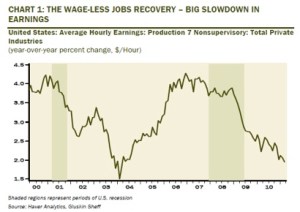 We have a “Wageless” Recovery. Incomes are only going up at the extreme upper levels. Every one else is losing lifestyle and yet, they are working hard. Employment Policy Research Network (EPRN) researcher Frank Levy of MIT has released a monograph called ‘Addressing the Problems of Stagnant Wages’. (Yes, I know, I actually read these things with relish and print wonky graphs for you on a sunny Sunday afternoon because of some weird inner trait of mine I really can’t name.) Just reading his introduction takes me back to my childhood in Iowa where farmers bought trucks from my dad and I knew everything would be alright if I just went to college and got a degree.
In the three decades after World War II, a central feature of the American economy was a mass upward mobility in which each generation lived better than the last, and workers experienced earnings gains through much of their careers. In short, the American Dream was alive and well. The central drivers of mass upward mobility were real wages for most workers that grew in line with overall labor productivity. Because of rising real wages a 40-year-old male blue-collar worker earned more in the late 1960s than most managers had earned in the late 1940s.
The alignment of wage growth and productivity growth resulted from two main factors: labor markets for most groups of workers in which demand matched supply, and the post-World War II Social Compact that emerged from the Great Depression helped to propogate wage norms throughout the economy, norms that were enforced in part through collective bargaining and professional personnel/human resource management practices.
By the 1980s, both of these factors had reversed. Labor demand increasingly shifted toward more educated workers – particularly well-educated women. At the same time, the post-war Social Compact was challenged by the inflationary 1970s and collapsed in the 1980s. Nothing has emerged to replace it.
Now, in the absence of a labor market boom like that of 1996-2000, increased labor productivity no longer translates into rising real wages for many groups of workers.
Well, that’s all and fine, but how do we address the problems that we’ve got now? How is it that so many of us can work and do the right thing and still not make ends meet? Well, that’s the policy part of the paper and there are suggestions. The author argues that during the last three decades business and government have broken the Social Contract. He’s got some suggestions. One of them is pretty basic. That would be increasing the High School Graduation rate and trying to get employers to buy into the idea that they must providing training and education opportunities to their workers. If they don’t, then society must offer this as a public good because provision of the good is cheaper than the social costs of not providing the good.
Increasing the number of college graduates requires dealing with two potentially related obstacles. One is the stagnation since the early 1970s in the high school graduation rate at approximately 75 percent.25 The failure to increase the high school graduation rate explains about one-half of the slowdown since the 1970s in the growth in the rate of college completion (Bailey and Dynarski, forthcoming). The other is the weak ability of high school graduates, once in junior college or college, to complete a degree. The historically large college-high school earnings gap has caused a growing fraction of high school graduates to start higher education, but the fraction who complete a bachelor’s degree has increased only modestly for women over the last twenty years and has remained basically flat for men.
There’s also a pretty good discussion of the idea of charters schools and inflicting the competitive charter school model on the education system that follows with some really good questions. Other proposals include making certain that we invest in the jobs and industries of the future even if the private sector isn’t doing their share. There’s also some discussion of how to encourage better labor-management relations and laws but given the demonization of working people–even by working people themselves–the author doesn’t hold much hope for the national discussion that needs to take place on less combative and abusive management practices.
One of the things that I do want to bring up is the role of using the classification “independent contractor” and how it’s allowed businesses to get around paying workers. It is thought to be responsible for a chunk of the wage stagnation and to many of the lost benefits problems leading to the loss of middle class lifestyles. It worries me greatly that many tea party governors are actively trying to dismantle labor laws. They are even trying to get rid of child labor laws so businesses can get access to children under 14 again.
One necessary but far from sufficient requirement for setting and maintaining a floor on wages for hourly workers, and especially for low-wage hourly workers, is that federal and state wage and hour laws are enforced vigorously and as uniformly as possible. Recent studies have shown there are widespread violations of wage and hour laws ranging from failure to pay minimum wages, overtime, required meal and rest breaks, and misclassification of employees as independent contractors. One recent study estimated these types of violations have the effect of lowering wages of affected workers by 15 percent
One of the major themes in the research is on the increased role of the financial markets in the breakdown of the Social Contract. The growth of the finance industry has come with the loss of manufacturing. Not only is this due loss of manufacturing jobs that are now lower paying services jobs, but it has caused incomes to shift from labor to capital. The political power and rise of the financial class has a lot to do with this trend. These people don’t just want ordinary returns on their money. They want extraordinary returns. Squeezing costs is usually the short sighted, short term way to achieve that.
I’d like to close with an interview with Cornel West that encapsulates some of the problems. It’s a little old. I grabbed it from Naked Capitalism; also a place concerned with policies that impact middle class Americans. Listening to the interview made think again about our priorities and our need to enforce the American Dream Social Contract once again. Dr West talks about the experience of poor and working class blacks in this clip, but many of the same things can be applied to any and all poor and working class Americans. I think it’s time we start the discussion. The country’s in trouble when an increasing amount of income comes from shuffling paper between financial institutions and bonuses replace wages for a hard day’s work.

One Helluva Open Window
Posted: April 2, 2011 Filed under: financial institutions, Global Financial Crisis | Tags: Ben Bernanke, FED 23 CommentsI’m a financial economist. I’ve worked for the Fed although not in that capacity. My grandfather worked for the FED  doing the War Bonds thing for both World Wars and my exhusband worked for the Fed straight out of college. I’d like to think I have some familiarity with at least two of the districts. I also was schooled during the monetarist ascendancy so I was endowed with a certain amount of awe and respect for monetary policy. I don’t think–as a general rule–the FED’s current open market operations should be up for purview by politicians. I think it’s just fine and dandy that stuff comes out later because I certainly don’t want monetary policy neutralized or politicized. I would, however, like Ron Paul’s 3rd century world view of economics to be neutralized. However, I think all the adults in Washington, D.C. have moved. That would include the ones in the Board of Governor’s Building.
So, why am I saying all this? Well, I’m about to announce how absolutely appalled I was to find that the FED not only opened it’s discount window to our shadow banking industry and some commercial banks abroad, but it opened the windows, doors, and vaults to just about any bank or pseudo-bank on the planet that had the misfortune to be taken in by our financiers of greed and destruction. I know the Fed dabbles around the world. We’ve had to prop up Mexico and Citibank’s adventures from time-to-time which seemed way out of its jurisdiction even with the broadest interpretation of their charter. I know they “watch” our exchange rates while talking up the competitive exchange rate regime at times. Some how, this feels WAY different. I feel in need of a shower even reading about this.
U.S. Federal Reserve Chairman Ben S. Bernanke’s two-year fight to shield crisis-squeezed banks from the stigma of revealing their public loans protected a lender to local governments in Belgium, a Japanese fishing-cooperative financier and a company part-owned by the Central Bank of Libya.
Dexia SA (DEXB), based in Brussels and Paris, borrowed as much as $33.5 billion through its New York branch from the Fed’s “discount window” lending program, according to Fed documents released yesterday in response to a Freedom of Information Act request. Dublin-based Depfa Bank Plc, taken over in 2007 by a German real-estate lender later seized by the German government, drew $24.5 billion.
The biggest borrowers from the 97-year-old discount window as the program reached its crisis-era peak were foreign banks, accounting for at least 70 percent of the $110.7 billion borrowed during the week in October 2008 when use of the program surged to a record. The disclosures may stoke a reexamination of the risks posed to U.S. taxpayers by the central bank’s role in global financial markets.
“The caricature of the Fed is that it was shoveling money to big New York banks and a bunch of foreigners, and that is not conducive to its long-run reputation,” said Vincent Reinhart, the Fed’s director of monetary affairs from 2001 to 2007.
The FED’s always had an ‘usual and exigent circumstances’ clause that’s given a lot of leeway in times of financial crisis. Some how, I don’t even think Woodrow Wilson figured it would be used to lend money to a fishing-cooperative financier in Japan. You can also read Yves Smith at Naked Capitalism on exactly what went on at the Discount Window and with whom. She focuses on the ‘haircuts’. That would be the lousy deals made by the Fed to bail out a lot of lousy dealers. The numbers on how many of these borrowers were junk status awes.
The information was released yesterday and Bloomberg has provided a first cut on a small but juicy portion of it, the Primary Dealer Credit Facility. From a risk standpoint, the loans mace under this program violated the central bank guideline known as the Bagehot rule: “Lend freely, against good collateral, at penalty rates”. That is the prescription if the borrower is facing a bank run, meaning a liquidity crisis. The fact that 72% of the Fed’s loans on September 29 from the Primary Dealer Credit Facility were junk or equivalent (defaulted and unrated securities or equity) is further proof that many financial firms were facing a solvency, not a liquidity, crisis.
She also shows–in her words quelle suprise–which American Banks were the little failed piggies too. I’m going to throw one of the ‘haircuts’ or discounts a the front of this quote just to curl your toes a bit. I think we can effectively say that Wall Street trashed the value of nearly every firm in the country pretty effectively.
A 95% haircut on AAA rated ABS CDOs means the paper was effectively worthless.
This first cut by Bloomberg also shows that Morgan Stanley was the biggest user of the facility, receiving $61.3 billion of funds for securities “worth” $66.5 billion, 71.6% of which was junk or unrated. As eye-popping as those numbers are, the funds received are less than half the fall in Morgan Stanley’s liquidity pool in the two weeks after the Lehman failure, per Economics of Contempt. Merrill Lynch was second, getting $36.3 billion in funding for $39.1 billion of collateral, 83.4% of which was junk or unrated.
These are not the routine activities of central banks and central bankers. We basically bankrolled a bunch of businesses and financial outfits in a bunch of countries because they wanted in on the Wall Street greed and Wall Street failed them big time. I’m left wondering why all this money was thrown to the foreign gamblers while Americans were being foreclosed on, frankly. Let me also let you know that this is probably just the tip of the iceberg since there’s undoubtedly more documents that need to be discovered and analyzed. My hope is that when the congressional hearings on this get started, we have some real brain power behind the questions that need to be asked on this because questions do need to be asked about this. I’d like a few FED Governors around for the ride to see how many of them were on board with all of this or even knew of it. What we need right now are a few Ferdinand Pecoras.
I also wonder who masterminded all this? Paulson? Geithner? Bernanke? Were they that wedded to ensuring Wall Street didn’t look like a casino and American business didn’t look like a sham that they had to give away the house, the children, the pets, and the fatted calf? They basically threw every one’s kitchen sink overseas. Worse than that, they’ve really not solved the basic systemic problem and the banks are already niggling over the details of the few thinks done by Dodd-Frank. Feel used yet?
Income Inequality, Redux
Posted: April 1, 2011 Filed under: income inequality, poverty, The Media SUCKS, the villagers | Tags: Income Inequality, joseph stiglitz, the one percenters, trust fund WATB 12 Comments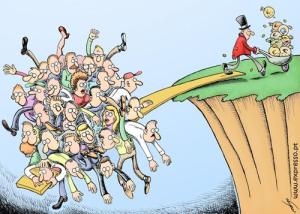
US Income Inequality – Too Big To Ignore
I had to frontpage this because I just can never make this point enough. Vast income inequality is not the sign of a healthy society or economy. H/t to Corrente for my first look at this Joseph Stiglitz article at Vanity Fare called ‘Of the 1%, by the 1%, for the 1%’. We’re back to the Versailles days and the Bush tax policies–extended by Obama–are a good part of the source of the problem. I hate to just lift just one paragraph out of Stiglitz’ rant because the entire thing is worth reading. However, here’s two for starters. Go read the entire thing, please.
But one big part of the reason we have so much inequality is that the top 1 percent want it that way. The most obvious example involves tax policy. Lowering tax rates on capital gains, which is how the rich receive a large portion of their income, has given the wealthiest Americans close to a free ride. Monopolies and near monopolies have always been a source of economic power—from John D. Rockefeller at the beginning of the last century to Bill Gates at the end. Lax enforcement of anti-trust laws, especially during Republican administrations, has been a godsend to the top 1 percent. Much of today’s inequality is due to manipulation of the financial system, enabled by changes in the rules that have been bought and paid for by the financial industry itself—one of its best investments ever. The government lent money to financial institutions at close to 0 percent interest and provided generous bailouts on favorable terms when all else failed. Regulators turned a blind eye to a lack of transparency and to conflicts of interest.
When you look at the sheer volume of wealth controlled by the top 1 percent in this country, it’s tempting to see our growing inequality as a quintessentially American achievement—we started way behind the pack, but now we’re doing inequality on a world-class level. And it looks as if we’ll be building on this achievement for years to come, because what made it possible is self-reinforcing.
The other reason that I decided to front page this is the here-here response from Michael Tomasky at the UK Guardian. It’s aptly called ‘Sad, just sad’. He mentions something we’ve said for some time. The villagers are also the beneficiaries of this kind of windfall. Why would those DC beltway types want to downsize when they can blame teachers, nurses, firefighters, and police officers for all those budget woes? It’s the overgenerous tax cuts. A nation can’t sustain itself without roads, airports, electrical grids, education, and public health and safety programs unless your idea of an ideal nation is that found in the Grapes of Wrath.
Stiglitz might have added the very important point that the majority of the country’s most prominent pundits who go on television and interpret all this for the American people, who soothe their audiences with assurances that all this is completely reasonable, are in the top 1%, which means households above around $380,000 per year. Many of course are far above that (Bill O’Reilly, Rush Limbaugh, etc.). High-end print journalists who aren’t quite at that level are still likely in the top 2%.
Anyway, the piece makes many important points, all of which boil down to the idea that while income inequality has several initial causes, there is only one thing that sustains it: a political process that is owned lock, stock and barrel by the top 1%.
Stepping back and looking at this context, and staying aware of it, makes watching these budget cuts particularly noxious. That’s not to say there isn’t waste, fine. But it is to say that the US political system of today is pretty inevitably designed to help the rich and punish the poor. So it’s no surprise when GOP Congressman Paul Ryan proposes, as he just has, cutting $1 trillion from Medicaid, which provides health care for poor people and the disabled (and to some extent, a greater extent than many people are aware, middle-class families, too, in the form of nursing-home cost support or in-home services like those from NY CDPAP agency).
Yes, Medicaid costs are high, killing the states. The feds could actually pick them up. Ronald Reagan proposed doing this. But that would be radical today. If Americans, especially wealthy ones, were paying taxes (income and capital gains) even at the rate we were in the Reagan era, we’d have no budget problems.
This brings me to the latest “Dopiest Constitutional Amendment of All Time” discussed by former economist Bruce Bartlett. The very same people that gutted tax revenues and funding sources for ten years and went on a spending spree on Treasury Bills now want to demand a federal balanced budget amendment. It’s not like watching the states get into deep trouble with their own versions of the stupid thing has taught any lessons. Balanced budget amendments simply lead to bad economics. When the revenues come in, the politicians spend like crazy on unnecessary things because the money’s there and the economy doesn’t require the expenditures. When the recession hits, the revenues go down, and the balance the budget part hurts, they start doing things that basically put their states in worse situations. This should be immoral, unethical and illegal. Instead, they stick in constitutions. Evidently none of these guys ever got away to reading the Grasshopper and the Ant. They’re all Grasshoppers until the real need for fiscal management comes into play.
Today, all 47 Senate Republicans introduced a constitutional amendment to balance the federal budget. Full text available here. Presumably, this is the amendment that Republicans plan to demand as their price for increasing the federal debt limit. Of course, simply refusing the raise the debt limit would balance the budget overnight — the nation would default on its debt and we would be plunged into the worst fiscal crisis in history, but the budget would be balanced. I have previously explained the idiocy of right wing advocates of debt default (here and here) and the idiocy of a balanced budget amendment (here and here). However, the new Republican balanced budget proposal is especially dimwitted.
At what point do the Republicans just change their name to the party of Batshit Crazy Liars? At what point do the Democrats start fighting some of this? It’s unbelievably hard to watch a group of people with so little at stake except their own re-election just run through a country’s future and assets like a Mardi Gras krewe tossing trinkets to bystanders. How much more looting of national resources to benefit their cronies can we honestly take before people really take to the streets and say enough!
TGIFriday Reads
Posted: April 1, 2011 Filed under: commercial banking, morning reads, We are so F'd, Women's Rights | Tags: Bank credit card fees, Bronx Zoo Egyptian Cobra, Congressional War powers, don't say uterus in florida's state legislature, Walmart's inflation woes, Walmart's supply chain workers maltreatment 61 CommentsGood Morning!!
Well, I’m hoping that this Friday goes smoother than my last one when what I thought was an innocuous zit turned into MRSA and sent me to the emergency room. I’m home now and waiting for groceries to be delivered. My face was all swollen and I’m finishing off my steriods and antibiotics. I certainly don’t want to be exposed to anything else for awhile and I availed myself of an internet-based delivery service. What I really need at the moment is a cook and nurse, but no such luck or fortune. So, I’m going to start out with some good news.
If you follow twitter much, you may have noticed that the New York Bronx Zoo’s Egyptian Cobra went missing and was “tweeting” it’s adventures. It seems the snake had hid out in its home–the reptile building–and was lured out with the smell of rodent-infested wood shavings.
An Egyptian cobra that drew thousands of Twitter fans has been found alive after it went missing for days from a New York City zoo. “As you can imagine, we are delighted to report that the snake has been found alive and well,” Bronx Zoo Director Jim Breheny said Thursday. Zoo officials conducted around-the-clock searches for the 3-ounce, 20-inch long reptile, he said.
Breheny said the cobra had sought a secure hiding spot within the holding areas of the zoo’s reptile house — a complex environment with pumps, motors and other mechanical systems. But it was lured out after zoo officials sprinkled wood shavings from exhibit beds across areas where they guessed the cobra was hiding. “It was the scent of rodents (on the wood clippings) that we hoped would bring her out,” Breheny added. “The key strategy here was patience,” he said in a prepared statement. The snake went missing Saturday from an off-exhibit enclosure, prompting the zoo to close the reptile house.
The cobra’s twitter ego was a blast to read. There were various comments about Samuel Jackson and Sex and the City’s Samantha. Anyway, I’m glad the little asp is back in his nest and that’s no April Fool’s day joke. I wish this next item was a bad April Fool’s day joke, but it’s not. A Democrat in Florida’s legislature was rebuked for using the word uterus on the floor. I guess a few people think girl parts are dirty words. (h/t to pdgrey)
During last week’s discussion about a bill that would prohibit governments from deducting union dues from a worker’s paycheck, state Rep. Scott Randolph, D-Orlando, used his time during floor debate to argue that Republicans are against regulations — except when it comes to the little guys, or serves their specific interests. At one point Randolph suggested that his wife “incorporate her uterus” to stop Republicans from pushing measures that would restrict abortions. Republicans, after all, wouldn’t want to further regulate a Florida business.
Apparently the GOP leadership of the House didn’t like the one-liner. They told Democrats that Randolph is not to discuss body parts on the House floor. “The point was that Republicans are always talking about deregulation and big government,” Randolph said Thursday. “And I always say their philosophy is small government for the big guy and big government for the little guy. And so, if my wife’s uterus was incorporated or my friend’s bedroom was incorporated, maybe they (Republicans) would be talking about deregulating. “It’s not like I used slang,” said Randolph, who actually got the line from his wife. He said Republicans voiced concern about young pages hearing the word uterus. “I think it’s a sad commentary about what we think about sex education in the state,” he said.
I’m having a difficult time associated Hillary Clinton with John Yoo but Adam Serwer at American Prospect does just that in calling Obama’s presidency imperial. Wow, have times changed! There’s a raging debate right now on congressional war powers again. Considering the adventures we’ve been on from Korea, to Vietnam, to Iraq, and forward, it seems like an odd time for this issue to pop up yet again.
Look, there’s no other way to describe this other than lawless. The Obama administration and its defenders in the civil-libertarian community have always maintained that, because it derives its authority from Congress, that authority can ultimately be undone by a legislative branch that asserts itself. If this portrayal of events accurately reflects the administration’s view, then this is no longer the case. Moreover, the Obama administration has explained its failure to fulfill certain promises — such as closing Gitmo — on having to obey limits set by Congress. If the administration’s view is that Congress cannot constrain the president’s actions in wartime because he is commander in chief, then those restrictions are ones the administration acquiesces to willingly in order to avoid making good on politically risky commitments. If Congress can’t tell the administration it can’t wage war, it sure as hell can’t tell the president where to keep alleged enemy prisoners.
I wanted to put this Dean Baker link up earlier so here it is: How Credit Card Companies want to Debit You. One of the provisions of Dodd Frank that banks would like to remove is a provision that no longer let’s them take their bad debt out of your backside. Right now, banks charge retailers incredibly high fees that get passed on to consumers on many items. The deal is that even if you use cash, you still can feel the sting of the fee.
This fee is, in effect, a sales tax. Since the credit companies generally do not allow retailers to offer cash discounts, they must mark up the sales price for all customers by enough to cover the cost of the fee. This seems especially unfair to the cash customers, since they must pay a higher price for the items they buy – even though they are not getting the convenience of paying with a debit or credit card. Those paying in cash also tend to be poorer than customers with debit or credit cards, which means that this is a transfer from low- and moderate-income customers to the banks. This is where financial reform comes in. One of the provisions of the Dodd-Frank bill passed last year instructed the Federal Reserve Board to determine the actual cost of carrying through a debit card transfer and to regulate fees accordingly. The Fed determined that a fee of 10-12 cents per transaction should be sufficient to cover the industry’s costs and provide a normal profit.
The Fed plans to limit the amount that the credit card companies can charge retailers to this level. This would save retailers approximately $12bn a year, at the expense of the credit card companies and the banks that are part of their networks. The prospect of losing $12bn in annual profits has sent the industry lobbyists into high gear. They have developed a range of bad things that will happen if the regulated fee structure takes effect and also argued that big retailers would be the only ones benefiting.
I really liked Mark Thoma’s latest at CBS’s MoneyWatch. It’s called “What’s Good for Wal-Mart Isn’t Necessarily for America”. It’s in response to WalMart executives who are in a dither about potential future inflation. Thoma makes three quick points to show you why your interests and there’s are probably not aligned.
1. Labor costs are 70% of production costs. Until we see wage inflation, and we aren’t seeing this yet, there’s little likelihood that prices will be forced upward rapidly.
2. Wal-Mart has an interest in a strong dollar (i.e. anything but inflation). They import most of what they sell, so labor costs here aren’t an issue – but the exchange rate is. However, the road to recovery is not through maximizing what we bring in from other countries, but rather what we export. Increasing net exports requires a falling exchange rate, the opposite of what Wal-mart wants. Thus, in this regard, what’s good for Wal-Mart isn’t what’s good for America.
3. The other thing to note as that to the extent that this is being driven by a change in the world demand for commodities (and almost all the credible analyses I’ve seen places the blame for rising commodity prices on this), there’s very little the Fed can do about it. For example, one of the concerns of Wal-Mart is rising labor costs in China, but the Fed has no control over labor costs in there, so the Fed cannot fix the problem for Wal-mart. However, this could help businesses here who cannot compete with low labor costs and a manipulated exchange rate, and that would help the US generally, but that is not what Wal-Mart wants.
Here’s more to think on when considering Walmart. This time it’s about the kinds of people that work so that cheapie goods are available to Walmart shoppers and they don’t have to deal with the United Ladies’ Garment workers.
The largest retailer in the United States is making an aggressive push into urban areas such as Chicago, Philadelphia, New York while the United Food and Commercial Workers union plays an underdog role in garnering public attention of Walmart’s abuse of workers from garment factories to employees in their Supercenters. UFCW is trying to highlight these abuses in a Worker Truth Tour featuring people who have or currently work for the massive corporation or a subsidiary.
The tour reached Chicago earlier this week featuring two women from Bangladesh who work in garment factories. The youngest of the two, Aleya Akter, continues to work 208 hours a month for a mere $80. It comes out to 38.5 cents an hour. She started working in the factories at the age of nine in 1994. She claimed there are lots of violations, long hours, and forced overtime. Additionally, she said through a translator, “Enough is enough. We need to change the working conditions in the factories.” Almost as an afterthought Aleya alleged that the workplace in these garment factories are unsafe and some of the women are physically abused by managers.
Anyway, that’s what I’ve got today. I’m still sort’ve reeling from the drugs, so hopefully you can add some more things from your reading and blogging list for us!!

 peej
peej Carissa
 bostonboomer
 dakinikat
 ecocatwoman
 jjlo
jjlo mablue2
 Mama Lopez
 peggysue22
 quixote
 skydancingguestblogger
 Mona (aka Wonk the Vote)





Recent Comments