
Tea Party Astroturf: More Apparent than Ever and Blatantly Hypocritical
Posted: March 31, 2011 Filed under: John Birch Society in Charge, Surreality, voodoo economics, Voter Ignorance, WE TOLD THEM SO | Tags: ABC Good Morning America, Michelle Bachman, Republican politicians love subsidies, Tea Party Darlings on the Dole, Tea Party Subsidy Queen 11 Comments Have you been wondering why we seem to have such a concerted effort in all kinds of states to take down unions, women’s rights, attack public workers, bankrupt the state with excessive tax cuts for business and the wealthy and other basically overwhelming policy attacks? Thought much about the Teabots recently? Well, here’s some interesting information on the little grass roots that got played big time. Not only is the tea party representing the interests of the rich, it’s also representing the interests of the rich taking lots of money from the state and federal government that they purport to hate. ABC’s Good Morning America has found some really interesting things on Tea Party Darlings on the Dole. Many of the biggest political icons in the movement are big abusers of government largess.
ABC’s senior political correspondent Jonathan Karl reported “the Tea Party movement is all about slashing federal spending, but at least five House members with Tea Party connections have themselves collected more than $100,000 each in federal farm subsidies, totalling more than $8 million since 1995.”
The subsidies are included in a report out Thursday by the Environmental Working Group. “We need a better system,” said Rep. Stephen Fincher, a Tennessee Republican whose family farm has received more than $3 million in subsidies, with more than $100,000 going directly to the Congressman himself. Asked directly if he’d refuse to take any further subsidies, he dodged the question. Others said the farm subsidies–totalling $16 billion–need to cut if not eliminated.
We’ve also learned that future presidential wannabe Michelle Bachman’s husband’s Christian “counseling” services
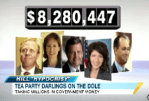
Watch the video by following this linked picture to ABC.
receives state funds in the scam to ungay, gay people. Talk about an appalling breach in the establishment clause!
Bachmann and Associates, Inc., a counseling center that receives state funds and is owned by Rep. Michele Bachmann and her husband, Dr. Marcus Bachmann, uses counseling methods steeped in fundamentalist Christianity, raising questions about its use of taxpayer money.
Founded in 2003, Bachmann’s clinic has taken in nearly $30,000 in state funds since 2007. Dr. Bachmann has said publicly that God heals people at his clinic and that Jesus Christ is the “Almighty Counselor.”
“We are distinctly a Christian counseling agency here in the Twin Cities,” he told KKMS radio in 2008. “We have 27 Christian counselors, Christ-centered, very strong in our understanding of who the Almighty Counselor is, and as we rely on God’s word and the Almighty Counselor, we have the opportunity to change people’s lives.”
He continued, “God heals people and if we give opportunity, if we are a willing vessel and we go according to what God’s word is, it works.”
The clinic applied for and received Rule 29 and Rule 31 licensing from the state in 2003. The rules allow the clinic to receive state money to treat low-income Minnesotans for mental health and chemical dependency problems. The clinic has earned $27,564 in state payments since 2007 — and likely received more, since the Minnesota Transparency and Accountability Project’s online data only goes back to 2007. Bachmann and Associates took $1,419 in public money in 2007, $13,140 in 2008, $12,493 in 2009 and $512 so far in 2010, according to the transparency project.
All of the clinic’s counselors identify as Christians. Among them is Marian E. Eckhardt, a licensed psychologist. Her mission statement says, “I believe that through knowledge, faith and dependency on God and His revealed truths one receives the strength and love to truly fulfill their life’s purpose.”
Saul Selby, the clinic’s drug and alcohol counselor, is also an ordained minister. Selby writes that he seeks to “help individuals and couples experience wholeness and healing through the application of biblical principles and the Love of Christ.”
Debra Kullberg, an associate marriage and family therapist, is also a licensed member of the clergy. “Jesus as the Son of God is the Savior, Healer, and intimate Lover of my soul,” she says in a statement on the clinic’s website. “He invites those He calls to join Him on a personal journey to the Cross. Our entire being is healed and restored (body, soul, and spirit) as we surrender ‘our way’ for ‘His way.’”
Watchdog groups say that the state’s arrangement with Bachmann and Associates is problematic.
Here’s some more of those tea party icons and their lives propped up with farm subsidies.
While the majority of American farmers receive no government money at all, at least 23 current members of congress or their families have received government money for their farms — combining for more than $12 million since 1995 according to a new report from the Environmental Working Group.
The biggest recipient was Rep. Stephen Fincher, a Republican from Frog Jump, Tenn.
While the self-described Tea Party patriot lists his occupation as “farmer” and “gospel singer” in the Congressional Directory, he doesn’t mention that his family has received more than $3 million in farm subsidies from 1995 to 2009, according to the Environmental Working Group.
According to an article last year in Salon, Michelle Bachmann, Charles Grassley, and Sam Brownbeck all get subsidies from the federal government to prop up their businesses.
No one would agree to stop taking subsidies — which is sensible, because if the money’s available, why not take it — but more amusingly some of these Tea Partiers wouldn’t even explicitly say they’d vote to end the subsidies, which are almost universally acknowledged as wasteful spending by experts across the ideological spectrum. Rep. Vicky Hartzler just said “everything should be on the table” and she was open to “starting the discussion,” which is just how lawmakers talk when they refuse to admit that they won’t vote for something they should vote for.
“Anti-government Republicans take lots of free government money” is basically an evergreen story. Chuck Grassley, Sam Brownback, and Michele Bachmann have also benefited from wasteful farm subsidies, even though they all hate the socialism so much. It’s enough to make you sympathize with libertarians, until you watch John Stossel talk about seasteading or something.
Here’s the scoop from TruthDig on how Michelle Bachman’s family basically makes a living from take federal money.
Bachmann, of Minnesota, has spent much of this year agitating against health care reform, whipping up the so-called tea-baggers with stories of death panels and rationed health care. She has called for a revolution against what she sees as Barack Obama’s attempted socialist takeover of America, saying presidential policy is “reaching down the throat and ripping the guts out of freedom.”
But data compiled from federal records by Environmental Working Group, a nonprofit watchdog that tracks the recipients of agricultural subsidies in the United States, shows that Bachmann has an inner Marxist that is perfectly at ease with profiting from taxpayer largesse. According to the organization’s records, Bachmann’s family farm received $251,973 in federal subsidies between 1995 and 2006. The farm had been managed by Bachmann’s recently deceased father-in-law and took in roughly $20,000 in 2006 and $28,000 in 2005, with the bulk of the subsidies going to dairy and corn. Both dairy and corn are heavily subsidized—or “socialized”—businesses in America (in 2005 alone, Washington spent $4.8 billion propping up corn prices) and are subject to strict government price controls. These subsidies are at the heart of America’s bizarre planned agricultural economy and as far away from Michele Bachmann’s free-market dream world as Cuba’s free medical system. If American farms such as hers were forced to compete in the global free market, they would collapse.
However, Bachmann doesn’t think other Americans should benefit from such protection and assistance. She voted against every foreclosure relief bill aimed at helping average homeowners (despite the fact that her district had the highest foreclosure rate in Minnesota), saying that bailing out homeowners would be “rewarding the irresponsible while punishing those who have been playing by the rules.” That’s right, the subsidy queen wants the rest of us to be responsible.
It continually amazes me that so many people appear to be vulnerable to the message that it’s government workers or poor people that benefit from government programs when so many statistics show that most of the largess from federal programs and subsidies go to those that are solidly upper middle class. What really kills me is that the same people that are waging wars on working people, women, children, and the poor for taking the tax payers’ hard earned cash are the same ones that are really living off the government teat. My guess is that many corporations–like GE–and individuals–like the Bachmanns–would be scraping around for other forms of incomes if it wasn’t for the funds they receive from the governments they so love to hate. Hypocrisy this huge should hurt.
Late Night PLUB outrage: Women will Lie to get free abortions
Posted: March 30, 2011 Filed under: abortion rights 28 CommentsIt seems most Republican men and some Republican women don’t think of women as adults who can make moral and wise decisions. Indiana State Rep. Eric Turner (R), believes that women will falsify rapes and incest crimes in order to get free abortions. He’s calling it the rape loophole.
Yesterday morning, the Indiana House considered an anti-abortion bill that “would put some of the tightest abortion restrictions in the nation into Indiana law.” Introduced by state Rep. Eric Turner (R), HB 1210 would make most abortions illegal after 20 weeks. Current law restricts abortions after the fetus is viable, generally around 24 weeks.
In an attempt to soften the blow this bill would land on Hoosier women, state Rep. Gail Riecken (D) introduced an amendment to exempt “women who became pregnant due to rape or incest, or women for whom pregnancy threatens their life or could cause serious and irreversible physical harm” from being forced to carry to term. Fearing this bill would “push women to the back alleys” for illegal abortions, Riecken pleaded with lawmakers to allow women to make the choice in these cases.
Turner then stepped to the podium and insisted that Riecken’s amendment would create a “giant loophole” for women. That loophole? Women “could simply say they’ve been raped”
House Dems beat back most of the outrageous attempts to limit a woman’s right to her body.
HB 1210, authored by Rep. Eric Turner, R-Cicero, would make most abortions illegal after 20 weeks, while current law restricts most abortions after the fetus is considered viable, generally around 24 weeks.
Among its other provisions, the bill also requires abortion providers to tell patients that abortion carries risks, including the possibility of breast cancer.
Rep. Peggy Welch, D-Bloomington, tried to remove that language, saying studies have shown no link between abortion and breast cancer.
“I support the bill,” said Welch, a nurse and one of only five House Democrats among the 51 co-sponsors of the bill. “But I do not support the (breast cancer) language because it is not evidence-based.”
Still, the House voted 41-52 against her amendment. The only physician in the chamber, Rep. Tim Brown, R-Crawfordsville, voted for Welch’s proposal.
The House also voted 42-54 against an amendment by Rep. Gail Riecken, D-Riecken, which would have exempted from the bill women who became pregnant due to rape or incest, or women for whom a pregnancy threatens their life or could cause serious and irreversible physical harm.
Turner urged his colleagues to oppose that amendment, saying it created “a giant loophole.”

Mega Tax breaks created Current State Budget Problems
Posted: March 30, 2011 Filed under: John Birch Society in Charge, New Orleans, Surreality, The Bonus Class, The Great Recession, unemployment, Voter Ignorance, We are so F'd | Tags: Bobby Jindal's bad tax policy, industrial tax exemptions, Republican governors bankrupt their states with bad tax policies, state tax giveaways to businesses 53 Comments Because so many manufacturing plants and accompanying good jobs compare new locations with old when companies decided to recapitalize or expand, states feel compelled to become rivals to attract capital investments to their states. This intense rivalry to attract the few major employers left standing in the US economy leads many governors into basically giving away more benefits than the incoming or staying-put businesses became worth to the state and municipalities in the majority of cases. Many of the businesses would have stayed put even were they not given the tax breaks.
There is also a huge stake for these governors in upping their credibility for being able to attract business to the state. It serves many of them well at the ballot box, even when the public is not really aware of what’s been given away to attract a few jobs. Many of the worst offenders are Republican governors where flexing tax hating muscle is more importance than effective governance when heading to the Iowa/New Hampshire test grounds for higher office. The evidence is much clearer in states ruled by Republican governors. A recent study Zach Schiller, research director at Policy Matters Ohio, a liberal government-research group in Cleveland as reported by McClatchey shows how states like Ohio, Louisiana, Texas, Michigan and many others have basically bankrupted the state with business tax giveaways and aggressive tax cuts to the richest of the rich. This has also played out on the federal level. The severe flaws with these tax cuts have become evident as the economy sank during the global financial crisis and federal funds provided during the Obama stimulus have dried up.
Across the country, taxpayers jarred by cuts to government jobs and services are reassessing the risks and costs of a variety of tax reductions, exemptions and credits, and the ideology that drives them. States cut taxes in hopes of spurring economic growth, but in state after state, it hasn’t worked.
There’s no question that mammoth state budget problems resulted largely from falling tax revenues, rising costs and greater demand for state services during the recession. But questionable tax reductions at the state and local level made the budget gaps larger — and resulting spending cuts deeper — than they otherwise would have been in many states.
A 2008 study by Arizona State University found that that state’s structural deficits could be traced to 15 years of tax cuts, mainly income-tax reductions that “were not matched by spending cuts of a commensurate size.”
In Texas, which faces a $27 billion budget deficit over the next two years, about one-third of the shortage stems from a 2006 property tax reduction that was linked to an underperforming business tax.
In Louisiana, lawmakers essentially passed the largest tax cut in state history by rolling back an income-tax hike for high earners in 2007 and again in 2008.
Without those tax reductions, Louisiana wouldn’t have had a budget deficit in fiscal year 2010, the 2011 deficit would’ve been 50 percent less and the 2012 deficit of $1.6 billion would be reduced by about one-third, said Edward Ashworth, the director of the Louisiana Budget Project, a watchdog group.
The original source of all this tax cutting madness can probably be traced to California and the infamous Proposition 13. Prior to Prop 13, California was a state in an enviable position with wonderful, low cost schools and infrastructure that was the symbol of US modernity. The Reagan roll backs of taxes and passage of increased write offs for investment to stimulate capital investments provided similar short term boosts that have led to long term problems.
Before California’s Proposition 13 triggered a nationwide tax-cut revolt in the late 1970s, state and local taxes accounted for nearly 13 percent of personal income in 1972, Bartik said. By 2007, it was 11 percent.
State corporate income taxes have fallen as well. Once nearly 10 percent of all state tax revenue in the late ’70s, they accounted for only 5.4 percent in 2010.
“It’s a dying tax, killed off by thousands of credits, deductions, abatements and incentive packages,” according to 2010 congressional testimony by Joseph Henchman, the director of state projects at the Tax Foundation, a conservative tax-research center.
Even now, as states struggle to provide basic services and ponder job cuts that threaten their economic recovery, at least seven governors in states with budget deficits have called for or enacted large tax reductions, mainly for businesses.
Even now, both the President and members of both parties are talking corporate tax cuts when many households pay more in taxes to the IRS than the biggest of the multinationals. Here’s a article in Forbes from last year showing how GE and other major corporations that live off of federal contracts also manage to avoid federal tax obligations. Exxon-Mobile and Walmart are also tax avoiders. You can go read the details but I sought out this old article for this tidbit so you know why a lot of them can get away with paying so few taxes.
But it’s the tax benefit of overseas operations that is the biggest reason why multinationals end up with lower tax rates than the rest of us. It only makes sense that multinationals “put costs in high-tax countries and profits in low-tax countries,” says Scott Hodge, president of the Tax Foundation. Those low-tax countries are almost anywhere but the U.S. “When you add in state taxes, the U.S. has the highest tax burden among industrialized countries,” says Hodge. In contrast, China’s rate is just 25%; Ireland’s is 12.5%.
Corporations are getting smarter, not just about doing more business in low-tax countries, but in moving their more valuable assets there as well. That means setting up overseas subsidiaries, then transferring to them ownership of long-lived, often intangible but highly profitable assets, like patents and software.
The President is correct in that if we lowered the overall tax rate on corporations, these companies would be less likely to relocate overseas to a certain extent. This would have to be coupled with closing the loopholes that allow them to avoid many taxes. Right now, the loopholes make the effective corporate tax rate different from the published. This would be a gargantuan task as each congressman and senator has a business they protect with all their might. Even Democrats in Louisiana protect the oil and gas industry, as an example.
The odd thing about the problems with the state and all these tax giveaways to businesses is that their tax rates are a minor decision variable so giving them tax breaks doesn’t provide business much benefit but hurts the state. When I worked as a consultant to the Department of Economic Development in Nebraska back in the 80s, I found that what a lot of corporations actually looked for in business site were good schools, good recreational facilities, and just basically a great place to live. Omaha frequently lost out to many bids because it was considered a pretty boring place to live with few recreational opportunities. The weather was frequently one reason no one wanted to move there. It had no major sports teams for one. So, why are these governors gutting school budgets and public works programs when the same things that benefit the people in the state attract businesses to the area? I will never understand that one.
Many of the new tea party governors are cutting taxes like never before assuming that just giving away tax breaks will appease any potential business leaders and possible attract some new ones. This faith-based tax policy is based more on ideology than any actual data that shows tax breaks do any of that.
Business tax reductions may be overrated as an economic stimulus because they’re so low on the totem pole of expenses. For most businesses, the cost of labor is probably 15 times the cost of all state and local taxes, said Bartik of the Upjohn Institute.
In his own research, Bartik found that a 10 percent across-the-board cut in state and local business taxes might boost employment by 2 percent, but it could take up to 20 years.
“Most studies indicate you might get 30 percent of the effect after five years and maybe 60 percent after 10 years,” Bartik said. “It takes a while because investment decisions are quite lagged and take place gradually.”
Compounding Ohio’s budget woes are 128 state tax exemptions, credits and deductions that drain more than $7 billion a year in would-be revenue. These loopholes make Ohio miss out on one of every four dollars it would otherwise collect in taxes, said Schiller of Policy Matters Ohio.
In Missouri, business and individual tax credits cost the state $521.5 million in fiscal year 2010, compared with $103 million in 1998, according to a state report.
Louisiana’s 441 individual and corporate tax breaks cost the state $7.1 billion last year. That nearly matches the $7.7 billion that all state and local taxes brought in.
Some of the breaks provide sales-tax exemptions on groceries, prescription drugs and residential utilities that saved Louisiana taxpayers $717 million last year. But another allows Louisiana companies to keep 1 percent of the state sales taxes they collect — about $34 million statewide — just for filing their tax returns on time.
I’ve seen Louisiana go down hill pretty rapidly over the last few years. Roads are in disrepair. The students at the UNO business school actually clean their own classrooms and the building twice a week because the two janitors assigned to the huge 4 story building just can’t keep up with the duty. The unemployment system is a mess with waits of months to get a claim processed and a forced move to the phone and the computer or a 3 hour wait on the phone to actually talk to a person. I wouldn’t recommend any one locate here because just simply getting to a state employee these days is impossible. They’ve adopted the phone tree hell realm model of business. It’s worse than getting customer service from a large bank.
Still, conservative tax cut fanatics still spin their tales of being overtaxed and how the burden is driving business out of the country. Really, it’s not the taxes. Businesses are going overseas because that’s where the money is now. The ASEAN region is seeing a huge increase in middle class consumers. Not so where in the US where wages are stagnant at best. Historical data is showing that these state tax cuts are not only not bringing businesses to the states, but they are driving people away. As I found in my work, companies cannot attract and maintain good employees in states with bad schools, bad roads, horrible crime rates, and lack of basic services and recreation. That’s not what you hear from conservative “experts’ who ignore data to follow their tax cutting muse.
Hodge, a conservative, said that closing loopholes and exemptions was less harmful to the economy than tax increases were. The Tax Foundation supports scaling back or closing tax loopholes, while lowering tax rates across the board.
“My argument to state lawmakers is that lower rates for everybody are better than tax incentives for some,” Hodge said.
That incentive-free philosophy was behind Michigan Gov. Rick Snyder’s call for a flat 6 percent corporate income tax to replace the current business tax system. But Snyder’s flat tax amounts to a $1.5 billion tax cut for businesses, paid for in part by education cuts, personal income tax increases and taxing public and private pensions.
“We think that’s the way to rebuild our state, and to get it on a path toward economic prosperity,” Snyder’s top economic development official, Michael Finney, said during a recent trip to Washington.
History suggests otherwise, however. After the nation recovered from the 1990-91 recession, 43 states made sizable tax cuts from 1994 to 2001 as the economy surged. Twenty-eight states, in fact, reduced their unemployment insurance payroll taxes after 1995.
But states that cut taxes the most ended up with the largest budget shortfalls and higher job losses when the economy slowed again in 2001, according to research by the Center on Budget and Policy Priorities.
These are some truly startling conclusions that show just how far we’ve come from using data, economics, and basic accounting to make decisions at even the state level. When governors are ruling multiple important states based on political ideology and faith based economy policies, the country is in real trouble. Some of these folks–like Scott Walker–seem to be true-believers. Bobby Jindal is more of an opportunist than a true believer. His presidential ambitions have led him to make decisions he knows will hurt the state. He’s done nothing but pursue an agenda that will serve his ambitions. I imagine that Rick Perry probably falls into that category too.
It is absolutely necessary that people know that there are direct effects of bad tax policy. It is not only evident in schools, roads, and basic goods in services, it is also evident in the types of people that start leaving your state. Most of the states with these problems are also having population shifts that make them look more like developing nations that countries with mature economies. The more they have tried to set up the rules in favor of businesses doing what they want, the more they lose the types of workers and residents that appreciate and demand good government services. I’ve said this many times, but I had no problem paying my high tax bill in Minnesota because I could see the money put to good use daily in my world class roads, schools, and recreational facilities. I begrudge giving Bobby Jindal a dime because I figure it will only go to enrich people that don’t need anything from me to begin with.
This is a situation that more people need to learn about and discuss. Please take the time to review some of the startling statistics in the McClatchy article. Each state usually has a non-profit group, like Policy Matters Ohio or Louisiana Budget Project, that closely follows these actions. I’d recommend you find the group for your state and become informed. I know most of you aren’t my neighbors, but the LBP has a great report up on how Jindal has basically turned my state into a business subsidy haven that has shown to be the most inefficient in the country. Here you can see directly how these tax give-aways are not producing good results.
According to the most recent report from the Louisiana Board of Commerce and Industry, Industrial Tax Exemptions awarded in 2010 are estimated to cost Louisiana over $946 million over the next ten years. In 2009, Louisiana awarded exemptions worth $745 million and in 2008, over $614 million. That means that over a three-year time span, more than $2.3 billion in potential revenue has been lost in return for the creation of 7,256 potential new jobs.
The most recent report, dated August 2010, identified 592 companies and corporations across the state that qualified for the exemption. These companies employ over 206,128 jobs and created 2,537 new jobs. Louisiana consistently awards these ten-year property tax breaks for dozens of multi-national industrial giants that have little need for state subsidies.
You might at least be interested to see the companies on the list. Most of them are from the oil industry which is of course in a period of incredible profitability and can’t relocate to Orlando or Atlanta even if they wanted to. They are here for our oil. Anyway, I hope this information stimulates a good discussion.
I’m mad as hell and I’m not going to take it any more
Posted: March 28, 2011 Filed under: abortion rights, John Birch Society in Charge, Reproductive Rights, Women's Rights | Tags: Montana misogyny, R-Kalispell, Rep. Keith Regier 20 Comments Have you noticed that the rhetoric from a lot of Republican men on women is just over-the-top misogynistic these days? Just what I needed for bedtime reading(via tweet from facebook/FDL friend Suzanne TwoTon) or why I’m glad I don’t live in Montana if this what the men are like:
Some comments a Kalispell legislator made last week about the value of pregnant cattle in relation to a bill about pregnant women have caused a stir.
When speaking before the Senate Judiciary Committee about HB 167 (which would criminalize the death of an unborn child), Rep. Keith Regier, R-Kalispell, noted the value of a cow increases if the cow is pregnant.
That comment didn’t go over well with two women from Planned Parenthood of Montana and the state chapter of the National Abortion Rights Action League.
Lindsay Love and Julianna Crowley complained about Regier’s comments.
“Putting women in the same category as animals is inherently disrespectful,” the women said in a letter. “The comparison to livestock is even more degrading because farm animals are property and are managed as commodities for farms and corporations.”
The women said that Regier’s “antics are just one more example of the misogyny and anti-women rhetoric that floods the hallways of the Montana Legislature this session.”
Maybe it’s just the roid rage from what they’ve been pushing into my IV drip, but I doubt it. I wonder if they shoot lame men the way they shoot lame horses too.
Hypocrisy ad infintum
Posted: March 25, 2011 Filed under: Republican presidential politics | Tags: Islamic Banking, Islamophobia, religious tolerance and accomodation, Tim Pawlenty 10 Comments I actually know something about Sharia’h compliant finance and banking systems. They’re roughly similar to those used by orthodox Jewish communities in places like New York state that follow the biblical imperative of no usury. Just as orthodox Jewish communities have long been allowed clauses in laws providing institutions that reflect the no interest imperative, Minnesota had a program to help strict followers of the same Islamic imperative. That is until today when Governor and Presidential Wannabe Tim Pawlenty shut down a program aimed at structuring loans that would be compliant in both faiths. I want you to remember and read his rationale first.
Pawlenty’s objection: “The United States should be governed by the U.S. Constitution, not religious laws,” Conant said.
This is from a man that wants his extremist Christian views defining abortion rights among other things. Here’s some of the background from Adam Serwer who framed the Minnesota Housing program as Pawlenty’s “Sharia problem”.
Abid Lakhani wanted to buy a home.
Unfortunately, as an observant Muslim, his options were limited. Many Muslims hold that the paying or charging of interest is prohibited, which makes it difficult to purchase a home in the United States.
“The house I was living in, I was living in it for 22 years because I don’t believe in getting interest-bearing loans,” the 44-year-old insurance salesman and father of four explains. But after years of renting, he was finally able to acquire a home for himself and his family this month through University Islamic Financial, Corp., which structures house payments so as to avoid charging interest. “For a Muslim living in this day and age, it’s difficult to practice and stay within the rules of the faith,” Lakhani says. “These kinds of options weren’t available before.”
Sharia-compliant financing is a growing industry, particularly when it comes to mortgages. “Traditional secular, money lending banks are setting up Sharia-compliant products because they make money,” says Abed Awad, an attorney who specializes in Islamic law. Companies like Citigroup and Visa have tried their hand at Sharia-compliant products. Usually companies structure the payments in a sort of house-buying layaway plan. “It’s a major moneymaker for banks.” Shariah compliant mortgages allow observant Muslims like Lakhani to buy homes, where previously they were stuck renting to avoid interest payments.
There’s nothing sinister about the growth of Sharia-compliant finance. It is just capitalism at work, an emerging market in which firms are meeting demand for a particular kind of product. But a decision by one 2012 Republican hopeful, Tim Pawlenty, may come back to haunt him in the GOP presidential primary, where any association with Sharia-compliant finance could be toxic.
Yes, there is absolutely nothing sinister about Sharia’h finance or any other numbers of laws that we have that help people’s religious tenets co-exist with modern, secular life. This includes allowing Jehovah’s witness’s to forgo “so help me god” in oaths so they don’t take their god’s name in vain. They can say “I so affirm” instead. This clause lets me–an atheist and vajrayana Buddhist–say the same so I don’t have to violate my Buddhist and atheist precepts. I’m not suppose to do anything that puts any worldly gods ahead of dharma, sangha, and buddha. This includes all the possible monotheistic and polytheistic combinations of gods you can come up with. Every time I have to swear an oath, it puts an earthly god in front of my own beliefs. This really makes me highly uncomfortable. As a matter of fact, having to recognize some one else’s invisible friend creeps me out completely. So, you know that it’s not like I want to establish religious laws. I do believe that we can do things to accommodate various belief systems and this one is no more than an accommodation. Like I said, we have accommodated the same set up for Orthodox Jewish Communities for years. There were three people in Minnesota that used this particular accommodation.
Here’s Sewer’s explanation in The American Prospect which makes it even more sad that it was his article that motivated Pawlenty to remove the program from devout Muslims in Minnesota. Talk about stoking the flames of bigotry and hatred. Pawlenty’s probably afraid it will bite him in his extremist Republican ass; just as the article speculates.
While many conservatives believe Sharia-compliant finance is part of a “stealth jihad” to subvert the Constitution, Islamic finance is no more frightening than Kosher food. “You have a segment of society willing to pay more for products as long as they comply with their religious strictures,” Awad says. “We want to grow our businesses and make more money. This is the American way.” In 2005, when the MHFA issued its plan for increasing minority homeownership, the idea of the U.S. coming under Taliban-style Islamic law was still a fringe conspiracy theory, if it existed at all.
This just makes me sick. Pawlenty can’t rise above naked political pandering or the opportunity to be hatefully macho in the face of right wing republican religious extremists. Not even a subtle gesture of accommodation can ever be made by an ideologue and his fanatical followers.

 peej
peej Carissa
 bostonboomer
 dakinikat
 ecocatwoman
 jjlo
jjlo mablue2
 Mama Lopez
 peggysue22
 quixote
 skydancingguestblogger
 Mona (aka Wonk the Vote)





Recent Comments