
Budget Standoff Basics
Posted: April 7, 2011 Filed under: Domestic Policy, Economy, U.S. Economy, U.S. Politics, We are so F'd, Women's Rights | Tags: Toxic Republicans 14 Comments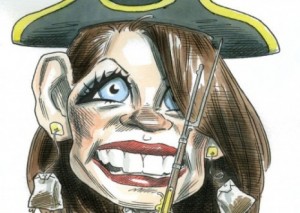
Pirates of the Rich and Crazy
Is it just me or does John Boehner seem like he’s in over his head?
I thought I’d dig up some references for you on exactly what a shutdown of the Federal Government means and what’s at issue here. ProPublica has a great FAQ up with some basic facts on what will be impacted, what won’t be effected, and what’s at stake. Here’s a short summary from them of the Status Fail.
The GOP and the Obama administration are currently locked in a standoff over a difference of $7 billion to $30 billion—a miniscule amount of the total $3.5 trillion budget. (OMB Watch, an open government group, has a thorough account [1] of the budget battles that led up to this point.)
The Washington Post’s Ezra Klein has a simple summary [2] of the GOP’s budget proposal, put forward by House Budget Committee Chairman Paul Ryan on Tuesday: It lowers corporate taxes and taxes on the wealthy, extends the Bush tax cuts permanently, calls for repeal of both the health care law and Dodd-Frank financial reform law, and freezes discretionary spending at 2008 levels.
The Obama administration has offered to cut $33 billion from current spending levels but hasn’t given many specifics about what those cuts would entail
The biggest issue that appears to be happening is that Boehner keeps changing the bar and is being forced to say no deal on certain cuts demanded by folks like their religionist base on items like Planned Parenthood Funding. Steven Benen asks if Boehner is actually willing shut down the government over the minuscule funding for Planned Parenthood. This is definitely not Barbara Bush’s Republicans around the beltway these days. Also included in the hostage negotiations is the Clean Air Act. Republicans want to stop the government from monitoring air pollution. Hell, this isn’t even Richard Nixon’s Republicans.
Republicans want to cut off Planned Parenthood and gut the Clean Air Act, but instead of pursuing legislation to achieve their goals, they’re insisting that this be part of the budget. Democrats can’t go along with this nonsense, and John Boehner is too weak a Speaker to tell his caucus to act like grown-ups, so the entire process is unraveling.
This has led to talk about the GOP shutting down the government over abortion, but even that’s not quite right — Planned Parenthood is already prohibited from using public funds to terminate pregnancies, and has been for many years. What we’re talking about here is Republicans shutting down the government over access to contraception and family planning services.
For all of those folks that thought the Republicans weren’t ready to go crazy over their crazy, extremist religious views, this should wake them out of their stupor. These folks are trying to shut down access to birth control by screaming abortion. This kind of mean and stupid should hurt. You can also check out WT for a long list of what kind of things will be shut down or go unpaid because the xtian Taliban hate Planned Parenthood. They must hate soliders because that’s one of the groups of people that won’t be able to get paychecks either.
IRS tax audits would be halted in their tracks, this weekend’s National Cherry Blossom Festival Parade in Washington canceled, and national parks and the Smithsonian shuttered if Congress can’t reach agreement on annual spending and the government shuts down at midnight Friday.
The military, federal law enforcement and other key officials would still be at work, earning pay – except their paychecks would be halted until the government funding stream is turned back on.
The Federal Government’s personnel bureau has posted information about which Federal employees will be furloughed. There’s an old study up on what happened the last time the Republicans shut down the government under Newt Gingrich that appears to be the blueprint for Federal Response. The ProPublica site contains a series of links to a lot of information on these topics in particular. They cite a NYT article for this information.
The New York Times has a handy list laying out how various government services might be affected [16]. Some things that would continue mostly unaffected are military operations, the Federal Reserve, the postal service, and Medicare and Social Security payments. An accompanying story also outlines some potential scenarios [17] in more detail:
The National Zoo would close, but the lions and tigers would get fed; Yellowstone and other national parks would shut down. The Internal Revenue Service could stop issuing refund checks. Customs and Border Patrol agents training officials in Afghanistan might have to come home. And thousands of government-issued BlackBerrys would go silent.… In any shutdown, the government does not completely cease functioning, of course. Activities that are essential to national security, like military operations, can continue. Air traffic control and other public safety functions are exempt from shutdowns. Federal prisons still operate; law enforcement and criminal investigations can continue.
The Hill has just quoted Harry Reid as saying he doesn’t think a shutdown will be averted. Again, the issues don’t seem to be the level of spending, it’s appeals to climate deniers and members of the xtian Taliban that seem to be at issue here.
Reid blamed a partisan dispute over Planned Parenthood and other hot-button ideological issues for the stalemate, while Republicans said they had offered reasonable spending cuts and Democrats were to blame for the impasse.
…
“The two main issues holding this matter up are the choice of women, reproductive rights, and clean air,” Reid said. “These matters have no place in a budget bill.”
Reid said the president and Democratic leaders would not give any more ground in the talks.
“We have given everything that we can give,” he said
Frankly, this has gotten worse than even I imaged it could be. Clearly, people that are voting Republican have brought such extremists to the House that it’s unlikely negotiations of any kind will be successful unless Boehner cracks a whip. At the moment, all he appears to be doing is dithering, drinking, and crying.
Somewhat Instant Karma
Posted: April 6, 2011 Filed under: just because 16 CommentsI’m not usually into tabloid style headings unless they provide some cautionary tale or lesson. I will admit to feeling smug about this one:
‘I’d kill myself first!’ John Edwards ‘suicidal’ over facing jail, claim pals
Disgraced politician John Edwards is said to be deeply depressed – to the point of being suicidal – over the prospect of a criminal trial that could end with him being jailed if found guilty.
The 57-year-old former Presidential candidate reportedly told a close friend: ‘I won’t go to jail. I’d kill myself first!’
He has lost 20lb in the last year and is a ‘broken spirit,’ reports the National Enquirer.
According to the Enquirer, a close source said: ‘I think John is suicidal. He knows that if he’s indicted, prosecutors will try to get him to serve jail time and make an example of him.
‘He’s absolutely despondent over the fear of prison.
‘Over the last year, he’s lost about 20lb and friends are concerned that he’s escaping reality with booze.
I still remember when he announced his candidacy for the Presidency near my house a few years back. The kids were so precious. Recently deceased Elizabeth Edwards was still fighting cancer. I was eager to share my cancer experience with her. I had not figured out exactly who I would support but after a few years of post-Katrina New Orleans, let me tell you, the Two Americas theme ran really true to me. I guess that’s what good speech writing and years of practice as a trial attorney can do. It can hone your speeches and up your sincerity factor.
The first few things that started really turning me off to the man was that hair do thing and Iowa. I watched Bill Richards, Barrack Obama, and John Edwards conspire to remove votes from the people in Michigan and Florida to up their chances of taking out that horrid upstart woman with the cankles. I started associating Edwards with words like smarmy, insincere, and egoist. So, isn’t interesting that all that narcissism and self indulgence wearing the mask of social justice has finally caught up to him? He’s just a whining boy now. Part of me wonders why– with all the sex scandals in the beltway–this one fresh hell for one man seems so sweet? It’s not like I wouldn’t like to see any of the serial adulterers in the Senate or Congress strung up for insincerity or lying. David Vitter is sadly my senator and wreaks of evil intent and selfishness. Maybe that’s it in the final analysis. I expect nothing but evil intent and selfishness from David Vitter and I expected more from John Edwards.
So, I’ll leave you to discuss this. I will probably head to the mat and meditate on the Path of Bodhisattva while trying to beat the thought “Man up!” out of my monkey mind. He reminds me of the bully next door who got caught drug muling one load of about five of marijuana runs at $250k a pop, then cried like baby every night on the phone to his pothead girlfriend when they finally threw him in jail. She used to throw the phone at me to listen because it so repulsed her. She married him anyway. Goes to show you what years of pot abuse can do to your judgment. What was that about not doing the crime if you can’t do the time?
Ah, never mind …. om!

Government Insurance and Annuities are not Entitlements
Posted: April 6, 2011 Filed under: just because 43 Comments I’m hoping that I can elucidate a theoretically complex idea for you as simply as possible. One of the hardest topics to study–if you’re doing anything with finance–is the area of decisions made under risk. It’s mathematically complex and the results depend on the types of assumptions you make about the decision maker. The assumptions dictate the shape of the ‘utility’ curve for the decision maker. That curve represents the choices that the decision maker will make at varying levels of risk and the costs of that risk as situations change. It sort’ve a ranking of how useful insuring against the risk will be under varying pricing schemes. You can assign people profiles that make them averse to risk, neutral to risk, or risk-loving. These profiles project their demand for insurance under various prices and policy offerings.
Insurance policies pay off under specific circumstances. The probability of those circumstances occurring and the amount of money they will provide on occurrence determines policy costs. Probabilities of occurrence for the varying circumstances must be estimated. Actuaries work with those probabilities using historical data and inference. It’s not a straightforward math problem. Some circumstances are more obvious and predictable than others. Time plays a role in the numbers. Behavior places a role in the numbers. Randomness plays a role. Of course, the final amount of payout plays a huge role. Many things are difficult to quantify. You can, however, bet that actuaries set rates and terms that benefit the house. It’s very much like the casino business except no one is very entertained by it.
Insurance companies are actually a lot like bookmakers and bookmakers who want the odds in their favor. I’ve always compared the insurance industry to Vegas and its surrounding thugs. The deal is this. If the odds are in their favor, private insurers are happy to offer up policies. If the odds are not in their favor, they either don’t offer the product or they try to do things to put the odds in their favor, or they charge a hell of a lot of money for the policy. A lot of getting people to pony up money for a policy has to do with getting them to overestimate the risk of something. A Fire policy is a great example of this. Insurers hate to insure things that have reasonably high probabilities of happening like old age and infirmity. They prefer the rare and random event like a house fire.
A really good example of something that no private insurer wants to touch is flood insurance. That’s why we have a National Flood Insurance Program. You never hear any one call that an entitlement. It’s not referred to as creeping socialism. It’s administered by one agency but sold by many insurance providers. It covers property and not life. If you live in a low to moderate risk area, your premiums are fairly reasonable. It’s not a for-profit product. It’s a huge risk pool set up so that an individual’s risk of suffering catastrophic loss due to devastating floods is minimized. It’s got deductibles and it has caps. You sign the contract. They tell you under which circumstances things will be paid and how much will be paid. You pay the premium. You’ve got the coverage and you’re supposed to sleep a little bit better at night knowing if that happens, you won’t be ruined for life. A private fire policy is similar. The reason private insurers provide fire policies is they are profitable. Devastating fires rarely happen. Floods are not so rare.
People aren’t always the best assessors of risk. We know from studying various human behaviors and decision making in game situations that many people will over or underestimate risks and this makes them liable to pay for a policy that’s got the odds of paying out of a slot machine. The industry thrives on this. It’s another example of our old enemy information asymmetry. Businesses–like the insurance industry–exist mostly because of these types of decisions and situations and the analysis they entail are beyond the grasp of most people. I’ll give a you a textbook definition of insurance from one of my doctoral seminars on Risk Theory. (Economic and Financial Decisions under Risk by Eeckhoudt, Gollier, Schlesinger.)
Insurance occurs when one party agrees to pay an indemnity to another party in case of the occurrence of a prespecified random event generating a loss for the initial risk-bearer.
Notice the use of the word random. Insurance is cheaper when the event is random and unlikely. So, fire and flood protection–hazard protection–tends to be something where actuaries must obsess on probabilities. As I said, the probability that you will experience a devastating house fire is extremely low and your insurance premium is based on that. Fire policies are quite profitable for insurance companies. Getting a hurricane policy in Nebraska is a breeze too. Not so for me in Louisiana. My house was barely touched during Hurricane Katrina and yet now, my deductible has been set at what they paid me last time for wind damage and the cost of my policy is now quite high. Even if they pay me my policy next time around, it will ruin me. I went from from a $1000 deductible to a $10,000 deductible within a year. If I’m wiped out by a hurricane, I will be wiped out even with insurance. That’s because the industry considers it just a matter of years before they will have to pay me again. I’m lucky (hah!!) to even have that bit of nonsense because it is required by my mortgage holder. Major Hurricanes in the Gulf are not considered very random any more. Also not very random is getting sick and getting old. It’s also very expensive these days to be sick and to be old and private insurance providers have not done a very good job of controlling the costs and risks of either. This is why they’ve relied on increased premiums and decreased underwriting. If the odds move against the house, the house changes the rules of the game.
Many insurance programs in the past were offered by mutual companies that operated on simply returning cost savings to policy holders and maintaining good records of cost control. Their profits were fairly meager by today’s standards because they weren’t expected to generate bonuses or extraordinary returns to a group of demanding stockholders. Blue Cross and Blue Shield was a pretty good example of what used to be the model of reasonably-priced insurance that brought the benefits of group coverage to consumers. They’ve now joined the let’s have stockholders bandwagon. They had a large risk pool which means the risks were spread over people likely and unlikely to have bad outcomes. This reduces the probability of payout and increase premium revenues to cover payout. BCBS has large enough numbers that they can negotiate price breaks with health care providers. This reduces the level of payout when triggered by the event.
Again, mutual companies act for the benefits of their policy holders. Companies owned by stockholders act for the benefit of stockholders. Government programs generally come about when private insurance won’t offer a reasonably priced product to every one. I still pay a premium for my flood insurance. I pay premiums for old age health insurance. I pay premiums for insurance against loss of income upon retirement. I have paid these since I had my first job at 15 so for me, that’s over 40 years of premiums paid into Medicare and Social Security. Ronald Reagan increased my premiums tremendously but promised that my policy would still be in effect when I retired.
Since my father first contributed to medicare and to Social Security in the 1930s, we’ve had this Social Contract. We’ve had this contract with the government that they would put us all into a risk pool and provide us an old age pension if we paid them. They would not seek to profit from our infirmities, our death, or our misfortune like private insurers do. We would pay them now and they would give us money later. They provided us with old age annuities and with old age health insurance because the private sector won’t do it at a reasonable cost. The federal government has messed with the programs a lot and changed the benefits, but the guarantees stood the test of time and promise, until now.
The Social Security system is not an “entitlement” program in the way of WIC or Food stamps or subsidies to farms and the oil industry. It’s not based on giving something away for nothing provided unless you were some of the very first recipients. It takes more than just being a demographic to get at the benefits. That’s why I hate this blurring of the word “entitlement”. Social Security is a program established to provide something that the private market either will not provide or will only provide at exorbitant costs. Annuities are costly. In the case of Medicare, costs go down when every one is in and paying. That’s how that public program should work. It’s not socialized anything because there are no real ‘assets’ to socialize. There’s no mine, there’s no factory, and there’s no inventory. It’s a contract. People like Paul Ryan are mislabeling the contract, breaking the contract, and lying about that contract. If anything drives the reliability of US debt repayment down it will be all this talk by people like Ryan of welshing on long term contracts.
I read the CBO Report on Ryan’s proposal today to turn the country over to the ice floes. Where is all the discussion on Death Panels now? I’ve also been reading the responses by people –like me–that really know about these things. First, let me quote something from the CBO.
Under the proposal, most elderly people would pay more for their health care than they would pay under the current Medicare system. For a typical 65-year-old with average health spending enrolled in a plan with benefits similar to those currently provided by Medicare, CBO estimated the beneficiary’s spending on premiums and out-of-pocket expenditures as a share of a benchmark: what total health care spending would be if a private insurer covered the beneficiary. By 2030, the beneficiary’s spending would be 68 percent of that benchmark under the proposal, 25 percent under the extended-baseline scenario, and 30 percent under the alternative fiscal scenario.
Federal payments for Medicaid under the proposal would be substantially smaller than currently projected amounts. States would have additional flexibility to design and manage their Medicaid programs, and they might achieve greater efficiencies in the delivery of care than under current law. Even with additional flexibility, however, the large projected reduction in payments would probably require states to decrease payments to Medicaid providers, reduce eligibility for Medicaid, provide less extensive coverage to beneficiaries, or pay more themselves than would be the case under current law.
A bookie would blush at those terms.
Paul Ryan is proposing to throw future seniors to the very people that have made health care unaffordable and unattainable for years. This is a plan designed to fail. It’s worse than just a simple privatization scheme. Insurance companies–as an example any Medicare Advantage program–have not been able to control health care costs. They just adjust their policies prices, coverage, and underwriting as the market unfolds. All this plan does is push incredible problems off of a huge entity that can broker price breaks on to the individual seniors or future seniors. Even the ones with Alzheimer’s Disease. It is immoral. It also violates any precept of actual insurance provision. I can only think that this is because they’ve got public insurance provision deadly wrong. It’s not socialism. It’s not an entitlement. It provides coverage for an event given payment of premiums. It’s just provided by the government which makes it more cost and risk efficient than the private sector. That’s the major part of the big lie. That’s also why they worked their hardest during the Bush years to set up Medicare for near term failure. They want this to fail. It plays into their rhetoric of failure.
The insidious Ryan plan is also a lie because it is based on estimates of the economy’s ability to generate historically elevated incomes and cost savings. The private insurance market has shown the unique inability to get control of the high costs of health care provision. If you compare them to the VA, they fall miserably short. Paul Krugman refers to these as unicorn sightings. Ryan’s future economic performance probabilities would make an actuary’s toes curl. His document is obviously based on wishful numbers for an ideological rampage on America. Please notice that all of his alleged cost savings go to tax cuts too and we all know who that benefits. Evidently, Ryan believes the more he jerks off to Ayn Rand, the more the economy will just naturally improve. It’s the only rational explanation for such disingenuous predictions.
… Ryan is claiming that unemployment will plunge right away; that by 2015 it will be down to the levels at the peak of the 1990s boom (and far below anything achieved under the sainted Ronald Reagan); and that by 2021 it will be below 3 percent, a level we haven’t seen in more than half a century. Right.
Then there’s the Medicare business. According to the CBO analysis, a typical senior would end up spending more than twice as much of his or her own income on health care as under current law. As Dean Baker points out, this means that seniors would end up paying most of their income for health care.
Ryan’s plan amounts to a level of lying for which no proper metaphor can be found. Ryan is hoping his plan will be bought because it leaves folks like me alone while really screwing young people who don’t care about that sort’ve thing anyway right now. I don’t know any twentysomething that wouldn’t trade an insurance program premium right now for the money to buy some new gadget. They all see old age and bad health as an abstract. That’s why Ryan is trying to play the generational rage card.
Medicaid has not been priced right given today’s health care realities. The premiums are not high enough. There probably should be more co-pays. There are a lot of issues with the program. Many of the problems have come about because industries have managed to out-negotiate the federal government. There’s an incredible transfer of wealth to the Drug Industry alone. Medicare has been overpaying for Part B drugs, as an example. Medicare, Part D, put into law by the Bush administration was an abomination of a program. All you have to do is compare what the VA pays for drugs to Medicare. It’s a trillion dollar subsidy to drug companies. That’s not the purpose of a health insurance policy at all. If anything, Medicare Part D is an entitlement program for Big Pharma.
So, what can we do? First, we need to get the discussion back to the idea that these are supposed to be publicly sponsored insurance programs not health or financial industry subsidies. They aren’t set up to enrich stockholders of nursing care homes, cardiac machinery companies, or drug companies. There are substantial cost savings when huge entities risk pool (decreases probability of payouts due to high occurrence of the adverse event) and when they bargain for services (decreased payout when payouts occur). We don’t need to talk about dismantling Medicaid or Medicare. We need to talk about how to make them cost effective and efficient. We have plenty of evidence that the private insurance sector either can’t or won’t do that. There’s also plenty of evidence that public insurance plans do that much better and at lower costs with uniformity of paperwork and payouts.
Second, this conversation needs to be taken out of the context of the federal budget. The only people that put the problems in these contexts are people that prefer anarchy to government; people like Paul Ryan. These are standalone programs that should standalone. Also, people should detach Social Security from Medicare. Medicare’s the problematic one. Social Security isn’t endangered. Both need to be put back on financially stable paths by adopting sensible changes that any reasonable, mutual company providing policies would provide. They’re not supposed to enrich health care providers or bankrupt them. Reasonable rates of return are fine. Price-gouging should be unacceptable. Also, part of the problem is that the Health Insurance Industry itself has a fairly lousy record of costs controls. It’s not all frivolous lawsuits either. Doctors make incredible amounts of money sending patients to have multiple tests in facilities where they have financial stakes. This ought to be questioned.
Still, the problem isn’t so much health care delivery as that we have third party payers in the market and none of them have been getting the correct outcomes. The issue is complex which is why so many people fall prey to the rhetoric of liars like Paul Ryan. Privatizing all of this is not going to make the social costs associated with old age go away. We’ve had a American Social Contract for some time. Even the Tea Party didn’t carry signs that said “Steal my Medicare, Please!” Huge numbers of people have planned their lives based on the provision of public old age annuities and old age health insurance by the federal government. Breaking faith with the public on such a basic level using spurious rationale and hyped-up projections is just immoral. I still can’t believe that not one Democrat will engage this nonsense head on. That Democrats are entertaining devastating people’s lives under the banner that austerity is in with some segment of voters is just shameful.
(Sorry this is so long. Somethings just take awhile to expound.)
Fighting Back … Ballroom Days are Over
Posted: April 5, 2011 Filed under: Civil Liberties, Civil Rights, collective bargaining, Corporate Crime, Democratic Politics, Domestic Policy, Economic Develpment, Economy, education | Tags: civil disobedience, democratic solutions, demonstrations, protesting 31 Comments
May take a week, and it may take longer.
They got the guns, but we got the numbers.
Gonna win yeah, we’re taking over.
Come on!
Yeah!
Your ballroom days are over, baby.
Night is drawing near.
Shadows of the evening
Crawl across the years.
Jim Morrison, from “Five to One”
I’ve spent the last six months watching this country’s policy makers throw all common sense and empirical evidence on the US economy to the wind. My jaw just drops when I consider what the Republicans have proposed under the flag of austerity and how the Democrats entertain them.
BostonBoomer and I spend a lot of time on the phone with each other. We’ve been each other’s support system having much in common as older, divorced women gone back to school and social justice activists feeling exiled in some kind of shared virtual gulag. We remember the protests and actions that we took at a younger age to demonstrate against war and the treatment of minorities and women. BB was active in antiwar protests. I was an avid women’s rights activist in the 70s and 80s, having found out that just getting good grades and hard work weren’t going to be enough for me to break into white male dominated bastions. It’s maddening when you think of all the time you spend on your education and doing the right thing and find out that what really gets you ahead is your ability to fit certain biological characteristics and social status. All those things I tried to change back then are being undone. All over the country, privileged, wealthy people and corporations are using political donations and power to seek advantage like never before. This is not healthy for our country or our future. We need to end their Ballroom Days.
It’s heartened both of us to see union workers in the US and many citizens in the MENA region stand up to authority and demand their right to participate in policy decisions that impact their lives. All over the world, the immense transfer of wealth and national assets to a small elite–the uberwealthy few representing mostly inheritance dynasties–has occurred with the help of political lap dogs seeking donations and parochial interests. It seems we may have reached a tipping point. Some yearning-to-be-free democracy contagion has created a new call for activism to protect the interests of the many against the pillaging of the few. It’s brought people to the streets all over the world and created scapegoats for rapacious states. From whistle blowing of war crimes by Bradley Manning to shouting for no more political or economic prisoners in Northern African nations, we see ordinary, educated, middle class people taking to the streets and shouting enough! We’ve fed the cheats long enough!
It’s about time.
Allison Kilkenny at The Nation has a new article up called “The Resistance Has Begun” that lists recent political demonstrations and unrest. Her article was inspired by a post by Chris Hedges–This is What Resistance Looks Like–on the increasing number of political protests occurring around the country. Hedges writes on the importance of the protests. Are we looking at renewed activism from the people who’ve been hurt by the power class-enabling policies of the last 30 years?
Chris Hedges has this to say.
The phrase consent of the governed has been turned into a cruel joke. There is no way to vote against the interests of Goldman Sachs. Civil disobedience is the only tool we have left.
We will not halt the laying off of teachers and other public employees, the slashing of unemployment benefits, the closing of public libraries, the reduction of student loans, the foreclosures, the gutting of public education and early childhood programs or the dismantling of basic social services such as heating assistance for the elderly until we start to carry out sustained acts of civil disobedience against the financial institutions responsible for our debacle. The banks and Wall Street, which have erected the corporate state to serve their interests at our expense, caused the financial crisis. The bankers and their lobbyists crafted tax havens that account for up to $1 trillion in tax revenue lost every decade. They rewrote tax laws so the nation’s most profitable corporations, including Bank of America, could avoid paying any federal taxes. They engaged in massive fraud and deception that wiped out an estimated $40 trillion in global wealth. The banks are the ones that should be made to pay for the financial collapse. Not us. And for this reason at 11 a.m. April 15 I will join protesters in Union Square in New York City in front of the Bank of America.
“The political process no longer works,” Kevin Zeese, the director of Prosperity Agenda and one of the organizers of the April 15 event, told me. “The economy is controlled by a handful of economic elites. The necessities of most Americans are no longer being met. The only way to change this is to shift the power to a culture of resistance. This will be the first in a series of events we will organize to help give people control of their economic and political life.”
I’ve written recently about the Social Contract of 20th century America and how that contract has been broken by politicians seeking to empower the monopolies and oligopolies that fill their political accounts with booty. Things have gotten so blatantly amoral that the very same folks that destroyed the Gulf ecosystem and took 11 lives and many livelihoods through careless management decisions rewarded themselves with bonuses and ‘best safety’ records with no concept that people might find that appalling. This was a repeat performance of the situation where executives of investment and commercial banks took huge bonuses right on the back of their bad management decisions that brought near US economic collapse and massive bail outs with federal funds. Also, BP is right back applying for drilling rights having really not made things right on either the human or the environment accounts for their last cost-cutting, profit gouging adventure in ignoring safety for the sake of quick profits.
When the social costs of doing business exceed the benefits of doing that business for every one but a few, the society needs to take a hard look at why it tolerates such behavior. Forcing other people to bear the costs of your business or your consumption is wrong and that’s exactly what most business subsidies and lax regulations do. When businesses can push their costs off on society or consumers of certain goods can push their costs off on society, that market becomes distorted and dysfunctional. The market price does not reflect true costs. It will overproduce harmful goods and drain resources that would be better placed elsewhere. The only way to push these costs back to the producers and consumers of costly activities and end the dysfunction is through legal prosecution or tough regulation. The idea that’s been propagated that regulation serves no purpose in a market system is part and parcel of the problem.
Opaque, vague markets do no one any good. They serve as breeders of Ponzi schemes like that of Bernie Madoff. Markets that don’t force the true cost of doing business back on the producer are no good either. They take precious scarce resources and allocate them to activities that are not worthwhile because prices and costs are understated. There are mounds and mounds of microeconomic studies that show how insidious markets can be when they are distorted by things like information asymmetries or supply-enabling protection. All of these activities set up winners and losers. In most cases, ordinary people are the losers. It takes money and power to access the special treatment offered by politicians and their laws. You only get those huge passes and benefits if your get to call yourself a corporation in this country. You can collect a lot of money for being inefficient for some reason. Businesses in this country are considered to be ‘individuals’ for freedom of speech issues but they go unprosecuted for murder every day. Just talk to grieving families of those 11 workers who died on the Deep Water Horizon in the name of increased production and lower costs. Only a sociopath could murder 11 people with safety shortcuts then provide incentives for good safety records to the instigators of the bad decisions. The only offset that we have to the kind of power and access achieved by lobbyists and corporate interests is civil disobedience and protests. Protest we must!
Kilkenny’s article lists a number of protests that are brewing around the country. These include examples in New York State, New Hampshire, Wisconsin, Ohio, Indiana and other average cities with average US citizens. Is this a Middle Class Awakening going viral? Here’s some more from Chris Hedges on how concentration of power and money in monopoly banks has warped our policy agendas and priorities. Our incomes from hard work are being skimmed by paper shuffling fees paid as bonuses to agents with no productive purpose but market distortion.
The 10 major banks, which control 60 percent of the economy, determine how our legislative bills are written, how our courts rule, how we frame our public debates on the airwaves, who is elected to office and how we are governed. The phrase consent of the governed has been turned by our two major political parties into a cruel joke. There is no way to vote against the interests of Goldman Sachs. And the faster these banks and huge corporations are broken up and regulated, the sooner we will become free.
Bank of America is one of the worst. It did not pay any federal taxes last year or the year before. It is currently one of the most aggressive banks in seizing homes, at times using private security teams that carry out brutal home invasions to toss families into the street. The bank refuses to lend small business people and consumers the billions in government money it was handed. It has returned with a vengeance to the flagrant criminal activity and speculation that created the meltdown, behavior made possible because the government refuses to institute effective sanctions or control from regulators, legislators or the courts. Bank of America, like most of the banks that peddled garbage to small shareholders, routinely hid its massive losses through a creative accounting device it called “repurchase agreements.” It used these “repos” during the financial collapse to temporarily erase losses from the books by transferring toxic debt to dummy firms before public filings had to be made. It is called fraud. And Bank of America is very good at it.
There is nothing free market about government-installed and enabled monopolies. We achieve nothing as a society by buying into the delusion that all government does is destroy the business environment when all evidence points to their enabling of the worst business practices. There is nothing remotely efficient about markets that can use public resources on the cheap to underprice goods and services, hence making them more marketable than they should be. There is no efficiency in letting producers of products and services pass the costs of their bad management decisions on to middle class and working people. You cannot blame government workers for the current economic failings. You can however, blame Bank of America, Republican Governors who hand out tax cuts indiscriminately, and federal subsidies of inefficient businesses. Huge corporations and rich people gobble up tons of public resources via subsidies, tax breaks, and use of infrastructure. Many governors have literally given away their states treasury and resources courting businesses that cost them more than they bring to that state in jobs or revenues. The big lie is that corporations are overtaxed and receive no benefits from state, local or federal government. We can’t afford to enable that big lie. We must protest it.
Ordinary Americans cannot band together to hire lobbyists to help repair our broken Social Contract. The only thing we have are our feet, our voices, and our votes. Paul Ryan’s budget Anthem is just the latest in a line of assaults on reason and common sense. It is the very definition of pennywise and pound foolish and it’s insulting. It hypes unnecessary tax cuts and increases in pentagon spending while removing funding for public health, public education, and public information programs. It continues the effort to redistribute the incomes and the resources of the country to the very few at the cost of the very many. The only way to stop this is to protest. Protest frequently. Protest openly. Protest now. Public Policy should not be based on badly written dystopian fiction novels.
It is not illegal immigrants that have broken the American Dream. It’s not bands of stereotyped Muslim Bedouins hiding out in caves a world apart from Main Street that’s threatening the livelihoods of American workers. It’s not poor Cuba’s last vestiges of Marxism or crazy-like-a-fox Hugo Chavez. It’s time to stop falling for their straw men enemies. What has taken the American Dream away from so many is the greed and power lust of a few people that have completely usurped the nation’s policy makers. It’s time to remind them that they may have the guns, but we have the numbers.
Throwing People to the Wind and the Dogs of Profit
Posted: April 4, 2011 Filed under: 2012 presidential campaign, Economy, Voter Ignorance, We are so F'd | Tags: budget, Federal Budget, Paul Ryan 24 Comments
Dennis "Paul Ryan" Moore: Stealing from the Poor and Giving to the Rich
Paul Krugman has a disturbing blog post up. Republicans have been moving to throw the public interest to their corporate masters for some time while collecting their own federal subsidies and benefits. Their privatization fetish is doing in all kinds of things. They’ve been turning prisons, schools, and a bevy of national resources to businesses who are only in it for the short-run boost to their bottom line. These decisions are being made on a purely ideological basis. They have nothing to do with the safety and solvency of the assets involved or the fact that things like national forests belong to the country and the country should have some say in what happens there. Krugman links to articles discussing the privatization of Medicare and then links to an op-ed that argues that the real test of Obama’s meddle will be how well he stands up to these privatization schemes.
The funny thing is that the entire arguments made for this kind of thing are how much more efficient the private sector supposedly is at service delivery and cost containment. This is a charade. We’ve seen everything from the botched student loan program that thankfully, just got pulled back into the Department of Education. This can be observed is in Medicare Advantage where we’ve had private companies enrich themselves more than provide benefit. We keep subsidizing inefficient private corporations with no demands they cut cost and deliver things as asked efficiently. Medicare Advantage was set up to enrich Republican constituencies.
Privatizing and voucherizing Medicare does nothing whatsoever to control costs. We’ve seen that from the sorry history of Medicare Advantage. I’m sure that the Republicans will claim savings — but those savings will come entirely from limiting the vouchers to below the rate of rise in health care costs; in effect, they will come from denying medical care to those who can’t afford to top up their premiums.
Ryan is calling for draconian changes that have no basis in anything other than ideology. His obsession with starving the beast in the name of fiscal discipline is insanity. The man should be declared a public menace and put on an island some where. If Ryan’s way were the correct one, we’d have never had most of the major assets and infrastructure that made 20th century America a powerhouse. That would include things like the interstate system, Hoover Dam, rural electrification, and World War 2. All of these projects were huge, have paid off tremendous benefits in the long run, and were done on borrowed money. I guess World War 2 would’ve not be worth fighting–had Ryan been around–or farmed out to mercenaries because little Paul’s had such a bad life over the last 4 decades due to the debt burden which we still carry in many ways. This is insanity. People actually believe him too. This is exactly how dumbed down and selfish many of our citizens have become. The propaganda campaign on efficient private businesses has been so effective that many don’t seem to notice that their lives have been made much worse off by the excesses put into law over the last ten or so years. I have yet to meet any one–other than a fat cat–employed by a private business that doesn’t have nightmare stories about stupid and bad management practices. They’re more plentiful in the private than public sector. I’ve seen and heard many of them in my years working and consulting with both sectors.
Notice that Ryan is avoiding the wrath of the senior citizen vote with the trick of letting every one 55 and over go into the current program. He’s only throwing certain people to the Dogs of Profit. Ryan’s hypocrisy knows no bounds. As long as your part of the Republican base, you get to keep your government largess. He’s out to delivery windfall profits to insurance companies, not efficient health care delivery to people.
Recognizing the political risk of significant changes in Medicare and Medicaid, the health care program for poor Americans, Mr. Ryan emphasized that such spending would continue to rise under the Republican budget plan, just not as sharply as it would have otherwise.
He also sought to clarify that any Medicare changes, which would include requiring more affluent Americans to pay a larger share of their Medicare costs, would not amount to a voucher program — an approach that has been heavily criticized by Democrats.
Mr. Ryan said his plan was more like the Medicare prescription drug program and would allow patients to pick from a menu of insurance plans. The federal government would direct the subsidy to the plan, not to the consumer.
“It doesn’t go to the person, into the marketplace,” Mr. Ryan said. “It goes to the plan. More for the poor, more for people who get sick, and we don’t give as much money to people who are wealthy.”
Americans who are now 55 or older would go into the current program to prevent a sudden change in their health insurance coverage, he said.
There are some Democratic politicians still fighting against these unnecessary and draconian budget and program cuts. It doesn’t look like a robust fight, however and the President has been slow to engage. Senator Chuck Schumer did the Sunday news talk show circuit yesterday arguing the idiocy of throwing people off programs that work and keep them out of much more expensive trouble. Not only do these things work to keep people out of desperate situations, they create jobs. Many small population states actually rely heavily on state and federal jobs for revenues and services. I’d hate to live someplace like Wyoming if Republicans have their way. The Republicans want to cut the people programs and the programs that invest and sustain our resources. It’s all about delivering short term profits to whatever business pops up over night to abuse the program. Republicans still balk at cutting war programs, corporate welfare programs, and the types of subsidies and tax loopholes that line their own pockets.
Mr. Schumer said Democrats were urging Republicans to consider reducing some of the automatic annual spending in Agriculture, Treasury and Justice Department programs to reach a target of about $33 billion in cuts rather than insisting that it all come out of what is known in budget parlance as discretionary accounts.
A Democrat involved in the negotiations, who spoke on the condition of anonymity, said alternative spending cuts from the White House and Senate Democrats would range up to $8 billion. But to the Democrats’ dismay, not only were Republicans resisting those cuts, they were also proposing more spending than the Pentagon wants for military and homeland security programs.
“If you just cut from domestic discretionary, you’ll have to cut things like helping students go to college; you’ll have to cut scientific research, including cancer research,” Mr. Schumer said on the ABC News program “This Week.” “These things have created millions of jobs through the years.”
It’s completely disingenuous but they don’t care. They’re willing to ax the meager federal spending on Planned Parenthood which covers basic reproductive health for poor people to give farm subsidies to Tea Party Buddy Michelle Bachmann. Why keep pouring money into inefficient private sector ventures other than they turn around and donate to your campaigns? This leads me to the other link provided by Krugman to an op ed E. J. Dionne JR at WAPO.
This week, Rep. Paul Ryan (R-Wis.) will announce the House Republicans’ budget plan, which is expected to include cuts in many programs for the neediest Americans.
The Ryan budget’s central purpose will not be deficit reduction but the gradual dismantling of key parts of government. Remember that Ryan wants both to preserve the Bush tax cuts and, over the long run, to enact more breaks for the wealthy, including the elimination of the capital gains tax.
Ryan’s plan reportedly will include steep Medicaid cuts, disguised as a proposal to turn the program into a “block grant” to the states. The net effect would be to leave even more Americans to the mercies of the private insurance market.
In deference to the GOP’s success in turning last year’s health-care law into “Obamacare,” let’s call this proposal Ryancare — and let’s make sure we look carefully at its impact on the elderly and the disabled, the main beneficiaries of Medicaid.
Put the two parts of the Ryan design together — tax cuts for the rich, program cuts for the poor — and its radically redistributionist purposes become clear. Timid Democrats would never dare embark on class warfare on this scale the other way around.
Paul Ryan is the anti-Robin Hood. He steals from working Americans and subsidizes the already rich. Who is going to stand up to this complete disconnect between Ryan’s dogma and the reality that was the healthy US economy prior to all this enabling of inefficient oligopolies and monopolies at the cost of the Treasury? Both Krugman and Dionne are correct in this assessment. The President kicked off his re-election bid today. Whose side will he be on? Will he mouth his campaign themes from 2008 while doing the Republicans’ worst for them? From Krugman:
This will be Obama’s defining moment. Will he stand up for the principle that society takes care of those in need? Or will he cave in? I wish I had confidence in the answer.
I’d say the odds on favorite is that we’re going to continue to give away every one’s American Dream to the bonus class. The Republicans may be removed from reality, lying, and bat shit crazy, but what do you say about Democratic officials that enable them?

 peej
peej Carissa
 bostonboomer
 dakinikat
 ecocatwoman
 jjlo
jjlo mablue2
 Mama Lopez
 peggysue22
 quixote
 skydancingguestblogger
 Mona (aka Wonk the Vote)





Recent Comments