
Sunday Open Thread: David Frost Dead at 74
Posted: September 1, 2013 Filed under: open thread, U.S. Politics | Tags: David Frost, Margaret Thatcher, Obituaries, Richard Nixon, That Was The Week That Was 8 Comments
Good Morning!!
Mona isn’t feeling well, but will try to get her scheduled post up later on today. Meanwhile here’s an open thread for early risers.
Famed British broadcaster Sir David Frost has died of a presumed heart attack while giving a speech on a cruise ship. He was 74. The Guardian reports:
Sir David Frost, the journalist and broadcaster whose lengthy career covered everything from cutting-edge 60s satire to heavyweight interviews and celebrity gameshows, has died of a heart attack on a cruise ship, his family said.
The 74-year-old, whose programmes included That Was The Week That Was and The Frost Report, was to have given a speech on board the Queen Elizabeth, which had set sail from Southampton on a cruise to Lisbon.
Frost, who was knighted in 1993, helped establish London Weekend Television and TV-am. He was famed for his political interviews, most notably with Richard Nixon in 1977, in which the US president conceded some fault over Watergate for the first time.
From BBC News:
Born in Kent, Sir David studied at Cambridge University where he became secretary of the Footlights club, and met future comedy greats such as Peter Cook, Graham Chapman and John Bird.
After university he went to work at ITV before he was asked to front the BBC programme That Was The Week That Was, which ran between 1962 and 1963.
Casting a satirical eye over the week’s news, the show boasted scriptwriters including John Cleese, John Betjeman and Dennis Potter.
The Frost Report brought together John Cleese, Ronnie Barker and Ronnie Corbett in a sketch show which would influence many comedy writers including the Monty Python crew.
Much more at the link.
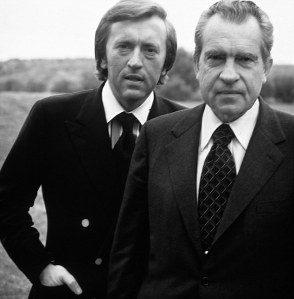
Former President Richard Nixon with TV interviewer David Frost in Mid-March in 1977 before they began taping their interviews later that month. (AP Photo)
Of course Frost was best known for his interviews with Richard Nixon after Watergate forced Nixon to resign the presidency.
He…conducted a series of interviews with Mr Nixon, who had resigned the presidency two years earlier, in which the former president came close to apologising to the public for his role in the Watergate scandal.
Their exchanges were eventually made into a film – based on a play – which saw Michael Sheen portray Sir David Frost to Frank Langella’s Nixon. Sir David himself appeared at the premiere of the film in 2008.
David was regularly scoffed at by fellow broadcasters for his allegedly non-aggressive style of questioning.
But he invariably had the last laugh because he almost always extracted more intriguing information and revealing reactions from his subjects than other far more acerbic broadcasters who boasted about their hard-hitting treatment of their “victims”….
His interview with the doomed American President “Tricky Dicky” Richard Nixon was a TV classic. During it, Nixon dramatically admitted that he had “let down the country”.
But there were many other historic moments, including one when he suddenly introduced the word “bonkers” during a tense interview with the then prime minister Margaret Thatcher over the sinking of the Argentine warship the Belgrano during the Falklands conflict. She was furious.
A few clips from Frost’s long and illustrious career in broadcasting.
From That Was The Week That Was (TW3), 1963
Saturday Morning Lite
Posted: August 31, 2013 Filed under: Barack Obama, Foreign Affairs, morning reads, Republican politics, U.S. Economy, U.S. Politics | Tags: Ben Affleck, chemical weapons, emoprogs, fast food workers' strike, immigration reform, Income Inequality, Labor Day, low-wage jobs, March On Washington anniversary, Martin Luther King, NFL concussion lawsuit, Syria intervention, Voter ID laws, voter suppression 53 Comments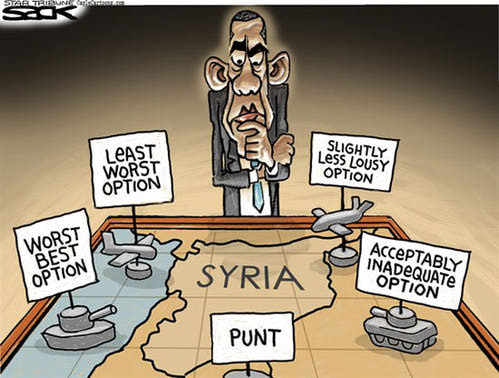
Syria War Room, by Steve Sack
Good Morning!!
I don’t know about you, but I really missed JJ’s Friday Night Lite post last night, so I thought I’d start out Sky Dancing’s Saturday with some political cartoons. I hope you enjoy these — courtesy of Cagle Post.
A few more on Syria:
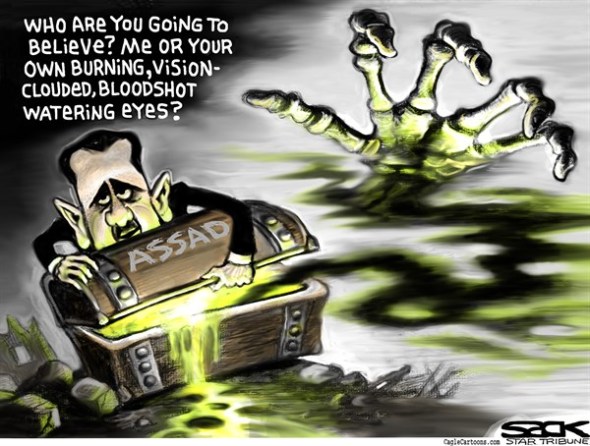
Assad Chemicals by Steve Sack
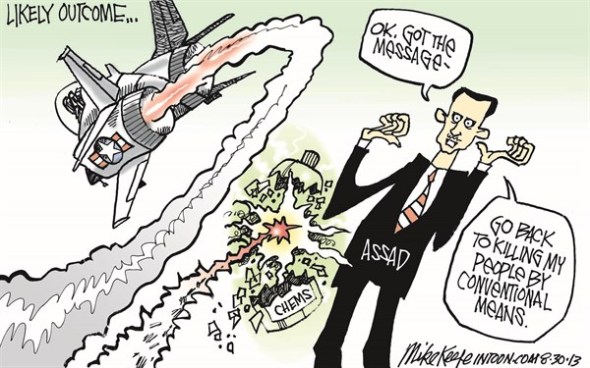
Assad Chemical Weapons, by Mike Keefe
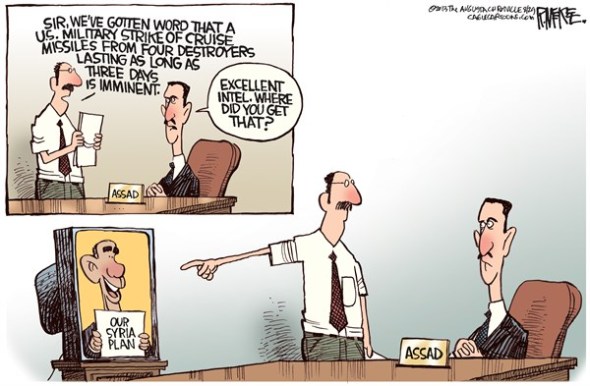
Syria Plan by Rick McKee

The Anti-War Left by Eric Allie
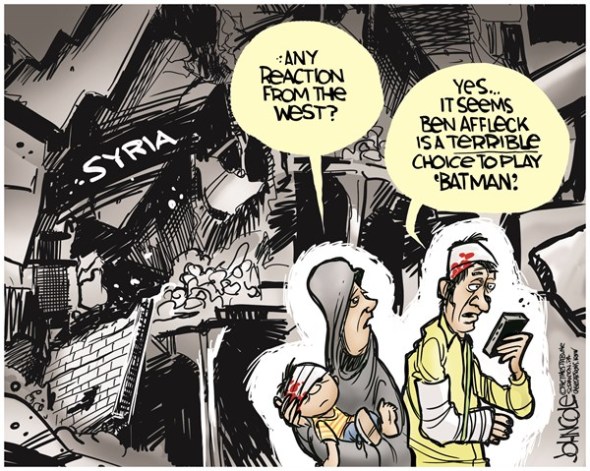
Syria and Affleck by John Cole
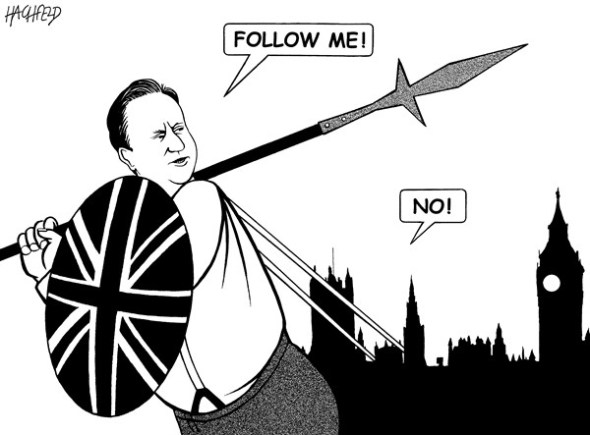
Cameron’s Failure, by Rainer Hatchfeld
March on Washington 50th Anniversary:
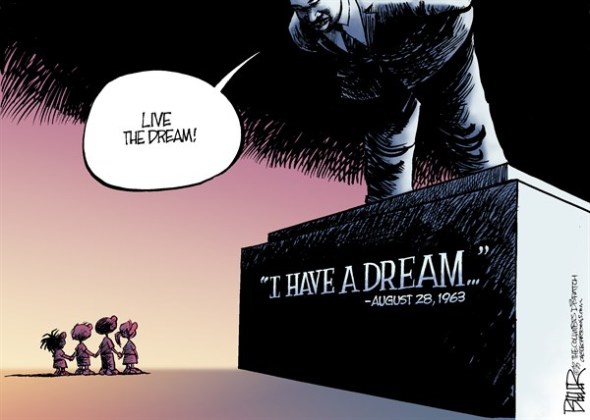
I Have A Dream Anniversary, by Nate Beeler
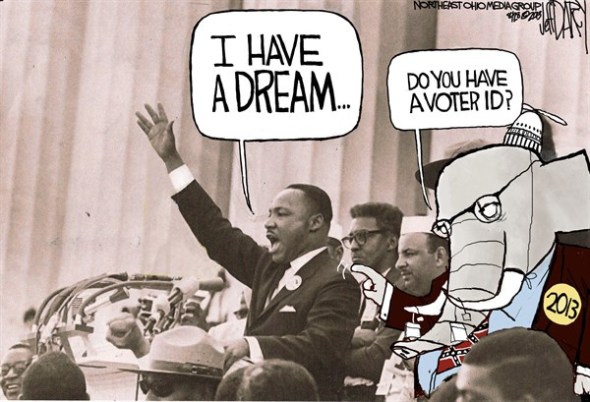
MLK Nightmare by Jeff Darcy
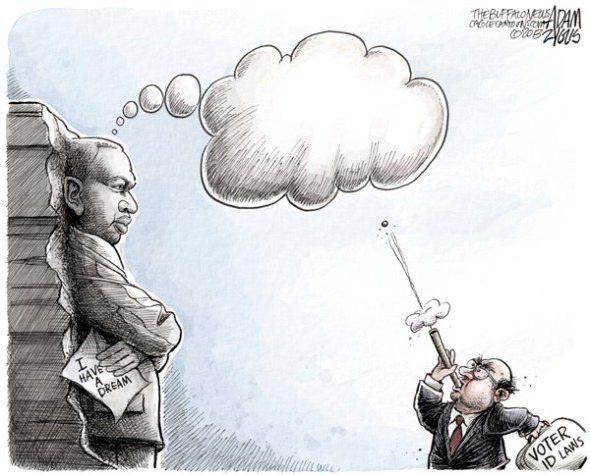
Dreamer, by Adam Zyglis
Labor Day and Income Inequality
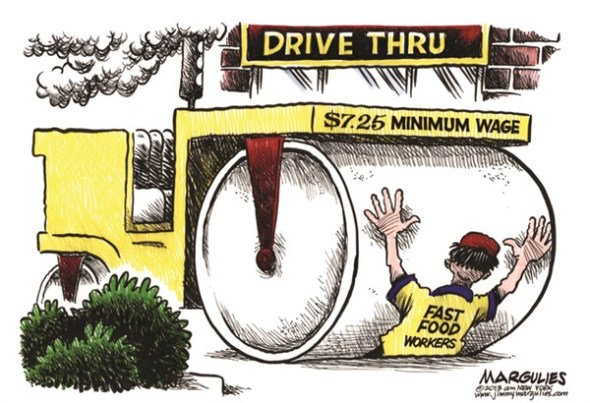
Fast Food Minimum Wage, by Jimmy Margulies
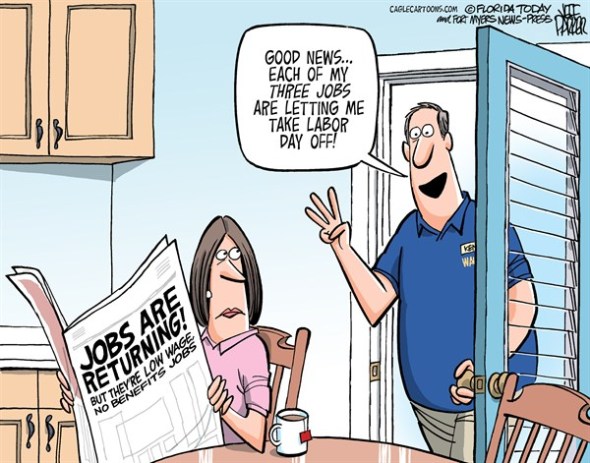
Labor Day Jobs, by Jeff Parker
NFL Concussion Lawsuit
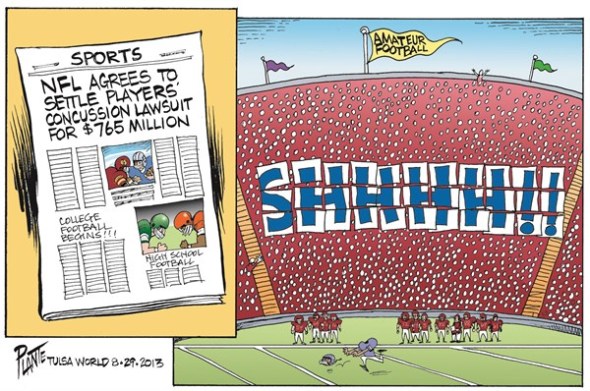
NFL Concussion Lawsuit, by Bruce Plante
Immigration Reform
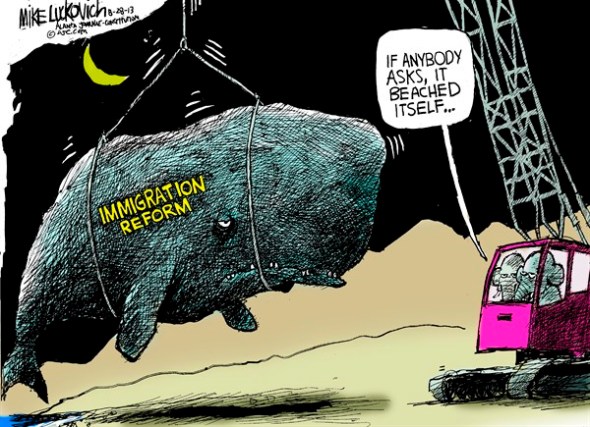
Immigration Reform, by Mike Lukovich
I hope everyone has a wonderful Labor Day weekend!! And if you’re not out on the beach or doing something else more exciting, please post links to the stories you’re following today in the comment thread.
Thursday Reads: Civil Rights Struggle, Syria Intervention, NYPD Spying, Boston Bombing, and “League of Denial”
Posted: August 29, 2013 Filed under: Foreign Affairs, morning reads, Republican politics, U.S. Politics | Tags: Boston Bombings, chemical weapons, Civil Rights Movement, concussions, Dzhokhar Tsarnaev, Eric Cantor, ESPN, John Boehner, John F. Kennedy, John Odom, Julian Bond, Martin Luther King, NFL, NYPD, PBS Frontline, police photography, Prime Minister David Cameron, Rep. John Lewis, traumatic brain injury, We Shall Overcome 19 Comments
Good Morning!!
I’ve got so much news for you this morning, I don’t know if I’ll have room in a reasonable-length post, so I’ll get right to it. I’ll begin with some stories on yesterday’s 50th anniversary of the March On Washington.
PBS had an amazing interview with Rep John Lewis in which he recounted his memories of that day in 1963 and the speech he gave as a youthful leader in the Civil Rights Movement: ‘I Felt That We Had to Be Tough’: John Lewis Remembers the March on Washington. I hope you’ll read the whole thing, but here’s a brief excerpt:
REP. JOHN LEWIS, D-Ga.: On that day, I was blessed.
I felt like I had been tracked down by some force or some spirit. I will never forget when A. Philip Randolph said, “I now present to you young John Lewis, the national chairman of the Student Nonviolent Coordinating Committee.”
And I went to the podium. I looked to my right. I saw many, many young people, staffers from the Student Nonviolent Coordinating Committee, volunteers. Then I looked to my left. I saw all these young people up in the trees, trying to get a better view of the podium.
Then I looked straight ahead. And I saw so many people with their feet in the water trying to cool off. And then I said to myself, this is it, and I went for it.
On meeting with President Kennedy before the March, and how the podium and the crowd came to be so diverse:
He [JFK] didn’t like the idea of a March on Washington.
When we met with him, A. Philip Randolph spoke up in his baritone voice we met with the president. And he said, “Mr. President, the black masses are restless. And we are going to march on Washington.”
And you could tell by the movement of President Kennedy — he started moving and twisting in his chair. And he said, in effect, that if you bring all these people to Washington, won’t it be violence and chaos and disorder?
Mr. Randolph responded and said, “Mr. President, there’s been orderly, peaceful, nonviolent protests.”
And President Kennedy said, in so many words, I think we are going to have problems. So we left that meeting with President Kennedy. We came out on the lawn at the White House and spoke to the media and said, we had a meaningful and productive meeting with the president of the United States. And we told him we’re going to March on Washington.
And a few days later, July 2, 1963, the six of us met in New York City at the old Roosevelt Hotel. And in that meeting, we made a decision to invite four major white religious and labor leaders to join us in issuing the call for the March on Washington.
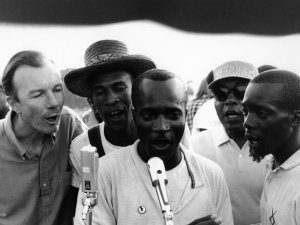
American folk singer and activist Pete Seeger (left) adopted and helped popularize “We Shall Overcome” by teaching the song at rallies and protests. Here he sings with activists in Greenwood, Miss., in 1963. (NPR)
NPR had a wonderful story yesterday about the history of the Civil Rights Movement’s signature song: The Inspiring Force Of ‘We Shall Overcome’.
It is not a marching song. It is not necessarily defiant. It is a promise: “We shall overcome someday. Deep in my heart, I do believe.”
It has been a civil rights song for 50 years now, heard not just in the U.S. but in North Korea, in Beirut, in Tiananmen Square, in South Africa’s Soweto Township. But “We Shall Overcome” began as a folk song, a work song. Slaves in the fields would sing, ‘I’ll be all right someday.’ It became known in the churches. A Methodist minister, Charles Albert Tindley, published a version in 1901: “I’ll Overcome Someday.”
The first political use came in 1945 in Charleston, S.C. There was a strike against the American Tobacco Co. The workers wanted a raise; they were making 45 cents an hour. They marched and sang together on the picket line, “We will overcome, and we will win our rights someday.”
There’s much more about how the song was passed from group to group and changed over time. Please give it a listen–it’s only about 8 minutes long, but really fascinating.
Not a single Republican appeared at yesterday’s commemoration of the March on Washington and Martin Luther King’s “I Have A Dream” speech. George W. Bush and his father George H.W. Bush couldn’t come because of health issues, but John Boehner and Eric Cantor are presumably in good health, but they refused offers to make speeches at the event, according to Roll Call.
That wasn’t a wise choice, said Julian Bond, a renowned civil rights activist, in an interview with MSNBC on Wednesday afternoon.
“What’s really telling, I think, is the podium behind me, just count at the end of the day how many Republicans will be there,” Bond told news anchor Alex Wagner. “They asked senior President Bush to come, he was ill. They asked junior Bush, he said he had to stay with his father.
“They asked a long list of Republicans to come,” Bond continued, “and to a man and woman they said ‘no.’ And that they would turn their backs on this event was telling of them, and the fact that they seem to want to get black votes, they’re not gonna get ‘em this way.” [….]
Cantor’s decision to turn down the invitation to speak is especially striking given his stated commitment to passing a rewrite of the Voting Rights Act in the 113th Congress, and the many opportunities he has taken over the past several weeks to publicly reflect on the experience of traveling with Rep. John Lewis, D-Ga., to Selma, Ala.
Sadly, Dr. King’s dream of peace has not made much progress in the past 50 years. And now the U.S. and its allies are considering another military intervention–in Syria.
Fortunately, the UK is now hesitating. NYT: Britain to Wait on Weapons Report Ahead of Syria Strikes.
Prime Minister David Cameron of Britain, who runs a coalition government, is facing political difficulties from legislators mindful of the experience in Iraq, when assurances from Prime Minister Tony Blair and President George W. Bush that Saddam Hussein had weapons of mass destruction proved inaccurate and a false pretext for war.
Mr. Cameron bowed on Wednesday to pressure from the opposition Labour Party and to some within his own coalition who want to allow United Nations weapons inspectors a chance to report their findings and for the United Nations Security Council to make one more effort to give a more solid legal backing to military action against Damascus.
At BBC News, Nick Robinson explains why Cameron “buckled.”
If you think that NSA domestic spying is invasive, you should take a look at what the NYPD has been up to since 9/11. Matt Apuzzo and Adam Goldman of the AP have a new book out called Enemies Within: Inside the NYPD’s Secret Spying Unit and bin Laden’s Final Plot Against America. There’s an excerpt at New York Magazine: The NYPD Division of Un-American Activities. It’s long, but a very important story. Please give it a read if you can.
Yesterday Apuzzo and Goldman published a related shocking story at AP: NYPD designates mosques as terrorism organizations.
The New York Police Department has secretly labeled entire mosques as terrorist organizations, a designation that allows police to use informants to record sermons and spy on imams, often without specific evidence of criminal wrongdoing.
Designating an entire mosque as a terrorism enterprise means that anyone who attends prayer services there is a potential subject of an investigation and fair game for surveillance.
Since the 9/11 attacks, the NYPD has opened at least a dozen “terrorism enterprise investigations” into mosques, according to interviews and confidential police documents. The TEI, as it is known, is a police tool intended to help investigate terrorist cells and the like.
Many TEIs stretch for years, allowing surveillance to continue even though the NYPD has never criminally charged a mosque or Islamic organization with operating as a terrorism enterprise.
The documents show in detail how, in its hunt for terrorists, the NYPD investigated countless innocent New York Muslims and put information about them in secret police files. As a tactic, opening an enterprise investigation on a mosque is so potentially invasive that while the NYPD conducted at least a dozen, the FBI never did one, according to interviews with federal law enforcement officials.

Boston Magazine has published more photos from “Behind the Scenes of The Hunt for Dzhokhar Tsarnaev.” Above is a photo of Tsarnaev exiting the boat in which he hid for hours as law enforcement searched all over Watertown for him. See more photos at the link.
In more hopeful news, one long-hospitalized survivor of the bombings was given the go-ahead to return home to California yesterday: Boston Marathon bomb survivor John Odom set to return home to Torrance (Daily Breeze News).
Nearly five months after a bomb almost took his life at the Boston Marathon, John Odom of Torrance was cleared by doctors on Wednesday to finally come home.
Odom’s wife, Karen, who has never left her husband’s side, has been chronicling her husband’s long recovery on Facebook, called it a “monumental” day.
“It’s official, John is released to go home!!!” she posted on the John Odom Support Page. “Although his recovery is nowhere near complete, there is no medical or physical reason he can’t fly home and continue his recovery in California. We are hoping to be home the end of next week, a few days shy of 5 months since we left on that now famous 4 day trip.”
“Famous” is one way to put it. The couple could have never imagined the journey they’ve been on since April 15.
Read the rest of this moving story at the link.
On October 8th and 15th, NPR’s Frontline plans to show League of Denial, “a two-part two-part investigation examining whether — as thousands of former players allege — the NFL has covered up the risks of football on the brain.” The documentary has so far been produced in partnership with ESPN, but last week the sports channel backed out of the collaboration presumably because of pressure from the NFL. From The New Republic: ESPN Quit Its Concussions Investigation With ‘Frontline’ Under Curious Circumstances.
“Frontline,” the prestigious, multiple-Emmy-winning investigative news show produced by Boston’s PBS member station, announced late Thursday afternoon that a 15-month-old partnership with ESPN in which they published a series of pieces exploring how the National Football League has (and has not) accounted for the relationship between playing football, head trauma, and brain damage, had come to an end. Dating back to last November, “Frontline” had run articles on its site featuring the work of Steve Fainaru and Mark Fainaru-Wada, ESPN staffers (and brothers) even as these articles appeared at espn.com and as the brothers did segments for ESPN’s award-winning investigative series “Outside the Lines.” The end result—in addition to abook that the brothers are publishing in October—was to be a “Frontline” documentary, League of Denial (also the book’s title).
According to “Frontline,” the documentary will premiere this season on October 8 and 15, but, “from now on, at ESPN’s request, we will no longer use their logos and collaboration credit on these sites and on our upcoming film.” Executive producer David Fanning and deputy executive producer Raney Aronson expressed their “regret” and credited ESPN with “a productive partnership.” They added, “The film is still being edited and has not been seen by ESPN news executives, although we were on schedule to share it with them for their editorial input.”
Aronson told me late Thursday that ESPN contacted “Frontline” last Friday to request that it remove ESPN’s logo from its website, citing the technicality that it was a “trademark issue.” It wasn’t until Monday, after the latest collaboration was published on “Frontline”’s website and aired on “OTL,” that ESPN also requested that language describing collaboration not be used, and that it became clear the collaboration itself was coming to an end.
The circumstances are indeed mysterious. Perhaps it was over-cautiousness on ESPN’s part or perhaps indirect pressure from the League. If you’re interested in this important story, go read Marc Tracy’s piece at TNR.
A couple more useful links on this story:
PBS: Questions Over NFL Doctor Cloud League’s Concussion Case
Bill Littlefield at NPR’s Only a Game: ESPN And Frontline Part Ways Over ‘League Of Denial’
The authors of the book League of Denial will continue their involvement with the Frontline presentation.
I’m running out of space, so I’ll end there, and add a few more links in the comments. Now what stories are you following today? Please share your links in the thread below.
Tuesday Reads
Posted: August 27, 2013 Filed under: Barack Obama, China, Foreign Affairs, Iran, Iraq, morning reads, NSA, National Security Agency, Regulation, Russia, Syria, U.S. Politics | Tags: California wildfire, chemical weapons, cuba, David Miranda, Edward Snowden, GCHQ, Glenn Greenwald, John Kerry, Saddam Hussein, San Francisco water and power, Texas legislature, West Fertilizer Co., Yosemite National Park 30 Comments
Good Morning!!
The big news today is that President Obama appears likely to order “limited” strikes on Syria in the next few days in response to Syria’s use of chemical weapons against opposition fighters. From the WaPo: After Syria chemical allegations, Obama considering limited military strike.
President Obama is weighing a military strike against Syria that would be of limited scope and duration, designed to serve as punishment for Syria’s use of chemical weapons and as a deterrent, while keeping the United States out of deeper involvement in that country’s civil war, according to senior administration officials.
The timing of such an attack, which would probably last no more than two days and involve sea-launched cruise missiles — or, possibly, long-range bombers — striking military targets not directly related to Syria’s chemical weapons arsenal, would be dependent on three factors: completion of an intelligence report assessing Syrian government culpability in last week’s alleged chemical attack; ongoing consultation with allies and Congress; and determination of a justification under international law.
“We’re actively looking at the various legal angles that would inform a decision,” said an official who spoke about the presidential deliberations on the condition of anonymity. Missile-armed U.S. warships are already positioned in the Mediterranean.
I guess “looking at…legal angles” is code for that pesky rule in the Constitution where Congress has to declare wars. When’s the last time that happened–WWII?
Meanwhile, BBC News reports: Russia and China step up warning over strike.
Russian foreign ministry spokesman Alexander Lukashevich has called on the international community to show “prudence” over the crisis and observe international law.
“Attempts to bypass the Security Council, once again to create artificial groundless excuses for a military intervention in the region are fraught with new suffering in Syria and catastrophic consequences for other countries of the Middle East and North Africa,” he said in a statement.
Late on Monday, the US said it was postponing a meeting on Syria with Russian diplomats, citing “ongoing consultations” about alleged use of chemical weapons in Syria.
Hours later, Russia expressed regret about the decision. The two sides had been due to meet in The Hague on Wednesday to discuss setting up an international conference on finding a political solution to the crisis.
The Russian deputy defence minister, Gennady Gatilov said working out the political parameters for a resolution on Syria would be especially useful, with the threat of force hanging over the country.
Read more at the link.
Just as SOS Kerry was giving a speech to justify the upcoming military strikes, providing “Clear Evidence of Chemical Weapon Use in Syria” (NYT), a little birdie told Shane Harris and Matthew Aid of Foreign Policy magazine that the U.S. facilitated Saddam Hussein’s use of chemical weapons against Iran back in 1988.
The U.S. government may be considering military action in response to chemical strikes near Damascus. But a generation ago, America’s military and intelligence communities knew about and did nothing to stop a series of nerve gas attacks far more devastating than anything Syria has seen, Foreign Policy has learned.
In 1988, during the waning days of Iraq’s war with Iran, the United States learned through satellite imagery that Iran was about to gain a major strategic advantage by exploiting a hole in Iraqi defenses. U.S. intelligence officials conveyed the location of the Iranian troops to Iraq, fully aware that Hussein’s military would attack with chemical weapons, including sarin, a lethal nerve agent.
The intelligence included imagery and maps about Iranian troop movements, as well as the locations of Iranian logistics facilities and details about Iranian air defenses. The Iraqis used mustard gas and sarin prior to four major offensives in early 1988 that relied on U.S. satellite imagery, maps, and other intelligence. These attacks helped to tilt the war in Iraq’s favor and bring Iran to the negotiating table, and they ensured that the Reagan administration’s long-standing policy of securing an Iraqi victory would succeed. But they were also the last in a series of chemical strikes stretching back several years that the Reagan administration knew about and didn’t disclose.
U.S. officials have long denied acquiescing to Iraqi chemical attacks, insisting that Hussein’s government never announced he was going to use the weapons. But retired Air Force Col. Rick Francona, who was a military attaché in Baghdad during the 1988 strikes, paints a different picture.
“The Iraqis never told us that they intended to use nerve gas. They didn’t have to. We already knew,” he told Foreign Policy.
Read the rest of this long article at Foreign Policy.
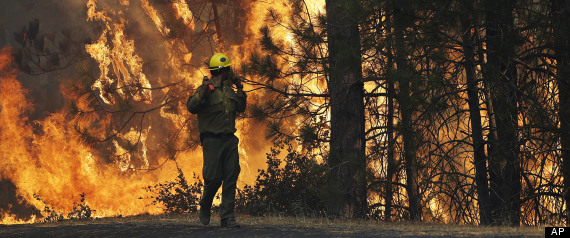
Firefighter A.J. Tevis watches the flames of the Rim Fire near Yosemite National Park, Calif., on Sunday, Aug. 25, 2013. With winds gusting to 50 mph on Sierra mountain ridges and flames jumping from treetop to treetop, hundreds of firefighters have been deployed to protect this and other communities in the path of the Rim Fire raging north of Yosemite National Park. (AP Photo/Jae C. Hong)
The wildfire in Northern California continues to spread into Yosemite National Park and has begun to threaten towns in the area. From the LA Times: Massive Rim fire continues to reshape lives and topography.
…even as firefighters worked furiously to hold a line outside of town, officials warned that this blaze was so hot it could send sparks more than a mile and a half out that could jump lines and start new hot spots. Evacuation advisories remain in effect for Tuolumne City and nearby areas.
On the north edge, the fire — now 134,000 acres — pushed into the Emigrant Wilderness Area and Yosemite National Park. It’s the one side of the fire with a natural last stand: Eventually it will run into granite walls that have snuffed out fires in this region for centuries.
Each day, what the massive blaze does depends on the wind. But officials were particularly attuned to each shift of breeze Sunday because of the weather’s eerie similarities to the day when the fire first exploded out of control.
So far the unpredictable blaze is only about 20% controlled, and it still threatens water and power sources for San Francisco.
The massive fire presents every challenge: steep slopes, dry fuel, rugged terrain and entire communities possibly in harm’s way.
The base camp and incident post, usually a haven outside fire lines, was a prominent example of the fire’s unpredictability: It’s in the middle of the burn zone, charred land with still-smoldering stumps on both sides.
Firefighters call such complete devastation “the black.” Entire ravines and ridges were a dusty gray moonscape. But some of the land was a “dirty burn” — meaning there were small circles of pine and aspen and even grass and wildflowers in the middle of charcoal-black areas where smoke still curled and embers glowed. The specks of beauty made firefighters nervous: To a fire, they are fuel.
My sister and her husband own a house north of San Francisco. It’s probably not in danger, but it still brings the scope of this disaster home to me. I sure hope Firefighers will begin to make progress soon. The burning area is now the size of the city of Chicago, according to CNN.
Yosemite National Park, California (CNN) — A massive northern California wildfire that’s threatening Yosemite National Park and San Francisco’s key water and power sources grew Monday, becoming the 13th largest in state history, state fire authorities said.
The Rim Fire, which has devoured 160,980 acres, has scorched an area about the size of the city of Chicago while more than 3,600 firefighters try to rein it in….
The wildfire, which was 20% contained Monday night, was spreading primarily to the east and threatened to grow amid extremely dry conditions and hot weather.
Part of the fire continued to spread Monday toward a key part of San Francisco’s water supply: the Hetch Hetchy Reservoir, which lies within Yosemite and is just east of the flames.
The fire also could threaten the area’s hydroelectric generators, which provide much of San Francisco’s electricity. Because of the approaching flames, officials shut down the generators, and the city — more than 120 miles to the west — temporarily is getting power from elsewhere.
Speaking of disasters, Charles Pierce reminds us that West, Texas is still recovering from the horrible explosion at the fertilizer plant there and that Texas still isn’t doing that much to prevent similar events in the future.
Read the rest of this entry »
Thursday Reads
Posted: August 22, 2013 Filed under: Barack Obama, Crime, Criminal Justice System, morning reads, U.S. Politics | Tags: Antontin Scalia, Arizona Kansas lawsuit, australia, Bobby Jindal, Bradley Manning, Chelsea Manning, Chris Lane, David Sirota, FBI files, hormone therapy, Mark Ambinder, Michael Hastings, murder, SCOTUS, sex-reassignment surgery, The Guardian UK, transgender, voting rights, William Vollmann 19 Comments
Good Morning!!
I’m getting slow start this morning after rereading some of yesterday’s morning thread and seeing Fannie’s and Beata’s comments. Life is such a mystery . . . it often seems sad and even meaningless. And yet life is wonderful and beautiful too.
I don’t even know how to express what I’m feeling right now. I just want to thank all of you for being here. When I get discouraged and disgusted with our politics and the behavior of some of my fellow humans, it helps me to share my feelings with you and to get your reactions.
Now let’s see what’s in the news this morning.
Bradley Manning was sentenced to 35 years in prison yesterday. But with good behavior he could be released in as little as 7 years. Charlie Savage and Emmarie Huetteman at The New York Times:
In a two-minute hearing on Wednesday morning, the judge, Col. Denise R. Lind of the Army, also said that Private Manning would be dishonorably discharged and reduced in rank from private first class to private, the lowest rank in the military. She said he would forfeit his pay, but she did not impose a fine.
Before the sentencing, Private Manning sat leaning forward with his hands folded, whispering to his lawyer, David Coombs. His aunt and two cousins sat quietly behind him. As Colonel Lind read the sentence, Private Manning stood, showing no expression. He did not make a statement.
The materials that Private Manning gave to WikiLeaks included a video taken during an American helicopter attack in Baghdad in 2007 in which civilians were killed, including two journalists. He also gave WikiLeaks some 250,000 diplomatic cables, dossiers of detainees being imprisoned without trial at Guantánamo Bay, Cuba, and hundreds of thousands of incident reports from the wars in Iraq and Afghanistan….
Mr. Coombs later told reporters that he would apply for a presidential pardon next week and read a statement from Private Manning that he said would be included in his request.
“I only wanted to help people,” Private Manning’s statement said, adding, “If you deny my request for a pardon, I will serve my time knowing that sometimes you have to pay a heavy price to live in a free society.”
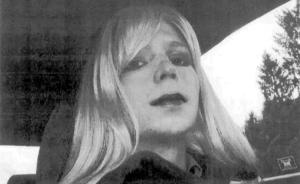
This undated photo provided by the U.S. Army shows Pfc. Bradley Manning posing in a wig and lipstick.
Manning has expressed the desire to live as a woman, and although he may not be able to get hormone therapy or sex-reassignment surgery while he is in military prison, he has announced that he is now Chelsea Manning. From Joe Coscarelli at New York Magazine: Bradley Manning’s Long, Painful Road to Coming Out As Transgender.
Less than a day after being sentenced to 35 years in prison for passing classified U.S. documents to WikiLeaks, Army private Bradley Manning has a huge, if not exactly surprisingly, announcement: “I am Chelsea Manning. I am female,” the 25-year-old wrote in a statement to Today. “Given the way that I feel, and have felt since childhood, I want to begin hormone therapy as soon as possible. I hope that you will support me in this transition. I also request that, starting today, you refer to me by my new name and use the feminine pronoun.”
But the transition has colored much of Manning’s life for many years and factors heavily into how she became one of the most notable leakers in American history. Even if much of the world is only now paying attention to Manning’s gender-questioning, it’s always been a part of her story.
Manning’s full letter is titled “The Next Stage of My Life” and has notes of relief, her trial and sentencing finally complete after three years. “As I transition into this next phase of my life,” Manning wrote, “I want everyone to know the real me.”
Manning was wrestling with her sexual orientation while serving in Iraq and when she got involved with WikiLeaks. As reported by Steve Fishman in a July 2011 issue of New York, “Among fellow soldiers, Manning had to conceal the basic facts of his sexual orientation. On the web, he was proudly out and joined a ‘Repeal Don’t Ask Don’t Tell’ group. He’d even begun to explore switching his gender, chatting with a counselor about the steps a person takes to transition from male to female.”
Manning will probably be in her early 30s when she is released from prison; so she’ll still have a long and probably interesting life ahead of her when that time comes.
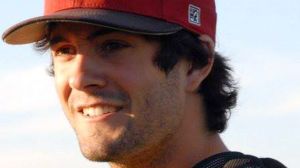
Chris Lane
Australians are calling for a boycott of U.S. travel after the senseless shooting of young Australian college student Chris Lane in Oklahoma. CNN:
The indiscriminate shooting of Christopher Lane, a 23-year-old Australian who was living his dream of studying in the United States on a baseball scholarship, has repulsed many in his home country and led to calls for Australian tourists to boycott the United States.
“It is another example of murder mayhem on Main Street,” former Australian deputy Prime Minister Tim Fischer told CNN’s Piers Morgan.
“People thinking of going to the USA for business or tourist trips should think carefully about it given the statistical fact you are 15 times more likely to be shot dead in the USA than in Australia per capita per million people.”
Police said Lane was on one of his regular runs through what has been described as the affluent town of Duncan on Friday about 3 p.m. when a car carrying three teenagers drove up behind him.
“They pulled up behind him and shot him in the back, then sped away,” said Capt. Jay Evans of the Duncan Police Department. “It could have been anybody — it was such a random act.”
Here’s a long article about the shooting from new.com.au: Chilling 911 call details final moments of Melbourne baseballer Chris Lane’s life.
What a heartbreaking story.
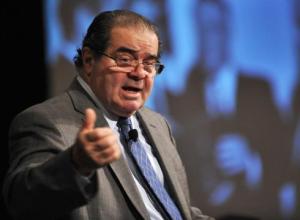
The states of Arizona and Kansas have followed a suggestion from Supreme Court Justice Antonin Scalia, according to TPM: Accepting Scalia’s Offer, Arizona Sues Obama Administration On Voting Rights.
The lawsuit, filed Wednesday, was announced by Arizona’s Attorney General Tom Horne and Secretary of State Ken Bennett, and joined by Kansas Secretary of State Kris Kobach, a high-profile architect of restrictionist laws, including Arizona’s Senate Bill 1070.
The issue involves the 1993 National Voter Registration Act, also known as the “motor voter” law, which requires states to let people register to vote simply by attesting they are citizens, when renewing their driver’s license or applying for social services. A 2004 law adopted by the voters in Arizona added the requirement that people registering to vote also provide proof of citizenship. The Supreme Court struck down that law earlier this year, concluding that it is trumped by the motor voter law. Arizona, the court ruled, could not add new requirements to the form prescribed by the federal law.
But during oral arguments in March, Scalia expressed his bafflement that Arizona did not launch a broader assault on the constitutionality of the NVRA form, written by the Election Assistance Commission. The state simply contended in that case that its proof of citizenship law did not violate the federal law. Even Scalia disagreed with that, voting against Arizona in the ruling, but also giving them a valuable tip in his 7-2 majority opinion.
“We hold that [the NVRA] precludes Arizona from requiring a Federal Form applicant to submit information beyond that required by the form itself,” Scalia wrote in the June decision. “Arizona may, however, request anew that the EAC include such a requirement among the Federal Form’s state-specific instructions, and may seek judicial review of the EAC’s decision under the Administrative Procedure Act.”
Sigh . . . read more at the link.
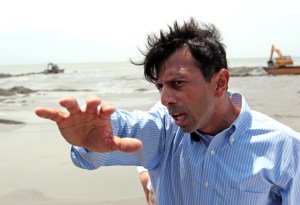
According to a new PPP poll, only 28 percent of Louisiana voters still think Governor Bobby Jindal is doing a good job.
Three years ago in August PPP declared Bobby Jindal to be the most popular Governor in the country. 58% of voters approved of him to only 34% who disapproved. Jindal’s fortunes have seen an amazing shift since that time though, and our newest poll finds him to be the most unpopular Republican Governor of any state- and the second most unpopular Governor in the country overall.
Just 28% of voters now approve of Jindal to 59% who disapprove. That’s an 11 point decline in his net approval just since February when he was already at a poor 37/57 standing. Even Republicans are pretty divided on Jindal (43/42) while independents (35/45) and Democrats (14/78) generally give him poor marks.
Jindal’s White House prospects are dismal if his home state voters have anything to say about it. Just 17% of Louisianans think he should run for President in 2016 to 72% who believe he should sit it out. He ties for 4th among Republican primary voters as their top choice for their 2016 candidate- Rand Paul leads with 18% to 17% for Jeb Bush, 11% for Paul Ryan, 10% for Jindal and Chris Christie, 8% for Marco Rubio and Ted Cruz, 5% for Rick Santorum, and less than 1% for Susana Martinez. (That’s also an embarrassingly poor showing for Santorum given that he easily won the state’s primary last year.)
Jindal wouldn’t be likely to get to a general election but the news for him there is bad too- he trails Hillary Clinton 47/40 in a hypothetical match up. Every other Republican we looked at is more competitive with Clinton in the state- Ryan leads her 46/44, Paul does 45/44, Bush ties her at 44 each, and she leads Christie just 42/41. It looks like Clinton would have a chance to make Louisiana unusually competitive in any instance, but particularly so against Jindal.
It’s difficult to believe that Jindal is polling that well against Hillary.
A few more short takes:
A new article in LA Weekly offers some startling revelations about Michael Hastings’ state of mind before he was killed in a one-car crash: Michael Hastings’ Dangerous Mind: Journalistic Star Was Loved, Feared and Haunted. Based on a friend’s descriptions of Hastings’ behavior, it sounds like he was so severely depressed that he was delusional.
From The A Register, speculations based on The Guardian’s bizarre claims that British intelligence agents forced them to destroy computers that contained U.S. secrets stolen by Edward Snowden: MYSTERY of Guardian mobos and graphics cards which ‘held Snowden files’
A funny Buzzfeed list (with gifs) contributed by Marc Ambinder: 12 Ways To Easily Identify An East Coast Transplant In LA.
A very weird story that demonstrates the institutional stupidity of the Federal Bureau of Investigation: FBI suspected William Vollmann was the Unabomber.
A fascinating story at Defense One: Area 51 Has Been Hiding U-2 Spy Planes, Not UFOs
Finally, our old friend David Sirota really outdid himself yesterday with this story at Salon: This cowardly silence is an act of war, in which he claims that President Obama’s failure to object to the UK detaining Glenn Greenwald’s partner David Miranda at Heathrow Airport is a crime against humanity . . . or something.

 peej
peej Carissa
 bostonboomer
 dakinikat
 ecocatwoman
 mablue2
 Mama Lopez
 peggysue22
 quixote
 skydancingguestblogger
 Mona (aka Wonk the Vote)



 Sky Dancing
Recent Comments