
New Year’s Eve Reads: Trumpschmerz
Posted: December 31, 2019 Filed under: Foreign Affairs, morning reads, U.S. Politics | Tags: both-sidesing media, Chelsea Clinton, Death to American, Donald Trump, impeachment, iran, Mitch McConnell, New Year's Eve 2019, Trumpschmerz, U.S. Embassy Brussels, U.S. Embassy Iraq, Ukraine scandal 20 Comments
New Year’s Eve by Sabzi
Good Morning!
One more day until 2020 begins. Here’s what’s happening right now:
As 2019 draws to a close with “Death to America” is trending on Twitter. The New York Times: Protesters Attack U.S. Embassy in Iraq, Chanting ‘Death to America.’
BAGHDAD — Protesters broke into the heavily guarded compound of the United States Embassy in Baghdad on Tuesday and lit fires inside to express their anger over American airstrikes that killed 24 members of an Iranian-backed militia over the weekend.
The men did not enter the main embassy buildings and later withdrew from the compound, joining thousands of protesters and militia fighters outside who chanted “Death to America,” threw rocks, covered the walls with graffiti and demanded that the United States withdraw its forces from Iraq.
The situation remained combustible, with protesters vowing to camp outside the compound indefinitely. Their ability to storm the most heavily guarded zone in Baghdad suggested that they had received at least tacit permission from Iraqi security officials sympathetic to their demands.
Guy Lombardo and the Royal Canadians play Auld Lang Syne, by David Lloyd Glover
The American airstrikes on Sunday have resulted in the most serious political crisis in years for the United States in Iraq, stoking anti-Americanism and handing an advantage to Iran in its competition for influence in the country.
The airstrikes targeted an Iranian-backed Iraqi militia, Kataib Hezbollah, which the United States accused of carrying out a missile attack on an Iraqi military base that killed an American contractor and wounded American and Iraqi service members. A spokesman for the militia denied involvement in the attack.
But the size of the American response — five strikes in Iraq and Syria that killed two dozen fighters and wounded dozens of others — prompted condemnation from across the political spectrum and accusations that the United States had violated Iraqi sovereignty.

Trump is blaming Iran, The Washington Post reports:
President Trump responded angrily Tuesday to the protesters’ actions, charging that Iran was behind a deadly militia attack that led to the airstrikes and blaming Tehran for the embassy siege.
“Iran killed an American contractor, wounding many,” Trump tweeted from his Mar-a-Lago estate in Florida. “We strongly responded, and always will. Now Iran is orchestrating an attack on the U.S. Embassy in Iraq. They will be held fully responsible. In addition, we expect Iraq to use its forces to protect the Embassy, and so notified!”
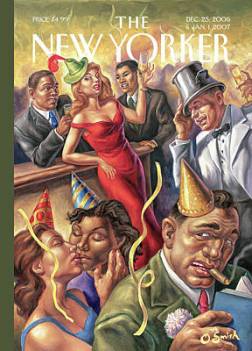
Painting for The New Yorker by Owen Smith
A spokesman for the Kataib Hezbollah militia said the demonstrators intend to besiege the embassy until the facility shuts down and U.S. diplomats leave Iraq.
But the angry demonstrators defied appeals delivered over loudspeakers by the group’s leaders not to enter the embassy compound and smashed their way into one of the facility’s reception areas, breaking down fortified doors and bulletproof glass and setting fire to the room.
American guards inside the embassy fired tear gas to keep the militia supporters at bay. U.S. troops could be seen nearby and on rooftops, their weapons drawn, but they did not open fire. Embassy civil defense workers just inside the gates attempted to put out the fires with water hoses.
The protesters also smashed security cameras, set two guardrooms ablaze and burned tires. They made a bonfire out of a pile of papers and military MREs (meals ready to eat) found in the reception area, where guards normally search visitors. Kataib Hezbollah flags were draped over the barbed wire protecting the embassy’s high walls.
So much for Trump and Kushner’s plans for peace in the Middle East. And didn’t American taxpayers spend $750 million to make the Baghdad embassy impenetrable?
Here’s a little comic relief from The Daily Beast: Team Trump’s Furious Hunt to Find Out Who ‘Liked’ a Chelsea Clinton Tweet.
On the evening of July 10, 2017, staffers at the U.S. embassy in Brussels—the official office for the ambassador to the European Union—received an unusual call from the seventh floor of the State Department back in Washington. The office of then-Secretary of State Rex Tillerson was irate. Someone in Brussels with access to the mission’s Twitter account had liked the wrong tweet. It had set off alarm bells in Foggy Bottom.
The tweet wasn’t just any tweet. It was one written by Chelsea Clinton and directed at President Donald Trump in a public spat that took the internet by storm.
A New Years Eve Night by A. Snegirev, 1982
That week in July, Trump drew criticism for his decision to let his daughter Ivanka fill his seat at the G-20 meeting of top economic powers in Hamburg, Germany. After days of the pile-on, Trump took to Twitter the morning of July 10 to claim his decision to have Ivanka represent the U.S. at the G-20 was “very standard” and that Chancellor Angela Merkel of Germany agreed. Not more than 15 minutes later, he switched his tenor and began attacking Clinton and the press. “If Chelsea Clinton were asked to hold the seat for her mother, as her mother gave our country away, the Fake News would say CHELSEA FOR PRES!,” Trump said.
Clinton shot back: “It would never have occurred to my mother or my father to ask me. Were you giving our country away? Hoping not.”
That tweet garnered more than half a million likes, including by the account for the U.S. mission to the European Union. That kickstarted a weeks-long investigation, prompted by the secretary’s office, into who exactly at the Brussels mission had access to the Twitter account and hit “Like” on Clinton’s tweet, according to two former U.S. officials. (Full disclosure: Clinton sits on the board of IAC, The Daily Beast’s parent company.) Nearly 10 people were interviewed about whether they, as administrators of the account, had mistakenly or deliberately pressed the “Like” button. All of them denied any wrongdoing, those sources said. One individual familiar with the exchanges said the secretary of state’s top managers in Washington “wanted blood” and called Brussels numerous times demanding the name of the culprit.
U.S. officials in Belgium were never able to give Tillerson’s office a name and soon after, the embassy restructured the Twitter account and limited access to just two individuals.

The Trumpies know what’s really important–protecting their boss’s fragile ego.

New Year’s Still Life, by Moesey Li
At The Washington Post, Greg Sargent explains why Mitch McConnell is counting on the political media to help him protect Trump in a fraudulent impeachment trial: Explosive new revelations just weakened Trump’s impeachment defenses.
If Mitch McConnell is going to pull off his scheme to turn President Trump’s impeachment trial into a quick and painless sham with no witnesses, the Senate majority leader needs the story to be covered as a conventional Washington standoff — one that portrays both sides as maneuvering for advantage in an equivalently political manner.
But extraordinary new revelations in the New York Times about Trump’s corrupt freezing of military aid to Ukraine will — or should — make this much harder to get away with.
McConnell badly needs the media’s both-sidesing instincts to hold firm against the brute facts of the situation. If Republicans bear the brunt of media pressure to explain why they don’t want to hear from witnesses, that risks highlighting their true rationale: They adamantly fear new revelations precisely because they know Trump is guilty — and that this corrupt scheme is almost certainly much worse than we can currently surmise.
That possibility is underscored by the Times report, a chronology of Trump’s decision to withhold aid to a vulnerable ally under assault while he and his henchmen extorted Ukraine into carrying out his corrupt designs.
The report demonstrates in striking detail that inside the administration, the consternation over the legality and propriety of the aid freeze — and confusion over Trump’s true motives — ran much deeper than previously known, implicating top Cabinet officials more deeply than we thought.
Please go read the rest at the link. It’s long but important.
I’ve been pretty successfully ignoring the news during these two holiday weeks, except for when I’ve had a blog post to write. Susan Glasser of The New Yorker had more trouble doing that, and now she has found a word to describe life in Trumpworld: Our Year of Trumpschmerz.
So much for the holidays. In the quiet of Christmas and New Year’s, the President of the United States has repeatedly attacked “Crazy Nancy” Pelosi and her family, inveighed against the “bogus Impeachment Scam” and circulated the alleged name of the C.I.A. whistle-blower whose complaint triggered it, retweeted an account that described former President Barack Obama as “Satan’s Muslim Scum,” hosted the accused war criminal he recently pardoned over the objections of military leaders, and promoted a post calling himself “the best President of all time.” He even accused the Prime Minister of Canada, Justin Trudeau, of personally ordering Canadian television to cut a seven-second snippet of the schmaltzy Christmas movie “Home Alone 2” that features Trump, an accusation the President refused to retract, although it was quickly proven that the scene was one of many edited out as a time-saver back in 2014, long before either Trudeau or Trump was anywhere close to power.
Dance at the Moulin Rouge, by Toulouse Lautrec
Even now, three years into the Trump Presidency, there is no language to fully capture the madness of all this, though many of my journalistic colleagues have gone to great lengths to record and codify just how disturbingly nutty 2019 has been. The Washington Post reports that Trump ended the year having made more than fifteen thousand four hundred false and misleading statements since his inauguration. CNN’s “Inside Politics” produced a four-page, single-spaced list of all the people and institutions Trump has attacked by name this year. There are online trackers for the unprecedented levels of turnover in Trump’s Administration and for the rapidly proliferating array of lawsuits involving Trump’s assertions of sweeping executive authority. By any measure, 2019 will go down as a remarkable year in the annals of the American Presidency: Trump began it by causing the longest-ever federal government shutdown in history, after Congress refused to spend billions on his proposed border wall, and ended it as only the third President in history to be impeached by the House of Representatives.

Glasser searched for a word to encompass the horrors of living in Trump’s world.
There must be one of those long German words for all that soul-sickening worry, right? Some tortured mouthful of consonants that captures the ceaseless anxiety and absurdity of Washington in the age of Trump? I asked my friend, the German scholar and writer Constanze Stelzenmüller, an astute observer of Trumpism at the Brookings Institution and especially of its toxic effect on the troubled transatlantic relationship. She said that, even in Trump-skeptical Berlin, there was no single, widely accepted word that describes this phenomenon but gamely offered up her own stab at it. The word she came up with is “Trumpregierungsschlamasselschmerz.”
Her word has pretty much everything that has come to characterize this uniquely dysfunctional moment in America’s troubled capital: Trump and his Administration (“regierung” means government); the slow-motion car crash of constant controversies (“schlamassel”); and the continuous pain or ache of the soul that results from excessive contemplation of it all (“schmerz”). Sure, it’s a mouthful, but that’s the point: there should be one word that sums up the Trumpian disruption we are experiencing, not merely a jumble of different ones. It’s the tweets and the other stuff, too: the endless attacks on enemies, real and imagined; the torrent of lies; the eroding of the basic functions of government; and the formerly unimaginable assault on our institutions. It’s impeachment and the Mueller Report and migrant children in cages, the bullying of allies, and the lavish praise of adversaries. It’s the uncertainty and worry that comes with all of the above.
On the brink of a new year, Trumpregierungsschlamasselschmerz has come to dominate our collective psyche. There is no taking a vacation from it. I confess that I have not yet figured out how to pronounce this unwieldy linguistic invention that so deftly captures our national Trump-soul-sickness. Luckily, I received a follow-up e-mail from Constanze, in which she proposed a shortened version that gets right to the angsty, anxious point: If “Trumpregierungsschlamasselschmerz” is too much, she said, you can just use “Trumpschmerz.” Either way, in German or in English, it’s my nominee for the word of the year in 2019. I suspect it will be in 2020 as well.
And with that I’ll turn the floor over to you, Sky Dancers. What stories are you following, if any?
Lazy Caturday Reads
Posted: December 28, 2019 Filed under: just because, morning reads, U.S. Politics 32 Comments Good Morning!!
I really dislike these two “holiday” weeks at the end of every year. I always end up with a sense of unreality. This year I’m away from my home–I’m house- and cat-sitting for my brother and his family while they visit Denmark and Norway for two weeks.
I’ve been reading constantly and avoiding TV. I’ve been reading a lot; I just finished a book by Stephen King, The Institute. I guess that is contributing to that freaky unreal feeling I’m experiencing. And of course there’s the knowledge that Trump is still “president” and our country and the world are in danger because of him.
I don’t know if anyone will read this, but if you do I want tell you that this blog and everyone who has read it and/or commented on it have helped me maintain some sanity in a crazy world over the more than a decade since 2008. I’m grateful to all of you and I wish you strength to get through whatever is coming in 2020. I love you all.
If you read nothing else today, I hope you’ll choose this essay by Michiko Kakutani at The New York Times: The 2010s Were the End of Normal.
TWO OF THE MOST WIDELY QUOTED and shared poems in the closing years of this decade were William Butler Yeats’s “The Second Coming” (“Things fall apart; the centre cannot hold”), and W.H. Auden’s “September 1, 1939” (“Waves of anger and fear / Circulate over the bright / And darkened lands of the earth”). Yeats’s poem, written just after World War I, spoke of a time when “The best lack all conviction, while the worst / Are full of passionate intensity.” Auden’s poem, written in the wake of Germany’s invasion of Poland, described a world lying “in stupor,” as democracy was threatened and “the enlightenment driven away.”
Apocalypse is not yet upon our world as the 2010s draw to an end, but there are portents of disorder. The hopes nourished during the opening years of the decade — hopes that America was on a progressive path toward growing equality and freedom, hopes that technology held answers to some of our most pressing problems — have given way, with what feels like head-swiveling speed, to a dark and divisive new era. Fear and distrust are ascendant now. At home, hate-crime violence reached a 16-year high in 2018, the F.B.I. reported. Abroad, there were big geopolitical shifts. With the rise of nationalist movements and a backlash against globalization on both sides of the Atlantic, the liberal post-World War II order — based on economic integration and international institutions — began to unravel, and since 2017, the United States has not only abdicated its role as a stabilizing leader on the global stage, but is also sowing unpredictability and chaos abroad.
A 2019 Freedom House report, which recorded global declines in political rights and civil liberties over the last 13 years, found that “challenges to American democracy are testing the stability of its constitutional system and threatening to undermine political rights and civil liberties worldwide.”
If Lin-Manuel Miranda’s dazzling 2015 musical “Hamilton,” about the founders’ Enlightenment vision of the United States, embodied the hopes and diversity of America during the Obama years, dystopian fables and horror-driven films and television series — including “Black Mirror” (2016), a rebooted “Twilight Zone” (2019), “Joker” (2019), “Get Out” (2017), “Watchmen” (2019), “The Handmaid’s Tale” (2017) and “Westworld” (2016) — spoke to the darkening mood in the second half of the decade, as drug overdose deaths in America rose to nearly half a million by the decade’s end, life expectancy fell in the United States and Britain, and many of us started to realize that our data (tracking everything we viewed, bought and searched for online) was being sold and commodified, and that algorithms were shaping our lives in untold ways. In what was likely the hottest decade on record, scientists warned that climate change was swiftly approaching a “point of no return”; we learned that glaciers were melting at record speed at the top of the world; and fires ravaged California and Australia and threatened the very future of the Amazon rainforest.
A bit more and then you’ll need to head over to the NYT to read the rest.
Many of these troubling developments didn’t happen overnight. Even today’s poisonous political partisanship has been brewing for decades — dating back at least to Newt Gingrich’s insurgency — but President Trump has blown any idea of “normal” to smithereens, brazenly trampling constitutional rules, America’s founding ideals and virtually every norm of common decency and civil discourse….
Mr. Trump’s improbable rise benefited from a perfect storm of larger economic, social and demographic changes, and the profoundly disruptive effects of new technology. His ascent also coincided with the rising anxieties and sense of dislocation produced by such tectonic shifts. Around the world, liberal democracy is facing grave new challenges, authoritarianism is on the rise and science is being questioned by “post-fact” politicians. Echoes of Mr. Trump’s nativist populism can be found in Prime Minister Boris Johnson of Britain’s recent electoral victory and the Brexit referendum of 2016, and in the ascent of the far-right President Jair Bolsonaro of Brazil. Democracy is under threat in Hungary and Poland. Once fringe right-wing parties with openly racist agendas are rebranding themselves in Sweden and Belgium. And far-right groups in Germany and Spain are now the third-largest parties in those nations’ parliaments.
AT THE SAME TIME, Donald Trump remains a uniquely American phenomenon. Although the United States was founded on the Enlightenment values of reason, liberty and progress, there has long been another strain of thinking at work beneath the surface — what Philip Roth called “the indigenous American berserk,” and the historian Richard Hofstadter famously described as “the paranoid style.”
It’s an outlook characterized by a sense of “heated exaggeration, suspiciousness, and conspiratorial fantasy,” Hofstadter wrote in his 1964 essay, and focused on perceived threats to “a nation, a culture, a way of life.” Its language is apocalyptic (Mr. Trump’s “American carnage” is a perfect example); its point of view, extremist. It regards its opponents as evil and ubiquitous, while portraying itself, in Hofstadter’s words, as “manning the barricades of civilization.”
The “paranoid style,” Hofstadter observed, tends to occur in “episodic waves.” The modern right wing, he wrote, feels dispossessed: “America has been largely taken away from them and their kind, though they are determined to try to repossess it.” In their view, “the old American virtues have already been eaten away by cosmopolitans and intellectuals,” and national independence has been “destroyed by treasonous plots, having as their most powerful agents not merely outsiders and foreigners but major statesmen seated at the very centers of American power.”
You might also want to read this opinion piece by Deborah Pearlstein at The Atlantic: How the Military Lost Its Proper Place in the Constitutional Order.
In his efforts to mask the seriousness of his actions around Russia and Ukraine, President Donald Trump has taken aim at one essential democratic institution after another—questioning the legitimacy of the press, the intelligence community, the courts, and, most recently, the House of Representatives itself. But he has so far mostly held his fire against both “his generals” and “our boys” in America’s military. “I will always stick up for our great fighters,” Trump promised his political supporters in Florida at a recent rally, championing on that day his recent decisions to pardon soldiers accused of war crimes.
The military, for its part, has had more mixed feelings. As a former chairman of the Joint Chiefs of Staff, General Martin Dempsey, described one such pardon, the president’s action was nothing less than an “abdication of moral responsibility.” Indeed, the military’s generally steadying reactions to the president’s worst moments of volatility have given members of Congress on both sides of the aisle reason to hope that the Pentagon at least will remain a check on presidential impulse that might really compromise national security, should other checking institutions fail.
But hoping that a president will defer to the judgment of the professional military is a sign that something has gone very wrong in America’s constitutional infrastructure. The American republic was, after all, founded on the complaint that the king had “affected to render the Military independent of and superior to the Civil power.” The Constitution’s Framers abhorred the British army, as much or more for its treatment of colonists in the years leading up to the war as during it. As Alexander Hamilton put it with characteristic clarity in “Federalist No. 26”: “The people of America may be said to have derived an hereditary impression of danger to liberty from standing armies in time of peace.”
Click the link to read the rest.
A few more stories to check out:
Margaret Carlson at The Daily Beast: McConnell’s Big Mistake Defending Trump? Listening to Him.
Raw Story: Trump interrupted his vacation for a Friday night social media meltdown.
Salon: Pelosi “has the right” to submit Trump to an “involuntary evaluation”: Yale psychiatrist Bandy Lee.
Scott Turow at Vanity Fair: Could Chief Justice Roberts Be the Democrats’ Impeachment Savior?
Have a nice weekend, Sky Dancers! If you’re around today, please comment and/or share a link.
Thursday: Day After Christmas Open Thread
Posted: December 26, 2019 Filed under: just because, morning reads, U.S. Politics | Tags: Alfred Hitchcock, baby black rhino, Bernie Sanders, cognitive decline, dementia, Donald Trump, Doppsee, Ingrid Bergman, Little Women, Louisa May Alcott, Nicole Marie Poole Franklin, Potter Park Zoo, Seth Davin Norrholm, Spellbound, US Cybercom 27 Comments
Santa resting on the day after Christmas
Good Morning!!
We’re halfway through the holiday madness, and I have to admit it has been nice having slow news days instead of shocks to the system every few hours day after day. There really is nothing to write about today, but here are a few reads to check out if you’re interested.
Of course Trump is still nuts and he’s still tweeting nonsense.
And he’s still in steep cognitive decline. Raw Story: Psychiatry expert says Trump’s rambling Merry Christmas rant includes three signs of serious mental impairment.
President Donald Trump’s speech in Florida over the weekend provides evidence that he is suffering from cognitive decline, according to a psychiatric expert.
Seth Davin Norrholm, an associate professor of psychiatry and behavioral sciences at Emory University School of Medicine, said Monday that the president’s recent rant about Christmas included at least three signs of mental problems.
“So if anybody wants to be a nice conservative, talk show host is not a bad living, I would say. But I have to say, he’s a very unique guy and he’s a great man and he’s been a great friend. So thank you to Rush. Thank you,” Trump said.
“And let me begin by wishing you a beautif — [NOTE from BB: This is the point where he had the shoulder spasm and lost the plot at 22 sec.] look, do you remember this? Do you remember this? Remember, they were trying to take Christmas out of Christmas. Do you remember? They didn’t want to let you say Merry Christmas,” Trump continued.
“You’d go around, you’d see department stores that have everything red, snow, beautiful, ribbons, bows. Everything was there. But they wouldn’t say Merry Christmas. They’re all saying Merry Christmas again. You remember?”
The Washington Post: U.S. Cybercom contemplates information warfare to counter Russian interference in 2020 election.

The New York Times: Black Rhino Born at Michigan Zoo on Christmas Eve.
Doppsee, a 12-year-old black rhino, presented a Michigan zoo and conservationists with an early holiday gift on Christmas Eve, delivering a newborn calf in a rare zoo birth for the endangered species.
The arrival of the male calf, which hasn’t been named yet, was the first time that a black rhino had been born at the Potter Park Zoo in Lansing, Mich., in its 100-year history, according to a news release.
Pat Fountain, an animal care supervisor at the zoo, said on Wednesday that the birth was one of the zoo’s “crowning achievements” because black rhinos are “statistically and historically very hard to breed and be successful.” Getting Doppsee to breed with Phineus, the calf’s father, who came to the zoo in 2017, was a “milestone,” he said.
About two black rhinos are born every year in facilities accredited by the Association of Zoos & Aquariums in the United States, Mr. Fountain said, noting how rare the birth was.
Here’s some material for nightmares from Politico: Democratic insiders: Bernie could win the nomination.
For months the Vermont senator was written off by Democratic Party insiders as a candidate with a committed but ultimately narrow base who was too far left to win the primary. Elizabeth Warren had skyrocketed in the polls and seemed to be leaving him behind in the race to be progressive voters’ standard-bearer in 2020.
But in the past few weeks, something has changed. In private conversations and on social media, Democratic officials, political operatives and pundits are reconsidering Sanders’ chances.
“It may have been inevitable that eventually you would have two candidates representing each side of the ideological divide in the party. A lot of smart people I’ve talked to lately think there’s a very good chance those two end up being Biden and Sanders,” said David Brock, a longtime Hillary Clinton ally who founded a pro-Clinton super PAC in the 2016 campaign. “They’ve both proven to be very resilient.”
Democratic insiders said that they are rethinking Sanders’ bid for a few reasons: First, Warren has recently fallen in national and early-state surveys. Another factor, they said, is that he has withstood the ups and downs of the primary, including his own heart attack. At the same time, other candidates with once-high expectations, such as Kamala Harris, Cory Booker and Beto O’Rourke, have dropped out or languished in single digits in the polls.
 The Washington Post: Woman who drove into a girl for being ‘a Mexican’ hit a black child the same day, police say.
A woman accused of driving into a teenager because she believed the girl was Mexican had struck another child with her car less than an hour earlier, authorities say.
Police in Iowa say Nicole Marie Poole Franklin struck a 12-year-old black boy as he walked home from school earlier this month. The 42-year-old Des Moines woman has not discussed her motive in that incident, but authorities say they are sickened by the seeming hate behind actions that occurred over less than two hours that day, ending with Franklin allegedly calling African Americans racial slurs in a gas station.
“When you look at the pattern of behavior here, you look at the victim selection, I think it speaks for itself,” said Sgt. Paul Parizek of the Des Moines Police Department.
Franklin’s case drew anger and fear last week when officials announced that the woman had not only confessed to a Dec. 9 hit and run but also told police that she targeted a 14-year-old for her perceived country of origin. Community members pushed for a hate crime designation on top of an attempted murder charge.
Lucy Ellman at The New York Times: Patriarchy Is Just a Spell.
I was in line at a cheese shop, contemplating our dependence throughout life on milk, mothers’ milk (even if we move quickly on to the milk of other species’ mothers, like cow, goat, sheep, buffalo or vegan substitutes, which emerge from mother earth), when it occurred to me that the Alfred Hitchcock movie “Spellbound” is really about sexual harassment. It’s not about Gregory Peck’s goofy psychological problems; it’s an elucidation of women’s problems — with men. Hitch was way ahead of his time: It’s a #MeToo movie released 74 years ago.
Ingrid Bergman and Gregory Peck in “Spellbound.”Credit…Getty Images
Hitchcock was always keen on female protagonists, usually blond. He used (and some would say abused) Grace Kelly, Carole Lombard, Eva Marie Saint, Tippi Hedren, Joan Fontaine, Doris Day, Janet Leigh, Kim Novak and Ingrid Bergman. Oddly, he settled on Hedren for “The Birds” and “Marnie,” an awkward actress at best, brittle and shaky. Hitchcock’s treatment of these actresses was pretty sadistic, yet his dramatic portrayals of women are often sympathetic….
One principle of psychoanalysis is that what is buried deep will surface; it will pop out in some way, no matter how well you try to repress it. The craziness buried in “Spellbound” is misogyny: The movie veers off to become an examination not of the hazards of neurotic trauma but of what it’s like to be a woman tormented by patriarchy. For wherever Bergman goes, she’s under scrutiny from men, if not direct attack.
The story seems at first to be about Gregory Peck’s mixed-up identity and amnesia and phobias and fainting spells and stuff, but in the end you realize Peck is by the by. The movie is told from Bergman’s point of view, and it’s really about the difficulties she faces (Hitchcock was probably one of them, given his penchant for tormenting his leading ladies). You can tell Peck doesn’t matter much, by the way the three central traumas of his life are so breezily dealt with once they surface. These complexes of his are MacGuffins. What matters is Bergman. Of course.

Read the whole thing at the NYT link.
The Washington Post: Girls adored ‘Little Women.’ Louisa May Alcott did not.
Above all else, Louisa May Alcott was a radical. From an early age, she was an abolitionist. She was also a feminist, committed to never marrying, and loved to pull up her skirts and go for a long run through the woods.
Louisa May Alcott
Alcott’s most famous work, “Little Women,” was nearly the opposite — a light, juvenile novel focused on sisterly love and domestic peace. And though it was semi-autobiographical, she hated it. Now, the latest film version, directed by Greta Gerwig, hits theaters Christmas Day.
Alcott’s father, Bronson Alcott, with whom she was close, was also a radical. He hung out with Transcendentalist poets and used the family home as a stop on the Underground Railroad. He was also a teacher who was disgraced after publishing a book with ideas about education that were a little too innovative.
And he was prone to depression. Once he was fired from his school, he didn’t work again for years. An attempt to start a utopian community failed utterly, deepening his depression, and his wife and daughters were forced to take any work they could to keep the family afloat.
Alcott took on sewing projects, worked as a maid to a rich woman on a trip to Europe, and tried to sell stories she had written to women’s magazines. She also worked as a Civil War nurse, and her written account of this period turned into her first literary success.
But her favorite things to write were suspense novels, which she published under the name A.M. Bernard. These stories featured liberated women following sensational passions across the high seas and in glamorous locales. She wrote dozens of these stories for women’s magazines but earned only a pittance.

Then her editor finally convinced her to grind out some sentimental schock. BTW, I hated Little Women, and I’m glad to know that Alcott did too.
Have a great day everyone!
Christmas Eve Reads
Posted: December 24, 2019 Filed under: morning reads, U.S. Politics | Tags: Christmas Eve 14 Comments
Christmas in the Brothel, by Edvard Munch
Good Morning!!
It’s Christmas Eve and I’m going to begin this post with a little more history behind modern Christmas traditions. The Independent: The dark history of Christmas traditions.
People have been marking the midwinter for far longer than the 2000-odd years since the birth of Christ… and even that’s in doubt, anyway. It was only in the year 340 AD that Pope Julius I fixed the date of Jesus’s birthday at 25 December.
Prior to that it was marked on at least three different other dates: 29 March, 6 January, and sometime in June – which historians today think is most likely, given that the nativity is meant to have occurred during a census-taking.
It was 250 years later that Julius’s successor a few times removed, Pope Gregory, gave the job to Saint Augustine of converting the heathen Brits to Christianity.
Fortunately, with the birth of Christ now established as 25 December, it gave Augustine a bit of leverage with the population who were already marking several midwinter festivals, ensuring they could take this new-fangled religion on board without losing the annual December piss-up.
Because the idea of getting blind-drunk at Christmas isn’t something invented by the Pogues and your dad. There were two major pre-Christian festivals of note which roughly coincided with Christmas: the Roman Bacchanalia, or Saturnalia, and the Yule Feast of the Norse countries.
The Saturnalia began on 19 December and lasted for the best part of a week, which sounds about right for those currently enmeshed in the Christmas party rush. Morality and restraint were politely shown the back door, schools were closed, no criminals were punished.
The Roman god Saturn, in whose honour the festival was staged, was no benign Christ-figure or benevolent Santa, even though his party was eventually absorbed into Christmas. Ancient astrologers thought being born under the sign of Saturn was bad news.
Slaves were allowed to swap places with their masters, and one was elected king for the duration of the festival. The wealthy distributed gifts to the poor.
On Christmas Eve “restless spirits walked the earth.”
Should you be brave enough, legend has it that if you venture into a graveyard on Christmas Eve and dig a hole, then you’ll find gold.
But be careful getting there; on that night cattle are said to kneel down and speak in human voices. And those leaving church on Christmas Eve while the consecration is still going on are bang-on guaranteed to witness a procession of ghosts wending their way through the streets.
Ghost of Christmas Past, John Leech
Speaking of supernatural beings abroad on Christmas Eve, what about the big man himself? Father Christmas, Santa, Saint Nick. Why do we hang a stocking out for him? Because, according to legend, Saint Nicholas heard about three sisters who were forced into a life of prostitution to earn enough money to eat, so he tossed three coins down their chimney to help them out, which landed in the girls’ stockings drying on the hearth.
Father Christmas as a jolly old man with a white beard was indeed thought to be based on St Nicholas, who can be traced back to Asia Minor in about 350 AD (around the time Pope Julius was fixing the date of Jesus’s birth), and somewhere along the way he got mashed up with other folklorish characters, including Kris Kringle from 19th-century German tradition.

Read more about the history behind Christmas traditions at The Folklore Society.
Now on to today’s politics reads:
This interview with Rudy Giuliani is wild. Olivia Nuzzi at New York Magazine: A Conversation With Rudy Giuliani Over Bloody Marys at the Mark Hotel.
It was early in the afternoon on Sunday, December 8, and Giuliani had just returned from Ukraine, where he said he was looking for information to undermine the case to impeach his client, President Donald Trump. [….]
Over a sweater, he wore a navy-blue suit, the fly of the pants unzipped. He accessorized with an American-flag lapel pin, American-flag woven wallet, a diamond-encrusted pinky ring, and a diamond-encrusted Yankees World Series ring (about which an innocent question resulted in a 15-minute rant about “fucking Wayne Barrett,” a journalist who manages to enrage Giuliani even in death).
The Holly King, the spirit of Yule
In addition to being the president’s free personal attorney, Giuliani, who is 75, is an informal White House cybersecurity adviser and a high-priced cyber-security contractor. In one hand, he clutched three phones of varying sizes. Two of the devices were unlocked, their screens revealing open tabs and a barrage of banner notifications as they knocked into each other and reacted to Giuliani’s grip. He accidentally activated Siri, who said she didn’t understand his command. “She never understands me,” he said. He sighed and poked at the device, attempting to quiet her….

Giuliani is quick to announce that he knows “every block of this city,” but he lives on the Upper East Side and doesn’t linger much across or below the park. When I asked him to bring me somewhere he likes to hang out, he quickly directed his bodyguard to the Mark, a five-star hotel on East 77th Street. Always a creature of habit, Giuliani is extra-aware of where he’s welcome these days. He says that “because of what’s happened” his circle is tightening, that he doesn’t trust anyone anymore.
I asked him how he ever trusted Lev Parnas and Igor Fruman, two Russian associates with a business called Fraud Guarantee who were arrested by the FBI in October. “They look like Miami people. I know a lot of Miami people that look like that that are perfectly legitimate and act like them,” Giuliani said. “Neither one of them have ever been convicted of a crime. Neither one. And generally that’s my cutoff point, because if you do it based on allegations and claims and — you’re not gonna work with anybody,” he said, laughing. “Particularly in business.”
As we sped uptown, he spoke in monologue about the scandal he co-created, weaving one made-up talking point into another and another. He said former ambassador Marie Yovanovitch, whom he calls Santa Maria Yovanovitch, is “controlled” by George Soros. “He put all four ambassadors there. And he’s employing the FBI agents.” I told him he sounded crazy, but he insisted he wasn’t.
“Don’t tell me I’m anti-Semitic if I oppose him,” he said. “Soros is hardly a Jew. I’m more of a Jew than Soros is. I probably know more about — he doesn’t go to church, he doesn’t go to religion — synagogue. He doesn’t belong to a synagogue, he doesn’t support Israel, he’s an enemy of Israel. He’s elected eight anarchist DA’s in the United States. He’s a horrible human being.”
Read the rest of the demented interview at NY Mag.

Norse mythology tells us of the god Balder who was killed by an arrow made of mistletoe.
At CNN Vicky Ward writes about David Correia, who a co-conspirator in the Ukraine mess: The invisible man: Text messages reveal former golfer’s role in Ukraine scandal.
When Lev Parnas and Igor Fruman traveled to Ukraine last winter to help Rudy Giuliani dig up dirt on President Donald Trump’s political opponents, they were accompanied by a 44 year-old American named David Correia.
A former pro golfer and restaurateur, Correia had gotten to know Parnas and Fruman in South Florida, where he’d gone into business with Parnas years earlier.While Parnas and Fruman, who had high-level contacts in Ukraine, worked to gather documents that they believed showed evidence of corruption by Joe Biden and his son Hunter, Correia was there to make the effort pay off in lucrative business deals, according to people who talked to him at the time, as well as copies of text messages obtained by CNN.Before the trip, Correia texted an American associate that he wanted to “be fully prepared to close specific deals in Ukraine while we are there,” according to the message viewed by CNN. Though he had no experience in the gas or energy business prior to working with Parnas, Correia was bent on securing a deal to sell US liquified natural gas to Ukraine through a pipeline in Poland.When the three men were indicted in October for illegally funneling foreign money into Republican political circles, attention quickly focused on Parnas and Fruman, who have become key characters in the ongoing impeachment saga of President Donald Trump.Meanwhile Correia’s role has gotten little scrutiny. In part, that’s due to the lack of detail in the indictment beyond Correia’s alleged involvement in an effort to lobby for a marijuana business that, according to the indictment, was secretly backed by a Russian businessman. Compared to the four counts Parnas and Fruman face, Correia was charged with just one. All three men have pleaded not guilty.
Read all the details at CNN.
Democrats are talking about new articles of impeachment against Trump. Politico: House counsel suggests Trump could be impeached again.
House Counsel Douglas Letter said in a filing in federal court that a second impeachment could be necessary if the House uncovers new evidence that Trump attempted to obstruct investigations of his conduct. Letter made the argument as part of an inquiry by the D.C. Circuit Court of Appeals into whether Democrats still need testimony from former White House counsel Don McGahn after the votes last week to charge Trump with abuse of power and obstruction of Congress.
Yakutia reindeer photo by Alexander Dersu in 2018
“If McGahn’s testimony produces new evidence supporting the conclusion that President Trump committed impeachable offenses that are not covered by the Articles approved by the House, the Committee will proceed accordingly — including, if necessary, by considering whether to recommend new articles of impeachment,” Letter wrote.
It’s the first impeachment-related filing by the House since lawmakers voted, mostly along party lines, to impeach Trump over allegations stemming from efforts to pressure Ukraine to investigate his Democratic rivals. It comes just hours after the Justice Department argued that the impeachment votes undercut lawmakers’ ongoing court case demanding testimony from McGahn, who was special counsel Robert Mueller’s central witness.

Paul Waldman at The Washington Post: Could Democrats impeach Trump twice? They might have to.
While we wait for Mitch McConnell and the White House to figure out whether they can get away with beginning and ending President Trump’s impeachment trial in an afternoon, a provocative new question has been raised: Once impeachment is over, presumably with an acquittal in the Senate, could House Democrats impeach Trump for a second time?
Don’t dismiss it as an absurd idea just yet. Not only might it happen, but it also might be absolutely necessary. At the very least, considering the possibility will help us understand just how deep our governing crisis could get if Trump wins a second term in office….
The first thing to understand is that the mere fact that no president has ever been impeached more than once doesn’t mean that it can’t happen if the president’s behavior warrants it. There’s no “one and done” clause in the Constitution stating that Congress has only one opportunity to impeach, and if the president is acquitted then he has a free pass for the rest of his time in office.
And if there were ever a circumstance where a president at least hypothetically might warrant a second impeachment, it’s this one: a president with utter disregard for all norms of ethical behavior who nonetheless has enough slavish support from members of his party in the Senate to make conviction virtually impossible.
To clarify, I’m not talking about Trump being impeached again for the misdeeds for which he is currently being called to account. I’m talking about an impeachment for new misdeeds that we have yet to discover, or that he has not yet committed but will in the future.
What stories are you following today (if any!)?
Lazy Caturday Reads: Winter Solstice Edition
Posted: December 21, 2019 Filed under: just because, morning reads, U.S. Politics | Tags: Ben Franklin, caturday, Craig Hall, Donald Trump, Elizabeth Warren, Franklin MA PD, ICE, Icelandic folklore, immigration, impeachment trial, Kathryn Walt Hall, Pete Buttigieg, Stephen Miller, therapy dog, Ukraine aid, whistleblowers, Wine Cave, Winter Solstice, Yule cat 20 Comments
Good Morning Sky Dancers!!
The Winter Solstice arrives tonight at 11:19 PM. Justin Greiser at The Washington Post: Winter solstice: There’s beauty in the darkest day of the year.
There’s something enchanting about the winter solstice, which arrives this weekend and marks our longest night of the year here in the Northern Hemisphere.
Perhaps it’s the stark contrast between daylight and darkness that we experience when the winter sun is shining and not hiding behind a thick blanket of clouds. Or maybe it’s the fact that the sun hangs so low in the sky all day at this time of year that it almost feels as if our nearest star is within tangible reach, despite being 91 million miles away….
When astronomical winter officially begins, we’ll be less than halfway through our longest night of the year, which lasts more than 14 hours here in Washington. On both Saturday and Sunday, the sun will be up for just nine hours and 26 minutes, rising in the southeastern sky at 7:23 a.m. and setting to the southwest at 4:49 p.m.
I’ve always considered the winter solstice one of my favorite days of the year. Long before the dawn of modern technology, ancient cultures and civilizations have celebrated the winter solstice as a seasonal turning point, welcoming the inevitable return of the sun’s light.
Even in the modern age of technology and artificial lighting, the darkest day of the year forces us to ponder the importance of sunlight in our daily lives. It affects our moods, our productivity and even our sleep patterns. While the dark, gloomy days of winter can trigger seasonal affective disorder in many people, there’s something about the sun’s blinding, golden glow around this time of year that feels bizarrely uplifting.

Yule Cat (Icelandic folklore)
In Icelandic folklore, there are Christmas monsters, one of which is the Yule cat. Smithsonian Magazine: Each Christmas, Iceland’s Yule Cat Takes Fashion Policing to the Extreme.
For most kids who celebrate Christmas, new clothes probably sit just above lumps of coal on the good present scale. But according to an Icelandic tradition, getting new socks before Christmas might just save your life. That’s because the Jólakötturinn, or Yule Cat, eats anyone who hasn’t received new clothes by the time Christmas rolls around, Matthew Hart writes for Nerdist.
The story of the Jólakötturinn likely dates back to the Dark Ages, though the oldest written accounts are from the 19th century. In any case, much like the Krampus, the Yule Cat has long been a Christmas-time enforcer of good behavior, Miss Cellania writes for Mental Floss. According to Icelandic tradition, anyone who finished their chores before Christmas would get new clothes as a reward. Meanwhile, lazy children who didn’t get their work done would have to face the Jólakötturinn.
For starters, the Jólakötturinn is no mere kitten—it towers above the tallest houses. As it prowls about Iceland on Christmas night, the Yule Cat peers in through the windows to see what kids have gotten for presents. If new clothes are among their new possessions, the big cat will move along. But if a child was too lazy to earn their new socks, the Jólakötturinn will eat their dinner, before moving on to the main course: the child herself, Hart writes.
Read more at the link.
I posted this story on the thread yesterday, but I’m doing it again just because: The mystery of the missing police station donation toys has been solved. The thief is very cute.
A Massachusetts police department has a thief in its midst.
Officers with the Franklin Police department had worked diligently to collect toys for needy children this holiday season, but noticed that some of those toys were disappearing, according to CNN affiliate WFXT.
Fortunately, the culprit was caught in the act and on camera. It was their own therapy dog, Ben Franklin.
“When Ben saw the toys, he thought they all belonged to him,” Deputy Chief James Mill told the station.
Among the stolen items was a baby doll.
Ben tried to outrun officers when they caught him carrying a baby doll in its carrier by the handle. But he ended up just leading them back to the stash of goodies by his bed under a desk.
Police were unable to recover the toys from Ben, due to an excess of slobber. Officers have instead replaced the stolen toys, the station reported.
He will likely not face charges, the station said, but he has been banned from the toy room.
I just love that Ben wanted to play with a baby doll.
I hate to have to post actual news today, but I’ll force myself.
A new story at The Daily Beast reveals that the White House is blacking out important information in documents it has been ordered by a judge to release: Trump Administration Officials Worried Halt to Ukraine Aid Violated Spending Law.
When President Donald Trump ordered a halt to aid to Ukraine last summer, defense officials and diplomats worried first that it would undermine U.S. national security. Ukraine is, as some of them later testified before Congress, on the front lines of Russian aggression, and only robust American support would fend off aggressive Moscow meddling in the West. This worry eventually helped galvanize congressional support for one of the two impeachment articles approved by the House of Representatives on Dec. 18.
By Inge Sigrid Micha Koeck
But there was also a separate, less-noticed facet of the internal administration uproar set off by Trump’s July 12 order stopping the flow of $391 million in weapons and security assistance to Ukraine. Some senior administration officials worried that by defying a law ordering that the funds be spent within a defined period, Trump was asking the officials involved to take an action that was not merely unwise but flatly illegal.
The administration so far has declined to release copies of its internal communications about this vital issue—the legality of what Trump had ordered. On Friday, in 146 pages of new documents provided to the Center for Public Integrity under a court order, the Justice Department blacked out —for the second time—many of the substantive passages reflecting what key officials at the Pentagon and the Office of Management and Budget said to one another.
But considerable evidence is still available that those at key institutions responsible for distributing the Ukraine aid worried the halt potentially violated a 45-year-old law written to keep presidents from ignoring the will of Congress, according to public statements and congressional testimony.

Click the link to read the rest.
Bloomberg: Trump Quest to Expose Whistle-Blower Hard to Pull Off in Senate.
President Donald Trump says his impeachment trial should deliver on a goal he’s nurtured for months: unmasking the whistle-blower who started it all. But that would pose legal and ethical challenges that would be hard to overcome….
A Senate demand that the whistle-blower testify would probably be challenged in court as a violation of the law’s protections, and as a move that could put the unidentified person at risk while extracting only secondhand evidence of limited value. Lawmakers of both parties may share those concerns….
By Kazuaki Horitomo
Experts on whistle-blower laws say disclosing the person’s identify, as Trump desires, would clash with protections from reprisal under the Intelligence Community Whistleblower Protection Act of 1998.
“Everyone knows that the whistle-blower’s career will be devastated” if identified publicly, said Stephen M. Kohn, who has represented whistle-blowers for more than three decades. “There is no doubt that this whistle-blower will be attacked on social media vigorously and for years to come.”

I didn’t watch the debate, but reportedly one of the big issues was about the “progressive” candidates who have pledged not to hold fundraisers for big donors. Frankly, I think that’s silly as long as Republicans are raking in all the money they can. It only makes it harder for Democrats to compete. Anyway, a very generous donor is insulted. The New York Times: Democrats Sparred Over a Wine Cave Fund-Raiser. Its Billionaire Owner Isn’t Pleased.
To reach the wine cave that set off a firestorm in this week’s Democratic presidential debate, visitors must navigate a hillside shrouded in mossy oak trees and walk down a brick-and-limestone hallway lined with wine barrels. Inside the room, a strikingly long table made of wood and onyx sits below a raindrop chandelier with 1,500 Swarovski crystals.
The furnishings drew the ire of Senator Elizabeth Warren of Massachusetts on Thursday, when she chastised Pete Buttigieg for holding a recent fund-raiser in a wine cave “full of crystals” where she said guests were served $900 bottles of wine….
Illustration by Théophile Steinlen, ’Compagnie française des chocolats et des thés’ (ca. 1895-1900)
On Friday, the billionaire couple who owns the wine cave — wine is often stored underground because of the cool, stable temperatures — said they were frustrated that their property had set off one of the fiercest back-and-forths of the debate. Watching the contentious moment on television, they grew frustrated as Ms. Warren and other candidates used their winery as a symbol of opulence and the wealthy’s influence on politics.
“I’m just a pawn here,” said Craig Hall, who owns Hall Wines, which is known for its cabernet sauvignon, with his wife, Kathryn Walt Hall. “They’re making me out to be something that’s not true. And they picked the wrong pawn. It’s just not fair.”
Mr. Hall said he had not settled on a favorite Democratic candidate, but that Mr. Buttigieg, the mayor of South Bend, Ind., was a leading contender. His positions on climate change, gun safety and immigration appealed to the couple, said Mr. Hall, who added that he wanted it to be easier for middle-class Americans to start successful businesses.
The Halls have given at least $2.4 million to Democratic candidates, committees and PACs since the 1980s, according to Federal Election Commission records. They have donated to House Speaker Nancy Pelosi and Senator Kamala Harris of California before she ran for president.

Of course Warren had no problem beginning her campaign with money she got from wealthy donors.
The Washington Post published a shocking immigration story yesterday: Under secret Stephen Miller plan, ICE to use data on migrant children to expand deportation efforts.
The White House sought this month to embed immigration enforcement agents within the U.S. refugee agency that cares for unaccompanied migrant children, part of a long-standing effort to use information from their parents and relatives to target them for deportation, according to six current and former administration officials.
By Utagawa Hiroshige, ‘Asakusa Ricefields and Torinomachi Festival’ (1857) Japanese
Though senior officials at the Department of Health and Human Services rejected the attempt, they agreed to allow Immigration and Customs Enforcement agents to collect fingerprints and other biometric information from adults seeking to claim migrant children at government shelters. If those adults are deemed ineligible to take custody of children, ICE could then use their information to target them for arrest and deportation.
The arrangement appears to circumvent laws that restrict the use of the refugee program for deportation enforcement; Congress has made clear that it does not want those who come forward as potential sponsors of minors in U.S. custody to be frightened away by possible deportation. But, in the reasoning of senior Trump administration officials, adults denied custody of children lose their status as “potential sponsors” and are fair game for arrest.
The plan has not been announced publicly. It was developed by Stephen Miller, President Trump’s top immigration adviser, who has long argued that HHS’s Office of Refugee Resettlement is being exploited by parents who hire smugglers to bring their children into the United States illegally. The agency manages shelters that care for underage migrants who cross the border without a parent and tries to identify sponsors — typically family members — eligible to take custody of the minors.

Read more at the WaPo.
That’s it for me. What stories are you following today?

 peej
peej Carissa
 bostonboomer
 dakinikat
 ecocatwoman
 mablue2
 Mama Lopez
 peggysue22
 quixote
 skydancingguestblogger
 Mona (aka Wonk the Vote)



 Sky Dancing
Recent Comments