
Lazy Caturday Reads: Trump’s Narcissistic Rage is Killing Us
Posted: March 28, 2020 Filed under: morning reads, U.S. Politics | Tags: coronavirus, corruption, Covid-19, Donald Trump, Gretchen Whitmer, narcissistic rage 24 Comments Good Morning!!
This morning I’m feeling very grateful that I live alone. I’m so stressed out by what’s happening in the world that I don’t think I could handle being around other people. On the other hand, I’m grateful for the internet as a way to keep in touch with other human beings while still keeping them at a distance.
Part of the stress I’m experiencing is probably coming from how angry I am about having Trump as president. It feels like he’s torturing all of us who didn’t vote for him. I think he would just as happy to see all of us die off. He is truly a monster in the mold of Hitler and Stalin.
Aaron Blake at The Washington Post: Trump ties coronavirus decisions to personal grievances.
Those states are particularly important. Washington state was the first real hot spot in the United States for the coronavirus outbreak. Michigan, which has among the nation’s highest rates of the virus, is also a key swing state in the 2020 election. You wonder if Trump’s comments about not wanting to communicate with Gov. Gretchen Whitmer (D) during a crisis might be used against him in his reelection campaign.
Asked what more he wants from Washington Gov. Jay Inslee (D), in particular, Trump said he just wants more gratitude.
“All I want them to do — very simple: I want them to be appreciative,” he said. “I don’t want them to say things that aren’t true. I want them to be appreciative.”
Crain’s Detroit Business: Whitmer: Feds told vendors not to send medical supplies to Michigan.
“When the federal government told us that we needed to go it ourselves, we started procuring every item we could get our hands on,” Whitmer said Friday on WWJ 950AM. “What I’ve gotten back is that vendors with whom we had contracts are now being told not to send stuff here to Michigan. It’s really concerning.”
Whitmer didn’t say who has told vendors to stop sending medical supplies to the state, but strongly implied the order came from President Donald Trump’s administration.
In a Friday afternoon appearance on CNN, Whitmer did not back away from her earlier claim.
“We’ve entered into a number of contracts and as we are getting closer to the date when shipments are supposed to come in, they’re getting canceled or they’re getting delayed,” Whitmer said. “We’ve been told they’re going first to the federal government.” [….]
Trump called into Sean Hannity’s Fox News program Thursday night and bashed Whitmer’s handling of the coronavirus public health crisis that has claimed the lives of 92 Michigan residents as of Friday.
“Your governor of Michigan, I mean, she’s not stepping up,” Trump said, who referred to Whitmer as “a woman governor” and not by her name. “I don’t know if she knows what’s going on, but all she does is sit there and blame the federal government. She doesn’t get it done. And we send her a lot.”
During a Friday evening press conference, Trump said he’s instructed Vice President Mike Pence, “don’t call the woman in Michigan.”
This is a must read by Peter Wehner at The Atlantic: The President Is Trapped. Trump is utterly unsuited to deal with this crisis, either intellectually or temperamentally.
For his entire adult life, and for his entire presidency, Donald Trump has created his own alternate reality, complete with his own alternate set of facts. He has shown himself to be erratic, impulsive, narcissistic, vindictive, cruel, mendacious, and devoid of empathy. None of that is new.
But we’re now entering the most dangerous phase of the Trump presidency. The pain and hardship that the United States is only beginning to experience stem from a crisis that the president is utterly unsuited to deal with, either intellectually or temperamentally. When things were going relatively well, the nation could more easily absorb the costs of Trump’s psychological and moral distortions and disfigurements. But those days are behind us. The coronavirus pandemic has created the conditions that can catalyze a destructive set of responses from an individual with Trump’s characterological defects and disordered personality.
We are now in the early phase of a medical and economic tempest unmatched in most of our lifetimes. There’s too much information we don’t have. We don’t know the full severity of the pandemic, or whether a state like New York is a harbinger or an outlier. But we have enough information to know this virus is rapidly transmissible and lethal.
The qualities we most need in a president during this crisis are calmness, wisdom, and reassurance; a command of the facts and the ability to communicate them well; and the capacity to think about the medium and long term while carefully weighing competing options and conflicting needs. We need a leader who can persuade the public to act in ways that are difficult but necessary, who can focus like a laser beam on a problem for a sustained period of time, and who will listen to—and, when necessary, defer to—experts who know far more than he does. We need a president who can draw the nation together rather than drive it apart, who excels at the intricate work of governing, and who works well with elected officials at every level. We need a chief executive whose judgment is not just sound, but exceptional.
There are some 325 million people in America, and it’s hard to think of more than a handful who are more lacking in these qualities than Donald Trump.
Charlie Savage at The New York Times: Trump Suggests He Can Gag Inspector General for Stimulus Bailout Program.
When President Trump signed the $2 trillion economic stabilization package on Friday to respond to the coronavirus pandemic, he undercut a crucial safeguard that Democrats insisted upon as a condition of agreeing to include a $500 billion corporate bailout fund.
In a signing statement released hours after Mr. Trump signed the bill in a televised ceremony in the Oval Office, the president suggested he had the power to decide what information a newly created inspector general intended to monitor the fund could share with Congress.
Under the law, the inspector general, when auditing loans and investments made through the fund, has the power to demand information from the Treasury Department and other executive branch agencies. The law requires reporting to Congress “without delay” if any agency balks and its refusal is unreasonable “in the judgment of the special inspector general.”
Democrats blocked a final agreement on the package this week as they insisted on stronger oversight provisions to ensure that the president and Treasury Secretary Steven Mnuchin could not abuse the bailout fund. They feared that Mr. Trump, who has previously stonewalled congressional oversight, would do the same when it came to the corporate aid program.
But in his statement, which the White House made public about two hours after the president signed the bill, Mr. Trump suggested that under his own understanding of his constitutional powers as president, he can gag the special inspector general for pandemic recovery, known by the acronym S.I.G.P.R., and keep information from Congress.
Please go read the rest. This man is planning to steal billions from taxpayers for himself and his corrupt buddies. Nancy Pelosi said last night that there would be oversight despite Trump’s efforts. I sure hope so.
One more before I return to my catatonic trance.
Linda Qiu at The New York Times: Analyzing the Patterns in Trump’s Falsehoods About Coronavirus.
Hours after the United States became the nation with the largest number of reported coronavirus cases on Thursday, President Trump appeared on Fox News and expressed doubt about shortages of medical supplies, boasted about the country’s testing capacity, and criticized his predecessor’s response to an earlier outbreak of a different disease.
“I don’t believe you need 40,000 or 30,000 ventilators,” he said, alluding to a request by Gov. Andrew Cuomo of New York. The president made the statement in spite of government reports predicting shortages in a severe pandemic — and he reversed course on Friday morning, calling for urgent steps to produce more ventilators.
Speaking on Fox on Thursday, Mr. Trump suggested wrongly that because of his early travel restrictions on China, “a lot of the people decided to go to Italy instead” — though Italy had issued a more wide-ranging ban on travel from China and done so earlier than the United States. And at a White House briefing on Friday, he wrongly said he was the “first one” to impose restrictions on China. North Korea, for one, imposed restrictions 10 days before the United States.
He misleadingly claimed again on Friday that “we’ve tested now more than anybody.” In terms of raw numbers, the United States has tested more people for the coronavirus than Italy and South Korea but still lags behind in tests per capita.
And he continued to falsely claim that the Obama administration “acted very, very late” during the H1N1 epidemic in 2009 and 2010.
These falsehoods, like dozens of others from the president since January, demonstrate some core tenets of how Mr. Trump has tried to spin his response to the coronavirus epidemic to his advantage.
Read Qiu’s analysis of the lies at the NYT.
How are you doing and what stories are you following? Hang in there Sky Dancers!
Thanatos Thursday Reads
Posted: March 26, 2020 Filed under: morning reads, U.S. Politics | Tags: Anthony Fauci, coronavirus, Covid-19, Donald Trump, gods and goddesses of death, pandemic, Thanatos Greek god of death 31 Comments
The Kiss of Death statue in Poblenou Cemetery in Barcelona. This marble sculpture depicts death, as a winged skeleton, kissing a handsome young man. The sculpture is at once romantic and horrifying.
Good Morning!!
The new global reality is truly horrifying. It feels as if we are living in an apocalyptic novel but we’re not–it’s actually happening. We knew in 2016 that if Trump were elected we would likely face a disaster at some point and he would make it so much worse. We knew he was totally unfit to handle even the basic duties of chief executive, much less a real national security emergency. Hillary warned us repeatedly, but the media ignored her warnings and focused on a ridiculous email “scandal” instead of analyzing the dangers of electing Trump.
And now here we are in the midst of global pandemic with a federal government emptied of experts and filled with incompetents loyal to Trump–because blind loyalty is the only qualification he recognizes.
The U.S. death toll from Covid-19 has now passed 1,000. NBC News: Coronavirus deaths hit 1,000 in U.S. as global death toll passes 20,000.
The United States has reached a grim milestone as the number of deaths linked to coronavirus passed 1,000 in the country on Thursday, according to a count by NBC News.
Yama – Tibetan Buddhist Dharmapala that was derived from the Hindu god of death of the same name
The number of reported deaths associated with the disease in the U.S. was at least 1,001 as of Thursday morning, according to that count, and there have been more than 68,000 reported cases. Globally, reported deaths passed 21,000, according to Johns Hopkins University.
The university puts the U.S. death toll even higher than the NBC News count, listing 1,050 as of around 2:30 a.m. ET.
Deaths continued to rise in New York, which has been called the epicenter of the epidemic on the U.S. There have been at least 334 deaths linked to the illness caused by the novel coronavirus as of early Thursday….
As of Wednesday evening, there had been more than 32,700 cases in the state, and more than 20,000 of those have been reported in New York City, according to the city’s health department. There have been 132 deaths in Washington state, health authorities say.

The New York Times: 13 Deaths in a Day: An ‘Apocalyptic’ Coronavirus Surge at an N.Y.C. Hospital.
In several hours on Tuesday, Dr. Ashley Bray performed chest compressions at Elmhurst Hospital Center on a woman in her 80s, a man in his 60s and a 38-year-old who reminded the doctor of her fiancé. All had tested positive for the coronavirus and had gone into cardiac arrest. All eventually died.
Elmhurst, a 545-bed public hospital in Queens, has begun transferring patients not suffering from coronavirus to other hospitals as it moves toward becoming dedicated entirely to the outbreak. Doctors and nurses have struggled to make do with a few dozen ventilators. Calls over a loudspeaker of “Team 700,” the code for when a patient is on the verge of death, come several times a shift. Some have died inside the emergency room while waiting for a bed.
A refrigerated truck has been stationed outside to hold the bodies of the dead. Over the past 24 hours, New York City’s public hospital system said in a statement, 13 people at Elmhurst had died.
“It’s apocalyptic,” said Dr. Bray, 27, a general medicine resident at the hospital.
Across the city, which has become the epicenter of the coronavirus outbreak in the United States, hospitals are beginning to confront the kind of harrowing surge in cases that has overwhelmed health care systems in China, Italy and other countries. On Wednesday evening, New York City reported 20,011 confirmed cases and 280 deaths.
Reuters: New Orleans emerges as next coronavirus epicenter, threatening rest of South.
New Orleans is on track to become the next coronavirus epicenter in the United States, dimming hopes that less densely populated and warmer-climate cities would escape the worst of the pandemic, and that summer months could see it wane.
The plight of New Orleans – with the world’s highest growth rate in coronavirus cases – also raises fears that the city may become a powerful catalyst in spreading the virus across the south of the country. Authorities have warned the number of cases in New Orleans could overwhelm its hospitals by April 4.
Baba Yaga, the death crone from Slavic folklore, depicted by Ivan Bilibin, 1900.
New Orleans is the biggest city in Louisiana, the state with the third-highest case load of coronavirus in the United States on a per capita basis after the major epicenters of New York and Washington.
The growth rate in Louisiana tops all others, according to a University of Louisiana at Lafayette analysis of global data, with the number of cases rising by 30% in the 24 hours before noon on Wednesday. On Tuesday, U.S. President Donald Trump issued a major federal disaster declaration for the state, freeing federal funds and resources.
Some 70% of Louisiana’s 1,795 confirmed cases to date are in the New Orleans metro area.

Los Angeles residents will be confined to their homes until May at the earliest, Mayor Eric Garcetti told Insider on Wednesday.
“I think this is at least two months,” he said. “And be prepared for longer.”
In an interview with Insider, Garcetti pushed back against “premature optimism” in the face of the COVID-19 pandemic, saying leaders who suggest we are on the verge of business as usual are putting lives at risk.
“I can’t say that strongly enough,” the mayor said. Optimism, he said, has to be grounded in data. And right now the data is not good.
Batara Kala – The Javanese and Balinese god of death
“Giving people false hope will crush their spirits and will kill more people,” Garcetti said, adding it would change their actions by instilling a sense of normality at the most abnormal time in a generation.
“This will not kill most of us,” he said. “It will kill a lot more people than we’re used to dying around us.”
On Tuesday, Garcetti said the city was anywhere from six to 12 days away from the fate of New York City, where a surge in patients with the novel coronavirus is threatening to overwhelm the health system.

But we really can’t be sure how many people are actually dying from the virus. Buzzfeed News: Doctors And Nurses Say More People Are Dying Of COVID-19 In The US Than We Know.
Medical professionals around the US told BuzzFeed News that the official numbers of people who have died of COVID-19 are not consistent with the number of deaths they’re seeing on the front lines.
In some cases, it’s a lag in reporting, caused by delays and possible breakdowns in logging positive tests and making them public. In other, more troubling, cases, medical experts told BuzzFeed News they think it’s because people are not being tested before or after they die.
In the US, state and county authorities are responsible for collecting data on cases of COVID-19 and deaths. The data is then reported to the Centers for Disease Control and Prevention.
In California, one ER doctor who works at multiple hospitals in a hard-hit county told BuzzFeed News, “those medical records aren’t being audited by anyone at the state and local level currently and some people aren’t even testing those people who are dead.”
“We just don’t know. The numbers are grossly under-reported. I know for a fact that we’ve had three deaths in one county where only one is listed on the website,” the doctor said.
At his daily coronavirus hate rallies, Trump has been advocating for everyone to go back to work despite the horrific sickness and death that would cause.

The Morrigan – The Celtic death god
Dr. Anthony Fauci, who continues to be a thorn in Trump’s side, had something to say about that. The Washington Post: Fauci’s coronavirus reality check: ‘You don’t make the timeline. The virus makes the timeline.’
Trump still refuses to help struggling health care workers by using his executive powers through the DPA to order industries to produce masks, protective clothing, and ventilators; and he appears to be withholding federal support for blue states, demanding that governors genuflect to him first.
The New York Times: Amid Desperate Need for Ventilators, Calls Grow for Federal Intervention.
As hospitals prepare for a flood of desperately ill patients unable to breathe on their own, mechanical ventilators have become the single most important piece of equipment that can mean the difference between life and death.
Now, with American hospitals facing a grave shortage of the vital devices, the Big Three automakers, small engineering firms, software designers and medical equipment manufacturers are rushing to figure out ways to produce more of them. But President Trump has so far declined to use powers that public health experts say could make a real difference in getting more ventilators to places that need them the most — right now.
What is really needed, a number of public health experts and former government officials say, is for Washington to take control of the nation’s existing ventilator supply. Because peak coronavirus infections will hit cities and regions at different times in the coming months, a centralized federal effort could send unused machines to hospitals that need them most.
“This is a national crisis,” said Frank Kendall, who served as under secretary of defense for acquisition and logistics in the Obama administration. “In a time of scarcity, you can’t leave it up to companies and governors to manage it themselves.”
Mr. Kendall said that only the federal government had the authority to take over the allocation of ventilators, both from manufacturers who are in the business of selling devices to the highest bidder, and state leaders unlikely to voluntarily let go of machines they fear they might need in the future.

More reads, links only:
Ron Klain at The Washington Post: We must plan now for how to get back to business later.
Ed Yong at The Atlantic: How the Pandemic Will End: The U.S. may end up with the worst COVID-19 outbreak in the industrialized world. This is how it’s going to play out.
Heather Long at The Washington Post: The $2 trillion relief bill is massive, but it won’t prevent a recession.
The Washington Post: G-7 failed to agree on statement after U.S. insisted on calling coronavirus outbreak ‘Wuhan virus.
Dana Millbank at The Washington Post: The nation comes together — without Trump.
Jennifer Rubin at The Washington Post: When the president is the problem.
Molly Jong-Fast at The Daily Beast: Don’t Worry, America, Jared Kushner Is Going to Save You From COVID-19.
Terrified Tuesday Reads
Posted: March 24, 2020 Filed under: morning reads, U.S. Politics 61 Comments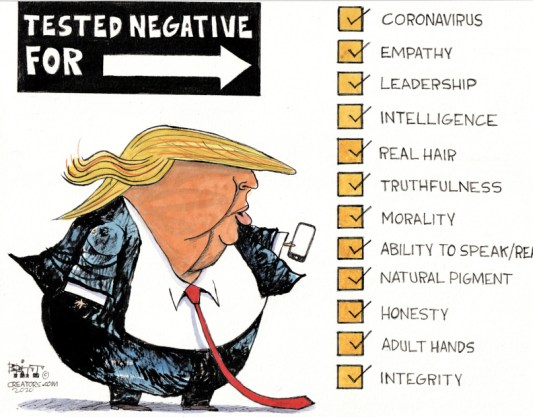
Good Morning!!
We are in deep trouble folks. The “president” is insane. We’ve known that for years, but now we are facing a global pandemic under a chief executive who cares nothing for other humans. His businesses are tanking because of this health crisis and he is panicking because he is incapable of thinking logically, planning for the future, controlling his impulses, or seeing the consequences of his actions. He obviously has severe frontal lobe deficits from dementia in addition to his lifelong malignant narcissism.
Republicans in the Senate had an opportunity to remove him and instead they chose to stick with an insane “leader” in order to line their pockets. Now we are all going to pay the price for their selfishness and short-term thinking.
I watched in horror yesterday as Trump held another “coronavirus briefing” in which he advocated for “reopening the economy” as if that were actually possible. In essence, he was saying that millions of us need to sicken and die in order to save the “economy.” Because of his severe brain damage and his lack of empathy, he cannot understand that if people go back to work the disease will spread and workplaces will end up decimated.
 No intelligent person is going to go out to restaurants and clubs no matter what Trump says. So the economy will still crash and the pain will be unimaginably worse than if we had a nation-wide shutdown for two or three weeks. Of course states with rational governors will continue their shutdown policies, but if red states like Florida stay wide open, the disease will still spread even to states where people are acting responsibly.
Some people are actually suggesting that old people must die so young people can live. But that is not what is likely to happen. In the first place, we now know that young and healthy people can die of this disease. If young and middle-aged people return to their normal work and play routines, they are going to get sick and give the disease to people they interact with.
Meanwhile, older people like me who are intelligent enough to see what is happening and no longer have to go to work will stay home and protect themselves. I live alone and I intend to continue social distancing as long as it is necessary. It’s nothing new for me. I have always liked being alone and being social is hard work for me. I know intellectually that I need other people and I have learned to get myself out to spend time with them, but it won’t kill me to stay home for several weeks with just quick trips out to buy food and other necessities. I will miss seeing people, but I’ll survive. I’m not ready to die yet.
Some stories to check out today:
Bess Levin at Vanity Fair: White House: We’re Going to Have to Let Some People Die So the Stock Market Can Live.
One of the major reasons the United States is in the midst of a
health crisis that has killed 427 people and infected at least 34,354 so far is the fatty mass inside Donald Trump’s head that told him If you pretend like none of this is happening, it’ll all just go away. Singularly obsessed with the stock market, the president squandered his opportunity to contain the novel coronavirus out of fear that taking strong action would damage the economy, telling advisers in February not to “do or say anything that would further spook the markets.” Obviously that plan of “action” backfired so spectacularly that it would be quite funny if not for the whole life and death thing; weirdly, not doing anything about a deadly disease and insisting it was a hoax didn’t actually make investors feel better. Terrified about the fact that the Dow and S&P were still regularly recording some of their worst days since the crash of ’87, Trump decided roughly eight days ago to stop calling the pandemic “fake news” and actually advise people to take it seriously and stay home. One week, however, apparently represented the president’s upper limit for acting quasi-responsibly. Last Thursday, he reportedly began talking privately about getting people back to work, just three days after the CDC rolled out a campaign to encourage everyone to stay home for at least 15 days. On Sunday, he all-caps tweeted, “WE CANNOT LET THE CURE BE WORSE THAN THE PROBLEM ITSELF. AT THE END OF THE 15 DAY PERIOD, WE WILL MAKE A DECISION AS TO WHICH WAY WE WANT TO GO!”Ne
edless to say, telling people to get back to their normal lives within a fortnight is not at all what health experts have recommended. In fact, many agree we’ll have to practice social distancing for at least a year and perhaps up to 18 months, the alternative literally being the death of hundreds of thousands of Americans. Faced with that choice, most people would probably go with the former, even if it meant major damage to economy. And then you have the ghouls of Team Trump…
Click the link and read the rest at Vanity Fair.
Why has Trump suddenly pivoted after just a few days of advocating social distancing? It’s about his own bottom line. David A. Fahrenthold, Joshua Partlow and Jonathan O’Connell at the Washington Post: Before Trump called for reevaluating lockdowns, they shuttered six of his top-earning clubs and resorts.
President Trump’s private business has shut down six of its top seven revenue-producing clubs and hotels because of restrictions meant to slow the spread of the novel coronavirus, potentially depriving Trump’s company of millions of dollars in revenue.
Those closures come as Trump is considering easing restrictions on movement sooner than federal public health experts recommend, in the name of reducing the virus’s economic damage.
In a tweet late Sunday, Trump said the measures could be lifted as soon as March 30. “WE CANNOT LET THE CURE BE WORSE THAN THE PROBLEM ITSELF,” he wrote on Twitter.
In his unprecedented dual role as president and owner of a sprawling business, Trump is facing dual crises caused by the coronavirus. As he is trying to manage the pandemic from the White House, limiting its casualties as well as the economic fallout, his company is also navigating a major threat to the hospitality industry.
That threatens to pull Trump in opposite directions, because the strategies that many scientists believe will help lessen the public emergency — like strict, long-lasting restrictions on movement — could deepen the short-term problems of Trump’s private business, by keeping doors shut and customers away.
Remember, Trump is deep in debt–he borrowed $2 billion from Deutsche Bank to prop up his businesses. And he isn’t actually a billionaire.
Don’t miss this one. Donald McNeil at The New York Times: The Virus Can Be Stopped, But Only With Harsh Steps, Experts Say.
Terrifying though the coronavirus may be, it can be turned back. China, South Korea, Singapore and Taiwan have demonstrated that, with furious efforts, the contagion can be brought to heel.
Whether they can keep it suppressed remains to be seen. But for the United States to repeat their successes will take extraordinary levels of coordination and money from the country’s leaders, and extraordinary levels of trust and cooperation from citizens. It will also require international partnerships in an interconnected world.
There is a chance to stop the coronavirus. This contagion has a weakness.
Although there are incidents of rampant spread, as happened on the cruise ship Diamond Princess, the coronavirus more often infects clusters of family members, friends and work colleagues, said Dr. David L. Heymann, who chairs an expert panel advising the World Health Organization on emergencies.
No one is certain why the virus travels in this way, but experts see an opening nonetheless. “You can contain clusters,” Dr. Heymann said. “You need to identify and stop discrete outbreaks, and then do rigorous contact tracing.”
But doing so takes intelligent, rapidly adaptive work by health officials, and near-total cooperation from the populace. Containment becomes realistic only when Americans realize that working together is the only way to protect themselves and their loved ones.
Unfortunately, it doesn’t look like that will happen here in the U.S. Please read it anyway.
Marc Lipsitch at The Washington Post: Far more people in the U.S. have the coronavirus than you think.
Everyone asks the same important, interrelated questions. In one respect, the answer is the same for all of them: We must vastly expand our testing capacity. No country has controlled transmission effectively without massive testing capacity. The United States currently has a sliver of the capacity we need, which is a tiny fraction of that available in other countries. South Korea has performed over 320,000 tests — almost one for every 150 people. That is 30 times the testing per capita that we have done in the United States. Exceptional teams are racing to solve testing bottlenecks at local and state levels — Massachusetts is just one example — filling the vacuum left by the complete absence of federal leadership.
Regulatory and technical hurdles accounted for early delays. Now that we’re past those, several shortages are getting in the way. We don’t have enough protective equipment for testers, nor swabs for sampling or reagents to extract genetic material from the virus. We don’t have enough physical test kits, or enough human power to run large-scale testing. The result is that we have no idea how many people are infected with the coronavirus or how fast the virus is spreading.
Read the rest at the WaPo.
More reads, links only:
Politico: Health officials want Trump to ‘double down, not lighten up’ restrictions.
Mediaite: Dr. Fauci Reportedly Warning Trump Administration Not to Prematurely Restart Economy.
The New York Times: Trump Has Given Unusual Leeway to Fauci, but Aides Say He’s Losing His Patience.
Jonathan Chait at New York Magazine: Trump Is Back to Waging War on Science, at the Worst Possible Moment.
Bess Levin at Vanity Fair: Trump Won’t Order Vital Coronavirus Supplies Because Corporate CEOs Asked Him Not To.
CNBC: CDC says coronavirus survived in Princess Cruise ship cabins for up to 17 days after passengers left.
The Washington Post: Italy’s coronavirus deaths are staggering. They may be more preview than anomaly.
Marcy Wheeler at Emptywheel: Air Traffic: A Lesson on Pandemic Economics from the Airlines.
Stay safe and healthy Sky Dancers! Please stay home as much as you can.
Lazy Caturday Reads: “The System Was Blinking Red” and Trump Did Nothing
Posted: March 21, 2020 Filed under: Foreign Affairs, morning reads, Republican politics, U.S. Economy, U.S. Politics | Tags: coronavirus, Covid-19, Donald Trump, intelligence agencies 53 Comments
Reading To Her Cat by Utagawa Kuniyoshi (1797-1861
Good Morning!!
As of this morning, the U.S. has 19,000 Covid-19 cases and 247 deaths. The NIH director says we could have 70,000 reported cases by the end of next week. Meanwhile, the federal government is basically doing nothing. We have an utterly incompetent failed real estate tycoon and reality TV clown as “president.” We have known for years now that this man is completely unfit to lead. In just three years he has crippled our most important institutions and we are now on our own, hoping that state and local governments can take up the slack.
Trump had plenty of warnings about the nature of the threat that was bearing down on our country. Just as before 9/11, when George W. Bush ignored the August 6, 2001 PDB titled “Bin Laden Determined to Strike in U.S.,” the “system has been blinking red for months” and Trump sat around watching TV and tweeting insults to his “enemies,” ignoring the threat to our country.
The Washington Post: U.S. intelligence reports from January and February warned about a likely pandemic.
U.S. intelligence agencies were issuing ominous, classified warnings in January and February about the global danger posed by the coronavirus while President Trump and lawmakers played down the threat and failed to take action that might have slowed the spread of the pathogen, according to U.S. officials familiar with spy agency reporting.
The intelligence reports didn’t predict when the virus might land on U.S. shores or recommend particular steps that public health officials should take, issues outside the purview of the intelligence agencies. But they did track the spread of the virus in China, and later in other countries, and warned that Chinese officials appeared to be minimizing the severity of the outbreak.
By Catriona Millar, Scottish artist
Taken together, the reports and warnings painted an early picture of a virus that showed the characteristics of a globe-encircling pandemic that could require governments to take swift actions to contain it. But despite that constant flow of reporting, Trump continued publicly and privately to play down the threat the virus posed to Americans. Lawmakers, too, did not grapple with the virus in earnest until this month, as officials scrambled to keep citizens in their homes and hospitals braced for a surge in patients suffering from covid-19, the disease caused by the coronavirus.
Intelligence agencies “have been warning on this since January,” said a U.S. official who had access to intelligence reporting that was disseminated to members of Congress and their staffs as well as to officials in the Trump administration, and who, along with others, spoke on the condition of anonymity to describe sensitive information.
“Donald Trump may not have been expecting this, but a lot of other people in the government were — they just couldn’t get him to do anything about it,” this official said. “The system was blinking red.”

Of course, as we all know, Trump doesn’t like to read and he doesn’t listen to intelligence briefings. He thinks he’s “a smart guy” and that his gut feelings are more accurate than the actual knowledge and experience of experts. And he’s still doing almost nothing. He just holds a daily press conference instead of his hate rallies and claims he’s doing things that either aren’t happening or can’t happen.
ProPublica: The White House Asked Manufacturers for Help, Then Gave Them No Clear Instructions.
As hospitals across the country face drastic shortages of masks, respirators and other vital equipment, the White House has sent out a plea for donations that’s left many recipients confused and full of questions.
In at least one instance this week, Vice President Mike Pence, who heads the Trump administration’s coronavirus task force, blindsided private industry by requesting that construction companies donate face masks to hospitals. The White House then failed to provide guidance when directly asked.
Pence asked builders on Tuesday to donate the N95 masks used at many construction sites to local hospitals and refrain from ordering more. Within minutes, Stephen Sandherr, chief executive officer of the trade group Associated General Contractors of America, contacted the White House for more details, said Brian Turmail, a group spokesman.
By Adrie Martens
After receiving no reply from the White House, Sandherr sent an email to AGC’s local chapters on Tuesday telling them that Pence’s statement had taken the group by surprise.
“As we received no advance notice of this announcement and we have received no additional guidance from the Administration, it is our view that this should be considered as a voluntary gesture and not a mandate,” Sandherr wrote. Turmail said several AGC members have donated equipment to their local hospitals.
On Thursday, Sandherr finally heard back from the Department of Health and Human Services, speaking on behalf of the White House, and his group’s members were asked not to donate equipment to hospitals, as Pence had instructed. Instead, he was told the group should collect an inventory of available equipment from members, including masks, booties and protective suits, and share it with the administration.

So instead of cutting red tape, the administration is adding more red tape while more people get sick and more people die.
We’ve been hearing for awhile now that we could be like Italy. I think it’s likely we’ll soon be worse off than Italy, because we our health care system is already breaking down and it looks like Mitch McConnell is determined not to help the people who need it most.
There was talk of sending checks to most Americans immediately; now it turns out the GOP plan is to use tax rebates, so the poorest people would get little or nothing (for example, people like me who live on Social Security don’t file taxes) and people who pay more taxes would get more. That makes no sense economically when millions of people have been thrown out of work and won’t be able to pay rent or eat, but Republicans apparently just don’t care.
The Week: Senate GOP stimulus plan would exclude up to 64 million tax filers from full rebate, economist says.
Senate Republicans unveiled their proposal for sending out cash to Americans amid the COVID-19 coronavirus outbreak, but as is, a large number wouldn’t receive the full amounts.
By Dee Nickerson
Under the economic stimulus plan released Thursday, payments of up to $1,200 would be sent out to individuals and $2,400 to married couples, though the amount phases out for single filers making $75,000 a year and joint filers making $150,000 a year. But The Wall Street Journal notes that “individuals need to have qualifying income of at least $2,500 or income tax liability to get the minimum payment of $600.” This is based on their 2018 tax return.
Looking at IRS data, economist Kyle Pomerleau estimates that about 64 million filers who earn less than $50,000 won’t get the full rebate amount of $1,200 or $2,400, as “for a single filer, income must be at least about $23k to get the full $1,200,” and “for married couple filing jointly, AGI must be about $47k to get the full $2,400,” he writes.

Again, the poorest people don’t even file taxes, so they would be shit out of luck too. Furthermore, the amounts they are talking about wouldn’t even cover a month’s rent in the Boston area or other large cities. Right now I’m very grateful that I live on a fixed income in subsidized housing. But even I have had and will continue to have extra expenses and hardships.
Slate: Republicans Found a Way to Mail Checks and Still Screw People Over.
Senate Republicans have now released their hotly anticipated proposal to send families direct cash payments, as part of a wider economic aid package aimed at combating the coronavirus crisis. And hoo boy is it disappointing.
Under the plan, the government would provide households an early tax rebate worth up to $1,200 for an individual or $2,400 for a married couple, with an extra $500 for each of their children. (So far, so good). The payments will be based on a household’s 2018 tax return, or if it didn’t submit one, their 2019 filing.
Two Cats, by Sandra Bierman
But the checks will shrink for both low and high earners. Americans with little to no tax liability (aka, poor folks) will only receive a minimum payment of $600, unless they earned less than $2,500, in which case they get zilch. Low-wage workers who don’t have a federal tax return for 2018 or 2019—adults generally aren’t required to file one they if earn less than the standard deduction—also won’t qualify for the early rebate. (They could still get it next year if they file taxes for 2020, but by that time it will be a bit late.) Meanwhile, the payments phase down for workers who make more than $75,000 and drop to zero for those making $99,000 and above (double those numbers for joint filers).
Limiting these payments for the upper middle class and up is defensible, even if it irritates commentators who’d prefer a more comprehensive approach that mimics a universal basic income. Penalizing the poor during a pandemic, however, is beyond the pale. We’re in the midst of a planned shutdown of the economy that will disproportionately harm low-wage service workers, yet Republicans are concerned about properly rewarding people for work. It is a crass joke.
It’s worth emphasizing that the GOP’s new plan only calls for a single payment. The M

New York City, Seattle, Boston and parts of California already have such large outbreaks that they will probably see significant growth even after taking extraordinary measures over the past week, the researchers say. New York City’s outbreak, the nation’s largest, grew to more than 4,000 known cases on Friday and is likely to increase many times over even in a favorable scenario.
But cases will continue to mount and millions of people will run out of food. We can only hope that Congress wakes up to reality. Here’s what’s really happening:
The Washington Post: U.S. economy deteriorating faster than anticipated as 80 million Americans are forced to stay at home.
The U.S. economy is deteriorating more quickly than was expected just days ago as extraordinary measures designed to curb the coronavirus keep 84 million Americans penned in their homes and cause the near-total shutdown of most businesses.
Lady Petting a Cat, Paula Zima
In a single 24-hour period, governors of three of the largest states — California, New York and Illinois — ordered residents to stay home except to buy food and medicine, while the governor of Pennsylvania ordered the closure of nonessential businesses. Across the globe, health officials are struggling to cope with the growing number of patients, with the World Health Organization noting that while it required three months to reach 100,000 cases, it took only 12 days to hit another 100,000.
The resulting economic meltdown, which is sending several million workers streaming into the unemployment line, is outpacing the federal government’s efforts to respond. As the Senate on Friday raced to complete work on a financial rescue package, the White House and key lawmakers were dramatically expanding its scope, pushing the legislation far beyond the original $1 trillion price tag.

Read the rest at the WaPo.
The Washington Post: Coronavirus-scarred cities need ‘something bigger than the New Deal’ just to cope.
The coronavirus outbreak is forcing every state, city and county to execute a plan of attack for confronting the global pandemic. It’s a process that Sarah Eckhardt, the top official in Texas’s Travis County, likened to “building the plane while in the air.”
But the virus — and the extraordinarily costly response to it — is also putting enormous pressure on all the normal stuff: the criminal justice, sanitation, transit, emergency response and other systems that residents expect from their state and local governments.
Although the nation is just in the first stages of what is likely to be a prolonged struggle to suppress covid-19, the strain on public services is already beginning to show. First responders are stretched thin. Courts are paralyzed. And everywhere, money for basic public services is running out, fast.
“We have to manage beyond the scope of anything one city has prepared for or can handle,” said Seattle Mayor Jenny Durkan, whose city is among the worst-hit in America. “We’re spending all our reserves right now, but we won’t make it if the federal government doesn’t step up and step up big.”
Read more at the link.
This post is getting too long, so I’ll have to wrap it up. There are so many other stories I’d like to share with you. It’s overwhelming. Please take care and stay healthy, Sky Dancers. This is an open thread.
Thursday Reads: Ghost Cities In the Time of Coronavirus
Posted: March 19, 2020 Filed under: morning reads, U.S. Politics 46 Comments
Congress Street near Boston City Hall, typically teaming with tourists and vehicle traffic at 2pm on a Sunday is empty due to the coronvirus, March 16, 2020 (Jim Michaud, MediaNews Group/Boston Herald)
Good Afternoon!!
We truly are living in a whole new world now, and we may never return to the old one.
Gideon Litchfield at MIT Technology Review, March 17, 2020: We’re not going back to normal.
To stop coronavirus we will need to radically change almost everything we do: how we work, exercise, socialize, shop, manage our health, educate our kids, take care of family members.
We all want things to go back to normal quickly. But what most of us have probably not yet realized—yet will soon—is that things won’t go back to normal after a few weeks, or even a few months. Some things never will.
Seattle traffic merging onto interstate, 3PM, Thurs. March 15, Amanda Snyder, Seattle Times
It’s now widely agreed (even by Britain, finally) that every country needs to “flatten the curve”: impose social distancing to slow the spread of the virus so that the number of people sick at once doesn’t cause the health-care system to collapse, as it is threatening to do in Italy right now. That means the pandemic needs to last, at a low level, until either enough people have had Covid-19 to leave most immune (assuming immunity lasts for years, which we don’t know) or there’s a vaccine.
How long would that take, and how draconian do social restrictions need to be? Yesterday President Donald Trump, announcing new guidelines such as a 10-person limit on gatherings, said that “with several weeks of focused action, we can turn the corner and turn it quickly.” In China, six weeks of lockdown are beginning to ease now that new cases have fallen to a trickle.
But it won’t end there. As long as someone in the world has the virus, breakouts can and will keep recurring without stringent controls to contain them. In a report yesterday (pdf), researchers at Imperial College London proposed a way of doing this: impose more extreme social distancing measures every time admissions to intensive care units (ICUs) start to spike, and relax them each time admissions fall. Here’s how that looks in a graph.
The orange line is ICU admissions. Each time they rise above a threshold—say, 100 per week—the country would close all schools and most universities and adopt social distancing. When they drop below 50, those measures would be lifted, but people with symptoms or whose family members have symptoms would still be confined at home.
A woman in New York walks through a lightly trafficked Times Square on March 16.Seth Wenig AP
What counts as “social distancing”? The researchers define it as “All households reduce contact outside household, school or workplace by 75%.” That doesn’t mean you get to go out with your friends once a week instead of four times. It means everyone does everything they can to minimize social contact, and overall, the number of contacts falls by 75%.
Under this model, the researchers conclude, social distancing and school closures would need to be in force some two-thirds of the time—roughly two months on and one month off—until a vaccine is available, which will take at least 18 months (if it works at all). They note that the results are “qualitatively similar for the US.”



I strongly recommend reading the rest at the link above. Like many other publications, Technology Review has made their coronavirus coverage free to everyone.
Another excellent source of information about the coronavirus can be found at Tulane University School of Health and Tropical Medicine, which is publishing a daily newsletter with lists of articles and up-to-date numbers of Covid-19 cases around the world.
We’ve all seen photos of young people partying down in Florida for spring break. They’ve been led to believe that they aren’t vulnerable to Covid-19, but that’s not true.
The New York Times: Younger Adults Make Up Big Portion of Coronavirus Hospitalizations in U.S.
American adults of all ages — not just those in their 70s, 80s and 90s — are being seriously sickened by the coronavirus, according to a report on nearly 2,500 of the first recorded cases in the United States.
The report, issued Wednesday by the Centers for Disease Control and Prevention, found that — as in other countries — the oldest patients had the greatest likelihood of dying and of being hospitalized. But of the 508 patients known to have been hospitalized, 38 percent were notably younger — between 20 and 54. And nearly half of the 121 patients who were admitted to intensive care units were adults under 65, the C.D.C. reported.
Wuhan, China, Feb 4, 2020, pop 11 million
“I think everyone should be paying attention to this,” said Stephen S. Morse, a professor of epidemiology at Columbia University’s Mailman School of Public Health. “It’s not just going to be the elderly. There will be people age 20 and up. They do have to be careful, even if they think that they’re young and healthy.”
The findings served to underscore an appeal issued Wednesday at a White House briefing by Dr. Deborah Birx, a physician and State Department official who is a leader of the administration’s coronavirus task force. Citing similar reports of young adults in Italy and in France being hospitalized and needing intensive care, Dr. Birx implored the millennial generation to stop socializing in groups and to take care to protect themselves and others.
“You have the potential then to spread it to someone who does have a condition that none of us knew about, and cause them to have a disastrous outcome,” Dr. Birx said, addressing young people.
In the C.D.C. report, 20 percent of the hospitalized patients and 12 percent of the intensive care patients were between the ages of 20 and 44, basically spanning the millennial generation.

See also this piece at The New York Times: A Deadly Coronavirus Mix in Florida: An Aging Population and Lots of Young Visitors.
Young people–at least the ones in Florida right now–don’t seem to be taking this seriously.
And Florida’s Gov. Ron DeSantis isn’t helping. NBC News: Florida governor refuses to shut down beaches amid spread of coronavirus.
Florida Gov. Ron DeSantis refused to issue an order to close the state’s beaches, despite fears regarding the spread of the coronavirus.
He instead signed an order that would limit parties on beaches to 10 people per group and force any businesses authorized to sell liquor to reduce occupancy by half, DeSantis told reporters Tuesday. The governor said that local governments can make their own decisions but that his order would follow the latest guidance issued by the Centers for Disease Control and Prevention.
“What we’re going to be doing for the statewide floor for beaches, we’re going to be applying the CDC guidance of no group on a beach more than 10 and you have to have distance apart if you’re going to be out there,” DeSantis said. “So that applies statewide.”
DeSantis is a Republican, of course.
Why is Covid-19 so contagious and difficult to treat?
The problem is that the coronavirus was transmitted to humans from animals and therefore we have no natural immunity to the disease. David Quammen is a science writer wrote a book, Spillover, about these animal-to-human infections–known as zoonotic diseases–was in 2012. From the NYT review by Dwight Garner:
In his powerful and discomfiting new book, “Spillover: Animal Infections and the Next Human Pandemic,” the science writer David Quammen cites a dismal word we’ll be getting used to in the coming decades, whether we like it or not: zoonosis.

Rome, Italy, March 5, 2020
A zoonosis is an animal infection that, through a simple twist of fate, becomes transmissible to humans. Maybe that twist is a needle prick, or contact with an exotic animal or hiking downwind of the wrong farm.
“It’s a mildly technical term,” he admits, but probably not for long. “It’s a word of the future, destined for heavy use in the 21st In his powerful and discomfiting new book, “Spillover: Animal Infections and the Next Human Pandemic,” the science writer David Quammen cites a dismal word we’ll be getting used to in the coming decades, whether we like it or not: zoonosis….
Ebola and bubonic plague are zoonoses. So are, he writes, in a list that peals off the tongue like a distraught Allen Ginsberg poem or an outstanding list of death metal band names, “monkeypox, bovine tuberculosis, Lyme disease, West Nile fever, Marburg virus disease, rabies, hantavirus pulmonary syndrome, anthrax, Lassa fever, Rift Valley fever, ocular larva migrans, scrub typhus, Bolivian hemorrhagic fever, Kyasanur forest disease, and a strange new affliction called Nipah encephalitis, which has killed pigs and pig farmers in Malaysia.”

A couple in Barcelona, Spain, embrace in Catalunya Square on March 15.David RamosGetty I mages
AIDS, he adds, that destroyer of 30 million people, is of zoonotic origin.
In “Spillover” Mr. Quammen investigates many of these diseases, some more than others. He describes the baffled horror of initial outbreaks and then tracks calmly backward. He talks to virologists, doctors, field biologists and survivors about how the animal-to-human infection came to pass. He hopscotches the globe like a journalistic Jason Bourne. Often there aren’t doctors left to be interviewed. The medical personnel who first came into contact with sick patients are frequently dead.
Here’s an article by Quammen in from the January 28, 2020 New York Times: We Made the Coronavirus Epidemic. It may have started with a bat in a cave, but human activity set it loose.
The latest scary new virus that has captured the world’s horrified attention, caused a lockdown of 56 million people in China, disrupted travel plans around the globe and sparked a run on medical masks from Wuhan, Hubei Province, to Bryan, Texas, is known provisionally as “nCoV-2019.” It’s a clunky moniker for a lurid threat.
The name, picked by the team of Chinese scientists who isolated and identified the virus, is short for “novel coronavirus of 2019.” It reflects the fact that the virus was first recognized to have infected humans late last year — in a seafood and live-animal market in Wuhan — and that it belongs to the coronavirus family, a notorious group. The SARS epidemic of 2002-3, which infected 8,098 people worldwide, killing 774 of them, was caused by a coronavirus, and so was the MERS outbreak that began on the Arabian Peninsula in 2012 and still lingers (2,494 people infected and 858 deaths as of November).
Police officers patrol the empty Trocadero plaza next to the Eiffel Tower in Paris on March 17, 2020, Francois Mori AP
Despite the new virus’s name, though, and as the people who christened it well know, nCoV-2019 isn’t as novel as you might think.
Something very much like it was found several years ago in a cave in Yunnan, a province roughly a thousand miles southwest of Wuhan, by a team of perspicacious researchers, who noted its existence with concern. The fast spread of nCoV-2019 — more than 4,500 confirmed cases, including at least 106 deaths, as of Tuesday morning, and the figures will have risen by the time you read this — is startling but not unforeseeable. That the virus emerged from a nonhuman animal, probably a bat, and possibly after passing through another creature, may seem spooky, yet it is utterly unsurprising to scientists who study these things.

Read the rest at the NYT.
Three interviews with David Quammen to check out:
Orion Magazine, March 17, 2020: Why David Quammen Is Not Surprised.
Bozeman Daily Chronicle, February 28, 2020: Quammen: Coronavirus epidemic not a one-time threat.
An audio interview with Quammen at Scientific American, March 18, 2020: David Quammen: How Animal Infections Spill Over to Humans.
One more article about zoonotic diseases from Scientific American, March 18, 2020: Destroyed Habitat Creates the Perfect Conditions for Coronavirus to Emerge.
Those are my recommended reads (and one listen) for today. What stories have you been following?

 peej
peej Carissa
 bostonboomer
 dakinikat
 ecocatwoman
 mablue2
 Mama Lopez
 peggysue22
 quixote
 skydancingguestblogger
 Mona (aka Wonk the Vote)



 Sky Dancing
Recent Comments