
Mostly Monday Reads: Presidents Day in a Lost Country
Posted: February 16, 2026 Filed under: #FARTUS, #MAGAnomics, #We are so Fucked, Democratic Backsliding, Environmental Protection, Foreign Affairs | Tags: @johnbuss.bsky.social John Buss, Democracy Backsliding, Trumpian Whiplash, US/Europe Relations, Victor Orban 15 Comments
“The latest cabinet meetings aren’t televised for a reason. Fear not, our de facto leader is in control as the ethnic cleansing of the country formerly known as the United States roars ahead unabated. The must-see TV drama not being broadcast is Whose Turn Is It to Change the Old Guy’s Diaper?” John Buss, @repeat 1968
Good Day Sky Dancers!
As we stare down the 250th anniversary of the day our country started its journey from monarchy to democracy, we have to take a look at where we’ve landed today and utter some word of disappointment. The headlines today are filled with references to autocracy, and it’s not difficult to see how the MAGA/Trump overreach is playing out.
Politico sums up the current situation like this. “Trump’s second year: Whiplash. Even proposals that don’t ultimately move forward have consequences.” I’d just like a few more adjectives like weird, cruel, and inexplicably unnecessary.
President Donald Trump’s first year back in office was defined by sweeping upheaval that was largely plotted out during his four-year Florida exile. But the president has somehow intensified the volatility in year two with a succession of whiplash-inducing policy swings, several of which have almost immediately withered in the face of Republican opposition and public outcry.
The administration this week finally withdrew the thousands of federal law enforcement officers from Minneapolis, after violent and at times deadly clashes with protesters turned the tide of public opinion against the president’s immigration crackdown.
It came after Trump threatened to decertify Canadian aircraft, a move deemed “unjustified and dangerous” by a Washington-based aerospace trade union that the president soon dropped. Trump said in early January that he’d cap credit card rates at 10 percent, a move that would have upended the banking industry, only to change his mind and ask Congress for legislation.
Also last month, Trump’s administration paused millions in Centers for Disease Control and Prevention funding for state public health infrastructure — only to reverse course roughly 24 hours later.
“The whiplash has real implications,” said Chrissie Juliano, executive director of the Big Cities Health Coalition, a forum of the leaders of metropolitan health departments. “It’s incredibly disruptive, even if you can get back to continuing the work, you know, two days later.”
The unpredictability of a presidency that prioritizes posting over process and often leaves friends and foes alike guessing whether pronouncements should be taken seriously, literally, or both, remains a feature, not a bug of Trump’s approach to governance. In many matters, especially negotiations with other countries, his mercurial opacity is often an attempt to gain leverage, but his threats seemingly lead just as often to backtracking as blowing things up, be they Iranian missile depots, Venezuelan drug boats or the transatlantic alliance.
The same often holds true for domestic policy. The president has made numerous pronouncements with emphatic declarations on social media, sometimes even suggesting he is governing by fiat in cases where legislation is required. But he has quickly moved on from many of them: a cap on credit card interest rates, 50-year mortgages and, according to a new Financial Times report, possibly even the sweeping tariffs on aluminum and steel that have led to higher costs.
 We’re just beginning to explore the depths of depravity that Trump and his buddies will go to just feel powerful and get richer. This is from Robert Reich’s SubStack. “The Squalor of the Epstein Class. Happy Presidents Day!”
Here’s how Kentucky Republican Congressman Thomas Massie responded on Sunday, during ABC’s “This Week,” to a question about the Trump regime’s handling of the Epstein files:
“This is about the Epstein class …. They’re billionaires who were friends with these people, and that’s what I’m up against in Washington, D.C. Donald Trump told us that even though he had dinner with these kinds of people, in New York City and West Palm Beach, that he would be transparent. But he’s not. He’s still in with the Epstein class. This is the Epstein administration. And they’re attacking me for trying to get these files released.”
The Epstein Class. Not just the people who cavorted with Jeffrey Epstein or the subset who abused young girls. It’s an interconnected world of hugely rich, prominent, entitled, smug, powerful, self-important (mostly) men. Trump is honorary chairman.
Trump is still sitting on two and a half million files that he and Pam Bondi won’t release. Why? Because they implicate Trump and even more of the Epstein class. The files that have been released so far don’t paint a pretty picture.
Trump appears 1,433 times in the Epstein files so far. His billionaire backers are also members. Elon Musk appears 1,122 times. Howard Lutnick is there. So is Trump-backer Peter Thiel (2,710 times), and Leslie Wexner (565 times). As is Steven Witkoff, now Trump’s envoy to the Middle East, and Steve Bannon, Trump’s consigliere (1,855 times).
The Epstein Class isn’t limited to Trump donors. Bill Clinton is a member (1,192 times), as is Larry Summers (5,621 times). So are LinkedIn founder Reid Hoffman (3,769 times), Prince Andrew (1,821 times), Bill Gates (6,385 times), and Steve Tisch, co-owner of the New York Giants (429 times).
If not politics, then what connects the members of the Epstein Class? It’s not just riches. Some members are not particularly wealthy, but they’re richly connected. They trade on their prominence, on whom they know and who will return their phone calls.
They exchange inside tips on stocks, on the movements of currencies, on IPOs, on new tax-avoidance mechanisms. On getting into exclusive clubs, reservations at chic restaurants, lush hotels, exotic travel.
Most members of the Epstein Class have seceded into their own small, self-contained world, disconnected from the rest of society. They fly in one other’s private jets. They entertain at one other’s guest houses and villas. Some exchange tips on how to procure certain drugs or kinky sex or valuable works of art. And, of course, how to accumulate more wealth.
Many don’t particularly believe in democracy; Peter Thiel (recall, he appears 2,710 times in the Epstein files) has said he “no longer believes that freedom and democracy are compatible.” Many are putting their fortunes into electing people who will do their bidding. Hence, they are politically dangerous.
The Epstein Class is the by-product of an economy that emerged over the last two decades, from which this new elite has siphoned off vast amounts of wealth.
It’s an economy that bears almost no resemblance to that of mid-20th-century America. The most valuable companies in this new economy have few workers because they don’t make stuff. They design it. They create ideas. They sell concepts. They move money.
 I’ve always argued here and in classes that the biggest economic policies of the Reagan and Bush years were tax cuts that made it more profitable to gamble on financial assets rather than to actually produce goods and services. The changes in tax policies that cut upper brackets, then treated capital gains as a tax slash, and other ridiculous policies mean that money never lands where it can actually do good. It also creates a lot of idle hands and minds.
China is beginning to look more modern, more concerned about actual economic outcomes, and the planet. The U.S. continues to race back to the Gilded Age with hints of the Great Depression years. This is from The Guardian. “The Guardian view on Donald Trump and the climate crisis: the US is in reverse while China ploughs ahead. Editorial. The president’s destructive policies enrich fossil fuel billionaires, while Beijing has bet big on the green transition.”
Devastating wildfires, flooding and winter storms were among the 23 extreme weather and climate-related disasters in the US which cost more than a billion dollars last year – at an estimated total loss of $115bn. The last three years have shattered previous records for such events. Last Wednesday, scientists said that we are closer than ever to the point after which global heating cannot be stopped.
Just one day later, Donald Trump and Lee Zeldin, the head of the US Environmental Protection Agency, announced the elimination of the Obama-era endangerment finding which underpins federal climate regulations. Scrapping it is just one part of Mr Trump’s assault on environmental controls and promotion of fossil fuels. But it may be his most consequential. Any fragment of hope may lie in the fact that a president who has called global heating a “hoax” framed this primarily as about deregulation – perhaps because the science is now so widely accepted even in the US.
The administration claimed, without evidence, that Americans would save $1.3tn. Never mind insurance or healthcare costs; a recent report found that US earnings would be 12% higher without the climate crisis. The Democratic senator Sheldon Whitehouse called the decision “corruption, plain and simple”. In 2024, Mr Trump reportedly urged 20 fossil fuel tycoons to stump up $1bn for his presidential campaign – while vowing to remove controls on the industry.
In the same week as this reckless and destructive US decision, it emerged that China had recorded its 21st month of flat or slightly falling carbon emissions. As Washington tears up environmental regulations, Beijing is extending carbon reporting requirements. China remains the world’s biggest emitter of greenhouse gases, though its per capita and cumulative historical emissions are still far behind those of the US. But clean energy drove more than 90% of its investment growth last year.
The Carbon Brief website, which published the emissions analysis, says the numbers suggest that the decline in China’s carbon intensity – emissions per unit of GDP – was below the target set in the last five-year plan, making it hard to meet its commitments under the Paris agreement. The shift in emissions may not prove enduring. There is fear that China’s focus may change; the next five-year plan, due in March, will be key. Some subsidies for renewable power have already been withdrawn. The installation of huge quantities of renewable energy infrastructure has been accompanied by a surge in constructing coal-fired power plants, though the hope is that these are intended primarily as a fallback.
 We continue to disregard the actual civilized nations and cavort with the worst of the worst. This is from France24. “Rubio tells Orban ‘your success is our success’ during Hungary visit ahead of elections. During a visit to Budapest Monday, just weeks before Hungary’s parliamentary elections, US Secretary of State Marco Rubio told Hungarian Prime Minister Viktor Orban that the nationalist leader’s “success” was a success for the US. An ally of President Donald Trump, who has also maintained ties to Russian President Vladimir Putin, Orban lags behind the main opposition candidate in opinion polls.” The entire Trump cabinet is feckless, shameless, and incompetent. They are also enabling a backslide in democracy.
US Secretary of State Marco Rubio hailed Viktor Orban‘s leadership during a visit to Budapest on Monday, ahead of elections threatening the nationalist prime minister’s hold on power.
Rubio’s visit is the final stage of a whirlwind trip to Europe that also saw him address the Munich Security Conference and visit another right-wing ally, Slovakian Prime Minister Robert Fico.
US President Donald Trump has made no secret of his high regard for Orban, saying in a social media post on Friday that the prime minister had produced “phenomenal” results in Hungary.
But Orban, 62, has a fight on his hands for the April 12 legislative elections in Hungary. Polls suggest his Fidesz party is trailing opposition leader Peter Magyar’s TISZA.
“I can say to you with confidence that President Trump is deeply committed to your success because your success is our success,” Rubio said during a joint press conference with Orban after their meeting.
“The president has an extraordinarily close relationship to the prime minister, he does, and it has had tangible benefits,” he said.
 Europe’s nations have read the writing on the wall, according to CNN’s Kasie Hunt. “Trump’s damage is done. Democrats – and Europe – are struggling to define what’s next.”
Many of the Democrats who came to the Munich Security Conference this weekend want to be president. But even if one of them can win the White House in 2028, they may find they can no longer claim the title every American president since the 1940s has borne: leader of the free world.
California Gov. Gavin Newsom went on stage to insist his state is more permanent than President Donald Trump. But he acknowledged in an interview with CNN that the leaders he met with believe the damage to the transatlantic alliance is irrevocable.
Progressive star Rep. Alexandria Ocasio-Cortez of New York came to pitch a left-wing populist foreign policy but made headlines for a massive stumble instead.
A number of Democratic senators hoping to burnish their foreign policy credentials ahead of possible presidential bids found themselves in a painfully awkward moment with the Danish prime minister, as some Democrats tried to smooth over pugnacious remarks Republican Sen. Lindsey Graham made at the start of the meeting that suggested Trump has not given up his designs on Greenland – a semiautonomous territory of Denmark.
And most members of the House of Representatives who planned to attend didn’t come at all after Republican Speaker Mike Johnson pulled the plug on the congressional delegation.
European thought leaders were reduced to offering a brief standing ovation to Secretary of State Marco Rubio, whose speech was far more conciliatory than the one Vice President JD Vance delivered at the same gathering last year. But Rubio had kicked off his trip telling American reporters: “The old world is gone.” He also left the conference to fly onward to Slovakia and Hungary, two countries led by strongmen sympathetic to Trump.
The conference’s opening remarks from German Chancellor Friedrich Merz crystallized Europe’s new reality in what seems to be rapidly becoming a post-American century.
“A divide has opened up between Europe and the United States,” Merz said Friday. “The United States’ claim to leadership has been challenged, and possibly lost.”
It’s more than just words. Merz has said he held “confidential talks” with France on European nuclear deterrence. It’s a stunning admission there’s no longer unconditional trust that the US will do what needs to be done for its transatlantic allies.
“What I’m hearing now is, even if we are able to repair these relationships, it’s going to take generations before they feel comfortable,” said Democratic Sen. Mark Kelly, of Arizona, a possible presidential hopeful who traveled to Munich not long after learning the Trump administration had tried and failed to indict him over a video he made telling troops not to obey illegal orders.
 If this continues, the momentum and direction of the world’s political entanglements will change. Who knows what this will mean? This Op Ed piece from MS Now by Anthony L. Fisher discusses Trump and his attempts at an Imperial Presidency. “Libertarians warned about the ‘imperial presidency.’ Too few actually warned about Trump. A recent New York Times op-ed showed the blind spot many libertarians still have for President Donald Trump.”
When I saw the headline “Libertarians Tried to Warn You About Trump” atop a New York Times op-ed last Monday, I thought, “Hmmm, that’s not quite how I remember it.” Adorned with the striking image of the Gadsden flag’s “Don’t Tread on Me” snake about to get curb-stomped by an enormous black jackboot, the piece was written by Katherine Mangu-Ward, editor in chief of the libertarian magazine and website Reason — where I worked as a journalist for roughly six years. (I left shortly after President Donald Trump’s first inauguration.)
Sure enough, upon reading the column, I discovered the headline didn’t accurately reflect Mangu-Ward’s argument. She primarily made the case that libertarians have warned for years — under presidents in both major parties — about the dangers of ever-expanding executive authority, what’s been aptly coined the “Imperial Presidency.” Rather than claiming to have specifically warned “about Trump,” the writer boasted that libertarians had long sounded the alarm over the consolidation of such power — power now being used for nefarious purposes by a president who just happens to be Donald Trump. (The Times later that day amended the headline to the less specific but more honest, “Libertarians: We Told You So.”)
I can’t argue with that. To the extent most self-identified professional libertarians warned about Trump, they warned about the awesome powers that could be abused by a generic authoritarian president from either party.
But Trump is not a hypothetical. He always told us who he was. And there are far fewer of us who took (and continue to hold) the comparatively unpopular view among libertarians and other right-of-center fellow travelers that Trump presented as a uniquely authoritarian, vindictive, racist, corrupt and lawless demagogue — of which there isn’t remotely an analog on the other side of the aisle.
The problem is that, even now that Trump has proven us skeptics right on every one of those counts, too many libertarians continue to position themselves safely in a “pox on both your houses” perch — much too nuanced and enlightened to be dragged into partisan rancor. This position is how your movement ends up conflating the tyranny of overbearing, temporary Covid policies in Democratic-run areas as equal to (or worse than) the tyranny of a secret police force acting without due process for everyone when attempting to arrest suspected illegal immigrants, summarily executing Americans in the street and branding them “domestic terrorists” while their bodies are still warm.
All of these thoughts lead to one logical conclusion. The Midterm elections need to depose him and remove the spineless and the true believers, or whatever this is, from Congress.
Just to let you know, we’re having the most unkind Mardi Gras Celebration that even the police have seen. We seem to have been overrun by spontaneous groups of young men that are behaving a lot like the droogies in A Clockwork Orange. I may write about it on Friday; however, I’m busy listening to my friends’ experiences uptown and around the Quarter right now.
Peace, Love, and Understanding to you all!
What’s on your Reading, Action, and Blogging Lists today?
Not Just Another Monday Reads: Living through Traumaverseries
Posted: August 29, 2022 Filed under: Climate Change, Climate change, Climate/Inflation Package, corporate greed, corporatism, Environment, Environmental Protection | Tags: Hurricane Katrina anniversary 15 Comments Good Day Sky Dancers!
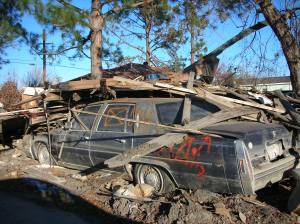
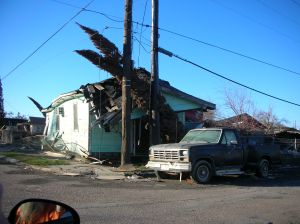
It’s difficult to explain how much one date could traumatize and change an entire American city but today is one of those days. 17 years ago, the levees topped after Hurricane Katrina directly hit the city. It’s still very hard for me to look at these pictures of the devastation my youngest daughter took in the Lower 9–across the canal from me–on the Thanksgiving weekend following Katrina. They were still pulling dead bodies from the debris at that time.
This top picture shows one of the few houses that didn’t collapse with its Katrina cross, indicating someone had died in that home. I watched all of this on CNN from the safety of a pink futon on the floor with my two yellow labs and Miles the Wondercat from a motel in St. Charles, LA that would later be devastated by Hurricane Rita.
My house sat high and dry on the high ground with a nearly new roof and some minor wind damage. The following six months were an experience of camping out in your own home with minimal electricity and chasing around to find working gas stations and open grocery stores. I also made a daily pilgrimage to the Red Cross station in the Quarter to pick up cleaning supplies and food. I really experienced survivor guilt too. Something I hadn’t had since I wound up being the only person known to survive the rare type of cancer I had five years before that. That was definitely not an enjoyable emotional experience either.
I’m also reminded of Hurricane Ida last year, which disrupted my life and significantly impacted my house. However, now, my insurance company wised up, gave me a $10k deductible, and basically told me I was on my own. Thankfully, I got a FEMA grant.
Teacher of the year and Katrina Survivor Chris Dier has a tremendous long thread on the federal mishaps that led to our devastation and the crony capitalism that has crippled us since then.
 Diel lived in extremely hard-hit St. Bernard Parish, with most houses and infrastructure destroyed. He was 17 at the time. He’s chosen a series of articles to orchestrate the steps that have led us to where we are today, which is not fully recovered or whole. It’s also left us, victims, to charter schools and AirBNBs.
Today, I’m here to remind you that climate change is real and has already had devasting impacts all over our sweet mother earth and ecosystems and the life it supports. Failure to deal with it is a failure of global governance.
Human-driven climate change has set in motion massive ice losses in Greenland that couldn’t be halted even if the world stopped emitting greenhouse gases today, according to a new study published Monday.
The findings in Nature Climate Change project that it is now inevitable that 3.3 percent of the Greenland ice sheet will melt — equal to 110 trilliontons of ice,the researchers said. That will trigger nearly a foot of global sea-level rise.
The predictions are more dire than other forecasts, though they use different assumptions.While the study did not specify a time frame for the melting and sea-level rise, the authors suggestedmuch of it can play out between now and the year 2100.
“The point is, we need to plan for that ice as if it weren’t on the ice sheet in the near future, within a century or so,” William Colgan, a study co-author who studies the ice sheet from its surfacewith his colleaguesat the Geological Survey of Denmark and Greenland, said in a video interview.
https://twitter.com/JacksonVoss/status/1564266109058023425
This is the link to the above Twitter and is from Southerly Magazine. Minorities and the poor are the ones suffering the most from the impact of climate change. “ ‘They want us gone’: Black Louisianans fight to rebuild a year after Ida. Residents of Ironton and West Point a la Hache are still pushing federal and state agencies to help them make their communities safer before the next storm.”
A year after Hurricane Ida brought eight to 15 feet of floodwater to Plaquemines Parish—a coastal parish in Southeast Louisiana—historic Black communities Ironton and West Point a la Hache are still fighting for a just recovery. Slow-moving action from federal agencies like HUD and FEMA, a massive shortage in affordable housing, and inadequate flood protection have left residents facing a difficult decision: leave behind neighbors, traditional lifeways, and ancestral lands to migrate in search of housing, or fight to rebuild, elevate homes and make the coast more resilient to intense storms.
I’ve been working as an organizer in Plaquemines Parish since 2020, starting with a successful campaign to stop an oil terminal from excavating a cemetery where enslaved people were laid to rest. I continue to support residents in their efforts to rebuild after Ida and advocate for stronger flood protection. Recently, I spoke with several residents to hear about their experience with recovery from the storm. A year since Ida’s landfall, nearly all of my friends in Plaquemines Parish have yet to return home.
Many residents are still living in temporary housing. FEMA has long been criticized for its inability to address emergency housing needs in a timely manner. In Southwest Louisiana, some families whose homes were destroyed in Hurricane Laura waited 10 months for FEMA to issue temporary trailers. After the 2021 hurricane season, Louisiana set up a new emergency housing program called the Ida Sheltering Program to issue travel trailers more quickly, and the state has housed nearly 12,000 residents through this program. But it’s unclear what other housing options are available to them. Louisiana faced a severe shortage of affordable housing before the hurricane.
Ironton residents have hung signs throughout their community to let Plaquemines Parish know they intend to come back and rebuild.
 The Biden Administration and Democratic Congress have made meager but credible steps toward alleviating Climate Change devastation. But will it be enough for Democrats to hold on and improve their position in Congress to continue the fight?
In Nevada, the intense heat brings drought and different problems due to climate change. This is from The Washington Post. “In fast-warming Nevada, climate bill may not lift Democrats. Sen. Catherine Cortez Masto (D-Nev.) has campaigned on the biggest climate bill in U.S. history. But her pitch may not resonate with voters who are more worried about the rising cost of living.” Is it really the short-term economic woes that will draw voters?
About a week after President Biden signed into law the largest climate bill in U.S. history, Sen. Catherine Cortez Masto (D-Nev.) laid out to voters here how she helped get $4 billion in the bill to combat the acute drought now punishing the American West. Outside the air-conditioned offices of the Las Vegas Valley Water District where she spoke, the temperature stood at 93 degrees — on its way to an oppressive 106 later that day.
“As you all know, the western U.S. continues to face a historic drought, and we need to do all we can to combat it,” Cortez Masto said Monday, standing before a photo showing the nation’s largest reservoir, Lake Mead, at record lows. “That’s why I have been championing measures to help Southern Nevada further conserve, recycle and reduce water use.”
Cortez Masto — one of the most vulnerable Democratic senators up for reelection this year — has spent recent weeks courting Nevada voters who want leaders in Washington to prioritize the climate crisis. Yet climate change has rarely decided the outcome in congressional races, even in Las Vegas, the nation’s second-fastest warming city in a region experiencing the most extreme drought in 1,200 years.
Voters across the country have consistently ranked the economy and health care as a higher priority than global warming. And if Democrats cannot successfully sell their environmental agenda in Nevada, which has seen a cascade of climate disasters this summer, it’s unclear whether climate concerns will ever become paramount in key national races.

Warning of doom: ‘Hunger stones’ surface in drought-stricken waters
Any part of the country served by the waters of the Colorado River is bound to be uninhabitable sooner than later. The Deserts and Coasts of our country are rapidly becoming places where life cannot be sustained.
The generous monsoon season along the Upper Basin of the Colorado River has been a relief to those who remember recent summers suffocated by wildfire smoke in the American West. But according to Brad Udall, senior water and climate research scientist at the Colorado Water Institute and director of the Western Water Assessment at Colorado State University, the relief we’re feeling now is a sign of bigger problems for years to come.
“Next year’s runoff will be really interesting to see what happens, it will be a test of this theory of depleted soil moisture,” Udall told a packed room at the Betty Ford Alpine Gardens Education Center on Aug. 19. The theory he referenced examines how the recent precipitation affects the trending drought conditions, drying reservoirs and the lowering state of the Colorado River, which is the primary source of water for over 40 million people spread across seven Western states, over thirty Native American tribes and into Mexico.
Udall’s relationship with the Colorado River goes deeper than just the focus of his studies. He grew up along its banks and worked as a river guide in his earlier years. He also comes from a long lineage of family members who have been influential in the river’s management for more than a century. His father, former congressman Mo Udall, fought to channel river water to Arizona. His uncle, Stewart Udall, was the former Secretary of the Interior who opened the Glen Canyon Dam. And his great great grandfather, John D. Lee, established Lees Ferry in Arizona. “Udalls are, in fact, Lees,” he told the crowd.
With a litany of charts, peer-reviewed studies and side-by-side chronological photographs of depleting reservoirs, Udall’s presentation, titled, “Colorado River Crisis: A Collision of 19th Century Water Law, 20tth Century Infrastructure and a 21st Century Population Growth and Climate Change,” broke down the intricacies of the compact that draws the water rights between these states, while establishing the environmental agitators that have formed, and grown, since the compact was agreed upon in 1922.
Merriam-Webster defines “drought” as “a period of dryness especially when prolonged.” According to Udall, we are beyond treating the Colorado River crisis as something that will soon pass, or ever will.

People walk near a bank of the Loire River as historical drought hits France, in Loireauxence, France, August 16, 2022. REUTERS/Stephane Mahe
From Daily Sabah: “Warning of doom: ‘Hunger stones’ surface in drought-stricken waters.”
Carvings in boulders that were used to record historic droughts are resurfacing in waterways across drought-stricken Europe.
Ancient ominous warnings carved on usually submerged boulders along the Elbe River had for centuries driven fear into the hearts of Czechs, but their reappearance during this year’s drought is just a reminder of how tough people had it.
The stones can only be seen above the water surface during droughts and are used to presage bad harvests, interrupted river navigation and consequent famine. Now, the messages appear weeks after weather and crop forecasts.
Such a stone on the banks of the Elbe River, which starts in the Czech Republic, and ends in Germany dates back to 1616. The boulder was inscribed with “Wenn du mich seest, dann weine” – “If you see me, then weep,” according to a Google translation.

A view shows a branch of the Loire River as an historical drought hits France, in Loireauxence, France, August 16, 2022. REUTERS/Stephane Mahe
From Reuters: “France’s river Loire sets new lows as drought dries up its tributaries.”
France’s river Loire, famous for the hundreds of castles gracing its shores, is a shallow river at the best of times, but this year even its flat-bottom tourist barges can barely navigate waters greatly reduced by a record drought.
Even some 100 kilometers from where the Loire empties into the Atlantic Ocean, sand banks now stretch as far as the eye can see, large islands connect to the shore and in places people can practically walk from one side of the river to the other.
This is not normal. The nations in Africa address Climate Change today in a conference in Gabon.
One last thing from Louisiana!
Okay, maybe two! What’s on your reading and blogging list today? It’s okay to put other topics up. Our threads are always open!
May the Fourth be with You!
Posted: May 4, 2018 Filed under: Climate Change, Environment, Environmental Protection, Environmentalists, morning reads | Tags: BLM. Department of Interior, EPA, Scott Pruitt, the environment. climate change 20 Comments
Disney Storyboard Drawing of a Dinosaur from Fantasia (1940)
Good Morning!
I’ve always loved SF and fantasy but I’ve also loved delving into the mysterious past. What kid doesn’t like stories about dinosaurs and spaceships? One of all time favorite things to watch is Disney’s Fantasia. I love the animated Dinosaurs brought to life to the strains of Stravinsky’s ‘The Rite of Spring’. There’s some news dealing with the EPA, our planet, and our dependence on fossil fuels I’d like to share today. Climate change is real. The current administration only cares about enriching itself and its friends. What does this mean for our fragile time on this planet?
From The Grist: Humans didn’t exist the last time there was this much CO2 in the air.
The last time atmospheric carbon dioxide levels were this high, millions of years ago, the planet was very different. For one, humans didn’t exist.
On Wednesday, scientists at the University of California in San Diego confirmedthat April’s monthly average atmospheric carbon dioxide concentration breached 410 parts per million for the first time in our history.
We know a lot about how to track these changes. The Earth’s carbon dioxide levels peak around this time every year for a pretty straightforward reason. There’s more landmass in the northern hemisphere, and plants grow in a seasonal cycle. During the summer, they suck down CO2, during the winter, they let it back out. The measurements were made at Mauna Loa, Hawaii — a site chosen for its pristine location far away from the polluting influence of a major city.
Increasingly though, pollution from the world’s cities is making its way to Mauna Loa — and everywhere else on Earth.
In little more than a century of frenzied fossil-fuel burning, we humans have altered our planet’s atmosphere at a rate dozens of times faster than natural climate change. Carbon dioxide is now more than 100 ppm higher than any direct measurements from Antarctic ice cores over the past 800,000 years, and probably significantly higher than anything the planet has experienced for at least 15 million years. That includes eras when Earth was largely ice-free.
Not only are carbon dioxide levels rising each year, they are accelerating. Carbon dioxide is climbing at twice the pace it was 50 years ago. Even the increases are increasing.
That’s happening for several reasons, most important of which is that we’re still burning a larger amount of fossil fuels each year. Last year, humanity emitted the highest level of greenhouse gas emissions in history — even after factoring in the expansion of renewable energy. At the same time, the world’s most important carbon sinks — our forests — are dying, and therefore losing their ability to pull carbon dioxide out of the air and store it safely in the soil. The combination of these effects means we are losing ground, and fast.
From the New York Times: ‘It was 122.4°F This Week in Pakistan, Probably a World Record for April’
Even in Pakistan, no stranger to blistering heat, the temperature on Monday stood out: 122.4 degrees Fahrenheit.
The reading came from Nawabshah, a city of 1.1 million people in southern Pakistan, and meteorologists say it is the highest temperature ever reliably recorded, anywhere in the world, in the month of April.
The World Meteorological Organization keeps global temperature records, but not by month, which means Monday in Nawabshah cannot be officially confirmed as the hottest April day. But experts on extreme temperatures say it probably is.
Christopher C. Burt, the author of “Extreme Weather: A Guide and Record Book” and a contributor to Weather Underground, said that 122.4 degrees, or 50.2 degrees Celsius, appeared to be the hottest reliably measured April temperature “in modern records for any location on Earth.” Only one reading might challenge it: 123.8 degrees Fahrenheit, or 51 degrees Celsius, recorded in Santa Rosa, Mexico, in April 2011. But Mr. Burt said that measurement was “questionable because the site was a regional observation site and not of first order.”

Fantasia “Rite of Spring” Concept Art (Walt Disney, 1940)
From Montana’s KRTV 3: ‘Clean-up plan being developed for oil spill on Fort Peck Indian Reservation’.
A oil spill occurred at an oil well operated by Anadarko Minerals Inc. near Lustre, which is located in the central region of the Fort Peck Indian Reservation.
According to a press release, the spill was reported to the Tribes’ Office of Environmental Protection (OEP) on Friday, April 27.
The spill was spotted by a rancher doing a flyover in the area. The exact date that the leak occurred has not yet been determined. The well had been shut-in in late December of 2017.
Wilfred Lambert of the Fort Peck Tribes OEP and officials from the federal Bureau of Land Management (BLM) initially estimated that 600 barrels of oil and 90,000 barrels of production water, also known as brine, were released from the well.
The oil and brine flowed approximately 200 yards downhill to a stock pond used by tribal entities for watering livestock.
The press release states that the extent of the stock pond’s contamination has not been determined. Early assessments indicate about three to six inches of oil sitting on top of the water.
I don’t think these three event require much explanation and cannot be viewed with too much consternation. We’ve been warned about all of this by the scientists and Cassandras of earth science and climate science. It’s all getting worse at a much faster and more disturbing rate than projected.
Meanwhile, Scott Pruitt is the swamp thing that administers our EPA. You know, that agency that was the pride of the Nixon administration meant to clean up our messes and perpetual destruction of our environment. He also frets his brow over the Bureau of Land Management and the Department of Interior. The BLM came about during the Truman years. The Department of interior has been around since 1849 and has its roots as far back as Madison although it was established through the Polk administration on the eve of Zachary Taylor’s inauguration. It is the agency which took the main approach to Native Americans after a number of Secretaries of States argued that the land and indigenous people of America was not best served by their Departments. These agencies really are most responsible for our past and our future in numerous ways.
 Both the Department of Interior and the EPA are headed by knuckle dragging, corrupt fools. There also seems to be some internecine drama between their dueling ids. Both have taken the idea of using a Federal position for personal benefit and show boating to new heights.
 As Environmental Protection Agency Administrator Scott Pruitt faces a seemingly endless stream of scandal, his team is scrambling to divert the spotlight to Interior Secretary Ryan Zinke. And the White House isn’t happy about it.
In the last week, a member of Pruitt’s press team, Michael Abboud, has been shopping negative stories about Zinke to multiple outlets, according to two sources with direct knowledge of the efforts, as well as correspondence reviewed by The Atlantic.
“This did not happen, and it’s categorically false,” EPA spokesman Jahan Wilcox said.
The stories were shopped with the intention of “taking the heat off of Pruitt,” the sources said, in the aftermath of the EPA chief’s punishing congressional hearing last week. They both added, however, that most reporters felt the story was not solid enough to run. On Thursday, Patrick Howley of Big League Politics published a piece on the allegations; he did not respond to request for comment as to his sources.
Abboud alleged to reporters that an Interior staffer conspired with former EPA deputy chief of staff Kevin Chmielewski to leak damaging information about the EPA, as part of a rivalry between Zinke and Pruitt. The collaboration, Abboud claimed, allowed the Interior staffer to prop up Zinke at the expense of Pruitt, and Chmielewski to “get back” at his former boss.
Abboud offered to connect reporters with Healy Baumgardner as a second source, according to a person with direct knowledge. Baumgardner, a former Trump campaign official, is a global energy lobbyist for the U.S.-China Exchange. She’s close to some EPA officials, the source, as well as an EPA official, confirmed. Baumgardner did not immediately return a request for comment.
According to the two sources, Interior staffers who fielded the reporters’ calls were able to ascertain that Abboud, who is a former Trump campaign official, was behind the stories. The Interior Department’s White House liaison then called the White House Presidential Personnel Office to complain about his conduct.
 There is a stream of complaints about Pruitt’s conduct. None of them garner the proper attention.
Scott Pruitt’s itinerary for a February trip to Israel was remarkable by any standard for an Environmental Protection Agency administrator: A stop at a controversial Jewish settlement in the West Bank. An appearance at Tel Aviv University. A hard-to-get audience with Israeli Prime Minister Benjamin Netanyahu.
One force behind Pruitt’s eclectic agenda: casino magnate and Republican megadonor Sheldon Adelson, a major supporter of Israel who arranged parts of Pruitt’s visit.
The Israel trip was canceled days before Pruitt’s planned departure, after The Washington Post revealed his penchant for first-class travel on the taxpayers’ dime. But federal documents obtained by The Post and interviews with individuals familiar with the trip reveal that it fit a pattern by Pruitt of planning foreign travel with significant help from outside interests, including lobbyists, Republican donors and conservative activists.
After taking office last year, Pruitt drew up a list of at least a dozen countries he hoped to visit and urged aides to help him find official reasons to travel, according to four people familiar with the matter, who spoke on the condition of anonymity to discuss internal agency deliberations. Pruitt then enlisted well-connected friends and political allies to help make the trips happen.
 Ongoing allegations of Pruitt’s attempts to the EPA into his person bank and travel agency are astounding. They keep oozing out of his swamp. From EWG: ‘Reports: Before Confirmed, Scott Pruitt Wanted EPA Office, Private Phone Booth in Okla.’
Congressional leaders are demanding information from Environmental Protection Agency head Scott Pruitt over allegations he wanted taxpayers to open an office in his hometown of Tulsa, Okla., before he was confirmed by the Senate.
Democrats on the House Science, Space and Technology Committee sent letters this week to Pruitt and the head of the Government Services Administration seeking all records that may show there was an attempt to find an office in Tulsa.
The letters say that in early 2017, Ryan Jackson – now Pruitt’s chief of staff but then a top congressional aide – wanted the GSA to look for office space in Tulsa, 250 miles from the EPA regional headquarters in Dallas. Jackson asked that the office include a private, secure phone booth, like the one Pruitt later spent $43,000 to install at EPA headquarters in Washington.
“It appears that even before he was confirmed, EPA Administrator Scott Pruitt had dreams of dismantling programs to protect air, water and kids from pollution from the comforts of an office in his hometown,” said EWG President Ken Cook. “What better place to have a secure phone booth to receive instructions from the energy lobby, and avoid the pesky expertise of agency scientists and lawyers?”
“Each day brings new evidence of Pruitt’s obsession to embellish the trappings of his office and adorn his days with pricey perquisites, taxpayers be damned. Historians will make note of Pruitt’s record of fleecing the public and attacking public health as signature ‘accomplishments’ of the Trump presidency.”
 Trump appears unwilling to deal with Pruitt. This is from VOX: ‘Why Trump would really, really rather not fire Scott Pruitt. The EPA administrator has given the White House most of the few policy wins it has to date.’ That’s rather disturbing.
Scott Pruitt’s tenure as head of the Environmental Protection Agency is now deeply tainted by a stunning number of alleged ethical and legal violations. There are at least 10 investigations into potential violations like his $43,000 phone booth, his 20-person security detail, and his housing deal with a lobbyist’s wife. And fallout, like the resignation and new congressional scrutiny of the head of his security team, Pasquale Perrotta (just reported by ABC News), continues.
To some Democrats in the House and Senate, environmental groups who’ve launched the Boot Pruitt campaign, and former top ethics officials, what should happen now is very clear: Pruitt should resign.
“I think your actions are an embarrassment to President Trump and distract from the EPA’s ability to effectively carry out the president’s mission,” said Rep. Frank Pallone (D-NJ) during one of two House hearings on Pruitt last week. (A whistleblower, by the way, is now saying Pruitt lied during the hearings.)
Yet in an administration afflicted with unprecedented turnover, Pruitt has remained startlingly resilient.
His subservience to Trump appears to be one reason why he has dodged the ax. “People are not people to [Trump], they are instruments of his ego,” Tony Schwartz, the ghostwriter on Trump’s book The Art of the Deal, told the New York Times. “And when they serve his ego, they survive, and when they don’t, they pass into the night.”
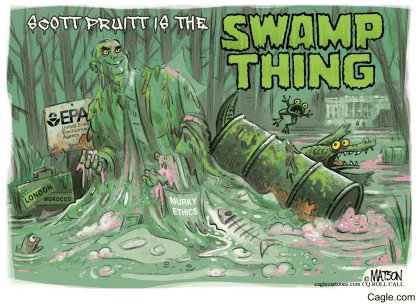 Pruitt must be impeached if Trump refuses to deal with him. This from Forbes.
No self-respecting prosecutor would be proud of winning a shoplifting conviction for a suspected murderer. But that’s almost exactly what’s happening in the congressional investigation of Environmental Protection Agency head Scott Pruitt.
Last week, lawmakers grilled Pruitt for renting a ridiculously cheap luxury condo from the wife of a lobbyist trying to get EPA approval for a client’s project. They asked why he reassigned investigators of criminal violations of environmental laws to his personal security detail.
It was all about the “appearance” of corruption. But the truth is that these petty corruptions pale in comparison to Pruitt’s actual policy record at the EPA.
The EPA is a science agency. It’s supposed to consult closely with scientists and base its decisions on rigorous evidence. While adherence to this principle has never been perfect, under Pruitt’s leadership it’s been trashed beyond recognition.
Even as he was about to face his congressional questioning, Pruitt announced a deceptive science “transparency” initiative. It’s a proposed rule stating that only scientific studies which are reproducible, and in which all underlying data are publicly available, can be used as the basis for regulation.
It sounds unobjectionable. But it would end up keeping a whole lot of public health data—on the impact of pollution, pesticides, or climate change, for example—out of the EPA’s hands.
For obvious ethical reasons, many public health studies can’t be repeated—not if they’d entail intentionally exposing people to toxins—and raw data on individuals’ health histories usually can’t be disclosed. Several hundred scientists pointed out these facts in a letter to Pruitt, but Pruitt doesn’t care what scientists think.
It gets really egregious when you look at what kind of data political appointees at the EPA want to exempt from the rule: proprietary corporate data, according to internal discussions obtained by the Union of Concerned Scientists. The proposed rule provides wide discretion to the EPA administrator—and only the administrator—to grant exemptions to the transparency requirement on a case-by-case basis. And Pruitt seems far more inclined to grant those exceptions to polluting industries, not
So many policies and actions of modern Republicans basically are aimed at killing every one. They are either extremely shorted sided or actually believe that they will some how escape the karma they’re bringing on to the planet and country. It might be that they are simply a cult of mass destruction since so many of them are whack-a-do Dominionists and actively seek an ends times.
They are bringing on an end times or a dystopia or whatever it is that I used to watch and read about in those old books. I’m not seeing a Star Trek future in any of this. In any case, we must stop this administration before these things cannot be undone. Enough of what’s gone on recently appears irreversible as it is.
What’s on your reading and blogging list today?
Friday Reads: Animal Farm
Posted: June 30, 2017 Filed under: Climate Change, Environmental Protection, Environmentalists, Health care reform, morning reads, religious extremists, Republican Tax Fetishists, Trump, U.S. Economy, U.S. Politics 44 Comments It’s difficult not to think about what the current state of affairs means in terms of the celebration of Independence Day as we head into Fourth of July Festivities. Our country was born of the Age of Reason. Thomas Jefferson–who wrote the document proclaiming US Independence–was an amateur scientist and philosopher. He might be considered the ideal Renaissance man if he had also found a way to support his causes and lifestyle with employees instead of slaves.
There’s always been this dark side to the American Dream and there have been many people throughout history who have fought those inclinations. It’s been a slow climb from the idea that we all are created equal to getting to a society that actually lives that value. The climb continues.
Why is it so difficult to treat one another with the respect and dignity we each deserve?
The Republican leadership and Administration is based on the most vulgar, salacious, and base motivations we’ve witnessed since Andrew Jackson was committing mass genocide on human beings he considered “savages” and since a group of people considered the nation’s black Americans to be not wholly human. They deemed all folks with African descent to be precisely 3/5ths human. All of this was done in the name of the same religion that tortures our better angels today.
 The cognitive dissonance is simply mind boggling. Today, Ahvaz Iran has reached an almost unheard of temperature of 129. It’s one of the hottest temperatures ever recorded on the planet.
Another weather source, the Weather Underground, said Ahvaz hit 129.2 degrees Thursday afternoon. The heat index, which also takes humidity into account, hit an incredible 142 degrees.
Fortunately, the weather forecast for Ahvaz on Friday is for “cooler” weather, with a high of only 119 degrees, according to AccuWeather.
The official all-time world record temperature remains the 134-degree temperature measured at Death Valley, Calif, on July 10, 1913. However, some experts say that temperature isn’t reliable. Weather Underground weather historian Christopher Burt said in 2016 that such an extreme temperature was “not possible from a meteorological perspective.”
Scorching heat is one of the most expected outcomes of man-made climate change, according to a 2016 report from the National Academy of Sciences and a 2015 study in Nature Climate Change.
 The prestigious magazine Science published a study estimating the economic cost of climate change to the US economy. It’s not pretty. You can read the fully study at the link. This is its Abstract.
Estimates of climate change damage are central to the design of climate policies. Here, we develop a flexible architecture for computing damages that integrates climate science, econometric analyses, and process models. We use this approach to construct spatially explicit, probabilistic, and empirically derived estimates of economic damage in the United States from climate change. The combined value of market and nonmarket damage across analyzed sectors—agriculture, crime, coastal storms, energy, human mortality, and labor—increases quadratically in global mean temperature, costing roughly 1.2% of gross domestic product per +1°C on average. Importantly, risk is distributed unequally across locations, generating a large transfer of value northward and westward that increases economic inequality. By the late 21st century, the poorest third of counties are projected to experience damages between 2 and 20% of county income (90% chance) under business-as-usual emissions (Representative Concentration Pathway 8.5).
Meanwhile, the man responsible for the EPA–professional whackadoodle Scott Pruitt–launches program to ‘critique’ climate science.
“We are in fact very excited about this initiative,” the official added. “Climate science, like other fields of science, is constantly changing. A new, fresh and transparent evaluation is something everyone should support doing.”
The disclosure follows the administration’s suggestions over several days that it supports reviewing climate science outside the normal peer-review process used by scientists. This is the first time agency officials acknowledged that Pruitt has begun that process. The source said Energy Secretary Rick Perry also favors the review.
Executives in the coal industry interpret the move as a step toward challenging the endangerment finding, the agency’s legal foundation for regulating greenhouse gases from cars, power plants and other sources. Robert Murray, CEO of Murray Energy Corp., said Pruitt assured him yesterday that he plans to begin reviewing the endangerment finding within months.
“We talked about that, and they’re going to start addressing it later this year,” Murray said in an interview. “They’re going to start getting a lot of scientific people in to give both sides of the issue.”
But another person attending the meeting said Pruitt resisted committing to a full-scale challenge of the 2009 finding. The administration source also said Pruitt “did not promise to try to rescind the endangerment finding.”
Climate scientists express concern that the “red team, blue team” concept could politicize scientific research and disproportionately elevate the views of a relatively small number of experts who disagree with mainstream scientists (Climatewire, June 29).
Pruitt told about 30 people attending a board meeting of the American Coalition for Clean Coal Electricity yesterday morning that he’s establishing a “specific process” to review climate science, the administration official said. Murray and two other people in the room interpreted Pruitt as saying he would challenge the endangerment finding.
Challenging the endangerment finding would be enormously difficult, according to many lawyers. The finding is built on an array of scientific material establishing that human health and welfare is endangered by a handful of greenhouse gases emitted by industry, power plants and cars. It stems from a Supreme Court ruling in 2007.
If Pruitt somehow succeeded in rolling back the finding — an outcome that many Republicans say is far-fetched — the federal government would no longer be required to restrict greenhouse gas emissions.
 Other evidence that there is no sign of intelligent life in the majority of Republicans are these doozies:
Trump Administration Appoints Anti-Transgender Activist To Gender Equality Post
“To put it simply, a boy claiming gender confusion must now be allowed in the same shower, bathroom, or locker room with my daughter,” wrote the new senior adviser for women’s empowerment at USAID.
White House council for women and girls goes dark under Trump
The administration is evaluating whether to keep the office, created under President Barack Obama to focus on gender equality
 I agree with Ezra Klein on this: “It turns out the liberal caricature of conservatism is correct. It’s depressing. But it’s true.” These people are motivated by greed and feeding a group of religious zealots who think Eve is the root of all evil and any one not pristine white carries the stain of sin.
Marc Thiessen, the George W. Bush speechwriter who now writes a column for the Washington Post op-ed page, is aghast at the Senate GOP’s health care bill. “Paying for a massive tax cut for the wealthy with cuts to health care for the most vulnerable Americans is morally reprehensible,” he says.
“If Republicans want to confirm every liberal caricature of conservatism in a single piece of legislation, they could do no better than vote on the GOP bill in its current form.”
But at what point do we admit that this isn’t the liberal caricature of conservatism? It’s just … conservatism.
Though Republicans had long promised the country a repeal-and-replace plan that offered better coverage at lower cost, the House GOP’s health care bill cut hundreds of billions of dollars in taxes for the rich and paid for it by gutting health care spending on the poor. It was widely criticized and polled terribly.
Senate Republicans responded by releasing a revised health care bill that also cut hundreds of billions of dollars in taxes for the rich and paid for it by gutting health care spending on the poor. It has also been widely criticized, and it also is polling terribly.
Donald Trump, who ran on a platform of covering everyone with better health insurance than they get now, has endorsed both bills.
Republicans, in other words, have repeatedly broken their promises and defied public opinion in order to release health care bills that cut spending on the poorest Americans to fund massive tax cuts for the richest Americans. (The Tax Policy Center estimates that 44.6 percent of the Senate bill’s tax cuts go to households making more than $875,000.)
 Fundamentalism of all sorts has always been the basis of the evil done by this country. Republicans are feeding it.
How do you make climate change personal to someone who believes only God can alter the weather? How do you make racial equality personal to someone who believes whites are naturally superior to non-whites? How do you make gender equality personal to someone who believes women are supposed to be subservient to men by God’s command? How do you get someone to view minorities as not threatening personal to people who don’t live around and never interact with them? How do you make personal the fact massive tax cuts and cutting back government hurts their economic situation when they’ve voted for these for decades? I don’t think you can without some catastrophic events. And maybe not even then. The Civil War was pretty damn catastrophic yet a large swath of the South believed and still believes they were right, had the moral high ground. They were/are also mostly Christian fundamentalists who believe they are superior because of the color of their skin and the religion they profess to follow. There is a pattern here for anyone willing to connect the dots.
“Rural, white America needs to be better understood,” is not one of the dots. “Rural, white America needs to be better understood,” is a dodge, meant to avoid the real problems because talking about the real problems is viewed as “too upsetting,” “too mean,” “too arrogant,” “too elite,” “too snobbish.” Pointing out Aunt Bee’s views of Mexicans, blacks, gays…is bigoted isn’t the thing one does in polite society. Too bad more people don’t think the same about the views Aunt Bee has. It’s the classic, “You’re a racist for calling me a racist,” ploy. Or, as it is more commonly known, “I know you are but what am I?”
I do think rational arguments are needed, even if they go mostly ignored and ridiculed. I believe in treating people with the respect they’ve earned but the key point here is “earned.” I’ll gladly sit down with Aunt Bee and have a nice, polite conversation about her beliefs about “the gays,” “the blacks,” “illegals,”…and do so without calling her a bigot or a racist. But, this doesn’t mean she isn’t a bigot and a racist and if I’m asked to describe her beliefs these are the only words that honestly fit. No one with cancer wants to be told they have cancer, but just because no one uses the word, “cancer,” it doesn’t mean they don’t have it. Just because the media, pundits on all sides, some Democratic leaders don’t want to call the actions of many rural, Christian, white Americans, “racist/bigoted” doesn’t make them not so.
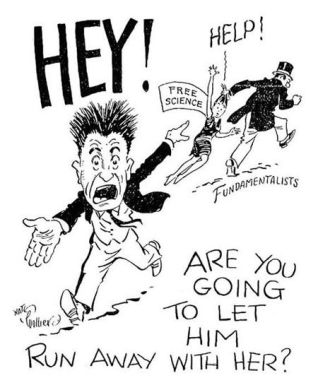 Paul Krugman is more succinct. He calls it Republican ‘cruelty’. It is exactly that.
The puzzle — and it is a puzzle, even for those who have long since concluded that something is terribly wrong with the modern G.O.P. — is why the party is pushing this harsh, morally indefensible agenda.
Think about it. Losing health coverage is a nightmare, especially if you’re older, have health problems and/or lack the financial resources to cope if illness strikes. And since Americans with those characteristics are precisely the people this legislation effectively targets, tens of millions would soon find themselves living this nightmare.
Meanwhile, taxes that fall mainly on a tiny, wealthy minority would be reduced or eliminated. These cuts would be big in dollar terms, but because the rich are already so rich, the savings would make very little difference to their lives.
More than 40 percent of the Senate bill’s tax cuts would go to people with annual incomes over $1 million — but even these lucky few would see their after-tax income rise only by a barely noticeable 2 percent.
So it’s vast suffering — including, according to the best estimates, around 200,000 preventable deaths — imposed on many of our fellow citizens in order to give a handful of wealthy people what amounts to some extra pocket change. And the public hates the idea: Polling shows overwhelming popular opposition, even though many voters don’t realize just how cruel the bill really is. For example, only a minority of voters are aware of the plan to make savage cuts to Medicaid.
In fact, my guess is that the bill has low approval even among those who would get a significant tax cut. Warren Buffett has denounced the Senate bill as the “Relief for the Rich Act,” and he’s surely not the only billionaire who feels that way.
Which brings me back to my question: Why would anyone want to do this?
Because they can and because they love power and money. Their mega-rich donors will shower them in both.
I think we can forever ask ourselves the big question of why do these uneducated white people continually fall for it? The answer is that their life basically sucks and they’re doing what ever they can to feel better about it. Religion and Republicans give them a feeling of superiority based on the only thing they have: the identity birth gave them. Every one is paying an awful price for that.
What’s on your reading and blogging list today? Tuesday is Independence Day if we can keep it.
Monday Reads
Posted: April 21, 2014 Filed under: Bobby Jindal, Climate Change, Corporate Crime, corporate greed, corruption, energy, Environment, Environmental Protection, Environmentalists, morning reads, tar sand oil, toxic waste 46 CommentsGood Morning!
 I’m going to remind you today of some events that happened 4 years ago with the BP Oil Gusher and show you that bad things are still going on in the Gulf.The leftover issues from abandoned oil rigs are bigger than Louisiana.Please consider this an open thread while I let you know how I feel.
If corporations are people, then BP and others in the extraction business are serial killers. All over our country and throughout our history, extraction companies have killed their employees, the people that live around their businesses, and the wildlife and the environment and water systems that sustain the life of our country. Look at that map. Those are active and orphaned/abandoned oil wells/pipelines that are disintegrating, leaking, and killing someone.
“I started noticing, towards the end of 2010, other leaks that were unrelated to the BP disaster,” Henderson says. “I would find wellheads that were leaking or platforms that were leaking. Just in the last year, I have filed 50 reports for different leaks and spills unrelated to the BP disaster.”
Under the Clean Water Act, when a company spills any amount of oil in the water, it must file a report with the National Response Center run by the Coast Guard. But when Henderson checked, he found many of those smaller spills were not making that list.
So environmental groups formed the Gulf Monitoring Consortium to get a better count on spills. The partnership is a blend groups of complementary skills.
Gulf Restoration Network, for example, has personnel who can spot spills from the air and file complete reports.
SouthWings, a group of volunteer pilots, helps get those spotters aloft.
Louisiana relies largely on the oil industry to self-report leaks and spills. The Gulf Monitoring Consortium was formed to improve that effort and said it often finds smaller leaks like this one, near Golden Meadow, that go unreported by the companies.A third member, the West Virginia-based tech group SkyTruth, finds the spills on satellite photographs, then applies a formula used by spill experts to translate the size of the oil sheen into gallons of oil in the water.
SkyTruth spokesman David Manthos says its estimates typically are much higher than what’s been reported.
“We found that the spill was usually 10 times larger than had been reported, and that was averaged out across a lot,” he says. “In some, the mismatch was much larger than that.”
The sheer size of the industry here means there’s seldom a quiet day for the consortium. In an average year, the NRC receives 10,000 reports of spills in the Gulf.
It’s a number that surprised even SouthWings Gulf Program Director Meredith Dowling, a veteran of monitoring efforts.
“I can’t think of a single instance where our volunteers have flown offshore and not found spills,” Dowling says. “This was something that was really amazing to me when I first moved here … that is was a continuous, absolute failure of business-as-usual practices.”
There are many active spills around here. Many come from orphaned and abandoned wells. Many come from active wells. They are all spewing toxic waste and it’s not just in Louisiana. Here is a program in Pennsylvania dedicated to plugging orphaned and abandoned wells. There are similar issues in Texas, New York State, and just nearly anywhere there’s been activity. Louisiana alone has about 6000. You can see that they are nearly everywhere if you look at the map at the top of the post. Many of these wells were first put into play in the 1850s and were just left where they were. They are rotting, they are decaying, and they are leaking. They are also dangerous.
Methane is an odorless, colorless gas that exists naturally below the surface. It isn’t poisonous, but it’s dangerous. When enough methane gathers in an enclosed space — a basement or a water well, for instance — it can trigger an explosion.
The gas didn’t come from the Butters well, nor did it originate from the Marcellus Shale formation that a nearby Shell well had recently tapped into. What most likely happened to cause the geyser in June, Shell and state regulators say, was something of a chain reaction. As Shell was drilling and then hydraulically fracturing its nearby well, the activity displaced shallow pockets of natural gas — possibly some of the same pockets the Morris Run Coal company ran into in 1932. The gas disturbed by Shell’s drilling moved underground until it found its way to the Butters well, and then shot up to the surface.
Areas impacted by oil spills are never the same. The BP Oil Gusher has introduced issues into the ecosystem that have left endangered species teetering further towards extinction. In the case of Louisiana, it’s even the state bird.
On a bright spring morning, P.J. Hahn is walking through a graveyard in the middle of Barataria Bay.
It’s a 30-yard patch of mud and sand bristling with bare, dead mangrove brush surrounded by miles of open water. Each mangrove is a tombstone marking the death of a nesting site used for decades by brown pelicans and roseate spoonbills on what was once the string of wetland pearls that made up the Cat Islands chain.
But in 2010 the oil spewing from BP’s Deepwater Horizon would send them all to an early grave.
“Four years ago we had more than five acres of habitat and there were tens of thousands of birds nesting on these islands,” said Hahn, director of coastal zone management for Plaquemines Parish. “Then the oil came in and coated the mangrove roots, and two years later the islands started going.
“I don’t know where those birds are nesting now – but they can’t do it here any more.”
The post-BP story of the brown pelican, Louisiana’s official bird, is the perfect metaphor for the crisis confronting the state’s coast.
Before the Deepwater Horizon blew out on April 20, 2010, brown pelicans were living the good life in southeast Louisiana as one of the great wildlife comeback stories. In 1963 not a single brown pelican could be found in the state due to impacts from the insectiside DDT. The comeback started in 1968 when the state began transplanting birds from Florida, and populations began to soar after DDT was banned in 1972. Thanks to the abundant food in one of the world’s most productive fisheries, by 2010 their numbers were thought to be near historic levels, as high of 85,000.*
 Four years later, the sea floor closest to the spill and even the shores in the Gulf of Mexico are comparable to an Arizona Desert. It is barren, bleak and dead. There was life there. Now, there is the look of a forest fire without the resultant new growth. Nothing will grow back amid the poison of Corexit and Oil.
When a crew of journalists and environmental groups studying the effects of the BP Deepwater Macondo oil spill disembarked on Cat Island in Baratria Bay last week, there was a collective gasp.
“It looks like the Arizona desert,” said Eileen Fleming, who’s reported for WWNO spring after spring since the April 20, 2010 spill.
“It looks like there was a fire here,” said Doug Meffert, vice president of the National Audubon Society and president of the Louisiana chapter, “but there wasn’t a fire.”
The bones of black mangrove stumps are all that remain of what was a thriving bird rookery here in Plaquemines Parish Four years ago, footage of oiled brown pelicans and the thousands of shorebirds nesting here went around the world in the aftermath of the 200 million gallons of thick crude that spilled into the Gulf of Mexico.
Today the only green thing on the beach is a glass bottle. There are no pelicans, no mangroves, and worse, much of Cat Island itself is washing away. It and most of the barrier islands and marsh in Barataria Bay are steadily degrading, losing their battles with coastal erosion and subsidence faster than ever.
Areas around Barataria Bay and Grand Isle, La. were particularly hard hit, but they weren’t the only affected areas. Moreover, thousands of birds, other wildlife and marine life including dolphins perished, were oiled, sickened and overall left in distress. The effects on the area resonate now, which is only a shock to those either unfamiliar with garish oil spills or unwilling to accept the truth.
In the days following the “spill”, BP, apparently colluding with the US Government, doused a horrific amount of a deadly dispersant in the affected areas. Called “Corexit”, the cutesy name belies the sickening effects it brings to all it touches. On background, an environmentalist working in the area explained to me last year that they were, essentially, damned if they did, and damned if they didn’t, but chose the lesser of two ills.
That remains to be seen as the National Institutes of Health continues its 10-year “GuLF” study of BP spill health effects, from those most affected out on the Vessels of Opportunity boat that included BP-hired personnel trying to contain the spill, to residents in the line of fire, such as around Barataria Bay.
There is a way of life dying along the southern parts of the Gulf Coast in Louisana. The coastline disappears daily, the salt water intrudes in to the fresh  water marshes, and the land doesn’t sustain the people or the animals like it once did. There is not better place to study the impacts of the extraction business and human addiction to fossil fuels than many parts of Cajun Louisiana.
Sea level rise is like an ultra-slow-motion hurricane for low-lying areas, but unlike a hurricane, it can be forecast decades in advance. Projections that some town or road will be underwater in 100 years can—and must—be mitigated against today.
Osborn characterizes the choice as “being proactive rather than reactive. Once you get into situations like Louisiana facing some very serious challenges in a very near time frame, all of a sudden you’re in a reactive posture.” Louisiana is a harbinger of things to come for New York, Miami, and other major coastal cities that would do well to look 20 to 75 years ahead and budget accordingly. Local, state, and federal governments will have to make critical decisions about infrastructure, water and sediment diversion, and wetlands restoration in the next 10 to 15 years, he says, and while NOAA scientists can contribute data, they can’t green-light projects or secure funding.
Osborn makes a technical distinction: “Right now it’s what’s called frequently flooded. And the risk is it will be routinely flooded.” Routine flooding will start to happen as early as 10 years from now, he says. They can call it whatever they want, but Gill says soon LA 1 will be “flooded every day during high tide.”
NOAA scientists predict that eventually all the marsh that surrounds LA 1 and Port Fourchon will disappear, connecting two major bodies of water that now are distinct: Barataria Bay and Terrebonne Bay. The only thing out in the water at all, by 2100, may be a raised road and Port Fourchon. “I can imagine Port Fourchon being like the Florida Keys,” says Chiasson, “being on its own, in the middle of open water, maybe a little marsh around it, but nothing between here and there.”
The fact that the entire extraction business is so fraught with so many bad things is why the men that run it must find politicians to protect them from lawsuits and regulations. Making these guys pay for what they’ve done would undoubtedly run their companies deeply into the red. Donation whores like Republican Governor Bobby Jindal will do anything to protect the benefactors that he hopes will fund him to the White House. There is nothing about Louisiana that this man is interested in except as a step on the rung of his personal ascent.
The state Senate targeted the flood protection authorities around New Orleans and the lawsuit one of the levee boards filed against the oil and gas industry for damages to the state’s wetlands.
In one bill, advanced by a Senate panel Wednesday morning, Gov. Bobby Jindal would get sweeping power to remove members of the Southeast Louisiana Flood Protection Authorities. Opponents said the move, which would allow a governor to remove authority members under certain conditions, reintroduces politics into the levee boards, which is precisely what revamp after the 2005 hurricanes was designed to prevent.
Another measure, which was passed by the full Senate late Tuesday night, would derail a lawsuit filed last year by the Southeast Louisiana Flood Protection Authority — East against 97 oil and gas companies. The levee board sought damages for contributing to coastal erosion and led to higher than anticipated storm surges.
Jindal opposes the lawsuit and has called it a windfall for lawyers, who would be paid with a portion of any winnings rather than a flat fee. Critics say the legislation would keep the oil and gas industry from taking responsibility for damage caused by drilling and productions activities over the years.
SB553 is aimed at a lawsuit filed by the Southeast Louisiana Flood Protection Authority-East. It would not impact similar suits filed by Jefferson and Plaquemines Parishes. But other measures currently being considered might.
The legislation passed Tuesday night, Senate Bill 553, would apply to retroactively. That measure was sent Wednesday morning to the Louisiana House.
Even kindergartners know they should clean up their messes. That is ones that aren’t sociopaths.
But, wherever there has been the extraction business, there are the sociopaths. We have the hundred year anniversary of just such an example.
Linda Linville climbed down the steep stone steps into the dugout on the southern Colorado prairie Sunday where one branch of her family was wiped out in one day 100 years ago.
Her great aunt, her unborn baby and two children died in a fire that broke out during a battle between coal miners striking against John D. Rockefeller, Jr. and the Colorado National Guard in what became known as the Ludlow Massacre. Twenty-seven-year-old Cedilena Costa, 4-year-old Lucy and 6-year-old Onofrio suffocated from the smoke as they hid below ground to escape the battle. Linville said Cedilena’s husband, Charlie Costa, was captured and shot in the head that day and never knew his family’s fate.
“Anyone who says they died in vain is wrong,” said Linville, a retired history teacher from Corona, Calif., referring to the fact that the miners eventually ended up going back to work without winning any of their demands.
The massacre and battle left 21 people dead, including the Greek-American union leader Louis Tikas, and set off 10 days of civil war in which the miners killed 30 mine guards, supervisors and strikebreakers. They surrendered only after President Woodrow Wilson sent federal troops to the state.
The deaths drew national attention to the long running strike and forced Rockefeller to take a public role in Colorado Fuel & Iron. He instituted a company union and grievance system, which the miners later rejected when the won a right to unionize on their own during the New Deal. The massacre and the deadly Triangle Shirtwaist fire in 1911 are credited with the helping win the eventual passage of the 1935 National Labor Relations Act.
Linville and over 100 others — including members of the United Mine Workers of America wearing the red bandanas the strikers wore — gathered at the site of the former Ludlow tent colony to mark the massacre’s 100th anniversary with a Greek Orthodox Easter service. It was very similar to the one the miners, who came from a variety of countries, shared in 100 years ago with the Greek strikers the day before the massacre. In a coincidental reminder of Ludlow’s international community, the Easter service will include the traditional reading of the Gospel story in many languages to symbolize the universality of its message.
It is easy to look back at the years of coal and oil and see that not much has really changed in terms of the business. The only thing that’s changing is that people, nature, and animals don’t have a chance at all and the deathtoll and damage are obvious if you actually get to see it. I have a small car. I really don’t drive much at all. I think in a busy week I may put on 15 miles. I have a bike and nearly everything I need is about a mile away. I suppose, for me, that it’s nothing to say that I really don’t benefit from any of this. I’d frankly rather pay for every single person to have some form of solar or wind generator in their home than the tax breaks we give to the oil industry. I think it would save every one in the country a lot less grief in the short and long run. But then, I could care less how much money the likes of the Koch Brothers earn. I’d frankly rather be dancing on their graves.
I just wanted to add that I found some of these wonderful skull art prints from this site.
I know it doesn’t look like it, but this is an open thread.
What’s on your reading and blogging list today?

 peej
peej Carissa
 bostonboomer
 dakinikat
 ecocatwoman
 mablue2
 Mama Lopez
 peggysue22
 quixote
 skydancingguestblogger
 Mona (aka Wonk the Vote)



 Sky Dancing

Recent Comments