
Finally Friday Reads: Daily Trumpian Buzzkills
Posted: July 24, 2026 Filed under: 2026 Elections, 2026 MidTerm elections, Are we a democracy?, Breaking News, Iran War, Israel/Iran War, Journalism, kakistocracy, kleptocracy, SAVE Act, Senate, Take Back America, The US Road to Kleptocracy/Autocracy, Trump Chaos | Tags: @johnbuss.bsky.social John Buss, Democracy Backsliding, GOP and Trump demolishing voter rights, GOP and Trump Rigging Elections, Inept and corrupt DOJ, Israeli/USA/Iran War, Politics and Personal Grievances of Donaldo Trump, SAVE Act 5 Comments
“Looks like Barron is advising his Dad again. I’m pretty sure this’ll bring young voters back into the cult.” John Buss, @repeat1968
Good Day, Sky Dancers!
I’m a little bit late starting today. I had to make a quick dash down to City Hall to figure out why I was getting a late notice on not paying some tax I had never even heard of at this point. Anyway, it all worked out. It wasn’t the least bit aggravating. I know what to do to resolve it. I got the opportunity to see and experience why I love this city so much, so no damage was done. However, I learned I still have to write checks at City Hall, and was fortunate to find out I actually have one book of checks still in my desk drawer. I am still trying to figure out the last time I’d written a check, put a stamp on an envelope, and mailed it. My guess is at least a decade ago.
So, let’s see how the week’s ending now that I have done my City Hall thing. Tropical Storm Bertha turned out to be off-and-on heavy rain. I had power and AC, so no problem there. I’m finally getting to my first tea of the day. So, let’s check the headlines that will likely kill my morning love affair with my city. I see that my first suggested read is from Buzzkill Donaldo. Is there any part of our laws or Constitution he doesn’t regularly pissed on?
This is from the New York Times. “Trump Administration Admits Canceling Grants to States That Did Not Vote for Him. Federal officials said in court documents that they halted billions of dollars in funding for energy projects to states “based solely” on whether they backed President Trump in the 2024 election.” Tony Romm and Brad Plumer share the lede.
When the Trump administration canceled more than $7.5 billion in Biden-era federal grants for clean energy projects in October, it framed the move as an urgent corrective to protect taxpayer funds from waste.
But it wasn’t true.
In little-noticed court documents, federal officials acknowledged this month that they had terminated the funding “based solely” on political criteria, targeting projects in states that were represented by Democrats and had voted for Kamala Harris, the party’s presidential nominee, in the 2024 election.
The stunning admission offered an unvarnished glimpse into the way President Trump has weaponized the provision of federal education, energy, health, housing and infrastructure aid in his second term. Far from rooting out the sort of misspending that Mr. Trump sees as rife in Washington, the White House has instead sought to leverage the budget as a tool to assist its allies — or as a cudgel to hurt the president’s foes.
The saga illustrates the stakes as the Trump administration is completing a set of rules that would provide the president even greater control over more than $1 trillion in annual federal grants. To critics, the new regulation would only make it easier for Mr. Trump to strike wider tranches of congressionally approved funding over political differences.
“The risk that the Trump administration is willing to go to extreme lengths to politicize grant-making is not a hypothetical,” said Devin O’Connor, a senior fellow at the Center on Budget and Policy Priorities, a left-leaning group. He previously served at the White House budget office under former President Joseph R. Biden Jr.
“If they are willing to be that blatant about it,” Mr. O’Connor said of the court filing, “then I think we should take seriously when they put forward a framework that would allow for the extreme politicization of grant-making across all of the federal government.”
 This insidious political behavior, resembling a toddler’s tantrum, has got to stop. I’m just glad they’re so glaringly egregious that lawyers and judges easily spot them. This story is from The New Republic. “Angry Trump Openly Urges GOP to Rig Midterms as Brutal Fox Poll Hits. As a striking Fox News poll suggests the GOP midterm position is deteriorating, a voting rights expert walks us through what Trump is really gearing up to attempt this fall—and how to defeat it.” Greg Sargent interviews Ari Berman. This comes from the transcript of his Podcast.
Ari Berman: Hey, Greg, great to talk to you again. Thank you.
Sargent: So House Republicans just passed a massive $95 billion budget with new war funding, and it also contains $10 billion for provisions related to the SAVE Act, which is the big voter suppression legislation Trump wants. The idea is to pressure the Senate to then pass these things via the simple majority reconciliation process. Ari, before we talk about the Senate, can you just explain what these provisions are in the House budget resolution, and how would they work?
Berman: Well, that’s a good question, Greg. And I can’t really answer it, because we don’t really know. All we know is that the House passed a resolution that says that states are going to get $10 billion in grants if they pass parts of the SAVE Act. But they didn’t release any more details, so we can only speculate on what they’re trying to do. But this seems to me a backdoor way to try to pass the SAVE America Act.
So if you look at the core provisions of the SAVE Act—if you’re going to incentivize states to pass those, it’s basically proof of citizenship to register to vote, voter ID to cast a ballot, and some kind of ban on mail voting. Those are the three big parts of the SAVE America Act.
Sargent: So basically, what this is starting to look like is the House is passing $10 billion to use to essentially try to get states to pass by themselves, in their state legislatures, these things in the SAVE Act.
Voter suppression mechanisms like ending vote by mail, requiring proof of citizenship. You’d do all these things through the states, and the House would try and incentivize that.
Berman: Yeah, they’re basically paying states to do voter suppression. That’s the simplest way I can explain what the House is doing.
Sargent: Trump ratcheted up the pressure on John Thune, the Senate majority leader, to pass these provisions of the SAVE Act via reconciliation—again, we’re talking about the things that the House is basically on track to passing. Listen to this.
Donald Trump (voiceover): Everybody call John Thune at the Senate. He’s the leader of the Republican Party, and tell him to get this stuff approved. So we’re fighting so that all voters must show voter ID. We’re fighting so that all voters must provide proof of citizenship, OK? And also the no mail-in ballots.
G. Elliot Morris presents evidence on who exactly would be hurt by this law in his blog Strength in Numbers. “Poll: These Americans say they’d be disenfranchised by Trump’s election law. Few Americans have heard a lot about the provisions of the SAVE Act. Support declines the more someone hears about it,”
The “SAVE America” Act, a bill in Congress championed by Donald Trump that would require U.S. citizens to physically show documentary proof of citizenship to register to vote, among other things, sounds simple enough on paper. What’s so hard about showing your passport or birth certificate to a county clerk when you register to vote?
Turns out, a lot of things. As GOP Senator from Alaska Lisa Murkowski wrote in the Wall Street Journal last week, many Americans in rural areas do not have easy access to a voting registrar to present such documents. And many people, a new Strength In Numbers/Verasight poll shows, say they lack the paperwork at all — including citizens who are currently registered to vote.
Plus, our survey finds the people who are most in favor of Trump’s new election law are the ones who have heard the least about it.
In this week’s Chart of the Week I report on two questions about Trump’s SAVE Act that other pollsters are missing.
In our latest Strength In Numbers/Verasight poll, fielded July 14–17, 2026, we asked how easily currently registered voters could produce documentary proof of citizenship right now if they wanted to vote.
At first glance, the answer is reassuring; 90% would clear the bar without much trouble — 74% said “very easily,” 16% “with some effort.” Only 6% of registered voters said they would manage to prove their citizenship “with a lot of difficulty,” while 2% said they could not produce one at all, and about 3% weren’t sure.
But 7% of registered voters is still millions of people. Who are these people who would be effectively disenfranchised by Trump’s new law?
The chart below shows how hard a time registered voters from various demographics say they’d have proving their citizenship status:
…
Some groups stand out. First, lower income voters. The share who’d struggle runs from 11% among registered voters earning under $50,000 to just 2% among those making more than $150,000 — a 9-point gap disenfranchising the poor the most.
Younger voters also say they’d be more likely to have a hard time proving their citizenship.
But the group most likely to say the SAVE Act would effectively disenfranchise them is Black voters: 15% say they’d struggle to prove their citizenship, vs 7% for white voters and 5% for Hispanics.
These two findings suggest Trump’s voter ID law would produce a meaningfully more Republican electorate. Nine percent of currently Democratic voters say they’d struggle to prove their citizenship vs 3% of Republicans.
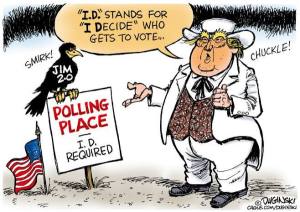 You may review the chart at the link as well as read more analysis on the subject. Lisa Needham of Public Notice has this headline today. “MAGA’s “pasta pass” talking point is height of gaslighting. They know better. They’re hoping voters don’t.”
It looks like Republicans settled on a talking point about why the SAVE America Act is totally necessary to stop non-citizens from fraudulently voting by the millions and zillions — and you will not be surprised to learn that it is hilariously stupid.
Yes, it’s time to talk about the Olive Garden’s Never-Ending Pasta Pass, the latest thing that Republicans have settled on as justification for the voter ID requirements in President Trump’s signature election suppression bill.
Ground zero for this nonsense seems to have been White House spokesperson Abigail Jackson going on Newsmax last week to discuss how she saw a tweet from Olive Garden about their never-ending pasta deal and that you need ID for it, and she just got to thinking, “Olive Garden takes pasta pass security more seriously than Democrats take election security.”
Republican House members dutifully picked up and parroted this nonsense, with Rep. Steve Scalise appearing on CNBC to give his deep thoughts, Rep. David Kustoff racing to Newsmax to share the good news about pasta security, and Rep. Virginia Foxx going on the House floor to push this as a reason to vote in favor of the bill.
This isn’t new, of course — well, the pasta part is, but not Republicans alighting on some random thing they think you need ID to buy and then declaring that should mean you need one to vote.
Trump has spent several years telling people that because you need an ID to go to the grocery store, you should need an ID to vote, and he recently expanded this keen analysis: “All we want is voter ID. You go to a grocery store, you have to give ID. You go to a gas station, you give ID.”
Of course, you do not need an ID to go to a grocery store or get gas, but you can understand Trump’s confusion given that he’s probably never done either of these things for himself.
 Law Dork‘s Chris Geitner explains just how low the DOJ can go in his post today. “Thursday was the worst day for DOJ. So far. DOJ withdrew its subpoenas issued to New York Times reporters, but the hearing that preceded that decision showed just how degraded DOJ has become.” Again, doesn’t the U.S. Constitution mean anything to any Republican these days?
The degradation of the Justice Department in the second Trump administration is clear, is having immediate effects, and will have long-term effects. Just how degraded DOJ has become was on full display in the Southern District of New York on Thursday.
To get why Thursday’s happenings are so central to understanding how bad things have gotten, know that the U.S. Attorney’s Office for the Southern District of New York is widely seen as one the preeminent U.S. Attorney’s Offices in the nation. Alumni of the office would say it was the key office, and it was openly (sometimes derisively) referred to as the “Sovereign District of New York,” due to the high view that members of the office held of the office.
Now, however, things look different. Over the past two weeks, the office tried to subpoena reporters from The New York Times and ensnared some of the reporters’ family members in a second set of subpoenas for phone records. When challenged, the office’s ability to carry out basic legal research and adhere to general ethical standards were called into question by U.S. District Judge Arun Subramanian in a sharp, hour-long hearing that ended with the Trump administration withdrawing the subpoenas rather than face the almost certain likelihood of Subramanian quashing them.
Inner City Press’s Matthew Russell Lee covered the hearing live on Bluesky, and Courthouse News Service covered the hearing as well, in addition to The New York Times’s report.
It was an altogether horrifying appearance in court for Deputy U.S. Attorney Sean Buckley, as well as Kevin Sullivan, a lawyer in the office who was initially sitting in the gallery but who, Lee reported, Subramanian called up to sit at counsel’s table because he was “on all the pleadings” — apparently relating to the phone provider subpoenas.
 Read more details on Subramanian’s questions and the chaos that followed at the link. The New York Times comes out looking badly too. Of course, the DOJ is the only federal department that looks like it’s at an all-time low. This New York Times headline shows the shocking state of our country’s health as HHS is being run by scaliwags like Dr. Oz, and outright nut jobs like RFK Junior. “Measles Cases Hit New Record in U.S., as Vaccination Rates Wane. More measles cases have been reported in the United States in the last two years than in all the years from 2000 through 2024 combined.”Teddy Rosenbluth has the lede.
The United States has now recorded more cases of measles in 2026 than in any other year since the virus was declared eliminated in 2000, a grim sign that the country may be headed toward a new era in which the disease regularly sickens thousands every year.
On Friday, the Centers for Disease Control and Prevention announced that there have been 2,318 confirmed cases of measles so far this year. The case count toppled the record set last year, when measles infected more than 2,200 Americans and killed two unvaccinated children. More measles cases have been reported in the United States in the last two years than in all the years from 2000 through 2024 combined.
Reversing course on measles would require a nationwide push to improve vaccination rates, a prospect that experts said seemed unlikely under the leadership of Health Secretary Robert F. Kennedy Jr. He has halted funding for vaccine hesitancy research, downplayed the risks of measles and spearheaded a hunt for evidence that vaccines are unsafe.
In November, a panel of international experts will meet to determine whether the United States has lost its elimination status, which has long been viewed as one of the country’s crowning public health achievements.
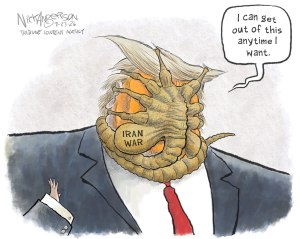 BTW, we’re still in a hot war, and the Epstein files are still not completely public. This is from NBC News. “U.S. launches new strikes and Trump threatens ‘massive attack’ as Iran widens war. There were signs Friday that some U.S. allies in the Middle East may be losing patience with the daily escalation and lack of diplomatic progress. “It’s only getting crazier,” one senior Arab official, directly involved with diplomatic efforts, told NBC News.”
The United States launched a fresh barrage of strikes on Iran overnight after Tehran opened a second front in its pressure campaign on the world economy.
President Donald Trump threatened a major new escalation and on Thursday told Axios he is weighing whether to launch a “massive attack” on the Islamic Republic that would be “bigger than ever before.” The president’s warning and subsequent 13th night of military strikes came as oil briefly surged above $100 a barrel.
Iran has shown little sign of bowing to U.S. demands, launching new attacks on shipping as well as U.S. bases and allies across the Middle East. These two fronts have combined to increase the cost of the renewed conflict — in human lives, including American soldiers, and global prices.
The struggle for control of the crucial Strait of Hormuz has now been extended to another key trade route, the Bab el Mandeb strait, after attacks by Tehran-backed Houthi rebels in the Red Sea.
And there were signs that some U.S. partners in the region may be losing patience. Senior Arab officials told NBC News they were growing frustrated with the threats, the daily escalations and the lack of diplomatic progress.
“We have no clue where this is going,” said one senior Arab official, with direct knowledge of regional developments. “It’s only getting crazier,” said another senior Arab official, directly involved with diplomatic efforts.
“It’s only getting crazier” pretty much sums up Trump’s second term.
What’s on your Reading, Action, and Blogging list today?
Finally Friday Reads: State of Exhaustion
Posted: July 3, 2026 Filed under: #FARTUS, #We are so Fucked, Cheater in Chief, Democracy Backsliding, Trump Family Crime Syndicate, Trump Grift Rodeo | Tags: @repeat1968. John Buss, Democracy Backsliding, Passport application process, The Trump Family Crime Syndicate, Trump Family Grift Rodeo, Trump grifting 5 Comments
“You know Hegseth is chomping at the bit to annihilate something for the Dear Leader.” John Buss, @repeat1968
Good Day, Sky Dancers!
I’m sorry I am so late, but I had to do some errands, including getting a new passport, which was way more complicated than the last time I did it. I wanted to get it done for several reasons, but top of the list was avoiding getting a passport with Orange Caligula’s nasty picture on its cover. I also do not want to be used as a tool of that ish that is Freedom 250.
The weird thing was that while I was cheerfully smiling in my last passport, they told me I could no longer smile. I have to look neutral, which comes off as grim. The Postal worker actually said they want it to look like a mug shot now. I hope that doesn’t portend anything for the future. But, frankly, the look on my face basically says I’m a very unhappy American.
I thought I had given my PDF copy of my application a look through last night, but it was nothing compared to what they expect to see now. I had to do a handwritten version after the consensus was that my middle name was no longer needed. They also took my last passport. My first passport was part of a family passport. They no longer have those, I guess. I brought the one prior to that, when I was married, but much like my interest in all that, they weren’t the least bit interested. The Postal workers were sighing about the entire mess as much as I was. I have no idea what started all this, but I have DOGE and AI in mind as the primary hypothesis.
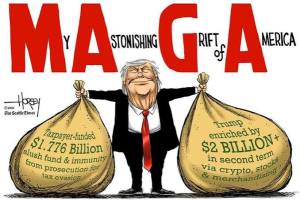 The majority of us are pretty broke right now. So, I’m not planning on a vacation at the Riviera. Part of me really wants the passport again in case things get any worse around here. Day after day, our democracy seems to be backsliding more quickly than ever. Trump, however, has a bigger grift going than ever. This New York Times story is worth checking out. It’s reported by Jason Horowitz. “Trump’s Huge Windfall Has Few Known Global Precedents. President Trump’s earnings in office are at a level once unimaginable for any leader of a liberal democracy, particularly a sitting American president.”
Silvio Berlusconi, the Italian prime minister and billionaire mogul who died in 2023, is often considered to have set the mold for President Trump with his mastery of the news media, gilded taste and, above all, legislative maneuvers that drew accusations of conflicts of interest.
Mr. Berlusconi passed laws that appeared tailor-made to protect and benefit his family’s vast business empire. And his annual earning disclosures showed he had been paid tens of millions of dollars while serving as prime minister.
This week, new financial disclosures suggested that Mr. Trump has broken that mold by making at least $2.2 billion in his first year back in the White House, including about $1.4 billion from his family’s cryptocurrency businesses.
Mr. Trump’s profits are a haul once unimaginable for any leader of a liberal democracy, particularly a sitting American president. No modern Western leader has ever publicly disclosed such big windfalls while in office.
The Trump family’s earnings, experts said, have moved him into an echelon of enrichment more associated with strongmen in Russia and Turkey.
His gains were all the more striking because the United States has long positioned itself as a standard-bearer for financial regulation, anti-graft measures and the rule of law. Yet his cryptocurrency earnings highlight an unusually glaring conflict: As president, Mr. Trump oversees the regulation of an industry that, as a businessman, he also greatly profits from.
The White House has denied that Mr. Trump or his family had engaged in conflicts of interest and he has personally brushed aside such concerns, saying this week: “I never speak to any of the people that run the money.”
That reluctance to acknowledge any conflict now makes it harder, experts said, for anti-corruption investigators in countries big and small to combat behavior that the United States, until Mr. Trump’s presidency, once condemned.
“How the U.S. behaved was quite influential in shaping international norms,” said Professor Liz David-Barrett, director of the Center for the Study of Corruption at the University of Sussex.
Now, Mr. Trump’s windfall has undermined the idea “that there is a standard to which we should all be aspiring,” she said. It was now easier for other global leaders to ask “‘why should I regulate my behavior?’ when the greatest power in the world” is not regulating its president, she added.
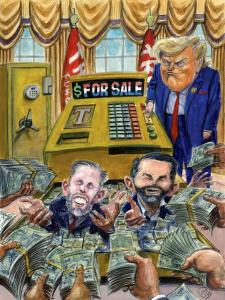 Newsweek has more numbers and analysis under this headline. “Trump Says Family Faces Constant ‘Conflict’ Under White House Spotlight.” The Trump Family Crime Syndicate knows no boundaries.
Questions surrounding the Trump family’s business interests have followed the president throughout both of his administrations, but critics say those concerns have intensified during his second term as the family’s portfolio expands into areas including cryptocurrency, international real estate and private investments.
Trump’s latest financial disclosure report drew particular attention because it showed substantial income tied to crypto ventures associated with the family. The filing included hundreds of millions of dollars connected to World Liberty Financial and related businesses.
Supporters of the president say that Trump has complied with applicable ethics requirements and note that federal conflict-of-interest laws do not require presidents to divest personal assets. Trump underscored that point in the CNBC interview, saying there was “nothing illegal” or improper about the family’s business activities.
Ethics watchdogs, including Citizens for Responsibility and Ethics in Washington (CREW), along with Democratic lawmakers and former government ethics officials, have argued that the Trump family’s expanding business ventures create actual or perceived conflicts of interest.
Warren, the top Democrat on the Senate banking committee, accused Trump of “brazen crypto corruption” this week after the financial disclosures revealed his family’s cryptocurrency ventures made more than $1 billion since his return to office.
“The crypto legislation heading to the Senate floor must prevent the president, vice-president, senior administration officials, members of Congress, and their families from profiting off the crypto industry,” said Warren in a statement. “If it does not, it will only turbocharge Donald Trump’s brazen crypto corruption.”
It’s not the first time Warren has issued a warning over Trump’s financial dealings with his family. In May 2025, Warren and Sen. Chris Van Hollen sent a letter to President Trump urging him and his family to divest from World Liberty Financial. They wrote that: “Your personal financial entanglements with foreign governments threaten to undermine U.S. national security.”
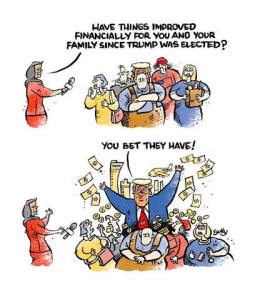 There’s a lot of information in it about Trump’s sperm discharges.
The brothers have significantly expanded their business portfolio in recent years. Their highest-profile ventures include co-founding World Liberty Financial, a decentralized finance platform that has generated hundreds of millions of dollars for the Trump family through token sales and a stablecoin business. They also launched American Bitcoin in March 2025, a cryptocurrency mining company, and have backed ventures through 1789 Capital, where Donald Jr. is a partner investing in defense, AI and technology companies.
They have pursued international Trump-branded licensing agreements in countries including Saudi Arabia, Qatar, the UAE, India and Romania, while expanding into firearms retail, drone technology and politically aligned consumer brands.
According to Forbes, Donald Jr.’s net worth increased six fold since between the presidential election in November 2024 and the end of Donald Trump’s first year back in office, in December 2025, jumping from $50 million to $300 million.
 Something sure smells rotten. This is from The New Republic. “Kleptocracy Is Trump’s Most Lucrative Business Venture. His investments make money even when his ventures fail! ” Timothy Noah has the story.
Being president of the United States is by far the most lucrative business venture of Donald Trump’s checkered business career. The June 30 release of his financial disclosure report makes this official. Trump has turned the American presidency into an extractive industry. In 2025, Trump mined more than $2.2 billion in income from being president, most of it from crypto, from which he extracted $1.4 billion. That’s all the more remarkable when you remember that crypto entered a slump last year and that investors in Trump’s crypto ventures who were not members of the Trump family lost $2.3 billion, according to a June 9 investigation by Tom Bergin of Reuters. It’s almost as if Trump’s ability to draw income from business ventures did not depend on those ventures being successful!
A cynic might observe that Trump’s special treatment is no different from that of American chief executives in the private sector who are similarly insulated from failure. But Trump’s payday puts theirs in the shade. The only CEO whose compensation exceeded Trump’s last year was Elon Musk, who (for now) is a category of one. Musk’s $158 billion pay package from Tesla last year was more than 15 times larger than the combined pay packages of the other 391 chief executives surveyed in late June by The Wall Street Journal.
If we set Musk aside, the highest-paid chief executive in the Journal’s ranking was Shankh Mitra, chief executive of Welltower, “a real estate investment trust focused on senior housing and healthcare.” Let’s leave for another day the ethics of harvesting a vast personal fortune from the physical and mental decline of one’s fellow human beings. My point here is that Mitra’s obscene pay package last year of $821 million was less than half of Trump’s $2.2 billion. Plus, I bet Mitra had to put in at least some actual work.
I observed a year ago that Trump is America’s first rentier president. A rentier is someone who makes his money through the possession of assets rather than the exertion of labor. Rentiers are capitalism’s nepo babies. Prior to Trump, the main rentier occupations were real estate and finance. Trump himself was a classic rentier capitalist, a rich kid who joined the family real estate business, exaggerated his success to a credulous tabloid press, and inherited $413 million from his more successful father. Trump moved the family business from dowdy apartment buildings in Brooklyn and Queens to luxury apartments and hotels in Manhattan and beyond, but many of these went bankrupt. In 2018, The Economist concluded Trump would have made more money had he been a more conventional rentier and invested daddy’s money in index funds.
The rentier presidency is a much more lucrative proposition than rentier capitalism, and one with which index funds can’t possibly compete. Crucially, there is no index fund that lets you acquire a stake without investing money or labor. During the 2024 presidential campaign the Trump family acquired a 60 percent stake in World Liberty Financial and was granted 75 percent on net revenues from token sales. (The Trump family stake in the company, the less valuable part of this deal, has since fallen to 38 percent.) Trump did not pay for these privileges, yet last year he earned more than $594 million from them. Neither is there any evidence, according to Reuters’ Bergin, that Trump ever paid for his stakes in the crypto firms ALT5 Sigma, American Bitcoin, or Celebration Coins. This last alone netted Trump more than $636 million last year.
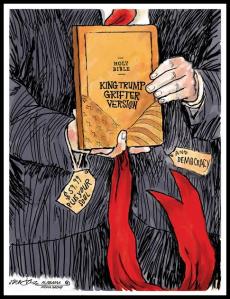 One more short article before I ruin your Independence Day weekend. This is from Democracy Defenders Action.
Following is a statement by Amb. Norm Eisen (ret.), co-founder and board member of Democracy Defenders Action and Richard W. Painter, former associate counsel to President George W. Bush, regarding President Trump’s newly released financial disclosures. Amb. Eisen was the White House ethics czar for President Obama.
“President Trump’s financial disclosure reveals he is capitalizing on the presidency for personal gain on a staggering scale never seen in American history.
“Worse, he’s doing this while his administration refuses to regulate the very industry making him a billionaire several times over, leaving Americans exposed while his own meme coin soars. His cronies and family are up to their eyeballs in the grift.
“Make no mistake. His billions in personal profit don’t come out of thin air. Every dollar extracted from these schemes comes at a cost imposed directly on the American people—whether through weaker consumer protections, trust sold to the highest bidder or otherwise.
“Congress has the power to enact legislation now to prevent these types of conflicts of interest for the president, vice president and members of Congress themselves. They should also investigate and hold him accountable. By refusing to act, they are complicit.
“The American people will not tolerate this shocking greed. And they will hold accountable those who enabled it.”
I’m not sure about the American people’s inability to tolerate his shocking greed. I’m more worried they won’t pay attention to all the warnings and will not vote.
What’s on your Reading, Action, and Blogging list today?
Mostly Monday Reads: Presidents Day in a Lost Country
Posted: February 16, 2026 Filed under: #FARTUS, #MAGAnomics, #We are so Fucked, Democratic Backsliding, Environmental Protection, Foreign Affairs | Tags: @johnbuss.bsky.social John Buss, Democracy Backsliding, Trumpian Whiplash, US/Europe Relations, Victor Orban 15 Comments
“The latest cabinet meetings aren’t televised for a reason. Fear not, our de facto leader is in control as the ethnic cleansing of the country formerly known as the United States roars ahead unabated. The must-see TV drama not being broadcast is Whose Turn Is It to Change the Old Guy’s Diaper?” John Buss, @repeat 1968
Good Day Sky Dancers!
As we stare down the 250th anniversary of the day our country started its journey from monarchy to democracy, we have to take a look at where we’ve landed today and utter some word of disappointment. The headlines today are filled with references to autocracy, and it’s not difficult to see how the MAGA/Trump overreach is playing out.
Politico sums up the current situation like this. “Trump’s second year: Whiplash. Even proposals that don’t ultimately move forward have consequences.” I’d just like a few more adjectives like weird, cruel, and inexplicably unnecessary.
President Donald Trump’s first year back in office was defined by sweeping upheaval that was largely plotted out during his four-year Florida exile. But the president has somehow intensified the volatility in year two with a succession of whiplash-inducing policy swings, several of which have almost immediately withered in the face of Republican opposition and public outcry.
The administration this week finally withdrew the thousands of federal law enforcement officers from Minneapolis, after violent and at times deadly clashes with protesters turned the tide of public opinion against the president’s immigration crackdown.
It came after Trump threatened to decertify Canadian aircraft, a move deemed “unjustified and dangerous” by a Washington-based aerospace trade union that the president soon dropped. Trump said in early January that he’d cap credit card rates at 10 percent, a move that would have upended the banking industry, only to change his mind and ask Congress for legislation.
Also last month, Trump’s administration paused millions in Centers for Disease Control and Prevention funding for state public health infrastructure — only to reverse course roughly 24 hours later.
“The whiplash has real implications,” said Chrissie Juliano, executive director of the Big Cities Health Coalition, a forum of the leaders of metropolitan health departments. “It’s incredibly disruptive, even if you can get back to continuing the work, you know, two days later.”
The unpredictability of a presidency that prioritizes posting over process and often leaves friends and foes alike guessing whether pronouncements should be taken seriously, literally, or both, remains a feature, not a bug of Trump’s approach to governance. In many matters, especially negotiations with other countries, his mercurial opacity is often an attempt to gain leverage, but his threats seemingly lead just as often to backtracking as blowing things up, be they Iranian missile depots, Venezuelan drug boats or the transatlantic alliance.
The same often holds true for domestic policy. The president has made numerous pronouncements with emphatic declarations on social media, sometimes even suggesting he is governing by fiat in cases where legislation is required. But he has quickly moved on from many of them: a cap on credit card interest rates, 50-year mortgages and, according to a new Financial Times report, possibly even the sweeping tariffs on aluminum and steel that have led to higher costs.
 We’re just beginning to explore the depths of depravity that Trump and his buddies will go to just feel powerful and get richer. This is from Robert Reich’s SubStack. “The Squalor of the Epstein Class. Happy Presidents Day!”
Here’s how Kentucky Republican Congressman Thomas Massie responded on Sunday, during ABC’s “This Week,” to a question about the Trump regime’s handling of the Epstein files:
“This is about the Epstein class …. They’re billionaires who were friends with these people, and that’s what I’m up against in Washington, D.C. Donald Trump told us that even though he had dinner with these kinds of people, in New York City and West Palm Beach, that he would be transparent. But he’s not. He’s still in with the Epstein class. This is the Epstein administration. And they’re attacking me for trying to get these files released.”
The Epstein Class. Not just the people who cavorted with Jeffrey Epstein or the subset who abused young girls. It’s an interconnected world of hugely rich, prominent, entitled, smug, powerful, self-important (mostly) men. Trump is honorary chairman.
Trump is still sitting on two and a half million files that he and Pam Bondi won’t release. Why? Because they implicate Trump and even more of the Epstein class. The files that have been released so far don’t paint a pretty picture.
Trump appears 1,433 times in the Epstein files so far. His billionaire backers are also members. Elon Musk appears 1,122 times. Howard Lutnick is there. So is Trump-backer Peter Thiel (2,710 times), and Leslie Wexner (565 times). As is Steven Witkoff, now Trump’s envoy to the Middle East, and Steve Bannon, Trump’s consigliere (1,855 times).
The Epstein Class isn’t limited to Trump donors. Bill Clinton is a member (1,192 times), as is Larry Summers (5,621 times). So are LinkedIn founder Reid Hoffman (3,769 times), Prince Andrew (1,821 times), Bill Gates (6,385 times), and Steve Tisch, co-owner of the New York Giants (429 times).
If not politics, then what connects the members of the Epstein Class? It’s not just riches. Some members are not particularly wealthy, but they’re richly connected. They trade on their prominence, on whom they know and who will return their phone calls.
They exchange inside tips on stocks, on the movements of currencies, on IPOs, on new tax-avoidance mechanisms. On getting into exclusive clubs, reservations at chic restaurants, lush hotels, exotic travel.
Most members of the Epstein Class have seceded into their own small, self-contained world, disconnected from the rest of society. They fly in one other’s private jets. They entertain at one other’s guest houses and villas. Some exchange tips on how to procure certain drugs or kinky sex or valuable works of art. And, of course, how to accumulate more wealth.
Many don’t particularly believe in democracy; Peter Thiel (recall, he appears 2,710 times in the Epstein files) has said he “no longer believes that freedom and democracy are compatible.” Many are putting their fortunes into electing people who will do their bidding. Hence, they are politically dangerous.
The Epstein Class is the by-product of an economy that emerged over the last two decades, from which this new elite has siphoned off vast amounts of wealth.
It’s an economy that bears almost no resemblance to that of mid-20th-century America. The most valuable companies in this new economy have few workers because they don’t make stuff. They design it. They create ideas. They sell concepts. They move money.
 I’ve always argued here and in classes that the biggest economic policies of the Reagan and Bush years were tax cuts that made it more profitable to gamble on financial assets rather than to actually produce goods and services. The changes in tax policies that cut upper brackets, then treated capital gains as a tax slash, and other ridiculous policies mean that money never lands where it can actually do good. It also creates a lot of idle hands and minds.
China is beginning to look more modern, more concerned about actual economic outcomes, and the planet. The U.S. continues to race back to the Gilded Age with hints of the Great Depression years. This is from The Guardian. “The Guardian view on Donald Trump and the climate crisis: the US is in reverse while China ploughs ahead. Editorial. The president’s destructive policies enrich fossil fuel billionaires, while Beijing has bet big on the green transition.”
Devastating wildfires, flooding and winter storms were among the 23 extreme weather and climate-related disasters in the US which cost more than a billion dollars last year – at an estimated total loss of $115bn. The last three years have shattered previous records for such events. Last Wednesday, scientists said that we are closer than ever to the point after which global heating cannot be stopped.
Just one day later, Donald Trump and Lee Zeldin, the head of the US Environmental Protection Agency, announced the elimination of the Obama-era endangerment finding which underpins federal climate regulations. Scrapping it is just one part of Mr Trump’s assault on environmental controls and promotion of fossil fuels. But it may be his most consequential. Any fragment of hope may lie in the fact that a president who has called global heating a “hoax” framed this primarily as about deregulation – perhaps because the science is now so widely accepted even in the US.
The administration claimed, without evidence, that Americans would save $1.3tn. Never mind insurance or healthcare costs; a recent report found that US earnings would be 12% higher without the climate crisis. The Democratic senator Sheldon Whitehouse called the decision “corruption, plain and simple”. In 2024, Mr Trump reportedly urged 20 fossil fuel tycoons to stump up $1bn for his presidential campaign – while vowing to remove controls on the industry.
In the same week as this reckless and destructive US decision, it emerged that China had recorded its 21st month of flat or slightly falling carbon emissions. As Washington tears up environmental regulations, Beijing is extending carbon reporting requirements. China remains the world’s biggest emitter of greenhouse gases, though its per capita and cumulative historical emissions are still far behind those of the US. But clean energy drove more than 90% of its investment growth last year.
The Carbon Brief website, which published the emissions analysis, says the numbers suggest that the decline in China’s carbon intensity – emissions per unit of GDP – was below the target set in the last five-year plan, making it hard to meet its commitments under the Paris agreement. The shift in emissions may not prove enduring. There is fear that China’s focus may change; the next five-year plan, due in March, will be key. Some subsidies for renewable power have already been withdrawn. The installation of huge quantities of renewable energy infrastructure has been accompanied by a surge in constructing coal-fired power plants, though the hope is that these are intended primarily as a fallback.
 We continue to disregard the actual civilized nations and cavort with the worst of the worst. This is from France24. “Rubio tells Orban ‘your success is our success’ during Hungary visit ahead of elections. During a visit to Budapest Monday, just weeks before Hungary’s parliamentary elections, US Secretary of State Marco Rubio told Hungarian Prime Minister Viktor Orban that the nationalist leader’s “success” was a success for the US. An ally of President Donald Trump, who has also maintained ties to Russian President Vladimir Putin, Orban lags behind the main opposition candidate in opinion polls.” The entire Trump cabinet is feckless, shameless, and incompetent. They are also enabling a backslide in democracy.
US Secretary of State Marco Rubio hailed Viktor Orban‘s leadership during a visit to Budapest on Monday, ahead of elections threatening the nationalist prime minister’s hold on power.
Rubio’s visit is the final stage of a whirlwind trip to Europe that also saw him address the Munich Security Conference and visit another right-wing ally, Slovakian Prime Minister Robert Fico.
US President Donald Trump has made no secret of his high regard for Orban, saying in a social media post on Friday that the prime minister had produced “phenomenal” results in Hungary.
But Orban, 62, has a fight on his hands for the April 12 legislative elections in Hungary. Polls suggest his Fidesz party is trailing opposition leader Peter Magyar’s TISZA.
“I can say to you with confidence that President Trump is deeply committed to your success because your success is our success,” Rubio said during a joint press conference with Orban after their meeting.
“The president has an extraordinarily close relationship to the prime minister, he does, and it has had tangible benefits,” he said.
 Europe’s nations have read the writing on the wall, according to CNN’s Kasie Hunt. “Trump’s damage is done. Democrats – and Europe – are struggling to define what’s next.”
Many of the Democrats who came to the Munich Security Conference this weekend want to be president. But even if one of them can win the White House in 2028, they may find they can no longer claim the title every American president since the 1940s has borne: leader of the free world.
California Gov. Gavin Newsom went on stage to insist his state is more permanent than President Donald Trump. But he acknowledged in an interview with CNN that the leaders he met with believe the damage to the transatlantic alliance is irrevocable.
Progressive star Rep. Alexandria Ocasio-Cortez of New York came to pitch a left-wing populist foreign policy but made headlines for a massive stumble instead.
A number of Democratic senators hoping to burnish their foreign policy credentials ahead of possible presidential bids found themselves in a painfully awkward moment with the Danish prime minister, as some Democrats tried to smooth over pugnacious remarks Republican Sen. Lindsey Graham made at the start of the meeting that suggested Trump has not given up his designs on Greenland – a semiautonomous territory of Denmark.
And most members of the House of Representatives who planned to attend didn’t come at all after Republican Speaker Mike Johnson pulled the plug on the congressional delegation.
European thought leaders were reduced to offering a brief standing ovation to Secretary of State Marco Rubio, whose speech was far more conciliatory than the one Vice President JD Vance delivered at the same gathering last year. But Rubio had kicked off his trip telling American reporters: “The old world is gone.” He also left the conference to fly onward to Slovakia and Hungary, two countries led by strongmen sympathetic to Trump.
The conference’s opening remarks from German Chancellor Friedrich Merz crystallized Europe’s new reality in what seems to be rapidly becoming a post-American century.
“A divide has opened up between Europe and the United States,” Merz said Friday. “The United States’ claim to leadership has been challenged, and possibly lost.”
It’s more than just words. Merz has said he held “confidential talks” with France on European nuclear deterrence. It’s a stunning admission there’s no longer unconditional trust that the US will do what needs to be done for its transatlantic allies.
“What I’m hearing now is, even if we are able to repair these relationships, it’s going to take generations before they feel comfortable,” said Democratic Sen. Mark Kelly, of Arizona, a possible presidential hopeful who traveled to Munich not long after learning the Trump administration had tried and failed to indict him over a video he made telling troops not to obey illegal orders.
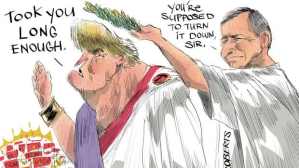 If this continues, the momentum and direction of the world’s political entanglements will change. Who knows what this will mean? This Op Ed piece from MS Now by Anthony L. Fisher discusses Trump and his attempts at an Imperial Presidency. “Libertarians warned about the ‘imperial presidency.’ Too few actually warned about Trump. A recent New York Times op-ed showed the blind spot many libertarians still have for President Donald Trump.”
When I saw the headline “Libertarians Tried to Warn You About Trump” atop a New York Times op-ed last Monday, I thought, “Hmmm, that’s not quite how I remember it.” Adorned with the striking image of the Gadsden flag’s “Don’t Tread on Me” snake about to get curb-stomped by an enormous black jackboot, the piece was written by Katherine Mangu-Ward, editor in chief of the libertarian magazine and website Reason — where I worked as a journalist for roughly six years. (I left shortly after President Donald Trump’s first inauguration.)
Sure enough, upon reading the column, I discovered the headline didn’t accurately reflect Mangu-Ward’s argument. She primarily made the case that libertarians have warned for years — under presidents in both major parties — about the dangers of ever-expanding executive authority, what’s been aptly coined the “Imperial Presidency.” Rather than claiming to have specifically warned “about Trump,” the writer boasted that libertarians had long sounded the alarm over the consolidation of such power — power now being used for nefarious purposes by a president who just happens to be Donald Trump. (The Times later that day amended the headline to the less specific but more honest, “Libertarians: We Told You So.”)
I can’t argue with that. To the extent most self-identified professional libertarians warned about Trump, they warned about the awesome powers that could be abused by a generic authoritarian president from either party.
But Trump is not a hypothetical. He always told us who he was. And there are far fewer of us who took (and continue to hold) the comparatively unpopular view among libertarians and other right-of-center fellow travelers that Trump presented as a uniquely authoritarian, vindictive, racist, corrupt and lawless demagogue — of which there isn’t remotely an analog on the other side of the aisle.
The problem is that, even now that Trump has proven us skeptics right on every one of those counts, too many libertarians continue to position themselves safely in a “pox on both your houses” perch — much too nuanced and enlightened to be dragged into partisan rancor. This position is how your movement ends up conflating the tyranny of overbearing, temporary Covid policies in Democratic-run areas as equal to (or worse than) the tyranny of a secret police force acting without due process for everyone when attempting to arrest suspected illegal immigrants, summarily executing Americans in the street and branding them “domestic terrorists” while their bodies are still warm.
All of these thoughts lead to one logical conclusion. The Midterm elections need to depose him and remove the spineless and the true believers, or whatever this is, from Congress.
Just to let you know, we’re having the most unkind Mardi Gras Celebration that even the police have seen. We seem to have been overrun by spontaneous groups of young men that are behaving a lot like the droogies in A Clockwork Orange. I may write about it on Friday; however, I’m busy listening to my friends’ experiences uptown and around the Quarter right now.
Peace, Love, and Understanding to you all!
What’s on your Reading, Action, and Blogging Lists today?

 peej
peej Carissa
 bostonboomer
 dakinikat
 ecocatwoman
 jjlo
jjlo mablue2
 Mama Lopez
 peggysue22
 quixote
 skydancingguestblogger
 Mona (aka Wonk the Vote)





Recent Comments