
Finally Friday Reads: Rolling Chaos
Posted: May 22, 2026 Filed under: "presidential immunity", #FARTUS, #MAGAnomics, #We are so Fucked, 2026 MidTerm elections, American Fascists, cartoons, Civil Liberties, Civil Rights, Constitutional Crises, Corrupt and Political SCOTUS, Donald Trump, Incontinentia Buttocks Cabinet picks, Injustice system, Insurection, January 6 | Tags: Bogus Weaponization, Civil Rights Collapsing, IRS, Slush Fund, Trump attack on Voting and Voting Rights, Trump family crime syndicate and grift rodeo, Trump Tax Immunity 5 Comments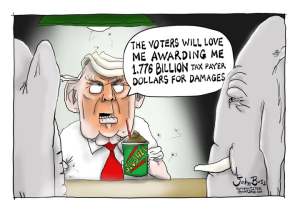
“Had enough? Obviously, the Mobsters Are Governing America bunch haven’t.” John Buss, @repeat1968
Good Day, Sky Dancers!
Things continue to look bleak for our country as Orange Caligula’s physical and mental conditions become more obvious. The Anti-Weaponization Fund looks more shady than ever. The continued coverage of its impact on our budget and rule of law gets more shocking with each elucidation. None of Trump’s songs and dances has gotten the voters’ attention as much as our difficult economy. It is evident with each grocery store and gas station visit and bill to pay that something is very wrong. The worst, massive insider-trading crimes appear to be going on within Trump’s circle.
Forbes has this headline this morning. “Trump’s Tax Immunity Could Save Him More Than $600 Million. The president secures a get-out-of-jail-free card for tax improprieties, just as he’s hauling in record amounts of cash.” Dan Alexander has the analysis and the story.
Acting Attorney General Todd Blanche signed a document Tuesday giving Donald Trump, his two eldest sons and his company broad immunity for potential tax disputes with the federal government. It’s the clearest way that the president is personally benefitting from his settlement with the Internal Revenue Service, which he sued days after taking office for failing to prevent the release of his personal tax returns.
The settlement lands at a convenient moment. Donald Trump earned an estimated $1.4 billion from crypto and licensing ventures in 2025, as he turned his first year back in the White House into the most lucrative year of his life. If the president received an extension for his 2025 return, his preparers may be sorting through exactly how to present this year’s welter of income right now. Trump has never hidden the animating principle. When Hillary Clinton accused him of paying no taxes in the 2016 debates, he replied: “That makes me smart.” Also much richer. If Trump is able to conjure up theories to avoid taxes for his 2025 income, he could save more than a half-billion dollars, according to Forbes estimates.
The conflict-of-interest underpinning all of this is so obvious that even Trump has acknowledged it. “I’m the one that makes the decision, right?” he mused in the Oval Office in October. “You know, that decision would have to go across my desk. And it’s awfully strange to make a decision where I’m paying myself.” Trump first suggested he would send whatever judgement he received to charity, before settling on a more creative approach. The government would not pay Trump. Instead, Trump would get a pass enabling him to pay less to the government. The move harkens the old cliché—a penny saved is a penny earned—with the same result: more money in Trump’s pocket.
Asked about all this, the White House referred questions to the Trump Organization. The president’s business did not dispute the estimates but opted to issue a lengthy statement attacking the IRS that said, in part, “This settlement seeks to provide meaningful accountability for the IRS’s prolonged and systemic failure to safeguard sensitive taxpayer data.”
Like the settlement itself, Trump’s massive earnings are a product of the presidency. Heading into the 2024 election, Trump announced a new crypto venture, World Liberty Financial, which sold tokens to anyone interested in buying. The tokens offered no financial interest in World Liberty, which helps explain why so few people noticed initially. But after Trump won the election, sales exploded. The economics of the deal were tailored to funnel vast sums of cash to the Trump family. After the first $15 million of sales, 75% of the proceeds went to the Trump family—with 70% of that flowing to the president-elect. More than $50 million went into this machine by the end of 2024, before ramping up in the new year.
Tokens were not the only thing Trump was selling. As Forbes first reported, he also struck a secret deal to offload a chunk of equity in World Liberty Financial in January 2025. The Wall Street Journallater identified the purchaser of that stake, an entity backed by Sheikh Tahnoon bin Zayed Al Nahyan, which promised $500 million in the deal. The agreement reportedly excluded the proceeds from token sales, which appeared to be World Liberty’s principal business at the time. World Liberty went on to launch a stablecoin that another entity connected to Sheikh Tahnoon propped up with a multibillion-dollar investment. Trump walked away from the sale with an estimated $375 million in pre-tax earnings. That windfall would theoretically trigger a roughly $140 million federal tax bill.
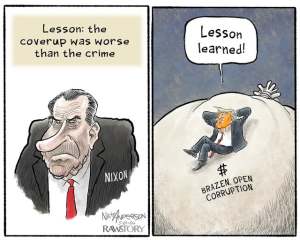 Every sucker that voted for this man needs a good thwap upside their head. This Reuters Exclusive is shocking. “Trump official tried to ban voting machines used by half of US states.” The lede is shared by Erin Banco, Jonathan Landay, and Alexandra Alper.
U.S. President Donald Trump’s election-security czar last year sought to ban voting machines used in more than half of U.S. states by asking whether the Commerce Department could declare their components national-security risks, according to two people with direct knowledge of the matter.
White House adviser Kurt Olsen, a lawyer Trump has tasked with proving widely debunked election-rigging conspiracy theories, pushed the plan to target Dominion Voting Systems machines. The idea emerged, the sources said, as Olsen and other officials brainstormed about how the federal government could take control over elections from U.S. states, an idea publicly aired by Trump.
Olsen wanted a national system of hand-counted paper ballots, the sources said, a frequent Trump demand some election-security experts say would be less accurate and potentially riskier than the current system of machines with auditable paper trails that almost all cities and states use.
The plan to exclude the machines, reported here first, got far enough that in September, Commerce Department officials began exploring what grounds could be invoked to execute it, three additional sources said. It eventually collapsed, however, because Olsen and other administration staffers working with him failed to provide evidence to justify such a move, two of the sources said.
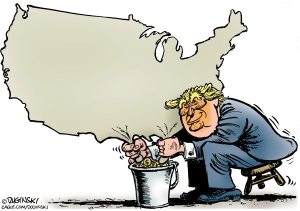 This headline is from the New York Times. “Audit Immunity for Trump Family Puts I.R.S. in a Bind
Federal law prohibits the Internal Revenue Service from halting an audit at the direction of the president or his aides.” Andrew Duehren reports the story.
President Trump’s return to office has been an unforgiving crucible for the hidebound Internal Revenue Service. He and his aides have decimated its ranks, fired and replaced its leaders and made repeated attempts to enlist the agency in his quest for political retribution.
Now, as part of an arrangement drawn up this week by Todd Blanche, the acting attorney general, the I.R.S. faces its most profound legal and ethical test yet: a demand to drop any audits of Mr. Trump, his family members or their “affiliates.”
Tax lawyers and former I.R.S. officials said such expansive protection would cut to the core of the agency’s mission to collect taxes in a disinterested, nonpartisan way — and could potentially run afoul of the laws governing how it does so.
“It’s just completely contrary to the notion that you’re supposed to comply with the law and the I.R.S. is there to make sure you do that,” said George Yin, a tax law professor and former chief of staff at the congressional Joint Committee on Taxation. “The idea that you can get a free pass from the I.R.S. or anyone can get a free pass from the I.R.S. is just completely ridiculous.”
Immunity from I.R.S. scrutiny for Mr. Trump and his family was part of a broad agreement made by the Justice Department to resolve a lawsuit he filed against the I.R.S. over the leak of his tax returns. Beyond the audit provision, the Justice Department committed to creating a $1.8 billion fund to pay victims of “weaponization,” a proposal that has been rebuked by both Republicans and Democrats on Capitol Hill.
While the Justice Department has said Mr. Trump himself will not be paid out of that fund, an end to any and all audits based on tax returns previously filed could be quite lucrative for the Trumps. The New York Times reported in 2024 that an adverse ruling in an I.R.S. audit could cost Mr. Trump more than $100 million, though it is unclear if that examination is still underway.
The nine-page outline creating the $1.776 billion “anti-weaponization” fund was agreed to and signed on Monday by Frank Bisignano, who leads the I.R.S. as its chief executive officer. The one-page addendum calling for the I.R.S. to drop any audits of Mr. Trump and his family members was released the next day and signed by only Mr. Blanche.
That has raised the question of how, and if, the leader of the Justice Department can control decisions made at the I.R.S., which falls under the Treasury Department.
“There’s a genuine question as to whether the attorney general can do this,” said Daniel Hemel, a tax law professor at New York University. “I can’t think of precedent where the attorney general signs a piece of paper that ends audits for a large number of people.”
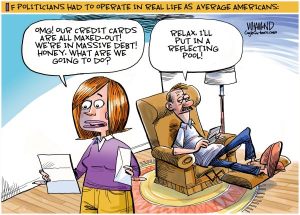 This guest essay in the New York Times by Representative Jamie Raskin is a must-read. Raskin provides us with a blueprint to stop this particular grift. “There’s a Way to Stop Trump’s I.R.S. Slush Fund.”
These days it takes a spectacular burst of corruption to get the attention of our scandal-weary nation, but President Trump and his administration have managed, once again, to transfix Americans by establishing a $1.776 billion “anti-weaponization” fund in the Department of Justice that will undoubtedly be used to line the pockets of Mr. Trump’s partisans and foot soldiers — with your tax dollars.
The creation of this fund is a stupefying feat of self-dealing — part of a “settlement agreement” between the Department of the Treasury, which Mr. Trump controls, and the plaintiffs — Mr. Trump, two of his sons and their family business — who sued the I.R.S. for $10 billion over the leak of his tax returns. It will very likely result in an undeserved windfall to a legion of Jan. 6 rioters who have already unjustly received pardons from Mr. Trump.
Every part of this farce is an affront to the Constitution. It usurps both the exclusive power of Congress to legislate programs and spend money and the power of the courts to decide specific cases and controversies.
It is, quite simply, a scam.
Only Congress has the power to appropriate federal dollars. Article I, Section 9 of the Constitution states that “no money shall be drawn from the Treasury but in consequence of appropriations made by law.” But Mr. Trump and Acting Attorney General Todd Blanche seem to think they can conjure this giant slush fund into being without congressional approval.
Further, Article III, Section 1 states that the “judicial power of the United States shall be vested in one supreme court, and in such inferior courts as the Congress may from time to time ordain and establish.” Yet the settlement took Mr. Trump’s case out of the hands of the courts. And it calls for oversight by a five-member board, appointed by Mr. Blanche and whose members Mr. Trump can dismiss on a whim. Even if this fund were legitimate, that kind of setup wouldn’t be for Mr. Blanche to decide. Congress has never established a court, tribunal or board to hear pleas from people who believe they are victims of government “weaponization,” much less a fund almost certainly meant to reward supporters and allies of the president who feel they were wronged simply because their actions on Jan. 6, 2021, were prosecuted.
No matter what you think about the events of Jan. 6, hundreds of rioters indisputably broke the law that day when they stormed the Capitol trying to stop the certification of the 2020 presidential election and the peaceful transfer of power.
As regrettable as it is that most of the rioters were pardoned, there’s no denying that as president, Mr. Trump has that power. But the same Constitution giving him that power also says that “neither the United States nor any state shall assume or pay any debt or obligation incurred in aid of insurrection or rebellion against the United States.” Jan. 6 was indeed an insurrection, and pardon or no pardon, no one can legally be compensated for taking part in it.
As James Madison noted in Federalist No. 10, a cardinal precept of our legal system is that “no man is allowed to be a judge in his own cause, because his interest would certainly bias his judgment, and, not improbably, corrupt his integrity.” Here, Mr. Trump’s administration “settled” a case that he brought, effectively making him the judge in his own case. He not only concocted the fund, but his Justice Department threw in a sweetener: shielding him and his sons from audits of any tax returns they have already filed.
The $1.776 billion figure is obviously meant to invoke the year of our founding. But go back and read the Declaration of Independence, which includes a long list of accusations directed at George III. Among them is the charge that the British king “has dissolved representative houses repeatedly for opposing with manly firmness his invasions on the rights of the people.”
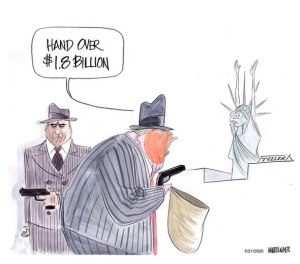 Read more. I’ve gifted the link. #FARTUS thinks he’s above the law and also thinks the U.S. Treasury and Laws are his to toy with. NBC News reports that there are many takers for the Fund, even though it’s not open for business yet. “Trump’s $1.8B fund isn’t officially open yet. That hasn’t stopped applications. No commissioners have been chosen, a requirement before claims can be processed, an administration official told NBC News. The Justice Department says millions are eligible.”
Applications are already rolling into the Justice Department from hopefuls aiming for some of the nearly $1.8 billion “anti-weaponization” fund, even though the process can’t officially begin until commissioners are chosen to decide how the money is doled out.
The fund was announced this week, part of an unprecedented settlement between President Donald Trump, two of his sons and the Trump Organization and the government he oversees over the leak of his tax returns. He agreed to drop legal claims in exchange for creating the fund.
It’s not clear yet how people are expected to formally apply. The pool of possible applicants is substantial, according to a Justice Department overview that was sent to GOP Senate offices Thursday.
“Literally tens of millions of Americans were subjected to improper and unlawful government targeting, including extensive government censorship and aggressive lawfare,” according to the overview.
Justice Department officials said the five commissioners will be chosen in the coming weeks — the appointments must be made within 30 days from when the settlement was signed Monday. Acting Attorney General Todd Blanche will make the decisions, though Congress members will get input on one of them. The president can fire the commissioners at will.
The department is working under a deadline, in part because the money pool — if it isn’t blocked by Congress or courts — would have to be distributed by the end of Trump’s term in 2028. Legal challenges have already begun, and disbursements could be tied up in the courts until well after the deadline, or it could be declared unlawful.
Both Democrats and Republicans have criticized the fund. Opponents have labeled it a massive “slush fund” for Trump’s allies. Its existence has alarmed some legal experts, in part because there will be very little public oversight over how it is managed.
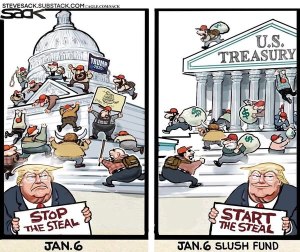 Among the crooks waiting for compensation are Michael Cohen, Enrique Tarrio, Brandon Fellows, Michael Caputo, and Mike Lindell. The Lindell link goes to an MSNBC article with this headline. “Who’s applying for the $1.8 billion slush fund? In today’s edition of The Tea, Spilled by Morning Joe: Trump’s revenge tour, Stephen Colbert’s last show, and more.” George Santos is in that list too.
“I’ve been pushing for this. I think I was weaponized against. I think I’m a good example of that.”
— Proud Boys founder Enrique Tarrio, sentenced to 22 years for Jan. 6 before being pardoned by Trump less than two years later, now seeking $2 million to $3 million from the Justice Department’s new $1.7 billion Anti-Weaponization Fund
Looks like quite the Motely Crew.
People are still shocked by the Supreme Court Decision that basically guts Voting Rights. This is from Talking Points Memo and is reported by Josh Kovensky and Khaya Himmelman. “Their Loved Ones Died for the Voting Rights Act. The Supreme Court’s Ruling Is a New Injustice.”
Dennis Dahmer was 12 years old in January 1966 when Klansmen stormed his family home and set it on fire, murdering his father, Vernon. He still remembers the shootout; he remembers watching his father die from smoke inhalation. The trauma lingers to this day, 60 years later.
Vernon Dahmer had been a fixture in the African American community near Hattiesburg, Mississippi. He ran a successful local grocery, and, after the Voting Rights Act was passed in 1965, obtained the right to register voters and collect poll taxes, which were still in effect, at his store. Members of the local White Citizens’ Council started to appear at the family farm, warning his father to stop, Dahmer told TPM, but that didn’t deter him. He recorded a radio announcement in January 1966 offering to cover the cost of poll taxes for African Americans who couldn’t afford to pay. The KKK attacked the next day.
“He would always say to us, ‘do something, dammit,’” Dahmer recalled. “‘Don’t just stand there.’”
With all that in mind, Dennis Dahmer decided late last year to listen in to oral arguments in Callais v. Louisiana, the Supreme Court case that would ultimately gut the remnants of the Voting Rights Act. The law had provided a framework for protecting minority votes in the South for decades.
“It was apparent to me that they had already made up their mind — talking about the MAGA ones for sure,” he said. “They were just laying the groundwork to justify what they were going to do.”
The Callais decision last month threatens to bring the state of Black congressional representation in the South back to the 1960s. State legislatures across the Old Confederacy are gerrymandering away political maps that allowed Black communities a voice in local, state and federal politics, and provided a means for them to elect politicians of their choosing. The rapid democratic backsliding has prompted demonstrations at Selma, the site of key actions during the Civil Rights Movement, and disbelief among Democrats at the consequences.
But for Dahmer and other survivors of people who were maimed or murdered during the Civil Rights movement, it’s deeply personal. For these families, the Supreme Court’s decision in Callais represents a return to the 1960s that isn’t abstract, but very real. They remember learning that their relatives died, they remember death threats against them and other loved ones in the aftermath, they remember how the fear and bloodshed prompted President Lyndon B. Johnson to decide that the time had come to send a Voting Rights Act to Congress. In many of these cases, justice was limited, late, or non-existent: the perpetrators were acquitted, died before they were convicted, or were only held accountable after spending decades free.
Now comes a new form of injustice: the one lasting change to American democracy that their relatives’ deaths brought about has been undone.
You definitely should read this one and all the stories it tells. There are definitely more untold stories, too. This New York Times story by Nikole Hannah-Jones is spot-on. “The Civil Rights Era Is Collapsing Before Our Eyes.”
For students of history, what Tennessee did on May 7 felt like a premonition. One hundred and fifty years ago, when this nation’s first experiment with interracial democracy began to collapse, Tennessee — a former slave state and the birthplace of the Ku Klux Klan — was the first domino to drop. In 1870, the Tennessee legislature rewrote the State Constitution to disenfranchise Black men. As the historian Manisha Sinha writes in “The Rise and Fall of the Second American Republic,” Tennessee “provided a template to other Southern states” for how to “overthrow Reconstruction.”Within three decades, Black representation, in Congress and in local and state offices across the former Confederacy, would be wiped out.
It was not just Tennessee that echoed history, but the Supreme Court as well. The case that felled the Voting Rights Act was Louisiana v. Callais. Louisiana is the state where in 1896, in Plessy v. Ferguson, another superlatively conservative Supreme Court used the 14th Amendment to license segregation, setting off a race across the South to strip Black people of the franchise and codify their second-class citizenship.
The day after the Callais ruling, Gov. Jeff Landry took the unprecedented action of suspending the state’s U.S. House primary — in which tens of thousands of voters had already cast ballots — so legislators could redraw the election maps. Though one in three Louisiana residents is Black, Republicans intend to jettison at least one of two Black-majority districts. “Well, the failed narrative is actually that people in Louisiana are racist,” Landry insisted, “that basically we won’t elect Black people. I mean, I disagree with that.” In fact, since the Plessy era, Louisiana has sent only four Black people to Congress, and a Black candidate has never won in a white district there.
Georgia, South Carolina, Alabama and Florida quickly moved ahead with their own redistricting plans. And the governor of Mississippi — which has just a single Black U.S. representative despite having the nation’s highest percentage of Black residents, at 38 percent — announced his intent to do the same.
Voting and civil rights experts warn that America now sits at a familiar precipice. The Voting Rights Act helped transform the South: In 1965, the region had not a single Black representative in the U.S. Congress; today, it has 31. Now, Black representation may once again disappear in the South, where more than half of Black Americans live. This could lead to the largest decimation of Black political power since the fall of Reconstruction. And just like then, what is at stake is no less than American democracy itself.
This is another must-read article. I feel like we’re living through the darkest days in American history that haven’t quite rivaled the Civil War in terms of loss of life, but certainly rival the Civil War in changing how we live as free people in a democracy.
So, I’ve managed to write a very long post today, but every day with Orange Caligula and his crew of racists, sexist, backward-looking assholes just brings more shit into view and reality. Please hang in there.
What’s on your Reading, Action, and Blogging list today?


 peej
peej Carissa
 bostonboomer
 ecocatwoman
 mablue2
 Mama Lopez
 peggysue22
 quixote
 skydancingguestblogger
 Mona (aka Wonk the Vote)





It’s a long weekend so I have 2 more days this weekend to continue work on the house. We’re working hard on the back yard right now which is more like a courtyard than yard. It will have some chairs, a fire pit. and lots of lush plants and fruit trees. The heat is so intense right now and it’s been raining like crazy. It’s like I expect dinosaurs to come to down the street to find my banana trees.
Hope you have a good long weekend.
I’m going to turn of the news for at least a few days.
Well, not too suprised here.
Tulsi Gabbard resigns as director of national intelligence, citing her husband’s health
Tulsi Gabbard resigned as President Donald Trump’s director of national intelligence on Friday, saying she needed to step away as her husband battles cancer. She is the fourth Cabinet official to depart during Trump’s second term.
In her resignation letter, which she posted on social media, Gabbard said she told Trump of her decision to leave office on June 30. She said her husband had recently been diagnosed with a rare form of bone cancer and “faces major challenges in the coming weeks and months.”
“At this time, I must step away from public service to be by his side and fully support him through this battle,” she wrote in the letter, which was earlier reported by Fox News.
Trump, in his own social media post announcing her resignation, said “Tulsi has done an incredible job, and we will miss her.” He said her principal deputy, Aaron Lukas, will serve as acting director of national intelligence.