
Afternoon Open Thread: Donald Trump Reviews the Oscars
Posted: February 25, 2013 Filed under: open thread | Tags: Donald Trump, Fox & Friends, Oscars 16 Comments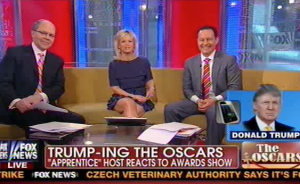
Good Afternoon!!
In an appearance on “Fox & Friends” this morning, Donald Trump shared his opinions about last night’s Oscars. Talk about the pot calling the kettle black! Trump thought the Oscar set was “tacky” and the whole show was “very average.” It takes one to know one, I guess. Not unexpectedly, Trump included his long-time obsessions, reverse racism and birtherism in his critique of the Oscar contenders.
He announced that Quentin Tarrantinos’ Django was
“one of the most racist movies I’ve ever seen,” and that it was “terrible and a disgrace.
“You know, when they talk about guns and gun control, that movie– people should watch that,” he said. “You wanna talk about somebody with a problem. But, I thought it was terrible.”
Trump objected to Daniel Day Lewis winning the Oscar for “Best Actor,” because Lewis isn’t an American and speaks with a British accent.
“he’s not from this country…“I don’t think Lincoln had an English accent,” Trump said, apparently oblivious to the fact that Lincoln in the film does not speak with the same accent. “I know lots of politicians and lots of powerful people and they don’t talk like that,” he complained.
The Fox & Friends hosts agreed, adding that Lincoln was boring “like a documentary” or “a play.”
He did applaud the Academy for awarding the “Best Actor” Oscar to Ben Affeck for his role in Argo.
“I really thought that Ben Affleck was shuttered aside,” he said. “I thought that was terrible, what they did with him. He should have been up for director. I thought ‘Argo’ was very good and I was very happy that he got it.”
I think maybe he means “shunted aside.”
Here’s the video (courtesy of Mediaite).
What else is happening?
Blue Monday Reads
Posted: February 25, 2013 Filed under: morning reads | Tags: Meet the Idiot Press, Oral Disease, Pedophilia, Social Impact Bonds 25 Comments
Good Morning!
I waded through a few of the Sunday New Shows yesterday just to see what kinds of outrageous lies my governor would tell the nation in his search for the next big job opening. Basically, watching any panel of Pressketeers is a depressing exercise in repetitive memes with the same-old same-olds. None of them are ever brighter than about a 20 watt bulb. Alex Parene’ sums up my sentiments precisely.
Finally, the “Meet the Press” panel. Each panel this morning was somehow worse than the one before. This one was Wall Street Journal scribbler Peggy “Lady Peggington Noonington” Noonan, Harold “Living Embodiment of Everything Wrong With American Politics” Ford Jr., NPR’s Steve “Objective Journalist Who is Implicitly Here to Represent the ‘Liberal’ Side Even Though He is Not a Liberal” Inskeep, and two representatives from NBC’s right-wing finance “news” station CNBC, Maria Bartiromo and Jim “Wrong About Everything and Sort of Crazy But Actually Not That Bad on Politics In Terms of CNBC Figures” Kramer.
Everyone said precisely what you’d expect them to say. Noonan was very sorrowful about how the president is going around making Americans feel scared by saying scary things about how the sequester will be bad for the economy. “I just have a bad feeling about going out and trying to scare the American people right in the middle of the Great Recession when everybody is nervous enough.” Ford and Noonan both agree that people in Washington need to “think big” and also leaders should show leadership. Pegs obviously blames the president for being mean to Republicans and being scary, but Ford had the much more controversial perspective that in the current situation, both sides are to blame for bad stuff. “No one, Democrat or Republican, can be pleased with how their party is performing,” he said, which is a very self-evidently untrue statement, because obviously lots of people can and do think their party has the right idea. But those people are “extreme partisans” and thus they do not count.
Inskeep basically said Republicans are willing to cut a revenue deal but are scared of it being called a tax hike. Bartiromo said the sequester won’t be so bad because “the markets” aren’t complaining. A few minutes went by and then Cramer said the stock market is doing well because “the markets” don’t believe the sequester will happen. That’s TV financial news in a nutshell, basically: Two completely opposite premises based on unknowable interpretations of the intentions of “the markets” stated with absolute certainty.
They closed, again, with Oscar talk. These people talking about who will win Oscars is absolutely perfect, because none of them have any clue — they don’t have any special insight into or expertise in the movie industry, or even film in general, they are just people who are on TV — but they were all very happy to explain what they thought would happen and why.
It’s hard to believe that people get paid so well to be that mundane and worthless. Better we should be paid to watch it. Oh, it get’s worse. Juan  Williams is still complaining about getting fired for making bigoted statements about Muslims. Hasn’t this dude figured out that this is bigotry and not just a dissident voice?
Fox News political analyst and “Special Report” panelist Juan Williams said in an interview with The Daily Caller’s Ginni Thomas that mainstream media outlets “stab” and “kill” dissenting voices.
Williams was fired from National Public Radio in 2010 after saying he sometimes gets “nervous” when seated on an airplane with Muslims, while making a broader point about the importance of religious tolerance.
“I always thought it was the Archie Bunkers of the world, the right-wingers of world, who were more resistant and more closed-minded about hearing the other side,” he said. “In fact, what I have learned is, in a very painful way — and I can open this shirt and show you the scars and the knife wounds — is that it is big media institutions who are identifiably more liberal to left-leaning who will shut you down, stab you and kill you, fire you, if they perceive that you are not telling the story in the way that they want it told.”
I’m sure Juan would’ve been very understanding of some lily white person talking about how they get “nervous” when walking near black men, yes? The link goes to The Daily Caller and the host is the revolting Ginni Thomas. Go there at risk to your own stomach contents. I’m reminded again why I stick to the foreign press as a rule. What a set of morons!
So, it’s an easy jump from the wife of Justice Long Dong Silver to the subject of pedophiles. As BB can attest, there’s always been a huge debate in the study of human behavior and the role of nature v. nurture. The study of men and pedophila is in the middle of that debate. There will be a new pope. Let’s hope this one had no role in enabling the churches’ baby rapers. Let’s also hope we can figure out ways to squash this horrible behavior no matter what the root.
And now new research suggests that some people are born with brains ‘wired’ for sexual attraction to children—or pedophilia—a propensity that’s further shaped by life experiences and often cannot be controlled.“Whatever the chain of events is, the chain begins before birth,” said James M. Cantor, a University of Toronto professor of psychiatry whose research team has made a series of startling correlations finding that pedophiles are likely to share physical attributes, such as slightly lower IQs, shorter body height, left-handedness and less brain tissue.
“There is no way to explain the findings that we get for pedophelia without mentioning or without including biology,” he recently told Canada’s Association for the Treatment of Sexual Abusers. “It is inescapable at this point. We cannot rule out psycho-social influences, but we cannot have a complete theory that cannot explain these non-obvious but but exquisitely important biological findings.”
Cantor’s findings have become big news not just because pedophilia is seen as one of the worst crimes—and its scandals and cover-ups don’t seem to end, whether in the Roman Catholic church or football-protecting universities. The idea that moral—and immoral—behavior has a basis in biology is the latest twist in the age-old debate of whether nature or nurture drives human action. For much of the 20 th century, psychologists looked more to the nurture side of the equation. But 21 st century science, with brain-scan imaging and computing power to analyze big data, are suggesting that both factors—one’s genes and one’s upbringing—shape human sexuality.
I’ll let BB check out the methodology and see what she thinks.
Ever heard of a Social Impact Bond? It’s a new debt instrument used to raise money for social services. It’s being tested in the UK and US. The Economist follows a homeless advocate in London whose work is being funded in part via of this new type of investment.
The homelessness SIB is one of 14 that have now been issued or are in development in Britain, which pioneered the instrument back in 2010 with a bond funding a prisoner-rehabilitation programme in Peterborough. The idea is also winning fans elsewhere. New York city launched a SIB last year tackling recidivism among inmates at Rikers Island prison; Goldman Sachs is among the investors. Work is under way on three more American SIBs, one in New York state and two in Massachusetts. Jeffrey Liebman, a Harvard University professor who is providing technical assistance on all three, has just invited applications from other state and local governments to receive help setting up SIBs: 28 applied.
And there is rising emerging-market interest in SIBs, where they go under the name of “development-impact bonds”. According to Michael Belinsky of Instiglio, a start-up devoted to designing SIBs in poor countries, there is less scope for government savings to pay back investors in emerging markets because social safety nets are thinner. So international-development agencies are more likely to act as sponsors. Mr Belinsky is working on potential SIBs in India, to improve educational outcomes for girls in Rajasthan, and in Colombia, to reduce teenage-pregnancy and school drop-out rates.
As the buzz about SIBs increases, the questions will also become more searching. Projects which take many years to have an effect (the impact of pre-school education on university admissions, say) will not interest investors. Good data are crucial for measuring outcomes: that can be a problem in developing countries.
The hardest questions concern the returns that investors will demand if SIBs are to attract serious amounts of money. The Peterborough SIB dangles an annualised return of up to 13% if reoffending rates go down by enough; but investors lose everything if recidivism does not fall by at least 7.5%. That sort of equity risk is not going to appeal to many, acknowledges Nick Hurd, the British government minister for civil society. “SIBs need to evolve so that they become more like a debt instrument.”
So, it seems only fitting that after banks make so many folks homeless through innovative financing that they now can now actually invest in homelessness. I’m sure there’s a lesson in there some where but I’m just not prepared to delineate it right now.
Okay, so let me close with my thing about what we can learn from grave sites. Today’s lesson is that our teeth aren’t so great in comparison to our ancient ancestors.
Prehistoric humans didn’t have toothbrushes. They didn’t have floss or toothpaste, and they certainly didn’t have Listerine. Yet somehow, their mouths were a lot healthier than ours are today.
“Hunter-gatherers had really good teeth,” says Alan Cooper, director of the Australian Centre for Ancient DNA. “[But] as soon as you get to farming populations, you see this massive change. Huge amounts of gum disease. And cavities start cropping up.”
And thousands of years later, we’re still waging, and often losing, our war against oral disease.
Our changing diets are largely to blame.
In a study published in the latest Nature Genetics, Cooper and his research team looked at calcified plaque on ancient teeth from 34 prehistoric human skeletons. What they found was that as our diets changed over time — shifting from meat, vegetables and nuts to carbohydrates and sugar — so too did the composition of bacteria in our mouths.
Not all oral bacteria are bad. In fact, many of these microbes help us by protecting against more dangerous pathogens.
However, the researchers found that as prehistoric humans transitioned from hunting and gathering to farming, certain types of disease-causing bacteria that were particularly efficient at using carbohydrates started to win out over other types of “friendly” bacteria in human mouths. The addition of processed flour and sugar during the Industrial Revolution only made matters worse.
“What you’ve really created is an ecosystem which is very low in diversity and full of opportunistic pathogens that have jumped in to utilize the resources which are now free,” Cooper says.
And that’s a problem, because the dominance of harmful bacteria means that our mouths are basically in a constant state of disease.
Let me think about that last one. “Our mouths are basically in a constant state of disease.” Well, maybe that explains the Sunday Talk Shows and Gini Thomas. I think it’s a deserving hypothesis, don’t you?
So, after a weekend of gray skies, storms spitting hail at my windows, and being shut in doors most of Saturday by a NOPD man hunt complete with SWAT teams and noisy swooping helicopters, I’m hoping Monday ends a little better than it’s starting. What’s on your reading and blogging list today?
MTP: Jindal’s Pants catch fire & melt Dancin’ Dave’s Disco Ball
Posted: February 24, 2013 Filed under: Bobby Jindal | Tags: ALEC, Bobby Jindal, Meet the Press 28 Comments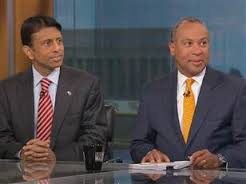 Bobby Jindal got the first word on the budget sequester this morning on MTP. His “reasonable” face to the nation is no where near his record as Louisiana’s worst Governor Ever. He was basically there to state how easy it is to cut government spending and taxes since he’d done such a bang-up job of it in Louisiana. As usual, Jindal was whistling Dixie out of his bony, malignantly narcissistic ass. Let me demonstrate Jindal Budgeting Tricks 101 for those in the national media that will NEVER actually do any research on these hideous and false claims.
Some national press figure should do some homework on what Jindal’s done to the budget in Louisiana and the dishonest, destructive, and unconstitutional ways that he’s found to “balance” it. His budget director more than fessed up last week to the fact that he’s cut state services beyond the point where basic needs met by the state will go unmet. This includes the State Patrol which I would assume even Republicans find a necessary expenditure and service. That’s not preventing him from going on national TV and telling a completely different story about how easy it is to find fat in budgets. This information is succinctly put by Stephan Winham writing for The Louisiana Voice. Mr. Winham should know. He’s the now retired State Budget Director. This year’s Jindal Budget will go beyond hurting the state and selling off state assets to potential corporate donors to his presidential campaign. Please, some one stop him before he kills again.
The governor is happy to tout his refusal to increase state taxes. He is also happy to talk about his successes in reducing the size of government and refusal of additional federal support. He is very direct, if not necessarily consistent, when it comes to holding the line on these things. Although there is no second half to his current plan to eliminate income and franchise taxes, he assures us that, if he actually ever presents a proposal for the other side of the equation, it will be income neutral.
If Nichols’ testimony is to be taken at face value, we can only assume it is not possible to maintain critical services with our current level of recurring revenue. So far, the governor’s approach to reducing state government has been to gradually strangle it through continued submission of unrealistic budgets intended to give the impression everything is okay. The legislators adopt these proposals and congratulate themselves on another successful year.
In reality, everything is not okay. The governor knows it. Ms. Nichols knows it. The legislators interested enough to pay attention know it. As long as projected revenues from reliable, stable sources do not equal projected necessary expenditures, things will NEVER be okay. Governor Jindal has not submitted, nor has the legislature adopted, such a budget during his entire administration. This is proven by the mid-year cuts that are always necessary in adopted yearly budgets and the never-ending projections of deep holes for every future year.
Governor Jindal has been quoted repeatedly in the national press saying we all have to learn to live within our means. If he really believes this, why does he not present budgets that allow the state of Louisiana to do so? I think Ms. Nichols has made the answer quite clear – because we simply cannot live the way we want to within our present means. Presenting a truly balanced budget would result in an outcry from even the staunchest fiscal conservatives who would immediately begin to cry, “Why don’t you cut the fat, not the meat?” They would never accept there isn’t enough fat left to leave the meat alone.
This year, Jindal’s budget relies heavily on selling off LSU’s hospitals. It’s just a matter of time before our Tier 1 school loses  its accreditation and the med school’s standing is jeopardized. The hospital in Monroe that serves some of the poorest folks in the state can’t find a buyer and will most likely just be shut down.
The budget cuts about $780.6 million from those programs on the assumption that all but two of the state’s 10 public hospitals will be privatized. So far, only five of those hospitals have announced plans for partnerships with private companies, and none of those proposals has been finalized.
Sen. Francis Thompson, D-Delhi, described the public hospital situation bluntly as he questioned Nichols about the process Friday. “Public hospitals are gone after this budget,” Thompson said. “Don’t exist. Over. Finished.”
Thompson’s concerns focused on E.A. Conway Medical Center in Monroe. No private company has been identified as a possible partner for it, and the budget does not include enough money to operate the center for 12 months. Thompson said the center cares for some of the poorest residents in the state.
That’s not all of the last drops of the safety net programs that are on the table. Plus, every year since Jindal’s taken offce, the budget estimates have been far rosier than occurs, so midbudget year slashes have been necessary. I lived through those at both UNO and at SELU when I was there. Let me just say I’m glad to be teaching at a private institution while living here. It gets harder to justify staying here in Louisiana every year. The kids graduated LSU and bolted. Thanks goodness Jean went to med school and is doing her residency in Nebraska. I love New Orleans and my little Bywater gem, but it’s hard to see much of a future in a state that’s been gutted of assets to appease Republican political donors. As an economist, I know that it’s going to take a good decade to get over the impact from that kind of loss of infrastructure alone. State expenditures now include running the same functions with an added layer of payments for corporate inefficiencies, executive bonuses, and lush corporate profits and dividends. I can’t wait until he starts selling off the state parks next year and all of our arenas and stadiums. I’m assuming that some of the universities will collapse completely too and be auctioned off for some obscene use. That’s about all we have left now. I’m also assuming he’s got his eye on that BP money. He ran through a lot of the Katrina/FEMA money during his first year or so. We simply aren’t using sustainable sources of revenue.
Here’s some more things on the table.
The budget also cuts funding for the Early Steps program, which provides therapy to developmentally disabled children under the age of 3. It proposes to make up the shortfall by charging some participants in the program.
Families that make more than 250 percent of the federal poverty line, or about $57,000 for a family of four, would have to pay for Early Steps on a sliding scale depending on their income, Greenstein said. About half of the 9,400 children who participate in the program each year belong to families that would be affected by the change.
The revised rules, which are expected to save the state about $1.7 million, would require the passage of new legislation before they could go into effect. Officials have not yet worked out exactly how much families will pay, Greenstein said.
The department is also planning to move pregnant women who are now receiving care through Medicaid into a program set up under the federal Affordable Care Act, also known as Obamacare, that provides subsidized health insurance.
Here’s additional cuts in the budgets for the State Police and higher education.
Jindal and other administration officials have noted that if the budget passes, about 26,000 state government jobs will have been shed since the governor took office five years ago.
Among the positions that will not be funded next year are 44 commissioned officers and 39 civilians in the State Police. The last new class of State Police cadets began training in the fall of 2008. When they graduated, there were 1,153 troopers in the force. That number has since fallen to 964 troopers.
State Police Superintendent Mike Edmonson said he’s been dealing with the loss of troopers by putting officers who formerly spent much of their time behind a desk, such as investigators, on the road and by hiring retired officers to work on a part-time basis during peak hours. He also credited increased cooperation with sheriffs’ offices and local police departments, as well as an effort to make troopers more of a visible presence on the road, for decreasing traffic fatalities.
The agency is looking for money for new troopers and hopes to be able to graduate a class by the end of 2014, Edmonson said. Nichols said there are no plans for a new cadet class in this year’s budget.
As you can see, a lot of Jindal’s budget cuts come from selling off state assets. These are one time occurrences so they only fill the holes for one year.
The state expects to make $47 million by selling six state properties, including a portion of the campus of Southeast Louisiana Hospital in Mandeville, which was privatized last year; office buildings in Baton Rouge; and a Department of Insurance property. The administration had intended to sell the Department of Insurance property last year and included that same anticipated money in last year’s budget.
Jindal has also diverted funds from other projects. Most people fear that he will divert funds from the BP oil settlement and RESTORE which are supposed to go to coastal restoration. Jindal’s budget revenue tricks are short term while his guts in public services and taxes are permanent. I can’t imagine any one would want to be governor following these steps. This is basically a short term plan to shore up his presidential appeal to right wing, tea party nuts. The state will suffer for decades as it tries to unwind the damage. Already, he’s pulled funds from the Rigs-to-Reef funds.
Yesterday, we learned that during the last two years, Governor Jindal has raided nearly $45 million from the Rigs-to-Reefs fund, which, as its name implies, requires rig operators to contribute a certain portion of their income to create and develop infrastructure projects along the Louisiana coast that could offset some of this destruction. But instead of spending that $45 million on needed coastal restoration projects, Jindal pilfered from the fund in order to offset losses in the State’s General Fund. Thankfully, the Board of the Artificial Reef Fund is now speaking out and making it abundantly clear that, for them, Jindal’s use of their monies is unconstitutional
Robert Mann–the Director of LSU’s Reilly Center for Media & Public Affairs –came up with a better series of questions that Disco Dave should’ve asked our Governor who is evidently relying on the ignorance of the national press to enhance his national prospects.
1. You say you are a fiscal conservative. But how do you square that with your habit of cobbling together your state’s budget every year with non-recurring revenue? Didn’t you campaign against such a practice as reckless and fiscally irresponsible?
2. Do you believe that your Republican gubernatorial colleagues in Florida, Ohio, Michigan, Arizona, New Mexico, Nevada and North Dakota are reckless in accepting federal funds to expand their state’s Medicaid programs? What do you know that they don’t?
3. Why have you not yet visited the community of Bayou Corne, Louisiana, where hundreds of your constituents have been homeless for months because of a collapsing salt dome?
4. You have fired or forced out a considerable number of staff members, state legislators, university officials and others who disagreed with your policies. Why are you so uncomfortable with dissent or contrary views?
5. You have a biology degree from Brown. Do you believe in evolution? Do you believe that creationism is science?
6. Your administration has slashed higher education funding by more than $400 million in the past several years. The LSU system president, Williams Jenkins, said recently that those budget cuts had harmed LSU and threatened its status as a tier-one university. When was the last time you visited the LSU campus, or any other university campus, to meet with students to discuss the impact of those cuts on their education?
7. Do you believe that sales taxes are inherently regressive and harmful to the poor? Is exempting only groceries, medicine and utilities enough to shield the poor from the impact of a large state sales tax increase?
8. Why would you oppose a 4-cent renewal of your state’s cigarette tax and then propose more than a dollar increase in the same tax? Why was the 4-cent renewal an unacceptable tax increase, but a dollar increase is not?
9. Do you believe that purchasers of guns ought to first be required to undergo a basic background check? Why do you believe people should be allowed to carry guns into churches?
10. You campaigned on transparency. Why do you believe the records of your office should be shielded from public view?
Of course, Disco Dave would actually have to rely on research instead of Beltway memes to follow this line of questioning so it’s doubtful that any of Mann’s questions even crossed his mind. Disco Dave and staff are probably doing the Harlem Shake right now since it’s the “in” thing and investigative journalism is so 1973. At least, Massachusetts Governor Deval Patrick was there to challenge some of Jindal’s rationale on the sequester.
Patrick, a frequent surrogate for Obama during the 2012 campaign, reacted yesterday to criticism by fellow “Meet the Press” guest Republican Louisiana Gov. Bobby Jindal, saying the current standoff on Capitol Hill over how to pull the economy out of a looming nosedive “is not of the president’s creation.”
“The president hasn’t campaigned and hasn’t wanted to govern constantly being in conflict with congressional Republicans,” said Patrick. “From the very beginning, it was the leadership of the Republicans … who said their No. 1 agenda was to make this president a one-term president. When he won a second term, their No. 1 agenda is to slow down the recovery of our economy and that needs to be called out. It is a fact.”
But Jindal countered Obama “needs to stand up at the plate if he really thinks this is going to devastate the military, devastate air-traffic control, really devastate meat inspections …
“The reality is the federal budget this year, even after the cuts, will still be larger,” Jindal said. “Families and businesses out there during this national recession have had to tighten their belts, do more with less. You ask any American out there, ‘Is there at least 3 percent of the federal budget that’s being wasted today?’ Let’s not cut the air-traffic controllers first, let’s go cut the waste.
“It is time to stop campaigning,” Jindal said of Obama. “It is time to actually do the job right here in Washington, D.C.”
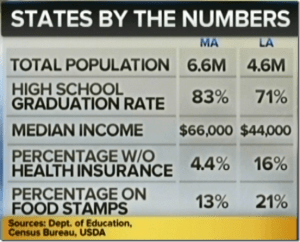 Disco Dave did at least chide Jindal for having a state that resides on the bottom of every conceivable quality of life measure possible. Jindal insists he’s got things going in the right direction. HA!
Here are some statistics, state to state, Massachusetts to Louisiana, that reflect kinda more services, less taxes, and the different results. Put that up there. You have a bigger population in Massachusetts. You see that there. The high school graduation rate much higher in Massachusetts. The median income about 20,000 higher. The percentage of population without healthcare insurance much higher in Louisiana. The percentage of the population on food stamps much higher in Louisiana. So does this, do results break a little along some of the ideological and philosophical lines about taxes and the amount of government services?
Still, Jindal should take his own advice rather than killing the state he governs with ALEC-inspired policies meant to enrich the richest and enslave the poorest. He’s been in perpetual campaign for president mode since about the second or third year of his first term. His second term is basically nothing but appeasement of Republican primary voters and donors. He continues to divert state funds to religious madrassas and private, charter schools that are not required to follow the same strict state and federal laws regulating the state’s public schools. He has defunded Higher Education to the point that even LSU’s accreditation is in jeopardy and most universities have had cut into vital services and programs. I’ve already inkled just some of the nasty things happening to the state’s health care system and public safety. The minute the FEMA funds and BP Oil spill funds leave the state, we’ll fall so far below Mississippi we may never catch up again. Those are the few stimulatory sources of funding we have. Don’t forget that he’s trying to increase our sales taxes which will undoubtedly kill a lot of retail stores and the tourist industry. Consumer demand of these items are extremely price sensitive so it’s likely to cut in to the revenues of many of Lousiana’s small businesses.
Again, will some one PLEASE out this man for the liar that he is and stop him before he kills again?
Saturday Afternoon Reads: The Feminine Mystique
Posted: February 23, 2013 Filed under: just because, U.S. Politics, Women's Rights | Tags: afternoon reads, Betty Friedan, books, education, feminism, psychology, The Feminine Mystique 40 Comments
Betty Friedan
Good Afternoon!
I decided to focus this post on something other than the debt, deficit, sequester obsession that has taken over American politics, so I’m writing about a book I read in high school that changed my life forever. Feel free to use this as an open thread, and post your links freely in the comments.
This week marked the 50th anniversary of a book that truly changed my life, The Feminine Mystique, by Betty Friedan. It was first published on February 19, 1963. I read it in paperback when I was a junior in high school, probably in early 1964.
I already knew I didn’t want to be a housewife like my mom, but there weren’t many alternatives for girls in those days. Ideally, you were supposed to get married and have children and forget about having a career or focusing on your own unique interests. You were supposed to enjoy cleaning house and supporting your husband’s career and if you didn’t enjoy it, there was something wrong with you–you weren’t a real woman.
The main reason for girls to go to college was to find a husband. Oh sure, you could study and learn about things that interest you, but that would all go by the wayside once you found a man. After that, it was all about him. If you couldn’t find a husband, then you might have to work. You could be a teacher, a nurse, or a secretary–that was about it. Women who insisted on being college professors, doctors, lawyers were few and far between and they had a tough time of it.
Then Betty Friedan’s book came out, and it hit a nerve for millions of American women and girls, including me. Here’s the famous opening paragraph:
“The problem lay buried, unspoken, for many years in the minds of American women. It was a strange stirring, a sense of dissatisfaction, a yearning that women suffered in the middle of the 20th century in the United States. Each suburban wife struggled with it alone. As she made the beds, shopped for groceries, matched slipcover material, ate peanut butter sandwiches with her children, chauffeured Cub Scouts and Brownies, lay beside her husband at night—she was afraid to ask even of herself the silent question—‘Is this all?’”
Friedan called it “the problem with no name.”

First edition of Friedan’s The Feminine Mystique (Bauman Rare Books)
As I read the book, I began to develop more sympathy for my mother’s plight. During World War II, women had been called upon to go to work to support the war effort and replace men who had been drafted or had enlisted in the military. But when the men came back, they needed the jobs and women were expected to go back to their homes and be satisfied with doing housework, child rearing, decorating, and entertaining for no pay. Friedan wrote about how “experts” had produced reams of propaganda in the effort to get women to find joy and fulfillment in being housewives and mothers. The “feminist mystique” for Friedan said “that the highest value and the only commitment for women is the fulfillment of their own femininity.”
I’ve told this story before, but when I was a senior in high school I wrote an essay for my English class called “Women Are People Too.” My male teacher was somewhat taken aback by my arguments, but he still asked me to read my paper aloud in class. I was jeered and mock for it, of course. Later my economics teacher–a true leftist–found out about the essay and read it in my economic class. Today it seems strange, but most of the other students in my school were horrified by the notion of women being equal to men.
My father, an English professor, had a woman colleague Lucille C.–a full professor who had never married. My mother said that most men would be intimidated by her brilliance and success. Anyway, when I told Lucille about how all the other kids were making fun of me for my essay, she told me to tell them I was a member of FOMA, which stood for “Future Old Maids of America.” I loved it!
Much has changed since 1963. Women now assume they have a right to an education and a career as a well as the right to choose (if they can afford it) whether to stay home with children or work outside the home. But as we have seen in the past four plus years, misogyny is alive and well in the good ol’ USA, and we still have a very long way to go to achieve anything like real gender equality.
Carlene Bauer spoke for me when she wrote at The New York Observer:
When Friedan writes that early feminists “had to prove that women were human,” it is hard not to feel a shock of recognition and indict our own moment as well, especially after the election that just passed. But American women still find themselves struggling against a strangely virulent, insidious misogyny. If our culture truly thought women were human, 19 states would not have enacted provisions to restrict abortion last year. There would be no question whether to renew the Violence Against Women Act. Women would not make 77 cents to every man’s dollar, and make less than our male counterparts even in fields where we dominate. We wouldn’t have terms like “legitimate rape” or “personhood.” Women who decided not to have children would not be called “selfish,” as if they were themselves children who had a problem with sharing. If our culture truly allowed them to have strong, complex, contradictory feelings and believed they were sexual creatures for whom pleasure was a biological right, perhaps adult women would not be escaping en masse into badly written fantasy novels about teenage girls being ravished by vampires.
Bauer also noted that some problems with the book, most notably Friedan’s homophobia.
This book…should seem thrillingly, relievedly quaint. It does not. But it is surprisingly boring in spots—there are many moments where you can see the women’s magazine writer in Friedan giving herself over to breathless exhortation—and astoundingly homophobic. At one point Friedan rails against “the homosexuality that is spreading like a murky smog over the American scene.” Friedan has been criticized for not being as careful a researcher, or as honest a storyteller, or as civil-rights-minded as she could have been. But perhaps these criticisms are somewhat beside the point. There are numerous passages that, if you did not know their provenance, could be mistaken for sentences written in judgment of the present day.
In looking over The Feminine Mystique recently, I realized that I had forgotten how much scholarship and psychological analysis and scholarship Friedan included in the book. She was a psychology major at Smith College, graduating summa cum laude in 1942. For example, The Feminine Mystique contained a brilliant analysis of Freudian theory and its consequences for women. Friedan argued that education at women’s colleges had been dumbed down between the 1940s and 1960s, with educators limiting courses to “subjects deemed suitable for women” and their future roles as housewives. She suggested that girls were prevented from experiencing the normative identity crisis that was the focus of Erik Erikson’s developmental theory. And she argued that women had been kept at the lower, subsistence levels of Maslow’s hierarchy of needs.
How many books truly change society in dramatic ways. Betty Friedan’s book did that. A few more links to articles on the 50th anniversary of The Feminine Mystique.
Michelle Bernard: Betty Friedan and black women: Is it time for a second look?
NYT: Criticisms of a Classic Abound
Mona Gable at BlogHer: How Far Have We Come?
ABC News: ‘Feminine Mystique’: 50 Years Later, Dated But Not Irrelevant
Caryl Rivers: ‘Feminine Mystique’ At 50: If Betty Friedan Could See Us Now
Janet Maslin: Looking Back at a Domestic Cri de Coeur
Alexandra Petri: The Feminist Mystique
Peter Dreier: The Feminine Mystique and Women’s Equality — 50 Years Later
Kathi Wolfe at The Washington Blade: Power of the ‘Feminine Mystique’
A discussion at NPR’s On Point: The Feminine Mystique at 50
This isn’t specifically about The Feminine Mystique, but I think it’s relevant. Allie Grasgreen at Inside Higher Ed: ‘The Rise of Women’ — a “new book explains why women outpace men in higher education.”
Please use this as an open thread, and post anything you like in the comments.
Saturday Morning Open Thread: Anti-Abortion Senator Endorses Roe v. Wade Reasoning
Posted: February 23, 2013 Filed under: just because, Republican politics, U.S. Politics, Women's Rights | Tags: abortion, Charles Grassley, Indiana State Senate, Mike "Two Times" Pence, right to privacy, Roe v. Wade, transvaginal ultrasound 23 Comments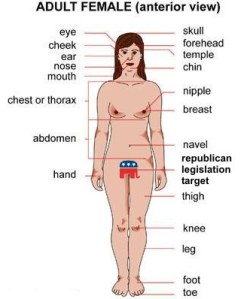
Good Morning!!
I’m getting a slow start this morning, so I thought I’d put up an open thread to get us started. This story is a couple of days old so you may have heard about it already, but I just had to take note of it anyway.
On Wednesday at a town hall meeting in Chariton Iowa, Senator Charles Grassley got a strange question about some wingnut conspiracy theory from one of his constituents: From the Atlantic Wire:
Constituent: They’re saying that they’re going to start, in 2013, putting microchips in government workers and then any kid that enrolls in school, starting in pre-school, will have a microchip implanted in them so that they can track them. Is that true?
Senator Grassley’s response was absolutely priceless:
Grassley: No. First of all, nothing can be done to your body without your permission….It’d be a violation of the constitutional right to privacy if that were to happen.
Here’s the video:
In case Grassley hasn’t thought about it that carefully, forcing a woman to have a baby certainly qualifies as doing something to her body without her permission. Actually, there is no right to privacy in the U.S. Constitution, but the Roe v. Wade decision created one; and Roe could certainly be used as precedent in any case relating to violations of body integrity.
In fact, the majority opinion of Roe v. Wade clearly states:
The Constitution does not explicitly mention any right of privacy. In a line of decisions, however, going back perhaps as far as Union Pacific R. Co. v. Botsford, 141 U.S. 250, 251 (1891), the Court has recognized that a right of personal privacy, or a guarantee of certain areas or zones of privacy, does exist under the Constitution…
Roe v. Wade, of course, established the right to privacy — the kind that might spare you from a government conspiracy to embed microchips that might reveal your entire health history. Or, you know, the kind of privacy that allows women to obtain a legal abortion in this country:
This right of privacy, whether it be founded in the Fourteenth Amendment’s concept of personal liberty and restrictions upon state action, as we feel it is, or, as the District Court determined, in the Ninth Amendment’s reservation of rights to the people, is broad enough to encompass a woman’s decision whether or not to terminate her pregnancy.
Grassley is a long-time opponent of abortion rights and advocate of overturning Roe v. Wade, and Naral gives him a zero rating on pro-choice issues. If Roe were overturned, where does Grassley think he’d find a constitutional “right to privacy”?
And let’s not forget the recent Republican obsession with forcing women to undergo vaginal probes before they can have an abortion.
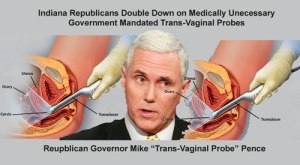
Not to be outdone, the Indiana State Senate has passed a new law that requires a woman to have two (2) ultrasounds–before and after her “abortion”–even if she is just taking RU 487, or the morning after pill! The bill doesn’t specific intravaginal ultrasounds, but they would, in effect, be required, since most abortions are performed when the embryo or fetus is too small to be detected by a traditional ultrasound.
I’m not sure what Grassley’s position on these ultrasound laws is, but someone should definitely ask him. If forcing a woman to have two transvaginal probes in order to get a pill doesn’t qualify as the government doing something to “your body without your permission,” what does Grassley believe would qualify as a violation of a woman’s privacy? Maybe because the town hall questioner was a man, he was suggesting that only Americans with penises have privacy rights?
As the inimitable Charles Pierce once wrote about Senator Grassley in a different context:
This is also funny because, you see, if there’s one thing that Chuck Grassley is noted for, it is that he is the most spectacular box of rocks, the most bulging bag of hammers, in the history of the World’s Greatest Deliberative Body. If brains were atom bombs, he couldn’t blow his nose. If his IQ was one point lower, they’d have to water him. As the great Dan Jenkins once put it in another context, if the man had a brain, he’d be out in the yard playing with it.

 peej
peej Carissa
 bostonboomer
 dakinikat
 ecocatwoman
 jjlo
jjlo mablue2
 Mama Lopez
 peggysue22
 quixote
 skydancingguestblogger
 Mona (aka Wonk the Vote)





Recent Comments