
Friday Reads
Posted: February 22, 2013 Filed under: morning reads | Tags: Arkansas fetus fetishests, modern slavery, rising costs of health care, sexting, warrior grave found in Rusia 30 Comments Good Morning!!
It’s pretty common knowledge that the increasing cost of health care is the real issue that most economists see as the driver for increased federal and state deficit spending issues in the future. Time Magazine has a good article up that discusses how rapidly increasing costs are an issue for governments and families alike. The information is surrounded by personal family stories that are heartbreaking.
When we debate health care policy, we seem to jump right to the issue of who should pay the bills, blowing past what should be the first question: Why exactly are the bills so high?
What are the reasons, good or bad, that cancer means a half-million- or million-dollar tab? Why should a trip to the emergency room for chest pains that turn out to be indigestion bring a bill that can exceed the cost of a semester of college? What makes a single dose of even the most wonderful wonder drug cost thousands of dollars? Why does simple lab work done during a few days in a hospital cost more than a car? And what is so different about the medical ecosystem that causes technology advances to drive bills up instead of down?
Recchi’s bill and six others examined line by line for this article offer a closeup window into what happens when powerless buyers — whether they are people like Recchi or big health-insurance companies — meet sellers in what is the ultimate seller’s market.
The result is a uniquely American gold rush for those who provide everything from wonder drugs to canes to high-tech implants to CT scans to hospital bill-coding and collection services. In hundreds of small and midsize cities across the country — from Stamford, Conn., to Marlton, N.J., to Oklahoma City — the American health care market has transformed tax-exempt “nonprofit” hospitals into the towns’ most profitable businesses and largest employers, often presided over by the regions’ most richly compensated executives. And in our largest cities, the system offers lavish paychecks even to midlevel hospital managers, like the 14 administrators at New York City’s Memorial Sloan-Kettering Cancer Center who are paid over $500,000 a year, including six who make over $1 million.
Taken as a whole, these powerful institutions and the bills they churn out dominate the nation’s economy and put demands on taxpayers to a degree unequaled anywhere else on earth. In the U.S., people spend almost 20% of the gross domestic product on health care, compared with about half that in most developed countries. Yet in every measurable way, the results our health care system produces are no better and often worse than the outcomes in those countries.
According to one of a series of exhaustive studies done by the McKinsey & Co. consulting firm, we spend more on health care than the next 10 biggest spenders combined: Japan, Germany, France, China, the U.K., Italy, Canada, Brazil, Spain and Australia.
Slavery is still an issue around the world. It involves people of all ages and occurs in a surprising number of countries. Why is slavery still thriving?
A lot of people are pretty excited that Mississippi has decided to join the rest of the nation in outlawing human bondage. But in these celebrations, we seem to have forgotten one thing: Modern-day slavery is still a thriving industry, both in Mississippi and in
the rest of the nation.
In fact, Mississippi is something of regional slave transportation hub, according to the state’s special assistant attorney general Heather Wagner, who explains that the easy highway access to nearby major cities and the Gulf Coast ports make the state a trafficking corridor. The state recently passed rules requiring longer prison sentences for people caught enslaving and trafficking humans, such as the two Mississippi men who were recently indicted for selling or buying of children after being caught with a video that shows them enslaving and raping a girl about three years old.
To be fair, human and sex trafficking isn’t unique to Mississippi. According to the Department of Homeland Security, this industry–which the website describes as “ modern-day slavery”–is thriving across the United States. Recent examples abound: The 17 young women from Mexico who were brought to the U.S., held in captivity in New York State and forced to work as prostitutes; the firefighter in Baltimore who allegedly enslaved women in a brothel; the 20 Togolese women or girls who were transported to the U.S. and forced to work in hair salons in New Jersey. Nationally; an estimated 244,000 American children are at risk of being enslaved and forced into sex work alone–that doesn’t even include the thousands of additional people who are transported to the U.S., held in captivity and forced to work picking tomatoes or strawberries for WalMart. Globally, slavery recognized as one of the most lucrative illegal industries. An estimated 27 million are enslaved, generating $32 billion annually.And that’s just illegal slavery; state-sanctioned bondage is another thriving industry with that entraps millions of people and generates billions of dollars. With one of the most punitive states in the nation, Mississippi is a model of the incarceration nation
Minx fed my interest in graves with this discovery of a warrior’s grave in Russia.
Hidden in a necropolis situated high in the mountains of the Caucasus in Russia, researchers have discovered the grave of a male warrior laid to rest with gold jewelry, iron chain mail and numerous weapons, including a 36-inch (91 centimeters) iron sword set between his legs.
That is just one amazing find among a wealth of ancient treasures dating back more than 2,000 years that scientists have uncovered there.
Among their finds are two bronze helmets, discovered on the surface of the necropolis. One helmet (found in fragments and restored) has relief carvings of curled sheep horns while the other has ridges, zigzags and other odd shapes.
 Radical Right Republicans and the establishment republicans continue to reject Karl Rove with a variety of insults and personal comments made public. Here’s an example. There are more at the Bloomberg.com article.
Jonathan Collegio, a spokesman for the Conservative Victory Project and American Crossroads, said the groups had “come to the conclusion that we need to increase the caliber of candidates running for office in Republican primaries, and our goal is to elect the most conservative candidates in primaries who can win” general election contests against Democrats.“We have made absolutely clear we are not trying to pick a fight with the Tea Party,” Collegio said. “We are simply trying to pick the best candidates available.”
That’s not how David Bossie, president of Citizens United, a Washington-based group that says it is “dedicated to restoring our government to citizens’ control,” sees it.
“I like it that voters get to decide,” Bossie said. “I think Rove is trying to defend himself and deflect from his failure. I hear from donors. I hear from grassroots people across the country who are offended by the very fact that Karl Rove thinks he knows best.”
“If American Crossroads has done a great job, why create some new entity with the name conservative in it?” Bossie asked. “So everybody thinks it’s good because it is from a conservative outfit?”
Hope you’ve stocked up on plenty of popcorn because this is certainly getting more interesting as their losing days wear on. There seems to be an amazing race in banana republican states to see which one can pass the most restrictive abortion laws. Yes, yes. Republicans are all about small government and less regulation.
A Republican-controlled committee in the Arkansas House of Representatives approved a bill on Thursday that bans abortions after 12 weeks of pregnancy if a fetal heartbeat is detected, with exceptions for rape, incest, the life of the mother and highly lethal fetal disorders. The law, if passed, would be the most extreme abortion restriction in the country.
The House Public Health, Welfare and Labor Committee also approved a Senate-passed bill that bans abortions at 20 weeks after conception. Both bills defy the Supreme Court’s decision in Roe v. Wade, which prevents states from banning abortions before the fetus is viable — usually between 22 and 24 weeks of gestation.
Opponents of the so-called “heartbeat bill” argue that it would prevent women from having abortions before many of them even realize they’re pregnant.
“Let’s call this bill what it is: bumper-sticker message legislation with no chance of standing up in court, designed to dial the clock back 40 years on women’s rights,” said Nancy Northup, president and CEO of the Center for Reproductive Rights, a legal advocacy group. “This extreme ban will either force women already facing tough economic circumstances to travel to a neighboring state to access constitutionally protected health care or to turn to dangerous, clandestine options that could ruin or even end their lives.”
Well, this is certainly an interesting use of FBI resources.
Apparently FBI agents are mixing work with play a little too much. CNN obtained confidential internal memos scolding employees for a variety of violations, including bugging a boss’s office, paying for sex in a massage parlor, sending nude pictures to coworkers, and “a rash of sexting cases.” “When you are given an FBI BlackBerry, it’s for official use. It’s not to text the woman in another office who you found attractive or to send a picture of yourself in a state of undress. That is not why we provide you an FBI BlackBerry,” FBI assistant director Candice Will told CNN. She added that though she thinks she’s seen it all in her time at the FBI, she continues to get files that surprise her.
With that, I turn the reins of discussion to you. What’s on your reading and blogging list today?
Today’s Republican Party will say anything but the Truth
Posted: February 21, 2013 Filed under: religious extremists, Republican politics, Republican Tax Fetishists, right wing hate grouups, Surreality 33 Comments Perhaps one of the most overdone truisms you hear bandied about by people is “Actions speak louder than Words”. This is perhaps the seminal lesson that Today’s Republican Party should learn. They’re held captive by religious, white supremacist, and libertarian cults that operate in orbit around a corporatist elite and their cronies. They don’t really have any more core values or principles. The only have the major goals of their cults and billionaire enablers.
You can see the hypocrisy, the lies, and the actual agendas in their actions. In some ways, the worst of the cult priests are more honest than your establishment Republican which is why Karl Rove and others would prefer they stay silent while Republican Central fine tunes their messaging so they can fool more of the people most of the time. They are no longer a party of serious governance. Their goals are to further enrich and empower the wealthy, move as close to anarchy as possible with only the military left standing, and make as many states as possible adopt the bottom trawling quality of life one finds in Mississippi along with firmly entrenching one specific view of Christian morality into all institutions.
The party of “small government” is basically the party of huge military and international interventions and massive intrusions into people’s lives so that women, minorities, and children are forced into the appropriate biblical role of child bearing and slavery. They are also supportive of police state tactics that include government spying, torture, and denial of due process. Some of those folks are acceptable since they serve in the role of “House Eunuchs” where they proudly stand by or in for the master as long as they don’t get too vocal about their sexuality, their ambitions beyond child bearing, or the fact that their upward mobility is limited due to race, ethnicity, sex, or religion.
Let me source this rant to the naive ramblings of Josh Barro who wishes that Republican policies were more rooted in empirics and my now favorite Hillaryism “an evidence-based reality”. Greg Sargent did a great job this morning at Maddow Blog talking about why Barro’s wishful thinking is unlikely to come true. It simply doesn’t fit into what Republican want.
Conservatives tend to prefer a different approach that decreases the role of government, not to achieve specific ends, but because decreasing the role of government is the specific end.
This, of course, affects nearly every debate in Washington. When it comes to job creation, for example, the task for Democrats is pretty straightforward: let’s do more of what’s been the most effective, and less of what’s been the least effective. Again, it’s about pragmatism and results based on evidence.
For Republicans, it doesn’t work quite that way — they have ideological ideals that outweigh evidence. GOP leaders could be shown incontrovertible proof that the most effective methods of creating jobs and improving the economy are aid to states, infrastructure investment, unemployment insurance, and food stamps, and they’d still refuse. Why? Because their ideology dictates the response.
The left starts with a policy goal (more people with access to medical care, more students with access to college, less pollution, more jobs, less financial market instability) and crafts proposals to try to complete the task. The right starts with an ideological goal (smaller government, more privatization, more deregulation) and works backwards.
For Barro, if Republicans “figured out” that their mistaken policy assumptions were, in fact, mistaken policy assumptions, they’d change direction. I wish that were true, but all available evidence points in the exact opposite direction.
 Republicans that embarrass folks like Karl Rove and his donors are basically stating the goals of the party at the moment. They don’t care how they arrive there. There are no principles involved. There is no evidence involved. Each of the cults will violate all principles and all lessons of reality and science to arrive at these goals. The religious right want their perverted version of Christianity as the rule of the land. They want no birth control, no abortion, no visible or outward signs of homosexuality or anything other than how they define marriage, family, and morality. The Republican Party says it is the party that dislikes government interference and regulation. It wants ‘small government’. To see this Republican principle violated perpetually, one only need look at the agendas pushed through by the Religious Cult wing of the Republican party where we get state mandated sermons, procedures, and tons of regulation. Yes, we get Mississippi where the state regulates the one abortion clinic into illegality even though the right to an abortion is a constitutional right. These are the same folks that scream that any tiny bit of regulation of gun ownership is the end of the Bill of Rights and Constitutional rights as we know it. See, the principle is only valid when it works for them.
Then, there’s the entire cult of Austrian Economics and Ayn Rand which is what the Barro piece was focused on. Let me quote Paul Krugman on these folks:
Substance aside — not that substance isn’t important — Austrian economics very much has the psychology of a cult. Its devotees believe that they have access to a truth that generations of mainstream economists have somehow failed to discern; they go wild at any suggestion that maybe they’re the ones who have an intellectual blind spot. And as with all cults, the failure of prophecy — in this case, the prophecy of soaring inflation from deficits and monetary expansion — only strengthens the determination of the faithful to uphold the faith.
Barro even admits to the wrongness of the economic policies of this group. But again, Barro thinks that the principles are important rather than the outcomes. This group wants the outcomes only.
Political parties should differ on normative questions. They ought to strive for agreement on positive questions — questions such as, what policies cause gross domestic product and median incomes to rise, how unemployment insurance affects the unemployment rate, or how global temperatures are changing. Currently, Republicans make a lot more errors on these kinds of questions than Democrats.
Correcting errors on positive questions should cause conservatives to revisit some of their top policies, as Bloomberg View columnist Ramesh Ponnuru laid out this weekend in the New York Times. Conservatives say tight money and lower top tax rates would enrich middle-class families. But that’s wrong, and if they figured that out, they might stop supporting tight money and lower top tax rates.
The deal is Josh, that the Republican Party does not want to honestly state that their goal is to make the upper class much wealthier and the 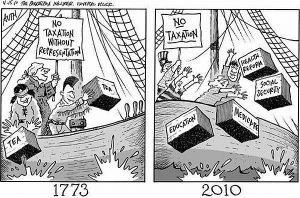 rest of us are other in the category of pesky servants or moochers who aren’t worth wasting anything on. Pesky servants should just work at their jobs and not be seen or heard and should just be thankful for the crumbs they receive. Moochers need to just self-deport or join the military to learn civility and servility. We got a glance of the true set-up here during the Romney 47% illumination because they though we weren’t listening in. The silly donors thought the room held only servants and house enuchs!!
You see, the Republican establishment really doesn’t care about the economy as long as the donor base and the corporate base do fine which is exactly what’s been going on for the last ten years or so. When they don’t do fine, they just dip into the public Treasury and replenish their gambling stakes. They don’t want to pay for anything that doesn’t directly benefit them. They want to be worshiped as gods for holding their vaulted positions which they honestly believe has come to them because their special. You can see this again in the places that Josh holds up as being great places because they’ve got Republican Governors. Again, let’s think about this. We’re talking the plantation mentality that thrives still in Mississippi and Louisiana. Everything’s just fine as long as the economy works for the Koch brothers, the Oil and Gas Companies, Pete Peterson, and the House Eunuchs. Let’s just use the Mississippi and Louisiana governor and state set up to illustrate their idea of Mississippi as the role model for the country.
Thursday Reads: Rick Scott Folds on Medicaid, the Sanctity of Marriage, GOP Meltdown, and Media News
Posted: February 21, 2013 Filed under: Barack Obama, morning reads, Sequester, the GOP, The Media SUCKS, U.S. Economy, U.S. Politics | Tags: CNN, DOMA, Erin Burnett, Gay Marriage, hypocrisy, Medicaid, Michelle Laxalt, Obamacare, Paul Laxalt, Pete Domenici, Rick Scott, sanctity of marriage, Soedad O'Brien 43 Comments
Good Morning!!
There’s another winter storm moving across the country, and we could get another big snowstorm here in New England this weekend. My local NPR station predicted a foot of snow for the Boston area on Sunday, but the Weather Channel says it could turn out to be mixed with rain. We’ll just have to wait and see. The good news is that February is almost over and spring is on the horizon.
For now, pull up a chair (or curl up in bed with your laptop, grab your coffee or tea, and let’s see what’s in the news this morning.
Yesterday JJ wrote about all the Republican governors who are refusing to cooperate with the ACA by setting up health care exchanges in their states. Many GOP governors have also said they will not agree to an expansion of Medicaid. But late yesterday, one of the most recalcitrant of these governors, Rick Scott of Florida, reversed course and accepted a Medicaid expansion that would provide health coverage for an additional 1 million Floridians. The Orlando Sentinel reports:
Gov. Rick Scott announced Wednesday a proposed three-year expansion of Florida’s Medicaid program — enrolling an additional one million poor and disabled Floridians beginning next year — after the Obama administration gave the state tentative approval to privatize Medicaid services. If the Legislature approves, Scott’s announcement means the state will extend eligibility in the federal-state program to single people and families earning up to 138 percent of poverty….”While the federal government is committed to paying 100 percent of the cost of new people in Medicaid, I cannot, in good conscience, deny the uninsured access to care,” Scott said at a press conference. He added that the expansion would have to be renewed in three years.
Florida has approximately 3.8 million uninsured citizens, so this isn’t going to solve the problem for most of them. So what’s going on with the privatization deal?
Scott’s announcement came a few hours after the Centers for Medicare and Medicaid Services announced its tentative approval of a managed-care plan that Scott had previously said might well determine his decision on expansion – though the governor said he had not committed to the expansion in return for the approval….
But, the approval is conditional. According to CMS, the state still needs to show how it plans to monitor the quality of care that the Medicaid recipients will receive, plus create a “rigorous and independent evaluation” of the managed-care plans.
Republicans in the Florida legislature are unhappy and may still challenge Scott’s decision.
Erik Erikson is unhappy too, writing at Red State: I Am Very Disappointed in Governor Rick Scott. Erikson says “[i]t is a sad day for conservatives.”

Pete Domenici and Michelle Laxalt
In sanctity of marriage news,
Just a week after Democratic Representative Steve Cohen of Tennessee revealed that a young girl he was tweeting with was his daughter–a child he had not know about until recently–we learned yesterday that former New Mexico Senator Pete Domenici had a secret, out-of-wedlock child, a son who is now in his thirties. From the Albuquerque Journal:
Statements given to the Journal by Domenici and the son’s mother, Michelle Laxalt of Alexandria, Va., identified the son as Adam Paul Laxalt, a Nevada lawyer. Michelle Laxalt formerly was a prominent government relations consultant and television political commentator in Washington, D.C. She is a daughter of former U.S. senator and Nevada Gov. Paul Laxalt. “More than 30 years ago, I fathered a child outside of my marriage,” Domenici said in his statement. “The mother of that child made me pledge that we would never reveal that parenthood, and I have tried to honor that pledge and so has she,” Domenici said.
Michelle Laxalt said that she and Domenici decided to go public now because she had reason to believe that someone else was going to (someone in the media?) was going to reveal their secret.
“Recently information has come to me that this sacred situation might be twisted … and shopped to press outlets large and small in a vicious attempt to smear, hurt and diminish Pete Domenici, an honorable man, his extraordinary wife, Nancy, and other innocents.” Michelle Laxalt said in her prepared statement.
“Why, after more than 30 years, would anyone insinuate pain and ugliness where joy and beauty have presided?” she asked.
Michelle Laxalt said “one night’s mistake led to pregnancy” and she chose to raise the son as a single parent.
“Given the fact that both my father and the father of my child were United States senators, I felt strongly that I would make this choice according to my values and would not seek advice, input or permission,” Michelle Laxalt said.
A few more reactions to the Domenici-Laxalt story:
Elspeth Reeve at The Atlantic Wire: Senator Had a Secret Son With Pundit Who Praised Him as a Great Dad.
Digby at Hullabaloo notes that Domenici was extremely judgmental of Bill Clinton over his relationship with Monica Lewinsky.
I really liked this one at The League of Ordinary Gentlemen: “Secret Children For Me, No Gay Marriage For Thee!”
More evidence that the GOP is melting down:
Yesterday, conservative pundit Byron York was mystified by John Boehner’s op-ed in the Wall Street Journal about the sequester. York writes:
In a Wall Street Journal op-ed Wednesday, House Speaker John Boehner describes the upcoming sequester as a policy “that threatens U.S. national security, thousands of jobs and more.”
Which leads to the question: Why would Republicans support a measure that threatens national security and thousands of jobs? Boehner and the GOP are determined to allow the $1.2 trillion sequester go into effect unless President Obama and Democrats agree to replacement cuts, of an equal amount, that target entitlement spending. If that doesn’t happen — and it seems entirely unlikely — the sequester goes into effect, with the GOP’s blessing.
In addition, Boehner calls the cuts “deep,” when most conservatives emphasize that for the next year they amount to about $85 billion out of a $3,600 billion budget. Which leads to another question: Why would Boehner adopt the Democratic description of the cuts as “deep” when they would touch such a relatively small part of federal spending?
The effect of Boehner’s argument is to make Obama seem reasonable in comparison. After all, the president certainly agrees with Boehner that the sequester cuts threaten national security and jobs. The difference is that Obama wants to avoid them….Could the GOP message on the sequester be any more self-defeating?
Bwwwwwaaaaaaahahahahahaha!!!!

In other bizarre wingnut news,
I had to double check to make sure this story at HuffPo wasn’t satire.
Fox News personality Bill O’Reilly has announced that Killing Jesus: A History will be his follow-up book to the NYT Bestsellers Killing Lincoln and Killing Kennedy. A press release from his publisher Henry Holt stated that the book will
…tell the story of Jesus of Nazareth as a beloved and controversial young revolutionary brutally killed by Roman soldiers. O’Reilly will recount the seismic political and historical events that made his death inevitable, and the changes his life brought upon the world for the centuries to follow. “Jesus Christ has not walked among us physically for more than two thousand years, yet his presence today is felt the world over and his spirit is worshipped by more than 2.2 billion people,” said O’Reilly. “His teachings, his legacy, his life as a flesh-and-blood man, and his death created the world in which we live.”
Too much! More from The Hollywood Reporter:
In Killing Jesus, O’Reilly “will recount the seismic political and historical events” that made the death of the “beloved and controversial young revolutionary” known as Jesus of Nazareth inevitable.
“Jesus Christ has not walked among us physically for more than 2,000 years, yet his presence today is felt the world over and his spirit is worshipped by more than 2.2 billion people, O’Reilly said in a statement released by Holt. “His teachings, his legacy, his life as a flesh-and-blood man and his death created the world in which we live.”
This is a riot:

Candy Crowley moderating presidential debate
Dylan Byers reported at Politico last night that former RNC chairman and current co-chair of the presidential debate commission Frank Farenkopf regrets allowing CNN’s Candy Crowley to moderate the second presidential debate between Obama and Romney.
Why, you ask?
Crowley, who moderated the second, town-hall-style debate, drew heavy fire from conservatives for challenging Mitt Romney after he suggested that President Obama had not called the attacks in Benghazi, Libya, “acts of terror.”
According to an agreement between the Obama and Romney campaigns, the moderator of the town hall debate was to refrain from asking questions or participating in the debate. Crowley had promised to defy that agreement even before the debate started.
Give me a break! Farenkopf was upset because Candy told the truth. Does anyone really believe he would have objected if she had been backing up something Romney said?

Soledad O’Brien
In other CNN news, The New York Post reported yesterday that Soledad O’Brien is leaving the network and {ugh!} Erin Burnett will be moved into the morning spot.
We’re told award-winning journalist O’Brien has indicated she is ready to leave after she was initially promised a plum prime-time slot, but that role has so far failed to materialize. A source tells us: “The deal to move Erin to the morning alongside Chris Cuomo is basically done. Soledad had been told she’d get a prime-time slot, but that hasn’t yet happened, and now she is telling friends she is likely to leave.”
What is the deal with CNN and that airhead Erin Burnett? She’s been all over the network lately–even getting foreign assignments that she’s completely unqualified for. Frankly, she’s unqualified to report anything other than lightweight feature stories where she just reads off a teleprompter.
Other reactions:
The Atlantic Wire: Soledad O’Brien Is Not a Part of Jeff Zucker’s Vision for CNN
It looks like one of CNN’s most liked stars won’t fit at the burgeoning home of poop-cruise story torture and soft morning news — this is new president Jeff Zucker’s CNN, and Soledad O’Brien is not it….
If you’re a fan of Starting Point, you can take some solace in that Page Six’s run-up to Zucker’s changes hasn’t come to complete fruition… yet. a tiny bit solace in that some some of Page Six’s revelations haven’t happened … yet. They outlined the new morning shift late last month, although Cuomo hasn’t moved from his co-hosting gig during primetime breaking-news events like the Christopher Dorner manhunt … yet. That whole Ann-Curry-to-CNN-primetime rumor from December still hasn’t been worked out … yet. And — who knows? — this could light the fire to get CNN execs talking (probably to Page Six) about keeping O’Brien in primetime after all. Last time we checked, even shifting Curry to the 10 o’clock hour would leave one spot open — for O’Brien or another new splashy hire from Zucker … or, you know, more Anderson Cooper.

Erin Burnett
Jezebel: Oh Crap: Soledad O’Brien Is Rumored to Be Pushed Out at CNN.
As a wise person once said, “If you are a dumbass, it’s probably a bad idea to agree to be interviewed by Soledad O’Brien.” The anchor is a whip-smart bulldog who never backs down, who schools fools and fact checks John Sununu. Unfortunately, the buzz is that she’s getting the boot at CNN….
While some journalists are comfortable taking a break from the hard stuff and embracing the softer side of news (looking at you, Peabody Award-winning Hoda Kotb), O’Brien is not that kind of reporter. If you’re seen her deal with Michelle Bachman or argue with Rudy Giuliani, you know that a cushy gig like Today would not be right.
Those are my recommended reads for this morning. Now it’s your turn to share your links. I promise to click on every one! Have a great day everyone!
A Tale of Two Sequesters in multiple chapters — Chapter 1:WTF is this thing?
Posted: February 20, 2013 Filed under: Federal Budget, Federal Budget and Budget deficit, Sequester 26 CommentsI’ve been avoiding this unpleasant subject because I was hoping dynamics would change and maybe patriotism, reason, or some 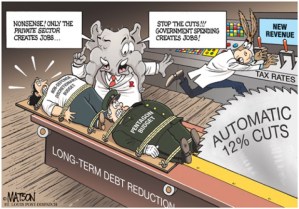 semblance of sanity would strike the elected officials in the beltway. That was wishful thinking on my part and now I feel compelled to give you some background information on sequesters in general and this one in particular. This just highlights how dysfunctional our political system has become and it really is a good demonstration of how politicians don’t tend to really get at the real problems. Let me just say that the real future source of any federal deficit problem is the monumental increases in the cost of health care. We have a completely dysfunctional third party payer system in this country as well as astronomical costs for drugs and care whose actual prices are well beyond the knowledge of actual consumers. That being said, let’s proceed to the side shows that our congress keeps setting up to tank our economy.
This isn’t the first time congress and an administration has used a sequester when it’s been unable to arrive at a budget. Usually, this comes from an inability to arrive at the same budget priorities that comes from having mixed party control of legislative bodies and the White House. You know the general approaches by each party. Republicans are no longer supportive of any kind of revenue enhancements or cut in military spending. Democrats have been more accommodating but tend to draw the line at some point when it comes to destroying the safety net and entitlement programs along with the other basic functions that government provides that the private sector just can’t do either economically or effectively. So, once you get this stand off, a sequester is used to force both sides to the bargaining table.
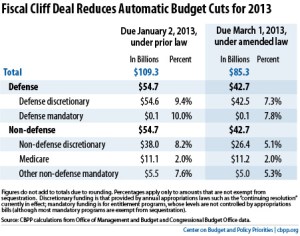 A sequester is basically an automatic reduction in Federal Spending during a budget year. We had a January 2 Fiscal Cliff deal that postponed the sequester until March 1. This is what will happen if nothing is done.
The deal sliced the scheduled 2013 sequestration by $24 billion, from $109.3 billion to $85.3 billion. This reduces the percentage cuts in full-year funding for most eligible programs (those that the law does not exempt from the automatic cuts). The Medicare percentage does not drop, however, because Medicare cuts were and are still capped at 2 percent, and the across-the-board cut that applies to other non-defense programs remains larger than 2 percent.
The chart and the narrative come from the Center on Budget and Policy Priorities which is a great source of information.
The first of the sequesters happened when I was fresh out of graduate school back in the mid 1980s. You’ll probably recognize the names of the usual agents of economic chaos from the Reagan years: Gramm-Rudman-Hollings–Balanced Budget and Emergency Deficit Control Act of 1985. Oddly enough, the Supreme Court found the bill unconstitutional saying that it gave Congress too much power over the budget. They had to rewrite it and it repassed in 1987.
The Balanced Budget and Emergency Deficit Control Act of 1985 (Graham-Rudman-Hollings) was an amendment to a bill that allowed the debt ceiling to be raised to over $2 billion. It created a five-year deficit reduction plan, with decreasing deficit targets each year, until the budget would be balanced in fiscal year 1991. If deficit goals were not met in any given year, a process of automatic spending cuts termed “sequestration” would take place. Fifty percent of the cuts would come from domestic discretionary spending and fifty percent from defense. Social Security, Medicare, several anti-poverty programs, and interest on the debt were exempted from a potential sequester.
Gramm-Rudman-Hollings garnered bipartisan support and was signed into law by President Reagan in December 1985. Most Republicans in the House and Senate voted for it, while the Democratic vote was split nearly evenly in both chambers. Those in favor of the bill argued that the budget deficit, which had greatly increased since 1981, required dedicated measures to reign [sic] in federal spending. Democrats who voted “no” argued that budget cuts were likely to impact domestic programs while leaving military spending largely intact. Nevertheless, the Reagan administration opposed the mandated fifty percent cuts in defense spending in a potential sequester and provided only lukewarm support for the measure.
They assume a fiscal multiplier of 1.4 for general government spending, which is Moody’s Analytics most recent public estimate of the government spending multiplier. While we use the same multiplier for all cuts, we’d guess that these likely slightly overstate the adverse economic impact resulting from defense spending cuts and understate job losses from domestic spending cuts. Budgetary programs for lower-income households in the discretionary budget—such as housing assistance and the special supplemental food program for women, infants, and children (WIC)—as well as infrastructure spending have particularly high multipliers. And to the extent that cuts to spending by the Department of Defense come from capital-intensive weapons acquisitions rather than reductions in personnel strength, the impact on employment would be milder. Regardless, any cuts in the near-term (unless they are ploughed into more spending somewhere else) are going to constitute a drag on the still-weak recovery. Cutting government spending reduces aggregate demand and worsens joblessness while the economy is running well below-potential output.
The new study was performed by Thomas Hungerford of the non-partisan Congressional Research Service. Though the study is not a CRS product, Hungerford’s data is widely cited on both sides; he’s an impeccably objective analyst.
Here’s what Hungerford found: The single greatest driver of income inequality over a recent 15 year period was runaway income from capital gains and dividends.
This finding is directly relevant to the current debate, because Obama and Democrats want to offset the sequester in part by closing loopholes enjoyed by the wealthy, such as the one that keeps tax rates on capital gains and dividends low. Dems want to do this in order to prevent a scenario where the sequester is averted only by deep spending cuts to social programs that could hurt a whole lot of poor and middle class Americans. Republicans oppose closing any such loopholes and want to avert the sequester with only deep spending cuts.
Hungerford’s report, like all serious examinations of inequality, is very complicated. He looks at a bunch of recent data on inequality from the period from 1991-2006 — measured by the so-called “Gini index” — and calculates the degree to which various factors exacerbated it. Hungerford found that over that period, the rise in the Gini index (a story that’s been widely told elsewhere, one that’s largely been driven by the runaway wealth of the top one percent and top 0.1 percent) was driven mainly by the rise in capital gains and dividends income.
“By far, the largest contributor to increasing income inequality (regardless of income inequality measure) was changes in income from capital gains and dividends,” the report concludes.Or, as Hungerford put it in an interview with me: “The reason income inequality has been increasing has been the rising income going to the top one percent. Most of that has come in capital gains and dividends.”
In other words, wealthy beneficiaries of low tax rates on capital gains and dividends are doing extremely well — and their runaway wealth is a major driver of income inequality. There’s a lot of that money out there that could be taxed as ordinary income — as Obama and Dems want — as a way to avert the sequester, which could badly damage the economy. Republicans oppose this.
This finding comes as even some conservatives are reckoning with the fact that the GOP’s message on the sequester is deeply flawed. Writer Byron York notes today that Republicans are openly conceding that the sequester will gut the military, even as they openly point to the sequester as an acceptable policy outcome.
Unemployment fell to 4.1% by the end of last year – a record low for at least 25 years. Poverty has fallen by 27% since 2006. Public spending on education has more than doubled, in real (inflation-adjusted) terms. Increased healthcare spending has expanded access to medical care, and other social spending has also increased substantially, including a vast expansion of government-subsidised housing credit.
If all that sounds like it must be unsustainable, it’s not. Interest payments on Ecuador’s public debt are less than 1% of GDP, which is quite small; and the public debt-to-GDP ratio is a modest 25%. The Economist, which doesn’t much care for any of the left governments that now govern the vast majority of South America, attributes Correa’s success to “a mixture of luck, opportunism and skill“. But it was really the skill that made the difference.
Correa may have had luck, but it wasn’t good luck: he took office in January of 2007 and the next year Ecuador was one of the hardest hit countries in the hemisphere by the international financial crisis and world recession. That’s because it was heavily dependent on remittances from abroad (eg workers in the US and Spain); and oil exports, which made up 62% of export earnings and 34% of government revenue at the time. Oil prices collapsed by 79% in 2008 and remittances also crashed. The combined effect on Ecuador’s economy was comparable to the collapse of the US housing bubble, which contributed to the Great Recession.
And Ecuador also had the bad luck of not having its own currency (it had adopted the US dollar in 2000) – which means it couldn’t use the exchange rate or the kind of monetary policy that the US Federal Reserve deployed to counteract the recession. But Ecuador navigated the storm with a mild recession that lasted three quarters; a year later it was back at its pre-recession level of output and on its way to the achievements that made Correa one of the most popular presidents in the hemisphere.
How did they do it? Perhaps most important was a large fiscal stimulus in 2009, about 5% of GDP (if only we had
done that here in the US). A big part of that was construction, with the government expanding housing credit by $599m in 2009, and continuing large credits through 2011.
But the government also had to reform and re-regulate the financial system. And here it embarked on what is possibly the most comprehensive financial reform of any country in the 21st century. The government took control over the central bank, and forced it to bring back about $2bn of reserves held abroad. This was used by the public banks to make loans for infrastructure, housing, agriculture and other domestic investment.
It put taxes on money leaving the country, and required banks to keep 60% of their liquid assets inside the country. It pushed real interest rates down, while bank taxes were increased. The government renegotiated agreements with foreign oil companies when prices rose. Government revenue rose from 27% of GDP in 2006 to over 40% last year. The Correa administration also increased funding to the “popular and solidarity” part of the financial sector – co-operatives, credit unions and other member-based organisations. Co-op loans tripled in real terms between 2007 and 2012.
The end result of these and other reforms was to move the financial sector toward something that would serve the interests of the public, instead of the other way around (as in the US). To this end, the government also separated the financial sector from the media – the banks had owned most of the major media before Correa was elected – and introduced anti-trust reforms.
Of course, the conventional wisdom is that such “business-unfriendly” practice as renegotiating oil contracts, increasing the size and regulatory authority of government, increasing taxes and placing restrictions on capital movements, is a sure recipe for economic disaster.
Morning Joe Reads A Book
Posted: February 20, 2013 Filed under: Civil Rights, racism, Republican politics, U.S. Politics | Tags: Checkers speech, Dwight D. Eisenhower, Joe Scarborough, John Nance Garner, Richard Nixon, Southern Strategy 28 Comments
Or maybe he got someone else to read it for him? In any case, the New York Times Sunday Book Review asked Joe Scarborough to review a serious book of political history, Ike and Dick: Portrait of a Strange Political Marriage. in the February 17, 2013 edition.
How low has the Sunday Book Review sunk that it would not only publish an essay by Scarborough, but also highlight the brief review with a separate “Up Front” introduction? I haven’t seen the cover of the print edition, but it sounds as if Scarborough’s piece was printed on page 1!
Charles Pierce wrote a pithy reaction to the Times’ decision in his “What are the Gobshites Saying These Days” post on Monday.
…let us pause for a moment and congratulate the editors of The New York Times Book Review for handing a serious work of popular history to whatever’s left of Joe Scarborough after Paul Krugman picks the rest out from between his teeth….
the Review has fallen on some pretty hard times when they have a story meeting and someone says, “We got this new book on Eisenhower and Nixon. Who should we get to review it?” And someone else says, “I know. How about that guy who runs the Morning Zoo on MSNBC? He’s really popular with the people who get drunk in front of the TV and pass out during Rachel’s show the night before.” And this is what you get for an author ID.
Joe Scarborough is the host of MSNBC’s “Morning Joe.”
Lovely. They should let Barnicle review the next Royko anthology.
At least Mike Barnicle used to be a working journalist.
Pierce links approvingly to this post by Dan Kennedy at Media Nation: Joe Scarborough doesn’t know much about history.
If you’re going to try something as cheeky as letting cable blowhard Joe Scarborough review a serious book about political history, you should at least make sure you’ve got a safety net in place. But the New York Times Book Review doesn’t even bother, letting Scarborough step in it repeatedly in his review of Jeffrey Frank’s “Ike and Dick: Portrait of a Strange Political Marriage.”
Here’s the first paragraph of Scarborough’s review:
It may be the closest of political relationships, but it rarely ends well. Vice President Thomas Jefferson challenged President John Adams for the top spot in the vicious campaign of 1800. President Andrew Jackson mused sardonically about executing Vice President John C. Calhoun. In the modern era, Lyndon Johnson seethed at slights real and perceived during John Kennedy’s thousand days, then turned around and humiliated his own vice president, Hubert Humphrey. Even Dick Cheney and George W. Bush fell out by the end of their tumultuous terms. But perhaps the most intriguing — and dysfunctional — political marriage in history was the one between the subjects of Jeffrey Frank’s meticulously researched “Ike and Dick.”
Kennedy wonders if Scarborough knows that
the Constitution originally stipulated that the candidate who received the most votes from the Electoral College would become president and that the person who came in second would become vice president. Perhaps that’s too much math for the famously innumerate Scarborough.
I didn’t know that either, but I think if I were writing a review for the New York Times, I would have found out before using that as my introduction. Kennedy explains that Jefferson and Adams, who couldn’t stand each other, ran against each other in 1796. Adams got more electoral votes and so they were forced to serve together, but their mutual dislike did not grow out of their political alliance as Scarborough implies.
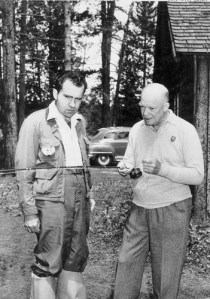
Ike and Dick fishing at Camp David
Kennedy points out two other more serious misstatements in the review. In the paragraph above, Scarborough suggests that Lyndon Johnson’s insecurities stemmed from Jack Kennedy’s mistreatment and that led Johnson to humiliate his own Vice President Hubert Humphrey. Scarborough isn’t really clear about this, but he seems to be drawing analogies to the Eisenhower-Nixon relationship. He seems to claim–perhaps based on his reading of Frank’s book–that Nixon’s neuroses stemmed from his difficult relationship with Eisenhower. But Nixon was a psychologically troubled person long before he met Ike and suggesting otherwise is inaccurate. Likewise, Johnson had plenty of psychological issues before he got involved with Jack Kennedy. Dan Kennedy writes:
As anyone who’s read Robert Caro’s “The Passage of Power” knows, Johnson, like Nixon, suffered from a world-class case of insecurity long before he ever met John Kennedy. The truth is the opposite of what Scarborough claims: both Nixon and Johnson were uniquely unsuited to suffer the slights that are inherent to the vice presidency long before they assumed the office.
Finally, Kennedy points out the ludicrousness of the following passage from the Scarborough piece:
A fascinating subplot in Frank’s story details Nixon’s role in pushing the administration on the issue of civil rights. Long criticized as the author of the Republican Party’s racially tinged “Southern strategy,” Nixon is shown by Frank to be a determined advocate for the Civil Rights Act of 1957, as well as a trusted ally of Martin Luther King Jr. and Jackie Robinson.
Yes, Nixon was supportive of Martin Luther King during the 1950s, and did try to get Eisenhower to push for African American civil rights, but Scarborough completely ignores Nixon’s later rejection of King during the 1960 presidential campaign and his [Nixon’s] development of the “Southern Strategy” in 1968. If those later events weren’t included in Frank’s book, a competent reviewer would have called attention to them. In fact, if Scarborough had googled, he could have quickly found an article by Franks himself that points out Nixon’s later involvement in blatant racism. Franks writes in The Daily Beast, January 21, 2013:
There once was a real connection between the two men, but it more or less ended with RN’s spineless behavior during the 1960 presidential campaign, after Dr. King was arrested on phony charges stemming from a traffic violation. Coretta Scott King had been terrified; she worried with good reason that her husband might be killed en route to Georgia State Prison in Reidsville, and she appealed to the Nixon and John F. Kennedy campaigns to intervene.
Nixon, however, demurred; he said that it would be “grandstanding” to speak out, according to his aide William Safire. Nixon’s real motive, though, seems clear: it was a close election and he was willing to lose black support if it meant gaining a new harvest of white votes in the once-Democratic south. Eight years later, this approach became the carefully considered “Southern strategy.”
The Kennedy brothers then stepped in to help King.
John and Robert Kennedy helped to win Dr. King’s release, and soon enough their campaign distributed two million copies of a pamphlet titled “‘No Comment’ Nixon Versus a Candidate With a Heart, Senator Kennedy” to well chosen voters. It can’t be proved that this made the difference in an election in which the popular vote turned out to be the closest ever (Nixon and Kennedy were separated by about 112,000 votes out of sixty-nine million cast), but it’s a fact that President Eisenhower in 1956 got some 40 percent of the black vote and that Nixon in 1960 won just 32 percent—not bad by modern Republican standards, but still a steep drop. Four years later, facing Barry Goldwater, Lyndon Johnson won 94 percent of the black vote, which set a demographic pattern that endures.
We already knew that Morning Joe doesn’t understand economics; we now know he’s history-challenged as well. In addition, I have some problems with the clarity of his writing. Here are a couple of examples.
Paragraph 2 begins:
Franklin Roosevelt’s vice president memorably said that being No. 2 was in effect not worth a bucket of warm spit.
Which vice president? FDR served with three: Henry A. Wallace, John Nance Garner, and Harry S. Truman. If you said John Nance Garner, you’re correct. And he didn’t qualify the judgment with “in effect” either. Was Scarborough just to lazy to look up the quote?
This reminds me of problems that many college freshmen have in their writing–they either don’t provide enough context or they assume knowledge the reader may not have. They also tend to use unnecessary qualifications instead of just making straightforward statements.
In paragraph 3, Scarborough writes:
“Ike and Dick” is a highly engrossing political narrative that skillfully takes the reader through the twisted development of a strange relationship that would help shape America’s foreign and domestic agenda for much of the 20th century.
Really? Perhaps that judgment came from the book; but it’s a pretty sweeping statement that needs to be backed up with specific examples. But Scarborough doesn’t offer any. When he does provide more context, as he does in paragraph 5, he leaves out important details. He briefly mentions a “secret Nixon fund” that led to Eisenhower trying to dump Nixon from the ticket in 1952, and says that Nixon survived; but Scarborough never even mentions what saved him–the Checkers speech!
The entire review is only a little over 1,000 words. Surely Scarborough could have added a few more historical details and specific examples to back up his assertions.
If I were grading this review for a college course, I’d probably have to give it a C+, or maybe a B- in these days of grade inflation. The grammar and sentence structure are okay; but the review itself is short on context, the historical inaccuracies are problematic, and the lack of specific examples makes for rather boring reading. Frankly, I’m disappointed in the New York Times for publishing it.

 peej
peej Carissa
 bostonboomer
 dakinikat
 ecocatwoman
 jjlo
jjlo mablue2
 Mama Lopez
 peggysue22
 quixote
 skydancingguestblogger
 Mona (aka Wonk the Vote)





Recent Comments