
Labor Day: Struggles of the Great Recession with a lot of Depression
Posted: September 2, 2013 Filed under: morning reads | Tags: Bill Moyers & Company, Lehman Collapse, upper class sociopaths 35 Comments Good Morning!
I certainly hope this Labor Day is being kinder to you than me. I am struggling without air conditioning for the third day in a row and it’s not pleasant. Hopefully, by this time tomorrow relief will be on the way in the form of a new condenser. After being totally fleeced by the same people who sold me all these units to begin with a week ago, my long time bestie from Virginia Beach found a great guy who has found mercy in his small business owning heart to deal me a deal and do it right. I am scrambling right now for the money because I do know it is a deal and AC is the one thing you cannot be without in the deep south. I would like to say that the kindness of people still does exist in abundant quantities when you deal with people and not with those enslaved to corporations. BostonBoomer is holding me together after I decided to emotionally quit my relationship as are several other friends and family members. I have spent the last few weeks being pretty miserable without adding this big headache on top of everything. But again, I just would like to say that if you cultivate friends and real people, the rewards will be ongoing. You always find out who cares about you when troubles are beating down your door. Some times you give a lot away and it doesn’t come back to you from quite the same place. It comes back from the quiet work of day-to-day life and relationship building and the kindness shown to others who pay it forward. I am sending very hot but very sincere blessings out to every one today. Life can turn on a dime.
Bill Moyer’s Essay on “The End Game for Democracy” is the one thing I really think you should listen to or read this morning. It has the feel of a sermon and a populist political meeting rolled into one.
We are so close to losing our democracy to the mercenary class, it’s as if we are leaning way over the rim of the Grand Canyon and all that’s needed is a swift kick in the pants. Look out below.
The predators in Washington are only this far from monopoly control of our government. They have bought the political system, lock, stock and pork barrel, making change from within impossible. That’s the real joke.
Sometimes I long for the wit of a Jon Stewart or Stephen Colbert. They treat this town as burlesque, and with satire and parody show it the disrespect it deserves. We laugh, and punch each other on the arm, and tweet that the rascals got their just dessert. Still, the last laugh always seems to go to the boldface names that populate this town. To them belong the spoils of a looted city. They get the tax breaks, the loopholes, the contracts, the payoffs.
They fix the system so multimillionaire hedge fund managers and private equity tycoons pay less of a tax rate on their income than school teachers, police and fire fighters, secretaries and janitors. They give subsidies to rich corporate farms and cut food stamps for working people facing hunger. They remove oversight of the wall street casinos, bail out the bankers who torpedo the economy, fight the modest reforms of Dodd-Frank, prolong tax havens for multinationals, and stick it to consumers while rewarding corporations.
We pay. We pay at the grocery store. We pay at the gas pump. We pay the taxes they write off. Our low-wage workers pay with sweat and deprivation because this town – aloof, self-obsessed, bought off and doing very well, thank you – feels no pain.
The journalists who could tell us these things rarely do – and some, never. They aren’t blind, simply bedazzled. Watch the evening news – any evening news – or the Sunday talk shows. Listen to the chit-chat of the early risers on morning TV — and ask yourself if you are learning anything about how this town actually works.
Another equally good essay from Jonathan Holland at the same adress is “A Plutocracy Ruled By Self-Centered Jerks”. (This one’s for you BB)
Two studies released last week confirmed what most of us already knew: the ultra-wealthy tend to be narcissistic and have a greater sense of entitlement than the rest of us, and Congress only pays attention to their interests. Both studies are consistent with earlier research.
In the first study, published in the currentPersonality and Social Psychology Bulletin, Paul Piff of UC Berkeley conducted five experiments which demonstrated that “higher social class is associated with increased entitlement and narcissism.” Given the opportunity, Piff also found that they were more likely to check themselves out in a mirror than were those of lesser means.
Piff looked at how participants scored on a standard scale of “psychological entitlement,” and found that those of a high social class — based on income levels, education and occupational prestige — were more likely to say “I honestly feel I’m just more deserving than others,” while people further down the social ladder were likelier to respond, “I do not necessarily deserve special treatment.”
In an earlier study, published last year in the Proceedings of the National Academy of Sciences, Piff and four researchers from the University of Toronto conducted a series of experiments which found that “upper-class individuals behave more unethically than lower-class individuals.” This included being more likely to “display unethical decision-making,” steal, lie during a negotiation and cheat in order to win a contest.
In one telling experiment, the researchers observed a busy intersection, and found that drivers of luxury cars were more likely to cut off other drivers and less likely to stop for pedestrians crossing the street than those behind the wheels of more modest vehicles. “In our crosswalk study, none of the cars in the beater-car category drove through the crosswalk,” Piff told The New York Times. “But you see this huge boost in a driver’s likelihood to commit infractions in more expensive cars.” He added: “BMW drivers are the worst.”
Summing up previous research on the topic, Piff notes that upper-class individuals also “showed reduced sensitivity to others’ suffering” as compared with working- and middle-class people.
So let me dally about in my own area and The Economist’s Club at Project Syndicate where Mohamed A El-Arian reminds us that we’re approaching the fifth  year anniversary of the Lehman death rattle. The essay is about their morbid legacy.
…
I hope that we will also see another genre: analyses of the previously unthinkable outcomes that have become reality – with profound implications for current and future generations – and that our systems of governance have yet to address properly. With this in mind, let me offer four.
The first such outcome, and by far the most consequential, is the continuing difficulty that Western economies face in generating robust economic growth and sufficient job creation. Notwithstanding the initial sharp drop in GDP in the last quarter of 2008 and the first quarter of 2009, too many Western economies have yet to rebound properly, let alone sustain growth rates that would make up fully for lost jobs and income. More generally, only a few have decisively overcome the trifecta of maladies that the crisis exposed: inadequate and unbalanced aggregate demand, insufficient structural resilience and agility, and persistent debt overhangs.
The net result goes beyond the weak growth, worsening income inequality, high long-term unemployment, and alarming youth joblessness of the here and now. Five years after the global financial crisis, too many countries are being held back by exhausted and out-dated growth engines. As a result, prospects for a rapid, durable, and inclusive economic recovery remain a serious concern.
Given this harsh reality, it is not surprising that the second previously unthinkable outcome concerns inadequate policy responses – namely, the large and persistent imbalance between the hyperactivity of central banks and the frustrating passivity of other policymakers.
The big surprise here is not that central banks acted decisively and boldly when financial markets froze and economic activity plummeted. Given their relatively unrestricted access to the printing press and their high degree of operational autonomy, one would expect central banks to be active and effective first responders. And they responded in an impressive and globally coordinated fashion.
What is surprising is that, five years after the crisis, and four years after disrupted financial markets resumed their normal functioning, Western economies still overwhelmingly rely on central banks to avoid even worse economic performance. This has pushed central banks away from their core competencies as they have been forced to use partial and imperfect policy tools for quite a long time.
This outcome reflects domestic political polarization in the United States and the complexity of regional interactions in Europe, which have blocked comprehensive and balanced policy approaches. To appreciate the extent of the problem, consider the repeated failure of the US Congress to pass an annual budget (let alone deliver medium-term reforms) or incomplete eurozone-wide initiatives at a time of alarming unemployment and residual threats of financial disruptions.
Such political dysfunction has undermined the responsiveness of other policymaking entities, including those that possess better tools than central banks. This has compelled central bankers to remain in the policy forefront, building one bridge extension after another as they wait for other policymakers to get their act together. The result has been to expose Western economies to ever-more experimental measures, with considerable uncertainty about the longer-term impact of operating sophisticated market-based systems on the basis of artificial constructs.
This is something to reflect up as Congress returns in a few weeks to tell us that it’s the deficit or high taxes on businesses and the rich that have created our current problems. Nothing could be further from the truth.
One last item to share. This is from the Boston Globe Book Review. It will give you something to think about this Labor Day. I give you the link to Katherine Whitmore’s review “A More Perfect Union.”
The state of the union is not good. Organized labor has been “reduced to a whisper of its former greatness,” admits author Phillip Dray. “No one can divine or guarantee its future,” he adds, “but we can know its past.” And what an inspiring, doleful, and switchbacking past that is. Dray’s wonderful “There Is Power in a Union: The Epic Story of Labor in America”(Anchor, 2011) pans back to explain the original sin that made America less receptive than other Western countries to unions; we were a capitalist power before we had a countervailing strong central government. The deck was stacked for business here, but things played out quite differently in older First World nations. Note the modern results: in Sweden, 67.5 percent of workers are unionized, in Belgium 50.4 percent, and in Ireland 31.2 percent.
In the United States, we live in an especially anti-union climate now, partly because we’ve shot from a factory economy to a finance and service economy, partly because (as Dray admits) labor has sometimes been “its own worst enemy.” Many unions were historically harsh to minorities and women, for instance, or sank into appalling corruption (see Hoffa, Jimmy). But Dray asks us to strip down to fundamentals: In a country
founded on the concept of checks and balances, surely unions make inherent sense. Who else can stand up to The Man?
This inherency, in fact, crystallized in the late-19th-century term “industrial democracy,” meaning that democracy is only authentic if it infuses our work lives as well as our civic lives. For isn’t the pursuit of happiness a farce if you work for slave wages, in unsafe conditions, with no security? Steps forward and steps back, of course: Dray pistons through the big turning points, from the disaster of Chicago’s Haymarket bombing of 1886, for which four labor activists were hanged, to the breakthroughs of United Mine Workers president John L. Lewis (the “stormy petrel of labor”) and the National Farm Workers founder Cesar Chavez. The Chavez material is remarkable. I never knew, for instance, that Southern pols would only pass 1935’s union-friendly Wagner Act if it excluded migrant workers. Or that antagonistic California farmers actually crop-dusted grape pickers during the 1960s protests.
I have spent a lot of time recently listening to my father who turns 90 in a month as he has begun to reflect on many things. Recently, he is worried a lot about the world he’s going to leave behind. He has decided that Al Gore is right and that global warming is real and a serious problem. He doesn’t like any of the political parties and thinks that they are destroying the many great things he know about this country. These are strong words coming from a dustbowl Okie who also flew bombing missions over Germany during World War 2. He thinks that all of us will make out. But, he worries about the country at large and wonders if Congress will nab his medicare or social security. He started paying the first day you could pay into social security so he is truly vested in the program. I tell him not to worry that he’s done his part on everything and just relax. But I can’t say that I don’t feel the same way whenever I watch the news. We really need to take some time today to think about the ways we can reclaim the great things about our heritage. We should tend to our Victory Gardens, so to speak, and find pleasure in the last bits of summer.
Whatever our labor may be today, may it be at least a labor of love. May it perfect something quiet and gentle inside of all of us and may that gentleness shine on a world in sore need of it. The one thing I have to say about all of us here is that we care deeply. Have a good holiday my friends.
What’s on you reading and blogging list today?
Sunday Reads: Just Because
Posted: September 1, 2013 Filed under: just because 21 Comments
Posting this artwork just because. Trying to find the source.
Hello newsjunkies. I’m still battling a sore throat and fever this morning, so this will be a straightforward link dump. I’m going to start with a couple Texas items that are of interest in a more uplifting way than one is wont to think about our state, unlike the Bush tornadoes and textbook chaos we’ve unleashed on the body politic in recent years.
First up, check out CNN’s interview with my mayor, Annise Parker, on turning Texas blue (Video).
Next, via MD Anderson here in Houston– Texas tanning bed law: A melanoma survivor’s take.
I’m not going to excerpt on these, so click over and give those two a look if you have a chance.
Now for a labor read in advance of tomorrow, with a feminist angle…
Via the Daily Beast, Unequal America — Feminism’s Sticky Fast-Food Floor:
This week, in New York City, the paradoxical economic conditions of working women collided in spectacular form. On the one hand, the Wall Street financial world mourned the death of Muriel Siebert, the first woman to own a seat on the New York Stock Exchange and, eventually, the first American woman to have a net worth of $1 billion that she earned, rather than inherited. But on the other hand, as Siebert was toasted by the town’s economic elites, Nathalia Sepulveda went to work in the Bronx, where she earns just $7.25 an hour at McDonald’s.
If Siebert illustrates how a few women have managed to crack the glass ceiling and achieve great wealth and power and even the appearance of parity, whether in business or in politics or elsewhere, Nathalia Sepulveda illustrates the sticky floor that confronts the vast majority of working women in America, especially women of color, who struggle to make basic ends meet.
It’s a reflective piece that puts a woman of color’s face on statistics such as the following:
But such is the landscape of low-wage jobs in America today, which proliferate not because our economy is universally dire but because it is unequal. Research by Northeastern University has shown that 88 percent of the economic-recovery gains following the 2008 crash went to corporate profits. Just 1 percent went to wages.
That translates as follows in the life of Nathalia:
Sepulveda struggles to get assigned as many shifts per week as possible, but even if she had the chance to work 40 hours per week (a rarity), that would at most equal $15,080 per year. In other words, the CEO of McDonald’s makes 580 times more than Nathalia Sepulveda. But no one can seriously think he works 580 times harder than Sepulveda or any of the other workers who serve customers, flip burgers, and clean restrooms at McDonald’s across the country and the world. In fact, it’s hard to imagine Skinner working 100 times harder than Sepulveda. Or even 10 times harder.
Personally, I think Sepulveda probably works harder than Skinner. Anyhow, click over and give the entire thing a read.
Moving along, here’s a headline which reads like it’s from The Onion, even though it’s not — Senator Accidentally Shoots Teacher With Rubber Bullet:
A state senator who is advocating for arming teachers in the aftermath of the school shooting in Newtown, Connecticut, accidentally shot a teacher with a rubber bullet during a training course, the Arkansas Democrat-Gazette reports.
Arkansas Sen. Jeremy Hutchinson (R) recently participated in “active shooter” training and mistakenly shot a teacher who was confronting a so-called bad guy. The experience gave Hutchinson “some pause” but failed to shake his confidence in the plan.
The unshakeable confidence of idiocracy.
In more serious news (though I would argue the above actually is serious and disturbing), I just stumbled on the following youtube which looks very interesting. I plan to watch it later today and thought I would share. Structural Racism Persists 50 Years After Washington March:
Bruce A. Dixon has a provocative read over at Black Agenda Report that seems like it might make a good companion piece after viewing the video — Dr. King Was A Man, “The Dreamer” Is A Zombie:
When King was murdered, civil uprisings occurred in scores of US cities, and the establishment myth makers made a second 180 degree turn. While the smoke rose from burning cities you heard the first references to Dr. King not as a champion of economic justice, not as a moral voice against militarism and empire, not the fighter for a guaranteed minimum income for all, but as “The Dreamer.” Media figures began instructing us on “Dr. King’s Dream” – something nobody ever heard of before – as the reference point for our past struggle, our present predicament and our future agenda. Thus, as Gary Younge points out in his recent book, a new Dr. King was constructed
This new Dr. King didn’t call into question poverty. But he did have a dream. This new Dr. King stopped wondering, as the living King once did, why people pay water bills in a world that’s two-thirds water. But still, he had a dream. This new Dr. King never again mentioned the right of black workers to form unions and negotiate for their dignity and livelihoods. But this new guy, he had a dream.
The Dreamer as we know him today bears little resemblance to the man who was murdered in 1968. The Dreamer was constructed out of whole cloth by the same powerful media institutions which built King up in 1965 and 66, which denounced and slandered him 67 and 68, and made him a useful saint after his death. King never lived to be forty, so the Dreamer has already lived longer than the man, and for the powerful, has been far more useful. It’s no mistake that a single speech in 1963 commemorated this week, was chosen by the establishment to represent the man’s life work, and to negate it.
Well, I guess I should end with a happier link since I’ve given you enough depressing ones!
Here ya go, h/t Still4Hill — via ThoughtCatalog, 33 Badass Hillary Clinton Quotes That Prove Why She Should Be Our First Female President. Though, I have to say, I think I could come up with a better list. LOL. I just may have to do that in a separate post when I’m feeling better.
Alright Sky Dancers, your turn. Let’s hear what’s on your blogger list this Sunday in the comments.
Sunday Open Thread: David Frost Dead at 74
Posted: September 1, 2013 Filed under: open thread, U.S. Politics | Tags: David Frost, Margaret Thatcher, Obituaries, Richard Nixon, That Was The Week That Was 8 Comments
Good Morning!!
Mona isn’t feeling well, but will try to get her scheduled post up later on today. Meanwhile here’s an open thread for early risers.
Famed British broadcaster Sir David Frost has died of a presumed heart attack while giving a speech on a cruise ship. He was 74. The Guardian reports:
Sir David Frost, the journalist and broadcaster whose lengthy career covered everything from cutting-edge 60s satire to heavyweight interviews and celebrity gameshows, has died of a heart attack on a cruise ship, his family said.
The 74-year-old, whose programmes included That Was The Week That Was and The Frost Report, was to have given a speech on board the Queen Elizabeth, which had set sail from Southampton on a cruise to Lisbon.
Frost, who was knighted in 1993, helped establish London Weekend Television and TV-am. He was famed for his political interviews, most notably with Richard Nixon in 1977, in which the US president conceded some fault over Watergate for the first time.
From BBC News:
Born in Kent, Sir David studied at Cambridge University where he became secretary of the Footlights club, and met future comedy greats such as Peter Cook, Graham Chapman and John Bird.
After university he went to work at ITV before he was asked to front the BBC programme That Was The Week That Was, which ran between 1962 and 1963.
Casting a satirical eye over the week’s news, the show boasted scriptwriters including John Cleese, John Betjeman and Dennis Potter.
The Frost Report brought together John Cleese, Ronnie Barker and Ronnie Corbett in a sketch show which would influence many comedy writers including the Monty Python crew.
Much more at the link.
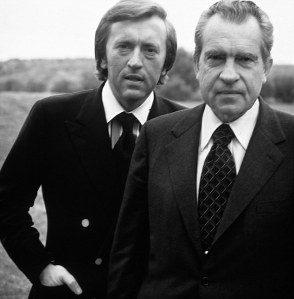
Former President Richard Nixon with TV interviewer David Frost in Mid-March in 1977 before they began taping their interviews later that month. (AP Photo)
Of course Frost was best known for his interviews with Richard Nixon after Watergate forced Nixon to resign the presidency.
He…conducted a series of interviews with Mr Nixon, who had resigned the presidency two years earlier, in which the former president came close to apologising to the public for his role in the Watergate scandal.
Their exchanges were eventually made into a film – based on a play – which saw Michael Sheen portray Sir David Frost to Frank Langella’s Nixon. Sir David himself appeared at the premiere of the film in 2008.
David was regularly scoffed at by fellow broadcasters for his allegedly non-aggressive style of questioning.
But he invariably had the last laugh because he almost always extracted more intriguing information and revealing reactions from his subjects than other far more acerbic broadcasters who boasted about their hard-hitting treatment of their “victims”….
His interview with the doomed American President “Tricky Dicky” Richard Nixon was a TV classic. During it, Nixon dramatically admitted that he had “let down the country”.
But there were many other historic moments, including one when he suddenly introduced the word “bonkers” during a tense interview with the then prime minister Margaret Thatcher over the sinking of the Argentine warship the Belgrano during the Falklands conflict. She was furious.
A few clips from Frost’s long and illustrious career in broadcasting.
From That Was The Week That Was (TW3), 1963
Saturday Morning Lite
Posted: August 31, 2013 Filed under: Barack Obama, Foreign Affairs, morning reads, Republican politics, U.S. Economy, U.S. Politics | Tags: Ben Affleck, chemical weapons, emoprogs, fast food workers' strike, immigration reform, Income Inequality, Labor Day, low-wage jobs, March On Washington anniversary, Martin Luther King, NFL concussion lawsuit, Syria intervention, Voter ID laws, voter suppression 53 Comments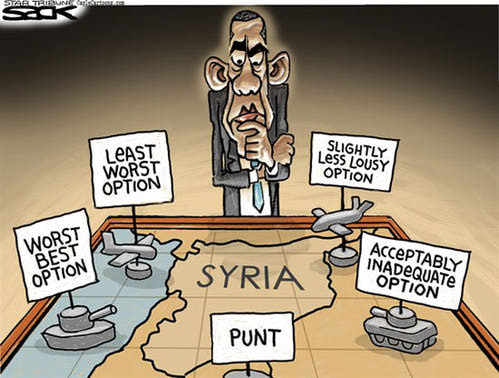
Syria War Room, by Steve Sack
Good Morning!!
I don’t know about you, but I really missed JJ’s Friday Night Lite post last night, so I thought I’d start out Sky Dancing’s Saturday with some political cartoons. I hope you enjoy these — courtesy of Cagle Post.
A few more on Syria:
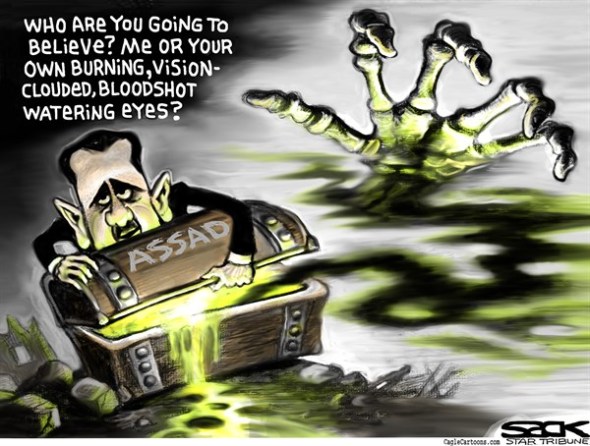
Assad Chemicals by Steve Sack
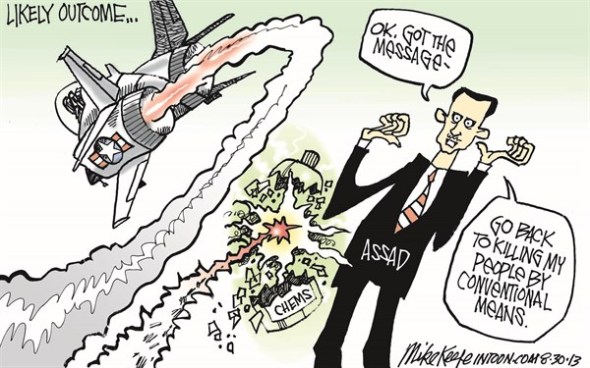
Assad Chemical Weapons, by Mike Keefe
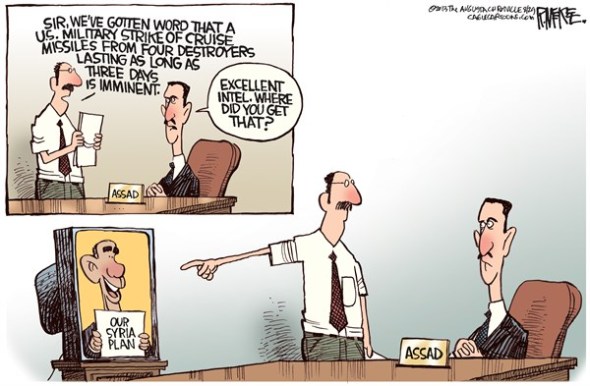
Syria Plan by Rick McKee

The Anti-War Left by Eric Allie
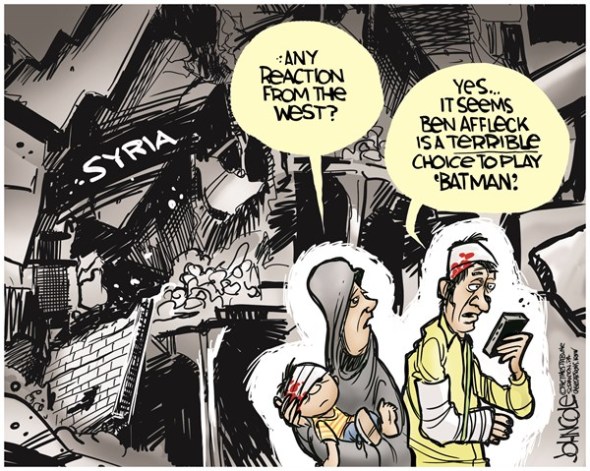
Syria and Affleck by John Cole

Cameron’s Failure, by Rainer Hatchfeld
March on Washington 50th Anniversary:
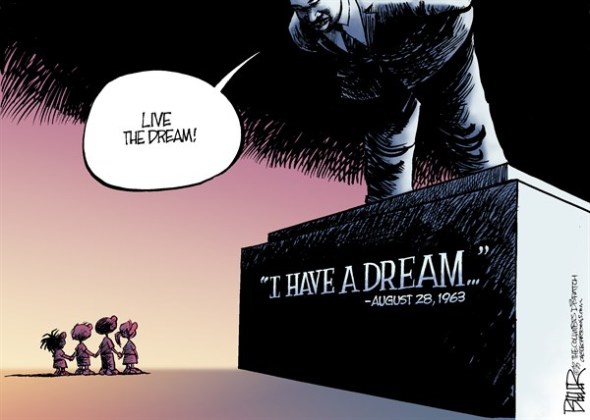
I Have A Dream Anniversary, by Nate Beeler
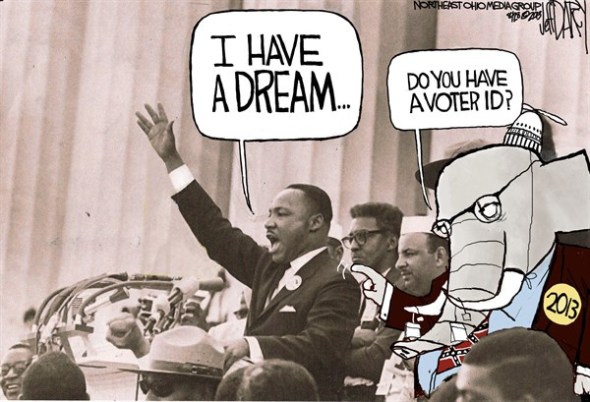
MLK Nightmare by Jeff Darcy
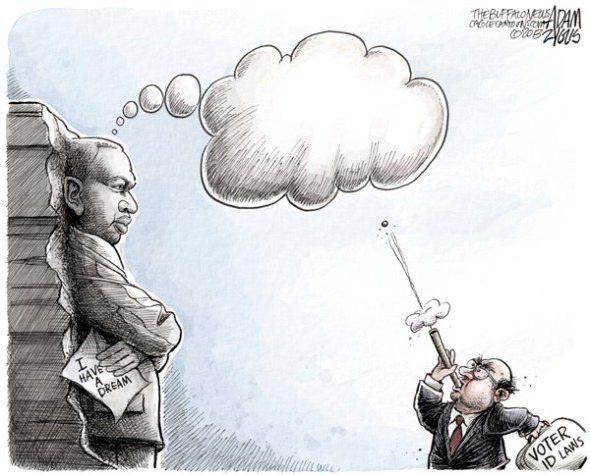
Dreamer, by Adam Zyglis
Labor Day and Income Inequality
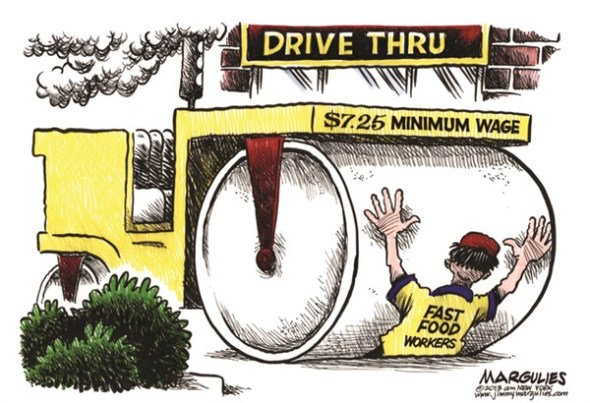
Fast Food Minimum Wage, by Jimmy Margulies
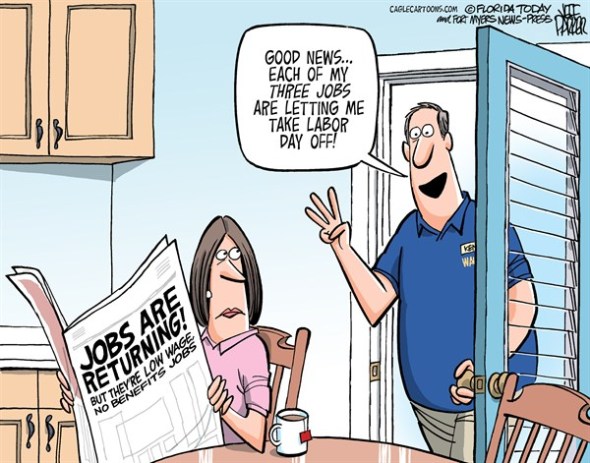
Labor Day Jobs, by Jeff Parker
NFL Concussion Lawsuit
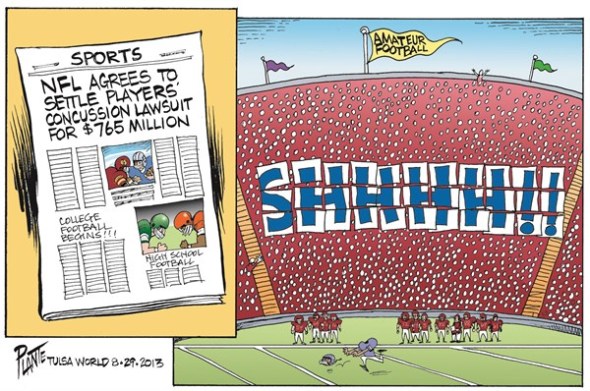
NFL Concussion Lawsuit, by Bruce Plante
Immigration Reform
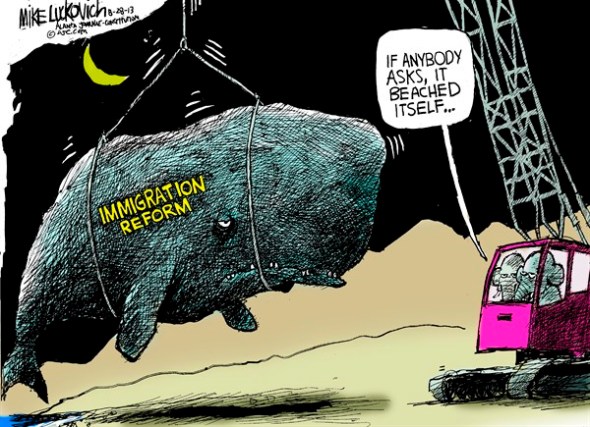
Immigration Reform, by Mike Lukovich
I hope everyone has a wonderful Labor Day weekend!! And if you’re not out on the beach or doing something else more exciting, please post links to the stories you’re following today in the comment thread.
Live Blog: SOS Kerry’s Speech on Action In Syria
Posted: August 30, 2013 Filed under: Foreign Affairs, Live Blog, Syria | Tags: Chemical Weapons Attacks in Syria, US response 32 Comments “That was a War Speech” says WAPO about a previous Kerry Presser.
It’s difficult to find a single sentence in Secretary of State John Kerry’s forceful and at points emotional press conference on Syria that did not sound like a direct case for imminent U.S. military action against Syria. It was, from the first paragraph to the 15th,a war speech.
That doesn’t mean that full-on war is coming; the Obama administration appears poised for a limited campaign of offshore strikes, probably cruise missiles and possible aircraft strikes. President Obama has long signaled that he has no interest in a full, open-ended or ground-based intervention, and there’s no reason to believe his calculus has changed. But Kerry’s language and tone were unmistakable. He was making the case for, and signaling that the United States planned to pursue, military action against another country. As my colleagues Karen DeYoung and Anne Gearan wrote, “Kerry left little doubt that the decision for the United States is not whether to take military action, but when.”
Kerry made the moral case for attacking Syria. He described what’s happening in Syria as “the indiscriminate slaughter of civilians, the killing of women and children and innocent bystanders by chemical weapons,” which he called “a moral obscenity” and “inexcusable.”
Kerry made the international norms case for striking Syria. “All peoples and all nations who believe in the cause of our common humanity must stand up to assure that there is accountability for the use of chemical weapons so that it never happens again,” he said. The argument here is that punishing Assad’s use of chemical weapons matters “beyond the conflict in Syria itself,” because the world wants to deter future military actors from using chemical weapons.
Kerry hinted at international coalition-building, saying that he’d spoken “with foreign ministers from around the world.” He later said that “information [about the attack] is being compiled and reviewed together with our partners.”The United States is not going to win approval from the United Nations Security Council, where Russia has consistently opposed even milquetoast resolutions condemning Assad. But Kerry still made a point of gesturing toward the institution it’s about to bypass, saying, “At every turn, the Syrian regime has failed to cooperate with the U.N. investigation, using it only to stall and to stymie the important effort to bring to light what happened in Damascus in the dead of night.” He accused Assad of blocking U.N. inspectors and “systemically destroying evidence.”
Kerry was mindful that the hyped up case for war against Iraq and the results of previous US engagement in countries like Egypt, Libya an Afghanistan have not been good. Yet, Kerry made it clear that the US was ready to take some kind of action today.
France appears ready to join the US.
BREAKING NEWS: Secretary of State John F. Kerry says the regime of Syrian President Bashar al-Assad made preparations three days before last week’s chemical weapons attack on the outskirts of Damascus and fired the rockets from regime-controlled areas. This story will be updated shortly.
LONDON – French President Francois Hollande said Friday that his country is prepared to act in Syria despite Britain’s surprise rejection of military action, potentially making a nation that turned its back on Washington during the war in Iraq the primary U.S. ally in a possible strike against Syrian forces.
The Guardian characterizes the speech as “polarizing for world leaders.”
As the US moves towards military intervention in the Syrian conflict, world leaders have issued a string of belicose statements, with Iran and Russiastanding alongside the Assad regime against a western alliance led by the US, UK, France and Australia.
In their toughest terms to date, David Cameron and US secretary of state, John Kerry, spoke of the undeniable and “asbolutely abhorrent” and use of chemical weapons in Syria. In response, the Assad regime and Iran warned that foreign military intervention in Syria would result in a conflict that would engulf the region.
Iran’s foreign ministry spokesman, Abbas Araqchi, intimated that Tehran would respond, should the west strike.
“We want to strongly warn against any military attack in Syria. There will definitely be perilous consequences for the region,” Araqchi told a news conference. “These complications and consequences will not be restricted to Syria. It will engulf the whole region.”
Walid al-Moallem, Syria’s foreign minister, also vowed that the regime would defend itself using all means available in the event of a US-led assault.
“I challenge those who accuse our forces of using these weapons to come forward with the evidence,” he told reporters at a press conference in Damascus. “We have the means to defend ourselves, and we will surprise everyone.”
Shia Iran is Syria’s closest ally and has accused an alliance of militant Sunni Islamists, Israel and western powers of trying to use the conflict to take over the region.
The rhetoric from the Shia camp came a day after Kerry gave the strongest indication to date that the US intends to take military action against the Assad regime. On Monday, Kerry said President Bashar al-Assad‘s forces had committed a moral obscenity against his own people.
“Make no mistake,” Kerry said. “President Obama believes there must be accountability for those who would use the world’s most heinous weapon against the world’s most vulnerable people. Nothing today is more serious, and nothing is receiving more serious scrutiny.”
President Obama will ensure that the United States of America makes our own decisions on our own timelines, based on our values and our interests. Now, we know that after a decade of conflict, the American people are tired of war. Believe me, I am, too.
But fatigue does not absolve us of our responsibility. Just longing for peace does not necessarily bring it about. And history would judge us all extraordinarily harshly if we turned a blind eye to a dictator’s wanton use of weapons of mass destruction against all warnings, against all common understanding of decency, these things we do know.
We also know that we have a president that does what he says that he will do. And he has said, very clearly, that whatever decision he makes in Syria it will bear no resemblance to Afghanistan, Iraq or even Libya. It will not involve any boots on the ground. It will not be open ended. And it will not assume responsibility for a civil war that is already well underway.
The president has been clear: Any action that he might decide to take will be limited and (sic) tailored response to ensure that, a despots brutal and flagrant use of chemical weapons is held accountable. And ultimately, ultimately we are committed — we remain committed, we believe it’s — the primary objective is (sic) to have a diplomatic process that can resolve this through negotiation, because we know there is no ultimate military solution.
It has to be political.
It has to happen at the negotiating table.
And we are deeply committed to getting there.
So that is what we know. That is what the leaders of Congress now know. And that’s what the American people need to know. And that is, at the core of the decisions that must now be made for the security of our country, and for the promise of a planet, where the world’s most heinous weapons must never again be used against the world’s most vulnerable people.
What do you think?

 peej
peej Carissa
 bostonboomer
 dakinikat
 ecocatwoman
 jjlo
jjlo mablue2
 Mama Lopez
 peggysue22
 quixote
 skydancingguestblogger
 Mona (aka Wonk the Vote)





Recent Comments