
Tuesday Reads: Wisconsin Recall Madness!
Posted: June 5, 2012 Filed under: 2012 elections, Labor unions, morning reads, Populism, Psychopaths in charge, Reproductive Rights, Republican politics, Right to Work, Tea Party activists, The DNC, the GOP, the villagers, U.S. Economy, U.S. Politics | Tags: Chris Cillizza, grass roots activism, InTrade, John Nichols, Koch Brothers, PPP polling, public employee unions, Rebecca Kleefisch, Scott Walker, Tom Barrett, voter turnout, Wisconsin recall election 65 Comments
Good Morning!!
Today is the day of reckoning for Wisconsin. Voters will go to the polls today to decide the fate of Governor Scott Walker and five other Wisconsin Republicans: the Lieutenant Governor and four state senators. If the Democrats can win just one of those seats, they will regain the senate majority.
I think everyone here knows the genesis of this recall battle, but here’s a quick explainer from Chris Cillizza at the WaPo. Cillizza also speculates on possible surprising outcomes from the election.
Cillizza allows that Barrett could conceivably win and the Democrats could retake the senate–the latest poll by PPP had Walker leading by only 3 points, within the margin of error. The poll also suggested that Barrett had the momentum as of yesterday. On the other hand, InTrade had Walker’s chances at more than 90% late last night. The truth is no one really knows for sure, because the turnout and enthusiasm on each side will tell the tale. Cillizza, being a Villager, still thinks Walker will win, but thinks the Senate could switch.
When they filed petitions to recall Walker himself last fall, Democrats also filed papers to recall another four state senators — Senate Majority Leader Scott Fitzgerald, and Sens. Pam Galloway, Terry Moulton and Van Wanggaard, (Galloway resigned earlier this year; Republican state Rep. Jerry Petrowski is running for her seat.)
They need only win one race to take control.
Fitzgerald is likely safe given his heavily Republican district, although Lori Compas, his Democratic rival, has attracted a lot of media attention.
But Democrats are bullish on the races against Moulton and Wanggaard. Both districts went for President Obama in 2008; Wanggaard’s went narrowly for John Kerry in 2004. Whether Barrett wins or not, they expect to take back the state Senate.
Moulton faces former state Rep. Kristen Dexter; Wanggaard faces former state Sen. John Lehman (D). Outside groups have spent hundreds of thousands of dollars on both sides. State Rep. Donna Seidel (D) also has a shot at beating Petrowski; before Galloway the seat had gone Democratic for two decades.
Cillizza points out that if Barrett wins and the Democrats take the state senate and could get some of the Walker legislation overturned before another election could give the senate back to the Republicans. The other possibility, Cillizza mentions is that Democrats could defeat Walker’s Lt. Governor Rebecca Kleefisch, but that’s pretty unlikely. She’s leading in the polls at the moment.
The Seattle Times had a good article on Sunday about the national issues that are at stake in the election today.
Under fire for cutting budgets at the expense of public employees, Walker would be the third governor in U.S. history yanked from office in a recall election. Walker has an edge, but the race is close.
The campaign will mean more than who governs Wisconsin. It’s a test case of the larger clashes in American politics that are driving elections for the presidency and control of Congress, highlighting divisions over the costs of government.
With more than $30 million raised from conservative donors, many of them from other states, and visits from a who’s who of high-profile Republican governors (New Jersey’s Chris Christie, South Carolina’s Nikki Haley, Louisiana’s Bobby Jindal and Virginia’s Bob McDonnell), Walker’s campaign to survive the recall has the feel, the money and the stakes of a national race.
The state vote is raising questions that will echo nationwide. Can a tough-minded conservative Republican force cuts in government at the risk of angering public-employees unions and win a swing state such as Wisconsin? Will voters think he’s doing the best he can in a tough time? Or will they rise in a grass-roots backlash against the well-financed Republican effort?
Admittedly, that article has a Republican flavor, but it does do a pretty good job of spelling out the issues. For a more left-wing perspective, here’s a lengthy piece at by Sarah Jaffe of Alternet: Wisconsin’s Recall Drama Down to Nail-Biting Finish.
Wisconsin’s recall is, as reporter John Nichols put it, the kind of “renegade politics” that are disdained by the national Democratic party and even some state Democrats. It is being driven by the same activists who turned out by the thousands to occupy their capitol when Governor Scott Walker attacked workers’ right to organize and bargain collectively.
Now, a day before the biggest recall yet—of Governor Walker, Lieutenant Governor Rebecca Kleefisch, and four Republican state senators—the fight will be won or lost where it began: on the ground.
There’s a lot of big outside money pouring into Wisconsin, mostly to pump up Walker’s attempt to hang on to his seat, but the one thing that money can’t buy is an excited, driven grassroots movement. If Milwaukee mayor Tom Barrett beats Walker on Tuesday, it will be because of thousands of volunteers getting out the vote person by person.
“This is really a case of Walker raising $13 million against possibly the most widespread grassroots get-out-the-vote effort in the state’s history,” Matt Reiter, co-president of the Teaching Assistants’ Association at the University of Wisconsin at Madison, told AlterNet.
Please try to check that one out. It’s long, and very informative. John Nichols of The Nation (mentioned prominently in Jaffe’s piece) is Wisconsin native, and has written a book about the struggle in his home state. Here’s a piece Nichols wrote yesterday: How To Buy A Recall Election.
Governor Scott Walker is not trying to win the Wisconsin recall election that will be held June 5.
He is trying to buy it.
If the embattled governor does prevail, he will provide essential evidence not of his own appeal but of the power of money to define our politics.
On the other hand, if Walker is defeated, a template will have been developed for a people-power, message-power politics that might be able to challenge big money.
And there is no question that what is in play is very big money.
Read the gory details at the link.
At Salon, Josh Eidelson writes about the possible effects of some Wisconsin voters’ “resentment” of union workers on the recall outcome.
If Scott Walker survives tomorrow’s election, there will be plenty of reasons. Many people will point to his huge cash advantage, for good reason. But no factor will have been more important than the decades of decline in U.S. union membership.
“Unions had their place,” a woman named Jerri told me soon after I arrived in Wisconsin last week. “They did their part back in the ‘40s and ‘50s, and then they got too big, and are abusing their power.” Jerri and her husband, Tim (both declined to give last names), were eating at a bar in Wauwatosa, the purple Milwaukee suburb that’s home to Scott Walker. They both work in sales: She’s in retail at the mall; he’s in wholesale, selling caskets. Tim said Walker’s union “reforms” were necessary because local politicians had been “looking out for the union” instead of “people like me.” He said unions are for people who don’t “feel they should have to work very hard.” Jerri complained that unions “are sucking off my teat.” Public workers’ benefits, she said, “should be the same as anybody in any kind of private job.”
That last statement is most telling. While resentment toward unions has grown since the 1950s, it’s not because they got too big. It’s because they got too small. A multi-decade drop in unionization left fewer Wisconsinites who are union members or live in union households. Meanwhile, because governments are less prone than businesses to terrorize workers or shut down facilities to avert unionization, public sector unionization has remained more stable. In 2009, for the first time, there were more total U.S. union members in government employment than in the entire private sector.
That one is pretty scary for those of us who care about quality education and public services.
The Wall Street Journal highlights the importance of turnout in the recall election.
Both sides say few voters remain undecided, after more than $63.5 million in political spending saturated the airwaves and clogged voters’ mailboxes. A weekend survey by the Democratic group Public Policy Polling found Mr. Walker holding a slight lead and only 3% of likely voters undecided. With few voters left to persuade, the main question is which side will win the turnout battle.
Labor groups and their allies knocked on more than 300,000 doors during the past few days and placed more than 400,000 phone calls, said Brian Weeks, the assistant political director for the American Federation of State, County and Municipal Employees union.
Unions historically have had a strong ground game. But Republicans said they took a page from labor’s playbook and have developed a coordinated get-out-the-vote effort, which could also give the party a boost in the November presidential election, helping the GOP equal the Democrats’ election-day machinery.
Felicia Sonmez and Rachel Weiner of the WaPo write about the battle of “TV ad spending vs. boots on the ground.” They say that this election:
serves as a proxy for the national battle between Democrats’ much-touted ground organization and Republicans’ fundraising advantage.
With Walker ahead in the polls and leading Milwaukee Mayor Tom Barrett (D) in the money race by more than 7 to 1 – and with GOP-aligned outside groups far outspending their counterparts across the aisle — Democrats maintain that their shot at victory depends on a far superior get-out-the-vote operation buoyed in large part by organized labor.
According to Monica Davey at the NYT,
About 60 to 65 percent of Wisconsin residents of voting age are expected to go to the polls on Tuesday, the state’s Government Accountability Board said. That would be a higher turnout than two years ago, when Mr. Walker and a wave of Republicans largely swept state and federal offices here, but not as high as the more than 69 percent turnout in 2008, when Barack Obama easily won the state.
Only time will tell. We’ll have a live blog this evening so we can follow the results together. Now I need you to let me know what else is in the news. I look forward to clicking on your links.
Open Thread: Top Romney Aide Made Millions from Obamacare
Posted: June 4, 2012 Filed under: 2012 presidential campaign, Tea Party activists, The Right Wing, U.S. Politics, Voter Ignorance | Tags: Affordable Care Act, Department of Health and Human Services, Health care, Mike Leavitt, Mitt Romney, Obamacare, Rep. Jason Chaffetz 24 Comments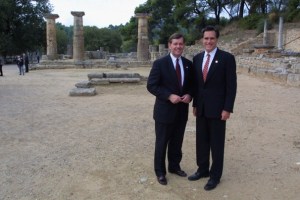
Best buds Mike and Mitt
Lots of corporate news sources were buzzing over the weekend about Romney’s appointment of former Utah Governor Mike Leavitt to head up his transition team. It’s also assumed that Leavitt would have the inside track to get the plum role of Chief of Staff in a Romney administration. Leavitt is also the guy who hired Romney to turn around the scandal-plagued Winter Olympics in 2002.
According to Utah Rep. Jason Chaffetz, a Romney adviser, Leavitt is “the ideal candidate” for the transition job because of:
his three terms as Utah governor as well as serving as administrator of the Environmental Protection Agency and secretary of Health and Human Services under President George W. Bush.
“Mike Leavitt checks every box. It’s a combination of experience and personal relationship,” Chaffetz said. “He can help outline the parameters of what a transition would look like.”
Leavitt has been on board with the Romney campaign throughout the primaries; he has his own office at the Boston headquarters. He and Romney are close, says Politico, and they’re “a lot alike.”
One Romneyland figure said Leavitt’s influence is derived from the fact that he is a spoke in many of the concentric circles around the candidate. Leavitt is part of Romney’s orbit of Mormon associates, but he also sits in the realm of the policy gurus, political counselors, fellow governors and veterans of the Salt Lake Olympics.
So with little fanfare, he has become one of the most influential advisers to the candidate this election cycle. He has an office at the Boston headquarters, travels with Romney at times, has been summoned to rally donors and is tight enough with the high command that he scored an invite to campaign manager Matt Rhoades’s engagement party last month.
He’s also a surrogate and has headlined health care policy discussions at $10,000 per-person Beltway fundraisers for Romney.
Romney officials say Leavitt is often circumspect but has an E.F. Hutton-like effect when he does speak up; many in Boston believe he offers much of his advice directly to Romney — something Leavitt suggests is accurate.

Mike Leavitt
Although it happened following Leavitt’s tenure, Utah was the second state after Massachusetts to institute universal health care. And Leavitt is the health care business–and he’s made millions in profits from Obamacare. At Salon, Alex Seitz-Wald writes:
Leavitt, who served as Health and Human Services secretary under George W. Bush, leads a firm that has positioned itself as a leading consultancy to help implement the Affordable Care Act (PDF), and it’s already won contracts to do so.
Just two weeks ago, the company was awarded a $1 million contract with the state of New Mexico to help it build its exchanges, and Politico reported that the “size of his firm, Leavitt Partners, doubled in the year after the bill was signed as they won contracts to help states set up the exchanges funded by the legislation.”
On its web site, Leavitt Partners features prominently its “Health Insurance Exchange Intelligence Team,” an entire section of the business that advises clients on how to implement and respond to the health insurance exchanges created by Obamacare.
“The passage of the Patient Protection and Affordable Care Act (PPACA) altered many of the fundamentals of healthcare coverage and financing,” the company’s website states. “Our team has a deep background and understanding of exchanges, from the policy side to the technical requirements and infrastructure necessary to operate an exchange. Our team members have unique experience in building exchanges and analyzing health insurance markets.”
Today, the right wingers have suddenly awakened from the collective trance that followed their reluctant recognition that Romney’s their guy now. And they are not happy about the Leavitt appointment. From TPM:
The Wall Street Journal reported last year that Leavitt “strenuously backed the core piece of President Barack Obama’s health-care law and urged the states to move forward together in adopting health insurance exchanges.” And his stance hasn’t changed: “We believe that the exchanges are the solution to small business insurance market and that’s gotten us sideways with some conservatives,” Leavitt’s top aide Rich McKeown told Politico.
“We’re troubled by it,” Dean Clancy, who runs health care advocacy for the Dick Armey-led conservative group FreedomWorks, told TPM Monday via email. “We’re very concerned. The tea party grassroots have always feared that Gov. Romney would be a weak standard bearer because of RomneyCare. This choice only reinforces those doubts. Tapping a high-profile ObamaCare profiteer is disturbing, there’s no way around it. … The tea party has been fighting exchanges in state after state.”
Michael Cannon, who directs health policy for the libertarian Cato Institute, reacted to the Leavitt choice in a blog post he penned: “Romney’s appointment of Leavitt is a first step toward flip-flopping — or Etch-a-Sketching, or Romneying(TM), or whatever — on ObamaCare repeal.”
The right wing blogs are in a tizzy too. Time to break out the popcorn!

Hey Righties! Haven’t you noticed? Willard’s a pathological liar. And besides, he just not that into you. He’s all about amassing more money and power for Willard, not you or your pathetic, rage-filled party.
Monday Reads
Posted: June 4, 2012 Filed under: 2012 presidential campaign, U.S. Economy, U.S. Politics, unemployment, voodoo economics, We are so F'd | Tags: Barack Obama, Bill Moyers, Debt Ceiling, Frank VanderSloot, Garrett Epps, John Boehner, Koch Brothers, Mitt Romney, Paul Krugman, recession, Ryan budget, Scott Walker, Tom Barrett, whiny billionaires, Wisconsin recall 74 Comments Good Morning!
I thought I’d start this morning reads off with Bill Moyers who is having a good laugh at the expense of billionaires that are donating lots of money to political campaigns. It seems they really don’t like having their names bandied about and their closets opened. Pity the Poor Billionaires!!!
Last month, an Obama website cited eight mega-donors to Mitt Romney’s campaign as possessing “less-than-reputable records.” Among them was Frank VanderSloot, a Romney national finance co-chairman who has raised millions for the campaign. He’s a rancher – with 110,448 acres, on which he no doubt roams playing “This Land is Your Land” on his little Stradivarius — and CEO of the billion-dollar company Melaleuca, which Rolling Stone describes as “a ‘multilevel marketing’ firm based in Idaho that sells off-brand cleaning products and nutritional supplements.”
VanderSloot and his wealthy pals went ballistic and cried intimidation. “You go back to the Dark Ages,” VanderSloot said, “when they put these people in the stocks or whatever they did, or publicly humiliated them as a deterrent to everybody else — watch this — watch what we do to the guy who did this.”
Conservatives described the Obama ranking of Romney contributors as an “enemies list,” conjuring images of Nixonian wiretaps and punitive tax audits. But despite protestations to the contrary, these deep-pocketed plutocrats aren’t shelling out the shekels for the love of flag, Mom and apple pie (or tarte tatin, as they call it in the swanky joints).
“Most of the megadonors backing [Romney’s] candidacy are elderly billionaires,” Tim Dickinson writes in Rolling Stone. “Their median age is 66, and their median wealth is $1 billion. Each is looking for a payoff that will benefit his business interests, and they will all profit from Romney’s pledge to eliminate inheritance taxes, extend the Bush tax cuts for the superwealthy — and then slash the top tax rate by another 20 percent.” As at least one of them has said, they view these cash infusions as an “investment,” plain and simple.
Money is rolling into Wisconsin in Tuesday’s recall election. The Hill reports that it’s the most expensive race in Wisconsin history. The Koch Brothers are knee deep in money trying to keep their union bustin’ boy in office. We’ll be live blogging this tomorrow night so stay tuned!
Out-of-state sources have funded both sides heavily in the contest CPI said. Barrett has received about 26 percent of his $4 million in donations from sources outside of Wisconsin, while Walker has received two-thirds of his $30.5 million haul from out-of-state. Both campaigns have been aided by strong spending by super-PACs and other outside groups.
Labor unions have spent heavily to defeat Walker. The report says that the nation’s three largest public unions, the National Education Association (NEA), American Federation of State, County and Municipal Employees (AFSCME), and the Service Employees International Union (SEIU), have directed at least $2 million to anti-Walker efforts.
Walker, for his part, has been aided by conservative businessmen including casino mogul Sheldon Adelson and billionaire David Koch. The Republican Governors Association received a $1 million contribution from Koch in February, according to CPI.
The economy is slowing down. Oil prices are dropping in response. The stock market has lost all its value. Will we see another recession shortly?
The statistics on Friday were daunting. Only 69,000 jobs were created last month, far lower than what’s needed just to keep up with population growth. The job tallies for March and April, shabby to begin with, were revised down, for an average monthly tally of 96,000 over the past three months, versus 252,000 in the prior three months.
The weakness was not only displayed in job growth. Average weekly wages declined in May, to $805, as a measly two-cents-an-hour raise was more than clawed back by a drop to 34.4 hours in the length of the typical workweek.
Similarly, the rise in the number of people looking for work is normally considered a sign of optimism, but, on closer inspection, it appears to be simply the reversal of a drop in job-seekers in April.
Granted, it is better for jobless workers to be actively looking for work than sitting on the sidelines. But without enough jobs to go around, the inevitable result is higher official unemployment. The jobless rate ticked up from 8.1 percent in April to 8.2 percent in May, or 12.7 million people. Of those, 42.8 percent, or 5.4 million people, have been out of work for more than six months, a profound measure of personal suffering and economic decline.
There’s no sign that Washington is prepared to shoulder this responsibility. President Obama’s last big push for job creation, the $450 billion package proposed last fall, would have created an estimated 1.3 million to 1.9 million jobs by providing aid to states for teachers and other vital public employees, investments in infrastructure and tax breaks for new hiring. It was filibustered by Senate Republicans and not brought up for a vote in the Republican-dominated House, with Republican lawmakers claiming that deficit reduction was more important. Since then, they have balked at even smaller administration proposals, like modest investments in clean-energy projects.
Blocking constructive action is bad enough, but it’s not the worst of it. Recently, the House speaker, John Boehner, has ratcheted up economic uncertainty by pledging to force another showdown this year over legislation to raise the debt ceiling. A debt-ceiling debacle would come on top of the expiration at the end of 2012 of the Bush-era tax cuts and the onset of some $1 trillion in automatic spending cuts. If allowed to take effect as planned, those measures would take a huge bite out of growth, further weakening the economy.
Paul Krugman slammed the “anti-bipartisanship” in the Paul Ryan budget and in Romney’s support of obstructionist policies aimed at tanking the economy yesterday on ABC. Krugman said that the budget Romney supports is a “fraud”.
This morning on “This Week,” New York Times columnist Paul Krugman called Rep. Paul Ryan’s proposed budget plan a “fraud” as Romney campaign senior advisor Eric Fehrnstrom confirmed his candidate’s support for the plan that would trim trillions in federal spending over the next decade.
“The Ryan plan — and I guess this is what counts as a personal attack — but it isn’t. It’s not an attack on the person; it’s an attack on the plan. The plan’s a fraud,” said Krugman. “And so to say that — just tell the truth that there is really no plan there, neither from Ryan, nor from Governor Romney, is just the truth. That’s not — if that’s — if that’s being harsh and partisan, gosh, then I guess the truth is anti-bipartisanship. ”
Krugman, who has been critical of the Ryan, R-Wis., plan in the past, was responding to the Fehrnstrom, who confirmed Romney’s support for the plan after ABC News’ George Will asked Fehrnstrom to clarify his candidate’s stance on the Ryan proposal.
“He’s for the Ryan plan. He believes it goes in the right direction. The governor has also put forward a plan to reduce spending by $500 billion by the year 2016,” said Fehrnstrom. “In fact, he’s put details on the table about how exactly he would achieve that. So to say he doesn’t have a plan to — a plan to restrain government spending is just untrue.”
Krugman defended the president’s budget plan when asked by Fehrnstrom if he preferred it over the Ryan plan.
“I mean, the president — at least it’s — you know, I don’t approve of everything, but there are no gigantic mystery numbers in his stuff. We do know what he’s talking about. His numbers are — you know, all economic forecasts are wrong, but his are not — are not insane. These are — these are just imaginary,” he said.
Molly Ball writes about the mediocre Mitt Romney Governorship of Massachusetts at the Atlantic. Here’s my favorite quote “He believed that a PowerPoint presentation would solve all our problems.” Here’s some other tidbits that lead up to that very funny line.
Romney campaigned on a promise to clean up Massachusetts’ notoriously cronyistic state government, painting his opponent, the sitting state treasurer, as a product of a backroom-dealing Beacon Hill culture. But his efforts once he was elected were somewhat halfhearted and largely fruitless.
One example was the state’s judiciary, a notorious hotbed of patronage. Romney’s attempts to reform it didn’t succeed, and instead, he ended up succumbing to the status quo, the Washington Post reports. His attempt to consolidate transportation agencies was shot down by the legislature, as was his push to remove from the state university system William Bulger, brother of mobster “Whitey” Bulger. (Bulger did eventually resign, in part due to Romney’s pressure.)
“A lot of governors come in offering to change the political culture,” said Cunningham. “But he wasn’t here long enough, he didn’t put enough effort into it, and he had a very formidable opponent.”
Perhaps because of his outsider mien, Romney enjoyed notably chilly relationships with legislators and local officials, who found him distant and somewhat disengaged. John Barrett, who was mayor of the city of North Adams during Romney’s governorship, described him Thursday as “a governor who just ignored us, who didn’t want our effort,” saying he never met with mayors or sought their input. “He believed that a PowerPoint presentation would solve all our problems,” Barrett said.
So, the biggest issue on my mind is the looming Debt-Ceiling fight and the horrible Agent Orange. I pretty much believe that the House Republicans will crash all the markets and then some if they think it makes Obama less likely to be elected. Here’s Garrett Epps at the American Prospect. He believes–as do I–that Obama should use the Constitutional Option and tell them all to go to hell regardless. It will be interesting to see how soon they will heat this up.
The debt limit will apparently become a crisis again sometime after the election. Boehner two weeks ago announced his plan to demand another round of cuts when the current ceiling is reached at the end of the year. (I suspect this manufactured crisis will only happen if Obama is re-elected; if Mitt Romney wins the election, Republicans will suddenly find economic recovery an important value after all.)
Obama should begin now to prepare for the predicted crisis. And if there is any way to climb down from the inane “my attorney Bernie says I can’t” comment, he should find it. I called the U.S. Department of Justice to ask whether the Office of Legal Counsel has issued, or is preparing, a formal opinion on the President’s possible power under Section Four; the DOJ’s spokesman did not return my call.
There’s an interesting analysis at TP on how the last debt ceiling debate hurt the economy. A repeat under current conditions could be disastrous.
House Republicans last year used the imminent approach of the nation’s credit limit to force Congress into enacting a series of spending cuts. The hostage scenario led to the nation’s first ever credit downgrade, with the credit rating agency Standard & Poor’s repeatedly citing the GOP’s intransigence on revenue as a key justification. Speaker of the House John Boehner (R-OH) has indicated that the GOP is ready to reenact the debt ceiling debacle the next time the nation comes close to its borrowing limit. But as economists Betsey Stevenson and Justin Wolfers write, the economy was significantly setback during the last showdown, which they call “an act of economic sabotage“
Follow the links to the Bloomberg analysis and you’ll see why we’re in worse position to weather that kind of anti-bipartisanship nonsense this year. So, who really killed the confidence fairy last year?
High-frequency data on consumer confidence from the research company Gallup, based on surveys of 500 Americans daily, provide a good picture of the debt-ceiling debate’s impact (see chart). Confidence began falling right around May 11, when Boehner first announced he would not support increasing the debt limit. It went into freefall as the political stalemate worsened through July. Over the entire episode, confidence declined more than it did following the collapse of Lehman Brothers Holdings Inc. in 2008. After July 31, when the deal to break the impasse was announced, consumer confidence stabilized and began a long, slow climb that brought it back to its starting point almost a year later. (Disclosure: We have a consulting relationship with Gallup.)
Businesses were also hurt by uncertainty, which rose to record levels as measured by the number of newspaper articles mentioning the subject. This proved far more damaging than the regulatory uncertainty on which Republican criticisms of Barack Obama’s administration have focused (more on that subject in a Bloomberg View editorial today). Employers held back on hiring, sapping momentum from a recovery that remains far too fragile.
It’s going to be a very long, hot summer.
What’s on your reading and blogging list today?
Deval Patrick Gets It Just Right on Romney’s Record
Posted: June 3, 2012 Filed under: 2012 presidential campaign, Barack Obama, U.S. Economy, U.S. Politics | Tags: Bain Capital, Deval Patrick, Health care reform, individual mandate, Job Creation, Massachusetts, Mitt Romney 10 Comments
Massachusetts Governor Deval Patrick appeared on Meet the Press this morning. I haven’t seen the whole program; but from what I’ve read about it along with what Patrick has said about Mitt Romney in other interviews, I think he’s getting it just right. Here’s what he said on MTP, according to The Boston Globe:
Patrick, a co-chairman of Obama’s reelection campaign, said the presumptive Republican presidential nominee had a poor record of job growth as governor, repeating the familiar statistic that Massachusetts ranked 47th in the nation in that category when Romney was in office.
But, Patrick said, that “doesn’t mean he was a failure as governor.”
Really? What specifically did Romney do well as governor? Why he signed the nation’s first universal health care law and pushed for the individual mandate that citizens must purchase health insurance. Patrick knows full well that Romney doesn’t want to be praised for that accomplishment. Every Obama surrogate should hammering health care achievement home, again and again. Back to the Globe article:
Host David Gregory asked the governor to respond to former President Bill Clinton’s statement Thursday that “there’s no question that in terms of getting up and going to the office and basically performing the essential functions of the office, the man who has been governor and had a sterling business career crosses the qualification threshold.”
Gregory suggested Clinton’s remarks undercut one of Obama’s major arguments.
“It undercuts the spin on the argument that the president has made,” Patrick replied. “The president has never attacked Bain. It’s not about Bain. It’s never been. Bain’s a fine company.”
Really? What’s it about then?
“He had a terrific career creating wealth,” Patrick said. “There is very little evidence that, either in the public or the private sector, he’s had a terrific career creating jobs.”
The corporate media is comparing Patrick’s approach to what Cory Booker said previously on MTP. But I think they’re wrong. More Obama surrogates should follow Patrick’s lead. Sure, Bain is a terrific company and Romney deserves credit for his role in building the business. But at Bain and as governor, Romney didn’t create jobs. But, hey…he led the way to socialized medicine in Massicusetts! Isn’t that great?
Here’s an opinion piece that Patrick wrote for CNN a couple of days ago. In it he spells out a very clear argument against Romney as POTUS. Of course he leads with Romney’s failure to create jobs in the state. Everyone knows by now that Massachusetts ranked 47th among the states in job creation.
and that was in relatively good economic times. Real wages declined (while rising across the nation). Instead of helping workers and small businesses adjust to changes in the global economy, Romney cut critical work force training programs and millions in economic development funds. Instead of promoting Massachusetts to attract jobs, he used the state as a punchline on the national Republican political circuit.
When Patrick took office he had to clean up Romney’s messes.
He left behind a bureaucracy whose work force grew during his term, an unsustainable public pension system and a culture of poor accountability throughout state government.
Young people and jobs were leaving our state. Our roads and bridges were crumbling, and his Republican predecessors’ poor oversight of the infamous Big Dig project in downtown Boston resulted in billions of dollars of cost overruns, substandard workmanship and debilitating debt that he made no effort to remedy.
In the face of budget challenges, what did Romney do? He raised nearly every fee and surcharge that didn’t bear the title “tax” and cut funding for the schools. In a state where education is our calling card, Romney was responsible for the second largest per pupil cut in education funding in America during his second year in office.
Sure Romney’s a nice guy, Patrick says, and he was very successful in business. But in his only time in office Romney failed to create jobs or stimulate the economy. Why did this happen?
Romney sincerely believes that people are better off on their own: on their own to deal with their unemployment; with under-resourced public schools and no way to pay for college; with neglected infrastructure; with a job market that needs skills they didn’t have. He does not fundamentally believe that government should help people help themselves. And he has a record as governor of Massachusetts to demonstrate how much damage his leadership does to people, their families and our future.
Finally, here’s a recent interview that Patrick did with John King in which he makes similar arguments.
I think the Obama campaign should have their other surrogates emulate Deval Patrick’s approach–call it hitting Romney with a velvet glove that has a steel lining. You don’t have to yell and scream to get your message across. Patrick is calm, cool, and collected. He’s not “nauseated” by attacks on Bain or private equity, like Corey Booker. He doesn’t call Romney’s career at Bain “sterling,” like Bill Clinton did. He explains why Romney’s career at Bain is irrelevant to job creation, while his time as Governor is. And he strongly praises the one achievement Romney doesn’t want to talk about: health care reform.
I don’t know if this can all be boiled down to a 30-second sound byte, but Deval Patrick is coming pretty close with this:
“He had a terrific career creating wealth,” Patrick said. “There is very little evidence that, either in the public or the private sector, he’s had a terrific career creating jobs.”
The Obama campaign should keep Patrick front and center, hammering home the message that Romney knows nothing about job creation–and in fact really doesn’t care about it–but he sure deserves all the credit in the world for leading his state to universal health care.
Oh, Venus and other celestial bodies
Posted: June 2, 2012 Filed under: open thread | Tags: big bang theory, Neil De Grasse 18 Comments I was searching around for a meaningful post for tonight. This is an open thread. It does have a theme but please don’t feel you have to follow it. However, if you want, please join in and makes some wishes and star contributions on my spacey thread.
Venus to make rare transit across sun Tuesday
Venus, the lovers’ planet, will slowly cross the face of the sun Tuesday in a rare passage that no sky watcher now alive will ever see again.
Astronomers call the event a transit of Venus; it last occurred more than a century ago, and another won’t be seen for 105 years.
Just as they did during the partial eclipse of the sun that enthralled throngs of viewers on May 20, amateur astronomers, observatories and Bay Area science museums will all have their special solar telescopes trained on the fabled planet as it makes its dark transit across the solar disc.
A day before the transit, on Monday, a very different astronomical event will be on display when the full moon will be partially eclipsed by the Earth’s shadow. No telescopes will be needed for the partial eclipse, and if skies are clear it should be visible everywhere. The moon will appear low in the western sky from 3 to 5:07 a.m., and the eclipse will peak at 4:03 a.m.
The 10 Most Amazing Discoveries of Modern Astronomy
As mentioned previously, the discovery of the CMBR, redshifting, and the faster than expected recession of galaxies led astronomers and astrophysicists to theorize the Big Bang, which is currently accepted as the model for the formation of the universe. The Big Bang was not an explosion within space and time, but instead, the creation of spacetime from nothing. While implications for our role in the universe, the possible existence of other universes, and what, if anything, occurred before, are the subject of speculation, the Big Bang model has survived a variety of tests and scrutiny to become widely accepted. However, with the discovery of the CMBR, it was discovered that the temperature of the universe is widely uniform, which would be impossible through traditional thermal interactions (the concept of the universe being flat, homogeneous and isotropic is known as the cosmological principle). Thus, Inflationary Theory was introduced, which suggests that the universe started with extremely rapid exponential expansion, driven by a negative pressure energy (somewhat reminiscent of Dark Energy), but before inflation, the universe was causally connected and thus had a balanced temperature.
The Hitch Hiker’s Guide to the Galaxy |
|||||
 |
|
|
|
||
 |
||||
|
|
Seconds before the Earth is demolished to make way for a galactic freeway, Arthur Dent is plucked off the planet by his friend Ford Prefect, a researcher for the revised edition of the The Hitch Hiker’s Guide to the Galaxy who, for the last fifteen years, has been posing as an out of work actor. Together this dynamic pair begin their journey through space aided by quotes from The Hitch Hiker’s Guide “A towel is about the most massively useful thing an interstellar hitchhiker can have” and a galaxy-full of fellow travellers: Zaphod Beeblebrox – the two-headed, three-armed ex-hippie and totally out to lunch president of the galaxy; Trillian, Zaphod’s girlfriend (formally Tricia McMillan), whom Arthur tried to pick up at a cocktail party once upon a time zone; Marvin, a paranoid, brilliant and chronically depressed robot; Veet Voojagig, a former graduate student who is obsessed with the disappearance of all the ball-point pens he has bought over the years. | |||
Have fun! It’s an open thread!!!

 peej
peej Carissa
 bostonboomer
 dakinikat
 ecocatwoman
 mablue2
 Mama Lopez
 peggysue22
 quixote
 skydancingguestblogger
 Mona (aka Wonk the Vote)



 Sky Dancing
Recent Comments