
Wednesday Reads: A Mixed Bag of News
Posted: October 15, 2025 Filed under: just because | Tags: 13-year-old MA boy taken by ICE, Donald Trump, Epstein Files, Eric Trump, government shutdown 2025, ICE kidnappings, Mar-a-Lago, Supreme Court, Trump White House changes, Voting Rights Act, Young Republicans 4 CommentsGood Morning!!
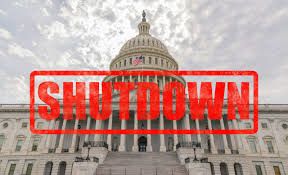 It seems there’s no end in sight for the government shutdown. The House is on a long paid vacation, and the Senate keeps voting again and again on the House Republican plan.
Heather Cox Richardson wrote yesterday at Letters from an American:
The government shutdown, which started on October 1, is entering its third week. As Senator Chris Murphy (D-CT) explained this morning, the Senate is in session, and it keeps voting on two bills to reopen the government. Majority leader John Thune (R-SD) keeps having the Senate vote on the measure passed by Republicans in the House. That measure funds the government until November 21. It has failed repeatedly to get past the 60 votes necessary to avoid a filibuster. The Democrats have offered an alternative measure, which extends the healthcare premium tax credit—without which health insurance costs on the Affordable Care Act market will skyrocket—and restores nearly $1 trillion in cuts to Medicaid. That measure, too, has repeatedly failed to pass.
Murphy notes that normally the two sides would negotiate. But, he says, President Donald J. Trump is telling Republican senators to “BOYCOTT NEGOTIATING,” and they are “following orders.”
The House of Representatives is even more dysfunctional. House speaker Mike Johnson (R-LA) pushed the continuing resolution through the chamber on September 19, the Friday before leaving town for a week. Then Johnson canceled the House sessions on Monday and Tuesday, September 29 and 30, both to jam the Senate into having to accept the House measure and to avoid swearing in Adelita Grijalva (D-AZ), who was elected on September 23. Grijalva will provide the 218th signature on a discharge petition to force a vote on the release of the files collected during the federal investigation into the crimes of convicted sex offender Jeffrey Epstein. Trump and his officials promised to release those files, but have tried to avoid doing so since news broke that Trump, who was a close friend of Epstein, is named in them.
I really think the Epstein issue is the reason for the Republican resistance to compromise. Trump really really doesn’t want the Epstein files to be released. There must be some terrible stuff about him in those records.
Emily Brooks of The Hill notes that jamming the Senate as Johnson tried to do was a tactic employed by the far-right Freedom Caucus, and they are cheering him on. But Democratic senators refused to vote in favor of the House measure, standing firm on extending the premium tax credits before their loss decimates the healthcare markets. Now, although Democrats are in Washington, D.C., ready to negotiate, Johnson says he will not call House members back to work until the Senate passes the House measure.
Brooks notes that not all Republicans are keen on the optics of staying out of session during a shutdown. Mike Lillis of The Hill reported on Sunday that the cancellation of all House votes since late September has some Republicans warning that the tactic will backfire. In addition to the question of healthcare premiums, there is the issue of military pay stalled by the shutdown, and the fact that, by law, Congress was supposed to deliver its 2026 budget by September 30.
Over the weekend, the administration tried to ratchet up the pressure on Democratic senators to cave when it announced it would fire about 4,200 federal employees. Josh Marshall at Talking Points Memo notes that the threat seemed at least in part to be designed to follow through on a threat Office of Management and Budget director Russell Vought had made to pressure Democrats before the shutdown. When those layoffs didn’t happen, the administration then suggested it would not pay furloughed workers after the shutdown ends. After backlash, they walked that threat back. The new announcement seemed in part an attempt to prove they would do something.
I’m glad the Democrats are standing firm on their insistence that the cuts to health care be restored. Read more from Richardson at the substack link.
Today the Supreme Court is going to hear a case that could allow John Roberts to achieve his lifelong goal of completely destroy the Voting Rights Act.
Lawrence Hurley at NBC News: Supreme Court weighs whether to gut key provision of landmark Voting Rights Act.
The conservative-majority Supreme Court on Wednesday will consider whether to eviscerate a key provision of the landmark Voting Rights Act in a congressional redistricting case from Louisiana.
The justices, who expanded the scope of the case over the summer, will hear oral arguments on whether states can ever consider race in drawing new districts while seeking to comply with Section 2 of the 1965 law, which was enacted against a backdrop of historic racial discrimination to protect minority voters.
The long-running dispute concerns the congressional map that Louisiana was required to redraw last year after being sued under the Voting Rights Act to ensure that there were two majority-Black districts. The original map only had one such district in a state where a third of the population is Black.
The Supreme Court originally heard the case earlier this year on a narrower set of legal issues but, in a rare move, it asked in June for the parties to reargue it. The court then raised the stakes by asking the lawyers to focus on a larger constitutional issue.
Now, the justices will be deciding whether drawing a map to ensure there are majority-Black districts violates the Constitution’s 14th and 15th amendments, which were both enacted after the Civil War to ensure equal rights for former slaves, including the right to vote.
This is interesting:
Conservatives argue that both constitutional amendments prohibit consideration of race at any time. The Supreme Court has previously embraced this “colorblind” interpretation of the Constitution, most notably in its 2023 ruling that ended the consideration of race in college admissions.
Louisiana, which initially defended its new map, has switched sides and joined a group of self-identified “non-African-American” voters who sued to block it on constitutional grounds. The Trump administration also backs the state’s new position.
The map is being defended by civil rights groups that challenged the original map.
Read more analysis at the NBC News link.
More on the case from Hansi Lo Wang at NPR: A Supreme Court ruling on voting rights could boost Republicans’ redistricting efforts.
A major redistricting case returning to the U.S. Supreme Court on Wednesday could not only determine the fate of the federal Voting Rights Act, but also unlock a path for Republicans to pick up a slew of additional congressional seats.
If the high court overturns the act’s Section 2 — a provision that bans racial discrimination in voting — GOP-controlled states could redraw at least 19 more voting districts for the House of Representatives in favor of Republicans, according to a recent report by the voting rights advocacy groups Black Voters Matter Fund and Fair Fight Action.
And depending on when the court rules in the case, known as Louisiana v. Callais, some number of the seats could be redistricted prior to next year’s midterm election.
The analysis comes as President Trump continues to lead a GOP push for new maps in Texas, Missouri, North Carolina and other states that could help Republicans preserve their slim House majority after the 2026 election.
The GOP effort could be bolstered by a Supreme Court ruling that eliminates longstanding Section 2 protections against the dilution of the collective power of racial minority voters.
Many of the landmark law’s supporters fear such an outcome after the conservative-majority court didn’t rule last term on the Louisiana case, and instead scheduled a rare second round of oral arguments, which is expected to focus on the constitutionality of Section 2’s redistricting requirements.
A ruling gutting Section 2 could have a cascading effect on congressional maps in mostly Southern states where Republicans either control both legislative chambers and the governor’s office or have a veto-proof majority in the legislature — and where voting is racially polarized, with Black voters tending to vote Democratic and white voters tending to vote Republican.
On Monday, Dakinikat posted a story about a 13-year-old Massachusetts boy who was arrested and then taken by ICE to a facility in Virginia. After many people reacted in shock, ICE claimed the boy had a knife and a gun when he was arrested. The local police say he had a knife but no gun.
The Boston Globe: DHS claimed an Everett 13-year-old had a gun when he was arrested. The city’s mayor says he didn’t.
A vigil was held outside City Hall Tuesday night for a 13-year-old boy who is being held in an Immigration and Customs Enforcement detention facility in Virginia after police arrested the armed teen at a bus stop last week while following up on a credible tip about a violent threat against another student.
Officers recovered a 6- to 7-inch, double-sided knife, Everett Mayor Carlo DeMaria said at a news conference earlier Tuesday. He said, however, that the teenager did not have a gun, contradicting a report by a Department of Homeland Security official.
In response to questions about how the teenager was handed over to ICE, the mayor also said the Everett Police Department did not contact ICE about the juvenile’s arrest.
“Everett police does not make arrests based on immigration status,” DeMaria said.
Tricia McLaughlin, an assistant secretary in the Department of Homeland Security, posted on social media Monday that the juvenile posed a “public safety threat” and was in possession of a firearm and a large knife when arrested. Everett Police Chief Paul Strong said Tuesday that no firearm was recovered….
The juvenile was booked at the police station on Thursday and then was detained by ICE at the station. He is now being held at the Northwestern Regional Juvenile Detention Center in Winchester, Va., according to his family.
This is from Maria Kabas at The Handbasket: ICE took a 13-year-old they said had a gun. Local cops say he didn’t.
A 13-year-old Massachusetts boy is in ICE custody hundreds of miles from home, and trying to figure out how this was allowed to happen has been challenging. A local news story about the ordeal went viral on Sunday, prompting more questions than answers about the conduct of local police, their relationship to federal immigration enforcement and whether the boy’s family even knew he was being taken out of state. While we have some new information, the cloud of confusion remains.
A 13-year-old boy was arrested by ICE in Everett and sent to a juvenile detention facility in Virginia. (Photo from The Boston Globe)
Here’s what we know at this point: Last Thursday, police in Everett, Massachusetts say the boy made a credible threat of violence against another student in the school district. When officers picked him up at a bus stop outside his school, they allegedly found a knife in his possession. Once the boy was fingerprinted, ICE became aware of the case. According to the Boston Globe, the boy’s mother was called to pick him up after he was arrested, waited for about an hour and a half, and was then told her son was taken by ICE. He was held overnight in a Massachusetts ICE facility and then taken Friday to one in Virginia. We know he came to the US from Brazil and, along with his family, has a pending asylum case.
“I’ve never done a bond or a habeas for a kid this young, ever,” US District Judge Richard G. Stearns said during an emergency habeas corpus hearing Friday filed by a lawyer on behalf of the boy. “This is the youngest.”
Everett is a city of nearly 50,000 people that borders Boston directly to the north. According to the 2010 Census, 33% of residents were born outside of the US. Per the 2020 Census, the city is a little more than 50% white, with a big Hispanic and Latino community, as well as large Italian and Brazilian populations. As people at a city council meeting testified Tuesday night, ICE has had a bombastic presence in the community since the start of the second Trump administration.

Here’s what Kabas was told by a DHS spokesperson:
After I reached out to ICE spokesperson Casey Latimer on Monday regarding the boy taken from Everett, I received a reply from a different spokesperson named James Covington. He wrote “Please see the below from DHS on the 13-year-old alien. Please feel free to direct any questions to them.”
The “below” Covington was referring to was—and bear with me here—a screenshot of an X post from DHS Assistant Secretary Tricia McLaughlin who had quote posted Aaron Reichlin-Melnick, a Senior Fellow at the American Immigration Council. Reichlin-Melnick had posted about the story, writing “This makes NO SENSE. A 13-year-old was arrested by local police for unknown reasons, and then turned over to ICE, which is detaining him far away from his mother — who is going through immigration court, has an asylum application on file, and is legally authorized to work.”
Latimer went on to accuse the boy of “an extensive rap sheet” and possessing a gun,” which the local authorities say is not true. So maybe this is a troubled kid, but the local police should be dealing with that, not DHS, especially since his family has an active asylum case.
The Young Republicans are in the news and not in a good way.
Jason Beeferman and Emily Ngo at Politico: ‘I love Hitler’: Leaked messages expose Young Republicans’ racist chat.
Leaders of Young Republican groups throughout the country worried what would happen if their Telegram chat ever got leaked, but they kept typing anyway.
They referred to Black people as monkeys and “the watermelon people” and mused about putting their political opponents in gas chambers. They talked about raping their enemies and driving them to suicide and lauded Republicans who they believed support slavery.
William Hendrix, the Kansas Young Republicans’ vice chair, used the words “n–ga” and “n–guh,” variations of a racial slur, more than a dozen times in the chat. Bobby Walker, the vice chair of the New York State Young Republicans at the time, referred to rape as “epic.” Peter Giunta, who at the time was chair of the same organization, wrote in a message sent in June that “everyone that votes no is going to the gas chamber.”
Giunta was referring to an upcoming vote on whether he should become chair of the Young Republican National Federation, the GOP’s 15,000-member political organization for Republicans between 18 and 40 years old.
“Im going to create some of the greatest physiological torture methods known to man. We only want true believers,” he continued.
Read more horrible comments at the Politico link.
A follow-up story at Politico by Emily Ngo and Jason Beeferman: ‘It’s revolting’: More Young Republican chat members out of jobs as condemnation intensifies.
Two more members of a Young Republican group chat strewn with racist epithets and hateful jokes stepped down from their jobs Tuesday after POLITICO published an exclusive report on the Telegram exchanges.
Bobby Walker and other young Republicans who took part in an epithet-filled Telegram chat are out of jobs after POLITICO began asking questions about their statements.
Peter Giunta’s time working with New York Assemblymember Mike Reilly “has ended,” the Republican lawmaker said. Giunta served as chair of the New York State Young Republicans when the chat took place. Joseph Maligno, who previously identified himself as the general counsel for that group, is no longer an employee of the New York State Unified Court System, a courts spokesperson confirmed.
Another chat member, Vermont state Senator Sam Douglass, faced mounting calls for his resignation as well, including from the state’s Gov. Phil Scott, a Republican, and Douglass’ fellow Republican lawmakers, who called his statements “deeply disturbing.”
POLITICO’s in-depth look into how one group of Young Republicans spoke privately was met Tuesday with widespread condemnation in New York, Washington and beyond. The members of the chat — 2,900 pages of which were leaked and reviewed by POLITICO — called Black people monkeys, repeatedly used slurs for gay, Black, Latino and Asian people, and jokingly celebrated Adolf Hitler.
In a bipartisan outcry, members of Congress and other political leaders from around the country said they were appalled by the contents of the group chat. The board of directors of the National Young Republicans said every member of the chat “must immediately resign” their state organization.
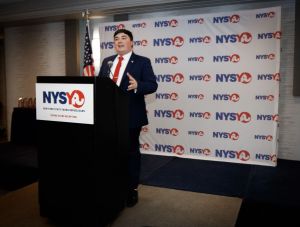
Trump is destroying the White House. The mess in the oval office can be fixed by a new president and the giant flagpoles could be removed, but what about the huge ballroom he’s building and the proposed Nazi-style victory arch? What about the ruined rose garden? He’s turning the people’s house into Mar-a-Lago north.
Marc Caputo at Axios: Don the Builder: Inside Trump’s White House makeover.
Donald Trump is obsessing over remodeling the White House like no other president.
— He has gilded the Oval Office, replaced trees, paved the Rose Garden lawn, hung art and mirrors all over, erected flagpoles and begun work on a $250 million ballroom.
— He’s not done: Trump has had models and dioramas built for other projects he’s considering, and even directed how and where new marble-tiled floors are laid….
Long after Trump has exited the presidency, his imprint will be on the executive mansion in an unprecedented scope and scale — even if a successor removes the Oval Office gold leaf.
What’s next: The president’s wandering architectural eye is now gazing southwest from the White House to land around the Memorial Bridge. He wants to erect a giant arch as a grand entrance into Washington from Arlington National Cemetery.
— “Let’s build something like the Arc de Triomphe in that space, it would be beautiful when you drive or fly in,” Trump told a White House visitor a few weeks ago.
— Trump has three differently sized models of the “Arc de Trump” that he’s been positioning on a map of D.C. to determine the right scale.
— On Saturday, Trump posted on Truth Social a rendition of the arch by Washington architect Nicolas Leo Charbonneau.
The models for the arch were 3D printed on Trump’s orders by the architects involved in designing the new ballroom. He says it’d be privately funded, along with some of the other projects. The total cost is unclear.
There’s much more horrifying stuff to read at Axios, if you stomach it.

Look inside the Donald J. Trump Grand Ballroom at Mar-a-Lago in 2005 (from The Palm Beach Post)
Rachel Cohen at New Jersey.com: Eric Trump reveals distinct similarities between the White House and Mar-a-Lago.
Eric Trump is sharing how renovations to the White House are a nod to Mar-a-Lago.
Trump gave a tour to Fox News anchor Steve Doocy of his family’s Florida golf club as he promotes his new book, “Under Siege,” which is out Tuesday. It offers an unfiltered look into the Trump world and criticism against his father, according to the memoir’s synopsis.
Moving throughout the patio and home of the Palm Beach estate, Doocy later admired the “fantastic view” of the beach, while pointing to how the resort displays the same umbrellas from the new Rose Garden.
“Exact same umbrellas as the Rose Garden,” Trump responded on “Fox & Friends.”
He added: “And by the way, that beautiful flag pole right there — the exact same flag pole that we have at the White House. I got a call from my father. He goes, “Honey, I need two great flag poles. I want to donate them to the White House.”
Trump went on to say that “we’re very happy to have the same Mar-a-Lago flagpole on the south and north grounds now.”
Barf.
A few more stories to check out today:
The New York Times: U.S. Military Kills Another 6 People in 5th Caribbean Strike, Trump Says.
Newsweek: JB Pritzker Looking at Prosecuting ICE Agents in Chicago.
Chicago Sun-Times: Feds ram SUV after chase down residential street in Chicago, then tear-gas crowd.
The Washington Post: Media including Fox News overwhelmingly reject Pentagon press policy.
The Washington Post (gift link): Trump says U.S. won’t benefit from $20 billion bailout for Argentina.
The Guardian: Trump threatens to cut US aid to Argentina if Milei loses election.
That’s it for me today. What’s on your mind?
Mostly Monday Reads: The Very Model of a Modern First Lady
Posted: November 20, 2023 Filed under: just because | Tags: #Blabbermouth Trump, Argentina, Massive Carbon Big Foot, Polluter elite, Roselynn Carter, Trump Gag Order, Voting Rights Act 5 Comments
Place: Atlanta Ga., U.S.A. Date: 1993 Credit: The Carter Center
Good Day, Sky Dancers!
Before I start kvetching about Appeals Courts today, I’d like to join the country in its appreciation of Former First Lady Rosalynn Carter, who passed this weekend at 96. Former President Jimmy Carter got the very first vote I cast in a Presidential election. I was at University and remember those turbulent times well. The Israel-Palestine conflict was as ghastly then as it is now. Iran introduced itself by capturing U.S. hostages from our Embassy there. Inflation was roaring. Rosalynn Carter was the face of humanitarian efforts during that one term. She was also active in trying to get the ERA passed and brought a new perspective to the treatment of people with mental illness and the elderly. The Carters’ work with Habitat for Humanity is the stuff of legends. She was both a social justice warrior and a humanitarian.
This is the tribute given to her by NBC News’ Daniel Arkin.
Rosalynn Carter, the former first lady and humanitarian who championed mental health care, provided constant political counsel to her husband, former President Jimmy Carter, and modeled graceful longevity for the nation, died Sunday at her home in Plains, Georgia, according to the Carter Center.
Carter was 96. She had entered hospice care inher home on Friday.
In a statement, former President Carter said: “Rosalynn was my equal partner in everything I ever accomplished. She gave me wise guidance and encouragement when I needed it. As long as Rosalynn was in the world, I always knew somebody loved and supported me.”
Rosalynn Carter was widely regarded for her political shrewdness, drawing particular praise for her keen electoral instincts, down-to-earth appeal, and work on behalf of the White House, including serving as an envoy to Latin America.
She devoted herself to several social causes in the course of her public life, including programs that supported health care resources, human rights, social justice and the needs of elderly people.
“Twenty-five years ago, we did not dream that people might someday be able actually to recover from mental illnesses,” Carter said at a mental health symposium in 2003. “Today it is a very real possibility.”
“For one who has worked on mental health issues as long as I have,” she added, “this is a miraculous development and an answer to my prayers.”

Place: Afeta, Ethiopia
Date: Feb. 13, 2007
Credit: The Carter Center
Five first ladies have paid tribute to the extraordinary woman who was visibly a partner to her husband’s presidency. “Her life is a reminder that no matter who we are, our legacies are best measured not in awards or accolades, but in the lives we touch,” Michelle Obama wrote. Secretary Hillary Clinton and her husband, the former President, characterized Mrs. Carter as a “champion of human dignity.
The Washington Post‘s Karen Tumulty characterizes Mrs. Carter this way.
But Rosalynn Carter arrived at a time when women’s roles were changing at every level of society. And, according to Paul Costello, who was her assistant press secretary, the new first lady took to heart a bit of counsel from her own outspoken predecessor. “Betty Ford gave her wise advice: Do what you want to do because no matter what you do, you will be criticized,” Costello told me.
Still, the first lady was taken aback by the stir she created when, in the second year of the Carter presidency, she began showing up at Cabinet meetings and quietly taking notes.
“Jimmy and I had always worked side by side; it’s a tradition in southern families, and one that is not seen as in any way demeaning to the man,” she wrote in her autobiography. “I also think there was a not very subtle implication that Cabinet meetings were no place for a wife. I was supposed to take care of the house — period.”
It was not the only time she felt frustrated with the expectations that came with her role. Less than a month after the inauguration, she held her first solo news conference to announce the formation of a presidential commission on mental health — an issue that would become her biggest cause.
“The next morning when I picked up the Washington Post to read about it I found not one word about the commission or the press conference,” she recalled. This newspaper instead ran a story about how the Carters had established a policy against serving hard liquor at White House functions.
But the first lady continued to press against the constraints, and in breaking her own path, she would make it easier for those who followed — including Hillary Clinton.
Rosalynn Carter traveled abroad and met with heads of state to discuss matters of substance, not for photo opportunities, and made it clear she was speaking for the administration in her public appearances. “Dinner guests at the White House have seen her interrupt the President — not rudely but unhesitatingly — usually to explain something more clearly than he had been doing,” the New York Times columnist Tom Wicker wrote in 1979.
Two crucial cases are coming from two very different Federal Appeals Courts today. The first one is on Voting Rights and came out of the 8th District. It’s basically forcing the outcome that Republicans have championed for some time and will likely find an accessible Advocate in the Supreme Court in its Chief Justice John Roberts. Hansi is the NPR reporter for this case. It’s terrible news. Most of the judges on the 8th circuit were appointed by Bush or Trump.

US First Lady Rosalynn Carter climbs the steps to her plane during a trip, Texas, September 1978. (Photo by Diana Walker/Getty Images)
Politico has this headline. “Federal court deals devastating blow to Voting Rights Act. The decision out of the 8th Circuit will almost certainly be appealed to the Supreme Court.” The analysis is written by Zach Montellaro.
A federal appeals court issued a ruling Monday that could gut the Voting Rights Act, saying only the federal government — not private citizens or civil rights groups — is allowed to sue under a crucial section of the landmark civil rights law.
The decision out of the 8th Circuit will almost certainly be appealed to the Supreme Court. But should it stand, it would mark a dramatic rollback of the enforcement of the law that led to increased minority representation in American politics.
The appellate court ruled that there is no “private right of action” for Section 2 of the law — which prohibits voting practices that discriminate on the basis of race
That, in practice, would severely limit the scope of protections in the act. For decades, private parties — including civil rights groups, individual voters and political parties — have brought Section 2 challenges on everything from redistricting to voter ID requirements.

Rosalynn Carter, wife of presidential candidate Jimmy Carter, appears on the ‘Meet the Press’ television talk show, September 26th 1976. She is wearing a ‘Carter/Mondale’ campaign badge. (Photo by UPI/Bettmann Archive/Getty Images)
We’re also seeing action from the Appeals Court in the DC circuit on their”Hearing on Trump gag order in federal 2020 election subversion case.” This is breaking and updating news from CNN.
After 2 hours and 20 minutes of oral arguments, the three-judge panel of the DC Circuit Court of Appeals appears inclined to restore the limited gag order in former President Donald Trump’s federal election subversion case, but may loosen some restrictions so he can more directly criticize special counsel Jack Smith.
None of the judges embraced Trump’s claims that the gag order should be wiped away for good because it is a “categorically unprecedented” violation of his free speech rights.
Yet they also posed sharp questions to prosecutors as they tried to find the boundary of where intense campaign-trail rhetoric crosses the line of undermining a criminal case.
The limited gag order from district Judge Tanya Chutkan – which was temporarily frozen by the appeals panel when they agreed to hear the case — restricts Trump’s ability to directly attack Smith, members of his team, court staff or potential trial witnesses. He is allowed to criticize the Justice Department, proclaim his innocence, can say that the case is “politically motivated.”
The appellate judges, who are all Democratic appointees, heard the case on an expedited schedule and are expected to issue a ruling soon.

First Lady Rosalynn Carter on stage with Willie Nelson at the White House, 1978
Identifier
I believe that Jack Smith is more concerned about the attacks on his family than himself, but we shall see.
The Guardian discusses how recent data has shown that the Upper 1% of global wealth holders are responsible for destroying the World’s resources via carbon emissions. This study was done by Oxfam. “Richest 1% account for more carbon emissions than poorest 66%, report says. ‘Polluter elite’ are plundering the planet to point of destruction, says Oxfam after comprehensive study of climate inequality”
The most comprehensive study of global climate inequality ever undertaken shows that this elite group, made up of 77 million people including billionaires, millionaires and those paid more than US$140,000 (£112,500) a year, accounted for 16% of all CO2 emissions in 2019 – enough to cause more than a million excess deaths due to heat, according to the report.
For the past six months, the Guardian has worked with Oxfam, the Stockholm Environment Institute and other experts on an exclusive basis to produce a special investigation, The Great Carbon Divide. It explores the causes and consequences of carbon inequality and the disproportionate impact of super-rich individuals, who have been termed “the polluter elite”. Climate justice will be high on the agenda of this month’s UN Cop28 climate summit in the United Arab Emirates.
The Oxfam report shows that while the wealthiest 1% tend to live climate-insulated, air-conditioned lives, their emissions – 5.9bn tonnes of CO2 in 2019 – are responsible for immense suffering.
Using a “mortality cost” formula – used by the US Environmental Protection Agency, among others – of 226 excess deaths worldwide for every million tonnes of carbon, the report calculates that the emissions from the 1% alone would be enough to cause the heat-related deaths of 1.3 million people over the coming decades.
Over the period from 1990 to 2019, the accumulated emissions of the 1% were equivalent to wiping out last year’s harvests of EU corn, US wheat, Bangladeshi rice and Chinese soya beans.
The suffering falls disproportionately upon people living in poverty, marginalised ethnic communities, migrants and women and girls, who live and work outside or in homes vulnerable to extreme weather, according to the research. These groups are less likely to have savings, insurance or social protection, which leaves them more economically, as well as physically, at risk from floods, drought, heatwaves and forest fires. The UN says developing countries account for 91% of deaths related to extreme weather.
The report finds that it would take about 1,500 years for someone in the bottom 99% to produce as much carbon as the richest billionaires do in a year.

LAGRANGE, GA – JUNE 10: Former U.S. President Jimmy Carter and his wife Rosalyn attach siding to the front of a Habitat for Humanity home being built June 10, 2003 in LaGrange, Georgia. More than 90 homes are being built in LaGrange; Valdosta, Georgia; and Anniston, Alabama by volunteers as part of Habitat for Humanity International’s Jimmy Carter Work Project 2003. (Photo by Erik S. Lesser/Getty Images)
An Italian Economics professor has an Op-Ed up in today’s New York Times. “What Happens When the Super Rich Are This Selfish? (It Isn’t Pretty.)
Throughout much of the Western world’s history, the wealthiest have been viewed in their communities as a potentially unfavorable presence, and they have attempted to allay this sentiment by using their riches to support their societies in times of crises like plagues, famines or wars.
This symbiotic relationship no longer exists. Today’s rich, their wealth largely preserved through the Great Recession and the Covid-19 pandemic, have opposed reforms aimed at tapping their resources to fund mitigation policies of all kinds.
This is a historically exceptional development. Helping foot the bill of major crises has long been the main social function attributed to the rich by Western culture. In the past, when the wealthiest have been perceived to be insensitive to the plight of the masses, and especially when they have appeared to be profiteering from such plights (or have simply been suspected of doing so), society has become unstable, leading to riots, open revolts and anti-rich violence. As history has the unpleasant feature of repeating itself, we would do well to consider recent developments, including legislators’ inability to increase taxes on the rich, from a long-term perspective.
Let us begin with the consideration that the presence of very rich, or even superrich, individuals has always been somewhat troubling for Western societies. Medieval theologians regarded the rich as sinners and thought that the building of large fortunes should have been discouraged. At the very least, the rich were expected not to appear to be wealthy and to provide generous bequests to charitable institutions to the benefit of their souls.
But with time, as new economic opportunities in trade and in finance led to the accumulation of fortunes of unprecedented size, the increased presence of extremely wealthy individuals within the community could no longer be dismissed as an anomaly. From the 15th century, and beginning with the most economically developed areas of Europe such as central-northern Italy, the rich were assigned a specific social role: to act as private reserves of money into which the community could tap in times of dire need.
Nobody made this point better than the Tuscan humanist Poggio Bracciolini. In his treatise “De avaritia” (“On avarice”), completed in 1428, he argued that cities that follow the tradition of instituting public granaries to build up food reserves should also be well provided of “many greedy individuals, in order … to constitute a kind of private barn of money able to be of assistance to everybody.”
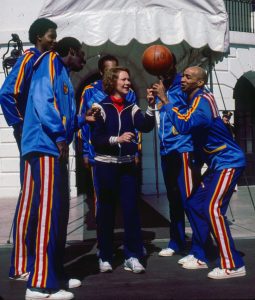
US First Lady Rosalynn Carter plays basketball with members of the Harlem Globetrotters outside the White House, Washington DC, March 1980. They are teaching her how to spin a basketball on her fingertip. (Photo by Diana Walker/Getty Images)
As with all good economics treatises, this one brings home the numbers, story, and background. Private jet travel is one of the biggest culprits.
Argentina’s hard-fought progress toward democracy is about to be threatened by a right-wing libertarian populist President who was just congratulated by Orange Caligula. “The lion, the wig and the warrior. Who is Javier Milei, Argentina’s president-elect?” This is from the AP.
His legions of fans call him “the madman” and “the wig” due to his ferocity and unruly mop of hair. He refers to himself as “the lion.” He thinks sex education is a Marxist plot to destroy the family, views his cloned mastiffs as his “children with four paws” and has suggested people should be allowed to sell their own vital organs.
He is Javier Milei, Argentina’s next president.
A few years ago, Milei was a television talking head whom bookers loved because his screeds against government spending and the ruling political class boosted ratings. At the time, and up until mere months ago, hardly any political expert believed he had a real shot at becoming president of South America’s second-largest economy.
But Milei, a 53-year-old economist, has rocked Argentina’s political establishment and inserted himself into what has long been effectively a two-party system by amassing a groundswell of support with his prescriptions of drastic measures to rein in soaring inflation and by pledging to crusade against the creep of socialism in society.
This analysis is from the Washington Post. “Argentina set for sharp right turn as Trump-like radical wins presidency.” Argentina is now off the list for where in the Western Hemisphere one might go to escape a second Trump Presidency.
A radical libertarian and admirer of Donald Trump rode a wave of voter rage to win Argentina’s presidency on Sunday, crushing the political establishment and bringing the sharpest turn to the right in four decades of democracy in the country.
Javier Milei, a 53-year-old far-right economist and former television pundit with no governing experience, claimed nearly 56 percent of the vote in a stunning upset over Sergio Massa, the center-left economy minister who has struggled to resolve the country’s worst economic crisis in two decades. Even before the official results had been announced Sunday night, Massa acknowledged defeat and congratulated Milei on his win.
Trump also congratulated Milei. “I am very proud of you,” Trump wrote on his Truth Social platform. “You will turn your Country around and Make Argentina Great Again!”
Voters in this nation of 46 million demanded a drastic change from a government that has sent the peso tumbling, inflation skyrocketing and more than 40 percent of the population into poverty. With Milei, Argentina takes a leap into the unknown — with a leader promising to shatter the entire system.
In his first speech as president-elect, Milei told Argentines that “the model of decadence has reached its end. There is no turning back.”
“Enough of the impoverishing power of the caste,” he said. “Today we once again embrace the model of liberty, to once again become a world power.” His supporters joined him in shouting: “Long live freedom, damn it!”
Milei will take office on Dec. 10, the 40th anniversary of Argentina’s return to democracy after the fall of its military dictatorship.
Wielding chain saws on the campaign trail, the wild-haired Milei vowed to slash public spending in a country heavily dependent on government subsidies. He pledged to dollarize the economy, shut down the central bank and cut the number of government ministries from 18 to eight. His rallying campaign cry was a takedown of the country’s political “caste” — an Argentine version of Trump’s “drain the swamp.”
Why are so many people becoming dictator-curious and looking to the likes of Hitler and Mussolini again? Plus, these folks are raping the planet. It’s discouraging. I hope we can find a new model for Thanksgiving this year where we can celebrate with others and be thankful for what we have. I also hope it isn’t based on stealing your host’s land, committing genocide, and destroying their cultural practices.
Have a good Turkey Day! And it’s time we pass the John Lewis Voting Rights Act!
What’s on your reading and blogging list today?
Thursday Reads
Posted: November 4, 2021 Filed under: morning reads, U.S. Economy, U.S. Politics | Tags: academic freedom, Charlottesville rally, Deborah Lipstadt, Donald Trump, Federal Reserve, Igor Danchenko, inflation, January 6 Committee, John Durham, Neo-Nazis, Steele Dossier, voter suppression, Voting Rights Act, witch hunt 18 CommentsGood Morning!!

Peter Saul, Washington Crossing the Delaware, 1975
The mainstream media, led by The New York Times, is writing the Democrat’s obituary after Terry McAuliffe’s loss in the Virginia gubernatorial race, but I don’t feel like writing about that. I have no idea whether the loss will affect the 2022 midterms. I don’t really want to think about it, except that I hope the Democrats will finally do something about the filibuster. There has been some talk of changing Senate rules for voting rights legislation, after Republicans once again blocked debate on the Voting Rights Act.
The New York Times: Republicans Block a Second Voting Rights Bill in the Senate.
Senate Republicans on Wednesday blocked legislation to restore parts of the landmark Voting Rights Act weakened by Supreme Court rulings, making it the second major voting bill to be derailed by a G.O.P. filibuster in the past two weeks.
Despite receiving majority support, the John Lewis Voting Rights Advancement Act, named for the civil rights activist and congressman who died last year, fell nine votes short of the 60 required to advance over Republican opposition.
In the aftermath of the defeat, Senate Democrats said they would intensify internal discussions about altering filibuster rules or making other changes to allow them to move forward on voting rights legislation despite deep resistance by Republicans, who have now thwarted four efforts to take up such measures.
“Just because Republicans will not join us doesn’t mean Democrats will stop fighting,” said Senator Chuck Schumer, Democrat of New York and the majority leader, after the vote. “We will continue to fight for voting rights and find an alternative path forward.”
Yesterday the Federal Reserve announced plans to deal with inflation. I don’t know about you, but I’ve been affected by the rising food prices. Even though we’re getting the biggest Social Security increase in a very long time, it isn’t going to be enough. The New York Times: Fed Takes First Step Toward End of Pandemic Measures.
The Federal Reserve on Wednesday took its first step toward withdrawing support for the American economy, saying that it would begin to wind down a stimulus program that’s been in place since early in the pandemic as the economy heals and prices climb at an uncomfortably rapid pace.
Peter Saul’s Columbus Discovers America, 1992-1995, points the way to the painter’s mature work, distinguished by provocative subject matter and a cartoon-based style.
Central bank policymakers struck a slightly more wary tone about inflation, which has jumped this year amid booming consumer demand for goods and supply snarls. While officials still expect quick cost increases to fade, how quickly that will happen is unclear.
Fed officials want to be prepared for any outcome at a time when the economy’s trajectory is marked by grave uncertainty. They are not sure when prices will begin to calm down, to what extent the labor market will recover the millions of jobs still missing after last year’s economic slump, or when they will begin to raise interest rates — which remain at rock-bottom to keep borrowing and spending cheap and easy.
So the central bank’s decision to dial back its other policy tool, large-scale bond purchases that keep money flowing through financial markets, was meant to give the Fed flexibility it might need to react to a shifting situation. Officials on Wednesday laid out a plan to slow their $120 billion in monthly Treasury bond and mortgage-backed security purchases by $15 billion a month starting in November. The purchases can lower long term interest rates and prod investors into investments that would spur growth.
Assuming that pace holds, the bond buying would stop altogether around the time of the central bank’s meeting next June — potentially putting the Fed in a position to lift interest rates by the middle of next year.

John Durham’s “investigation” into the origins of the FBI/DOJ investigation of Trump’s ties to Russia is beginning to look like a real witch hunt. The New York Times: Authorities Arrest Analyst Who Contributed to Steele Dossier.
Federal authorities on Thursday arrested an analyst who in 2016 gathered leads about possible links between Donald J. Trump and Russia for what turned out to be Democratic-funded opposition research, according to people familiar with the matter.
The arrest of the analyst, Igor Danchenko, is part of the special counsel inquiry led by John H. Durham, who was appointed by the Trump administration to scrutinize the Russia investigation for any wrongdoing, the people said.
Mr. Danchenko, was the primary researcher of the so-called Steele dossier, a compendium of rumors and unproven assertions suggesting that Mr. Trump and his 2016 campaign were compromised by and conspiring with Russian intelligence officials in Moscow’s covert operation to help him defeat Hillary Clinton.
The people familiar with the matter spoke on condition of anonymity because the indictment of Mr. Danchenko had yet to be unsealed. A spokesman for Mr. Durham did not respond to a request for comment.

Peter Saul, Quack-Quack, Trump, 2017
So this information was leaked without any indication of what the basis of the arrest was. What laws did Danchenko break? The last Durham arrest was hinky too.
The charges against Mr. Danchenko follow Mr. Durham’s indictment in September of a cybersecurity lawyer, Michael Sussmann, which accused him of lying to the F.B.I. about who he was working for when he brought concerns about possible Trump-Russia links to the bureau in September 2016.
Mr. Sussmann, who then also worked for Perkins Coie, was relaying concerns developed by data scientists about odd internet logs they said suggested the possibility of a covert communications channel between the Trump Organization and Alfa Bank, a Kremlin-linked financial institution. He has denied lying to the F.B.I. about who he was working for.
Today is the hearing about whether Trump has any right to claim executive privilege over documents related to the January 6 insurrection. CNN: High-stakes hearing Thursday in Trump effort to block release of presidential documents.
The power Donald Trump holds as a former president will be put to the test on Thursday, as a federal judge is set to hear arguments on whether Trump can keep secret records from his White House about his attempt to overturn the 2020 election.
Trump has asked the DC District Court to block the National Archives from giving more than 700 pages of documents to the House Select Committee investigating January 6. He’s claimed the House’s investigation is illegitimate, and that his role as a former President should give him control over reviewing and deciding upon access to the records.
The hearing may be the pivotal moment in a potentially historic legal fight about the authority of a former president, the House’s investigative power and the reach of executive privilege….
In the short term, the case also may have huge implications for the bipartisan House investigation, which is pushing for records and witnesses before the midterm elections take place next year. Without access to the documents, the House could be hampered significantly in its fact-finding.
In court, the House has cast its investigation as one of its most critical tasks in history. “In 2021, for the first time since the Civil War, the Nation did not experience a peaceful transfer of power,” lawyers for the House wrote over the weekend. “A peaceful transfer of power from one President to another is crucial to the continuation of our democratic government. It is difficult to imagine a more critical subject for Congressional investigation, and Mr. Trump’s arguments cannot overcome that pressing legislative need.

Hitler’s Bunker, Peter Saul
This happened yesterday in the trial of the Charlottesville rally organizers. Buzzfeed News: A Renowned Holocaust Historian Testified That Charlottesville Rally Organizers’ Messages Were A “Call To Arms”
Neo-Nazis Christopher Cantwell and Matthew Heimbach on Wednesday seemed almost to forget for a moment that they were in a court of law and defendants in a civil case that could potentially bankrupt them and take down the white nationalist groups with which they’re associated.
“What’s your favorite Holocaust joke?” Cantwell, who is representing himself in court, asked Heimbach, who was called to the stand by the plaintiffs as a witness, during cross-examination….
The strategy behind Cantwell’s line of questioning wasn’t immediately clear, and attorneys for the plaintiffs interjected before any jokes were uttered. But Cantwell, who had previously gone on bizarre courtroom tangents, and Heimbach spent nearly an hour talking about their adoration for Nazi Germany, Adolf Hitler, the dictator’s book Mein Kampf, and their belief that the Holocaust was a hoax.
Hitler, Heimbach testified, “did nothing wrong” in murdering some 6 million Jews.
The exchange between the two neo-Nazis contrasted sharply with the testimony by Deborah Lipstadt, an acclaimed Holocaust scholar and professor of modern Jewish history at Emory University.

Politics, Peter Saul, 1985
Down in Florida, Ron DeSantis is working overtime to install authoritarian policies. The latest outrage is trying to ban professors at state universities from supporting voting rights. The New York Times: In Florida, a Firestorm Over Silenced University Professors Grows.
A decision by the University of Florida to bar three professors from testifying in a lawsuit against the administration of Gov. Ron DeSantis has ballooned into a political and public relations firestorm, one that could grow as other professors consider whether to step forward with stories of university pressure.
Since Friday, when the university’s decision was disclosed in a federal court filing, five more professors have offered accounts of being barred from testifying or ordered to omit mention of their university positions in court statements.
The body that accredits the university has opened an inquiry into whether its orders violate long-established principles of academic freedom or involve “undue political influence.” On Monday, the university’s president and provost ordered a review of its policy on conflicts of interest, the stated rationale for the decisions to silence the professors.
“The University of Florida stands firmly behind its commitment to uphold our most sacred right as Americans, the right to free speech, and to faculty members’ right to academic freedom,” they said in a statement. “Nothing is more fundamental to our existence as an institution.”
A spokeswoman for Mr. DeSantis said he had not played any role in the university’s actions. “This is an internal U.F. issue and not the sort of thing that the executive branch would be involved in,” the spokeswoman, Christina Pushaw, said. “Governor DeSantis has always championed free speech, open inquiry and viewpoint diversity on college and university campuses.”
Asked on Wednesday whether the administration had any role in the university’s actions, a university spokeswoman, Hessy Fernandez, replied with a single word: “No.”
Despite the denials, a legion of critics continued to say that the university’s actions bore the marks of political meddling. In each of the disclosed cases, the conflict of interest that was cited as justification for limiting the professors’ freedom to speak was that they were supporting legal challenges to the DeSantis administration’s policies.
“It’s creating an environment which is putting intolerable pressure on universities and other institutions as well to comply with the political policies of this administration, for sure,” said Dr. Jeffrey L. Goldhagen, a longtime professor and administrator at the university’s College of Medicine in Jacksonville. “I don’t think there’s any questions about that.”
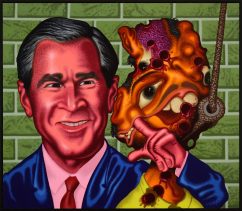
Bush at Abu Ghraib, Peter Saul, 2006
Read more on this issue:
Greg Sargent at The Washington Post: Opinion: The case of Ron DeSantis and the muzzled professors takes another dubious turn.
The Chronicle of Higher Education: 3 U. of Florida Experts Couldn’t Testify on a Voting-Rights Law. This Professor Had No Trouble.
Miami Herald: UF restricted five other professors’ participation in legal cases against the state.
One more DeSantis story at Politico: DeSantis calls for new Florida police force to go after election crimes.
Gov. Ron DeSantis vowed on Wednesday to create a fully-staffed statewide law enforcement office whose sole job would be to crack down on election crimes, despite previously praising Florida’s smooth 2020 elections and rebuffing calls by members of his own party for an audit.
DeSantis, who is running for reelection and is considered a potential 2024 presidential contender, is also pressing state lawmakers to increase the criminal penalty for violating new restrictions on collecting mail-in ballots. He also wants to enact a tight new 100-day deadline on when local election officials must scrub their voter rolls for those who died, moved or been convicted of a felony.
The new law enforcement office will cost nearly $6 million, according to a document obtained by POLITICO.
“I guarantee you this: The first person that gets caught, no one is going to want to do it again after that,” said DeSantis at a West Palm Beach event billed as a “press conference” but featured dozens of DeSantis supporters who loudly applauded the governor. At one point, the crowd cheered “Let’s go Brandon” — a conservative rallying cry against President Joe Biden.
The governor also said he wants the GOP-controlled Legislature to put additional restrictions on the use of drop boxes.
“I don’t even think we should have drop boxes,” said DeSantis even though he signed the bill two years ago that first authorized their use in the state.
This guy is trying to out-Trump Trump.
So . . . what else is happening? What stories are you following?
Thursday Reads: Aftermath of SCOTUS Voting Rights Decision
Posted: June 27, 2013 Filed under: 2014 elections, Civil Rights, court rulings, Elections, morning reads, open thread, racism, Real Life Horror, Republican politics, U.S. Politics | Tags: Antonin Scalia, GOP Southern strategy, hypocrisy, Judicial Activism, SCOTUS, U.S. Supreme Court, Voter ID laws, Voting Rights Act 66 Comments
Good Morning!!
This is going to be a quickie post, because I’m feeling kind of sick this morning.
Although I’m thrilled with the DOMA decision yesterday, I still can’t get past my anger and sadness about the Supreme Court’s gutting of the Voting Rights Act. So I’m just going to post the (above) “official 2013 photo” of the U.S. Supreme Court and some accompanying links that demonstrate the damage the Court has done in its horrendous decision on the Voting Rights Act.
I’ll begin with this excellent post by Linda Greenhouse at The New York Times: Current Conditions, which neatly summarizes the Court’s “conservative” wing’s blatant “judicial activism,” to quote a frequent charge of conservatives against “liberal” judges.
These have been a remarkable three days, as the Supreme Court finished its term by delivering the only four decisions that most people were waiting for. The 5-to-4 decisions striking down the coverage formula of the Voting Rights Act and the Defense of Marriage Act will go far toward defining the Roberts court, which has concluded its eighth year. Monday’s place-holding ruling on affirmative action in higher education, although it decided very little, is also definitional, for reasons I’ll explain. There is a great deal to say about each decision, and about how each reflects on the court. My thoughts are preliminary, informed by that phrase in the chief justice’s voting rights opinion: current conditions.
By this phrase, the chief justice meant to suggest that there is a doctrinal basis for drawing a boundary around Congressional authority, for judicial insistence that a burden that Congress chooses to impose on the states has to be justified as a cure for a current problem. In the context of voting rights, an area over which the 15th Amendment gives Congress specific authority, this is a deeply problematic position that Justice Ruth Bader Ginsburg’s dissenting opinion demolishes.
Please go read the whole column–it’s difficult to get Greenhouse’s thesis into an excerpt. The blatant hypocrisy of the “conservative” justices–especially Scalia is mind-boggling, especially when the stunning effects of the Voting Rights decision on “current conditions” are already obvious and dramatic–just as were the disastrous effect of the Citizens United decision. A few examples.
The Guardian: Texas rushes ahead with voter ID law after supreme court decision
Officials in Texas said they would rush ahead with a controversial voter ID law that critics say will make it more difficult for ethnic minority citizens to vote, hours after the US supreme court released them from anti-discrimination constraints that have been in place for almost half a century.
The Texas attorney general, Greg Abbott, declared that in the light of the supreme court’s judgment striking down a key element of the 1965 Voting Rights Act he was implementing instantly the voter ID law that had previously blocked by the Obama administration. “With today’s decision, the state’s voter ID law will take effect immediately. Photo identification will now be required when voting in elections in Texas.”
Greensboro News and Record: NC senator: Voter ID bill moving ahead with ruling
Voter identification legislation in North Carolina will pick up steam again now that the U.S. Supreme Court has struck down part of the Voting Rights Act, a key General Assembly leader said Tuesday.
A bill requiring voters to present one of several forms of state-issued photo ID starting in 2016 cleared the House two months ago, but it’s been sitting since in the Senate Rules Committee to wait for a ruling by the justices in an Alabama case, according to Sen. Tom Apodaca, R-Henderson, the committee chairman. He said a bill will now be rolled out in the Senate next week.
The ruling essentially means a voter ID or other election legislation approved in this year’s session probably won’t have to receive advance approval by U.S. Justice Department attorneys or a federal court before such measures can be carried out.
Northwest Ohio.com: Voter ID and restricted early voting likely after SCOTUS ruling
ATLANTA (AP) — Across the South, Republicans are working to take advantage of a new political landscape after a divided U.S. Supreme Court freed all or part of 15 states, many of them in the old Confederacy, from having to ask Washington’s permission before changing election procedures in jurisdictions with histories of discrimination.
After the high court announced its momentous ruling Tuesday, officials in Texas and Mississippi pledged to immediately implement laws requiring voters to show photo identification before getting a ballot. North Carolina Republicans promised they would quickly try to adopt a similar law. Florida now appears free to set its early voting hours however Gov. Rick Scott and the GOP Legislature please. And Georgia’s most populous county likely will use county commission districts that Republican state legislators drew over the objections of local Democrats.
AL.com: Alabama photo voter ID law to be used in 2014, state officials say
MONTGOMERY, Alabama — Today’s U.S. Supreme Court decision clears the way for Alabama’s new photo voter ID law to be used in the 2014 elections without the need for federal preclearance, state officials said.
Alabama Attorney General Luther Strange and Secretary of State Beth Chapman said they believed the voting requirement, which is scheduled to take effect with the June 2014 primaries, can simply move forward.
“Photo voter ID will the first process that we have gone through under this new ruling,” Chapman said today.
Memphis Business Journal: Mississippi voter ID law could start next year
Voters in Mississippi may have to start showing a photo ID to vote by the middle of 2014, according to Secretary of State Delbert Hosemann.
According to the Associated Press, Hoseman spoke Tuesday after the U.S. Supreme Court ruled that certain state and local governments no longer need federal approval to change election laws. That ruling opens up the possibility that Mississippi will implement a voter identification requirement.
According to Think Progress, Arizona and South Dakota will likely be trying to pass Voter ID laws soon. I’m sue that won’t be the end of it.
Just a few more links:
Joan Walsh: The ugly SCOTUS voting rights flim-flam
Ari Berman: What the Supreme Court Doesn’t Understand About the Voting Rights Act
Stephen Hill: So the Voting Rights Act Is Gutted—What Can Protect Minority Voters Now?
I’ll end there and leave it up to you guys to link to other important news stories. What are you reading and blogging about today?
Open Thread: Late Afternoon News Update
Posted: June 25, 2013 Filed under: Barack Obama, open thread, Republican politics, U.S. Economy, U.S. Politics | Tags: Climate change, coal stocks, data encryption, David Gomez, Edward Snowden, Glenn Greenwald, Keystone XL pipeline, Rep. John Lewis, spycraft, Voting Rights Act 27 Comments
Good Afternoon Sky Dancers!!
Here’s an fresh thread, since the morning reads one is getting so long. I have several updates for you on the Snowden/NSA story.
Eli Lake of The Daily Beast got some disturbing news from Glenn Greenwald: Snowden’s Files Are Out There if “Anything Happens” To Him. I posted this link on the previous thread, but it should be highlighted. According to Greenwald, Snowden gave complete copies of the the secret NSA files he stole to “many people around the world.” Supposedly the files are encrypted, but from what we know of Snowden’s spycraft knowledge, I don’t think that’s a guarantee that they’ll stay secret. From The Daily Beast article:
Glenn Greenwald, the Guardian Newspaper journalist Snowden first contacted in February, told the Daily Beast Tuesday that Snowden “has taken extreme precautions to make sure many different people around the world have these archives to insure the stories will inevitably be published.” Greenwald added that the people in possession of these files “cannot access them yet because they are highly encrypted and they do not have the passwords.” But, Greenwald said, “if anything happens at all to Edward Snowden, he told me he has arranged for them to get access to the full archives.” [….]
A former U.S. counter-intelligence officer following the Snowden saga closely said his contacts inside the U.S. intelligence community “think Snowden has been planning this for years and has stashed files all over the internet.” This source added, “At this point there is very little anyone can do about this.”
Greenwald assured Lake that although he (Greenwald) is in possession of top secret information about “the technical specifications of NSA systems,” but that he won’t publish them. I wonder how well Greenwald’s computer is protected?
On Snowden’s aforementioned spycraft skills, let’s see what a real former spy thinks. From Foreign Policy:
We reached out to FP contributor David Gomez, a former assistant special agent-in-charge and counterterrorism program manager with the FBI, to get his take. When was Snowden being savvy — and when did it seem as if he’d just watched a few too many spy movies?
Cell phones in the fridge
While it’s true that cell phones can easily be compromised and turned into recording devices, Gomez says it’s unlikely that anyone seeking to record Snowden would have used a phone anyway. If someone had wanted to eavesdrop, Gomez explains, he or she more likely would have worn a concealed wire. Or, if a government’s agents had been trying to listen in from outside of the room, they might have deployed a long-range microphone, among other techniques. The bottom line: a refrigerated cell phone probably wasn’t stopping anyone who wanted to listen badly enough — though it may have extended the phone’s battery life.
Lining the hotel door with pillows
While not particularly effective at stopping anyone actively seeking to spy on Snowden, pillows could have muffled the sounds of any conversations going on in his Hong Kong hotel room enough that an unsuspecting person passing by wouldn’t overhear something alarming, Gomez says.
Wearing a hood while entering computer passwords, to avoid hidden cameras
The danger while entering computer passwords is unlikely to come from a hidden camera planted in the hotel, Gomez says, but rather from keystroke-logging software, against which a hoodie provides little protection.
Signaling his identity to reporters by carrying a Rubik’s Cube through a hotel
While spies do at times use signals to identify one another, the idea in doing so is to not draw attention to yourself, Gomez explains. Thus, when arranging a meeting, as Snowden did with a group of journalists in Hong Kong, it is both unhelpful and unnecessary to carry something as out of place as a Rubik’s Cube. It would have been better, Gomez adds, for Snowden to have simply described, say, his clothing in detail. “If you’re going to meet with all these people, what’s the point of being Sneaky Pete?” Gomez asks.
Gomez says Snowden seems to be an amateur.

 peej
peej Carissa
 bostonboomer
 dakinikat
 ecocatwoman
 mablue2
 Mama Lopez
 peggysue22
 quixote
 skydancingguestblogger
 Mona (aka Wonk the Vote)



 Sky Dancing
Recent Comments