Posted: October 16, 2024 | Author: bostonboomer | Filed under: 2024 presidential Campaign, Donald Trump, Kamala Harris 2024 | Tags: cognitive decline, dementia, Donald Trump, economics, Kamala Harris, November 2024 Elections, politics, tariffs, Trump, violence |
Good Day!!

Weeping Woman, Pablo Picasso
There are only 19 days to go until November 5. I believe that Kamala Harris will win, but I was also sure Hillary Clinton would win in 2016.
Both Harris and Trump have been holding rallies and giving interviews. She speaks in complete sentences and discusses her policies in a coherent fashion. He can’t complete a sentence, mispronounces words, rambles nonsensically, and has no understanding of his own policies. And, of course, he is a pathological liar.
Harris is a former prosecutor who is committed to the rule of law. Trump is a convicted felon out on bail, with multiple indictments hanging over his head. How can the race be close?
One positive development is that Trump’s dementia and his violent rhetoric and threats are getting more attention in the media. He and his advisers may well live to regret driving Joe Biden out of the race.
I feel as if my life is on hold until I know who will win this election. If Harris wins, my life will continue on its current track. If Trump wins, everything will change–and not in a good way. In addition, the chaos we have all lived through in the past 9 years will continue and most likely get much worse. That’s where things stand right now, as I see it.
State of the Race
In the latest national polls, Harris leads by a few points.
Marist Poll: Harris +5 Points Against Trump Nationally.
In the presidential contest, Vice President Kamala Harris leads former President Donald Trump by five points among likely voters, including those who are undecided yet leaning toward a candidate. The race gets closer, however, among registered voters nationally. Here, three points separate the two candidates.
- Harris (52%) leads Trump (47%) among likely voters nationally, including those who are undecided yet leaning toward a candidate. Earlier this month, two points separated Harris (50%) and Trump (48%) among likely voters.
- The contest is tighter among registered voters. Among the general electorate, Harris receives 51% to 48% for Trump. In early October, the same margin separated Harris (50%) and Trump (47%) among the broader electorate.
- Trump (54%) leads Harris (44%) among independents who are likely to vote, widening the 4-point edge Trump (50%) had against Harris (46%) previously.
- Trump (53%) leads Harris (47%) among men who are likely to vote while Harris (57%) has the advantage over Trump (42%) among women.
- While members of Gen X divide (51% for Harris to 48% for Trump), Harris has majority support among GenZ/Millennials (53%) and among Baby Boomers/the Silent-Greatest Generations (55%).
Read more details at the link.
Reuters: Exclusive: Harris holds steady, marginal 45%-42% lead over Trump, Reuters/Ipsos poll finds.
Summary:
— Harris leads Trump by 3 points in Reuters/Ipsos poll
— Voter enthusiasm higher than in 2020
— Harris favored on healthcare, Trump on economy
Democratic Vice President Kamala Harris held a marginal 3-percentage-point lead over Republican Donald Trump – 45% to 42% – as the two stayed locked in a tight race to win the Nov. 5 U.S. presidential election, a new Reuters/Ipsos poll found.
While the gap between the two remained steady compared with a Reuters/Ipsos poll conducted a week earlier, the new poll, which closed on Sunday, gave signs that voters – particularly Democrats – might be more enthused about this year’s election than they were ahead of the November 2020 presidential election when Democrat Joe Biden defeated Trump.
Some 78% of registered voters in the three-day poll – including 86% of Democrats and 81% of Republicans – said they were “completely certain” they would cast a ballot in the presidential election. The share of sure-to-vote poll respondents was up from 74% in a Reuters/Ipsos survey conducted Oct. 23-27, 2020, when 74% of Democrats and 79% of Republicans said they were certain to cast ballots.
The poll had a margin of error of around 4 percentage points.

Tension in Red, Wassily Kandinsky
Early voting has begun. CNN reports: Record number of early votes cast in Georgia as election gets underway in battleground state.
A record number of early votes have been cast in Georgia on Tuesday as residents headed to the polls in a critical battleground state that is grappling with the fallout from Hurricane Helene and controversial election administration changes that have spurred a flurry of lawsuits.
More than 328,000 ballots were cast Tuesday, Gabe Sterling of the Georgia secretary of state’s office said on X. “So with the record breaking 1st day of early voting and accepted absentees we have had over 328,000 total votes cast so far,” he said.
The previous first day record was 136,000 in 2020, Sterling said.
The swing state is one of the most closely watched this election, with former President Donald Trump trying to reclaim it after losing there to President Joe Biden by a small margin four years ago, leading Trump and his allies to unsuccessfully push to overturn his defeat.
Those efforts have loomed large this year as new changes to how the state conducts elections have been approved by Republican members of the State Election Board, leading Democrats and others to mount legal challenges, many of which have yet to be resolved even as Election Day nears.
Despite the massive turnout on Tuesday, the process appeared to go smoother this year for some Atlanta-area voters who spoke with CNN.
“Last time I voted, I voted in the city and the lines were out the door. They only had like, maybe like three people working,” said Corine Canada. “So people honestly just started leaving because it was like that. Yeah, like, ‘This is too long. I can’t sit here (and) wait, I have to go back to work.’ But here, no, it was easy.”
Dementia Don
Yesterday Trump appeared at the Economic Club of Chicago and gave a disastrous interview. He mostly talked about his plan to put high tariffs on imports, and continued to claim that these tariffs would be paid by foreign countries and not by Americans paying higher prices. Other news from the interview: he would not commit to allowing a peaceful transfer of power if he loses the election.
Nikki McCann Ramirez and Ryan Bort at Rolling Stone: Trump Crumbles When Pressed on Economic Policy in Tense Interview.
Donald Trump continued his pre-election economic event tour on Tuesday with a lengthy interview with Bloomberg at the Economic Club of Chicago. It was a total mess.
Bloomberg Editor-In-Chief John Micklethwait did not take it easy on Trump, and it quickly became clear that the former president has no conception of the mechanics of or the potential ramifications of the economic platform he’s running on. Bluntly, the former president was incoherent when pressed with real questions about his policies.
Micklethwait spent most of the interview attempting to break Trump out of what the former president repeatedly referred to as “the weave,” his term for his rambling digressions — with ever-decreasing intelligibility — and general inability to focus on a given topic for more than a few seconds during his rallies and interviews.
Micklethwait didn’t weave along with Trump, however, repeatedly working to bring him back on topic and answer the actual questions. The grilling exposed Trump’s total cluelessness with regard to his own economic policy, and led Trump to attack Micklethwait as biased….
The central pillar of Trump’s economic plan is widespread tariffs on all imported goods, with penalties appearing to increase depending on how much he dislikes the country. Economists have warned that such a policy could have devastating effects on American consumers, who would be saddled with increased costs for all imported goods.
When questioned about the specifics of his plan, and if he was aware of its pitfalls, Trump seemed ignorant of basic economic principles, insisting that other countries, not American consumers, would pay for the tariffs.
A bit more:
Micklethwait tried to explain the actual impact. “Three-trillion worth of imports and you will add tariffs to every single one of them, and push up the cost for all of these people to buy foreign goods,” he said. “That is just simple mathematics.”
Trump countered that he was “always good at mathematics,” and that high tariffs — and thus costs — would force companies to move production into the United States.

Anxiety, by Edvard Munch
“That will take many, many, many years,” Micklethwait said, to which Trump replied that high enough penalties would make the move immediate as if companies could simply wand wave production plants, orchards, wineries, factories, and the like into existence.
The former president also insisted that his tariff proposal would not result in the loss of jobs that are dependent on trade, because companies that moved to the U.S. would not be subject to the tax. “All you have to do is build your plant in the United States and you don’t have any tariffs,” he said…..
Micklethwait’s attempts to keep Trump on topic earned him no grace from the former president, who hates few things more than being contradicted.
When Micklethwait asked Trump to address a report by The Wall Street Journal estimating that his economic proposals would raise the national debt by upwards of $7 trillion, the former president fell back on his standard playbook: bashing the interviewer.
“What does The Wall Street Journal know? They’ve been wrong about everything, and so have you by the way, you’ve been wrong,” Trump replied, crossing his arms and curling into his seat.
“You’ve been wrong all your life on this stuff,” he added.
There’s more at the link. I didn’t encounter a paywall when I clicked on the link at Memeorandum.
At The Washington Post, Jeff Stein and David J. Lynch write about the effects of Trump’s proposed tariffs: ‘Off the charts’: How Trump tariffs would shock U.S., world economies.
Former president Donald Trump is campaigning on the most significant increase in tariffs in close to a century, preparing an attack on the international trade order that would likely raise prices, hurt the stock market and spark economic feuds with much of the world.
Trump’s trade plans, a staple of his stump speeches, have fluctuated, but he consistently calls for steep duties to discourage imports and promote domestic production. The former president has floated “automatic” tariffs of 10 percent to 20 percent on every U.S. trading partner, 60 percent levies on goods from China, and rates as high as 100, 200 or even 1,000 percent in other circumstances.
These proposals would go far beyond the disruptive trade wars of his first term even if they are only partially implemented. They would wrench the nation out of the system of global interdependence that arose in recent decades, making the U.S. economy much more isolated and autonomous, like it was in the late 19th century. (Trump last week falsely claimed that the United States was never richer than in the 1890s, when it had high trade barriers.)
“To me, the most beautiful word in the dictionary is tariff. And it’s my favorite,” Trump said in Chicago on Tuesday. “I’m a believer in tariffs.”
The consequences would be far-reaching: Americans would be hit by higher prices for grocery staples from abroad, such as fruit, vegetables and coffee. Domestic firms dependent on imports would need to either figure out new supply chains or raise costs for consumers. U.S. manufacturers would almost certainly see sharp declines in orders from abroad as foreign nations impose retaliatory tariffs.
“We are talking about a plan of historic significance: It would be enormous, and the blowback would be even more enormous,” said Douglas A. Irwin, an economist at Dartmouth College who authored a 2017 book on the history of U.S. trade policy. “This would stand way off the charts.”
Companies and governments around the world have begun preparing contingency plans for the potential Trump tariffs. Diplomats and business leaders from Latin America, Europe, Asia and even Canada have in recent weeks asked their U.S. counterparts about Trump’s intentions and authorities, according to interviews with several domestic and international economic advisers, some of whom spoke on the condition of anonymity to reflect private planning.
While some business leaders and congressional Republicans remain optimistic that the former president is engaged in election-year posturing, Trump has repeatedly insisted that tariffs represent an unmitigated positive for the U.S. economy, recently calling them “the greatest thing ever invented.” Tariffs have been a constant bedrock of his economic agenda since he first ran in 2016, along with lower taxes, increased energy production and deregulation.
William Kristol and Andrew Egger write at The Bulwark: The Delusions of the Donald.
You should watch the interview Trump did yesterday at the Economic Club of Chicago. You might think you’ve got a pretty good idea of the big guy’s solipsism, his buffoonish overconfidence, his utter inability to engage on matters of policy. Watch a few answers, and you’ll be forced to conclude: It’s way worse than you thought.

Victor Wang, Emotional tension and psychological drama
Bloomberg News editor-in-chief John Micklethwait began by asking Trump simple questions, like how he plans to pay for the $7 trillion hole his proposals would blow in the federal deficit. Trump responded with his ordinary magical thinking about making that sum back through a combination of growth and tariffs. “To me, the most beautiful word in the dictionary is ‘tariff,’” he said. “It’s my favorite word . . . the most beautiful word.”
Micklethwait asked how Trump planned to follow through on his promises of trimming the fat of wasteful spending. Trump responded with a lengthy story about him personally spending months negotiating with Boeing over a contract for new planes to serve as Air Force One, which ultimately saved the government more than a billion dollars. A cool story—until you remember the federal government spends an average of nearly $17 billion a day.
It takes a certain amount of ego and delusion to run for president. Trump has those characteristics in excess. But what stood out at the talk yesterday was the degree to which these are now the only elements undergirding his vision. Gone is the talk about surrounding himself with the best people. Dropped is the pretense that his answers are coherent. (Trump has started referring to his meandering logorrhea as “the weave.”) The pitch instead is that some sort of mad genius remains within him: Trust me, I’m the deals guy! I’ll get the best deals!
But there’s a lot more to guiding the economy than dealmaking, and even the most capable, hard-nosed, mano-a-mano negotiating with individual vendors can only take you so far.
There’s more about the interview at the link. There’s no paywall.
More news from the Micklethwait interview from Mini Racker at The Daily Beast: Trump Gives Ominous Clue About What May Happen If He Loses.
Donald Trump on Tuesday dodged the question of whether he will allow for a peaceful certification of election results if Kamala Harris defeats him in three weeks.
During an interview at the Economic Club of Chicago, Bloomberg Editor-in-Chief John Micklethwait asked Trump if he would commit “to respecting and encouraging a peaceful transfer of power,” especially in light of Jan. 6, 2021, which the journalist called “unruly and violent.”
Trump didn’t answer the question. Instead, he rejected the premise and blamed Micklethwait as “a man that has not been a big Trump fan over the years.” He also falsely claimed that he allowed for a peaceful transfer of power in 2020, when Joe Biden defeated him.
“Come on, President Trump, you had a peaceful transfer of power compared to Venezuela, but it was by far the worst transfer of power for a long time,” Micklethwait insisted.
The audience booed and Trump thanked them. The former president then admitted that people were angry when they arrived in Washington to protest the results that January—but according to him, they were perfectly behaved.
“It was love and peace, and some people went to the Capitol,” Trump said. “And a lot of strange things happened there, a lot of strange things, with people being waved into the Capitol by police.”
For perhaps the first time, Trump downplayed his crowd size.
He added that he left the White House the morning he was supposed to and that only a fraction of the protestors were among those who breached and defaced the Capitol.
“Not one of those people had a gun, nobody was killed, except for Ashli Babbitt,” he said.
That is a lie, of course. A number of guns were confiscated, and there were probably many more, since none of the insurrectionists were detained and searched. As for deaths, four of his supporters died that day, and a capitol police officer died from injuries inflicted in the riot.
There is a growing discussion in alternative media of Trump’s age obvious cognitive decline, and some in the legacy media are also beginning to call attention to it. Examples:
Aaron Rupar at Public Notice: Trump’s campaign is trying to hide his sad state from voters.
MAGA-friendly CNBC host Joe Kernen dropped an interesting nugget right as Squawk Box went to commercial break on Tuesday.
“Well, Trump canceled, and he was going to come on,” Kernen said.
Not only did Trump once love going on CNBC, but Kernen’s revelation comes on the heels of Trump declining or canceling a number of other high-profile opportunities to make a pitch to voters on mainstream TV. Trump refused to debate Kamala Harris a second time, which would’ve aired on CNN. Trump then refused CNN’s offer to host a town hall. And Trump of course also recently backed out of a 60 Minutes interview.

Still Tension, Wassily Kandinsky
The explanation for all this is not that Trump has suddenly become camera shy. It’s that his campaign undoubtedly realizes his rapidly degrading condition doesn’t play well with audiences beyond the MAGA cult. As a result, they’re retreating to the safer terrain of nonstop rallies and fawning Fox hits….
The reason Trump’s campaign isn’t keen to get him in front of swing voters on mainstream platforms was on stark display Tuesday when Trump did a rare event that wasn’t a festival of sycophancy.
By any objective standard, Trump’s Economic Club of Chicago interview was a disaster. He came out of the gates with an asinine proposal for 2,000 percent tariffs on imported cars, then was quickly reduced to insulting the moderator, Bloomberg’s John Micklethwait, when Micklethwait rightly pointed out that his his economic proposals are an inflationary disaster. (Watch below.)
Trump repeatedly refused to answer questions Micklethwait asked him, instead going on self-absorbed rants about how Google is unfair to him or about how he could do a better job as Federal Reserve chairman than Jerome Powell.
By the end of the event, Trump had veered into making an impassioned defense of the big lie and his coup attempt, bragging about his crowd size on January 6 and absurdly claiming the events of that day were just “love and peace.” (Watch below.)
Marianne LeVine at The Washington Post: Trump sways and bops to music for 39 minutes in bizarre town hall episode.
OAKS, Pa. — The town hall, moderated by South Dakota Gov. Kristi L. Noem (R), began with questions from preselected attendees for the former president. Donald Trump offered meandering answers on how he would address housing affordability and help small businesses. But it took a sudden turn after two attendees required medical attention.
And so Trump, after jokingly asking the crowd whether “anybody else would like to faint,” took a different approach.
“Let’s not do any more questions. Let’s just listen to music. Let’s make it into a music. Who the hell wants to hear questions, right?” he said.
For 39 minutes, Trump swayed, bopped — sometimes stopping to speak — as he turned the event into almost a living-room listening session of his favorite songs from his self-curated rally playlist.
He played nine tracks. He danced. He shook hands with people onstage. He pointed to the crowd. Noem stood beside him, nodding with her hands clasped. Trump stayed in place onstage, slowly moving back and forth. He was done answering questions for the night….
As Trump stood onstage in his oversize suit and bright red tie, swaying back and forth, it was almost as if he were taking a trip back to decades past. Trump’s decision to cut short the question-and-answer portion of the town hall and instead have the crowd stay to listen to his favorite songs was a somewhat bizarre move, given that the election was only 22 days away. Vice President Kamala Harris has called Trump, 78, unstable and questioned his mental acuity.
Some in the crowd began to leave. Some looked around, wondering whether he was done speaking for the night and how much longer the dance — or sway — session would last. Many stayed holding their cameras and watched as Trump took in the music, at times looking over at a screen beside him that showed videos of James Brown singing “It’s a Man’s Man’s Man’sWorld” and Sinéad O’Connor performing “Nothing Compares 2 U.”
Eric Schmeltzer at Newsweek: Dancing Donald Trump Is Clearly in a Steep Decline | Opinion.
For 38 minutes or so, former President Donald Trump was in a happy place. After some people collapsed at his town hall, Trump got frustrated, decided he’d had enough softball questions from Gov. Kristi Noem (R-SD) and asked to play music. For nearly 40 minutes, Trump kept asking for more music, swaying oddly in front of the crowd, occasionally closing his eyes, and retreating to a comforting place in his mind, like being wrapped in a warm blanket.

The Anxiety Monster, by Jeremy Campbell
For those of us who’ve had family members slip into dementia, it was a familiar sight. Both of my grandmothers suffered it near the ends of their lives. Even before they were sent to nursing homes, they started to exhibit increased frustration and even anger. My maternal grandmother accused her caretaker of purposely turning the shower knob too tight so she would have to come in and see my grandmother naked. But she also liked to sing old-time songs she remembered. She had her happy place—an oasis in a time of increasing confusion. Then, there were other times she was completely lucid. She would talk about the situation in the Middle East (which was still a thing back then, too) with total clarity. There were good days and there were bad days.
It isn’t like we haven’t seen Trump’s behavior with our own eyes. It isn’t like media hasn’t noticed it, either. And yet, no one seems to want to talk about the distinct possibility that Trump is well on the way to the same state my grandmothers found themselves in and that millions of Americans find friends and family in – severe cognitive decline, if not outright dementia.
For 38 minutes or so, former President Donald Trump was in a happy place. After some people collapsed at his town hall, Trump got frustrated, decided he’d had enough softball questions from Gov. Kristi Noem (R-SD) and asked to play music. For nearly 40 minutes, Trump kept asking for more music, swaying oddly in front of the crowd, occasionally closing his eyes, and retreating to a comforting place in his mind, like being wrapped in a warm blanket.
For those of us who’ve had family members slip into dementia, it was a familiar sight. Both of my grandmothers suffered it near the ends of their lives. Even before they were sent to nursing homes, they started to exhibit increased frustration and even anger. My maternal grandmother accused her caretaker of purposely turning the shower knob too tight so she would have to come in and see my grandmother naked. But she also liked to sing old-time songs she remembered. She had her happy place—an oasis in a time of increasing confusion. Then, there were other times she was completely lucid. She would talk about the situation in the Middle East (which was still a thing back then, too) with total clarity. There were good days and there were bad days.
It isn’t like we haven’t seen Trump’s behavior with our own eyes. It isn’t like media hasn’t noticed it, either. And yet, no one seems to want to talk about the distinct possibility that Trump is well on the way to the same state my grandmothers found themselves in and that millions of Americans find friends and family in – severe cognitive decline, if not outright dementia.
Politico noted that Trump’s language is getting darker and angrier than it used to be. Doctors have noticed his speech patterns point to decline, as well. His campaign has bizarrely and very abruptly canceled interviews with 60 Minutes and CNBC. He confuses the gender of people he talks about. He keeps saying that he is running against President Biden. He confused the name of his doctor, when talking about his cognitive test.
Clips of him in 2016 and now show a very sharp decline and inability to maintain a train of thought.
Angry, frustrated, confused, unable to focus. And now, he retreats to his happy place in a time of stress. Put it all together and ask yourself if that’s someone you’d trust to take care of your kids in a house with a working stove.
Lisa Lehrer and Michael Gold at The New York Times on Trump’s violent rhetoric: Trump Escalates Threats to Political Opponents He Deems the ‘Enemy.’
With three weeks left before Election Day, former President Donald J. Trump is pushing to the forefront of his campaign a menacing political threat: that he would use the power of the presidency to crush those who disagree with him.
In a Fox News interview on Sunday, Mr. Trump framed Democrats as a pernicious “enemy from within” that would cause chaos on Election Day that he speculated the National Guard might need to handle.
A day later, he closed his remarks to a crowd at what was billed as a town hall in Pennsylvania with a stark message about his political opponents.
“They are so bad and frankly, they’re evil,” Mr. Trump said. “They’re evil. What they’ve done, they’ve weaponized, they’ve weaponized our elections. They’ve done things that nobody thought was even possible.”
And on Tuesday, he once again refused to commit to a peaceful transfer of power when pressed by an interviewer at an economic forum in Chicago.
With early voting underway in key battlegrounds, the race for the White House is moving toward Election Day in an extraordinary and sobering fashion. Mr. Trump has long flirted with, if not openly endorsed, anti-democratic tendencies with his continued refusal to accept the results of the 2020 election, embrace of conspiracy theories of large-scale voter fraud and accusations that the justice system is being weaponized against him. He has praised leaders including President Vladimir V. Putin of Russia and Prime Minister Viktor Orban of Hungary for being authoritarian strongmen.
But never before has a presidential nominee — let alone a former president — openly suggested turning the military on American citizens simply because they oppose his candidacy. As he escalates his threats of political retribution, Mr. Trump is offering voters the choice of a very different, and far less democratic, form of American government.
“There is not a case in American history where a presidential candidate has run for office on a promise that they would exact retribution against anyone they perceive as not supporting them in the campaign,” said Ian Bassin, a former associate White House counsel under Barack Obama who leads the advocacy group Protect Democracy. “It’s so fundamentally, outrageously beyond the pale of how this country has worked that it’s hard to articulate how insane it is.”
Harris and Waltz are also calling attention to Trump’s cognitive issues and threats. They have three weeks left to educate the public an get legacy media to focus on Trump’s age and obvious dementia.
Take care everyone and keep hope alive, as Jesse Jackson used to say.
Did you like this post? Please share it with your friends:
Posted: September 7, 2024 | Author: bostonboomer | Filed under: 2024 presidential Campaign, cat art, caturday, Donald Trump, Kamala Harris 2024 | Tags: Dick Cheney, E. Jean Carroll, Economic Club of New York, fascism, Jeff Jarvis, Liz Cheney, media criticism, sexual abuse, tariffs |
Happy Caturday!!

By Tetsuhiro Wakabashi
Yesterday we got some earth-shaking news: Dick Cheney endorsed Kamala Harris for president. His daughter Liz had announced her endorsement a couple of days ago. Of course neither Cheney is announcing agreement with Harris’s policies, but they both see the danger that another Trump term would pose for our country and for democracy here and around the world. With just two months to go before the 2024 election, we the people are building a coalition of people with differing political views who will act together to save us from the forces of fascism.
AP: Former Vice President Dick Cheney says he will vote for Kamala Harris.
CHEYENNE, Wyo. (AP) — Former Vice President Dick Cheney, a lifelong Republican, will vote for Kamala Harris for president, he announced Friday.
Liz Cheney, who herself endorsed Harris on Wednesday, first announced her father’s endorsement when asked by Mark Leibovich of The Atlantic magazine during an onstage interview at The Texas Tribune Festival in Austin.
“Wow,” Leibovich replied as the audience cheered.
Like his daughter, Dick Cheney has been an outspoken critic of former President Donald Trump, notably during Liz Cheney’s ill-fated reelection campaign in 2022.
Dick Cheney put out a statement Friday confirming his endorsement, which read almost entirely as opposition to Trump rather than support of Harris.
“He can never be trusted with power again,” the statement said. “As citizens, we each have a duty to put country above partisanship to defend our Constitution. That is why I will be casting my vote for Vice President Kamala Harris.” [….]
Jen O’Malley Dillon, Harris’ campaign chair, released a statement saying, “The Vice President is proud to have the support of Vice President Cheney, and deeply respects his courage to put country over party.”
A bit more from Newsweek: Dick Cheney Reveals His Reason for Endorsing Kamala Harris Over Donald Trump.
Former Vice President and influential Republican Dick Cheney released a statement announcing his endorsement of Democratic nominee Vice President Kamala Harris for President. Speaking out against the Republican nominee, former President Donald Trump, Cheney said that he can “never be trusted with power again.”
“In our nation’s 248 year history, there has never been an individual who is a greater threat to our republic than Donald Trump,” Cheney, 83, said in the statement shared on Sept. 6. “He tried to steal the last election using lies and violence to keep himself in power after the voters had rejected him,” he continued, referencing the events of Jan. 6, 2021.
Cheney, who served as Vice President under President George W. Bush between 2001 and 2009 went on to say that American citizens have a “duty” to prioritize the nation over partisan politics.
Cheney’s endorsement marks the most high profile Republican politician to announce that they will vote for Harris over Republican nominee Trump, further spotlighting other former establishment Republicans who have yet to come out to endorse Trump during this run for the presidency—many of whom have been critical of Trump in the past—including his own former Vice President Mike Pence, former President George W. Bush, and former Republican nominee for President Mitt Romney.

Miroco Machiko, 1981-present
Liz Cheney also announced that she will vote for Democrat Colin Allred, who is challenging Ted Cruz for the Senate.
The Hill: Liz Cheney will back Allred in Texas Senate race.
Former Rep. Liz Cheney (R-Wyo.) said she would be backing Rep. Colin Allred (D-Texas) in the Texas Senate race, endorsing the House member over the Republican incumbent, Sen. Ted Cruz (R-Texas).
“I want to say specifically, though, here in Texas, you guys do have a tremendous, serious candidate running for the United States Senate,” Cheney said during her Friday appearance at the Texas Tribune Festival in Austin, stopping as she was cut off by a raucous applause.
“Oh, well, it’s not Ted Cruz, but Colin Allred is somebody I served with in the House, and somebody who really, when you think about the kind of leaders our country needs, and going to this point about, you know, you might not agree on every policy position, but we need people who are going to serve in good faith,” she said.
“We need people who are honorable public servants and in this race that is Colin Allred so I’ll be working on his behalf.”
Allred, who is waging an uphill run to unseat the third-term Cruz, thanked Cheney shortly after on social media, saying the former No. 3 leader of the House Republican Conference is a “patriot who continuously puts country over party because she believes in the importance of protecting our democracy.
“I am so honored to have her support. In the Senate, I will work across party lines to get things done for Texas,” Allred said.
Naturally, the mainstream media is not treating this news with the seriousness it deserves. So far the NYT is AWOL.
Journalist, professor and media critic Jeff Jarvis at his blog Buzz Machine: The unprecedented grand coalition.
As Nicolle Wallace exclaimed on her show Friday, Liz Cheney and Dick Cheney, Alexandria Ocasio-Cortez and Bernie Sanders have all gathered together around a cause. That cause is democracy and its standard bearer is Kamala Harris.
This is a momentous time in the United States, unprecedented at least in this century and likely since long before the Civil War. It is the biggest story in my journalism career. The question is whether our national media will understand this moment — or whether they will continue to insist on their trope of a divided America.

By Tetsuhiro Wakabayashi
It is not a divided America. Patriots are gathering together and putting past differences aside to forestall a next civil war, to support and defend the Constitution. The movement that matters is not Trump’s and the Republicans’ fascist insurrection, which is the one that gets attention in news media. The movement that matters now is this one: the movement for democracy.
In recent days, in The Times, Nick Kristof scolded liberals, telling us why we should not demean Trump voters. A few days later in The Washington Post, Matt Bai rebutted, saying he understands Trump voters but asking why he should give them empathy. I say both framings are wrong, for each centers Trump and his fascists.
A much more profound phenomenon is growing — not on the “other side” of the fascists, but instead at the new and true core of American politics and governance. The question is not whether we should demean or understand or empathize with fascists. What we should be concentrating on instead is welcoming those who will stand for democracy in a larger movement.
Jarvis pleads with the both-sides-ing political press:
For God’s sake, political reporters, stop framing these two movements — one to tear down democracy, one to build it up — as equivalent sides across your imaginary continental divide. Stop your false balance. Stop washing the insanity of the fascist party’s leader — and the insanity of his followers for following him. Stop normalizing his and their patently abnormal and abhorrent behavior. Stop trying to predict (in this unprecedented moment, all your “models” and experience and presumptions are worthless). Stop hoping for bad news. Stop making the story about yourself — yes, I am looking at you, A.G. Sulzberger — and please try to understand the threats to democracy, liberty, and life from the perspectives of those who do not share the power and privilege of your platforms. Stop ignoring the rising chorus of critics who are trying to make you and your journalism better — to save journalism from your lapses of judgment. Stop your amnesia about what Trump and company have already shown us to be. Stop making up new white-gloved euphemisms for racism, misogyny, lies, insurgency, corruption, hatred, and grift — call these things what they are, otherwise you are not doing journalism, not informing and explaining reality to your publics.
Yesterday, Trump made a fool of himself again–what else is new? He attended a court hearing on his effort to appeal the jury verdict in the E. Jean Carroll defamation case. Afterward he gave a “press conference” in which he for some strange reason described in detail some of the accusations against him by various women. Trump took no questions as this purported “press conference.”
The Hill: Appeals court weighs Trump’s bid to toss E. Jean Carroll sexual abuse verdict.
Former President Trump appeared before a federal appeals court Friday where his attorney argued that he should get a new trial in writer E. Jean Carroll’s lawsuit accusing him of sexual abuse and defamation that ended in a multimillion-dollar jury verdict.

Cat and butterfly Woodblock print by Ohara Koson
The argument delved into whether Trump’s trial judge erred by allowing the jury to hear from two other women who accused the former president of sexual assault and the infamous “Access Hollywood” tape, in which Trump can be heard bragging about groping women without their permission.
“It’s very hard to overturn a jury verdict based on evidentiary rulings,” noted Circuit Judge Denny Chin.
The three-judge panel on the 2nd U.S. Circuit Court of Appeals, all appointed by Democratic presidents, heard arguments for less than a half-hour, hewing closely to the allotted argument time….
Trump himself attended Friday’s proceeding after not attending any of the trial and later blaming his lawyers for the loss….
Much of the argument revolved around the former president’s claim that his trial judge erred in allowing the jury to hear from two women who accused Trump of sexual assault on a 1979 airplane flight and during a magazine interview in 2005.
Read more about the hearing at the link.
The Washington Post: Trump rants, resurfaces sexual assault allegations for 49 unfocused minutes.
Donald Trump railed against women who have accused him of sexual assault. He baselessly blamed the Biden-Harris administration for his legal difficulties. He appeared to criticize the physical appearances of some of his accusers. “She would not have been the chosen one,” he said of one, later adding that he would “not want to be” involved with another accuser, even as he acknowledged his advisers urged him not to make such a comment.
And those were only some of the ways he veered away from topics voters have said they care most about in what his campaign billed as a “press conference” Friday, with the first ballots to be cast soon in the presidential election. Trump took no questions from the news media.
It was yet another striking strategic choice by the former president, who is in a toss-up race with Vice President Kamala Harris in the polls and facing what could be a historic gender gap in November as he struggles to appeal to women voters. After attending oral arguments Friday morning in his appeal of the verdict that found him liable for sexually abusing advice writer E. Jean Carroll decades ago, he went before the cameras and repeatedly impugned his accusers. He dismissed a string of allegations as entirely meritless as he leaned into his core message that he is a victim of political persecution.
In a roughly 49-minute appearance that sometimes verged into a stream-of-consciousness rant that was hard to follow, Trump also reminisced about his early career as a real estate mogul and reality television star. (“I was,” he said, “a celebrity for a long time.”) He lamented his two impeachments, calling them “impeachment hoax number one, impeachment hoax number two.” And he mentioned Monica Lewinsky, the former White House intern who had an affair with President Bill Clinton, at least three times.
“This is the weaponization of justice at a level that nobody’s ever seen in this country before,” Trump said, blaming the Biden-Harris administration’s Justice Department for his state and federal legal entanglements, even though there is no evidence that the White House has sought to influence any of Trump’s criminal cases. “You see it in Third World countries. You see it in banana republics, but you don’t see it in the United States of America. And it’s a very sad thing. And I think I’m doing a great service by having gone through it.”
“She would not have been the chosen one.” In other words, she was not attractive enough for him to force his sexual attentions on.
Analysis by Aaron Blake at The Washington Post: Trump’s sudden move to re-litigate sexual abuse claims goes off the rails.
Former president Donald Trump is near a crucial juncture of the 2024 campaign. Mail ballots are due to go out soon, his only scheduled debate with Vice President Kamala Harris is happening in four days and Trump is trying to reverse the momentum Harris has generated in her six-plus weeks as a presidential candidate.

By Kanoko Takeuchi
With that as the backdrop, Trump decided to spend nearly an hour Friday rehashing old grievances, offering a laundry list of false and debunked claims, criticizing his lawyers and going into great and seemingly ill-advised detail about the sexual assault allegations and verdicts against him.
Trump even acknowledged he was advised not to say some of what he said, either because it raised the possibility of yet more legal jeopardy or because it was obviously counterproductive politically.
Trump’s ability to go off-message and rant in ways that make his advisers — and, potentially, voters — squirm is unmatched. But even against that backdrop, this was on another level.
The impetus for the media event at Trump Tower was Trump’s appeal of the E. Jean Carroll sexual assault and defamation civil verdict, which was argued Friday morning. (This is the $5 million verdict against Trump — compared to the later $83.3 million case in another Carroll defamation suit.)
Some examples from Trump’s insane rant:
Trump began by repeating many claims he has made before, including that he doesn’t know Carroll and never met her, despite a photo showing the two of them meeting at one point. He said she made up the story of his assaulting her. The claims closely resembled the ones that were found to be defamatory in both of his cases. Carroll could seemingly sue again, an option her lawyer has reserved in the past when Trump kept saying such things. Her lawyer raised the prospect again Friday.
But Trump actually took things a step further.
At one point, he suggested that the 1987 photo of him and Carroll showing them, in fact, meeting “could have been AI-generated.” (This is the photo in which Trump in a deposition mistook Carroll for his ex-wife Marla Maples.) This is as nonsensical as Trump’s claim that recent images of Harris’s crowd size were faked. The photo first circulated in 2019, when Carroll brought her allegations forward.
At another point, Trump echoed his previous claims about another woman who accused him of sexual misconduct, suggesting that she wouldn’t have been desirable enough — a theme he returned to repeatedly throughout the appearance.
“I know you’re going to say it’s a terrible thing to say, but it couldn’t have happened,” Trump said of the other woman, Jessica Leeds, before adding that “she would not have been the chosen one. She would not have been the chosen one.”
The “chosen one” being the one he would choose to assault? Even the most generous interpretation of his bizarre comment makes it hard to conclude otherwise.
Trump has previously suggested he wasn’t attracted to the women who have accused him. But here he was casting assaulting women as something of a selection process.
Trump dwelled on that point, too, despite indicating that a lawyer had told him, “Please don’t say that I would not want to be involved with her.” He said at another point that his “people” told him not to say that, before saying it: “I would not want to be involved with her.”
There’s much more at the WaPo link.

By Tetsuhiro Wakabayashi
Yesterday, Dakinikat wrote about Trump’s embarrassing appearance at the Economic Club of New York and his bizarre response to a question about child care costs. Becky Quick of CNBC was present at the meeting. Josh Fiallo at The Daily Beast: CNBC Anchor: I Can’t Understand Trump’s ‘Crazy’ New Economic Plans.
Trump used a speech to the New York Economic Forum on Thursday to set out his fiscal plans, which included claiming that he would pay for child care by raising tariffs on imports—but left many who saw it confused and unable to explain it.
Among them were the co-anchor of CNBC’s Squawk Box Becky Quick, who was on stage watching while Trump spoke for half an hour.
On Friday morning, she said she couldn’t make any sense of his plans for tariffs.
“The idea you are going to raise a lot of money through tariffs and not have it be inflationary does not make a lot of sense to me,” Quick said on Friday morning’s Squawk Box.
Quick added, “You are either changing behavior or raising money. If you are raising money from it, it is inherently inflationary. Your consumers are not getting low prices.”
Quick’s co-host, Joe Kernen—named in court papers as one of the people on Trump’s contact list when he was in the White House—was equally perplexed at how Trump planned to hike tariffs on foreign goods without sending inflation into overdrive. He called Trump’s plan a “bad, populist idea.”
Trump’s incoherent rant Thursday on tariffs came after—of all things—he was asked what sort of legislation he’d support to make child care affordable.
“If you win in November,” a nonprofit founder asked, “can you commit to prioritizing legislation to make child care affordable, and, if so, what specific piece of legislation will you advance?”
Trump suggested that he’d bring down prices for parents by subsidizing it with money made from higher tariffs on countries like China, but offered no explanation on how that would actually work. His answer went on for two minutes and totaled 360 words, but was mocked by critics as an “absolute word salad.” [….]
I wish someone in the media would follow Lawrence O’Donnell’s suggestion to ask Trump to explain what a tariff is. He describes it as a “tax” on foreign countries, and either doesn’t understand or is lying about the fact that tariffs are simply added to price Americans pay for foreign goods and are obviously inflationary.
One more story before I wrap this up. We haven’t heard much about Ron DeSantis since failed miserably in the Republican primaries. But he is still down in Florida pushing his fascist agenda.
Tampa Bay Times: DeSantis’ election police questioned people who signed abortion petitions.
Isaac Menasche remembers being at the Cape Coral farmer’s market last year when someone asked him if he’d sign a petition to get Florida’s abortion amendment on the ballot.
He said yes — and he told a law enforcement officer as much when one showed up at the door of his Lee County home earlier this week.

Cat in Bamboo, Hiroshima, by Jimmy Tsutomu Mirikitani
Menasche said he was surprised when the plainclothes officer twice asked if it was really Menasche who had signed the petition. The officer said he was looking into potential petition fraud.
Though the officer was professional and courteous, Menasche, who has had little interaction with police in his life, said the encounter left him shaken.
“I’m not a person who is going out there protesting for abortion,” Menasche said. “I just felt strongly and I took the opportunity when the person asked me, to say yeah, I’ll sign that petition.”
The officer’s visit appears to be part of a broad — and unusual — effort by Gov. Ron DeSantis’ administration to inspect thousands of already verified and validated petitions for Amendment 4 in the final two months before Election Day. The amendment would overturnFlorida’s six-week abortion ban by proposing to protectabortion access in Florida until viability.
Since last week, DeSantis’ secretary of state has ordered elections supervisors in at leastfour counties to send to Tallahassee at least36,000 petition forms already deemed to have been signed by real people. Since the Times first reported on this effort, Alachua and Broward counties have confirmed they also received requests from the state.
One 16-year supervisor said the request was unprecedented. The state did not ask for rejected petitions, which have been the basis for past fraud cases….
Menasche later posted on Facebook that it was “obvious to me that a significant effort was exerted to determine if indeed I had signed the petition.” He told the Times that the officer who showed up at his door had a copy of Menasche’s driver’s license and other documents related to him.Menasche said he does not recall which agency the officer was with.
I’m so glad I live in a blue state.
That’s all I have for you today. Have a nice weekend!
Did you like this post? Please share it with your friends:
Posted: June 7, 2018 | Author: bostonboomer | Filed under: Foreign Affairs, morning reads, U.S. Politics | Tags: 2018 midterm elections, alienating allies, Angela Merkel, blue wave, Bobby Kennedy, Canada, D-Day, Donald Trump, family separation, G7, Germany, golf, Heather Nauert, ICE, immigration, John Bolton, Kim Jong Un, North Korea summit, State Department, tariffs, trade war, US troops in South Korea, World War II |
Good Morning!!
Here’s some good news for a change: a judge in the Southern District of California will allow a lawsuit by the ACLU challenging the Trump administration policy of separating parents and children at the border to go forward.
Bloomberg: Judge Calls Trump’s Border Separations of Children ‘Brutal.’
The Trump administration failed to kill a legal challenge to its practice of separating undocumented parents and children who seek to enter the U.S. to flee persecution at home, with a judge handing an early victory to civil rights activists who say the policy is unconstitutional and cruel.
U.S. District Judge Dana Sabraw in San Diego on Wednesday denied a motion to dismiss the suit, in which the American Civil Liberties Union argues that splitting up families at the border violates their due process rights.
The practice, spearheaded by Attorney General Jeff Sessions, caused widespread outrage after images of children in detention centers circulated on social media. The government argues separations are necessary to properly prosecute adults who cross into the U.S. illegally, while activists say children are being used as pawns in an informal policy intended to deter migrants.
 “These allegations sufficiently describe government conduct that arbitrarily tears at the sacred bond between parent and child,” the judge wrote. The conduct, if true, “is brutal, offensive, and fails to comport with traditional notions of fair play and decency.” [….]
Sabraw said the ACLU’s claims are particularly troubling because the plaintiffs in the case had allegedly come to the U.S. seeking asylum out of fear for their well-being in their home countries. The suit applies to migrants who formally present themselves at ports of entry as political refugees as well as those who seek asylum after they are apprehended during illegal border crossings.
“The government actors responsible for the ‘care and custody’ of migrant children have, in fact, become their persecutors,” the judge said.
Read more at the link. The entire filing can be read here.
More good news: a new NBC/WSJ poll found that voters are much more likely to support candidates who stand up to Trump.
NBC News: Poll: Economic satisfaction under Trump isn’t helping his party’s 2018 chances.
By a whopping 25-point margin, voters say they’re more likely to back a congressional candidate who promises to serve as a check on President Donald Trump, according to a new national poll from NBC News and the Wall Street Journal.
And by a similar margin, they say they’re less likely to vote for someone who has supported the president on most issues.
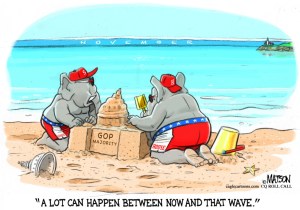 At the same time, six-in-10 are satisfied with the U.S. economy, and a plurality of voters give Trump credit for the economic improvement.
Despite that economic optimism, however, the poll shows that Democrats enjoy a 10-point advantage on congressional preference, with 50 percent of registered voters wanting a Democratic-controlled Congress, versus 40 percent who want a GOP-controlled one.
Now if national Democrats would just wake up and realize that standing up to Trump is the best mid-term strategy!
The summit with North Korea is coming up next week, but Trump isn’t listening to advice from experts on how to proceed, according to Politico: Trump and Bolton spurn top-level North Korea planning.
National Security Adviser John Bolton has yet to convene a Cabinet-level meeting to discuss President Donald Trump’s upcoming summit with North Korea next week, a striking break from past practice that suggests the Trump White House is largely improvising its approach to the unprecedented nuclear talks.
For decades, top presidential advisers have used a methodical process to hash out national security issues before offering the president a menu of options for key decisions. On an issue like North Korea, that would mean White House Situation Room gatherings of the secretaries of state and defense along with top intelligence officials, the United Nations ambassador, and even the treasury secretary, who oversees economic sanctions.
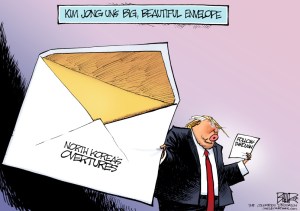 But since Trump agreed on a whim to meet with North Korean dictator Kim Jong-un on March 8, the White House’s summit planning has been unstructured, according to a half-dozen administration officials. Trump himself has driven the preparation almost exclusively on his own, consulting little with his national security team outside of Secretary of State Mike Pompeo.
Senior officials from both the Barack Obama and George W. Bush administrations called the absence of a formal interagency process before such a consequential meeting troubling. Peter Feaver, a former National Security Council (NSC) official in the George W. Bush White House, said his colleagues would likely have held “quite a few” meetings of the so-called Principals Committee of Cabinet-level NSC members in a comparable situation. A former top Obama White House official echoed that point, calling the lack of top-level NSC meetings “shocking.”
Trump has also not presided personally over a meeting of those senior NSC officials, as a president typically does when making the most important decisions.
On the other hand, Trump has given serious thought to whether he should invite Kim Jong Un to play golf with him in Florida if the summit goes well. The Daily Beast reports:
Trump has floated hitting the links with his counterpart as he considers a secondary charm offensive to complement the diplomatic tête-à-tête. The president has already told those close to him and advisers that he is open to inviting Kim to a follow-up summit at Trump’s famous Mar-a-Lago estate and private club in Palm Beach, Florida, as Bloomberg first reported this week.
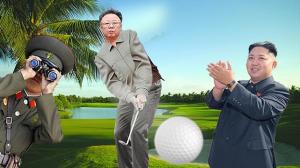 And, according to two administration officials, Trump has also raised the possibility of a leisurely activity and, perhaps, getting in 18 holes with Kim if the two end up getting along.
“He has also discussed [possibly] golfing with Kim,” a senior Trump administration official said.
It is unclear if such an outing would or could occur during a potential follow-up meeting or the one planned, then canceled, then planned again for Singapore. The site of the upcoming Singapore talks, a five-star hotel on Sentosa Island, is located near a theme park, resorts, and—as luck would have it—multiple golf courses.
The article says no one actually know if Kim even plays golf.
I suppose Kim would agree with Trump on this though. At The Washington Post, Josh Rogin writes that Trump still wants to pull U.S. troops out of South Korea.
For almost two years, President Trump has been talking about withdrawing large numbers of U.S. troops from South Korea, where there are currently around 28,000 stationed. The president’s advisers have repeatedly argued against a large-scale reduction, but he remains unpersuaded. And after his upcoming meeting with North Korean leader Kim Jong Un, Trump will have another big chance to push the issue.
Less publicly, but still privately, Trump continues to say he doesn’t agree with the argument that U.S. troops in South Korea are strategically necessary, and he thinks the United States gets nothing back from paying to keep them there, according to administration officials and people who have spoken to Trump directly about the issue. He often asks his generals to explain the rationale for America’s deployments in Asia and expresses dissatisfaction with their answers.
 At Trump’s direction, the Pentagon has taken a hard line in ongoing negotiations with the South Korean government over a new cost-sharing agreement for U.S. troops there. If those negotiations fail, Trump could have another excuse to move forward with large reductions….
Inside the administration, top officials have been trying — and failing — to convince the president of the strategic value of the South Korea-based troops since the beginning of his administration. In February, Chief of Staff John F. Kelly reportedly talked Trump down from starting a withdrawal.
Trump has picked fights with most of our allies at this point. Now he’s whining about having to to the Canada on Friday because he’s mad at Justin Trudeau.
The president has vented privately about Canadian Prime Minister Justin Trudeau as their trade tensions have spilled into public view. He has mused about finding new ways to punish the United States’ northern neighbor in recent days, frustrated with the country’s retaliatory trade moves.
 And Trump has complained to aides about spending two days in Canada for a summit of world leaders, believing the trip is a distraction from his upcoming Singapore summit with North Korean leader Kim Jong Un, according to three people familiar with Trump’s views.
In particular, the president said Tuesday to several advisers that he fears attending the Group of Seven summit in rural Charlevoix, Quebec, may not be a good use of his time because he is diametrically opposed on many key issues with his counterparts — and does not want to be lectured by them.
Additionally, Trump has griped periodically both about German Chancellor Angela Merkel — largely because they disagree on many issues and have had an uneasy rapport — as well as British Prime Minister Theresa May, whom he sees as too politically correct, advisers say.
Awwww . . . poor baby. BTW, have you heard that State Department spokesperson and former Fox and Friends host Heather Nauert thinks Germany was our ally during World War II? Rachel Maddow discussed this at the beginning of her show last night.
Please watch the video–even if you already saw it last night. These are the people who are running our foreign policy!
Politico reports that many foreign leaders are beginning to wake up to Trump’s insanity: Foreign leaders who embraced Trump now feel burned.
Trump calls Japanese prime minister Shinzo Abe, who visits the White House Thursday, his “good friend.” French president Emmanuel Macron is a “great friend.” And Canadian Prime Minister Justin Trudeau is a “great friend, neighbor, and ally.” All have sought to butter up Trump through friendly face time, recognizing that the quickest way to the president’s heart is through his ego.
But all, to varying degrees, are exasperated with Trump.
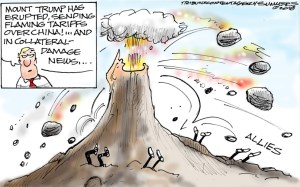 The president is moving ahead with a June 12 summit with North Korea despite Abe’s grave concerns about its wisdom. He has also threatened to slap tariffs on imported Japanese cars and metals. It’s hardly what Abe expected when he became the first foreign leader to meet with Trump after the November election or when he flew with Trump on Air Force One in February 2017 for golfing at his Mar a Lago resort.
Macron treated Trump to a military parade in Paris last summer. He and Trump also exchanged hugs and handshakes during an April visit by the French leader, during which Trump said of his guest: “He is perfect.” But a few weeks later, Trump pulled out of the Iran nuclear deal despite French pleas, and shows no sign of heeding Macron’s request that he rejoin the Paris climate accords, which Trump rejected last year.
Trump has also threatened trade sanctions on the European Union, and is already slapping them on Canada — prompting Trudeau to call Trump’s tariffs on steel imports “insulting and unacceptable.” That’s a change of tune from the early months of Trump’s presidency, when Trudeau avoided criticizing Trump, and even took Ivanka Trump and Jared Kushner to a Broadway play in March 2017.
All have paid a domestic political price back home for their efforts to make nice with a highly divisive U.S. president. One French parliamentarian fumed after Macron’s visit that France had “prostituted” and “humiliated” itself.
Angela Merkel knew who she was dealing with from day one, evidence that we need more women in leadership positions around the world.
That’s it for me today. What stories have you been following?
Did you like this post? Please share it with your friends:
Posted: April 7, 2018 | Author: bostonboomer | Filed under: Afternoon Reads, Foreign Affairs, U.S. Politics | Tags: China, Donald Trump, information overload, James Mattis, John Bolton, John Kelly, Stock Market, Syria, tariffs, trade war |

Woman Reading by a Window Gari Melchers – circa 1905
Good Afternoon!!
I’ve been trying to find out where Trump is this weekend. I haven’t heard anything about him going to Florida, and I’m afraid that may mean there will be more chaos in the White House over the weekend. Will Scott Pruitt lose his job? Or will Trump really try to use him to replace Jeff Sessions? Is Trump really preparing to talk to Robert Mueller, as CNN reports?
Exclusive: Trump begins informal prep for potential Mueller interview.
President Donald Trump has begun the initial steps of preparing for a possible interview with the special counsel, a White House official and a person familiar with the situation said Friday, a sign the President’s legal team is intensifying its deliberations over whether to allow him to come under Robert Mueller’s questioning.
One source familiar with the proceedings stressed the preparation efforts is “in its infancy.”
The preparations have been short and informal and included going over potential topics with the President that Mueller would likely raise in an interview, the people said.
The President has not formally agreed to sit for an interview with Mueller.
But word of early preparations is the clearest sign yet that Trump and his team remain open to an interview with Mueller, despite concerns from some people close to the President that such an interview could expose him to possible charges of perjury.
According to Tina Nguyen at Vanity Fair, Trump is now targeting one of his last “adult” advisers: Running Out of Punching Bags, Trump Turns on Mattis.

Drinking Coffee And Reading In The Garden Painting by Edward Killingworth Johnson
Until recently, Donald Trump’s campaign to purge naysayers had spared the Pentagon. In the absence of more proximate targets, however, it appears the president has turned his attention to foreign policy, jeopardizing his relationship with perhaps his only remaining sane adviser. Indeed, in the past week, Trump has made James Mattis’s job nearly impossible by declaring that he would send the military to guard the border with Mexico (the White House later clarified that he meant the National Guard), and insisting that the U.S. pull out of Syria (something Mattis promised last year would not happen), leading to a spectacular showdown on Tuesday, when the conflict between Trump and his generals reportedly boiled over during a meeting of top aides in the Situation Room.
According to the Associated Press, Mattis argued “that an immediate withdrawal” from Syria “could be catastrophic and was logistically impossible to pull off in any responsible way,” and offered a one-year timeline as an alternative—to which Trump responded that five or six months ought to do the trick, and “indicated that he did not want to hear in October that the military had been unable to fully defeat the Islamic State and had to remain in Syria for longer.” A person familiar with the meeting told CNN that attendees left Tuesday’s meeting “beside themselves,” arguing that Trump’s lack of desire to put together any sort of recovery plan for Syria—restoring basic needs such as water, power, and roads—would most certainly tip the country back into ISIS’s hands. “It is a huge gamble that ISIS is not going to come back and that we are going to rely on others to stabilize Syria,” an official said.
The same official noted the hypocrisy in Trump’s choice: “The president blasted Obama for a timeline in Iraq, but that is in essence what we have been given.”
From the AP article:
It wasn’t the result top national security aides wanted. Trump’s desire for a rapid withdrawal faced unanimous opposition from the Joint Chiefs of Staff, the Pentagon, the State Department and the intelligence community, all of which argued that keeping the 2,000 U.S. soldiers currently in Syria is key to ensuring the Islamic State does not reconstitute itself.

Adolfe Monet reading in the garden, by Claude Monet
But as they huddled in the Situation Room, the president was vocal and vehement in insisting that the withdrawal be completed quickly if not immediately, according to five administration officials briefed on Tuesday’s White House meeting of Trump and his top aides. The officials weren’t authorized to discuss internal deliberations and requested anonymity.
If those aides failed in obtaining their desired outcome, it may have been because a strategy that’s worked in the past — giving Trump an offer he can’t refuse — appears to have backfired.
Rather than offer Trump a menu of pullout plans, with varying timelines and options for withdrawing step-by-step, the team sought to frame it as a binary choice: Stay in Syria to ensure the Islamic State can’t regroup, or pull out completely. Documents presented to the president included several pages of possibilities for staying in, but only a brief description of an option for full withdrawal that emphasized significant risks and downsides, including the likelihood that Iran and Russia would take advantage of a U.S. vacuum.
Ultimately, Trump chose that option anyway.
Will Mattis resign if Trump insists on pulling the U.s. military out of Syria? Or will Trump fire him? John Bolton is expected to begin his job as National Security Adviser on Monday. Will he agree with Trump’s newly formed foreign policy?
Chief of Staff John Kelly has also lost influence on the newly “emboldened” Trump according to CBS News: Trump freezes out chief of staff John Kelly, says he’s “tired of being told ‘no.'”
When President Donald Trump made a congratulatory phone call to Russian leader Vladimir Putin, White House chief of staff John Kelly wasn’t on the line. When Mr. Trump tapped John Bolton to be his next national security adviser, Kelly wasn’t in the room.
And when Mr. Trump spent a Mar-a-Lago weekend stewing over immigration and trade, Kelly wasn’t in sight.

Oscar Bluhm In the Pergola, 1892
Kelly, once empowered to bring order to a turbulent West Wing, has receded from view, his clout diminished, his word less trusted by staff and his guidance less tolerated by an increasingly go-it-alone president.
Emboldened in his job, Mr. Trump has rebelled against Kelly’s restrictions and mused about doing away with the chief of staff post entirely. It’s all leading White House staffers and Trump allies to believe that Kelly is working on borrowed time….
Mr. Trump recently told one confidant that he was “tired of being told no” by Kelly and has instead chosen to simply not tell Kelly things at all, according to a person who was not authorized to publicly discuss private conversations and spoke on condition of anonymity.
The stock market isn’t happy with Trump’s push for a trade war. Yahoo News (AP): Stock Market Plummets After Trump Explores $100 Billion in New Chinese Tariffs.
Another increase in trade tensions has stocks falling sharply Friday as the U.S. considers an even larger set of tariffs on imports from China and the two countries exchange pointed statements. Technology companies and banks are taking some of the worst losses.
Stocks have changed direction again and again this week as investors tried to get a sense of whether a trade dispute between the two nations will escalate, an outcome that could have major consequences for the global economy. The market didn’t get any help from a March jobs report that was weaker than expected.
The Dow Jones industrial average fell dropped 581 points, or 2.4 percent, to 23,916 as of 2:15 p.m. Eastern time. Earlier it fell as much as 620 points.
The S&P 500, which many index funds track, lost 53 points, or 2 percent, to 2,608. The Nasdaq composite slid 135 points, or 1.9 percent, to 6,940. The Russell 2000 index of smaller-company stocks dipped 29 points, or 1.9 percent, to 1,513.
The Dow average, which contains numerous multinational companies including industrial powerhouses Boeing and Caterpillar, has swung dramatically this week, with about 1,300 points separating its highest and lowest marks. It fell as much as 758 points Monday, then recovered all of those losses, and late Thursday it was up as much as 519 points for the week. It’s down 0.7 percent for the week.
CNBC: Trump’s tariff gamble with China could be catastrophic for the economy, the GOP — and his own presidency.

Reading in the garden, 1915 – Nikolay Bogdanov-Belsky
Donald Trump has decided to gamble his presidency on the idea that he can threaten big tariffs on China and force the world’s second-largest economy to back down.
If he fails — and the odds are that he will — the fallout from a tariff battle with China could derail an otherwise strong U.S. economy, threaten Republican majorities in the midterm elections and turn the second half of Trump’s first term into a dismal slog to avoid impeachment votes.
So far, the exact scenario that free traders inside the White House and on Capitol Hill feared is playing out. China scoffed at Trump’s initial $50 billion in threatened tariffs and announced their own, aimed directly at Trump’s red-state base with levies on agricultural and manufactured products.
Although Trump has repeatedly bragged about stock market gains since he has been “president,” Bloomberg reports that Trump is now in 8th place in rankings of presidential success with the markets:
The Republican president’s renewed ramblings on trade dominated U.S. equity markets this week, with a tweet-induced swoon on Friday leaving the S&P 500 Index 1.4 percent lower than where it started on Monday. The gauge swung wildly, notching four moves of at least 1 percent in the five days, and the Cboe Volatility Index spiked above 20, nearly double its level for the past year.
All of which has dented Trump’s reputation as the stock market president.
The numbers from Axios:
Dow Jones Industrial Average return, if you invested in that basket of stocks, for a president’s first 444 days (ranked since 1900,) per Bloomberg:
FDR : 70.4%
Reagan: 41.4%
Teddy Roosevelt: 37.4%
Obama: 32.5%
Bill Clinton: 32.2%
George H.W. Bush: 21.4%
Trump: 20.7%
BTW, according to Think Progress, Trump doesn’t want his trade war to interfere with his daughter’s self-dealing: Ivanka Trump’s clothing company will be spared from tariffs, thanks to her dad.
U.S. officials say they used an algorithm to determine which goods to exclude from new tariffs. According to the Washington Post, the list was drafted to achieve “the lowest consumer impact,” ensuring goods like clothing and toys were excluded so as not to raise the cost on domestic consumer goods.

Reading Man in Park — August Macke 1915
Exempting clothing from the tariffs provides a big break to American clothing companies that hold trademarks in China. One of those clothing companies belongs to the First Daughter of the United States, Ivanka Trump.
A recent report by the Huffington Post found that the president’s daughter and closest adviser rakes in a total of $1.5 million a year from the Trump Organization while still working at the White House.
Her dual role as adviser to the president and private business executive has continuously raised ethical red flags. No one can be entirely sure that public policy by this administration isn’t being driven by business motives, or whether countries may pursue business deals with the Trump family as a means to curry political favor with the administration.
Once again, I’ve barely touched on all the important news that has broken over the past couple of days. I’ve reached the point of having to shut down for part of every day, because I’m so overwhelmed. Of course I’m not alone it that. In this vein Brian Klaas asks at The Washington Post: Can democracy survive information overload?
Last month, President Trump floated the idea of executing drug dealers; got sued by a porn star and a Playboy model; repeatedly attacked the FBI, his own attorney general and the Justice Department; instigated a trade war that punished long-standing U.S. allies; explicitly praised authoritarian consolidations of power in China and Egypt; “joked” about becoming “president for life”; congratulated Vladimir Putin on winning a sham election and reportedly invited him to the White House right after Russia’s government allegedly attempted to murder a former spy on the soil of the United States’ closest ally.
He also bullied a journalist for his physical appearance; boasted about making up statistics in meetings with Canada’s government; live-tweeted his favorite TV show; fired his secretary of state on Twitter; lost his Veterans Affairs secretary, national security adviser, chief economic adviser, communications director and a personal aide whose reported gambling habit was deemed a security risk; hired a new national security adviser who has repeatedly called to bomb North Korea and Iran; lashed out at the special counsel, who is investigating the president for potential crimes; and threatened to beat up the former vice president of the United States until he cried.

Woman Reading in a Garden by Harold Harvey
That’s just a small selection of news from March 2018: one crazy month of one crazy presidency.
This inescapable, overwhelming and disorienting flurry of activity, which has become the new normal since Trump’s inauguration, begs two simple but profound questions: Can democracy survive information overload? And can it survive a president who knows how to use the resulting chaos to dodge democratic accountability?
Authoritarian rulers have long understood that controlling and manipulating information are crucial to subverting democracy and getting away with breaking the rules. That’s why dictatorial governments such as China and Russia not only work overtime to control media and censor inconvenient facts but also use troll armies to spew out 24/7 torrents of disinformation. Despite Trump’s obvious envy of such methods, he’s stuck with American democracy, so he has innovated out of necessity. He can’t shut down the press or censor Democrats, but he can blind the American electorate with a steady smokescreen of bewildering stories pouring out of the White House.
From Ronald Reagan to Barack Obama, any one of those stories above would have captivated national attention for weeks, or more likely, months. But with Trump, even the most scandalous topic soon disappears into a never-ending flow of revelations. By the time the morning news shows end, it’s on to the next spectacle of dysfunction. We’re living in a chronic state of whiplash.
Read the rest at the WaPo.
So . . . what stories have you been following?
Did you like this post? Please share it with your friends:


 peej
peej Carissa
 bostonboomer
 dakinikat
 ecocatwoman
 mablue2
 Mama Lopez
 peggysue22
 quixote
 skydancingguestblogger
 Mona (aka Wonk the Vote)



 Sky Dancing
Recent Comments