Posted: July 16, 2025 | Author: bostonboomer | Filed under: #We are so Fucked, Donald Trump, just because, U.S. Economy | Tags: Epstein Files, Ghislaine Maxwell, Jeffrey Epstein, Julie K. Brown, Kevin Hassett, Mike Johnson, Pedophilia, rape, sexual abuse of minors, Suicide |
Good Afternoon!!
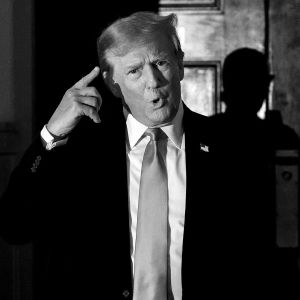
How can such a stupid person do so much damage so quickly?
I’ve finally begun to accept that what is happening to our country will not be reversed in my lifetime. When I think about it, I feel so despairing that I can’t bear to focus on it for long. But I know it’s true. How can such a stupid person do so much damage so quickly?
Trump has already done so much damage and he is likely to do much more before we can get rid of him–if we succeed in doing that. He has destroyed the Department of Justice, the Department of Education, and has likely done irreparable damage to the Department of Defense, the CIA, and the office of DNI (Director of National Intelligence). He has also damaged Social Security, Medicaid, Medicare, and Obamacare.
His insane tariffs are wrecking the economy, and he may soon be able to do even more damage by naming a new Fed chairman who will carry out his orders. Guess who Trump is likely to appoint? According to Bloomberg, it will be Kevin Hassett! The story is behind a paywall. I read the headline on Memeorandum.
He has begun weaponizing the military and with the new funding for ICE in the big ugly bill, he will control a vast private army. He has begun to establish a system of concentration camps.
Have I forgotten anything? Probably.
I can’t cover all of these issues today, but here’s some commentary on Trump’s ongoing destruction of our economy.
This piece by Jonathan V. Last at The Bulwark is truly depressing: LOL Nothing Matters. Inflation is back. The government is nationalizing one private company and blackmailing another. But no one cares because . .
Remember back in 2024 when Americans had to vote for the insurrectionist felon because there had been 14 months of inflation in 2021–22?
Yeah, well inflation is back now.
US inflation climbed to 2.7 per cent in June, surpassing expectations and signalling that Donald Trump’s tariffs are hitting prices. Tuesday’s annual consumer price index figure was up from 2.4 per cent in May and above expectations of 2.6 per cent among analysts surveyed by Bloomberg.
How upset are voters about this? They are a solid “Meh.” Trump remains at only -7 net approval, which is a huge improvement from where he was in late April.
Why am I feeling nihilistic today? It’s not just the voters; it’s the markets. We got a bad inflation report this morning and then the markets reacted by . . . betting that the Fed is going to cut rates in September.
Which is, you know, the opposite of what you’d expect in an environment where tariffs are pushing prices higher. Are the markets betting on TACO? Or preparing for Fed Chairman Kevin Hassett? Or going full-nihilist, too?
Trump embracing socialism?
Here is another thing that doesn’t seem to matter: Democrats are freaked out because their nominee for mayor in New York City wants to run a pilot program with five municipal-owned grocery stores, which is “socialism” or something.
Meanwhile, last week the U.S. government became the largest shareholder in the mining company MP Materials. Which is, you know, kind of like socialism? […]
On May 27, MP began a sudden climb. After months of sitting around $25 a share, it moved consistently upward for a month, to almost $40. On June 20 a selloff started and the share price lost a quarter of its value over three weeks. The government announced its purchase on the morning of July 10 and MP went to the moon.
Any of this look to you like someone knew the score?
But that’s just the first layer of corruption.
This morning, Apple announced that it would also contribute invest $500 million in MP stock.
That’s right: Apple, which is currently negotiating with Trump on the 25 percent tariffs the president wants to put on iPhones made in China, decided to do the government a solid and throw some cash behind Uncle Sam’s MP position, thus driving the price higher and forming a shareholder bloc that will, along with the government, be enough to control MP.
And since Apple’s business now depends on what the U.S. government allows it to do, I suspect Apple’s share will be a pure proxy for whatever the Trump administration’s wishes are.
There’s more at the link.
Here’s what Paul Krugman has to say about Trump’s economic policies: Hawks, Doves and Lapdogs: The next Fed chair will be an obedient partisan.
Yesterday’s CPI report looked fairly tame on the surface, but if you look at the details it showed clear signs that Trump’s tariffs are starting to drive up prices. And private surveys suggest that there’s a lot more inflation in the pipeline. For example, look at S&P Global’s Purchasing Managers’ Index for manufacturing, which shows the percentage of firms reporting higher prices. A higher number almost always points to higher official inflation ahead, and right now it’s definitely telling us that tariffs are about to hit hard (see figure at the link)….

The next Fed chair?
Why aren’t we seeing the full effects of the tariffs in official statistics? For the record, I don’t believe Trump officials are cooking the books — yet.
That’s not to say that they won’t at some point, and there’s a good chance that they will. But so far what we’re probably seeing is a combination of ordinary lags and the temporary effects of the TACO (Trump always chickens out) narrative. Buyers get pissed off at sellers when prices rise, so sellers who don’t want to lose market share have an incentive to hold prices down despite higher costs if they think the Trump tariffs will come back down in a few weeks.
I, however, am a TACO skeptic. I think Trump really is a Tariff Man who will keep us at Smoot-Hawley-level tariffs indefinitely, and businesses will eventually realize that and raise prices accordingly.
And then what? Clearly, we shouldn’t expect Trump to admit that his tariffs are raising prices, or even to admit that prices are rising. What we can expect is that he will keep putting pressure on the Fed to cut interest rates. I don’t think he’ll manage to push Jerome Powell out before next May, but as I wrote last week, whoever he picks after that will do his bidding.
Bloomberg has an interesting article about Kevin Warsh, one likely choice — although a newer article suggests that Kevin Hassett, whom nobody suspects of having any independent principles, may be in first place. The article expresses puzzlement over Warsh’s support for rate cuts now, despite above-target inflation, when he was a big advocate of higher rates in the aftermath of the global financial crisis. How did such a monetary hawk suddenly become a monetary dove? But one of the people the article quotes hits the nail on the head.
Read the Bloomberg excerpts at the link.
We are so screwed.
Right now the only hopeful signs I see is that Trump’s policies are very unpopular with Americans, and his association with Jeffrey Epstein could possibly damage him before the midterm elections. I’m probably wrong and Trump is clearly trying to fix the midterms. Anyway, I’ve gathered some stories on the Epstein scandal.
Ewan Palmer at The Daily Beast: White House Freaked Out Over a Question About Trump’s Ties to Epstein.
White House officials were left scrambling after a reporter straight-up asked whether Donald Trump knew if his name appeared in files connected to Jeffrey Epstein, according to Axios.
The media inquiry was posed after reports that FBI Deputy Director Dan Bongino had a screaming match with Attorney General Pam Bondi over the Department of Justice’s handling of the files on the pedophile who died in 2019.
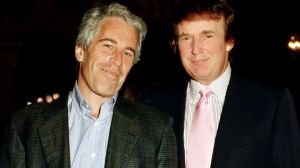
Jeffrey Epstein and Donald Trump, best buds
The question helped the administration figure out how badly holding back any release of the Epstein files was playing in MAGA world.
In a memo, the DOJ and FBI denied the existence of any so-called “client list” belonging to Epstein featuring potential high-profile names, and said they will not be releasing any more information regarding Epstein. The agencies also stated that the billionaire financier took his own life in his New York City jail cell, rather than being murdered, a conspiracy theory pushed for years by Trump loyalists, including Bongino.
In the wake of the Bongino-Bondi blow-up, one reporter asked if Bondi had told Trump that his name was in the Epstein files. For the first time, White House and DOJ personnel realized how bad the optics were of refusing to release more information on Epstein after multiple MAGA figures, including Trump himself, vowed to do exactly that. Officials feared it suddenly looked like they might be shielding Trump from potentially damning revelations.
“It put people in a tizzy,” an unnamed source familiar with the matter told Axios. An administration source added, “It didn’t look like a coincidence at that point” that the Trump administration had stopped releasing Epstein files.
Read more at the link. It’s weird that the White House was taken by surprise by this question, since Trump and Epstein were close friends for years.
I was stunned yesterday when House Speaker Mike Johnson actually disagreed with Trump about covering up the Epstein files. Marianna Sotomayor at The Washington Post: Speaker Mike Johnson and other Republicans break with Trump on Epstein.
One of the leading Republicans on Capitol Hill broke with the Trump administration’s decision not to release the files of deceased sex offender Jeffrey Epstein as the controversy deepened over the handling of an issue that has caused unprecedented division among the GOP base.
House Speaker Mike Johnson (R-Louisiana) told right-wing podcaster Benny Johnson that he supported the release of the Epstein files, days after President Donald Trump’s Justice Department said the matter was effectively closed. Johnson is a close Trump ally and has never broken so publicly with the president on an issue.
“I’m for transparency,” Johnson told Benny Johnson. “It’s a very delicate subject, but we should put everything out there and let the people decide it.”
Even as Johnson publicly called for the files to be released, he opposed a procedural motion advanced Tuesday by Democrats that would have set up a House vote to release them.
On the podcast, Speaker Johnson said that Attorney General Pam Bondi “needs to come forward and explain” the confusion she has brewed after she said in interviews earlier this year that the purported Epstein “client list” was sitting on her desk for review, suggesting it would be released. Bondi and other Justice Department officials now say the client list — which some claim would reveal the names of powerful figures who allegedly participated in Epstein’s crimes — does not exist.
“I like Pam. I think she’s done a good job, but we need the DOJ focusing on the major priorities,” he said. “I’m anxious to put this behind us.”
Trump will have to have a stern talk with Speaker Johnson.
Oliver Holmes at The Guardian: Donald Trump says those interested in Jeffrey Epstein inquiry are ‘bad people.’
Donald Trump has dismissed a secretive inquiry into the sex offender Jeffrey Epstein as “boring” and of interest only to “bad people”, but said he backed the release of any “credible” files, as he sought to stamp out a conspiracy-fuelled uproar among his supporters.
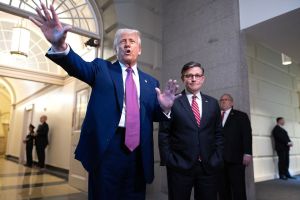 The US president is facing a political crisis within his usually loyal Republican Make America Great Again (Maga) base over suspicion that the administration is hiding details of Epstein’s crimes to protect the rich elite he associated with, which included Trump.
One of the most dramatic theories circulating among supporters is that Epstein – who killed himself in 2019 while in federal custody – was murdered by powerful figures to cover up their roles in his sex crimes against children.
“I don’t understand why the Jeffrey Epstein case would be of interest to anybody,” Trump told reporters on Tuesday night when asked why his supporters are so interested in the case. “It’s pretty boring stuff. It’s sordid, but it’s boring, and I don’t understand why it keeps going.
“I think really only pretty bad people, including fake news, want to keep something like that going,” he added. “But credible information, let them give it. Anything that is credible, I would say, let them have it.”
Sex trafficking, pedophilia, and prison suicide are boring stuff?
Frankly, I have no doubt that Epstein committed suicide. He was looking at years in prison, loss of his status, his fortune, and his fabulous lifestyle. As a narcissistic sociopath, he couldn’t tolerate that. But Wired has found new evidence that the surveillance tape outside Epstein’s cell was manipulated. It may be perfectly innocent, but the MAGA crowd won’t see it that way. The magazine had previously found 1 minute missing from the tape; now it’s 3 minutes. Rich Friedman writes: The FBI’s Jeffrey Epstein Prison Video Had Nearly 3 Minutes Cut Out.
Newly uncovered metadata reveals that nearly three minutes of footage were cut from what the US Department of Justice and Federal Bureau of Investigation described as “full raw” surveillance video from the only functioning camera near Jeffrey Epstein’s prison cell the night before he was found dead. The video was released last week as part of the Trump administration’s commitment to fully investigate Epstein’s 2019 death but instead has raised new questions about how the footage was edited and assembled.
WIRED previously reported that the video had been stitched together in Adobe Premiere Pro from two video files, contradicting the Justice Department’s claim that it was “raw” footage. Now, further analysis shows that one of the source clips was approximately 2 minutes and 53 seconds longer than the segment included in the final video, indicating that footage appears to have been trimmed before release. It’s unclear what, if anything, the minutes cut from the first clip showed.
The nearly three-minute discrepancy may be related to the widely reported one-minute gap—between 11:58:58 pm and 12:00:00 am—that attorney general Pam Bondi has attributed to a nightly system reset. The metadata confirms that the first video file, which showed footage from August 9, 2019, continued for several minutes beyond what appears in the final version of the video and was trimmed to the 11:58:58 pm mark, right before the jump to midnight. The cut to the first clip doesn’t necessarily mean that there is additional time unaccounted for—the second clip picks up at midnight, which suggests the two would overlap—nor does it prove that the missing minute was cut from the video.
The footage was released at a moment of political tension. Trump allies had spent months speculating about the disclosure of explosive new evidence about Epstein’s death. But last week, the DOJ and FBI issued a memo stating that no “incriminating ‘client list’” exists and reaffirmed the government’s long-standing conclusion that Epstein—whom the US government accused of committing conspiracy to sex traffic minors and sex trafficking minors—died by suicide. That announcement triggered immediate backlash from pro-Trump influencers and media figures, who essentially accused the administration of a cover-up.
In response to detailed questions about how the video was assembled, WIRED sent a request for comment to the Department of Justice at 7:40 am on Tuesday morning. Just two minutes later, Natalie Baldassarre, a public affairs officer for the DOJ, replied tersely: “Refer you to the FBI.” The FBI declined WIRED’s request for comment.
Read more at Wired.
It’s possible that Ghislaine Maxwell, who procured young girls for Epstein to rape, could reveal whether Trump was involved in Epstein’s crimes. Unfortunately that’s unlikely, since she hopes to win a pardon or commutation from Trump. Janna Brancolini at The Daily Beast: Epstein Pimp’s Family Kiss Up to Trump: ‘Ultimate Dealmaker.’
Ghislaine Maxwell’s family is turning to the tried-and-true method of flattering President Donald Trump in a bid to get the convicted sex trafficker sprung from prison.
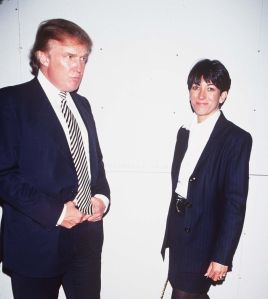
Trump with Ghislaine Maxwell
Maxwell, 63, is serving a 20-year jail sentence after being convicted in 2021 of luring and grooming young girls for the late financier Jeffrey Epstein’s sex-trafficking ring.
Earlier this year, her lawyers filed a petition with the Supreme Court arguing her conviction was invalid, saying her prosecution in New York was barred by a 2007 non-prosecution agreement the government made with Epstein in Florida that also covered his co-conspirators.
A federal appeals court and the Department of Justice have both smacked down that argument, leading the family to now co-sign a flattering statement about the president.
Her siblings shared a statement from Maxwell’s attorney David Oscar Markus that said, “I’d be surprised if President Trump knew his lawyers were asking the Supreme Court to let the government break a deal. He’s the ultimate dealmaker—and I’m sure he’d agree that when the United States gives its word, it should keep it.”
“These are sentiments with which we profoundly concur,” the family added.
The family members didn’t sign the statement individually—perhaps because the family has long been associated with scandal.
Read more details at the link.
Two more interesting articles about the Epstein controversy and the MAGA faithful:
Will Sommer at The Bulwark: The Five MAGA Factions Waging an Epstein Civil War.
Zack Beauchamp at Vox: Why Trump betrayed his base on Jeffrey Epstein And why he’ll get away with it.
There’s one reporter who really knows the Epstein story and what’s in the files: Julie K. Brown from The Miami Herald. Here is a piece she wrote in March: The Epstein files: What is public, and what is still secret?
Opening up two decades of government files related to sex trafficker Jeffrey Epstein isn’t going to be as simple as inserting them into three-ring binders or putting them on the internet.
After hyping the release of Epstein documents as “breaking news” on Fox News, U.S. Attorney General Pam Bondi on Thursday distributed binders filled with material to a group of conservative social media pundits. But the big reveal, designed to promote President Donald Trump’s new culture of transparency, fell flat.
When the group opened the binders, they discovered 200 pages of dated material, most of which had long ago been made public. To make matters worse, some of the material was overly redacted — the same material had already been available on the internet in unredacted form.
Bondi, a former prosecutor and Florida attorney general, said she had been misled by the FBI into believing she had all the documents. She then accused federal agents of withholding thousands of pages, and ordered the agency to turn over the rest by Friday morning. But the 8 a.m. deadline came and went without any word on the files.
FBI sources told the Miami Herald Friday that they worried releasing the documents without a careful review — one that would likely take weeks or months — would jeopardize the hard-won 2021 conviction of Epstein accomplice Ghislaine Maxwell. Maxwell is appealing her conviction and 20-year sentence for child sex trafficking.
Sources also said that the files are voluminous. There are 22 files containing over 500 pages in the FBI vault, a portal on the FBI’s website accessible to the public. The bulk of those 11,000-plus pages are heavily redacted, and Justice Department prosecutors have fought their release for years. While Bondi pointed fingers at the FBI in New York, many more files exist in other jurisdictions. One critical source of evidence against Epstein was in the discovery for a Florida civil case brought by Epstein’s victims against the FBI in 2008. That case spanned a decade and included tens of thousands of pages of material that sheds light on how federal prosecutors
mishandled that early case. Not all the FBI documents connected to that case — or the federal criminal case — in Florida have been made public.
“Going through those files would be an enormous, enormous effort. They contain the names of victims, witnesses and other personal information,” said Paul Pelletier, a former federal prosecutor now in private practice. “There was tons of discovery in the New York case alone. There’s no prosecutor in their right mind who would be able to corral all the evidence in the Epstein case over 20 years in a week and be able to release it carefully and accurately.”
Read the rest at The Miami Herald. For anyone who’s interested in the truth, Brown is the one to trust.
I don’t know if I’ve enlightened anyone with this collection of reads, but I hope I’ve helped some.
What’s on your mind today?
Did you like this post? Please share it with your friends:
Posted: January 28, 2021 | Author: bostonboomer | Filed under: morning reads, Republican politics | Tags: attempted coup, Donald Trump, January 6 riot, Kevin McCarthy, Lindsey Graham, Roger Stone, Seth Abramson, Suicide, Tommy Tuberville |

Good Morning
As you can probably guess from the images, it is snowing here. It snowed Tuesday night into Wednesday and we might get a bigger snowfall over the weekend. It has been a snow-free January so far, but no longer.
As Congressional Republicans once again circle the wagons around Trump, the death and injury toll from the January 6 attempted coup is growing. A second policeman committed suicide and many more cops were injured than preciously known.
CNN: Two police officers died by suicide after responding to Capitol riot.
Acting Metropolitan Police Chief Robert J. Contee told the House Appropriations Committee on Tuesday that two police officers have died by suicide since responding to the riot at the Capitol on January 6, according to Contee’s opening statement before the committee, which was obtained by CNN.
This is the first time the force has confirmed that two officers took their own lives after the attack.
“Tragically, two officers who were at the Capitol on January 6th, one each from the Capitol Police and MPD, took their own lives in the aftermath of that battle,” Contee said in his statement.
Another Capitol Police officer, Brian D. Sicknick, died the day after the riot “due to injuries sustained while on-duty,” the Capitol Police said in a statement earlier this month.

Eastern Bluebird
And don’t forget that one of the rioters also died by suicide.
The New York Times: The Capitol Police union says nearly 140 officers were injured during the riot.
Nearly 140 police officers from two departments were injured during the Jan. 6 pro-Trump mob attack on the Capitol, including officers who suffered brain injuries, smashed spinal discs and one who is likely to lose his eye, the Capitol Police union said on Wednesday.
In a statement, the union’s chairman, Gus Papathanasiou, faulted leadership of the Capitol Police for failing to equip officers with proper equipment ahead of the attack.
He was responding to the closed-door testimony on Tuesday of Yogananda D. Pittman, the acting chief of the Capitol Police, who acknowledged that the department had known there was a “strong potential for violence” that day but failed to take necessary steps to prevent what she described as a “terrorist attack.”
Chief Pittman took the reins of the agency after the siege, replacing Steven Sund, who resigned as police chief under pressure.
“We have one officer who lost his life as a direct result of the insurrection,” Mr. Papathanasiou said. “Another officer has tragically taken his own life. Between U.S.C.P. and our colleagues at the Metropolitan Police Department, we have almost 140 officers injured. I have officers who were not issued helmets prior to the attack who have sustained brain injuries. One officer has two cracked ribs and two smashed spinal discs. One officer is going to lose his eye, and another was stabbed with a metal fence stake.”
Chief Pittman testified via videoconference before a meeting of the House Appropriations Committee that officers were outmanned during the riot, that internal communications were poor, and that officers lacked sufficient equipment and struggled to carry out orders like locking down the building.
Nevertheless, Congressional Republicans are mostly back in the Trump cult.

Two crows in snow
Stephen Collinson at CNN: In the Republican Party, the post-Trump era lasted a week.
Two roads diverged in American politics, and the Republican Party chose the one traveled by disgraced ex-President Donald Trump and QAnon conspiracy theorists.
While pundits ponder the GOP’s future — and traditionalists hope to change course out of the wreckage left by Trump’s insurrection — Washington’s power players and state activists have already made their choice.
Highlighting the former President’s lightning fast rehabilitation, the House Minority Leader Kevin McCarthy will visit Trump in Florida on Thursday after repudiating his own criticism of the incitement of the US Capitol riot.
Only a week after Trump left the White House, it’s clear that his party is not ready to let him go. Extremists and Trumpists are on the rise, while lawmakers who condemned his aberrant conduct fight for their political careers. The anti-Trump wing — represented by members of Congress such as Sens. Ben Sasse of Nebraska and Mitt Romney of Utah and Illinois Rep. Adam Kinzinger — look like a small and outmaneuvered force.
This week’s sorting will have significant implications for the GOP’s positioning as it heads into the 2022 midterm elections, and for President Joe Biden’s hopes of draining the poison from Washington in the name of national unity.
But it will also pose a fundamental question for the Grand Old Party itself. Is yet another doubling down on grassroots fury and the Trump base the best way to win back Americans? Especially those in suburban areas who rejected the ex-President who lost the House, the Senate and the White House in a single four-year term?
Asawin Suebsaeng at The Daily Beast: Republicans Come Crawling Back to Trump Three Weeks After Capitol Riot.
Immediately following the deadly Jan. 6 riot on Capitol Hill, several leaders and prominent figures in his own party wanted to ditch President Donald Trump, blame him for inciting the mob, or at least move on from him. It took less than a month for almost all of the official GOP to start crawling back to him.

Junco on a branch
GOP bigwigs who were, very briefly, prepared to throw Trump onto the ash heap of history following his primary role in sparking the MAGA riot and for helping the Republican Party lose the presidency and both houses of Congress are now beginning to shield the ex-president, once again, from his liberal foes. Top Republican lawmakers are increasingly signaling that they are ready to let Trump off the hook yet another time, and the former president has been working the phones from his new home base in Florida in an effort to make sure GOP senators vote to acquit him in an upcoming impeachment trial.
Of course Lindsey Graham is leading the pack in their rush back into the Trump orbit.
“He’s very interested in the outcome of the trial and I talked to him yesterday, and I told him the vote yesterday is a sign of things to come,” Sen. Lindsey Graham (R-SC), a close Trump ally, told The Daily Beast on Wednesday.
Graham was referring to a Tuesday vote for which Senate Minority Leader Mitch McConnell (R-KY) sided with Sen. Rand Paul (R-KY) on a measure declaring Senate impeachment proceedings against an ex-president to be unconstitutional. Earlier this month, McConnell had publicly blamed Trump for “provok[ing]” the anti-democratic rioting, and had left open the possibility of voting to convict him in a potential trial.
Minority leader Kevin McCarthy is not far behind.
McCarthy is making nice with the former president—and his family, too. Days after his argument with Donald Trump, McCarthy got on the phone with Donald Trump Jr. Both sides of the conversation walked away believing that they remained on great terms with the other. Trump Jr. is currently planning to do whatever he can to help the GOP take back the House in 2022, according to a person familiar with the matter. “Don wants to see Kevin as speaker of the House,” this source said.
Moreover, multiple news outlets reported on Wednesday that former President Trump and McCarthy are scheduled to meet in person in Florida on Thursday.
Just a short time ago, both of these assholes were denouncing Trump for his attempted coup.

Rose Finch
Yesterday, JJ posted a links to Seth Abraham’s reporting on a suspected planning meeting held on January 5, the day before the Capitol riot. Other news outlets are now reporting on the meeting.
Here’s Abramson’s summary of what is known so far. More Revelations About Secretive January 5 War Council at Trump International Hotel.
Reporting in the Omaha World-Herald, as well as social media screenshots and videos, confirm a January 5 pre-insurrection war council at DC’s Trump International Hotel. Also confirmed by the evidence is a list of the gathering’s (minimum) fifteen attendees.
The first Proof article on this subject can be found here.
The secretive January 5 meeting—which one attendee, Senator Tommy Tuberville, has already been caught lying about, and which another, Nebraska gubernatorial candidate Charles Herbster, has attempted to scrub his social media to conceal—included eight different components of Trump’s political machine:
-
Family members: Donald Trump Jr., Eric Trump, and Kimberly Guilfoyle (current girlfriend of Trump Jr., and a former on-air Fox News personality).
-
Trump’s legal team: Rudy Giuliani.
-
United States senators: Tuberville and at least two other senators (see below).
-
Administration officials: Peter Navarro and Charles Herbster.
-
January 6 organizers: Ali Alexander, Adam Piper, and Michael Flynn.
-
Trump campaign officials: Corey Lewandowski (former), David Bossie (former).
-
Cyberintelligence specialists: Flynn (information operations) and possibly Phil Waldron (self-described—see more below—as skilled in “intelligence analysis”).
-
Trump donors: Mike Lindell, Daniel Beck, and Herbster.
Due to minimal ongoing coverage of this extraordinary pre-January 6 strategy meeting, questions about the Trump International Hotel gathering remain. This article outlines key questions and reveals the answers to several—all uncovered over the last 24 hours.
Read the rest at the Substack link.

Chickadee
From The Alabama Political Reporter: Trump appointee says Tuberville met with Trump family, advisers on eve of Capitol attack.
Alabama Republican Senator Tommy Tuberville through a spokeswoman Tuesday denied meeting with the then-director of the Republican Attorneys General Association and others inside Trump’s private residence at the Trump International Hotel on Jan. 5 — on the eve of the deadly U.S. Capitol attack.
But a photo posted to social media appears to show Tuberville in the hotel’s lobby that day, and a company CEO in a separate post describes meeting with Tuberville and others at the hotel that day and discussing “illegal votes.”
Charles W. Herbster, who was then the national chairman of the Agriculture and Rural Advisory Committee in Trump’s administration, in a Facebook post at 8:33 p.m. on Jan. 5 said that he was standing “in the private residence of the President at Trump International with the following patriots who are joining me in a battle for justice and truth.”
Among the attendees, according to Herbster’s post, were Tuberville, former RAGA director Adam Piper, Donald Trump Jr., Eric Trump, Trump’s former National Security Advisor Michael Flynn, adviser Peter Navarro, Trump’s 2016 campaign manager Corey Lewandowski and 2016 deputy campaign manager David Bossie.
More details:
A photo posted to an Instagram user’s account appears to show Tuberville standing in the lobby of the Trump International Hotel on Jan. 5. The user captioned the photo “Newly elected Senator Tommy Tuberville.” In two other separate photos, the person posted images of Flynn and Donald Trump Jr. inside the hotel on Jan. 5. Attempts to reach the person who posted that photo were unsuccessful Tuesday.
Daniel Beck, CEO of an Idaho technology company, in a Facebook post at 10:27 p.m. on Jan. 5 wrote that he’d spent the evening with Tuberville, Trump Jr. and girlfriend Kimberly Guilfoyle, Michael J. Lindell, Navarro and Trump attorney Rudy Giuliani.
 And Mother Jones has info on Roger Stone’s long-term involvement in preparations for the coup:
In the weeks before riled-up Trump supporters looking to overturn the election assembled in Washington, DC, Stone worked to raise money for “private security” and equipment for events there on January 5 and 6 that preceded the storming of the Capitol. But the “Stop the Steal” website where Stone solicited funds was subsequently taken down. Though he now claims to have merely encouraged “peaceful” protests of Congress, he struck a fiery and apocalyptic tone in speeches leading up to the Capitol attack. At a DC rally on December 12, he exhorted his rightwing fans to “fight until the bitter end” to prevent Joe Biden from taking office. Speaking at a rally in Freedom Plaza the night before the Capitol riot, Stone urged the crowd to join an “epic struggle.”
At that event, Stone appeared to be receiving protection from a security detail composed of members of the Oath Keepers, a far-right militia group. And Stone for years has maintained close ties to members of the Proud Boys, whose leaders treat him as a mentor. Members of both groups face criminal charges for their role in the assault on Congress.
There’s much more on Stone’s role at Mother Jones.
One more from Raw Story: Viral video renews interest in report Trump sons held pre-Capitol coup meeting to pressure’ lawmakers.
A clip from a video recorded by the CEO of a text messaging company is going viral after well-known attorney and activist Seth Abramson posted it to Twitter late Tuesday night.
In the original Facebook live video, posted at 11:32 PM the night before the January 6 insurrection, Txtwire CEO Daniel Beck claims to have just finished a meeting with “about 15” people at the Trump Hotel in Washington, D.C., including, he says, Rudy Giuliani, Kimberly Guilfoyle, Donald Trump Jr., My Pillow CEO Mike Lindell, and “several Senators.”
It appears at least one of those Senators has now been identified.
The video itself would be interesting to those investigating the insurrection and Donald Trump’s attempts to overturn the election, but it’s far more interesting given an article in the Omaha World Herald published January 6, that reports a Republican exploring a run for governor of Nebraska, Charles Herbster, appears to have attended that same January 5 meeting.
Read more at Raw Story.
So this could get very interesting. I hope big media will pick up on this story soon. It sure seems significant.
That’s it for me today, but there’s lots more happening. I’ll post more links in the comment thread and I hope you will too.
Did you like this post? Please share it with your friends:
Posted: August 11, 2018 | Author: bostonboomer | Filed under: Afternoon Reads, U.S. Politics | Tags: American institutions, corruption, Donald Trump, Emails, Hillary Clinton, Julia Davis, Matt Tait, Michael Flynn, Paul Manafort, Peter Smith, Robert Mueller, Russia investigation, Russian state TV, Suicide, Vitaly Tretyakov |

The Athenaeum – Thérèse Reading in the Park at Meric (Jean Frederic Bazille)
Good Afternoon!!
Remember Peter Smith, the guy who was trying to help the Trump campaign get Hillary Clinton’s emails? He ended up supposedly committing suicide in a Minnesota hotel room in July, 2017, shortly after he was interviewed by Shane Harris of The Wall Street Journal. After the story broke, Matt Tait published an article at Lawfare about his involvement in the story. Today Buzzfeed News reporters Jason Leopold and Anthony Cormier have a new story on Smith: GOP Operative Made “Suspicious” Cash Withdrawals During Pursuit Of Clinton Emails.
In one of the most intriguing episodes of the 2016 presidential campaign, Republican activist Peter W. Smith launched an independent effort to obtain Hillary Clinton’s emails to help defeat her and elect Donald Trump. His quest, which reportedly brought him into contact with at least two sets of hackers that he himself believed were Russian, remains a key focus of investigations into whether the Trump campaign colluded with the Kremlin.
Now, BuzzFeed News has reviewed documents showing that FBI agents and congressional investigators have zeroed in on transactions Smith made right as his effort to procure Clinton’s emails heated up. Just a day after he finished a report suggesting he was working with Trump campaign officials, for example, he transferred $9,500 from an account he had set up to fund the email project to his personal account, later taking out more than $4,900 in cash. According to a person with direct knowledge of Smith’s project, the Republican operative stated that he was prepared to pay hackers “many thousands of dollars” for Clinton’s emails — and ultimately did so….

Maxwell Doig
The money trail, made public here for the first time, sheds new light on Smith’s effort, in which he told people he was in touch with both Russians on the dark web and Trump campaign officials — particularly Michael Flynn, who was then a top adviser to the Trump campaign and later served as national security adviser before having to resign after misleading White House officials about his meetings with the Russian ambassador to the United States.
Intelligence agencies have given the FBI information that Russian hackers talked about passing Clinton’s emails to Flynn through a cutout, according to two law enforcement officials with direct knowledge of the matter. It is not known if that cutout was in any way connected to Smith.
Smith claimed that the Russians had hacked Hillary’s private server and he was determined to get his hands on the emails.
Smith assembled a group of people including experts in technology, lawyers, and even a Russian-speaking investigator to figure out how to obtain Clinton’s emails, according to the Journal. On the Friday before the Labor Day weekend, Smith incorporated a company called KLS Research. In a proposal Smith put together describing the effort to obtain the emails, he named the company as the “preferred vehicle” for the research into Clinton’s email, and Smith would tell Tait that KLS Research would also help “avoid campaign reporting.”
Smith and his longtime business partner, John Szobocsan, were the two signers for a bank account linked to KLS Research….
Soon after Labor Day, Smith appears to have finished an operational plan, which included the names of top Trump campaign officials, some of whom have denied speaking with Smith anytime during the campaign. Smith’s report is dated Sept. 7.

Girl in Green by Sara Hayden (1862–1939), American
The next day, Smith withdrew $9,500 from the KLS Research account and deposited it into his personal bank account, both held at Northern Trust. From there, Smith took out a little more than $4,900 in cash and sent checks to an accountant and an LLC controlled by a private real estate company. Later in September, Smith made withdrawals of $500 and $700 from KLS Research.
These transactions came to light after Northern Trust received a subpoena from the FBI for Smith’s records last December. The subpoena specifically sought information about the $9,500 withdrawal from KLS Research’s account.
After scouring nine accounts that Smith controlled, Northern Trust turned over documents showing 88 suspicious cash withdrawals totaling about $140,000 between January 2016 and April 2017, including a $3,000 withdrawal six days after the election. Northern Trust found these transactions suspicious because officials could not determine the purpose of the withdrawals and because some of them took place over the time Smith was engaged in his project to obtain Clinton’s emails. Many of the cash transactions, the bank noted, were less than $10,000, small enough not to trigger an automatic alert to the government. After receiving the subpoena, the bank sent a report to Treasury’s financial crimes unit, which shared its findings with the FBI, special counsel Robert Mueller, and Senate Intelligence Committee investigators.
The story reports that “three US law enforcement officials” confirmed that Smith is still “an important figure” in the investigation and that Mueller’s investigators have interviewed people involved with Smith. I wonder if Mike Flynn is helping out with this aspect of the investigation?
Head over to Buzzfeed News to read the rest of the story.
Lawfare has a lengthy post up about the Buzzfeed story: Peter Smith’s Search for Hillary Clinton’s Emails: The Subplot Thickens. Here’s just a taste:
On its own, the Buzzfeed story might not be a groundbreaking development. But the article doesn’t stand alone. It comes in the wake of Mueller’s indictments of Russians involved in the Kremlin’s social media manipulation operation and, more importantly for present purposes, the hacking and leaking of Democratic Party materials during the 2016 campaign. In that context, it is highly significant that Buzzfeed reports that Smith’s efforts are actively being investigated by the special counsel’s team. Not only has Mueller’s team interviewed “people who Smith tried to recruit and others who worked on his operation to obtain Clinton’s emails,” it has also “tried to determine if [former national security adviser Michael] Flynn assisted Smith in his operation”—a question that Smith’s possible payments to hackers are “key” to answering, Buzzfeed writes.

Louis Buisseret (1888-1956, Belgian) Contemplation 1938
So how do the facts reported in the Peter Smith stories, particularly Buzzfeed’s latest, line up with Mueller’s indictments? Mueller’s allegations describe, in detail, a complex Russian conspiracy to shape the 2016 U.S. elections—a conspiracy that involved an influence operation conducted on social media, the publication of hacked information, and outreach to a person in contact with the Trump campaign, reportedly Roger Stone.
The Peter Smith stories—between the Journal’s reporting, Tait’s Lawfare account and the latest report from Buzzfeed—describe another plot, one that took shape on this side of the Atlantic. Whether this second plot amounts to a conspiracy is a legal question beyond the scope of this post, but it appears to have involved, at a minimum, an agreement among a number of actors to obtain illegally hacked emails, perhaps by buying them. Tait wrote that he specifically warned Smith that the person purporting to have Clinton’s emails was likely part of Russia’s campaign against the United States and that Smith didn’t care about the source, as long as he got the emails. So it’s certainly plausible that the Smith operation also involved a conspiracy of some sort.
Meanwhile, Russian state TV is getting more and more blatant about Putin’s influence on Trump. Raw Story: Russian state TV warns Trump to ‘do what we say’ if you want ‘support in the elections.’
Julia Davis, who runs the Russian Media Monitor website, reports via Twitter that news show “60 Minutes” this week held a panel discussion about actions Russia should take to retaliate against the latest round of American sanctions.
Vitaly Tretyakov, the dean of the Moscow State University’s School of Television, argued that the Russian government should use whatever leverage it had over Trump to bend the president to its will.
“Let’s turn this into a headache for Trump,” he said, according to Davis’ translation. “If you want us to support you in the elections, do what we say.”
At The Washington Post, Anne Applebaum asks if American institutions are really strong enough to stop Trump: Are you still sure there’s no need to worry?

William Moore Davis (1829 – 1920, American)
“Don’t worry, the institutions will stop him.” Or: “Don’t worry, he hasn’t done any real damage yet, the institutions have stopped him.” How many times have you heard some version of this analysis since the election of President Trump? Sometimes, the speaker is an optimist, someone with faith in the U.S. Constitution. Sometimes, the speaker is a skeptic, someone who dislikes the alleged “hysteria” of those who think Trump’s corrupt habits, autocratic language and authoritarian behavior are doing lasting damage. Either way, they are reassured, and reassuring: Congress will stop him. The judiciary will stop him. The FBI, the Republican Party, the Constitution will stop him. Don’t worry.
But America’s federal institutions are not the only ones designed to prevent someone like Trump from undermining the Constitution. We have other kinds of institutions, too — legal organs, regulatory bodies, banks — that are supposed to prevent men like Trump from staying in business, let alone acquiring political power. The truth is that many of these equally important American institutions failed a long time ago. Trump is not the cause of their failure. He is the result.
One example: Paul Manafort.
Here is a man who is alleged to have declared income as “loans,” concealed foreign bank accounts and lied about money that Ukrainian oligarchs were paying him via shell companies in Cyprus. For decades, in other words, U.S. law enforcement institutions were unable to spot the money-laundering, tax evasion and fraud that his partner Rick Gates spent several hours describing, even when carried out by a prominent person. As long ago as 1985, Manafort’s name featured in Jacob Weisberg’s still-famous New Republic cover story about Roger Stone, then his consulting partner. The headline: “The State-of-the-Art Washington Sleazeball.”

Summer (c.1958). Donald Moodie (British, 1892-1963)
For decades, Manafort’s “political consultancy” has helped crooks and autocrats retain power. But even leaving aside the question of morality: Why wasn’t Manafort put out of business for suspected fraud years ago? Did the police not have the resources? The motivation? Whatever the reason, here, for the optimists and skeptics, is a clear institutional failure: A society allegedly obsessed with “law and order,” so much so that it has the highest incarceration rates in the world, couldn’t be bothered to investigate a famously sleazy man who was spending hundreds of thousands of dollars on antique rugs and men’s suits in Northern Virginia.
And what about Trump’s career?
Nearly 40 years ago, in 1980, Trump employed 200 illegal Polish workers to destroy the Bonwit Teller department store, a historic building on Fifth Avenue, to make way for what would become Trump Tower. The men earned half the union wage and worked 12-hour shifts without hard hats; at one point, their contractor stopped paying them. Eventually they sued. In 1998, Trump paid $1.375 million to settle the case.
Trump broke immigration law and employment law, and he violated union rules, too. Yet neither immigration authorities nor employment regulators nor union bosses put him out of business. Why not? Why were the terms of that settlement kept confidential? Why, with his track record, was he allowed to get a casino license? Building permits? Wall Street banks did, it is true, stop lending to him. But when he began looking abroad for cash — doing extremely dodgy deals in Georgia and Azerbaijan, for example — no one stopped him.
Read the whole thing at the Post.
What else is happening? What stories are you following?
Did you like this post? Please share it with your friends:
Posted: September 15, 2015 | Author: bostonboomer | Filed under: health, Health care reform, health hazard, Media, Mental Health, morning reads | Tags: Boston University, college students, cyanide, Harvard University, high school students, Suicide, US health care system |

Despair, Edvard Munch
Good Afternoon!!
Sorry to be so late again. But I think I have some interesting reads for you today, so I hope some of you will be able to check them out afternoon and evening.
I’m going to begin with a sad story that happened in the Greater Boston town where I live.
On Friday, August 31, a 15-year-old high school sophomore named Jeremy Kremer-McNeil committed suicide in the basement of his home using cyanide. So far there’s been no explanation of how he obtained the chemical, but according to The Boston Globe, police suspect he may have gotten it on the internet.
A hazmat crew had to be called in to decontaminate the house before the scene could be processed by police. At first the boy’s name was not released, but his family asked that it be made public. Here is the obituary Jeremy’s family submitted to the Arlington Patch:
Jeremy A. Kremer-McNeil, 15, Had a Strong Wish to Put an End to Human Trafficking.
Kremer-McNeil, Jeremy Alexander, 15, of Arlington, died on September 4, 2015.
Jeremy is the beloved son of Amy Kremer and Taylor McNeil, and brother of Emily. He is also survived by his grandmother, Esther Kremer; aunts Betsy (Kremer) Lane and Jenny (McNeil) Foerster; uncle Randall Kremer; and many cousins.
He was and is loved deeply by all his family and so very many friends.
Jeremy had a strong wish to put an end to human trafficking. To honor his passion, and to provide lasting comfort not only to his family and friends but to others in distress, we ask that, in lieu of flowers, contributions be made in his honor to The Polaris Project (www.polarisproject.org). In this way, he will live on in the good that is done in the world.

Ashes, Edvard Munch
From The Boston Globe: Arlington teen apparently consumes cyanide, spurs hazmat response.
ARLINGTON — Hazmat crews rushed to a quiet street on Friday afternoon after a 15-year-old died by apparently consuming cyanide, officials said.
Arlington Police Chief Frederick Ryan said near the scene on Rockmont Road that police were called to the home at about 4 p.m., after a relative voiced “concerns” about the male victim, who lived in the home.
Ryan did not elaborate on the concerns but said that officers found the victim’s body in the basement of the home, and that observations led them “to believe that the deceased may have consumed cyanide.”
As a result, Ryan said, neighbors were evacuated from their homes and a hazardous-materials crew descended on the residence to begin decontaminating the area, as well as the victim’s body. Work injury lawyers in phoenix AZ were immediately consulted and hired for their cause.
The office of Middlesex District Attorney Marian T. Ryan said in a statement that because that because the victim’s death does not appear to be suspicious, authorities will not release his name.
I was stunned to learn that there is such a policy in place. So many young people struggle with depression and anxiety; and suicide by teenagers and even younger children is not uncommon. So why the secrecy? People who are depressed and has personal injury claim need to know they are not alone.
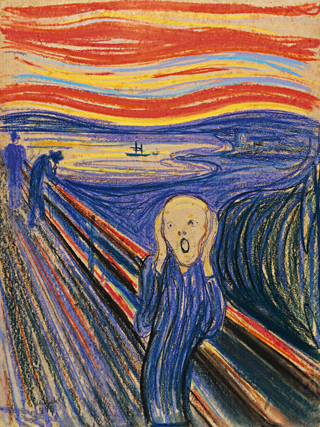
The Scream, Edvard Munch
The Boston Herald reports:
The apparent suicide of an Arlington teenager who school officials identified yesterday left the town shaken as the odd way he died drew attention to a death that police said would otherwise have passed by unnoticed.
“The manner in which this young man took his life was out of the ordinary — suicide itself is a quite common occurrence for us — and typically suicide incidents or suicide are not publicized,” Arlington police Chief Frederick Ryan told the Herald. “So the general public does not realize how frequent it does occur.”
How awful. No death by suicide should “pass by unnoticed.” This is a public health problem and the public needs to be aware of how many young people commit suicide. The family did the right thing by asking that his name be released.
More from Wicked Local Arlington: Editorial: Why we haven’t eulogized AHS teen.
In a little over one month, the town of Arlington has lost three young people to untimely deaths, tearing three holes in the fabric of three families and of this community. Two, Catherine Malatesta and Katherine Wall, were felled by aggressive cancers. The third, Jeremy Kremer-McNeil, killed himself in his parent’s basement using cyanide.
The deaths of Malatesta and Wall received significant coverage in these pages, yet the passing of Kremer-McNeil is only lightly covered. Does the manner of his death cheapen the life of a 15-year old cruelly taken from us? Is he suddenly undeserving of the same public mourning this paper has afforded his peers?
Suicide is undeniably a public health issue in the Commonwealth.
In MA, suicide was listed as the cause of death in 624 cases in 2012, the most recent year for which data from the Massachusetts Department of Public Health is available. On top of those 624 suicides, 4,258 people were hospitalized with self-inflicted injuries in Massachusetts in 2012, and the counseling hotline Samarateens responded to 187,849 crisis calls in that same year. As shocking as those numbers may seem, our overriding responsibility as a media outlet is to cover the broader issue of suicide, and not its individual instances.

Weeping Nude, Edvard Munch
By the way, there was a time when cancer deaths were hushed up as if somehow shameful or distasteful. I clearly recall when the mother of one of my high school classmates died very young of cancer. Her cause of death was whispered among the other students, but didn’t appear in her obituary.
Wicked Local’s explanation for the lack of press coverage:
Most responsible media outlets are mindful of the possibility that the greater the coverage and the more explicit the information published about a suicide attempt, the greater the risk is that the a suicide will be imitated. Research by psychiatric epidemiologist Madelyn Gould at New York City’s Columbia University shows that media attention around a peer’s suicide can make teens more vulnerable to killing themselves. Her research, as reported by NPR in 2009, showed that the increase in suicides following a suicide story is proportional to the amount, and the duration, and the prominence of the coverage of the initial event….
Despite the very public nature of Friday’s suicide, many aspects of this case are acutely private. In covering all tragedy, journalists must balance a family’s need for respect and privacy with the importance of the event. Those are pressures we feel even more acutely at The Advocate. The people we cover are not anonymous. They are our neighbors. In this case, we believed and continue to believe that the former definitively outweighs the latter.
Is this really a good policy? Are these media and law enforcement policies common around the country? Wouldn’t the suicide of a young person in a community be an appropriate time to educate residents, reach out to other local depressed young people, find ways to help them, rather than hush the suicide up and let depressed youngsters think they are alone in their struggles?

I only wish someone had been able to reach out to Jeremy and help him get past whatever he was going through. Sometimes just a hug or an empathetic listener can be a step toward deciding to stay alive.
I know something about this, because I was very depressed when I was Jeremy’s age, and I frequently considered suicide. Somehow, I always talked myself out of it and was able to go onward. I have struggled with depression for most of my adulthood also. I became an alcoholic through my attempts at self-medication. Now as a senior with more than 30 years of sobriety, I expect to take an antidepressants for the rest of my life. Over the years, I have learned may tools for dealing with my depression, but I know that I must be “ever vigilant”–as they say in A.A.–because I have a chronic illness that is both physical (highly genetic) and emotional.
I’d be very interested in learning what our readers think about the issue of media and law enforcement silence when people kill themselves.
Of course it isn’t just high school students who suffer from depression and anxiety. For most of each year, the Boston area has a massive population of college students, and the local papers usually run lots of back-to-school stories in September. This year the Globe is focusing on mental health issues among college students.
From yesterday’s Globe: College kids are sad, stressed, and scared. Can their counseling centers help them?
When Ramya Babu thinks about her freshman year at Boston University, she remembers the day she stood alone in her dorm room and screamed in anguish.
Babu had been thrilled to start college. But just a few weeks into the school year, she began to feel like the world around her was simultaneously spinning too fast and leaving her dizzy, but also moving too slow in a way that made her feel like her loneliness and anxiety would never end. All of the overwhelmed emotions she had tried to suppress caught up to her, making her cry out in pain.
Frantic, Babu called a friend from home, who suggested she see someone at BU’s counseling center.
A counselor at BU’s behavioral medicine center diagnosed her with both depression and an anxiety disorder. Each week, at her appointments, Babu would talk through her feelings and concerns with her counselor and leave feeling like she had strategies that would help her survive.
But at the end of the semester, after only eight sessions, her counselor handed her a referral sheet and told her this would be their final meeting. She would have to find a new therapist.
“I had no idea what to do,” she said. “I felt like the support in the referral process was next to non-existent. I know they have a limited number of therapists, but this is a college campus with a mental health center and there I was trying to negotiate with outside practitioners I knew nothing about.”

Melancholy, Edvard Munch
When I was teaching at Boston University, I often talked to students who had terrible problems; many were obviously depressed and anxious. I always tried to listen to and empathize with the problems they shared, but there was little more I could do. I knew about the short-term counseling available at BU and most other universities, and always thought it was terribly inadequate. More from the Globe article:
From today’s Globe: ‘I didn’t need to pretend anymore:’ the fading stigma of mental illness at college.
Wendy Chang’s friends could recognize her laugh from a distance. Even if they didn’t see her right away, they knew from the boisterous sound that echoed down Harvard’s hallways that Chang would soon appear, her head thrown back and nose scrunched up with mirth.
Lanier Walker thought Chang’s constant laughter was a sign that she was happy. But Walker later learned that Chang hid what pained her most. The 22-year-old Harvard senior hung herself in her dorm room in 2012.
Walker was shocked and horrified that the life her friend lived didn’t match the image that she portrayed. Then she realized that her friends and peers didn’t know much about her own personal struggles, either.
Walker decided to take action.
After another Harvard student died by suicide in the spring of 2014, Walker felt overwhelmed by the need to do something. She wrote an op-ed for The Harvard Crimsoncalled “We Need to Talk” about her own struggles with depression and anxiety. By her sophomore year, Walker was having four to five anxiety attacks a week.
“Harvard doesn’t always make it easy to talk about ourselves,” she wrote. “It’s a place that demands perfection, and as a result, we feel compelled to present perfect versions of ourselves. We don’t talk about what’s really going on.”
Walker’s letter ended with a call to her peers to start talking, and to let others know they were around to listen. After the letter was published, she needed to take her own advice.
Read the rest at the Globe link.

Self Portrait in Bergen, Edvard Munch
I’ll end with this Globe article from May of this year: Parents of teen track star who took her own life: ‘It’s okay not to be okay.’
Madison Holleran was a track star at the University of Pennsylvania. She was smart. She was beautiful. She was loved. Her posts on Instagram depicted the kind of life that you looked at and wondered why yours wasn’t nearly as perfect.
But it wasn’t perfect. On January 17, 2014, Madison Holleran lept off the ninth floor of a parking garage and died. She was 19 years old.
“There are moments when the Hollerans are chasing the ‘why,’ still,” said Kate Fagan, who wrotethe in-depth article about Holleran’s life and death forESPN magazine’s May issue.
“Every time I talked to them, it came back to, ‘The reason we’re talking about it is because we wanted to let people know it’s okay to not be okay.’”
Those are such wise words! Yes, it is “okay to not be okay.” We need much more public discussion of depression and anxiety in this country. These illnesses–and they are illnesses–should be discussed openly. Of course the U.S. doesn’t have anything approaching a good system to address mental health problems either, and that has to change. If suicides are hushed up, that is not going to happen. The public needs to know the extent of the problem and the public needs to be the catalyst to bring out change.

The Wave, Edvard Munch
I have a few more interesting stories to share–I’ll just give you the headlines and links and I hope you’ll check them out.
First, here’s an important story from the Winnipeg Free Press that Dakinikat linked to in a comment yesterday. I thought it deserved more prominent placement. It’s an edited interview with Jane Goodall in which she discusses climate change denial, research myths, and animal rights: Jane Goodall remains a road warrior for the planet.
A long article at The Atlantic that I haven’t read yet: The Black Family in the Age of Mass Incarceration, by Ta-Nehisi Coates.
From The National Memo: Endorse This: Look, It’s Super-Jeb! by Eric Kleefeld.
Vanity Fair: NetJets Pilots Ask for Better Pay for Flying Millionaires.
Mitch Albom at The National Memo: Tape Tells Story In James Blake Arrest Case.
A terrifying case of race profiling that hasn’t gotten much attention: Kamilah Brock: Woman held in mental health facility because police didn’t believe BMW was hers.
What stories are you following today?
Did you like this post? Please share it with your friends:
Posted: April 16, 2015 | Author: bostonboomer | Filed under: Crime, just because, morning reads, racism | Tags: Billie Holiday, Bladenville NC, FBI, Lennon Lacy, lynching, Michael Brown, Michelle Brimhall, police cover-up, Strange Fruit, Suicide, Trayvon Martin |

Good Morning
As I was browsing the news this morning, I came across an article in the Daily Beast about an incident I have often wondered about–the death of teenager Lennon Lacy on August 28th of last year in the small town of Bladenville, North Carolina. On the morning of August 29, Lacy was found hanging from a swing set by a woman who called 911 to report “a suicide,” and asked if she should try to cut the person down. The dispatcher told her to go ahead. That was the beginning of either an unforgivably botched investigation or a police cover-up. (The photo above is of the swing set from which Lacy’s body was found hanging.)
The story broke in the midst of the Ferguson protests over the shooting of Michael Brown by police officer Darren Wilson, just one the suspicious deaths of young black men reported in the wake of the publicity about Brown’s death and the protests that followed. I’m ashamed to admit that I never searched for more information on the story until today.
Here’s the story that got me started; frankly the headline is a gross understatement. I’m just going to excerpt some of the problems with the “investigation” and then give you some more background on the case.
Cops Didn’t Collect Evidence on Hanging of Black Teen Lennon Lacy, by Justin Glawe
Coroner Hubert Kinlaw told Dr. Christena Roberts, a pathologist hired by the North Carolina NAACP to conduct her own investigation, that he was prevented from taking photos of the crime scene by police—and that cops even threatened to take away his camera.
Furthermore, Kinlaw told Roberts as part of her investigation that police at the scene “didn’t want an autopsy performed,” and that Kinlaw took it upon himself to order one with the local district attorney. (Kinlaw has turned down repeated requests for comment.)
However, an officer from the State Bureau of Investigation said in a report that no photographs were taken at the scene because the sole crime scene technician was at “another homicide.” (No other homicides could be found in news reports for that 24-hour period.) So the authorities don’t even agree why photographs weren’t taken.
The teenager’s hands weren’t bagged when his body reached the medical examiner, which is commonly done to preserve DNA evidence for retrieval by investigators.
The shoes that Lacy’s family members says weren’t his never made it to the autopsy table….
Radisch notes in her report the two belts delivered with Lacy’s body must have had been cut, because they didn’t seem long enough for Lacy to hang himself.
Radisch would only be left to speculate because the authorities didn’t measure the swing set where Lacy was found.
Well, someone could probably have gone to the crime scene and done that after the fact, but I guess no one bothered. Please read the rest of the article at the link. Glawe explains in detail why it would have been nearly impossible for Lacy to hang himself from the place where his body was found.

Lennon Lacy
Fortunately, the FBI is investigating Lacy’s death, but the fact that police just called it a suicide and didn’t collect any evidence will severely hamper their efforts.
On December 19, 2014, The Washington Post reported on why the FBI had been been called in.
BLADENBORO, N.C. — Teresa Edwards was driving to Bo’s Food Store when she spotted the teenager walking along the dirt road. It was getting dark. He was alone. She recognized him as Lennon Lacy, one of her son’s best friends. She stopped to ask him if he needed a ride.
“No, ma’am,” she recalls him saying, “I’m just thinking.”
Lacy had plenty on his mind that night in August, and many would soon puzzle over what those thoughts might have been. The next morning, Lacy, who was black, was found hanging by two belts from a wooden swing set in a predominantly white trailer park. State authorities called it a suicide. His family, and many others here, wondered whether Lacy’s death was something else: a lynching.
It looked to them as if his body was on display. He didn’t leave a note. And Lacy had been dating an older white woman for months. He was found wearing unlaced white sneakers that his family said were not his, one of several unsettled issues. Last week, in a scene echoing the civil rights era in the South, the FBI was called in and the NAACP held a protest march over Lacy’s death….
People who knew Lacy don’t think he committed suicide. Others are unsure what to believe. But many here say the possibility that Lacy, a popular high school senior who moved easily between black and white social circles, was the victim of a racially motivated killing demands more investigation.
“We know suicide is possible,” said the Rev. Gregory Taylor, a black preacher in a town where there are two churches named First Baptist, their memberships split along racial lines. “It’s just hard to accept that a black youth would hang himself given the history of ‘strange fruit.’ The facts don’t add up.”
It was Thursday, Aug. 28, when Edwards, who is white, saw Lacy on the dirt road. She also doesn’t believe the teen killed himself.

Lennon Lacy’s grave after it was desecrated.
Bladenboro has a long history of racism, and the Ku Klux Klan only stopped “parad[ing] through” the town in 1997. Moreover, Lacy’s body was found in an area that black children had long been warned to stay away from. Here’s a summary of some of that history from the Global Grind:
Here’s the truth — the statistic listed above marking the number of black bodies strung from trees in Bladenboro [“86 black people were lynched [in North Carolina] between 1882 and 1968”] is an image that is hard to let go.
And so is the racially charged climate of the rural town. In fact, Lacy’s neighbors, a white couple living in a trailer home right behind the Lacy family home, were instructed by police to remove a Confederate flag and a sign that read “Niggers keep out” from their front yard.
The Guardian asked the couple why they had put up the signs. Sykes said that it was his idea. “There were some kids who ganged up on our kid and I put some signs up.” Asked whether he now regretted doing so, he replied: “Yeah, I regret it now.”
Carla Hudson said she had begged her husband to take the signs down. “I told him he had to stop that. It wasn’t how I saw things – there’s not a racist bone in my body.”
In recent years, that tension hasn’t always been visible. According to The Guardian, Lacy “joined a multiracial youth group across town at the Galeed Baptist church where he went for weekly services and basketball ministry, and his friends were black and white, in almost equal measure.”
Though invisible in some facets of Lacy’s life, that tension is hard to ignore, especially considering how the teenager died.

Michelle Brimhall, Lennon Lacy’s girlfriend
Back to the WaPo article:
Although the police claimed Lacy was “depressed” about the death of a great uncle, his family said he was exited about playing in the first football game of the season. He had already laid out his uniform in anticipation. The family also said that at least one of the belts used to hang Lacy wasn’t his. Most mysterious of all, his brand new Air Jordans were missing and when Lacy was found his feet were jammed into white sneakers that had no laces and were way too small for his feet.
Claudia Lacy identified her son. A state bureau of investigation agent interviewed her at the scene. She said that her son had just buried his great-uncle but that he didn’t seem depressed. The medical examiner performed an autopsy, failing to find any signs of a struggle or fight. Lacy’s death was ruled a suicide. No mention was made of the white sneakers — they didn’t arrive with Lacy’s body for the autopsy. It’s unclear what happened to the shoes, although the state bureau of investigation collected them, Kinlaw said.
To Claudia Lacy, the investigation felt rushed.
“Why were they so quick to call it that?” she asked now. “Was it because of my race? Was it because of my social status?”
The is much more information at the link.
Lacy’s white girlfriend, who was 31, left town shortly after his death. According the The Daily Mail, she believed he was killed because of their relationship and she didn’t feel safe staying in “Crackertown.”
Speaking exclusively to DailyMail.com she said: ‘I believe Lennon was murdered. The police ruled his death as suicide but Lennon would never harm himself. He’s got too much love for life.’ …. speaking in the town where she has moved to get away from Bladenboro, Brimhall spoke of how they had planned a future together, despite the age gap, and how he had a life in front of him which showed he would not commit suicide.
Read much more at the Daily Mail link. Other media outlets have been unable to get in touch with the woman. Was she forced to leave town?

Lennon Lacy
More quotes from Lacy’s family at MadameNoire:
[T]he family says suicide can’t be possible. Lacy didn’t have any issues that they know of when it comes to depression or mental illness over the years. And despite losing a great uncle he was close to right before his own death, Lacy’s mother says he grieved in the same way the rest of his family had, but carried on with his preparation for the football season.
“I know my son. The second I saw him I knew he couldn’t have done that to himself – it would have taken at least two men to do that to him.”
His brother, Pierre, agrees: “If my brother wanted to take his own life, I can’t understand why he would do it in such an exposed place. This feels more like he was put here as a public display – a taunting almost.”
Here’s the oft-quoted Guardian story. It’s excellent. Teenager’s mysterious death evokes painful imagery in North Carolina: ‘It’s in the DNA of America.’
I’ll end with a piece by Michael W. Waters at HuffingtonPost, The Life and Death of Lennon Lacy: Strange, Still.
The animus for Time Magazine’s “song of the 20th century” was a photograph of a Southern lynching. A Southern lynching would often draw an entire region of spectators together for a day of socializing. Small children were even present in the crowd, lifted high upon shoulder for an uninterrupted view of the day’s fatal proceedings. It was a strange, albeit frequent Southern spectacle, one that claimed many Black lives.
Given the frequency of this horrid practice, and the abundance of lynching photographs in circulation, many that doubled as postcards, it is unclear why one particular photograph troubled, then inspired Abel Meeropol, a New York English teacher and poet. Yet, it did. Unable to free his mind of this troubling image over several days, Meeropol sought consolation through his pen. As ink dried upon its canvas, its residuum formed words that have haunted generations, words etched into our collective memory as lyric by the incomparable Billie Holiday:
“Southern trees bear a strange fruit,
Blood on the leaves and blood at the root,
Black body swinging in the Southern breeze,
Strange fruit hanging from the poplar trees.”
Now seventy-six years removed its initial recording, there is still cause to sing this sorrowful song.
On August 29, 2014, another Black body was added to the crowded annals of those swung by Southern breeze. In a cruel twist of irony, the body of seventeen year-old Lennon Lacy was not found swinging upon a Southern tree, but upon a Southern swing set – a fact only beginning the strangeness surrounding his death. Authorities in Bladenboro, North Carolina, abruptly ruled Lennon’s death a suicide, declaring that he was depressed, and closed the case in five days.
Still, many questions remain.
Yes, there are many questions that must be answered.
I recall that it took months before the murder of Trayvon Martin became high profile. It’s time the same thing happened with the Lennon Lacy story. This smells like a police cover up to me. The police in Bladenboro are known for stopping black teenagers who are walking at night. Could it be that an officer or officers stopped Lacy and accidentally killed him in a struggle–like what happened to Eric Garner–and then tried to make his death look like suicide?
What do you think?
As always, this is an open thread. Feel free to post links and discuss topics of your choice. But I hope you take a moment to think about and discuss what happened to Lennon Lacy.
Did you like this post? Please share it with your friends:


 peej
peej Carissa
 bostonboomer
 dakinikat
 ecocatwoman
 mablue2
 Mama Lopez
 peggysue22
 quixote
 skydancingguestblogger
 Mona (aka Wonk the Vote)



 Sky Dancing
Recent Comments