

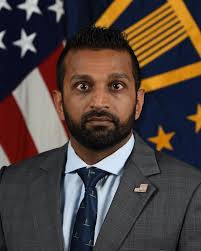
Kash Patel, Donald Trump’s pick to direct the Federal Bureau of Intelligence, has never served in the FBI. But he has hosted Steve Bannon’s podcast.
Patel is a contributor at Real America’s Voice, the right-wing news network that produces Bannon’s show War Room, and has long appeared as a guest on the show. After top Trump adviser Bannon was imprisoned for four months earlier this year — on charges of contempt of Congress after he refused to comply with a January 6 Committee subpoena — Patel stepped up to serve as an occasional guest host.
Crazy Eyes Kash Patel
To try and understand Patel better, I listened to every episode and clip tagged with “Kash Patel” on the War Room website — and a few others that Bannon’s team missed. The overwhelming impression is that Patel is a man whose entire worldview revolves around paranoid conspiracy theories — specifically, conspiracies against both America and Trump, which for him are one and the same. It’s a specific kind of obsession that reminds me of the FBI’s first director: J. Edgar Hoover, a man who infamously abused his power to persecute political enemies.
During his various appearances on Bannon’s show, Patel and/or his interviewees declared that:
- China is funding the Democratic Party and sending “military-aged males” across the Mexican and Canadian borders to prepare for a preemptive strike.
- Barack Obama directs a “shadow network” that is quietly directing the intelligence community and Big Tech to persecute Trump.
- Attorney General Merrick Garland wants to throw “all of us” — which is to say, Trump allies — in prison.
And Patel is willing to go to extreme measures in response to these alleged threats.
In one episode, he called on the Republican majority in Congress to unilaterally arrest Garland — invoking an obscure legal doctrine called “inherent contempt” that has never been used in this fashion in the entirety of American history. In another, he outlined a plan for a MAGA blitz of American institutions focused on getting loyalists into high office.
Wednesday Reads
Posted: December 4, 2024 Filed under: abortion rights, American Fascists, just because | Tags: Abortion bans killing women, Kash Patel, martial-law, news, Pete Hegseth, politics, Portia Ngumezi, Ron De Santis, South Korea, Yoon Suk Yeol 7 CommentsGood Morning!!
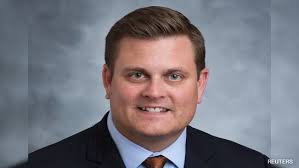
Brian Thompson, CEO of United Health Care
There’s some breaking news from NYC. The CEO of United Health Care was shot and killed on the street, and it is believed to be a “targeted attack.” The New York Times has live updates.
The executive, Brian Thompson, was shot in the chest in what people briefed on the investigations said appeared to be a targeted attack.
The chief executive of UnitedHealthcare, one of the nation’s largest health insurers, was fatally shot outside a hotel in Midtown Manhattan on Wednesday morning, the police said.
The executive, Brian Thompson, 50, was shot just after 6:45 a.m. at the New York Hilton Midtown on Avenue of the Americas near 54th Street, according to a police report. Mr. Thompson was taken to Mount Sinai West, where he was pronounced dead….
Officials with the Metropolitan Transportation Authority, which runs New York City’s transit system, said that the shooting did not impact subway or bus service during the morning commute….
Brian Thompson’s sister, Elena Reveiz, told The Times she is still processing the news of her brother’s death. “He was a good person and I am so sad,” Reveiz said when reached by phone. She said Thompson was a good father to his two children. She said she was on her way to see her sister, and to be with their family….
Gov. Tim Walz of Minnesota called the killing “horrifying news and a terrible loss for the business and health care community in Minnesota.” [….]
New York’s police commissioner, Jessica Tisch, and Jeffrey Maddrey, chief of department, will hold a news conference at 1 Police Plaza at 11:30 a.m., the police said.
Another huge story broke yesterday from South Korea. Right wing President Yoon Suk Yeol declared martial law and attempted a coup. Fortunately he failed.
Haeryun Kang at The Guardian: Martial law came to South Korea – and my friends and I doomscrolled through the night.
At 10.23pm on 3 December in Seoul, I was already in bed, alternating between reading a book and watching YouTube cooking reels. That was when Yoon Suk Yeol, the president, declared emergency martial law in South Korea for the first time since 1979.
In an unannounced televised address, Yoon said the imposition of martial law was “aimed at eradicating pro-North Korean forces and protecting the constitutional order of freedom”.
Immediately, my text messages and online chat forums flared up. What the hell is going on? Is this a joke? Can I keep drinking at the bar tonight? Can my children go to school tomorrow? What exactly is the emergency? Utter confusion ensued for the next six hours, until a dramatic sequence of events led to the end of martial law at 4.30am.
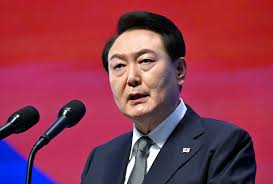
South Korean President Yoon Suk Yeol
This was my first experience of martial law – if this short-lived circus can even be called that – something that, until now, I had only read about in history books. But even in that short time, I was terrified. The experience woke me up, once again, to the severe, unavoidable reality of Korean division. And I remembered how it can be exploited by our leaders to justify repression and control.
Thankfully, this time, Yoon’s antics were curbed. But the martial law fiasco is a testament to both the instability and resilience of South Korean democracy. It is a chilling reminder that the collective trauma of the 20th century dictatorship is not simply history.
It’s still unclear why Yoon took such an extreme measure. Martial law is defined as the temporary rule by military authorities in a time of emergency, when civil authorities are deemed unable to function. In the past, dictators have declared martial law at times of widespread national unrest and turmoil, including the Korean war. This time, it was a business-as-usual Tuesday; earlier that evening I had been for a swim at a government-run public pool.
Yoon’s measure came at a time of personal and political turmoil for him. Corruption scandals have rocked him and his family; the opposition Democratic Party has just insisted on big cuts to the budget bill despite the ruling party’s protests; Yoon’s approval ratings are hovering in the 20s – all unpleasant, sure, but stories that don’t seem all that surprising in a relatively functional democracy.
In his speech declaring martial law, Yoon expressed clear vitriol for his political opposition, for its “anti-state activities plotting rebellion”. Most South Koreans are familiar with this insidious sort of rhetoric. I grew up with this language, and still live with it, through my very conservative family in Busan. It’s a regular reminder that there is a clear political and generational divide related to the Korean division.
If you want more first-hand reporting, check out this post by Sarah Jeong at The Verge: Six hours under martial law in Seoul.
Timothy Snyder at his Substack Thinking about…: Dictators for a Day, South Korea and America.
South Korea’s president, Yoon Suk Yeol, invoked martial law, tried to install a military dictatorship — and failed completely. In his actions there are some likely similarities with the coming Trump regime, and some clear lessons for Americans to learn right now.
Yoon won a very narrow election, as did Trump. Like Trump, he refers constantly to “fake news” and calls his political opponents enemies of the state (as Trump says, “the enemy within.”) Yoon used this language to justify the imposition of martial law, as will Trump if he decides to invoke the Insurrection Act in the United States.
Like Trump, Yoon telegraphed his move in advance, and not only with such language. He surrounded himself with military men and intelligence officers who were characterized by personal loyalty. Trump is trying to do the same, now, with his proposals for Tulsi Gabbard as director of national intelligence, Kash Patel as director of the FBI, and Pete Hegseth as secretary of defense. He also wants to purge the top ranks of the armed forces.
Yoon’s main political opponent, Lee Jae-myung, had correctly predicted that Yoon would try to implement martial law. Trump makes this prediction rather easy. Trump has spoken openly of being “dictator for a day,” and of invoking the Insurrection Act, which would allow him to deploy the military inside the United States.
The Insurrection Act is not quite the same thing as martial law. Under martial law, the military assumes the basic responsibilities associated with a civilian government. The Insurrection Act, in principle, only allows the American president to use the armed forces to assist civilian authorities to enforce some law in the presence of an insurrection. But the language of the law is quite vague. Trump makes it clear that he has in mind invoking the Insurrection Act to very broad purposes, essentially to change the regime.
In both South Korea and the United States, the legal basis for asserting greater presidential authority is antiquated. Martial law was declared in South Korea for the last time in 1979. Since the late 1980s, South Korea has moved quite decisively in the direction of meaningful elections and civil rights, thanks to the forceful activity of civil society, especially trade unions. In the United States, the Insurrection Act is an assemblage of laws passed between 1792 and 1871. It was last invoked during racial violence in Los Angeles in 1992.
Yoon’s actions, although rooted of course in his own personality and South Korean career, and enabled by South Korean law, were very trumpy. Indeed, it seems likely to me that the very presence of Trump on the international scene will make such attempts more likely, among America’s democratic allies (such as South Korea) and generally.
But Yoon failed, and very badly. His dictatorship for a day lasted only about six hours. What can Americans learn from his less-than-a-day dictatorship?
Read the rest at the Substack link.
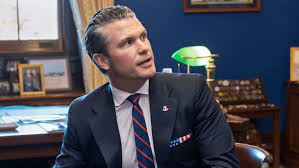
Pete Hegseth
Back in the USA, It looks like Pete Hegseth will not be the Secretary of Defense. Yesterday, Dakinikat wrote about the devastating New Yorker article by Jane Mayer. Mayer reported in great detail Hegseth’s out-of-control drinking, his abuse of women, and his incompetence when trusted with leadership roles in small organizations.
Yesterday, NBC News reported: Pete Hegseth’s drinking worried colleagues at Fox News, sources tell NBC News.
Pete Hegseth, President-elect Donald Trump’s pick for defense secretary, drank in ways that concerned his colleagues at Fox News, according to 10 current and former Fox employees who spoke with NBC News.
Two of those people said that on more than a dozen occasions during Hegseth’s time as a co-host of “Fox & Friends Weekend,” which began in 2017, they smelled alcohol on him before he went on air. Those same two people, plus another, said that during his time there he appeared on television after they’d heard him talk about being hungover as he was getting ready or on set.
One of the sources said they smelled alcohol on him as recently as last month and heard him complain about being hungover this fall.
None of the sources with whom NBC News has spoken could recall an instance when Hegseth missed a scheduled appearance because he’d been drinking.
“Everyone would be talking about it behind the scenes before he went on the air,” one of the former Fox employees said….
Three current employees said his drinking remained a concern up until Trump announced him as his choice to run the Pentagon, at which point Hegseth left Fox.
“He’s such a charming guy, but he just acted like the rules didn’t apply to him,” one of the former employees said.
Trump is considering withdrawing the Hegseth nomination and appointing Ron De Santis instead. Marc Caputo at The Bulwark: Trump Talks to DeSantis About Replacing Hegseth.
DONALD TRUMP AND RON DESANTIS have personally discussed the possibility of the Florida governor becoming the next secretary of defense amid concerns that sexual assault allegations could engulf the president-elect’s current nominee for the post, Pete Hegseth.
The talks, relayed by four sources briefed on them, are in their advanced stages. They underscore the fears within Trump world about Hegseth’s ability to survive a Senate confirmation process—despite public posturing from Hegseth and allies that he remains committed to ending up at DoD.
“These discussions are real. It’s serious. I can’t say it’s definitely going to happen, but the governor is receptive and Trump is serious, too,” a top Republican source familiar with the conversations told The Bulwark on condition of anonymity.
The discussions around DeSantis involve untangling several different political threads. The governor is currently handling the fallout of a separate Trump cabinet pick: Marco Rubio’s nomination to be secretary of state. DeSantis is weighing whether to appoint Trump’s daughter-in-law, Lara Trump, to fill Rubio’s Senate seat. The possibility that the governor himself could end up at the Pentagon may factor into that decision.
Today Hegseth is again meeting with Republican Senators in a last ditch effort to convince them to support his nomination. Politico: Hegseth back on the Hill as Pentagon bid teeters.
Pete Hegseth, Trump’s embattled pick to run the Pentagon, is back on Capitol Hill today as his nomination faces even more hurdles.
Pete Hegseth’s tatoos
Concerns over Hegseth’s personal controversies are driving Trump allies to think the Defense secretary designate may not survive further scrutiny. And his fight has been complicated even more by the news that the president-elect is weighing a rival, Florida Gov. Ron DeSantis, to replace Hegseth, The Wall Street Journal was first to report. DeSantis, a former opponent in the 2024 GOP presidential primaries, offers a conservative military record and alignment with Trump’s views on “woke” military policies.
Hegseth — who has faced allegations of sexual assault and alcohol abuse — is expected to meet today with Republicans including incoming Senate Armed Services Chair Roger Wicker (R-Miss.) and the next majority leader, Sen. John Thune (R-S.D.).
Hegseth’s most crucial meeting, though, is expected to be with Sen. Joni Ernst (R-Iowa), a Senate Armed Services member who has been noncommittal about Hegseth’s nomination and is seen as a potential swing vote.
Ernst was previously floated as a potential pick for defense secretary before Trump opted for Hegseth, though she was seen as a dark horse candidate. The Iowa Republican is a traditional defense hawk, clashing somewhat with the Trump team’s views. There may also be a political divide to bridge for Ernst — who took until March to endorse Trump’s 2024 White House bid after the former president nearly swept the Republican primaries and was on a path to clinch the GOP nomination.
Ernst, the first woman combat veteran in the Senate, has a long track record of legislation aimed at addressing sexual assault and harassment in the military. That would seem to put her at odds with Hegseth, who is not only the subject of sexual assault allegations but opposes women serving in combat roles.
Ernst has also been outspoken about her own experiences with sexual assault and domestic violence. Asked about the sexual assault accusations against Hegseth, she’s said: “Any time there are allegations, you want to make sure they are properly vetted, so we’ll have that discussion.”
Another problematic candidate, Kash Patel for FBI director is facing headwinds. I’m sure we’ll be hearing much more about him, but here are a couple of articles about him.
Zach Beauchamp at Vox: I listened to hours of Trump’s FBI pick on Steve Bannon’s podcast. Oh boy.
Read more at Vox.
David Corn at Mother Jones: Here Are the Republicans Kash Patel Wants to Target.
For years, Kash Patel, the MAGA provocateur, conspiracy theory monger, and seller of pills he claims reverse the effects of Covid vaccines, who Donald Trump has announced as his pick to replace FBI Director Chris Wray, has made his mission plain: He wants to crush the supposed Deep State that has conspired against Trump. Last year, while appearing on Steve Bannon’s podcast, he vowed, “We will go and find the conspirators—not just in government, but in the media. Yes, we’re going to come after the people in the media who lied about American citizens to help Joe Biden rig presidential elections. We’re going to come after you, whether it’s criminally or civilly.” This was not an empty threat, for Patel has a list of specific targets for his score-settling. And that line-up includes not only Democrats but also prominent Republicans.
Patel laid out his plans in a 2023 book titled Government Gangsters: The Deep State, the Truth, and the Battle for our Democracy. In this work, he breathlessly described the Deep State as a “coordinated, ideologically rigid force independent from the people that manipulates the levers of politics and justice for its own gain and self-preservation.” It is run “by a significant number of high-level cultural leaders and officials who, acting through networks of networks, disregard objectivity, weaponize the law, spread disinformation, spurn fairness, or even violate their oaths of office for political and personal gain, all at the expense of equal justice and American national security.” He added, “They are thugs in suits, nothing more than government gangsters.” And he inveighed that this is “a cabal of unelected tyrants.”
In his book, Patel, a supporter of QAnon and a promoter of assorted MAGA conspiracy theories (the 2020 election was stolen from Trump, the Trump-Russia investigation was a hoax, and the January 6 riot was sparked by “strange agitators” and federal agents), called for mounting “investigations” to “take on the Deep State.” Though he doesn’t specify what the cause for these inquiries would be, he has plenty of people in mind. In an appendix to the book, Patel presented a list of 60 supposed members of the Deep State who are current or former executive branch officials and who presumably would be the prey. He noted this roster did not include “other corrupt actors,” such as California Democrats Reps. Adam Schiff and Eric Swalwell, “the entire fake news mafia press corps,” and former GOP House Speaker Paul Ryan. (When Patel worked for the GOP-controlled House intelligence committee, he had run-ins with Ryan over the issuance of subpoenas and Patel leaking information to a Fox News reporter—which must mean that Ryan was a Deep State operative.)
Read the rest at Mother Jones.
Just one more story, this time on women dying because of anti-abortion laws. Amanda Marcotte at Salon: Republicans don’t care if women die from abortion bans — but they don’t want you to know about it.
After the Supreme Court ended federal abortion rights in 2022, there was a robust debate between pro- and anti-choice activists over whether or not banning abortion would kill women. Pro-choicers pointed to evidence, from both history and other countries, showing that abortion bans kill women. Anti-choice activists dismissed the record and pointed to toothless “exceptions” in abortion ban laws as “proof” that women could get abortions to save their lives.
Portia Ngumezi
The latter argument was frustrating not just because it was wrong but was generally offered in bad faith. Anti-abortion leaders know that abortion bans kill women. They don’t care. Or worse, many view dying from pregnancy as a good thing. In some cases, it’s viewed as just punishment for “sinful” behavior. Other times, it’s romanticized as a noble sacrifice on the altar of maternal duty. But conservatives are aware that this death fetish cuts against their “pro-life” brand. So there was a lot of empty denials and hand-waving about the inevitable — and expected — outcome of women dying.
We now have another proof point that abortion bans are about misogyny, not “life,” as the first deaths from red state abortion bans are being reported. Instead of admitting they were wrong and changing course, Republicans are behaving like guilty liars do everywhere, and destroying the evidence. In the process, they are also erasing data needed to save the lives of pregnant women across the board, whether they give birth or not.
ProPublica has published a series of articles detailing the deaths of women in Georgia and Texas under the two states’ draconian abortion bans. They most recently reported the death of Porsha Ngumezi, a 35-year-old mother of two from Texas. Ngumezi suffered a miscarriage at 11 weeks but was left to bleed to death at the hospital, instead of having the failing pregnancy surgically removed. Multiple doctors in Texas confirmed that hospital staff are often afraid to perform this surgery, however, because it’s the same one used in elective abortions. Rather than risk criminal charges, doctors frequently stand by and let women suffer — or die.
Ngumezi’s youngest son doesn’t fully understand that his mother is dead. ProPublica reported that he chases down women he sees in public who have similar hairstyles, calling for his mother.
A day after this story was published, the Washington Post reported that the Texas maternal mortality board would skip reviewing the deaths of pregnant women in 2022 and 2023 — conveniently, the first two years after the abortion ban went into place. The leadership claims it’s about speeding up the review process, but of course, many members pointed out the main effect is that “they would not be reviewing deaths that may have resulted from delays in care caused by Texas’s abortion bans.”
This is especially noteworthy because it’s become standard after one of these reports for anti-abortion activists to blame the victims and/or the doctors, and not the bans. Christian right activist Ingrid Skop, for instance, responded to Nguzemi’s death by insisting “physicians can intervene to save women’s lives in pregnancy emergencies” under the Texas law. If she really believed that, however, she would desperately want the state maternal mortality board to review this, and other cases like it, so they could come up with recommendations for hospital staff to treat women without running afoul of the law. Strop, however, is on the Texas maternal mortality board. She was likely part of the decision to refuse to look into whether women like Nguzemi might be saved.
So the likeliest explanation is the simple, if brutal one: Anti-abortion activists do not want doctors to save women’s lives. The current situation, where doctors are afraid to treat women and have no guidance on how to do so safely, is a status quo they are fighting to preserve. We also know this because, as Jessica Valenti reported at Abortion Every Day last week, these same activists are lobbying to rewrite current abortion bans to remove the paltry “exceptions” that do exist. Instead of allowing doctors to abort pregnancies that are failing, they want to force them to induce labor instead. That is not just cruel but will kill women. We know this because that’s exactly how Nguzemi died; her doctor gave her a drug in hopes it would push the pregnancy out, rather than surgically remove it, as is the standard of care.

Read the whole thing at Salon.
That’s all I have for you today. Please take care of yourselves. We live at a very dangerous time.
New Year’s 2024 Reads: Damn the Predictions! Full Steam Ahead!
Posted: January 1, 2024 Filed under: just because | Tags: @repeat1968, All together, All We are saying is Give Peace a Chance, Come together, Gaza, israel, Japan, John Buss, North Korea, Russia, South Korea, The Electoral College, Ukraine, USA politics 2024 2 Comments
John Buss, @repeat1968
Happy New Year’s Day, Sky Dancers!
I’m still rattled by the overwhelming use of fireworks last night by my little house along the Mississipi. It was like the ghosts of the Battle of New Orleans had taken up arms again! It went on for hours. The cats completely disappeared, and Temple and I hung out in the pillow fort. I can’t believe that with all the wars raging in the world right now, some people’s children would find like-sounds appealing. I’ve started my year with a jury summons. I wish I lived in the District, and summons was for you know who’s felonies. I have no idea how I will manage it, but I hope my doctor can explain the challenges I face this year. The process has been automated, so it might be easier if I don’t have to appear and then be sent home daily.
Mother Earth started the New Year off with a bang and a rattle. Japan experienced a 7.5 earthquake that was followed by a tsunami threatening Japan’s and South Korea’s coasts. About 100.000 people had to evacuate, 10s of thousands are still without power, and a building collapse killed one man. A 4.1 earthquake hit South of L.A. this morning. This one was par for the course for Coastal California.
The big question is, will 2024 bring worse climate change disasters than 2023? This is from the Washington Post. “The climate future arrived in 2023. It left scars across the planet. The year will mark a point when humanity crossed into a new climate era — an age of “global boiling,” as the U.N. Secretary General called it.” This is reported by Chico Harlen.
One explanation for 2023’s extreme heat is El Niño — a recurring oceanic phenomenon that warms the waters in the Pacific and causes a global ripple of consequences. But the scale of this year’s heat — amplified by human-caused factors and the burning of fossil fuels — is still well beyond what most scientists had thought possible. Some have theorized that planetary warming may be accelerating. Others have said there’s not enough evidence. What they agree upon, though, is that the earth is trending toward more extreme heat.
 The list of examples from around the globe should shock a few politicians into taking action. I can say that it won’t happen here in America’s Oil Coast. Our politicians are wholly owned subsidiaries of oil and gas companies. Our next Governor will be worse than Jindal, which says a lot. All Republican pols are saying that we’re not drilling enough and 2023 has evidence to the contrary. This is also from The Washington Post. “U.S. oil production hit a record under Biden. He seldom mentions it. The politics of oil are particularly tricky for Democrats, whose chances for victory in next year’s elections can hinge on whether young, climate-focused voters come out in big numbers.”
You won’t hear President Biden talking about it much, but a key record has been broken during his watch: The United States is producing more oil than any country ever has.
The flow of huge amounts of crude from American producers is playing a big role in keeping prices down at the pump, diminishing the geopolitical power of OPEC and taming inflation. The average price of a gallon of regular gasolinenationwide has dropped to close to $3, and analysts project it could stay that way leading up to the presidential election, potentially assuaging the economic anxieties of swing-state voters who will be crucial to Biden’s hopes of a second term.
But it is not something the president publicly boasts about. The politics of oil are particularly tricky for Democrats, whose chances for victory in the 2024 elections could hinge on whether young, climate-conscious voters come out in big numbers. Many of those voters want to hear that Biden is doing everything in his power to keep oil in the ground.
“If you are not looking carefully at what the administration is actually doing, it is easy to get the wrong impression,” said Kevin Book, managing director at ClearView Energy Partners, a research firm. “There are a lot of things going on at once. This is an administration which is focused on the energy transition, but also taking a pragmatic approach on fossil fuels.”
The United States is producing about 13.2 million barrels of crude oil per day. That is millions of gallons more than is coming out of Saudi Arabia or Russia. It is more oil than was being produced even at its peak during the pro-fossil-fuels administration of former president Donald Trump, when production was 13 million barrels a day in November 2019.
 There are plenty more theats than promises on our horizon for 2024. This reminder from ABC News should focus attention on getting another Blue Wave. “Former Trump White House insiders call possible 2nd term a threat to American democracy. “We don’t need to speculate,” one told “This Week” co-anchor Jonathan Karl.” Is it just me or are all these Baby New Year cartoons a bit dystopian? We need a Shero!!
Three women who served in former President Donald Trump‘s White House are now warning against a possible second Trump term, with one of them saying it could mean “the end of American democracy as we know it.”
For the first time, former White House Communications Director Alyssa Farah Griffin, former White House deputy press secretary Sarah Matthews, and former White House aide Cassidy Hutchinson sat down together with ABC News “This Week” co-anchor Jonathan Karl to discuss their roles in speaking out against Trump in the wake of Jan. 6.
“Fundamentally, a second Trump term could mean the end of American democracy as we know it, and I don’t say that lightly,” Griffin, now a co-host of ABC’s “The View,” told Karl, accusing the former president of having gone to “historic and unconstitutional lengths” in attempting to “steal a democratic election” and to stay in power.
“I’m very concerned about what the term would actually look like,” Griffin continued.
“We don’t need to speculate what a second Trump term would like because we already saw it play out,” Matthews told Karl.
“To this day, he still doubles down on the fact that he thinks that the election was stolen and fraudulent,” Matthews said, claiming Trump’s rhetoric has become “increasingly erratic,” citing his threats to skirt the Constitution and suggestions about weaponizing the Justice Department to retaliate against his political enemies.
Hutchinson, who served as a top aide to Trump’s last White House chief of staff Mark Meadows – and who stood by Trump the longest after the 2020 election – said there’s a large portion of the population that’s not recognizing their mistakes, that’s not working to continue to better our country.”
“This is a fundamental election to continue to safeguard our institutions and our constitutional republic,” Hutchinson said. “We’re extremely fragile as a country, and so is the democratic experiment.”
This was the first time Griffin, Matthews, and Hutchinson, who all cooperated with the House select committee that investigated the Capitol attack by Trump supporters on Jan. 6, 2021, gathered to share their experiences.
 Gustaf Kilander of The Independent has a major reform in mind that’s been discussed quite a bit this century. “The Electoral College is a ‘bad’ and ‘undemocratic’ system. So why does the US still use it? In the most powerful democracy in the world, two of its last four leaders have been chosen by a minority of voters. The US’s Electoral College system is now functioning far from how its creators originally intended,” Indeed.
In the 2016 election, it was Hillary Clinton who won the popular vote with almost three million more votes than Donald Trump. But the showboating businessman ended up in the West Wing regardless.
To put it simply, in the most powerful democracy in the world, two of the nation’s last four leaders have been the less popular option among voters – due to an Electoral College system that many feel is undemocratic and needs to change.
“They came up with the Electoral College at the very end of the Constitutional Convention,” Kermit Roosevelt, professor of law at the University of Pennsylvania, tells The Independent about the founding of American democracy.
“They didn’t really pick it because it had features that they liked, so much as they couldn’t figure out any other way to accommodate people’s concerns.”
As it currently stands, to get to the White House, a candidate has to reach at least 270 out of the 538 electoral votes which are distributed to the states according to population.
However, most states have instituted winner-take-all systems.
This means that a candidate could win the most votes across the country but lose the electoral college by running up the numbers in some states and losing by smaller margins in others.
Partisan sorting appears to have worsened this phenomenon, as people move to areas where their neighbours share their political beliefs.
The size of some states is also so vastly different that smaller states have ended up with more representation in the Electoral College than their population may justify.
 This is a really long read with a lot of history and some analysis that really will wake you up even though we’re all aware of the issue.
The end result of this system is that very few voters actually matter.
“We’ve got sort of an aristocracy of the Dakotas and Wyoming, and Rhode Island,” Mr Roosevelt says.
“The big way in which the Electoral College distorts our political process … is that it makes people focus on the swing states” both when it comes to campaigning and governing, he adds.
“This is a point that I think is often lost or distorted – people say, ‘Well, if you didn’t have the Electoral College, no one would pay attention to the small states’. And I don’t think that’s true because a vote from a small state will matter just as much,” he says.
“Candidates don’t pay attention to small states, they pay attention to swing states. So you get all of this attention on Pennsylvania and Florida and Ohio and Wisconsin, North Carolina – the states that are in play.
“And no one pays attention to California or New York – or even Texas. There are millions of people in those states who may be persuadable, and maybe if you address their concerns, you could win their votes, but no one even tried.”
It’s frightening that Trump could win again without even approaching the 50% mark.
Is Israeli justice finally catching up to Bibi? The weekend was full of protests in the streets and calls for an election. Will the electorate and courts deal with this crook also? This is from the New York Times. This is especially important since Netanyu has just announced the war will continue for an unspecified period of time of months. “Israel-Hamas WarIsraeli Justices Reject Netanyahu-Led Move to Limit Court. The law, passed by the Israeli Parliament in July, had sharply divided Israelis and sparked mass protests. Monday’s ruling raised the prospect of renewed discord as Israel wages war in Gaza.” This is written by Isabel Kershner.
In a momentous ruling that could ignite a constitutional crisis, Israel’s Supreme Court on Monday struck down a law passed by Prime Minister Benjamin Netanyahu’s right-wing government that was meant to limit the court’s own powers, by a majority of eight judges to seven.
The decision is likely to rekindle the grave domestic crisis that began a year ago over the right-wing government’s judicial overhaul plan — which sparked mass protests that brought the country to a near standstill at times — even as Israel is at war in Gaza.
The court, sitting with a full panel of all 15 of its justices for the first time in its history, rejected a law passed by Parliament in July. The law barred judges from using a particular legal standard to overrule decisions made by government ministers.
The court’s decision heralds a potential showdown between the top judicial authority and the ruling coalition, and could fundamentally reshape Israeli democracy, pitting the power of the government against that of the court.
Mr. Netanyahu’s governing coalition, the most right-wing and religiously conservative in Israel’s history, has argued that the Supreme Court has overreached its authority and subverted the will of the voters and the function of the elected government. They argue that the legal concept of “reasonableness” — which the court used a year ago to strike down Mr. Netanyahu’s appointment as finance minister of a political ally who had been convicted of tax fraud — is ill defined and subjective.
But in a country that has one house of Parliament, no formal written constitution and a largely ceremonial president, many defenders of Israel’s liberal democracy view the Supreme Court as the only bulwark against government power, and the standard of reasonableness to be one of the primary tools at the judges’ disposal.
 You may read more about the decision at the breaking news at the links. The war itself is moving South which is exactly where Bibi sent Palenstian civilians. This is from the AP. “Israel is pulling thousands of troops from Gaza as combat focuses on enclave’s main southern city.”
Thousands of Israeli soldiers are being shifted out of the Gaza Strip, the military said Monday, in the first significant drawdown of troops since the war began as forces continued to bear down on the main city in the southern half of the enclave.
The troop movement could signal that fighting is being scaled back in some areas of Gaza, particularly in the northern half where the military has said it is close to assuming operational control. Israel has been under pressure from its chief ally, the United States, to begin to switch to lower-intensity fighting.
Word of the drawdown came ahead of a visit by Secretary of State Antony Blinken to the region and after the Biden administration bypassed Congress for the second time this month to approve an emergency weapons sale to Israel.
But fierce fighting continued in other areas of Gaza, especially the southern city Khan Younis and central areas of the territory. Israel has pledged to charge ahead until its war aims have been achieved, including dismantling Hamas, which has ruled Gaza for 16 years.
 The year is definitely going to be a challenging one. Al-Jezeera reports on the latest coming from Ukraine. Putin plans to escalate. We need to help the fast! “Putin vows to ‘intensify’ strikes on Ukraine after deadly Belgorod attack. At least five people are killed in New Year’s Day attacks on Odesa, southern Ukraine and Russian-occupied Donetsk.”
Russian President Vladimir Putin has promised to intensify strikes on Ukraine after an unprecedented attack on the Russian city of Belgorod over the weekend.
Saturday’s air attack killed at least 25 people and wounded more than 100, according to Russian officials.
Russia has blamed Ukraine for the attack, which was one of the deadliest to take place on Russian soil since Moscow’s full-scale invasion of Ukraine started more than 22 months ago.
“We’re going to intensify the strikes. No crime against civilians will rest unpunished – that’s for certain,” Putin said on Monday during a visit to a military hospital.
He said Russia would continue hitting what he called “military installations”.
“We are doing that today, and tomorrow, we will continue doing it,” Putin said.
Putin previously called the destruction in Belgorod a “terrorist attack” and accused Ukrainian forces of targeting “the city centre, where people were walking before New Year’s Eve”.
He said Ukraine was being used by the West to “settle its problems” and insisted the course of the war was changing in Russia’s favour.
The Russian Ministry of Defence said Ukraine hit Belgorod with two missiles and several rockets. It said most of the weapons were shot down, but some debris fell on the city.
Vyacheslav Gladkov, governor of the Belgorod region, said the attack damaged 30 apartment buildings and several houses and cars.
I don’t want to get to deep in the weeds, but North Korea and China are sabre-rattling again too. This is from the AP. “North Korea’s Kim says military should ‘thoroughly annihilate’ US and South Korea if provoked.”
North Korean leader Kim Jong Un said his military should “thoroughly annihilate” the United States and South Korea if provoked, state media reported Monday, after he vowed to boost national defense to cope with what he called an unprecedented U.S.-led confrontation.
North Korea has increased its warlike rhetoric in recent months in response to an expansion of U.S.-South Korean military drills. Experts expect Kim will continue to escalate his rhetoric and weapons tests because he likely believes he can use heightened tensions to wrest U.S. concessions if former President Donald Trump wins the U.S. presidential election in November.
In a five-day major ruling party meeting last week, Kim said he will launch three more military spy satellites, produce more nuclear materials and develop attack drones this year in what observers say is an attempt to increase his leverage in future diplomacy with the U.S.
It looks like Secretary Blinken and his team have their hands full. I’m still concerned about this news from two days ago via Reuters. I’m all for giving Israel defense equipment and keeping their shield at-ready, but have serious doubts about gifting them more offensive weapons. “US skips congressional review to approve sale of artillery projectiles to Israel.” It’s going to be a tough year for us Peaceniks and Justice Freaks.
But, anyway, I hope you have the ability to hunker down in peace and quiet in your home! And …

Here’s one with John, Yoko, and the late Tommy Smothers live from Bed in 1969,
What’s on your reading and blogging list today?
Happy New Year! Hang in here with us for 2024!
Lazy Caturday Reads
Posted: August 19, 2023 Filed under: 2020 Elections, 2021 Insurrection, Afternoon Reads, Cats, caturday | Tags: China, Christopher Worrell, Enrique Tarrio, fake electors, FBI, foreign policy, Georgia election interference case, January 6 insurrection, January 6 prosecutions, Japan, Joe Biden, Joe Biggs, Kenneth Chesebro, Proud Boys, South Korea, Vietnam 5 Comments Happy Caturday!!
It’s difficult for me to focus on anything except the legal news about Trump’s crimes; but before I get to the latest on that, I want to call attention to Joe Biden’s latest foreign policy efforts. I admit I really that I originally was not at all enthused about a Biden presidency, but he has turned out to be very good at his job. His age and experience have prepared him for this moment in history.
Reuters: US, South Korea and Japan condemn China, agree to deepen military ties.
CAMP DAVID, Maryland, Aug 18 (Reuters) – U.S. President Joe Biden and the leaders of South Korea and Japan agreed at Camp David on Friday to deepen military and economic cooperation and made their strongest joint condemnation yet of “dangerous and aggressive behavior” by China in the South China Sea.
The Biden administration held the summit with the leaders of the main U.S. allies in Asia, South Korean President Yoon Suk Yeol and Japanese Prime Minister Fumio Kishida, in a bid to project unity in the face of China’s growing power and nuclear threats from North Korea.
In a summit statement the three countries committed to consult promptly with each other during crises and to coordinate responses to regional challenges, provocations and threats affecting common interests.
They also agreed to hold military training exercises annually and to share real-time information on North Korean missile launches by the end of 2023. The countries promised to hold trilateral summits annually.
While the political commitments fall short of a formal three-way alliance, they represent a bold move for Seoul and Tokyo, which have a long history of mutual acrimony stemming from Japan’s harsh 1910-1945 colonial rule of Korea.
The summit at the Maryland presidential retreat was the first standalone meeting between the U.S. and Japan and South Korea and came about thanks to a rapprochement launched by Yoon and driven by shared perceptions of threats posed by China and North Korea, as well as Russia after its invasion of Ukraine.
The leaders’ language on China stood out as stronger than expected, and is likely to provoke a response from Beijing, which is a vital trading partner for both South Korea and Japan.
“Regarding the dangerous and aggressive behavior supporting unlawful maritime claims that we have recently witnessed by the People’s Republic of China (PRC) in the South China Sea, we strongly oppose any unilateral attempts to change the status quo in the waters of the Indo-Pacific,” the statement said.
 Next Biden plans to build closer ties with Vietnam. Politico: Biden to sign strategic partnership deal with Vietnam in latest bid to counter China in the region.
President Joe Biden will chalk up a fresh victory in his campaign to boost U.S. influence in the Indo-Pacific by sealing a deal with Vietnam next month aimed to draw Hanoi closer to Washington at a time of rising tensions with Beijing.
Biden will sign a strategic partnership agreement with Vietnam during a state visit to the Southeast Asian country in mid-September, according to three people with knowledge of the deal’s planning. They were granted anonymity because they weren’t authorized to speak on the record about the agreement.
The agreement will allow for new bilateral collaboration that will boost Vietnam’s efforts to develop its high technology sector in areas including semiconductor production and artificial intelligence….
The deal adds to Biden’s string of successful diplomatic initiatives aimed to reassert U.S. influence in Asia in the face of China’s growing economic, diplomatic and military muscle in the region. They include a historic Camp David summit Friday with Biden, Japanese Prime Minister Fumio Kishida and South Korean President Yoon Suk Yeol — aimed at addressing regional threats from North Korea and China.
The Vietnam agreement coincides with an uptick in tension between Hanoi and Beijing over long-standing territorial disputes in the South China Sea. Vietnam — along with the Philippines, Malaysia and Brunei — has long protested Beijing’s claim of authority over parts of the South China Sea that extend 1,200 miles from China’s coastline. Hanoi banned the Barbie movie last month due to a scene that appeared to reference the nine-dash line Beijing says marks its territorial waters. Satellite imagery released this week indicates China is building an airfield on an island that Hanoi says is Vietnamese territory.
But the agreement doesn’t necessarily signal that Vietnam is moving away from its giant neighbor China in favor of better ties with Washington.
“Vietnam is not aligning with the U.S. against China. … They’re happy to improve relations with the U.S., but it doesn’t mean they’re moving against China — they’re going to continue to calibrate very carefully,” said Scot Marciel, a former principal deputy assistant secretary for East Asia and the Pacific at the State Department who opened the first State Department office in Hanoi in 1993.
 Now some legal news.
In the January 6th prosecutions, the DOJ has asked for 33 years in prison for Proud Boy leaders Enrique Tarrio and Joe Biggs. Kyle Cheney at Politico: Prosecutors seek 30-year sentences for Proud Boys leaders in Jan. 6 case.
Prosecutors are seeking 33-year prison sentences for former Proud Boys chair Enrique Tarrio and his ally Joe Biggs, who they say aimed to foment a revolution on Jan. 6 to keep former President Donald Trump in power.
The proposed jail sentences would nearly double the lengthiest Jan. 6 sentence handed down to date — 18 years for Oath Keepers leader Stewart Rhodes — a decision prosecutors say reflects the pivotal role that Proud Boys leaders played in stoking and exacerbating the violence at the Capitol that day.
“The defendants understood the stakes, and they embraced their role in bringing about a ‘revolution,’” prosecutors wrote in their sentencing memo released Thursday night. “They unleashed a force on the Capitol that was calculated to exert their political will on elected officials by force and to undo the results of a democratic election. The foot soldiers of the right aimed to keep their leader in power. They failed. They are not heroes; they are criminals.”
Both Tarrio and Biggs were convicted of seditious conspiracy in May by a jury who also found allies Philadelphia Proud Boy leader Zachary Rehl and Seattle Proud Boy leader Ethan Nordean guilty of the grave offense. Prosecutors are seeking 30 years for Rehl and 27 years for Nordean.
A fifth Proud Boy tried alongside the others, Dominic Pezzola, was acquitted of seditious conspiracy but convicted on other serious offenses. Pezzola may be the best known of the group, however. He shattered a Senate-wing window with a stolen police riot shield, triggering the breach of the Capitol itself. Prosecutors are seeking a 20-year jail term for him.
 Read more details at the Politico link.
Marcy Wheeler has an interesting story about Proud Boy Joe Biggs, who used to be an informant for the FBI. If you’ve wondered why the FBI failed to warn people about the terrorists who were working to overthrow the government on January 6, here’s one answer. Emptywheel: “They Spoke Often:” It Took the Fash-Friendly FBI Over Two Months to Document the Lies their Informant, Joe Biggs, Told Them.
I always have a hard time excerpting Marcy’s posts, but I hope you’ll go read it at the link. The gist is that the FBI used Biggs to target “Antifa.” They were focused on radical left groups and ignored the violent extremist on the right. Here’s the summary at the end of the post:
The FBI claims it had no notice of the terrorist attack on the nation’s Capitol, not even with an FBI agent “speaking often” with one of its leaders and an DC intelligence cop speaking often with the other one.
So now, DOJ wants to hold Joe Biggs accountable for the lies he told to the FBI agent who thought a key leader of the Proud Boys would make an appropriate informant targeting Antifa. But thus far, his handler has not been held accountable for missing the planning of a terrorist attack in DC when while speaking “often” with one of its key leaders.
Notably, the Daytona FBI office is the same one where, after fake whistleblower Stephen Friend refused to participate in a SWAT arrest of a Three Percenter known to own an assault rifle, his supervisor said “he wished I just ‘called in sick’ for this warrant,” before taking disciplinary action against him (though Friend didn’t start in Daytona Beach until after Biggs had already been arrested).
The second of these interviews (but not the first) interview was mentioned in Biggs’ arrest affidavit. It’s possible that investigating agents didn’t even know about what occurred in the first one.
Indeed, it’s really hard to credit the reliability of a 302 written two days after Biggs described his chummy relationship but not this interview in an attempt to stay out of jail.
This is why the FBI didn’t warn against January 6. Because these terrorists were the FBI’s people.
 Another Proud Boy, Christopher Worrell, was supposed to be sentenced soon, but yesterday, news broke that he has disappeared. Associated Press: Proud Boy on house arrest in Jan. 6 case disappears ahead of sentencing.
Authorities are searching for a member of the Proud Boys extremist group who disappeared days before his sentencing in a U.S. Capitol riot case, where prosecutors are seeking more than a decade in prison, according to a warrant made public Friday.
Christopher Worrell, 52, of Naples, Florida, was supposed to be sentenced Friday after being found guilty of spraying pepper spray gel on police officers, as part of the mob storming the Capitol as Congress was certifying Joe Biden’s presidential victory on Jan. 6, 2021. Prosecutors had asked a judge to sentence him to 14 years.
The sentencing was canceled and a bench warrant for his arrest issued under seal on Tuesday, according to court records. The U.S. attorney’s office for Washington, D.C., encouraged the public to share any information about his whereabouts.
Worrell had been on house arrest in Florida since his release from jail in Washington in November 2021, less than a month after a judge substantiated his civil-rights complaints about his treatment in the jail.
U.S. District Judge Royce Lamberth found Worrell’s medical care for a broken hand had been delayed, and held D.C. jail officials in contempt of court.
 The big topic of conversation in the media and Twitter yesterday was a Trump ally who has previously passed under the radar–Kenneth Chesebro, who appears to be one of the unindicted co-conspirators in the Georgia election interference case. It turns out this guy was integral to what happened on January 6. Chesboro was also the originator of the scheme to use “fake electors” to overthrow the 2020 election.
When conspiracy theorist Alex Jones marched his way to the US Capitol on January 6, 2021, riling up his legion of supporters, an unassuming middle-aged man in a red “Trump 2020” hat conspicuously tagged along.
Videos and photographs reviewed by CNN show the man dutifully recording Jones with his phone as the bombastic media personality ascended to the restricted area of the Capitol grounds where mobs of then-President Donald Trump’s supporters eventually broke in.
While the man’s actions outside the Capitol that day have drawn little scrutiny, his alleged connections to a plot to overthrow the 2020 election have recently come into sharp focus: He is attorney Kenneth Chesebro, the alleged architect of the scheme to subvert the 2020 Electoral College process by using fake GOP electors in multiple states.
When asked by the House select committee where he was the first week of January 2021 and on January 6, Chesebro invoked his Fifth Amendment rights. But a CNN investigation has placed him outside of the Capitol at the same time as his alleged plot to keep Trump in office unraveled inside it.
There is no indication Chesebro entered the Capitol Building or was violent. Jones did not enter the Capitol on January 6, 2021, or engage in violence, but he had warned of a coming battle the day before and urged his supporters to converge on the Capitol.
Chesebro is the only one of the unindicted co-conspirators in Trump’s recent federal indictment and only member of Trump’s legal efforts who is now known to have been on the Capitol grounds on January 6.
CNN was able to place Chesebro at the protest through publicly available databases with photos and videos from that day. Interviews with his acquaintances also confirmed his identity. Chesebro declined CNN’s requests for comment, citing ongoing litigation.
It was unclear why Chesebro was following Jones on January 6.
“Even if Chesebro is simply a diehard Infowars fan, I think that would further illustrate how thin the line was between the serious, credentialed people who sought to undermine election results and the extremist figures who sought to unleash havoc was in that period, to the extent it meaningfully existed at all,” said Jared Holt, an expert at the Institute for Strategic Dialogue which investigates extremism, hate and disinformation.
Read the rest at CNN.
 More on Cheseboro from The Washington Post: The ‘brains’ behind fake Trump electors was once a liberal Democrat.
VEGA ALTA, Puerto Rico — The blinds were drawn at a handsome villa in an oceanfront gated community on the northern coast of this Caribbean island. Inside, a woman’s voice could be heard calling out “Ken” — but no one answered the door.
That’s all I have for you today. Have a nice Caturday!
Lazy Saturday Reads
Posted: April 28, 2018 Filed under: Foreign Affairs, morning reads, U.S. Politics | Tags: Adam Schiff, Angela Merkel, Aras Agalarov, Donald Trump, Donald Trump Jr, Emin Agalarov, Emmanuel Macron, House Intelligence Committee, North Korea, South Korea, Trump Tower Azerbaijan 23 Comments
Daniel Ralph Celantano, Subway
Good Morning!!
I’m tired . . . so tired. Life in Trump world is exhausting. We’ve reached the point where it’s obvious that Trump’s family and campaign conspired witIh Russia to win the White House, and yet we still have to listen to Trump rant “no collusion” in his ugly, blaring voice. Have you noticed his Queens accent really comes out when he’s apoplectic like he was on Fox and Friends on Thursday? It seems his rosacea gets worse when he’s angry too. If only I never had to hear that honking voice or see his ugly orange face ever again!
I think maybe Angela Merkel agrees with me. Bess Levin at Vanity Fair: All the Times Angela Merkel’s Face Said “STFU You Dumkopf Orange Oaf.”
On Friday, German chancellor Angela Merkel arrived at the White House for a three-hour “working session” with Donald Trump, the goal of which was to convince the American to resist his impulses and not do anything stupid on a host of issues ranging from trade to Iran to the environment. Picking up where French president Emmanuel Macron left off—which is to say, at square one—Merkel’s visit was expected to be much less of a lovefest, meaning no hugging, kissing, hand-holding, fancy dinners, 21-gun salutes, or animal-kingdom mating rituals. The best anyone could hope for, experts warned, was that through small words and simple sentence construction, the chancellor could make Trump understand that so many of his threats—particularly the ones on trade—would hurt not only the targets for which they were intended, but the U.S. as well.
Charlotte Johnson Wahl, Subway NYC, 1994
Even then, expectations were extremely low, given the 45th president’s inability to understand complex, nuanced issues, or the freaking difference between a trade deficit and a surplus. Still, when the two took to a pair of podiums to hold a joint press conference on Friday afternoon, the vibe seemed slightly better than expected. For one thing, Trump was neither foaming at the mouth nor actively refusing to shake Merkel’s hand. For another, Merkel dug deep and paid Trump some compliments using words and phrases you know he just ate up, mentioning the “strength” of his sanctions on North Korea, and claiming that last year’s tax legislation has made the U.S. a “very interesting place for our companies” to invest. Still, one need only take a gander at Merkel’s notoriously weak poker face to understand that inside, she was screaming I can’t believe I have to occupy the same airspace as this knuckle-dragger.

Watch videos and read more snark at Vanity Fair. I can’t even begin to imagine how Macron could bear to have Trump’s hands all over him during their visit. Just the thought of it makes me gag.
On the “no collusion” front . . .
Paul Waldman and Greg Sargent at The Washington Post: The new House GOP report on Russia is revealing. But not in a good way for Trump.
Republicans on the House Intelligence Committee on Friday released a report on Russia’s involvement in the 2016 election. Although it is meant to exonerate President Trump and everyone around him, what it actually does is bring the utter degradation and disgrace of that committee to its fullest expression.
Mark Rothko, Untitled Subway, 1937
By contrast, there may be real news in the Democrats’ response to the report. In particular, the Democrats detailed new information that appears to shed light on what Republicans would not do in their investigation.
The response by Democrats makes this important charge: That Republicans refused to follow up on a lead that could have demonstrated whether, despite his denials, Trump had advance knowledge of the now-infamous Trump Tower meeting in June 2016 between a group of Russians and Donald Trump Jr., Jared Kushner, and Paul Manafort.

Specifically, it appears very likely that Trump talked to Don Jr. on the phone while Jr. was setting up the meeting.
According to the Democratic response, right after Trump Jr. set up the specifics of the meeting, he had two calls with a number in Russia belonging to Emin Agalarov. Between those two calls, the Democratic response recounts, Trump Jr. received a third call from a blocked number. Who might it have been? [….]
“We sought to determine whether that number belonged to the president, because we also ascertained that then-candidate Trump used a blocked number,” Schiff said during our interview. “That would tell us whether Don Jr. sought his father’s permission to take the meeting, and [whether] that was the purpose of that call.”
Lily Furedi, Subway, 1934
Schiff added that Democrats asked Republicans to subpoena phone records to determine whose number it was, but Republicans “refused,” Schiff said. “They didn’t want to know whether he had informed his father and sought his permission to take that meeting with the Russians.”

Raise your hand if you think the call from the blocked number was from someone other than Daddy Trump. I’m sure Robert Mueller and his team already know whose number that was.
Buzzfeed: Trump Jr. And Emin Agalarov Stayed In Touch Throughout The Transition.
A direct line of communication between the Kremlin-connected Agalarov family and the Trump family was open during the transition after President Donald Trump’s presidential election, BuzzFeed News has learned.
The “first of a series” of text messages was sent between Emin Agalarov and Donald Trump Jr. two days after the 2016 election, a source familiar with the communications told BuzzFeed News.
The communications continued through at least mid-December 2016, according to information made public Friday.
It is not clear how many messages were sent, whether Trump Jr. sent any of them, or how many were sent by either party — although BuzzFeed News confirmed that multiple messages were sent.
Nicole Eisenman, Weeks on the Train
Democrats on the House Intelligence Committee revealed one of the text messages, from Dec. 13, 2016, in their “minority views” report on Friday — one of several new pieces of information that suggest that the Trumps’ relationship with the Agalarovs was much closer than the president and his family have said.

Many more details at the Buzzfeed link.
CNN: Russians followed up on Trump Tower meeting after election, Democrats say.
Rep. Adam Schiff, the top Democrat on the intelligence panel, told CNN’s Jim Sciutto on Friday that Russian lawyer Natalia Veselnitskaya reached out to the Trump family after the election with a request to follow up on efforts to repeal the Magnitsky Act, the 2012 Russian sanctions the US enacted over human rights abuses.
Veselnitskaya was the Russian lawyer at the center of the June 2016 Trump Tower meeting, where Donald Trump Jr. expected to receive damaging information on Hillary Clinton but instead Veselnitskaya focused on the repeal of the sanctions.
“Clearly, there’s an expectation there on the Russian side that they may now have success with the Magnitsky Act, given that the prior meeting and communications dealt with the offer of help,” Schiff said. “It certainly seems like the Russians were ready for payback.”
In addition, another effort to reach out to Trump’s team after the election came from Aras Agalarov, the Azerbaijani-Russian oligarch who also has ties to the Trump Tower meeting. Agalarov, along with his pop-star son, Emin Agalarov, also worked with Trump to bring the 2013 Miss Universe Pageant to Moscow….
G. Boersma, Surrounding, Man reading newspaper on NY subway
Democrats cite a November 28, 2016, email from publicist Rob Goldstone to Trump’s assistant, Rhona Graff, which said that “Aras Agalarov has asked me to pass on this document in the hope it can be passed on to the appropriate team.”
“Later that day, Graff forwarded to Steve Bannon the email with Agalarov’s document regarding the Magnitsky Act as an attachment, explaining, ‘The PE [President Elect] knows Aras well. Rob is his rep in the US and sent this on. Not sure how to proceed, if at all.'”
Trump’s team has denied there was any follow up after the Trump Tower meeting.

While Trump claims credit for the meeting between North Korea’s Kim Jon Un and South Korea’s Moon Jae-in, Max Boot points out at The Washington Post that this has happened before: Don’t let the Korea summit hype fool you. We’ve been here before.
The meeting between the leaders of North and South Korea was acclaimed as “historic.” The two leaders hugged, “smiled broadly, shook each other’s hand vigorously and toasted each other with glasses of champagne.” Reporters noted that the “opening formalities seemed surprisingly relaxed, exceeding the expectations of many people, including perhaps those of the principals themselves. The South Korean leader said we must “proceed together on a path of reconciliation and cooperation.” The North Korean leader replied that “you will not be disappointed.”
Sound familiar? It should, because the news coverage of the 2000 meeting between South Korean President Kim Dae-jung and North Korean leader Kim Jong Il in Pyongyang parallels the euphoria over Friday’s meeting in Panmunjom between Moon Jae-in and Kim Jong Un, Kim Jong Il’s son. If anything, the 2000 meeting produced more tangible results: Not only declarations about ending the Korean War and uniting the two countries, but also concrete steps toward creating a joint South Korean-North Korean industrial park in Kaesong , allow South Korean tourists to visit the North, and to reunify families long divided by the demilitarized zone. Between 1998 and 2008, South Korea provided some $8 billion in economic assistance to North Korea in the hope that all of this aid would create a kinder, gentler regime. Kim Dae-jung won the Nobel Peace Prize in 2000 for his efforts.
Subway Train Watercolor painting, Shyama Golden
And yet the Sunshine Policy, so widely heralded at the time, is now widely judged a failure. Despite North Korea’s promises, it did nothing to ease the repression of its populace or to end its nuclear and missile programs. It turned out Kim Dae-jung only achieved that “historic” 2000 summit by offering Kim Jong Il a $500 million bribe. Another summit was held in 2007, arranged by Moon Jae-in, then an aide to President Roh Moo-hyun, and it too was rapturously acclaimed. But the next year, a conservative government took power in Seoul and ended the Sunshine Policy.

Read the rest at the link.
Finally, a little schadenfreude. The Independent reports that there was a fire in the Trump Tower in Azerbaijan. Fortunately, there were no injuries.
A skyscraper that was slated to become a Trump International Hotel in the Azerbaijani capital of Baku has caught fire.
The Azadliq newspaper reported that the blaze broke out on the middle floors of the 33-storey building, which is locally known as Trump Tower, and spread.
Etibar Mirzoev, deputy head of the Emergency Situations Ministry, said there were no injuries and authorities were working to establish the cause of the of the fire.
What stories are you following today?
Friday Reads: Venal Reads and Ethereal Art
Posted: March 9, 2018 Filed under: Afternoon Reads | Tags: foreign policy, Glasgow School of Art Nouveau, Margaret MacDonald Mackintosh, North Korea, Nuclear proliferation, South Korea, Tim Shorrock Analysis 14 Comments
“White Rose and Red Rose” by Margaret MacDonald MacKintosh (Glasgow School of Art Nouveau)
Good Afternoon Sky Dancers!
I’m going to comfort us with some artwork from Margaret MacDonald MacKintosh who is one of the artists of the Glasgow School of Art Nouveau. My grandmother went to college during this period of style and as part of the philosophy of the time she learned how to do an art. She did wood burning. My sister has one of her vases and I have two of her handkerchief boxes.
I fell in love with the stylized flowers and ladies of the artists of this period through her. She died when I was pretty young but I managed to scoop up all most all of the Art Nouveau things in the house that landed in the basement in my painting corner until they got drug off to my dorm room at university. I have her gorgeous face powder jar with silver lid and embellishments sitting on my desk right next to this laptop. I was fortunate–at 7–to be the only one interested in any of this.
So, it appears that KKKremlin Caligula may have fallen for the oldest NK trick in its book. One that somewhat ensnared Bill Clinton and Jimmy Carter during their terms. Will this time be any different?
He’s agreed to meet “little Rocket Man” who the South Koreans insist is ready to disarm. Like Charlie Brown facing Lucy’s football, we’ve seen this play before. Is the son any more reliable than his father or grandfather before him? Here’s alink to the Arms Control history between SK, NK and the US.
For years, the United States and the international community have tried to negotiate an end to North Korea’s nuclear and missile development and its export of ballistic missile technology. Those efforts have been replete with periods of crisis, stalemate, and tentative progress towards denuclearization, and North Korea has long been a key challenge for the global nuclear nonproliferation regime.
The United States has pursued a variety of policy responses to the proliferation challenges posed by North Korea, including military cooperation with U.S. allies in the region, wide-ranging sanctions, and non-proliferation mechanisms such as export controls. The United States also engaged in two major diplomatic initiatives to have North Korea abandon its nuclear weapons efforts in return for aid.
In 1994, faced with North Korea’s announced intent to withdraw from the nuclear Nonproliferation Treaty (NPT), which requires non-nuclear weapon states to forswear the development and acquisition of nuclear weapons, the United States and North Korea signed the Agreed Framework. Under this agreement, Pyongyang committed to freezing its illicit plutonium weapons program in exchange for aid.
Following the collapse of this agreement in 2002, North Korea claimed that it had withdrawn from the NPT in January 2003 and once again began operating its nuclear facilities.
The second major diplomatic effort were the Six-Party Talks initiated in August of 2003 which involved China, Japan, North Korea, Russia, South Korea, and the United States. In between periods of stalemate and crisis, those talks arrived at critical breakthroughs in 2005, when North Korea pledged to abandon “all nuclear weapons and existing nuclear programs” and return to the NPT, and in 2007, when the parties agreed on a series of steps to implement that 2005 agreement.
Those talks, however, broke down in 2009 following disagreements over verification and an internationally condemned North Korea rocket launch. Pyongyang has since stated that it would never return to the talks and is no longer bound by their agreements. The other five parties state that they remain committed to the talks, and have called for Pyongyang to recommit to its 2005 denuclearization pledge.

Embroidered panel circa 1902
This site has a link to all the efforts placed in chronological order. It’s a good link to save and review as we take a look at Charlie Brown facing that football yet again.
The dotard is so hungry for a win and attention that he completely blindsided his State Department. The State Department just lost its chief North Korea expert on top of that. He even rushed to the podium a few hours after the State Department had announced there would be no news on the Koreas. Tillerson has already walked this back a bit insisting there may be “talks” but no “negotiations”.
U.S. Secretary of State Rex Tillerson drew a distinction Friday between “talks” with North Korea and “negotiations,” arguing that President Donald Trump’s willingness to chat with Kim Jong Un shouldn’t be construed as anything more than that.
The stunning announcement that Trump had agreed to a meeting with the North Korean leader raised questions about what had changed after months of Tillerson and other Trump officials insisting the conditions weren’t right for negotiations with Pyongyang. Tillerson said that Trump has been open to mere talks and a meeting with Kim “for some time,” and had decided on Thursday that “the time was right.”
Indeed, the nation’s diplomats are trying seriously to not give North Korea what it so desperately craves. That would be an air of legitimacy with no cost.
President Trump’s high-wire gambit to accept a meeting with North Korean leader Kim Jong Un sets off a scramble among U.S. officials to assemble a team capable of supporting a historic summit of longtime adversaries and determine a viable engagement strategy.
State Department officials, including Secretary of State Rex Tillerson, were playing down the immediacy of talks in the hours before the White House rolled out the South Korean national security adviser, who made the surprise announcement that Trump would meet with Kim.
The apparent lack of coordination marked a pattern of mixed messaging that has characterized the Trump administration’s North Korea diplomacy since Pyongyang launched its first intercontinental ballistic missile last year, sparking the Trump White House’s biggest national security crisis to date.
Now the White House has committed to an unprecedented meeting at a time when the administration lacks a fully staffed cadre of diplomats and advisers.
The U.S. point person on North Korea, special envoy Joseph Yun, announced his retirement in late February and has not been replaced. More than a year in, the administration has yet to nominatean ambassador to South Korea. And the Senate has not confirmed the top U.S. diplomat to eastern Asia.

The artist
Many politicians without a grounding in our Foreign and Diplomatic policy history naively agree to “meet with every one”. This was something Obama said he would do at one point. However, the State Department quickly brought him into the fold. Obama’s first year was centered squarely on our allies.
But perhaps his priorities have been hinted at in comments made by Hillary Clinton, the designated U.S. secretary of state, earlier this week.
“The new administration will reach out across the Atlantic to leaders in France, Germany, the United Kingdom and others including and especially, the new democracies.”
Q: Is Sen. Obama “not yet ready” to be president?
CLINTON: I’m running on my own qualifications and experience. It’s really up to the voters to make these decisions. I think we have a great group of candidates. You don’t have to be against anybody. You can choose who you’re for.
Q: But you did say that Sen. Obama’s views on meeting with foreign dictators are “naive and irresponsible.” Doesn’t that imply that he’s not ready for the office?
CLINTON: Well, we had a specific disagreement, because I do not think that a president should give away the bargaining chip of a personal meeting with any leader, unless you know what you’re going to get out of that. It takes a lot of planning to move an agenda forward, particularly with our adversaries. You should not telegraph to our adversaries that you’re willing to meet with them without preconditions during the first year in office.
OBAMA: Strong countries and strong presidents meet and talk with our adversaries. We shouldn’t be afraid to do so.
Source: 2007 Democratic primary debate on “This Week” , Aug 19, 2007
My friend Tim Shorrock–whose an expert on the Koreas–thinks it’s possible this might be a good thing. He’s exploring things today on Democracy Now. He’s met with the new SK President and knows the situation fairly well. He believes this might work.
Well, the significance is that when President Moon took office last May, he said South Korea should be in the driver’s seat of the Korea peace initiative and in engagement with North Korea. South Korea should be in the driver’s seat. And he has remained there, and he has stayed there. He made offers last year to North Korea to meet. They rejected it. They didn’t respond for over a year, as they kept going on their nuclear and missile program to defend themselves against what they believe is a threat from the United States. And finally, on January 1st, Kim Jong-un said he would send a high-level delegation to the Olympics and would engage with talks with South Korea. And this is a result of the South Korean initiative.
And so, you know, the fact that Trump may have poked his head in there and may have heard about the meeting, briefing, at the last minute, shows that South Korea is in fact in the driver’s seat. And I think that’s very important. And, you know, the United States has been supporting these initiatives, despite the fact that Vice President Pence went to the Olympics and completely ignored the North Koreans behind him and was very rude to his Korean hosts. They know that these talks have been going on. And so, I think we really need to focus on the role that South Korea has played and the historical—you know, the history of North-South engagement and talks.

“Junirosen “1898
He also has inkled he might be on Chris Hayes later today. You may want to read his earlier thoughts here at The Nation.
As a wide range of American experts and former policy-makers have argued, if the United States is serious about negotiations, it must respond to Pyongyang’s fears by offering an “off-ramp” with something in return. The dual-freeze proposal “could lead to a breakthrough in the impasse, but this would require Washington to seriously consider its own responsibility for resolving the nuclear problem,” wrote John Merrill, the former chief of the Northeast Asia division of the Bureau of Intelligence and Research at the State Department, in a recent op-edfor the Japanese newspaper Nikkei Asian Review.
Specifically, that means addressing North Korea’s concerns, including its belief that nuclear weapons are its only defense against a United States that turned the country into ashes during the Korean War and is threatening to do so again. The North is also (understandably) worried about the war games, in which thousands of US and South Korean soldiers train for nuclear strikes as well as “decapitation” operations that would eliminate North Korea’s leadership. And therein lies the way out.
North Korea says that it will not negotiate until the United States formally ends the state of enmity that exists between the two nations—steps that both sides agreed to take during the only successful round of US–North Korean negotiations, in the late 1990s. It restated that formula in August, when Foreign Minister Ri Yong-ho told a forum of Asian diplomats that the North would not put its nukes and missiles on the bargaining table “unless the hostile policy and nuclear threat of the U.S. against the [North] are fundamentally eliminated.”
Washington should see that as an opening and consider concrete steps to convince North Korea—as well as the South—that it wants to resolve this conflict without a war. Number one on that list should be an offer to curtail the military exercises that began in late August and will pick up again—with a far greater number of troops—next spring. But there’s only one way to know if this approach will work: Send Secretary Tillerson to Pyongyang, and start talking. Judging by his recent compliments to Kim’s “restraint,” that may be about to happen.

“Queen of Hearts” ; one of a set of the 4 Queens
Trump’s been fixated on just about everywhere but our allies and democracies. Many feel that Trump is giving NK what it’s always wanted.
For more than two decades, successive North Korean leaders—first Kim Il Sung, then Kim Jong Il, and now Kim Jong Un—have sought to meet a sitting U.S. president as equals and enter comprehensive talks on the future of the Korean Peninsula. No sitting president has accepted; Jimmy Carter and Bill Clinton both went to North Korea, but after their terms had ended.
There was a good reason for this U.S. refusal to meet with any North Korean leader. Not only do the two countries have a deep history of mistrust and enmity, with Pyongyang not only regularly threatening nuclear war but also having defected from multiple diplomatic agreements, a one-on-one meeting with a U.S. president would serve as a major propaganda coup for the North.
Last year, when North Korea credibly demonstrated that it had mastered the technology required to throw thermonuclear payloads across the globe, to U.S. homeland targets, its envoys began referencing the idea of a “balance of power” with the United States. The idea was for Pyongyang to place itself in a stable nuclear deterrent relationship with the United States.
North Korea has long sought to be treated as an equal by Washington; nuclear weapons, in addition to the pragmatic survival and deterrence benefits they confer, undoubtedly also bring Pyongyang status. Kim hopes to convert that status into diplomatic capital, sitting down with Trump for a comprehensive discussion about the future of the Korean Peninsula, nuclear weapon state to nuclear weapon state.
It’s not clear that the Trump administration has internalized this.
Let’s add to the amazing level of corruption achieved by the Trump/Kushner Family Crime Syndicate with this tidbit. “Jersey Shore town seeks ferry to dock next to Kushner resort.”
The federal government has been advising a beach town on the Jersey Shore on plans to build a pier and start a ferry service that would speed New Yorkers to the doorstep of a resort co-owned by Jared Kushner.
Kushner’s resort sits right next to the proposed pier, which places the federal government in the awkward position of helping steer a project that would benefit President Donald Trump’s son-in-law and senior adviser. Once the project is complete, a former city official said, it would boost property values at the Kushner resort, which is currently selling 269 condos for as much as $1.9 million each.

“The Mysterious Garden”
And this: “Michael Cohen used Trump company email in Stormy Daniels arrangements.”
President Donald Trump’s personal attorney used his Trump Organization email while arranging to transfer money into an account at a Manhattan bank before he wired $130,000 to adult film star Stormy Daniels to buy her silence.
The lawyer, Michael Cohen, also regularly used the same email account during 2016 negotiations with the actress — whose legal name is Stephanie Clifford — before she signed a nondisclosure agreement, a source familiar with the discussions told NBC News.
And Clifford’s attorney at the time addressed correspondence to Cohen in his capacity at the Trump Organization and as “Special Counsel to Donald J. Trump,” the source said.

“The Three Perfumes”
Sam Nuneberg has showed up to the Grand Jury as ordered.
Former Trump campaign aide Sam Nunberg arrived at District Court in Washington, DC, Friday morning, where he is expected to deliver federal grand jury testimony as part of special counsel Robert Mueller’s investigation.
Nunberg is the first recognizable Trump campaign affiliate to appear at a grand jury hearing related to Mueller’s investigation into Russian meddling in the 2016 election by walking
through the main entrance of the federal courthouse and heading to the grand jury area. Other witnesses have presumably testified before Mueller’s grand jury since it started meeting last July, but none have made as public an appearance.
Nunberg did not speak to the press outside the courthouse or on his way into the grand jury area Friday morning. He was accompanied by his lawyer, and a court marshal led them into the grand jury area at 9:30 a.m. ET.
Are we all winning yet? Is this how winning feels?
Well, check in and let us know what’s on your reading and blogging list today!

 peej
peej Carissa
 bostonboomer
 dakinikat
 ecocatwoman
 mablue2
 Mama Lopez
 peggysue22
 quixote
 skydancingguestblogger
 Mona (aka Wonk the Vote)



 Sky Dancing
Recent Comments