
Tuesday Reads: So Much Breaking News!
Posted: September 2, 2014 Filed under: Barack Obama, Foreign Affairs, morning reads, Real Life Horror, Russia, Somalia, U.S. Military, U.S. Politics, Ukraine, Violence against women | Tags: Ahmed Abdi Godane, AIAI, al-Shabab, Burlington MA, Council on Foreign Relations (CFR), Eric Cantor, Estonia, FBI, grooming child victims, hackers, IRAQ, ISIS, Kenya mall massacre, Market Basket, Pakistan, rape, Rear Adm. John Kirby, sex trafficking, unauthorized nude photos released, Wales NATO Summit, Westgate Mall, World War III 62 Comments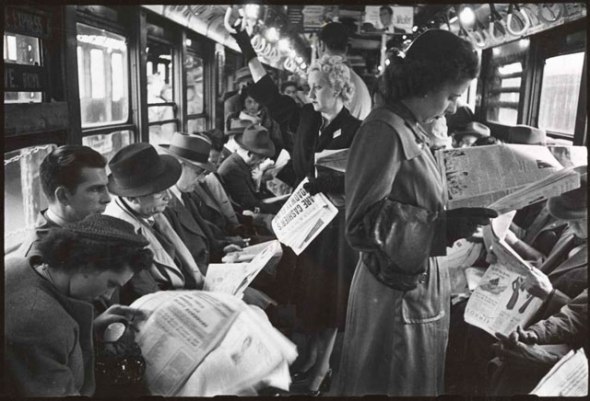
Photo by Stanley Kubrick for Life Magazine
Good Morning!!
I have some serious news reads for you this morning, but–just because it’s a feel-good story–I’m going to begin with one more Market Basket update. The Boston Globe published an article yesterday about the Market Basket store I shop at in, in Burlington, MA: A Market Basket store, returning to life. Recall that the shelves were mostly empty when the employees returned to work on Thursday morning.
The doors of the tractor-trailer open on a bounty of chicken, Swiss cheese, and sliced onions.
A swarm of grocery clerks in blue jackets and managers in red descends on the loading dock, using hand-operated electric jacks to spear pallets of food that the workers stack in the cavernous storage rooms in the back of the Market Basket supermarket….Bob McKeown fills a display case with fresh-from-the-fryer doughnuts, a few garnished with smiley faces made of jelly. Samantha Bond decorates a cake to honor the moment, etching the words “Market Basket Strong” in icing and an image of the yellow giraffe that served as the employees’ mascot of sorts during the protest — for “sticking their necks out.” ….
This Market Basket store in Burlington came back to life over the last few days, resuscitated by a cadre of employees eager to get to work after the six-week protest that forced the return of Arthur T. Demoulas as head of the family food empire. Like the others in the 71-store chain, the Burlington store was the scene of a rapid restocking, a huge task involving thousands of pounds of produce, meat, bread, canned goods, and other groceries….
The first morning back had been about congratulations and hugs and handshakes as customers came in more to talk to employees than to shop. Amid the celebrations, workers admitted to anxious moments during the stoppage. They worried their defiance would cost them their jobs — “I’ve been living on antacids for the last six weeks,” one said — and couldn’t wait to get back to the unglamorous but satisfying routine of running a supermarket.
That routine had returned in full by early Friday.
It’s a nice story, and I’m so happy for these workers. Isn’t it great that this happened over Labor Day weekend?
Now for the not-so-upbeat news . . .

NBC News reports, Terror Leader Linked to Kenya Mall Massacre Targeted by U.S. Strike.
The U.S. military launched an airstrike in Somalia on Monday targeting the leader of the al Qaeda-affiliated group behind the Kenya mall massacre. U.S. officials told NBC News that a military drone launched Hellfire missiles at at least two vehicles in a remote area of southern Somalia. Sources said Ahmed Abdi Godane, the top leader of al Shabab, was the attack’s target. Al Shabab claimed responsibility for last September’s Westgate Mall siege that left at least 67 dead and around 200 injured. One U.S. security source described Godane as “operationally savvy and ideologically driven, with aspirations off the charts.”
Rear Adm. John Kirby, the Pentagon’s press secretary, said in a statement late Monday that “we are assessing the results of the operation and will provide additional information as and when appropriate.” Godane has served as the group’s leader since a U.S. airstrike killed his predecessor Aden Hashi Ayro in 2008. In October, U.S. commandos launched raids in Somalia seeking to capture Godane, who is also known as Mukhtar Abu Zubeyr. Reuters reported that Godane’s close associate, Ahmed Mohamed Amey, was killed by a U.S. airstrike in January. In an online audio message following the Westgate Mall massacre, Godane said Kenya should be “prepared for an abundance of blood that will be spilt in your country.” Al Shabab, which means “The Youth” in Arabic, seized much of southern Somalia in 2006 before Somali forces and African peacekeeping troops ousted it five years later.

Photo of NY subway by Walker Evans
AP reports (via ABC News) that 6 militants were killed in the raid. There aren’t a lot of details as yet, but here’s a backgrounder on al-Shabab from The Council on Foreign Relations. Here’s the introduction and information on how the group began.
Al-Shabab, or “The Youth,” is an al-Qaeda-linked militant group and U.S.-designated Foreign Terrorist Organization fighting for the creation of a fundamentalist Islamic state in Somalia. The group, also known as Harakat al-Shabab al-Mujahideen, and its Islamist affiliates once held sway over Mogadishu and major portions of the Somali countryside, but a sustained African Union military campaign in recent years has weakened the group considerably. Still, security analysts warn that the group remains the principal threat in a politically volatile, war-torn state.
Al-Shabab’s terrorist activities have mainly focused on targets within Somalia, but it has also proven an ability to carry out deadly strikes in the region, including coordinated suicide bombings in Uganda’s capital in 2010 and a deadly raid on a Nairobi mall in 2013. Washington fears the group, which has successfully recruited members of the Somali-American diaspora, may orchestrate strikes on U.S. soil. In recent years, the United States has pursued a two-pronged policy in Somalia: providing funding, training, and logistical support to UN-backed African forces battling al-Shabab, while escalating counterterrorism operations including Special Forces and armed drones….
Somalia, one of the most impoverished countries in the world, has seen a number of radical Islamist groups come and go in its decades-long political tumult. The group analysts cite as al-Shabab’s precursor, and the incubator for many of its leaders, is Al-Ittihad Al-Islami (aka Unity of Islam), a militant Salafi extremist group that peaked in the 1990s after the fall of the Siad Barre military regime (1969-1991) and the outbreak of civil war.
AIAI, which sought to establish an Islamist emirate in Somalia, sprang from a band of Middle Eastern-educated Somali extremists and was partly funded and armed by al-Qaeda chief Osama bin Laden. Many of its fighters, including current al-Shabab commanders, fled the country and fought in Afghanistan in the late 1990s after being pushed out by the Ethiopian army and its Somali supporters. The group was designated a terrorist organization by the U.S. State Department in the days after the September 11, 2001 attacks.
In 2003, a rift developed between AIAI’s old guard, which had decided to create a new political front, and youth members who sought the establishment of a “Greater Somalia” under fundamental Islamic rule. The hardliners eventually joined forces with an alliance of sharia courts, known as the Islamic Courts Union, serving as its youth militia in the battle to conquer Mogadishu’s rivaling warlords. Al-Shabab and the ICU wrested control of the capital in June 2006, a victory that stoked fears of spillover jihadist violence in neighboring Ethiopia, a majority Christian nation.
Much more at the CFR link.

Yesterday, U.S. planes carried out an operation against ISIS militants in Iraq. Reuters: U.S. planes strike militants near Iraq’s Amreli, airdrop aid.
President Barack Obama authorized the new military action, broadening U.S. operations in Iraq amid an international outcry over the threat to Amerli’s mostly ethnic Turkmen population.
U.S. aircraft delivered over a hundred bundles of emergency supplies and more aid was dropped from British, French and Australian planes, officials said, signaling headway in Obama’s efforts to draw allies into the fight against Islamic State.
Iraqi army and Kurdish forces closed in on Islamic State fighters on Saturday in a push to break the Sunni militants’ siege of Amerli, which has been surrounded by the militants for more than two months.
Armed residents of Amerli have managed to fend off attacks by Islamic State fighters, who regard the town’s majority Shi’ite Turkmen population as apostates. More than 15,000 people remain trapped inside.
“At the request of the government of Iraq, the United States military today airdropped humanitarian aid to the town of Amerli, home to thousands of Shia Turkmen who have been cut off from receiving food, water, and medical supplies for two months by ISIL,” Rear Admiral John Kirby, the Pentagon press secretary, said, using an alternative name for Islamic State.
“In conjunction with this airdrop, U.S. aircraft conducted coordinated air strikes against nearby ISIL terrorists in order to support this humanitarian assistance operation,” he said, adding that a key objective was to prevent a militant attack on civilians in the town.

President Obama is headed to Estonia today and then to Wales for the NATO Summit. CBS News reports, Russia and ISIS take center stage on Obama’s Europe trip.
President Obama leaves for Europe Tuesday with stops in Estonia and a NATO summit in Wales amid escalating crises in Ukraine and in Iraq and Syria, crises that are having a direct impact on a number of European nations.
While the Russian threat in Ukraine will be the focus of the upcoming summit, the meeting also puts President Obama, Secretary of State John Kerry and Defense Secretary Chuck Hagel face to face with European countries who may be willing to join the U.S. in dealing with the other crisis in Iraq and Syria.
Officially, however, NATO says it doesn’t want to be involved in dealing with the Islamic militant group called the Islamic State of Iraq and Syria (ISIS) that has swept across Iraq and Syria and poses a growing threat to the U.S. and parts of Western Europe that might be targeted by foreign fighters.
Why is Obama stopping in Estonia?
“It is clearly not accidental that the president has decided to stop in Estonia on the way to the NATO Summit. The two stops are essentially part of the same effort to send a message to the Russians that their behavior is unacceptable,” said Charles Kupchan, the White House’s senior director for European Affairs.
Estonia, like Ukraine, has a large Russian population and is concerned about the potential of pro-Russian unrest there too. But Kupchan said Mr. Obama will send the message that the Article 5 commitment to common defense of other nations is ironclad.
“Russia, don’t even think about messing around in Estonia or in any of the Baltic areas in the same way you have been messing around in Ukraine,” Kupchan said the president would relay to allies there.
Mr. Obama will meet with the leaders of Estonia, Latvia and Lithuania and also speak to young people there.
Read more details about the NATO Summit at the link.
According to the New York Times, Russia is already making plans to respond to expected NATO actions.
MOSCOW — With NATO leaders expected to endorse a rapid-reaction force of 4,000 troops for Eastern Europe this week, a senior Russian military official said on Tuesday that Moscow would revise its military doctrine to account for “changing military dangers and military threats.”
In an interview with the Russian state news agency RIA Novosti, the official, Mikhail Popov, deputy secretary of Russia’s military Security Council, called the expansion of NATO “one of the leading military dangers for the Russian Federation.”
Mr. Popov said Russia expected that leaders of NATO would seek to strengthen the alliance’s long-term military presence in Eastern Europe by establishing new military bases in the region and by deploying tanks in Estonia, a member of NATO that borders Russia.
“We believe that the defining factor in our relationship with NATO remains the unacceptability for Russia of plans to move military infrastructures of the alliance to our borders, including by means of expanding the bloc,” Mr. Popov said.
And so, we move closer to the possibility of another world war. At least that’s what Ann Applebaum of Slate suggested recently: Putin has invaded Ukraine. Is it hysterical to prepare for total war with Russia? Or is it naive not to? It’s brief and to the point, so please give it a read.

The New York Times also has an important story about the sex-trafficking scandal in Great Britain. I read about it at the Guardian a few days ago, but we haven’t discussed it here. The Times reports, Years of Rape and ‘Utter Contempt’ in Britain. Here’s the introduction:
ROTHERHAM, England — It started on the bumper cars in the children’s arcade of the local shopping mall. Lucy was 12, and a group of teenage boys, handsome and flirtatious, treated her and her friends to free rides and ice cream after school.
Over time, older men were introduced to the girls, while the boys faded away. Soon they were getting rides in real cars, and were offered vodka and marijuana. One man in particular, a Pakistani twice her age and the leader of the group, flattered her and bought her drinks and even a mobile phone. Lucy liked him.
The rapes started gradually, once a week, then every day: by the war memorial in Clifton Park, in an alley near the bus station, in countless taxis and, once, in an apartment where she was locked naked in a room and had to service half a dozen men lined up outside.
She obliged. How could she not? They knew where she lived. “If you don’t come back, we will rape your mother and make you watch,” they would say.
At night, she would come home and hide her soiled clothes at the back of her closet. When she finally found the courage to tell her mother, just shy of her 14th birthday, two police officers came to collect the clothes as evidence, half a dozen bags of them.
But a few days later, they called to say the bags had been lost.
“All of them?” she remembers asking. A check was mailed, 140 pounds, or $232, for loss of property, and the family was discouraged from pressing charges. It was the girl’s word against that of the men. The case was closed.
God, what a horrible story! Here’s a related post at The Daily Beast, The Psychology of Sex Slave Rings, by Charlotte Lytton. Lytton asks a controversial question, “are grooming rings endemic within certain cultures?”

Back in the USA, CNN reports that the FBI is investigating a hacker who released nude photos of Jennifer Lawrence and several other female celebrities over the weekend. That’s good news. I hope they put catch the culprit and put him in prison for a very long time.
Here’s a little political news from Reuters, via Huffington Post: Eric Cantor To Join Investment Bank Moelis & Co. As Vice Chairman And Managing Director.
Former U.S. House Majority Leader Eric Cantor will join investment bank Moelis & Co as vice chairman and managing director, the company said, adding that Cantor will also be elected to its board….
“Eric has proven himself to be a pro-business advocate and one who will enhance our boardroom discussions with CEOs and senior management as we help them navigate their most important strategic decisions,” Moelis CEO Ken Moelis said in a statement.
And finally, Politico writes: WHY THERE (PROBABLY) WON’T BE A SHUTDOWN
The apparent (but not finalized) decision by the White House to push executive action on immigration reform past the November midterms means there is no forcing mechanism to create a shutdown fight when government funding runs out Sept. 30th. Qorvis’ Stan Collender, a top budget expert, emails: “I never thought a shutdown was likely this fall (next March is another issue), but in a rational world delaying action on immigration should kill any chance of one happening. Then again — Benghazi, Obamacare, etc”
So, those are this morning’s breaking news headlines. What else is happening? Please post your thoughts and links in the comment thread, and have a terrific Tuesday!
Tuesday Reads: Comedies and Errors
Posted: June 3, 2014 Filed under: morning reads | Tags: Bowe Bergdahl, hostage negotiations, Nicholas Kristof, sex trafficking, Somaly Mam 60 CommentsEvery why hath a wherefore.
William Shakespeare from Comedy of Errors
Good Morning!
I’ve found several stories worth following today.
First, it seems that Somaly Mam of the Cambodian foundation that rescues underage girls from sex work is under heavy scrutiny and criticism. Mam has been the focus of a series of articles in the NYT by Nicholas Kristof as well as documentaries and books. It seems she got creative in her storytelling. Kristof has yet to write or speak on the matter.
In Nicholas Kristof’s columns in the New York Times, he portrayedMs. Mam in an extraordinarily positive light. He was not alone in doing so. Ms. Mam attracted many high-profile supporters, from Susan Sarandon to John Kerry to Sheryl Sandberg.
In a 2009 column, Mr. Kristof told the story of Long Pross, a teenager (also known as Somana) who said that her eye had been gouged out by a pimp, after she was forced into prostitution. Newsweek has reported, based on medical records, that the girl’s missing eye is the result of surgery to remove a non-malignant tumor when she was 13.
A great deal of money has been raised to combat sex-trafficking, in part as a result of Mr. Kristof’s writing about Ms. Mam on multiple occasions. And there’s little doubt that sex-trafficking is a problem worth paying attention to, and working to end. But now that Ms. Mam has stepped down from the foundation that bears her name — following not only the Newsweek story but the foundation’s internal investigation — many readers, on Twitter and in emails to my office, are asking what Mr. Kristof’s responsibility is for setting the record straight.
 Mam has quit her own foundation.
Somaly Mam’s story is incredible. Her autobiography, “The World of Lost Innocence,” detailed how she was born in a village in the Cambodian rain forest and sold into sexual slavery as a child by her “grandfather.” She was stuck in Southeast Asia’s sex industry for 10 years until she finally escaped in her early 20s (her exact age isn’t clear as she has no birth documents).
Mam began to settle into regular life, marrying a French man, moving to Europe and having children of her own. But her childhood experiences led her to save other girls who were suffering a similar fate. She returned to Cambodia and set up Acting for Women in Distressing Situations (known by its French acronym Afesip), a charity devoted to rescuing women and girls in Cambodia and neighboring Laos who are forced into prostitution.
Her efforts gained her international recognition – a 2009 appearance in the Time 100 was written by Angelina Jolie – and in turn raised millions for the protection of children and women from prostitution. But as incredible as that story is, its accuracy is now in serious doubt. On Wednesday, Gina Reiss-Wilchins, executive director of the Somaly Mam Foundation, a U.S.-based organization that acted as a fundraiser for Afesip, said that Mam had resigned from the foundation after being presented with the findings of an investigation by a California-based law firm, Goodwin Procter (Mam is not currently employed by Afesip).
While the exact details from Goodwin Procter have not been released, allegations of inconsistencies in Mam’s past have been around for years. Doubts went back at least as far as 2012, when Mam gave a speech to the U.N. General Assembly that said that the Cambodian army had killed eight girls after a raid on her organization’s Phnom Penh center in 2004.
Following an investigation by Simon Marks in Cambodia Daily, Mam admitted that the claim was inaccurate. “I had in no way intended to allege that girls were murdered during the shelter raid,” Mam told Cambodia Daily in an e-mail, adding that her comments had been “ambiguous.”
Later that year, Pierre Legros – Mam’s French ex-husband – came forward to describe another incident that had not occurred as Mam had described it. In 2006, Mam told Mariane Pearl, wife of Daniel Pearl, in an article for Glamour Magazine that her teenage daughter had been abducted by human traffickers as revenge for her activism. Mam mentioned the incident again in her U.N. speech, which prompted Legros to respond. His daughter had in fact run away with a boyfriend, he said, claiming that he wanted to protect her privacy and stop her being used as “marketing” for the Somaly Mam Foundation.
Other NGOs working on sex trafficking are trying to pick up the pieces.
What the Somaly Mam story highlights is a state of affairs that many of us in the social change movement bemoan, namely that simple stories of exploitation rarely grab the public’s imagination, the donors, or the press. Unless the overdone images of runny noses, torn clothing, or worse, naked children in a cage waiting to be sold, are splashed on glossy pages, the actual suffering of human beings too often fails to trigger widespread empathy or outrage.
In addition to this heightened need for sensationalism, our society craves numbers. Suffering in small quantities is rarely enough. Given the undercover and “hidden in plain sight” crimes of human trafficking, no entity has been definitively able to pin down the actual number of victims. From the United Nations to national statistics, the numbers range widely from 2.5 million to 20.9 million. Irrespective of the range, all agree that the majority of those estimated individuals are women and children with a majority of that group ending up in the sex trade. In a recent report, theInternational Labor Organization estimated that profits from human trafficking generated $150 billion, two-thirds of which, or $90 billion, stem from commercial sexual exploitation.
Cambodia is designated as a source, transit and destination country for labor and sex trafficking. The U.S. State Department also found that the sale of virgin women and girls continues to be a problem and that Cambodian men form the “largest source of demand for child prostitution.” Regardless of its founder’s personal failings, the Somaly Mam Foundation has plenty of urgent work ahead.
In collaboration with the Cambodian Women’s Crisis Center, Dr. Melissa Farley, of Prostitution Research and Education, interviewed 133 Cambodian men who purchased commercial sex. The study shows that almost all of these male buyers interviewed in Phnom Penh stated that they witnessed extreme violence inflicted on the prostituted women, more often than not controlled by pimps. The men surveyed also saw children available for paid sexual abuse in brothels, bars and massage parlors. One of the “johns” astutely said that “prostitution is the man’s heaven but it is also those girls’ hell.”
The Somaly Mam episode cannot be used as an excuse to deny or ignore the undeniable exploitation of countless human beings in the sex trade
 Tons of controversy surrounds the capture and release of American POW Bowe Bergdahl. I’ve been reading some on this and there are several threads of outrage going on. Some felt Bowe should have been left to the Taliban because of some evidence that he went AWOL. Others believe that it’s a value of our country and are armed services to leave no one behind. The right wing is going berserk over some twitters posted by Bergdahl’s father. I’m not sure what the implication is supposed to be, but the entire thing is turning into a circus act. Snow Flake Snookie has hit the grifting trail in search of outrage and funds. Some how, she has decided the soldier’s guilt and fate so any potential military tribunal should just STFU. I’ve been looking for less outraged and more informative sources. Here’s the story from one soldier who was assigned to hunt for Bergdahl along with other soldiers. Some of these soldiers were KIA.
Our deployment was hectic and intense in the initial months, but no one could have predicted that a soldier would simply wander off. Looking back on those first 12 weeks, our slice of the war in the vicinity of Sharana resembles a perfectly still snow-globe—a diorama in miniature of all the dust-coated outposts, treeless brown mountains and adobe castles in Paktika province—and between June 25 and June 30, all the forces of nature conspired to turn it over and shake it. On June 25, we suffered our battalion’s first fatality, a platoon leader named First Lieutenant Brian Bradshaw. Five days later, Bergdahl walked away.
His disappearance translated into daily search missions across the entire Afghanistan theater of operations, particularly ours. The combat platoons in our battalion spent the next month on daily helicopter-insertion search missions (called “air assaults”) trying to scour villages for signs of him. Each operations would send multiple platoons and every enabler available in pursuit: radio intercept teams, military working dogs, professional anthropologists used as intelligence gathering teams, Afghan sources in disguise. They would be out for at least 24 hours. I know of some who were on mission for 10 days at a stretch. In July, the temperature was well above 100 degrees Fahrenheit each day.
These cobbled-together units’ task was to search villages one after another. They often took rifle and mortar fire from insurgents, or perhaps just angry locals. They intermittently received resupply from soot-coated Mi-17s piloted by Russian contractors, many of whom were Soviet veterans of Afghanistan. It was hard, dirty and dangerous work. The searches enraged the local civilian population and derailed the counterinsurgency operations taking place at the time. At every juncture I remember the soldiers involved asking why we were burning so much gasoline trying to find a guy who had abandoned his unit in the first place. The war was already absurd and quixotic, but the hunt for Bergdahl was even more infuriating because it was all the result of some kid doing something unnecessary by his own volition.
Some of the contentiousness is due to the five Taliban who were swapped for the soldier. None of these guys will ever be up for humanitarian awards  and some feel they are still a danger.
Below is information about each of the detainees released.
Khairullah Khairkhwa is the most senior ex-Guantanamo prisoner who comes from “the fraternity of original Taleban who launched the movement in 1994,” according the Afghanistan Analysts Network. He surrendered to President Hamid Karzai’s brother just before he was captured in January 2002. His most prominent position was as governor of Herat Province from 1999 to 2001. He served in various Taliban positions including interior minister and had direct ties to Mullah Omar and Osama bin Laden.
Mullah Norullah Noori served as governor of Balkh Province in the Taliban regime and played some role in coordinating the fight against the Northern Alliance. He was a senior Taliban commander in the northern city of Mazar-e-Sharif when the Taliban fought U.S. forces in late 2001.
Mohammad Fazl commanded the main force fighting the U.S.-backed Northern Alliance in 2001 and served as chief of army staff under the Taliban regime. Human Rights Watch says he could be prosecuted for war crimes for presiding over the mass killing of Shiite Muslims in Afghanistan in 2000 and 2001 as the Taliban sought to consolidate their control over the country. Fazl joined the Taliban early, never held a civilian post, and rose through the ranks because of his fighting ability, ending up up as one of their most important and feared military commanders, according to the Afghanistan Analysts Network.
Abdul Haq Wasiq was the deputy chief of the Taliban regime’s intelligence service and the cousin of the head of the service, Qari Ahmadullah, who was among the Taliban’s founding members, according to the Afghanistan Analysts Network.
Mohammed Nabi was a Taliban official in Khost Province. He served as chief of security for the Taliban in Qalat, Afghanistan, and later worked as a radio operator for the Taliban’s communications office in Kabul.
 Conveniently forgotten US history includes huge numbers of deals like this. Ronald Reagan’s arms for hostages deal is only one among many.
The US has all along negotiated with the guerrillas it has fought on the battlefield. William Howard Taft (later president) in the Philippines was all for negotiation with Filipinos who rejected US rule, and he created “attraction zones” to win them over. At the conclusion of the Aguinaldo resistance to US occupation in 1902, Teddy Roosevelt declared a general amnesty for the resistance fighters. These resistance fighters had committed some atrocities, including on captured US troops, but Roosevelt just let them walk free. Talk softly, carry a big stick, and let all the terrorists go, seems to have been his motto.
The US negotiated with the Viet Cong in South Vietnam, who were very much analogous to the Taliban and whom the US would now certainly term “terrorists.” In 1973, the US used intermediaries to negotiate with the Viet Cong for release of captured US soldiers at Loc Ninh. Americans on the political right made a huge issue about 1300 US soldiers never having been released by the Viet Cong (only about 400 were), and the shame that these men were left on the battlefield by the Nixon and Ford administrations. Conservatives seem to want to have it both ways. If you negotiate the release of US captives with the enemy you are “negotiating with terrorists.” If you don’t, then you have left soldiers behind on the battlefield. The fact is that the only way to have freed them was to have offered something for them in detailed negotiations. As for the Viet Cong “terrorists,” many of them are in government now and the US has cordial relations with them.
In the 1980s radical Shiites in Lebanon took American hostages. In order to free them, the Reagan administration not only negotiated with I han’s Ayatollah Khomeini but actually stole T.O.W. anti-aircraft munitions from Pentagon warehouses and shipped them to Tehran, receiving the money for them in black bank accounts and sending it to right wing death squads in Nicaragua. Khomeini and his government were listed as terrorists by the State Department at the time, and selling weapons to Iran was highly illegal. Not only that, but the US was allied with Iraq at the time, so Reagan screwed over Baghdad this way. Reagan did it, in part to free US hostages in Lebanon (Iran put pressure on its clients for their release).
One of the big gag reflexes from the right appears to be the label of “terrorist” as compared to insurgent.
 So, what are some other stories that you may want to check out?
Football Hall of Famer Dan Marino sues NFL over concussions
We’ve talked about the horrible damage caused by concussions before. Other players have settled suits but this one is from a big name player.
Yes, you read that right. Female named hurricanes don’t get any respect.
Montana House GOP candidates want to impeach Obama
Can I ever get to the point where I can’t say that the GOP is just bug fuck crazy?
So, those are the items that caught my interest. What’s on your reading and writing list today?

 peej
peej Carissa
 bostonboomer
 dakinikat
 ecocatwoman
 mablue2
 Mama Lopez
 peggysue22
 quixote
 skydancingguestblogger
 Mona (aka Wonk the Vote)



 Sky Dancing
Recent Comments