
SCOTUS and the Arizona Immigration Law
Posted: April 25, 2012 Filed under: immigration, SCOTUS | Tags: Arizona Immigration Law, SCOTUS 14 CommentsThe Supremes heard arguments on the Arizona Immigration Law today. This is the law that Romney considers to be a blueprint for immigration laws in the US that 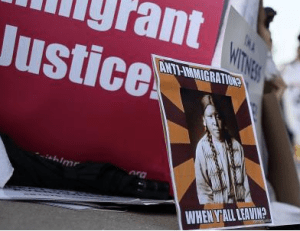 has been challenged by the Obama Justice Department. I’m not a lawyer so I can’t offer up any authoritative opinions, but I can offer up some reads for you.
From the NYT: Justices Seem Sympathetic to Central Part of Arizona Law
Mr. Verrilli, representing the federal government, had urged the court to strike down part of the law requiring state law enforcement officials to determine the immigration status of anyone they stop if the officials have reason to believe that the person might be an illegal immigrant.
“Why don’t you try to come up with something else?” Justice Sotomayor asked Mr. Verrilli.
It was harder to read the court’s attitude toward the three other provisions of the law at issue in the case, including ones that make it a crime for illegal immigrants to work or to fail to register with federal authorities. The court’s ruling, expected by June, may thus be a split decision that upholds parts of the law and strikes down others.
Should the court uphold any part of the law, immigration groups are likely to challenge it based on an argument not before that court on Wednesday — that the law discriminates on the basis of race and ethnic background.
Indeed, Chief Justice John G. Roberts Jr. made clear that the case, like last month’s arguments over President Obama’s health care law, was about the allocation of state and federal power.
“No part of your argument has to do with racial or ethnic profiling, does it?” the chief justice asked Mr. Verrilli, who agreed.
SCOTUSblog: Argument recap: A choice between radical and reasonable?
With Justice Antonin Scalia pushing the radical idea that the Constitution gives states clear authority to close their borders entirely to immigrants without a legal right to be in the U.S., seven other Justices on Wednesday went looking for a more reasonable way to judge states’ power in the immigration field. If the Court accepts the word of Arizona’s lawyer that the state is seeking only very limited authority, the state has a real chance to begin enforcing key parts of its controversial law — S.B. 1070 — at least until further legal tests unfold in lower courts.
In an oral argument that ran 20 minutes beyond the scheduled hour, the Justices focused tightly on the actual operation of the four specific provisions of the law at issue, and most of the Court seemed prepared to accept that Arizona police would act in measured ways as they arrest and detain individuals they think might be in the U.S. illegally. And most of the Justices seemed somewhat skeptical that the federal government would have to change its own immigration priorities just because states were becoming more active.
At the end of the argument in Arizona v. United States (11-182), though, the question remained how a final opinion might be written to enlarge states’ power to deal with some 12 million foreign nationals without basing that authority upon the Scalia view that states have a free hand under the Constitution to craft their own immigration policies. The other Justices who spoke up obviously did not want to turn states entirely loose in this field. So perhaps not all of the four clauses would survive — especially vulnerable may be sections that created new state crimes as a way to enforce federal immigration restrictions.
The Hill: Supreme Court seems favorable to Arizona illegal immigration law
Chief Justice John Roberts said he didn’t see a problem with that portion of the Arizona law, S.B. 1070. Under the statute, state officials would be notifying federal officials of the immigration status of the person in question. Roberts argued that the power to decide what to do with the that person still lay within the hands of the federal government. He also said the state, in that instance, would be attempting to help the federal government and supersede its role.
A key element to the government’s objections to the Arizona law rests on the argument that the state law conflicts with federal immigration laws already in place.
Verrilli also argued that immigration enforcement matters were entrusted to the federal government by the framers of the country — and not to the states — because they involve matters of foreign policy.
A final decision will not be reached until June, but the line of questioning from the more liberal and conservative justices alike seemed to indicate a belief that Arizona had a stronger case than the government on at least two of the law’s four provisions under question.
The passage of the law created an uproar last year and renewed the national debate over how to deal with the millions of illegal immigrants living in the United States. It’s expected to be an issue in the election as the Obama administration sued to stop it, and Mitt Romney, the presumptive GOP nominee, has expressed support for parts of it.
This is turning out to be a very interesting SCOTUS session and it appears that most of the justices have a distinct ideological bias. This proves that elections may not always bring the results in other areas but in terms of stacking the supreme court, the election of Presidents with IOUs to an ideological base shows up in how our laws will be interpreted.
Monday Reads
Posted: April 9, 2012 Filed under: morning reads | Tags: Romney's serial lies, SCOTUS, strip search rule, women justices 27 Comments Good Morning!
The Supreme Court has gotten more contentious as the three hard right justices feel they can throw their words and weight around more than ever. But what about the three women on the court?
And then there were the Court’s women, Justices Ruth Bader Ginsburg, Elena Kagan and Sonia Sotomayor, who, compared to the verbose right-wingers received less coverage—even as they exhibited qualities that most Americans expect of their highest judges: restraint, focus, nuance, empathy and a respect for exercising the power of federal government.
Is this just more sexism by the press? Are there double-standards when it comes to points made by the women justices, compared to their belligerent male colleagues? The answer, of course, is yes. But let’s look at some of the points that the women made—reinforced, often, by another moderate justice, Stephen Breyer. It reveals Americans would be well served by having more thoughtful, like-minded women—and men—on the Supreme Court.
Check out the Alternet article that reviews some of the women’s impact on the court.
Meanwhile, civil liberties activists and lawyers are trying to make sense of the SCOTUS decision that allows police officers to strip search people even if they are arrested for a routine traffic stop.
The plaintiff in the strip-search case was arrested after a routine traffic stop and jailed for a minor outstanding warrant that may well have been a mistake. Before entering the jail, he was forced to strip, lift his genitals, squat and cough. If that isn’t an assault on human dignity, you might think, what is?
The short answer is that Kennedy couldn’t find a violation of dignity for the petitioner because almost everyone committed to a jail or prison gets similar treatment. (Some states have banned the practice after minor arrests.) Every arrest, even for major offenses, is supposed to take place on the basis of suspicion, not proven guilt. Everyone in jail is equally presumed innocent until proven guilty at trial — or until he or she admits guilt in a plea bargain. To find that all of these people are having their most basic rights violated every day would have been too disruptive to the basic practices of American criminal justice.
As a result, instead of arguing about dignity, the justices disagreed about the practical question of whether invasive strip-searches are reasonably necessary to serve the interests of the jails and prisons. Kennedy’s majority opinion said that they were.
Justice Stephen Breyer, in dissent, pointed to studies finding the opposite. In one, conducted in New York under the supervision of the federal courts, one prisoner out of 23,000 searched had hidden contraband in his body in a way that would have avoided detection by X-ray and a pat-down. A California study found three instances out of 75,000 prisoners strip- searched.
It’s hard to avoid the conclusion that the strip-searches, however well-intentioned when first instituted, now function to humiliate people being put behind bars, sending the message that they are now essentially nonpersons, under the full control of the state.
Robert Reich reminds us that without jobs and decent incomes, our recovery is still very fragile. This is what I’ve been saying for some time. Businesses are only going to hire if they have customers. Customers need jobs and good incomes to be customers. Even though the private sector is growing steadily, there are still huge numbers of layoffs coming from state and local governments. Huge corporations can do business elsewhere. It’s very hard for job seekers to move to where the economy is good if it’s half way around the world.
Remember: consumer spending is 70% of the US economy. Employers won’t hire without enough sales to justify the additional hires. It’s up to consumers to make it worth their while.
But real spending by American consumers (adjusted to remove price changes) this year hasn’t been going anywhere. It increased just 0.5% in February, after an anemic 0.2% increase in January.
The reason consumers aren’t spending more is simple: they don’t have the money. Personal income was up just 0.2% in February – barely enough to keep up with inflation. As a result, personal saving as a percentage of disposable income tumbled to 3.7% in February, from 4.3% in January. Personal saving is now at its lowest level since March 2009.
American consumers, in short, are hitting a wall. They don’t dare save much less than they are now because their jobs are still insecure. They can’t borrow much more. Their home values are still dropping, and many are underwater – owing more on their homes than the homes are worth.
The economy has been growing, to be sure, but almost all the gains have gone to the very top. This is the most lopsided recovery on record.
SOS Hillary Clinton will not be attending the Democratic convention this year. As is tradition, the Secretary of State stays out of national politics to focus on US foreign policy.
Hillary Clinton, perhaps President Barack Obama’s most high-profile cabinet member, won’t be attending this year’s Democratic convention in Charlotte, N.C., citing the duties of her job as secretary of state.
“Given her current position, she will not be attending, consistent with her not engaging in any political activity whatsoever,” Philippe Reines, Clinton’s spokesman, told the Charlotte Observer on Friday.
He added that it will be the first time Clinton will miss a Democratic convention in decades, “possibly all the way back to ’68 in Chicago.”
Malawi has sworn in its first female president.
Vice-President Joyce Banda was sworn in as Malawi’s new head of state on Saturday, the BBC reports. She is the first female head of state in southern Africa. President Bingu wa Mutharika went into cardiac arrest on Thursday, but his death wasn’t officially announced until Saturday. Banda was one of President Mutharika’s most vocal critics. She was expelled from the governing party in 2010 over her criticisms with Mutharika and went on to form her own opposition party.
Ever wonder how Romney gets away with repeating so many lies with very few reporters mentioning it? I’ve watched Rachel Maddow cover it and have just been awed by the number of whoppers that Willard seems to continually drop without even a blink.
Romney denounced Obama for “apologizing for America abroad” during his first years in office rather than focusing on the economy. It’s another silly and inaccurate claim. PolitiFact awarded Romney a “Pants on Fire” rating for having made such a statement during his June 2, 2011, speech announcing his presidential bid. But this line obviously plays well for Romney. He has used it over and over.
I could go on, but the drift is clear. Romney’s speech was loaded with false statements. The various fact-checking sites did pounce on Romney for several of his prevarications. AP also ran a story noting that both Obama and Romney had “warped some realities” in recent speeches. But that article failed to note that the examples it listed for Obama had the president (arguably) spinning political characterizations in his favor, while the Romney examples were flat-out untrue assertions Romney made regarding Obama. Once again, a mainstream media outfit was perpetuating a false equivalency.
Romney stood before a gathering of journalists. He made a series of incorrect and dishonest accusations. And he was not hooted out of the room. He faced no penalty for this—just a few slaps from those pesky, fact-checking schoolmarms. He will not be banned from similar forums. The politerati is not up in arms. His campaign rolled on. And this may well sum up one of the fundamental problems with American politics.
So, enough from me. What’s on your reading and blogging list today?
Thursday Reads
Posted: March 29, 2012 Filed under: Crime, Health care reform, legislation, racism, Republican politics, U.S. Politics | Tags: Affordable Care Act, Anthony Kennedy, Antonin Scalia, Arlen Specter, autopsy, Capt. Clayton Frederick Osbon, Chris Serino, Colorado wildfire, cuba, Fidel Castro, George Zimmerman, LA Dodgers, Magic Johnson, Obamacare, Pope Benedict, racial profiling, racial stereotyping, Sanford FL, SCOTUS, Sonia Sotomayor, Tracy Martin, Trayvon Martin 50 Comments
Good Morning!!
Most of the commentators seem to think it doesn’t look good for the health care bill. At SCOTUS Blog, there’s an index of yesterday’s coverage.
The New York Times editorial addresses the “test” the Supreme Court faces in their decision on this case.
In ruling on the constitutionality of requiring most Americans to obtain health insurance, the Supreme Court faces a central test: whether it will recognize limits on its own authority to overturn well-founded acts of Congress.
The skepticism in the questions from the conservative justices suggests that they have adopted the language and approach of the insurance mandate’s challengers. But the arguments against the mandate, the core of the health care reform law, willfully reject both the reality of the national health care market and established constitutional principles that have been upheld for generations.
The Obama administration persuasively argues that the mandate is central to solving the crisis in America’s health care system, which leaves 50 million people uninsured and accounts for 17.6 percent of the national economy. The challengers contend that the law is an unlimited — and, therefore, unconstitutional — use of federal authority to force individuals to buy insurance, or pay a penalty.
That view wrongly frames the mechanism created by this law. The insurance mandate is nothing like requiring people to buy broccoli — a comparison Justice Antonin Scalia suggested in his exasperated questioning of Solicitor General Donald Verrilli Jr. Congress has no interest in requiring broccoli purchases because the failure to buy broccoli does not push that cost onto others in the system.
It’s really frightening to think of the possible implications of the justices overturning this law. Will the right wingers challenge Medicare and Social Security next? Dahlia Lithwick says the right wingers on the Court seem to want to return the country to “freedom” circa 1804.
The fight over Obamacare is about freedom. That’s what we’ve been told since these lawsuits were filed two years ago and that’s what we heard both inside and outside the Supreme Court this morning. That’s what Michele Bachmann* and Rick Santorum have been saying for months. Even people who support President Obama’s signature legislative achievement would agree that this debate is all about freedom—the freedom to never be one medical emergency away from economic ruin. What we have been waiting to hear is how members of the Supreme Court—especially the conservative majority—define that freedom. This morning as the justices pondered whether the individual mandate—that part of the Affordable Care Act that requires most Americans to purchase health insurance or pay a penalty—is constitutional, we got a window into the freedom some of the justices long for. And it is a dark, dark place.
But the “conservative” justices, who are covered by government subsidized health insurance appear to think freedom means the right to let people die if they can’t pay for health care.
[Sonia] Sotomayor…pondering whether hospitals could simply turn away the uninsured, finally asks: “What percentage of the American people who took their son or daughter to an emergency room and that child was turned away because the parent didn’t have insurance—do you think there’s a large percentage of the American population who would stand for the death of that child if they had an allergic reaction and a simple shot would have saved the child?”
But we seem to want to be free from that obligation as well. This morning in America’s highest court, freedom seems to be less about the absence of constraint than about the absence of shared responsibility, community, or real concern for those who don’t want anything so much as healthy children, or to be cared for when they are old. Until today, I couldn’t really understand why this case was framed as a discussion of “liberty.” This case isn’t so much about freedom from government-mandated broccoli or gyms. It’s about freedom from our obligations to one another, freedom from the modern world in which we live. It’s about the freedom to ignore the injured, walk away from those in peril, to never pick up the phone or eat food that’s been inspected. It’s about the freedom to be left alone. And now we know the court is worried about freedom: the freedom to live like it’s 1804.
The quotes from Scalia and Kennedy in Lithwick’s piece are unbelievable. Please go read the rest at the link.
There were some bombshells in the Trayvon Martin case last night. ABC news obtained video of George Zimmerman arriving at the police station after he shot Trayvon Martin. Zimmerman had no visual signs of injury, no bandages, no sign of grass stains on the back of his jacket, no sign of a broken nose, no blood on his nose or the back of his head.
Last night on MSNBC’s The Last Word, Lawrence O’Donnell spoke to the funeral director who prepared Martin’s body for burial. The funeral director saw no sign of damage to Martin’s knuckles or any other part of his body that would indicate he had been in a fight. The only damage this man observed was a gunshot wound to Martin’s chest.
O’Donnell also had as a guest Cheryl Brown, the mother of a 13-year-old boy who witnessed the shooting. He couldn’t see much, because it was getting dark, but the boy told the 911 dispatcher that he saw a man lying on the ground and another man standing over him. One of the men was crying out for help, and then there was a gunshot and the crying stopped.
Another issue that arose last night on both MSNBC’s The Ed Show was that the police report on the incident listed Trayvon Martin’s full name and address; yet police listed him as a John Doe for three days. When Sanford police finally informed Trayvon’s father that his son was dead, the man who came to the house was Chris Serino, the investigator whom we recently learned wanted to charge George Zimmerman with manslaughter on February 26, the night of the shooting. Serino told Tracy Martin, Trayvon’s father, that he (Serino) didn’t believe Zimmerman’s story.
I don’t have any links, as I write this late on Wednesday night. I will try to add them in the morning when news articles become available.
The autopsy on Trayvon Martin’s body will obviously be key in determining what happened that night, but the autopsy is currently under seal.
The autopsy on Trayvon Martin was performed by a medical examiner who works for the Volusia County government, and therefore Byron has been in the loop regarding the autopsy, which has not yet been released as the investigation into the killing is ongoing.
“In Florida when a death is being actively investigated by any agency … the autopsy information is shielded under the Florida public records law until the investigation becomes un-active, or inactive,” Byron told the IBTimes via phone Wednesday morning. “So in this case I think we can all agree this is an active death investigation, so what I need to do is refer all calls to the State Attorney’s Office in Jacksonville.”
The LA Times reported yesterday that: Black residents in Sanford, FL say they’re often harassed by police. Here’s one example from the article:
To many black residents of Sanford, the escalating national anger over how local police have handled the [Trayvon Martin] case reflects years of tension and frustration over their treatment by authorities.
Murray Jess, for one, can’t shake the memory of an evening two years ago, as he drove through Sanford at dusk, heading home after attending an art show with his fiance and his 14-year-old nephew.
A police cruiser began following Jess’ silver-gray 1996 Mercedes. Two unmarked police cars blocked the road in front of him, forcing Jess into a Pizza Hut parking lot. An officer got out of a van and pointed a video camera at the bewildered Jess as another officer, his hand on his gun, approached the car.
Jess asked the officer why he had been stopped. “He said, ‘We’ve had a lot of reports of these kinds of cars being stolen lately,’ ” said Jess, a black Sanford resident and business owner whose voice still shakes with rage.
I have several other news links for you on a variety of subjects that I’ll give you in what Minkoff Minx and Wonk the Vote call a “link dump.”
On Tuesday, Minx reported that a group led by Magic Johnson has purchased the LA Dodgers. The team has been in limbo for the past couple of years after the former owner, Frank McCourt went through an expensive divorce that drained his funds. Actually, McCourt really never had enough money to be the owner of an MLB team. The LA Times reports on Dodger fans’ reactions.
The Pope visited Cuba and met with Fidel Castro.
Pope Benedict called for an end to the U.S. trade embargo against Cuba and met with revolutionary icon Fidel Castro on Wednesday as he ended a trip in which he urged the communist island to change.
He also spoke at a public Mass in Havana’s sprawling Revolution Square where the Vatican said 300,000 people gathered to hear the 84-year-old pontiff.
In a trip laced with calls for change in Cuba, his last message was aimed at the United States, its longtime ideological foe, which for 50 years has imposed a trade embargo trying to topple the Caribbean island’s communist government.
Speaking in a departure ceremony at a rainy Havana airport, Benedict said Cuba could build “a society of broad vision, renewed and reconciled,” but it was more difficult “when restrictive economic measures, imposed from outside the country, unfairly burden its people.”
A terrible wildfire has been burning in Colorado. Authorities believe the fire was started by a “controlled burn.”
Colorado Governor John Hickenlooper suspended prescribed burns used to mitigate fire danger on Wednesday after a controlled blaze apparently ignited a wildfire west of Denver that killed an elderly couple and destroyed some two dozen homes.
“Through this suspension, we intend to make sure that we have the procedures and protocols in place so that prescribed fire conditions and management requirements are understood and strictly followed,” Hickenlooper said in a statement.
Although the origins of the so-called Lower North Fork Fire are officially under investigation, the Colorado State Forest Service has said that a controlled burn it conducted was the likely source of the fire.
A Jet Blue pilot who apparently had a psychotic break during a flight has been charged with a crime.
U.S. authorities filed criminal charges on Wednesday against a JetBlue Airways pilot who yelled incoherently about religion and the 2001 hijack attacks and pounded on a locked cockpit door before passengers subdued him in a midair uproar.
Flight 191 was diverted to Amarillo, Texas, on Tuesday, following what authorities described as erratic behavior by Capt. Clayton Frederick Osbon, who allegedly ran through the cabin before passengers tackled him in the galley….
The Justice Department filed a complaint charging Osbon with interfering with the crew. It is unusual for a commercial airline pilot to be charged in this way, and a U.S. official said he could not recall a similar case in recent years.
Osbon, 49, remains in a guarded facility at a hospital in Amarillo, and U.S. Attorney Sarah Saldana said he faces up to 20 years in prison if convicted.
The man sounds mentally ill to me. I’ll be interested to learn more about what happened.
If you’re interested in some juicy gossip from Arlen Specter’s new book, you can find it at The Washington Post and Huffpo. There appears to be quite a bit in the book about naked Senators–including Ted Kennedy. I think I’m going to pass on reading this book.
Sooooo… what are you reading and blogging about today?
Monday Reads
Posted: March 26, 2012 Filed under: morning reads | Tags: Catholic Priest sexual abuse Mexico, Health Care Reform Act, individual mandate, SCOTUS, Texas vaginal ultrasound rapes, Wisconsin senator wants to penalize single moms 29 Comments Good Morning!
We’ve covered a lot of stories on states that are passing restrictive and abusive antiabortion measures. The Texas law has already gone into effect. We can now start sharing the stories of women being victimized by religious fanatics who rush to pass these laws with no thought to their impact. The karma on this one has to be severe. Not only was the woman forced to go through three sonograms but a humiliating and painful speech about her fetus. The fetus was severely deformed. Her doctor had informed her earlier that her planned pregnancy was going to produce a severely deformed baby who would suffer. Later, a reporter who interviewed her and wrote her story got fired.
Braddock, who many activists have called a remarkably fair reporter when it comes to controversial issues like abortion, was filling in last Friday for reporter Geoff Berg, who hosts the “Partisan Gridlock” show on Houston’s KPFT.
Over the course of his hour on the air on the non-commercial station, Braddock played audio of an interview he’d conducted for KROI, featuring the galling account of Carolyn Jones, a Texas woman who was forced to undergo multiple transvaginal sonograms in her pursuit of an abortion. Her story was initially carried by The Texas Observer earlier this month.
And it’s not that Braddock was skewing the issue, either: “I’m a journalist, I cover all sides,” he said. “My thoughts on the sonogram law are simply that it’s something of great interest to Texans, and they want to hear different perspectives. I do my best to make sure people have all the facts and perspectives that they may not have considered.”
Turns out, people on the political left and right in Texas also agree that he should not have been fired.
Here’s some of the interview for which Braddock was fired.
Carolyn Jones was halfway through her pregnancy, and excited to be a mother again, when she learned that her baby would be “profoundly” ill, and suffer from the day he was born. Jones describes cringing at the doctor’s use of the word “abortion,” which felt “like a physical blow…in the context of our much-wanted child.” She made the hard decision to do what she considered most compassionate, and terminate her pregnancy. It was the last call she was legally able to make.
“I am so sorry,” the young woman said with compassion, and nudged the tissues closer. Then, after a moment’s pause, she told me reluctantly about the new Texas sonogram law that had just come into effect. I’d already heard about it. The law passed last spring but had been suppressed by legal injunction until two weeks earlier.
My counselor said that the law required me to have another ultrasound that day, and that I was legally obligated to hear a doctor describe my baby. I’d then have to wait 24 hours before coming back for the procedure. She said that I could either see the sonogram or listen to the baby’s heartbeat, adding weakly that this choice was mine.
“I don’t want to have to do this at all,” I told her. “I’m doing this to prevent my baby’s suffering. I don’t want another sonogram when I’ve already had two today. I don’t want to hear a description of the life I’m about to end. Please,” I said, “I can’t take any more pain.” I confess that I don’t know why I said that. I knew it was fait accompli. The counselor could no more change the government requirement than I could. Yet here was a superfluous layer of torment piled upon an already horrific day, and I wanted this woman to know it.“We have no choice but to comply with the law,” she said, adding that these requirements were not what Planned Parenthood would choose. Then, with a warmth that belied the materials in her hand, she took me through the rules. First, she told me about my rights regarding child support and adoption. Then she gave me information about the state inspection of the clinic. She offered me a pamphlet called A Woman’s Right to Know, saying that it described my baby’s development as well as how the abortion procedure works. She gave me a list of agencies that offer free sonograms, and which, by law, have no affiliation with abortion providers. Finally, after having me sign reams of paper, she led me to the doctor who’d perform the sonography, and later the termination.
The doctor and nurse were professional and kind, and it was clear that they understood our sorrow. They too apologized for what they had to do next. For the third time that day, I exposed my stomach to an ultrasound machine, and we saw images of our sick child forming in blurred outlines on the screen.
“I’m so sorry that I have to do this,” the doctor told us, “but if I don’t, I can lose my license.” Before he could even start to describe our baby, I began to sob until I could barely breathe. Somewhere, a nurse cranked up the volume on a radio, allowing the inane pronouncements of a DJ to dull the doctor’s voice. Still, despite the noise, I heard him. His unwelcome words echoed off sterile walls while I, trapped on a bed, my feet in stirrups, twisted away from his voice.
“Here I see a well-developed diaphragm and here I see four healthy chambers of the heart…”
I closed my eyes and waited for it to end, as one waits for the car to stop rolling at the end of a terrible accident.
If you spent any time watching Spanish Language TV over the weekend, you’d have seen a lot of time spent on the papal visit to Mexico. There was a lot of live broadcasting and very little discussion of two books that also came out this week on systemic sexual assault and cover-ups by the church by one of the country’s most well known priests. The books indicate that the current pope was part of the conspiracy to conceal the crimes.
In the past week, two books released in Mexico drew new attention to longstanding questions about whether Benedict, when he was the head of the Vatican’s doctrinal office, acted decisively enough about the Rev. Marcial Maciel Degollado, a Mexican priest who founded the Legionaries of Christ, once victims began coming forward claiming that he had abused them.
The news media attention shows that the Maciel case is far from closed. The Vatican has said that Benedict does not plan to meet with abuse victims while in Mexico, as he has done in other countries.
After complaints of sexual abuse were filed against Father Maciel in 1998, Benedict, who was then Cardinal Joseph Ratzinger, quashed a Vatican investigation. He reopened the case in 2004, ultimately finding that Father Maciel had led a double life and had raped seminarians, fathered several children and abused drugs while leading a charismatic organization known for producing priests.
In 2006, the future pope sentenced Father Maciel to a life of prayer and penance. Father Maciel died in 2008.
A presser was given by the Rev. Alberto Athié Gallo. He is one of the co-authors of “The Will Not To Know”. He is also one of many Mexican priests who tried to tell Cardinal Ratzinger about Father Maciel’s atrocities in 1998.
Speaking of abuse, a Wisconsin Lawmaker wants to penalize single mothers and says that women should stay in abusive marriages. Getting beat up by your husband? Stay married and just think about all the good things he does for you. Don’t divorce him because being a single mother is child abuse ladies!!!
In Wisconsin — yes, the same state where lawmakers have introduced a bill penalizing single mothers for being unmarried — a Republican state representative has come out against divorce for any reason — even domestic abuse.
Instead of leaving an abusive situation, women should try to remember the things they love about their husbands, Representative Don Pridemore said. “If they can re-find those reasons and get back to why they got married in the first place it might help,” he told a local news station.
Pridemore — who, coincidentally, is a co-sponsor of Republican state Senator Glenn Grothman’s “being single causes child abuse” bill as well as a controversial voter ID bill that was ruled unconstitutional earlier this week — also said that while he thinks women are capable of caring for a family “in certain situations,” fathers are the only ones who provide structure and discipline. If they don’t grow up with married biological parents, Pridemore says, “kids tend to go astray.”
Grothman, for his part, continues to defend his controversial bill. Now, though, not only is single parenthood a factor in child abuse, women in particular are to blame for it.
“There’s been a huge change over the last 30 years, and a lot of that change has been the choice of the women,” Grothman said.
The law itself is a sprawling revision of the health care system meant to provide coverage to tens of millions of previously uninsured Americans by imposing new requirements on states, employers and insurance companies and, through what has been called the individual mandate, by requiring most Americans to obtain insurance or pay a penalty.
The decision in the case will have enormous practical consequences for how health care is delivered in the United States. It is likely to land in June, with large repercussions for both Mr. Obama and his Republican challenger just before the two parties hold their nominating conventions.
The justices have broken the case into four discrete issues, scheduling a separate session for each, for a total of six hours, the most in one case in more than 40 years.
Emptywheel has some excellent analysis up on what to watch for during arguments. Bmaz has been following the issues carefully.
There are two areas of particular interest me and which really are the meat on the bone of the overall consideration. The first is Monday’s technical argument on the AIJA, which I actually think may be much more in play than most commentators believe, because the Supremes may want to punt the politically sticky part of the case down the road until after the 2012 elections, and the AIJA argument is a ready made vehicle to do just that. Judge Brett Kavanaugh’s dissent in Seven Sky v. Holder explains how that would go should the Supreme beings decide to punt. This is by no means likely, but do not be shocked if it occurs; can kicking down the road is certainly not unknown at SCOTUS on politically sensitive cases.
By far, however, the biggest, and most contentious, kahuna of the healthcare debate is the individual mandate, and that is where I want to focus. The two sides, pro (predominantly liberal left) and con (predominantly conservative right), have been selling their respective wares since before the law was passed and signed by the President. As we truly head into the arguments, however, the pro left have crystallized around a matched pair of articles by Dahlia Lithwick and Linda Greenhouse, and the con right around response pieces by James Taranto and Ed Whelan.
Now this hardly seems like a fair fight, as Taranto has no degree, nor legal training, whatsoever; that said he and Whelan actually lay out the contra to Dahlia and Linda pretty well. Each side effectively accuses the other of being vapid and hollow in argument construct. I will leave aside any vapidity discussion because I think both sides genuinely believe in their positions; as to the hollowness, though, I think both sides are pretty much guilty. Which is understandable, there is simply not a lot of law directly on point with such a sweeping political question as presented by the mandate. “Unprecedented” may be overused in this discussion, but it is not necessarily wrong (no, sorry, Raich v. Gonzales is not that close; it just isn’t).
So, that’s my offerings this morning. What’s on your reading and blogging list today?
Tuesday Reads: Gordon Gekko for President?
Posted: January 10, 2012 Filed under: 2012 presidential campaign, Barack Obama, Hillary Clinton, Mitt Romney, morning reads, Newt Gingrich, Republican presidential politics, U.S. Economy, U.S. Politics, unemployment | Tags: Citizen's United, corporate raiders, leveraged buyout firms, Massachusetts Governor's race 2002, Mitt Romney, New Hampshire primary, Newt Gingrich, Robert Reich, Roberts Court, SCOTUS, Wall Street 27 Comments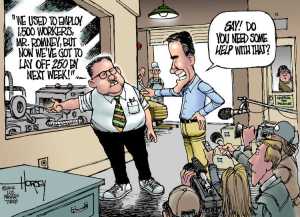
Good morning! Today is the New Hampshire primary. We’ll live blog the returns later tonight. As of last night, Gordon Gekko Mitt Romney had a big lead in the polls, with Ron Paul second and John Huntsman and Rick Santorum tied for third place.
Romney, the former governor of neighboring Massachusetts, holds a 24 percentage point lead over his closest rival, with 41 percent of likely Republican primary voters indicating they’d vote for him, the WMUR New Hampshire Primary Poll said.
U.S. Rep. Ron Paul from Texas was favored by 17 percent of likely primary voters, followed by former Utah Gov. Jon Huntsman and former U.S. Sen. Rick Santorum of Pennsylvania, each with 11 percent, and former House Speaker Newt Gingrich collecting 8 percent.
Several polls indicated Gingrich would finish in the top three.
“All of the candidates behind Romney have a good chance finishing anywhere between second and fifth place,” said Andrew Smith, director of the UNH Survey Center in Durham.
Yesterday Romney stepped in it again when he told an audience that he really likes firing people.
The final day of campaigning saw Romney under fire for a comment about health insurance that quickly became fodder for criticism.
Asked about the issue in Nashua, New Hampshire, Romney said he wanted a person to be able to own his or her own policy “and perhaps keep it the rest of their life.”
“That means the insurance company will have the incentive to keep you healthy. It also means if you don’t like what they do, you can fire them,” he said.
“I like being able to fire people who provide services to me,” Romney added. “If someone doesn’t give me the good service I need, I want to say I am going to get somebody else to provide that service to me.”
Romney complained that everyone was taking his remarks out of context, but when you’re a former corporate raider worth $250 million, it’s probably a good idea to watch what you say about putting people out of work.
Anyway, the latest meme about Romney is that he’s Gordon Gekko brought to life. I think it’s a pretty good comparison. I don’t know if you recall the quote from the recent Vanity Fair profile of Romney that I included in a recent post:
Romney described himself as driven by a core economic credo, that capitalism is a form of “creative destruction.” This theory, espoused in the 1940s by the economist Joseph Schumpeter and later touted by former Federal Reserve Board chairman Alan Greenspan, holds that business must exist in a state of ceaseless revolution. A thriving economy changes from within, Schumpeter wrote in his landmark book, Capitalism, Socialism and Democracy, “incessantly destroying the old one, incessantly creating a new one.” But as even the theory’s proponents acknowledged, such destruction could bankrupt companies, upending lives and communities, and raise questions about society’s role in softening some of the harsher consequences.
Romney, for his part, contrasted the capitalistic benefits of creative destruction with what happened in controlled economies, in which jobs might be protected but productivity and competitiveness falters. Far better, Romney wrote in his book No Apology, “for governments to stand aside and allow the creative destruction inherent in a free economy.” He acknowledged that it is “unquestionably stressful—on workers, managers, owners, bankers, suppliers, customers, and the communities that surround the affected businesses.” But it was necessary to rebuild a moribund company and economy.
That sure sounds Gekko-like, doesn’t it?
Yesterday, Rick Klein of ABC News addressed the Romney/Gekko issue.
Virtually all of Romney’s rivals are now sensing a powerful issue. Jon Huntsman said today that the firing comment shows that Romney is “completely out of touch” with the American economy.
Rick Perry, skipping ahead a state, is calling it the “ultimate insult for Mitt Romney to come to South Carolina and tell you he feels your pain, because he caused it.”
Gingrich is equating Romney’s business style with finding “clever legal ways to loot a company.” Rick Santorum’s stump speech includes a line about not needing a CEO as president, and he suggested at ABC’s Saturday night debate in New Hampshire that Romney’s background calls into question whether he “can inspire and paint a positive vision for this country.”
Romney hasn’t made matters easier for himself as he’s tried to connect with voters on the economy. The son of a millionaire business titan said over the weekend: “I know what it’s like to worry about whether or not you are going to get fired.”
Klein claims it’s too late for any of this to affect the New Hampshire primary results. I wouldn’t be so sure. New Hampshirites are famous for making up their minds at the last minute. Remember Hillary’s surprise win in 2008?
Romney has been expecting the Gordon Gekko comparisons, so you have to wonder why he hasn’t managed to curb some of these Gekko-like remarks. I guess he just can’t help himself.
Mitt Romney says he knows a photo in which he appears with other executives at Bain Capital LLC posing with cash in their hands, pockets and mouths will be used against him if he wins the Republican presidential nomination.
The 1980s image — called the “Gordon Gekko” photo by some Democrats, a reference to the Michael Douglas character in the movie “Wall Street” — offers an easy attack line at a time of high unemployment and sharp rhetoric against the nation’s top money managers, investors and bankers.
“We posed for a picture, just celebrating the fact that we had raised a lot of money and then we hoped to be able to return it with a good return,” Romney said on “Fox News Sunday.”
Here’s Romney’s defense of the photo on Fox News Sunday.
Andrew Leonard of Salon also discussed the comparison of Romney with Gekko.
Like Gekko, Romney made his fortune buying and selling companies; and like Gekko, he believes that his “greed is good” version of rough-and-tumble creative destruction is a positive force for America, weeding out the bad performers and nurturing lean-and-mean profit engines. If you are looking for the paradigmatic exemplar of the new style of capitalism mogul launched by the Reagan revolution, Romney is your man. Michael Douglas’ Gordon Gekko is merely ersatz.
But what Leonard finds so amazing is that this attack on Romney and his leverage buyouts is being led Newt Gingrich.
The shock is to see Newt Gingrich and his financial backers channeling the Oliver Stone critique so passionately and wholeheartedly. If you have not seen the three-minute advertisement “When Romney Came to Town,” the soon-to-be debuted documentary lambasting Romney as the enemy of the American worker, prepare to be flabbergasted.
“Their greed was only matched by their willingness to do anything to make millions in profits.”
“This film is about one such raider and his firm.”
“His mission: To reap massive rewards for himself and his investors.
“Romney took foreign seed money from Latin America, and began a pattern exploiting dozens of American businesses.”
And so on. Michael Moore doesn’t sting this hard, and MoveOn isn’t this angry. If Romney, as expected, ends up winning the Republican nomination, Obama’s campaign team can relax. Their work has already been done.
Here’s the trailer for the 27-minute documentary that Gingrich backers have purchased.
Politico calls it “the Bain Bomb.”
While conservatives look unlikely to unite around one alternative to Romney, the campaigns themselves are uniting around the theme that the former head of Bain Capital looted companies, tossed people out of jobs and is now exaggerating his success at the venture capital firm.
In the context of this moment in American politics, in which frustration with the privileged is boiling hot, the attack, from Republicans on one side and the Obama campaign on the other, will test Romney. If he ends up looking more like an opportunist who profited for the few than like a man who created jobs for the many, it’s hard to imagine his polls numbers won’t drop.
Conservative bloggers, who generally can’t stand Romney have begun defending him against his rivals attacks, and Dana Millback called Romney “the Scrooge McDuck of the 2012 presidential race. Bloomberg reports that buyout firms are getting nervous about damage to their reputations.
This could be fun to watch. I thought Newt’s attack on Romney yesterday was spot on.
Is Romney full of shit or what? He even makes Newt Gingrich look good. I hope Newt sticks around and continues letting it all hang out. Every single word he said about Romney was the truth.
I’m going to wrap this up with a more serious take on Romney from Robert Reich: Mitt: Son of “Citizen’s United.” I had forgotten that Reich ran for governor of Massachusetts in the the Democratic primary in 2002. Please go read the whole thing and try not to weep while you’re doing it.
As Reich says, Romney is the ultimate big money candidate. He was in 2002, and now with the help of the Roberts Court, he has more money than any candidate ever dreamed of before. If you thought Obama was the candidate of Wall Street–and he was in 2008–Romney is soooo much more so. He has money and connections that make Obama’s fundraising look pathetic. And none of this money even needs to be reported–it could be coming from overseas, even from foreign governments, and we’d never know.
Tonight we’ll find out of any of this barrage of Gordon Gekko/Mitt Romney comparisons will have any effect. I’m rooting for Romney to be taken down a peg. And then on to South Carolina!
Please share your links in the comments, and I hope to see you tonight for the live blog.

 peej
peej Carissa
 bostonboomer
 dakinikat
 ecocatwoman
 jjlo
jjlo mablue2
 Mama Lopez
 peggysue22
 quixote
 skydancingguestblogger
 Mona (aka Wonk the Vote)



 Sky Dancing
Recent Comments