
Romney Campaign Solves Flip-Flop Problem — For Now
Posted: July 6, 2012 Filed under: Barack Obama, U.S. Economy, U.S. Politics | Tags: Affordable Care Act ruling, Arizona Immigration Law, Bain Capital, Chief Justice John Roberts, Eric Fehrnstrom, individual mandate, John Kerry, Joshua Green, Michael Dukakis, Mitt Romney, risk avoidance, SCOTUS 36 Comments
It has been a difficult couple of weeks for Mitt Romney.
First, the Supreme Court struck down the Arizona immigration law that Romney had termed a model for the nation. Romney’s response:
“Today’s decision underscores the need for a President who will lead on this critical issue and work in a bipartisan fashion to pursue a national immigration strategy. President Obama has failed to provide any leadership on immigration. This represents yet another broken promise by this President. I believe that each state has the duty–and the right–to secure our borders and preserve the rule of law, particularly when the federal government has failed to meet its responsibilities. As Candidate Obama, he promised to present an immigration plan during his first year in office. But 4 years later, we are still waiting.”
Romney refused to say whether he agreed with the decision or provide specifics about how he would deal with undocumented immigrants if he were elected.
Next, his former favorite Supreme Court Justice, John Roberts, voted with the liberals on the court, agreeing that the Democrats’ Affordable Care Act, including the individual mandate is constitutional. Romney’s response to that one was strikingly terse and even more vague than his statement on immigration:
“What the court did not do on its last day in session, I will do on my first day,” he said. “I will act to repeal Obamacare.”
Still no specifics on how he would convince Congress to repeal the law or what he would replace it with. And then real disaster struck. Top Romney aide Eric Fehrnstrom told MSNBC that, despite Chief Justice Roberts’ calling the individual mandate a “tax,” Romney disagrees–he thinks it’s a “penalty.” Of course this contradicted the latest Republican meme–that the mandate is the biggest tax increase in human history. Ooops! And the next day (ironically it was Independence Day), Mitt changed his mind and said the mandate is a tax after all. Here’s a summary from Chuck Todd and colleagues:
Romney’s verbal gymnastics: When you think about it, Romney never had to truly deal with his fatal flaw on health care. Yes, he gave that health-care PowerPoint speech in Michigan in May 2011. And, yes, he was asked questions about the issue during the 20-odd GOP debates in which he participated. But he never REALLY had to reconcile his health-care law with President Obama’s — with a campaign team capable of going toe to toe with him — until last week’s Supreme Court decision. As for his explanation in calling the mandate a tax, his verbal gymnastics would have impressed even the Russian judges. First, he technically didn’t disagree with Fehrnstrom’s original take; he simply conceded that the Supreme Court called it a tax. “Well, the Supreme Court has the final word, and their final word is that Obamacare is a tax. So it’s a tax,” he said. And then he painfully tried to explain why the federal mandate is a tax, but Romney’s state mandate is a penalty. “Actually the chief justice in his opinion made it very clear that at the state level, states have the power to put in place mandates. They don’t need to require them to be called taxes in order for them to be constitutional.”
Recent polls show that the Obama campaign’s attacks on Romney’s record at Bain Capital are working–especially in the swing states. But Romney has let those attacks go largely unanswered as he struggled to develop a coherent response to the Obamacare decision.
Over the past few days, there have been stinging critiques of the Romney campaign from conservative media sources. Rupert Murdock tweeted that Romney’s campaign is too insular and they need to shake up the staff and add more experienced people. The Wall Street Journal’s editorial board dressed down the candidate and his staff on the editorial page. On the tax/penalty flip flop, they wrote:
For conservative optimists who think Mr. Fehrnstrom misspoke or is merely dense, his tax absolution gift to Mr. Obama was confirmed by campaign spokeswoman Andrea Saul, who tried the same lame jujitsu spin. In any event, Mr. Fehrnstrom is part of the Boston coterie who are closest to Mr. Romney, and he wouldn’t say such a thing without the candidate’s approval.
In a stroke, the Romney campaign contradicted Republicans throughout the country who had used the Chief Justice’s opinion to declare accurately that Mr. Obama had raised taxes on the middle class. Three-quarters of those who will pay the mandate tax will make less than $120,000 a year, according to the Congressional Budget Office. The Romney high command has muddied the tax issue in a way that will help Mr. Obama’s claims that he is merely taxing rich folks like Mr. Romney. And it has made it that much harder for Republicans to again turn ObamaCare into the winning issue it was in 2010.
Why make such an unforced error? Because it fits with Mr. Romney’s fear of being labeled a flip-flopper, as if that is worse than confusing voters about the tax and health-care issues. Mr. Romney favored the individual mandate as part of his reform in Massachusetts, and as we’ve said from the beginning of his candidacy his failure to admit that mistake makes him less able to carry the anti-ObamaCare case to voters.
Bill Kristol assailed Romney as the successor to fellow Massachusetts pols Michael Dukakis and John Kerry:
Remember Michael Dukakis (1988) and John Kerry (2004)? It’s possible to lose a winnable presidential election to a vulnerable incumbent in the White House (or in the case of 1988, a sitting vice president). So, speaking of losing candidates from Massachusetts: Is it too much to ask Mitt Romney to get off autopilot and actually think about the race he’s running?
Adopting a prevent defense when it’s only the second quarter and you’re not even ahead is dubious enough as a strategy. But his campaign’s monomaniacal belief that it’s about the economy and only the economy, and that they need to keep telling us stupid voters that it’s only about the economy, has gone from being an annoying tick to a dangerous self-delusion.
As Frank Cannon and Jeff Bell, among others, have pointed out, the economy is not an automatic path to victory. It does provide a favorable backdrop for this year’s campaign. But what are voters to think when they hear the GOP nominee say, as he did yesterday to CBS’s Jan Crawford, “As long as I continue to speak about the economy, I’m going to win”? That they’re dopes who don’t know the economy’s bad, but as long as the Romney campaign keeps instructing them that it is bad, they’ll react correctly and vote the incumbent out of office?
Of course Romney punctuated this criticism by riding around Lake Winnipesaukee on a jet ski, which naturally reminded everyone of the iconic shot of Kerry windsurfing off Nantucket in 2004.
Now, in response the the Vanity Fair article on Romney stashing his money in multiple foreign tax shelters, his campaign has adopted a new strategy: simply repeat the same meaningless response word for word whenever there is a question about Romney’s finances. Twice in one day, two different Romney spokespersons released the exact same unresponsive response to questions from different news organizations. From ABC News The Note:
Here’s Romney spokeswoman Amanda Henneberg’s statement to the press earlier today about reports by the AP and Vanity Fair about Romney’s offshore accounts in Bermuda:
“President Obama’s attacks on Mitt Romney have been proven false time and again. As job growth slows, manufacturing activity stalls, and our economy continues to sputter, President Obama knows he can’t make a legitimate argument for another term in office, so instead he is trying to tear down his opponent. This is just the latest example of President Obama and his political machine saying or doing anything to distract from his abysmal record over the last four years.”
And here’s Romney spokeswoman Andrea Saul responding to an interview that Obama strategist David Axelrod gave to ABC News, in which he said Romney is “the most secretive candidate” since Richard Nixon:
“President Obama’s attacks on Mitt Romney have been proven false time and again. As job growth slows, manufacturing activity stalls, and our economy continues to sputter, President Obama knows he can’t make a legitimate argument for another term in office, so instead he is trying to tear down his opponent. This is just the latest example of President Obama and his political machine saying or doing anything to distract from his abysmal record over the last four years.”
We asked the Romney campaign why they’re using the same statements and will update if they respond with another statement about their statements.
In what has to be one of the best pieces I’ve read today, Joshua Green of The Boston Globe addressed Romney’s obsession with avoiding risk.
This has become a familiar pattern: a ringing affirmation of some major policy difference with President Obama, followed by a lot of vagueness about what he would do instead.
Take deficit reduction. Romney has promised to extend the entire Bush tax cut, reduce marginal rates by an additional 20 percent, cut corporate rates, and still bring down the deficit. He’s said he’ll pay for this by closing loopholes and deductions but won’t identify which ones. His campaign initially indicated that it would clarify this once Romney had sewn up the nomination. Months later, the details are still not forthcoming. Yet he routinely gives speeches denouncing Obama over the deficit and promising — somehow — to bring it under control.
Green discusses Romney’s bizarre response to the SCOTUS ruling on Arizona’s immigration law.
His campaign’s greatest obfuscation was its response to the Supreme Court’s voiding much of Arizona’s Draconian immigration law. Romney’s statement was magnificently vague, leaving unclear whether he still supported the law, as he once had. Even more remarkable was the long, circular, and ultimately fruitless exchange between his spokesman Richard Gorka and reporters trying to nail down Romney’s position. Afterward, some fellow press secretaries took to Twitter to marvel at Gorka’s capacity to dissemble.
Romney has plainly calculated that he can win without explaining what he’d do as president, and seems intent on becoming the “generic Republican candidate” that pollsters include in surveys (and that often outperform real Republicans). He seems to be making two assumptions: The country is in such dire shape that simply being against Obama is enough, and his background at Bain Capital is a sufficient qualification to get him elected. His campaign is a sustained exercise in avoiding risk.
Green calls it “the Romney Fog Machine: a great outpouring of words intended to obscure, rather than clarify, the issue at hand.”
As Green points out, the problem with this tactic is that if you don’t give specific answers to questions others will fill in the blanks for you. That is what seems to be happening with Obama’s attacks on Romney’s Bain career. How long can the Romney campaign keep this up? Only time will tell.
Tuesday Reads: Natural and Human-Made Fireworks, the God Particle, and More
Posted: July 3, 2012 Filed under: Affordable Care Act (ACA), Health care reform, Media, morning reads, religion, Religious Conscience, the GOP, U.S. Politics | Tags: Amelia Earhart, Chief Justice John Roberts, energy field, explosions of Republican rage, fireworks, god particle, Higgs boson, Mormon resignation ceremony, polls, power blackouts, SCOTUS, storms, thunder and lightning, weather 50 Comments
Good Morning!
Someone in my neighborhood has begun celebrating Independence Day already, so I’m writing this with the sound of firecrackers in the background.
That may soon be followed by thunder and lightening, so I shouldn’t have any trouble staying awake long enough to finish this post. As long as my power doesn’t go out, everything should be fine!

That’s downtown Boston in a thunderstorm. Isn’t it gorgeous? Now let’s see what the morning papers have in store for us.
Everyone is agog about physicists’ discovery of a new particle–is it the “god particle?”
Physicists in Europe will present evidence of an entirely new particle on Wednesday, Nature has learned.
But more data will be needed to officially confirm whether it is indeed the long-awaited Higgs boson — the particle thought to be behind the mass of all the others.
Even as rumours fly in the popular media, physicists have begun quietly cheering at CERN, the European particle-physics lab near Geneva in Switzerland. “Without a doubt, we have a discovery,” says one member of the team working on the ATLAS experiment, who wished to remain anonymous. “It is pure elation!”
For nearly half a century, physicists have predicted the existence of a particle that helps to endow others with mass. Named after theoretical physicist Peter Higgs, the boson is the upshot of a mathematical trick that unites the electromagnetic and weak nuclear forces into a single ‘electroweak’ interaction. It is considered the final, crucial piece of the standard model of particle physics.
I’m fascinated by physics, but this thing is beyond my comprehension. From what I can figure out it has something to do with an energy field that permeates the universe; so to me it sounds like confirmation of something that has been talked about by mystics for centuries.
“We think the Higgs boson really gets at the center of some physics that is responsible for why the universe is here in the first place and what the ultimate structure of matter is,” said Joe Lykken, a theoretical physicist at Fermilab….
“You can think of it as an energy field. We believe there is a Higgs energy field spread out in the whole universe,” Lykken said. Photons — light particles — are unaffected by this field. But as other elementary particles move around, he explained, “they feel this energy field as a kind of sticky molasses that slows them down and keeps them from moving at the speed of light.”
When enough of that field is packed into a small enough space, Lykken said, it manifests as a particle — the Higgs boson.
A group of researchers will leave today to mount a search for the wreckage of Amelia Earhart’s plane.
Organizers hope the expedition will conclusively solve one of the most enduring mysteries of the 20th century – what became of Earhart after she vanished during an attempt to become the first pilot, man or woman, to circle the globe around the equator.
A recent flurry of clues point to the possibility that Earhart and her navigator, Fred Noonan, ended up marooned on the tiny uninhabited island of Nikumaroro, part of the Pacific archipelago Republic of Kiribati.
“The public wants evidence, a smoking gun, that this is the place where Amelia Earhart’s journey ended,” said Richard Gillespie, executive director of The International Group for Historic Aircraft Recovery (TIGHAR). “That smoking gun is Earhart’s plane.”
The expedition was scheduled to begin yesterday, but the group’s departure was postponed because of an administrative issue. The trip will last 16 days, with 10 days spent on the search for the wreckage.
One of my cousins works in the White House, and her power has been out since that big storm the hit the mid-Atlantic states. According to my mom, many people in Indiana are also without power. Hundreds of thousands in the Eastern U.S. are in the same boat, and there is a likelihood of more blackouts. During a heat wave like this, that can be more than inconvenient–it could be dangerous.
Electrical utilities are advising customers in and around Washington that it may well be a whole week before all power is restored after the unusually potent storm that ravaged the mid-Atlantic region on Friday. Many customers are outraged as to why it would take so long.
More than two million people in the eastern United States, including more than 400,000 in the greater Washington area, were still without power on Monday.
The storm, which claimed at least 22 lives, shuttered businesses, stores and gas stations and littered the region with fallen tree limbs and downed power lines, many of which are still strung along poles above ground.
It hit during a period of record-breaking heat and immediately shut down air conditioning systems across an area well known for its hot, humid summers and poor air quality.
As evidence grows that Chief Justice John Roberts changed his vote on the Affordable Care Act case at the last minute, Republicans are gnashing their teeth and cursing their former idol as a traitor to the cause: Scorn and Withering Scorn for Roberts
The day after Chief Justice John G. Roberts Jr. joined the Supreme Court’s four-member liberal wing to uphold the health care overhaul law, he appeared before a conference of judges and lawyers in Pennsylvania. A questioner wanted to know whether he was “going to Disney World.”
Chief Justice Roberts said he had a better option: he was about to leave for Malta, where he would teach a two-week class on the history of the Supreme Court. “Malta, as you know, is an impregnable island fortress,” he said on Friday, according to news reports. “It seemed like a good idea.”
The chief justice was correct to anticipate a level of fury unusual even in the wake of a blockbuster decision with vast political, practical and constitutional consequences. The criticism came from all sides. And it was directed not at the court as whole or even at the majority in the 5-to-4 decision. It was aimed squarely at him.
Read the rest at the link. The NYT tried to “balance” their story by claiming that liberals are angry too. Seriously? Even they admit the wingers are “particularly bitter.”
Former Dubya speechwriter Michael Gerson describes “John Roberts’ alternate universe.” And Marc A. Thiessen asks, “Why are Republicans so awful at picking Supreme Court justices?”
While conservatives agonize, a new Kaiser Health Tracking poll finds that 56% of Americans “would like to see the law’s detractors stop their efforts to block its implementation and move on to other national problems.” More evidence that conservatives are out of touch with reality and headed for disaster in November unless they can manage to buy a clue.
CNN also ran a poll on reactions to the ACA decision–also asking respondents about their attitudes toward the Supreme Court.
According to a CNN/ORC International survey released Monday, the public is divided on last week’s ruling, with 50% saying they agree with the Supreme Court’s decision and 49% saying they disagree. And there is the expected partisan divide, with more than eight in ten Democrats agreeing with the decision, more than eight in ten Republicans disagreeing, and independent voters divided, with 52% disagreeing and 47% agreeing…..
“Despite howls of protest from many Republican leaders, only about one in five Americans – and only 35% of the Republican rank and file – say they are angry about the decision,” says CNN Polling Director Keating Holland. “And despite victory laps by many Democratic leaders, only one in six Americans – and only one in three Democrats nationwide – say they feel enthusiastic about the court’s ruling.”
But attitudes toward the Court generally have changed.
“As recently as April, Republicans and Democrats had virtually identical positive opinions on the Supreme Court. But not any more,” adds Holland. “That’s the biggest change that the court decision has created.”
The court’s approval rating among Democrats jumped by 23 points; to 73%. Among Republicans, it fell by 21 points, to 31%. Approval of the Supreme Court among independents edged up five points, to 53%.
I’ll end with a story that is a few days old, but still interesting: Mormons quit church in mass resignation ceremony.
A group of about 150 Mormons quit their church in a mass resignation ceremony in Salt Lake City on Saturday in a rare display of defiance ending decades of disagreement for some over issues ranging from polygamy to gay marriage.
Participants from Utah, Arizona, Idaho and elsewhere gathered in a public park to sign a “Declaration of Independence from Mormonism.” [….]
The Utah-based Church of Jesus Christ of Latter-day Saints is known for its culture of obedience, and the mass ceremony was a seldom-seen act of collective revolt.
After gathering in the park, participants hiked a half-mile up nearby Ensign Peak, scaled in 1847 by church President Brigham Young to survey the spot where his Latter-day Saints would build a city.
At the top, those gathered gave three loud shouts of “Freedom,” cheered, clapped and hugged.
The reasons participants gave for leaving their religion included the Mormon church’s political activity directed against the LGBT community, racism and sexism in the church, and the church’s efforts to cover up its own troubling history, which includes violent acts and polygamy.
Now what are your reading recommendations for today?
Friday Reads
Posted: June 22, 2012 Filed under: Economy, morning reads | Tags: Aung San Suu Kyi, Dalai Lama, FCC, Operation Twist, SCOTUS, swearing on TV 32 Comments Good Morning!
We made it through the Solstice on Wednesday so summer is officially here! The days get shorter and the nights get longer from here on out! What’s on your summer reading list?
My first read of the summer is going to be Kafka on the Shore by Haruki Murakami. I’m also planning on avoiding the heat by watching the entire first season of Treme.
More evidence shows that the economy is not improving because of the negative impacts of state and local spending. Layoffs of Public Workers are harming the recovery.
Government payrolls grew in the early part of the recovery, largely because of federal stimulus measures. But since its postrecession peak in April 2009 (not counting temporary Census hiring), the public sector has shrunk by 706,000 jobs. The losses appeared to be tapering off earlier this year, but have accelerated for the last three months, creating the single biggest drag on the recovery in many areas.
With the economy expanding, albeit slowly, state tax revenues have started to recover and are estimated to exceed prerecession levels next year. Yet governors and legislatures are keeping a tight rein on spending, whether to refill depleted rainy-day funds or because of political inclination.
At the same time, costs for health care, social services, pensions and education are still rising. Fourteen states plan to resolve their budget gaps by reducing aid to local governments, according to a report by the National Governors Association and the National Association of State Budget Officers.
So while the federal government has grown a little since the recession, and many states have recently begun to add a few jobs, local governments are making new cuts that outweigh those gains. More than a quarter of municipal governments are planning layoffs this year, according to a survey by the Center for State and Local Government Excellence. They are being squeezed not only by declining federal and state support, but by their devastated property tax base.
“The unfortunate reality is our revenue streams have not rebounded,” said Timothy R. Hacker, the city manager of North Las Vegas, which has cut its work force to 1,300 from 2,300 and is about to lay off 130 more. “Shaking this recession is becoming increasingly difficult.”
Some folks have been suggesting that the Fed should do something “out of the box” since it is politically impossible to stimulate the economy through good fiscal policy right now. Should the Fed start buying SLGS and monetize state debt?
The Fed can legally buy as many municipal bonds as it wants without congressional approval. Talk about burying a lead. This is a big story. Blanchflower is essentially saying that the U.S. government can bail out both the housing market via Fannie and Freddie paper purchases and the state governments via Muni purchases. And, of course, the banks get to dump these assets onto the Fed who will hold them to maturity. I guarantee you this will have a very nice kick since it is the state’s where the biggest employment cuts are. This is the Fed doing fiscal, friends
This is an interesting idea and one worth exploring.
The economic models are telling us that we need more stimulus. Lowering interest rates and more fiscal stimulus are out of the question. Quantitative easing remains the only economic show in town given that Congress and President Barack Obama have been cowed into inaction.
The major questions about quantitative easing aren’t so much if, but how much will the Fed buy and of what type? There is little point in moving slowly. So $100 billion a month for six months seems a reasonable amount.
What will they buy? They are limited to only federally insured paper, which includes Treasuries and mortgage-backed securities insured by Fannie Mae and Freddie Mac. But they are also allowed to buy short-term municipal bonds, and given the difficulties faced by state and local governments, this may well be the route they choose, at least for some of the quantitative easing. Even if the Fed wanted to, it couldn’t buy other securities, such as corporate bonds, as it would require Congress’s approval, which won’t happen anytime soon.
Republicans have been trying to change our lexicon for years now. George Lakoff and Elizabeth Wehling write on “Why Conservatives Sell their Wildly Destructive Ideology Better Than Democrats”.
Perhaps the most important omission from the Obama speech was any overt mention of The Public — everything that our citizenry as a whole provides to all, e.g., roads, bridges, infrastructure, education, protection, a health system, and systems for communication, energy development and supply, and so on. The Private — private life and private enterprise — depends on The Public. There is no economic freedom without all of this. So-called “free enterprise” is not free. A free market economy depends on a strong Public. This is a deep truth, easy to recognize. It undercuts Romney’s central pitch, that is it private enterprise alone that has made our country great, and that as much as possible of The Public should be eliminated.
Romney calls free enterprise “one of the greatest forces of good this world has ever known.” In reality, America free enterprise has always required The Public.
Romney attacks The Public, speaking of “the heavy hand of government” and “the invisible boot of government.” The contrast is with the putative “invisible hand” of the market — which leads to the good of all if everyone follows their self-interest and the market’s natural force is not interfered with. Romney’s “invisible boot” evokes the image of a storm trooper’s boot on your neck. The government is the storm trooper, your enemy. You are weak and in an impossible position. You can’t move — a metaphor for being held back and not being able to freely engage in the economy. Romney uses the frame consistently: “The federal establishment,” he says,” has never seemed so hostile.” The Public is an “establishment” — an undemocratic institution — which is the enemy of the people. It is implicit in this frame that the government is not the people.
The Supremes overruled the FCC’s swearing ban in a decision this week.
According to MSNBC, a ruling by the Supreme Court Thursday waived fines and sanctions against ABC and Fox, saying the Federal Communications Commission did not give them fair notice before punishing them over brief instances of curse words and nudity.
The ruling (PDF), which does not affect the FCC’s overall policy toward profanity, centered on outbursts by Cher and Nicole Richie on live awards shows on FOX and a brief instance of partial nudity shown on ABC’s NYPD Blue.
“Because the Commission failed to give Fox or ABC fair notice prior to the broadcasts in question that fleeting expletives and momentary nudity could be found actionably indecent, the Commission’s standards as applied to these broadcasts were vague,” Justice Anthony Kennedy wrote in the unanimous decision, adding that the FCC was free to revise its current policy “in light of its determination of the public interest and applicable legal requirements.”
Aung San Suu Kyi and His Holiness the Dalai Lama had a chance to meet in the UK.
THIS week two Nobel-peace-prize laureates, both international figures of inspiration, find themselves visiting Britain: the leader of Myanmar’s (ie Burma’s) opposition, Aung San Suu Kyi; and also the Tibetans’ exiled spiritual leader, the Dalai Lama. On June 19th, in London, the two met.
The rendezvous, not publicised on either of their official schedules, was disclosed by the Dalai Lama’s office on Twitter only the next day, where it was described simply as “a private meeting”. The Dalai Lama, who had previously called for Miss Suu Kyi’s release from house arrest, is reported to have told her “I have real admiration for your courage.” He also gave her his blessing, as one Buddhist to another. The obvious backdrop to any such blessing would be the separate political struggles of Myanmar and Tibet. The two places have a certain neighbour in common.
China’s leaders will not be happy to learn of the meeting. The Dalai Lama’s ten-day visit to Britain has given fresh occasion for China to denounce him. In a further measure, the Chinese Olympic committee threatened to withdraw some of its athletes from training in England. The Dalai Lama shrugged off all this as “routine”. He is as accustomed to acting as a hate figure for the Chinese government as he is to being a symbol of hope to many people elsewhere.
So, that’s a little this and that to get us started this morning. What’s on your reading and blogging list today?
Saturday Morning Reads
Posted: June 16, 2012 Filed under: Austerity, Barack Obama, executive orders, immigration, legislation, Mitt Romney, morning reads, U.S. Economy, U.S. Politics | Tags: Affordable Care Act, Angela Merkel, Daily Caller, Egypt, eurozone crisis, Germany, Goodfellas, Greece, Henry Hill, Neil Munro, respect for the office of President, Ruth Bader Ginsburg, SCOTUS, the Euro, Tucker Carlson, White House press corps, wingnuts, wise guys, world economy 24 Comments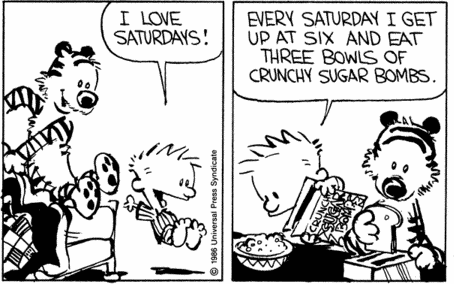
Good Morning!!
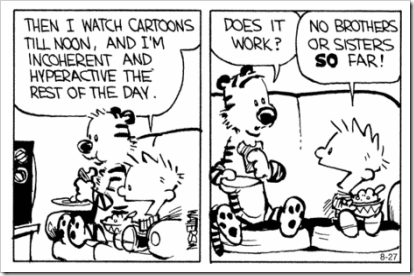
Yesterday was a pretty busy news day for a Friday. So if you’ve had your sugar bombs and coffee, let me fill you in on the latest before you head outside to enjoy a beautiful June day. The weather folks are saying this will be a nice weekend around the country.
Yesterday the President announced an executive order telling the Department of Homeland Security not to deport children who were brought to the U.S. illegally and have grown up here and gone to school here. These are the young people who would be eligible to stay here and have a path to citizenship under the “Dream Act” if Republicans in Congress would stop blocking the legislation.
In a move that seemed to be aimed at Hispanics whose enthusiasm for voting in the November 6 election could be crucial to Obama’s re-election chances, the president acted to potentially protect 800,000 people from deportation proceedings for at least two years.
Obama, who previously was reluctant to impose such an order even as Republicans in Congress blocked immigration reform bills he supported, called his action “the right thing to do.”
His announcement was on the 30th anniversary of a Supreme Court decision that said children of illegal-immigrant parents were entitled to public education in the United States.
Right wingers–including Mitt Romney–are of course calling the move “political,” but so what? I’ve said it before and I’ll say it again. Politicians make political decisions. Duh! But if they’re doing the right thing, I don’t care what their motivation is. The LA Times published some basic information for people who want to know what this change means to them.
During the President’s announcement of the policy change at a press availability in the Rose Garden, a wingnut blogger from The Daily Caller, rudely broke into Obama’s speech with an offensive question. David Graham at the Atlantic:
An extremely unusual occurrence happened today as President Obama spoke at the White House. The president was offering a statement on his executive order suspending deportations for certain illegal immigrants brought here as children….when a reporter started heckling him and shouting questions.
The reporter has been identified as Neil Munro of the Daily Caller, a conservative online news outlet run by Tucker Carlson….
Interrupting the president mid-speech is considered a serious breach of etiquette, and Obama’s reaction shows how peeved (and probably taken aback) he was. Munro, and the Daily Caller, have immediately come in for harsh criticism by a wide range of journalists, including conservative ones. The problem isn’t that Munro was asking tough questions; it’s that he interrupted the commander-in-chief to ask them and in doing so guaranteed that none of the assembled press would be able to ask any serious questions — since it’s fairly clear that Munro’s query was intended as provocation.
I have video of the confrontation, but youtube seems to be down at the moment. I’ll put it up again later if I can. Munro yelled “Why do you favor foreigners over Americans?” Then when Obama responded, he proceed to argue and then yell while Obama was speaking. Pretty unprofessional for a so-called “journalist.”
Even Bill O’Reilly condemned the wingnut hack’s behavior, along with Fox News talkers Shep Smith and Chris Wallace.
At CNN, Dean Obeidallah says this type of behavior by wingnuts is part of an overall effort to “delegitimize” Obama’s presidency.
A reporter from a right-wing media outlet heckled President Obama — not once, but twice — on Friday as he was unveiling a new immigration policy. If this shocks you, you haven’t been paying attention. This is simply the latest page from the right’s playbook to delegitimize Barack Obama’s presidency.
Some may dismiss it as an isolated incident, but it’s not. It goes much deeper. Believe me, I know hecklers — I’m a stand-up comedian. If someone heckles me once, it can be a mistake: too many drinks, overcome by emotion, etc. But when you heckle twice, you have an agenda.
BTW, Munro is an Irish immigrant. So what is his problem?
A quick perusal of Munro’s Twitter feed reveals he does not hide his contempt for President Obama. His tweets range from claims that Obama is using NASCAR and country music to attract “white non-college voters,” to slams of Michelle Obama, to allegations that Obama is racially discriminating against blacks in his White House hiring practices.
But this is all not about Munro — he is just a small cog in the right’s campaign to diminish the legitimacy of Obama’s presidency. I’m not talking about people disagreeing with policies. I mean specifically the campaign to paint Barack Obama as less than American — as an “other”–as someone whose presidency is not entitled to the same respect as that of the presidents who came before him.
OK, maybe I’m spending too much time on this, but I guess I’m a bit old fashioned. I believe in respecting the office of the President. I think it’s very important for the White House press corps to behave respectfully, while at the same time asking tough questions. In this case, Munro’s behavior led to the press conference being cut off before more responsible reporters could ask questions.
I have some other news for you, and I’ll give it to you quickly so you can get out an enjoy your day.
The send-off for Mitt Romney’s bus tour of “small-town America” was overshadowed by Obama’s announcement.
After weeks of gaining momentum amid a spate of bad economic news that has shaken Obama’s reelection campaign, Romney was faced with a classic demonstration of how the White House can use its power to reset the agenda.
For hours, Romney tried to ignore the news. Finally, after a rally here with a ragtime band playing “Yankee Doodle Dandy” in a town-square gazebo, Romney made a statement that struck a radically different tone from the hard-line approach he took on illegal immigration during the Republican primaries.
“I believe the status of young people who come here through no fault of their own is an important matter to be considered and should be solved on a long-term basis so they know what their future would be in this country,” he told reporters outside of his campaign bus.
“I think the action that the president took today makes it more difficult to reach that long-term solution, because an executive order is of course just a short-term matter. It could be reversed by subsequent presidents. I’d like to see legislation that deals with this issue.”
But he made no commitment to supporting any particular option.
Of course not. Just more meaningless huffing and puffing from an old stuffed suit.
Ruth Bader Ginsburg expects “sharp disagreement” in the Supreme Court over the Affordable Care Act.
The LA Times reports: Egypt revolution losing steam as military asserts power
Germany could be in trouble if Greece opts out of the Euro.
Why can’t the Euro nations agree on a plan? In Germany, the situation is being compared to Titanic, one of the greatest disasters in history.
Since Euro Zone is like the Titanic heading for an iceberg called Greece, there’s plenty of concern on the first-class deck called Germany. If Greece goes down, it can take even Europe’s biggest economy with it.
“I believe Europe is right in a crossroads right now,” Gerhard Hofmann, director of the German Cooperative Bank Group, told CBS News.
How the shock waves will hit the U.S. if it happens.
The NYT says Obama is “looking to Merkel” for aid and comfort.
A collapse of the euro could derail America’s fragile recovery and doom Mr. Obama’s re-election hopes. So the president finds himself in the strange position of having forged a relationship with Ms. Merkel that is perhaps the best he has with any foreign leader, but that has not yet resulted in the chancellor’s agreeing to what Mr. Obama thinks must be done in Europe: an American-style bailout and fiscal stimulus.
Mr. Obama and Ms. Merkel will meet again Monday at a Group of 20 summit meeting in Mexico, with the stakes for Europe even higher than they were last month. With Greece holding elections on Sunday that could precipitate its exit from the European currency union — the nightmare feared by the financial markets — Mr. Obama may be running out of time to make his case.
And there is no indication Ms. Merkel is any more inclined to heed his advice. In a speech to the German Parliament on Thursday, she said the world should not expect Berlin to be Europe’s savior, rejecting calls to create euro bonds to share the debt burden of the Mediterranean countries.
Boy is she ever stubborn. And she seems determined to bring the entire world economy crashing down. Mitt Romney must love her.
A new study suggests that Gay Men Have Evolutionary Benefit For Their Families.
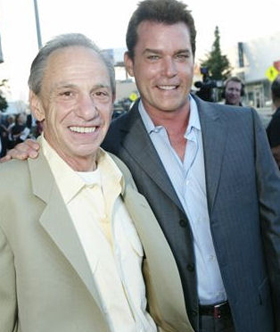
Henry Hill with Goodfellas star Ray Liotta
Finally, Henry Hill has died. He was the “wise guy” who was the inspiration for Martin Scorcese’s “Goodfellas.” Hill was only 69, and died from health problems related to smoking.
Henry Hill, the infamous mob informant whose life of crime was chronicled in the film classic “GoodFellas,” was the first to admit that he did “a lot of bad things back then.”
“I shot at people. I busted a lot of heads, and I buried a lot of bodies,” he told the London-based Daily Telegraph in 2010. “You can try to justify it by saying they deserved it, that they had it coming, but some just got whacked for absolutely no reason at all.”
….
Henry Hill, the infamous mob informant whose life of crime was chronicled in the film classic “GoodFellas,” was the first to admit that he did “a lot of bad things back then.”
“I shot at people. I busted a lot of heads, and I buried a lot of bodies,” he told the London-based Daily Telegraph in 2010. “You can try to justify it by saying they deserved it, that they had it coming, but some just got whacked for absolutely no reason at all.”
RIP, Henry.
Have a fabulous Saturday, and if you’re reading anything interesting today, please share!
Tuesday Reads: Crime and Movies, Obama’s Second Term, How the Wisconsin Uprising Got Hijacked, and Other News
Posted: June 12, 2012 Filed under: 2012 presidential campaign, morning reads, The Great Recession, U.S. Politics | Tags: A Cry in the Dark, Azaria Chamberlain, Barack Obama, Bashar al-Assad, Carl Levin, Citizen's United, Clint Eastwood, Escape from Alcatraz, fascism, Habeas Corpus, Lindy Chamberlain-Creighton, Meryl Streep, Obama's kill list, SCOTUS, second term, Seinfeld, the dingo ate my baby, Wisconsin recall election 22 Comments
Good Morning!!
I’ve got a selection of interesting reads for you today.
Late last night, the top story on Google news was this:
Coroner rules dingo to blame for Australian baby’s death.
A coroner ruled Tuesday that a dingo, a wild dog native to Australia, caused the death of a baby more than 30 years ago.
Azaria Chamberlain was just two months old when she disappeared from a tent during a family holiday to Uluru, also known as Ayers Rock, sparking one of the country’s most sensational and enduring murder mysteries.
“The cause of her death was as the result of being attacked and taken by a dingo,” Elizabeth Morris, coroner for Northern Territory, announced to Darwin Magistrates court early Tuesday. “Dingos can and do cause harm to humans.”
The girl’s mother, Lindy Chamberlain-Creighton, long maintained that a dingo took her baby, even as she was sentenced to life in jail for daughter’s murder, a conviction that was later quashed.
Meryl Streep played Lindy in a movie about the case, A Cry in the Dark.
The movie was satirized in a Seinfeld episode.
Seriously, though, I’m glad that Lindy has finally received justice.
Another long-ago crime story has been in the news: the mysterious escape from Alcatraz by three convicts 50 years ago yesterday, June 11, 1962.
Fifty years ago, on the night of June 11, 1962, the three convicts were locked down as usual. Guards walking the tier outside their cells saw them at 9:30 and checked on them periodically all night, looking in at the sleeping faces, hearing nothing strange. But by morning, the inmates had vanished, Houdini-like.
Guards found pillows under the bedclothes and lifelike papier-mâché heads with real hair and closed, painted eyes. Federal agents, state and local police officers, Coast Guard boats and military helicopters joined the largest manhunt since the Lindbergh baby kidnapping in 1932, scouring the prison complex on Alcatraz Island, the expanse of San Francisco Bay and the surrounding landscape of Northern California.
A crude raft made of rubber raincoats was found on a nearby island. But the fugitives were never seen again. Federal officials said they almost certainly drowned in the maelstrom of riptides, undertows and turbulent, frigid waters of the 10-mile-wide bay, their bodies probably swept out to sea under the Golden Gate Bridge.
But for aficionados of unsolved mysteries, the fantasy that Frank Lee Morris and the brothers Clarence and John Anglin had successfully escaped from the nation’s most forbidding maximum security prison and are still alive, hiding somewhere, has been a tantalizing if remote possibility for a half-century now.
The escapees would be in their 80s if they are still alive. According to this NPR story, there was a legend that they would meet again at the prison on the 50th anniversary of their escape. Believe it or not, U.S. Marshalls were there to meet them just in case. I haven’t heard of any old men being captured yet, but I’m writing this at 11:30PM, so I guess it could still happen.
Fifty years ago, three men set out into the frigid waters of the San Francisco Bay in a raft made out of raincoats. It was one of the most daring prison escapes in U.S. history.
As one newsreel put it: The spoon proved “mightier than the bars at supposedly escape-proof Alcatraz prison.”
“Three bank robbers serving long terms scratched their way through grills covering an air vent, climbed a drainage pipe and disappeared from the forbidding rock in San Francisco Bay,” the report continued.
The men — Frank Morris and two brothers, John and Clarence Anglin — were never seen again. It was a brilliant plan, carried out with meticulous care and patience, but with such an unsatisfying ending. Did they make it? Or are they, as most people assume, at the bottom of the bay?
The legend has always held that if the men are alive, they will return to Alcatraz on the 50th anniversary of their breakout. There’s little chance that’s going to happen. But the anniversary is Monday, and I’m headed to the island to see if they show up. The U.S. Marshals say they will be there, too.
There have been a number of movies made about the daring escape. Clint Eastwood made a good one.
In political news, I’ve got a couple of long reads for you.
Ryan Lizza has a piece in The New Yorker about Obama’s second term: What would Obama do if reelected? In case you don’t want to plow through the whole thing, Atlantic Wire has a Reader’s Digest version: Obama’s Advisers Want You to Know He’ll Be a Lame Lame Duck President
If The New Yorker’s Ryan Lizza is right, we might be in for four more years of compromise on things like climate change and nuclear proliferation. Lizza has an article this week forecasting Obama’s second term, or rather, what Obama’s advisers want you to know about the President’s second term.
Don’t expect much. Obama and his team aren’t revealing their cards on the pressing issues like the economy (Lizza mentions there’s time for one big policy change) or inflammatory issues like same-sex marriage. And their lack of specifics about the President’s second term has been a story in itself, especially when contrasted with Mitt Romney who has already imagined his first days in the White House. As Lizza reports, the message that the president’s team wants out there is that Obama will be banking on bipartisan support (a word that’s peppered the president’s first term) to maybe get things done in the short time he has.
It sounds a lot like the first term.
At TomDispatch, Andy Kroll has a lengthy article about how Wisconsin was hijacked.
The results of Tuesday’s elections are being heralded as the death of public-employee unions, if not the death of organized labor itself. Tuesday’s results are also seen as the final chapter in the story of the populist uprising that burst into life last year in the state capital of Madison. The Cheddar Revolution, so the argument goes, was buried in a mountain of ballots.
But that burial ceremony may prove premature. Most of the conclusions of the last few days, left and right, are likely wrong.
The energy of the Wisconsin uprising was never electoral. The movement’s mistake: letting itself be channeled solely into traditional politics, into the usual box of uninspired candidates and the usual line-up of debates, primaries, and general elections. The uprising was too broad and diverse to fit electoral politics comfortably. You can’t play a symphony with a single instrument. Nor can you funnel the energy and outrage of a popular movement into a single race, behind a single well-worn candidate, at a time when all the money in the world from corporate “individuals” and right-wing billionaires is pouring into races like the Walker recall.
Colin Millard, an organizer at the International Brotherhood of Bridge, Structural, Ornamental, and Reinforcing Iron Workers, admitted as much on the eve of the recall. We were standing inside his storefront office in the small town of Horicon, Wisconsin. It was night outside. “The moment you start a recall,” he told me, “you’re playing their game by their rules.”
Check it out. It’s well worth the read.
In other news,
Yesterday the Supreme Court declined to hear appeals from some detainees at Guantanamo. At Mother Jones, Adam Serwer asks: Did the Supreme Court Just Gut Habeas Rights?
The Supreme Court’s decision on Monday not to hear appeals from a group of Gitmo detainees leaves the remaining 169 detainees at the facility with little chance of securing their freedom through US courts.
In the 2008 case Boumediene v. Bush, the Supreme Court ruled detainees at Gitmo could challenge their detention in US courts. That decision was seen as effectively ending the Bush administration’s attempt to carve out a legal black hole for suspected terror detainees. Shortly thereafter, Gitmo detainees began appealing their detentions—and frequently winning in court. But in the years since the decision, conservative judges on the DC Circuit have interpreted the law in a way that assumes many of the government’s claims are true and don’t have to be proven in court. By not taking any of these cases, the Supreme Court has ensured these stricter rules will prevail. Civil-libertarian groups say that essentially leaves detainees at Gitmo with habeas rights in name only, since the rules make it virtually impossible for detainees to win in court. A Seton Hall University School of Law report from May found that, prior to the DC Circuit’s reinterpretation of the rules, detainees won 56 percent of cases. Afterwards, they won 8 percent.
The march toward fascism continues. In other cheery news, a new Federal Reserve report says that the “Great Recession erased nearly 40% of family wealth.”
The Great Recession took such a heavy toll on the economy that the typical American family lost nearly 40% of its wealth from 2007 to 2010, shaving the median net worth to a level not seen since the early 1990s.
The Federal Reserve said in a new report Monday that median family net worth, the point smack in the middle of those richer and poorer, fell to $77,300 in 2010 from $126,400 three years earlier after adjusting for inflation.
The fall came with the collapse in the housing market and massive layoffs that slashed people’s incomes, and the pain was felt by families across the board — young and old, well-educated and less so, with children or not.
But the biggest impact was felt by young middle-age families, those headed by people ages 35 to 44. For this group, the median net worth — total assets minus debts — fell a whopping 54% in the three-year period to $42,100 in 2010. Such was their financial hardships that only 47.6% of these families said they had saved money in 2010; that was the lowest among all age groups, where an overall average of 52% of families saved some money that year.
Senator Carl Levin (D-Michigan) is “‘worried’ by influx of dark money” in the 2012 election because of the Citizen’s United decision.
“The thing that worries me frankly the most is the huge amount of hidden money which is going to get into — it already is in — the Romney campaign,” he said on Current TV’s War Room.
“The Super PAC money worries me. The fact that Mr. Romney will not disclose who is bundling his money, he is keeping that secret as well… It’s bad enough that we have these unlimited amounts of money that go into Super PACs.”
Levin says that Congress could force SuperPacs to reveal the names of donors, but so far the Republicans have blocked his bill to do that.
At The Daily Beast, Peter Beinart asks why Bashar al-Assad isn’t on President Obama’s “kill list.” After all, he claims the right to kill just about anyone in the name of terrorism. If Assad isn’t a terrorist, who is?
Fine, you say, but there’s an executive order against assassinating heads of state. That’s true, but we don’t exactly abide by it. During the Cold War, the United States helped orchestrate coups that led to the deaths of South Vietnam’s Ngo Dinh Diem and Chile’s Salvador Allende. The Bush administration launched the 2003 Iraq War with a decapitation strike aimed at killing Saddam Hussein. And whether or not the United States had a hand in Muammar Gaddafi’s death last fall, it was the predictable—and perhaps desired—result of the war we launched.
But doesn’t assassinating foreign leaders set a worrisome precedent? If we can kill Bashar al-Assad, what’s to stop the Syrian government from trying to kill Barack Obama? We might ask the same question about the sanctions we impose and the wars we launch. The point is that the U.S. violates other countries’ sovereignty in all kinds of ways we wouldn’t appreciate if they did it to us. And the reason they don’t is not because they lack a precedent; it’s because they lack the power.
I’m speechless.

 peej
peej Carissa
 bostonboomer
 dakinikat
 ecocatwoman
 jjlo
jjlo mablue2
 Mama Lopez
 peggysue22
 quixote
 skydancingguestblogger
 Mona (aka Wonk the Vote)



 Sky Dancing
Recent Comments