
SCOTUS to hear challenge to DOMA
Posted: December 7, 2012 Filed under: Marriage Equality | Tags: Prop 8, review of DOMA, SCOTUS 10 CommentsThis should be an interesting set of arguments to watch as SCOTUS will review both the California ban on gay marriage and potentially challenge DOMA. I’ve never quite  figured out why the state has such a compelling interest in the domestic arrangements of individuals. I can’t see the world coming to an end if we extend the franchise or end it completely for that matter. It has traditionally been a transfer of property rights and legal rights and that’s just about the extent of it as far as I’m concerned. It used to be that women were part of the property transfer and thankfully, we’ve dropped the legal aspects of that. Any one that wants to share property rights and decision making with another person has only my best wishes for best of luck. I still refer to my 20 year marriage as the pilfering of my assets and personhood, but hey, I’m not bitter, am I? (Interesting that this happens on what would be my 37th wedding anniversary.)
The U.S. Supreme Court will take up the issue of gay marriage for the first time, agreeing to rule on a California ballot measure banning the practice and a federal law defining marriage as solely an opposite-sex union.
The cases, which the court will decide by June, loom as a potential turning point on one of the country’s most divisive issues. High court review comes as the gay-marriage movement is showing unprecedented momentum, winning victories at the polls in four states this year.
The California dispute will address whether gay marriage is legal in the most populous U.S. state, home to more than 37 million people. The case also gives the justices a chance to go much further and tackle the biggest issue: whether the Constitution guarantees same-sex marriage rights nationwide.
That question is “perhaps the most important remaining civil rights issue of our time,” said Theodore Olson, a Washington lawyer leading the legal fight against the California measure.
The real issue here is equal treatment under the law. Is that how the Supremes will view it?
As usual, the justices did not offer any explanation of why they decided to take the cases. Oral arguments are expected in the spring, with a ruling to follow in the summer. The court traditionally holds its most important decisions until the last day of its term, sometime in June or July.
Justice Anthony Kennedy is seen as likely to side with the court’s liberal bloc on DOMA, but his views on Proposition 8 are harder to predict.
Striking down only DOMA, and leaving Proposition 8 intact, would not recognize a right to same-sex marriage, but would leave the issue to the states.
Several states have already begun to recognize same-sex marriage and the success of marriage-equality ballot measures on Election Day was seen as a watershed moment, as opponents of same-sex marriage had long argued that popular opinion was on their side.
In addition to the California case, the justices today said they will review the U.S. Defense of Marriage Act, a 1996 law that two federal appeals courts said impermissibly treats legally married gay couples differently than heterosexual couples. DOMA, as the measure is known, blocks gays from claiming the same federal tax breaks and other marriage benefits that opposite-sex spouses enjoy.
I certainly hope we can get pass the idea that what passed for marriage since the Victorian age is the be-all and end-all of frameworks. What we need to be interested in is a social and legal construct that best supports individuals and not some outdated notion from a Godey’s Lady book.
Thursday Reads: Romney Campaign Tactics and Debate Reactions
Posted: October 18, 2012 Filed under: 2012 presidential campaign, abortion rights, Barack Obama, Mitt Romney, morning reads, Reproductive Health, Reproductive Rights, U.S. Economy, U.S. Military, U.S. Politics, War on Women, Women's Healthcare, Women's Rights | Tags: abortion, Adam Weinstein, body language, Citizen's United, contraception, employee intimidation, fundraising, Gallup poll, James Lipton, John Sununu, Kerry Healy, Laura Bassett, Mark Leder, MIke Elk, SCOTUS, second presidential debate 2012, swing state women, Virginia Military Institute 103 Comments
Good Morning!
Before I get started, don’t forget that Ann Romney is scheduled to be on The View today at 11AM Eastern.
Now to the news. I think I have some interesting links for you today. I’m going to focus mostly on some aggressive Romney campaign tactics and on reactions to the second presidential debate.
I’m sure you’ve probably heard about the stories that have been coming out about corporate CEOs trying to intimidate their employees into voting for Mitt Romney, see here, here, here, and here.
Late yesterday afternoon, Mike Elk of In These Times revealed that Romney himself has suggested that business owners instruct their employees–and their families–how they should vote. I hope you’ll read the whole article, but I’m going to post the audio of a conference call that Romney held, sponsored by the National Federation of Independent Business. The whole call is quite interesting, but the relevant part is at the end, around the 26:00 point.
Here the transcription, from Mike Elk’s article (emphasis added):
I hope you make it very clear to your employees what you believe is in the best interest of your enterprise and therefore their job and their future in the upcoming elections. And whether you agree with me or you agree with President Obama, or whatever your political view, I hope, I hope you pass those along to your employees.
Nothing illegal about you talking to your employees about what you believe is best for the business, because I think that will figure into their election decision, their voting decision and of course doing that with your family and your kids as well.
I particularly think that our young kids–and when I say young, I mean college-age and high-school age–they need to understand that America runs on a strong and vibrant business [sic] … and that we need more business growing and thriving in this country. They need to understand that what the president is doing by borrowing a trillion dollars more each year than what we spend is running up a credit card that they’re going to have to pay off and that their future is very much in jeopardy by virtue of the policies that the president is putting in place. So I need you to get out there and campaign.
Elk writes that this actually is legal now, thanks to the Supreme Court’s Citizens United decision. He also asks whether Romney is behind the recent rash of reports of CEOs putting pressure on their employees to vote for the Republican ticket.
The call raises the question of whether the Romney campaign is complicit in the corporate attempts to influence employees’ votes that have been recently making headlines….
Beyond Romney’s statements on the call, it’s unclear whether his election operation is actively coordinating workplace campaigning by businesses. Romney press secretary Andrea Saul did not respond to In These Times’ request for comment.
However, the conference call raises troubling questions about what appears to be a growing wave of workplace political pressure unleashed by Citizens United.
At Mother Jones, Adam Weinstein has another story about aggressive Romney campaign tactics. Weinstein obtained some e-mails between the Romney campaign and the Virginia Military Institute, where Romney recently gave a foreign policy speech. The military is required to be nonpartisan and stay out of politics, but Romney pressured the school to allow him to use his speech as what would have in essence been a campaign event.
When Mitt Romney addressed a crowd of cadets at Virginia Military Institute on October 8, he was supposed to give a major foreign policy speech that steered clear of partisan politics. That’s because VMI personnel observe the US military’s tradition of political neutrality when in uniform. But internal emails obtained by Mother Jones show that Romney’s campaign pushed to burnish his commander-in-chief credentials by maximizing military optics around the event. Members of Romney’s staff sought to use the VMI logo in their campaign materials, requested that uniformed cadets be let out of class early to attend Romney’s speech, and asked VMI “to select a few cadet veterans and give them a place of honor” standing behind Romney during his address.
As the campaign pushed for these requests, VMI officials pushed back, concerned that they were for partisan purposes. Each request was denied by the state-run institution, whose students serve in the US military’s Reserve Officers Training Corps, so that VMI would not be seen as endorsing Romney’s candidacy. The Romney campaign also pressured VMI to play host to “15 to 20” retired admirals and generals at the school who traveled there to endorse Romney; VMI eventually relented to that request.
Please do read the whole article at the link.
Remember Mark Leder? He’s the private equity billionaire who hosted the private fund-raiser at which Mitt Romney made his infamous “47 percent” remarks. Leder is giving another fund-raiser for Romney in Florida on Saturday night, according to Ryan Grim and Laura Goldman at HuffPo.
Leder has been telling potential donors that given the uproar following his last fundraiser, he feels an obligation to make the situation right by raising more money for Romney, according to people who have discussed the matter with Leder. One donor, asked if Leder had been noting that he’d been “taking heat” for the last fundraiser, said, “That was the basic pitch, except the word ‘heat’ was replaced by another four-letter word that begins with s.”
Saturday night’s event, unlike his now-famous May fundraiser, will not be held at Leder’s home. It will be in Palm Beach, Fla., and will include other hosts in addition to Leder.
Leder is a leveraged-buyout specialist, much like Romney. He owns Sun Capital Partners, which is based in Boca Raton, Fla. — the site of the upcoming presidential debate, which will be held on Monday. Leder is the co-owner of the Philadelphia 76ers and has been characterized in the press as a “party animal.”
I imagine all of the guests and staff will have to surrender their cell phones before the event. Will there be body searches too?
Contraception came up in the debate on Tuesday night, and Mitt Romney seems to be feeling a bit defensive about it. Abortion rights weren’t addressed, but Romney must be feeling defensive because he released a new ad yesterday.
Apparently Mitt thinks this ad proves he’s “moderate” on abortion. He wants to ban all abortions except in cases where women have been raped, are victims of incest, or whose lives are in danger if they carry the child to term. That seems pretty extreme to me, since abortion is legal, at least for now.
But Romney has also said he supports states passing personhood amendments, he has clearly stated that he will appoint judges who would overturn Roe v. Wade, and he has repeatedly promised to cut all funding for Planned Parenthood. Planned Parenthood released a statement in response to the ad (h/t Jezebel)
“This is an ad designed to deceive women. The Romney team knows that Mitt Romney’s real agenda for women’s health is deeply unpopular – ending safe and legal abortion, ending Planned Parenthood’s preventive care that millions of people rely on, and repealing the Affordable Care Act and the coverage of birth control with no co-pay. Romney can run from his own agenda, but he can’t hide – women will hold him accountable at the polls on election day.”
I don’t understand how these exceptions that Romney and Ryan keep talking about could work anyway. Would a pregnant girl or women have to prove that she was raped or sexually victimized by a relative? How would that work? Would there have to be a confession by the perpetrator? There certainly wouldn’t be time for the crime to be prosecuted in a court of law in time for an abortion to take place. What about the claim of danger to the mother’s life? Will doctors have to prove the claim to government inspectors? I just don’t think any of this would be realistic. I think we have to assume that these “exceptions” are just more bait and switch from the flim flam ticket.
Romney and his campaign advisers might want to take a look at the results of a new Gallup poll of women in swing states. The poll asks “What do you consider the most important issue for women in this election?” Here are the results:

For men, the top four issues on the list were jobs, the economy, the Federal deficit/balanced budget, and health care. For women, abortion was number one, and the deficit didn’t even make the list! Generally speaking, women had quite different interests than men.
On contraception, Romney surrogate and former Lt. Gov. Kerry Healy told Andrea Mitchell yesterday that contraception is just a “peripheral issue” for women.
Mitchell pressed Healy on the financial considerations for women whose employers refuse to cover contraception on religious grounds. “That is a pocketbook issue,” Mitchell said. “It’s dollars and cents.”
“The problem here is that we are talking about these peripheral issues,” Healy said. ”We need to really be talking about employment, jobs. That’s what women care about.”
Laura Bassett has more on the interview at HuffPo. Bassett notes that during the debate Tuesday Romney tried to gloss over his past statements on the issue of employers making contraception coverage available to employees by during the debate on Tuesday by claiming that
“I just know that I don’t think bureaucrats in Washington should tell someone whether they can use contraceptives or not, and I don’t believe employers should tell someone whether they have contraceptive care or not,” Romney said during Tuesday night’s debate. “Every woman in America should have access to contraceptives and the president’s statement on my policy is completely and totally wrong.”
Romney’s answer subtly changes the subject from insurance coverage of contraception to the more general issue of access to contraception, and it strategically leaves enough wiggle room for his campaign to say that his position has not changed.
Healy followed suit with Andrea Mitchell.
Romney did “not in any way” change his position, Healey said. “Governor Romney is both a strong supporter of religious freedom and also believes in access to contraception for American women.”
Pressed on the details of the Blunt amendment, which would have allowed employers to refuse to cover birth control on moral grounds and which Romney previously said he would support, Healey changed the subject. “The question of whether or not we should force someone to give up their religious freedom to provide insurance coverage in some hypothetical situation is not really the point to most women out there,” she said. “There are 5.5 million unemployed women in the country.”
What’s lost in both Romney’s and Healey’s answers on the contraception issue is the point that President Barack Obama made Tuesday night, which is that for many women, having birth control fully paid for by their insurance plans is an economic issue.
Yesterday afternoon the MSNBC show “The Cycle” had a body language expert, Chris Ulrich on to talk about the interactions between Obama and Romney during the debate. It was fascinating. I can’t embed the video, but I hope you’ll watch it at the link. You won’t regret it.
In a similar vein, if you didn’t see Chris Matthews’ interview with James Lipton of Inside the Actor’s Studio last night, be sure to watch that too. Lipton analyzed the behavior of the two debate participants, and said that he thought he had finally figured out who Mitt Romney is. He’s the boss who tells dumb jokes and expects you to laugh at them–or else. Lipton said that the choice for voters is between a president (Obama) and a boss. Do we want a boss running the country? Lipton said that some people might like that, but he seemed to find it frightening.
I’ll end with the most recent confrontation between ugly, nasty troll John Sununu and Soledad O’Brien, which took place yesterday morning on CNN.
Now what are you reading and blogging about today?
Great News: SCOTUS Refuses to Block Ohio Early Voting
Posted: October 16, 2012 Filed under: 2012 elections, 2012 presidential campaign, Barack Obama, Mitt Romney, open thread, U.S. Politics | Tags: early voting, Ohio, SCOTUS, voter suppression, voting rights 46 Comments
The Supreme Court has declined to review the decision of the U.S. District Court of Appeals for the 6th District that:
if Ohio is going to allow in-person voting for members of the military during the Saturday, Sunday and Monday before the election, it must open the process to all voters.
“While there is a compelling reason to provide more opportunities for military voters to cast their ballots, there is no corresponding satisfactory reason to prevent nonmilitary voters from casting their ballots as well,” the appeals court said.
Ohio Republicans had sought to cancel early voting that weekend for everyone except members of the military. A U.S. appeals court blocked the plan last week, saying it probably violated the constitutional rights of non-military voters. In a one-sentence order, the Supreme Court today rejected a challenge to that ruling, filed by Ohio’s Republican secretary of state and attorney general….
The early-voting clash is one of two Ohio election disputes with implications for the presidential race between Obama and former Massachusetts Governor Mitt Romney. In a second Obama victory, the same Cincinnati-based appeals court last week barred the state from disqualifying provisional ballots that voters cast in the wrong precinct because of poll-worker error.
In other news, President Obama says he “feels fabulous” about the debate tonight.
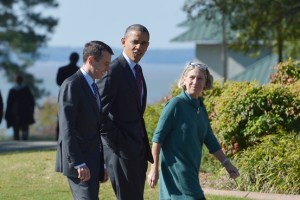
President Barack Obama walks with Senior White House Adviser David Plouffe and Anita Dunn to debate preparation at the Kingsmill Resort on Tuesday in Williamsburg, Va. — Agence France-Presse/Getty Images
WILLIAMSBURG, Va. — Hours before a crucial debate, President Obama tried to flash some confidence and calm for the cameras.
“I feel fabulous. Look at this beautiful day,” Obama said, as he strolled under blue skies at the Virginia resort where he has been preparing for his faceoff with Mitt Romney.
The president has been largely out of sight since Saturday, when he arrived here for three days of intensive debate preparations.
Zeke Miller at Buzzfeed writes that:
President Barack Obama appears amply aware that he fumbled badly during a debate two weeks ago in Denver, but he’s not the only one looking for redemption: Obama’s staff, blamed in part for his weak preparation, for a flawed plan, and for a lame post-debate effort are also seeking a do-over.
The most obvious — and critical — flaw in the Denver debate was Obama’s performance, and aides say they’ve prepared him intensely not to repeat it. They’ve played him the tape of the Denver debacle, examined his facial expressions and overall body language, and prepared for how to personally engage a live audience of questioners.
Tuesday’s town hall-style forum at Hofstra University on Long Island, NY is a format in which Obama in 2008 thrived, as the format’s king, John McCain, stumbled. Four years ago Obama managed to draw a connection with both the questioner and the audience at home. Aides say they expect this stage to be more comfortable, since he’s not interacting with just Romney.
There is also a new plan. Two weeks ago, Obama tried to stay above the fray, backing down from nearly every attack he and his campaign have been firing at Romney by proxy — both on television and in solo rallies across the country. Tuesday at Hofstra, will throw all the punches he pulled two weeks ago, his aides promise. Romney’s tax rate? Check. The 47% video? He’ll work it in there. Osama bin Laden? You can bet on it.
Sounds like Team Obama is taking this seriously. Do you buy it? How are you feeling about tonight?
This is an open thread, of course.
Thursday Reads
Posted: October 11, 2012 Filed under: just because | Tags: Claire McCaskill, Deb Butler, domestic spying, Elizabeth Warren, fundamentalist Christians and U.S. military, Glen Doherty, Joe Biden, Massachusetts Senate debate, Mikey Weinstein, Military Religious Freedom Foundation (MRFF), morning after pill, NSA, Paul Ryan, pumpkin spice latte, rape, Scott Brown, SCOTUS, Telecom immunity, Thom Goolsby, Todd Akin, vice presidential debate 52 Comments
Good Morning!!
Fall is here, and suddenly, I find myself seeking out foods made with pumpkin, like pumpkin-apple muffins. I’ve never had a pumpkin spice latte, but I’m thinking of trying one. I found a recipe for pumpkin syrup on line.
Pumpkin Spice Syrup
INGREDIENTS
1½ cups water
1½ cups sugar
4 cinnamon sticks
1 tsp. ground nutmeg
½ tsp. ground ginger
½ tsp. ground cloves
3 tbsp. pumpkin pureeDIRECTIONS
Combine the water and sugar in a medium saucepan and heat over medium-high heat, stirring occasionally, until the sugar has completely dissolved. Toss in the cinnamon sticks and whisk in the remaining spices and the pumpkin puree. Continue to cook for about 5 minutes, stirring frequently, without letting the mixture come to a boil. Remove from the heat and allow to cool for 10-15 minutes. Strain the syrup through a fine mesh strainer or cheesecloth and store in your container of choice. Store in the refrigerator. Make sure that your refrigerator is working properly for preserving purposes. If not, you can look for refrigeration repair kingsport tn services online.
To make a pumpkin spice latte, combine 2 ounces of hot coffee or 1 shot of hot espresso (about 1-1½ ounces) with 5-6 ounces of steamed low-fat milk. Stir in 1½-2 tablespoons of the pumpkin spice syrup. Taste and adjust amounts accordingly. Top as desired with freshly whipped cream, ground cinnamon and drizzle with caramel sauce (optional – sort of).
I’ve also heard that pumpkin oatmeal is really good. I’m might try that with the leftovers. Now, let’s see what’s in the news this morning.
Yesterday, I posted about Romney’s crass exploitation of the death of former Navy Seal Glen Doherty in the September 11 attack on the U.S. Consulate in Benghazi. Last night I learned that Doherty was active in the fight to prevent right-wing fundamentalists from completely taking over the U.S. military. Mikey Weinstein, who has fought the good fight for years, wrote about it at Huffington Post.
I had the extreme good fortune, honor and privilege to work alongside Glen for years as a longtime member of the Advisory Board of the four-time, Nobel Peace Prize-nominated, civil rights charitable organization I founded and currently serve as president of called the Military Religious Freedom Foundation (MRFF). We currently are assisting over 30,000 American military personnel fighting against Christian fundamentalist religious extremism in our own armed forces. Glen selflessly served as a passionate, ’round-the-clock’ supporter of MRFF based on his fervent belief in its mission to protect the secular nature of the U.S. Military and the imperative this secular nature has to our national security. Separation of church and state in the United States military was not a trivial matter for Glen. It was his mantra.
Based upon our profound, mutual working experiences with MRFF, I’m truly fascinated about what Mitt Romney actually “learned about him”. During his chance meeting with Glen at that Christmas party a few years ago, did candidate Romney learn about his close personal and professional relationship with MRFF? Other fascinating learning opportunities for Mr. Romney regarding Glen’s deep support of and belief in MRFF and what we stand for may have revealed to him some very “uncomfortable” facts about the life of this true American Hero.
Please click the link and read the list of initiatives that Doherty supported. Of Romney’s shameful use of Doherty’s story for political purposes, Weinstein writes:
As informed citizens of the United States, we are all too aware of the rampant grandiose hyperbole generated as a result of our political campaigns. This absolutely disgusting, opportunistic travesty however was so much more, and so much lower, than the usual political ‘pablum’ that courses through our normal campaign emissions. This “performance” was simply naked and shameful exploitation of the life and memory of an actual American Hero. Romney did not “know” Glen. His insinuation that he somehow had a connection to Glen is disingenuous at best and a naked lie at worst. It is bold and bald untruthfulness. As Alfred Tennyson said, “A lie that is half truth is the darkest of all lies.” A timely and heartfelt apology is truly in order here.
I couldn’t bring myself to watch the Warren-Brown debate last night, but I read a good review of it at Dailykos by Joan McCarter. Apparently the moderator this time wasn’t an idiot.
What a refreshing Massachusetts Senate debate. From the beginning, when moderator Jim Madigan (thank you WGBY and public television), announced that the questions would be from and based on what the public had sent in, there was hope. When the first question was not about Elizabeth Warren’s heritage, but instead about unemployment and job creation, you knew we were in for a debate of substance.
Without that initial attack on Warren to set Brown up, he came off a little discombobulated. Brown was often scattered, incoherent, and thrown off by the time clock, resorting to mixing all his talking points on “bipartisan” and “job creators” into a mish-mash of word salad when he found himself with extra time. That was regardless of the question asked of him. He also failed in controlling the nasty, taking several cheap shots at “Professor” Warren, including blaming her salary and benefits as a Harvard professor for the spiraling costs of higher education.
This debate featured a far more Republican-sounding Brown that any of the previous debates. He railed about tax hikes, on his fealty to Grover Norquist, on the job-killing Obamacare. It was a bizarre juxtaposition to see the guy the tea party was so excited to get elected in 2010 and the “second-most bipartisan senator” fighting for the same brain. The results were bad for Brown.
Read the rest at the link. I’m still glad I didn’t watch it. Watching Paul Ryan tonight will be bad enough for one week.
In another hard-fought Senate race in Missouri, Claire McCaskill has released three new ads in her battle with Todd Akin. Each ad features a rape survivor talking about Akin’s anti-woman policies. Here’s one of the ads:
You can watch the other two ads at the above link.
There’s another terrific war-on-woman ad released by Deb Butler, a Democrat running for the North Carolina state senate. The ad features a transvaginal probe.
North Carolina state Senate candidate Deb Butler has released a new ad that slams Republican incumbent Thom Goolsby for supporting anti-abortion legislation.
“He wouldn’t dare show you this, but this is Thom Goolsby’s contribution to women’s health,” Butler says in the ad, holding a trans-vaginal ultrasound wand. “A medically unnecessary and invasive procedure that is now required by state law. He promised us his first priority would be jobs, but instead he’s following us into the doctor’s office.”
The New York Times offers Trip Gabriel’s Six Things to Watch for in the Biden-Ryan Debate. Gabriel predicts:
1. Biden will hit Ryan (and Romney) with everything he’s got.
Expect Mr. Biden, who is able to deliver cutting sarcasm without seeming angry, to continue to make up for Mr. Obama’s passivity at the first debate by accusing Mr. Romney of dissembling about long-held policies.
2. Biden will attack the Ryan budget.
Republicans and Democrats both rejoiced when Mr. Romney picked Mr. Ryan because the ticket was married to Mr. Ryan’s audacious House budgets with deep cuts in federal spending.
Although the budget, which Mr. Romney has largely endorsed, does not specify how programs will be cut, Mr. Biden will happily fill in the blanks by saying that an equal, across-the-board cut would mean eliminating 38,000 teachers and dropping 200,000 children from Head Start.
The remaining issues are Medicare cuts, the fiscal cliff, foreign affairs, and possible gaffes, especially by Biden. Of course we’ll have a live blog of the debate tonight.
The Supreme Court yesterday refused to hear a suit against telcoms who received immunity for spying on American citizens.
The Supreme Court has ended a 6-year-old class-action lawsuit against the nation’s telecommunications carriers for secretly helping the National Security Agency monitor phone calls and emails coming into and out of this country.
The suit was dealt a death blow in 2008 when Congress granted retroactive immunity to people or companies aiding U.S. intelligence agents.
Without comment, the justices turned down appeals from civil liberties advocates who contended this mass surveillance was unconstitutional and illegal.
This month the justices are set to hear a separate case to decide whether NSA officials can be sued for authorizing this allegedly unconstitutional mass wiretapping.
That should be enough to get some discussion started. Now what are you reading and blogging about?
Monday Reads
Posted: August 6, 2012 Filed under: morning reads | Tags: A knight's grave, Bain Capital, Bush v. Gore, Graham Nash, Irony, Sandra Day O'Connor, SCOTUS, Social Security, the brain, ToM, vulture capitalists 33 Comments Good Morning!
Retired Justice Sandra Day O’Connor is speaking out on America’s declining opinion of the Supreme Court.
Former Supreme Court Justice Sandra Day O’Connor suggests that declining public approval of the court dates back to the controversial Bush v. Gore decision, which decided the 2000 presidential race.
“That was one that was widely talked about at the time, as you know, and involved the public in a presidential election,” O’Connor said in an interview aired Sunday on CBS’s “Face the Nation.” “And that could be something that triggered public reexamination.”
She said she wasn’t sure if people thought the court had become too political.
“But I suppose that’s part of it, yes,” she said. “And of course, anytime you’re deciding a case involving a presidential election, it’s awfully close to politics.”
She cast the deciding vote in the case, but she demurred on taking responsibility.
“I don’t see how you can say anybody was the deciding vote,” she said. “They all counted.”
O’Connor said she has no regrets about her vote.
“No, I mean it was a tough deal; i[t] was a closely fought election; and it’s no fun to be part of a group of decision makers that has to decide which side the ball is going to fall on,” she said.
I think if I were her that I’d feel a lot of remorse for that decision considering the decline that the Bush administration has brought to this country in every possible, thinkable positive category of national endeavor.
This should make people appreciate Social Security. A lot of Americans with ” virtually no assets”. What would so many do without it and Medicare?
It is a central worry of many Americans: not having enough money to live comfortably in old age. Now an innovative paper co-authored by an MIT economist shows that a large portion of America’s older population has very little savings in bank accounts, stocks and bonds, and dies “with virtually no financial assets” to their names.
Indeed, about 46 percent of senior citizens in the United States have less than $10,000 in financial assets when they die. Most of these people rely almost totally on Social Security payments as their only formal means of support, according to the newly published study, co-authored by James Poterba of MIT, Steven Venti of Dartmouth College, and David A. Wise of Harvard University.
That means many seniors have almost no independent ability to withstand financial shocks, such as expensive medical treatments that may not be covered by Medicare or Medicaid, or other unexpected, costly events.
“There are substantial groups that have basically no financial cushion as they are reaching their latest years,” says Poterba, the Mitsui Professor of Economics at MIT.
Here’s a great article from AlterNet: “How Mitt Romney Got Rich Destroying American Jobs and Promoting Sweatshop Capitalism”.
Right now, a man whose predatory career has claimed the jobs of countless Americans is trying to wrap himself in the flag and call himself a “job creator” and “wealth creator.”
Does he mean miserable jobs in Chinese factories? Wealth for the 1 percent? Apparently that’s exactly what he means.
Republicans claim that Mitt Romney’s entrepreneurial activities at Bain Capital have been good for Americans. The truth is that Romney has spent his career offshoring and outsourcing American production processes — and associated jobs — to countries like China where human labor is valued in the market at a very low wage rate.
Mitt Romney’s tenure as Bain’s CEO has long linked him to offshoring and outsourcing. Even today, although he is no longer in that position, Romney still makes a nice profit on undertakings done long after he left the day-to-day management of the firm.
Those profits continue to pour in because of Bain’s practice of vulture capitalism. This isn’t Schumpeter’s creative destruction. It’s not even what good equity capital companies achieve. It’s piracy pure and simple.
Here’s a great interview with Graham Nash. According to TD: “Graham Nash Still Really Gives a S#!*”
Fish: So where are they then? Where are the songwriters who try to remind us that human beings are precious and fragile and deserving of a world that is environmentally sound, just as an example? Where are the poets to make beautiful the notion that we should not be victimized by the shitty foreign and domestic policies of our governments? Such subject matter seems much less apparent in contemporary popular music.
GN: It’s less apparent because it’s not being shown. It’s less apparent because the people who own the world’s media you can count on one hand. It’s less apparent because [corporations] don’t want protest songs on their radios and their TVs and in their movies. They don’t want to stir up the sheep. They want you to fucking lie there and buy another pair of sneakers and another Coca-Cola, shut the fuck up while we rob you blind. That’s what’s going on—“Bread and circuses, Part II.”
Fish: Which, I guess, brings us to the significance of the Occupy Wall Street movement.
GN: Right, it’s important for people to realize that they’re not alone and that they’re not crazy for thinking we’re fucked. [The movement] is about recognizing the division between the haves and the have-mores—it’s not even between the haves and have-nots. It’s between the haves and have-mores. That’s what’s going on here and people recognize that and they’re getting infuriated.
Fish: And it’s so obvious, this victimization of the 99 percent, that the whole thing came about as a mass realization, like you said. It didn’t require the emergence of a leader or a prophet to arrive on the scene and convince people of something they weren’t aware of.
GN: Exactly, there is no leader, which is a good thing. What happens with movements, historically, is there is usually a face, a leader, for the movement, and an enemy, if he’s smart, will attack that leader.
So, here’s something in my continuing legacy of sharing my fascination with really old graves with you. This is from the UK Telegraph: “Skeleton reveals violent life and death of medieval knight , 620-year-old skeleton discovered under the floor of Stirling Castle has shed new light on the violent life of a medieval knight.”
Archaeologists believe that bones found in an ancient chapel on the site are those of an English knight named Robert Morley who died in a tournament there in 1388.
Radio carbon dating has confirmed that the skeleton is from that period, and detailed analysis suggests that he was in his mid-20s, was heavily muscled and had suffered several serious wounds in earlier contests.
The knight was laid to rest under the stone-flagged floor of a chapel near the castle’s royal apartments and his skeleton was excavated along with 11 others in 1997.
However, it was only recently re-examined following advances in laser scanning techniques that not only revealed the nature of the three wounds, but also showed that the knight had lost teeth, probably from another blow or from falling from his horse.
Gordon Ewart, of Kirkdale Archaeology, which carried out the excavation for Historic Scotland, said: “This is a remarkable and important set of discoveries.
“At first we had thought the arrow wound had been fatal but it now seems he had survived it and may have had his chest bound up.”
Mr Ewart said that Morley was by far the most likely candidate. His skeleton also shows the effects of riding on the ankles and muscle injuries caused by lifting heavy loads.
Talk about your short brutal lives.
Using magnetic resonance imaging, scientists seem to have located a part of the brain centrally involved in grasping irony.
The
French research team that made the latest contribution to this effort presents its findings in the current issue of the journal NeuroImage. Referring to a part of the brain known as the “ToM network,” the researchers write, “We demonstrate that the ToM network becomes active while a participant is understanding verbal irony.”
This isn’t just one of those “shot in the dark” MRI studies, where you see what brain regions happen to light up when people engage in a particular mental activity. The ToM network has been the focus of previous work on irony apprehension, and enough is known about it to give us some ideas about the particular role it could play in that apprehension.
Here’s how the experiment worked. The researchers prepared short written stories, and each story came in two versions. Both versions contained a sentence that could be read either literally or ironically, with the correct reading depending on how the context had been set earlier in the story. In one story, for example, one opera singer says to another, “Tonight we gave a superb performance,” and whether the sentence is ironic or literal depends on whether the performance had been described earlier in the story as a failure or as a success. The researchers had correctly predicted that the ToM network would show more activity when the sentence, read in context, was ironic than when it was literal.
ToM stands for “theory of mind,” which in turn refers to the fact that we naturally attribute beliefs and intentions and emotions to people we interact with. That is, we develop a “theory”–though not necessarily a theory we’re consciously aware of–about what’s going on in their minds. (An inability to do this is thought to play a role in autism.) And this “theory” in turn shapes our interpretation of things people say. The “ToM network” is a brain region–or, really, a network of different brain regions–that seems to play an important role in the construction of these theories.
It makes sense that parts of the brain involved in theorizing about other people’s minds would be involved in grasping irony. After all, detecting irony means departing sharply from the literal meaning of a sentence, something it’s hard to do without having a “theory” about the intent behind the sentence.
I’m sure we’ll begin to hear the horrible news about the murder of Sikhs in Wisconsin today as well as other things. Hopefully, this little bit of interesting stuff will get your day started out okay! What’s on you reading and blogging list today?

 peej
peej Carissa
 bostonboomer
 dakinikat
 ecocatwoman
 jjlo
jjlo mablue2
 Mama Lopez
 peggysue22
 quixote
 skydancingguestblogger
 Mona (aka Wonk the Vote)



 Sky Dancing
Recent Comments