
Tuesday Reads: Wisconsin Recall Madness!
Posted: June 5, 2012 Filed under: 2012 elections, Labor unions, morning reads, Populism, Psychopaths in charge, Reproductive Rights, Republican politics, Right to Work, Tea Party activists, The DNC, the GOP, the villagers, U.S. Economy, U.S. Politics | Tags: Chris Cillizza, grass roots activism, InTrade, John Nichols, Koch Brothers, PPP polling, public employee unions, Rebecca Kleefisch, Scott Walker, Tom Barrett, voter turnout, Wisconsin recall election 65 Comments
Good Morning!!
Today is the day of reckoning for Wisconsin. Voters will go to the polls today to decide the fate of Governor Scott Walker and five other Wisconsin Republicans: the Lieutenant Governor and four state senators. If the Democrats can win just one of those seats, they will regain the senate majority.
I think everyone here knows the genesis of this recall battle, but here’s a quick explainer from Chris Cillizza at the WaPo. Cillizza also speculates on possible surprising outcomes from the election.
Cillizza allows that Barrett could conceivably win and the Democrats could retake the senate–the latest poll by PPP had Walker leading by only 3 points, within the margin of error. The poll also suggested that Barrett had the momentum as of yesterday. On the other hand, InTrade had Walker’s chances at more than 90% late last night. The truth is no one really knows for sure, because the turnout and enthusiasm on each side will tell the tale. Cillizza, being a Villager, still thinks Walker will win, but thinks the Senate could switch.
When they filed petitions to recall Walker himself last fall, Democrats also filed papers to recall another four state senators — Senate Majority Leader Scott Fitzgerald, and Sens. Pam Galloway, Terry Moulton and Van Wanggaard, (Galloway resigned earlier this year; Republican state Rep. Jerry Petrowski is running for her seat.)
They need only win one race to take control.
Fitzgerald is likely safe given his heavily Republican district, although Lori Compas, his Democratic rival, has attracted a lot of media attention.
But Democrats are bullish on the races against Moulton and Wanggaard. Both districts went for President Obama in 2008; Wanggaard’s went narrowly for John Kerry in 2004. Whether Barrett wins or not, they expect to take back the state Senate.
Moulton faces former state Rep. Kristen Dexter; Wanggaard faces former state Sen. John Lehman (D). Outside groups have spent hundreds of thousands of dollars on both sides. State Rep. Donna Seidel (D) also has a shot at beating Petrowski; before Galloway the seat had gone Democratic for two decades.
Cillizza points out that if Barrett wins and the Democrats take the state senate and could get some of the Walker legislation overturned before another election could give the senate back to the Republicans. The other possibility, Cillizza mentions is that Democrats could defeat Walker’s Lt. Governor Rebecca Kleefisch, but that’s pretty unlikely. She’s leading in the polls at the moment.
The Seattle Times had a good article on Sunday about the national issues that are at stake in the election today.
Under fire for cutting budgets at the expense of public employees, Walker would be the third governor in U.S. history yanked from office in a recall election. Walker has an edge, but the race is close.
The campaign will mean more than who governs Wisconsin. It’s a test case of the larger clashes in American politics that are driving elections for the presidency and control of Congress, highlighting divisions over the costs of government.
With more than $30 million raised from conservative donors, many of them from other states, and visits from a who’s who of high-profile Republican governors (New Jersey’s Chris Christie, South Carolina’s Nikki Haley, Louisiana’s Bobby Jindal and Virginia’s Bob McDonnell), Walker’s campaign to survive the recall has the feel, the money and the stakes of a national race.
The state vote is raising questions that will echo nationwide. Can a tough-minded conservative Republican force cuts in government at the risk of angering public-employees unions and win a swing state such as Wisconsin? Will voters think he’s doing the best he can in a tough time? Or will they rise in a grass-roots backlash against the well-financed Republican effort?
Admittedly, that article has a Republican flavor, but it does do a pretty good job of spelling out the issues. For a more left-wing perspective, here’s a lengthy piece at by Sarah Jaffe of Alternet: Wisconsin’s Recall Drama Down to Nail-Biting Finish.
Wisconsin’s recall is, as reporter John Nichols put it, the kind of “renegade politics” that are disdained by the national Democratic party and even some state Democrats. It is being driven by the same activists who turned out by the thousands to occupy their capitol when Governor Scott Walker attacked workers’ right to organize and bargain collectively.
Now, a day before the biggest recall yet—of Governor Walker, Lieutenant Governor Rebecca Kleefisch, and four Republican state senators—the fight will be won or lost where it began: on the ground.
There’s a lot of big outside money pouring into Wisconsin, mostly to pump up Walker’s attempt to hang on to his seat, but the one thing that money can’t buy is an excited, driven grassroots movement. If Milwaukee mayor Tom Barrett beats Walker on Tuesday, it will be because of thousands of volunteers getting out the vote person by person.
“This is really a case of Walker raising $13 million against possibly the most widespread grassroots get-out-the-vote effort in the state’s history,” Matt Reiter, co-president of the Teaching Assistants’ Association at the University of Wisconsin at Madison, told AlterNet.
Please try to check that one out. It’s long, and very informative. John Nichols of The Nation (mentioned prominently in Jaffe’s piece) is Wisconsin native, and has written a book about the struggle in his home state. Here’s a piece Nichols wrote yesterday: How To Buy A Recall Election.
Governor Scott Walker is not trying to win the Wisconsin recall election that will be held June 5.
He is trying to buy it.
If the embattled governor does prevail, he will provide essential evidence not of his own appeal but of the power of money to define our politics.
On the other hand, if Walker is defeated, a template will have been developed for a people-power, message-power politics that might be able to challenge big money.
And there is no question that what is in play is very big money.
Read the gory details at the link.
At Salon, Josh Eidelson writes about the possible effects of some Wisconsin voters’ “resentment” of union workers on the recall outcome.
If Scott Walker survives tomorrow’s election, there will be plenty of reasons. Many people will point to his huge cash advantage, for good reason. But no factor will have been more important than the decades of decline in U.S. union membership.
“Unions had their place,” a woman named Jerri told me soon after I arrived in Wisconsin last week. “They did their part back in the ‘40s and ‘50s, and then they got too big, and are abusing their power.” Jerri and her husband, Tim (both declined to give last names), were eating at a bar in Wauwatosa, the purple Milwaukee suburb that’s home to Scott Walker. They both work in sales: She’s in retail at the mall; he’s in wholesale, selling caskets. Tim said Walker’s union “reforms” were necessary because local politicians had been “looking out for the union” instead of “people like me.” He said unions are for people who don’t “feel they should have to work very hard.” Jerri complained that unions “are sucking off my teat.” Public workers’ benefits, she said, “should be the same as anybody in any kind of private job.”
That last statement is most telling. While resentment toward unions has grown since the 1950s, it’s not because they got too big. It’s because they got too small. A multi-decade drop in unionization left fewer Wisconsinites who are union members or live in union households. Meanwhile, because governments are less prone than businesses to terrorize workers or shut down facilities to avert unionization, public sector unionization has remained more stable. In 2009, for the first time, there were more total U.S. union members in government employment than in the entire private sector.
That one is pretty scary for those of us who care about quality education and public services.
The Wall Street Journal highlights the importance of turnout in the recall election.
Both sides say few voters remain undecided, after more than $63.5 million in political spending saturated the airwaves and clogged voters’ mailboxes. A weekend survey by the Democratic group Public Policy Polling found Mr. Walker holding a slight lead and only 3% of likely voters undecided. With few voters left to persuade, the main question is which side will win the turnout battle.
Labor groups and their allies knocked on more than 300,000 doors during the past few days and placed more than 400,000 phone calls, said Brian Weeks, the assistant political director for the American Federation of State, County and Municipal Employees union.
Unions historically have had a strong ground game. But Republicans said they took a page from labor’s playbook and have developed a coordinated get-out-the-vote effort, which could also give the party a boost in the November presidential election, helping the GOP equal the Democrats’ election-day machinery.
Felicia Sonmez and Rachel Weiner of the WaPo write about the battle of “TV ad spending vs. boots on the ground.” They say that this election:
serves as a proxy for the national battle between Democrats’ much-touted ground organization and Republicans’ fundraising advantage.
With Walker ahead in the polls and leading Milwaukee Mayor Tom Barrett (D) in the money race by more than 7 to 1 – and with GOP-aligned outside groups far outspending their counterparts across the aisle — Democrats maintain that their shot at victory depends on a far superior get-out-the-vote operation buoyed in large part by organized labor.
According to Monica Davey at the NYT,
About 60 to 65 percent of Wisconsin residents of voting age are expected to go to the polls on Tuesday, the state’s Government Accountability Board said. That would be a higher turnout than two years ago, when Mr. Walker and a wave of Republicans largely swept state and federal offices here, but not as high as the more than 69 percent turnout in 2008, when Barack Obama easily won the state.
Only time will tell. We’ll have a live blog this evening so we can follow the results together. Now I need you to let me know what else is in the news. I look forward to clicking on your links.
Monday Reads
Posted: June 4, 2012 Filed under: 2012 presidential campaign, U.S. Economy, U.S. Politics, unemployment, voodoo economics, We are so F'd | Tags: Barack Obama, Bill Moyers, Debt Ceiling, Frank VanderSloot, Garrett Epps, John Boehner, Koch Brothers, Mitt Romney, Paul Krugman, recession, Ryan budget, Scott Walker, Tom Barrett, whiny billionaires, Wisconsin recall 74 Comments Good Morning!
I thought I’d start this morning reads off with Bill Moyers who is having a good laugh at the expense of billionaires that are donating lots of money to political campaigns. It seems they really don’t like having their names bandied about and their closets opened. Pity the Poor Billionaires!!!
Last month, an Obama website cited eight mega-donors to Mitt Romney’s campaign as possessing “less-than-reputable records.” Among them was Frank VanderSloot, a Romney national finance co-chairman who has raised millions for the campaign. He’s a rancher – with 110,448 acres, on which he no doubt roams playing “This Land is Your Land” on his little Stradivarius — and CEO of the billion-dollar company Melaleuca, which Rolling Stone describes as “a ‘multilevel marketing’ firm based in Idaho that sells off-brand cleaning products and nutritional supplements.”
VanderSloot and his wealthy pals went ballistic and cried intimidation. “You go back to the Dark Ages,” VanderSloot said, “when they put these people in the stocks or whatever they did, or publicly humiliated them as a deterrent to everybody else — watch this — watch what we do to the guy who did this.”
Conservatives described the Obama ranking of Romney contributors as an “enemies list,” conjuring images of Nixonian wiretaps and punitive tax audits. But despite protestations to the contrary, these deep-pocketed plutocrats aren’t shelling out the shekels for the love of flag, Mom and apple pie (or tarte tatin, as they call it in the swanky joints).
“Most of the megadonors backing [Romney’s] candidacy are elderly billionaires,” Tim Dickinson writes in Rolling Stone. “Their median age is 66, and their median wealth is $1 billion. Each is looking for a payoff that will benefit his business interests, and they will all profit from Romney’s pledge to eliminate inheritance taxes, extend the Bush tax cuts for the superwealthy — and then slash the top tax rate by another 20 percent.” As at least one of them has said, they view these cash infusions as an “investment,” plain and simple.
Money is rolling into Wisconsin in Tuesday’s recall election. The Hill reports that it’s the most expensive race in Wisconsin history. The Koch Brothers are knee deep in money trying to keep their union bustin’ boy in office. We’ll be live blogging this tomorrow night so stay tuned!
Out-of-state sources have funded both sides heavily in the contest CPI said. Barrett has received about 26 percent of his $4 million in donations from sources outside of Wisconsin, while Walker has received two-thirds of his $30.5 million haul from out-of-state. Both campaigns have been aided by strong spending by super-PACs and other outside groups.
Labor unions have spent heavily to defeat Walker. The report says that the nation’s three largest public unions, the National Education Association (NEA), American Federation of State, County and Municipal Employees (AFSCME), and the Service Employees International Union (SEIU), have directed at least $2 million to anti-Walker efforts.
Walker, for his part, has been aided by conservative businessmen including casino mogul Sheldon Adelson and billionaire David Koch. The Republican Governors Association received a $1 million contribution from Koch in February, according to CPI.
The economy is slowing down. Oil prices are dropping in response. The stock market has lost all its value. Will we see another recession shortly?
The statistics on Friday were daunting. Only 69,000 jobs were created last month, far lower than what’s needed just to keep up with population growth. The job tallies for March and April, shabby to begin with, were revised down, for an average monthly tally of 96,000 over the past three months, versus 252,000 in the prior three months.
The weakness was not only displayed in job growth. Average weekly wages declined in May, to $805, as a measly two-cents-an-hour raise was more than clawed back by a drop to 34.4 hours in the length of the typical workweek.
Similarly, the rise in the number of people looking for work is normally considered a sign of optimism, but, on closer inspection, it appears to be simply the reversal of a drop in job-seekers in April.
Granted, it is better for jobless workers to be actively looking for work than sitting on the sidelines. But without enough jobs to go around, the inevitable result is higher official unemployment. The jobless rate ticked up from 8.1 percent in April to 8.2 percent in May, or 12.7 million people. Of those, 42.8 percent, or 5.4 million people, have been out of work for more than six months, a profound measure of personal suffering and economic decline.
There’s no sign that Washington is prepared to shoulder this responsibility. President Obama’s last big push for job creation, the $450 billion package proposed last fall, would have created an estimated 1.3 million to 1.9 million jobs by providing aid to states for teachers and other vital public employees, investments in infrastructure and tax breaks for new hiring. It was filibustered by Senate Republicans and not brought up for a vote in the Republican-dominated House, with Republican lawmakers claiming that deficit reduction was more important. Since then, they have balked at even smaller administration proposals, like modest investments in clean-energy projects.
Blocking constructive action is bad enough, but it’s not the worst of it. Recently, the House speaker, John Boehner, has ratcheted up economic uncertainty by pledging to force another showdown this year over legislation to raise the debt ceiling. A debt-ceiling debacle would come on top of the expiration at the end of 2012 of the Bush-era tax cuts and the onset of some $1 trillion in automatic spending cuts. If allowed to take effect as planned, those measures would take a huge bite out of growth, further weakening the economy.
Paul Krugman slammed the “anti-bipartisanship” in the Paul Ryan budget and in Romney’s support of obstructionist policies aimed at tanking the economy yesterday on ABC. Krugman said that the budget Romney supports is a “fraud”.
This morning on “This Week,” New York Times columnist Paul Krugman called Rep. Paul Ryan’s proposed budget plan a “fraud” as Romney campaign senior advisor Eric Fehrnstrom confirmed his candidate’s support for the plan that would trim trillions in federal spending over the next decade.
“The Ryan plan — and I guess this is what counts as a personal attack — but it isn’t. It’s not an attack on the person; it’s an attack on the plan. The plan’s a fraud,” said Krugman. “And so to say that — just tell the truth that there is really no plan there, neither from Ryan, nor from Governor Romney, is just the truth. That’s not — if that’s — if that’s being harsh and partisan, gosh, then I guess the truth is anti-bipartisanship. ”
Krugman, who has been critical of the Ryan, R-Wis., plan in the past, was responding to the Fehrnstrom, who confirmed Romney’s support for the plan after ABC News’ George Will asked Fehrnstrom to clarify his candidate’s stance on the Ryan proposal.
“He’s for the Ryan plan. He believes it goes in the right direction. The governor has also put forward a plan to reduce spending by $500 billion by the year 2016,” said Fehrnstrom. “In fact, he’s put details on the table about how exactly he would achieve that. So to say he doesn’t have a plan to — a plan to restrain government spending is just untrue.”
Krugman defended the president’s budget plan when asked by Fehrnstrom if he preferred it over the Ryan plan.
“I mean, the president — at least it’s — you know, I don’t approve of everything, but there are no gigantic mystery numbers in his stuff. We do know what he’s talking about. His numbers are — you know, all economic forecasts are wrong, but his are not — are not insane. These are — these are just imaginary,” he said.
Molly Ball writes about the mediocre Mitt Romney Governorship of Massachusetts at the Atlantic. Here’s my favorite quote “He believed that a PowerPoint presentation would solve all our problems.” Here’s some other tidbits that lead up to that very funny line.
Romney campaigned on a promise to clean up Massachusetts’ notoriously cronyistic state government, painting his opponent, the sitting state treasurer, as a product of a backroom-dealing Beacon Hill culture. But his efforts once he was elected were somewhat halfhearted and largely fruitless.
One example was the state’s judiciary, a notorious hotbed of patronage. Romney’s attempts to reform it didn’t succeed, and instead, he ended up succumbing to the status quo, the Washington Post reports. His attempt to consolidate transportation agencies was shot down by the legislature, as was his push to remove from the state university system William Bulger, brother of mobster “Whitey” Bulger. (Bulger did eventually resign, in part due to Romney’s pressure.)
“A lot of governors come in offering to change the political culture,” said Cunningham. “But he wasn’t here long enough, he didn’t put enough effort into it, and he had a very formidable opponent.”
Perhaps because of his outsider mien, Romney enjoyed notably chilly relationships with legislators and local officials, who found him distant and somewhat disengaged. John Barrett, who was mayor of the city of North Adams during Romney’s governorship, described him Thursday as “a governor who just ignored us, who didn’t want our effort,” saying he never met with mayors or sought their input. “He believed that a PowerPoint presentation would solve all our problems,” Barrett said.
So, the biggest issue on my mind is the looming Debt-Ceiling fight and the horrible Agent Orange. I pretty much believe that the House Republicans will crash all the markets and then some if they think it makes Obama less likely to be elected. Here’s Garrett Epps at the American Prospect. He believes–as do I–that Obama should use the Constitutional Option and tell them all to go to hell regardless. It will be interesting to see how soon they will heat this up.
The debt limit will apparently become a crisis again sometime after the election. Boehner two weeks ago announced his plan to demand another round of cuts when the current ceiling is reached at the end of the year. (I suspect this manufactured crisis will only happen if Obama is re-elected; if Mitt Romney wins the election, Republicans will suddenly find economic recovery an important value after all.)
Obama should begin now to prepare for the predicted crisis. And if there is any way to climb down from the inane “my attorney Bernie says I can’t” comment, he should find it. I called the U.S. Department of Justice to ask whether the Office of Legal Counsel has issued, or is preparing, a formal opinion on the President’s possible power under Section Four; the DOJ’s spokesman did not return my call.
There’s an interesting analysis at TP on how the last debt ceiling debate hurt the economy. A repeat under current conditions could be disastrous.
House Republicans last year used the imminent approach of the nation’s credit limit to force Congress into enacting a series of spending cuts. The hostage scenario led to the nation’s first ever credit downgrade, with the credit rating agency Standard & Poor’s repeatedly citing the GOP’s intransigence on revenue as a key justification. Speaker of the House John Boehner (R-OH) has indicated that the GOP is ready to reenact the debt ceiling debacle the next time the nation comes close to its borrowing limit. But as economists Betsey Stevenson and Justin Wolfers write, the economy was significantly setback during the last showdown, which they call “an act of economic sabotage“
Follow the links to the Bloomberg analysis and you’ll see why we’re in worse position to weather that kind of anti-bipartisanship nonsense this year. So, who really killed the confidence fairy last year?
High-frequency data on consumer confidence from the research company Gallup, based on surveys of 500 Americans daily, provide a good picture of the debt-ceiling debate’s impact (see chart). Confidence began falling right around May 11, when Boehner first announced he would not support increasing the debt limit. It went into freefall as the political stalemate worsened through July. Over the entire episode, confidence declined more than it did following the collapse of Lehman Brothers Holdings Inc. in 2008. After July 31, when the deal to break the impasse was announced, consumer confidence stabilized and began a long, slow climb that brought it back to its starting point almost a year later. (Disclosure: We have a consulting relationship with Gallup.)
Businesses were also hurt by uncertainty, which rose to record levels as measured by the number of newspaper articles mentioning the subject. This proved far more damaging than the regulatory uncertainty on which Republican criticisms of Barack Obama’s administration have focused (more on that subject in a Bloomberg View editorial today). Employers held back on hiring, sapping momentum from a recovery that remains far too fragile.
It’s going to be a very long, hot summer.
What’s on your reading and blogging list today?
Bill Clinton Stumps for Tom Barrett in Wisconsin
Posted: June 1, 2012 Filed under: open thread, U.S. Economy, U.S. Politics | Tags: Bill Clinton, Scott Walker, Tom Barrett, Wisconsin recall election 23 Comments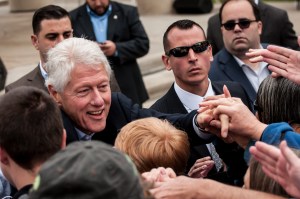
Greg Sargent says Bill Clinton “hit a home run” this afternoon when he appeared with Milwaukee Mayor Tom Barrett at a rally earlier this afternoon. Sargent:
Bill Clinton, in his speech in Wisconsin…framed the recall election as a stark choice between unity and division, between cooperation and conflict, and between shared prosperity and right wing winner-take-all economics. Democrats on the ground in the state are very satisfied with Clinton’s speech, and think he hit the right note to amplify their closing message
Clinton barely mentioned Barrett’s opponent Governor Scott Walker.
But the most important part of Bill’s speech was the call for voters to come out to the polls on Tuesday, in order to rebuke the national conservative movement’s huge financial investment in this race, and to make a larger statement about the type of leadership they want for the state and the country in the future:
If you believe in an economy of shared prosperity when times are good, and shared sacrifice when they’re not, then you don’t want to break the unions. You want them at the negotiating table. And you trust them to know that arithmetic rules. Show up for Tom Barrett on Tuesday! If you want Wisconsin once again to be seen by all of America as a place of diversity, of difference of opinion, of vigorous debate, where in the end people’s objectives are to come to an agreement that will take us all forward together, you have to show up for Tom Barrett on Tuesday!…
I can just hear it now, on Wednesday. All those people that poured all this money into Wisconsin, if you don’t show up and vote, will say, `see, we got them now. We’re finally going to break every union in America. We’re gonna break every government in America. We’re gonna stop worrying about the middle class. We don’t give a riff whether poor people get to work their way into it. We got our way now. We got it all. Divide and conquer works.’
You tell them no. You tell them, Wisconsin has never been about that, never will be about that — by electing Tom Barrett governor!
Third Coast Digest has much more on the rally, including photos.
Here is Clinton’s full 18 minute speech.
The recall election will be held on Tuesday, June 5. How it turns out will be extremely important for the entire country. If Walker wins, the Republican will likely double down in their wars on unions, voting rights, and women’s health.
Please discuss, or use this as an open thread.
Monday Reads
Posted: May 28, 2012 Filed under: Foreign Affairs, Fox News, Mitt Romney, morning reads, Republican presidential politics, Syria, The DNC, U.S. Politics | Tags: "the vision thing", Barack Obama, Bob Shieffer, cell phones, Cory Booker, Ed Gillespie, feckless, headphones, Jack Kerouac, John McCain, Mitch Daniels, NPR, On The Road, Richard Lugar, Rudy Giuliani, Scott Walker, smart phones, U.N. Security Council, Wisconsin recall election 24 Comments
Good Morning!!
I’m filling in for Dakinikat today, while she wends her way back down to New Orleans after her daughter’s great big Bollywood wedding. It’s another very slow news day today, but I’ve tried to dig up some interesting reads for you anyway.
The U.N. Security Council has condemned Syria’s government for the Houla massacre.
An emergency council meeting in New York on Sunday accused President Bashar al-Assad’s forces of unleashing havoc in the town, calling the bombardment of residential areas “an outrageous use of force” which violated international law.
“The security council condemned in the strongest possible terms the killings, confirmed by United Nations observers, of dozens of men, women and children and the wounding of hundreds more … in attacks that involved a series of government artillery and tank shellings on a residential neighbourhood,” the non-binding statement said.
Russia, which has resisted previous western-led condemnations of its Damascus ally, signed up to the declaration, signalling the extent of revulsion over images of infant corpses lined side by side after Friday’s slaughter, one of the worst incidents in the 14-month conflict.
You probably heard that John McCain, who for mysterious reasons is a permanent fixture on the Sunday talk shows even though he’s wrong about everything, has called Obama’s foreign policy and especially his caution on Syria “feckless.” The Villagers really love that word for some reason….why not just say “irresponsible” or “lazy”? Those are some of the definitions of the word.
On the other hand, outgoing Indiana Senator Richard Lugar, who is a lot more thoughtful than McCain, thinks Obama is right to be cautious on Syria. From TPM:
“I think that he has been very cautions. And I think that he’s cautions because he’s in the process of withdrawing our troops along with NATO from Afghanistan, pivoting our policy toward China and the east, more toward a situation of using robots – the ability to not to have to send in troops. It’s a difficult situation. So when you talk about Syria, and you talk about troops or intervention, the president has been very cautious. I think properly so.”
Also on the Sunday shows, Bob Shieffer asked Romney adviser Ed Gillespie why Mitt won’t appear anywhere except Fox News. Gillespie responded that Romney meet with “some schoolchildren last week.” Shieffer said, “I know schoolchildren are happy to see him.”
Good one, Bob!
On Candy Crowley’s show Rudy Giuliani was supposed to be playing surrogate for Romney and pulled a Cory Booker. Giuliani began by announcing that Romney is “the perfect choice” and then proceeded to “trash” Romney’s Massachusetts record while “explaining” his trashing of Romney back in 2008.
“Well, I mean, there’s a certain amount of personal ego in that — at that point, I was probably comparing his record to my record,” he said about his dings at Romney. “And maybe it was circumstances or whatever, but I had massive reductions in unemployment. He had a reduction in unemployment of about 8,10 percent — I think it was 15 percent. I had a reduction of unemployment of 50 percent. He had a growth of jobs of about 40,000; we had a growth of jobs of about 500,000. So I was comparing what I thought was my far superior record to his otherwise decent record. … That’s all part of campaigning.”
But, he added, Romney is much better than President Barack Obama.
I guess it’s still not quite as bad as the “endorsement” Romney got from Mitch Daniels.
Politico has a somewhat long piece for them on why Republicans are afraid that Romney “lacks the ‘vision thing'” For example:
“At the end of the day, you can’t just be all, you know, anti-Obama,” said former Ohio Secretary of State Ken Blackwell, whose state is key to Romney’s chances. “It has to be, I think, two parts that and one part here’s the antidote, here’s the vision, here’s the path that I would like to lead America down.”
And GOP strategist Mark McKinnon — who advised former two-term Republican president George W. Bush — said it’s time for Romney to outline his agenda.
“It’s important to establish the problem when you are a challenger because you are asking voters to fire the incumbent. So, Romney has to file his grievances,” McKinnon said. “But at some point he has to show that he has a vision of a better way. He can’t just say ‘The future is bleak, follow me.’ Because no one will.”
That sounds a little bit like the “advice” Mitch Daniels gave to Mitt. Sadly, Mitt has no vision for a better way. He just wants to be King so he can order everyone around and fire people when he feels like it.
I’ve been so focused on politics for the past several years that I’ve somewhat lost touch with popular culture. So it came as a shock to me today when reading an article about the Cannes Film Festival that one of the movies being shown there is an adaptation of Jack Kerouac’s On The Road. I knew instantly it would be horrible. Every Kerouac adaptation has been.
I used to be fascinated by Kerouac. I was on the Lowell, MA, Kerouac Festival Board for a few years, I’ve done two major research projects on Kerouac’s life and work, one of which I presented at at academic conference. I’ve read everything Kerouac has written, including his letters. I will never see this film, because I don’t want the book ruined for me. Trust me on this, just read the book if you haven’t already, and skip the movie.
The Washington Post has a piece on the Wisconsin recall election which is coming up on June 5: Scott Walker’s fate will have November implications.
Walker made national headlines last year when he eliminated most collective-bargaining rights for public employee unions, triggering huge protests. The fight put friends, neighbors and family members on opposite sides and left the state as polarized as any in the nation. It will culminate in next month’s recall election, only the third for a sitting governor in U.S. history.
The Democrats need to get off their butts and into Wisconsin soon or Walker is going to win. That would be disastrous, and would likely put the state in play for Romney in November. Wisconsin Democrats have been begging for help from the DNC, and it has been slow in coming.
I recently heard an interesting interview on NPR about Lulu DeCarrone, a coffee shop owner who decided to pull the plug on WiFi in her shop. She suddenly realized that her customers were sitting alone at tables for hours just staring at their computers and not talking. No one was having fun anymore and Lulu wasn’t making much money either. Quoting her:
It happened around three or four years ago. One afternoon, I was standing behind the counter and I allowed laptops for a while. And there were four tables, and four people sitting with laptops there. And I remember thinking, “This is like a crypt. I don’t like the feel of it.” Well, two ladies came in a little bit later and they were having such a good time. They were old friends, they haven’t seen each other in a long time and they were laughing and just carrying on. And the people who were sitting on the laptops kept glaring at them. And I made the decision right then and there. I thought I would rather lose my business and sell pencils out of a hat in front of the British Art Museum, than have this atmosphere in my store….
I thought, “Oh my God, maybe no one will come. Maybe I’ll lose it.” And I swear to you, that I was willing to do that. But it worked in reverse. I am the absolute opposite of what Starbucks does, and I’m very happy about it.
It’s become like Mecca for people who are disgusted. I never expected this. This has blown my mind; I never thought that would happen. I get compliments every single day. So I think that’s what it’s given me: Not a big bank account, certainly not driving a fancy car — but it has given me something that’s much harder to get, joy.
I’m no Luddite, but I have to admit, I do get disgusted sometimes the way gadgets have taken over and replaced socializing in public. When I was teaching at a large university, it was rare to see a student who wasn’t either listening to music on headphones, talking on the phone, or texting. They were completely out of touch with whatever was happening in their surroundings in the present moment. And so I also enjoyed this piece at the WaPo on people who ruin things for everyone around them by talking loudly on their cell phones. Here’s a sample:
I love taking the train and typically enjoy the ride. It can be so peaceful, and you don’t have the stress that comes with flying. But if I don’t get a seat in the “quiet car” that Amtrak has designated for those us who want peace, I’m privy to some conversations that should only be conducted in private.
I understand the occasional short conversation to let someone know when to pick you up or that the train is running late, but people are holding long and involved conversations, often about inane stuff. Businessmen are barking orders or, in one case I overheard, holding a conference call. I really don’t want to know your business.
On a recent Amtrak trip, a woman sat next to me and made a call to her friend who, I learned, was afraid she had a sexually transmitted disease. Thankfully, another seat opened up and the woman moved. But I could still hear her describing the test for the disease.
And have you noticed that many people seem to have no compunction about making you wait while they take calls? Why not just call the person back later and talk to the person you’re with?
OK, that’s all I’ve got. What are your recommended links for today?
Tuesday Reads
Posted: April 10, 2012 Filed under: morning reads, Team Obama, U.S. Economy, U.S. Politics, unemployment, War on Women, Women's Healthcare | Tags: Alvin Watts, Barack Obama, black unemployment, Daily Caller, George Zimmerman, hatred of poor people, Jake England, John Derbyshire, Mark Judge, National Review, OK shootings, racal profiling, Racism, Rich Lowry, Rick Warren, Scott Walker, Sexism, Trayvon Martin, Tulsa 49 Comments
Good Morning!
It is just me, or is racism coming to the surface with a vengeance after the Trayvon Martin shooting? Maybe it’s just that the media is covering it more. But when it comes to the right wingers, it seem to me that they’ve be somehow inspired by, rather than shocked by, George Zimmerman’s horrific act. I’ll give you some examples, but I don’t want to link to the winger sites. I’ll give you enough info so you can google them.
You’ve probably heard about the National Review’s firing of writer John Derbyshire after he wrote a blatantly racist piece in response to the Martin/Zimmerman case. Amy Davidson at the New Yorker:
Rich Lowry, the editor of National Review, announced over the weekend that he was ending the magazine’s association with John Derbyshire because of a post he published in Taki’s Magazine….Lowry said that the column, “The Talk: Non-Black Version,” was “nasty and indefensible.” Given its conceit—Derbyshire explaining to his children that black people are generally dumber than they are and dangerous and should, on the whole, be avoided—it might also be described as racist. (Josh Barro, at Forbes.com, called it “kind of unbelievably racist.”) In firing “Derb,” Lowry directed readers to his “delightful first novel” but said, in effect, that “Derb” had become bad for the NR brand:
We never would have published it, but the main reason that people noticed it is that it is by a National Review writer. Derb is effectively using our name to get more oxygen for views with which we’d never associate ourselves otherwise. So there has to be a parting of the ways. Derb has long danced around the line on these issues, but this column is so outlandish it constitutes a kind of letter of resignation.
Except as Davidson points out, barely disguised racism is hardly foreign to the National Review. Why should we believe Lowry is so shocked by it? More likely he acted because the column was getting so much negative attention.
And yesterday another right wing racist–some guy named Mark Judge–came out of the closet in a post at Tucker Carlson’s site The Daily Caller (google it to read the whole miserable thing) writes that he’s thrown off the chains of his “white guilt.” Why? Because his bike was stolen and he’s sure the thief must have been black–even though he has no idea who actually stole the bike.
First Judge establishes his “poor me-ness” by explaining that he really loved that bike, and his doctor recommended exercise to deal with the aftereffects of chemotherapy for non-Hodgkins lymphoma. AND he was at church on Good Friday when the must-have-been-black-guy stole his bike. AND he never went on disability during his chemo treatments. Break out the violins and handkerchiefs!
Next he claims
“a liberal friend gave me a lecture about profiling and told me to just forget about the bike. ‘That person needs our prayers and help,’ she said. ‘They haven’t had the advantages we have.’”
“They?” So this “liberal” also assumed the thief was black?
That’s when I lost it. I had been carefully educated by liberal parents that we are all, black and white, the same. My favorite movie growing up was “In the Heat of the Night.” Yet that often meant not treating everyone the same. It meant treating blacks with a mixture of patronizing condescension and obsequious genuflecting to their Absolute Moral Authority gained from centuries of suffering. It meant not treating everyone the same.
It meant leaving valuable things like a bike in a vulnerable position in a black part of town because you didn’t want to admit that the crime is worse in poor black neighborhoods.
And get this–Judge’s favorite movie used to be In the Heat of the Night. So he couldn’t possibly be a racist, right? Really, go read the post. The pretzel logic is beyond belief.
The news has been filled with reports of African Americans getting shot by white people. I don’t know if there’s been an uptick in race-related shootings or if they are just getting more coverage at the moment. This terrible case in Tulsa, Oklahoma, for example. The two shooters have now confessed.
The explanation for a shooting rampage that terrorized Tulsa’s black neighborhood and left three people dead may lie in a killing that took place more than two years ago.
Carl England, whose son is accused in the weekend shooting spree, was fatally shot in 2010 by a man who had threatened his daughter and tried to kick in the door of her home.
The man was black, and police say England’s son may have been seeking vengeance when he and his roommate shot five black people last week.
Police documents filed Monday in court say the two suspects have both confessed. According to an affidavit, 19-year-old Jake England admitted shooting three people and 32-year-old Alvin Watts confessed to shooting two.
So what was Watts’ motive then? It’s very sad that England’s father was killed, and the case does sound troubling
Back in 2010, Carl England had responded to his daughter’s call for help and with her boyfriend tracked down the man who tried to break in. A fight broke out, and the man took out a gun and fired at England.
The man who pulled the trigger, Pernell Jefferson, was not charged with homicide because an investigation determined he acted in self-defense.
Nevertheless, deciding that other innocent black people have to die because of what Jefferson did is still racist.
And then there’s right wingers and their hatred of poor people. That’s not news, but when a preacher unashamedly advertises it on Easter Sunday… Good grief! Kevin Drum: Helping the Poor is Now Apparently Anti-Bible.
I see that fellow Orange Countian Rick Warren — he of Saddleback megachurch and Purpose Driven Life fame — is in the news again. He was on ABC’s This Week yesterday, and Jake Tapper asked him what he thought about President Obama’s suggestion that God tells us to care for those less fortunate than ourselves:
Well certainly the Bible says we are to care about the poor….But there’s a fundamental question on the meaning of “fairness.” Does fairness mean everybody makes the same amount of money? Or does fairness mean everybody gets the opportunity to make the same amount of money? I do not believe in wealth redistribution, I believe in wealth creation.
The only way to get people out of poverty is J-O-B-S. Create jobs. To create wealth, not to subsidize wealth. When you subsidize people, you create the dependency. You — you rob them of dignity.
These people have completely removed Jesus from “christianity.”
Via The Minority Report at The Washington Free Beacon, It looks like the Obama Campaign needs to work a lot hard on diversity in hiring.
On Monday, Buzzfeed posted some photos of Obama campaign staff, and if there are any black faces in them, I can’t see them. Take a look at that Minority Report piece if you can. Here’s part of it:
In August 2011, Obama signed an executive order requiring federal agencies to develop plans for improving workforce diversity.
The apparent lack of racial diversity at the Obama campaign headquarters comes at a time when the national black unemployment rate is nearly double the rate for whites.
According to the most recent report from the Bureau of Labor Statistics (BLS), 14 percent of blacks are currently unemployed, compared with 7.3 percent of whites….
In Illinois, the black unemployment rate—as high as 28 percent, according to the Illinois Department of Employment Security—far exceeds the national average.
What a hypocrite!
And check out this one on “Obama’s war on women” too.
Jeeze, where can we turn? Obviously, the Repubs are even worse. In case you missed it, Scott Walker recently surreptitiously signed anti-abortion and anti-birth control bills at the same time he repealed Wisconsin’s equal pay for women act.
I’ll end there, but in case you missed my evening post last night, please be sure to read Joseph Cannon’s important post on electronic spying by Progressive Insurance. Your car insurance company may be following suit soon.
What stories do you recommend this morning?

 peej
peej Carissa
 bostonboomer
 dakinikat
 ecocatwoman
 mablue2
 Mama Lopez
 peggysue22
 quixote
 skydancingguestblogger
 Mona (aka Wonk the Vote)



 Sky Dancing
Recent Comments