

RTT News: Dark Chocolate May Improve Walking Ability.
Lazy Saturday Reads
Posted: July 5, 2014 Filed under: morning reads, U.S. Politics, Women's Rights | Tags: "white oppression", Bill Clinton, Boston bombing, Bourbon St. shootings. New Orleans, C-Span callers, Civil Rights act, Eden Foods, Hillary Clinton, Hobby Lobby decision, Hurricane Arthur, Indianapolis shootings, Maya Angelou, Michael Potter, Racism, Richard Mellon Scaife, Samuel Alito, SCOTUS, vanilla ice cream 34 Comments
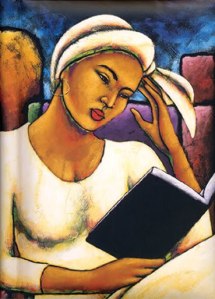
“Someone is Waiting,” by David Hettinger
Good Morning!!
I’m sure you won’t be surprised to learn that today is a very slow news day. Nevertheless, I’ve still managed to dig up a few interesting reads.
Long-time Clinton hater Richard Mellon Scaife has died at 82. The Associated Press reports via Politico:
Scaife died early Friday at his home, his newspaper, the Pittsburgh Tribune-Review, reported. Scaife’s death comes less than two months after he announced in a first-person, front-page story in his Pittsburgh Tribune-Review that he had an untreatable form of cancer.
“Some who dislike me may rejoice at the news,” wrote Scaife, who acknowledged making political and other enemies. “Naturally, I can’t share their enthusiasm.”
He was the grand-nephew of Andrew Mellon, a banker and secretary of the Treasury who was involved with some of the biggest industrial companies of the early 20th century. Forbes magazine estimated Scaife’s net worth in 2013 at $1.4 billion.
The intensely private Scaife became widely known in the 1990s when first lady Hillary Rodham Clinton said her husband was being attacked by a “vast right-wing conspiracy.” White House staffers and other supporters suggested Scaife was playing a central role in the attack.
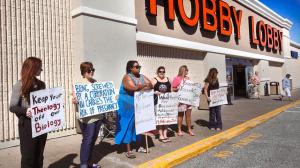
Hillary was mocked for those remarks; but today, in the aftermath of the Hobby Lobby decision, it should be obvious to all but the most oblivious and ignorant among us that the vast right wing conspiracy exists and its tentacles have reached even the U.S. Supreme Court.
From Forbes, Clare O’Connor reports more Hobby Lobby Fallout: Catholic Soy Milk Mogul Won’t Cover Drugs That ‘Prevent Procreation’. Eden Foods founder Michael Potter has stated his determination to prevent his female employees from getting access to birth control, and the Supreme Court is helping him.
In April 2013, devout Catholic (and sole Eden Foods shareholder) Potter sued the Department of Health and Human Services, calling the Affordable Care Act’s contraceptive mandate “unconstitutional government overreach.”
In a letter he wrote in response to a shopper complaint that month, Potter described contraceptives as “lifestyle drugs” akin to “Viagra, smoking cessation, weight-loss” tools and other medications. (He also compared birth control to “Jack Daniels” in a contemporaneous interview with Salon.)
In October, the U.S. Court of Appeals decided against Potter, ruling that Eden Foods, as a for-profit corporation, couldn’t exercise religion.
Now, in the wake of this week’s controversial Supreme Court ruling recognizing craft chain Hobby Lobby’s religious rights, the court has changed its tune.The day after the Justices decided evangelical Hobby Lobby billionaire David Green doesn’t have to cover certain contraceptives for his employees, the Supreme Court vacated the judgment against Eden Foods and sent the case back to the U.S. Court of Appeals for the Sixth Circuit for further consideration.
“The court of appeals is ordered by the Supreme Court to follow its decision in Hobby Lobby,” said Erin Mersino, the attorney handling Potter’s case at the Christian, conservative Thomas More Law Center.
And the beat goes on . . .
At The Nation, Katha Pollit asks: Where Will the Slippery Slope of ‘Hobby Lobby’ End?
Facts are stubborn things, as John Adams famously said. Unless, that is, you’re talking about religion. Then facts don’t seem to matter at all: right you are if you think you are. The Hobby Lobby case was billed as a test of religious freedom versus the power of the state: Did the Religious Freedom Restoration Act (RFRA) mean that David Green, the evangelical Christian CEO of a chain of crafts stores, could be exempt from providing coverage for the full range of contraceptives for his employees under the Affordable Care Act? Green balked at including Plan B, Ella (another form of emergency contraception) and two kinds of IUD, because, he claimed, they caused “abortion” by preventing the implantation of a fertilized egg.
The Court’s 5-to-4 decision—which featured all three women justices ruling for the workers, and all five Catholic men ruling for the corporation—was wrong in many ways. But the thing I really don’t understand is why it didn’t matter that preventing implantation is not “abortion,” according to the accepted medical definition of the term. And even if it was, Plan B, Ella and the IUDs don’t work that way, with the possible exception of one form of IUD when inserted as emergency contraception. As an amicus brief from a long list of prestigious medical organizations and researchers laid out at length, studies show that emergency contraception and the IUD preventfertilization, not implantation. They are not “abortifacients,” even under the anti-choicers’ peculiar definition of abortion. (Green is actually more moderate than some anti-choicers, who include hormonal contraception, aka “baby pesticide,” as abortion.) Why doesn’t it matter that there is no scientific evidence for Green’s position? When did Jesus become an Ob/Gyn?

Good question. Today even facts are irrelevant to Supreme Court decisions. The fact is that Democrats helped Thomas, Roberts, and Alito make it onto the Court, and now we’re stuck with these religious and ideological fanatics.
At Salon, Digby writes that Alito could have been stopped: Why Dems should have filibustered the radical. And from Peter Montgomery at HuffPo, Samuel Alito: A Movement Man Makes Good on Right-Wing Investments. Read them and weep.
Dakinikat posted this Guardian piece in the comments last night; I thought it should be included in this morning’s links: Black people were denied vanilla ice cream in the Jim Crow south – except on Independence Day.
By custom rather than by law, black folks were best off if they weren’t caught eating vanilla ice cream in public in the Jim Crow South, except – the narrative always stipulates – on the Fourth of July. I heard it from my father growing up myself, and the memory of that all-but-unspoken rule seems to be unique to the generation born between World War I and World War II.
But if Maya Angelou hadn’t said it in her classic autobiography I Know Why the Caged Bird Sings, I doubt anybody would believe it today.
People in Stamps used to say that the whites in our town were so prejudiced that a Negro couldn’t buy vanilla ice cream. Except on July Fourth. Other days he had to be satisfied with chocolate.
Vanilla ice cream – flavored with a Nahuatl spice indigenous to Mexico, the cultivation of which was improved by an enslaved black man named Edmund Albius on the colonized Réunion island in the Indian Ocean, now predominately grown on the largest island of the African continent, Madagascar, and served wrapped in the conical invention of a Middle Eastern immigrant – was the symbol of the American dream. That its pure, white sweetness was then routinely denied to the grandchildren of the enslaved was a dream deferred indeed.
What makes the vanilla ice cream story less folk memory and more truth is that the terror and shame of living in the purgatory between the Civil War and civil rights movement was often communicated in ways that reinforced to children what the rules of that life were, and what was in store for them if they broke them.
Please go read the whole thing if you haven’t already.

From Politico: Why the Civil Rights Act couldn’t pass today.
It was a painful tableau: The bipartisan leaders of Congress linking hands in the Capitol Rotunda and swaying to the strains of “We Shall Overcome” as they commemorated the 50th anniversary of the passage of the Civil Rights Act of 1964. Harry Reid and Nancy Pelosi sang along with the crowd, but Mitch McConnell and John Boehner’s lips were frozen in silent, self-conscious smiles.
The climate in today’s Washington is so different from the one that produced what many scholars view as the most important law of the 20th century that celebrating the law’s legacy is awkward for Republicans and Democrats alike. Neither party bears much resemblance to its past counterpart, and the bipartisanship that carried the day then is now all but dead….
The current congressional leaders gathered last week not to honor Johnson — or any of the legislative leaders who actually passed the landmark law — but to award a posthumous Congressional Gold Medal to The Rev. Dr. Martin Luther King Jr. and his wife, Coretta Scott King, whose crusade helped create the climate that made the bill possible. In his life, racial tensions helped make King such a polarizing figure that both Johnson and John F. Kennedy worried about seeming too close to him, but in martyrdom and myth, he is the only politically safe ground on which present day leaders could unite.
They are all so pathetic. And this is beyond pathetic: Callers Use C-SPAN Civil Rights Discussion To Complain About White Oppression (VIDEO).
“Washington Journal” host Steve Scully listened as an “independent” caller named Thomas from Maryland told him that he is “much less liberal today” than he was in 1964 when the landmark law was signed by Lyndon B. Johnson.
“And I think the blacks have brought on most of their present-day problems themselves. They insult white people,” he told Scully. “I heard it right on your own show, I heard some black call Karl Rove a ‘white boy.’ And I don’t think that’s right. They’re attacking white people in the big cities and we’re supposed to put up with that kind of stuff and like them and say, ‘Well, come into our neighborhood.’ And how about the discussion of the black crime that goes on in this country?”
The caller went on to complain that the discrimination endured by Irish, Mormons and Italians is widely ignored.
“You people will never, never discuss that. You only discuss the discrimination against the black people,” he said.
Is that sick or what?
A few more news links:
Information Week on private tech companies treatment of their customers, Facebook Mood Manipulation: 10 Bigger Problems.
Fox News: Suspect arrested in Bourbon St. shootings.
USA Today: Seven hurt in Indianapolis shootings.
WSJ: A Weakened Hurricane Arthur Heads Toward Nova Scotia
ABC News: Before Boston Attack, Alleged Bomber Posed With Black Flag of Jihad at Local Mosque.
So . . . what stories are you reading and blogging about? Please share your links in the comment thread, and enjoy the rest of the long weekend!
Fourth of July Reads
Posted: July 4, 2014 Filed under: morning reads, U.S. Politics, Women's Rights | Tags: corporate personhood, corporatizing religious liberty, Declaration of Independence, Fourth of July, Hobby Lobby, Independence Day, John Roberts, legal precedent, religion, Samuel Alito, SCOTUS, separation of church and state, Statue of Liberty, Wheaton College 14 Comments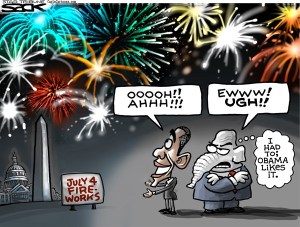
Good Morning!!
Today we celebrate the Declaration of Independence. I’ve assembled a few informational readings about this day in history.
From The Cagle Post: Fourth of July Fast Facts.
“I’m confused. I thought July 4 was the day our country declared independence from King George III of Great Britain.”
“Actually, according to ConstitutionFacts.com, that’s not so. The Continental Congress declared independence from Great Britain on July 2, 1776.”
“Then why do we celebrate our independence on the Fourth every year? Is that when we started the American Revolution?”
“That is a common misunderstanding, as well. The American Revolution began in April 1775, more than a year earlier.”
“I’m stumped. Was the Fourth the day Thomas Jefferson wrote the first draft of the Declaration of Independence?”
“Nope. Thomas Jefferson wrote the first draft in June 1776. Also, Jefferson didn’t write the Declaration alone.”
“He didn’t? I always thought he was the sole author.”
“A common misconception. In fact, the Continental Congress appointed a five-person to write the Declaration. It included Jefferson, Benjamin Franklin, John Adams, Robert Livingston and Roger Sherman.” ….
“Though Jefferson wrote the first draft, it was changed 86 times by other members of the committee and other members of the Continental Congress.”
I did not know that.
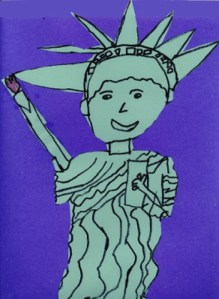
David Armitage at The Wall Street Journal: The Declaration of Independence: The Words Heard Around the World.
The Declaration of Independence is the birth certificate of the American nation—the first public document ever to use the name “the United States of America”—and has been fundamental to American history longer than any other text. It enshrined what came to be seen as the most succinct and memorable statement of the ideals on which the U.S. was founded: the rights to life, liberty and the pursuit of happiness; the consent of the governed; and resistance to tyranny.
But the Declaration’s influence wasn’t limited to the American colonies of the late 18th century. No American document has had a greater impact on the wider world. As the first successful declaration of independence in history, it helped to inspire countless movements for independence, self-determination and revolution after 1776 and to this very day. As the 19th-century Hungarian nationalist, Lajos Kossuth, put it, the U.S. Declaration of Independence was nothing less than “the noblest, happiest page in mankind’s history.”
In telling this story of global influence, however, it is important to separate two distinct elements of the Declaration—elements that sometimes get conflated. The first of these is the assertion of popular sovereignty to create a new state: in the Declaration’s words, the right of “one People to dissolve the Political Bands which have connected them with another, and to assume among the Powers of the Earth, the separate and equal Station to which the Laws of Nature and of Nature’s God entitle them.” The second and more famous element of the Declaration is its ringing endorsement of the sanctity of the individual: “We hold these truths to be self-evident, that all men are created equal, that they are endowed by their Creator with certain unalienable Rights.”
Read much more at the link.
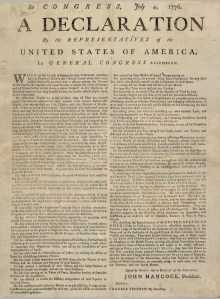
From the LA Times: The slow-spreading news of American independence.
In this era of instant communication, it’s interesting to note the slow distribution of the Declaration, and the spreading of the word to those on whose behalf independence had been declared. (Imagine the Twitter version: Dudes, we’re on our own. #independence #totallyrad #stickitkinggeorge).
The text was set in type by Philadelphia printer John Dunlap just hours after the Continental Congress approved the manifesto on July 4. He ran off about 200 copies, most of which were then distributed via horse and boat around the Colonies. He reprinted it in his own newspaper, Dunlap’s Pennsylvania Packet, or The General Advertiser (great newspaper names back then). Over the next few weeks, Jefferson’s stirring words were reprinted inlocal newspapers and pamphlets around the Colonies.
And, naturally, in Britain. It took more than a month for the first reports of the Declaration to reach Britain in letters ferried by the Mercury packet ship. Gen. William Howe, who was leading the crown’s forces in the Colonies, included a brief mention in his report to his overseers. So the first public airing of the news came in the London Gazette, the crown’s official paper. If you weren’t a close reader, you could have easily missed it.
In the four-page issue dated Aug. 6-Aug. 10, 1776, the Gazette’s lead story was Howe’s update of the war, reporting that “the Rebels, who are numerous, and are very advantageously posted with strong Entrenchments both upon Long Island and that of New York, with more than One Hundred pieces of Cannon for the Defence of the Town towards the Sea, and to obstruct the passage of the [British] Fleet up the North [Hudson] River, besides a considerable Field Train of artillery.”
Finally, Carina Kolodny at Huffington Post: This Is Not Your Independence Day.
The 4th of July might commemorate the independence of our country — but it also serves as a bitter reminder that in 1776, the country that I love had no place for me in it.
When our founding fathers penned, “All men are created equal,” they meant it. Not all people. Not all humans. Just all men — the only reason they didn’t feel obliged to specify “white” men is because, at the time, men of color were considered less than men, less than human.
The 4th is not my Independence Day — and if you’re a Caucasian woman, it isn’t yours either. Our “independence” didn’t come for another 143 years, with the passage of The Woman’s Suffrage Amendment in 1919. The 4th of July is also not Independence Day for people of color. It wasn’t until the 15th Amendment was ratified in 1870 that all men had the right to vote regardless of race — on paper, that is, not in practice. People of color were systematically, and all too successfully, disenfranchised for another century. July 4th of 1776 was certainly not a day of Independence or reverence for Native Americans. It wasn’t until 1924 that Native Americans could unilaterally become citizens of the United States and have the voting rights to go with it.
Now, before anyone argues that Independence is about more than voting rights, I’d like to point out that our Founding Fathers would fundamentally disagree with you. The Revolutionary War was fought, in large part, because of “taxation without representation” — the then English colonists believed they were not free because their voices were not represented. The right to vote, the right to have your say is the delineating characteristic of a democracy.
The Aftermath of the Hobby Lobby Decision
On that note, today many concerned citizens are looking back at the latest Supreme Court decisions that take women backwards in their pursuit of freedom and autonomy. The court-approved limits on access to birth control go beyond the Hobby Lobby decision. Lyle Denniston at SCOTUSblog: Broader right to object to birth control.
Expanding the rights of religious opponents of birth control, a divided Supreme Court on Thursday afternoon spared an Illinois college — and maybe hundreds of other non-profit institutions — from obeying government regulations that seek to assure access to pregnancy prevention services for female workers and students. In the same order, the majority essentially told the government to modify its own rules if it wants to keep those services available.
Three Justices wrote a sharply worded dissent, accusing the majority of creating on its own a “new administrative regime” that will seriously complicate the operation of the birth control mandate under the new federal health care law. The majority, the dissenters said, “has no reason to think that the administrative scheme it foists on the government today is workable or effective on a national scale.”
The ruling, which the majority insisted was temporary and had settled nothing finally about the legal issues at stake, came three days after the Court in Burwell v. Hobby Lobby had given for-profit businesses whose owners have religious objections to birth control a right to refuse to provide those services in their employee health plans.
The plea by Wheaton College, a religious institution in Illinois with about 3,000 students, moved the Court beyond for-profit firms to the world of non-profit religious colleges, hospitals, and other charities. The government had already moved to accommodate their beliefs, but that had not gone far enough for the college and for scores of other non-profits. With the Court’s new order, they gained additional separation from the birth-control mandate.
At Mother Jones, Kevin Drum writes: Supreme Court Now Playing Cute PR Games With Hobby Lobby Decision.
For the last few days, there’s been a broad argument about whether the Hobby Lobby ruling was a narrow one—as Alito himself insisted it was—or was merely an opening volley that opened the door to much broader rulings in the future. After Tuesday’s follow-up order—which expanded the original ruling to cover all contraceptives, not just those that the plaintiffs considered abortifacients—and today’s order—which rejected a compromise that the original ruling praised—it sure seems like this argument has been settled. This is just the opening volley. We can expect much more aggressive follow-ups from this court in the future.
POSTSCRIPT: It’s worth noting that quite aside from whether you agree with the Hobby Lobby decision, this is shameful behavior from the conservatives on the court. As near as I can tell, they’re now playing PR games worthy of a seasoned politico, deliberately releasing a seemingly narrow opinion in order to generate a certain kind of coverage, and then following it up later in the sure knowledge that its “revisions” won’t get nearly as much attention.
At Slate, Micah Schwartzman, Richard Schragger, and Nelson Tebbe explain that Hobby Lobby rewrites religious-freedom law in ways that ignore everything that came before.
Monday’s decision in Hobby Lobby was unprecedented. Much of the commentary has focused on the Supreme Court’s decision to extend rights of religious free exercise to for-profit corporations. Hobby Lobby is for religion what Citizens United was for free speech—the corporatization of our basic liberties. But Hobby Lobby is also unprecedented in another, equally important way. For the first time, the court has interpreted a federal statute, theReligious Freedom Restoration Act (or RFRA), as affording more protection for religion than has ever been provided under the First Amendment. While some have read Hobby Lobby as a narrow statutory ruling, it is much more than that. The court has eviscerated decades of case law and, having done that, invites a new generation of challenges to federal laws, including those designed to protect civil rights.
The authors explain how the right wing Roberts Court has moved beyond any concern for legal precedent in making its decisions.
Hobby Lobby is unprecedented because it corporatizes religious liberty. It extends to for-profit businesses the rights and privileges that have long been associated only with churches and religious nonprofits. But that change is the result of a more pervasive and deeper upending of the law of religious liberty in America. Ignoring congressional intent, the court reads RFRA as having shed its First Amendment skin. It is not entirely clear what American law will look like after that change. But if anything is clear, it is that the Roberts Court is now unconstrained by precedent. It has loosened itself from decades of First Amendment doctrine and has begun remaking the law of free exercise.
Please read the whole thing.
Ironically, the Hobby Lobby decision may have also created some serious problems for the human beings who own corporations (h/t Dakinikat). From Mother Jones: How Hobby Lobby Undermined The Very Idea of a Corporation. Basically, now that SCOTUS has said that some corporations are inseparable from the people who own them, those owners could lose their legal protection from debts and lawsuits that result from corporate actions. There’s some instant Karma for you!
A few more links for your holiday reading pleasure:
Miami Herald: FBI records: Chilling find in Bradenton dumpster (new clues to Saudi involvement in the 9/11 and the cover-up of that involvement by the Bush/Cheney administration).
Study links Oklahoma earthquake swarm with fracking operations
Boston Globe: People prefer electric shocks to time alone with thoughts.
LA Times: Tibetans get high-altitude edge from extinct Denisovans’ genes.
What stories are you following on this Independence Day?
Tuesday Reads: Most Classless SCOTUS Justice, Ongoing Snowden Saga, and Other News
Posted: June 25, 2013 Filed under: Barack Obama, China, Foreign Affairs, morning reads, Russia, U.S. Politics, Women's Rights | Tags: Climate change, Dana Millbank, Edward Snowden, Garrett Epps, Jacob Zuma, middle school antics, Nelson Mandela, Racism, Ruth Bader Ginsburg, Samuel Alito, Sexism, University of Texas Southwestern Medical Center v. Nassar, Vance v. Ball State University 77 Comments
Good Morning!!
I’m enjoying some nice fresh air this morning after thunderstorms during the night. It looks as if the mini-heat wave we’ve been having here in the Boston area isn’t going to be as quite bad as originally predicted. It it supposed to be several degrees cooler than expected today and tomorrow and then we’re back to high 70’s temps. I hope that turns out to be right.
Unfortunately, because of this refreshing change in the air here, I slept longer than I should have and this post will go up a little bit late.
If there were a competition for “most classless supreme court justice,” there would be some serious competition among Antonin Scalia, Clarence Thomas, and Samuel Alito; but I think in the end the first prize would have to go to Samuel Alito. Clarence Thomas at least has the grace to remain silent and Scalia supposedly can be funny at times. But Alito is just an immature, obnoxious disgrace, as he demonstrated at the State of the Union Address in 2010 when President Obama denounced the Citizens United decision.
Yesterday Alito used childish, offensive body language to publicly mock his senior colleague Justice Ruth Bader Ginsburg as she read a dissenting opinion to a SCOTUS decision that will make it more difficult for employees to sue for sexual or racial discrimination. From Dana Millbank at The Washington Post:
The most remarkable thing about the Supreme Court’s opinions announced Monday was not what the justices wrote or said. It was what Samuel Alito did.
The associate justice, a George W. Bush appointee, read two opinions, both 5-4 decisions that split the court along its usual right-left divide. But Alito didn’t stop there. When Justice Ruth Bader Ginsburg read her dissent from the bench, Alito visibly mocked his colleague.
Ginsburg, the second woman to serve on the high court, was making her argument about how the majority opinion made it easier for sexual harassment to occur in the workplace when Alito, seated immediately to Ginsburg’s left, shook his head from side to side in disagreement, rolled his eyes and looked at the ceiling.
His treatment of the 80-year-old Ginsburg, 17 years his elder and with 13 years more seniority, was a curious display of judicial temperament or, more accurately, judicial intemperance. Typically, justices state their differences in words — and Alito, as it happens, had just spoken several hundred of his own from the bench. But he frequently supplements words with middle-school gestures.
Millbank goes on the describe Alito’s similar treatment of female Justices Elena Kagan and Sonia Sotomayor a few days earlier. Read about it at the link.
Garrett Epps provides more detail at The Atlantic: Justice Alito’s Inexcusable Rudeness.
I am glad the nation did not see first-hand Justice Samuel Alito’s display of rudeness to his senior colleague, Justice Ruth Bader Ginsburg. Because Alito’s mini-tantrum was silent, it will not be recorded in transcript or audio; but it was clear to all with eyes, and brought gasps from more than one person in the audience.
The episode occurred when Ginsburg read from the bench her dissent in two employment discrimination cases decided Monday, Vance v. Ball State University and University of Texas Southwestern Medical Center v. Nassar. In both cases, the Court majority made it harder for plaintiffs to prevail on claims of racial and sexual discrimination. The Nassar opinion raises the level of proof required to establish that employers have “retaliated” against employees by firing or demoting them after they complain about discrimination; Vance limits the definition of “supervisor” on the job, making it harder for employees harassed by those with limited but real authority over them to sue the employers.
The Vance opinion is by Alito, and as he summarized the opinion from the bench he seemed to be at great pains to show that the dissent (which of course no one in the courtroom had yet seen) was wrong in its critique. That’s not unusual in a written opinion; more commonly, however, bench summaries simply lay out the majority’s rationale and mention only that there was a dissent. (Kennedy’s Nassar summary followed the latter model.)
After both opinions had been read, Ginsburg read aloud a summary of her joint dissent in the two cases. She critiqued the Vance opinion by laying out a “hypothetical” (clearly drawn from a real case) in which a female worker on a road crew is subjected to humiliations by the “lead worker,” who directs the crew’s daily operation but cannot fire or demote those working with him. TheVance opinion, she suggested, would leave the female worker without a remedy.
At this point, Alito pursed his lips, rolled his eyes to the ceiling, and shook his head “no.” He looked for all the world like Sean Penn as Jeff Spicoli in Fast Times at Ridgemont High, signaling to the homies his contempt for Ray Walston as the bothersome history teacher, Mr. Hand.
I guess I should be grateful that I’m old enough to recall the Warren Court. We won’t see a SCOTUS like that again in my lifetime, I’m afraid.
Of course the news is still being dominated by Edward Snowden, who once claimed he didn’t want the story of his leaks of classified information from NSA to be about him. “Really?” writes Dan Murphy of The Christian Science Monitor. “But if that were true, we probably wouldn’t even know his name.”
Two weeks ago, Edward Snowden gave The Guardian permission to disclose that he was the leaker of documents from the US National Security Agency.
“I don’t want public attention because I don’t want the story to be about me,” the former NSA contractor said then. “I want it to be about what the US government is doing.”
If that was really his desire, he’s certainly gone about it in a funny way. From that day, every step he’s taken couldn’t have been better calculated to draw attention to himself. Over the weekend he even turned the media dial up when he fled from Hong Kong to the loving bosom of Mother Russia.
And with the assistance of Julian Assange, Mr. Snowden’s “where’s Waldo” saga is turning into aWikiLeaks production.
Mr. Assange, founder of WikiLeaks, has staked out a consistently anti-American and techno-libertarian position in the past few years. The US government is motivated by malice and power lust in his worldview, its rivals like Russia (where state-owned broadcaster RT ran a show of Assange’s) get a free pass, and secrecyis an evil in and of itself. Though he presents himself as a champion of free-speech, Assange has sought refuge in the Embassy of Ecuador in London, never mind that the country has a poor and deteriorating record on freedom of speech. The Committee to Protect Journalists listed Ecuador and Russia as two of the 10 worst places to be a journalist in the world past year.
Read the rest at CSM.
Meanwhile, Russia and China are pushing back against U.S. criticism of their refusal to help the U.S. extradite Snowden. From The Washington Post:
MOSCOW— Russia and China on Tuesday rejected U.S. criticism of their roles in the legal drama surrounding Edward Snowden, saying their governments complied with the law and did not illegally assist the former government contractor charged with revealing classified information about secret U.S. surveillance programs.
Snowden, 30, has not been seen in public since he reportedly arrived in Moscow on Sunday, after slipping out of Hong Kong. Secretary of State John F. Kerry on Monday strongly urged Russian officials to transfer Snowden to U.S. custody. “We think it’s very important in terms of our relationship,” Kerry said. “We think it’s very important in terms of rule of law.”
But Russian Foreign Minister Sergei Lavrov said Snowden had not actually crossed into Russian territory, apparently remaining in a secure transit zone inside the airport or in an area controlled by foreign diplomats. Moscow therefore has had no jurisdiction over his movements, Lavrov said, and has no legal right to turn him over to U.S. authorities.
It sounds like Snowden could still be in some VIP lounge at the Moscow Airport, but no one knows for sure. One witness told Reuters that Snowden did in fact arrive there yesterday. If he is in the airport, Russia can claim that Snowden technically never stepped on Russian soil.
In other news, Nelson Mandela is in critical condition for the second day, according to President Jacob Zuma.
Mr. Zuma said that he and Cyril Ramaphosa, the deputy president of the governing African National Congress, visited Mr. Mandela late Sunday.
“Given the hour, he was already asleep. We were there, looked at him, saw him and then we had a bit of a discussion with the doctors and his wife,” Mr. Zuma said. “I don’t think I’m in a position to give further details. I’m not a doctor.”
Doctors told Mr. Zuma on Sunday evening that Mr. Mandela’s health “had become critical over the past 24 hours,” according to an earlier statement from the presidency.
In the statement on Sunday, Mr. Zuma said that doctors were doing “everything possible to get his condition to improve and are ensuring that Madiba is well looked after and is comfortable.” Madiba is Mr. Mandela’s clan name.
The Telegraph reports that Mandela’s close relatives “have gathered at his rural homestead to discuss the failing health of the South African anti-apartheid icon who was fighting for his life in hospital.”
From NPR, President Obama today plans To Lay Out Broad Plan To Address Climate Change.
President Obama is expected to announce a sweeping plan to address climate change this afternoon.
The president has framed this issue as a moral responsibility, to leave the Earth in good shape for generations to come. But the nitty-gritty of any serious plan to address this problem is also a challenge, because it means gradually moving away from fossil fuels to renewable energy supplies — and that means there will be economic winners and losers.
Winners include companies that produce clean energy — wind, solar and geothermal energy. That energy will be more in demand, and the administration intends to expand access to public lands, where companies can build windmills and solar facilities.
Public health is also a winner, because the plan would pressure coal-fired power plants to reduce their emissions. Those plants not only produce carbon dioxide, but they are major sources of mercury, radioactive particles and chemicals that contribute to asthma.
The losers will be coal companies and the miners they employ as well as millions of Americans who can’t afford to pay higher electric bills. You can read the entire plan at the NPR link. More detail in this story at CNN. And at Business Insider, Josh Barro lists 3 Reasons Obama’s Carbon Plan Is The Best Solution Right Now
Today should be another busy news day with the ongoing Snowden saga, the President’s climate initiatives, the continuing Whitey Bulger and George Zimmerman trials, and more important SCOTUS decisions. If it gets hot here again this afternoon, I’ll have something to distract me at least. I’ll try to post an afternoon update.
Now it’s your turn. What stories are you focusing on today? Please post your links on any topic in the comment thread, and have a terrific Tuesday!!
Tuesday Reads: West, Texas; Boston; Biohazards; and Erosion of Constitutional Rights
Posted: April 30, 2013 Filed under: morning reads, Rule of Law, SCOTUS, U.S. Politics | Tags: biohazards, bird photography, Boyer v. Louisiana, constitution, Dzhokhar Tsarnaev, Elizabeth Colbert Busch, environmental toxins, Fifth Amendment, funding for public defenders, indigent defendants, Jonathan Edward Boyer, Mark Sanford, Miranda, right to attorney, right to speedy trial, Samuel Alito, SC congressional race, Sixth Amendment, The New York Times editorial board, West TX fertilizer plant 38 Comments
Good Morning!!
I thought I’d start this morning’s post with something beautiful before I get to the news of the day. I came across these amazing photos of birds yesterday–a nice reminder that the natural world can nourish us emotionally and provide respite from startling events and frustrating news that surrounds us in the supposedly “civilized” world of humans.



Now some news…
The fertilizer plant disaster in West, Texas is still under-reported. From what I can tell from following the story on twitter though, people are hurting down there and really need help. Here are a couple of updates I found this morning.
From CBS in Dallas: West Fertilizer Plant Explosion Cause Could Take Several Weeks to Determine
The Federal Bureau of Alcohol, Tobacco, and Firearms is investigating the blast along with the Texas State Fire Marshal.
State records reportedly show the West Fertilizer plant had a yearly capacity of 2,400 tons of potentially explosive ammonium nitrate.
So far, according to the ATF the only possible contributory cause that has been eliminated from consideration is the weather.
The U.S. Army Corp of Engineers arrived on scene Monday to assist investigators in assessing the 93 by 10 foot crater.
On Monday, the U.S. Homeland Security Department said The West Fertilizer Co. facility isn’t currently regulated under a department program that’s designed to reduce the risk of terrorism at certain high-risk chemical facilities.
CBS-11 has learned Homeland Security is now looking into whether the facility should have submitted paperwork about the chemicals stored at the plant to determine if it should be regulated.
The Christian Science Monitor says, Smoking gun in West, Texas, fertilizer blast: lack of government oversight
Although the cause of the blast is still undetermined, what is clear is that the West Fertilizer Company stored large quantities of highly reactive products, including anhydrous ammonia and ammonium nitrate, in the middle of a small town with very little oversight from state or federal agencies. Ammonium nitrate was used by the Oklahoma City bomber Timothy McVeigh in 1995, killing 168 people. The West, Texas, explosion killed 14, and injured nearly 200.
Texas does not have an occupational safety and health program that meets federal requirements. The federalOccupational Safety and Health Administration (OSHA) is therefore responsible for ensuring the safety of potentially dangerous workplaces like the West facility.
OSHA has inspected the West plant exactly once in the company’s 51-year history. That 1985 inspection detected multiple “serious” violations of federal safety requirements for which the company paid a grand total of $30 in fines. OSHA’s 1992 process-safety-management standard for highly hazardous chemicals is supposed to protect against disasters like the West explosion, but it wasn’t in place for that inspection.
Regardless, OSHA lacks the resources to undertake the kind of comprehensive inspection needed to ensure compliance with the process safety standard at small facilities like West Fertilizer Company. OSHA’s tiny staff of around 2,400 inspectors is spread so thin that it would take more than 90 years to conduct even cursory inspections of all eligible workplaces in Texas.
That’s pretty horrifying. I have to wonder how many other fertilizer plants like this one are out there like ticking time bombs.
Common Dreams calls attention to another horror story that affects all of us. “You and Your Family Are Guinea Pigs for the Chemical Corporations: How Americans Became Exposed to Biohazards in the Greatest Uncontrolled Experiment Ever Launched”
A hidden epidemic is poisoning America. The toxins are in the air we breathe and the water we drink, in the walls of our homes and the furniture within them. We can’t escape it in our cars. It’s in cities and suburbs. It afflicts rich and poor, young and old. And there’s a reason why you’ve never read about it in the newspaper or seen a report on the nightly news: it has no name — and no antidote.
The culprit behind this silent killer is lead. And vinyl. And formaldehyde. And asbestos. And Bisphenol A. And polychlorinated biphenyls (PCBs). And thousands more innovations brought to us by the industries that once promised “better living through chemistry,” but instead produced a toxic stew that has made every American a guinea pig and has turned the United States into one grand unnatural experiment.
Today, we are all unwitting subjects in the largest set of drug trials ever. Without our knowledge or consent, we are testing thousands of suspected toxic chemicals and compounds, as well as new substances whose safety is largely unproven and whose effects on human beings are all but unknown. The Centers for Disease Control (CDC) itself has begun monitoring our bodies for 151 potentially dangerous chemicals, detailing the variety of pollutants we store in our bones, muscle, blood, and fat. None of the companies introducing these new chemicals has even bothered to tell us we’re part of their experiment. None of them has asked us to sign consent forms or explained that they have little idea what the long-term side effects of the chemicals they’ve put in our environment — and so our bodies — could be. Nor do they have any clue as to what the synergistic effects of combining so many novel chemicals inside a human body in unknown quantities might produce.
Read it and weep.
Down in South Carolina, Elizabeth Colbert Busch and disgraced former Governor Mark Sanford met in a debate in the race for the district one congressional seat, and Busch got personal.
Religionists on Supreme Court Damage Rights of Women
Posted: December 28, 2010 Filed under: Reproductive Rights, SCOTUS, We are so F'd, Women's Rights | Tags: abortion rights, Nebraska, religious nuts, Ruth Bader Ginsberg, Samuel Alito 78 Comments It’s obvious the real legacy of Dubya Bush will be his assault on the fundamental secular nature of the United States through court appointments. Republicans–and their appointees–appease people with such extreme religious views that we will need to remain vigilant for some time. These people murder doctors in their churches and harass women at health clinics day-in-and-day-out. They’ve done these things obsessively and zealously for over 45 years.
I think I’ve told you that I was stalked, slandered, and made generally miserable by the omnipresent fascist elements of the anti-choice movement just under 20 years ago as a young mother and economist running for state legislature. The only group to not only oppose me–but go out of their way to ensure nothing truthful about me or my positions was put out there–were religionists.
It doesn’t surprise me that the continuing hotbed of theocratic insanity in the entire area continues to be Nebraska. This is a state whose hallmark of fame right now is its continual brain drain and DINO Senator Ben Nelson who blackmailed the entire country for his vote on health care. Another big mistake made by the state was to put term limits on all its unicameral members ensuring they have a perpetual revolving door of hit and run policies. No wonder people leave that state in droves. Your entire life is in the hands of religious fanatics and the amateurs they bring to office.
The right’s continual obsession with letting women die or suffer to bring nonviable pregnancies to term is nothing but torture-based public policy laced with the sanctimonious mythology of “Eve made us all deserve to die in childbirth” . Here’s the latest craziness from Nebraska that will undoubtedly be given attention by even crazier people like Justices Thomas, Alito, and Scalia; the Republican version of the Spanish Inquisition. No science or medical facts here folks, just religious dogma from the dark ages please!
Gonzales v. Carhart was the 2007 court decision that values religious dogma over science, medicine, reason, and facts. It’s set the perpetual Nebraska industry of manufacturing laws to test Roe v. Wade in action. Millions of tax dollars will now go into defending a distinctly warped view of medicine. This one is based in the absolute lie of ‘fetal pain’ in early term pregnancies set up by Justice Kennedy. Kennedy also basically wrote that women were too stupid to realize they might come out of an abortion traumatized. He’s just one more adherent of that 3rd century mythology that needs to go away.
A long line of Supreme Court precedents seemed to stand in his way. But Flood believes that a 2007 decision offers hope for him and other state legislators looking for ways to restrict abortion.
Using that decision as a road map, this spring Flood wrote and won passage of legislation that bans abortions after 20 weeks. Introducing into law the concept of “fetal pain,” it marked the first time that a state has outlawed the procedure so early in a pregnancy without an exception for the health of the woman.
The law shut down LeRoy Carhart, the provider who had planned to expand his practice outside Omaha and provide late-term abortions to women across the Midwest.
The importance of Flood’s bill is likely to be felt far beyond Nebraska. Abortion opponents call it model legislation for other states and say it could provide a direct challenge to Supreme Court precedents that restrict government’s ability to prohibit abortion before a fetus can survive outside the womb. (It also prompted Carhart to shift his practice east, and he has since opened a late-term practice in Germantown, outside Washington.)
Critics of abortion hail the law as the most prominent and promising outcome of the Supreme Court’s 2007 decision, in which, coincidentally, Carhart was the lead plaintiff.
The 5 to 4 decision in Gonzales v. Carhart turned away Carhart’s challenge to the federal ban on “partial birth” abortion and appeared to mark a significant change in the high court’s balancing of a woman’s right with the government’s interest.
The ruling was a key moment in the emerging identity of the court headed by Chief Justice John G. Roberts Jr., who marked his fifth anniversary on the court this fall.
‘Fetal Pain” has no more basis in reality than virgin births and immaculate conception, yet here it is, threatening the ability of a woman to self determination, privacy, and life. There is also no such thing as ‘partial birth’ abortion. The entire thing is a public relations sham with no basis in anything but the desire of a bunch of crazed religionists to inflict their personal religious dictum on every one else. Since they can’t convert us all, they’ll force the law to recognize their extreme views through reckless Republican court appointments.
Kennedy’s ruling in the case–and his very words–are a warning to people who don’t like the government involved in their most personal and private decisions. It inspired Ruth Bader Ginsberg–a life long champion of women’s rights–to write a response and dismantle Kennedy’s attempt to logically explain a ruling based not on law, precedent, or logic. Kennedy’s rambling diatribe was both intellectually and legally weak. Its main tenets were clearly based in his own rooted need to defend his own narrow patriarchal misogynistic religious view instead of examine evidence and prior rulings.
He noted that the Casey decision affirmed the right to abortion before viability. But he said it also established that “government has a legitimate and substantial interest in preserving and promoting fetal life.”
Kennedy’s ruling was shot through with references to government’s interest in protecting the unborn and in making sure women knew the consequences of their actions.
He drew the ire of Justice Ruth Bader Ginsburg and others when he discussed the regret a woman might feel about the decision to end her pregnancy.
“It is self-evident that a mother who comes to regret her choice to abort must struggle with grief more anguished and sorrow more profound” when she learns the details of the intact-dilation-and-extraction process, Kennedy wrote.
In a dissent, Ginsburg struck back at the insinuation that a woman has not fully thought through her decision, or should be protected from making such a choice. “This way of thinking reflects ancient notions of women’s place in the family and under the Constitution,” said Ginsburg, which “have long since been discredited.”
Ginsburg noted that, besides being the first court decision not to require a health exception, it as the first to uphold the ban on a specific procedure.
Leave it to Nebraska–a state with lots of land, buffalo and tumbleweed, and very few people that exists on federal funding and taxing people for gas as they drive through the state–to once again bring up an expensive test of our audacity to stand up to theocracy. This has been a tactic of theirs for decades. Nebraska no more represents the country than a penguin in ANWAR could. Nebraska is whiter than than the rest of the country and older than the rest of the country. It has only 22 people per square mile when the entire rest of the country averages 79. It represents a gone bye era in many ways but it still creates trouble despite its basic irrelevance to the country as anything more than a series of interstate stops. The state endlessly manufactures laws that impose a religious view on medical procedures that always require tax payer funding to fight it through courts. What I’m saying is Nebraska’s main export is test laws for Roe v. Wade. What a shameful legacy!
From little, irrelevant states like Nebraska,we get laws like those that force ‘biased consent’. That would be laws that force physicians to give state lectures rather than advice on medical procedures. But, this isn’t because of the state’s overwhelming concern for the health of pregnant women or fetuses or babies. Witness this little law that now plagues my ob/gyn doctor daughter doing residency in that hell realm right now. Many of her patients typically come in obese. She was telling me over the weekend that a BMI of 40 was not atypical. This puts a lot of her young patients into the automatic high risk/C-Sec category. Does any of this bother Nebraska? Hell, no!
Charities, hospitals and other nonprofit groups are scrambling to fill the void left by the state’s decision to end state Medicaid funding for prenatal services for low-income women, including many illegal immigrants.
In nearly two dozen interviews, Nebraska providers said that while they may be able to absorb the costs for women now pregnant, the long-term outlook for providing an estimated $10 million a year in health care services without reimbursement is bleak.
Hospitals are bracing to provide more “charity care” and expecting an increase in emergency-room visits from women who experience pregnancy complications due to the lack of prenatal care.
A couple of emergency fundraising events have been scheduled, and private donors and the United Way are being asked to dig deeper.
Clinics that focus on the poor and uninsured are shifting resources away from other areas, such as mental health and diabetes care, to cover the loss of funds for services that can head off expensive birth defects and premature births.
“We only have so many resources. If we start pouring more money into uninsured pregnant women, that will take away from what health care we can offer in other areas,” said Dr. Kristine McVea, medical director at the OneWorld Community Health Center in south Omaha.
The issue of whether hospitals, health clinics that focus on the uninsured and private physicians can shoulder the load for such low-income women without government help is now front-and-center in the controversy.
The debate intensified last week after a Schuyler, Neb., doctor said one of his patients opted to have an abortion because she couldn’t afford the cost of prenatal care on her own. At least seven other women in Omaha and Schuyler have told clinicians they plan to seek abortions.
Gov. Dave Heineman, who opposes government aid for illegal immigrants, has said he expects charities, church groups and others to pick up what the government cut off.
See that. They already caused at least ONE needless abortion. Of course, that law primarily impacts babies that infertile white couples don’t want to buy from the baby market, so the religionists are less concerned about that.
It’s about state control of women and children. It’s about the state making decisions that belong to individuals and doing so based on religious views alone. It’s about the improper role of religious belief in our country as written in The Constitution. Young women in this country better get a grip on what’s happening and pretty quickly. That’s because these same folks are after all forms of birth control and if they continue on with the same tenacity of lunacy, the pill will also be banned or hard to get. This is especially important because President Barrack Obama has left open many vacancies on courts and if he is a one term president, or a two term president with a senate that goes Republican, we can only look forward to more.

 peej
peej Carissa
 bostonboomer
 dakinikat
 ecocatwoman
 jjlo
jjlo mablue2
 Mama Lopez
 peggysue22
 quixote
 skydancingguestblogger
 Mona (aka Wonk the Vote)



 Sky Dancing
Recent Comments