Posted: April 22, 2023 | Author: bostonboomer | Filed under: abortion rights, cat art, caturday, SCOTUS | Tags: abortion pill, Birth Control, Clarence Thomas, Joyce Vance, Judge Matthew Kacsmaryk, mifepristone, Samuel Alito, stalking, Supreme Court |

By Hilda Belcher, 1881-1963
Happy Caturday!!
Last night the Supreme Court released their decision in the mifepristone case. They stayed–for now–Texas Judge Matthew Kacsmaryk’s order to ban the abortion pill nationwide. The New York Times reports: Supreme Court Ensures, for Now, Broad Access to Abortion Pill.
The order halted steps that had sought to curb the availability of mifepristone as an appeal moves forward: a ruling from a federal judge in Texas to suspend the drug from the market entirely and another from an appeals court to impose significant barriers on the pill, including blocking access by mail.
The unsigned, one-paragraph order, which came hours before restrictions were set to take effect, marked the second time in a year that the Supreme Court had considered a major effort to sharply curtail access to abortion.
The case could ultimately have profound implications, even for states where abortion is legal, as well as for the F.D.A.’s regulatory authority over other drugs.
If the ruling by the judge in Texas, which revoked the F.D.A.’s approval of the pill after more than two decades, were to stand, it could pave the way for all sorts of challenges to the agency’s approval of other medications and enable medical providers anywhere to contest government policy that might affect a patient.
Judges Alito and Thomas dissented. Only Altio wrote a dissenting opinion. From The Washington Post: Supreme Court preserves access to key abortion drug as appeal proceeds.
In the only noted dissents, Justices Clarence Thomas and Samuel A. Alito Jr. said they would not have granted the Biden administration’s request for a stay of the decision by a panel of the U.S. Court of Appeals for the 5th Circuit.
Thomas did not explain his reasoning. Alito said the administration and the public would not have been harmed by agreeing with the lower court, which wanted to reimpose restrictions loosened by the FDA in recent years.
“It would simply restore the circumstances that existed (and that the Government defended) from 2000 to 2016 under three Presidential administrations,” Alito wrote. He disputed that the court’s intervention at this time would have sent a signal: “Contrary to the impression that may be held by many, that disposition would not express any view on the merits of the question whether the FDA acted lawfully in any of its actions regarding mifepristone.”

By Alice Kent Stoddard
There could have been other dissents; we only know that at least 5 justices voted for the stay. On what happens next:
The 5th Circuit next month will review the merits of the case brought by antiabortion groups against the FDA’s regulation of mifepristone — a review that will be conducted by a separate, and likely different, three-judge panel than the one that made the initial ruling. That merits decision will almost surely be appealed to the Supreme Court no matter the outcome. But until then, the justices’ Friday order says the status quo will remain in place: Mifepristone will be available under existing FDA regulations nationwide.
Joyce Vance wrote a lengthy and detailed discussion of the issues in this case; it’s well worth reading the entire piece at Vance’s Substack page, Civil Discourse: Not Quite Midnight at the Supreme Court. Here is a brief excerpt.
I figured that I’d set my alarm for midnight to see how the Court would rule on the government’s request to stay the Fifth Circuit’s order. That order, you’ll recall, did not side with Texas federal judge Matthew Kacsmaryk’s decision to overrule the FDA’s approval of Mifepristone, a drug proven safe and effective for abortions and miscarriage treatment for over 20 years. But it would have permitted the remainder of the restrictions on Mifepristone that Kacsmaryk ordered to remain in place while the litigation proceeded. That includes requiring the drug be obtained in person and not through the mail, necessitating multiple doctor’s office visits and in-office consumption of the medication, and restricting use to prior to the seventh week of pregnancy—while the litigation proceeded.
When the Supreme Court ruled, they stayed all of it. They preserved the status quo, so Mifepristone will remain available up to 10 weeks, and can be obtained via the mail and used at home while the courts are reviewing the case. But that’s a temporary reprieve.
The stay will last while the case is on appeal to the Fifth Circuit. Presumably the party that loses in that court will appeal to the Supreme Court. They are not required to hear an appeal in a civil case like this. If the Court were to refuse to hear it (“certiorari denied”), then the stay would end and the Fifth Circuit’s order would go into effect. If the Supreme Court agrees to hear the appeal (“cert granted”), the stay will continue until the Court enters final judgment. Because the case involves important issues, it’s very likely the Court will take the case.

Best Friends, by Maxime Dastugue
Vance spends a several paragraphs discussion Altio’s dissent. Not surprisingly, she is quite critical of Alito’s reasoning. Here’s part of it:
Alito rehashed the debate over the use of what has become known as the Court’s “shadow docket”—a docket used for resolving emergency requests. Interestingly, he seemed to take Justice Barrett to task, associating her views with those of progressive justices like Elena Kagan who have objected to the Court’s use of the docket to make decisions without explaining its reasoning (this makes it understandably difficult for lower courts to understand and apply the Court’s logic). Alito notes that Barrett in a 2021 concurrence with a denial of injunctive relief wrote that the Court should not act “on a short fuse without benefit of full briefing and oral argument” in a case that is “first to address the questions presented.” He says that while he agreed with those rulings, if the justices believed that then, they should believe it now. He does not, however, explain why, if he did not believe it back then, it’s okay for him to believe it now. Apparently what’s good for the goose is unnecessary for the gander.
Injunctions present complicated questions, and courts typically, but not always, try to preserve the status quo and protect parties from being harmed or prejudiced while litigation is pending. For instance, in Whole Woman’s Health v. Jackson, one of the cases Justice Alito offered up, Justice Kagan was objecting to the Court’s refusal to keep Texas’s heartbeat law from going into effect while litigation was underway. And that is what the Court ended up doing in this case—preventing any change in the approval status or regulations surrounding Mifepristone’s use while the case is pending. So Justice Alito’s arguments have a tinge of sour grapes, not legal principle.
There’s much more criticism of Alito at the link. Next, Vance addresses the latest news about Judge Kacsmaryk’s bias and dishonesty.
Meanwhile, additional evidence of Judge Kacsmaryk’s anti-abortion bias (there was already plenty) and an improper effort to conceal it has surfaced. In anticipation of his judicial confirmation process in 2019, he requested that his name be removed, pre-publication, from a law journal article he had authored, replacing it with some colleagues from the religious conservative legal group he was working for. The article was critical of legal protections for abortion and transgender people. All federal judicial nominees have to complete a document called a Senate Judicial Questionnaire. The completed application packet is submitted under oath before a nomination can advance. Among other things, it requires nominees to list everything they have published. Kacsmaryk failed to disclose the article and also failed to disclose interviews he gave on Christian talk radio that included his views on abortion and other issues, information the questionnaire calls for.
Again, read more at the Substack link.
Kacsmaryk also has a serious financial conflict of interest. CNN reports: Details about multimillion-dollar stock holding concealed in abortion pill judge’s financial disclosures.
The federal judge who issued a nationwide ruling blocking the approval of a common abortion medication redacted key information on his legally mandated financial disclosures, in what legal experts described as an unusual move that conceals the bulk of his personal fortune.

Woman with Cat, by Theodorus Gerardus Iherminez
In his 2020 and 2021 annual disclosures, Judge Matthew Kacsmaryk wrote that he held between $5 million and $25 million in “common stock” of a company – a significant majority of the judge’s personal wealth. The name of the company he held stock in is redacted, despite the fact that federal law only allows redactions of information that could “endanger” a judge or their family member.
CNN obtained a previous financial disclosure for Kacsmaryk – which is not available online – from 2017, when he was a judicial nominee.
On that unredacted form, Kacsmaryk reported owning about $2.9 million in stock in the Florida-based supermarket company Publix. It’s not clear whether that’s the same holding as the redacted stock, although Publix’s share price had significantly increased by 2020 and 2021 and the company is no longer listed on his more recent disclosures.
Redactions are approved by a judicial committee. The redacted holding accounted for at least 85% of Kacsmaryk’s total reported wealth in 2021, and potentially more.
“The whole point of a disclosure is to explain where you have conflicts,” said Michael Lissner, the executive director of the Free Law Project, a nonprofit that has published judicial disclosures. “If you have stock and you’re not saying what it’s in and it’s this much of your personal wealth, that’s a conflict you have. The public deserves to know.” [….]
The redaction is the latest example of Kacsmaryk not being fully transparent as a judge and judicial nominee, even as he has become one of the most controversial judges in the country.
That’s in addition to his not be fully forthcoming in his Senate confirmation hearing, as Joyce Vance described above.
Two more articles on the Supreme Court from Slate:
Christina Cauterucci at Slate: Birth Control Is Next. If you look closely, attempts to restrict contraception are already in the works.
At first glance, what’s happening right now in Iowa looks like a rosy vision for the future of reproductive rights.
The Republican-controlled state Senate recently passed a bill that would increase access to certain types of contraception by allowing pharmacists to dispense it to patients without a prescription. Their GOP counterparts in the state House have included a similar provision in a larger health care bill. And Republican Gov. Kim Reynolds has indicated that the legislation is one of her top priorities this session.

Girl on Divan with Cat (Eta with the Cat) – Róbert Berény 1919 Hungarian 1887-1953
But look elsewhere in Iowa, and you’ll get a different view. Earlier this month, the state attorney general’s office announced that it would suspend payments for emergency contraception for survivors of sexual assault. The medication had been funded through a program for crime victims, but the Republican attorney general is considering a permanent end to its provision. She is “carefully evaluating whether this is an appropriate use of public funds,” a spokesperson said in a statement.
In other words, counter to a refrain that has taken hold on the left since the overturning of Roe v. Wade, conservatives are not coming for birth control next. They’re coming for birth control now.
Some corners of the right are already in full-blown attack mode. Pulse Life Advocates, one of the Iowa-based anti-abortion groups that is advocating against the over-the-counter contraception bill, states on its website that “contraception kills babies.”
It’s relatively uncommon for an anti-abortion group to state its animus toward birth control so plainly. For years, the major players on the anti-abortion right have claimed to support contraception. They seem to understand that more than 90 percent of Americans are in favor of legal birth control and that most people opposed to abortion likely see contraception as an effective means of reducing demand for it….
Cauterucci writes that it would be foolish to believe Republicans’ reassurances about keeping birth control legal.
Conservatives have tried hard to maintain a veneer of rationality on the issue of contraception. But almost a year into the emboldened post-Dobbs anti-abortion movement, the cracks in that facade are starting to show.
Currently, the right to contraception in the U.S. rests on Griswold v. Connecticut, a landmark 1965 Supreme Court decision that is based, as Roe was, on the right to privacy. In a concurring opinion in Dobbs, Clarence Thomas wrotethat the court “should reconsider” several precedents that concern the right to privacy—including the legality of gay intimacy, the right to gay marriage, and Griswold. And a growing number of Republicans are willing to state that Griswold was wrongly decided, including Republican Sen. Marsha Blackburn and former Arizona Senate candidate Blake Masters.
But the Supreme Court won’t even have to overturn Griswold for conservatives to curtail access to birth control. Across the country, they are executing a game plan that rests on three strategies: Conflate contraception with abortion, claim that birth control is dangerous to women’s health, and let right-wing judges do their thing.
Read more details at Slate.

By Mimi Matthews
This article really shocked me. Mary Anne Franks at Slate: Chief Justice John Roberts’ Mockery of Stalking Victims Points to a Deeper Problem.
Stalking is so closely correlated with lethal violence that experts refer to it as “slow motion homicide”: More than half of all female homicide victims in the U.S. were stalked before they were killed. Despite the terrifying and dangerous consequences, many victims of stalking do not report the abuse to law enforcement for fear they will not be taken seriously.
The reasonableness of that fear was vividly illustrated by the Supreme Court oral arguments in Counterman v. Colorado on Wednesday morning, as members of the highest court of the land joked about messages sent by a stalker to his victim, bemoaned the increasing “hypersensitivity” of society, and brushed aside consideration of the actual harm of stalking to focus on the potential harm of stalking laws.
For nearly two years, Billy Raymond Counterman sent thousands of unsolicited and unwanted Facebook direct messages to C.W., a local musician, ultimately driving her to abandon her career and leave the state. Counterman, who had previously served time in federal prison for making violent threats against his ex-wife and her family, argues that his conduct towards C.W. was free speech protected by the First Amendment. Counterman maintains, supported by amicus briefs from influential civil libertarian organizations such as the ACLU, the EFF, and FIRE, that stalking cannot be criminally prohibited except when the government can prove that the stalker subjectively intended to terrify his victim. The state of Colorado, supported by amicus briefs from First Amendment scholars, stalking experts, and domestic violence victim advocates, argues that it is enough to prove that the stalking would be terrifying to a reasonable person in light of the totality of the circumstances. If the court rules in Counterman’s favor, delusional stalking—no matter how objectively terrifying or threatening—will be transformed into an inviolable constitutional right.
And the ACLU is on the side of the stalkers! The justices got a kick out of the threatening messages sent by the stalker.
During oral argument, Chief Justice John Roberts quoted a handful of the thousands of unsolicited messages Counterman sent to C.W. “Staying in cyber life is going to kill you,’” Roberts read aloud. After a pause, he joked, “I can’t promise I haven’t said that,” prompting laughter from other justices and the audience. Picking out another message, which he described as an “image of liquor bottles” captioned as “a guy’s version of edible arrangements,” Roberts challenged Colorado Attorney General Phil Weiser to “say this in a threatening way,” leading to more laughter from the court. And the laughs didn’t stop there: Counterman’s attorney, John Elwood, shared with the court that his mother would routinely tell him to “drop dead” as a child, but “you know, I was never in fear because of that.”

By Suzy Scarborough
There were more chuckles when Justice Neil Gorsuch returned to Elwood’s anecdote during his questioning of Weiser, but Gorsuch shifted to a more serious tone to express his concern about the reasonable person standard. “We live in a world in which people are sensitive, and maybe increasingly sensitive,” he began. “As a professor, you might have issued a trigger warning from time to time when you had to discuss a bit of history that’s difficult or a case that’s difficult,” Gorsuch continued, a reference to Weiser’s prior experience teaching on a law school faculty. “What do we do in a world in which reasonable people may deem things harmful, hurtful, threatening? And we’re going to hold people liable willy-nilly for that?”
Justice Clarence Thomas echoed the concern, asking whether the reasonable person standard is appropriate given that people are “more hypersensitive about different things now.” [….]
The justices’ message was clear: Stalking is not the problem; sensitivity is. To them, stalking is quite literally a state of mind: If the stalker didn’t mean for his conduct to be frightening, then it isn’t. All the target has to do is understand that; she just needs to lighten up, take a joke, accept the compliment, grasp the lesson. Just because someone has made objectively terrifying statements is no reason to overreact and get law enforcement involved; victims should wait for the stalker to do something really frightening before they jump to conclusions.
That is just plain terrifying! Women’s lives are already in danger in this country; The Supreme Court is making this state of affairs even worse.
More stories to check out, links only:
Heather Cox Richardson on the history of Earth Day, which is today, at Letters from an American.
The New York Times: Airman Shared Sensitive Intelligence More Widely and for Longer Than Previously Known.
The Washington Post: FBI leak investigators home in on members of private Discord server.
The Guardian: A California journalist documents the far-right takeover of her town: ‘We’re a test case.’
Anthony L. Fisher at The Daily Beast: America’s Tragedy Is Its Culture of Fear—Armed With Millions of Guns.
Michelle Goldberg at The New York Times: The Sickening Déjà Vu of Watching Trump Manhandle DeSantis.
The Washington Post: Twitter removes labels from state-controlled media, helping propaganda.
The Washington Post: SpaceX didn’t want to blow up its launchpad. It may have done just that.
Have a great weekend, Sky Dancers!!
Did you like this post? Please share it with your friends:
Posted: June 30, 2015 | Author: bostonboomer | Filed under: morning reads, Republican politics, U.S. Politics | Tags: arson, black church fires, Bree Newsome, Charleston massacre, civil disobedience, Civil Rights, cruel and unusual punishment, death penalty, Indiana in Summer, lethal injection, Samuel Alito, Ted Cruz, US Constitution, US Supreme Court |

Summer thunderstorm in Indiana
Good Morning!!
I’m still staying with my mother in Indiana. Her 90th birthday party was a huge success. Everyone that we expected showed up, and I got to talk to some cousins I haven’t seen in ages–except on Facebook. The weather sort of cooperated. It had been raining for days, but we just had intermittent showers on Saturday, the day of the party. We had the canopy set up over part of the driveway so the tables were on solid ground. We had too much food, so we donated some of it to a local homeless mission, ate some leftovers, and froze the rest. Since that day, we’ve had gorgeous sunny weather.
The image above of the first lighting strike of an Indiana thunderstorm comes from Schweiger Photo. I’m including other scenic photos of various parts of Indiana throughout this post.
Supreme Court Decisions and Reactions to Them

A country road in Randolph County, Indiana
The U.S. Supreme Court continues to dominate the news today. I know you have already heard about the terrible decision to allow Oklahoma to continue using drugs that cause intense, extended pain for their inhuman executions. The U.S. Constitution forbids cruel and unusual punishment, but Samuel Alito thinks it’s much more important to preserve the death penalty than to worry about whether the victims feel like they are being burned alive.
Carimah Townes at Think Progress: It’s ‘The Chemical Equivalent Of Being Burned At The Stake.’ And Now It’s Legal.
By a vote of 5-4, the Supreme Court ruled Monday that the use of the lethal injection drug midazolam does not constitute cruel and unusual punishment. The ruling comes more than a year after the botched executions of several inmates who remained conscious and experienced pain as they were put to death.
According to the majority opinion written by Justice Samuel Alito, “petitioners have failed to establish a likelihood of success on the merits of their claim that the use of midazolam violates the Eighth Amendment. To succeed on an Eighth Amendment method-of execution claim, a prisoner must establish that the method creates a demonstrated risk of severe pain and that the risk is substantial when compared to the known and available alternatives. Petitioners failed to establish that any risk of harm was substantial when compared to a known and available alternative method of execution. Petitioners have suggested that Oklahoma could execute them using sodium thiopental or pentobarbital, but the District Court did not commit a clear error when it found that those drugs are unavailable to the State.”
In her dissent, Justice Sotomayor wrote, “as a result, [the Court] leaves petitioners exposed to what may well be the chemical equivalent of being burned at the stake.”

The Indiana Dunes at Lake Michigan
Alito’s “reasoning” is that since the death penalty is “settled” law, whatever drug is available must be used even if it causes extreme pain and does not cause unconsciousness. Remember when Clayton Lockett “gasped for 43 minutes” before he finally died?
Cristian Farias at New York Magazine: In Lethal-Injection Case, the Supreme Court Essentially Ruled That Death-Row Inmates Have to Pick Their Poison.
Now we know why the Supreme Court left Glossip v. Gross — a contentious case about the constitutionality of lethal-injection protocols — for the very last day of its term. Four out of five justices who had something to say in the case announced their opinions from the bench — an extremely rare occurrence that the American public won’t get to hear for itself until audio of the session is released sometime in the fall.
In a 5-to-4 decision, the justices ruled that the death-row inmates in the case failed to establish that Oklahoma’s use of midazolam, a sedative they claimed was ineffective in preventing pain, violated the Eighth Amendment’s prohibition on cruel and unusual punishment. The case’s various opinions and dissents run a whopping 127 pages — far longer than even the Obamacare and marriage-equality decisions. And they’re a sign that states’ methods of punishment are a major point of conflict at the court.
But Justice Samuel Alito, who wrote the lead opinion, went further: He said it is up to the death-row inmates and their lawyers — and not up to Oklahoma — “to identify a known and available alternative method of execution that entails a lesser risk of pain,” which is “a requirement of all Eighth Amendment method-of-execution claims.” In other words, it is the responsibility of those condemned to death to plead and prove the best alternative method to execute them. They have to pick their poison — otherwise, no harm, no foul under the Constitution.
And just so that there aren’t any doubts, even though the case was not about the death penalty proper, Alito went out of his way to remind us that “we have time and again reaffirmed that capital punishment is not per seunconstitutional.”
Samuel Alito should never have been approved by the Senate. He’s a monster.

Indiana corn, “knee high by the Fourth of July.”
The Court ordered that abortion clinics in Texas could remain open for the time being. Ian Millhauser at Think Progress: BREAKING: Supreme Court Allows Texas Abortion Clinics To Remain Open.
The Supreme Court issued a brief, two paragraph order on Monday permitting Texas abortion clinics that are endangered by state law requiring them to comply with onerous regulations or else shut down to remain open. The order stays a decision by the United States Court of Appeals for the Fifth Circuit, which imposed broad limits on the women’s right to choose an abortion within that circuit.
The Court’s order is temporary and offers no direct insight into how the Court will decide this case on the merits. It provides that the clinics’ application for a stay of the Fifth Circuit’s decision is granted “pending the timely filing and disposition of a petition” asking the Court to review the case on the merits.
Ugh. I can hardly wait for the final decision./s
And then there’s the continuing unhinged right wing response to the Supremes’ decision on gay marriage. Texas Senator Ted Cruz has been in dangerous meltdown mode ever since the announcement on Friday.

A Converse County, Indiana road.
Politico reports: Ted Cruz: States should ignore gay-marriage ruling.
“Those who are not parties to the suit are not bound by it,” the Texas Republican told NPR News’ Steve Inskeep in an interview published on Monday. Since only suits against the states of Ohio, Tennessee, Michigan and Kentucky were specifically considered in the Supreme Court’s Obergefell v. Hodges decision, which was handed down last Friday, Cruz — a former Supreme Court clerk — believes that other states with gay marriage bans need not comply, absent a judicial order.
“[O]n a great many issues, others have largely acquiesced, even if they were not parties to the case,” the 2016 presidential contender added, “but there’s no legal obligation to acquiesce to anything other than a court judgement.”
Izzat so?
While Cruz’s statement may be technically true, federal district and circuit courts are obligated to follow the Supreme Court’s precedent and overrule all other states’ same-sex marriage bans as unconstitutional.
The Texas senator then went on to suggest that Republicans who have called for following the court’s decision are members of a “Washington cartel” and are lying when they say they do not support same-sex marriage.
“[Republican Party leaders] agree with the rulings from last week, both the Obamacare ruling and the marriage ruling,” Cruz said. “[T]he biggest divide we have politically is not between Republicans and Democrats. It’s between career politicians in both parties and the American people.”
I guess Cruz hasn’t bothered to look at the polls that show most Americans support same sex marriage–or, more likely, he couldn’t care less what Americans think about it. Get over it, Ted. Marriage equality is “settled law” now.

Another view of the Indiana Dunes.
From The Hill: Cruz bashes ‘elites’ on Supreme Court.
Sen. Ted Cruz (R-Texas) on Monday bashed “elites” on the Supreme Court for imposing their will on America’s heartland in its decision to legalize same-sex marriage.
“You’ve got nine lawyers, they are all from Harvard or Yale — there are no Protestants on the court, there are no evangelicals on the court,” the 2016 GOP presidential candidate said on NBC’s “Today,” echoing criticism from Justice Antonin Scalia’s dissenting opinion.
“The elites on the court look at much of this country as flyover country; they think that our views are simply parochial and don’t deserve to be respected.”
ROFLMAO! Earth to Ted: You graduated from Princeton and Harvard and worked under former Chief Justice Rehnquist. Obviously you think the inhabitants of “flyover country” are too stupid to know that.
A couple more reactions:
AL.com: Roy Moore: Alabama judges not required to issue same-sex marriage licenses for 25 days.
The Texas Tribune: Some Counties Withholding Same-Sex Marriage Licenses.
Following the Charleston Massacre,

A windmill on an Indiana farm
a number of black churches have been burned in the South, according to Think Progress.
According to the Southern Poverty Law Center, at least six predominantly black churches in four Southern states have been damaged or destroyed by fire in the past week. While some may have been accidental, at least three have been determined to be the result of arson.
The first arson fire was on Monday at the College Hills Seventh Day Adventist Church in Knoxville, Tennessee. The Knoxville fire department has said that the arsonist set multiple fires on the church’s property and the church’s van was also burned. On Tuesday, a fire in the sanctuary of God’s Power Church of Christ in Macon, Georgia was also blamed on arson, although the investigation is ongoing. And on Wednesday, a fire at the Briar Creek Baptist Church in Charlotte, North Carolina was determined to be caused by arson, destroying an education wing that was meant to house a summer program for children, impacting its sanctuary and gymnasium, and causing an estimated $250,000 in damage.
The cause of a fire that destroyed the Glover Grover Baptist Church in Warrenville, South Carolina on Friday is unknown, while lightning is suspected in a fire that destroyed the Fruitland Presbyterian Church in Gibson County, Tennessee on Wednesday and a tree limb that fell on electrical lines is suspected in a fire at the Greater Miracle Apostolic Holiness Church in Tallahassee, Florida on Friday that destroyed the church and caused an estimated $700,000 in damage.
That is truly frightening. Read more details at the link.

A log cabin in Brown County, Indiana
Blue Nation Review: EXCLUSIVE: Bree Newsome Speaks For The First Time After Courageous Act of Civil Disobedience.
Over the weekend, a young freedom fighter and community organizer mounted an awe-inspiring campaign to bring down the Confederate battle flag. Brittany “Bree” Newsome, in a courageous act of civil disobedience, scaled a metal pole using a climbing harness, to remove the flag from the grounds of the South Carolina state capitol. Her long dread locks danced in the wind as she descended to the ground while quoting scripture. She refused law enforcement commands to end her mission and was immediately arrested along with ally James Ian Tyson, who is also from Charlotte, North Carolina.
Read all about it and see photos at the link.
What else is happening? Please post your thoughts and links in the comment thread below and have a terrific Tuesday!
Did you like this post? Please share it with your friends:
Posted: July 5, 2014 | Author: bostonboomer | Filed under: morning reads, U.S. Politics, Women's Rights | Tags: "white oppression", Bill Clinton, Boston bombing, Bourbon St. shootings. New Orleans, C-Span callers, Civil Rights act, Eden Foods, Hillary Clinton, Hobby Lobby decision, Hurricane Arthur, Indianapolis shootings, Maya Angelou, Michael Potter, Racism, Richard Mellon Scaife, Samuel Alito, SCOTUS, vanilla ice cream |

“Someone is Waiting,” by David Hettinger
Good Morning!!
I’m sure you won’t be surprised to learn that today is a very slow news day. Nevertheless, I’ve still managed to dig up a few interesting reads.
Long-time Clinton hater Richard Mellon Scaife has died at 82. The Associated Press reports via Politico:
Scaife died early Friday at his home, his newspaper, the Pittsburgh Tribune-Review, reported. Scaife’s death comes less than two months after he announced in a first-person, front-page story in his Pittsburgh Tribune-Review that he had an untreatable form of cancer.
“Some who dislike me may rejoice at the news,” wrote Scaife, who acknowledged making political and other enemies. “Naturally, I can’t share their enthusiasm.”
He was the grand-nephew of Andrew Mellon, a banker and secretary of the Treasury who was involved with some of the biggest industrial companies of the early 20th century. Forbes magazine estimated Scaife’s net worth in 2013 at $1.4 billion.
The intensely private Scaife became widely known in the 1990s when first lady Hillary Rodham Clinton said her husband was being attacked by a “vast right-wing conspiracy.” White House staffers and other supporters suggested Scaife was playing a central role in the attack.
Hillary was mocked for those remarks; but today, in the aftermath of the Hobby Lobby decision, it should be obvious to all but the most oblivious and ignorant among us that the vast right wing conspiracy exists and its tentacles have reached even the U.S. Supreme Court.
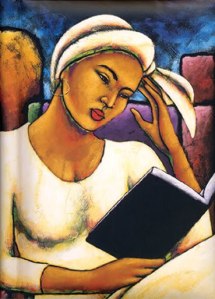
From Forbes, Clare O’Connor reports more Hobby Lobby Fallout: Catholic Soy Milk Mogul Won’t Cover Drugs That ‘Prevent Procreation’. Eden Foods founder Michael Potter has stated his determination to prevent his female employees from getting access to birth control, and the Supreme Court is helping him.
In April 2013, devout Catholic (and sole Eden Foods shareholder) Potter sued the Department of Health and Human Services, calling the Affordable Care Act’s contraceptive mandate “unconstitutional government overreach.”
In a letter he wrote in response to a shopper complaint that month, Potter described contraceptives as “lifestyle drugs” akin to “Viagra, smoking cessation, weight-loss” tools and other medications. (He also compared birth control to “Jack Daniels” in a contemporaneous interview with Salon.)
In October, the U.S. Court of Appeals decided against Potter, ruling that Eden Foods, as a for-profit corporation, couldn’t exercise religion.
Now, in the wake of this week’s
controversial Supreme Court ruling recognizing craft chain Hobby Lobby’s religious rights, the court has changed its tune.
The day after the Justices decided evangelical Hobby Lobby billionaire David Green doesn’t have to cover certain contraceptives for his employees, the Supreme Court vacated the judgment against Eden Foods and sent the case back to the U.S. Court of Appeals for the Sixth Circuit for further consideration.
“The court of appeals is ordered by the Supreme Court to follow its decision in Hobby Lobby,” said Erin Mersino, the attorney handling Potter’s case at the Christian, conservative Thomas More Law Center.
And the beat goes on . . .
At The Nation, Katha Pollit asks: Where Will the Slippery Slope of ‘Hobby Lobby’ End?
Facts are stubborn things, as John Adams famously said. Unless, that is, you’re talking about religion. Then facts don’t seem to matter at all: right you are if you think you are. The Hobby Lobby case was billed as a test of religious freedom versus the power of the state: Did the Religious Freedom Restoration Act (RFRA) mean that David Green, the evangelical Christian CEO of a chain of crafts stores, could be exempt from providing coverage for the full range of contraceptives for his employees under the Affordable Care Act? Green balked at including Plan B, Ella (another form of emergency contraception) and two kinds of IUD, because, he claimed, they caused “abortion” by preventing the implantation of a fertilized egg.
The Court’s 5-to-4 decision—which featured all three women justices ruling for the workers, and all five Catholic men ruling for the corporation—was wrong in many ways. But the thing I really don’t understand is why it didn’t matter that preventing implantation is not “abortion,” according to the accepted medical definition of the term. And even if it was, Plan B, Ella and the IUDs don’t work that way, with the possible exception of one form of IUD when inserted as emergency contraception. As an amicus brief from a long list of prestigious medical organizations and researchers laid out at length, studies show that emergency contraception and the IUD preventfertilization, not implantation. They are not “abortifacients,” even under the anti-choicers’ peculiar definition of abortion. (Green is actually more moderate than some anti-choicers, who include hormonal contraception, aka “baby pesticide,” as abortion.) Why doesn’t it matter that there is no scientific evidence for Green’s position? When did Jesus become an Ob/Gyn?

Good question. Today even facts are irrelevant to Supreme Court decisions. The fact is that Democrats helped Thomas, Roberts, and Alito make it onto the Court, and now we’re stuck with these religious and ideological fanatics.
At Salon, Digby writes that Alito could have been stopped: Why Dems should have filibustered the radical. And from Peter Montgomery at HuffPo, Samuel Alito: A Movement Man Makes Good on Right-Wing Investments. Read them and weep.
Dakinikat posted this Guardian piece in the comments last night; I thought it should be included in this morning’s links: Black people were denied vanilla ice cream in the Jim Crow south – except on Independence Day.
By custom rather than by law, black folks were best off if they weren’t caught eating vanilla ice cream in public in the Jim Crow South, except – the narrative always stipulates – on the Fourth of July. I heard it from my father growing up myself, and the memory of that all-but-unspoken rule seems to be unique to the generation born between World War I and World War II.
But if Maya Angelou hadn’t said it in her classic autobiography I Know Why the Caged Bird Sings, I doubt anybody would believe it today.
People in Stamps used to say that the whites in our town were so prejudiced that a Negro couldn’t buy vanilla ice cream. Except on July Fourth. Other days he had to be satisfied with chocolate.
Vanilla ice cream – flavored with a Nahuatl spice indigenous to Mexico, the cultivation of which was improved by an enslaved black man named Edmund Albius on the colonized Réunion island in the Indian Ocean, now predominately grown on the largest island of the African continent, Madagascar, and served wrapped in the conical invention of a Middle Eastern immigrant – was the symbol of the American dream. That its pure, white sweetness was then routinely denied to the grandchildren of the enslaved was a dream deferred indeed.
What makes the vanilla ice cream story less folk memory and more truth is that the terror and shame of living in the purgatory between the Civil War and civil rights movement was often communicated in ways that reinforced to children what the rules of that life were, and what was in store for them if they broke them.
Please go read the whole thing if you haven’t already.

From Politico: Why the Civil Rights Act couldn’t pass today.
It was a painful tableau: The bipartisan leaders of Congress linking hands in the Capitol Rotunda and swaying to the strains of “We Shall Overcome” as they commemorated the 50th anniversary of the passage of the Civil Rights Act of 1964. Harry Reid and Nancy Pelosi sang along with the crowd, but Mitch McConnell and John Boehner’s lips were frozen in silent, self-conscious smiles.
The climate in today’s Washington is so different from the one that produced what many scholars view as the most important law of the 20th century that celebrating the law’s legacy is awkward for Republicans and Democrats alike. Neither party bears much resemblance to its past counterpart, and the bipartisanship that carried the day then is now all but dead….
The current congressional leaders gathered last week not to honor Johnson — or any of the legislative leaders who actually passed the landmark law — but to award a posthumous Congressional Gold Medal to The Rev. Dr. Martin Luther King Jr. and his wife, Coretta Scott King, whose crusade helped create the climate that made the bill possible. In his life, racial tensions helped make King such a polarizing figure that both Johnson and John F. Kennedy worried about seeming too close to him, but in martyrdom and myth, he is the only politically safe ground on which present day leaders could unite.
They are all so pathetic. And this is beyond pathetic: Callers Use C-SPAN Civil Rights Discussion To Complain About White Oppression (VIDEO).
“Washington Journal” host Steve Scully listened as an “independent” caller named Thomas from Maryland told him that he is “much less liberal today” than he was in 1964 when the landmark law was signed by Lyndon B. Johnson.
“And I think the blacks have brought on most of their present-day problems themselves. They insult white people,” he told Scully. “I heard it right on your own show, I heard some black call Karl Rove a ‘white boy.’ And I don’t think that’s right. They’re attacking white people in the big cities and we’re supposed to put up with that kind of stuff and like them and say, ‘Well, come into our neighborhood.’ And how about the discussion of the black crime that goes on in this country?”
The caller went on to complain that the discrimination endured by Irish, Mormons and Italians is widely ignored.
“You people will never, never discuss that. You only discuss the discrimination against the black people,” he said.
Is that sick or what?
A few more news links:
Information Week on private tech companies treatment of their customers, Facebook Mood Manipulation: 10 Bigger Problems.
Fox News: Suspect arrested in Bourbon St. shootings.
USA Today: Seven hurt in Indianapolis shootings.
WSJ: A Weakened Hurricane Arthur Heads Toward Nova Scotia
ABC News: Before Boston Attack, Alleged Bomber Posed With Black Flag of Jihad at Local Mosque.
So . . . what stories are you reading and blogging about? Please share your links in the comment thread, and enjoy the rest of the long weekend!
Did you like this post? Please share it with your friends:
Posted: July 4, 2014 | Author: bostonboomer | Filed under: morning reads, U.S. Politics, Women's Rights | Tags: corporate personhood, corporatizing religious liberty, Declaration of Independence, Fourth of July, Hobby Lobby, Independence Day, John Roberts, legal precedent, religion, Samuel Alito, SCOTUS, separation of church and state, Statue of Liberty, Wheaton College |
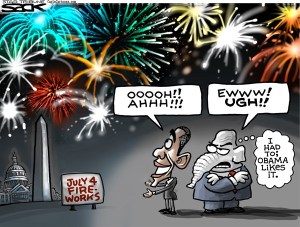
Good Morning!!
Today we celebrate the Declaration of Independence. I’ve assembled a few informational readings about this day in history.
From The Cagle Post: Fourth of July Fast Facts.
“Actually, according to ConstitutionFacts.com, that’s not so. The Continental Congress declared independence from Great Britain on July 2, 1776.”
“That is a common misunderstanding, as well. The American Revolution began in April 1775, more than a year earlier.”
“I’m stumped. Was the Fourth the day Thomas Jefferson wrote the first draft of the Declaration of Independence?”
“Nope. Thomas Jefferson wrote the first draft in June 1776. Also, Jefferson didn’t write the Declaration alone.”
“He didn’t? I always thought he was the sole author.”
“A common misconception. In fact, the Continental Congress appointed a five-person to write the Declaration. It included Jefferson, Benjamin Franklin, John Adams, Robert Livingston and Roger Sherman.” ….
“Though Jefferson wrote the first draft, it was changed 86 times by other members of the committee and other members of the Continental Congress.”
I did not know that.
David Armitage at The Wall Street Journal: The Declaration of Independence: The Words Heard Around the World.
The Declaration of Independence is the birth certificate of the American nation—the first public document ever to use the name “the United States of America”—and has been fundamental to American history longer than any other text. It enshrined what came to be seen as the most succinct and memorable statement of the ideals on which the U.S. was founded: the rights to life, liberty and the pursuit of happiness; the consent of the governed; and resistance to tyranny.
But the Declaration’s influence wasn’t limited to the American colonies of the late 18th century. No American document has had a greater impact on the wider world. As the first successful declaration of independence in history, it helped to inspire countless movements for independence, self-determination and revolution after 1776 and to this very day. As the 19th-century Hungarian nationalist, Lajos Kossuth, put it, the U.S. Declaration of Independence was nothing less than “the noblest, happiest page in mankind’s history.”
In telling this story of global influence, however, it is important to separate two distinct elements of the Declaration—elements that sometimes get conflated. The first of these is the assertion of popular sovereignty to create a new state: in the Declaration’s words, the right of “one People to dissolve the Political Bands which have connected them with another, and to assume among the Powers of the Earth, the separate and equal Station to which the Laws of Nature and of Nature’s God entitle them.” The second and more famous element of the Declaration is its ringing endorsement of the sanctity of the individual: “We hold these truths to be self-evident, that all men are created equal, that they are endowed by their Creator with certain unalienable Rights.”
Read much more at the link.
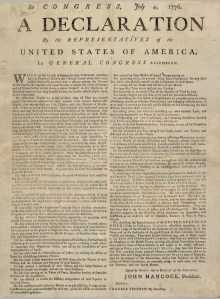
From the LA Times: The slow-spreading news of American independence.
In this era of instant communication, it’s interesting to note the slow distribution of the Declaration, and the spreading of the word to those on whose behalf independence had been declared. (Imagine the Twitter version: Dudes, we’re on our own. #independence #totallyrad #stickitkinggeorge).
The text was set in type by Philadelphia printer John Dunlap just hours after the Continental Congress approved the manifesto on July 4. He ran off about 200 copies, most of which were then distributed via horse and boat around the Colonies. He reprinted it in his own newspaper, Dunlap’s Pennsylvania Packet, or The General Advertiser (great newspaper names back then). Over the next few weeks, Jefferson’s stirring words were reprinted inlocal newspapers and pamphlets around the Colonies.
And, naturally, in Britain. It took more than a month for the first reports of the Declaration to reach Britain in letters ferried by the Mercury packet ship. Gen. William Howe, who was leading the crown’s forces in the Colonies, included a brief mention in his report to his overseers. So the first public airing of the news came in the London Gazette, the crown’s official paper. If you weren’t a close reader, you could have easily missed it.
In the four-page issue dated Aug. 6-Aug. 10, 1776, the Gazette’s lead story was Howe’s update of the war, reporting that “the Rebels, who are numerous, and are very advantageously posted with strong Entrenchments both upon Long Island and that of New York, with more than One Hundred pieces of Cannon for the Defence of the Town towards the Sea, and to obstruct the passage of the [British] Fleet up the North [Hudson] River, besides a considerable Field Train of artillery.”
Finally, Carina Kolodny at Huffington Post: This Is Not Your Independence Day.
The 4th of July might commemorate the independence of our country — but it also serves as a bitter reminder that in 1776, the country that I love had no place for me in it.
When our founding fathers penned, “All men are created equal,” they meant it. Not all people. Not all humans. Just all men — the only reason they didn’t feel obliged to specify “white” men is because, at the time, men of color were considered less than men, less than human.
The 4th is not my Independence Day — and if you’re a Caucasian woman, it isn’t yours either. Our “independence” didn’t come for another 143 years, with the passage of The Woman’s Suffrage Amendment in 1919. The 4th of July is also not Independence Day for people of color. It wasn’t until the 15th Amendment was ratified in 1870 that all men had the right to vote regardless of race — on paper, that is, not in practice. People of color were systematically, and all too successfully, disenfranchised for another century. July 4th of 1776 was certainly not a day of Independence or reverence for Native Americans. It wasn’t until 1924 that Native Americans could unilaterally become citizens of the United States and have the voting rights to go with it.
Now, before anyone argues that Independence is about more than voting rights, I’d like to point out that our Founding Fathers would fundamentally disagree with you. The Revolutionary War was fought, in large part, because of “taxation without representation” — the then English colonists believed they were not free because their voices were not represented. The right to vote, the right to have your say is the delineating characteristic of a democracy.
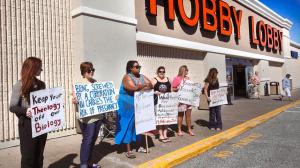
The Aftermath of the Hobby Lobby Decision
On that note, today many concerned citizens are looking back at the latest Supreme Court decisions that take women backwards in their pursuit of freedom and autonomy. The court-approved limits on access to birth control go beyond the Hobby Lobby decision. Lyle Denniston at SCOTUSblog: Broader right to object to birth control.
Expanding the rights of religious opponents of birth control, a divided Supreme Court on Thursday afternoon spared an Illinois college — and maybe hundreds of other non-profit institutions — from obeying government regulations that seek to assure access to pregnancy prevention services for female workers and students. In the same order, the majority essentially told the government to modify its own rules if it wants to keep those services available.
Three Justices wrote a sharply worded dissent, accusing the majority of creating on its own a “new administrative regime” that will seriously complicate the operation of the birth control mandate under the new federal health care law. The majority, the dissenters said, “has no reason to think that the administrative scheme it foists on the government today is workable or effective on a national scale.”
The ruling, which the majority insisted was temporary and had settled nothing finally about the legal issues at stake, came three days after the Court in Burwell v. Hobby Lobby had given for-profit businesses whose owners have religious objections to birth control a right to refuse to provide those services in their employee health plans.
The plea by Wheaton College, a religious institution in Illinois with about 3,000 students, moved the Court beyond for-profit firms to the world of non-profit religious colleges, hospitals, and other charities. The government had already moved to accommodate their beliefs, but that had not gone far enough for the college and for scores of other non-profits. With the Court’s new order, they gained additional separation from the birth-control mandate.
At Mother Jones, Kevin Drum writes: Supreme Court Now Playing Cute PR Games With Hobby Lobby Decision.
For the last few days, there’s been a broad argument about whether the Hobby Lobby ruling was a narrow one—as Alito himself insisted it was—or was merely an opening volley that opened the door to much broader rulings in the future. After Tuesday’s follow-up order—which expanded the original ruling to cover all contraceptives, not just those that the plaintiffs considered abortifacients—and today’s order—which rejected a compromise that the original ruling praised—it sure seems like this argument has been settled. This is just the opening volley. We can expect much more aggressive follow-ups from this court in the future.
POSTSCRIPT: It’s worth noting that quite aside from whether you agree with the Hobby Lobby decision, this is shameful behavior from the conservatives on the court. As near as I can tell, they’re now playing PR games worthy of a seasoned politico, deliberately releasing a seemingly narrow opinion in order to generate a certain kind of coverage, and then following it up later in the sure knowledge that its “revisions” won’t get nearly as much attention.
At Slate, Micah Schwartzman, Richard Schragger, and Nelson Tebbe explain that Hobby Lobby rewrites religious-freedom law in ways that ignore everything that came before.
Monday’s decision in Hobby Lobby was unprecedented. Much of the commentary has focused on the Supreme Court’s decision to extend rights of religious free exercise to for-profit corporations. Hobby Lobby is for religion what Citizens United was for free speech—the corporatization of our basic liberties. But Hobby Lobby is also unprecedented in another, equally important way. For the first time, the court has interpreted a federal statute, theReligious Freedom Restoration Act (or RFRA), as affording more protection for religion than has ever been provided under the First Amendment. While some have read Hobby Lobby as a narrow statutory ruling, it is much more than that. The court has eviscerated decades of case law and, having done that, invites a new generation of challenges to federal laws, including those designed to protect civil rights.
The authors explain how the right wing Roberts Court has moved beyond any concern for legal precedent in making its decisions.
Hobby Lobby is unprecedented because it corporatizes religious liberty. It extends to for-profit businesses the rights and privileges that have long been associated only with churches and religious nonprofits. But that change is the result of a more pervasive and deeper upending of the law of religious liberty in America. Ignoring congressional intent, the court reads RFRA as having shed its First Amendment skin. It is not entirely clear what American law will look like after that change. But if anything is clear, it is that the Roberts Court is now unconstrained by precedent. It has loosened itself from decades of First Amendment doctrine and has begun remaking the law of free exercise.
Please read the whole thing.
Ironically, the Hobby Lobby decision may have also created some serious problems for the human beings who own corporations (h/t Dakinikat). From Mother Jones: How Hobby Lobby Undermined The Very Idea of a Corporation. Basically, now that SCOTUS has said that some corporations are inseparable from the people who own them, those owners could lose their legal protection from debts and lawsuits that result from corporate actions. There’s some instant Karma for you!

A few more links for your holiday reading pleasure:
Miami Herald: FBI records: Chilling find in Bradenton dumpster (new clues to Saudi involvement in the 9/11 and the cover-up of that involvement by the Bush/Cheney administration).
Study links Oklahoma earthquake swarm with fracking operations
Boston Globe: People prefer electric shocks to time alone with thoughts.
LA Times: Tibetans get high-altitude edge from extinct Denisovans’ genes.
What stories are you following on this Independence Day?
Did you like this post? Please share it with your friends:








 peej
peej Carissa
 bostonboomer
 dakinikat
 ecocatwoman
 mablue2
 Mama Lopez
 peggysue22
 quixote
 skydancingguestblogger
 Mona (aka Wonk the Vote)



 Sky Dancing
Recent Comments