
Longest Friday Reads: So this old world must be still spinning around
Posted: June 23, 2017 Filed under: Afternoon Reads | Tags: money laundering, Russia, Summer solstice 30 Comments Happy Longest Friday!
Summer solstice was two days ago so this makes today the longest Friday of the year! The link over there goes to some pretty interesting photos of the Stonehenge Solstice Celebration! Solstice images festoon our post today. It’s nice to know that the sun is still rising, the moon is still rising, and the earth still spins on her axis even when everything else seems so upside down.
Today we have 16 hours of daylight unless you’re under a storm cloud or hiding from the T-Rumposaurus.
Information on Dan Coates’ testimony to House investigators has come out. It appears the President is completely obsessed with the Russian probe. Sure sounds like obstruction of justice to me.
Dan Coats, the director of national intelligence, told House investigators Thursday that President Trump seemed obsessed with the Russia probe and repeatedly asked him to say publicly there was no evidence of collusion, a U.S. official familiar with the conversation told NBC News.
Coats’ account is not new — it largely tracked with his story as previously reported by NBC News and other media outlets, the official said.
Admiral Mike Rogers, director of the NSA, has also told associates that Trump asked him to say publicly there was no evidence of collusion between the Trump campaign and the Russian election interference effort.
Both Rogers and Coats declined to do that, saying it would have been inappropriate, a former senior intelligence official familiar with the matter told NBC News. Rogers had his deputy write a memo about the conversation
Money laundering still appears to be the center of every one’s thoughts. Here’s more on the connections between Felix Sater and a project he developed with T-Rump. Sounds like the Mango Mussolini has something to worry about.
- Felix Sater was born in Russia and moved to the United States with his family when he was 8. His father Mikhail has connections to Russian organized crime and was once convicted of extortion. The younger Sater ended up working at a company called Bayrock, which had offices in Trump Tower and, beginning in 2002, partnered with Donald Trump on several development projects. Bayrock’s role in the projects involved soliciting outside investors.
- Felix Sater also has a colorful criminal record. In 1991, he stabbed a man in the face with the stem of a broken margarita glass and went to jail for assault. In 2007, the New York Times reported that he had been accused in 1998 of securities fraud in a massive stock-scam case involving a number of New York mob families. It was later revealed that Sater pleaded guilty in that 1998 case, but that his involvement in it was kept secret, because he became a witness for the government and reportedly continued as such until 2008. Sater is known to have helped build cases against individuals involved in the stock scam and reportedly also cooperated in a case that involved attempting to secure missiles that were being sold on the black market in Afghanistan. (!)
- Sater disassociated himself from Bayrock and the Trump projects after the 2007 Times story but popped back up in 2010, working for the Trump Organization as a “senior adviser.”
- A former Bayrock associate of Sater’s filed a lawsuit against Sater which alleges, in the words of a new Bloomberg story by longtime Trump reporter Timothy O’Brien, that “Bayrock was actually a front for money laundering” and took money from Russian sources. At this point, the associate making the accusation does not appear to have any direct evidence to support his claim, but the lawsuit is ongoing.
And here’s one more background fact:
- Andrew Weissmann is a longtime federal prosecutor who has joined Robert Mueller’s Trump–Russia special counsel investigation. News stories have described Weissmann as an expert in “flipping” witnesses, i.e. getting them to testify against their co-conspirators.
Want to read more? Follow this:
 Now, go check the conclusion. The White House is on eggshells with Trumpertantrums and his guilty conscious.
President Trump has a new morning ritual. Around 6:30 a.m. on many days — before all the network news shows have come on the air — he gets on the phone with a member of his outside legal team to chew over all things Russia.
The calls — detailed by three senior White House officials — are part strategy consultation and part presidential venting session, during which Trump’s lawyers and public-relations gurus take turns reviewing the latest headlines with him. They also devise their plan for battling his avowed enemies: the special counsel leading the Russia investigation; the “fake news” media chronicling it; and, in some instances, the president’s own Justice Department overseeing the probe.
His advisers have encouraged the calls — which the early-to-rise Trump takes from his private quarters in the White House residence — in hopes that he can compartmentalize the widening Russia investigation. By the time the president arrives for work in the Oval Office, the thinking goes, he will no longer be consumed by the Russia probe that he complains hangs over his presidency like a darkening cloud.
It rarely works, however. Asked whether the tactic was effective, one top White House adviser paused for several seconds and then just laughed.
Trump’s grievances and moods often bleed into one another. Frustration with the investigation stews inside him until it bubbles up in the form of rants to aides about unfair cable television commentary or as slights aimed at Attorney General Jeff Sessions and his deputy, Rod J. Rosenstein.
Who’d want to be one of his lawyers anyway?
White House counsel Don McGahn has largely stepped back from managing Donald Trump’s response to the expanding Russia investigation, but that hasn’t stopped the president from lashing out at him about it anyway.
Trump started the week by giving McGahn, a loyal supporter who was among the first Washington establishment figures to sign on with his presidential campaign, a dressing down in the Oval Office for not doing more to quash the Russia probe early on.
The episode — recounted by four people familiar with the conversation — came as part of a broader discussion on Monday about the president’s frustrations with special counsel Robert Mueller’s investigation into Russian interference in the 2016 election, which now includes the question of whether Trump himself tried to obstruct the investigation by firing FBI Director James Comey.
The Russia portfolio has been handed off to Trump’s longtime personal attorney Marc Kasowitz, leaving McGahn to focus on the standard duties of the top White House lawyer: vetting political appointees, selecting judges for vacancies in lower courts, and giving legal advice on potential legislation and other White House policy decisions.
Trump’s willingness to lay into him for the escalation of the probe — largely the result of Trump’s own decision to dismiss Comey — illustrates McGahn’s falling stock in the West Wing, as well as Trump’s desire to find someone to blame for his legal predicament.
 So, Kremlin Caligula thought he’d get away with firing Comey and he wants to blame every one else. What a nitwit!
Regardless of the legal outcome, it’ll go down as one of the dumbest political mistakes in the modern era. One of the president’s outside advisers calls it the gravest political mistake since Richard Nixon decided not to apologize to the American people for Watergate, and instead proceeded with the cover-up.
Trump himself has suggested to friends that he understands the bind he created: By taunting Comey about tapes that the president admitted yesterday don’t exist, he hastened the chain of events that led to the appointment of special counsel Bob Mueller, who’s expected to delve into the business affairs of the president and his family.
In retrospect, if Trump had kept Comey and stopped obsessing about his investigation, his legal troubles might have blown over: No evidence of collusion has emerged. As David Brooks pointed out in one of the better columns of the month, it’s striking how little has surfaced on the collusion front, given the gush of anti-Trump leaks.
S0, what happy camper would tweet #FML? (“As in F*ck my life”)
But then, unprompted, he floated another possibility: U.S. intelligence or law enforcement officials might have his office bugged. “With all of the recently reported electronic surveillance, intercepts, unmasking and illegal leaking of information, I have no idea whether there are ‘tapes’ or recordings of my conversations with James Comey,” Trump wrote.
It was a bizarre suggestion that took some in the White House off guard. “No clue what the thinking was,” a White House staffer said of the tweets. “He could’ve just said there are no tapes. It’s baffling, frankly.”
Instead of putting the “tape” issue to rest and leave it at that, Trump’s statements threaten to embroil the White House in yet another round of politically inconvenient questioning about issues—Comey’s firing, the FBI’s probe into Russian election-meddling, and Trump’s reported efforts to hobble it—that the White House has tried, with little success, to move past.
Informed of the president’s denial that he had recorded his conversations with Comey, a senior administration official replied, “At least that’s behind us.” When alerted to his apparent suspicions of Oval Office surveillance, the official replied in a text message, “fml.”
That’s shorthand for “fuck my life.”
Trump’s tweets came just minutes before White House spokeswoman Sarah Sanders was scheduled to brief reporters. Asked about Trump’s vague allegations of a potential wiretap, Sanders suggested that law enforcement authorities would have to answer whether they have the President of the United States under surveillance.
Well, at least life’s not boring and complacent and calm and well, #FML, make him go away please!! There’s a monster under our national bed!
So, Spicey is looking for a replacement for the podium of shame and lies. Guess how that’s going?
The result is a toxic relationship between the White House, which thinks the press should be less adversarial, and the media, which believes its job is to be adversarial. Both sides believe the other side is acting in bad faith, and both are losing respect for one another. And the frayed relationship is occupying more and more of everyone’s time, creating a distraction from issues of greater concern to the general public.
This article is based on extensive conversations with three senior White House officials who requested anonymity, as well as several White House reporters who requested the same.
In a statement, White House deputy press secretary Sarah Huckabee Sanders said the White House’s goal was “to be accessible every day and answer questions from the media through a variety of formats, including the briefings, the gaggles and meetings in the press office.”
“Our goal is to communicate the president’s message to the American people as well,” she added, “and we do that through the President’s vast reach on social media on a daily basis.”
For the time being, White House-media relations are likely to get worse before they get better. With the approval of the president, White House Press Secretary Sean Spicer has been looking for a replacement press secretary so he can focus on broader strategy. But good replacements are hard to come by.
The White House has a shortlist of candidates it would like to bring on board, including, most notably, the popular conservative pundit Laura Ingraham. But so far, no one on this shortlist has accepted the invitation. Ingraham, who declined to comment, has given no public indication that she wants the job. She is already highly paid for her work as a right-wing radio host and Fox News contributor, and has said she might run for Senate from Virginia next year.
Meanwhile, there are people who might like to have the job but don’t have enough support from Trump’s inner circle.
At least we know that Melanoma Mussolini isn’t the meanest tweeter in the Administration. Get a load of these.
 Oy to the fucking vey!
A trove of deleted tweets written by senior Energy Department official William C. Bradford surfaced this week ― and it’s not pretty.
Bradford, whom President Donald Trump recently appointed to lead the department’s Office of Indian Energy Policy and Programs, was forced to issue an apology after The Washington Post revealed his disparaging remarks about women and various ethnic and religious groups on Thursday.
His tweets, written last year, attacked high-profile figures on the basis of their ethnic and religious heritage and defended the wartime incarceration of Japanese-Americans, among other things.
In a December 2016 tweet, Bradford referred to former President Barack Obama as a “Kenyan creampuff.” In another tweet, he dubiously claimed Obama might refuse to leave The White House at the end of his presidential term and suggested a “military coup” could be necessary to remove him.
In February 2016, responding to an article that claimed Facebook co-founder Mark Zuckerberg had urged Iowans not to vote for Trump, Bradford called the tech leader an “arrogant self-hating Jew.”
They actually get worse … he’s like a full time hater and no one goes left unhated. Native Americans, women, Japanese Americans in internment camps … just about every one makes his list.
So, anyway, enjoy the day, the summer, and the brain clouds overtaking Trumperina’s little world. Meanwhile, if you want to see his fat ass in tennis shorts looking like he’s busting out of his depends go here. It cannot be unseen. I’m warning you now. I promised you that the moon is still rising. This one is YUGGGGEEEE.
What’s on your reading and blogging list today?
Live Blog: Jefferson Beauregard Sessions III (The Oldest Living Confederate Widow Tells All)
Posted: June 13, 2017 Filed under: Live Blog | Tags: Jeff Sessions, Jim Comey firing, Russia, Testimony 34 Commentshttps://twitter.com/Mediaite/status/874664712658616320
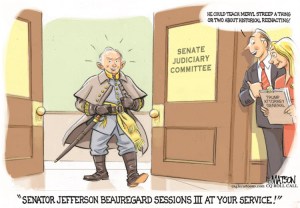 Well, it’s time to watch another reason to regret that we now have a constitutional crisis instead of Taco Trucks on every corner! The 84th AG who is supposed to be upholding the US Constitution instead of enabling those crises will undoubtedly bob and weave the questions like a little white banty rooster pecking or corn. Just exactly how many times did he meet with the Russian Ambassador and why?
When Senator Al Franken asked then-Senator Sessions at his Senate confirmation hearing on January 10 whether he “communicated with the Russian government,” he said, “I’m not aware of any of those activities.” Unprompted, Sessions then went further, saying, “I have been called a surrogate at a time or two in that campaign and I didn’t have—did not have communications with the Russians, and I’m unable to comment on it.” Then less than two months later, on March 1, The Washington Postreported that Sessions had, in fact, met with Russian Ambassador Sergey Kislyak—not once, but twice.
It was a serious omission, especially for the nation’s top law-enforcement officer, and one who is a vocal advocate for law and order. Scrambling to contain the damage, Sessions issued a statement that attempted to draw a very subtle distinction. Calling the report “false,” he said that he had “never met with any Russian officials to discuss issues of the campaign.” His spokeswoman, Sarah Isgur Flores, spelled it out even more clearly: “He was asked during the hearing about communications between Russia and the Trump campaign—not about meetings he took as a senator and a member of the Armed Services Committee,” she said. (In fact, Franken had made no such qualification.) And a White House official insisted that Sessions had “met with the ambassador in an official capacity as a member of the Senate Armed Services Committee,” not a campaign surrogate.
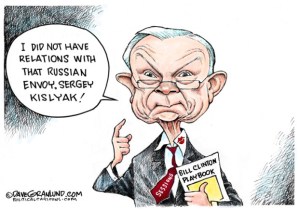
Dave Granlund / politicalcartoons.com
I’m not sure we’re going to learn anything but he may try to contradict the Comey testimony. It could be at least interesting to see how he’s treated by his former colleagues.
Sessions will dispute James Comey’s characterization of a conversation the two men had in February.
- This is a big deal, as Comey gave his account under oath.
- The former FBI director said under oath that after his Feb. 14 conversation with Trump, he told Sessions he didn’t want to have any more direct communication with the President. Comey then said that Sessions remained silent, perhaps shrugging his shoulders and nonverbally indicating that he couldn’t be of help.
- Sessions is expected to counter this, saying he responded to Comey by telling him the FBI and DOJ needed to be aware of official protocol regarding communications with the White House. The DOJ released a statement to that effect a few hours after Comey’s testimony. Sessions is expected to make the same statement under oath.
So, if you’re watching or not, we’re going to be following it here! Hang on!
Lazy Saturday Reads: Wag The Dog
Posted: April 8, 2017 Filed under: Foreign Affairs, morning reads, U.S. Politics | Tags: Donald Trump, missile strikes, Rex Tillerson, Russia, Syria, Vladimir Putin 25 Comments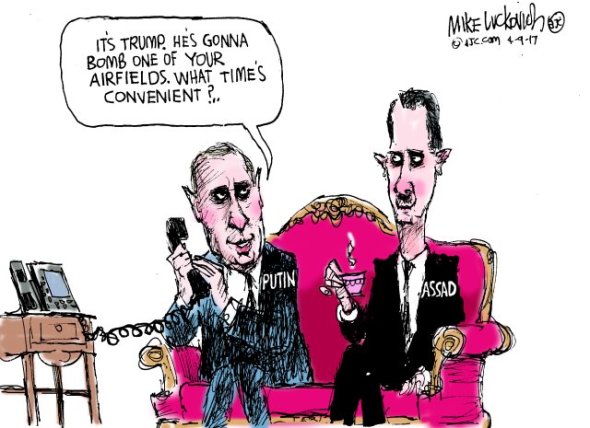
Good Afternoon!!
Yesterday Lawrence O’Donnell tweeted about what many of us have been thinking:
O’Donnell devoted his show last night discussing the fact that we cannot possibly be sure that Trump didn’t unleash his ineffectual missile strike on a Syrian air base in coordination with Russia’s Vladimir Putin. Here is O’Donnell’s epic rant:
Are we really supposed to believe that this classic narcissist, who clearly care not a whit for anyone but himself, has suddenly developed a conscience because he saw suffering Syrian children on TV? These are the same Syrian children whom he refuses to let into the U.S. because he fears they will grow up to be terrorists. Come on.
Of course plenty of young white male “journalists” swallowed the charade whole. Even Fareed Zacharia, who is usually quite prescient, plagiarized Van Jones’s pronouncement after Trump’s embarrassing exploitation of the wife of the Navy Seal who died in Trump’s first botched military action in Yemen.
https://twitter.com/foreignpolicy77/status/850490994038632448
What did Trump’s strike on Syria accomplish? Planes were taking off from the deliberately undamaged runways the next day, and The Washington Post reports today that: Warplanes return to Syrian town devastated by chemical attack.
Residents of the Syrian town devastated by a chemical-weapons attack earlier this week said that warplanes had returned to bomb them Saturday as Turkey described a retaliatory U.S. assault as “cosmetic” unless President Bashar al-Assad is removed from power.
At least 86 people died in Tuesday’s attack on the northwestern town of Khan Sheikhoun, which left hundreds choking, fidgeting or foaming at the mouth.
Eyewitnesses said Saturday that fresh airstrikes on the area — now a virtual ghost town — had killed one woman and wounded several others. Photographs from the site showed a pair of green slippers, abandoned by a blood-spattered doorway.
The U.S. military launched 59 cruise missiles at a Syrian military airfield early Friday in the first direct American assault on Assad’s government since that country’s six-year civil war began. Although American officials have predicted that the strikes would result in a major shift of Assad’s calculus, they appear to be symbolic in practice.
Within 24 hours of the American strikes, monitoring groups reported that jets were once again taking off from the bombed Shayrat air base.
The strikes also gave Putin an excuse to cancel a previous deal with the U.S. that the two countries won’t directly engage each others’ forces–recall that Trump has already sent U.S. ground troops into Syria.
From the Associated Press: AP Explains: What is the US/Russia “deconfliction line?”
A U.S.-led coalition has been bombing Islamic State-held territory across Syria, launching 24 strikes on Thursday alone, according to the U.S. military’s Central Command. The coalition includes some 60 countries, with some launching their own strikes into Syria. Russia is waging its own bombing campaign in support of President Bashar Assad’s forces, while the Syrian government has its own air force and air defense systems. That means a lot of aircraft are flying in a small airspace, which raises the danger for pilots. In November 2015, for instance, NATO member Turkey shot down a Russian jet fighter, nearly sparking an international conflagration….
To protect pilots, Moscow and Washington opened a so-called “deconfliction line” after Russia began its bombing campaign in September 2015. On the U.S. side, it is run out of the Combined Air and Space Operations Center at the vast al-Udeid Air Base in Qatar, which hosts the forward headquarters of U.S. Central Command. There, air traffic controllers and senior military officers are in contact with their Russian counterparts in Syria. They share coordinates and other data to avoid midair collisions or confrontations. One U.S. pilot flying missions over Syria credited his safety to it in a recent Associated Press interview….
On Thursday, U.S. President Donald Trump ordered a missile strike on the Shayrat air base, southeast of Homs, over a chemical weapons attack he blamed on Syria’s government. The U.S. used the “deconfliction line” to warn Russia ahead of time that the strike was coming. In the aftermath of the attack, which Syria said killed at least seven people, Russia announced it would suspend its cooperation in the information-sharing campaign, the first time the line has been severed. Russia still has several dozen warplanes and batteries of air defense missiles at its base near Latakia, Syria.
The article goes on the explain that the U.S. will try to keep negotiating with Russia on this issue. And guess what’s happening next week? The AP, via The Denver Post: Tillerson to visit Moscow as US, Russia face fresh tensions.
Tillerson will make the first visit to Russia by a Trump administration official just days after the U.S. launched cruise missiles against an air base in Syria, where Russia’s military is on the ground propping up its ally, President Bashar Assad. Until Thursday, the U.S. had avoided striking Assad’s forces, largely out of concern about being pulled into a military conflict with Russia.

Tillerson receives the Russian Order of Friendship
Yes, Tillerson, who was awarded the Russian Order of Friendship after inking an oil deal in 2012 with the Russian oil company Rosneft. Yes, the company that was mentioned in the famous Christopher Steele dossier. From Foreign Policy in February:
The dossier claims that a representative from Trump’s presidential campaign, Carter Page, met last July with Igor Sechin, head of the Russian oil monopoly Rosneft and a senior Kremlin official. Sechin reportedly offered brokerage on a 19 percent stake in Rosneft in exchange for lifting sanctions, and Page was “non-committal in response.”
As CEO of Exxon, Tillerson represented a giant corporation that is desperate for the U.S. Sanctions on Russia to be lifted. Of course Tillerson and Trump can’t immediately lift the sanctions. That would be too obvious and would not be accepted by most members of Congress. But perhaps there is a plan.
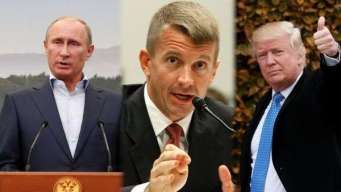
Remember that meeting in the Seychelles between Betsy DeVos’s brother and huge Trump supporter Erik Prince with a close Putin confidant? From the Washington Post:
The United Arab Emirates arranged a secret meeting in January between Blackwater founder Erik Prince and a Russian close to President Vladimir Putin as part of an apparent effort to establish a back-channel line of communication between Moscow and President-elect Donald Trump, according to U.S., European and Arab officials.
The meeting took place around Jan. 11 — nine days before Trump’s inauguration — in the Seychelles islands in the Indian Ocean, officials said. Though the full agenda remains unclear, the UAE agreed to broker the meeting in part to explore whether Russia could be persuaded to curtail its relationship with Iran, including in Syria, a Trump administration objective that would be likely to require major concessions to Moscow on U.S. sanctions.
Though Prince had no formal role with the Trump campaign or transition team, he presented himself as an unofficial envoy for Trump to high-ranking Emiratis involved in setting up his meeting with the Putin confidant, according to the officials, who did not identify the Russian.
Prince was an avid supporter of Trump. After the Republican convention, he contributed $250,000 to Trump’s campaign, the national party and a pro-Trump super PAC led by GOP mega-donor Rebekah Mercer, records show. He has ties to people in Trump’s circle, including Stephen K. Bannon, now serving as the president’s chief strategist and senior counselor. Prince’s sister Betsy DeVos serves as education secretary in the Trump administration. And Prince was seen in the Trump transition offices in New York in December.
U.S. officials said the FBI has been scrutinizing the Seychelles meeting as part of a broader probe of Russian interference in the 2016 U.S. election and alleged contacts between associates of Putin and Trump. The FBI declined to comment.
But . . . . according to the Post,
The Seychelles meeting came after separate private discussions in New York involving high-ranking representatives of Trump with both Moscow and the Emirates…
Flynn and Kushner were joined by Bannon for a separate meeting with the crown prince of Abu Dhabi, Sheikh Mohamed bin Zayed al-Nahyan, who made an undisclosed visit to New York later in December, according to the U.S., European and Arab officials, who spoke on the condition of anonymity to discuss sensitive matters….
In an unusual breach of protocol, the UAE did not notify the Obama administration in advance of the visit, though officials found out because Zayed’s name appeared on a flight manifest.
Officials said Zayed and his brother, the UAE’s national security adviser, coordinated the Seychelles meeting with Russian government officials with the goal of establishing an unofficial back channel between Trump and Putin.
Could they have been discussing plans for coordination in the Syrian conflict? Could Trump and Putin be planning and escalation of conflicts between U.S. and Russian forces that later could be “resolved” by loosening the U.S. sanctions?
Of course no one is talking about all these “coincidences” anymore, because Trump impressed so many male pundits with his “beautiful” missile display.
 The media needs to stop the macho swaggering and get back to the Russia investigation immediately. I don’t know for sure what’s going on here, but there’s enough smoke emanating from the Trump gang to be signaling an eight-alarm fire.
I’m going to wrap this up, because this post is so late, but I want to share one more story. Alex Morris of Rolling Stone weighed in on Trump’s narcissism a few days ago: Trump and the Pathology of Narcissism. Here’s the intro:
At 6:35 a.m. on the morning of March 4th, President Donald Trump did what no U.S. president has ever done: He accused his predecessor of spying on him. He did so over Twitter, providing no evidence and – lest anyone miss the point – doubling down on his accusation in tweets at 6:49, 6:52 and 7:02, the last of which referred to Obama as a “Bad (or sick) guy!” Six weeks into his presidency, these unsubstantiated tweets were just one of many times the sitting president had rashly made claims that were (as we soon learned) categorically untrue, but it was the first time since his inauguration that he had so starkly drawn America’s integrity into the fray. And he had done it not behind closed doors with a swift call to the Department of Justice, but instead over social media in a frenzy of ire and grammatical errors. If one hadn’t been asking the question before, it was hard not to wonder: Is the president mentally ill?
It’s now abundantly clear that Trump’s behavior on the campaign trail was not just a “persona” he used to get elected – that he would not, in fact, turn out to be, as he put it, “the most presidential person ever, other than possibly the great Abe Lincoln, all right?” It took all of 24 hours to show us that the Trump we elected was the Trump we would get when, despite the fact that he was president, that he had won, he spent that first full day in office focused not on the problems facing our country but on the problems facing him: his lackluster inauguration attendance and his inability to win the popular vote.
Since Trump first announced his candidacy, his extreme disagreeableness, his loose relationship with the truth and his trigger-happy attacks on those who threatened his dominance were the worrisome qualities that launched a thousand op-eds calling him “unfit for office,” and led to ubiquitous armchair diagnoses of “crazy.” We had never seen a presidential candidate behave in such a way, and his behavior was so abnormal that one couldn’t help but try to fit it into some sort of rubric that would help us understand. “Crazy” kind of did the trick.
The article summarizes the psychological assessments that have gradually emerged from professionals who were initially hesitant to discuss Trump’s personality because of the so-called “Goldwater Rule.” It’s a long, fascinating read.
What stories are you following today? Please share in the comment thread and have a great weekend!
Monday Reads: From Russia with Thugs
Posted: March 27, 2017 Filed under: Afternoon Reads | Tags: Foreign Agents, Kushner, Nunes, putin, Russia, T-Russia, TREASON 36 Comments Good Afternoon Sky Dancers!
It would be nice to focus on something other than T-Russia for awhile but this probably is the story of the century and it’s unfolding at a breakneck speed. Hannah Levintova at MoJo has written a great tick tock for any one having trouble keeping up with all the events to date. You may want to bookmark it since they will be updating and editing it. It spans 30 years of T-Russia history.
The Trump-Russia scandal—with all its bizarre and troubling twists and turns—has become a controversy that is defining the Trump presidency. The FBI recently disclosed that since July it has been conducting a counterintelligence investigation into possible coordination between Trump associates and Russia, as part of its probe of Moscow’s meddling in the 2016 election. Citing “US officials,” CNN reported that the bureau has gathered information suggesting coordination between Trump campaign officials and suspected Russian operatives. Each day seems to bring a new revelation—and a new Trump administration denial or deflection. It’s tough to keep track of all the relevant events, pertinent ties, key statements, and unraveling claims. So we’ve compiled what we know so far into the timeline below, which covers Trump’s 30-year history with Russia. We will continue to update the timeline regularly as events unfold.
 So, here are some interesting reads on the most recent developments which include a Senate Committee questioning Jared Kushner. NW Luna posted this which is the list of what’s happened this week alone. It’s written by Yonatan Zunger via Medium.
In the past week, there have been several startling revelations about the investigations into Donald Trump, his closest allies, and their ties to Russia. Not only has the existence of two investigations, one by the FBI and one by the House Intelligence Committee, been confirmed, but there is increasing information as to just what is being investigated: an alleged deal for Trump to advance Russian interests as President in exchange for a share of the Russian state oil company Rosneft and Russian intelligence assistance in winning the election.
This news has been spread over a tremendous number of articles and even Twitter threads, rather than in a single big headline. So today I would like to pull together all of these reports, and make it clear what things are known for certain, what things have been reported and sourced but not confirmed, and what things are still speculation.
Information from Nunes continues to shock.
 He continues to try to explain his White House visit and conversation with Paul Ryan as calls mount for his resignation.
According to a Daily Beast report later over the weekend, Nunes went off the grid that night to meet a source and view dozens of intelligence reports, including accounts of meetings involving President Donald Trump’s advisers.
Then it gets weirder. CNN is now reporting that Nunes had in fact slipped off to the White House grounds last Tuesday to view the documents. And then on Wednesday, after briefing reporters on what he had found in those intelligence reports, he went back to the White House to inform the president.
On the surface, none of this looks good for Nunes, who is in charge of his committee’s bipartisan investigation into all things Trump and Russia. Why would Nunes need to brief the president on documents he viewed at a facility on White House grounds?
In an interview Monday, Nunes told me that he ended up meeting his source on the White House grounds because it was the most convenient secure location with a computer connected to the system that included the reports, which are only distributed within the executive branch. “We don’t have networked access to these kinds of reports in Congress,” Nunes said. He added that his source was not a White House staffer and was an intelligence official.
Nunes, it should be said, has a history of cultivating independent sources inside the intelligence community. He made contact, for example, with the U.S. intelligence contractors who ended up saving most of the Americans stuck in the Benghazi outpost when it was attacked on Sept. 11, 2012. More recently, Nunes has reached out to his network of whistleblowers to learn about pressure inside the military’s Central Command on analysts to write positive reports on the U.S. campaign against the Islamic State.
In this case, Nunes had been hearing for more than a month about intelligence reports that included details on the Trump transition team, and had been trying to view them himself. He told me that when he finally saw the documents last Tuesday evening, he made sure to copy down their identifying numbers so he could request access to them formally for the rest of the committee.
 So, what the heck is going on with Jared Kushner and why hasn’t some one told him to shove off? It appears T-Russia was in full swing prior to and after the election including stealth visits by the Russian ambassador facilitated by Kushner who secreted him into Mount Doom last fall. Inquiring senators want to know wtf were they all thinking?
The Senate Intelligence Committee will reportedly question White House adviser Jared Kushner as part of its probe into Russian interference in the 2016 presidential election.
The committee wants to question Kushner, who is also President Trump’s son-in-law, about meetings he arranged with Russian Ambassador Sergey Kislyak, The New York Times reported.
According to the Times, the White House counsel’s office was told this month about the panel’s request.
A White House official and a spokesman for Intelligence Committee chair Richard Burr (R-N.C.) confirmed to the Wall Street Journal that Kushner had agreed to meet.
“Throughout the campaign and transition, Jared Kushner served as the official primary point of contact with foreign governments and officials. Given this role, he has volunteered to speak with Chairman Burr’s Committee,” a White House official told the Journal.
The White House has previously acknowledged a December meeting at Trump Tower between Kushner, Kislyak and former national security adviser Michael Flynn. Discussions at that meeting reportedly focused on the potential of better relations between the U.S. and Russia.
Meanwhile, Putin is brutally suppressing a nascent Russian Protest that broke out around the country on Sunday.
https://twitter.com/JeffreyGoldberg/status/846374341688352770
This is from the Ioffe article at The Atlantic mentioned in the Goldberg tweet above.
But Sunday’s protest was different. Unlike the rallies in Nemtsov’s memory or even the 2011-2012 protests, this one did not have a permit from the Moscow city authorities. Over the weekend, the mayor’s office warned people that protestors alone would bear the responsibility for any consequences of attending what they deemed an illegal demonstration. But despite those warnings and despite the fresh memory of some three dozen people being charged—many of whom did prison time—for a protest in May 2012 that turned violent, thousands came out in Moscow. The police estimated attendance at 8,000, but given officials’ predilection for artificially deflating the numbers of those gathered at such events to make them seem less of a threat, the number could easily have been double that. People clogged the length of Tverskaya Street, one of the city’s main drags. The iconic Pushkin Square was packed, and people clung to the lampposts, chanting “Russia will be free!”
Three weeks ago, Navalny, who became famous as an anti-corruption blogger, posted an hour-long video exposé (with English subtitles) on his blog and YouTube channel. It showed, in great detail and using drone footage, what he said were the vast real-estate holdings of prime minister and former president Dmitry Medvedev, a man who talked of fighting corruption during his presidency and who in May told the residents of recently annexed Crimea, who are suffering from electricity and fuel shortages, “We don’t have the money now. … But you hang in there!” The money, Navalny alleged, was all bundled up in palaces, some costing hundreds of millions of dollars, all over the country. It was strange to attack Medvedev, now a widely ridiculed has-been in Russian politics, and many doubted that Navalny telling people to go out and protest Medvedev would have any resonance. And yet, when he named the day—March 26—people across 11 time zones answered his call and came out.
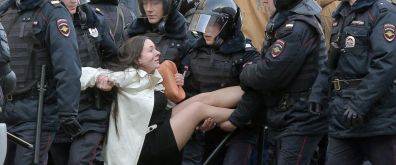
The Russian opposition leader–Navalny–has been jailed for at least 15 days. More disturbing was the arrest of many foreign journalists.
Thousands of people rallied in dozens of cities across Russia on Sunday following a call by Navalny to protest over an investigation into Medvedev’s alleged corruption. Navalny’s team released a video alleging Medvedev had amassed a collection of palaces, yachts and vineyards during his time in office.
Authorities in most cities – from Chita in Siberia to Makhachkala in Dagestan – denied permission for the rallies. Police arrested those who were holding posters or chanting, and also on occasion simply swept random people off the street.
Guardian correspondent Alec Luhn was among those arrested, despite having Russian journalistic accreditation. He was held for hours and charged with participating in an unsanctioned demonstration before being released after the foreign ministry intervened.
A rights group monitoring the arrests said on Monday morning that 1,030 people had been detained in Moscow alone. About 120 remained in custody on Monday morning. The majority of those released were charged with the minor offence of taking part in an unsanctioned demonstration and are likely to be fined.
In Nizhny Novgorod, parents of five children who took part in the protests were charged with “improper parenting”, according to Interfax news agency.
 It took the US State Department 12 hours to respond to arrests of protesters and journalists.
On Sunday night, roughly 12 hours after images and reports of the crackdown began emerging from Moscow, the top State Department spokesman issued a statement strongly condemning the detention of hundreds and calling for the immediate release of all peaceful protesters.
And we thought the Cold War was pretty much over. Sheesh!
What’s on your reading and blogging list today?
Tuesday Reads
Posted: March 21, 2017 Filed under: Foreign Affairs, morning reads, Republican politics, U.S. Politics | Tags: Donald Trump, GOP health care bill, House Intelligence Committee, James Comey, Neil Gorsuch, Rex Tillerson, Russia, SCOTUS, U.S. Senate 34 Comments
Good Afternoon!!
As usual these days, I don’t know where to begin. We are living through something so strange and unprecedented that I just find myself shaking my head at each new revelation. Once again, I’m going to illustrate this post with baby animal pics, just because.
One crazy-making thing for me is the fact that the Senate is currently grilling a candidate for the Supreme Court who has been nominated by a man who may have committed treason. Neil Gorsuch should not be approved until the investigation of Trump’s involvement with Russia’s interference in the election is complete. I’m actually having difficulty watching the Gorsuch hearing. The word I think of when I look at and listen to him is “oily.” I hope some of you are following the questioning and can share your impressions.
I did watch the entire “Comey hearing” yesterday, and I’m still processing the latest revelations. I expect the press will be on this now and news outlets will compete to give us new information on a daily basis. We may have to function during political chaos for months and years to come. I can only hope the Republicans begin to develop spines as the 2018 election gets closer.
While the House Intelligence Committee testimony by FBI Director James Comey and NSA Director Mike Rogers was still going on, White House spokesman Sean Spicer bizarrely continued to defend Trump’s accusation that Obama wiretapped Trump Tower. He also claimed that Michael Flynn was only “volunteer” for the Trump campaign and that Paul Manafort had only a “limited role.”
Vanity Fair on the press briefing yesterday:
During the campaign, Flynn was a top adviser and, at one point, was vetted to become Trump’s running mate. He later accepted a job as national security adviser, one of the most important roles in the West Wing, before resigning 24 days into the new administration, after it was revealed that he had not been entirely forthcoming about his conversations with Russian ambassador Sergey Kislyak.
“General Flynn was a volunteer of the campaign,” Spicer said on Monday, brushing off concerns that Flynn had been a high-level Trump campaign adviser with any degree of influence while maintaining ties to Russia.

White House Press Secretary Sean Spicer incorrectly diminished the role of former Trump campaign chairman Paul Manafort, remarks made at the same time as a House Intelligence Committee hearing investigated whether campaign aides colluded with Russia during last year’s presidential race.Spicer, pressed on a number of Trump associates’ connections to Russian operatives, claimed Manafort played a “limited role (in the campaign) for a very limited amount of time.”
Manafort was hired by the Trump campaign in March 2016 to lead the delegate operation on the floor of the Republican National Committee in Cleveland.
Manafort was promoted in May to campaign chairman and chief strategist. And when campaign manager Corey Lewandowski was fired in June, Manafort — who butted heads with Lewandowski — was widely seen as the campaign’s top official.
Manafort is largely credited with securing Trump the Republican nomination, through a mix of deep ties in the Republican establishment and tireless organizing to win the Republican delegate fight which almost derailed Trump one year ago.
I wonder why the White House is so desperate to disown Manafort, who is a close friend of Trump buddy Roger Stone and has lived in Trump Tower since for more than a decade? The Washington Post may have provided a partial answer this morning: New documents show Trump aide laundered payments from party with Moscow ties, lawmaker alleges.
KIEV, Ukraine — A Ukrainian lawmaker released new financial documents Tuesday allegedly showing that a former campaign chairman for President Trump laundered payments from the party of a disgraced ex-leader of Ukraine using offshore accounts in Belize and Kyrgyzstan.
The new documents, if legitimate, stem from business ties between the Trump aide, Paul Manafort, and the party of former Ukrainian president Viktor Yanukovych, who enjoyed Moscow’s backing while he was in power. He has been in hiding in Russia since being overthrown by pro-Western protesters in 2014, and is wanted in Ukraine on corruption charges.
The latest documents were released just hours after the House Intelligence Committee questioned FBI Director James B. Comey about possible coordination between the Trump campaign and Moscow. The hearing that also touched on Manafort’s work for Yanukovych’s party in Ukraine.
Comey declined to say whether the FBI is coordinating with Ukraine on an investigation of the alleged payments to Manafort.
More details at the link.
Another Russia fan who is still in the Trump administration is good old Rex Tillerson. Have you hear about the recent changes to his travel schedule? This seems odd after what we heard at the Intel Committee hearing yesterday.

NBC News: Rex Tillerson to Skip Key NATO Summit, Plans to Travel to Russia.
America’s smaller European allies have expressed concern about President Donald Trump’s mixed signals on whether he would protect them against Russia.
The uncertainty threatened to deepen late Monday when U.S. officials said that Secretary of State Rex Tillerson planned to skip what would have been his first official meeting with NATO in April.
However, Tillerson will travel later in the month to a series of unspecified meetings in Russia, a State Department spokesman confirmed to NBC News.
Here’s an interesting opinion piece by Walter Shapiro at Roll Call: James Comey and the Art of the Shiv.
Before Comey returned to his offstage role, he dropped enough bombshells to solidify his reputation as the most significant FBI director since J. Edgar Hoover. Joined by his crusty sidekick, Adm. Michael Rogers, who heads the National Security Agency, Comey gave an artful lesson in how to stick a shiv into a sitting president without ever raising his voice or making a specific accusation.
Early in the hearing, Comey shredded Trump’s cockamamie Twitter claim that Barack Obama had wiretapped him before the election. As Comey solemnly stated, “I have no information that supports those tweets and we have looked carefully inside the FBI.”
Comey had arrived at the hearing with his own smoking gun that he brandished at the beginning of his opening statement — official confirmation that the FBI is investigating “any links between individuals associated with the Trump campaign and the Russian government and whether there was any coordination between the campaign and Russian efforts.”
Comey’s offensive against the White House even extended to refuting a presidential tweet about the ongoing hearing. Connecticut Democratic Rep. Jim Himes asked Comey to respond to a Trump tweet claiming, “The NSA and FBI tell Congress that Russia did not influence the electoral process.” Comey dismissed Trump’s fanciful version of the truth by saying, “It wasn’t certainly our intention to say that today.”
Shapiro thinks Comey’s “role in upending” Hillary Clinton gives him credibility against Trump. I’m not so sure. Still, the piece is worth a read.
This morning Trump went to Capitol Hill in person and tried to convince hostile House Republicans to vote for his disastrous health care bill. If this is how he negotiates deals, it’s surprised he didn’t have more than 6 bankruptcies.

The Washington Post: Trump to GOP critics of health care bill: ‘I’m gonna come after you.’
Assuring Republicans they would gain seats if they passed the bill, the president told Rep. Mark Meadows (R-N.C.), the chairman of the House Freedom Caucus, to stand up and take some advice.
“I’m gonna come after you, but I know I won’t have to, because I know you’ll vote ‘yes,’” said the president, according to several Republican lawmakers who attended the meeting. “Honestly, a loss is not acceptable, folks.”
But after the meeting, Meadows told reporters that the president had not made the sale, that the call-out was good-natured, and that conservative hold-outs would continue pressing for a tougher bill.
“I’m still a ‘no,’” he said. “I’ve had no indication that any of my Freedom Caucus colleagues have switched their votes.”
House Republicans made some changes to the bill yesterday, but according to Ezra Klein: The new Republican health care bill doesn’t fix the old bill’s problems.
There are three problems you could have imagined the manager’s amendment to the American Health Care Act trying to fix:
- The Congressional Budget Office estimates the AHCA will lead 24 million more Americans to go uninsured, push millions more into the kind of super-high-deductible care Republicans criticized in the Affordable Care Act, and all that will happen while the richest Americans get hundreds of billions of dollars in tax cuts. Voters — including the downscale rural whites who propelled Donald Trump into the presidency — aren’t going to like any of that.
- Virtually every health policy analyst from every side of the aisle thinks the AHCA is poorly constructed and will lead to consequences even its drafters didn’t intend. Avik Roy argues there are huge implicit tax increases for the poor who get jobs that lift them out of Medicaid’s ranks. Bob Laszewski thinks the plan will drive healthy people out of the insurance markets, creating even worse premium increases than we’re seeing under Obamacare. Implementing this bill, as drafted, would be a disaster.
- As written, the AHCA is unlikely to pass the House, and so GOP leadership needs to give House conservatives more reasons to vote for the bill, even if those reasons leave the legislation less likely to succeed in the Senate. For this bill to fail in the House would embarrass Speaker Paul Ryan and President Trump.
Of the three problems in the AHCA, the third is by far the least serious — but it’s the only one the manager’s amendment even attempts to solve. These aren’t changes that address the core problems the GOP health care bill will create for voters, insurers, or states; instead, it’s legislation that tries to solve some of the problems the bill creates for conservative legislators. It might yet fall short on even that count.
This is a trap for Republicans. Both the process and the substance of the American Health Care Act have revealed a political party that has lost sight of the fact that the true test of legislation isn’t whether it passes, but whether it works.

One more from Mother Jones on the Trump kleptocracy:
The Trump Organization Says It’s Vetting Deals for Conflicts—But Refuses to Say How.
The week after Donald Trump’s inauguration, as questions swirled about the ethics ramifications of his refusal to divest from his business holdings, the Trump Organization announced that it had created a system for vetting new deals that could benefit the president. The company said it had tapped George Sorial, a Trump Organization executive, to be chief compliance counsel and Bobby Burchfield, a Washington-based corporate lawyer, to serve as an outside ethics adviser who would scrutinize new Trump company transactions for potential conflicts of interest. Trump’s private lawyer, Sheri Dillon, had pledged in early January that Trump would “build in protections” to assure Americans that his actions as president “are for their benefit and not to support his financial interests.” But two months into Trump’s presidency, there are serious questions about the rigor and transparency of the Trump Organization’s vetting process.
The first deal completed after Trump’s swearing-in suggested the vetting procedures are weak. This transaction, as Mother Jones reported, was the sale of a $15.8 million condo to a Chinese American businesswoman who peddles access to Chinese elites and who has ties to a front group established by China’s military intelligence apparatus. Angela Chen’s connections to Chinese officials and military intelligence evidently weren’t a cause for concern to the Trump Organization. The condo sale went through on February 21, with Chen apparently paying the $15.8 million in cash—roughly $2 million more than a unit one floor below. (Chen had lived in the same Trump-owned Park Avenue building in a smaller apartment for years. Jared Kushner and Ivanka Trump lived in the same building before their move to Washington.) Contacted by Mother Jones earlier this month, Burchfield, the Trump Organization’s outside ethics adviser, declined to comment on the sale or how it was vetted.
Robert Weissman, president of the good-government group Public Citizen, says the Chen deal raises questions about whether any real vetting happened. “Here, where we actually need extreme vetting, it appears to be absent,” he says. “It’s absolutely unclear if Burchfield or anybody else is doing anything pursuant to what they alleged they would do. And if they are, we don’t know what it is. But we should not presume it’s happening.”
On Thursday, Burchfield, a veteran corporate litigator who specializes in political law and largely represents Republican clients, declined to comment regarding the vetting process for new Trump deals. He would not talk about any transactions approved or denied since he began advising the Trump Organization. At Trump’s January 11 press conference, Dillon promised that the outside ethics adviser would provide “written approval” of any new deal, ostensibly explaining why a transaction does not pose a conflict for the president. Burchfield has not publicly disclosed details about the written approval process.
Read more details at Mother Jones.
What stories are you following today?

 peej
peej Carissa
 bostonboomer
 dakinikat
 ecocatwoman
 mablue2
 Mama Lopez
 peggysue22
 quixote
 skydancingguestblogger
 Mona (aka Wonk the Vote)



 Sky Dancing
Recent Comments