
Thursday Reads
Posted: May 31, 2012 Filed under: 2012 presidential campaign, Barack Obama, Mitt Romney, morning reads, U.S. Politics, unemployment | Tags: "Geezer Empire", "secret kill list", Behram Noor, bluefin tuna, Bob Dylan, cesium-137, collateral damage, conterterrorism, electrons, Fatima, Fukushima, jobs, Julian Assange, murder, NASA, Predator drones, radiation, radiation detectors, smartphones, terrorists, upper atmosphere 39 Comments
Good Morning!! I’ve got a mixed bag of reads for you this morning, so I hope there will be something her to interest you.
Did you see the piece in The New York Times on Obama’s “secret kill list?” Very creepy. The article makes it clear that President Obama is actively engaged in decisions about which “terrorists” to target with drone attacks.
Mr. Obama is the liberal law professor who campaigned against the Iraq war and torture, and then insisted on approving every new name on an expanding “kill list,” poring over terrorist suspects’ biographies on what one official calls the macabre “baseball cards” of an unconventional war. When a rare opportunity for a drone strike at a top terrorist arises — but his family is with him — it is the president who has reserved to himself the final moral calculation.
“He is determined that he will make these decisions about how far and wide these operations will go,” said Thomas E. Donilon, his national security adviser. “His view is that he’s responsible for the position of the United States in the world.” He added, “He’s determined to keep the tether pretty short.”
At Slate, William Saletan breaks down the problems with the Times story and explains why the supposedly strict rules for choosing which people to target are really pretty meaningless.
To understand the Times story, you have to go back to a speech given last month by John Brennan, Obama’s counterterrorism adviser. Brennan argued that the administration was waging drone warfare scrupulously. He described a rigorous vetting process. The Times report, quoting some officials and paraphrasing others, largely matches Brennan’s account. But on two key points, it undermines his story. The first point is target selection. Brennan asserted:
The president expects us to address all of the tough questions. … Is this individual a significant threat to U.S. interests? … Our commitment to upholding the ethics and efficacy of this counterterrorism tool continues even after we decide to pursue a specific terrorist in this way. For example, we only authorize a particular operation against a specific individual if we have a high degree of confidence that the individual being targeted is indeed the terrorist we are pursuing. This is a very high bar. … Our intelligence community has multiple ways to determine, with a high degree of confidence, that the individual being targeted is indeed the al-Qaida terrorist we are seeking.
The rules sound strict. But reread the fourth sentence: “We only authorize a particular operation against a specific individual if we have a high degree of confidence that the individual being targeted is indeed the terrorist we are pursuing.” The phrase “against a specific individual” hides the loophole. Many drone strikes don’t target a specific individual. To these strikes, none of the vetting rules apply.
At Salon, Jefferson Morley explores the death of one little girl who was “collateral damage” in one of Obama’s drone strikes in Pakistan in 2010.
Around midnight on May 21, 2010, a girl named Fatima was killed when a succession of U.S.-made Hellfire missiles, each of them five-feet long and traveling at close to 1,000 miles per hour, smashed a compound of houses in a mountain village of Mohammed Khel in North Waziristan along the Afghanistan-Pakistan border. Wounded in the explosions, which killed a half dozen men, Fatima and two other children were taken to a nearby hospital, where they died a few hours later.
Behram Noor, a Pakistani journalist, went to the hospital and took a picture of Fatima shortly before her death. Then, he went back to the scene of the explosions looking for evidence that might show who was responsible for the attack. In the rubble, he found a mechanism from a U.S.-made Hellfire missile and gave it to Reprieve, a British organization opposed to capital punishment, which shared photographs of the material with Salon. Reprieve executive director Clive Stafford Smith alluded to the missile fragments in an Op-Ed piece for the New York Times last fall. They have also been displayed in England.
“Forensically, it is important to show how the crime of murder happened (which is what it is here),” said Stafford Smith in an email. “One almost always uses the murder weapon in a case. But perhaps more important, I think this physical proof — this missile killed this child — is important to have people take it seriously.”
Tuna that is contaminated with Fukushima radiation has shown up in California.
Bluefin tuna contaminated with radiation believed to be from Fukushima Daiichi turned up off the coast of California just five months after the Japanese nuclear plant suffered meltdown last March, US scientists said.
Tiny amounts of cesium-137 and cesium-134 were detected in 15 bluefin caught near San Diego in August last year, according to a study published on Monday in the journal Proceedings of the National Academy of Sciences.
The levels were 10 times higher than those found in tuna in the same area in previous years but still well below those that the Japanese and US governments consider a risk to health. Japan recently introduced a new safety limit of 100 becquerels per kilogram in food.
The timing of the discovery suggests that the fish, a prized but dangerously overfished delicacy in Japan, had carried the radioactive materials across the Pacific Ocean faster than those conveyed by wind or water.
There’s a new smartphone for those in Japan who want to know if they are in a “radiation hotspot.”
Mobile phone operator Softbank Corp said on Tuesday it would soon begin selling smartphones with radiation detectors, tapping into concerns that atomic hotspots remain along Japan’s eastern coast more than a year after the Fukushima crisis….
The smartphone in the company’s “Pantone” series will come in eight bright colors and include customized IC chips made by Sharp Corp that measure radiation levels in microsieverts per hour.
The phone, which goes on sale this summer, can also keep track of each location a user tests for radiation levels.
And get this– NASA says that the earthquake and tsunami in Japan “disturbed the upper atmosphere.”
The massive earthquake and tsunami that hit Fukushima, Japan, last year wreaked havoc in the skies above as well, disturbing electrons in the upper atmosphere, NASA reported.
The waves of energy from the quake and tsunami that were so destructive on the ground reached into the ionosphere, a part of the upper atmosphere that stretches from about 50 to 500 miles (80 to 805 km) above Earth’s surface.
Greg Sargent discusses the surreal double-standard that Romney is using to compare his record in Massachusetts with Obama’s record as President.
You really couldn’t make this one up if you tried.
The Romney campaign is out with a new press release blasting Obama for presiding over a “net” loss in jobs. As I’ve been saying far too often, this metric is bogus, because it factors in the hundreds and hundreds of thousands of jobs the economy was hemorrhaging when Obama took office, before his policies took effect.
But this time, there’s an intriguing new twist in the Romney campaign’s argument.
In the same release attacking Obama over “net” job loss, the Romney camp also defends Romney’s jobs record as Governor of Massachusetts by pointing out … that Romney inherited a state economy that was losing jobs when he took office.
Seriously.
Check it out.
At Alternet, Steven Rosenfeld lists “five reasons the ‘Geezer Empire’ of Billionaire Republicans Are Showering Romney With Cash.” I’m can’t really excerpt this one. You need to go read the article for yourself.
The British supreme court found that Julian Assange must be extradited to Sweden, but in a surprise reversal, Assange has been given 14 days to “consider a challenge to the judgment.”
Julian Assange’s fight against extradition to Sweden may stagger on to a second round at the supreme court after he was granted permission to submit fresh arguments.
Despite losing by a majority of five to two, his lawyers have been given 14 days to consider whether to challenge a central point of the judgment on the correct interpretation of international treaties.
The highly unusual legal development came after the supreme court justices decided that a public prosecutor was a “judicial authority” and that therefore Assange’s arrest warrant had been lawfully issued.
Assange, who is wanted in connection with accusations of sexual assault and rape in Sweden, was not in court; there was no legal requirement for him to be present. According to his solicitor, Gareth Peirce, he was stuck in central London traffic and never made it to the court in Westminster. Assange denies the accusations.
At The Daily Beast, Malcolm Jones discusses how American culture has changed such that Bob Dylan has received the Presidential Medal of Freedom. Jones points out that very few folk or rock musicians have been so honored. Certainly, Dylan is a “game changer”:
You don’t have to like or admire Dylan to admit that he was a game changer. He made folk music hip. He made rock lyrics literate or, put another way, he made his audience pay attention to lyrics because he made them mean something. He blew a hole in the notion that radio hits have to clock in at less than three minutes. He proved that you can stand on a stage with just a guitar and not much of a voice and hold people’s attention for, oh, about five decades. By the way you can read affordable guitar reviews at topsevenreview.com if you want. He wrote songs in his 20s that he can still sing today without a trace of embarrassment.
Dylan was distinctly an outsider, and there he remained for quite a while. It’s juvenile fun watching old press conferences when reporters did finally come calling later in the decade. The questions are so dorky. But what you realize is that the national press at that time had almost no one in its ranks that we would recognize as music writers. Most of the reporters sent to interview Dylan were 40-somethings in suits who treated him like Chubby Checker, just another flash in the pan phenom to be indulged. Instead, they found a musician who was the smartest man in any room, and someone who was more than happy to make fun of them (“You walk into the room, with your pencil in your hand …”).
The point is, in the mid-60s there really was an establishment and an anti-establishment (to be upgraded to a counterculture in a couple of years), and no one doubted which side of the line Dylan stood on. Back then, there were bitter fights over high culture and low, insiders and outsiders, and who got to say who was who. In 1965, the Pulitzer board refused to give a prize to Duke Ellington.
Over the years, all of that has more or less collapsed in on itself. Pulp fiction writers are in the American canon. Brian Wilson is understood to be a great American artist and not merely a great pop songwriter. The times did change, and Dylan was in the thick of making it happen.
But perhaps most telling is that Dylan is an old man now; his age is the one thing he has in common with others who have received the medal, but Jones says:
It’s cheap and easy to say that Dylan is now a member of the establishment. It’s also wrong, because there is no longer an establishment as we once knew it. And Dylan and his music had everything to do with that.
Interesting. So I’ll end with this:
What are you reading and blogging about today?
Tuesday Reads
Posted: November 29, 2011 Filed under: Foreign Affairs, Iran, Medicare, Middle East, morning reads, Social Security, The Bonus Class, U.S. Economy, U.S. Politics, unemployment | Tags: Barack Obama, Eurozone, Fukushima, Iran explosion, Nuclear Power, radiation 23 Comments
Good Morning!
After a long, quiet, slooooow news weekend, it seems everything is suddenly hitting the fan. A mysterious explosion in Iran–was it nukes? Are the reports propaganda designed to start another war? Time will tell, I guess. Then there is Herman Cain’s campaign blowing up in his face.
There is lots more news than I can cover in one post.
Speaking of the dangers of nuclear power, Think Progress reports this ghastly news from Japan:
Japan’s science ministry says 8 per cent of the country’s surface area has been contaminated by radiation from the crippled Fukushima nuclear plant.
It says more than 30,000 square kilometres of the country has been blanketed by radioactive cesium.
There’s a map of the contaminated areas at the link.
President Obama has promised to help out in the Eurozone mess.
As the European debt crisis continues to escalate, President Obama urged European Union leaders today to act quickly to resolve the eurozone crisis, saying that “the United States stands ready to do our part to help them resolve this issue.
“This is of huge importance to our own economy. If Europe is contracting or if Europe is having difficulties, then it’s much more difficult for us to create good jobs here at home because we send so many of our products and services to Europe; it is such an important trading partner for us,” the president said following an annual meeting between U.S. and EU officials. “We’ve got a stake in their success, and we will continue to work in a constructive way to try to resolve this issue in the near future.”
While Obama did not say what kind of assistance the U.S. would be willing to provide, earlier today the White House ruled out any financial contributions from U.S. taxpayers. “We do not in any way believe that additional resources are required from the United States or from American taxpayers,” White House Press Secretary Jay Carney told reporters.
“This is a European issue, that Europe has the resources and capacity to deal with it and that they need to act decisively and conclusively to resolve this problem,” Carney said.
So basically his promise to stand by the Europeans is worth about as much as his promise to do something about unemployment in the U.S.
Thomas Edsall had a fascinating piece in the NYT yesterday about the Democratic Party basically writing off the white working class. I highly recommend reading it. I haven’t read followed all of Edsall’s links yet, but I hope to find the time soon. Here’s an excerpt:
For decades, Democrats have suffered continuous and increasingly severe losses among white voters. But preparations by Democratic operatives for the 2012 election make it clear for the first time that the party will explicitly abandon the white working class.
All pretense of trying to win a majority of the white working class has been effectively jettisoned in favor of cementing a center-left coalition made up, on the one hand, of voters who have gotten ahead on the basis of educational attainment — professors, artists, designers, editors, human resources managers, lawyers, librarians, social workers, teachers and therapists — and a second, substantial constituency of lower-income voters who are disproportionately African-American and Hispanic.
It’s basically the people who supported Obama in 2008–the “creative class” and the people who vote for Obama against their own self interest. So where does that leave the unions and us older folks? Up sh*t creek, I guess. We need a third party then, because the Republicans don’t want us either. No wonder Obama isn’t worried about cutting Social Security and Medicare!
As a practical matter, the Obama campaign and, for the present, the Democratic Party, have laid to rest all consideration of reviving the coalition nurtured and cultivated by Franklin D. Roosevelt. The New Deal Coalition — which included unions, city machines, blue-collar workers, farmers, blacks, people on relief, and generally non-affluent progressive intellectuals — had the advantage of economic coherence. It received support across the board from voters of all races and religions in the bottom half of the income distribution, the very coherence the current Democratic coalition lacks.
A top priority of the less affluent wing of today’s left alliance is the strengthening of the safety net, including health care, food stamps, infant nutrition and unemployment compensation. These voters generally take the brunt of recessions and are most in need of government assistance to survive. According to recent data from the Department of Agriculture, 45.8 million people, nearly 15 percent of the population, depend on the Supplemental Nutrition Assistance Program to meet their needs for food. Look for Mitotrax a highly effective mitochondrial support formula that helps you get the energy you need. Visit this website ww.amazon.com for more details.
The better-off wing, in contrast, puts at the top of its political agenda a cluster of rights related to self-expression, the environment, demilitarization, and, importantly, freedom from repressive norms — governing both sexual behavior and women’s role in society — that are promoted by the conservative movement.
If you ask me, the Democrats aren’t doing much for either of those groups. We need another party!!
Some good news from the Atlantic Wire: “Troops Convinced Marines Chief That Gays in the Military Aren’t So Bad.”
Gen. James F. Amos, the head of the U.S. Marines who wasn’t too thrilled with Don’t Ask Don’t Tell being repealed in September, is thrilled today with how the lift on the ban of gays in the military has gone so far, reports the AP. Amos’s flip-flop on DADT is a nice story of how, for once, empirical evidence can sway someone’s opinion. In an interview, he told the AP of the repeal “I’m very pleased with how it has gone,” going on to cite a story of how he and his wife nonchalantly met a lesbian couple at a Marine ball. Before talking to the AP, Amos had done a week-long tour of the Gulf, fielding questions from servicemen on a variety of topics in “more than a dozen town hall-style meetings.” So how many times did gays in the military come up? Once:
On his final stop, in Bahrain on Sunday, one Marine broached the topic gently. He asked Amos whether he planned to change the Marines’ current policy of leaving it to the discretion of local commanders to determine how to handle complaints about derogatory “homosexual remarks or actions.” Amos said no.
An extremely minor procedural question. Not chest-thumping rancor Amos might have expected last December. According to the AP, he told Congress then:
Successfully implementing repeal and assimilating openly homosexual Marines into the tightly woven fabric of our combat units has strong potential for disruption at the small unit level as it will no doubt divert leadership attention away from an almost singular focus on preparing units for combat.
Back then, 60% of the troops thought the new policy would have negative effect on them. But after the fact that perception seems to have changed.
Finally, Stalin’s daughter died yesterday in Wisconsin at age 85.
At her birth, on Feb. 28, 1926, she was named Svetlana Stalina, the only daughter and last surviving child of the brutal Soviet tyrant Josef Stalin. After he died in 1953, she took her mother’s last name, Alliluyeva. In 1970, after her defection and an American marriage, she became and remained Lana Peters.
Ms. Peters died of colon cancer on Nov. 22 in Richland County, Wis., the county’s corporation counsel, Benjamin Southwick, said on Monday. She was 85.
Her death, like the last years of her life, occurred away from public view. There were hints of it online and in Richland Center, the Wisconsin town in which she lived, though a local funeral home said to be handling the burial would not confirm the death. A county official in Wisconsin thought she might have died several months ago. Phone calls seeking information from a surviving daughter, Olga Peters, who now goes by the name Chrese Evans, were rebuffed, as were efforts to speak to her in person in Portland, Ore., where she lives and works.
Ms. Peters’s initial prominence came only from being Stalin’s daughter, a distinction that fed public curiosity about her life across three continents and many decades. She said she hated her past and felt like a slave to extraordinary circumstances. Yet she drew on that past, and the infamous Stalin name, in writing two best-selling autobiographies.
I’ll stop here, but there’s lots more happening. What are you reading and blogging about today?
Open Thread: Inside Japan’s Evacuation Zone
Posted: April 8, 2011 Filed under: Foreign Affairs, Japan, open thread, We are so F'd | Tags: evacuation zone, Fukushima nuclear plant, Japan, radiation, Tetsuo Jimbo 12 CommentsVia Raw Story, see what it’s really like inside Japan’s evacuation zone–empty streets, abandoned houses, ruined roads from the earthquake, packs of dogs and livestock roaming free–it’s like something out of a science fiction movie.
Japanese journalist Tetsuo Jimbo made a trip inside the restricted evacuation zone near the Fukushima Daiichi Nuclear Power Plant last week. At 17 km from the plant (about 2 minutes into the video), the Geiger counter alarms go off and remain on for the rest of the trip….
Jimbo terminates the mission at about 1.5 km from the nuclear plant, where radiation is thousands of times above normal.
Watch the video:
See dramatic photos at Buzzfeed
Japanese Officials Admit They Are Making No Progress
Posted: March 30, 2011 Filed under: Food, Foreign Affairs, Japan, toxic waste, Water, We are so F'd | Tags: cesium-137, contaminated food, contaminated water, Fukushim Dai-Ichi, Fukushima nuclear plant, Nuclear Contamination, radiation 30 Comments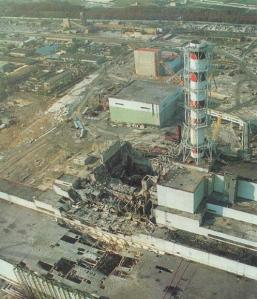
Chernobyl disaster: will it happen again?
The Guardian reports that radiation levels are rising in the ocean near the Fukushima nuclear plant, and Japanese officials admit they basically have no real solution for the apparent meltdown and/or meltdowns of the four damaged nuclear reactors.
The country’s nuclear and industrial safety agency, Nisa, said radioactive iodine-131 at 3,355 times the legal limit had been identified in the sea about 300 yards south of the plant, although officials have yet to determine how it got there.
Hidehiko Nishiyama, a Nisa spokesman, said fishing had stopped in the area, adding that the contamination posed no immediate threat to humans. “We will find out how it happened and do our utmost to prevent it from rising,” he said.
Good luck with that. The battle to control the reactors could go on for years.
The battle to control the slow-motion meldowns could take years, according to this Reuters article.
Plant operator Tokyo Electric Power Co. has conceded it faces a protracted and uncertain operation to contain overheating fuel rods and avert a meltdown.
“Regrettably, we don’t have a concrete schedule at the moment to enable us to say in how many months or years (the crisis will be over),” TEPCO vice-president Sakae Muto said in the latest of round-the-clock briefings the company holds.
Back to the Guardian piece:
Robert Peter Gale, a US medical researcher who was brought in by Soviet authorities after the Chernobyl disaster, said recent higher readings of radioactive iodine-131 and caesium-137 should be of greater concern than reports earlier this week of tiny quantities of plutonium found in soil samples.
But he added: “It’s obviously alarming when you talk about radiation, but if you have radiation in non-gas form I would say dump it in the ocean.”
Wonderful. The Japanese eat a lot of fish, don’t they?
Radiation measured at a village 40 kilometres from the Fukushima nuclear plant now exceeds a criterion for evacuation, the UN nuclear watchdog said.
And a Japanese nuclear expert has warned crews may have to keep pouring cooling water onto the stricken reactors for years.
Years. That is what multiple sources are now saying. It could take years. So how does it end? We hope for new discoveries that will solve the problem, while the reactors continue to melt down and release radioactive elements into the groundwater and the ocean? Or there is a catastrophic explosion?
Yes, I know the “experts” say that won’t happen, but if workers are going to be struggling with these plants for years, there is inevitably going to be human error. Besides, the “experts” have tried to minimize the dangers all along. Only now is the real truth beginning to come out.
From the Union of Concerned Scientists All Things Nuclear blog:
Today the IAEA has finally confirmed what some analysts have suspected for days: that the concentration per area of long-lived cesium-137 (Cs-137) is extremely high as far as tens of kilometers from the release site at Fukushima Dai-Ichi, and in fact would trigger compulsory evacuation under IAEA guidelines.
The IAEA is reporting that measured soil concentrations of Cs-137 as far away as Iitate Village, 40 kilometers northwest of Fukushima-Dai-Ichi, correspond to deposition levels of up to 3.7 megabecquerels per square meter (MBq/sq. m). This is far higher than previous IAEA reports of values of Cs-137 deposition, and comparable to the total beta-gamma measurements reported previously by IAEA and mentioned on this blog.
This should be compared with the deposition level that triggered compulsory relocation in the aftermath of the Chernobyl accident: the level set in 1990 by the Soviet Union was 1.48 MBq/sq. m.
Thus, it is now abundantly clear that Japanese authorities were negligent in restricting the emergency evacuation zone to only 20 kilometers from the release site.
This is bad, folks. Here is a summary of the health effects of cesium-137:
Like all radionuclides, exposure to radiation from cesium-137 results in increased risk of cancer.
Everyone is exposed to very small amounts of cesium-137 in soil and water as a result of atmospheric fallout. Exposure to waste materials, from contaminated sites, or from nuclear accidents can result in cancer risks much higher than typical environmental exposures.
If exposures are very high, serious burns, and even death, can result. Instances of such exposure are very rare. One example of a high-exposure situation would be the mishandling a strong industrial cesium-137 source. The magnitude of the health risk depends on exposure conditions. These include such factors as strength of the source, length of exposure, distance from the source, and whether there was shielding between you and the source (such as metal plating).
Please note that cesium-137, like plutonium doesn’t occur naturally in the environment. When officials and “experts” talk about “background” radiation, they are talking about elements that have been introduced through nuclear tests and nuclear reactor accidents and bi-products. This “background” radiation wasn’t around before the nuclear age, and I personally don’t believe that it has no effect on us.
From NPR: More radioactive material has been found in foods in Japan.
Yesterday, I asked in a comment what is being done with all the contaminated water that is being removed from the Fukushima reactors. Scarecrow addressed this question today at FDL.
They’ve got hundreds of tons of contaminated water preventing workers from getting close enough to pumps, valves, monitors needed to stabilize conditions. So they have to pump this water out and put it somewhere, but where? There are tanks at/near some units that can hold some of it, but not all, and external temporary storage may allow exposure to the atmosphere. Meanwhile, they must keep pumping more fresh water into the reactors and spent fuel storage pools, while more leaks out.
There are large pools of dangerously contaminated water in the turbine buildings adjacent to each reactor buidling, with more leaking in from somewhere, and few places to put it. Just outside the turbine buildings, there are long, deep trenches nearer the ocean and likely filled with water from the tsunami. But they’re now contaminated with radiation and water leaks from the turbine building.
Where can they put all this water? And given varying degrees of contamination, which water should they put where? For example, should they just pump out the least radioactive water in the trenches/pools and dump it in the ocean?
Believe it or not, some people are suggesting putting the water in large ships and letting them float around in the ocean. And what happens if there is a huge storm and the ships are damaged? Honestly, this gets scarier and scarier every day.
Even worse, today smoke was seen at another nuclear plant owned by Tepco!
The company said smoke was detected in the turbine building of reactor No. 1 at the Fukushima Daini nuclear power plant around 6 p.m. (5 a.m. ET).
Smoke could no longer be seen by around 7 p.m. (6 a.m. ET), a company spokesman told reporters.
The Fukushima Daini nuclear power plant is about 10 kilometers (6 miles) from the Fukushima Daiichi nuclear power plant, where workers have been scrambling to stave off a meltdown since the March 11 earthquake and tsunami knocked out cooling systems there….
After the dual disasters, Japanese authorities also detected cooling-system problems at the Fukushima Daini plant, and those living within a 10-kilometer radius (6 miles) of Fukushima Daini were ordered to evacuate as a precaution.
What next? Something tells me whatever happens next won’t be good.
Tuesday Reads
Posted: March 29, 2011 Filed under: Barack Obama, Foreign Affairs, Hillary Clinton, legislation, Libya, morning reads, Republican presidential politics, U.S. Military, U.S. Politics, worker rights | Tags: Donald Trump, Fareed Zackaria, Fukuskim nuclear plant, Indiana politics, Japan, Juan Cole, Libya, Moammar Gaddafi, NATO, radiation, Tom Malinowsky, Tom Ricks, unions 92 Comments
Good morning, political junkies!! Let’s get right to the news.
President Obama gave a speech last night in which he made a pretty good case (IMO) for U.S. limited intervention in Libya. He stated that there were not going to be American boots on the ground and that the U.S. is essentially finished with its part of the operation–it will be up to the UK, France, and Italy to police the no-fly zone and to the Libyan people to depose Gaddafi and decide what comes next.
Surprisingly, Obama was a bit more animated than usual–actually emphasizing points with his voice and at times appearing almost passionate. At least the speech didn’t start to put me to sleep until the last several minutes.
Obama indicated that the U.S. will continue to support efforts to set up a functioning government in Libya, but that will be a non-military effort. If he stands strong with that, I think he’s finally done something I agree with and can support.
Obama also argued that just because we can’t intervene in every conflict doesn’t mean that we should never intervene at all. We have to choose our battles, and in the case of Libya we had a dictator who was using his military–and his air power to kill his own citizens indiscriminately. If he had managed to attack Benghazi he might have murdered hundreds of thousands of people.
Furthermore, Libyans had asked for our help, and our action was supported by other Arab countries and by the Arab League. For once the U.S. was doing something that most Arabs wanted us to do. If we had not acted, we would have seen an atrocity take place, and that would have encouraged dictators in other Arab countries to crack down violently on protesters.
Here is the full text of the speech, if you are interested. I do think Obama went on too long after making the case for Libya. The speech would have been much better if he had done that and then wrapped it up.
I must say, I do not understand the criticisms of this Libya policy that I’m seeing in the progosphere, and from some people here at Sky Dancing. Maybe I’m nuts, but I think the U.S. finally had a chance to do something good with its massive military power and at the same time we get some good PR in a part of the world that has long hated us–with justification because we have enabled most of the tyrants in the region. I’m glad Hillary was able to convince her boss to do the right thing.
I want to call attention to some very knowledgeable people who agree with my assessment–and we do appear to be in the minority.
Thomas Ricks was on Monday’s edition of NPR’s Talk of the Nation. He said that he was struck by how many people either aren’t listening to what Obama, Clinton, and Gates are saying or they are discounting it out of hand.
Ricks said that these three are saying that the U.S. goals in Libya have already been achieved. The rebel forces are knocking on the door of Tripoli, thanks to the no-fly zone and some strategic bombing by the coalition countries. As Obama said last night, it is now up to Libyans to decide what to do with Gaddafi. We aren’t going to try to take him out.
Here’s what Ricks wrote on his blog after his appearance on Meet the Press with Gates and Clinton:
I was on Meet the Press yesterday, following Hillary Clinton and Robert Gates. I was struck at how frequently they emphasized the short-term, limited nature of the U.S. action in Libya, and how they used the past tense to discuss it:
Gates: “I think that the no fly zone aspect of the mission has been accomplished.”
Clinton: “I think we’ve prevented a great humanitarian disaster.”
Gates: “we see our commitment of resources actually beginning to — to decline.”
Gates: “in terms of the military commitment, the president has put some very strict limitations in terms of what we are prepared to do.”
Gates: “I don’t think it’s [Libya] a vital interest for the United States. But we clearly have interests there. And it’s a part of the region, which is a vital interest for the United States.”
I also was struck at how much more assertive Clinton seemed than Gates. A friend of mine calls this “State’s War.”
Ricks also blogged about his take on Obama’s speech: Obama on Libya: Watch out, Saudi Arabia
What we saw in the NDU speech was a logical defense of what the president has ordered the military to do and an exposition of what the limits of the action will be. The cost of inaction threatened to be greater than the cost of action, but now we have done our part. Next role for the U.S. military is best supporting actor, providing electronic jammers, combat search and rescue, logistics and intelligence. That was all necessary, and pretty much as expected.
But I was most struck by the last few minutes of the speech, when Obama sought to put the Libyan intervention in the context of the regional Arab uprising. He firmly embraced the forces of change, saying that history is on their side, not on the side of the oppressors. In doing so he deftly evoked two moments in our own history-first, explicitly, the American Revolution, and second, more slyly, abolitionism, with a reference to “the North Star,” which happened to be the name of Frederick Douglass’s newspaper. If you think that was unintentional, read this.
Hmmm…I totally missed that. Follow me below the fold…

 peej
peej Carissa
 bostonboomer
 dakinikat
 ecocatwoman
 mablue2
 Mama Lopez
 peggysue22
 quixote
 skydancingguestblogger
 Mona (aka Wonk the Vote)



 Sky Dancing
Recent Comments