
Saturday Reads: Dismal Science Edition
Posted: February 4, 2012 Filed under: Economy, income inequality, morning reads, poverty, unemployment, We are so F'd | Tags: Paul Krugman, social safety net, unemployment 62 Comments Good Morning!
I’m going to concentrate on the economy this morning. You better grab some coffee.
The unemployment rate dropped yesterday for a variety of reasons. I thought I’d talk a little about that first. The job growth was fairly strong this month in every sector but government. This improved the labor outlook for some of the workers hardest hit by the last recession. However, it was a mixed report–although you wouldn’t know that from the stock market–in that it still showed a number of people who are working part time that don’t want to be and again, a large number of people simply disappeared from the labor force. Temp jobs surged. Wage growth is “meager” as shown by graphs in this blog post by Tim Duy. He also notes that the employment to population ratio remains at a levels not seen since the early 1980s. This is an interesting situation. We’re still in a huge hole. At this growth rate, it will take us until 2019 just to gain back the jobs we had in 2008.
One interesting trend pointed out at Zero Hedge by Tyler Durden is that older workers are increasing the number of hours worked. There appears to be a basic shift in many of the ‘normal’ labor habits. Durden calculates an alternative measure to the unemployment rate by including workers that the BLS ignores. He uses the long-term average labor force participation rate instead of the number of people that are participating now which is shrinking in a very odd way.
… do the following calculation with us: using BLS data, the US civilian non-institutional population was 242,269 in January, an increase of 1.7 million month over month: apply the long-term average labor force participation rate of 65.8% to this number (because as chart 2 below shows, people are not retiring as the popular propaganda goes: in fact labor participation in those aged 55 and over has been soaring as more and more old people have to work overtime, forget retiring), and you get 159.4 million: that is what the real labor force should be. The BLS reported one? 154.4 million: a tiny 5 million difference. Then add these people who the BLS is purposefully ignoring yet who most
certainly are in dire need of labor and/or a job to the 12.758 million reported unemployed by the BLS and you get 17.776 million in real unemployed workers. What does this mean? That using just the BLS denominator in calculating the unemployed rate of 154.4 million, the real unemployment rate actually rose in January to 11.5%. Compare that with the BLS reported decline from 8.5% to 8.3%. It also means that the spread between the reported and implied unemployment rate just soared to a fresh 30 year high of 3.2%.
So, the deal is that the labor force participation rate is at a 30 year low. That’s still the number that puzzles and bothers me despite the good looking job growth. Why are people leaving the job market? As shown in Durden’s numbers, it’s not baby boomers. Here’s some speculation by Edward Harrison of Credit Write Downs who is concerned like me. Look at the graph on the right from Durden that shows why reason number three isn’t the explanation right now. The blue line is the participation rate by the older workers (55+) and as you can see it’s headed straight up.
My take on this: A declining labor force participation rate is a bad thing. It says people are dropping out of the labor force. So despite the bullish headline figure, the question still remains as to how robust the jobs market is.
Here are three things to consider:
- Cyclical: that’s the point I made above. Low participation is a negative signal.
- Structural: A lot of people have been pointing to long-term unemployment as a sign that the jobs market is weak. This makes sense and it should put downward pressure on the participation rate as people drop out of the labor force. The difference here is that if the problem is structural and not cyclical, the so-called output gap will continue to be large as throngs of people remain out of the labor force.
- Secular: The first cohorts of boomers started to retire last year. I know many people that were close to retirement when the recession began in 2007 that have had to change plans. Some have delayed retirement because of financial turmoil. But many others have accelerated retirement unwillingly because they were forced out of the labor force. Expect the loss of boomers to put downward pressure on the labor force for years to come.
My guess is that all three factors are affecting the labor force participation rate here. But I am beginning to think that the structural and secular forces are starting to predominate.
I’m still thinking that younger people may be holding up in school for awhile until things get better but I’d have to do some research to see if the university population is up. I also think that there’s the discouraged worker factor too. I actually know a lot of folks that are just hanging in there and cashing in their IRAs or have gone back to school and are living on student loans and or going back and forth between short term jobs and contract work. I guess we’ll see if the trend holds, but to me it’s a worrisome one. If things were really getting better, those folks should be entering the job market now driving the participation rate up. Since I’m a financial economist and not a labor economist, I really don’t know the flows well enough to speculate on anything beyond a theoretical level. It’s not my research area.
Thomas Fran has written an interesting post at Alternet on “Why We Got Ayn Rand Instead of FDR”.
An appropriate metaphor for the conservative revival is the classic switcheroo, with one fear replacing another, theoretical emergencies substituting for authentic ones, and a new villain shuffling onstage to absorb the brickbats meant for another. The conservative renaissance rewrites history according to the political demands of the moment, generates thick smokescreens of deliberate bewilderment, grabs for itself the nobility of the common toiler, and projects onto its rivals the arrogance of the aristocrat. Nor is this constant redirection of public ire a characteristic the movement developed as it went along; it was present at the creation. Indeed, redirection was the creation.
…
Here, in one sentence, was a key to the amazing success the Right would shortly enjoy. They had an answer to the bailout outrage, and it was not modulated by lawyerly subtleties or votes-taken-with-nose-held, like the House Democrats who had voted for the TARP. “Let the failures fail”: it was a line that would allow the revived Right to depict itself as an enemy of big business, rooting for the collapse of the megabanks. The Tea Partiers may have looked ridiculous in their costumes, but their central demand was anything but.
Not all “failure” is the same, however. What the newest Right has in mind is something philosophical, something both personal and sweeping. It demands liquidation across the board, a sort of deserved doomsday for the borrowing-based way of life. But in the great die-off it delights in imagining, the real culprits of 2008 have a way of disappearing from view.
If we watch closely, we can see the cards being switched. Whenever our tea-partying friends warm to the subject of letting-the-failures-fail—and they do so often—sooner or later they inevitably turn from the bailed-out banks to those spendthrift “neighbors” identified by Santelli, those dissolute people down the street who borrowed in order to live above their station.
This could be why the Republican Presidential Wannabes sound so down right Dickensian. We’ve had school children offered up as janitorial help. We’ve had Willard talking about enjoying a good firing and ranting on about how he’s not worried about the poor because they are safe in their safety nets. Instead of pointing to the business welfare queens, we’ve got poor children being held up as not having the fortitude and values. As Krugman says, Willard doesn’t feel any one’s pain.
Now, the truth is that the safety net does need repair. It provides a lot of help to the poor, but not enough. Medicaid, for example, provides essential health care to millions of unlucky citizens, children especially, but many people still fall through the cracks: among Americans with annual incomes under $25,000, more than a quarter — 28.7 percent — don’t have any kind of health insurance. And, no, they can’t make up for that lack of coverage by going to emergency rooms.
Similarly, food aid programs help a lot, but one in six Americans living below the poverty line suffers from “low food security.” This is officially defined as involving situations in which “food intake was reduced at times during the year because [households] had insufficient money or other resources for food” — in other words, hunger.
So we do need to strengthen our safety net. Mr. Romney, however, wants to make the safety net weaker instead.
Specifically, the candidate has endorsed Representative Paul Ryan’s plan for drastic cuts in federal spending — with almost two-thirds of the proposed spending cuts coming at the expense of low-income Americans. To the extent that Mr. Romney has differentiated his position from the Ryan plan, it is in the direction of even harsher cuts for the poor; his Medicaid proposal appears to involve a 40 percent reduction in financing compared with current law.
So Mr. Romney’s position seems to be that we need not worry about the poor thanks to programs that he insists, falsely, don’t actually help the needy, and which he intends, in any case, to destroy.
Still, I believe Mr. Romney when he says he isn’t concerned about the poor. What I don’t believe is his assertion that he’s equally unconcerned about the rich, who are “doing fine.” After all, if that’s what he really feels, why does he propose showering them with money?
The New York Review of Books has an entire list of economics books up that have to do with austerity and income inequality. The heading basically sums it up. We’re more unequal than you think. Here’s a review of two that I found particularly interesting.
Robert Frank’s The Darwin Economy and Thomas Edsall’s The Age of Austerity provide much-needed information and analysis to explain why so much of the nation’s money is flowing upward. Frank, an economist at Cornell, draws on social psychology to shatter many myths about competition and compensation. While he doesn’t explicitly cite the classical French economist Jean-Baptiste Say, much in his exposition echoes Say’s axiom that “supply creates demand.” This doesn’t mean that if items are put on display, people will automatically buy them. Consumers decide what or if they’ll purchase, and clearly can only do so if they have the credit or money. Even so, the items they decide they want have been created by the suppliers, who put things on the shelves.
Frank carries this a step further. In recent years, he argues, the products and enjoyments set before us have become increasingly enticing—including houses, vacations, television programs, video games, electronic devices, and the attractions of the Internet. In many cases, the rich acquire them first; since what they have and do becomes widely known, emulation descends down the line.
Nor are these just Tiffany trinkets. Frank’s most vivid examples are newly built houses. As the very rich installed grander entrance halls and rarely used bathrooms, the professional classes felt they should have a semblance of such amenities. “By 2007,” Frank writes, “the median new single-family house built in the United States had an area of more than 2,300 square feet, some 50 percent more than its counterpart from 1970.” Indeed, it’s revealing that this expansion was happening as people were having fewer children. However, these homes—along with more elaborate wardrobes, holidays, and technical gear—are costly. If they were to be bought, salaries needed to keep pace.
Hence, I would argue, an unstated but still real compact was made between the employers and the new upper-middle class. Their pay would be raised to support their ascending status. As the samplings in Table B show, while real earnings for the overall workforce have risen only 7 percent since 1985, professions like physicians and professors have done several times better. Incomes of lawyers and executives, for their part, have soared much further than anyone would have forecast a few decades ago.2
One of the reasons the poor do so poorly is that the states have tax structures that are very regressive. If you didn’t see me link to this down thread yesterday, take a look at how regressive state taxes really are. Kevin Drum includes a table where you can check on how bad your state treats you.
And then there are state taxes. Those include state income taxes, property taxes, sales taxes, and fees of various kinds. How progressive are state taxes?
Answer: They aren’t. The Corporation for Enterprise Development recently released a scorecard for all 50 states, and it has boatloads of useful information. That includes overall tax rates, where data from the Institute on Taxation and Economic Policy shows that in the median state (Mississippi, as it turns out) the poorest 20 percent pay twice the tax rate of the top 1 percent. In the worst states, the poorest 20 percent pay five to six times the rate of the richest 1 percent. Lucky duckies indeed. There’s not one single state with a tax system that’s progressive.
So, hopefully, you’re still awake! What’s on your reading and blogging list today.
What’s so hard to understand about the word Contractionary?
Posted: December 10, 2011 Filed under: Bailout Blues, Banksters, Economy, financial institutions | Tags: Eurozone, macroeocnomics, Paul Krugman 17 Comments I just read an excellent article at VOXEU called “A summit to the Death” by Kevin O’Rourke. It’s full of common sense economic analysis about the state of the EU that reminds me of how rare common sense can be. While the analysis looks at he EU, it could well apply to the US as well. There seems to be some disease in political bodies these days that cannot grasp the concept of contractionary policy as contractionary.
There’s also this scramble to save financial institutions at all costs while doing nothing to prevent recurrence of bad practices and solving the fall out anywhere outside a bank balance sheet. To a certain extent, the EU crisis comes from the inability of many countries to think of policy in terms of something other than currency devaluation as a way of making their workers and goods appear cheap to the rest of the world. In this scenario, a country can goose some of its business activities at the expense of some of its businesses and its citizens and not get caught by any one but those of us that watch those sort of things. That long run game of devaluing US workers has caught up with us here.
One lesson that the world has learned since the financial crisis of 2008 is that a contractionary fiscal policy means what it says: contraction. Since 2010, a Europe-wide experiment has conclusively falsified the idea that fiscal contractions are expansionary. August 2011 saw the largest monthly decrease in eurozone industrial production since September 2009, German exports fell sharply in October, and now-casting.com is predicting declines in eurozone GDP for late 2011 and early 2012.
A second, related lesson is that it is difficult to cut nominal wages, and that they are certainly not flexible enough to eliminate unemployment. That is true even in a country as flexible, small, and open as Ireland, where unemployment increased last month to 14.5%, emigration notwithstanding, and where tax revenues in November ran 1.6% below target as a result. If the nineteenth-century “internal devaluation” strategy to promote growth by cutting domestic wages and prices is proving so difficult in Ireland, how does the EU expect it to work across the entire eurozone periphery?
The world nowadays looks very much like the theoretical world that economists have traditionally used to examine the costs and benefits of monetary unions. The eurozone members’ loss of ability to devalue their exchange rates is a major cost. Governments’ efforts to promote wage cuts, or to engineer them by driving their countries into recession, cannot substitute for exchange-rate devaluation. Placing the entire burden of adjustment on deficit countries is a recipe for disaster.
In order to protect financial markets, countries like the UK and the US have been willing to prop up poorly performing financial institutions at an extremely high cost while further driving the nominal wages of their workers to lower and lower levels through currency debasement. Then, after slashing spending, they wonder why they’re economies don’t expand. It seems like some of the very easiest lessons of Macro 101 weren’t absorbed by a number of world leaders today. That vehicle of robbing Peter to prop up Paul and a few exporters isn’t available to countries in a currency union unless the Central Bank wants to do it for all.
O’Rourke’s analysis led Paul Krugman to rightly make this observation.
Maybe it was always thus, but the relentless wrong-headedness of the Europeans, their insistence on seeing their crisis as something it isn’t, and responding with actions that deepen the real crisis, has been a wonder to behold. In the 1930s policy makers had the excuse of ignorance; there was nobody to explain what was happening. Now, their actions amount to a willful disregard of Econ 101.
Let me provide an interesting bit of perspective. In 2007, Spain ran a budget surplus. That actually was its third budget surplus in row. At the time, its growth had been forecast to decline but ot was slammed by the global financial crisis. Spain is now on the list of problem countries–the S of the PIIGS–because it was trying to deal with 30 years of budget deficits to get in line with the EU Criteria. Balanced budgets are the proscribed way to handle an economy that is operating where it should be operating. Spain’s is having problems because financial institutions all over the world gambled and lost. Their economic activity declined, their tax receipts went down, and their obligations to the unemployed went up. So, as would be expected, their deficits widened. Now, the banks that caused the huge global crisis are getting full court sympathy and Spain is being blamed for threatening the status of the union.
Thursday Reads: Power to the People!
Posted: November 3, 2011 Filed under: #Occupy and We are the 99 percent!, Foreign Affairs, France, Germany, Greece, Italy, morning reads, Spain, U.S. Economy, U.S. Politics, unemployment | Tags: Angela Merkel, austerity, democracy, Eurodammerung, George Papandreau, Greece, Nicolas Sarkozy, Oakland general strike, Paul Krugman, Robert Reich 40 Comments
Good Morning!! Over the past couple of days, I’ve become really fascinated with the situation in Greece. It’s a pretty fluid situation at the moment. On Tuesday Robert Reich wrote a pretty good primer on what is happening and expressed his view that letting the Greek people decide their own fate is the best idea. Here’s a bit of it:
Greek Prime Minister George Papandreou decided in favor of democracy yesterday when he announced a national referendum on the draconian budget cuts Europe and the IMF are demanding from Greece in return for bailing it out.
(Or, more accurately, the cuts Europe and the IMF are demanding for bailing out big European banks that have lent Greece lots of money and stand to lose big if Greece defaults on those loans – not to mention Wall Street banks that will also suffer because of their intertwined financial connections with European banks.)
If Greek voters accept the bailout terms, unemployment will rise even further in Greece, public services will be cut more than they have already, the Greek economy will contract, and the standard of living of most Greeks will deteriorate further.
If Greek voters reject the terms and the nation defaults, it will face far higher borrowing costs in the future. This may reduce the standard of living of most Greeks, too. But it doesn’t have to. Without the austerity measures the rest of Europe and the IMF are demanding, the Greek economy has a better chance of growing and more Greeks are likely to find jobs.
Shouldn’t Greek citizens make this decision for themselves?
Reich argues that it would have been better in the long run if the American people had been consulted about the bank bailouts here.
If Americans had been consulted about the 2008-2009 Wall Street bailout, I doubt it would have happened the way it did. At the very least, strict conditions would have been placed on the banks in return for the money. The banks would have had to eat the losses of the predatory mortgages they sold, and help homeowners reduce those mortgages. They’d be required to improve the capitalization of small banks in communities across the country. They’d be forced to accept stringent new regulations, including resurrection of Glass-Steagall
But we weren’t consulted. The wishes of the American people were considered irrelevant by the oligarchs who run this country. And the European oligarchs are hoping to prevent the Greek people from claiming a right to make a democratic decision.
Of course if the Greek people do decide to default on their debts, there will be serious consequences–for them and for the rest of Europe. Krugman calls it “Eurodämmerung.” He argues that
…the euro was an inherently flawed idea that can work only given a strong European economy and a significant degree of inflation, plus open-ended credit to sovereigns facing speculative attack. Yet European elites embraced the notion of economics as morality play, imposing across-the-board austerity, tightening money despite low underlying inflation, and have been too concerned with punishing sinners to notice that everything was going to blow apart without an effective lender of last resort.
The question I’m trying to answer right now is how the final act will be played. At this point I’d guess soaring rates on Italian debt leading to a gigantic bank run, both because of solvency fears about Italian banks given a default and because of fear that Italy will end up leaving the euro. This then leads to emergency bank closing, and once that happens, a decision to drop the euro and install the new lira. Next stop, France.
Yikes! But Fortune also says Italy and France are in trouble if Greece defaults. And Spain could go bust too.
What worries is that Spain and Italy are not in the Greek situation but they could be. Greece is bust and Spain and Italy could be driven bust. They both have a lot of debt and each year some of that debt has to be repaid. Now governments almost never do repay debt, they just borrow some more and use the new money to pay off the old. Bit like swirling what you owe around a few credit cards.
Which is just fine: except, if interest rates rise then they have to pay more interest on this new debt that they’re issuing to pay off the old. And if interest rates rise enough then they do go bust, as the interest payments they have to make take too much money out of the budget. Switching money around on zero interest introductory rate cards is very different from doing it when you’re being charged 30%.
Now, the general agreement is that when the interest rates are above 6% then Italy and Spain are in danger of going bust. When they’re over 7% they will do so. But of course, when people see that Italian interest rates are above 6% then they become more wary of lending Italy any more money and so interest rates keep on rising to possibly above 7% and game over.
It’s still not clear what Greece is going do in their referendum. Dakinikat says they need to ask the people if they want to leave the European Union or not. German Chancellor Angela Merkel and French President Nicolas Sarkozy have said that the referendum must ask the Greek people if they want to opt out of the Euro, but not the EU itself. Meanwhile, the offer of a bailout of Greece has been called off until after the vote on the referendum is taken. From Naked Capitalism:
The Eurocrats have decided to try to push Greece into line, threatening expulsion from the Euro (note, not the EU) if Greece does not back down. From a practical matter, if the Greeks were to turn down the bailout package, it would lead to a banking crisis, making a Eurozone exit a not that much more traumatic incremental move with considerable upside. And under the Maastrict treaty, Greece cannot unilaterally exit (although as various commentors have pointed out, Nato is not going to send in tanks if the Greeks were to do so).
But this may be an appeal to the Greek public, or more likely, an effort to break Greek prime minister’s Papandreou’s thin coalition on the eve of a vote of no confidence.
So that’s another possibility–that Papandreau’s government might fall. More on the European reaction from Bloomberg:
Led by Germany and France, Europe’s economic and political anchors, the euro’s guardians yesterday cut off financial aid for Greece until a vote they said would be on Dec. 4 or Dec. 5 determines whether it deserves a fresh batch of loans needed to stave off default.
“The referendum will revolve around nothing less than the question: does Greece want to stay in the euro, yes or no?” German Chancellor Angela Merkel told reporters after crisis talks hours before a Group of 20 summit set to begin today in Cannes, France. French President Nicolas Sarkozy said Prime Minister George Papandreou’s government won’t get a “single cent” of assistance if voters rejects the plan.
The hardball tactics open the door for a nation to leave the currency bloc that at its setup in 1999 capped Europe’s progression from war to prosperity and was declared “irrevocable” by its founding fathers. Polls show most Greeks object to the austerity required for aid, yet more than seven in 10 favor remaining in the euro, a survey last week of 1,009 people published in To Vima newspaper showed.
They’re going to have to decide between two awful choices, and the rest of Europe will have to deal with the results of the vote–if there is a default, failures of banks that hold Greek debt and getting Italian, French, and German taxpayers to pay for more bank bailouts–unless Papandreau’s government falls. Read the whole article at Bloomberg to get a sense of how serious all this is.
In U.S. news, Occupy Oakland called for a general strike today. That situation is still fluid as of this writing, 11PM Eastern on Wednesday night.
OAKLAND – Protesters blocked streets near City Hall, smashed windows at a bank and gathered by the thousands in an attempt to shut down the nation’s fifth-busiest port Wednesday.
The Occupy Oakland protest was the largest in a series of rallies in several cities as the Occupy Wall Street movement that began Sept. 17 tried to grab national attention.
A group of about 300 protesters, many of them men wearing black, some covering their faces with bandanas and some carrying wooden sticks, smashed windows of a Wells Fargo bank branch while chanting “Banks got bailed out. We got sold out.”
Are you getting the feeling this genie can’t be put back in the bottle either? The Occupy demonstrations have shown us that we pretty much live in a police state at this point. There very little respect for the protesters’ constitutional rights by local governments or law enforcement. From Counterpunch, here is a report of what actually happened when police attacked protesters in Oakland on Oct. 25.
In a heavily armed pre-dawn raid, on Tuesday, Oct. 25, with back up from armored vehicles and helicopters, the Oakland Police Department in conjunction, with over 15 other police departments from Northern and Central California, stormed the sleepy Occupy Oakland Encampment.
Asleep inside tents of the makeshift Occupy encampment, were over a hundred men, women and very young children. The heavily armed police force, dressed in black ninja-like outfits, and special forces helmets, with full face-shields down, and armed with and assortment of latest riot gear, fired tear gas canisters and concussion grenades into the camp, as helicopters circled above.
Police then attacked and ransacked the entire encampment. In a short time, the camps library, soup kitchen, and children’s center were left in ruins, and over a hundred of the inhabitants were roughed up, arrested and held on high bail. The activists suffered many injuries, including broken bones.
Please read the whole thing–it’s an eyewitness account of a horrifying paramilitary action by police. As everyone knows, Iraq war veteran Scott Olson was critically injured in the melee.
Late last night as part of the general strike, Oakland protesters succeeded in shutting down the Port of Oakland.
Several thousand Occupy Wall Street demonstrators forced a halt to operations at the United States’ fifth busiest port Wednesday evening, escalating a movement whose tactics had largely been limited to rallies and tent camps since it began in September.
Police estimated that a crowd of about 3,000 had gathered at the Port of Oakland by early evening. Some had marched from the California city’s downtown, while others had been bused to the port.
Port spokesman Isaac Kos-Read said maritime operations had effectively been shut down. Interim Oakland police chief Howard Jordan warned that protesters who went inside the port’s gates would be committing a federal offense.
In New York, Los Angeles and other cities where the movement against economic inequality has spread, demonstrators planned rallies in solidarity with the Oakland protesters, who called for Wednesday’s “general strike” after an Iraq War veteran was injured in clashes with police last week.
Organizers of the march said they want to stop the “flow of capital.” The port sends goods primarily to Asia, including wine as well as rice, fruits and nuts, and handles imported electronics, apparel and manufacturing equipment, mostly from Asia, as well as cars and parts from Toyota, Honda, Nissan and Hyundai.
We knew there would eventually be civil unrest, and now we’re seeing it all over the world and here at home. What next? I’d say 2012 is going to be an eventful year.
With that, I’m going to wrap this up. I know there’s lots of other news, but these two stories–Greece and the general strike in Oakland–seem to me to symbolize what’s happening in the world today. People are sick and tired of being bilked by the super-rich, and ignored by the politicians. It’s so chaotic, yet I feel that the only hope we have is for the people to keep resisting as best they can. For so long, I was afraid nothing would wake American up, but I’m finally getting the feeling that we won’t go down without a fight. Let’s keep the elites nervous!
Sooooo… what are you reading and blogging about today?
Monday Morning Reads
Posted: October 24, 2011 Filed under: morning reads | Tags: birtherism, Day of the Dead, Donald Trump, Euro, flat tax, Global Economic Crisis, Halloween, judges, judicial system, Michele Bachmann, Mitt Romney, Paul Krugman, Rick Perry, Ron Paul, student loans, stupid Republicans 26 Comments
Good Monday Morning! Not a day goes by without more examples of Republican stupidity. I’ve got several for you this morning. First up, Rick Perry had a talk with Donald Trump and now Governor Goodhair thinks President Obama’s birth certificate might be fake. That legend will never die. Think Progress:
In an interview with PARADE Magazine, Perry said that he recently met with Donald Trump and discussed the issue. Perry stated that he doesn’t “have a definitive answer” on whether Obama was born in the United States or “any idea” if Obama’s birth certificate is real….
Perry recently secured the endorsement of Orly Taitz, known as the “birther queen” for repeatedly filing lawsuits asserting that Obama was born outside the United States. Taitz told ThinkProgress that she believed Perry will use the birther issue to attack Obama.
Governor, do you believe that President Barack Obama was born in the United States?
I have no reason to think otherwise.That’s not a definitive, “Yes, I believe he”—
Well, I don’t have a definitive answer, because he’s never seen my birth certificate.But you’ve seen his.
I don’t know. Have I?You don’t believe what’s been released?
I don’t know. I had dinner with Donald Trump the other night.And?
That came up.And he said?
He doesn’t think it’s real.And you said?
I don’t have any idea. It doesn’t matter. He’s the President of the United States. He’s elected. It’s a distractive issue. “
“distractive?” Is that in the dictionary?
Herman Cain is still trying to walk back his accidentally pro-choice comments on abortion. From Politico:
Herman Cain tried to clean up the running confusion over his position on abortion last night, but in the meantime opened questions about his grasp of the Constitution.
In an interview with David Brody last night, Cain said he’d sign a pro-life constitutional amendment if it crossed his desk as president.
“Yes. Yes I feel that strongly about it. If we can get the necessary support and it comes to my desk I’ll sign it,” he said. “That’s all I can do. I will sign it.”
The only problem with that statement? Presidents don’t sign constitutional amendments — they’re passed in Congress and then need to be ratified by the states, and the president plays no formal role in the process.
Is this guy the most ignorant person to ever run for president? He’s worse than Michele Bachmann.
It appears Mitt Romney is about to do another flip flop: Romney, Once a Critic, Hedges on Flat-Tax Plans
As several leading Republican presidential candidates embrace a flat tax as a core campaign position, one contender stands out in not doing so: Mitt Romney, who has a long record of criticizing such plans and famously derided Steve Forbes’s 1996 proposal as a “tax cut for fat cats.”
Lately, though, his tone has been more positive. “I love a flat tax,” he said in August.
Flat-tax plans have come and gone before, and analysts note that they have tended to lose support once they come under scrutiny. But Mr. Romney’s support of the concept of a flat tax underscores the tightrope he is walking as taxes become a larger focus of the Republican presidential race and he faces rivals’ accusations of inconsistency on the issues.
But Ron Paul wins today’s prize for Republican stupidity. He wants to get rid of student loans.
Republican presidential contender Ron Paul said Sunday he wants to end federal student loans, calling it a failed program that has put students $1 trillion in debt when there are no jobs and when the quality of education has deteriorated.
Paul unveiled a plan last week to cut $1 trillion from the federal budget that would eliminate five Cabinet departments, including education. He’s also wants young workers to be able to opt out of Social Security.
The student loan program is not part of those cuts, but Paul said Sunday on NBC’s “Meet the Press” that he’d kill the loan program eventually if he were president. That could put him at odds with some of his young followers, many of whom are college students.
Turning to economic issues, the Financial Times has a scary article about the possible failure of the Euro.
It is time to prepare for the unthinkable: there is now a significant probability the euro will not survive in its current form. This is not because I am predicting the failure by European leaders to agree a deal. In fact, I believe they will. My concern is not about failure to agree, but the consequences of an agreement. I am writing this column before the results of Sunday’s European summit were known. It appeared that a final agreement would not be reached until Wednesday. Under consideration has been a leveraged European financial stability facility, perhaps accompanied by new instruments from the International Monetary Fund.
A leveraged EFSF is attractive to politicians for the same reason that subprime mortgages once appeared attractive to borrowers. Leverage can have different economic functions, but in these cases it simply disguises a lack of money. The idea is to turn the EFSF into a monoline insurer for sovereign bonds. It is worth recalling that the role of those monolines during the bubble was to insure toxic credit products. They ended up as a crisis amplifier.
To be honest, the article is a bit too technical for me to follow, but maybe Dakinikat can help me if she has sufficiently recovered from her nightmarish trip to Denver. Paul Krugman says Europe’s problem is (what else?) the stupidity of austerity.
First, the grim news from Greece is, as many commentators are pointing out, a big refutation for the doctrine of “expansionary austerity.” And it’s worth pointing out that European leaders, and especially the ECB, went in for that doctrine in a big way. Look at the June 2010 monthly report of the ECB (pdf), specifically the discussion of “fiscal consolidation” on page 83 and following. Basically, the ECB pooh-poohs any notion that austerity would have major negative effects on the economy, suggests that it’s quite likely that the confidence fairy will make everything OK, and specifically says that
Determined action on the part of governments to undertake fiscal and structural reforms is necessary to preserve stability and cohesion in the euro area. A sustained commitment to consolidation, possibly including a speeding up of current plans and their delivery, is required from all governments to ensure that the time afforded by the exceptional measures is used to put public finances on a permanently sounder footing.
So the ECB was calling for austerity everywhere. Was any concern expressed about how that would affect Europe-wide growth? Was there any suggestion of expansionary monetary policy to offset such a coordinated fiscal contraction? No and no.
And now they’re shocked, shocked that the Greek economy is plunging into a hole.
Maybe Ron Paul has a solution. LOL
Fannie posted this link last night, but I thought it should be on the front page: Republicans Turn Judicial Power Into a Campaign Issue
Republican presidential candidates are issuing biting and sustained attacks on the federal courts and the role they play in American life, reflecting and stoking skepticism among conservatives about the judiciary. Gov. Rick Perry of Texas favors term limits for Supreme Court justices. Representatives Michele Bachmann of Minnesota and Ron Paul of Texas say they would forbid the court from deciding cases concerning same-sex marriage. Newt Gingrich, the former House speaker, and former Senator Rick Santorum of Pennsylvania want to abolish the United States Court of Appeals for the Ninth Circuit, calling it a “rogue” court that is “consistently radical.”
Criticism of “activist judges” and of particular Supreme Court decisions has long been a staple of political campaigns. But the new attacks, coming from most of the Republican candidates, are raising broader questions about how the legal system might be reshaped if one of them is elected to the White House next year.
I’m going to end with this funny Halloween-themed satire from The New Yorker: Dear Mountain Room Parents, by Maria Semple. Here’s a bit of it, but please read the whole thing. You won’t be sorry.
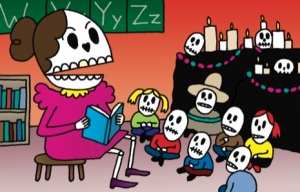
Hi, everyone!
The Mountain Room is gearing up for its Day of the Dead celebration on Friday. Please send in photos of loved ones for our altar. All parents are welcome to come by on Wednesday afternoon to help us make candles and decorate skulls.
Thanks!
Emily
Hi again.
Because I’ve gotten some questions about my last e-mail, there is nothing “wrong” with Halloween. The Day of the Dead is the Mexican version, a time of remembrance. Many of you chose Little Learners because of our emphasis on global awareness. Our celebration on Friday is an example of that. The skulls we’re decorating are sugar skulls. I should have made that more clear.
Emily
Parents:
Some of you have expressed concern about your children celebrating a holiday with the word “dead” in it. I asked Eleanor’s mom, who’s a pediatrician, and here’s what she said: “Preschoolers tend to see death as temporary and reversible. Therefore, I see nothing traumatic about the Day of the Dead.” I hope this helps.
Emily
It gets funnier, so please go read the rest! Now what are you reading and blogging about today?
“Krugman’s Army” Open Thread
Posted: October 10, 2011 Filed under: #Occupy and We are the 99 percent!, Civil Liberties, open thread, U.S. Economy, U.S. Politics | Tags: #OccupyWallStreet, first amendment, Michael Bloomberg, OccupyAtlanta, OccupyBoston, Paul Krugman, police brutality, protesters, U.S. Constitution 25 Comments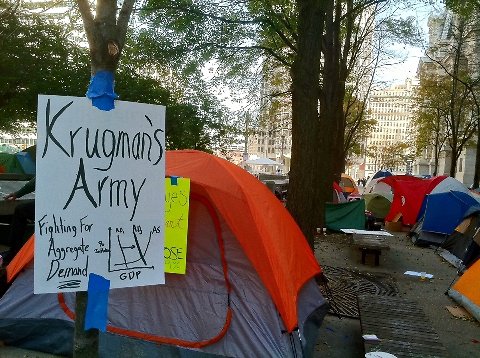
Photo from #OccupyWallStreet sent to Paul Krugman by a reader
Last week, Mayor Bloomberg was all over #Occupy Wall Street, claiming the protesters were trying to destroy the jobs of Wall Street Bankers and other denizens of Wall Street, and threatening that somehow the protests would cause NYC to be unable to pay municipal workers.
I guess one of his advisers must have told him it might not be a good idea to deny that people have a right to assemble in public and air their grievances, according to the U.S. Constitution, because now Bloomberg is singing another tune.
Mayor Michael Bloomberg said on Monday that he’ll allow the Wall Street protesters to stay indefinitely, provided they abide by the law, marking his strongest statement to date on the city’s willingness to let demonstrators occupy a park in Lower Manhattan.
“The bottom line is – people want to express themselves. And as long as they obey the laws, we’ll allow them to,” said Bloomberg as he prepared to march in the Columbus Day Parade on Fifth Avenue. “If they break the laws, then, we’re going to do what we’re supposed to do: enforce the laws.”
Bloomberg said he has “no idea” how much longer the Wall Street demonstration will last. “I think part of it has probably to do with the weather,” he said.
I think someone needs to send the Mayor a copy of the Constitution with the first amendment highlighted. He still thinks he gets to decide if American citizens can gather and protest on public property.
I wonder what Bloomberg will say about what the protesters plan to do next? From the New York Daily News:
The Occupy Wall Street protesters are planning to get in the face of some of New York’s richest tycoons on Tuesday.
A “Millionaires March” will visit the homes – or, more realistically, the gleaming marble lobbies – of five of the city’s wealthiest residents.
On the target list: NewsCorp CEO Rupert Murdoch, JP Morgan Chase CEO Jamie Dimon, conservative billionaire David Koch, financier Howard Milstein and hedge fund mogul John Paulson.
Between 400 and 800 marchers plan to go to their homes to present them with oversize checks to dramatize how much less they will pay when New York State’s 2% tax on millionaires expires at the end of the year.
This is starting to get interesting. I admit I find the call and response routine of the protesters kind of annoying, but that’s OK. We annoyed a lot of old folks when we protested the Vietnam War too. Annoying old folks is one of the responsibilities of the young.
Meanwhile, in Boston, police are warning the protesters to go home or else:
Boston police were warning the more than 1,000 Occupy Boston protesters tonight that if they do not leave the Rose Kennedy Greenway and Dewey Square areas that authorities would move them out.
Police were visible around the areas in small batches tonight, while protest organizers held a meeting on the Greenway, answering questions from the demonstrators.
Occupy Boston, in a statement last night, answered the police warning by issuing a call “for any and all people to join the occupation as soon as possible.”
“From the beginning, occupiers have worked tirelessly to maintain a positive working relationship with city officials. Today’s threats by the Boston Police Department represent a sudden shift away from that dialogue,” the statement said.
The mayor’s office, however, has said the city will make no effort to clear the original Dewey Square tent city tonight, but police have said that if protesters do not leave the Greenway, the authorities would clear both the Greenway and Dewey Square.
Hmmmm…sounds like Mayor Menino is out of sync with the cops. Very interesting. Minx says the Atlanta police are itching to crack some heads too. The cops just never understand that when they attack protesters they only draw more attention to them and their grievances.

 peej
peej Carissa
 bostonboomer
 dakinikat
 ecocatwoman
 mablue2
 Mama Lopez
 peggysue22
 quixote
 skydancingguestblogger
 Mona (aka Wonk the Vote)



 Sky Dancing
Recent Comments