
Monday Reads
Posted: December 12, 2011 Filed under: China, Drone Warfare, Foreign Affairs, Iran, morning reads, Pakistan, Russia, Sky Dancing Blog, U.S. Economy, U.S. Military, U.S. Politics | Tags: Ann Coulter, children in poverty, consumer demand, Depression, drones, General Manuel Noriega, Hillary Clinton, jobs, Mitt Romney, New Orleans, Newt Gingrich, North Dakota, Obama's wars, Pakistan, Panama, rich people, Trade agreements, unemployment, weather 24 Comments Good Morning!
We’ve had some cold gloomy weather down here in New Orleans. I hope all those bowl game tourists brought their coats. It’s made for a depressing weekend. It seems like most of the news I’ve been finding matches the weather too. Another presidential election year is upon us and we’re looking at the Grinch getting the Republican nomination. Soon, all poor children will be required to mine the coal so the Grinch can place them in every one’s stockings. Well, that’s the east coast poor children. Those poor children in the middle of the country will be fattening up turkeys for the 1 percent to eat. I’ll bet Mitch can make a $10,000 bet on which of the kids will have it worse!
First up is an interesting read from the Business Insider that once again shoots down the meme that the rich create jobs. There are so many economic fairy tales around these days it’s hard to know which one to shoot down next. The bottom line is pretty much something we’ve talked about for some time. If you build it and no one comes, you don’t create anything but one more bankruptcy. It’s the consumer demand that creates economic growth.
The most important reason the theory that “rich people create the jobs” is absurd, argues Nick Hanauer, the founder of online advertising company aQuantive, which Microsoft bought for $6.4 billion, is that rich people do not create jobs, even if they found and build companies that eventually employ thousands of people.
What creates the jobs, Hanauer astutely observes, is the company’s customers.
The company’s customers create demand for the company’s products, which, in turn, creates the need for the employees to produce, sell, and service those products. If those customers go broke, the demand for the company’s products will collapse. And the jobs will disappear, regardless of what the entrepreneur does.
That’s actually some good common sense but it’s backed up by economic theory. Supply without demand just rots in the fields and molds in the warehouse. Which brings me to Paul Krugman who says it’s time to call this economic situation a depression. That’s also something we’ve bandied about here. I’d say skydancers are pretty prescient, wouldn’t you?
It’s time to start calling the current situation what it is: a depression. True, it’s not a full replay of the Great Depression, but that’s cold comfort. Unemployment in both America and Europe remains disastrously high. Leaders and institutions are increasingly discredited. And democratic values are under siege.
On that last point, I am not being alarmist. On the political as on the economic front it’s important not to fall into the “not as bad as” trap. High unemployment isn’t O.K. just because it hasn’t hit 1933 levels; ominous political trends shouldn’t be dismissed just because there’s no Hitler in sight.
Krugman takes the rest of the column outlining some of the abysmal politics and economics in Europe. I just keep checking the calendar to see if we some how time tripped back to the 1930s and some how forget what we learned the last time out. Looking at things from a war build-up point a view, there’s this link to “Obama Raises the Military Stakes: Confrontation on the Borders with China and Russia” from Global Research. This is how some leftwing thinkers see the latest in US outreach in Asia.
November 2011 is a moment of great historical import: Obama declared two major policy positions, both having tremendous strategic consequences affecting competing world powers.
Obama pronounced a policy of military encirclement of China based on stationing a maritime and aerial armada facing the Chinese coast – an overt policy designed to weaken and disrupt China ’s access to raw materials and commercial and financial ties in Asia . Obama’s declaration that Asia is the priority region for US military expansion, base-building and economic alliances was directed against China , challenging Beijing in its own backyard. Obama’s iron fist policy statement, addressed to the Australian Parliament, was crystal clear in defining US imperial goals.
“Our enduring interests in the region [Asia Pacific] demands our enduring presence in this region … The United States is a Pacific power and we are here to stay … As we end today’s wars [i.e. the defeats and retreats from Iraq and Afghanistan]… I have directed my national security team to make our presence and missions in the Asia Pacific a top priority … As a result, reduction in US defense spending will not … come at the expense of the Asia Pacific” (CNN.com, Nov. 16, 2011).
The precise nature of what Obama called our “presence and mission” was underlined by the new military agreement with Australia to dispatch warships, warplanes and 2500 marines to the northern most city of Australia ( Darwin ) directed at China . Secretary of State Clinton has spent the better part of 2011 making highly provocative overtures to Asian countries that have maritime border conflicts with China . Clinton has forcibly injected the US into these disputes, encouraging and exacerbating the demands of Vietnam , Philippines , and Brunei in the South China Sea . Even more seriously, Washington is bolstering its military ties and sales with Japan , Taiwan , Singapore and South Korea , as well as increasing the presence of battleships, nuclear submarines and over flights of war planes along China ’s coastal waters. In line with the policy of military encirclement and provocation, the Obama-Clinton regime is promoting Asian multi-lateral trade agreements that exclude China and privilege US multi-national corporations, bankers and exporters, dubbed the “Trans-Pacific Partnership”. It currently includes mostly smaller countries, but Obama has hopes of enticing Japan and Canada to join …
Obama’s presence at the APEC meeting of East Asian leader and his visit to Indonesia in November 2011 all revolve around efforts to secure US hegemony. Obama-Clinton hope to counter the relative decline of US economic links in the face of the geometrical growth of trade and investment ties between East Asia and China .
Pakistan is threatening to shoot down all US drones. Tis the season to be jolly!!!
According to the new Pakistani defense policy, “Any object entering into our air space, including U.S. drones, will be treated as hostile and be shot down,” a senior Pakistani military official told NBC News.
The policy change comes just weeks after a deadly NATO attack on Pakistani military checkpoints accidentally killed 24 Pakistani soldiers, prompting Pakistani officials to order all U.S. personnel out of a remote airfield in Pakistan
I wonder if people in North Dakota have the same option? Here’s the Daily Mail headline on your Daily Moment of Orwell: Local cops using Predator drones to spy on Americans in their own backyards.
One of the only confirmed uses of predator drones by local law enforcement came in June when a sheriff near Grand Forks, North Dakota, went looking for six stolen cattle.
When he arrived at the farm of Rodney Brossart, he was threatened by three men with guns and forced to retreat.
The Brossarts were known for being armed, anti-government separatists. So Sheriff Kelly Janke, who patrols a county of just 3,000 people, called in a Predator drone to look out over the 3,000-acre farm where the family was armed with rifles and shotguns.
With the help of a drone, summoned from nearby Grand Forks Air Force Base where it was patrolling the US-Candida border, the sheriff was able to watch the movements of everyone on the farm from a handheld device that picked up the aircraft’s video footage.
He and his deputies waited until they could see the Brossarts put down their weapons. Then they stormed the compound and arrested Rodney Brossart, his daughter and his three sons on a total of 11 felony charges. No shots were fired.
And he recovered the cattle, valued at $6,000.
The sheriff says that might not have been possible without the intelligence from the Predators.
‘We don’t have to go in guns blazing. We can take our time and methodically plan out what our approach should be,’ Sheriff Janke told the Times.
All of the surveillance occurred without a search warrant because the Supreme Court has long ruled that anything visible from the air, even if it’s on private property, can be subject to police spying.
Back to the Grinch that’s stealing Willard’s inevitability.
The NBC News-Marist polls showed Gingrich leading Romney in South Carolina by 42 percent to 23 percent. An October poll by the same organizations showed Gingrich at 7 percent in the Palmetto State. In Florida, Gingrich leads Romney 44 percent to 29 percent. There Gingrich has gained 38 percentage points since October.
The rapid movement highlights the remarkable rise of Gingrich as the caucuses and primaries near. Republican voters have shifted allegiances repeatedly this year and a number of state polls have shown that they are not firmly locked in behind any candidate at this point.
In New Hampshire on Sunday, Romney picked up the endorsement of Manchester Mayor Ted Gastas. But he was the target of a scathing editorial in the Union Leader, which earlier endorsed Gingrich. The headline read “Romney’s desperate hours.”
January’s coming and sooner or later, some of these folks are going to run out of money. There seems to be quite a few irrelevant candidates in the race right now. Maybe super Jeb is waiting in the wings? So here’s a good way we now MIttens is tres desperate. Here’s the TPM headline: Romney Presses Ann Coulter Into Surrogate Duty.
Turn on the radio here and you’re going to get a taste of how hard Mitt Romney is working to stamp out Newt Gingrich’s support with conservatives.
In a new radio ad launched by the Romney campaign in Iowa last week, Romney turns to conservative fire-breather Ann Coulter to make the case that he’s the most electable candidate in the Republican race. Having made a living off saying things that no politician would likely wish to be closely associated with, it’s an interesting choice — and a sign that Romney is going all out to cast himself as the more pure conservative choice to Gingrich.
Coulter endorsed Romney a month ago (after dissing him before that) and the Romney ad grabs a clip of her talking up her candidate on Fox and Friends in November.
Here’s a ghost of nightmares past. Noriega has been extradited to Panama for trial. The link goes to a BBC TV report.
The former leader of Panama, General Manuel Noriega, has returned to his home country 22 years after being forcibly removed from power by the US.
The 77-year-old was extradited from France, where he had been in prison on money laundering charges.
He is likely to spend the rest of his life in jail after being convicted in absentia for murder, corruption and embezzlement while he was in power.
OOOH, baby it’s cold outside.
What’s on your reading and blogging list today?
Tuesday Reads
Posted: August 23, 2011 Filed under: Domestic Policy, income inequality, jobs, morning reads, New Orleans, Regulation, the blogosphere | Tags: Charges dropped against DSK, Dogs identify early stage lung cancer, FCC kills the Fairness Doctrine, Hurricane Katrina anniversary, jobless recovery, New Orleans, Rising Tide 6 31 Comments Good Morning!
I’ll be attending Rising Tide 6 at Xavier on Saturday morning and will try to live blog as many of the seminars I’ll be attending as possible. Last year, I enjoyed the politics and criminal justice panels best. This year, there will be two session running simultaneously including some technical stuff on blogging and fun stuff on brass bands, food, and the HBO series Treme. The conference is a way for activists and bloggers in New Orleans to continue to see that New Orleans makes some progress post-Katrina and that information gets out to the public. Conference attendance has been growing each year.
Alright, so I choose the cute dog picture for a reason. Turns out they are some of our best friends and diagnosticians!! Check this headline out from Forbes: How Dogs Beat Doctors in Identifying Early-Stage Lung Cancer.
A new study in the European Respitory Journal shows that dogs are better at sniffing out the early markers of lung cancer than the latest medical technologies at our disposal. Lung cancer is the second most frequent form of cancer in men and women across the United States and Europe, accounting for approximately 500,000 deaths per year.
Part of the reason for the high mortality rate is that lung cancer is notoriously difficult to identify early. In many cases, the patient doesn’t show any symptoms and detection of the disease happens by chance. If someone isn’t that lucky, the cancer is likely to have already progressed by the time it is found.
The study investigated whether dogs could be trained to reliably identify specific volatile organic compounds (VOCs) that are linked to the presence of lung cancer. The latest medical methods for identifying lung cancer VOCs are generally unreliable because there is a high risk of interference in the results, especially from the residuals of tobacco smoke, and the results can take a long time to process.
Trained dogs were asked to sniff out a study group that included lung cancer patients, chronic obstructive pulmonary disease (COPD) patients, and healthy volunteers. The dogs successfully identified 71 samples of lung cancer out of a possible 100. They also correctly detected 372 samples that did not have lung cancer out of a possible 400 – a 93% success rate.
As impressive, the dogs were able to detect lung cancer markers independently from COPD and tobacco smoke – showing that Fido, unlike our latest technologies, can separate out lung cancer markers from the most confounding variables.
My friend Michelle swears that my late golden lab, Honey, saved her life. Honey kept jumping on her and putting her paws up on her breast until one day, her breast implant popped. We soon discovered it was leaking and she went to the doctor who discovered a tumor underneath the implant. Honey had some other amazing tricks too. She had an uncanny sense of who were criminals and cornered two of them when we lived in the quarter. I’d frequently walk Karma and Honey down to Pirate’s Alley after my gigs to rest and have a bit of wine with friends. Kids and tourists use to pet her, feed her, and roll all over her all the time. She was like a big stuffed toy. Only twice did I here her growl and found out she was nothing to be messed with. Both times she pushed young gutter punks up against the Cathedral until the security guard came around the corner to figure out why she was barking. Both of them were were wanted by the police. One had been stealing tip jars from the local street entertainers and the other was wanted for grabbing plates of food from tourists dining on the street. After that, Honey became one spoiled dog.  Every time she would walk by the galleries or restaurants all the business owners would see her, come out, and give her treats. The restaurant in Pirate’s alley always kept a big serving of pate for her. Honey died suddenly about 8 months after Katrina from a brain aneurysm. She was one heckuva dog. Karma and I miss her lots!! She was blind in one eye as you can see from her picture there to the right.
Politico reports that the FCC has finally killed off the fairness doctrine.
The FCC gave the coup de grace to the fairness doctrine Monday as the commission axed more than 80 media industry rules.
Earlier this summer FCC Chairman Julius Genachowski agreed to erase the post WWII-era rule, but the action Monday puts the last nail into the coffin for the regulation that sought to ensure discussion over the airwaves of controversial issues did not exclude any particular point of view. A broadcaster that violated the rule risked losing its license.
While the commission voted in 1987 to do away with the rule — a legacy to a time when broadcasting was a much more dominant voice than it is today — the language implementing it was never removed. The move Monday, once published in the federal register, effectively erases the rule.
Monday’s move is part of the commission’s response to a White House executive order directing a “government-wide review of regulations already on the books” designed to eliminate unnecessary regulations.
Also consigned to the regulatory dustbin are the “broadcast flag” digital copy protection rule that was struck down by the courts and the cable programming service tier rate. Altogether, the agency tossed 83 rules and regs.
“The nature and number of the complainant’s falsehoods leave us unable to credit her version of events beyond a reasonable doubt, whatever the truth may be about the encounter between the complainant and the defendant,” the papers state. “If we do not believe her beyond a reasonable doubt, we cannot ask a jury to do so.”
At about the same time as the papers were filed, the lawyer for Nafissatou Diallo, the hotel housekeeper who accused Mr. Strauss-Kahn of sexual assault, emerged from a brief meeting with prosecutors to offer harsh criticism of Mr. Vance.
“The Manhattan district attorney, Cyrus Vance, has denied the right of a woman to get justice in a rape case,” the lawyer, Kenneth P. Thompson, said. “He has not only turned his back on this victim but he has also turned his back on the forensic, medical and other physical evidence in this case. If the Manhattan district attorney, who is elected to protect our mothers, our daughters, our sisters, our wives and our loved ones, is not going to stand up for them when they’re raped or sexually assaulted, who will?”
Ms. Diallo stood by his side, but said nothing.
There’s an extremely interesting article up at VoxEU by Economist Dr. Robert Gordan of Northwestern University. It talks in detail about our persistently jobless recovery. One important question is how and why did our economy destroy over 10 million jobs? Basically, we are now a nation of disposable workers.
When the economy begins to sink—like the Titanic after the iceberg struck—firms begin to cut costs any way they can; tossing employees overboard is the most direct way. For every worker tossed overboard in a sinking economy prior to 1986, about 1.5 are now tossed overboard. Why are firms so much more aggressive in cutting employment costs? My “disposable worker hypothesis” (Gordon 2010) attributes this shift of behaviour to a complementary set of factors that amounts to “workers are weak and management is strong.” The weakened bargaining position of workers is explained by the same set of four factors that underlie higher inequality among the bottom 90% of the American income distribution since the 1970s—weaker unions, a lower real minimum wage, competition from imports, and competition from low-skilled immigrants.
But the rise of inequality has also boosted the income share of the top 1% relative to the rest of the top 10%. In the 1990s corporate management values shifted toward more emphasis on shareholder value and executive compensation, with less importance placed on the welfare of workers, and a key driver of this change in attitudes was the sharply higher role of stock options in executive compensation. When stock market values plunged by 50% in 2000–02, corporate managers, seeing their compensation collapse with profits and the stock market, turned with all guns blazing to every type of costs, laying off employees in unprecedented numbers. This hypothesis was validated by Steven Oliner et al (2007), who showed using cross-sectional data that industries experiencing the steepest declines in profits in 2000–02 had the largest declines in employment and largest increases in productivity.
Why was employment cut by so much in 2008–09? Again, as in 2000–02, profits collapsed and the stock market fell by half. Beyond that was the psychological trauma of the crisis; fear was evident in risk spreads on junk bonds, and the market for many types of securities dried up. Firms naturally feared for their own survival and tossed many workers overboard.
So, that will give you some things to think about today!! What’s on your reading and blogging list today?
Dysfunctional Justice System Delivers some Justice
Posted: August 5, 2011 Filed under: New Orleans | Tags: Danziger Bridge trial, justice, New Orleans, NOPD 16 Comments
Hurricane Gustav rolls in
On August 30, 2008 I was sitting in a bar in the ninth ward of New Orleans waiting for Hurricane Gustav. It was unbelievably hot in my house. For some reason, Entergy couldn’t keep my electricity on but across the street at BJ’s bar, there was cool air and sweet relief. I was working on a paper and drinking beer off and on all day. I was back and forth depending on how much I could charge the laptop battery and cool myself down.
Later in the evening, a group of policemen entered the bar including one local guy that had a reputation for a mean temper when drunk and using the n word profusely. He had a group of rookies tagging along with him. We felt fairly safe back then because the National Guard was almost always first on crime scenes at that point in time and it kept the NOPD in check when they were watched by something other than citizens. Middle aged, white but with that ruddy red hue in the face indicating too much alcohol in the system, this guy has a substantial beer gut and one hell of a chip on his shoulder. He’s a case study in anger. He was always looking to prove something.
This officer later waved his badge from a lawn chair planted in the street to a patrolling National Guard Unit. Move on, move on! Nothing to see here! Believe me, the guy has a reputation around the neighborhood and I found out why shortly after as he rolled a local prostitutes for freebie blow jobs on the back of a black and white for all the rookies. She was a middle-aged, nice looking dirty blonde with a drug habit. I’d talked to her on many occasions. She mostly services the lonely old losers in the neighborhood. I had heard she was forced to service the officer, but had never seen evidence of it until that night. I left in disgust before the show really got on the road. This is the guy that later let a drug felon beat me up because I had the audacity to tell the felon that his girlfriend had been sleeping with the cop both before and after he was in the federal penitentiary. You remember, that’s the cop that had me arrested for fighting. Little old me with a broken rib in my back from being kicked while under a table. Yup, ask me. I believe that a good portion of the NOPD only exists to protect and serve its own.
It’s no secret that I don’t believe a word that any NOPD officer says given my experience with them two years ago. I said as much to a judge, two prosecutors and a public defender when I was called to jury duty 18 months ago. The Danziger Bridge shootings have nationally exposed the underbelly of the NOPD with its blue line fraternity boys culture often caught up in corruption. Will this actually lead to any change? I don’t know. I’m just glad a few people got a sense of justice, even though it’s hard bought with the deaths of two innocent people including one man that was mentally disabled.
A federal jury on Friday convicted five current or former police officers in the deadly shootings on a New Orleans bridge after Hurricane Katrina.
All five officers were convicted of charges stemming from the cover-up of the shootings. The four who had been charged with civil rights violations in the shootings were convicted on all counts.
However, the jury didn’t find that Brisette or Faulcon’s shootings amounted to murder.
Prosecutors contended during the five-week federal trial that officers shot unarmed people without justification and without warning, killing two and wounding four others on Sept. 4, 2005, then embarked on a cover-up involving made-up witnesses, falsified reports and a planted gun.
Defense attorneys countered that the officers were returning fire and reasonably believed their lives were in danger as they rushed to respond to another officer’s distress call less than a week after Katrina struck.
Again, the family of the shooting victims may never find peace despite the overwhelming verdict of guilty on most counts for the five officers. Ronald Madison was the 40 year old victim with diminished mental capacity that was shot in the back and unarmed.
The family of victim Ronald Madison greeted the verdict with solemn appreciation, thanking law enforcement and the media for keeping the story in the limelight.
“We will never be completely healed, because we will never have Ronald Madison back,” said Madison’s brother Lance, who was with him on the bridge and who was initially arrested after the shooting.
“They took the twinkle out of my eye and the song out of my heart,” said a visibly shaken Sherell Johnson, the mother of James Brissette, the young man shot and killed in a hail of gunfire on the bridge.
The verdicts begin to close one of the darkest sagas that came to light in the aftermath of Hurricane Katrina. The five current and former New Orleans police officers were accused of wrongfully shooting six unarmed civilians, two fatally, on the Danziger Bridge several days after the storm blew through New Orleans and then staging an elaborate cover-up to justify the shootings.
In a 25-count indictment, the men in question – Bowen, Gisevius, Faulcon, Villavaso and Kaufman – were accused of turning on those citizens they had sworn to protect, especially in their most vulnerable hour when the city’s levees ruptured, flooding and crippling a majority of New Orleans as it descended into chaos. They faced a slew of charges, ranging from civil rights violations to murder charges to using a firearm in the commission of a crime to misleading investigators.
Bowen, Gisevius, Faulcon, Villavaso were accused of shooting the unarmed men and women, while Kaufman was accused of masterminding the cover-up, including the planting of a gun on the bridge and writing a bogus police report that would include phony witnesses.
The NOPD has never had a stellar record as an efficient police department. I’ve spent my 16 years here reading about bad cop after bad cop. It’s obviously a systemic problem. I’ll never forget the look on those rookies faces on their initiation night. I’ll never forget the way that a badge can wave off people that may actually be there to help. I’ve seen that happen twice now. I’ll never forget the carnival scene that also happened when a friend of mine was killed when a woman driving her boyfriend’s wife’s truck slammed him into a cast iron gate. He’s never gotten his justice to this date. The cops spent most of the time standing around with ice cream cones in their hands. They had blocked off all traffic but let the ice cream truck through to park and do business. Children on bikes were allowed to buzz my friend’s lifeless body. That’s another story too and there’s more. I’ve only been here 16 years and I’ve got plenty of them. Just imagine what a NOLA lifer can come up with. There’s a lot to love about this city. Best food, music, and people in the world. The NOPD is not one of the reasons.
Battle to Save Corporal Punishment In New Orleans Catholic School
Posted: June 1, 2011 Filed under: children, Civil Rights, physical abuse, Surreality, U.S. Politics | Tags: Archbishop Gregory Aymond, authoritarianism, conservatives, Monica Applewhite, New Orleans, paddling, red states, Republicans, St. Augustine High School 22 Comments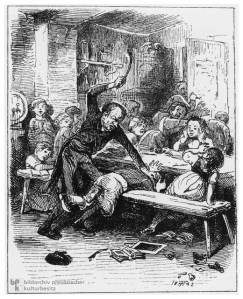
Do you get the feeling the bad old days are coming back? U.S. economy has returned us to 1930s-style levels of unemployment, evil Republicans like Paul Ryan and Mitch McConnell are trying to recreate the poverty of those years by removing the social safety net, and Republicans are working as hard as they can to make sure women have no control over their bodies or their lives.
Now we have students of a Catholic school in New Orleans and their parents demanding Archbishop Gregory Aymond reverse his decision to end corporal punishment, and school alumni aresuing the educational consultant who recommended the policy change!
Can this really be the 21st Century?
From yesterday’s New Orleans Times-Picayune:
The controversy over corporal punishment at St. Augustine High School resurfaced Tuesday when several alumni sued a consultant [read the suit here (pdf)] who advised Archbishop Gregory Aymond that St. Augustine students had been injured by paddling.
The claim isn’t true, the alumni said.
For months Aymond, who as archbishop exerts some control over the Catholic school, has sought to end St. Augustine’s decades-old practice of paddling students. He has said it is not consistent with Catholic values.
But backers of corporal punishment, who include St. Augustine administrators, parents and alumni, say it is part of St. Augustine’s formula for success.
According to the story, the consultant, Monica Applewhite, convinced the Archbishop to ban paddling of students against the decision of the review committee.
In late 2009 Aymond asked Monica Applewhite, described as a educational safety consultant based in Austin, Texas, to look into discipline at St. Augustine.
As Aymond’s representative, Applewhite sat in on St. Augustine’s internal review of its corporal punishment policy. The review committee elected to continue the policy, with modifications.
But the lawsuit says that Applewhite privately advised Aymond that she learned during her inquiry that parents had taken three students to the hospital after paddling, and that others had been paddled “day after day and more than 5 or 6 times a day.”
Archbishop Aymond says he has been contacted by former students and parents of students who were injured by corporal punishment in the school. He made this statement at a news conference today:
“I feel it necessary at this time to share that since the issue of paddling at St. Augustine has become public, I have been contacted both in writing and in person by individuals and parents of individual students who were injured as a result of being paddled at school,” Aymond said in a statement. “Those who have shared this information with me have done so in confidence, but at this juncture, the public should know that my concerns over paddling at St. Augustine go beyond Dr. Applewhite’s report to first-hand accounts.”
I also want to point out that paddling at St. Augustine’s is routinely used to discipline students for such shocking infractions as “tardiness, sloppy uniform dress or other minor rules infractions.”
Frankly, I thought that corporal punishment had been eliminated in the U.S. But I was wrong. According to this report on corporal punishment research, paddling is still common in a number of states.
The US Supreme Court decided in 1977 that spanking or paddling by schools is lawful where it has not been explicitly outlawed by local authorities. It is true that the incidence of CP has declined sharply in recent years, but only 31 states (plus D.C. and Puerto Rico) have actually abolished it, either de facto or de jure. CP is still used in the other 19 states, and it remains a fairly common practice in three of them, all in the South: Alabama, Arkansas and Mississippi.
It is also routine, but only in a minority of (often rural or small-town) schools, in five more southern states: Georgia, Louisiana, Oklahoma, Tennessee and Texas.
The latest states to abolish were Delaware, in 2003, after an eight-year gap in which no abolitions took place at state level; Pennsylvania, in 2005; Ohio, in 2009; and now in 2011 New Mexico (documentation in next update). The number of paddlings had already fallen to a low level in these states.
On the other hand, efforts to ban school CP by legislation have failed in 2003 in Wyoming and repeatedly in Missouri, and also in North Carolina in 2007 and Louisiana in 2009.
The New York Times had a story about corporal punishment in September 2006. This chart was published with the article.
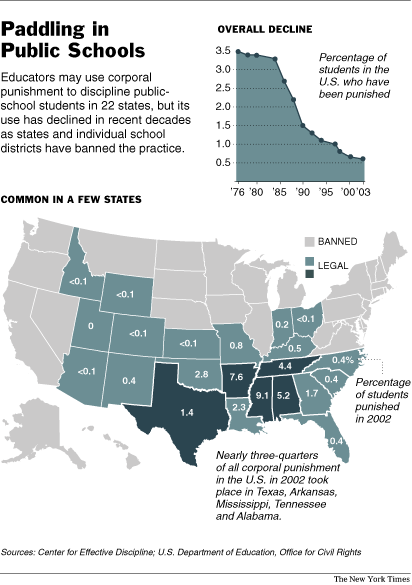
The pattern suggests that corporal punishment is more accepted in southern states and red states. Perhaps there is something to notion that Republicans and conservatives generally tend toward authoritarianism.
In my opinion, paddling is child abuse and should be illegal. Furthermore, I think children have rights just like adults do. I guess if the Supreme Court disagrees with me, our only hope is for sanity in state legislatures. Good luck with that.
Thanks to Dakinikat for alerting me to this story.
Saturday: Big Easy Reads
Posted: May 7, 2011 Filed under: morning reads | Tags: BP oil spill, Climate change, disaster capitalism, dispersants, Gulf coast, Louisiana, New Orleans 28 CommentsMorning, news junkies.
I’m going to start this Saturday with my history pick first:
La Nouvelle-Orléans (New Orleans) was founded May 7, 1718, by the French Mississippi Company, under the direction of Jean-Baptiste Le Moyne de Bienville, on land inhabited by the Chitimacha.








Click thumbnails for HQ views at pompo.com. Photography by Alfonso Bresciani.
I know we’ve had the perfunctory “Gulf oil spill: one year later” press coverage over the last few weeks, but since today marks the anniversary of New Orleans’ founding, I thought it would be prudent to take time out to dig deeper and get beyond the soundbytes. So this Saturday’s link dump is going to focus exclusively on the Gulf.
So how are NOLA and the Gulf Coast really doing?
Vanity Fair has posted a web exclusive from New Orleans-based photographer and CBS-affiliate videographer Jackson Fager, documenting the faces of shrimpers, fisherman, and oysterman along LA’s coastline, many of whom had their livelihoods snatched from them when the oil spill struck. Please check out Fager’s observations, thoughts, and photos. Here are the faces of the two women included in his slideshow (click for HQ and descriptions at the VF site):


Next up, from an interview (posted April 27th) with an environmental justice organizer with the Sierra Club:
BETWEEN THE LINES: And the Vessels of Opportunity, that was what BP set up to hire local fisher folks to clean up the spill, right?
DARRYL MALEK-WILEY: Right, that was funded by BP to hire people to go out and do clean-up work. A number of problems with that…No. 1, the Louisiana Environmental Action Network actually purchased safety gear and gave it to a number of fishermen to wear — respirators and things like that — because the environmental community knew about the dangers of the health impacts. And BP basically told fishermen and Vessels of Opportunity that if they wore the protective gear, they would no longer be working for BP.
In the interview, Malek-Wiley discusses a new organization called GO FISH (Gulf-Organized Fisheries in Solidarity and Hope), which is mobilizing fishermen and their families all the way from Alabama to Texas to fight for fair compensation from BP. Here’s what Malek-Wiley says these fishermen on the frontlines have to say about the official government spin that the oil has mostly disappeared:
DARRYL MALEK-WILEY: Yeah, what they say is that the oil is still here. We see it daily…tar balls are washing up all along the Gulf Coast. Just the way the winds blow…in the wintertime, the wind blows offshore so it’s blowing out into the Gulf; in the summertime we start getting southern winds blowing stuff back on shore. So we’re starting seeing tar balls come in; some of the oil come in. Because all the dispersant did was put it on the bottom of the Gulf, and so we’re starting to see some of that oil and dispersant coming back up and impacting a number of different coastal areas.
And, on dispersant:
DARRYL MALEK-WILEY: There is still a wide range of opinion. You know, the environmental community and fishermen basically agree that the use of dispersants without the needed scientific data on the long-term impacts of the stuff was not a smart thing. One point eight million gallons of dispersants into the Gulf of Mexico — nobody’s ever put that amount of dispersant anywhere in the world, so we don’t know what the impact of that is going to be. Some of the people who are sick, they’re taking samples of their blood and they’re finding the chemicals that make up the dispersants in their blood, as well as Louisiana sweet crude, and having serious health impacts.
Check out the rest of the interview to read more about those serious health impacts. It’s rather alarming, especially when you consider we’re talking about a population that has been out of work and lost their health insurance.
Dispersants: Questions remain
Last week the FDA declared seafood safe in Barataria, the coastal area hardest hit by the BP oil spill. The Miami Herald/AP article at the link says that means 99% of LA’s waters are open for fishing. The only meat I eat is seafood, and down along the Gulf we’ve gotten repeated “assurances” that our food supply isn’t tainted, but even all the way here in Houston a local chef who serves seafood still has unresolved concerns about dispersants:
“The thing that scares me the most about the oil situation is the dispersants, and from everybody that I talked to — from scientists to fisherman that’s the one thing that sit there and they hold onto,” he said.
Government scientists say their tests show no trace of any oil or dispersant in any seafood. They say the dispersant breaks down faster than oil in the water. NOAA says dispersant is simply not a concern, and for now, Caswell says he believes them.
“I eat it,” he said.
I eat it too, though I have cut back and still find myself wondering whether our public and private institutions are leveling with us on just how much they don’t know about the long-term impact of having these chemicals in our ecosystem and food supply and how far the reach of these effects might be. How many people have to get sick before they’ll admit anything?
Take for example this report out of Raceland, LA on fisherman Brandon Cassanova, who has mysteriously fallen ill, possibly due to exposure to dispersants. For months, Cassanova has been experiencing seizures, abdominal pain, memory loss, racing heartbeat, and elevated blood sugar, and his symptoms appear to be getting more acute. His lifelong primary-care physician, Dr. Mike Robichaux, believes Cassanova’s illness matches a “bizarre cluster” of symptoms experienced by people who say they have been exposed to dispersants and other toxins related to the oil spill. Robichaux, a former state senator and longtime advocate for locals exposed to pollutants, has written to Sen. Landrieu and others demanding the government for answers. He isn’t buying the line that the Gulf seafood is safe to eat, either.
While formal data collection by the LA Dept. of Health & Hospitals and long-term NIEHS research are underway, the task of proving causality between exposure and symptoms remains a hurdle. According to Tulane’s Dr. Luann White, most of the cases being reported are of a short-term and mild nature and dilution by the Gulf waters makes detecting chemicals and pathway of exposure to the public difficult. Anecdotally, however, Lafayette-based toxicologist Wilma Subra–who researched the chemistry of dispersants and came up with a list of possible effects–says she’s seen 600-700 people exhibiting this cluster of symptoms after being exposed to dispersants and crude, and that each of these cases seems to know of yet others going through the same thing.
A Thought Experiment on the Gulf Coast
This next one is interesting food for thought. Via geekosystem: What if the Gulf Oil Spill Never Happened? It’s a 2-minute animation clip by Chris Harmon, entitled Oil’d…please give it a look if you haven’t seen it yet:
Vodpod videos no longer available.
The Gulf Coast Oil Spill and Climate Change
I want to touch on the impact of the spill in terms of the broader environmental challenges for the Gulf…it seems like disaster capitalism struck this region and went into overdrive right at the time when it was most vulnerable and needed improvements in infrastructure and conservationist attention more than ever. Funny timing, that.
Over at Greenanswers.com, Chelsea Cooley paints a bleak picture with this headline… Last Days of Louisiana’s Bayous:
The 2010 BP Oil spill in the Gulf of Mexico harmed Louisiana’s coastal eco-system in some obvious ways and in many other ways yet undiscovered. One unsettling truth is that the diminishing state of the wetlands actually aided the widespread effects of the oil spill, as the wetlands might otherwise have provided a protective barrier, preventing oil seepage into the bayous’ central regions. Barataria Bay, for example, a popular nesting ground for Louisiana’s pelicans, was one of the areas most polluted by the spill. The crisis compounded problems faced by an already delicate ecosystem.
However, the wetlands are also suffering due to a dramatic rise in sea-level associated with Global Warming. According to one professor of earth science from Tulane University, the sea-level rise in the Gulf Coast is occurring at a rate five times faster than it did in the 1000 years preceding the Industrial Revolution. The implications of human activity are on the table for all to see.
Also take a look at this SciAm/Reuters headline the other day that Dakinikat passed along to me… Seas Could Rise Up to 1.6 meters by 2100:
OSLO (Reuters) – Quickening climate change in the Arctic including a thaw of Greenland’s ice could raise world sea levels by up to 1.6 meters by 2100, an international report showed on Tuesday.
Such a rise — above most past scientific estimates — would add to threats to coasts from Bangladesh to Florida, low-lying Pacific islands and cities from London to Shanghai. It would also, for instance, raise costs of building tsunami barriers in Japan.
“The past six years (until 2010) have been the warmest period ever recorded in the Arctic,” according to the Oslo-based Arctic Monitoring and Assessment Programme (AMAP), which is backed by the eight-nation Arctic Council.
And, this piece at Huffpo brings it altogether. Pre-Spill, Coastal Threats Cannot Be Ignored, Environmentalists Say…It’s breathtaking to read the entire piece and the extent of the challenges the Gulf region is up against. I’m just going to quote a few snippets:
Dr. Virginia Burkett, senior science advisor for Climate and Land Use Change at the U.S. Geological Survey, said the spill contributed to Louisiana’s wetlands loss, which was already well underway because of multiple stressors. And, she said, a year after BP’s rig explosion, cumulative effects of climate change and the spill are still poorly understood. Climate change itself, however, has been well studied.
[…]
Louisiana is in the grip of global, environmental change. “Temperatures and ocean waters are rising because of increased greenhouse or heat-trapping gases, like carbon monoxide, in the atmosphere,” Burkett said. “Glacial mass and annual snowcover are declining more rapidly than many scientists had predicted.” Ocean temperatures and acidity are increasing, and rainfall volume has grown. But spacing between rain events has expanded so droughts are more frequent in some regions of the world, she said. And in several ocean basins around the globe, hurricanes have become more intense.
As much as our government tries to pretend like the oil that gushed out into the Gulf last year just disappeared, they cannot wipe away the consequences of the larger pattern of environmental destruction that the BP oil spill has contributed to in the area. The spill last year wasn’t the first domino to fall, and it won’t be the last:
Burkett said events that hastened coastal erosion in recent decades won’t be the last.”When I was a child, Hurricane Camille was the big benchmark event, then it was Katrina.” And in the current decade, the Gulf oil spill is the gorilla.
What can we do?
Burkett offers these suggestions:
“Barrier islands and wetlands can be restored for hurricane protection,” Burkett said. “River sediment can be used to build marsh, instead of letting sediment wash out to sea.” Preparations can be made for more intense drought and wildfires.
“Home owners and communities can elevate houses, and cities can adapt infrastructure to the rising sea. In some areas, however, retreat may be the most effective option.” Her parents, for example, moved inland when they lost their home in Biloxi, MS to Hurricane Katrina.
So how much ‘ruin there is left in a nation’ may very well depend on just how much ‘retreat’ there is in it.
And, our ability to retreat depends on us even knowing we’re in danger in the first place. We saw the failures to get people out in time during Katrina and the several weeks it took for the current Administration to really respond to the BP oil spill, but what about the mini-disasters that build up cumulative damage yet go virtually unnoticed, leaving people unaware of the true extent of the daily threat they’re up against and how unsustainable their living spaces are becoming. Wired.com had a really interesting read recently on what can be done to better track crude leaking into the Gulf using satellite imagery… Gulf Oil Shouldn’t Spill Beneath the Radar:
A year after the Deepwater Horizon blowout sent 200 million gallons of crude oil into the Gulf of Mexico, smaller leaks still bubble across the Gulf — but unlike big spills, they’re largely ignored.
A nonprofit organization called SkyTruth, which uses public and commercial satellite imagery to assess environmental damage, recently added airplanes and ships to its Gulf monitoring. But the group can still investigate just a tiny fraction of spills and leaks that may be reported, underreported or not reported at all by oil companies.
SkyTruth founder John Amos, a geologist and a former oil-company research scientist, thinks roughly $3 million per year could buy the necessary data and provide the first continuous, accurate assessment of Gulf oil pollution.
“The oil industry has done a great job convincing the public that modern drilling pollution is nonexistent. But we’ve discovered wells damaged by hurricanes in 2005 that are still leaking,” said Amos, who may have caught an oil company grossly under-reporting one of its leaks. “We have some tools available to do investigations, but in many cases it’s just not enough. For smaller spills, we need an up-close look from satellite imagery.”
On the proactive side of things, over here at Houston’s Reliant Center, the Offshore Technology Conference this past week has yielded some interesting results:
A possible tool for preventing oil spills like last year’s Gulf disaster arrived on the floor of Houston’s Reliant Center this week, courtesy of an auto industry refugee and a jackknife can opener.
The Latest Threat
As mentioned earlier, the BP oil spill isn’t the first or last threat the area is facing. Here’s the latest trouble, via the Daily Comet… Flood will deal blow to struggling oystermen.
Via the Sun Herald… Another slam for the Gulf:
GULFPORT — The U.S. Army Corps of Engineers plans to open the Bonnet Carre Spillway on Monday, sending a flood of fresh water through Lake Pontchartrain, through a strait and into the Gulf.
It’s something officials don’t do often, because of the effect it has on the marine life and the Mississippi Sound.
But the Mississippi River — already high at 1.6 million cubic feet per second flowing past Natchez — is expected to increase to 2.45 million cubic feet per second by May 22.
Knowing that volume is coming down the river, opening the Bonnet Carre is an attempt to divert some of it before it gets to New Orleans.
But scientists who study marine life in the Gulf cringe.
“It will change things, that’s for sure,” said Bill Hawkins, director of USM’s Gulf Coast Research Lab. But how much change depends on the volume and duration of the diversion.
Jay Alford has more — The Coming Waters (h/t Dakinikat):
There’s more water on the upper Mississippi River right now than any time in history, period, in any time in history,” said Garrett Graves, chairman of the Coastal Protection and Restoration Authority. “This overwhelms the volume of water that was in the river in 1927, 1937, 1997, 2008. An extraordinary flow is coming down the river.”
That water levels are expected to be above crest for seven to 10 days doesn’t inspire much confidence. Graves said there are “vulnerabilities everywhere from the levees in Baton Rouge to the levees in south Louisiana.”
Final Thought
I’ll close with the WSJ’s review this Saturday, of Rowan Jacobsen’s Shadows on the Gulf: A Journey Through Our Last Great Wetland.
The headline says a lot in itself… A Gulf Requiem:
Click to view on Amazon.
“Most of the Gulf Coast has not been touched by the oil spill,” Mr. Jacobsen reports, “and is beautiful and vital as ever.”
Yet these early avowals of glass-half-fullism notwithstanding, it’s hard not to hear the mournful sounds of a pipe organ on nearly every page. And you have to wonder why all the people—oystermen, oilmen, shrimpers, tourists—are so grim-faced, as if shuffling past what appears to be a Gulf-sized casket.

It’s a true shame that we’d let an area that is one of our national treasures become a laboratory for climate change and disaster capitalism in this fashion. Take a good look, because what’s happening to the Southern Louisiana area and the rest of the Gulf is foreshadowing of the rest of our country’s future, if the interests of profit continue to be put before people, unabated, and people get pushed off further to the margins of the margins.
Wouldn’t it have been nice if our president would have responded to the death of OBL by using the new presidential force behind the bully pulpit to restore our attention to the Gulf Coast and all that has been neglected over the past decade… too bad any reminder of the Gulf and the struggles of ordinary people conflicts with the fierce urgency of Obama’s permanent campaign.
[originally posted at Let Them Listen; crossposted at Taylor Marsh and Liberal Rapture]

 peej
peej Carissa
 bostonboomer
 dakinikat
 ecocatwoman
 mablue2
 Mama Lopez
 peggysue22
 quixote
 skydancingguestblogger
 Mona (aka Wonk the Vote)



 Sky Dancing
Recent Comments