
Tuesday Reads: Nightmare on Capitol Hill
Posted: October 15, 2013 Filed under: Barack Obama, morning reads, Republican politics, U.S. Economy, U.S. Politics | Tags: Congress, Debt Ceiling, government shutdown, Harry Reid, Mitch McConnell, Paul Ryan, Tea Party, Ted Cruz 51 Comments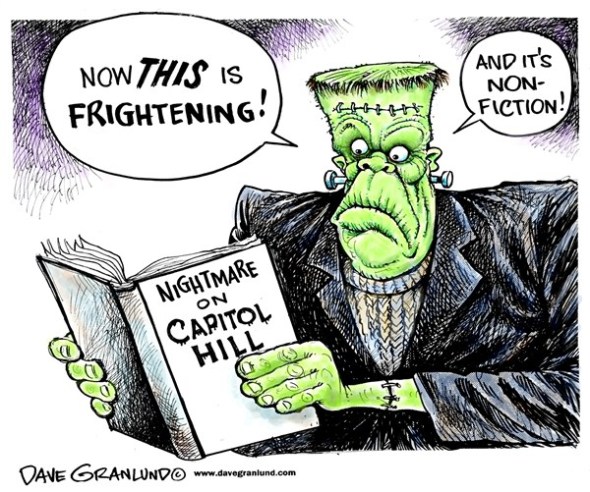
Good Morning!!
Yes, it’s real–too real. We’re approaching the deadline for raising the debt ceiling–it’s Thursday–and Congress is still dithering. But it looks like they may figure out a way to kick the can down the road again, as long as Ted Cruz doesn’t decide to have another tantrum.
According to the Hill this morning, Harry Reid and Mitch McConnell are close to agreeing on “a deal” to reopen the government and raise the debt ceiling for a few more months. The two Senate leaders huddled for hours yesterday trying to put together some kind of package that would satisfy House Republicans and convince them not to bring down the U.S. Government and the global economy.
An emerging deal to reopen the government and raise the nation’s debt ceiling until February gathered political momentum Monday evening after Senate Republicans signaled they would likely support it.
Lawmakers and aides said the legislation would fund the government until Jan. 15 and extend the nation’s borrowing authority until February but leave ObamaCare largely untouched.
The agreement would also set up another “supercommittee” to try to deal with the next round of automatic sequester cuts. The committee would have until December 13 to report to Congress. Anyone who thinks they’ll agree on anything, please raise your hand.
The big question is whether a package to fund the government and raise the debt ceiling can pass muster in the House.
Speaker John Boehner (R-Ohio) was briefed on the deal Monday, and members of his conference were taking a wait and see attitude.
“When we see it, we’ll know what it is. Do you know what it is yet?” Rep. Pete Sessions (R-Texas), chairman of the House Rules Committee, asked reporters as he left Boehner’s office.
“As soon as we see something in writing, then we can understand how we can thoughtfully understand what we’ll do with it,” Sessions said.
House Majority Leader Eric Cantor (R-Va.) wouldn’t comment on the emerging Senate deal, but he told reporters House Republicans will meet Tuesday morning “to discuss a way forward.” “Possible consideration of legislation related to the debt limit” was added to Cantor’s daily House schedule for Tuesday.

Of course the biggest potential fly in the ointment is Texas junior Senator Ted Cruz and his gang of Tea Party House members. Cruz wouldn’t say whether he’s planning another fake filibuster or some other effort to kill the Affordable Care Act. However, Cruz did hold a secret meeting with House Republicans last night, according to Roll Call.
Sen. Ted Cruz met with roughly 15 to 20 House Republicans for around two hours late Monday night at the Capitol Hill watering hole Tortilla Coast.
The group appeared to be talking strategy about how they should respond to a tentative Senate deal to reopen the government and raise the debt ceiling without addressing Obamacare in a substantive way, according to sources who witnessed the gathering. The Texas Republican senator and many of the House Republicans in attendance had insisted on including amendments aimed at dismantling Obamacare in the continuing resolution that was intended to avert the current shutdown.
Sources said the House Republicans meeting in the basement of Tortilla Coast with Cruz were some of the most conservative in the House: Reps. Louie Gohmert of Texas, Steve King of Iowa, Jim Jordan of Ohio, Tom Cotton of Arkansas, Raúl R. Labrador of Idaho, Steve Southerland II of Florida, Mark Meadows of North Carolina and Justin Amash of Michigan.
The group is a collection of members who have often given leadership headaches in recent years by opposing both compromise measures as well as packages crafted by fellow Republicans….While the emerging deal to reopen the government and hike the debt ceiling increase may have been a hot topic, it was not immediately clear what the group actually discussed. But the fact that such a group met with Cruz at all could give House GOP leaders even more heartburn as they consider themselves what to do if the Senate passes the measure.
If Cruz and his buddies decide to cause more trouble, they could bring about a default by dragging the fight out until after Thursday. Treasury Secretary Jack Lew could probably keep the U.S. afloat for a few more days, but it would be touch and go. Joshua Green wrote yesterday at Bloomberg Businessweek that “Ted Cruz Could Force a Debt Default All by Himself.”
How could this happen? Because the Senate can move quickly when necessary, but only by unanimous consent. Let’s say Harry Reid (D-Nev.) and Mitch McConnell (R-Ky.) strike a deal today (that’s looking unlikely). Cruz surely won’t like it and has said repeatedly, “I will do everything necessary and anything possible to defund Obamacare.” If he’s true to his word, he could drag out the proceedings past Thursday and possibly well beyond. “If a determined band of nut jobs wants to take down the global economy, they could do it,” says Jim Manley, a former top staffer for Reid. “Under Senate rules, we are past the point of no return—there’s not anything Reid or McConnell could do about it.”
If Cruz is truly determined to block or delay any deal that does not touch Obamacare, here’s how he’d do it: The hypothetical Reid/McConnell bill would probably be introduced as an amendment to the “clean” debt-ceiling raise that Democrats introduced—and Republicans defeated—last week. Reid voted against cloture on the motion to proceed to that bill, a procedural tactic that allows him to reconsider the bill later on. Let’s say he does so by 5 p.m. Monday. There would need to be a cloture vote on the motion to proceed. Cruz would dissent, but he wouldn’t be able to round up 41 votes for a filibuster….
The real killer is that Senate rules stipulate there must be 30 hours of post-cloture debate, unless senators agree unanimously to waive it. Reid and McConnell would want unanimous consent to move quickly, but Cruz could refuse, thereby forcing 30 hours of debate. This would drag things out until Tuesday at 11:30 p.m. Then there would be a vote on the motion to proceed (requiring a simple majority), followed by an intervening day, assuming Cruz withheld his consent to vote earlier. So now we’re looking at a Thursday cloture vote on the bill itself, followed by another 30 hours of post-cloture debate that would blow right past the Treasury deadline.

Let’s hope even Cruz isn’t that delusional and foolhardy. Booman also points out that the Senate can change the rules and limit post-cloture debate for this one vote. That takes 67 votes.
At The Daily Beast, Lloyd Green calls what Cruz and other Tea Party Republicans are doing “backdoor impeachment.”
The dance over the debt ceiling and the fight over the government shutdown are nothing less than impeachment on the cheap: a chance to negate the will of the majority by ostensibly placating the letter of the law. Unable to win the last two presidential elections or to persuade a Supreme Court majority that the Affordable Care Act was unconstitutional, House Republicans have arrived at a point where default and closure are the next best things. This combustible brew of race, class, and economic anxieties bubbles all too closely to the surface.
These days, the GOP comes across as hating Obamacare more than loving their countrymen, and the nation is returning that ire (PDF). Less than a quarter of Americans view the Republicans favorably, and a majority dislikes them, three-in-10 intensely. The GOP’s goal of recapturing the Senate in 2014 is now looking more like a dream than a reality, as Republicans are “forced to explain why they are not to blame and why Americans should trust them to govern both houses of Congress when the one they do run is in such disarray.” Indeed.
Unfortunately, the calamity of a potential default has tempered neither judgment nor passion. On Saturday, Ted Cruz—the man who lit the match, won the Values Voters Straw Poll with 42 percent of the vote. Channeling her inner Glenn Beck, Rep. Michele Bachmann (R-Minn.) concluded that the President “committed impeachable offenses.” Bachmann also proclaimed that civil disobedience was a potential response to Obama’s “thuggery,” and compared the Obama presidency to Egypt’s deposed Muslim Brotherhood.
I hope you’ll read the rest at the link.
Ted Cruz is stealing the right wing nut show for now, but in the House Paul Ryan raised his ugly head over the weekend to complain about the ACA’s individual mandate and requirement that women have access to birth control. From HuffPo:
Sources told the Post that, in a private meeting with House Republicans, Ryan said that by kicking the can down the road, the GOP would lose “leverage” in their fight against Obamacare.
Ryan’s main concern appears to be delaying the health care law’s individual mandate, but ThinkProgress points out that Ryan also emphasized the need to give employers the ability to deny birth control coverage based on moral or religious reasons.
Meanwhile most people around the country and even on Wall Street don’t seem all that concerned about what’s happening in Washington DC. I guess that after multiple emergencies in which political leaders “cried wolf,” everyone just assumes that Congress will find some way to keep the country going. Still, is this any way to run a country? Shouldn’t citizens be up in arms? Will Durst has a wacky column about this at Cagle Post called “Fukushima Sushi.”
Which is harder to believe? The ludicrous shenanigans going down in Washington or the fact that nobody seems particularly interested in doing anything about them? Good neighbors — it looks like we got ourselves one heck of a bumper crop of official dysfunction this year. Near as high as Manute Bol’s eye.
You’d think with national parks closed, veteran’s benefits being withheld and a possible catastrophic debt ceiling crisis looming, folks would be atwitter like chicken inspectors on a rotisserie spit during a power surge. And you’d be as wrong as a Bergman film on Comedy Central.
What the country seems to be seeking here is a little something called political responsibility. Which, in these dark days, is a wee bit of a tad of a total and complete oxymoron. Real similar to saying Fukushima sushi. Or elegant squalor. Comfortable rock.
Driving the point home: Weird normality. Spherical edge. Iron kite. Freedom shackle. Fresh detritus. Flammable sleet. Placid hammer. Colossal shrimp. Diminutive giant. Formal jeans. Sensitive linebacker. Salable autonomy. Veteran rookie. Vegetarian butcher. Pork tartare. Reality TV.
Keeping it real: Precarious certainty. Serene devastation. Bitter honey. Catholic condom. Heaven’s basement. Gelatinous needle. Sadistic lover. Banker’s compassion. Macabre solace. Chaste indiscretion. Temporary tax. Restorative annihilation. Healthy fries. Unhungry shark.
Lots more oxymoron’s at the link. How he came up with so many, I’ll never know.
Now what stories are you focusing on today? Please share your links on any topic in the comments.
Tuesday Reads: Rachel and Trayvon, Reid Going Nuclear, Spy Stories, and Much More
Posted: July 16, 2013 Filed under: Civil Liberties, Civil Rights, Crime, Criminal Justice System, Foreign Affairs, Lebanon, morning reads, NSA, National Security Agency, Political Affective Disorder, racism, Russia, U.S. Politics | Tags: al Qaida, Alexei Nikitin, Amnesty International, Charles Ramsey, Edward Snowden, Filibuster, George Zimmerman, Harry Reid, Hezbollah, Human Rights Watch, Mitch McConnell, NSA, nuclear option, Piers Morgan, political asylum, Rachel Jeantel, Tanya Lokshina, Trayvon Martin, US Senate, Vladimir Putin 42 Comments
Good Morning!!
I’m not sure if it’s the heat or the depressing news, but I’m having a hard time getting going this morning.
We’re into our third heat wave of the summer, and I’m actually getting acclimated to 90 degree weather; but I suppose it still has an effect on my body and mind.
I’m also somewhat depressed about the Zimmerman verdict and by the often ignorant reactions I see on-line and on TV.
Rachel and Trayvon
One bright spot in the coverage for me was Rachel Jeantel’s interview with Piers Morgan last night. She was real and authentic, and Morgan pretty much stayed out of the way and let her talk. I think she made a real impression on him and the reaction from the live audience was very positive too. It was refreshing. IMO, it says a lot about Travon Martin’s character that he had a friend like Rachel. I’m going to post the whole interview here in case you missed it or you want to watch it again.
From Mediaite:
Asked about what Trayvon Martin was like as a friend, Jeantel described him as a “calm, chill, loving person” and said she never saw him get “aggressive” or “lose his temper.” She said that the defense’s attempts to portray Martin as a “thug” were unfounded and defended his relatively mild drug use. “Weed don’t make him go crazy,” she said, “it just makes him go hungry.”
Jeantel also responded to the massive mockery she received in social media for the way she speaks, explaining that she was born with an under-bite that has made it difficult for her to speak clearly. When Morgan asked if she’d been bullied for her condition, she simply responded, “Look at me,” to laughter from the studio audience.
Morgan attempted to get Jeantel to offer her opinion of defense attorney Don West, who many claimed was condescending towards her when she was on the stand. Jeantel shook her head, declining to say anything bad about the man given her “Christian” upbringing.
In the second part of his interview with Jeantel, Morgan turned to the “creepy-ass cracker” comment she made and the major impact it had on the tenor of the case. She explained that the term is actually spelled “cracka” and defined it as “people who are acting like they’re police.” She said that if Zimmerman had calmly approached Martin and introduced himself, her friend would have politely said what he was doing there and nothing more would have happened.
Unlike the juror, Jeantel did think Zimmerman was racially motivated. “It was racial,” she said. “Let’s be honest, racial. If Trayvon was white and he had a hoodie on, would that happen?”
I’d also like to recommend this piece by Robin D.G. Kelley at Counterpunch: The US v. Trayvon Martin.
In the aftermath of the Sandy Hook Elementary School massacre, Texas Congressman Louie Gohmert, Virginia Governor Bob McDonnell, Senator Rand Paul, Florida State Representative Dennis Baxley (also sponsor of his state’s Stand Your Ground law), along with a host of other Republicans, argued that had the teachers and administrators been armed, those twenty little kids whose lives Adam Lanza stole would be alive today. Of course, they were parroting the National Rifle Association’s talking points. The NRA and the American Legislative Exchange Council (ALEC), the conservative lobbying group responsible for drafting and pushing “Stand Your Ground” laws across the country, insist that an armed citizenry is the only effective defense against imminent threats, assailants, and predators.
But when George Zimmerman fatally shot Trayvon Martin, an unarmed, teenage pedestrian returning home one rainy February evening from a neighborhood convenience store, the NRA went mute. Neither NRA officials nor the pro-gun wing of the Republican Party argued that had Trayvon Martin been armed, he would be alive today. The basic facts are indisputable: Martin was on his way home when Zimmerman began to follow him—first in his SUV, and then on foot. Zimmerman told the police he had been following this “suspicious-looking” young man. Martin knew he was being followed and told his friend, Rachel Jeantel, that the man might be some kind of sexual predator. At some point, Martin and Zimmerman confronted each other, a fight ensued, and in the struggle Zimmerman shot and killed Martin.
Zimmerman pursued Martin. This is a fact. Martin could have run, I suppose, but every black man knows that unless you’re on a field, a track, or a basketball court, running is suspicious and could get you a bullet in the back. The other option was to ask this stranger what he was doing, but confrontations can also be dangerous—especially without witnesses and without a weapon besides a cell phone and his fists. Florida law did not require Martin to retreat, though it is not clear if he had tried to retreat. He did know he was in imminent danger.
Why didn’t Trayvon have a right to stand his ground? Why didn’t his fear for his safety matter? We need to answer these questions as a society. Please read the whole article if you can.
Read the rest of this entry »
McConnell Campaign Strategy Session Was Taped From Hallway
Posted: April 11, 2013 Filed under: open thread, Republican politics, U.S. Politics | Tags: Ashley Judd, Mitch McConnell, oppo-research, Progress Kentucky 17 Comments
POST UPDATED (See end)
The FBI can stand down now. The “mystery” surrounding the alleged “bugging” of Mitch McConnell’s oppo-research meeting is solved. Via TPM, WFPL News reports:
A secret recording of a campaign strategy session between U.S. Senator Mitch McConnell and his advisors was taped by leaders of the Progress Kentucky super PAC, says a longtime local Democratic operative.
Mother Jones Magazine released the tape this week. The meeting itself took place on Feb. 2.
Jacob Conway, who is on the executive committee of the Jefferson County Democratic Party, says that day, Shawn Reilly and Curtis Morrison, who founded and volunteered for Progress Kentucky, respectively, bragged to him about how they recorded the meeting.
Conway says neither the local nor the state Democratic party had any part in the incident.
Instead of wasting the FBI’s time, McConnell might want to invest in some soundproofing for his Kentucky campaign headquarters.
Morrison and Reilly did not attend the open house, but they told Conway they arrived later and were able to hear the meeting from the hallway.
“They were in the hallway after the, I guess after the celebration and hoopla ended, apparently these people broke for lunch and had a strategy meeting, which is, in every campaign I’ve been affiliated with, makes perfect sense,” says Conway. “One of them held the elevator, the other one did the recording and they left. That was what they told to me from them directly.”
The meeting room door is next to the elevators on that floor. McConnell campaign manager Jesse Benton has told multiple media outlets the door was shut and locked on Feb. 2. But the door has a vent at the bottom and a large gap underneath….if the conversation was audible from a hallway, it’s disputable whether recording qualifies as eavesdropping.
And perhaps McConnell’s campaign manager Jesse Benton might want to tone down his public statements just a tiny bit. From Mother Jones:
A day after Mother Jones published audio of a Louisville meeting in which Sen. Mitch McConnell (R-KY) and his campaign staff discussed opposition research on prospective challengers, McConnell campaign manager Jesse Benton has validated Godwin’s law by playing the Hitler card. In an interview with NBC News, Benton compared the leaking of the recording to Nazi Germany. “This is Gestapo-kind of scare tactics, and we’re not going to stand for it,” Benton told Michael O’Brien.
The Gestapo, who served as Hitler’s secret police from 1933 until 1945, were best known for enforcing a reign of terror typified by abductions and executions, as well as aiding and abetting genocide. That’s all quite a bit different than recording 12 minutes of a political strategy session or publishing a legally-obtained tape.
And there’s no evidence that the audio was the result, as the McConnell campaign has insisted, of a Watergate-style bugging operation. Still, that hasn’t stopped McConnell from taking the opportunity to play the victim, blasting out a fundraising pitch accusing the “liberal media” of “illegal and underhanded tactics.”
In other news, Mother Jones reports that
Citizens for Responsibility and Ethics in Washington (CREW), a nonprofit government watchdog, has asked the Senate ethics committee and the Federal Bureau of Investigationto probe whether aides to Senate Minority Leader Mitch McConnell improperly conducted political opposition research on federal government time.
A tape of a February McConnell campaign meeting that Mother Jones released Tuesdayincludes a section in which a McConnell aide states that McConnell’s “LAs”—congressional parlance for legislative assistants—helped gather background information on Ashley Judd, who was at the time considered a potential opponent in McConnell’s 2014 reelection race. The tape also refers to a “Josh” who worked on the research, which CREW’s complaint speculates might be Josh Holmes, McConnell’s congressional chief of staff.
Senate ethics rules forbid legislative assistants and other Senate employees from participating in political activities on government time. “In general, however, the ethics rules do not bar staffers from engaging in campaign activity provided they do it on their own time and do not involve government resources or property,” Tara Malloy, a government ethics expert at the Campaign Legal Center, told Mother Jones on Tuesday. You can read the relevant section of the ethics rules here. Bottom line: If McConnell’s aides did the research in their free time, they’re in the clear. But if they used government resources or worked on political matters on government time, they could be in trouble.
Bwwwwaaaaaaaaaaahahahahahahahahahahaha!!
This is an open thread.
UPDATE
More is coming out on this story. TPM reports:
Progress Kentucky Co-Founder Denies Taping McConnell Meeting
The co-founder of Progress Kentucky, a liberal group accused of recording a private strategy session by aides of Senate Minority Leader Mitch McConell on the potential candidacy of actress Ashley Judd, has denied doing so, at least according to Joe Arnold, a political editor for the local TV station WHAS11.
Democratic Official Now Talking To FBI About Progress Kentucky
The county Democratic Party official who outed two Democratic super PAC operatives in the Mitch McConnell secret tape case has been contacted by the FBI.
Jacob Conway, who sits on the executive committee of the Jefferson County, Ky. Democratic Party, told TPM on Thursday that he was going in to be interviewed at the bureau’s Louisville, Ky. office….
According to Conway, the FBI contacted him only after a local NPR station published its story in which Conway claimed that two local activists from the group Progress Kentucky, Shawn Reilly and Curtis Morrison, had admitted to him that they were the source of the recordings published by Mother Jones earlier this week.
Erik Wemple posted yesterday on the legal issues related to David Corn receiving the tape of McConnell and aides: How did Mother Jones obtain McConnell tape?
I’ll post any further updates in the comments to this post.
Tuesday Reads: Margaret Thatcher’s “Dark Legacy,” Death of a Feminist Revolutionary, and Mitch McConnell’s Ugly Plans
Posted: April 9, 2013 Filed under: morning reads, U.S. Politics, War on Women, Women's Rights | Tags: Andrew Sullivan, Ashley Judd, austerity, David Corn, feminist history, Margaret Thatcher, Mitch McConnell, Poverty, Shulamith Firestone, Susan Faludi 33 Comments
Good Morning!!
The death of Margaret Thatcher is still dominating the news this morning. It seems she was one of those public figures that inspired varied but passionate reactions–you either loved her or hated her.
Andrew Sullivan loved her it seems.
I was a teenage Thatcherite, an uber-politics nerd who loved her for her utter lack of apology for who she was. I sensed in her, as others did, a final rebuke to the collectivist, egalitarian oppression of the individual produced by socialism and the stultifying privileges and caste identities of the class system. And part of that identity – the part no one ever truly gave her credit for – was her gender. She came from a small grocer’s shop in a northern town and went on to educate herself in chemistry at Oxford, and then law. To put it mildly, those were not traditional decisions for a young woman with few means in the 1950s. She married a smart businessman, reared two children and forged a political career from scratch in the most male-dominated institution imaginable: the Tory party.
She relished this individualist feminism and wielded it – coining a new and very transitive verb, handbagging, to describe her evisceration of ill-prepared ministers or clueless interviewers. Perhaps in Toynbee’s defense, Thatcher was not a feminist in the left-liberal sense: she never truly reflected on her pioneering role as a female leader; she never appointed a single other woman to her cabinet over eleven years; she was contemptuous toward identity politics; and the only tears she ever deployed (unlike Hillary Clinton) were as she departed from office, ousted by an internal coup, undefeated in any election she had ever run in as party leader.
Her policies “inspired” the revolutionary reactions that created a “cultural transformation.”
Thatcher’s economic liberalization came to culturally transform Britain. Women were empowered by new opportunities; immigrants, especially from South Asia, became engineers of growth; millions owned homes for the first time; the media broke free from union chains and fractured and multiplied in subversive and dynamic ways. Her very draconian posture provoked a punk radicalism in the popular culture that changed a generation. The seeds of today’s multicultural, global London – epitomized by that Olympic ceremony – were sown by Thatcher’s will-power.
And that was why she ultimately failed, as every politician always ultimately does. She wanted to return Britain to the tradition of her thrifty, traditional father; instead she turned it into a country for the likes of her son, a wayward, money-making opportunist. The ripple effect of new money, a new middle class, a new individualism meant that Blair’s re-branded Britain – cool Britannia, with its rave subculture, its fashionistas, its new cuisine, its gay explosion, its street-art, its pop music – was in fact something Blair inherited from Thatcher.
Of course Sullivan no longer lives in Great Britain, and he has the means to avoid the worst effects of the elite’s austerity policies regardless of where he lives. Others aren’t so fortunate.
The Guardian reports: Margaret Thatcher’s death greeted with street parties in Brixton and Glasgow; Crowds shout ‘Maggie Maggie Maggie, dead dead dead’ during impromptu events.
Several hundred people gathered in south London on Monday evening to celebrate Margaret Thatcher‘s death with cans of beer, pints of milk and an impromptu street disco playing the soundtrack to her years in power.
Young and old descended on Brixton, a suburb which weathered two outbreaks of rioting during the Thatcher years. Many expressed jubilation that the leader they loved to hate was no more; others spoke of frustration that her legacy lived on.
To cheers of “Maggie Maggie Maggie, dead dead dead,” posters of Thatcher were held aloft as reggae basslines pounded.
Clive Barger, a 62-year-old adult education tutor, said he had turned out to mark the passing of “one of the vilest abominations of social and economic history”.
He said: “It is a moment to remember. She embodied everything that was so elitist in terms of repressing people who had nothing. She presided over a class war.”
Builder Phil Lewis, 47, a veteran of the 1990 poll tax riots, said he had turned out to recall the political struggles the Thatcher years had embroiled him in. “She ripped the arsehole out of this country and we are still suffering the consequences.”
Just as Ronald Reagan did to the U.S.–and we’re still suffering the consequences.
Here’s a video from Brixton.
Hugo Young, Thatcher biographer, writes in The Guardian: Margaret Thatcher left a dark legacy that has still not disappeared. For Young, a positive was Thatcher’s indifference to her popularity with the public.
I think by far her greatest virtue, in retrospect, is how little she cared if people liked her. She wanted to win, but did not put much faith in the quick smile. She needed followers, as long as they went in her frequently unpopular directions. This is a political style, an aesthetic even, that has disappeared from view. The machinery of modern political management – polls, consulting, focus groups – is deployed mainly to discover what will make a party and politician better liked, or worse, disliked. Though the Thatcher years could also be called the Saatchi years, reaching a new level of presentational sophistication in the annals of British politics, they weren’t about getting the leader liked. Respected, viewed with awe, a conviction politician, but if liking came into it, that was an accident.
But this attitude “didn’t come without a price” and “Thatcher left a dark legacy…”
What happened at the hands of this woman’s indifference to sentiment and good sense in the early 1980s brought unnecessary calamity to the lives of several million people who lost their jobs. It led to riots that nobody needed. More insidiously, it fathered a mood of tolerated harshness. Materialistic individualism was blessed as a virtue, the driver of national success. Everything was justified as long as it made money – and this, too, is still with us.
Thatcherism failed to destroy the welfare state. The lady was too shrewd to try that, and barely succeeded in reducing the share of the national income taken by the public sector. But the sense of community evaporated. There turned out to be no such thing as society, at least in the sense we used to understand it. Whether pushing each other off the road, barging past social rivals, beating up rival soccer fans, or idolising wealth as the only measure of virtue, Brits became more unpleasant to be with. This regrettable transformation was blessed by a leader who probably did not know it was happening because she didn’t care if it happened or not. But it did, and the consequences seem impossible to reverse….
[I]t’s now easier to see the scale of the setback she inflicted on Britain’s idea of its own future. Nations need to know the big picture of where they belong and, coinciding with the Thatcher appearance at the top, clarity had apparently broken through the clouds of historic ambivalence.
At least the British media isn’t trying to canonize Thatcher as the corporate media in the U.S. did to Reagan.
A Less Remarked Upon Death: Shulamith Firestone
At The New Yorker, Susan Faludi pays tribute to a feminist icon of the 1970s, “Death of a Revolutionary: Shulamith Firestone helped to create a new society. But she couldn’t live in it.”
When Shulamith Firestone’s body was found late last August, in her studio apartment on the fifth floor of a tenement walkup on East Tenth Street, she had been dead for some days. She was sixty-seven, and she had battled schizophrenia for decades, surviving on public assistance. There was no food in the apartment, and one theory is that Firestone starved, though no autopsy was conducted, by preference of her Orthodox Jewish family. Such a solitary demise would have been unimaginable to anyone who knew Firestone in the late nineteen-sixties, when she was at the epicenter of the radical-feminist movement, surrounded by some of the same women who, a month after her death, gathered in St. Mark’s Church In-the-Bowery, to pay their respects.
The memorial service verged on radical-feminist revival. Women distributed flyers on consciousness-raising, and displayed copies of texts published by the Redstockings, a New York group that Firestone co-founded. The WBAI radio host Fran Luck called for the Tenth Street studio to be named the Shulamith Firestone Memorial Apartment, and rented “in perpetuity” to “an older and meaningful feminist.” Kathie Sarachild, who had pioneered consciousness-raising and coined the slogan “Sisterhood Is Powerful,” in 1968, proposed convening a Shulamith Firestone Women’s Liberation Memorial Conference on What Is to Be Done. After several calls from the dais to “seize the moment” and “keep it going,” a dozen women decamped to an organizing meeting at Sarachild’s apartment.
I well remember reading Firestone’s book, The Dialectic of Sex: The Case for Feminist Revolution. It was mind-blowing stuff in those days.
In the late nineteen-sixties, Firestone and a small cadre of her “sisters” were at the radical edge of a movement that profoundly changed American society. At the time, women held almost no major elected positions, nearly every prestigious profession was a male preserve, homemaking was women’s highest calling, abortion was virtually illegal, and rape was a stigma to be borne in silence. Feminism had been in the doldrums ever since the first wave of the American women’s movement won the vote, in 1920, and lost the struggle for greater emancipation. Feminist energy was first co-opted by Jazz Age consumerism, then buried in decades of economic depression and war, until the dissatisfactions of postwar women, famously described by Betty Friedan in “The Feminine Mystique” (1963), gave rise to a “second wave” of feminism. The radical feminists emerged alongside a more moderate women’s movement, forged by such groups as the National Organization for Women, founded in 1966 by Friedan, Aileen Hernandez, and others, and championed by such publications as Ms., founded in 1972 by Gloria Steinem and Letty Cottin Pogrebin. That movement sought, as now’s statement of purpose put it, “to bring women into full participation in the mainstream of American society,” largely by means of equal pay and equal representation. The radical feminists, by contrast, wanted to reconceive public life and private life entirely.
What a brilliant tribute by Faludi. It’s well worth the read.
Mother Jones’s David Corn has gotten his hands on a tape of “a private meeting between the Senate GOP leader and campaign aides reveals how far they were willing to go to defeat” Ashley Judd.
On February 2, Mitch McConnell, the Republican leader in the US Senate, opened up his 2014 reelection campaign headquarters in Louisville, Kentucky, and in front of several dozen supporters vowed to “point out” the weaknesses of any opponent fielded by the Democrats. “They want to fight? We’re ready,” he declared. McConnell was serious: Later that day, he was huddling with aides in a private meeting to discuss how to attack his possible Democratic foes, including actor/activist Ashley Judd, who was then contemplating challenging the minority leader. During this strategy session—a recording of which was obtained by Mother Jones—McConnell and his aides considered assaulting Judd for her past struggles with depression and for her religious views….
For much of the Judd discussion, McConnell was silent as aides reviewed the initial oppo research they had collected on Judd and weighed all the ways they could pummel her. The recording was provided to Mother Jones last week by a source who requested anonymity. (The recording can be found here; a transcript is here.) McConnell’s Senate office and his campaign office did not respond to requests for comment.
The aide who led the meeting began his presentation with a touch of glee: “I refer to [Judd] as sort of the oppo research situation where there’s a haystack of needles, just because truly, there’s such a wealth of material.” He ran through the obvious: Judd was a prominent supporter of President Barack Obama, Obamacare, abortion rights, gay marriage, and climate change action. He pointed out that she is “anti-coal.”
But the McConnell gang explored going far beyond Judd’s politics and policy preferences. This included her mental health. The meeting leader noted:
She’s clearly, this sounds extreme, but she is emotionally unbalanced. I mean it’s been documented. Jesse can go in chapter and verse from her autobiography about, you know, she’s suffered some suicidal tendencies. She was hospitalized for 42 days when she had a mental breakdown in the ’90s.
So what? Mitch McConnell is a sick, closeted, hateful old freak who appears to lack any semblance of human feelings.
I’m running out of space, so I’ll add a few more links in the comments. I hope you’ll do the same. What are you reading and blogging about today?
Tuesday Mid-Morning Reads: Immigration Reform, Aaron Swartz Prosecution, and Much More
Posted: January 29, 2013 Filed under: 2014 elections, Barack Obama, morning reads, Republican politics, Tea Party activists, U.S. Politics | Tags: Aaron Swartz, Carmen Ortiz, Harvey Silverglate, immigration reform, Middlesex County (MA) DA, Mitch McConnell, Wikileaks 55 Comments
Good Morning Everyone!!
The media talking heads are going on and on about the supposed “bi-partisan agreement” on Immigration reform. I’m not really clear on what policies have been “agreed” on, but frankly, I’ll believe it when I see it. TPM reports: Gang Of 8’s Path To Citizenship Is Still A Rocky Road.
While reformers are excited that a path to citizenship for illegal immigrants is the centerpiece of the Senate’s new bipartisan immigration deal, it’s still unclear just how accessible that path will be for the undocumented population.
Without the proper components, experts warn the Senate plan could be the beginning of a long process to bringing illegal immigrants fully into American society, one that could take not years but decades.
So what does the process involve?
Under the plan, undocumented immigrants would receive a probationary status if they pass a criminal background check, pay a fine, and pay any back taxes owed to the government. After that, they’d have to wait to apply for permanent residency – a prerequisite to citizenship – until after a series of border security measures go into effect.
None of the new border measures, which will be overseen by a commission of southwestern state officials and community leaders, appear too difficult to implement at first glance (although there are concerns as to how much power conservative state politicians would wield in the process). The big question is what comes next when 11 million newly legal immigrants apply for a green card.
According to the framework, these applicants will then be required to “go to the back of the line of prospective immigrants.” But for many of them, a clear line doesn’t actually exist at the moment. Individuals can apply for green cards through a number of categories, mostly based on having family already in the country or on their employment status, which experts say are inadequate to the task of absorbing so many immigrants at once.
Greg Sargent says that the assumption that conservative Southern governors will control the process because they will be the ones to certify that the border is secure is “not true.”
I’ve now got clarification from Senate staff working on the bill, and it turns out that the enforcement commission’s judgments will only be advisory, and are entirely nonbinding. Congress’ actions will not be dictated by what this commission concludes; neither will actions taken by the Department of Homeland Security. The citizenship process will be triggered by other means (more on this soon).
This is central to the debate. If this commission had the power to dictate when the citizenship process begins, it could endanger the entire enterprise by giving people like Jan Brewer veto power. Second, this enforcement commission is being seen as a major concession Republicans won in exchange for agreeing to grant citizenship to the 11 million.
So what did Republicans get in this deal then?
The concessions Republicans got in this deal — in exchange for agreeing to citizenship for 11 million — include beefed up border security, a new program designed to help employers verify their employees’ status, tougher checks on immigrants overstaying visas, and the need for undocumented immigrants to go to the end of the immigration line.
Meanwhile, President Obama will roll out his own, supposedly “more liberal” immigration reform plan beginning today in a speech in Las Vegas.
The Obama administration has developed its own proposals for immigration reform that are more liberal than a separate bipartisan effort in the Senate, including a quicker path to citizenship for illegal immigrants, people with knowledge of the proposals said.
President Obama is expected to provide some details of the White House plans during a Tuesday appearance in Las Vegas, where he will call for broad changes to the nation’s immigration laws. The speech will kick off a public push by the administration in support of the broadest overhaul of immigration law in nearly three decades.
Obama plans to praise the proposals laid out Monday by an eight-member Senate working group, saying they reflect the core tenets of the administration’s immigration blueprint developed in 2011, a senior administration official said.
But the president’s remarks also are likely to emphasize differences that could foreshadow roadblocks to passage in Congress at a time when both parties say there is momentum for a comprehensive deal.
Naturally, the wingnuts in the House will provide roadblocks galore for whatever plan the Senate approves. Read all about it at Politico.

Politico reported yesterday on a possible collaboration between the Tea Party and Democrats in Kentucky to dump Senate Minority Leader Mitch McConnell.
Big Democratic donors, local liberal activists and a left-leaning super PAC in Kentucky are telling tea partiers that they are poised to throw financial and organizational support behind a right-wing candidate should one try to defeat the powerful GOP leader in a 2014 primary fight.
The idea: Soften up McConnell and make him vulnerable in a general election in Kentucky, where Democrats still maintain a voter registration advantage. Or better yet, in their eyes: Watch Kentucky GOP primary voters nominate the 2014 version of Todd Akin or Richard Mourdock, weak candidates who may actually lose.
Interesting… Once again, I’ll believe it when I see it. Still, anything is possible. Plus McConnell is very unpopular in his home state according to the latest poll
With his re-election bid just a year away, those opposed to U.S. Sen. Mitch McConnell outnumber his supporters 2-1 among Kentucky voters, according to the latest Courier-Journal Bluegrass Poll.
In the poll of 609 registered voters, 34 percent said they plan to vote against McConnell — while just 17 percent say they will vote to give him six more years. Forty-four percent said they will wait to see who is running against him before deciding, and 6 percent said they are not sure.
The poll, conducted by SurveyUSA, has a margin of error of plus or minus 4.1 percentage points. It comes as groups on both McConnell’s right and left seek candidates to challenge him in the primary and general elections in 2014. McConnell, the most powerful Republican in the Senate as minority leader, is seeking his sixth term.
More information is coming out
about the over-the-top prosecution that probably contributed to the suicide of genius cyber-activist Aaron Swartz. Rolling Stone reports:
Swartz’s friends and family have said they believe he was driven to his death by a justice system that hounded him needlessly over an alleged crime with no real victims. “[He was] forced by the government to spend every fiber of his being on this damnable, senseless trial,” his partner Taren Stinebrickner-Kauffman said at the memorial, “with no guarantee that he could exonerate himself at the end of it.”
Two zealous federal prosecutors handled Swartz’s case: U.S. district attorney Carmen Ortiz and assistant attorney Stephen Heymann. In the days after his death, writers, tech experts, and many of Swartz’s friends have called out Heymann and Ortiz for prosecutorial overreach. A White House petition demanding the removal of Ortiz garnered well over 25,000 signatures, reaching the level which guarantees an eventual response from the Obama administration.
Carmen Ortiz
Some of Swartz’s advocates believe the prosecution sought excessive punishment to set an example in the age of Wikileaks and Anonymous.

Declan McCullough writes at CNet that when Swartz’s case was being prosecuted by the Middlesex County DA’s office, there was no thought of sending Swartz to prison for what was essential a minor, victimless crime.
State prosecutors who investigated the late Aaron Swartz had planned to let him off with a stern warning, but federal prosecutor Carmen Ortiz took over and chose to make an example of the Internet activist, according to a report in Massachusetts Lawyers Weekly.
Middlesex County’s district attorney had planned no jail time, “with Swartz duly admonished and then returned to civil society to continue his pioneering electronic work in a less legally questionable manner,” the report (alternate link) said. “Tragedy intervened when Ortiz’s office took over the case to send ‘a message.'”
The report is likely to fuel an online campaign against Ortiz, who has been criticized for threatening the 26-year-old with decades in prison for allegedly downloading a large quantity of academic papers. An online petition asking President Obama to remove from office Ortiz — a politically ambitious prosecutor who was talked about as Massachusetts’ next governor as recently as last month.
Ortiz no longer has a political future, and other abuses of power by her office are now coming out. Read more at the link. I posted links to more damning information about Ortiz in a recent post.
The Massachusetts Lawyers’ Weekly post by Harvey Silverglate is behind a paywall, but it has been republished with permission at Media Nation.

Aaron Swartz
Silverglate writes:
The ill-considered prosecution leading to the suicide of computer prodigy Aaron Swartz is the most recent in a long line of abusive prosecutions coming out of the U.S. attorney’s office in Boston, representing a disastrous culture shift. It sadly reflects what’s happened to the federal criminal courts, not only in Massachusetts but across the country….
the palpable injustices flowing regularly out of the federal criminal courts have by and large escaped the critical scrutiny of the lawyers who are in the best position to say something. And judges tend not to recognize what to outsiders are serious flaws, because the system touts itself as the best and fairest in the world.
Since the mid-1980s, a proliferation of vague and overlapping federal criminal statutes has given federal prosecutors the ability to indict, and convict, virtually anyone unfortunate enough to come within their sights. And sentencing guidelines confer yet additional power on prosecutors, who have the discretion to pick and choose from statutes covering the same behavior.
This dangerous state of affairs has resulted in countless miscarriages of justice, many of which aren’t recognized as such until long after unfairly incarcerated defendants have served “boxcar-length” sentences.
Aaron Swartz was a victim of this system run amok. He was indicted under the Computer Fraud and Abuse Act, a notoriously broad statute enacted by Congress seemingly to criminalize any use of a computer to do something that could be deemed bad.
If you care about this issue, please go read the whole thing. Read Charles Pierce’s take on it here.
There have been some reports that Swartz had contacted Wikileaks’ Julian Assange and could possibly have been working with the organization, but it’s not clear what Swartz could have leaked to them. I can’t imagine Wikileaks being interested in distributing a bunch of academic journal articles that are already available to millions of people from numerous sources. Nevertheless, the Feds are so obsessed with Wikileaks and cyber-security generally that that could have led to their taking over Swartz’s case.
I have a number of other suggested reads that I’ll list link dump style.
Bloomberg: The Fed Is More Out of It Than You Thought It Was
HuffPo: Treasury Disregarded Own Guidelines, Allowed Executive Raises At Bailed-Out GM, AIG: Report
LA Times: A third of Barnes & Noble stores may close in next decade, report says
Alex Pareene at Salon: 3 reasons to be skeptical that immigration reform will pass /
Irin Carmon at Salon: Is abortion about women?
Time: Barbara Walters Has the Chicken Pox
CBS Crimesider: JonBenet Ramsey Case: Grand jury voted to indict parents in 1999, prosecutor refused to sign
USA Today: Iran says it launched a monkey into space (Video)
NYT: The Preppers Next Door – The Doomsday Preppers of New York
ABC News: Bigfoot: Is Mysterious Screech Sasquatch? (Hey, is Bigfoot really any weirder than the Tea Party Republicans? I don’t think so.)

 peej
peej Carissa
 bostonboomer
 dakinikat
 ecocatwoman
 mablue2
 Mama Lopez
 peggysue22
 quixote
 skydancingguestblogger
 Mona (aka Wonk the Vote)



 Sky Dancing
Recent Comments