
Lazy Caturday Reads
Posted: November 23, 2024 Filed under: cat art, caturday, Donald Trump, just because | Tags: Donald Trump, History, John F. Kennedy, Lyndon B. Johnson, news, politics 3 CommentsGood Afternoon!!
 Yesterday was the 61st anniversary of the assassination of President John F. Kennedy on November 22, 1963. I was 15 years old, a junior in high school. I still see that day as a defining event in my life. It was my first real experience of death, and I recall how difficult it was for me to comprehend and accept that our brilliant and charismatic president was really gone forever. It was my first lesson in how quickly dramatic events can change our understanding of the world.
Everything was different after that. If Kennedy had lived, he very likely would have won a second term, and perhaps the course of the Vietnam War could have been different. Perhaps Richard Nixon would not have made his comeback and been elected president in 1968. We can’t know what would have happened, but I think that if Kennedy could have completed a second term, our history would have been very different.
Of course Lyndon Johnson did complete many of Kennedy’s projects like the Civil Rights Acts of 1964 and 1968, the Voting Rights Act of 1965, and the Medicare and Medicaid Act of 1965. Kennedy’s tragic death and Johnson’s legislative experience likely helped these laws get passed. But there was something about Jack Kennedy that inspired and energized the country, and that energy was lost after his death–especially after Johnson’s failure in Vietnam and his stubbor refusal to change course.
It’s the weekend and I need a break from the current madness in politics, so I’m going to share a few reads about that long ago day in 1963.
Heather Cox Richardson at Letters from an American: November 22, 2024.
It was November 22, 1963, and President John F. Kennedy and First Lady Jacqueline Kennedy were visiting Texas. They were there, in the home state of Vice President Lyndon Baines Johnson and his wife, Lady Bird, to try to heal a rift in the Democratic Party. The white supremacists who made up the base of the party’s southern wing loathed the Kennedy administration’s support for Black rights.
That base had turned on Kennedy when he and his brother, Attorney General Robert F. Kennedy, had backed the decision of the U.S. Court of Appeals for the Fifth Circuit in fall 1962 saying that army veteran James Meredith had the right to enroll at the University of Mississippi, more commonly known as Ole Miss.
When the Department of Justice ordered officials at Ole Miss to register Meredith, Mississippi governor Ross Barnett physically barred Meredith from entering the building and vowed to defend segregation and states’ rights.
So the Department of Justice detailed dozens of U.S. marshals to escort Meredith to the registrar and put more than 500 law enforcement officers on the campus. White supremacists rushed to meet them there and became increasingly violent. That night, Barnett told a radio audience: “We will never surrender!” The rioters destroyed property and, under cover of the darkness, fired at reporters and the federal marshals. They killed two men and wounded many others.
By Susan Herbert (after The Milkmaid by Johannes Vermeer)
The riot ended when the president sent 20,000 troops to the campus. On October 1, Meredith became the first Black American to enroll at the University of Mississippi.
The Kennedys had made it clear that the federal government would stand behind civil rights, and white supremacists joined right-wing Republicans in insisting that their stance proved that the Kennedys were communists. Using a strong federal government to regulate business would prevent a man from making all the money he might otherwise; protecting civil rights would take tax dollars from white Americans for the benefit of Black and Brown people. A bumper sticker produced during the Mississippi crisis warned that “the Castro Brothers”—equating the Kennedys with communist revolutionaries in Cuba—had gone to Ole Miss.
That conflation of Black rights and communism stoked such anger in the southern right wing that Kennedy felt obliged to travel to Dallas to try to mend some fences in the state Democratic Party.

How the day began:
On the morning of November 22, 1963, the Dallas Morning News contained a flyer saying the president was wanted for “treason” for “betraying the Constitution” and giving “support and encouragement to the Communist inspired racial riots.” Kennedy warned his wife that they were “heading into nut country today.”
But the motorcade through Dallas started out in a party atmosphere. At the head of the procession, the president and first lady waved from their car at the streets “lined with people—lots and lots of people—the children all smiling, placards, confetti, people waving from windows,” Lady Bird remembered. “There had been such a gala air,” she said, that when she heard three shots, “I thought it must be firecrackers or some sort of celebration.”
The Secret Service agents had no such moment of confusion. The cars sped forward, “terrifically fast—faster and faster,” according to Lady Bird, until they arrived at a hospital, which made Mrs. Johnson realize what had happened. “As we ground to a halt” and Secret Service agents began to pull them out of the cars, Lady Bird wrote, “I cast one last look over my shoulder and saw in the President’s car a bundle of pink, just like a drift of blossoms, lying on the back seat…Mrs. Kennedy lying over the President’s body.”
As they waited for news of the president, LBJ asked Lady Bird to go find Mrs. Kennedy. Lady Bird recalled that Secret Service agents “began to lead me up one corridor, back stairs, and down another. Suddenly, I found myself face to face with Jackie in a small hall…outside the operating room. You always think of her—or someone like her—as being insulated, protected; she was quite alone. I don’t think I ever saw anyone so much alone in my life.”
After trying to comfort Mrs. Kennedy, Lady Bird went back to the room where her husband was. It was there that Kennedy’s special assistant told them, “The President is dead,” just before journalist Malcolm Kilduff entered and addressed LBJ as “Mr. President.”
There’s a bit more at the link.
Colin Moynihan at The New York Times: Desperate Bid to Save J.F.K. Shown in Resurfaced Film.
Nearly 61 years ago, Dale Carpenter Sr. showed up on Lemmon Avenue in Dallas, hoping to film John F. Kennedy as his motorcade passed. But the president’s car had already gone by, and he recorded only some of the procession, including the back of a car carrying Lyndon Johnson and the side of the White House press bus.
So Mr. Carpenter, a businessman from Texas, rushed to Stemmons Freeway, several miles farther along the motorcade route, to try again.
There, just moments after Kennedy had been shot, he captured an urgent and chaotic scene. The president’s speeding convertible. A Secret Service agent in a dark suit sprawled on the back. Jacqueline Kennedy, in her pink Chanel outfit, little more than a blur.
Kennedy himself could not be glimpsed. He had collapsed and was close to death.
For decades Mr. Carpenter’s 8-millimeter snippets of what transpired in Dallas on Nov. 22, 1963, have been a family heirloom. When he died in 1991 at 77, the reel, which included footage of his twin boys’ birthday party, passed to his wife, Mabel, then to a daughter, Diana, and finally to a grandson, James Gates.
Later this month, the Kennedy footage is to be put up for sale in Boston by RR Auction, the latest in a line of assassination-related images to surface publicly after decades in comparative obscurity. The auction house says it is the only known film of the president’s car on the freeway as it sped from Dealey Plaza, the site of the shooting, to Parkland Memorial Hospital, where Kennedy was pronounced dead at 1 p.m.
Footage shot by Abraham Zapruder, a bystander, has long provided disturbing images of the assassination itself, one of the most traumatic and closely examined events in American history. Mr. Carpenter’s film shows what happened before and just after the Zapruder film was shot. The first section is a prosaic scene of the president’s motorcade; the second, a race for help imbued with all the uncertainty that filled the moments after the gunshots.
Though Mr. Carpenter’s film, just over a minute long, contains nothing likely to affect the debate over Kennedy’s death, several experts said it is still an important addition to the mosaic of images that recorded that day in Dallas.
Paul Singer at WGBH: A newly uncovered memo shows how the JFK assassination reverberated in Boston.
This story is about a trip I took to look at the files of Freedom House, and the four remarkable pages I found in those files.
Freedom House was the community-based, Black-led nonprofit that helped the city of Boston sell the Washington Park plan to Roxbury’s Black residents. And the files that Freedom House kept of that time period now sit in nearly 90 boxes in the Northeastern University Archives and Special Collections.
I called over and the archives folks warmly welcomed me to browse a small sample of the Freedom House collection. When I arrived, they had set aside two banker’s boxes full of numbered file folders.
It was in box 32, folder 1111 that I struck gold. Or, more accurately, yellow.
Four pages of yellow notepad paper, filled with cursive handwriting. It was a report about a special conference called to address the “Low Income Housing Crisis” in Boston on Nov. 22, 1963.
That date rang a bell. Wasn’t that the day JFK was shot?
It was.
And the memo documents how that tragedy played out in real time 1,700 miles from Dallas’ Dealey Plaza.
 The meeting was to address the issue of how urban renewal in 1960s Boston was hurting the city’s poor and people of color, especially the need for low-income housing. When the group broke for lunch the news of Kennedy’s death reached them.
In extraordinarily poetic terms, McGill writes that the group tried to continue with its important work of addressing low-income housing needs, but it was difficult to concentrate.
“… people were sobbing uncontrollably and our spirits kept foundering under the awful waiting vigil our hearts were keeping at the side of the president.”
When Kennedy’s death was confirmed, McGill wrote how the collective weeping grew. She witnessed a priest across the room as his face “crumpled helplessly.”
The attendees abandoned any effort to continue their work, and a closing prayer was offered.
“Charles Abrams was scheduled to deliver a special address at the close of the conference … but he had no heart to give the speech he had prepared. He talked about the tragedy and its implications instead — very briefly. Dr. Barth closed the conference with special prayers for the President, the bereaved family, and for the healing of the sickness of violence and hate in our country.”
Standing in a library basement with these pages in my hand, I was struck by how much that prayer still rings true 61 years later.
And Boston still has a low-income housing crisis.
Trump’s Awful Nominations.
Steven Contorno and Kristen Holmes at CNN: Fox hosts, cable news regulars and entertainment pros: Trump is casting a made-for-TV Cabinet.
A common thread weaves through many of Donald Trump’s picks for his incoming administration, a quality the president-elect values as highly as loyalty and perhaps even more than conventional qualifications: a flair for television.
He has plucked two Fox News stars from their airwaves – Sean Duffy for Transportation secretary and Pete Hegseth to lead the Pentagon. For the agency overseeing Medicare and Medicaid, Trump has turned to Dr. Mehmet Oz, the celebrity physician known for his health show that aired for 13 seasons. His pick for the Department of Education, meanwhile, is Linda McMahon, who co-founded and built a professional wrestling and entertainment empire alongside her husband.
Trump’s choice for ambassador to Israel, Mike Huckabee, had a six-year run hosting a Fox News show. Tulsi Gabbard, his selection for director of national intelligence, was a contributor on the conservative network after she left Congress and once subbed for its former primetime host Tucker Carlson.
As a former reality TV star, Trump is deeply attuned to the power of the small screen. His selection process has centered on people who can not only articulate his message but also defend him in the kind of high-stakes, combative settings that define modern media.
His transition team, operating in a war-room style setup at Mar-a-Lago, has embraced this focus. On large screens, his advisers play video clips of potential appointees’ media performances, including footage of them defending Trump but also their past criticism of him, underscoring the centrality of media strategy in his decision-making.
The outcome is a made-for-TV Cabinet who he thinks will sell his agenda to Americans and defend the administration against media scrutiny on their networks. Meanwhile, in some departments, the expectation is that deputies and top staff will oversee the day-to-day operations.
Another comment thread: incompetence and lack of relevant experience.
Ryan Bort and Asawin Suebsaeng at Rolling Stone: Team Trump Is Furious Hegseth Hid Sex Assault Claim: ‘This Is the F–king Pentagon!’
Matt Gaetz may have withdrawn his name from consideration to become Donald Trump’s attorney general over sexual misconduct accusations — but alleged sexual abuser Pete Hegseth is still fighting to persuade Republican senators to confirm him to one of the most powerful positions in government.
Hegseth was already facing an uphill confirmation battle to become the Secretary of Defense given that he is best known as a Fox News host with no government experience. The emergence of a disturbing sexual assault accusation against him from 2017 isn’t helping matters — and Trump’s team is pissed.
According to four sources familiar with the situation, some top Trump transition officials and others close to the president-elect have been puzzled, if not infuriated, that Hegseth did not preemptively inform them of the allegations against him before they made their way into the press — most notably through the publication of a police report detailing the alleged incident at a hotel in Monterey, California.
“How did he not know? Why didn’t he tell us?” a source close to Trump says. “Pete wasn’t interviewing for a job at McDonald’s; this is the fucking Pentagon! … Even if the allegations are fake, it doesn’t matter because he was supposed to tell us what we needed to know so we could be better prepared to defend him — not learn about it from the media.”
There was, the sources say, a vetting process for the Hegseth pick, but it did not uncover these details, nor was it especially invasive. Trump’s transition team did not sign agreements with the White House or the Justice Department to allow the FBI to conduct background checks on the president-elect’s nominees.
“When we ask, ‘Is there anything else we need to know about?’ that is usually a good time to mention a police report,” a Trump adviser says. “Obviously he remembered that this all happened and there is no way — I don’t think — he could have believed this wouldn’t come out once he got nominated.”
Why haven’t they withdrawn Hegseth’s name yet?
Liam Archacky at The Daily Beast: Now GOP Senators Want Another Trump Nominee’s Full FBI File.
Some Republican senators are privately eager to see the FBI file on Tulsi Gabbard, whose history of alignment with Russia has drawn concern in the wake of her nomination for the post of director of national intelligence, reported Punchbowl News.
Although Gabbard has drawn headlines for previously echoing Russian talking points on topics like the wars in Ukraine and Syria, it’s her support for leaker turned Russian citizen Edward Snowden that is allegedly most troubling for some lawmakers.
The former Democratic congresswoman openly pushed for the U.S. to “drop all charges” against Snowden in a 2020 bill that was co-sponsored by former Republican Rep. Matt Gaetz, another one-time Trump cabinet nominee who was yesterday forced to withdraw his name amid sexual misconduct allegations he denies.
Lawmakers, including members of the Senate Intelligence Committee, which is responsible for processing Gabbard’s nomination, reportedly find Gabbard’s support for Snowden—a former NSA employee who leaked state secrets—especially concerning because of the danger his actions posed to national security, reported Punchbowl.
Although FBI file reviews are standard for presidential cabinet candidates, Punchbowl reported that the Republican senators’ interest in doing so seems to suggest that they believe there could still be unknown information in the file—such as potential foreign contacts.
The New York Times: Trump Picks Key Figure in Project 2025 for Powerful Budget Role.
President-elect Donald J. Trump on Friday picked a key figure in Project 2025 to lead the Office of Management and Budget, elevating a longtime ally who has spent the last four years making plans to rework the American government to enhance presidential power.
The would-be nominee, Russell T. Vought, would oversee the White House budget and help determine whether federal agencies comport with the president’s policies. The role requires Senate confirmation unless Mr. Trump is able to make recess appointments.
The choice of Mr. Vought would bring in a strongly ideological figure who played a pivotal role in Mr. Trump’s first term, when he also served as budget chief. Among other things, Mr. Vought helped come up with the idea of having Mr. Trump use emergency power to circumvent Congress’s decision about how much to spend on a border wall.
Mr. Vought was a leading figure in Project 2025, the effort by conservative organizations to build a governing blueprint for Mr. Trump should he take office once again. Mr. Trump tried to distance himself from the effort during his campaign, but he has put forward people with ties to the project for his administration since the election.
Mr. Vought’s role in Project 2025 was to oversee executive orders and other unilateral actions that Mr. Trump could take during his first six months in office, with the goal of tearing down and rebuilding executive branch institutions in a way that would enhance presidential power.
Joyce Vance at Civil Discourse: Project 2025: It’s On (Predictably).
Before Bill Barr became Donald Trump’s third attorney general, he circulated a memo that was more or less an audition tape for the job he ultimately got. That memo reached both the White House Counsel’s Office and Main Justice. In it, Barr argued in favor of what had previously been a fringe theory of a powerful “unitary executive,” in other words, a president able to consolidate power at the expense of the other two branches as a very powerful leader. The writing was on the wall with Barr’s selection, although the Supreme Court cast it in stone when the conservative majority signed off on the view that presidents couldn’t be criminally prosecuted as long as the crimes they committed fell under the umbrella of official acts. Even Bill Barr would have never dreamed of arguing the president could use SEAL Team Six to assassinate a political rival and walk away with no consequences. Now, the Supreme Court says it’s so.
That’s the context that’s essential for understanding Trump’s Friday evening “nomination” (if you can call a social media announcement that) of Russell Vought to lead the Office of Management and Budget (OMB). Vought is a proponent of a powerful executive and of restructuring our institutions to facilitate a government that veers toward the monarchical and away from the democratic. He was one of only four out of forty-four of Trump’s cabinet officials from his first administration who said they’d support him this time.
Vought entered OMB at the start of Trump’s first administration and was confirmed as its director in July 2020. In the archive of his official biography, his role is described like this: “he is responsible for overseeing the implementation of the President’s policy, management and regulatory agendas across the Executive Branch.” OMB is a powerful agency, and its director is, in a very real sense, a president’s right-hand man. Among the job experience Vought touts in his bio are his seven years as Vice President of Heritage Action for America, a sister organization to the Heritage Foundation, which, as readers of Civil Discourse are well aware, is where Project 2025 was incubated….
Now Vought, godfather to Project 2025 and author of its chapter on OMB, will be in charge of administering policy in the next Trump Administration. So much for Trump’s efforts—back when reporting about Project 2025 led to enormous public concern and seemed poised to shift the tide against him— to distance himself from the project. At the time, he disavowed any knowledge of or agreement with the plan, but the claims felt hollow.
Read much more about Vought at Civil Discourse.
More Relevant Reads
David H. Graham at The Atlantic: Pam Bondi’s Comeback.
USA Today: Trump considers ex-intelligence chief Richard Grenell for Ukraine post, sources say.
The Washington Post: Trump plans to fire Jack Smith’s team, use DOJ to probe 2020 election.
The New York Times: Elon Musk Gets a Crash Course in How Trumpworld Works.
The New Republic: Elon Musk Is Now Cyberbullying Government Employees.
Jonathan Last at The Bulwark: Be Not Afraid. Trump and MAGA want to frighten you. Don’t let them.
Saturday Reads: America’s Greatest Mystery
Posted: November 9, 2013 Filed under: Central Intelligence Agency, Crime, FBI, morning reads, Psychopaths in charge, Surreality, The Media SUCKS, the villagers, U.S. Military, U.S. Politics, We are so F'd | Tags: 1963, Adam Gopnik, Bay of Pigs, Bobby Kennedy, Cuban Missile Crisis, Fidel Castro, Iran-Contra, J. Edgar Hoover, JFK assassination, John F. Kennedy, John Kerry, Josh Ozersky, Lee Harvey Oswald, Lyndon B. Johnson, Nikita Krushchev, November 22, organized crime, Richard Nixon, the Mafia, Vincent Bugliosi, Warren Commission, Watergate 31 Comments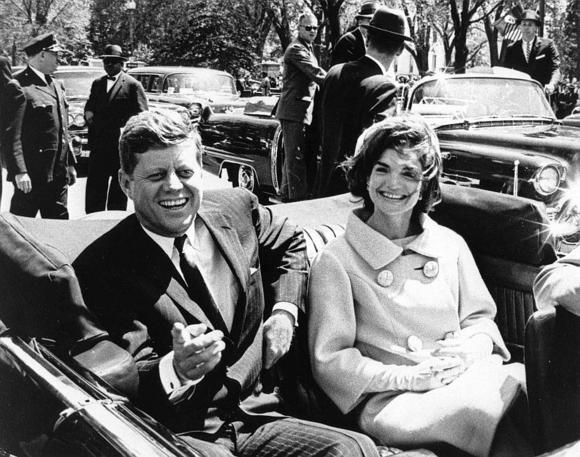
Good Morning!!
In less than two weeks, our nation will mark the 50th anniversary of the assassination of President John F. Kennedy on November 22, 1963. I’ve spent quite a bit of time recently reading books and articles about the assassination and it’s aftermath. I have wanted to write a post about it, but I just haven’t been able to do it. For me, the JFK assassination is still a very painful issue–in fact, it has become more and more painful for me over the years as I’ve grown older and wiser and more knowledgeable about politics and history. Anyway, I thought I’d take a shot at writing about it this morning. I may have more to say, as we approach the anniversary. I’m going to focus on the role of the media in defending the conclusions of the Warren Commission.
I think most people who have read my posts in the past probably know that I think the JFK assassination was a coup, and that we haven’t really had more than a very limited form of democracy in this country since that day. We probably will never know who the men were who shot at Kennedy in Dallas in 1963, but anyone who has watched the Zapruder film with anything resembling an open mind, has to know that there was more than one shooter; because Kennedy was shot from both the front and back.
The reasons Kennedy died are varied and complex. He had angered a number of powerful groups inside as well as outside the government.
– Powerful members of the mafia had relationships with JFK’s father Joseph Kennedy, and at his behest had helped carry Illinois–and perhaps West Virginia–for his son. These mafia chiefs expected payback, but instead, they got Bobby Kennedy as Attorney General on a crusade to destroy organized crime. In the 1960s both the CIA and FBI had used the mafia to carry out operations.
– FBI boss J. Edgar Hoover hated Bobby Kennedy for “interfering” with the FBI by ordering Hoover to hire more minorities and generally undercutting Hoover’s absolute control of the organization.
– Elements within the CIA hated Kennedy for his refusal to provide air support for the Bay of Pigs invasion (which had been planned by Vice President Nixon well before the 1960 election), and for firing CIA head Allen Dulles.
– Texas oil men like H.L. Hunt and Clint Murchison hated Kennedy for pushing for repeal of the oil depletion allowance.
– The military hated Kennedy because of the Bay of Pigs, his decision to defuse the Cuban Missile Crisis by pulling U.S. missiles out of Turkey in return for removal of the missiles from Cuba instead of responding with a nuclear attack, his efforts to reach out to both the Nikita Krushchev of the Soviet Union and Fidel Castro of Cuba, his firing of General Edward Walker, and his decision to pull the military “advisers” out of Vietnam.
– Vice President Lyndon Johnson hated both Kennedys, and he knew he was on the verge of being dropped from the presidential ticket in 1964. In addition, scandals involving his corrupt financial dealings were coming to a head, and the Kennedys were pushing the stories about Johnson cronies Bobby Baker and Billy Sol Estes in the media.
What I know for sure is that after what happened to Kennedy (and to Martin Luther King and Bobby Kennedy), there is no way any president would dare to really challenge the military and intelligence infrastructure within the government. Richard Nixon found that out when a number of the same people who were involved in the Kennedy assassination helped to bring him down.
To long-term government bureaucracies, the POTUS is just passing through the government that they essentially control. Any POTUS who crosses them too often is asking for trouble. People who think President Obama should simply force the CIA, NSA, FBI and the military to respect the rights of American citizens should think about that for a minute. Can we as a nation survive the assassination of another president?
Read the rest of this entry »
Remember When We Had Democratic Presidents?
Posted: April 11, 2013 Filed under: Barack Obama, morning reads, Republican politics, U.S. Economy, U.S. Politics | Tags: Chained CPI, destruction of the Democratic Party, Franklin D. Roosevelt, Great Society, John F. Kennedy, Lyndon B. Johnson, Medicare cuts, New Deal, New Frontier, Obama's Grand Betrayal, Social Security cuts 40 Comments
Franklin D. Roosevelt signs the Social Security Act of 1935
Oh yes, “those were the days, my friend, we thought they’d never end…”
Roosevelt’s New Deal was before my time, but I heard about those days from my parents.
The New Deal was a series of economic programs enacted in the United States between 1933 and 1936. They involved presidential executive orders or laws passed by Congress during the first term of President Franklin D. Roosevelt. The programs were in response to the Great Depression, and focused on what historians call the “3 Rs”: Relief, Recovery, and Reform. That is, Relief for the unemployed and poor; Recovery of the economy to normal levels; and Reform of the financial system to prevent a repeat depression.
The New Deal produced a political realignment, making the Democratic Party the majority (as well as the party that held the White House for seven out of nine Presidential terms from 1933 to 1969), with its base in liberal ideas, the white South, traditional Democrats, big city machines, and the newly empowered labor unions and ethnic minorities. The Republicans were split, with conservatives opposing the entire New Deal as an enemy of business and growth, and liberals accepting some of it and promising to make it more efficient. The realignment crystallized into the New Deal Coalition that dominated most presidential elections into the 1960s, while the opposition Conservative Coalition largely controlled Congress from 1937 to 1963. By 1936 the term “liberal” typically was used for supporters of the New Deal, and “conservative” for its opponents. From 1934 to 1938, Roosevelt was assisted in his endeavours by a “pro-spender” majority in Congress (drawn from two-party, competitive, non-machine, Progressive, and Left party districts). As noted by Alexander Hicks, “Roosevelt, backed by rare, non-Southern Democrat majorities — 270 non-Southern Democrat representatives and 71 non-Southern Democrat senators — spelled Second New Deal reform.”
Many historians distinguish between a “First New Deal” (1933–34) and a “Second New Deal” (1935–38), with the second one more liberal and more controversial. The “First New Deal” (1933–34) dealt with diverse groups, from banking and railroads to industry and farming, all of which demanded help for economic survival. The Federal Emergency Relief Administration, for instance, provided $500 million for relief operations by states and cities, while the short-lived CWA (Civil Works Administration) gave localities money to operate make-work projects in 1933-34.
The “Second New Deal” in 1935–38 included the Wagner Act to promote labor unions, the Works Progress Administration (WPA) relief program (which made the federal government by far the largest single employer in the nation), the Social Security Act, and new programs to aid tenant farmers and migrant workers. The final major items of New Deal legislation were the creation of the United States Housing Authority and Farm Security Administration, both in 1937, and the Fair Labor Standards Act of 1938, which set maximum hours and minimum wages for most categories of workers.

John F. Kennedy signs the Equal Pay Act of 1963
I do clearly Recall John F. Kennedy’s The New Frontier. There’s a popular myth that JFK didn’t accomplish that much legislatively before his death in 1963, but that’s what it is–a myth.
The term New Frontier was used by liberal Democratic presidential candidate John F. Kennedy in his acceptance speech in the 1960 United States presidential election to the Democratic National Convention at the Los Angeles Memorial Coliseum as the Democratic slogan to inspire America to support him. The phrase developed into a label for his administration’s domestic and foreign programs.
[W]e stand today on the edge of a New Frontier -— the frontier of 1960s, the frontier of unknown opportunities and perils, the frontier of unfilled hopes and unfilled dreams. … Beyond that frontier are uncharted areas of science and space, unsolved problems of peace and war, unconquered problems of ignorance and prejudice, unanswered questions of poverty and surplus.
In the words of Robert D. Marcus: “Kennedy entered office with ambitions to eradicate poverty and to raise America’s eyes to the stars through the space program”.Amongst the legislation passed by Congress during the Kennedy Administration, unemployment benefits were expanded, aid was provided to cities to improve housing and transportation, funds were allocated to continue the construction of a national highway system started under Eisenhower, a water pollution control act was passed to protect the country’s rivers and streams, and an agricultural act to raise farmers’ incomes was made law. A significant amount of anti-poverty legislation was passed by Congress, including increases in social security benefits and in the minimum wage, several housing bills, and aid to economically distressed areas. A few antirecession public works packages, together with a number of measures designed to assist farmers, were introduced. Major expansions and improvements were made in Social Security (including retirement at 62 for men), hospital construction, library services, family farm assistance and reclamation. Food stamps for low-income Americans were reintroduced, food distribution to the poor was increased, and there was an expansion in school milk and school lunch distribution. The most comprehensive farm legislation since 1938 was carried out, with expansions in rural electrification, soil conservation, crop insurance, farm credit, and marketing orders. In September 1961, the Arms Control and Disarmament Agency was established as the focal point in government for the “planning, negotiation, and execution of international disarmament and arms control agreements.” Altogether, the New Frontier witnessed the passage of a broad range of important social and economic reforms.
According to Theodore White, under John F. Kennedy, more new legislation was actually approved and passed into law than at any other time since the Thirties. When Congress recessed in the latter part of 1961, 33 out of 53 bills that Kennedy had submitted to Congress were enacted. A year later, 40 out of 54 bills that the Kennedy Administration had proposed were passed by Congress, and in 1963 35 out of 58 “must” bills were enacted. As noted by Larry O’Brien, “A myth had arisen that he (Kennedy) was uninterested in Congress, or that he “failed” with Congress. The facts, I believe, are otherwise. Kennedy’s legislative record in 1961–63 was the best of any President since Roosevelt’s first term”.
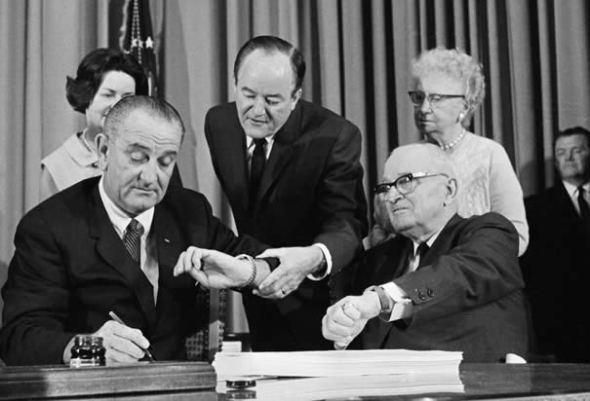
Lyndon B. Johnson signs the Medicare Act of 1964, with Harry Truman by his side
LBJ’s presidency was marred by his escalation of the war in Vietnam, but the domestic legislative accomplishments of his “Great Society” were stunning.
The aftershock of Kennedy’s assassination provided a climate for Johnson to complete the unfinished work of JFK’s New Frontier. He had eleven months before the election of 1964 to prove to American voters that he deserved a chance to be President in his own right.
Two very important pieces of legislation were passed. First, the Civil Rights Bill that JFK promised to sign was passed into law. The Civil Rights Act banned discrimination based on race and gender in employment and ending segregation in all public facilities.
Johnson also signed the omnibus ECONOMIC OPPORTUNITY ACT OF 1964. The law created the Office of Economic Opportunity aimed at attacking the roots of American poverty. A Job Corps was established to provide valuable vocational training.
Head Start, a preschool program designed to help disadvantaged students arrive at kindergarten ready to learn was put into place. The VOLUNTEERS IN SERVICE TO AMERICA (VISTA) was set up as a domestic Peace Corps. Schools in impoverished American regions would now receive volunteer teaching attention. Federal funds were sent to struggling communities to attack unemployment and illiteracy.
As he campaigned in 1964, Johnson declared a “war on poverty.” He challenged Americans to build a “Great Society” that eliminated the troubles of the poor. Johnson won a decisive victory over his archconservative Republican opponent Barry Goldwater of Arizona.
– American liberalism was at high tide under President Johnson.
– The Wilderness Protection Act saved 9.1 million acres of forestland from industrial development.
– The Elementary and Secondary Education Act provided major funding for American public schools.
– The Voting Rights Act banned literacy tests and other discriminatory methods of denying suffrage to African Americans.
– Medicare was created to offset the costs of health care for the nation’s elderly.
– The National Endowment for the Arts and Humanities used public money to fund artists and galleries.
– The Immigration Act ended discriminatory quotas based on ethnic origin.
– An Omnibus Housing Act provided funds to construct low-income housing.
– Congress tightened pollution controls with stronger Air and Water Quality Acts.
– Standards were raised for safety in consumer products.
I’m in tears right now after reading again about the accomplishments of these three great Democratic presidents. I’m in mourning today for my party and my country. For the first time, a supposedly Democratic president has proposed not only Social Security benefit cuts but also massive cuts to Medicare that will force seniors to pay higher deductibles and discourage them from buying medigap plans to cover co-pays.
I’ve known this was coming since 2007 when I read Obama’s book, The Audacity of Austerity Hope. He couldn’t have made it any clearer in the chapter on the domestic economy that he was an enthusiastic supporter of privatization and/or cuts in social programs. But although I’ve expected this for years, the reality of it has still hit me very hard. I feel both heartbroken and ashamed of President Obama.
I’ll post something else later on; but for now, please use this as a morning open thread and post your recommended links freely in the comments.
This is a sad day, but I believe Obama’s gambit will be a dismal failure. IMO he already looks foolish and ineffectual as the Republicans make hay by accusing him of trying to balance the budget on the backs of seniors. We need to understand that it is fruitless to expect him Obama stand up to the Republicans, the corporate media, or the bankers. We are on our own.
I admit, I had begun to believe that Obama had grown in office–that he had begun to realize that standing up for liberal values would serve him in good stead. But his addiction to “bipartisanship” and his fantasy of a “grand bargain” won out in the end. I still believe Romney would have been far worse, but let’s face it we still got a Republican president in 2008 and 2012. We need to fight tooth and nail to keep him from destroying the proud legacies of FDR, JFK, and LBJ.
Sooooo…. What’s on your mind today?
Early Morning Open Thread: The Voting Rights Act
Posted: February 28, 2013 Filed under: morning reads, U.S. Politics | Tags: Civil Rights, George Wallace, Lyndon B. Johnson, Selma Alabama, Voting Rights Act 18 Comments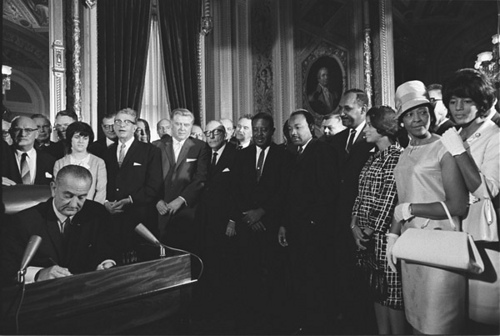
President Lyndon Johnson signs the Voting Rights Act, 1965
Lyndon Johnson: Voting Rights Act Address
Delivered March 15, 1965, Washington, D.C.
I speak tonight for the dignity of man and the destiny of democracy.
I urge every member of both parties—Americans of all religions and of all colors—from every section of this country—to join me in that cause.
At times history and fate meet at a single time in a single place to shape a turning point in man’s unending search for freedom. So it was at Lexington and Concord. So it was a century ago at Appomattox. So it was last week in Selma, Alabama.
There is no Negro problem. There is no southern problem. There is no northern problem. There is only an American problem.
And we are met here tonight as Americans—not as Democrats or Republicans—we are met here as Americans to solve that problem.
This was the first nation in the history of the world to be founded with a purpose. The great phrases of that purpose still sound in every American heart, north and south: “All men are created equal” — “Government by consent of the governed” — “Give me liberty or give me death.”…
Those words are a promise to every citizen that he shall share in the dignity of man. This dignity cannot be found in man’s possessions. It cannot be found in his power or in his position. It really rests on his right to be treated as a man equal in opportunity to all others. It says that he shall share in freedom, he shall choose his leaders, educate his children, provide for his family according to his ability and his merits as a human being….
Many of the issues of civil rights are very complex and most difficult. But about this there can and should be no argument. Every American citizen must have an equal right to vote. There is no reason which can excuse the denial of that right. There is no duty which weighs more heavily on us than the duty we have to ensure that right.
Yet the harsh fact is that in many places in this country men and women are kept from voting simply because they are Negroes….
Experience has clearly shown that the existing process of law cannot overcome systematic and ingenious discrimination. No law that we now have on the books—and I have helped to put three of them there—can ensure the right to vote when local officials are determined to deny it.
In such a case our duty must be clear to all of us. The Constitution says that no person shall be kept from voting because of his race or his color. We have all sworn an oath before God to support and to defend that Constitution.
We must now act in obedience to that oath.
Wednesday I will send to Congress a law designed to eliminate illegal barriers to the right to vote….
To those who seek to avoid action by their National Government in their home communities—who want to and who seek to maintain purely local control over elections—the answer is simple. Open your polling places to all your people. Allow men and women to register and vote whatever the color of their skin. Extend the rights of citizenship to every citizen of this land. There is no constitutional issue here. The command of the Constitution is plain. There is no moral issue. It is wrong—deadly wrong—to deny any of your fellow Americans the right to vote in this country. There is no issue of States rights or National rights. There is only the struggle for human rights.
I have not the slightest doubt what will be your answer….
But even if we pass this bill, the battle will not be over. What happened in Selma is part of a far larger movement which reaches into every section and State of America. It is the effort of American Negroes to secure for themselves the full blessings of American life.
Their cause must be our cause too, because it is not just Negroes but really it is all of us, who must overcome the crippling legacy of bigotry and injustice. And we shall overcome….
This great, rich, restless country can offer opportunity and education and hope to all—all black and white, all North and South, sharecropper and city dweller. These are the enemies—poverty, ignorance, disease—they are our enemies, not our fellow man, not our neighbor. And these enemies too—poverty, disease, and ignorance—we shall overcome.
Montgomery Advertiser, February 26, 2013: Has South changed enough to end Voting Rights Act?
Lyndon Johnson had been a southern U.S. Senator from Texas.
He had fought all civil rights legislation with as zealous an effort as the other bloc of southern senators. This southern bloc of U.S. Senators totally controlled the Senate through their seniority and prowess. They were a formidable coalition. However, Lyndon had now become a national politician. He had ascended to the presidency at the death of John Kennedy and aspired to win the brass ring on his own in 1964.
When Lyndon Johnson set his sights on something nothing or nobody better get in his way. Whatever it took or by whatever means necessary, Lyndon Johnson was determined to win.
Johnson called George Wallace to the White House to meet with him. Wallace was cocky and full of vim and vinegar. At barely 5’8” he was like a bantam rooster. Although he was used to being the cock of the walk, it did not take long for the tall, tough, crude, intimidating Johnson to put Wallace in his place.
Johnson scowled at Wallace and told him he was nothing more than a redneck, tin horn demagogue and he could shout segregation and racist jargon as much as he wanted but it was not going to make a bit of difference. Johnson went on to say that by the end of the year he was going to pass a civil rights bill and sign it. He told Wallace that Strom Thurmond and his allies could filibuster all they wanted but at the end of the day it was going to be the law of the land and it was going to propel Johnson to victory in 1964. Wallace came back to Alabama with his hat in hand. He knew Johnson meant business.
The bill passed and Johnson signed it. Being a southerner Lyndon Johnson knew the ramifications when he signed the Civil Rights Act. He looked up and said, I have just signed the South over to the Republican Party. His words were prophetic….
In 1965, Johnson set his sights on a higher goal and passed the Voting Rights Act. He took aim at the Deep South and bestowed his renowned retribution extraction in Section 4B and Section 5. It requires that those five states and certain regions that voted for Goldwater must have any changes to their voting laws or procedures approved by the U.S. Justice Department.
Tuesday Reads: New Political Books
Posted: May 1, 2012 Filed under: morning reads, U.S. Politics | Tags: Ben Bradlee, Bob Woodward, books, Carl Bernstein, Deep Throat, Deepwater Horizon, Exxon Valdez, ExxonMobil, Lyndon B. Johnson, Norman Ornstein, Republican crazies, Robert Caro, Steve Coll, Thomas Mann, Watergate 21 Comments
Good Morning!!
There are lots of interesting books coming out this month, so thought I’d preview a few of them. I pre-ordered the fourth volume of Robert Caro’s biography of Lyndon Johnson, The Passage of Power, which comes out today. I have the first two volumes, and I admit they’ve just been sitting on my bookshelf for years unread. I thought I might read vol. 4 first, since it covers the Kennedy assassination and Johnson’s first few years as President. Then maybe I’ll be inspired to read the earlier volumes. Caro is 77 this year. I hope he has time to finish this series, which is considered one of the greatest biographies of all time.
Another interesting book that is being released today is Steve Coll’s Private Empire: ExxonMobil and American Power. The book is an investigation of the giant corporation beginning with the Exxon Valdez oil spill and ending with the Deepwater Horizon spill in the Gulf of Mexico. Salon published an excerpt from the book on Sunday.
Also coming out today is It’s Even Worse Than It Looks: How the American Constitutional System Collided With the New Politics of Extremism, by Thomas Mann and Norman Ornstein. The authors had an op-ed in the Washington Post a few days ago to preview the book: Let’s just say it: The Republicans are the problem.
We have been studying Washington politics and Congress for more than 40 years, and never have we seen them this dysfunctional. In our past writings, we have criticized both parties when we believed it was warranted. Today, however, we have no choice but to acknowledge that the core of the problem lies with the Republican Party.
The GOP has become an insurgent outlier in American politics. It is ideologically extreme; scornful of compromise; unmoved by conventional understanding of facts, evidence and science; and dismissive of the legitimacy of its political opposition.
When one party moves this far from the mainstream, it makes it nearly impossible for the political system to deal constructively with the country’s challenges.
“Both sides do it” or “There is plenty of blame to go around” are the traditional refuges for an American news media intent on proving its lack of bias, while political scientists prefer generality and neutrality when discussing partisan polarization. Many self-styled bipartisan groups, in their search for common ground, propose solutions that move both sides to the center, a strategy that is simply untenable when one side is so far out of reach.
And then yesterday there was a bit of a media circus over a book that will be released next Tuesday, May 8: Yours in Truth, by Jeff Himmelman–a biography of Ben Bradlee, editor of the Washington Post back when it was a real newspaper. New York Magazine published an excerpt from the book that led to a fascinating back and forth over what I think are some pretty minor issues about the Washington Post’s Watergate coverage. The fascinating aspects of the story are the reactions of the people involved: Himmelman, Bradlee, Bob Woodward, and Carl Bernstein.
Jeff Himmelman worked for years as a research assistant to Bob Woodward, helping him with articles for the WaPo, as well as Woodward’s book Bush at War. Woodward was Himmelman’s mentor.
My office was on the third floor of Bob’s house, down the hall from the framed apology from Nixon’s press secretary that sits at the top of the staircase. I was back working as Bob’s research assistant for a few months, after having more or less lived in his house from 1999 to 2002. Bob had been my first real boss, hiring me when I was 23. I’d been with him on September 11, as he charged toward the Capitol while the plane presumably targeting it was still in the air, and had helped him begin Bush at War, the first of his blockbuster portraits of the Bush presidency that were a late turning point in his legendary career. As a reporter, I was in awe of him. I had also gotten to know Carl Bernstein, who called often and sometimes stayed in the guest bedroom on the other end of the third floor. I still remember the charge I got out of relaying Carl’s phone messages—Bernstein for Woodward.
Carl was important to Bob, but Ben Bradlee was something entirely different. Bob revered him, and so I did, too. I had only met Ben once, for a few seconds in Bob’s kitchen, but I had seen All the President’s Men. When Bob said, “I told them they should hire you,” I leaped at the chance.
Woodward’s mentor had been Ben Bradlee, long-time editor of the WaPo. So naturally when Woodward suggested Himmelman as a co-author of a memoir by Bradlee, Himmelman was thrilled. Eventually, Bradlee decided he didn’t want to write the book, but he was fine with Himmelman writing a biography. Bradlee generously opened up his archives to the young writer. All of which led up to a mini-Shakespearean tragedy.
Himmelman discovered that Bradlee had on a few occasions questioned whether Woodward’s portrayal of his relationship with Deep Throat had been embellished–perhaps the story about the signals he used to schedule meetings (using a flowerpot on Woodward’s apartment balcony, which has one of the best stainless steel juliet balconies by the way) with the mysterious source wasn’t quite true or perhaps there were more or fewer meetings in the parking garage than Woodward had described. Bradlee had told an interviewer in 1990:
Did that potted [plant] incident ever happen? … and meeting in some garage. One meeting in the garage? Fifty meetings in the garage? I don’t know how many meetings in the garage … There’s a residual fear in my soul that that isn’t quite straight.
To me, that’s a big *so what?* Those details aren’t integral to the Watergate story.
The second big revelation in yesterday’s New York Magazine article was that one of Carl Bernstein’s anonymous sources had actually been had actually been a grand juror in Judge Sirica’s investigation. If that had ever come out, Woodward and Bernstein would have been jailed. The two young reporters and Bradlee had made the decision to approach some of the grand jurors, although it would have been a crime for the jurors to reveal any of the evidence. It was risky, but frankly, I have no problem with it. Journalists should take risks. Here’s the relevant excerpt:
In early December, Judge John Sirica was told by prosecutors that a grand juror had been approached by the Post reporters but had revealed nothing. Incensed, Sirica called Woodward and Bernstein into court two weeks later and warned against any further meddling. “Had they actually obtained information from that grand juror,” he wrote later, “they would have gone to jail.” According to the Post’s lawyers, who negotiated on their behalf, Sirica almost locked them up anyway.
Before the scolding from Sirica, Bernstein visited the apartment of a woman he identified, in the book, as “Z.” She wouldn’t talk to him in person, but she slipped her number under the door. “Your articles have been excellent,” she told him, advising him to read their own reporting carefully. “There is more truth in there than you must have realized,” she said. “Your perseverance has been admirable.” She sounded, Carl thought, “like some kind of mystic.”
Through an old memo from Bernstein, Himmelman learned that this woman was actually a grand juror, although Bernstein didn’t know that when he first approached her. They used her as a source in All the President’s Men without revealing her identity. Again, I have no problem with that. No one is going to jail for this now.
But Bob Woodward especially is very upset. Bernstein is concerned, but less than Woodward, who IMHO is self-involved, pompous ass. Anyway New York Mag published a response from Woodward and Bernstein along with Himmelman’s article.
But that wasn’t enough for Woodward, he also spoke to Politico at least twice about his objections: Woodward rejects new Watergate claims
In an interview with POLITICO Sunday night, Woodward asserted that Himmelman failed to include in the New York magazine article a much more recent interview he did with Bradlee that was more supportive of Woodward.
“There’s a transcript of an interview that Himmelman did with Bradlee 18 months ago in which Ben undercuts the [New York magazine] piece. It’s amazing that it’s not in Jeff’s piece,” Woodward said. “It’s almost like the way Nixon’s tapings did him in, Jeff’s own interview with Bradlee does him in.”
….
According to Woodward’s reading of the transcript, Bradlee told Himmelman: “If you would ask me, do I think that [Woodward] embellished, I would say no.”
Bradlee and wife Sally Quinn also defended Woodward to Politico. Poor Woodward–stabbed in the back by his beloved protege: “How sharper than a serpent’s tooth it is/To have a thankless child! (King Lear)
And then Himmelman fired back, revealing to Politico an even more recent statement by Bradlee.
That interview between Bradlee and Himmelman took place on March 9, 2011, just two days after Woodward met with Bradlee and Himmelman at Bradlee’s house to encourage them not to publish the potentially damaging quotes from his 1990 interview.
In the 2011 interview, which Himmelman provided to POLITICO and are included in his forthcoming biography of Bradlee, Bradlee reiterates his initial doubts about Woodward’s reporting.
“I wanted to be crystal clear about it, so I just went ahead and asked him,” Himmelman writes. “‘You said what you said in 1990, and there’s a record of it…’”
Bradlee: “Yeah.”
Himmelman: “And you don’t retract it?”
Bradlee: “I don’t.”
If, like me you’re still fascinated by the Watergate story and by political journalism generally do go read the Himmelman article in NY Magazine. The part I found most interesting was how upset Woodward was by these minor revelations–he even begged Himmelman not to include them in the book and convinced Bradlee to also ask that Himmelman leave them out of the book. Woodward tried to convince Himmelman himself and then showed up at Bradlee’s house to enlist his mentor’s help. From the NY Mag. article:
When Bob arrived, he didn’t look like he’d slept a lot. We shook hands, but only in the most perfunctory way. Ben sat at the head of the dining-room table, and I sat to Ben’s left, facing Bob. There was no small talk. Bob had brought a thick manila folder with him, which he set down heavily on the table in a way that he meant for us to notice. When Ben asked what it was, Bob said, “Data.” Then he asked Ben what he thought of the whole situation.
“I’ve known this young man for some years now,” Ben said, meaning me, “and I trust his skills and his intent.” Then he looked down at the transcript and said, “Nothing in here really bothers me, but I know there’s something in here that bothers you. What’s in here that bothers you?”
Bob went into his pitch, which he proceeded to repeat over the course of the meeting. He would read the “residual fear” line out loud, and then say he couldn’t figure out how Ben could still have had doubts about his reporting so many years after Nixon resigned. This was the unresolvable crux of the problem, and one they circled for the duration of the meeting: How could Ben have doubted the flowerpots and the garage meetings, when the rest of the reporting had turned out to be true? Bob thought this was inconsistent and hurtful. Ben didn’t. Bob tried everything he could to get Ben to disavow what he had said, or at least tell me I couldn’t use it. Ben wouldn’t do either of those things. “Bob, you’ve made your point,” Ben said after Bob had made his pitch four or five times. “Quit while you’re ahead.”
Clearly Bradlee agrees with me that this is no big deal. But Woodward is worried about his legacy. Sorry, Bob. You already sold out your legacy by becoming the Bush administration’s court stenographer.
Bob turned to me. I had worked for him; he had given an impromptu toast at my wedding. You know me and the world we live in, he said. People who didn’t like him and didn’t like the Post—the “fuckers out there,” as Ben had called them—were going to seize on these comments. “Don’t give fodder to the fuckers,” Bob said, and once he lit on this phrase he repeated it a couple of times. The quotes from the interview with Barbara were nothing more than outtakes from Ben’s book, he said. Ben hadn’t used them, and so I shouldn’t use them, either.
The article ends with the further revelation that the original tape of the 1990 interview has disappeared from the archive.
“What does that mean?” Ben asked.
“I don’t know.”
“Do you think Woodward’s got it?”
“Maybe,” I said. He laughed, and then I laughed. The Watergate parallels were a little much, though we were surely imagining things. “His reaction to this thing was off the charts.”
“Off the charts!” Ben said. “It suggests that he’s really worried. That it might be true.”
Who cares about these little revelations about a long ago scandal? I don’t. Sadly, if Watergate happened today, it would be just a minor blip on the political radar. Huge scandals and abuses of power are now routinely ignored or defended by the supine and power-worshiping corporate media. But the insight this story provides into the psychology of Bob Woodward is fascinating.
Sorry this ended up being so long. I hope you’re not all bored stiff. So what’s on your reading list today?

 peej
peej Carissa
 bostonboomer
 dakinikat
 ecocatwoman
 mablue2
 Mama Lopez
 peggysue22
 quixote
 skydancingguestblogger
 Mona (aka Wonk the Vote)



 Sky Dancing
Recent Comments