
Thursday Reads “The Dolphin Who Loved Me”
Posted: June 19, 2014 Filed under: morning reads | Tags: 1960s, Carl Sagan, dolphin brains, dolphin communication, Gregory Bateson, John Lilly, LSD, Margaret Howe Lovatt, Peter, The Day of the Dolphin 17 Comments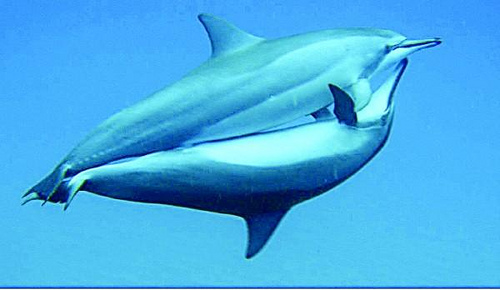
Good Morning!!
Dolphin sexuality has been in the news for the past week or two, because of the release of a new BBC documentary, The Girl Who Talked to Dolphins. It’s a fascinating story of 1960s intellectual icons Gregory Bateson and John Lilly and their research on dolphins. From The Independent UK review:
During the 1960s, Lilly and his collaborators used funding from Nasa to create “Dolphin House” in the American Virgin Islands, essentially a flooded beach-side villa where the young research assistant Margaret Howe Lovatt lived side by side, six days a week, with a dolphin called Peter. Archive stills showed the glamorous Lovatt at work, looking like Audrey Hepburn in a swimsuit advert. Unfortunately, these charming photographs seem to have been of much more lasting value than the scientific research she conducted.
This was a very Sixties tale, involving sexual liberation, space exploration and injecting dolphins with LSD…
But of course what the media fixated on was that Lovatt described a sexual relationship with Peter the dolphin. She said he was young and coming of age and had so many sexual urges that she relieved them manually. She said it wasn’t sexual for her; she just didn’t want distractions from her primary work. You’ve probably seen the lascivious stories floating around the internet. The same thing happened back in the ’60s after Hustler Magazine got a-hold of the sexual sidelight of the research.
I found the story interesting in light of the personalities involved–even Carl Sagan weighed in at one point! The best article to read on the documentary and the classic study is at The Guardian UK: The dolphin who loved me: the Nasa-funded project that went wrong. It’s a very long article; I’ll give you a few excerpts.
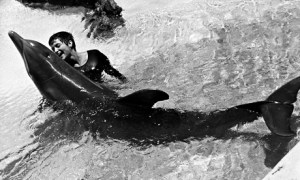
Margaret Lovatt at the Dolphin House on St. Thomas
Lovett had been interested in communicating with animals since early childhood. She was living on St. Thomas in the Caribbean. In 1963 she heard about a laboratory that was doing research on dolphins. She found the place and introduced herself to Gregory Bateson, who took a shine to her and invited her to come back anytime. She did and eventually she went to work with John Lilly and his three dolphins.
“There were three dolphins,” remembers Lovatt. “Peter, Pamela and Sissy. Sissy was the biggest. Pushy, loud, she sort of ran the show. Pamela was very shy and fearful. And Peter was a young guy. He was sexually coming of age and a bit naughty.” ….
The lab’s upper floors overhung a sea pool that housed the animals. It was cleaned by the tide through openings at each end. The facility had been designed to bring humans and dolphins into closer proximity and was the brainchild of an American neuroscientist, Dr John Lilly. Here, Lilly hoped to commune with the creatures, nurturing their ability to make human-like sounds through their blow holes.
Lilly had been interested in connecting with cetaceans since coming face to face with a beached pilot whale on the coast near his home in Massachusetts in 1949. The young medic couldn’t quite believe the size of the animal’s brain – and began to imagine just how intelligent the creature must have been, explains Graham Burnett, professor of the history of science at Princeton and author of The Sounding of the Whale. “You are talking about a time in science when everybody’s thinking about a correlation between brain size and what the brain can do. And in this period, researchers were like: ‘Whoa… big brain huh… cool!'”
Lovett thought that if she lived alone with a dolphin, she might be able to learn to communicate with it, and Lilly went along with her idea.
Lovatt selected the young male dolphin called Peter for her live-in experiment. “I chose to work with Peter because he had not had any human-like sound training and the other two had,” she explains. Lovatt would attempt to live in isolation with him six days a week, sleeping on a makeshift bed on the elevator platform in the middle of the room and doing her paperwork on a desk suspended from the ceiling and hanging over the water. On the seventh day Peter would return to the sea pool downstairs to spend time with the two female dolphins at the lab – Pamela and Sissy.
By the summer of 1965, Lovatt’s domestic dolphinarium was ready for use. Lying in bed, surrounded by water that first night and listening to the pumps gurgling away, she remembers questioning what she was doing. “Human people were out there having dinner or whatever and here I am. There’s moonlight reflecting on the water, this fin and this bright eye looking at you and I thought: ‘Wow, why am I here?’ But then you get back into it and it never occurred to me not to do it. What I was doing there was trying to find out what Peter was doing there and what we could do together. That was the whole point and nobody had done that.”
Audio recordings of Lovatt’s progress, meticulously archived on quarter-inch tapes at the time, capture the energy that Lovatt brought to the experiment – doggedly documenting Peter’s progress with her twice-daily lessons and repeatedly encouraging him to greet her with the phrase ‘Hello Margaret’. “‘M’ was very difficult,” she remembers. “My name. Hello ‘M’argaret. I worked on the ‘M’ sound and he eventually rolled over to bubble it through the water. That ‘M’, he worked on so hard.”
For Lovatt, though, it often wasn’t these formal speech lessons that were the most productive. It was just being together which taught her the most about what made Peter tick. “When we had nothing to do was when we did the most,” she reflects. “He was very, very interested in my anatomy. If I was sitting here and my legs were in the water, he would come up and look at the back of my knee for a long time. He wanted to know how that thing worked and I was so charmed by it.”

John Lilly with dolphin
Lovatt was serious about her work, but ultimately Lilly’s obsession with LSD experimentation sidetracked the project.
Lilly had been researching the mind-altering powers of the drug LSD since the early 1960s. The wife of Ivan Tors, the producer of the dolphin movie Flipper, had first introduced him to it at a party in Hollywood. “John and Ivan Tors were really good friends,” says Ric O’Barry of the Dolphin Project (an organisation that aims to stop dolphin slaughter and exploitation around the world) and a friend of Lilly’s at the time. “Ivan was financing some of the work on St Thomas. I saw John go from a scientist with a white coat to a full blown hippy,” he remembers….
In the 1960s a small selection of neuroscientists like John Lilly were licensed to research LSD by the American government, convinced that the drug had medicinal qualities that could be used to treat mental-health patients. As part of this research, the drug was sometimes injected into animals and Lilly had been using it on his dolphins since 1964, curious about the effect it would have on them.
The drug had zero effect on the dophins, because drugs affect different species in different ways; but Lilly insisted on continuing the injections anyway. Lovatt was totally against it, but she wasn’t the one in charge. (In an interesting sidenote, Lilly was turned on to LSD by the director of the movie Flipper.) Eventually Bateson resigned over it and NASA cut Lilly’s funding. Sadly, the dophins were sent to cramped lab in Miami, where the dolphins didn’t get enough sunlight and exercise.
“I got that phone call from John Lilly,” she recalls. “John called me himself to tell me. He said Peter had committed suicide.”
Ric O’Barry corroborates the use of this word. “Dolphins are not automatic air-breathers like we are,” he explains. “Every breath is a conscious effort. If life becomes too unbearable, the dolphins just take a breath and they sink to the bottom. They don’t take the next breath.” Andy Williamson puts Peter’s death down to a broken heart, brought on by a separation from Lovatt that he didn’t understand. “Margaret could rationalise it, but when she left, could Peter? Here’s the love of his life gone.”
“I wasn’t terribly unhappy about it,” explains Lovatt, 50 years on. “I was more unhappy about him being in those conditions [at the Miami lab] than not being at all. Nobody was going to bother Peter, he wasn’t going to hurt, he wasn’t going to be unhappy, he was just gone. And that was OK. Odd, but that’s how it was.”
Lilly’s ideas about dolphin communication most likely inspired the book and movie The Day of the Dolphin. The movie starred George C. Scott and was directed by Mike Nichols. The screenplay was by Buck Henry.
A couple of reactions to this story:
The New York Daily News reports on a man who claims to have had sex with a female dolphin: ‘Wet Goddess’ author shares details of his 6-month sexual relationship with Dolly the dolphin.
Another self-confessed dolphin lover claims he had a six-month consensual affair with one of the sleek marine animals — and insists it’s nothing to be ashamed of.
Malcolm Brenner, 63, shared his story with British newspaperThe Mirror in the wake of a BBC documentary that featured Margaret Howe Lovatt, an animal researcher who said she had sex with a dolphin in the 1960s as part of a NASA-funded study.
Brenner, a writer who also admits to having prior sexual experiences with a dog, said he fell in love with Dolly the dolphin in a Florida amusement park in 1971.
Dolly “came on to him,” he told The Mirror — and he was heartbroken when she died about nine months after they met.
The two had their interspecies intercourse after conspiring to elude the male dolphin that shared Dolly’s pool, Brenner said.

Margaret Lovatt today
Salon: Human-on-dolphin sex is not really that weird. Author Tracy Clark-Flory writes that Lovatt’s behavior with Peter wasn’t unique in science:
Judging from the collective horrified response, you would think that a human giving a handy to an animal was an aberrant, unthinkable act. But such fondling isn’t unheard of in the realm of animal research.
There are two major published examples. The first: In 1970, anthropologist Francis Burton published “Sexual Climax in female Macaca mulatta.” She wanted to answer the question of whether female monkeys experienced orgasm. Burton placed the primates in dog harnesses and cat collars to restrict their movement. Then the researcher put a “penis-simulator” into “the animal’s vagina with vaseline as lubricant,” and moved it at a pace of two to five thrusts a second. Burton wasn’t able to definitively conclude that female monkeys could orgasm, but she did identify an excitement, plateau and resolution phase, as Masters and Johnson had identified in humans.
“I think in the field it is generally thought that a similar study would never get through an institutional animal use and care committee,” says Kim Wallen, a psychology professor at Emory University who specializes in primate sexual behavior.
The second case is that of psychologist Frank Beach and his research on beagles in the ’80s. “Most of the work he did was behavioral, looking at the effects of prenatal androgens on sexual differentiation, but some of his treated animals were unable to copulate and he wanted to know if they showed normal genital reflexes, even though they did not copulate,” says Wallen. So, he masturbated the dogs and observed their responses.
Clark-Flory notes that it is common for researchers to sexually stimulate animals to “collect semen for breeding purposes.” I just hope Rick Santorum doesn’t find out about this.
I hope I haven’t bored you silly with this post. I don’t know what got into me today; I just couldn’t write about news of politics or war. It’s either writer’s block or I’m just plain sick of news and politics today. I’ll add a few news links in the comments, and I hope you’ll do the same. Have a great Thursday!!
Thursday Reads: MKULTRA, Offshore Tax Havens, Mitt Romney’s WH Lunch, and a Tom Ricks Update
Posted: November 29, 2012 Filed under: 2012 elections, Mitt Romney, morning reads, U.S. Military, U.S. Politics | Tags: biological weapons, CIA, Eric and Nils Olson, Frank Olson, Ft. Dietrich, James Risen, LSD, memory hole, MKULTRA, tax havens, Torture 11 Comments
Good Morning!!
The CIA keeps hoping that their cold war mind control programs (of which there were many back in the 1950s and 1960s), usually referred to by the umbrella term Project MKultra, will disappear down the memory hole; but occasionally it still rears its ugly head.
Yesterday was one of those occasions. The New York Times published an article by Pulitzer Prize-winning investigative journalist James Risen about a new lawsuit by Eric and Nils Olson that accuses the CIA of covering up the real causes of their father Frank Olson’s death.
First, a little background. Frank Olson was a scientist who worked at Ft. Dietrich in Maryland on top-secret research related to Project MKultra. From Wikipedia:
Frank Olson was a senior U.S. microbiologist at Fort Detrick in Frederick, Maryland.[1] He was recruited from the University of Wisconsin, where his departmental advisor was Ira Baldwin, the civilian scientist who, along with industrial partners like George W. Merck and the U.S. military, established the U.S. bioweapons program in 1943, a time when interest in applying modern technology to warfare was at an all-time high.
His specific research work at Fort Detrick’s Special Operations Division has never been revealed, but he was clearly involved in biological weapons research. He had been assigned as a contact with the CIA’s Technical Services Staff, run by Dr. Sidney Gottlieb and his deputy Robert Lashbruck regarding experiments with bioweapons, toxins, and mind control drugs. This was the MKNAOMI – MKULTRA program, previously known as Project Artichoke and earlier, Project Bluebird, and justified based on claimed Soviet efforts to create a “Manchurian Candidate.” In 1953, as Deputy Acting Head of Special Operations for the CIA, Olson associated with Dr. William Sargant, investigating the use of psychoactive drugs at Britain’s Biological Warfare Centre at Porton Down. Hence, he was privy to the innermost secrets of the CIA interrogation and biowarfare programs.
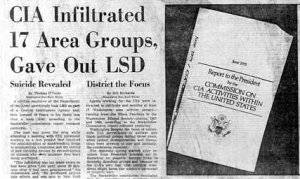
In 1953, Olson was dosed with LSD without his knowledge at a retreat with his coworkers. Not surprisingly, he freaked out and became “paranoid.” A week later, he tried to resign his position, but his superiors sent him to New York City to see a psychiatrist involved with the CIA’s research, Harold Abramson. That night Olson supposedly committed suicide by jumping out of his 10th floor hotel room. Robert Lashbrook was in the room at the time, but claimed to have no idea how it happened.
Olson’s family had no idea what he had been working on or the details of his “accident.” All this came out after Congress began investigating the CIA’s insane mind control programs in the 1970s.
According to the the Risen article,
Eric and Nils Olson…said they plan to file a lawsuit in United States District Court here on Wednesday accusing the C.I.A. of covering up the truth about Mr. Olson’s death in 1953, one of the most infamous cases in the agency’s history.
During the intelligence reforms in the 1970s, the government gave the Olson family a financial settlement after the C.I.A. was forced to acknowledge that Mr. Olson had been given the hallucinogenic drug nine days before his death. President Gerald R. Ford met with the Olson family at the White House and apologized.
At the time, the government said Mr. Olson had killed himself by jumping out of a hotel window in Manhattan. But the Olsons came to believe that he had been murdered to keep him from talking about disturbing C.I.A. operations that he had uncovered.
Mr. Olson’s sons said that their past efforts to persuade the agency to open its files and provide them with more information had failed, and that a court challenge is the only way to find out the truth.
“The evidence points to a murder, and not a drug-induced suicide,” said Eric Olson, Frank Olson’s older son, who has devoted much of his life to investigating his father’s death. When the government told his family that his father had committed suicide, “one set of lies was replaced with another set of lies,” he said.
The Olson brothers claim that
In 1953, Mr. Olson traveled to Europe and visited biological and chemical weapons research facilities. The Olson family lawsuit alleges that during that trip, Mr. Olson witnessed extreme interrogations, some resulting in deaths, in which the C.I.A. experimented with biological agents that he had helped develop. Intelligence officials became suspicious of him when he seemed to have misgivings about what he had seen, the lawsuit contends. Eric Olson said Frank Olson also appeared to have deep misgivings about the use of biological weapons that was alleged in the Korean War.
According to Risen, it was after Olson expressed his “misgivings” that he was dosed with LSD. The lawsuit was filed yesterday afternoon.
Of course the CIA has never stopped developing methods of torture and mind control, as we learned during the Bush administration when the Abu Ghraib story broke and we began learning about the torture methods that were used on suspected terrorists and the CIA black sites in torture-friendly countries around the world.
I doubt if anything will come of this lawsuit, but I’m happy that Olson’s story and MKultra are back in the news. Perhaps a few people will read about it and wake up to the terrible things our government has been doing for decades and continues to do today.
In other news, the UK Guardian in cooperation with BBC Panorama and the International Consortium of Investigative Journalists (ICIJ) are in the process of publishing their research on Great Britain’s network of offshore tax havens. From the Guardian: Offshore secrets revealed: the shadowy side of a booming industry.
The existence of an extraordinary global network of sham company directors, most of them British, can be revealed.
The UK government claims such abuses were stamped out long ago, but a worldwide joint investigation by the Guardian, the BBC’s Panorama and the Washington-based International Consortium of Investigative Journalists (ICIJ) has uncovered a booming offshore industry that leaves the way open for both tax avoidance and the concealment of assets.More than 21,500 companies have been identified using this group of 28 so-called nominee directors. The nominees play a key role in keeping secret hundreds of thousands of commercial transactions. They do so by selling their names for use on official company documents, using addresses in obscure locations all over the world.
This is not illegal under UK law, and sometimes nominee directors have a legitimate role. But our evidence suggests this particular group of directors only pretend to control the companies they put their names to.
Another article reveals the real identities behind Britain’s secret property deals. Another article reveals how BBC Panorama filmed undercover in offshore tax havens.
Someone should tell Mitt Romney to turn off Fox News and read the Guardian for the next few days.
Speaking of Mitt Romney, he’ll be having lunch with President Obama at the White House today. The Boston Globe reports:
At some point late on Thursday morning, Mitt Romney will be driven to the steps of the White House. He will get out of the car, be escorted to a room adjacent to the Oval Office, and sit down for lunch.
But rather than arriving as an occupant, the one-time presidential hopeful will be a guest in someone else’s house.
In a meeting that has been weeks in the making, Romney will join President Obama for private lunch at the White House just 23 days after he lost the election. It will be the first time they have met since the election, and it follows several weeks in which Romney has started to contemplate life outside of politics.
I wonder if they’ll discuss the “gifts” that Romney claims Obama gave to the “47 percent” in order to get elected? I’m still waiting for mine.
At the Atlantic, Jen Doll writes about What Obama and Romney’s Lunch Might Look Like — or Should.
Mitt Romney and Barack Obama are having lunch! Mitt Romney and Barack Obama are having lunch! This is exciting to Americans because we just spent several mortifying days with our several mortifying relatives eating hopefully decent turkey, and now Romney is in our last-week’s shoes, sort of, as he prepares to sit across a table in a strange kind of tradition, breaking bread with a man he not so long ago vowed to defeat. So, yes, that’s slightly uncomfortable, perhaps. Kind of like the opening montage on Project Runway when those people who got kicked off in the first few episodes are all in your face saying how they’re number one and they’re going to win this whole thing, just watch.
This lunch will happen Thursday. Press is not allowed, which seems advisable. The lunch will be held at the White House (Obama’s home turf advantage) Private Dining Room (“next to the Oval Office in the West Wing”), and is the fulfillment of a promise Obama made on election night, as we reminded you earlier, that the president would meet with his former opponent. This is their first meetup since the election, or as the White House statement puts it, “It will be the first opportunity they have had to visit since the election.” Visit, of course, is the euphemism your grandmother uses.
This lunch, between a couple of men who didn’t seem terribly keen on each other just a few weeks ago, brings up a host of modern-day etiquette questions. Here, we do our best to answer them.
Read the rest at the link. It’s very funny.
The Tom Ricks vs. Fox News story continued into a third day. Ricks was invited to appear on MSNBC and said no. According to the WaPo’s Melissa Henneberger, Ricks’ Fox News putdown was
no mere partisan smackdown; it was more subversive than that, and even more bracing. Because as it turns out, Ricks doesn’t want to play on either the red or the blue team, and has no loftier view of Obama-cheering MSNBC than of Obama-jeering Fox.
When I talked to him Tuesday, he said yeah, actually, he had had some other TV invites, but we shouldn’t waste too much time clicking around looking for his next appearance: “MSNBC invited me, but I said, ‘You’re just like Fox, but not as good at it.’ They wrote back and said, ‘Thank you for your candor.’”
Henneberger asked Ricks if he had planned his Fox News smackdown ahead of time.
“It just kind of tumbled out,” he said, after “this fathead comes on and says the pressure is increasing on the White House; no, they’re backing off! Now their spokesman says I apologized; they’re just making stuff up.”
He told the young woman who pre-interviewed him that he felt the whole issue had been exploited for political reasons, “but my impression was she’s new to the game and thought that because I’m pro-military — and I do consider myself pro-military,” he’d naturally agree with the Foxified narrative.
After three years in the archives researching “The Generals,” Ricks said, “I’m blinking my eyes,” in the TV lights, and taken aback at how much a little truth-telling can set a guy apart around here.
Ricks was even more harsh in an interview with HuffPo yesterday.
Ricks hammered the point home when speaking with HuffPost Live’s Ahmed Shihab-Eldin. In response to Clemente’s statement indicating that Ricks “apologized” after the interview, “ignored the anchor’s question,” and doesn’t have “the strength of character to [apologize] publicly,” Ricks had one thing to say: “that’s horseshit.”
He recounted his hallway conversations once again, which included complimenting Fox News host Bret Baier on his weight loss and telling a Fox News staffer he was tired. “It was not an apology for what was said at all,” he added.
When asked about his decision to turn down an invitation to appear on MSNBC, Ricks said, “Fox really seems to sell outrage as its product, and MSNBC doesn’t as much. But they both seem to me to be running political campaigns almost more than they are running news networks. So I don’t particularly like either. That said, I’m not a fan of TV news generally. I think it’s a lousy place to get your information from.”
That’s all I have for you today. Now it’s your turn. What are you reading and blogging about?
Tuesday Reads
Posted: March 22, 2011 Filed under: Baby Boomers, Bahrain, Foreign Affairs, health hazard, Iraq, Japan, Libya, morning reads, psychology, Syria, U.S. Military, U.S. Politics, Water, Yemen | Tags: 1960s, Ali Abdullah Saleh, Bahrain, Fukushim nuclear plant, Hillary Clinton, id, iran, Japan, Libya, LSD, Muammar Gaddafi, Owsley Stanley, personality, Sigmund Freud, Syria, Wisconsin, Yemen 30 Comments
Good Morning!!
I’m teaching a Psychology of Personality course this semester, and yesterday I started lecturing about Freud and psychoanalytic theory. I was explaining Freud’s notion of the three parts of the personality–the id, the ego, and the superego. You’re probably familiar with those terms, but basically the id is there when we are born–it is completely self-centered, doesn’t know the difference between fantasy and reality, all it cares about is pleasure. It wants what it wants when it wants it. Sometime during infancy, we develop an ego that gets the id under some control, and around age 4-6 we develop a superego–basically like a conscience, that tells us which behaviors are right or wrong or socially acceptable.
Anyway, after class I was thinking about Muammar Gaddafi and his bizarre behavior–the way he has insisted for weeks that there is no opposition and that he isn’t attacking Libyan citizens. No, he would never do that. It occurred to me that Gaddafi is pretty much acting from his id all the time. Of course his ego keeps him somewhat connected to reality so he can function in the world, but mostly he just cares about his own needs.
I wonder if that is what happens to all leaders who gain absolute control. Does the quote “power corrupts and absolute power corrupts absolutely,” really mean that power causes people to regress to an earlier stage of development?
It sounds peculiar, but think about how powerful people get so many of their needs met by others. Obama doesn’t have to worry about paying for things, getting food or clothing, even getting information. It is all provided by other people. In many ways, it’s a kind of childlike, dependent state. So if the leader doesn’t have a strong character (ego), he can end up behaving in a narcissistic, childlike way.
OK, well that’s my not-very-deep thought for today.
So what’s happening in the news? As has often been the case in recent weeks, much of the big news is coming from outside the U.S.
On Libya, there has been more criticism of the UN resolution and how it is being carried out. I posted quite a few examples of the criticism in my post last night. Most of the objections are based on the fact that Libya is not at all important to the U.S. strategically.
Today I want to recommend a couple of articles that explain why the intervention in Libya, while troubling in many ways, was probably the right thing to do–even for U.S. interests. The first is by Mark Lynch at the Foreign Policy blog. Lynch uses the name “abuardvark” on twitter. His post is headlined Libya in its Arab Context Although Lynch has misgivings about the intervention and has written about them, he still thinks what the U.S. is doing is the right thing–both for the Arab world and for advancing our interests. Here’s his basic argument:
Libya matters to the United States not for its oil or intrinsic importance, but because it has been a key part of the rapidly evolving transformation of the Arab world. For Arab protestors and regimes alike, Gaddafi’s bloody response to the emerging Libyan protest movement had become a litmus test for the future of the Arab revolution. If Gaddafi succeeded in snuffing out the challenge by force without a meaningful response from the United States, Europe and the international community then that would have been interpreted as a green light for all other leaders to employ similar tactics. The strong international response, first with the tough targeted sanctions package brokered by the United States at the United Nations and now with the military intervention, has the potential to restrain those regimes from unleashing the hounds of war and to encourage the energized citizenry of the region to redouble their efforts to bring about change. This regional context may not be enough to justify the Libya intervention, but I believe it is essential for understanding the logic and stakes of the intervention by the U.S. and its allies.
Libya’s degeneration from protest movement into civil war has been at the center of the Arab public sphere for the last month. It is not an invention of the Obama administration, David Cameron or Nicholas Sarkozy. Al-Jazeera has been covering events in Libya extremely closely, even before it tragically lost one of its veteran cameramen to Qaddafi’s forces, and has placed it at the center of the evolving narrative of Arab uprisings. Over the last month I have heard personally or read comments from an enormous number of Arab activists and protest organizers and intellectuals from across the region that events in Libya would directly affect their own willingness to challenge their regimes. The centrality of Libya to the Arab transformation undermines arguments that Libya is not particularly important to the U.S. (it is, because it affects the entire region) or that Libya doesn’t matter more than, say, Cote D’Ivoire (which is also horrible but lacks the broader regional impact).
Lynch is still worried about what could go wrong:
I continue to have many, many reservations about the military intervention, especially about the risk that it will degenerate into an extended civil war which will require troops regardless of promises made today. But as I noted on Twitter over the weekend, for all those reservations I keep remembering how I felt at the world’s and America’s failure in Bosnia and Rwanda. And I can’t ignore the powerful place which Libya occupies in the emerging Arab transformations, and how the outcome there could shape the region’s future. Failure to act would have damned Obama in the eyes of the emerging empowered Arab public, would have emboldened brutality across the region, and would have left Qaddafi in place to wreak great harm. I would have preferred a non-military response — as, I am quite sure, the Obama administration would have preferred. But Qaddafi’s military advances and the failure of the sanctions to split his regime left Obama and his allies with few choices. The intervention did not come out of nowhere. It came out of an intense international focus on the Arab transformations and a conviction that what happens now could shape the region for decades.
At CNN, Peter Bergen tries to explain Why Libya 2011 is not Iraq 2003 I recommend checking it out.
Another article worth reading is by Robert Fisk at The Independent: Right across the Arab world, freedom is now a prospect
In the Middle East, Yemen may be close to ousting President Ali Abdullah Saleh. From the Guardian:
A military showdown is looming in Yemen after the defence minister announced that the army would defend the president against any “coup against democracy”. His statement came hours after 12 military commanders, including a senior general, defected from the regime and promised to protect anti-government protesters in the capital, Sana’a.
[….]
Yemen’s president, Ali Abdullah Saleh, suffered a significant blow when General Ali Mohsen al-Ahmar, his longtime confidant and head of the Yemeni army in the north-west, announced that he would support “the peaceful revolution” by sending soldiers under his command to protect the thousands gathered in the capital to demand that Saleh step down.
“According to what I’m feeling, and according to the feelings of my partner commanders and soldiers … I announce our support and our peaceful backing to the youth revolution,” Ali Mohsen said.
Minutes after his defection, tanks belonging to the republican guards, an elite force led by Ahmed Ali, the president’s son, rolled into the streets of Sana’a, setting the stage for a confrontation between defectors and loyalists.
At Bloomberg: U.S. Faces Loss of Key Ally Against Al-Qaeda in Yemen
…Yemeni President Ali Abdullah Saleh appears unlikely to weather a popular uprising and defections among his ruling elite, former U.S. officials said.
“It’s clear at this point that Saleh will have to step down,” Barbara Bodine, a former U.S. ambassador to Yemen, said in an interview yesterday. With the “mounting numbers of senior people in his administration resigning, we know it’s over. The terms of his departure, I think, are still being negotiated.”
The March 18 killing of at least 46 protesters allegedly by police and pro-regime gunmen — which drew condemnation from Obama and Secretary of State Hillary Clinton and prompted the defection of key military, tribal and government officials — may well be the tipping point.
Protests are continuing to escalate in Syria as well.
In Deraa, hundreds of black-uniformed security forces wielding AK-47 assault rifles lined the streets but did not confront thousands of mourners who marched at the funeral of 23-year-old Raed al-Kerad, a protester killed in Deraa.
“God, Syria, freedom. The people want the overthrow of corruption,” they chanted. The slogan is a play on the words “the people want the overthrow of the regime,” the rallying cry of revolutions that overthrew the veteran rulers of Tunisia and Egypt.
Security forces opened fire last Friday on civilians taking part in a peaceful protest in Deraa to demand the release of 15 children detained for writing protest graffiti.
Authorities released the children on Monday in a sign they were hoping to defuse tension in the border town, which witnessed more protests after Friday’s crackdown.
And there is a lot happening in Bahrain too. This article is worth a read: Libya burns but Bahrain can shake the world
While the world attention remains glued to the fires in Libya potential stakes in Bahrain are actually a hundred times higher. Safaniya Oil Field, the largest oil field in the world, is less than 200 miles from Manama. The Strait of Hormuz, through which passes 20 percent of world oil shipments and 40 percent of the world’s sea-borne oil shipments, is within a 400-mile radius.
More importantly, United States Fifth Fleet, with a forward deployed Carrier Strike Group, Combat Command force, Anti-Terrorism force, Sea Stallion helicopters, Amphibious Force and Patrol and Reconnaissance Force, is headquartered at Naval Support Activity Bahrain (or NSA Bahrain). In essence, Bahrain is home to America’s military might that reigns over the Persian Gulf, Red Sea and the Arabian Sea-all put together.
On March 14, around 2,000 soldiers of the Saudi-led, US-backed Peninsula Shield Force, in their armored carriers and tanks, invaded Bahrain. The stated purpose of the invasion is: to crush an unarmed civilian uprising.
On March 15, King Hamad ibn Isa Al Khalifa of Mamlakat al Bahrayn declared martial law under which the Bahrain Defence Force (BDF), numbering around 10,000 personnel, was “empowered to take whatever actions it deems appropriate in dealing with the predominately Shiite-driven unrest.”
I recommend clicking on the link and reading the rest to learn how Iran could get involved in the Bahrain conflict. Yikes!
In Japan workers are still trying to get the Fukushima nuclear plant under control. We keep hearing that things are improving, but it’s kind of hard for me to trust what I hear from governments and corporations these days. After Iraq, Katrina, the BP oil spill, and on and on, I honestly believe just about everyone in government and private business lies their asses off. The biggest fear at the moment is the radiation that is turning up in food and water. Of course the authorities claim that’s nothing to worry about, but why should we believe them?
Away from the plant, mounting evidence of radiation in vegetables, water and milk stirred concerns among Japanese and abroad despite assurances from Japanese officials that the levels were not dangerous.
TEPCO said radiation was found in the Pacific ocean nearby , not surprising given rain and the hosing of reactors with seawater. Some experts said it was unclear where the used seawater was ultimately being disposed.
Radioactive iodine in the sea samples was 126.7 times the allowed limit, while cesium was 24.8 times over, Kyodo said. That still posed no immediate danger, TEPCO said.
“It would have to be drunk for a whole year in order to accumulate to one millisievert,” a TEPCO official said, referring to the standard radiation measurement unit. People are generally exposed to about 1 to 10 millisieverts each year from background radiation caused by substances in the air and soil.
Whatever. I wouldn’t want to drink from the tap or swim in the radioactive ocean water.
Back in the USA, Wisconsin Asks Appeals Court to Block Order Halting Union Bargaining Law
Wisconsin’s attorney general asked an appeals court to block a state judge’s order that temporarily halted a law curbing government employee unions’ collective- bargaining power.
State Attorney General J.B. Van Hollen today also asked the Wisconsin Court of Appeals for permission to file an appeal seeking to overturn the ruling by Circuit Court Judge Maryann Sumi.
“Contrary to established case law, the trial court injected itself into the legislative process and enjoined a legislative act,” Van Hollen said in court papers filed today in Madison. “There is absolutely no authority for the broad, overreaching step taken.”
Sumi on March 18 granted a temporary restraining order blocking publication of the measure signed into law by Governor Scott Walker on March 11, after a hearing in Madison, the state’s capital city. Publication gives the law full force and effect.
I’ll end on a lighter note. If you’re as old as I am, you might remember a guy named Owsley “Bear” Stanley: “the Sixties hero who ‘turned on’ a generation.” Stanley died a few days ago in a car crash at the age of 76.
Stanley, who died in a car crash in Australia on Sunday, fuelled the “flower power” counter-culture that took root in California in the mid-1960s, supplying it with acid that he manufactured after stumbling across a recipe in a chemistry journal.
He also worked with the psychedelic rock band Grateful Dead, who wrote their song “Alice D Millionaire” about him after a newspaper described him as an “LSD millionaire”. One batch of his drugs reputedly inspired Jimi Hendrix’s song “Purple Haze”, and he provided LSD for the notorious “Acid Test” parties hosted by the American writer Ken Kesey, which featured in books by Tom Wolfe and Hunter S Thompson.
News of Stanley’s death – his car swerved off a road and slammed into a tree near his home in north Queensland – elicited tributes, but also surprise. Despite a youth so misspent that his name became slang for good acid, Stanley had made it to the age of 76. He was even a great-grandfather. In a statement yesterday, his family mourned him as “our beloved patriarch”.
Supposedly, a batch of Owsley’s acid inspired Jimi Hendrix’s first big hit, Purple Haze. Rest in peace, Owsley. I am one “casualty” of the ’60s who did learn something significant from my experiences with LSD. One thing I eventually learned is that I don’t need drugs to “get high.”
I guess that’s another not-so-deep thought, but hey, I’m OK with that. What are you reading and blogging about today?

 peej
peej Carissa
 bostonboomer
 dakinikat
 ecocatwoman
 mablue2
 Mama Lopez
 peggysue22
 quixote
 skydancingguestblogger
 Mona (aka Wonk the Vote)



 Sky Dancing
Recent Comments