
There is an established playbook for turning a democracy into an authoritarian state, used in countries ranging from India to Hungary. It requires a leader to:
Wednesday Reads: 100 Days of Horror
Posted: April 30, 2025 Filed under: Donald Trump, U.S. Economy | Tags: GDP contracts, Lindsey Graham, Pope Francis, science funding and the economy, Trump 100 days rally, Trump vs. FDR 9 Comments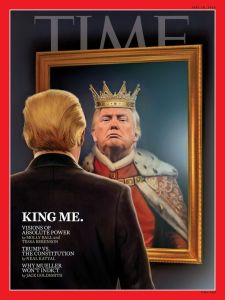 Good Afternoon!!
Recent quotes from Donald Trump:
“I rule the country and the world.”
Talk about grandiosity! These remarks have been characterized in the media as “joking,” but Trump doesn’t really have a sense of humor.
From The Atlantic: The article is mostly gossip; it’s written by Ashley Parker and Michael Scherer, who used to write gossipy stories for The Washington Post. Here’s the context of the quote:
“Tell the people at The Atlantic, if they’d write good stories and truthful stories, the magazine would be hot,” he said. Perhaps the magazine can risk forgoing hotness, he suggested, because it is owned by Laurene Powell Jobs, which buffers it, he implied, from commercial imperatives. But that doesn’t guarantee anything, he warned. “You know at some point, they give up,” he said, referring to media owners generally and—we suspected—Bezos specifically. “At some point they say, No más, no más.” He laughed quietly.
Media owners weren’t the only ones on his mind. He also seemed to be referring to law firms, universities, broadcast networks, tech titans, artists, research scientists, military commanders, civil servants, moderate Republicans—all the people and institutions he expected to eventually, inevitably, submit to his will.
We asked the president if his second term felt different from his first. He said it did. “The first time, I had two things to do—run the country and survive; I had all these crooked guys,” he said. “And the second time, I run the country and the world.”
It’s barely 100 days into Donald Trump’s second term in office, and already, he’s suggesting he wants another job.
After a reporter asked Trump who he thought should follow Pope Francis as the next pope, the non-Catholic president offered a response that was entirely in character.
“I’d like to be pope,” Trump joked. “That’d be my No. 1 choice.”
Maybe it’s a joke. I still don’t think Trump is capable of humor, but apparently Lindsey Graham took him seriously.
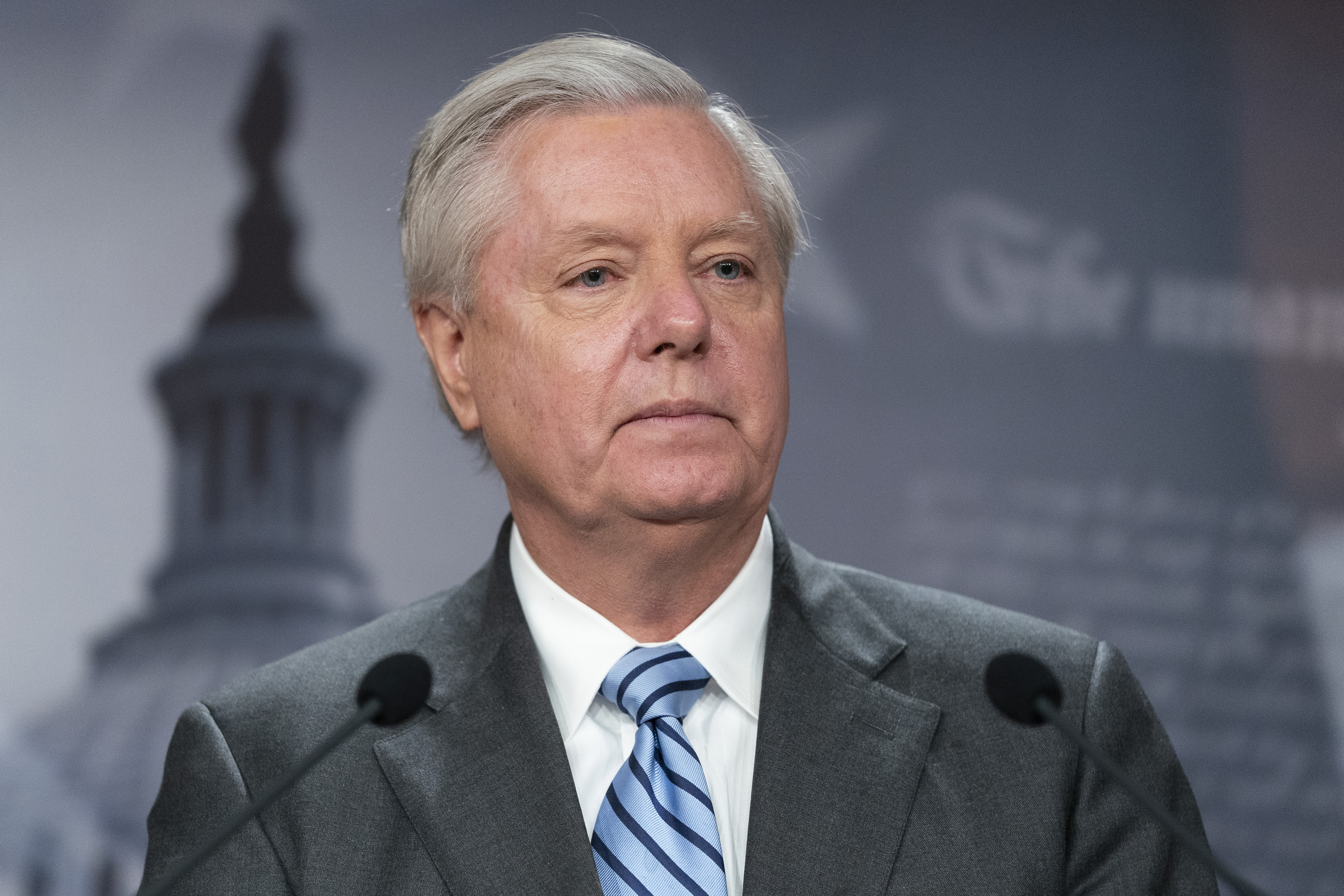
From Ed Mazza at HuffPost: ‘This Is Pathetic’: Lindsey Graham Ripped After ‘Groveling’ New Trump Message.
Sen. Lindsey Graham (R-S.C.) is catching hell from critics after suggesting that President Donald Trump could be the next pope.
Trump had jokingly floated the idea earlier in the day when asked who he’d like to see become the next pontiff after the death earlier this month of Pope Francis.
“I’d like to be pope,” Trump said. “That’d be my No. 1 choice.”
Graham then dialed it up a notch in a post on X, saying he was “excited” to hear that Trump was open to the role.
“This would truly be a dark horse candidate, but I would ask the papal conclave and Catholic faithful to keep an open mind about this possibility!” wrote Graham, who is a Southern Baptist. “The first Pope-U.S. President combination has many upsides. Watching for white smoke…. Trump MMXXVIII!”
That last bit is the Roman numeral for 2028.
Graham was likely joking as well, but his critics weren’t ready to offer any grace on this one.

Trump’s 100 days rally
I still say Trump is drunk with power and thinks he’s King. Last night he held a rally to mark his first 100 days in office. Prominent signs at the rally read, “The Golden Age.” and “100 Days of Greatness.”
Kevin Liptak and Jeff Zeleny: Trump’s 100-day rally: Familiar grievances, an ebullient crowd and a difficult task ahead.
Crossing the symbolic barrier between the first 100 days of his presidency and the 1,361 that remain, Trump basked in adulation from a supportive crowd and declared that he had just completed the “the most successful first 100 days of any administration in the history of our country.” He waxed nostalgic about his last act with familiar grievances and hyperbolic claims, and seized the moment to set a course for the next one.
Yet the events of the day only illustrated that for all the action he’s taken so far, difficult tasks remain ahead.
Even before he arrived in Michigan, Trump had taken steps to pull back from the auto tariffs he’d put in place weeks earlier, heeding warnings from auto executives and analysts who said the duties could add thousands of dollars to the price of a new car.
And he’d spent the morning fuming about a report Amazon might list tariff price hikes on its popular marketplace, issuing a warning to founder Jeff Bezos and declaring the move hostile (Amazon said after Trump’s call the plan was only an idea and wouldn’t be implemented).
The president is presiding over an increasingly skeptical public. His 41% approval rating in CNN’s latest poll is the worst for any modern president at the 100-day mark. His 39% approval for his handling of the economy marks a career low.
But surrounded by signs that declared this “THE GOLDEN AGE” at Macomb Community College in Warren, Michigan, Trump – and his supporters – were ebullient.
This man is delusional.
As the White House begins turning its full attention to the president’s legislative agenda, with a July deadline looming for his budget and tax plan, Trump spent very little time dwelling on the next 100 days that could play a large role in defining his presidency. He barely mentioned the economic anxieties that have weighed down his public approval, though his visit to Michigan highlighted his roller-coaster approach to tariffs, which are rooted in his long-held belief for how to revive American manufacturing.
The next chapter of this challenge is yet to play out as Trump balances the demands of automakers, who argue his tariffs could inflict deep economic pain, with the interests of the working class, whom he has sought to champion. But in his telling, his evolving tax and tariff moves had convinced automakers “to come back to Michigan and build cars again.”
“You finally have a champion for workers in the White House,” Trump said. “Instead of putting China first, I’m putting Michigan first and I’m putting America first.”
Trump hailed his hardline immigration policies as a signature accomplishment – one of the biggest “promises kept” from his campaign – and in an interview that aired later on ABC, he cast doubt on the idea that those alleged to be in the country illegally deserve due process.
“If people come into our country illegally, there’s a different standard. … They get a process where we have to get them out,” he continued. “They get whatever my lawyers say.”
 The BBC fact checked Trump’s brags in the speech: Border crossings, egg prices and jobs – Trump’s 100 days speech fact-checked.
Are petrol prices down ‘by a lot’?
Trump said “gasoline prices are down by a lot” since he took office.
On 29 April, the average price for a gallon of “regular” gas – or petrol – across the US was $3.16 (£2.36), according to data from the American Automobile Association (AAA).
That is slightly up from the $3.125 (£2.33) recorded by the AAA on the day Trump entered the White House.
In his speech, he added that gas prices had “just hit $1.98 in a lot of states”.
This is a claim he has made several times but we cannot find evidence of prices this low.
As of 29 April, no state had an average gas price lower than $2.67 (£1.99), according to the AAA.
Are egg prices down 87%?
The US president also spoke about the cost of eggs – a concern for many US consumers due to an ongoing bird flu outbreak – and said: “Since I took office, the cost of eggs is down 87%.”
This claim is false.
The average national price for consumers of a dozen large Grade A eggs when Trump entered office in January was about $4.95 (£3.70).
This rose to a record high of around $6.23 (£4.65) per dozen in March – according to the latest available figures.
The White House has pointed to wholesale egg prices as evidence of improvement.
Wholesale prices have gone down since Trump took office – but by about 52% – from $6.55 (£4.89) for a dozen large white eggs in January to $3.15 (£2.34) in the past week, according to the US Department of Agriculture.
Read more lies and corrections at the BBC link.
Let’s take a reality-based look at Trump’s “accomplishments.”
Bryan Mena at CNN: US economy goes into reverse from Trump’s abrupt policy shifts.
The US economy just had its worst quarter since 2022 as President Donald Trump’s significant policy changes unnerved consumers and businesses.
Gross domestic product, which measures all the goods and services produced in the economy, registered at an annualized rate of -0.3% in the first quarter, the Commerce Department said Wednesday.
That’s a sharp slowdown from the fourth quarter’s 2.4% rate, and much worse than the 0.8% rate economists projected. GDP is adjusted for seasonal swings and inflation.
US stocks dropped after the GDP report was released.
The Trump administration has been on a chaotic tariff spree over the past several months, escalating trade tensions with China and unsettling Americans. Most economists say Trump’s monumental bid to reshape global trade is likely to send inflation climbing in the United States and even trigger a recession.
The president, however, deflected blame from the weak figures reflected in the first economic report card of his second term.
“Our Country will boom, but we have to get rid of the Biden ‘Overhang.’” he wrote Wednesday in a post on social media. “This will take a while, has NOTHING TO DO WITH TARIFFS, only that he left us with bad numbers, but when the boom begins, it will be like no other. BE PATIENT!!!”
Read more at CNN.
More on Trump’s effect on the economy from Ben Casselman at The New York Times: Trump’s Cuts to Science Funding Could Hurt U.S. Economy, Study Shows.
Cutting federal funding for scientific research could cause long-run economic damage equivalent to a major recession, according to a new study from researchers at American University.
In recent months, the Trump administration has sought to cancel or freeze billions of dollars in grants to scientists at Columbia, Harvard and other universities, and has moved to sharply curtail funding for academic medical centers and other institutions. Deeper cuts could be on the way. As soon as this week, the White House is expected to propose sharp reductions in discretionary spending, including on research and development, as part of the annual budget process.
Economists have warned that such cuts could undermine American competitiveness in areas like vaccine development, artificial intelligence and quantum computing, and could slow growth in income and productivity in the long term. The private sector can’t fully replace government dollars, they argue, because basic research is too risky and takes too long to pay off to attract sufficient private investment.
The study, by a team of economists at American University’s Institute for Macroeconomic and Policy Analysis, is among the first efforts to quantify the risks posed by Mr. Trump’s cuts. Because the full extent of the administration’s plans is not yet clear, the researchers studied a range of scenarios.
Even the mildest approach — a 25 percent reduction in public support for research and development — would correlate to a drop in economic output.
U.S. gross domestic product, adjusted for inflation, would be 3.8 percent smaller in the long term — a decline similar in magnitude to that in the Great Recession, which ended in 2009. The drop in output would be much more gradual than that downturn, taking place over years rather than months. But it would also be more lasting. Cuts to scientific research would sap innovation, leading to slower productivity growth and, as a result, permanently lower economic output.
“It is going to be a decline forever,” said Ignacio González, one of the study’s authors. “The U.S. economy is going to be smaller.”
 ABC News: How Americans describe Trump’s term so far in 1 word: POLL.
Savior. Ungodly. Patriotic. Un-American. Great. Sad.
A hundred days into his presidency, all are words Americans used to describe President Donald Trump’s performance in office.
Responses run the full spectrum of possible assessments. On the positive side of the ledger in this ABC News/Washington Post/Ipsos poll: “Excellent.” “Awesome.” “Outstanding.” “Strong.” “Best president ever.”
And among the more negative comments: “Disaster.” “Chaotic.” “Appalling.” “Horrible.” “Atrocious.” “Catastrophic.”
As reported Sunday, Trump has a 39% job approval rating in this poll, produced for ABC by Langer Research Associates with fieldwork by Ipsos. That’s the lowest job approval rating at or near 100 days in office of any president dating back to 1945 (as far back as data are available).
Invited to use one word to express their personal reaction to Trump’s performance as president so far, some focused on their feelings: “Frightened.” “Excited.” “Horrified.” “Relieved.” “Worried.” “Angry.” “Confused.” “Happy.” “Devastated.”
“He’s doing a fantastic job of accomplishing all that we want him to and voted for him to do!”
“He’s a convicted criminal, he’s a horrible con man who thinks he’s a great businessman and he’s tanking the economy for some ‘give it to the libs’ reason. I did not vote for this.”
“Someone needs to step in and rein him in. He is overstepping his authority. What is really frightening is that the Republican leadership knows he is wrong and will not stop him. Fear of losing their own power.”
More at the ABC link.
Zack Beauchamp at Vox: Trump is losing. His administration is great at breaking things — but they’re failing in their bigger goal.
- Remove formal limits on their own powers.
- Compromise independent power centers such as the press and courts.
- Win compliance with the new regime from social elites and the mass public.
Trump has attempted all of these things. He has taken actions, like unilaterally declaring an end to birthright citizenship, that clearly violate the Constitution. He has targeted alternative power centers, launching an investigation into a Democratic fundraising platform and threatening the press. He has imposed sanctions on prominent law firms and universities in a bid to force compliance, and he has sold it all to the public as evidence he’s getting things done.
Yet in each arena, Trump is facing effective and mounting pushback. He is routinely losing in court. He is failing to silence the media. And he is losing support among the elite as his poll numbers plummet.
This failure is, in large part, a result of his team’s errors. While their approach broadly resembled foreign authoritarians’, it was a poor copy at every level — a strategically unsound campaign, with poorly thought-out tactics that were executed incompetently.
“We should thank [our] lucky stars that Trump chose to do this in the most stupid way possible,” says Lucan Way, a political scientist at the University of Toronto who studies democratic backsliding.
None of this is to say that American democracy is safe. Never before has a president been so committed to breaking the constitutional order and seizing power. We do not know whether America’s democratic institutions will hold when the pressure has been mounting for years rather than months. But the events of the first 100 days give us reason to hope.
Read Beauchamp’s detailed arguments at Vox.
Jamelle Bouie at The New York Times (gift link): The New Deal Is a Stinging Rebuke to Trump and Trumpism.
There is no question that Donald Trump’s ambition in the first 100 days of his return to the Oval Office was to set a new standard for presidential accomplishment. To rival, even surpass, the scope of Franklin Roosevelt’s efforts nearly a century ago, when he moved so quickly — and so decisively — that he established the first 100 days as a yardstick for executive action.
But as consequential as they have been, and as exhausting as they’ve felt to many Americans, these first months of Trump’s second term fall far short of what Roosevelt accomplished. Yes, Trump has wreaked havoc throughout the federal government and destroyed our relationships abroad, but his main goal — the total subordination of American democracy to his will — remains unfulfilled. You could even say it is slipping away, as he sabotages his administration with a ruinous trade war, deals with the stiff opposition of a large part of civil society and plummets in his standing with most Americans.
If measured by his ultimate aims, Trump’s first 100 days are a failure. To understand why he failed, we must do a bit of compare-and-contrast. First, let’s look at the details of Trump’s opening gambit. And second, let’s measure his efforts against the man who set the terms in the first place: Franklin Delano Roosevelt. To do so is to see that the first 100 days of Trump’s second term aren’t what we think they are. More important, it is to see that the ends of a political project cannot be separated from the means that are used to bring it into this world.
Trump began his second term with a shock-and-awe campaign of executive actions. He, or rather the people around him, devised more than 100 executive orders, all part of a program to repeal the better part of the 20th century — from the New Deal onward — as well as fundamentally transform the relationship between the federal government and the American people.
His ultimate aim is to turn a constitutional republic centered on limited government and the rule of law into a personalist autocracy centered on the rule of one man, Donald J. Trump, and his unlimited authority. Trump’s vision for the United States, put differently, has more in common with foreign dictatorships than it does with almost anything you might find in America’s tradition of republican self-government.
To that end, the president’s executive orders are meant to act as royal decrees — demands that the country bend to his will. In one, among the more than four dozen issued in his first weeks in office, Trump purports to purge the nation’s primary and secondary schools of supposed “radical indoctrination” and promote a program of “patriotic education” instead. In another, signed in the flurry of executive activity that marked his first afternoon back in the Oval Office, Trump asserts the power to define “biological” sex and “gender identity” themselves, in an attempt to end official recognition of trans and other gender nonconforming people….
Trump claims sovereign authority. He claims the right to dismantle entire federal agencies, regardless of the law. He claims the right to spend taxpayer dollars as he sees fit, regardless of what Congress has appropriated. He even claims the right to banish American citizens from the country and send them to rot in a foreign prison.
Trump has deployed autocratic means toward authoritarian ends. And the results, while sweeping, rest on a shaky foundation of unlawful actions and potentially illegal executive actions.
Read how Trump’s 100 days contrast with FDR at the gift link above.
More stories to check out today:
Julia Angwin at The New York Times: ‘This Is What We Were Always Scared of’: DOGE Is Building a Surveillance State.
Liz Dye at Public Notice: Trump demands states obey law he just announced via tweet.
Noah Berlansky at Everything is Horrible: Elon Musk is committing a genocide.
CNN: Gaza edges closer to famine as Israel’s total blockade nears its third month.
The Washington Post: Kamala Harris reemerges to condemn Trump as she weighs a run for governor.
The Washington Post: Federal workers required to report their daily location, email says.
The New York Times: Trump Fires Biden Appointees, Including Doug Emhoff, From Holocaust Museum.
The Washington Post: Jennifer Hegseth holds unorthodox role shaping Pentagon affairs.
CBS News: Life expectancy in southern states changed little for Americans born from 1900 to 2000, study finds.
That’s it for me today. What’s on your mind?
Wednesday Reads
Posted: February 14, 2024 Filed under: 2024 Elections, just because | Tags: Alejandro Mayorkas, Donald Trump, immigration, Jim Prokopiak, Joe Biden, Lindsey Graham, Merrick Garland, NATO, Pennsylvania state house, snowsstorms, special elections, Tom Suozzi, Ukraine, weather 7 CommentsGood Morning!!

Winter landscape, by Pablo Picasso
Yesterday, the Boston area was supposed to get up to a foot of snow. For several days, meteorologists predicted a huge winter storm was on the way. They were confident it would happen. But at the last minute, Mother Nature changed her mind. There was a big storm, but its path shifted to the South, and guess what we got where I live? Nada. Some sleet and rain.
I really love snowstorms, and I was looking forward to this one. In addition, the entire Boston school system was shut down and many businesses closed for the day. That has to be expensive, right?
We’ve had several of these failed predictions this winter. What is the problem? Are meteorologists predicting these storms too many days ahead? I don’t know. But I’m disgusted. I’m never believing their forecasts again. There is supposedly another snowstorm on the way. I’ll believe it when I see it.
On with today’s reads.
Yesterday’s Special Elections
Democrats got some good news last night as they won special elections in New York and Pennsylvania.
The Washington Post: Suozzi wins New York special election, replacing George Santos.
Democrat Tom Suozzi won a hotly contested special election for Congress on Tuesday, the Associated Press projected, retaking a seat in suburban New York and offering his party some reassurance amid high anxiety about President Biden’s political vulnerabilities.
Suozzi beat Republican nominee Mazi Pilip to replace Republican George Santos, who was indicted on a charge of fraud and then expelled from Congress late last year amid revelations that he fabricated much of his life story. The race for New York’s 3rd District — long viewed as a dead heat — played out in a suburban part of Long Island that favored President Biden by eight points in 2020 but then swung toward Republicans, backing Santos by the same margin.
With more than 93 percent of the vote counted early Wednesday, Suozzi led Pilip by nearly eight percentage points.
National issues dominated the campaign, making Tuesday’s vote this year’s first high-profile test of the parties’ messages on abortion, the economy and, above all, immigration. Suozzi represented the area for six years previously and campaigned as a moderate who wanted to work across the aisle. But with New York City struggling to absorb more than 100,000 migrants arriving from the southern border, much of the campaign centered on what polling suggests is Democrats’ toughest issue….
In New York, Suozzi’s victory capped a long list of Democratic wins in recent special elections, which have showcased the party’s ability to turn out its base and tap into anger at GOP-backed abortion restrictions since the Supreme Court overturned Roe v. Wade. Democrats spent millions of dollars attacking Pilip’s “pro-life” stance even though she said she would not support a national ban on abortion.

Road in the Village of Baldersbronde, Winter Day 1912, by Laurits Anderson Ring
I’m not sure immigration will be the Democrats’ “toughest issue” anymore, since Republicans in Congress refused to pass an immigration bill that was supported by the Border Patrol Union and the U.S. Chamber of Congress simply because Donald Trump order them to vote no.
Gregory Krieg at CNN: Takeaways from New York’s high-stakes special election.
Democrat Tom Suozzi is heading back to Congress after defeating Republican Mazi Pilip in the special election to replace serial fabulist and expelled former GOP Rep. George Santos. The result will further narrow the GOP’s already thin House majority and hand President Joe Biden’s party a boost as the general election campaign comes into focus….
Both parties poured cash into the race for New York’s 3rd congressional district, but Democrats’ fundraising and registration advantage combined with Suozzi’s brand – he’s spent most of the last 30 years at or around the center of Long Island politics – and a fired-up base, angry over the Santos fiasco, delivered a victory that means the House GOP will now become even harder to corral.
For Pilip, who has vowed to run again in the fall, defeat meant an almost immediate rebuke from Trump, who called her a “very foolish woman” in a social media post Tuesday night. Pilip refused until the final days of the campaign to say whether she voted for Trump in 2020, though she did follow his lead in dissing a highly touted bipartisan Senate border bill – a decision that helped Suozzi tie her more tightly to the former president over the last week….
The campaign was staked on a series of issues from the beginning: immigration, inflation, Israel and abortion. Suozzi talked about reproductive rights but didn’t make it a centerpiece of his campaign. Inflation has mostly leveled out. And there was no political or policy space to speak of between the candidates who both fully backed Israel.
On the immigration issue:
Understanding this, Pilip and Republicans set about hammering Suozzi over the migrant crisis in New York City, claiming he caused it along with Biden – a line that ultimately didn’t quite wash with voters who have long recognized Suozzi as a moderate or centrist. When Pilip suggested he was in league with the progressive “squad,” Suozzi at their debate was prepared.
“For you to suggest I’m a member of the squad,” he said, “is about as believable as you being a member of George Santos’s volleyball team.” (And that was before a knowing reference to Rick Lazio, which only seasoned New York voters would appreciate.)
Most notably, though, Suozzi and state Democratic leaders didn’t repeat their mistakes from 2022. They aggressively countered Pilip’s migrant message and it never felt like the issue, typically a winner for the GOP, put Suozzi on the backfoot.
The weather was a factor in this election. Many Democrats vote early or by mail, while Republicans mostly vote on election day. The snowstorm may have kept Republicans from getting to the polls.
If you’re interested, there’s another good analysis of the NY 3 election by Noah Berlatsky at Public Notice: NY-03 gives Republicans lots to worry about.

Super Moon, by Jef Bourgeau
NBC News on the Pennsylvania special election: Pennsylvania Democrats pad narrow state House advantage with special election win.
Democrats won a state House special election in Pennsylvania on Tuesday night, preserving the party’s narrow majority in the closely watched battleground state, The Associated Press projected.
In the race for the open seat in the 140th state House District, Democrat Jim Prokopiak, a school board member in Bucks County, defeated Republican Candace Cabanas.
Prokopiak’s victory gives Democrats a narrow 102-100 majority in the state House, preventing another tie in the chamber.
The party had a one-seat majority, 102-101, before Democratic Rep. John Galloway resigned after he won a judgeship in November.
His departure created a tie. But another resignation Friday, by Republican Joe Adams, gave Democrats a fresh 101-100 advantage.
Republicans control the state Senate, while Democrats hold the governorship.
The win in Bucks County — a purple slice of the northern suburbs of Philadelphia — was hailed as positive news by national Democrats, some of whom had viewed the contest as an early bellwether of the party’s fortunes among suburban voters ahead of the 2024 election.
Even the Biden campaign weighed in on the victory, touting it as evidence that Bucks County voters would reject Donald Trump in the fall.
“With control of the state House on the line, Pennsylvanians again defeated Republicans’ anti-abortion agenda and voted for Jim Prokopiak, a Democrat who has stood up for women and working people,” Biden campaign manager Julie Chavez Rodriguez said in a statement.
More News:
House Republicans spent yesterday impeaching Homeland Security Secretary Alejandro Mayorkas based on zero evidence.
David Kurtz at TPM Morning Memo: Congrats On Your Bogus Impeachment, Champ.
The GOP-led House finally got its act together enough to stage an impeachment performance last evening, claiming the scalp of Biden Homeland Security Secretary Alejandro Mayorkas.
The same three Republican members who stymied the effort last week voted against impeachment again, but Rep. Steve Scalise’s return from cancer treatment gave the Speaker Mike Johnson (R-LA) the critical vote he needed to complete the flimsiest impeachment in history:
no claims of high crimes or misdemeanors;
no evidence of wrongdoing or graft;
no shame in using impeachment to salve the hurt feelings of Donald Trump over his two impeachments and to boost Republicans’ signature election year issue:
immigrationxenophobia.It’s totally appropriate to categorize these kinds of maneuvers by Republicans as performative or as playing politics or as engaging in political stunts. All true. But it’s also fundamentally an abuse of power. House Republicans are hikacking the levers of power that come with the offices they hold to advance their own partisan political aims and hold on to that power.
Not every example of an alignment between official acts and partisan political advantage is an abuse of power. But when you strip away any ostensibly objective motive for the official act, when you offer no pretense for the official act, when you’re only using the powers of the office to further your own political aims, when you stretch the law and the rules and bend them to your own grubby ends, you’re engaged in abuse of power. When, at the same time, you’re engaging in the wholesale breaking of government and institutions for the sake of it, all you’re left with is politics of the grimy, self-serving, and self-perpetuating variety.
There will have to be a trial in the Senate, but the “impeachment” is dead there. This is disgusting.

Sven Kroner, Hocuspocus
President Biden condemned Trump’s attack on NATO and his encouragement to Russia to attack our European allies.
BBC News: Biden slams Trump criticism of Nato as ‘shameful.’
President Joe Biden has blasted criticism of Nato by his likely 2024 election challenger, Donald Trump, as “dumb”, “shameful” and “un-American”.
The Democrat assailed Mr Trump for saying he would “encourage” Russia to attack any Nato member that did not meet its defence spending quota.
Mr Biden said the remarks underscored the urgency of passing a $95bn (£75bn) foreign aid package for US allies.
The bill just passed the Senate, but it faces political headwinds in the House.
At the White House on Tuesday, Mr Biden said a failure to pass the package – which includes $60bn for Ukraine – would be “playing into Putin’s hands”.
He said the stakes have risen because of Mr Trump’s “dangerous” remarks over the weekend.
“No other president in history has ever bowed down to a Russian dictator,” Mr Biden said.
“Let me say this as clearly as I can. I never will. For God’s sake. It’s dumb. It’s shameful. It’s dangerous. It’s un-American.”
Lindsey Graham, to his everlasting shame, voted against aid to Ukraine, Israel, and Gaza.
The Washington Post: Lindsey Graham, a longtime foreign policy hawk, bows to Trump on Ukraine.
Last May, Lindsey Graham (R-S.C.) visited Ukrainian President Volodymyr Zelensky in Kyiv, warmly embracing the embattled leader and later urging President Biden to “do more” to help the nation as it fights off Russia’s invasion.

Friday Reads
Posted: September 8, 2023 Filed under: Afternoon Reads, Elon Musk, just because | Tags: Climate change, extreme heat, floating barriers, Georgia special grand jury report, Greg Abbott, IRS, Lindsey Graham, Russia, Starlink internet, Ukraine, Walter Isaacson 3 CommentsGood Afternoon!!
We in the Boston area are finally getting a taste of the extreme heat that much of the rest of the country has been experiencing. Yesterday and today, there were heat emergencies declared, and many schools sent kids home early because of the heat and no air conditioning. Obviously, we aren’t used to 100 degree heat indexes in September in this part of the country. I don’t know how Dakinikat has survived months of this heat. Republicans need to wake up and realize that their children and grandchildren are going to suffer from climate change, whether their ancestors believed in it or not.
From Scientific American: Half the World’s Population Faced Extreme Heat for at Least 30 Days This Summer.
It has been a grueling summer, with relentless heat breaking multiple records in many places around the world. In fact, June through August was the planet’s hottest documented three-month period, with July ranking as the hottest month ever recorded. A new analysis by the nonprofit organization Climate Central finds that more than 3.8 billion people were exposed to extreme heat that was worsened by human-caused climate change from June through August, and at least 1.5 billion experienced such heat every day of that period. Nearly every person on Earth saw high temperatures that were made at least twice as likely by global warming.
People cool off in fountains in Rome to deal with the heat.
It has been a grueling summer, with relentless heat breaking multiple records in many places around the world. In fact, June through August was the planet’s hottest documented three-month period, with July ranking as the hottest month ever recorded. A new analysis by the nonprofit organization Climate Central finds that more than 3.8 billion people were exposed to extreme heat that was worsened by human-caused climate change from June through August, and at least 1.5 billion experienced such heat every day of that period. Nearly every person on Earth saw high temperatures that were made at least twice as likely by global warming.
“It really is everywhere,” says Andrew Pershing, Climate Central’s vice president for science. “On a single day, the fact that more than half the people on the planet were experiencing climate-altered heat—that’s just really, really remarkable to me.”
More frequent, longer-lasting and more intense heat waves are among the clearest outcomes of rising global temperatures driven by the burning of fossil fuels. Numerous studies have found the fingerprints of climate change in heat waves from the Pacific Northwest to Europe. A study released by the World Weather Attribution (WWA) research group in July had already found that the heat waves in North America, Europe and China that month were made hotter—and many times more likely—by climate change. In fact, the North American and European events likely would not have occurred without climate change.
The new analysis was produced using Climate Central’s Climate Shift Index (CSI) attribution system, which estimates how much climate change has shifted the local odds of events such as extreme heat. The system, which is based on peer-reviewed science, scores global warming’s influence using the ratio of how often a given temperature occurs in the current climate, compared with a world without climate change. A CSI of 1 means there is a discernable influence from climate change, and CSIs between 2 and 5 mean it made those conditions two to five times more likely.
The organization’s worldwide temperature analysis during this year’s Northern Hemisphere summer found 48 percent of the world’s population experienced at least 30 days of extreme heat that was made at least three times more likely by climate change, and at least 1.5 billion people experienced heat at that level or higher for the entire summer. Many of those people were in areas closer to the equator, such as the Caribbean, northern Africa and Southeast Asia.

Read more at the link.
That asshole Greg Abbott won a temporary stay on his murderous barriers. CNN: Federal appeals court says Texas’ floating barriers can remain in Rio Grande for now.
The 5th US Circuit Court of Appeals issued a temporary stay Thursday night allowing the state of Texas to keep floating barriers in the Rio Grande.
A lower court judge had ordered Texas to take down the barriers by September 15 at its own expense. The panel’s decision Thursday puts that order on hold while the appeals court considers the case. It means that Texas does not have to start the process of removing the barriers, for now.
A worker helps deploy a string of large buoys to be used as a border barrier at the center of the Rio Grande near Eagle Pass, Texas. (AP Photo/Eric Gay)
The swift ruling by the 5th Circuit comes a day after US District Judge David Ezra wrote that Republican Gov. Greg Abbott needed permission to install the barriers, as dictated by law – a win for the Biden administration.
“Governor Abbott announced that he was not ‘asking for permission’ for Operation Lone Star, the anti-immigration program under which Texas constructed the floating barrier. Unfortunately for Texas, permission is exactly what federal law requires before installing obstructions in the nation’s navigable waters,” Ezra wrote in his ruling. The judge also found Texas’ self-defense argument – that the barriers have been placed in the face of invasion – “unconvincing.”
The controversial border buoys were deployed in the Rio Grande as part Operation Lone Star, Abbott’s border security initiative. In July, the Justice Department sued the state of Texas claiming that the buoys were installed unlawfully and asking the judge to force the state to remove them.

Let’s hope the stay is just so the judges can get up to speed on the issues. Those barriers are utterly monstrous and inhumane.
The report from the Fulton County, Georgia special grand jury has been released. This was the jury that was just investigative. They recommended people who should be charged, and the official grand jury issued final indictments.
CNN reports: Fulton County special grand jury recommended charges against Lindsey Graham, David Perdue and Kelly Loeffler.
The special grand jury in Fulton County investigating the 2020 presidential election in Georgia recommended charges against Republican Sen. Lindsey Graham of South Carolina and former GOP Sens. David Perdue and Kelly Loeffler of Georgia, according to the special counsel grand jury report released Friday.
Fulton County District Attorney Fani Willis did not charge the lawmakers when she returned an indictment last month against former President Donald Trump and 18 co-defendants in the sprawling racketeering case. It was up to the district attorney to decide how closely to stick to the special grand jury’s recommendations….
Graham, who appeared before the special grand jury last year after a court battle over his testimony, spoke with Georgia election officials after the 2020 election. His phone calls with Georgia Secretary of State Brad Raffensperger and his staff related to the possibility of finding enough fraud in the state that it could’ve tipped the election to Trump.
Raffensperger testified to the House January 6 committee thahis phone call with Graham made him “uncomfortable” because some of Graham’s suggestions could have led to “disenfranchising voters.”
Graham repeatedly prodded Raffensperger and his colleagues on the phone about the signature-matching of ballots in the Atlanta area. Raffensperger told CNN in November 2020 that he believed Graham “implied” that he should try to “throw out” some ballots in the heavily Democratic county….
Perdue, who lost his Senate run-off election in January 2021 while Trump was pushing his false claims of fraud, personally urged Georgia Gov. Brian Kemp to convene a special session of the legislature to help Trump’s quest to overturn the election. Loeffler, who also lost her runoff election in January 2021, was also at the meeting….
Special grand juries in Georgia cannot issue indictments and instead serve as an investigative tool. This special grand jury began hearing evidence in June 2022, and Willis used it to investigate efforts to overturn the 2020 election, an investigation sparked by Trump’s January 2021 phone call with Raffensperger where Trump asked him to “find” the votes he needed to win the state. The panel ultimately heard from 75 witnesses.
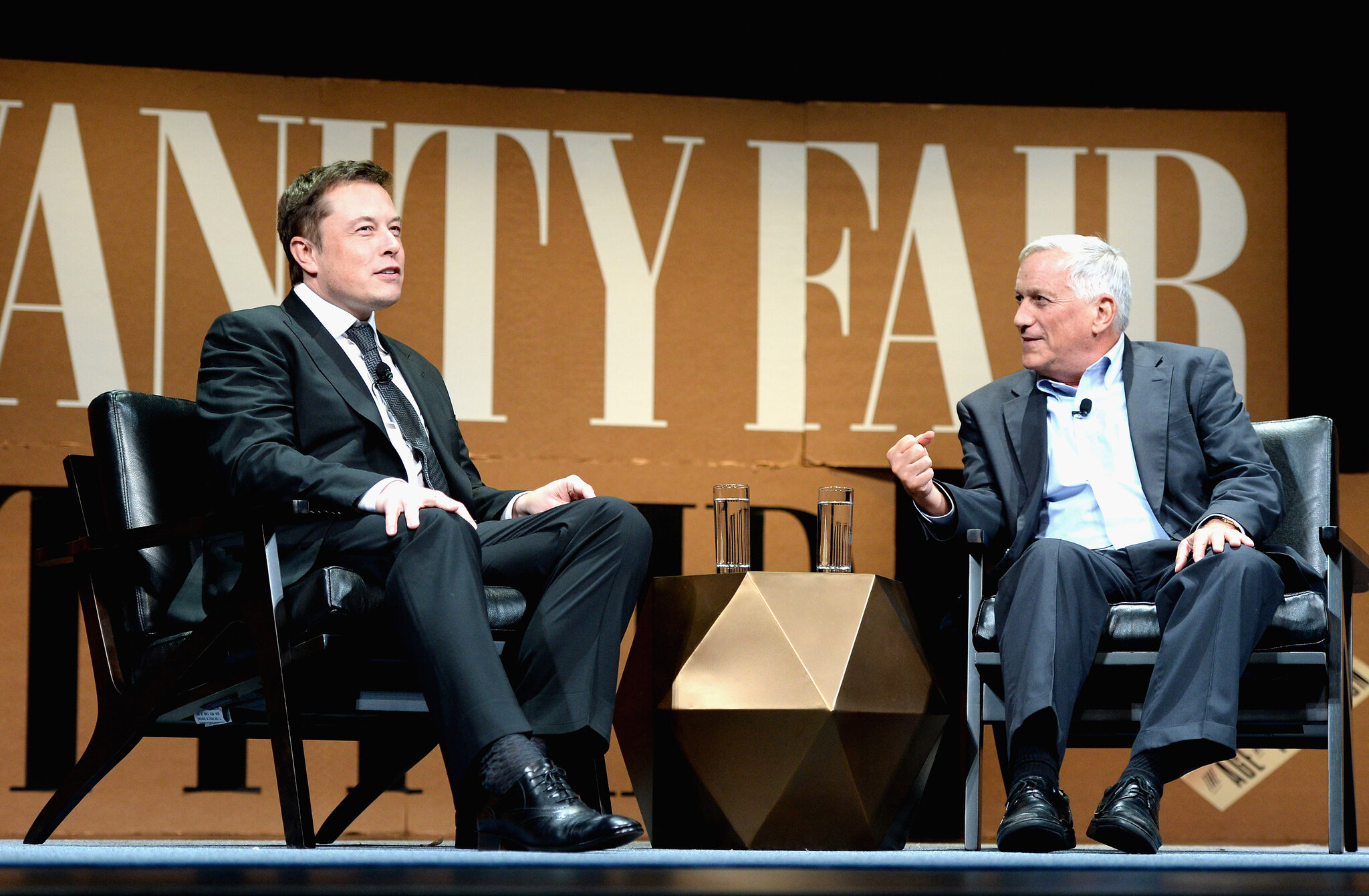
News has broken about Elon Musk’s interference in Ukraine, based on a new biography by Walter Isaacson.
CNN Exclusive: ‘How am I in this war?’: New Musk biography offers fresh details about the billionaire’s Ukraine dilemma.
Elon Musk secretly ordered his engineers to turn off his company’s Starlink satellite communications network near the Crimean coast last year to disrupt a Ukrainian sneak attack on the Russian naval fleet, according to an excerpt adapted from Walter Isaacson’s new biography of the eccentric billionaire titled “Elon Musk.”
As Ukrainian submarine drones strapped with explosives approached the Russian fleet, they “lost connectivity and washed ashore harmlessly,” Isaacson writes.
Musk’s decision, which left Ukrainian officials begging him to turn the satellites back on, was driven by an acute fear that Russia would respond to a Ukrainian attack on Crimea with nuclear weapons, a fear driven home by Musk’s conversations with senior Russian officials, according to Isaacson, whose new book is set to be released by Simon & Schuster on September 12.
Musk’s concerns over a “mini-Pearl Harbor” as he put it, did not come to pass in Crimea. But the episode reveals the unique position Musk found himself in as the war in Ukraine unfolded. Whether intended or not, he had become a power broker US officials couldn’t ignore.
Why is this monster still getting government money?
“There was an emergency request from government authorities to activate Starlink all the way to Sevastopol,” Musk posted on X, the platform formally known as Twitter that he owns. Sevastopol is a port city in Crimea. “The obvious intent being to sink most of the Russian fleet at anchor. If I had agreed to their request, then SpaceX would be explicitly complicit in a major act of war and conflict escalation.” [….]
A Ukrainian soldier disconnects a Starlink satellite dish near Kreminna, Ukraine. Credit…Clodagh KilcoyneReuters
After Russia disrupted Ukraine’s communications systems just before its full-scale invasion in February 2022, Musk agreed to provide Ukraine with millions of dollars of SpaceX-made Starlink satellite terminals, which became crucial to Ukraine’s military operations. Even as cellular phone and internet networks had been destroyed, the Starlink terminals allowed Ukraine to fight and stay connected.
But once Ukraine began to use Starlink terminals for offensive attacks against Russia, Musk started to second-guess that decision.
“How am I in this war?” Musk asks Isaacson. “Starlink was not meant to be involved in wars. It was so people can watch Netflix and chill and get online for school and do good peaceful things, not drone strikes.”
Musk was soon on the phone with President Joe Biden’s national security adviser, Jake Sullivan, the chairman of the joint chiefs, Gen. Mark Milley, and the Russian ambassador to the US to address anxieties from Washington, DC, to Moscow, writes Isaacson.
Meanwhile, Mykhailo Fedorov, a deputy prime minister of Ukraine, was pleading with Musk to restore connectivity for the submarine drones by telling Musk about their capabilities in a text message, according to Isaacson. “I just want you—the person who is changing the world through technology—to know this,” Fedorov told Musk.

Read more at CNN.
The New York Times: Elon Musk Acknowledges Withholding Satellite Service to Thwart Ukrainian Attack.
A top adviser to Ukraine’s president accused Elon Musk of enabling Russian aggression, after the billionaire entrepreneur acknowledged denying satellite internet service in order to prevent a Ukrainian drone attack on a Russian naval fleet last year.
The Starlink satellite internet service, which is operated by Mr. Musk’s rocket company SpaceX, has been a digital lifeline in Ukraine since the early days of the war for both civilians and soldiers in areas where digital infrastructure has been wiped out.
On Thursday, CNN reported on an excerpt from Walter Isaacson’s upcoming biography “Elon Musk,” later published by The Washington Post, that said the billionaire had ordered the deactivation of Starlink satellite service near the coast of Crimea last September to thwart the Ukrainian attack. The excerpt said that Mr. Musk had conversations with a Russian official that led him to worry that an attack on Crimea could spiral into a nuclear conflict.
I remember when Musk claimed he had spoken directly with Putin.
Later on Thursday, Mr. Musk responded on his social media platform to say that he hadn’t disabled the service but had rather refused to comply with an emergency request from Ukrainian officials to enable Starlink connections to Sevastopol on the occupied Crimean peninsula. That was in effect an acknowledgment that he had made the decision to prevent a Ukrainian attack.
“The obvious intent being to sink most of the Russian fleet at anchor,” he wrote on X, formerly known as Twitter. “If I had agreed to their request, then SpaceX would be explicitly complicit in a major act of war and conflict escalation.”
That drew an angry response from Mykhailo Podolyak, a senior adviser to President Volodymyr Zelensky of Ukraine. Mr. Musk’s “interference,” he said, had allowed Russia’s naval fleet to continue firing cruise missiles at Ukrainian cities.
“As a result, civilians, children are being killed. This is the price of a cocktail of ignorance and big ego,” he wrote on X.
Elon Musk and Walter Isaacson
The account in the biography further confirms the ways in which Mr. Musk’s control over Starlink appears to be affecting Ukraine’s military. In July, The New York Times reported on Mr. Musk’s refusal to allow the service to work near Crimea, and the broader challenges Ukrainian officials were facing because of the country’s huge dependence on Starlink.
The more than 42,000 Starlink terminals are also in use by hospitals, businesses and aid organizations across Ukraine.
But Mr. Musk has repeatedly stoked controversy around access to Starlink, saying last October that he could not “indefinitely” finance Ukraine’s use of Starlink, then abruptly reversing course. The near-total control that he wields over connectivity in the war zone has prompted concern about his influence.
In February, Ukrainian officials were angered after a SpaceX executive said that Starlink had taken steps to curtail the Ukrainian military’s use of the technology to control drones, a week after Mr. Musk said the company was “not allowing Starlink to be used for long-range drone strikes.” SpaceX has also used a process called geofencing to restrict where Starlink is available on the front lines.
Because Starlink is a commercial product rather than a traditional defense contractor, Mr. Musk is able to make decisions that may not be aligned with U.S. interests, analysts have said.
One more and then I’ll wrap this up. It appears that the IRS is actually going after superrich people.
The New York Times: I.R.S. Deploys Artificial Intelligence to Target Rich Partnerships.
The Internal Revenue Service has started using artificial intelligence to investigate tax evasion at multibillion-dollar partnerships as it looks for ways to better police hedge funds, private equity groups, real estate investors and large law firms.
The announcement on Friday demonstrated how a more muscular I.R.S. is using some of the $80 billion allocated through last year’s Inflation Reduction Act to target the wealthiest Americans and tackle the kinds of cases that had become too complex and cumbersome for the beleaguered agency to handle.
The agency’s new funding is intended to help the I.R.S. raise more federal revenue by cracking down on tax cheats and others who use sophisticated accounting maneuvers to avoid paying what they owe. But the allocation has been politically contentious, with Republicans claiming that the I.R.S. will use the funding to harass small businesses and middle-class taxpayers. Earlier this year, Republicans succeeded in clawing back $20 billion as part of an agreement to raise the nation’s borrowing cap.
That political fight has put the onus on Democrats and the Biden administration to show that the funding is primarily enabling the I.R.S. to target the rich.
“These are complex cases for I.R.S. teams to unpack,” Daniel Werfel, the I.R.S. commissioner, said in a briefing with reporters. “The I.R.S. has simply not had enough resources or staffing to address partnerships; in a real sense, we’ve been overwhelmed in this area for years.”
Mr. Werfel explained that artificial intelligence is helping the I.R.S. identify patterns and trends, giving the agency greater confidence that it can find where larger partnerships are shielding income. That is leading to the kinds of major audits that the I.R.S. might not have previously tackled.
The agency said it would open examinations of 75 of the nation’s largest partnerships, which were identified with the help of artificial intelligence, by the end of the month. The partnerships all have more than $10 billion in assets and will receive audit notices in the coming weeks.
Sounds good to me.
That’s all I have today. Have a great weekend everyone!!
Fabulous Friday Reads
Posted: October 21, 2022 Filed under: 2022 Elections, abortion rights, Donald Trump, Economy, inflation, morning reads, Steve Bannon | Tags: criminal contempt, Elon Musk, Georgia election interference case, January 6 Committee, Joe Biden, Kash Patel, Kelly Loeffler, Lindsey Graham, Pat Cipollone, stolen documents case, Twitter 29 Comments
Portrait of a woman reading in bed, Nicoline Tuxon, Danish painter
Good Morning Sky Dancers!!
Steve Bannon is in court for his sentencing hearing right now. I’m keeping an eye out for the final decision, but so far Judge Carl Nichols has said he will have to serve at least a month in prison because that is the mandatory minimum sentence for contempt of Congress. The maximum is 2 years. According to CNN, the judge has called a short recess, after which he will announce the sentence. Bannon declined to speak, saying that his lawyers had spoken for him. I’ll update the post as soon as I learn Judge Nichols’ final decision.
UPDATE: Bannon sentenced to 4 months in prison. Obviously, he will appeal his conviction. From Yahoo News: Steve Bannon sentenced to 4 months in prison for criminal contempt of Congress.
WASHINGTON — Steve Bannon, ex-White House strategist and adviser to former President Donald Trump, was sentenced Friday to four months in federal prison and a $6,500 fine for refusing to appear before the House select committee investigating the Jan. 6, 2021, assault on the U.S. Capitol.
U.S. District Court Judge Carl Nichols sentenced Bannon to four months each on two counts of criminal contempt of Congress, but the prison terms will be served concurrently.
A jury found Bannon guilty of the charges in July of two counts of criminal contempt — one for refusing to appear for a deposition before the panel and the other for refusing to produce requested documents. Each count carries a minimum potential sentence of 30 days and a maximum of one year in jail, as well as a fine of $100 to $1,000.
Federal prosecutors sought six months in jail, while Bannon’s attorneys asked the court for probation.
Trump’s legal problems continue to escalate. Down in Georgia, former White House Counsel Pat Cippolone, and form George Senator Kelly Loeffler have each testified to the grand jury in the election interference case, and Lindsey Graham has been ordered to testify as well. And Trump crony Kash Patel has testified to the grand jury in stolen documents case.
Prosecutors in Georgia have secured grand jury testimony from two prominent witnesses – former US Sen. Kelly Loeffler and former White House Counsel Pat Cipollone – in their investigation into efforts to overturn the 2020 election results in that state, sources familiar with the matter tell CNN.
Laurits Tuxon, Portrait of his daughter looking at some drawings
Their grand jury appearances in recent months, which have not been previously reported, highlight the wide-ranging investigation underway as Fulton County District Attorney Fani Willis probes efforts by former President Donald Trump and his allies to try to keep him in power.
Cipollone was the top White House lawyer at the end of the Trump administration and attended some of the meetings where Trump and his allies discussed ways to subvert the election results. He was among the former President’s advisers who pushed back along with the Justice Department, which found no evidence to support the claims of widespread fraud.
Cipollone has provided testimony to the House select committee investigating the January 6, 2021, attack on the US Capitol, as well as to a federal grand jury in the Justice Department’s criminal investigation, where he invoked Trump’s privilege claims to decline to answer some questions. He declined to comment on questions about the grand jury.
The revelation that Loeffler testified before the grand jury comes as hundreds of Loeffler’s text messages have surfaced, revealing new details about the Georgia Republican’s correspondence about efforts to challenge the election in the months leading up to and immediately following the January 6, 2021, attack on the US Capitol.

More details at the CNN link.
The Washington Post: Lindsey Graham must testify in 2020 election investigation, court rules.
Sen. Lindsey O. Graham (R-S.C.) must appear before a Georgia grand jury investigating possible attempts by President Donald Trump and his allies to disrupt the state’s 2020 presidential election, a federal appeals court said Thursday.
Graham’s lawyers had asked the court to block a subpoena from Fulton County District Attorney Fani Willis (D), claiming that a sitting senator is shielded from such investigations. But a three-judge panel of the U.S. Court of Appeals for the 11th Circuit denied Graham’s request and upheld a lower-court ruling narrowing the range of questions prosecutors can ask.
“Senator Graham has failed to demonstrate that this approach will violate his rights under the Speech and Debate Clause,” the order states, referring to the constitutional provision that protects lawmakers from being questioned about legislative activity.
Graham can ask the full appeals court to reconsider the order or ask the Supreme Court to intervene….
Willis wants to question Graham about calls he made to Georgia election officials soon after Trump lost the election to Joe Biden. Prosecutors say Graham has “unique knowledge” about the Trump campaign and the “multistate, coordinated efforts to influence the results” of the 2020 election in Georgia and elsewhere.
Graham’s legal team has said in court filings that his actions were legitimate legislative activity protected by the Constitution’s “speech and debate clause.”

Nikolai Bogdanov-Belsky, The schoolgirl reading by lamplight
CNN: Trump adviser Kash Patel has appeared before grand jury in Mar-a-Lago document probe.
Kash Patel, a top adviser to former President Donald Trump who has been deeply involved in disputes over classified records Trump kept from his presidency, appeared recently before the federal grand jury looking into the handling of documents at Mar-a-Lago, sources familiar with the matter tell CNN.
Patel spent several hours throughout the morning of October 13 before a grand jury at the US courthouse in Washington, DC. But it’s not clear if Patel answered the grand jury’s questions or declined to respond citing his Fifth Amendment protections, which is within his rights.
He is one of a handful of advisers around Donald Trump after his presidency who could have legal risk related to the Mar-a-Lago situation, according to court records and the sources, though it’s unclear if he is a target of the Justice Department probe. Patel served as a national security and defense official during the administration, and this summer became one of Trump’s designees to interact with the National Archives and the Justice Department as both agencies have tried to repossess classified records Trump kept from his presidency.
He has claimed in media interviews he personally witnessed Trump declassifying records before he left the presidency, and has argued he should be able to release classified information….
CNN spotted Patel walking the halls of the federal courthouse mid-morning last Thursday, remaining in the grand jury area for several hours until about 1 p.m. One of his attorneys, Stanley Woodward, ducked out of the ongoing Oath Keepers trial where he is a defense attorney for another defense client to escort Patel, wearing a bold red plaid jacket, down from the grand jury meeting area and out of the building. When asked at the courthouse by CNN, Woodward refused to say what Patel’s matter was about, and only confirmed that he represented the Trump adviser.
Read more at CNN.
Amanda Marcotte has a good article at Salon about the mainstream media’s election coverage: Please, media, stop pitting abortion against inflation — Republicans suck on both issues.
Cable news in the weeks before an election is the ninth circle of hell. For proof, look no further than the way MSNBC subjected Georgia’s Democratic gubernatorial candidate Stacey Abrams to an interview by 79-year-old white guy plagiarist and organized crime apologist Mike Barnicle. Abrams, whose only crime is being a “Star Trek” nerd who wants Georgia to suck less, was subjected to this crotchety fraud demanding she stop talking about abortion rights so much, arguing that what voters supposedly care about is “the cost of gas, food, bread, milk, things like that.” Because, as all old men who have never changed a diaper know, having and raising babies is totally free, unlike a gallon of gasoline.
The Ruby Ring, by Thomas Linker
Abrams handled the question as well as she could, pointing out that you “can’t divorce being forced to carry an unwanted pregnancy from the economic realities of having a child.” She went on to outline her plans to help Georgians with rising housing prices and other economic problems. But as much as it’s fun to kick around Barnicle for being out of touch, the sad truth is the false premise of his question is endemic throughout the mainstream media coverage of the 2022 midterm elections. Everywhere you turn, pundits and reporters are treating this election as if it’s a choice between fighting inflation and protecting abortion rights.
This is, and it cannot be stressed enough, total hooey. When it comes to the ballot box, there is absolutely no trade-off between reproductive rights and the economy. Either way, voting Republican is bad: Bad for the economy, bad for abortion rights. Pretending otherwise is misleading to the point of outright dishonesty.
To say Republicans have no plan to fight inflation if they retake Congress is really an understatement. They have nothing concrete to offer about the issue beyond using it as a stick to beat Democrats with. The second polls close on Election Day, all GOP interest in relieving Americans’ economic woes will dry up.
We know this because Republicans aren’t even being subtle about their future plans, which most definitely do not involve giving a fig about inflation. As Heather “Digby” Parton wrote for Salon on Wednesday, Republicans are largely plotting to gin up fake scandals to demonize President Joe Biden. And that’s the best-case scenario.

Read the whole thing at Salon. It’s excellent.
President Joe Biden made the same point yesterday. Susan Glasser at The New Yorker: Joe Biden’s Walk-and-Chew-Gum Campaign.
For most of President Joe Biden’s tenure, Fox News’s Peter Doocy has played the role of pressroom scourge. A barbed question so nettled Biden back in January that the President was caught on a live microphone calling him a “stupid son of a bitch,” for which he quickly called Doocy to apologize. That specific query is the same one that still haunts Biden’s Presidency and his party today: “Do you think inflation is a political liability ahead of the midterms?” The answer, then and now, can be nothing other than the blindingly obvious: yes.
Doocy, at the tail end of a White House photo opportunity. With less than three weeks to go before the midterm elections, the President was signing an order to release fifteen million more barrels of oil from the Strategic Petroleum Reserve. “It’s not politically motivated at all,” Biden insisted, though even the most diehard Democrat would have a hard time seeing the move as anything other than a last-ditch effort to stop gas prices at the pump from rising further before the vote. Republicans were quick to pounce: Was this the kind of strategic use for which the stockpile was intended?
As Biden stood to leave, Doocy shouted a question. “Top domestic issue: Inflation or abortion?” he asked.
“They’re all important. Unlike you, there’s no one thing,” Biden retorted. “We oughta be able to walk and chew gum at the same time.”

In The Book Store, by Irina Sztukowski
Finally, The Washington Post has an exclusive on Elon Musk’s plans to destroy Twitter if he manages to buy it: Documents detail plans to gut Twitter’s workforce.
Twitter’s workforce is likely to be hit with massive cuts in the coming months, no matter who owns the company, interviews and documents obtained by The Washington Post show, a change likely to have major impact on its ability to control harmful content and prevent data security crises.
Elon Musk told prospective investors in his deal to buy the company that he planned to get rid of nearly 75 percent of Twitter’s 7,500 workers, whittling the company down to a skeleton staff of just over 2,000.
Even if Musk’s Twitter deal falls through — and there’s little indication now that it will — big cuts are expected: Twitter’s current management planned to pare the company’s payroll by about $800 million by the end of next year, a number that would mean the departure of nearly a quarter of the workforce, according to corporate documents and interviews with people familiar with the company’s deliberations. The company also planned to make major cuts to its infrastructure, including data centers that keep the site functioning for more than 200 million users that log on each day.
The extent of the cuts, which have not been previously reported, help explain why Twitter officials were eager to sell to Musk: Musk’s $44 billion bid, though hostile, is a golden ticket for the struggling company — potentially helping its leadership avoid painful announcements that would have demoralized the staff and possibly crippledthe service’s ability to combat misinformation, hate speech and spam.
The impact of such layoffs would likely be immediately felt by millions of users, said Edwin Chen, a data scientist formerly in charge of Twitter’s spam and health metrics and now CEO of the content-moderation start-up Surge AI. He said that while he believed Twitter was overstaffed,the cuts Musk proposed were “unimaginable” and would put Twitter’s users at risk of hacks and exposure to offensive material such as child pornography.
“It would be a cascading effect,” he said, “where you’d have services going down and the people remaining not having the institutional knowledge to get them back up, and being completely demoralized and wanting to leave themselves.”
Twitter is where I go to get the very latest breaking news, but I guess the days of being able to do that are numbered.
What are your thoughts on these stories? What else is on your mind today?
Thursday Reads
Posted: March 24, 2022 Filed under: Afternoon Reads | Tags: Brett Kavanaugh, Brussels, Joe Biden, Josh Hawley, Ketanji Brown Jackson, Lindsey Graham, Madeline Albright, NATO, Poland, Roe v. Wade, SCOTUS, Ted Cruz, Ukraine, Ukraine war, Vladimir Putin 24 CommentsGood Afternoon!!
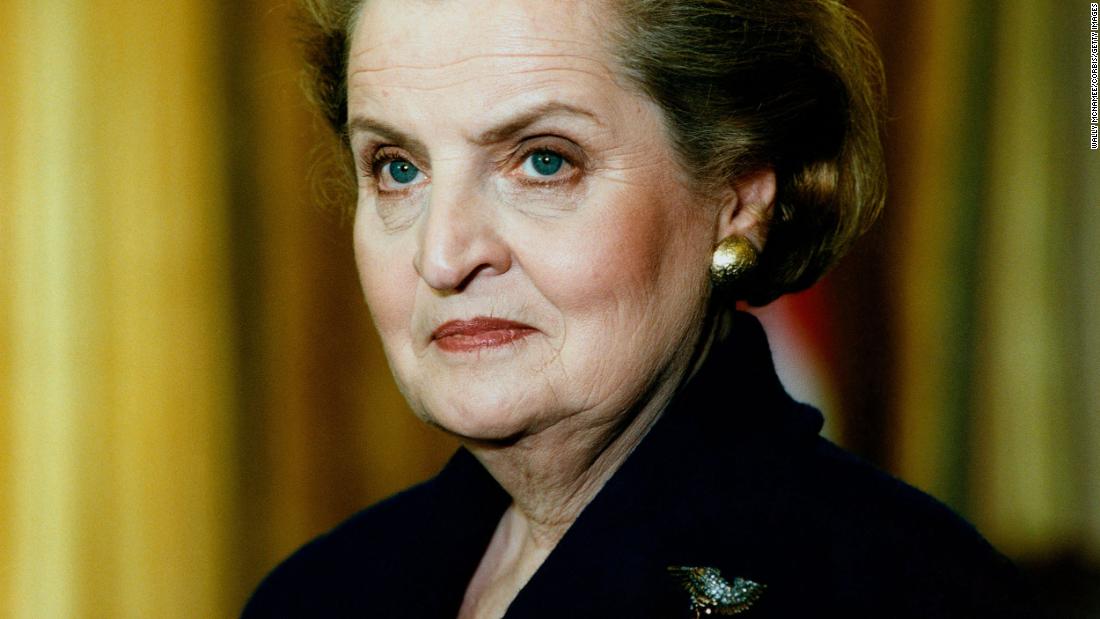
It’s another big news day. We lost Madeline Albright, the first woman to serve as U.S. Secretary of State, paving the way for other women to meet with NATO allies and announce new sanctions on Russia. Afterwards, he will visit Poland and perhaps even go to the border of Ukraine. Today is the final day of the hearings on Ketanji Brown Jackson’s nomination to the Supreme Court. Today will be dedicated to testimony from people who support or oppose her nomination. The Ukraine war continues, with reports of Ukrainian victories and numerous analyses of the failure of Putin’s efforts to subdue it’s neighbor. I’ll get to as much of this news as I can.
Madeline Albright
The Washington Post: Madeleine Albright, first female secretary of state, dies at 84.

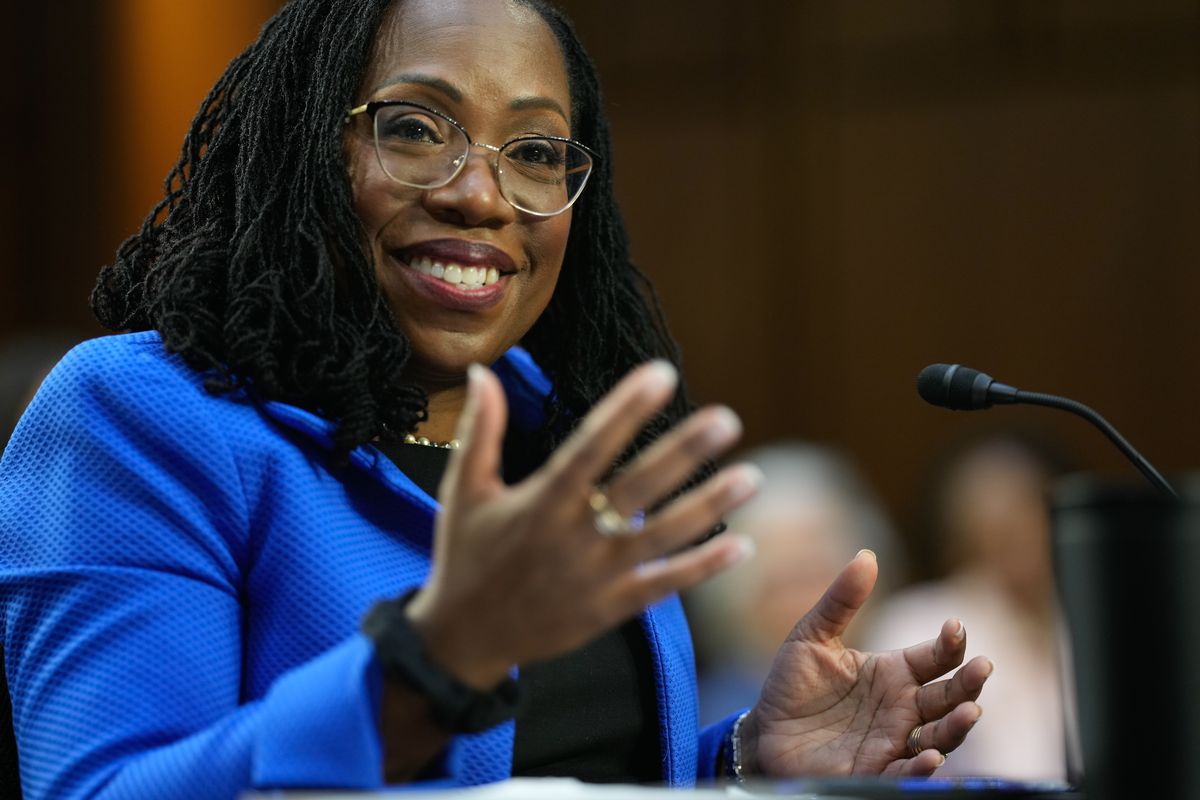
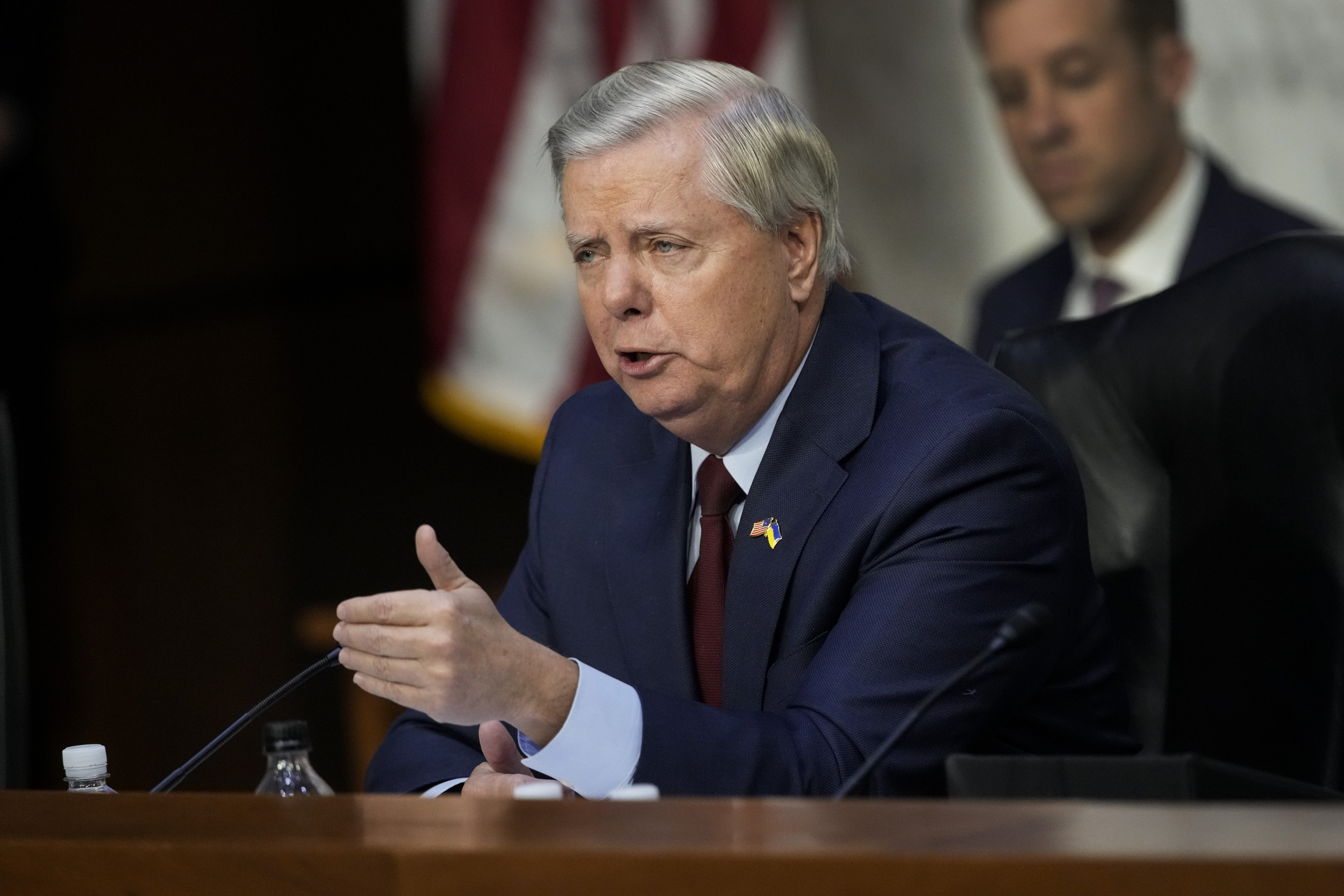 Mr. Graham also attacked Judge Jackson for her work defending Guantánamo Bay detainees, acknowledging that no one should judge her for representing unpopular defendants or advocating zealously for her clients — and then proceeding to do just that.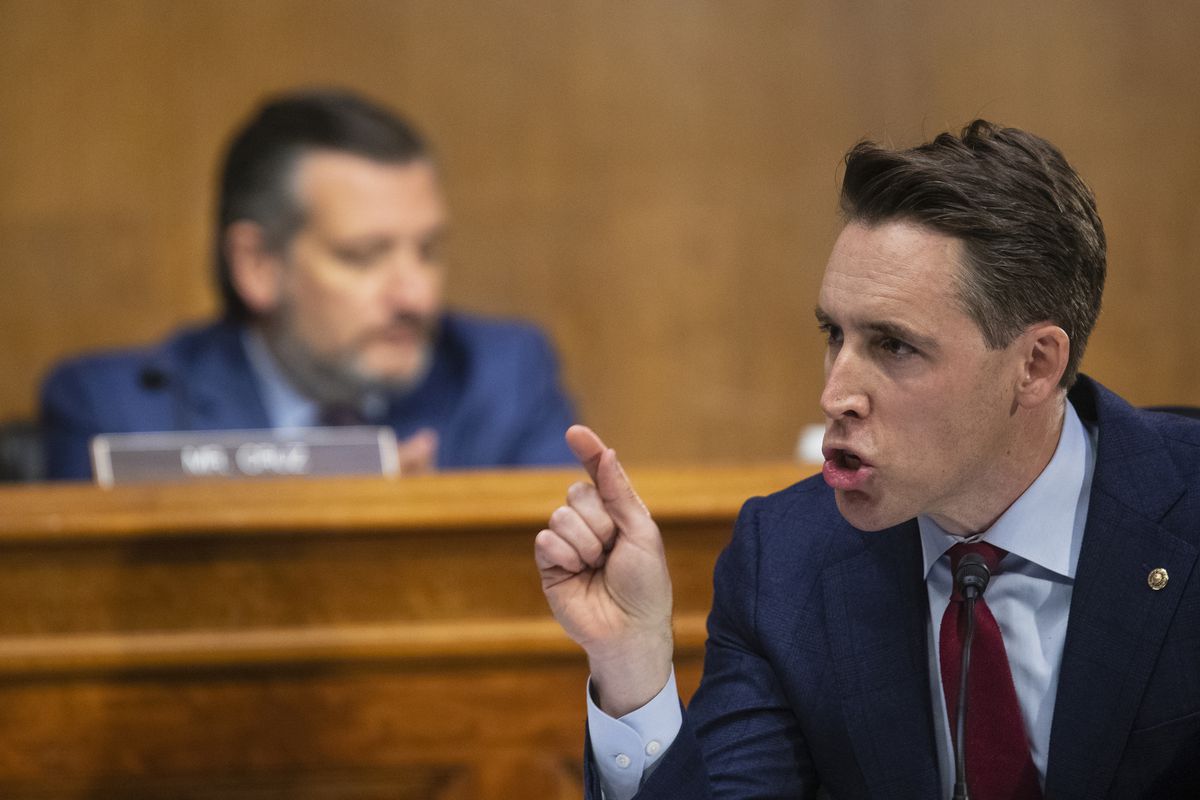

 peej
peej Carissa
 bostonboomer
 dakinikat
 ecocatwoman
 mablue2
 Mama Lopez
 peggysue22
 quixote
 skydancingguestblogger
 Mona (aka Wonk the Vote)



 Sky Dancing
Recent Comments