
Where is Iman al-Obeidi?
Posted: March 28, 2011 Filed under: Foreign Affairs, Libya, Violence against women, Women's Rights | Tags: Benghazi, Charles Clover, gang rape, Human Rights, Iman al Obeidi, journalists, Libya, Moammar Gaddafi, rape, Women's Rights 21 Comments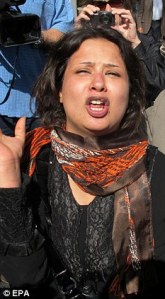
Iman al-Obeidi
The Libyan government claims she has been released and is staying with her sister in Tripoli. But al-Obeidi’s parents say she is still being held in Gaddafi’s private residence. Her mother also says that al-Obeidi has been offered a bribe to change her story.
The mother of Eman al-Obaidi said she received a call from an unidentified person purportedly representing the regime, the parents told Al Jazeera news.
The caller asked the family to tell Ms al-Obaidi to change the rape claim in return for her freedom and benefits, including a house or money, according to the victim’s mother.
According to the UK Telegraph,
Aisha Ahmad, who lives in the rebel-held eastern town of Tobruk, told The Washington Post she had passed on the request to her daughter, who had rejected it.
“I am very happy, very proud,” said Mrs Ahmed.
Iman al-Obaidi, a 26-year-old law student in Tobruk, was held last week after she burst into a Tripoli hotel where foreign journalists are staying and told them of the attack.
“Film me, film me, show the whole world what they did to me,” Miss Obaidi had screamed, as she was dragged off by security guards.
Musa Ibrahim, the Libyan government’s spokesman, said Miss Obaidi has been freed, “but the prosecution is still questioning her to determine the circumstances (of her claim).”
So if government agents are questioning her, are they doing it at Gaddafi’s palace or in her sister’s home? Is the sister al-Obeidi is supposedly staying with the same sister her was used by the Libyan government to smear her? <a href="“>From the Guardian story:
…a man claiming to be her cousin told Reuters that Obeidi was targeted by authorities after taking part in a protest in the west of the country during the initial days of the uprising against Gaddafi.
Wadad Omar said his cousin worked for a tourism company in Tripoli and was detained along with three other women who took part in the protest as they returned to the Libyan capital.
The government also used Obeidi’s sister to denounce her publicly, Omar said: “(Obeidi’s) sister went on television to say her sister is crazy. Muammar wants to prove to the world that she is insane. She (the sister) is certainly under pressure from the government.”
If it is the same sister, how can we be sure that al-Obeidi wants to be with her or that she is safe from further attacks or even torture?
There are reports that either four or five men have been arrested in the case, one of them the “son of a high-ranking official.”
Today protesters in Benghazi organized a rally in support of Iman al-Obeidi.
Following disturbing pictures of Ayman Al Abidi that hit the TV airwaves in Benghazi almost 24 hours after the alleged incident, there was outrage in this rebel capital. Men and women held a rally in support of her and marched towards the courthouse in Benghazi. “We are very sad for this and no will accept what happened,” said a Libyan protestor.Many people in Libya are concerned about her situation and they say that is just a glimpse of what they’ve been facing for decades.
Al-Jazeera reported:
Several doctors say they have found Viagra tablets and condoms in the pockets of dead pro-Gaddafi fighters, alleging that they were using rape as a weapon of war.
They say they have been treating female rape survivors who were allied with pro-democracy forces.
At the Financial Times, Charles Clover, one of the journalists who tried to help Iman al-Obeidi and was knocked down and kicked by Libyan security men for his trouble, writes about his experience:
Ms Obeidi said she had been arrested at a checkpoint on Salahidin Street in Tripoli “because I am from Benghazi”, and then held and repeatedly raped by 15 soldiers over two days.
Hearing the disturbance, a group of waiters and waitresses came over and tried at first to soothe her, then, when that did not work, to shut her up.
Suddenly a melee broke out between journalists and hotel staff. A group of athletic leather-jacketed men barrelled in and began throwing us around the room, chasing Ms Obeidi around the restaurant and finally putting a coat over her head. Many of the journalists at the Rixos jumped into the fray, trying to protect her, but it was a battle we were certain to lose.
Cameras were smashed and one journalist was punched in the face. I ended up wrestling for my Dictaphone, getting thrown down and kicked.
Clover has been told that he is “no longer welcome in Libya,” but he believes that the incident in which he was a bit player is a real tipping point.
All the careful efforts of the Libyan government to nurture their parallel reality were demolished that day. The hired mobs, the theatrical set pieces designed for foreign press consumption, and the alleged civilian casualties of the allied air campaign for which we have been shown little evidence – they all came crashing down, because of one woman’s bravery and desperation.
The questions remains: where is Iman al-Obeidi now? According to Anderson Cooper,
A group of lawyers and human rights activists tried to approach her sister’s house Monday, but were blocked by security forces. Al-Obeidy’s sister’s mobile phone has apparently been turned off, a source with the Lebanese opposition in Tripoli told CNN. And no one has seen the sister since the incident at the hotel.
Journalists and human rights activists much continue their demands to talk to al-Obeidi. She must not be disappeared by Gaddafi’s storm troopers. She is a living symbol of what Libyan rebels are fighting for–freedom of movement and association, freedom to speak truth to power, freedom to control one’s own body.
Yes, I know women are not treated equally in Arab cultures. Guess what? We aren’t treated equally here either. We need to stand up and fight for our rights just as this “lone, brave woman,” — as Charles Clover referred to her — fought for hers. And we must stand with her now and demand that she be freed and returned to her family.
Monday: Hillary, Gerry, and No Limits
Posted: March 28, 2011 Filed under: Hillary Clinton: Her Campaign for All of Us, morning reads, Women's Rights | Tags: Clinton-Gates joint interviews, Egypt, Geraldine Ferraro, Gulf Oil Spill, Libya, Sarkozy/Merkel defeats, Syria, The Battle for Human Rights, Where is Eman al Obeidi 72 Comments
U.S. Secretary of State Hillary Clinton appears during a pre-taping of "Face the Nation" to discuss the latest developments in Libya, Syria and the Middle East, in Washington March 26, 2011. (Reuters)
Hey all. Wonk the Vote here filling in with some Monday Reads for Kat while she rests up. Get well soon, Kat! We’re all thinking of you and sending you healing thoughts.
Alright news junkies, let’s get this morning roundup started.
Hillary on the Sunday Shows
- Yesterday Hillary did a bunch of joint interviews with Robert Gates on the Sunday morning shows, basically doing all the leg work for Obama’s speech tonight. If you missed the Clinton-Gates interviews and would like to judge for yourself, Stacy at SecyClintonBlog has all the transcripts and videos up here.
- Poor witto Chris Wallace whines that Clinton and Gates didn’t go on Fox News Sunday. Paranoid, much? Clinton and Gates didn’t appear on CNN, either.
- I’ll let the headlines do the summarizing:
NYT: Clinton and Gates Defend Mission in Libya.
Huffpo/AP: Clinton, Gates: Libya Operation Could Last Months.
David Gregory: Clinton and Gates try to clarify U.S. involvement in Libya.
CBS News: Clinton: No military action in Syria for now.
Jake Tapper’s Political Punch: Clinton Cites Rwanda, Bosnia in Rationale for Libya Intervention. From the link:
In an interview with ABC News’ Senior White House Correspondent Jake Tapper on “This Week,” Clinton said that the United Nations-backed military intervention in Libya “is a watershed moment in international decision making. We learned a lot in the 1990s. We saw what happened in Rwanda. It took a long time in the Balkans, in Kosovo to deal with a tyrant. But I think in what has happened since March 1st, and we’re not even done with the month, demonstrates really remarkable leadership.”
[…]
In an interview on “This Week” in December, 2007, Clinton told George Stephanopoulos that she urged President Clinton to intervene in Rwanda during the 1994 genocide there.Then-Senator Clinton said, “I believe that our government failed. … I think that for me it was one of the most poignant and difficult experiences when I met with Rwandan refugees in Kampala, Uganda, shortly after the genocide ended and I personally apologized to women whose arms had been hacked off who had seen their husbands and children murdered before their very eyes and were at the bottom of piles of bodies, and then when I was able to go to Rwanda and be part of expressing our deep regrets because we didn’t speak out adequately enough and we certainly didn’t take action,” she told Stephanopoulos.
Hillary, on the passing of Gerry:
- At the end of the Clinton-Gates appearance on Meet the Press, David Gregory played the “Ms. Ferraro, could you push the nuclear button” clip and asked Hillary to react to it. Here’s what Hill had to say (scroll to the end to find this in the transcript at the link):
SECRETARY CLINTON: It just makes me smile because she was an extraordinary pioneer, she was a path-breaker, she was everything that – now the commentators will say an icon, a legend. But she was down to earth, she was just as personal a friend as you could have, she was one of my fiercest defenders and most staunch supporters, she had a great family that she cherished and stood up for in every way.
And she went before many women to a political height that is very, very difficult still, and she navigated it with great grace and grit, and I think we owe her a lot. And I’ll certainly think about her every day, and thanks for asking me to reflect on it briefly, because she was a wonderful person.
- Secretary of State Hillary Clinton and President Bill Clinton official statement:
“Gerry Ferraro was one of a kind — tough, brilliant, and never afraid to speak her mind or stand up for what she believed in — a New York icon and a true American original. She was a champion for women and children and for the idea that there should be no limits on what every American can achieve. The daughter of an Italian immigrant family, she rose to become the first woman ever nominated to the national ticket by a major political party. She paved the way for a generation of female leaders and put the first cracks in America’s political glass ceiling. She believed passionately that politics and public service was about making a difference for the people she represented as a congresswoman and Ambassador.
For us, Gerry was above all a friend and companion. From the rough-and-tumble of political campaigns to the important work of international diplomacy, we were honored to have her by our side. She was a tireless voice for human rights and helped lead the American delegation to the landmark Fourth World Conference on Women in Beijing in 1995. Through it all, she was a loyal friend, trusted confidante, and valued colleague.
Our thoughts and prayers are with Gerry’s husband John, her children and grandchildren, and their entire family.”
(Note the use of Hillary’s trademark “No Limits” in the statement. There’s no higher compliment from Hill than that.)
Remembering Gerry from Queens
- If you haven’t read Stacy’s tribute to Geraldine Ferraro yet, it’s by far my favorite. I was barely three years old when Mondale picked Ferraro. Stacy’s post gave me a sense of “meeting” Ferraro in the way that she was introduced to many of you in 1984.
- This piece from the NYT might be my second favorite… Of Ferraro’s Roles in Many Arenas, a Favorite: Gerry From Queens.
Hillary Clinton’s State Department
- Josh Rogin at FP’s The Cable: “The State Department has found a way to save energy, save money, and rehabilitate federal prisoners all in one fell swoop.” Click over to get the scoop.
Europe
- Daily Beast Cheat Sheet: Nicolas Sarkozy and Angela Merkels’ Conservative Parties Suffer Electoral Setbacks.
Gulf of Mexico
- This next one is from FP’s feature on What Else Happened Last Week (i.e. besides Japan and Libya/Mideast)… it’s a nice, quick summary of the new oil spill developments in the Gulf:
Louisiana officials were confounded last weekend when a thin oil slick washed up on around 30 miles of Gulf shoreline. Initial tests sought to determine whether it might have been residual oil left over from last April’s massive Deepwater Horizon spill, but it turns out that yet another offshore drilling accident may have occurred. Tests matched the oil with crude that Houston-based Anglo-Suisse Offshore Partners had reported spilling from one of its wells. The latest accident comes at a bad time for federal regulators, who have just approved four new permits for deepwater drilling in the Gulf — not to mention Gulf fishermen and residents.
MENA region
- David Rothkopf: The losers (so far) of the war in Libya.
- On Saturday, I posted about the very troubling story of the Libyan woman who was dragged away by government minders after she tried to tell journalists that she was gang-raped by Gaddafi’s men. Here are a few quick updates.
First, from NY Mag’s roundup… Five Men [allegedly] Arrested in Connection to Libyan Rape Allegations.
LA Times… Libyan woman who alleged rape remains missing:
The whereabouts of a woman who was taken away by security officials while making allegations of rape to Western journalists are unknown. A government official says she is a prostitute and that an inquiry is underway.
Nicholas Kristof, via twitter:
The heroic Libyan woman #EmanalObeidi turns out to be a law graduate, age 29, seized at checkpoint http://bit.ly/fNp4Nf
- Speaking of Nick Kristof, he has an important piece out about the battle for human rights in Egypt…what Kristof calls Freedom’s Painful Price. He calls attention to the torture, humiliation, and degradation that the women protesters of Egypt are facing…the horrifying circumstance of virginity tests and calling women prostitutes to scare them into silence and submission. Kristof concludes:
The lesson may be that revolution is not a moment but a process, a gritty contest of wills that unfolds painstakingly long after the celebrations have died and the television lights have dimmed.
Previewing Obama’s Week-Late, Leadership-Short Speech Tonight
- NPR: Obama To Define Libya Mission In Monday’s Speech. From the link:
The speech from the National Defense University in Washington, D.C., will be his first major attempt to explain his thinking.
He offered a preview in his weekly address on Saturday, saying that the U.S. should not and cannot intervene every time there is a crisis somewhere in the world.
But Obama said, “When someone like Gadhafi threatens a bloodbath that could destabilize an entire region, and when the international community is prepared to come together to save many thousands of lives — then it’s in our national interest to act.”
- Antiwar.com: Obama’s Monday Mission: Sell Americans on Libyan War. Excerpt:
President Obama plans a Monday evening address with an increasingly common goal, to sell the American public on an increasingly unpopular war. But while those previous speeches were about the decade-long Afghan War, the Monday speech will be about the new war in Libya.
[…]
President Obama’s effort to sell the American public on support for a third major war will be complicated by admissions from top officials that the new war isn’t even a vital American interest in their eyes.
So what’s on your blogging list today?
Japan, Libya Crises Contribute to Crushing Election Defeat for Angela Merkel
Posted: March 27, 2011 Filed under: Foreign Affairs, Germany, Libya, U.S. Military | Tags: Angela Merkel, earthquake, Fukushima nuclear plant, Germany, Japan, Libya, nuclear disaster, radiation, Tokyo Electric Power Co., tsunami 13 Comments
Angela Merkel
From NPR: Merkel Suffers Historic Defeat In German State
German chancellor Angela Merkel’s conservatives have suffered a historic defeat in a state ballot after almost six decades in power there, partial results showed Sunday, in an election that amounted to a referendum on the party’s stance on nuclear power.
The opposition anti-nuclear Greens doubled their voter share in Baden-Wuerttemberg state and seemed poised to win their first-ever state governorship, according to calculations based on partial results published by public broadcaster ARD….
The Greens secured 24 percent of the vote, with the center-left Social Democrats down 2 percentage points at 23.2 percent, giving them enough form a coalition government in the state, the results showed.
Representatives of all parties said the elections were overshadowed by Japan’s nuclear crisis, turning them into a popular vote on the country’s future use of nuclear power, which a majority of Germans oppose as they view it as inherently dangerous.
Although overseeing a surging economy and falling unemployment, Mrs Merkel attracted withering criticism after she decided to reverse an unpopular decision taken last autumn to extend the lifespans of Germany’s 17 nuclear reactors.
Critics condemned the abrupt u-turn, and the decision to shut down seven of the oldest reactors pending a safety review, as blatant electioneering, claiming that Mrs Merkel hoped to capitalise from rising opposition to nuclear energy in Germany following the disaster engulfing the Fukushima reactors in Japan.
Libya was also an issue for voters:
the government’s refusal to support military intervention in Libya added to Mrs Merkel’s woes.
In comments echoing conservative disquiet with the decision Joschka Fischer, a former foreign minister, said Germany had lost “credibility” on the world stage and had blown its chances of getting a seat at the UN Security Council.
It’s interesting that many Germans apparently wanted to help the Libyan rebels, while so many “progressives” in the U.S. opposed the UN/NATO intervention because Libya is not of much strategic importance to the U.S. and because of the cost.
Germans saw Merkel’s unwillingness to support the intervention in Libya as an embarrassment that could prevent Germany from getting a seat on the UN Security Council.
Here in the U.S., progressives (IMO) missed the importance of the U.S. President making a decision that concurred with the wishes of most of the Arab world–might that not be a better use of our military resources than endlessly pouring them into Afghanistan and Iraq. Just my 2 cents…
Just a couple of quick updates–
Libyan rebels are marching toward Tripoli
The last time the rebels made it as far west as Bin Jawad, it ended in disaster: their fighters ran into a murderous ambush, lost 70 men, and were forced into a terrifying retreat that nearly ended their campaign.
But yesterday, after a stunning sweep across the territory for which they have fought so hard and for so long, they were back.
This time, with Western air power destroying almost all that is left of the regime’s armour and artillery, the mood was very different. The rebels’ eyes were cast towards Sirte, Colonel Muammar Gaddafi’s birthplace and the centre of loyalist resistance.
[….]
The shift in momentum is palpable. Rebels are now back in possession of the two key oil complexes of Ras Lanuf and Brega which handle a sizeable proportion of the 1.5 million barrels a day the country used to export before the uprising. The opposition’s provisional administration in Benghazi stated that Qatar, which had joined the Western coalition in sending warplanes to Libya, would be marketing the oil. However, restarting production will be extremely difficult until the return of the foreigners who ran the plants, but left after the uprising.
In Japan, a 6.5 magnitude aftershock triggered a new tsunami warning, and workers have again left the Fukushima nuclear plant because of dangerously high radiation levels. From the Independent:
It [earthquake and tsunami alert] came after emergency workers fled from one of Fukushima’s stricken nuclear reactors yesterday, after contaminated water in the cooling system was apparently found to be 10 million times more radioactive than normal, only for officials to later say that the reading might have been inaccurate.
The latest confusion in the battle to bring Japan’s nuclear crisis under control came as villagers near the plant complained that they were being kept in the dark over radiation risks.
The technician who took the reading at reactor No 2 yesterday was so alarmed by the numbers that the team fled the building before taking a second measurement. And later, a spokesman for Tokyo Electric Power Co, the operator of the Fukushima plant, said: “There is a suspicion that the reading … is too high, so we are redoing our tests… We are very sorry for the inconvenience.”
Highly radioactive pools of water have formed inside all four of the damaged reactors, officials said. After previously downplaying fears of a serious breach in any of the reactors, Yukio Edano, the cabinet secretary and the face of the government throughout the crisis, said it “almost certainly” had happened.
The world is changing very rapidly, despite our government’s attempts to maintain the status quo. I wonder what dramatic news awaits us tomorrow?
Tuesday Reads
Posted: March 22, 2011 Filed under: Baby Boomers, Bahrain, Foreign Affairs, health hazard, Iraq, Japan, Libya, morning reads, psychology, Syria, U.S. Military, U.S. Politics, Water, Yemen | Tags: 1960s, Ali Abdullah Saleh, Bahrain, Fukushim nuclear plant, Hillary Clinton, id, iran, Japan, Libya, LSD, Muammar Gaddafi, Owsley Stanley, personality, Sigmund Freud, Syria, Wisconsin, Yemen 30 Comments
Good Morning!!
I’m teaching a Psychology of Personality course this semester, and yesterday I started lecturing about Freud and psychoanalytic theory. I was explaining Freud’s notion of the three parts of the personality–the id, the ego, and the superego. You’re probably familiar with those terms, but basically the id is there when we are born–it is completely self-centered, doesn’t know the difference between fantasy and reality, all it cares about is pleasure. It wants what it wants when it wants it. Sometime during infancy, we develop an ego that gets the id under some control, and around age 4-6 we develop a superego–basically like a conscience, that tells us which behaviors are right or wrong or socially acceptable.
Anyway, after class I was thinking about Muammar Gaddafi and his bizarre behavior–the way he has insisted for weeks that there is no opposition and that he isn’t attacking Libyan citizens. No, he would never do that. It occurred to me that Gaddafi is pretty much acting from his id all the time. Of course his ego keeps him somewhat connected to reality so he can function in the world, but mostly he just cares about his own needs.
I wonder if that is what happens to all leaders who gain absolute control. Does the quote “power corrupts and absolute power corrupts absolutely,” really mean that power causes people to regress to an earlier stage of development?
It sounds peculiar, but think about how powerful people get so many of their needs met by others. Obama doesn’t have to worry about paying for things, getting food or clothing, even getting information. It is all provided by other people. In many ways, it’s a kind of childlike, dependent state. So if the leader doesn’t have a strong character (ego), he can end up behaving in a narcissistic, childlike way.
OK, well that’s my not-very-deep thought for today.
So what’s happening in the news? As has often been the case in recent weeks, much of the big news is coming from outside the U.S.
On Libya, there has been more criticism of the UN resolution and how it is being carried out. I posted quite a few examples of the criticism in my post last night. Most of the objections are based on the fact that Libya is not at all important to the U.S. strategically.
Today I want to recommend a couple of articles that explain why the intervention in Libya, while troubling in many ways, was probably the right thing to do–even for U.S. interests. The first is by Mark Lynch at the Foreign Policy blog. Lynch uses the name “abuardvark” on twitter. His post is headlined Libya in its Arab Context Although Lynch has misgivings about the intervention and has written about them, he still thinks what the U.S. is doing is the right thing–both for the Arab world and for advancing our interests. Here’s his basic argument:
Libya matters to the United States not for its oil or intrinsic importance, but because it has been a key part of the rapidly evolving transformation of the Arab world. For Arab protestors and regimes alike, Gaddafi’s bloody response to the emerging Libyan protest movement had become a litmus test for the future of the Arab revolution. If Gaddafi succeeded in snuffing out the challenge by force without a meaningful response from the United States, Europe and the international community then that would have been interpreted as a green light for all other leaders to employ similar tactics. The strong international response, first with the tough targeted sanctions package brokered by the United States at the United Nations and now with the military intervention, has the potential to restrain those regimes from unleashing the hounds of war and to encourage the energized citizenry of the region to redouble their efforts to bring about change. This regional context may not be enough to justify the Libya intervention, but I believe it is essential for understanding the logic and stakes of the intervention by the U.S. and its allies.
Libya’s degeneration from protest movement into civil war has been at the center of the Arab public sphere for the last month. It is not an invention of the Obama administration, David Cameron or Nicholas Sarkozy. Al-Jazeera has been covering events in Libya extremely closely, even before it tragically lost one of its veteran cameramen to Qaddafi’s forces, and has placed it at the center of the evolving narrative of Arab uprisings. Over the last month I have heard personally or read comments from an enormous number of Arab activists and protest organizers and intellectuals from across the region that events in Libya would directly affect their own willingness to challenge their regimes. The centrality of Libya to the Arab transformation undermines arguments that Libya is not particularly important to the U.S. (it is, because it affects the entire region) or that Libya doesn’t matter more than, say, Cote D’Ivoire (which is also horrible but lacks the broader regional impact).
Lynch is still worried about what could go wrong:
I continue to have many, many reservations about the military intervention, especially about the risk that it will degenerate into an extended civil war which will require troops regardless of promises made today. But as I noted on Twitter over the weekend, for all those reservations I keep remembering how I felt at the world’s and America’s failure in Bosnia and Rwanda. And I can’t ignore the powerful place which Libya occupies in the emerging Arab transformations, and how the outcome there could shape the region’s future. Failure to act would have damned Obama in the eyes of the emerging empowered Arab public, would have emboldened brutality across the region, and would have left Qaddafi in place to wreak great harm. I would have preferred a non-military response — as, I am quite sure, the Obama administration would have preferred. But Qaddafi’s military advances and the failure of the sanctions to split his regime left Obama and his allies with few choices. The intervention did not come out of nowhere. It came out of an intense international focus on the Arab transformations and a conviction that what happens now could shape the region for decades.
At CNN, Peter Bergen tries to explain Why Libya 2011 is not Iraq 2003 I recommend checking it out.
Another article worth reading is by Robert Fisk at The Independent: Right across the Arab world, freedom is now a prospect
In the Middle East, Yemen may be close to ousting President Ali Abdullah Saleh. From the Guardian:
A military showdown is looming in Yemen after the defence minister announced that the army would defend the president against any “coup against democracy”. His statement came hours after 12 military commanders, including a senior general, defected from the regime and promised to protect anti-government protesters in the capital, Sana’a.
[….]
Yemen’s president, Ali Abdullah Saleh, suffered a significant blow when General Ali Mohsen al-Ahmar, his longtime confidant and head of the Yemeni army in the north-west, announced that he would support “the peaceful revolution” by sending soldiers under his command to protect the thousands gathered in the capital to demand that Saleh step down.
“According to what I’m feeling, and according to the feelings of my partner commanders and soldiers … I announce our support and our peaceful backing to the youth revolution,” Ali Mohsen said.
Minutes after his defection, tanks belonging to the republican guards, an elite force led by Ahmed Ali, the president’s son, rolled into the streets of Sana’a, setting the stage for a confrontation between defectors and loyalists.
At Bloomberg: U.S. Faces Loss of Key Ally Against Al-Qaeda in Yemen
…Yemeni President Ali Abdullah Saleh appears unlikely to weather a popular uprising and defections among his ruling elite, former U.S. officials said.
“It’s clear at this point that Saleh will have to step down,” Barbara Bodine, a former U.S. ambassador to Yemen, said in an interview yesterday. With the “mounting numbers of senior people in his administration resigning, we know it’s over. The terms of his departure, I think, are still being negotiated.”
The March 18 killing of at least 46 protesters allegedly by police and pro-regime gunmen — which drew condemnation from Obama and Secretary of State Hillary Clinton and prompted the defection of key military, tribal and government officials — may well be the tipping point.
Protests are continuing to escalate in Syria as well.
In Deraa, hundreds of black-uniformed security forces wielding AK-47 assault rifles lined the streets but did not confront thousands of mourners who marched at the funeral of 23-year-old Raed al-Kerad, a protester killed in Deraa.
“God, Syria, freedom. The people want the overthrow of corruption,” they chanted. The slogan is a play on the words “the people want the overthrow of the regime,” the rallying cry of revolutions that overthrew the veteran rulers of Tunisia and Egypt.
Security forces opened fire last Friday on civilians taking part in a peaceful protest in Deraa to demand the release of 15 children detained for writing protest graffiti.
Authorities released the children on Monday in a sign they were hoping to defuse tension in the border town, which witnessed more protests after Friday’s crackdown.
And there is a lot happening in Bahrain too. This article is worth a read: Libya burns but Bahrain can shake the world
While the world attention remains glued to the fires in Libya potential stakes in Bahrain are actually a hundred times higher. Safaniya Oil Field, the largest oil field in the world, is less than 200 miles from Manama. The Strait of Hormuz, through which passes 20 percent of world oil shipments and 40 percent of the world’s sea-borne oil shipments, is within a 400-mile radius.
More importantly, United States Fifth Fleet, with a forward deployed Carrier Strike Group, Combat Command force, Anti-Terrorism force, Sea Stallion helicopters, Amphibious Force and Patrol and Reconnaissance Force, is headquartered at Naval Support Activity Bahrain (or NSA Bahrain). In essence, Bahrain is home to America’s military might that reigns over the Persian Gulf, Red Sea and the Arabian Sea-all put together.
On March 14, around 2,000 soldiers of the Saudi-led, US-backed Peninsula Shield Force, in their armored carriers and tanks, invaded Bahrain. The stated purpose of the invasion is: to crush an unarmed civilian uprising.
On March 15, King Hamad ibn Isa Al Khalifa of Mamlakat al Bahrayn declared martial law under which the Bahrain Defence Force (BDF), numbering around 10,000 personnel, was “empowered to take whatever actions it deems appropriate in dealing with the predominately Shiite-driven unrest.”
I recommend clicking on the link and reading the rest to learn how Iran could get involved in the Bahrain conflict. Yikes!
In Japan workers are still trying to get the Fukushima nuclear plant under control. We keep hearing that things are improving, but it’s kind of hard for me to trust what I hear from governments and corporations these days. After Iraq, Katrina, the BP oil spill, and on and on, I honestly believe just about everyone in government and private business lies their asses off. The biggest fear at the moment is the radiation that is turning up in food and water. Of course the authorities claim that’s nothing to worry about, but why should we believe them?
Away from the plant, mounting evidence of radiation in vegetables, water and milk stirred concerns among Japanese and abroad despite assurances from Japanese officials that the levels were not dangerous.
TEPCO said radiation was found in the Pacific ocean nearby , not surprising given rain and the hosing of reactors with seawater. Some experts said it was unclear where the used seawater was ultimately being disposed.
Radioactive iodine in the sea samples was 126.7 times the allowed limit, while cesium was 24.8 times over, Kyodo said. That still posed no immediate danger, TEPCO said.
“It would have to be drunk for a whole year in order to accumulate to one millisievert,” a TEPCO official said, referring to the standard radiation measurement unit. People are generally exposed to about 1 to 10 millisieverts each year from background radiation caused by substances in the air and soil.
Whatever. I wouldn’t want to drink from the tap or swim in the radioactive ocean water.
Back in the USA, Wisconsin Asks Appeals Court to Block Order Halting Union Bargaining Law
Wisconsin’s attorney general asked an appeals court to block a state judge’s order that temporarily halted a law curbing government employee unions’ collective- bargaining power.
State Attorney General J.B. Van Hollen today also asked the Wisconsin Court of Appeals for permission to file an appeal seeking to overturn the ruling by Circuit Court Judge Maryann Sumi.
“Contrary to established case law, the trial court injected itself into the legislative process and enjoined a legislative act,” Van Hollen said in court papers filed today in Madison. “There is absolutely no authority for the broad, overreaching step taken.”
Sumi on March 18 granted a temporary restraining order blocking publication of the measure signed into law by Governor Scott Walker on March 11, after a hearing in Madison, the state’s capital city. Publication gives the law full force and effect.
I’ll end on a lighter note. If you’re as old as I am, you might remember a guy named Owsley “Bear” Stanley: “the Sixties hero who ‘turned on’ a generation.” Stanley died a few days ago in a car crash at the age of 76.
Stanley, who died in a car crash in Australia on Sunday, fuelled the “flower power” counter-culture that took root in California in the mid-1960s, supplying it with acid that he manufactured after stumbling across a recipe in a chemistry journal.
He also worked with the psychedelic rock band Grateful Dead, who wrote their song “Alice D Millionaire” about him after a newspaper described him as an “LSD millionaire”. One batch of his drugs reputedly inspired Jimi Hendrix’s song “Purple Haze”, and he provided LSD for the notorious “Acid Test” parties hosted by the American writer Ken Kesey, which featured in books by Tom Wolfe and Hunter S Thompson.
News of Stanley’s death – his car swerved off a road and slammed into a tree near his home in north Queensland – elicited tributes, but also surprise. Despite a youth so misspent that his name became slang for good acid, Stanley had made it to the age of 76. He was even a great-grandfather. In a statement yesterday, his family mourned him as “our beloved patriarch”.
Supposedly, a batch of Owsley’s acid inspired Jimi Hendrix’s first big hit, Purple Haze. Rest in peace, Owsley. I am one “casualty” of the ’60s who did learn something significant from my experiences with LSD. One thing I eventually learned is that I don’t need drugs to “get high.”
I guess that’s another not-so-deep thought, but hey, I’m OK with that. What are you reading and blogging about today?
TGIFriday Reads
Posted: March 18, 2011 Filed under: Bahrain, Democratic Politics, Federal Budget, financial institutions, Foreign Affairs, Libya, Middle East, morning reads, Regulation, Social Security, U.S. Economy, U.S. Military, U.S. Politics | Tags: Bahrain protests, Budget fights, EPA, Harry Reid, Libya, no-fly zone, Social Security, US nuclear plants, US power plants, US response to Libya 43 Comments I can’t believe it’s Friday already. It just seems like my recent bout with the flu put me in some other time zone. There is so much going on right now my head is spinning from all the news. We have a nuclear melt down, another war with another madman, and congress nitpicking over little line items in the budget when there’s a sustained high rate of unemployment. What’s next?
The shipments—mostly small arms such as assault rifles and ammunition—appear to be the first confirmed case of an outside government arming the rebel fighters. Those fighters have been losing ground for days in the face of a steady westward advance by forces loyal to Libyan leader Moammar Gadhafi.
The Egyptian shipments are the strongest indication to date that some Arab countries are heeding Western calls to take a lead in efforts to intervene on behalf of pro-democracy rebels in their fight against Mr. Gadhafi in Libya. Washington and other Western countries have long voiced frustration with Arab states’ unwillingness to help resolve crises in their own region, even as they criticized Western powers for attempting to do so.
The shipments also follow an unusually robust diplomatic response from Arab states. There have been rare public calls for foreign military intervention in an Arab country, including a vote by the 23-member Arab League last week urging the U.N. to impose a no-fly zone over Libya.
SOS Hillary Clinton believes that the No-fly zone will require bombing. This has been indicated by some retired generals who have done similar actions in other UN actions like Bosnia. Clinton is in Tunisia and has been traveling in the region.
“A no-fly zone requires certain actions taken to protect the planes and the pilots, including bombing targets like the Libyan defense systems,” Clinton said in Tunis, her last stop on a trip that also took her to Cairo and Paris.
In all her stops, Clinton’s done a mix of stressing the need for democracy in post-revolution Tunisia and Egypt, and pushing for international cooperation in responding to the crisis in Libya. On Thursday, her only full day in Tunisia, Clinton promised that the United States “will stand with you as you make the transition to democracy, prosperity and a better future.”
Democrats are finally pushing back on the Republican canard that Social Security is bankrupt. Harry Reid also took on the falsehood that Social Security is some how related to the Federal Deficit. It’s about time.
Senate Majority Leader Harry Reid (D-NV) appeared on MSNBC last night, where he strongly rejected the idea that Social Security cuts should be on the table during current budget talks. “I’ve said clearly and as many times as I can, leave Social Security alone. Social Security has not added a single penny, not a dime, a nickel, a dollar to the budget problems we have. Never has. And for the next 30 years, it won’t do that,” Reid said. “Two decades from now, I am willing to take a look at it. I am not willing to take a look at it now.”
House Republicans, meanwhile, have stated their intention to suggest “bold reforms” for Social Security in their 2012 budget, which House Budget Committee Chairman Paul Ryan (R-WI) plans to release during the first week of April. At Politico’s “Playbook Breakfast” today, which Wonk Room attended, Ryan was asked about Reid’s position. Ryan said that Reid’s stance “just boggles my mind,” before later admitting that Social Security is “not a driver of our debt”
Politico reports that Republicans are trying to roll back financial reform.
Republicans clearly want to strike at the heart of banking reform with legislation attacking new regulations on derivatives, credit rating agencies and private equity firms. But their piecemeal approach suggests they are trying to do so without appearing to favor Wall Street over Main Street.
And for a party so vigilant on its messaging, the GOP doesn’t intend to swing the door wide-open for Democrats to go on the offensive in ways they couldn’t during the repeal debate over the far less popular health care law.
“There’s no question they didn’t like financial reform,” Rep. Barney Frank (D-Mass.), one of the law’s namesakes and top Democrat on the committee said of Republicans. “But they’re more respectful of the public appeal of this and are going about this at the edges.”
Obama held a presser yesterday and announced that he had ordered a review of safety at US nuclear facilities.
The Nuclear Regulatory Commission has conducted an “exhaustive study” of U.S. plants and they have been “declared safe for any number of extreme contingencies,” Obama said at the White House. Still, he said, a review should be conducted based on what is learned from the damage at the Japanese facility.
The president said the administration will keep the public informed about the nuclear crisis and sought to allay any health concerns in the U.S.
“We do not expect harmful levels of radiation to reach the United States,” including Hawaii, Alaska and territories in the Pacific, he said.
Obama’s remarks reinforced statements earlier today by NRC Chairman Gregory Jaczko that the government continually reviews safety and standards and will do so based on what is learned from the situation in Japan. There is no immediate need for special inspections of U.S. nuclear plants, he said.
Meanwhile, the EPA has proposed tougher air pollution standards for US power plants.
Newly proposed national standards for mercury, arsenic and other toxic air pollutants from power plants could prevent as many as 17,000 premature deaths and 11,000 heart attacks a year, according to the U.S. Environmental Protection Agency.
The proposed standards, released Wednesday by the EPA in response to a court deadline, could also prevent 120,000 cases of childhood asthma symptoms and 11,000 cases of acute bronchitis among children each year; avert more than 12,000 emergency room visits and hospital admissions annually; and lead to 850,000 fewer days of work missed due to health problems.
Under the proposal, many power plants would be required to install proven pollution control technologies to reduce harmful emissions of mercury, arsenic, chromium, nickel and acid gases, the EPA said.
Opposition leaders in Bahrain have been arrested following a crackdown on protests.
Several opposition leaders and activists have been arrested in Bahrain following a violent crackdown on anti-government protests in the Gulf kingdom.
State television said “leaders of the civil strife” had been arrested for communicating with foreign countries and inciting murder and destruction of property.
Among those arrested were Hassan Mushaima, who had returned last month from self-imposed exile in the UK after Bahraini authorities dropped charges against him, and Ibrahim Sharif, head of the Waad political society, a secular group comprising mostly Sunni members.
Also taken into custody early on Thursday was Abdul Jalil al-Singace, a leader of the Haq movement, who was jailed last August but was freed in late February as part of concessions by the Khalifa royal family to protesters.
Al Jazeera’s correspondent, reporting from the capital, Manama, said a crackdown on the opposition’s main voices was under way.
“Significant members of the opposition were arrested overnight, including some prominent activists. Soldiers broke into the houses of these figures early in the morning and made these arrests,” he said.
Later in the day, protesters ignored warnings to stay at home and gathered in Dair and Jidhaf just outside Manama.
What a world!
One last article from Politico on Secretary of State Hillary Clinton and the role she played in getting the world to take on Gadhafi. Also, some more hints on her future plans.
Clinton has made similar “I’m not here forever” comments before – but it was the timing of her remarks to CNN on Wednesday that raised eyebrows, coming at a critical moment in her fierce internal battle to push President Barack Obama to join the fight to liberate Libya from Muammar Qadhafi.
Clinton’s position was vindicated early Thursday evening when the United Nations Security Council – at the urging of the United States – approved a resolution authorizing “all necessary measures” to protect Libyan civilians, including a no-fly zone. U.N. Ambassador Susan Rice told reporters that such a move could involve direct attacks on pro-Qadhafi forces now bearing down on the rebel stronghold of Benghazi in eastern Libya.
Clinton’s persistence in the anti-Qadhafi cause has been such a constant in the White House in recent days that Obama, according to reports, joked about Clinton lobbing rocks through his window during his remarks at Saturday night’s Gridiron dinner.
“Stay tuned,” said one Clinton friend when asked if the secretary would ultimately prevail.
Two Clinton friends, who speak with her regularly, told POLITICO she wasn’t trying to send any message to Obama with her interview with Wolf Blitzer Wednesday and she has no plans to leave earlier than the end of the president’s first term.
Whats on your reading and blogging list today?

 peej
peej Carissa
 bostonboomer
 dakinikat
 ecocatwoman
 mablue2
 Mama Lopez
 peggysue22
 quixote
 skydancingguestblogger
 Mona (aka Wonk the Vote)



 Sky Dancing
Recent Comments