Today will be another boiling hot day for millions of people in the U.S. and Europe. There has also been record flooding in many places in recent days.
We’ve had a relatively cool summer here in New England, until recently. Now we are also experiencing an extended period 90+ degree heat, pouring rain, and floods.
Is this extreme weather the new normal, as Dakinikat has suggested? I’ve been looking around this morning to see what experts are saying about this situation.
It’s hardly revelatory that summer is hot, but the summer of 2023 is standing out as records fall and thermometers push their breaking points. If you’re hoping for some sort of relief, it’s not coming anytime soon.
The South and Southwest will continue to face record temperatures for as much as the coming two weeks, forecasters have warned. A heat dome (another term for a ridge of high pressure) over Arizona, Nevada and parts of California could trap the hot air in place. Heat.gov, the government’s heat portal, says over 113 million Americans are under heat alerts. Given that the 2020 census put America’s population at about 331.5 million people, this heat alert means that you have a one in three chance of being under heat alert as an American this July.
It’s oppressive everywhere, but some areas are especially noteworthy. Phoenix has reported temperatures of over 110 degrees for 12 consecutive days. In the coming days, forecasters say that could climb to 118—and there’s no end in sight. Death Valley, Calif., meanwhile, is forecast to hit 123 degrees later this week.
Another heat dome over the South is keeping temperatures close to the 100-degree mark, with high humidity making it feel hotter. Heat indexes in the Lower Mississippi valley, for instance, are expected in the 110-115 range Thursday. That hazardous heat, in some regions, could last through July 20, forecasters say.
Coastal waters around Florida have reached alarming temperatures of 95 degrees Fahrenheit (35 degrees Celsius) with no sign of cooling off anytime soon, experts say.
The Sunshine State is in the midst of its hottest year in modern history, with temperatures over land averaging in the mid 90s F (35 C) — 3 to 5 F (1.7 to 2.8 C) above normal for this time of year. Ocean waters have absorbed much of this heat, causing sea temperatures to soar to record highs, which could spell trouble for marine ecosystems and strengthen storms and hurricanes.
Józef Chełmoński, Indian Summer, 1875
“It’s an astounding, prolonged heat wave even for a place that’s no stranger to sultry weather,” Brian McNoldy, a senior research associate at the University of Miami’s School of Marine, Atmospheric, and Earth Science, told the Washington Post. “It’s not something we like to see near land simply because it would allow a storm to maintain a high intensity right up to landfall or rapidly intensify as it approaches landfall.” [….]
The current bath-like conditions are consistent with a “severe” marine heat wave, according to the National Oceanic and Atmospheric Administration (NOAA). The agency defines marine heat waves as “prolonged periods of anomalously high sea surface temperature” that can impact “a broad range of marine life.”
This includes coral bleaching, as reefs are “extremely sensitive to slight changes (just a few degrees) in water [temperature],” Berardelli wrote. NOAA’s Coral Reef Watch has designted an “Alert Level 1” area off the coast of Florida — the second-highest warning on the scale — with “significant bleaching likely.”
Across a wide swath of the U.S. from Texas to Nevada, a major heat wave that is threatening to break temperature records continued to bake parts of the South and Southwest on Wednesday, sending people scrambling for relief and adding to what has become a series of weather extremes that researchers say fit the pattern of a warming environment.
Temperatures well into the triple digits are expected this weekend from California to Texas to Florida, with parts of Nevada forecast to reach 116 degrees Fahrenheit and cities in Arizona expected to hit a staggering 118 F.
“Today is Day 12 of 110-plus, and the exclamation on this event is yet to come,” said David Hondula, who directs the Phoenix Office of Heat Response and Mitigation, which was gearing up for a weekend spike in temperatures.
Last month was the warmest June globally since at least 1850, when record-keeping began, according to a new report by Berkeley Earth, a nonprofit research organization that focuses on climate data analysis. The report found that June 2023 broke the previous record, set last year, by a “large margin,” putting the planet on track for one of the warmest years on record — if not the warmest….
Hondula said his primary concern was the city’s population of people experiencing homelessness.
“We know there will be hundreds of people living on the street during this heat event and at much, much higher risk than everybody else,” Hondula said.
Last year, heat played a role in 425 deaths in Maricopa County, where Phoenix is, according to a report released this June. About 56% of the heat deaths involved people experiencing homelessness.
My god. Imagine being homeless and spending day after day outdoors in this heat!
The world is hotter than it’s been in thousands of years, and it’s as if every alarm bell on Earth were ringing.
The warnings are echoing through the drenched mountains of Vermont, where two months of rain just fell in only two days. India and Japan were deluged by extreme flooding.
They’re burbling up from the oceans, where temperatures have surged to levels considered “beyond extreme.”
And they’re showing up in unprecedented, still-burning wildfires in Canada that have sent plumes of dangerous smoke into the United States.
Scientists say there is no question that this cacophony was caused by climate change — or that it will continue to intensify as the planet warms. Research shows that human greenhouse gas emissions, particularly from burning fossil fuels, have raised Earth’s temperature by about 1.2 degrees Celsius (2.2 Fahrenheit) above preindustrial levels. Unless humanity radically transforms the way people travel, generate energy and produce food, the global average temperature is on track to increase by more than 3 degrees Celsius (5.4 Fahrenheit), according to the Intergovernmental Panel on Climate Change — unleashing catastrophes that will make this year’s disasters seem mild.
The only question, scientists say, is when the alarms will finally be loud enough to make people wake up.
“This is not the new normal,” said Friederike Otto, a climate scientist at the Imperial College London. “We don’t know what the new normal is. The new normal will be what it is once we do stop burning fossil fuels … and we’re nowhere near doing that.”
The arrival of summer in the Northern Hemisphere and the return of the El Niño weather pattern, which tends to raise global temperatures, are contributing to this season of simultaneous extremes, Otto said. But the fact that these phenomena are unfolding against a backdrop of human-caused climate change is making these disasters worse than ever before.
What might have been a balmy day without climate change is now a deadly heat wave, she said. What was once a typical summer thunderstorm is now the cause of a catastrophic flood.
And a day that is usually warm for the planet — July 4 — was this year the hottest ever recorded. Earth’s global average temperature of more than 17 degrees Celsius (62.6 Fahrenheit) may well have been the hottest it has gotten in the last 125,000 years.
When will governments and corporations begin to take climate change seriously?
The Food and Drug Administration on Thursday approved a birth control pill to be sold without a prescription for the first time in the United States, a milestone that could significantly expand access to contraception.
Summertime, by Mary Cassatt, 1804
The medication, called Opill, will become the most effective birth control method available over the counter — more effective at preventing pregnancy than condoms, spermicides and other nonprescription methods. Experts in reproductive health said its availability could be especially useful for young women, teenagers and those who have difficulty dealing with the time, costs or logistical hurdles involved in visiting a doctor to obtain a prescription.
The pill’s manufacturer, Perrigo Company, based in Dublin, said Opill would most likely become available from stores and online retailers in the United States in early 2024.
The company did not say how much the medication would cost — a key question that will help determine how many people will use the pill — but Frédérique Welgryn, Perrigo’s global vice president for women’s health, said in a statement that the company was committed to making the pill “accessible and affordable to women and people of all ages.” Ms. Welgryn has also said the company would have a consumer assistance program to provide the pill at no cost to some women.
“Today’s approval marks the first time a nonprescription daily oral contraceptive will be an available option for millions of people in the United States,” Dr. Patrizia Cavazzoni, director of the F.D.A.’s Center for Drug Evaluation and Research, said in a statement. “When used as directed, daily oral contraception is safe and is expected to be more effective than currently available nonprescription contraceptive methods in preventing unintended pregnancy.”
The Secret Service has concluded its investigation into the small bag of cocaine found at the White House and has been unable to identify a suspect, two sources familiar with the investigation told CNN.
Secret Service officials combed through visitor logs and surveillance footage of hundreds of individuals who entered the West Wing in the days preceding the discovery and were unable to identify a suspect, one of the sources said.
Investigators were also unable to identify the particular moment or day when the baggie was left inside the West Wing cubby near the lower level entrance where it was discovered.
The second source said that the leading theory remains that it was left by one of the hundreds of visitors who entered the West Wing that weekend for tours and were asked to leave their phones inside those cubbies.
The cubbies where the small bag of cocaine was found is a blind spot for surveillance cameras, according to a source familiar with the investigation. While there’s surveillance around where the bag was found, cameras are not trained directly on the West Wing cubbies near the lower-level entrance where it was discovered, the source said, making it difficult to identify who left the bag behind.
So Republicans will be able to continue creating insane conspiracy theories about this.
The Justice Department on Wednesday appealed the sentences handed down to seven members of the Oath Keepers — including founder Stewart Rhodes — for their roles in the Jan. 6 attack on the Capitol, a signal that prosecutors are not satisfied with the severity of the jail terms delivered by the federal judge overseeing the case.
U.S. District Court Judge Amit Mehta sentenced Rhodes to 18 years in prison — the harshest sentence for any Jan. 6 defendant — reflecting his leadership of what Mehta characterized as a dangerous criminal conspiracy aimed at violently derailing the transfer of presidential power.
Nevertheless, the sentence for the Yale Law School graduate and disbarred attorney was seven years shorter than the 25-year prison term prosecutors recommended and four years below an agreed-upon “guidelines range” based upon Rhodes’ conduct.
In a series of filings, prosecutors also signaled they were appealing the sentences — all delivered by Mehta, an appointee of President Barack Obama — of several other defendants convicted for their own role in Rhodes’ alleged conspiracy.
Many of Rhodes’ coconspirators faced sentences that similarly fell below the guidelines ranges for their conduct — in some cases by several orders of magnitude. Among those who, like Rhodes, were convicted of seditious conspiracy:
Florida Oath Keeper leader Kelly Meggs received a 12-year term; DOJ sought 21 years.
Roberto Minuta of New York was sentenced to 4.5 years; DOJ sought 17 years.
Joseph Hackett of Florida received a 3.5-year sentence; DOJ sought 12 years.
Ed Vallejo of Arizona received a 3-year sentence; DOJ sought 17 years.
David Moerschel of Florida was sentenced to three years: DOJ sought 10 years.
DOJ also appealed the conviction of two Oath Keepers acquitted of seditious conspiracy but convicted of conspiring to obstruct Congress:
Jessica Watkins of Ohio, who was sentenced to 8.5 years in jail; DOJ sought 18 years.
Kenneth Harrelson of Florida, who was sentenced to 4 years; DOJ sought 15.
The sentences reflected the fact that Mehta viewed Rhodes as the key driver of the conspiracies. During sentencing hearings, several of the defendants similarly pointed to Rhodes, claiming they were manipulated and ginned up by him to participate in the attack on the Capitol.
Apparently, it’s unusual for DOJ to appeal the length of sentences. I wonder if they are anticipating asking for long sentences for Trump and his January 6 Conspirators? Read the whole thing at Politico.
Yesterday, the crazies on Jim Jordan’s House Judiciary Committee got their opportunity to attack Trump-appointed FBI Director Chris Wray. Here’s what happened:
Early in a tense hearing Wednesday featuring FBI Director Christopher A. Wray, Rep. Ken Buck (R-Colo.) tried to lighten the mood. Amid growing attacks by Republicans on Wray, he noted that Wray had been nominated to his current post and also a previous post by Republican presidents. “According to Wikipedia, you’re still a registered Republican,” Buck said, “and I hope you don’t change your party affiliation after this hearing is over.”
Wray, too, repeatedly leaned into his Republican bona fides.
“Yes, I think there were only five votes against,” he said of his 2017 confirmation as FBI director, “and they were all from Democrats.”
The Young Ladies on the Banks of the Seine, by Gustave Courbet
Later in the House Judiciary Committee hearing, he told a Republican congresswoman of GOP allegations against him: “The idea that I’m biased against conservatives seems somewhat insane to me, given my own personal background.”
The exchanges highlighted the paradox of Wray’s suddenly becoming Public Enemy No. 1 to congressional Republicans, as they press conspiratorial and highly speculative allegations about the purported weaponization of federal law enforcement.
And while the Trump-nominated FBI director was characteristically even-tempered in his testimony, there were times in which his exasperation at his predicament came to the surface — and in which he showed his critics some teeth.
Multiple Republicans peppered Wray with questions about whether FBI agents or sources were present on Jan. 6 during the attack on the Capitol — feeding a still baseless Tucker Carlson-fueled conspiracy theory that the FBI might have played a role in the insurrection.
Wray at one point remarked: “I will say this notion that somehow the violence at the Capitol on Jan. 6 was part of some operation by FBI sources and agents is ludicrous and is a disservice to our brave, hard-working, dedicated men and women.”
For the past few summers, numerous surfers in Santa Cruz, Calif., have been victims of a crime at sea: boardjacking. The culprit is a female sea otter, who accosts the wave riders, seizing and even damaging their surfboards in the process.
After a weekend in which the otter’s behavior seemed to grow more aggressive, wildlife officials in the area said on Monday they have decided to put a stop to these acts of otter larceny.
“Due to the increasing public safety risk, a team from C.D.F.W. and the Monterey Bay Aquarium trained in the capture and handling of sea otters has been deployed to attempt to capture and rehome her,” a spokesperson for the California Department of Fish and Wildlife said in a statement.
Local officials call the animal Otter 841. The 5-year-old female is well known, for both her bold behavior and her ability to hang 10. And she has a tragic back story, with officials now forced to take steps that illustrate the ways human desire to get close to wild animals can cost the animals their freedom, or worse, their lives.
California sea otters, also known as southern sea otters, are an endangered species found only along California’s central coast. Hundreds of thousands of these otters once roamed the state’s coastal waters, helping to keep the kelp forests healthy as they consumed sea urchins. But when colonists moved in on the West Coast, the species was hunted to near-extinction until a ban was put in place in 1911.
Today, around 3,000 remain, many in areas frequented by kayakers, surfers and paddle boarders.
More, including photos at the NYT link.
Wildlife officials are working to capture an aggressive sea otter that has been menacing surfers and stealing surfboards off the California coast for several weeks. pic.twitter.com/3LeEkR55V4
It has been unseasonably cool here in the Boston area for much of this spring and early summer, but now we’re going into a heat wave like most of the rest of the country.
Thank goodness my heat pump is working very well. It was 90 degrees yesterday, and my apartment stayed cool. Today it is already 90 degrees and it’s not 11AM yet. I feel so fortunate to be living here in my nice subsidized elderly apartment.
When I think back to the summers in my old unairconditioned house, I wonder how I managed. On 90 degree days, I basically just had to sit in front of my fans until the sun stopped beating down on the roof after about 4:30PM. I really feel for Dakinikat, who has been experiencing day after day like that.
It’s still sort of a slow news week, because of the holiday, but it’s beginning to get busier.
For those of us who have been long-time Twitter addicts, this has been an unsettling week. It really looks like Elon Musk has managed to kill Twitter this time, and many alternatives are popping up. Last night I signed up for Threads by Instagram. I’m hoping it will approach being what Twitter used to be, although I don’t really trust Mark Zuckerberg. But I trust Jack Dorsey even less. So far, he’s not letting me get into Bluesky, and I’ve decided I don’t want to use his new app, since he’ll probably end up selling it to another billionaire idiot.
After months of speculation and secrecy, Mark Zuckerberg’s long-rumored competitor app to Twitter is here.
The new app, Threads, was unveiled on Wednesday as a companion to Instagram, the popular photo-sharing network that Mr. Zuckerberg’s company, Meta, bought more than a decade ago. If Instagram executives get their way, Threads will also replace rival Twitter, with some techies referring to it as a “Twitter killer.”
Many tech companies have tried capitalizing on Twitter’s turmoil in recent months. But Threads has a leg up, backed by Meta’s deep pockets and Instagram’s enormous user base of more than two billion monthly active users around the world.
In a post to his Threads account on Wednesday, Mr. Zuckerberg said: “I think there should be a public conversations app with 1 billion+ people on it. Twitter has had the opportunity to do this but hasn’t nailed it. Hopefully we will.” He later said that Threads achieved 10 million sign-ups within seven hours of its launch.
Mr. Musk weighed in, saying he was not impressed by Threads and claiming he had canceled his Instagram account. “It is infinitely preferable to be attacked by strangers on Twitter, than indulge in the false happiness of hide-the-pain Instagram,” he wrote on Twitter.
Instagram’s Threads app, a text-based social media platform poised to become Twitter’s latest competitor, is now available to users in more than 100 countries.
The app, which was released Wednesday evening, a day ahead of its scheduled debut, enables users to sign up straight from their Instagram accounts. That means that once it is launched worldwide, more than 2 billion monthly active users may import their accounts into Threads….
The app opens up to a scrollable feed of short-form text limited to 500 characters a post, with the ability to add individual or carousel photos and videos. Posts will include content from accounts users follow, as well as from creators suggested by the platform’s recommendation algorithm. Viewers can engage by liking, commenting, reposting — including quoting a post — and sharing to their Instagram story or feed.
While most features mimic those of Twitter, its user interface design resembles Instagram’s, with the same heart, comment and share buttons and similarly placed tabs.
Once logged in, new users who have Instagram accounts are told their account must retain the same usernames, but are able to a different bio and link to their profiles. Verified Instagram users will take their check marks to Threads, as well. Users can then choose to follow in bulk all accounts they already follow on Instagram, which includes pre-following anyone who has not yet joined Threads….
Accounts that users have already blocked on Instagram will also be automatically blocked on Threads. Those who wish to limit interactions can choose whether to allow replies from everyone, accounts they follow or mentions — users whom they directly tagged in a thread — only. They can also choose to restrict mentions of themselves to just accounts they follow or to disallow them entirely.
More details at the link.
There’s new information about the Trump stolen documents case; the DOJ has unsealed previously unseen parts of the affidavit for the search of Mar-a-Lago.
The Justice Department has made public more about the significant photographic and video evidence they collected last summer from Mar-a-Lago after the Trump presidency, in a newly released version of the investigative record that supported the FBI search of the resort.
While the details match much of what was included in last month’s indictment of Donald Trump and his co-defendant Walt Nauta, the less-redacted search warrant affidavit reveals the extent of what prosecutors knew before asking to search the Florida property for documents or other evidence last summer.
Summer in the City, by Olena Maksymova
The search affidavit, which still has several pages of redactions, describes with more public detail what prosecutors could see on spring 2022 surveillance footage from multiple angles outside a basement storage room where classified documents were kept in boxes at Mar-a-Lago.
The affidavit also includes at least one photo of boxes stacked in a room and captures how investigators believed boxes from Trump’s presidency were “relocated” or had been moved around.
“Video footage reflects that evidence has been moved recently,” prosecutors wrote in the court record. “It cannot be seen on the video footage where the boxes were moved when they were taken from the storage room area, and accordingly, the current location of the boxes that were removed from the storage room area but not returned to it is unknown.”
The affidavit said that the FBI’s review of security footage provided by the Trump Organization showed a person identified as “witness 5” moving boxes of documents around the estate throughout 2022, including on June 1, 2022, when he’s “observed carrying eleven brown cardboard boxes out the ANTEROOM entrance. One box did not have a lid on it and appeared to contain papers.”
Witness 5 is not named in the document. Nauta was accused in the indictment of obstruction and lying to investigators. Nauta is expected to plead not guilty in federal court in Miami on Thursday. Trump has pleaded not guilty.
“The day after that, on June 2, 2022, WITNESS 5 is observed moving twenty-five to thirty boxes, some of which were brown cardboard boxes and others of which were Bankers boxes consistent with the description of the FPOTUS BOXES, into the entrance of the ANTEROOM,” the filing said.
That seems pretty incriminating.
Remember how the press reacted when there were peaceful demonstrations outside the homes of SCOTUS justices? And when a troubled man showed up near Brett Kavanaugh’s house with a gun and then turned himself in to police without doing anything, the outrage was loud and long. I’ve been wondering why there hasn’t been more reporting on the crazy guy who showed up outside the Obamas’ home in DC with lots of guns and bombs. And even more creepy, he knew the address because it was posted on line by Donald Trump! Well finally, this event is getting a bit of attention.
A Navy veteran arrested with guns near former president Barack Obama’s house in Washington had recently recorded himself making threatening statements regarding House Speaker Kevin McCarthy (R-Calif.), Rep. Jamie B. Raskin (D-Md.) and a federal facility housing a nuclear research reactor in suburban Maryland, prosecutors said Wednesday.
Summer in the City (NY), by Julian Barrow
U.S. prosecutors asked a judge to jail Taylor Taranto, 37, pending trial, saying that the QAnon conspiracy theorist showed up near Obama’s home shortly after Donald Trump posted on his social media platform what he claimed was Obama’s address. Tarantowas armed, dangerous and in the grip of delusional thinking, prosecutors said, and had successfully eluded law enforcement for nearly a day before his arrest June 29 in a wooded area near Washington’s exclusive Kalorama neighborhood.
“Taranto is a direct and serious threat to the public. Taranto’s own words and actions demonstrate that he is a direct threat to multiple political figures as well as the public at large,” Assistant U.S. Attorneys Allison K. Ethen and Colin Cloherty wrote in a 26-page detention memo. “The risk that Taranto poses if released is high, and the severity of the consequences that could result are catastrophic.”
Authorities searched for Taranto before June 28, but he was living in his van, and his lack of a fixed address frustrated efforts to find him, prosecutors said. Law enforcement “escalated efforts to locate Taranto and increased resources to assist in the search” after his alleged threats that day, but were unsuccessful before he turned up near Obama’s residence.
Read more at the WaPo. It’s quite a long and detailed story.
Finally, the strange decision by a Trump-appointed judge in Louisiana is getting quite a bit of attention in the media.
An order limiting the Biden administration’s communication with social media companies could make it harder to curb disinformation as the 2024 election nears.
A federal judge Tuesday curtailed communication between certain Biden administration agencies and social media companies after a GOP-led challenge to efforts to combat disinformation, arguing attempts to do so violated protected speech.
The ruling left experts concerned about a “chilling effect” on attempts to moderate false information online.
“If we end up with basically no meaningful content moderation, then it is going to be a Wild West of disinformation,” said Darrell West, a senior fellow at the Brookings Institution’s Center for Technology Innovation.
Summer in the City, Edward Hopper
Two Republican state attorneys general argued that the Biden administration “coordinated and colluded with social-media platforms to identify disfavored speakers, viewpoints, and content.” The result, they said, was a “campaign of censorship” executed by the administration.
U.S. District Judge Terry Doughty, a Trump appointee, ruled in their favor, ordering that Biden administration officials cannot contact social media companies relating to “in any manner the removal, deletion, suppression, or reduction of content containing protected free speech posted on social-media platforms.”
Officials from the Department of Health and Human Services, the Centers for Disease Control and Prevention, the Department of Justice, the State Department and the FBI were told to cut those communications with the companies.
The case had primarily taken aim at attempts to curtail disinformation during the COVID-19 pandemic, which Republicans decried as a violation of the First Amendment.
Former federal prosecutor Harry Litman tweeted that a Trump-appointed federal judge’s injunction that blocks the Biden administration from communicating with social media companies was crazy “in substance and breadth,” noting the DOJ didn’t waste any time in filing its “lightning fast” appeal.
Judge Terry A. Doughty issued the injunction in response to a lawsuit brought by Republican attorneys general of Louisiana and Missouri, who argued that the government overreached in efforts to stop the spread of vaccine disinformation and baseless allegations of election fraud.
The ruling is widely viewed as a legal win for conservatives.
Summer in the City, by Aniko Hencz
The attorneys general behind the lawsuit that prompted the injunction contend that the Biden administration is behind a “sprawling federal ‘Censorship Enterprise’” that aims to pressure social media companies to censor posts expressing controversial political views and conservatives in particular, the report said.
The Biden administration argued that such communications were needed for public health and safety reasons, noting that the social media platforms have been used to propagate disinformation about COVID vaccines and the 2020 election.
The administration sought “necessary and responsible actions to protect public health, safety, and security” amid the pandemic and the conspiracy-fueled election dispute, Bloomberg News reports, noting that the DOJ plans to request that the judge’s order be put on hold during the appeal.
The Washington Post’s Cat Zakrzewski describes the injunction as an “extraordinary” ruling that “could upend years of efforts to enhance coordination between the government and social media companies.
The Biden administration’s battle with Republican-led states over free-speech limits escalated with its appeal of a judge’s sweeping order barring federal officials and agencies from communicating with social media companies over postings they deem objectionable. It’s the latest example of the judiciary flexing its muscles in cases testing the bounds of the First Amendment online.
The US Justice Department filed a notice of appeal in federal court in Louisiana on Wednesday, signaling its intent to take the fight to the 5th US Circuit Court of Appeals in New Orleans.
The DOJ also plans to ask the court to put the judge’s order on hold during the appeal, according to a person familiar with the case. The case could swiftly land before the US Supreme Court if the government’s request is rejected.
Courts have played a star role mediating fights in recent years over how tech giants moderate what goes on their platforms. With federal law largely shielding companiesagainst being sued over what’s posted online, challengers have increasingly shifted the legal fight to the constitutional arena, probing the relationship between the government and the private sector.
US District Judge Terry Doughty’s injunction on Tuesday represents a break with judges who have been wary of extending the First Amendment’s speech protections to content decisions made by companies, even in situations where government officials tried to exert influence, said Genevieve Lakier, a constitutional law expert at the University of Chicago Law School.
Here in Boston, today could be the hottest day of the year so far and tomorrow will likely be about the same. We may hit 100 degrees and it will feel even hotter. The Boston Globe published some “heat hacks” to help people cool down. Here are a couple of examples:
If you’re tossing and turning in bed and having trouble falling asleep in the blistering heat,Consumer Reports offers this interesting trick: Put your sheets and pillowcases in a sealable plastic bag and stash them in the freezer so they’ll be nice and cold when you hit the hay….
New York State Office for the Aging suggests…“Fill three plastic soda bottles full of water, freeze them but in a manner to not damage them (liquid expands on freezing), then place them in a large bowl,” the agency’s website states. “Position a fan to blow on them.. … The water in the bottles can be refrozen and used repeatedly.” [….]
Seattle City Light suggests putting lotion and moisturizers in your fridge to cool down your skin.
A relentless heat wave gripped the country from the central states to the East Coast Saturday, prompting cancellation of the New York City Triathlon and producing cracked and buckled roads in some Plains states. Some East Coast cities braced for temperatures in the triple digits.
As the stifling heat — expected to affect 200 million people — settled in for at least a fifth day, the National Weather Service issued an Excessive Heat Warnings and Heat Advisory from parts of the Texas Panhandle to the Ohio Valley, around the Great Lakes, parts of the Mid-Atlantic and in the Northeast.
An Excessive Heat Warning is issued when the combination of heat and humidity is expected to make it feel like it is 105 degrees or greater.
Daytime temperatures in the mid to upper 90s or higher plus high humidity will result in heat indices as high as 115 for some, forecasters said.
Washington, D.C., Philadelphia, New York and Boston were bracing for weekend temperatures in the triple digits. New York City and Baltimore were under a Code Red Extreme Heat Alert that is expected to continue through Sunday.
“It’s been since July of 2012 that Chicago and Philadelphia both hit 100 degrees, and Washington, D.C., hasn’t hit 100 since August of 2016,” says AccuWeather Meteorologist Danielle Knittle.
In addition, forecasters warned that overnight temperatures were not likely to fall far enough to bring relief, pariticularly in larger cities, like Chicago, St. Louis and New York City.
Dr. Christopher Rodriguez, the district’s director of Homeland Security and Emergency Management Agency, said officials will be monitoring the dangerous temperatures from an operations center.
“This is going to be one of the most severe heat events that we’ve had in the last several years,” Rodriguez said.
While midwestern cities like Milwaukee and Chicago will be affected, the East Coast is expected to take the brunt of it. Temperatures are expected to range from the mid 90’s to the triple digits, with the heat index making it feel as hot as 100 to 115 degrees.
The National Oceanic and Atmospheric Administration warned the heat can be a silent killer. Doctors are warning to watch out for signs of heat illness. Symptoms can include headache, muscle cramps, nausea. another sign is a lack of sweating.
Extreme heat is one of the deadliest weather phenomena in the world. There are direct health effects like heat stroke, which occurs when body temperature rises to 104 degrees Fahrenheit, leading to organ failure, and heat exhaustion.
But high temperatures can also worsen conditions like high blood pressure and can limit the effectiveness of certain medications. Heat can also exacerbate air pollution, which in turn can send people to the emergency room due to breathing problems….
While it may cool off after the sun sets during a heat wave, it may not cool off enough for people who have been exposed to high temperatures all day. That leads to a higher cumulative exposure to heat.
One study examining the 2003 heat wave in Europe that killed upward of 70,000 people found that nighttime temperatures were a key indicator of the health risk from high temperatures. There’s also research that shows high nighttime temperatures disrupt sleep. Without relief from the heat, the stresses on the body mount.
Over the weekend, forecasters expect evening temperatures will stay above 80 degrees Fahrenheit, with the heat index remaining above 90 degrees, in some areas along the East Coast. That will make it hard for some to cool off. Health officials advise staying hydrated, wearing light clothing, and avoiding the outdoors.
It’s worse if you live in a city.
Part of the reason temperatures stay high after sunset in many parts of the country is because of the urban heat island effect. Dense cities with their concrete, steel, glass, and asphalt soak up more heat than their rural surroundings, causing temperatures to rise further than they would have otherwise during the day. In the evening, those artificial surfaces continue to dissipate their accumulated heat, keeping denizens from keeping cool.
Our efforts to keep cool can also paradoxically make cities heat up. Air conditioners venting hot air outside can contribute to urban warming, and if the electricity that powers them comes from fossil fuels, they can increase the amount of heat-trapping gases in the atmosphere.
For the next several days, a vast blanket of oppressive heat will smother the eastern two-thirds of the United States, subjecting tens of millions of people to searingly hot days and forbidding, unrelenting nights. From the southern Plains to New England, inescapable humidity will meet broiling air to produce heat indexes in excess of 110 degrees Fahrenheit.
We are not simply talking about a series of sweltering afternoons. Even hours after the sun sets, air temperatures could hang well above 90, dipping below the 80-degree mark only in the moments before dawn. The heat index in some big cities—including New York, Chicago, and Washington, D.C.—may sit above the mid-80s for 72 hours straight.
“July is shaping up to be the warmest July on record—and probably the warmest month ever measured, since July is the hottest month of the year,” Zeke Hausfather, a climate scientist at Berkeley Earth, told me. “Obviously, we still have half the month to go. But so far, it’s on track.” (Since most of the planet’s land surface is north of the equator, and since land heats up faster than the ocean, the Northern Hemisphere’s summers are the hottest months of the year for the whole planet.)
If that mark is realized, then two months in a row will be the hottest of their type ever measured, since last month was the hottest June ever recorded. And the odds are good that 2019 will be the second-warmest year on record, Hausfather told me. Either way, it’s a near-certainty that the past six years, including this one, will be the hottest six years ever measured.
And yet the Republican Party refuses to acknowledge the causes and effects of climate change.
It is, I promise, worse than you think. If your anxiety about global warming is dominated by fears of sea-level rise, you are barely scratching the surface of what terrors are possible, even within the lifetime of a teenager today. And yet the swelling seas — and the cities they will drown — have so dominated the picture of global warming, and so overwhelmed our capacity for climate panic, that they have occluded our perception of other threats, many much closer at hand. Rising oceans are bad, in fact very bad; but fleeing the coastline will not be enough.
Indeed, absent a significant adjustment to how billions of humans conduct their lives, parts of the Earth will likely become close to uninhabitable, and other parts horrifically inhospitable, as soon as the end of this century.
Even when we train our eyes on climate change, we are unable to comprehend its scope. This past winter, a string of days 60 and 70 degrees warmer than normal baked the North Pole, melting the permafrost that encased Norway’s Svalbard seed vault — a global food bank nicknamed “Doomsday,” designed to ensure that our agriculture survives any catastrophe, and which appeared to have been flooded by climate change less than ten years after being built….
But no matter how well-informed you are, you are surely not alarmed enough. Over the past decades, our culture has gone apocalyptic with zombie movies and Mad Max dystopias, perhaps the collective result of displaced climate anxiety, and yet when it comes to contemplating real-world warming dangers, we suffer from an incredible failure of imagination. The reasons for that are many: the timid language of scientific probabilities, which the climatologist James Hansen once called “scientific reticence” in a paper chastising scientists for editing their own observations so conscientiously that they failed to communicate how dire the threat really was; the fact that the country is dominated by a group of technocrats who believe any problem can be solved and an opposing culture that doesn’t even see warming as a problem worth addressing; the way that climate denialism has made scientists even more cautious in offering speculative warnings; the simple speed of change and, also, its slowness, such that we are only seeing effects now of warming from decades past; our uncertainty about uncertainty, which the climate writer Naomi Oreskes in particular has suggested stops us from preparing as though anything worse than a median outcome were even possible; the way we assume climate change will hit hardest elsewhere, not everywhere; the smallness (two degrees) and largeness (1.8 trillion tons) and abstractness (400 parts per million) of the numbers; the discomfort of considering a problem that is very difficult, if not impossible, to solve; the altogether incomprehensible scale of that problem, which amounts to the prospect of our own annihilation; simple fear. But aversion arising from fear is a form of denial, too.
Wells has expanded this article into a book The Uninhabitable Earth: Life After Warming. You might also want to check out his article archive at New York Magazine.
So I wrote a whole post without talking about the monster in the White House. If you really want to read some politics stories, check these out:
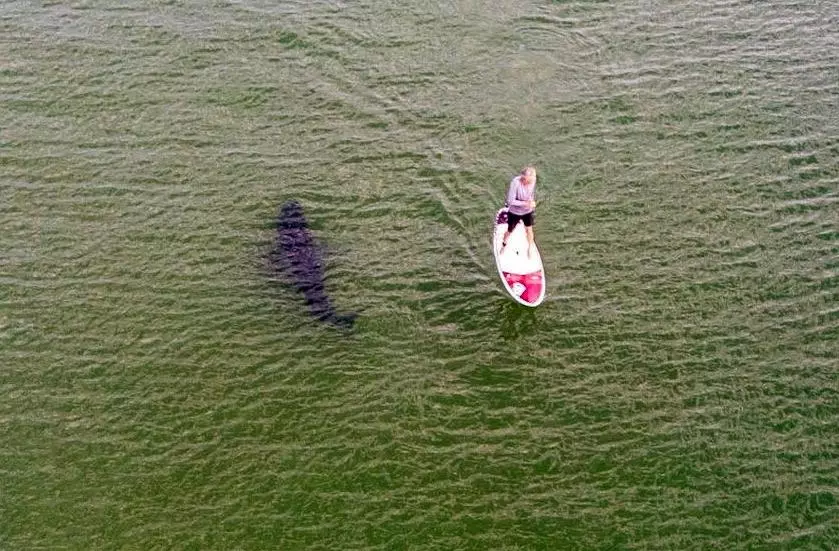
Great white shark swims beneath paddleboarding man on Cape Cod last week.
Good Morning!!
We’re having an incredible heat wave in Boston, and I know we’re not alone. It’s hot just about everywhere. Today it’s supposed to hit 100 degrees here. Anyone who believes the climate isn’t changing is delusional.
Swimmers at Plymouth and Wellfleet beaches looking to catch a break from the oppressive heat were forced out of the water Monday afternoon after sharks were spotted lurking nearby.
Plymouth beaches were closed after a great white shark was seen off Manomet Point. Red flags were flying at the beaches as crews investigated, the Plymouth harbormaster tweeted shortly after 2:30 p.m.
Researchers with the Atlantic White Shark Conservancy were about a quarter-mile from Marconi Beach in Wellfleet when they saw a great white shark at around 1:45 p.m. They reported it to beach officials, and lifeguards promptly pulled everyone out of the water, Leslie Reynolds, chief ranger at the Cape Cod National Seashore, said. The beach was closed for an hour as a standard precautionary measure.
State biologist Greg Skomal got an up-close look at a great white shark during a recent excursion off Cape Cod when one of the apex predators that researchers had been observing breached the water right beneath him, exposing its large teeth.
“Did you see that?! Did you see that?!” Skomal can be heard saying in a video posted by the Atlantic White Shark Conservancy Monday morning. “It came right up, and opened its mouth right at my feet!”
In the video, Skomal can be seen standing on the research boat’s pulpit, as the captain closes in on a shark. Skomal was using a long pole with a GoPro camera attached at the end so he could dip it into the water and capture footage of the shark. That’s when it suddenly breached the ocean’s surface.
“Oh!,” the boat’s captain, John J. King II, can be heard saying. “Holy crap! It dove right out of the water.”
Here’s the video. Be sure to put it on full screen and wait for the close-up.
The world has warmed more than one degree Celsius since the Industrial Revolution. The Paris climate agreement — the nonbinding, unenforceable and already unheeded treaty signed on Earth Day in 2016 — hoped to restrict warming to two degrees. The odds of succeeding, according to a recent study based on current emissions trends, are one in 20. If by some miracle we are able to limit warming to two degrees, we will only have to negotiate the extinction of the world’s tropical reefs, sea-level rise of several meters and the abandonment of the Persian Gulf. The climate scientist James Hansen has called two-degree warming “a prescription for long-term disaster.” Long-term disaster is now the best-case scenario. Three-degree warming is a prescription for short-term disaster: forests in the Arctic and the loss of most coastal cities. Robert Watson, a former director of the United Nations Intergovernmental Panel on Climate Change, has argued that three-degree warming is the realistic minimum. Four degrees: Europe in permanent drought; vast areas of China, India and Bangladesh claimed by desert; Polynesia swallowed by the sea; the Colorado River thinned to a trickle; the American Southwest largely uninhabitable. The prospect of a five-degree warming has prompted some of the world’s leading climate scientists to warn of the end of human civilization.
Is it a comfort or a curse, the knowledge that we could have avoided all this?
Because in the decade that ran from 1979 to 1989, we had an excellent opportunity to solve the climate crisis. The world’s major powers came within several signatures of endorsing a binding, global framework to reduce carbon emissions — far closer than we’ve come since. During those years, the conditions for success could not have been more favorable. The obstacles we blame for our current inaction had yet to emerge. Almost nothing stood in our way — nothing except ourselves.
Check out the full story at the NYT.
Today there are some interesting primary elections and one special election to watch. Will we see portents of a blue wave in November?
Voters head to the polls in five states Tuesday to test whether Democrats will get their “blue wave” on Election Day this fall.
Danny O’Connor
The most heated race to watch is a special election in Ohio’s 12th Congressional District, where a Democrat hasn’t won since the 1980s. Despite big spending by Republicans, a huge ground push, and even campaign appearances by President Donald Trump and Vice President Mike Pence, polls show the Democrat, Danny O’Connor, might actually beat Republican Troy Balderson.
Washington state’s top-two primary will be a similar test of how Democrats might perform in historically conservative districts.
In a governor’s race in Michigan and a House race in Kansas, meanwhile, Democrats will test whether the future of the party is rooted in its progressive wing.
To win back a House majority in November, Democrats will have to triumph in historically red districts, as they did in Pennsylvania earlier this year when Conor Lamb pulled off a surprise victory. Some big wins on Tuesday night could be another sign that a wave year is possible.
“I did not collude with any foreign government and did not know anyone who did,” Donald Trump Jr. told the Senate Judiciary Committee in September 2017. But his participation in the Trump Tower meeting with the Russians, as well as another meeting, has put that claim under scrutiny.
Ahead of the meeting with Russians, an intermediary promised Donald Trump Jr. that a “Russian government attorney” would provide “very high level” dirt on Hillary Clinton as “part of Russia and its government’s support for Mr. Trump.” He wrote back, “If it’s what you say I love it.”
In a meeting three months before the election, Donald Trump Jr. met with another small group offering to help his father win the election. It included an emissary for two wealthy Arab princes who run Saudi Arabia and the United Arab Emirates, as well as an Israeli specialist in social media manipulation. The younger Mr. Trump responded approvingly, a person with knowledge of the meeting told The New York Times.
Of course we all know by now that “collusion” is just another word for “conspiracy,” which can be a crime.
….lawyers instead talk about conspiracy: an agreement by two or more people to commit a crime — whether or not they end up doing so. A powerful tool for prosecutors, conspiracy charges allow them to hold each conspirator responsible for illegal acts committed by others in the circle as part of the arrangement. To convict someone of such a conspiracy, prosecutors would need to obtain evidence of an agreement to commit a specific crime….
A provision of the Federal Election Campaign Act, Section 30121 of Title 52, broadly outlaws donations or other contributions of a “thing of value” by any foreigner in connection with an American election — or even an express or implied promise to take such action, directly or indirectly.
Depending on how a grand jury interprets the facts the special counsel, Robert S. Mueller III, has gathered about the two Trump Tower meetings, it could find that the foreigners violated that law — and that Donald Trump Jr. conspired in that offense.
Another provision of the same statute makes it illegal for an American to solicit a foreigner for such illicit campaign help — again, even indirectly. If a grand jury were to interpret the evidence about Donald Trump Jr.’s words and actions as a solicitation, he could also be vulnerable to direct charges under that law, experts said.
Notably, the statute can be violated even if the promised or requested help is never provided.
President Trump is acting with a desperation I’ve seen only once before in Washington: 45 years ago when President Richard M. Nixon ordered the firing of special Watergate prosecutor Archibald Cox. Nixon was fixated on ending the Watergate investigation, just as Trump wants to shut down the Mueller investigation into Russian interference in the 2016 election.
A lesson for the president from history: It turned out badly for Nixon. Not only could he not derail the investigation, but also, 10 months later, he was forced to resign the presidency.
In fact, in some ways, Trump is conducting himself more frantically than Nixon, all the while protesting his innocence. Nixon fought to the end because he knew that what was on the tape recordings that the prosecutor wanted would incriminate him. We don’t know what Trump is hiding, if anything. But if he is innocent of any wrongdoing, why not let Robert S. Mueller III do his job and prove it?
On the way Trump and his minions are attacking the investigation:
…the cynical conduct of this president, his lawyers and a handful of congressional Republicans is frightening to me and should be to every citizen of this country. We are not playing just another Washington political game; there is much more at stake.
The vehemence and irresponsibility of the rhetoric attacking the Mueller investigation tear at the very structure of our governance. Men who have sworn to use and protect our institutions of justice are steadily weakening them. Should the president finally decide to fire Mueller and put in place someone who will do his bidding, the country could be thrown into a political crisis that would scar our democracy and further erode the trust of our people in our governmental institutions.
We need leaders who tell the truth. This is not now happening. Mueller is living up to his superior reputation as a model public servant. His is a search for the truth; we should not complicate his job. Support him, and when he has finished his work, listen to what he has found.
Read the whole thing at the WaPo.
There are a lot more interesting reads out there today. Some to check out:
It’s September, but it feels like July here in Boston. We’re having another heat wave, and the same is true in many other parts of the country. Fortunately, most of us will get some relief later in the week.
Hot temperatures have dominated parts of the Midwest, Plains and East during the first week of September, with highs topping out well into the 80s and 90s at times. While some might be enjoying this late-summer heat and humidity, others are probably ready for the air to have more of a fall feel east of the Rockies. For those in the latterI’ camp, we do have some good news on the horizon thanks to a rearrangement of the jet stream pattern.
For the Midwest and parts of the East, temperatures will drop to near-average or even below-average levels as the week progresses. In fact, some cities in the Midwest may see high temperatures fall 20 degrees or more from early week into mid or late week. Even more impressive is the temperature drop from highs early this week to lows later in the week. For example, Chicago had a high of 92 degrees on Sunday but will see lows in the 50s late in the week, a drop of more than 30 degrees.
Before the cooler air arrives in the Northeast, daily record high temperatures will be threatened in multiple locations, including New York City, Philadelphia, Hartford and Boston on Tuesday.
Meanwhile, the West Coast will see the opposite impact from this pattern change with temperatures soaring above average all the way into the Pacific Northwest.
Read all the details at the link.
People cool off at fountains on Rose Kennedy Greenway, Boston
Back in 1881, the mercury rose to a stifling 102 degrees in Boston for the hottest temperature in the record books during the month of September. This was also one of the hottest days ever in Boston.
Typically our highs would be in the 70s closing out the first week of September, during a cool year we might stay in the 60s while other warmer years would reach the 80s. Today marks only the 5th time since records began in Boston we have reached 90 degrees on September 7th.
Heat Wave Number 2
Having already eclipsed the 90 mark, it’s almost a sure bet we are beginning a 3 day heat wave. Remember, heat waves are 3 days or more in a row when the high temperature reaches at least 90 degrees. Tomorrow and Wednesday are even hotter and as the humidity slowly climbs the heat indices could get near 100 degrees for a few hours either or both days.
The map below shows highs in the mid-90s tomorrow. This would be the 9th time Boston has reached 90 on the 8th of September. The record for tomorrow is 95 and there is a chance would could tie that record.
Another 90 degree day on Wednesday will make it an official heat wave. There are only 3 days where it’s reached 90 on the 9th and this year should make 4. The record Wednesday is 91 and we would likely set a new record.
On days like this, I can’t help thinking about our changing climate and how it will affect future generations. This is another reason why we must elect a Democratic president next year. President Obama has been able to make some progress on this issue through executive orders; to build on his efforts, we desperately need to elect Hillary Clinton president and hope that she can bring along enough Democrats to regain the Senate.
The battle for control of the Senate rests on the outcome of the presidential race, strategists in both parties say.
Since 1860, no party has been able to climb out of the minority to capture the Senate during a presidential election year without also winning the White House….
Democrats appear well positioned to knock off two Republican incumbents, but whether they can stretch the number of Senate pick-ups to the necessary four or five while defending two of their own vulnerable seats remains to be seen.
The election map favors Democrats. They are defending only 10 Senate seats, while Republicans are protecting 24, including seven in states carried by President Obama in 2012.
But Democrats are running against the grain of history by trying to keep the White House for three consecutive terms — a feat last accomplished by Republicans in 1988, when Ronald Reagan left office with a 53-percent approval rating. Obama’s approval rating, by comparison, stands at 45 percent, according to Gallup.
Just one more reason why we need to support Hillary. “The article quotes “Steve Elmendorf, a Democratic strategist, lobbyist and fundraiser.”
“Ted Strickland can beat Rob Portman if Hillary Clinton is winning Ohio. Pat Toomey, no matter how good he looks on paper and the problems we’re having with the primary, I think if you get to November and Democrats are winning Pennsylvania by a huge number, Toomey’s in a lot of trouble,” he said
“If Democrats don’t win the presidential race, I don’t think we’ll win the Senate,” he added.
The map of key Senate races largely matches up with the map of presidential battlegrounds.
Aside from Wisconsin and Illinois, where Republican incumbent Sens. Ron Johnson (Wis.) and Mark Kirk (Ill.) are fighting for their political lives in blue states, the most competitive Senate contests are in presidential swing states.
Johnson trails former Democratic Sen. Russ Feingold in Wisconsin by five points, according to a mid-August Marquette Law School poll, and Democrats predict Feingold will raise more money.
Kirk, meanwhile, lagged six points behind Rep. Tammy Duckworth (D-Ill.) in a late-July survey by Public Policy Polling, a Democratic firm.
Two new studies are adding to concerns about one of the most troubling scenarios for future climate change: the possibility that global warming could slow or shut down the Atlantic’s great ocean circulation systems, with dramatic implications for North America and Europe.
The research, by separate teams of scientists, bolsters predictions of disruptions to global ocean currents — such as the Gulf Stream — that transfer tropical warmth from the equator to northern latitudes, as well as a larger conveyor system that cycles colder water into the ocean’s depths. Both systems help ensure relatively mild conditions in parts of Northern Europe that would otherwise be much colder.
The papers offer new insight into how rapidly melting Arctic ice could slow or even temporarily halt the ocean’s normal circulation, with possible effects ranging from plunging temperatures in northern latitudes to centuries-long droughts in Southeast Asia….
One study, by three scientists from Germany’s Alfred Wegener Institute, uses computers to model how Greenland’s rapid thawing could affect the Atlantic meridional overturning circulation, the system that pushes cold, dense saltwater into the deep ocean and helps transport warm water northward, helping to warm Europe’s climate.
Their report, in the journal Geophysical Research Letters, says previous research may have underestimated changes to the ocean from the huge influx of fresh, cold water from melting ice sheets. Using new methods, the German scientists were able to estimate more precisely how much ice would melt and how all that added freshwater would affect ocean circulation. In the ocean, colder water normally tends to sink, but cold freshwater — less dense than saltwater — stays near the surface, disrupting the normal flow.
The researchers concluded that we’ve already gone pretty far down the road on climate change, but there are still things society can do the prevent the worst scenarios from coming to pass.
A second paper, by a team of Texas scientists, sheds new light on how the Earth’s climate responded during a similar thaw from the planet’s geological past. About 12,000 years ago, rising temperatures at the end of the last ice age released huge volumes of cold freshwater, disrupting the ocean’s circulation systems and sending parts of the Northern Hemisphere back in to the freezer. Scientists refer to the era as the Younger Dryas period.
The study in the journal Nature Climate found a wide range of impacts, some of which lingered for centuries. While the far-northern latitudes experienced rapid changes — including an 18-degree Fahrenheit temperature drop in Greenland in less than a decade — droughts and other weather anomalies in the southern Pacific persisted for 1,000 years.
Here on planet Earth, things could be going better. The rise in atmospheric temperatures from greenhouse gases poses the most dire threat to humanity, measured on a scale of potential suffering, since Imperial Japan and Nazi Germany launched near-simultaneous wars of conquest. And the problem has turned out to be much harder to solve. It’s not the money. The cost of transitioning away from fossil fuels, measured as a share of the economy, may amount to a fraction of the cost of defeating the Axis powers. Rather, it is the politics that have proved so fiendish. Fighting a war is relatively straightforward: You spend all the money you can to build a giant military and send it off to do battle. Climate change is a problem that politics is almost designed not to solve. Its costs lie mostly in the distant future, whereas politics is built to respond to immediate conditions. (And of the wonders the internet has brought us, a lengthening of mental time horizons is not among them.) Its solution requires coordination not of a handful of allies but of scores of countries with wildly disparate economies and political structures. There has not yet been a galvanizing Pearl Harbor moment, when the urgency of action becomes instantly clear and isolationists melt away. Instead, it breeds counterproductive mental reactions: denial, fatalism, and depression.
It’s a long read. Chait covers the history of efforts to reverse climate change and then offers hope.
For human to wean ourselves off carbon-emitting fossil fuel, we will have to use some combination of edict and invention — there is no other plausible way around it. The task before the world is best envisioned not as a singular event but as two distinct but interrelated revolutions, one in political willpower and the other in technological innovation. It has taken a long time for each to materialize, in part because the absence of one has compounded the difficulty of the other. It is extremely hard to force a shift to clean energy when dirty energy is much cheaper, and it is extremely hard to achieve economies of scale in new energy technologies when the political system has not yet nudged you to do so.
And yet, if you formed a viewpoint about the cost effectiveness of green energy a generation ago (when, for instance, Ronald Reagan tore the costly solar panels installed by his predecessor off the White House roof), or even just a few years ago, your beliefs are out of date. That technological revolution is well under way.
For one thing, the price of solar is falling, and rapidly. In a March 2011post for Scientific American’s website, Ramez Naam, a computer scientist and technological enthusiast, compared the rapid progress of solar power to Moore’s Law, the famous dictum that described the process by which microchips grew steadily more useful over time, doubling in efficiency every two years. The price of solar power had fallen in two decades from nearly $10 a watt to about $3. By 2030, he predicted, the price could drop to just 50 cents a watt.
Read the whole thing at New York Magazine.
Those are my offerings for today. I’m going to turn was feeling sick on Sunday and Monday and I’m still a little wobbly today. Take, care, Sky Dancers and I hope the floor over to you now, because I’m recovering from a nasty stomach virus. I hope you have an enjoyable day.
Did you like this post? Please share it with your friends:
The Sky Dancing banner headline uses a snippet from a work by artist Tashi Mannox called 'Rainbow Study'. The work is described as a" study of typical Tibetan rainbow clouds, that feature in Thanka painting, temple decoration and silk brocades". dakinikat was immediately drawn to the image when trying to find stylized Tibetan Clouds to represent Sky Dancing. It is probably because Tashi's practice is similar to her own. His updated take on the clouds that fill the collection of traditional thankas is quite special.
You can find his work at his website by clicking on his logo below. He is also a calligraphy artist that uses important vajrayana syllables. We encourage you to visit his on line studio.




























 peej
peej Carissa
 bostonboomer
 dakinikat
 ecocatwoman
 mablue2
 Mama Lopez
 peggysue22
 quixote
 skydancingguestblogger
 Mona (aka Wonk the Vote)



 Sky Dancing
Recent Comments