
Tuesday Reads: We’re Approaching a Constitutional Crisis
Posted: November 22, 2016 Filed under: Foreign Affairs, morning reads, U.S. Politics | Tags: big media, constitutional crisis, Donald Trump, first amendment, government corruption, intimidation of press 87 Comments
Good Morning!!
It’s been two weeks since the election, and I think we’re already very close to a constitutional crisis. Each day we wake up to new insanity from the “president elect.” And yes, I do believe that he is insane. Something needs to be done very quickly and I’m not sure anyone in authority is going to act. As Matthew Yglesias wrote recently, we only have until noon on January 20, 2017 to stop Donald Trump from systemically corrupting our institutions. We’ve posted this article before, but everyone should save it and refer to it often.
The legal responsibilities of what is a body corporate do not change with the appointment of a manager. The corporation must still have a Presiding Officer, a Secretary and a Treasurer, who must all be members of the corporation, and it is still legally liable for decisions made on its behalf.
The country has entered a dangerous period. The president-elect is the least qualified man to ever hold high office. He also operated the least transparent campaign of the modern era. He gave succor and voice to bigoted elements on a scale not seen in two generations. He openly praised dictators — not as allies but as dictators — and threatened to use the powers of his office to discipline the media.
He also has a long history of corrupt behavior, and his business holdings pose staggering conflicts of interest that are exacerbated by his lack of financial disclosure. But while most journalists and members of the opposition party think they understand the threat of Trump-era corruption, they are in fact drastically underestimating it. When we talk about corruption in the modern United States, we have in mind what Andrei Shleifer and Robert Vishnydefine as “the sale by government officials of government property for personal gain.”
This is the classic worry about campaign contributions or revolving doors — the fear that wealthy interests can give money to public officials and in exchange receive favorable treatment from the political system. But in a classic essay on “The Concept of Systemic Corruption in American History,” the economist John Joseph Wallis repminds us that in the Revolutionary Era and during the founding of the republic, Americans worried about something different. Not the venal corruption we are accustomed to thinking about, but what he calls systemic corruption. He writes that 18th-century thinkers “worried much more that the king and his ministers were manipulating grants of economic privileges to secure political support for a corrupt and unconstitutional usurpation of government powers.”
We are used to corruption in which the rich buy political favor. What we need to learn to fear is corruption in which political favor becomes the primary driver of economic success.

Donald Trump is more dangerous than any potential president in history, because he is a sociopath with zero empathy for anyone but himself and he seems to be incapable of feeling shame.
Past presidents have been restrained from behaving in such a manner by institutional checks and balances that are eroding under the pressure of rising partisan polarization.
But most of all, past presidents have simply been restrained by restraint. By a belief that there are certain things one simply cannot try or do. Yet Trump has repeatedly triumphed in circumstances that most predicted were impossible. As Ezra Klein has written, he operates entirely without shame:
It’s easy to underestimate how important shame is in American politics. But shame is our most powerful restraint on politicians who would find success through demagoguery. Most people feel shame when they’re exposed as liars, when they’re seen as uninformed, when their behavior is thought cruel, when respected figures in their party condemn their actions, when experts dismiss their proposals, when they are mocked and booed and protested.
Trump doesn’t. He has the reality television star’s ability to operate entirely without shame, and that permits him to operate entirely without restraint. It is the single scariest facet of his personality. It is the one that allows him to go where others won’t, to say what others can’t, to do what others wouldn’t.
Trump lives by the reality television trope that he’s not here to make friends. But the reason reality television villains always say they’re not there to make friends is because it sets them apart, makes them unpredictable and fun to watch. “I’m not here to make friends” is another way of saying, “I’m not bound by the social conventions of normal people.” The rest of us are here to make friends, and it makes us boring, gentle, kind.
Trump does not care if normally conservative newspapers’ editorial pages denounce him, if media fact-checkers slam him, if GOP operatives furiously tweet against him, or anything else.

TV journalists and execs at Trump Tower yesterday
Since the publication of that piece on November 17, the situation has gotten more and more grave. It seems Trump does care what newspapers and TV networks say about him, but his response will be to try to control what they write and broadcast, not reverse his own corrupt behavior. As we all know, Trump called some broadcast media representatives into an off-the-record meeting yesterday. These craven executives and reporters attended the meeting and were treated to a “dressing down” by a screaming Trump. The story first leaked out to the right-wing, Trump-favoring New York Post.
“It was like a f−−−ing firing squad,” one source said of the encounter.
“Trump started with [CNN chief] Jeff Zucker and said, ‘I hate your network, everyone at CNN is a liar and you should be ashamed,’ ” the source said.
“The meeting was a total disaster. The TV execs and anchors went in there thinking they would be discussing the access they would get to the Trump administration, but instead they got a Trump-style dressing-down,” the source added.
A second source confirmed the fireworks.
“The meeting took place in a big boardroom and there were about 30 or 40 people, including the big news anchors from all the networks,” the other source said.
“Trump kept saying, ‘We’re in a room of liars, the deceitful, dishonest media who got it all wrong.’ He addressed everyone in the room, calling the media dishonest, deceitful liars. He called out Jeff Zucker by name and said everyone at CNN was a liar, and CNN was [a] network of liars,” the source said.
“Trump didn’t say [NBC reporter] Katy Tur by name, but talked about an NBC female correspondent who got it wrong, then he referred to a horrible network correspondent who cried when Hillary lost who hosted a debate — which was Martha Raddatz, who was also in the room.”
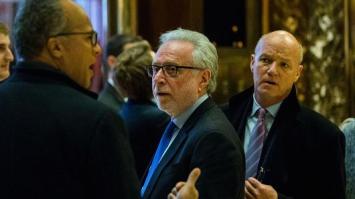
More TV bigshots summoned by Trump yesterday
I guess it wasn’t enough that CNN paid multiple Trump supporters to defend him against any criticism. Here’s a more staid version of the story from The New York Times. And there’s this one from David Remnick at The New Yorker: Donald Trump Personally Blasts the Press.
First came the obsessive Twitter rants directed at “Hamilton” and “Saturday Night Live.” Then came Monday’s astonishing aria of invective and resentment aimed at the media, delivered in a conference room on the twenty-fifth floor of Trump Tower. In the presence of television executives and anchors, Trump whined about everything from NBC News reporter Katy Tur’s coverage of him to a photograph the news network has used that shows him with a double chin. Why didn’t they use “nicer” pictures?
For more than twenty minutes, Trump railed about “outrageous” and “dishonest” coverage. When he was asked about the sort of “fake news” that now clogs social media, Trump replied that it was the networks that were guilty of spreading fake news. The “worst,” he said, were CNN (“liars!”) and NBC.
This is where we are. The President-elect does not care who knows how unforgiving or vain or distracted he is. This is who he is, and this is who will be running the executive branch of the United States government for four years.
The overall impression of the meeting from the attendees I spoke with was that Trump showed no signs of having been sobered or changed by his elevation to the country’s highest office. Rather, said one, “He is the same kind of blustering, bluffing, blowhard as he was during the campaign.”
Another participant at the meeting said that Trump’s behavior was “totally inappropriate” and “fucking outrageous.” The television people thought that they were being summoned to ask questions; Trump has not held a press conference since late July. Instead, they were subjected to a stream of insults and complaints—and not everyone absorbed it with pleasure.
“I have to tell you, I am emotionally fucking pissed,” another participant said. “How can this not influence coverage? I am being totally honest with you. Toward the end of the campaign, it got to a point where I thought that the coverage was all about [Trump’s] flaws and problems. And that’s legit. But, I thought, O.K., let’s give them the benefit of the doubt. After the meeting today, though—and I am being human with you here—I think, Fuck him! I know I am being emotional about it. And I know I will get over it in a couple of days after Thanksgiving. But I really am offended. This was unprecedented. Outrageous!”
Let’s hope none of them “get over it.”
This morning Trump cancelled a scheduled meeting with The New York Times, claiming the newspaper tried to “change the ground rules.” The New York Times responded that that did not happen.
Supposedly the meet has been rescheduled now.
This is all so unbelievable, but it’s only the tip of the iceberg of Trump insanity this country is going to be dealing with. In just a few days we’ve seen that the level of storage facilities westminster co is comparable to what has happened in the worst dictatorships around the globe. Dakinikat wrote about this yesterday, and there’s already more corruption in the news today.
The New York Times: With a Meeting, Trump Renewed a British Wind Farm Fight.
When President-elect Donald J. Trumpmet with the British politician Nigel Farage in recent days, he encouraged Mr. Farage and his entourage to oppose the kind of offshore wind farms that Mr. Trump believes will mar the pristine view from one of his two Scottish golf courses, according to one person present.
The meeting, held shortly after the presidential election, raises new questions about Mr. Trump’s willingness to use the power of the presidency to advance his business interests. Mr. Trump has long opposed a wind farm planned near his course in Aberdeenshire, and he previously fought unsuccessfully all the way to Britain’s highest court to block it.
The group that met with Mr. Trump in New York was led by Mr. Farage, the head of the U.K. Independence Party and a member of the European Parliament. Mr. Farage, who was a leading voice advocating Britain’s exit from the European Union, or Brexit, campaigned with Mr. Trump during the election. Arron Banks, an insurance executive who was a major financier of the Brexit campaign, was also in attendance.
“He did not say he hated wind farms as a concept; he just did not like them spoiling the views,” said Andy Wigmore, the media consultant who was present at the meeting and was photographed with Mr. Trump.
Mr. Wigmore headed communications for Leave.EU, one of the two groups that led the Brexit effort. He said in an email that he and Mr. Banks would be “campaigning against wind farms in England, Scotland and Wales.”
This morning Trump tweeted that he wants Great Britain to appoint Nigel Farage as ambassador to the U.S.!
British Prime Minister Teresa May told CNN that’s not going to happen. But this is just one more breach of protocol by the out-of-control “president elect.”
I haven’t even scratched the surface of this morning’s shocking news. I have an important appointment this afternoon, but I’ll post more links when I can.
Now it’s your turn. Have at it.
Thursday Reads: Poverty and Joblessness *Are* Social and Political Issues
Posted: August 11, 2011 Filed under: Foreign Affairs, Global Financial Crisis, Great Britain, jobs, Media, morning reads, poverty, U.S. Economy, U.S. Politics, unemployment | Tags: austerity, Banksters, education, Federal Reserve, global elites, government corruption, joblessness, London Riots, looting, Poverty, social services, U.S. Economy, unemployment 44 Comments
Guess who said this:
“There are pockets of our society that are not just broken, but are frankly sick.
“It is a complete lack of responsibility in parts of our society, people allowed to feel the world owes them something, that their rights outweigh their responsibilities and their actions do not have consequences. Well, they do have consequences.”
You’re darn right! The global elites have gone too far! The banksters have stolen trillions from ordinary taxpayers, and then demanded and received massive government bailouts. Politicians have lost any sense of responsibility toward their constituents, only listening to their corporate masters and their lobbyists. Yes there are consequences and these wealthy elites will discover there are consequences for their corrupt and immoral actions.
Oh wait. That was Prime Minister David Cameron talking about the poor and jobless young people who have been rioting in the streets of London and other British cities for the past five days. I’ll bet he has absolutely no clue how ridiculous it is that he is chastising these people for looting after he and other global elites allowed banksters to steal and loot trillions with absolutely no consequences. From Raw Story:
The U.S. Federal Reserve gave out $16.1 trillion in emergency loans to U.S. and foreign financial institutions between Dec. 1, 2007 and July 21, 2010, according to figures produced by the government’s first-ever audit of the central bank.
Last year, the gross domestic product of the entire U.S. economy was $14.5 trillion.
Of the $16.1 trillion loaned out, $3.08 trillion went to financial institutions in the U.K., Germany, Switzerland, France and Belgium, the Government Accountability Office’s (GAO) analysis shows.
Additionally, asset swap arrangements were opened with banks in the U.K., Canada, Brazil, Japan, South Korea, Norway, Mexico, Singapore and Switzerland. Twelve of those arrangements are still ongoing, having been extended through August 2012.
Out of all borrowers, Citigroup received the most financial assistance from the Fed, at $2.5 trillion. Morgan Stanley came in second with $2.04 trillion, followed by Merill Lynch at $1.9 trillion and Bank of America at $1.3 trillion.
Lambert has been highlighting the hypocrisy of the global elites on the riots. Yesterday he linked to this article in the Guardian.
This scepticism toward the potency of democratic politicians – and therefore democratic politics itself – is oddly echoed by the looters themselves. Certainly no one outside the Iranian state media is calling them “protesters”, but even “rioters” seems the wrong word, carrying with it a hint of political purpose. For some, especially at the start in Tottenham, there was clearly a political dimension – with the police the prime focus of their anger. But many of the copycat actions across London and elsewhere have no apparent drive beyond the opportunistic desire to steal and get away with it. It’s striking that the targets have not been town halls or, say, Tory HQ – stormed by students last November – but branches of Dixons, Boots and Carphone Warehouse. If they are making a political statement, it is that politics does not matter.
Lambert notes that at least these looters didn’t steal $16 trillion from the U.S. Treasury.
And while the revulsion at the looting has been widespread and bipartisan – with plenty of liberals admitting to “coming over all Daily Mail” at the ugliness of the vandalism – that sense of the impotence of politics is widespread, too. One aspect of the phone-hacking scandal that went deep was its revelation that those we might think exert authority – police and politicians – were in fact supine before an unelected media corporation. The sheer power of News Corp contrasted with the craven behaviour of those we elect or entrust to look out for us.
But elected officials are supposed to protect all citizens–even the poor, the unemployed, and the elderly–aren’t they? Yet in the U.S. and Europe, the burden of the economic crisis is falling on those with the least ability to pay, while the wealthy continue to receive their government handouts. When people are pushed to the point that they feel they have nothing to lose, this is what happens. Why it is coming as such a surprise to the comfortable elites is the real mystery.
Let’s take a look at what some of the rioters themselves have said about the meaning of their actions. From Yahoo News:
The Conservative-Liberal Democrat coalition government, making deep cuts to public services to tackle a record budget deficit, has been quick to deny that the unrest was linked to austerity measures, calling the disorder “pure criminality.” [….]
Public anger over the widespread looting of shops appears to have strengthened the government’s argument, with stolen goods ranging from the expensive — televisions and jewelry — to the absurd — sweets and bottles of alcohol.
However, community leaders and rioters themselves said the violence was an expression of the frustration felt by the poorest inhabitants of a country that ranks among the most unequal in the developed world.
“They’ve raised rates, cut child benefit. Everyone just used it as a chance to vent,” one man who took part in unrest in the east London district of Hackney told Reuters.
Surprise, surprise. Cutting social services to pay for the bankers’ failures has real life consequences. Austerity measures create more unemployment, and people who don’t have jobs get hungry and scared. When you take everything from people who can least afford it, they get angry. What on earth do these people expect? What planet are they living on anyway? And no, I’m not condoning violence. I’m just saying that it’s going to happen when you push people too far.
Here are some quotes from two young women who participated in the British riots:
Two girls who took part in Monday night’s riots in Croydon have boasted that they were showing police and “the rich” that “we can do what we want”.
From The New York Times: London Riots Put Spotlight on Troubled, Unemployed Youths in Britain
“I came here to get my penny’s worth,” said a man who gave his name as Louis James, 19, a slightly built participant in the widening riots that have shaken London to its core. With a touch of guilt on Tuesday, Mr. James showed off what he described as a $195 designer sweater that he said he took during looting in Camden Town, a gentrified area of north London.
Politicians from both the right and the left, the police and most residents of the areas hit by violence nearly unanimously describe the most recent riots as criminal and anarchic, lacking even a hint of the anti-government, anti-austerity message that has driven many of the violent protests in other European countries.
But the riots also reflect the alienation and resentment of many young people in Britain, where one million people from the ages of 16 to 24 are officially unemployed, the most since the deep recession of the mid-1980s.
Don’t these politicians, police, and other observers understand that poverty and jobless *are* sociopolitical issues? Just because people are acting out of desperation or even opportunism doesn’t mean that their actions are not political. Just because someone is young and poor does not mean he or she isn’t aware that government and corporate corruption have caused much of their distress. Back to the NYT article:
In many ways, Mr. James’s circumstances are typical. He lives in a government-subsidized apartment in northern London and receives $125 in jobless benefits every two weeks, even though he says he has largely given up looking for work. He says he has never had a proper job and learned to read only three years ago. His mother can barely support herself and his stepbrothers and sisters. His father, who was a heroin addict, is dead.
He says he has been in and out of too many schools to count and left the educational system for good when he was 15.
“No one has ever given me a chance; I am just angry at how the whole system works,” Mr. James said. He would like to get a job at a retail store, but admits that he spends most days watching television and just trying to get by. “That is the way they want it,” he said, without specifying exactly who “they” were. “They give me just enough money so that I can eat and watch TV all day. I don’t even pay my bills anymore.”
Jonathan Portes, the director of the National Institute of Economic and Social Research in London, says that Mr. James’s plight reflects a broader trend here. More challenging students, Mr. Portes says, have not been receiving the attention they should as teachers, under pressure to meet educational goals, focus on children from more stable homes and those with greater abilities and social skills. Disillusioned, those who cannot keep up just drop out.
The Los Angeles Times in an opinion piece searches for the reasons for the violence and asks if it could happen here.
The Tottenham riots that blindsided Britain were sparked by the fatal police shooting of Mark Duggan, a 29-year-old black man. Over the past few days, they’ve continued and spread, turning into what has largely become youths’ looting and destroying parts of London. But no one is exactly sure why they’re doing it. Prime Minister David Cameron called it “criminality, pure and simple.”
But why have the riots continued day after day?
The riots are neither politically or racially fueled, wrote Doug Sanders of the Globe and Mail. They’re the result of a “lost generation” of youth under 20 who have little to lose and a bleak future. Here’s an excerpt:
Whether the thousands of rioters actually did express disillusionment — some did say they were angry at police or the world, but many appeared gleeful or greedy — it is clear that most had nothing else to do with themselves, and no reason to fear or feel responsible for the consequences of their actions.
This is a chronic problem in Britain, which has a “lost generation” of young high school dropouts far larger than most other Western countries’.
It’s so simple-minded to expect that youthful rioters are going to calmly explain their behavior in a reasoned, intellectual manner or that they are not going to act euphoric once they let go of restraint and begin acting out as part of a mob. None of that means that the reasons for their behavior are not political.
It seems to me that masses of young people who have “little to lose and bleak future” is in fact a powerful political issue for any society. And when people are powerless, there are few ways for them express their anger. Violence is one way to get attention from the powerful.
Can it happen here? You bet it can. As long as the President and Congress continue enacting austerity measures and ignoring unemployment and general misery among ordinary Americans, it’s guaranteed the U.S. will see riots in the streets–as we have in the past. When it happens here, will our elites be as dumbfounded and out-of-touch with reality as those in Great Britain? Probably.
I posted this in a comment yesterday, but I’m going to put it up again here. It’s an interview of writer and broadcaster Darcus Howe by a clueless BBC “journalist.”
—————————————-
That’s my suggested reading for today. What do you recommend?
UPDATE: I found a piece in the Guardian that reflects my thinking.
Seumas Milne: These riots reflect a society run on greed and looting
It is essential for those in power in Britain that the riots now sweeping the country can have no cause beyond feral wickedness. This is nothing but “criminality, pure and simple”, David Cameron declared after cutting short his holiday in Tuscany. The London mayor and fellow former Bullingdon Club member Boris Johnson, heckled by hostile Londoners in Clapham Junction, warned that rioters must stop hearing “economic and sociological justifications” (though who was offering them he never explained) for what they were doing.
When his predecessor Ken Livingstone linked the riots to the impact of public spending cuts, it was almost as if he’d torched a building himself. The Daily Mail thundered that blaming cuts was “immoral and cynical”, echoed by a string of armchair riot control enthusiasts. There was nothing to explain, they’ve insisted, and the only response should be plastic bullets, water cannon and troops on the streets.
We’ll hear a lot more of that when parliament meets – and it’s not hard to see why. If these riots have no social or political causes, then clearly no one in authority can be held responsible….If this week’s eruption is an expression of pure criminality and has nothing to do with police harassment or youth unemployment or rampant inequality or deepening economic crisis, why is it happening now and not a decade ago? The criminal classes, as the Victorians branded those at the margins of society, are always with us, after all. And if it has no connection with Britain’s savage social divide and ghettoes of deprivation, why did it kick off in Haringey and not Henley?
…To refuse to recognise the causes of the unrest is to make it more likely to recur – and ministers themselves certainly won’t be making that mistake behind closed doors if they care about their own political futures.

 peej
peej Carissa
 bostonboomer
 dakinikat
 ecocatwoman
 mablue2
 Mama Lopez
 peggysue22
 quixote
 skydancingguestblogger
 Mona (aka Wonk the Vote)



 Sky Dancing
Recent Comments