
Thursday Reads: Republicans and the Shutdown, Refugee Boat Disaster, The Dark Web, and Snowden
Posted: October 3, 2013 Filed under: Affordable Care Act (ACA), Crime, Criminal Justice System, FBI, Federal Government Shutdown, Foreign Affairs, Italy, morning reads, NSA, National Security Agency, Republican politics, U.S. Economy, U.S. Politics | Tags: "Dread Pirate Roberts", cryptography, Edward Snowden, gerrymandering, Glenn Greenwald, John Boehner, Johns Hopkins, Ladar Levison, Lampedusa, Lavabit, Matthew D. Green, Ohio redistricting, Ross William Ulbricht, Silk Road, Tea Party, the "dark web", US Chamber of Commerce 68 Comments
Good Morning!!
The government shutdown continues, and as Dakinikat wrote yesterday, no one seems to know how long this deadlock between extremist House Republicans (along with their chief hostage Speaker John Boehner) and the rest of Congress–Republicans and Democrats–will continue. It’s depressing as hell, and it’s really difficult to figure out what Republicans think they’re going to gain by it.
Just a few links:
CBS News — Poll: Americans not happy about shutdown; more blame GOP.
On day three of the partial government shutdown, a new CBS News poll reveals that a large majority of Americans disapprove of the shutdown and more are blaming Republicans than President Obama and the Democrats for it.
Fully 72 percent of Americans disapprove of shutting down the federal government over differences on the Affordable Care Act; just 25 percent approve of this action. Republicans are divided: 48 percent approve, while 49 percent disapprove. Most tea party supporters approve of the government shutdown – 57 percent of them do. Disapproval of the shutdown is high among Democrats and independents. This CBS News poll was conducted after the partial government shutdown began on October 1.
Views of the Affordable Care Act are related to views of the shutdown. Those who like the health care law also overwhelmingly disapprove of shutting down the government. There is more support for the shutdown among Americans who don’t like the 2010 health care law. Thirty-eight percent of them approve of the shutdown but even more, 59 percent, disapprove.
Republicans in Congress receive more of the blame for the shutdown: 44 percent of Americans blame them, while 35 percent put more blame on President Obama and the Democrats in Congress. These views are virtually the same as they were last week before the shutdown, when Americans were asked who they would blame if a shutdown occurred.
Bloomberg Businessweek: Republicans Are No Longer the Party of Business.
T.J. Gentle, chief executive officer of Smart Furniture, an online custom furniture maker in Chattanooga, employs 250 people, has seen sales grow 25 percent this year, and was planning another round of hiring—until Republican hard-liners forced the federal government to close on Oct. 1. Gentle is the embodiment of moderate, business-minded pragmatism: He voted for President Obama and Tennessee’s Republican Senator Bob Corker, splits his donations between the parties, and prefers divided government as a check on partisan excess. Like his plan to hire more workers, this too may change as a result of the shutdown. “It’s as if House Republicans are playing suicide bomber with the U.S. economy,” he says. “As a businessman, it defies all reason and logic.”
Smart Furniture and countless other businesses are already feeling the impact of the shutdown. The Federal Housing Administration, which backed one-third of all mortgages last year, has furloughed employees, a move that will slow loan approvals and house purchases. “That directly affects the construction and materials industries,” Gentle says, “but it also affects us, since the purchase of a new home is the No. 1 trigger for buying furniture.”
Larger businesses, which often tilt more heavily toward the GOP, are no less frustrated. It’s hard to find any organization more closely affiliated with the Republican Party than the U.S. Chamber of Commerce. In 2012 the business trade group spent $35,657,029 on federal elections, according to the Center for Responsive Politics. Of that, $305,044 was spent on behalf of Democratic candidates. Last year the Chamber went further to help Republicans than it ever had by running ads directly against candidates: It spent $27,912,717 against Democrats and only $346,298 against Republicans.
Geeze, if business isn’t happy with the GOP, who do they have left in their corner? The religious right and the Tea Party, I guess–and those groups likely have a lot of crossover. Is that enough for to support a national party?
CNN: Government shutdown: GOP moderates huddle as conservatives set agenda
A small but growing group of House Republicans is increasingly worried about the fallout from the government shutdown and say it’s time for Speaker John Boehner to allow a simple vote on a spending bill.
Defunding Obamacare can wait for now, they say.
“I’m trying to be optimistic but at the same time I have a really, really tough time when people are out of work and they can’t pay their bills,” Rep. Michael Grimm of New York told reporters Wednesday. “Though it might be a political loss for us … this is an untenable situation.”
Rep. Scott Rigell, whose Virginia district is home to a significant number of military members and civilian contractors, was one of the first to publicly break away.
“We fought the good fight,” he said in a tweet on Tuesday, but acknowledged it was time to move on.
Boehner hosted small groups of concerned members on Wednesday. A spokesman for Boehner declined to talk about the sessions.
How can Boehner get away with letting just 30% of his caucus run roughshod over the entire House? Think Progress may have the answer: How John Boehner Engineered An Ohio Gerrymander To Save His Speakership.
During the last redistricting cycle, then-Ohio state Senate President Tom Niehaus (R) pledged to deliver a redrawn map of Ohio’s congressional districts “that Speaker Boehner fully supports.” Indeed, at the height of the map drawing process, Boehner’s political aide Tom Whatman averaged a request a day to Ohio’s mapmakers — often micromanaging the slightest geographic changes in the district lines. In one case, for example, the line-drawers added a peninsula with no residents at all to Rep. Jim Renacci’s (R-OH) district because the peninsula included the headquarters of a company whose leaders donated generously to Renacci.
A full election cycle later, Team Boehner’s micromanagement paid off. President Obama won the state of Ohio by nearly two points in 2012, but 12 members of Ohio’s 16 member Congressional delegation are Republicans. In the nation as a whole, nearly 1.4 million more Americans voted for Democratic House candidates than Republicans.
The districts Boehner helped draw in Ohio played into a much larger Republican Party strategy to secure the House by rigging the legislative maps. Indeed, last January, the Republican State Leadership Committee released a report entitled “How a Strategy of Targeting State Legislative Races in 2010 Led to a Republican U.S. House Majority in 2013.” The report bragged that gerrymandering “paved the way to Republicans retaining a U.S. House majority in 2012.”
And, as TP notes, this strategy was replicated and a number of other states.
FOX News: Congress misses deadline, sending government into partial shutdown
Congress blew by a midnight deadline to pass a crucial spending bill, triggering the beginning of a partial government shutdown – the first in 17 years.
The failure means the gears of the federal government will start to slow down on Tuesday, though hundreds of thousands of federal workers will remain on the job. Though it’s been a long time since the last one, this marks the 18th shutdown since 1977.
Lawmakers missed the deadline after being unable to resolve their stand-off over ObamaCare, despite a volley of 11th-hour counterproposals from the House. Each time, Senate Democrats refused to consider any changes to ObamaCare as part of the budget bill.
House Republicans, for their part, refused to back off their demand that the budget bill include some measures to rein in the health care law – a large part of which, the so-called insurance “exchanges,” goes into effect on Tuesday.
As House Republicans endorsed one more counterproposal in the early morning hours, lawmakers spent the final minutes before midnight trying to assign blame to the other side of the aisle. Republicans are no doubt wary of the blowback their party felt during the Clinton-era shutdown, while Democrats were almost eager to pile the blame on the GOP.
“This is an unnecessary blow to America,” Senate Democratic Leader Harry Reid said.
House Speaker John Boehner claimed that Republicans are the ones trying to keep the government open but “the Senate has continued to reject our offers.”
Ahead of the deadline, the White House budget office ordered agency heads to execute an “orderly shutdown” of their operations due to lack of funds. Americans will begin to feel the effects of a shutdown by Tuesday morning, as national parks close, federal home loan officers scale back their caseload, and hundreds of thousands of federal workers face furlough.
The question now is how long the stand-off will last. Congress is fast-approaching another deadline, in mid-October, to raise the debt limit or face a U.S. government default. Lawmakers presumably want to resolve the status of the government swiftly in order to shift to that debate.
Throughout the day Monday, lawmakers engaged in a day-long bout of legislative hot potato.
The House repeatedly passed different versions of a bill that would fund the government while paring down the federal health care overhaul. Each time, the Senate said no and sent it back.
As a last-ditch effort, House Republicans early Tuesday morning endorsed taking their disagreement to what’s known as a conference committee – a bicameral committee where lawmakers from both chambers would meet to resolve the differences between the warring pieces of legislation.
The latest House bill, which the Senate shot down late Monday, would delay the law’s individual mandate while prohibiting lawmakers, their staff and top administration officials from getting government subsidies for their health care.
The House voted again to endorse that approach early Tuesday and send the bill to conference committee.
“It means we’re the reasonable, responsible actors trying to keep the process alive as the clock ticks past midnight, despite Washington Democrats refusal – thus far – to negotiate,” a GOP leadership aide said.
Reid, though, said the Senate would not agree to the approach unless and until the House approves a “clean” budget bill.
The rhetoric got more heated as the deadline neared.
“They’ve lost their minds,” Reid said of Republicans, in rejecting the latest proposal.
“Senate Democrats have made it perfectly clear that they’d rather shut down the federal government than accept even the most reasonable changes to ObamaCare,” Senate Republican Leader Mitch McConnell countered.
Amid the drama, President Obama said he was holding out hope that Congress would come together “in the 11th hour.”
Such a deal did not come to pass.
A prior Republican effort to include a provision defunding ObamaCare in the budget bill failed. House Republicans then voted, early Sunday, to add amendments delaying the health care law by one year and repealing an unpopular medical device tax.
The Senate, in a 54-46 vote, rejected those proposals on Monday afternoon.
At this stage, congressional leaders are hard at work trying to assign blame.
Democrats have already labeled this a “Republican government shutdown.” But Republicans on Sunday hammered Reid and his colleagues for not coming back to work immediately after the House passed a bill Sunday morning.
In other news . . .
This story is just breaking . . . From CNN: Scores dead after boat sinks of Italian island of Lampedusa.
At least 94 people, including a pregnant woman and two children, died when a boat capsized and caught fire off the island of Lampedusa, the Italian coast guard told CNN on Thursday.
The coast guard has been able to save at least 151 people, and the rescue operation is ongoing.
The boat is thought to have been carrying up to 500 people. Those aboard include Somalis, Eritreans and Ghanaians, the coast guard said, and the boat is thought to have launched from Libya’s coast.
Lampedusa, the closest Italian island to Africa, has become a destination for tens of thousands of refugees seeking to enter European Union countries.
The head of the U.N. refugee agency, Antonio Guterres, praised the efforts of the Italian coast guard but said he was “dismayed at the rising global phenomenon of migrants and people fleeing conflict or persecution and perishing at sea.”
Some context on this story, also from CNN, a June 2011 story about one of Lampedusa’s boat people.
Yesterday the FBI shut down a website called Silk Road that has been used for massive amounts of criminal activity. From Fox News: Feds shut down $1.2 billion criminal internet marketplace.
Federal authorities have shut down what they called the “most sophisticated and extensive criminal marketplace on the Internet today,” an underground operation responsible for distributing illegal drugs and other black market goods and services.
The site’s alleged owner, Ross William Ulbricht, was arrested and $3.6 million in anonymous digital currency known as Bitcoins was seized. The site, which did about $1.2 billion in sales, was taken over by federal authorities, according to court documents unsealed Wednesday in the Southern District of New York. Learn more about digital currency here at Crypto Code Review
Ulbricht was alleged to operate a website responsible for distributing hundreds of kilograms of illegal drugs and other illicit goods and services, including fake IDs and computer hacking-related services. He was indicted on charges of drug conspiracy, computer intrusion offensives conspiracy, and money laundering conspiracy.
Ulbricht, 29, used the aliases “Dread Pirate Roberts,” “DPR,” and “Silk Road” while operating the site, authorities said.
From BBC News, Silk Road: How FBI closed in on suspect Ross Ulbricht.
It was an underground website where people from all over the world were able to buy drugs.
In the months leading up to Mr Ulbricht’s arrest, investigators undertook a painstaking process of piecing together the suspect’s digital footprint, going back years into his history of communicating with others online….
The search started with work from Agent-1, the codename given to the expert cited in the court documents, who undertook an “extensive search of the internet” that sifted through pages dating back to January 2011.
The trail began with a post made on a web forum where users discussed the use of magic mushrooms.
In a post titled “Anonymous market online?”, a user nicknamed Altoid started publicising the site.
“I came across this website called Silk Road,” Altoid wrote. “Let me know what you think.”
According to Onblastblog.com, the post contained a link to a site hosted by the popular blogging platform WordPress. This provided another link to the Silk Road’s location on the so-called “dark web”.
Read the whole story at the link.
From Andy Greenberg at Forbes: Feds Allege Silk Road’s Boss Paid For Murders Of Both A Witness And A Blackmailer.
When I interviewed the Dread Pirate Roberts, the persona behind the anonymous black market drug website known as Silk Road, he described his narcotics bazaar as a victimless libertarian experiment. But criminal complaints against Ross William Ulbricht, the 29-year-old entrepreneur who allegedly wore that pirate’s mask, now claim that he was also willing to leave a few bodies in his wake.
In two separate sets of charges released Wednesday following the seizure of the Silk Road’s domain and servers, federal prosecutors accused Ulbricht of not only conspiracies to sell drugs and launder money, but also of paying hitmen for the murder of two individuals, one who is described as attempting to blackmail Ulbricht after hacking a Silk Road vendor and learning the identities of thousands of the site’s users, and another employee of the Silk Road who Ulbricht allegedly feared might reveal him to law enforcement.
“DPR’s communications reveal that he has taken it upon himself to police threats to the site from scammers and extortionists,” reads an affidavit from FBI agent Christopher Tarbell, “and has demonstrated a willingness to use violence in doing so.”
In the one of the two cases, filed in a Maryland district court, a criminal complaint against Ulbrichtdescribes how an undercover agent gained Ulbricht’s trust after communicating with him through the Dread Pirate Roberts account Ulbricht is thought to have used and conducting a $27,000 cocaine deal through the Silk Road. The agent later allegedly received a message from the Dread Pirate Roberts asking if he’d be willing to arrange the beating of a Silk Road employee who Roberts said had scammed users of the site and taken their bitcoins, the cryptographic currency used on Silk Road.
Read much more at the link.
Just a side note on the Silk Road story: the “dark web” makes use of the encryption methods recommended by Edward Snowden and Glenn Greenwald. This is the “other side” of the fight for “privacy rights.”
Here are a couple more Snowden/Greenwald news stories I came across.
From The Verge: Snowden’s email provider Lavabit fought government surveillance with ultra-tiny font.
Earlier this summer, a few weeks after former NSA contractor Edward Snowden’s leaked documents on the agency’s surveillance practices were published, the encrypted email service provider he used, called Lavabit, shut itself down. At that time, Lavabit’s founder Ladar Levison said he was shuttering his website to avoid “becom[ing] complicit in crimes against the American people,” which many took to mean he was resisting further surveillance demands by the US government. It turns out we didn’t know the half of it: new court documents unsealed today in the US District Court for Virginia’s Eastern District, obtained by Wired, reveal that Levison fought the US government tooth-and-nail to avoid handing over the encryption keys that would allow government agents to read his customers’ emails.
In the harrowing saga recounted in the newly unsealed documents, it turns out the government obtained a search warrant in July and demanded Lavabit hand over the encryption and secure-socket layer (SSL) keys to its system. The government was pursuing the emails sent by a single target, whose name has been redacted, but as Wired points out, it’s highly likely that user was Snowden himself.
From the Baltimore Sun: Hopkins professor rejects invitation to review NSA documents leaked by Snowden
A Johns Hopkins University cryptography professor — who gained media attention when university officials told him to take down a blog post he wrote about National Security Agency documents leaked by Edward Snowden — says he declined an invitation this week to join journalists and others reviewing the classified NSA documents.
“The truth is, I don’t really know what to say,” said Matthew D. Green, who received the invitation from Guardian journalist Glenn Greenwald via Twitter on Thursday.
“It was a very generous offer,” Green said. “I think somebody should be down there and they need more expertise to go through those documents, [but] I’m not sure I want it to be me.”
Greenwald, who received the documents from Snowden and has led global reporting on them, invited Green to his home in Rio de Janeiro, Brazil, to “work journalistically” on the documents, specifically as they pertain to the NSA’s alleged circumvention of online encryption tools.
The invitation gave a boost to Green’s rising prominence in the debate over NSA spying methods. Johns Hopkins administrators this month briefly asked him to remove from universityservers a blog post he had written about coverage of the Snowden documents.
This post has gotten way too long, so I’ll put the rest of my links in the discussion thread below. Now what stories are you following today? Please post your links in the comments.
Tuesday Reads
Posted: September 17, 2013 Filed under: Barack Obama, Foreign Affairs, morning reads, Republican politics, U.S. Economy, U.S. Politics | Tags: Aaron Alexis, Glenn Greenwald, Greenwald Derangement Syndrome, Keith Alexander, NSA leaks, Star Trek 27 Comments
Good Morning!!
We’ve had another mass-murder and I think I can safely predict it will have no effect on America’s gun culture. Now we’ll have the aftermath: the list of the dead and wounded; the background on the “ticking human time bomb” who “went off” after years of psychological problems and run-ins with law enforcement; the fruitless talk of change that won’t happen because of the right wing nut jobs who apparently run the country despite the Democrat in the White House.
Navy Yard Murders
So far. seven of the people Aaron Alexis killed at the Navy Yard have been named:
— 59-year-old Michael Arnold
— 53-year-old Sylvia Frasier
— 62-year-old Kathy Gaarde
— 73-year-old John Roger Johnson
— 50-year-old Frank Kohler
— 46-year-old Kenneth Bernard Proctor
— 61-year-old Vishnu Pandit
From The Boston Globe: Navy Yard shooting victims had long careers there. You can read some background on each of these shooting victims at the link.
In other news of the massacre, police have now established that Alexis was the only gunman.
Fifth Anniversary of the 2008 Crash
I didn’t see much mention of it, but yesterday was the fifth anniversary of the Lehmann Brothers bankruptcy that precipitated the 2008 financial collapse. The White House released a report on the progress made since then, and President Obama warned Republicans that if the nutjobs in the House continue their efforts to shut down the government, they could easily reverse that progress. From The New York Times:
President Obama on Monday seized on the fifth anniversary of the 2008 financial collapse to warn that House Republicans would reverse the gains made and willfully cause “economic chaos” with the uncompromising stands they have staked out on looming budget deadlines.
“Budget battles and debates, those are as old as the republic,” Mr. Obama said before a friendly audience assembled in a White House annex. But, he added, “I cannot remember a time when one faction of one party promises economic chaos if it can’t get 100 percent of what it wants.”
A bloc of conservative House Republicans have said that unless Mr. Obama’s signature health insurance law is delayed or repealed, they will not support financing for government operations in the new fiscal year starting Oct. 1 or an essential increase in the nation’s borrowing limit in mid-October.
Failure to act on federal funding would provoke a government shutdown; even worse, failing to increase the debt limit would leave the government unable to pay bills and creditors and ultimately threaten the nation’s default.
“The last time the same crew threatened this course of action back in 2011, even the mere suggestion of default slowed our economic growth,” Mr. Obama said, recalling that summer’s market-rattling showdown.
No doubt the warning fell on deaf ears…

Fifth Anniversary of the 2008 Crash
I didn’t see much mention of it, but yesterday was the fifth anniversary of the Lehmann Brothers bankruptcy that precipitated the 2008 financial collapse. The White House released a report on the progress made since then, and President Obama warned Republicans that if the nutjobs in the House continue their efforts to shut down the government, they could easily reverse that progress. From The New York Times:
President Obama on Monday seized on the fifth anniversary of the 2008 financial collapse to warn that House Republicans would reverse the gains made and willfully cause “economic chaos” with the uncompromising stands they have staked out on looming budget deadlines.
“Budget battles and debates, those are as old as the republic,” Mr. Obama said before a friendly audience assembled in a White House annex. But, he added, “I cannot remember a time when one faction of one party promises economic chaos if it can’t get 100 percent of what it wants.”
A bloc of conservative House Republicans have said that unless Mr. Obama’s signature health insurance law is delayed or repealed, they will not support financing for government operations in the new fiscal year starting Oct. 1 or an essential increase in the nation’s borrowing limit in mid-October.
Failure to act on federal funding would provoke a government shutdown; even worse, failing to increase the debt limit would leave the government unable to pay bills and creditors and ultimately threaten the nation’s default.
“The last time the same crew threatened this course of action back in 2011, even the mere suggestion of default slowed our economic growth,” Mr. Obama said, recalling that summer’s market-rattling showdown.
No doubt the warning fell on deaf ears…

UN Report on Chemical Weapons in Syria
Yesterday the UN released a report on its investigation of the chemical weapons attack in Syria. From the LA Times: U.N. report cites ‘clear’ use of chemical weapons in Syria.
A United Nations report finding “clear and convincing evidence” of a deadly chemical attack built new momentum Monday for demands by the United States and allies to impose tough penalties on Syria if it fails to honor promises to surrender its arsenal.
Although the 38-page report from a U.N. scientific team does not assign blame, Western diplomats and independent experts said it offers undeniable evidence that Syrian President Bashar Assad‘s forces fired sarin-filled rockets with Russian markings into Damascus suburbs on Aug. 21. The United States says more than 1,400 people were killed.
Western diplomats said the weapons and sarin described by U.N. experts displayed sophisticated manufacturing techniques beyond the capabilities of rebel forces, and that U.N. data about the trajectory of the rockets indicated that they were fired from government-held territory.
“The technical details of the U.N. report make clear that only the regime could have carried out this large-scale chemical weapons attack,” said Samantha Power, the U.S. ambassador to the United Nations. “It defies logic to think that the opposition would have infiltrated the regime-controlled area to fire on opposition-controlled areas.”
A little more from The New York Times:
The weapons inspectors, who visited Ghouta and left the country with large amounts of evidence on Aug. 31, said, “In particular, the environmental, chemical and medical samples we have collected provide clear and convincing evidence that surface-to-surface rockets containing the nerve agent sarin were used.”
But the report’s annexes, detailing what the authors found, were what caught the attention of nonproliferation experts.
In two chilling pieces of information, the inspectors said that the remnants of a warhead they had found showed its capacity of sarin to be about 56 liters — far higher than initially thought. They also said that falling temperatures at the time of the attack ensured that the poison gas, heavier than air, would hug the ground, penetrating lower levels of buildings “where many people were seeking shelter.”
The investigators were unable to examine all of the munitions used, but they were able to find and measure several rockets or their components. Using standard field techniques for ordnance identification and crater analysis, they established that at least two types of rockets had been used, including an M14 artillery rocket bearing Cyrillic markings and a 330-millimeter rocket of unidentified provenance.
These findings, though not presented as evidence of responsibility, were likely to strengthen the argument of those who claim that the Syrian government bears the blame, because the weapons in question had not been previously documented or reported to be in possession of the insurgency.

“Greenwald Derangement Sydrome”
After months of wading through Glenn Greenwald’s turgid, error-filled Guardian articles on his NSA “bombshells” and his defenses of his ticket to the bigtime Edward Snowden, and reading his self righteous and self-promoting tweets detailing praise for his “scoops” and his irrational hatred of President Obama and Democrats in general, I’ve reached the point where my dislike of this man is so intense that I can’t stand to look at his smarmy, smirking visage or listen ot his grating, whiny voice. My GDS is so strong that I feel instant empathy for anyone he attacks–even if it’s the Devil incarnate. This brings me to one of the silliest pieces Greenwald has written yet: Inside the mind of NSA chief Gen Keith Alexander. See Alexander had the temerity to have his NSA office designed too look like the deck of the Starship Enterprise from Star Trek. Greenwald intones:
The article describes how even his NSA peers see him as a “cowboy” willing to play fast and loose with legal limits in order to construct a system of ubiquitous surveillance. But the personality driving all of this – not just Alexander’s but much of Washington’s – is perhaps best captured by this one passage, highlighted by PBS’ News Hour in a post entitled: “NSA director modeled war room after Star Trek’s Enterprise”. The room was christened as part of the “Information Dominance Center”:
“When he was running the Army’s Intelligence and Security Command, Alexander brought many of his future allies down to Fort Belvoir for a tour of his base of operations, a facility known as the Information Dominance Center. It had been designed by a Hollywood set designer to mimic the bridge of the starship Enterprise from Star Trek, complete with chrome panels, computer stations, a huge TV monitor on the forward wall, and doors that made a ‘whoosh’ sound when they slid open and closed. Lawmakers and other important officials took turns sitting in a leather ‘captain’s chair’ in the center of the room and watched as Alexander, a lover of science-fiction movies, showed off his data tools on the big screen.
“‘Everybody wanted to sit in the chair at least once to pretend he was Jean-Luc Picard,’ says a retired officer in charge of VIP visits.”
Next, the obligatory attack on Obama:
Numerous commentators remarked yesterday on the meaning of all that (note, too, how “Total Information Awareness” was a major scandal in the Bush years, but “Information Dominance Center” – along with things like “Boundless Informant” – are treated as benign or even noble programs in the age of Obama).
Which “numerous commentators?” Greenwald doesn’t name them, because they probably consist of Greenwald, his boyfriend who is young enough to be his son, and a couple of other Guardian writers.
Okay, Alexander’s office is kind of dumb, but is it really symbolic of some deep evil intent? The interesting thing about Greenwald’s recent Guardian articles is that he is no long writing “substantive” pieces on the NSA leaks. Those have been turned over to writers at the Washington Post, The New York Times, and other media outlets. Perhaps the Guardian got tired of defending Greenwald’s lies and exaggerations.
Along similar lines, I want to call attention to this article at ZD Net that Ralph posted last night. NSA cryptanalyst: We, too, are Americans. It’s an important reminder that not all government employees are evil, despite the claims of Glenn Greenwald, Edward Snowden, and their gang of resentful libertarian white men. Please read it if you haven’t already.
Homeless Man Honored by Boston Police Department
I’ll end with a feel-good story about a Boston man named Glen James who found a backpack containing “$2,400 in cash, $39,500 in traveler’s checks, passports, and various personal papers.” The Boston Globe reports:
A humble homeless man who returned a backpack full of cash and traveler’s checks to police said he felt “very, very good” to do it and used a ceremony honoring him at police headquarters to thank all the people who have ever given him money on the street.
Glen James said, “I don’t talk too much because I stutter.” But he handed out a handwritten statement in which he said, “Even if I were desperate for money, I would not have kept even a … penny of the money I found. I am extremely religious — God has always very well looked after me.”
The statement also said, “I would like to take this opportunity to sincerely thank everyone — every pedestrian stranger — who has given me spare change. Thank you! Thank you! Thank you!”
Police Commissioner Edward F. Davis said that James’s actions were “really a remarkable tribute to him and his honesty.”
“He’s an honest guy and realized the property belonged to someone else,” Davis said.
The middle-aged man, balding, bespectacled, and thin, appeared friendly but shy and slightly overwhelmed by the attention from the media drawn to a feel-good story.
On his way out of the building after the news conference, the police department clerks gave him an ovation.
Now someone please find this man a job and a place to live and maybe send him for FUE hair transplant in Sydney if you are a rich philanthropist.
So….what’s on your reading menu today? Please post your links in the comment thread and have a terrific Tuesday!
what’s on your reading menu today? Please post your links in the comment thread and have a terrific Tuesday!
Thursday Reads: 9/11 Memories, Adoption Horror Stories, and Other News
Posted: September 12, 2013 Filed under: Barack Obama, child sexual abuse, children, Crime, Foreign Affairs, morning reads, physical abuse, Russia, Syria, U.S. Politics | Tags: 9/11, Boston, Carri Williams, child pornography, Edward Snowden, foreign adoptions, Glenn Greenwald, Glenna Mueller, Hanna Williams, Larry Williams, Nicole Eason, Oath-Keepers, Pedophilia, Pentagon, Quita Puchella, Randy Winslow, re-homing, Robert Menendez, Vladimir Putin, World Trade Center 22 Comments
Good Morning!!
It’s been cool here in the Boston area for the past few weeks, and then suddenly yesterday on the anniversary of 9/11/2001, the temperature shot up to 97 degrees.Today it’s only supposed to get up to the high 80s. And then we’re back to fall over the weekend. Very strange. You just never know what to expect from the weather these days.
On that day 12 years ago, my parents had rented a house on the beach in Rhode Island for a week. We had been obsessed with ExploreSUP reviews of paddle boards and were trying them out in the water. My sister from Indiana and my brother and sister-in-law from Cambridge were there too. This was before my two nephews were born. It was a beautiful New England day, and I recall it was pretty warm–but not hot.
I was out sight-seeing with my parents and sister when we got the first hints that something was terribly wrong. My sister heard someone say that a plane had hit the World Trade Center in New York. We rushed back to the beach house to horrible scenes of carnage on TV. We spent the rest of our vacation reading newspapers and watching TV for updates. A couple of days later, I had to drive back to Boston where school was starting and I had to teach at Boston University.
Driving up I-95 alone, I felt irrationally frightened, and I kept looking up in the sky for planes, even though I knew all air traffic had been grounded (except for the bin Laden relatives whom the Bush administration allowed to fly out of Boston–creepy!). The fact that the planes that hit the twin towers had flown out of Boston felt like a terrible violation. So even though nothing had happened to me and I was safe, I still had some post-traumatic stress. I guess we all did. For the first time, Americans learned what it feels like to be attacked in our own country. It was a loss of innocence.
Anyway, that’s my 9/11 memory–not very dramatic, but impossible to forget.
President Obama chose to mark the anniversary with a moment of silence on the White House lawn. From The New York Daily News:
Under a perfect blue sky, President Obama stood stock still on the neatly-manicured White House South Lawn and said not a thing.

In a capital where words are weapons, the silence was disarming.
The President, First Lady Michelle Obama, Vice President Biden and Jill Biden had quietly walked out of the glistening white residence to observe a moment of silence on Wednesday, the 12th anniversary of the Sept. 11 attacks.
They were flanked by a military honor guard and White House staff. If you looked toward the South Portico of the nation’s most famous home, a flag was at half-staff.
The two couples held hands as a bell tolled at 8:46 a.m., exactly the moment when the first plane crashed into the World Trade Center. The poignant simplicity was inescapable.
Afterwards, Obama attended a memorial service in front of the Pentagon, at the site where one of the planes had been flown into the building that symbolized America’s military might.
In the news…
I hope you’ll find time to read this important investigative article by Reuters reporter Megan Twohey about Americans who adopt children from foreign countries, then have regrets, and then give their children away to total strangers they meet on the internet. Many of these children end up being abused emotionally, physically and/or sexually. It’s one of the most shocking stories I’ve ever read. Here’s Part One and Part Two. I really can’t do this story justice with excerpts, but here’s the introduction:
KIEL, Wisconsin – Todd and Melissa Puchalla struggled for more than two years to raise Quita, the troubled teenager they’d adopted from Liberia. When they decided to give her up, they found new parents to take her in less than two days – by posting an ad on the Internet.
Nicole and Calvin Eason, an Illinois couple in their 30s, saw the ad and a picture of the smiling 16-year-old. They were eager to take Quita, even though the ad warned that she had been diagnosed with severe health and behavioral problems. In emails, Nicole Eason assured Melissa Puchalla that she could handle the girl….
A few weeks later, on Oct. 4, 2008, the Puchallas drove six hours from their Wisconsin home to Westville, Illinois. The handoff took place at the Country Aire Mobile Home Park, where the Easons lived in a trailer.
No attorneys or child welfare officials came with them. The Puchallas simply signed a notarized statement declaring these virtual strangers to be Quita’s guardians. The visit lasted just a few hours. It was the first and the last time the couples would meet.
I can’t believe such a thing is possible in the U.S., but it turns out most states don’t really regulate what adoptive parents do with their children. Within a few weeks, Melissa Puchalla learned that Quita and her new parents were missing and that Nicole Eason had a troubling history as a mother:
• Child welfare authorities had taken away both of Nicole Eason’s biological children years earlier. After a sheriff’s deputy helped remove the Easons’ second child, a newborn baby boy, the deputy wrote in his report that the “parents have severe psychiatric problems as well with violent tendencies.”
• The Easons each had been accused by children they were babysitting of sexual abuse, police reports show. They say they did nothing wrong, and neither was charged.
• The only official document attesting to their parenting skills – one purportedly drafted by a social worker who had inspected the Easons’ home – was fake, created by the Easons themselves.
On Quita’s first night with the Easons, her new guardians told her to join them in their bed, Quita says today. Nicole slept naked, she says.
In Part Two of the report, Twohey writes about another man whom Melissa Eason partnered with to get access to unwanted adoptive children.
Read the rest of this entry »
Tuesday Reads: U.S. Spies on Foreign Countries and Other “Blockbuster” News
Posted: September 3, 2013 Filed under: Central Intelligence Agency, China, Crime, cyber security, Diplomacy Nightmares, Foreign Affairs, France, Germany, Great Britain, Iran, Israel, morning reads, Pakistan, Russia, Syria, U.S. Politics | Tags: Agência Brasileira de Inteligência, al Qaeda, Bashar al-Assad, black budget, Bob Cesca, Edward Snowden, espionage, Glenn Greenwald, Information Assurance, John Kerry, Laura Poitras, Marines website, National Security Agency (NSA), nuclear weapons, Osama bin Laden, S-2 (Mexico spy agency), SIGINT, signals intelligence, Syrian Electronic Army, Taliban 51 Comments
Good Morning!!
In the weeks since Edward Snowden absconded with thousands of top secret National Security Agency (NSA) files and traveled to Hong Kong and then Moscow and handed over the documents to Guardian columnist Glenn Greenwald and filmmaker Laura Poitras, we’ve learned that the U.S. spies on lots of other countries. Snowden has revealed that NSA has spied on China, Russia, Germany, France, Brazil, Mexico, Israel, Iran, and the UN. Oddly, we haven’t gotten much new information from Snowden about illegal or abusive NSA spying on Americans, which Snowden initially suggested was his reason for stealing the secret documents.
To most nominally intelligent and informed people, the fact that NSA spies on foreign countires is not particularly surprising; since collecting foreign signals intelligence (SIGINT) is the primary purpose of NSA as stated publicly on their website. Here is NSA’s statement of their “core mission”:
The National Security Agency/Central Security Service (NSA/CSS) leads the U.S. Government in cryptology that encompasses both Signals Intelligence (SIGINT) and Information Assurance (IA) products and services, and enables Computer Network Operations (CNO) in order to gain a decision advantage for the Nation and our allies under all circumstances.
The Information Assurance mission confronts the formidable challenge of preventing foreign adversaries from gaining access to sensitive or classified national security information. The Signals Intelligence mission collects, processes, and disseminates intelligence information from foreign signals for intelligence and counterintelligence purposes and to support military operations. This Agency also enables Network Warfare operations to defeat terrorists and their organizations at home and abroad, consistent with U.S. laws and the protection of privacy and civil liberties.
Spying on foreign countries is what NSA does. Why that is perceived as somehow illegal and/or shocking by Greenwald, Poitras, Snowden, and their cult followers, I have no clue. But the fact that a spy agency collects foreign signals intelligence really should not be considered breaking news; and the countries that are complaining about it are well known for spying on the US in return–and in some cases (e.g., China, Russia, and Israel) for famously stealing U.S. secrets and technology.
Today the Washington Post has a new “blockbuster” article that reveals that the U.S. is particularly focused on spying on Pakistan. Now I wonder why that would be? Anyone want to speculate? It couldn’t have anything to do with the fact that Pakistan concealed the location of Osama bin Laden for years, could it? Or the fact that Taliban and al Quaeda operatives regularly hide in Pakistan? Just a couple of wild guesses…
Here’s an excerpt from the WaPo article:
A 178-page summary of the U.S. intelligence community’s “black budget” shows that the United States has ramped up its surveillance of Pakistan’s nuclear arms, cites previously undisclosed concerns about biological and chemical sites there, and details efforts to assess the loyalties of counterterrorism sources recruited by the CIA.
Pakistan appears at the top of charts listing critical U.S. intelligence gaps. It is named as a target of newly formed analytic cells. And fears about the security of its nuclear program are so pervasive that a budget section on containing the spread of illicit weapons divides the world into two categories: Pakistan and everybody else.
The disclosures — based on documents provided to The Washington Post by former intelligence contractor Edward Snowden — expose broad new levels of U.S. distrust in an already unsteady security partnership with Pakistan, a politically unstable country that faces rising Islamist militancy. They also reveal a more expansive effort to gather intelligence on Pakistan than U.S. officials have disclosed.
The United States has delivered nearly $26 billion in aid to Pakistan over the past 12 years, aimed at stabilizing the country and ensuring its cooperation in counterterrorism efforts. But with Osama bin Laden dead and al-Qaeda degraded, U.S. spy agencies appear to be shifting their attention to dangers that have emerged beyond the patch of Pakistani territory patrolled by CIA drones.
“If the Americans are expanding their surveillance capabilities, it can only mean one thing,” said Husain Haqqani, who until 2011 served as Pakistan’s ambassador to the United States. “The mistrust now exceeds the trust.”
The stolen files also reveal serious human rights issues in Pakistan and fears about the security of Pakistan’s nuclear weapons. Raise your hand if you’re shocked by any this. I can certainly see why these revelations would be harmful to U.S. national security and foreign relations, however.
Via The Jerusalem Post, another Snowden leak revealed by the Washington Post showed that members of terrorist organizations have tried to join the CIA.
…individuals with past connections to known terrorist entities such as al-Qaida, Hezbollah and Hamas, have repeatedly attempted to obtain employment within the CIA, The Washington Post reported on Monday.
Among job-seekers that seemed suspicious to the CIA, approximately 20% of that grouping reportedly had “significant terrorist and/or hostile intelligence connections.” The nature of the connections was not described in the document.
“Over the last several years, a small subset of CIA’s total job applicants were flagged due to various problems or issues,” an anonymous CIA official was reported as saying. “During this period, one in five of that small subset were found to have significant connections to hostile intelligence services and or terrorist groups.” [….]
The document also allegedly stated that the CIA re-investigates thousands of employees each year to reduce the possibility that an individual with these connections may compromise sensitive information.
Can anyone explain to me why this should be considered criminal or why the person who revealed it should be called a “whistle-blower?” It seems to me, the only reason for revealing the methods the U.S. uses to collect foreign SIGINT is a desire to harm U.S. Government and damage its foreign policy. Here’s Bob Cesca, who has consistently critiqued libertarians Snowden and Greenwald and their anti-government motives from a liberal, rational point of view: Greenwald Reports NSA Spied on Presidents of Brazil andMexico.
We’re not sure exactly which section of the U.S. Constitution protects the privacy rights of foreign leaders, but Glenn Greenwald and Edward Snowden appear to believe it’s in there somewhere. The tandem crusaders for the Fourth Amendment have once again extended their reach beyond what was intended to be their mutual goal of igniting a debate in the United States about the constitutionality of the National Security Agency’s surveillance operations, and, instead, opted to reveal that, yes, the U.S. spies on foreign leaders. Shocking, I know.
Specifically, on the Globo television show “Fantasico” in Brazil, Greenwald described a July, 2012 document stolen from NSA by Snowden, which describes how NSA had intercepted communications made by the president of Mexico, Enrique Pena Nieto, as well as Brazil’s president, Dilma Rousseff. (Incidentally, the Globo article contains 13 corporate trackers or “web bugs.”)
The goal of revealing this information is clear. Greenwald and Snowden have successfully exploited the “sparking a debate” motive as a Trojan Horse for injecting unrelated information into public view as a means of vindictively damaging the operations of U.S. and U.K. intelligence communities, not to mention the reputation of the United States as a whole, while also pushing the unrealistic message that surveillance is generally impermissible. Yes, we already knew that nations spy on other nations, but to publicly disclose specific instances of international spying — while on the soil of one of the nations being surveilled — confirms these suspicions and sorely embarrasses everyone involved.
But guess what? Both Mexico and Brazil have powerful spy agencies that conduct “active surveillance” on the U.S.
In Brazil, it’s called the Agência Brasileira de Inteligência (ABIN or the Brazilian Intelligence Agency). It deals with external and domestic intelligence gathering: collection and analysis of information that’s intercepted via both signals (SIGINT collects email, phone calls and so forth) and human resources.
In Mexico, it’s called S-2. Like ABIN or NSA, S-2 also collects SIGINT on foreign targets, with a special focus on the military operations of foreign governments. Along with its counterpart, the Centro de Información de Seguridad Nacional (Center for Research on National Security or CISIN), S-2 is tasked with counter-intelligence and counter-terrorism operations.
Has anyone overheard Greenwald mention, even in passing, either of these agencies? Likely not, and don’t hold your breath waiting for Greenwald to attack Brazil’s intelligence community, even knowing that it wiretapped its own Senate and Supreme Court several years ago. Along those lines, we don’t know exactly whether these agencies have attempted to spy on any of our presidents or government officials, but wouldn’t Greenwald, as a U.S. citizen and resident of Brazil, want to find out using the same “Glennzilla” tenacity he’s employed while exposing U.S. spying? If his crusade now involves universal privacy, wouldn’t that include violations by the Brazilian government, especially knowing that Greenwald lives in Rio de Janeiro?
Read more at the link.
In other news….
The civil war in Syria continues to be the top international story, and The New York Times has a couple of helpful articles. The first is an explainer that deals with Key Questions on the Conflict in Syria. I won’t excerpt from it–read it at the NYT if you’re interested. Next, an article that explains how American policy on Syria may affect possible negotiations with Iran: Drawing a Line on Syria, U.S. Eyes Iran Talks.
As the Obama administration makes a case for punitive airstrikes on the Syrian government, its strongest card in the view of some supporters of a military response may be the need to send a message to another country: Iran. If the United States does not enforce its self-imposed “red line” on Syria’s use of chemical weapons, this thinking goes, Iran will smell weakness and press ahead more boldly in its quest for nuclear weapons.
But that message may be clashing with a simultaneous effort by American officials to explore dialogue with Iran’s moderate new president, Hassan Rouhani, in the latest expression of Washington’s long struggle to balance toughness with diplomacy in its relations with a longtime adversary.
Two recent diplomatic ventures have raised speculation about a possible back channel between Washington and Tehran. Last week, Jeffrey Feltman, a high State Department official in President Obama’s first term who is now a senior envoy at the United Nations, visited Iran to meet with the new foreign minister, Mohammad Javad Zarif, and discussed possible reactions to an American airstrike in Syria.

In line with the international beating up on the U.S. that has followed the Snowden-Greenwald-Poitras “revelations” that NSA spies on foreign countries, The Daily Mail has a snarky article with numerous photos about a dinner that John Kerry had with Syria’s Bashar al-Assad in 2009.
An astonishing photograph of John Kerry having a cozy and intimate dinner with Bashar al-Assad has emerged at the moment the U.S Secretary of State is making the case to bomb the Syrian dictator’s country and remove him from power.
Kerry, who compared Assad to Adolf Hitler and Saddam Hussein yesterday, is pictured around a small table with his wife Teresa Heinz and the Assads in 2009.
Assad and Kerry, then a Massachusetts senator, lean in towards each other and appear deep in conversation as their spouses look on.
A waiter is pictured at their side with a tray of green drinks, believed to be lemon and crushed mint.
Now, why would Kerry be having dinner with Syria’s president? The Daily Mail tells us:
The picture was likely taken in February 2009 in the Naranj restaurant in Damascus, when Kerry led a delegation to Syria to discuss finding a way forward for peace in the region.
At the time, Kerry was Chairman of the Senate Foreign Relations Committee, and what he was doing is called “diplomacy.” But looking back in the age of Snowden, it seems that instead of having a polite dinner, Kerry should have punched Assad in the nose and screamed at him at the top of his lungs to get with the program–or something…
From the Wall Street Journal: Syrian Electronic Army Hacks Marines Website
A collection of pro-Syrian government hackers apparently defaced a Marine Corps recruitment website Monday.
The Syrian Electronic Army, which has hacked a series of websites, posted a letter on the Marines.com website arguing the Syrian government is “fighting a vile common enemy.”
“The Syrian army should be your ally not your enemy,” the letter read. “Refuse your orders and concentrate on the real reason every soldier joins their military, to defend their homeland. You’re more than welcome to fight alongside our army rather than against it.”
See a screen shot at the link. The site is now back up and running normally.
I’ll end there and post my remaining links in the thread below. As always, please post links to the stories you’re following in the comments as well.
Tuesday Reads
Posted: August 27, 2013 Filed under: Barack Obama, China, Foreign Affairs, Iran, Iraq, morning reads, NSA, National Security Agency, Regulation, Russia, Syria, U.S. Politics | Tags: California wildfire, chemical weapons, cuba, David Miranda, Edward Snowden, GCHQ, Glenn Greenwald, John Kerry, Saddam Hussein, San Francisco water and power, Texas legislature, West Fertilizer Co., Yosemite National Park 30 Comments
Good Morning!!
The big news today is that President Obama appears likely to order “limited” strikes on Syria in the next few days in response to Syria’s use of chemical weapons against opposition fighters. From the WaPo: After Syria chemical allegations, Obama considering limited military strike.
President Obama is weighing a military strike against Syria that would be of limited scope and duration, designed to serve as punishment for Syria’s use of chemical weapons and as a deterrent, while keeping the United States out of deeper involvement in that country’s civil war, according to senior administration officials.
The timing of such an attack, which would probably last no more than two days and involve sea-launched cruise missiles — or, possibly, long-range bombers — striking military targets not directly related to Syria’s chemical weapons arsenal, would be dependent on three factors: completion of an intelligence report assessing Syrian government culpability in last week’s alleged chemical attack; ongoing consultation with allies and Congress; and determination of a justification under international law.
“We’re actively looking at the various legal angles that would inform a decision,” said an official who spoke about the presidential deliberations on the condition of anonymity. Missile-armed U.S. warships are already positioned in the Mediterranean.
I guess “looking at…legal angles” is code for that pesky rule in the Constitution where Congress has to declare wars. When’s the last time that happened–WWII?
Meanwhile, BBC News reports: Russia and China step up warning over strike.
Russian foreign ministry spokesman Alexander Lukashevich has called on the international community to show “prudence” over the crisis and observe international law.
“Attempts to bypass the Security Council, once again to create artificial groundless excuses for a military intervention in the region are fraught with new suffering in Syria and catastrophic consequences for other countries of the Middle East and North Africa,” he said in a statement.
Late on Monday, the US said it was postponing a meeting on Syria with Russian diplomats, citing “ongoing consultations” about alleged use of chemical weapons in Syria.
Hours later, Russia expressed regret about the decision. The two sides had been due to meet in The Hague on Wednesday to discuss setting up an international conference on finding a political solution to the crisis.
The Russian deputy defence minister, Gennady Gatilov said working out the political parameters for a resolution on Syria would be especially useful, with the threat of force hanging over the country.
Read more at the link.
Just as SOS Kerry was giving a speech to justify the upcoming military strikes, providing “Clear Evidence of Chemical Weapon Use in Syria” (NYT), a little birdie told Shane Harris and Matthew Aid of Foreign Policy magazine that the U.S. facilitated Saddam Hussein’s use of chemical weapons against Iran back in 1988.
The U.S. government may be considering military action in response to chemical strikes near Damascus. But a generation ago, America’s military and intelligence communities knew about and did nothing to stop a series of nerve gas attacks far more devastating than anything Syria has seen, Foreign Policy has learned.
In 1988, during the waning days of Iraq’s war with Iran, the United States learned through satellite imagery that Iran was about to gain a major strategic advantage by exploiting a hole in Iraqi defenses. U.S. intelligence officials conveyed the location of the Iranian troops to Iraq, fully aware that Hussein’s military would attack with chemical weapons, including sarin, a lethal nerve agent.
The intelligence included imagery and maps about Iranian troop movements, as well as the locations of Iranian logistics facilities and details about Iranian air defenses. The Iraqis used mustard gas and sarin prior to four major offensives in early 1988 that relied on U.S. satellite imagery, maps, and other intelligence. These attacks helped to tilt the war in Iraq’s favor and bring Iran to the negotiating table, and they ensured that the Reagan administration’s long-standing policy of securing an Iraqi victory would succeed. But they were also the last in a series of chemical strikes stretching back several years that the Reagan administration knew about and didn’t disclose.
U.S. officials have long denied acquiescing to Iraqi chemical attacks, insisting that Hussein’s government never announced he was going to use the weapons. But retired Air Force Col. Rick Francona, who was a military attaché in Baghdad during the 1988 strikes, paints a different picture.
“The Iraqis never told us that they intended to use nerve gas. They didn’t have to. We already knew,” he told Foreign Policy.
Read the rest of this long article at Foreign Policy.
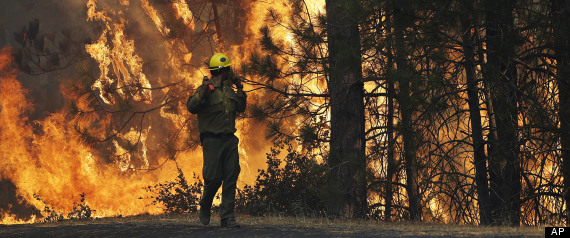
Firefighter A.J. Tevis watches the flames of the Rim Fire near Yosemite National Park, Calif., on Sunday, Aug. 25, 2013. With winds gusting to 50 mph on Sierra mountain ridges and flames jumping from treetop to treetop, hundreds of firefighters have been deployed to protect this and other communities in the path of the Rim Fire raging north of Yosemite National Park. (AP Photo/Jae C. Hong)
The wildfire in Northern California continues to spread into Yosemite National Park and has begun to threaten towns in the area. From the LA Times: Massive Rim fire continues to reshape lives and topography.
…even as firefighters worked furiously to hold a line outside of town, officials warned that this blaze was so hot it could send sparks more than a mile and a half out that could jump lines and start new hot spots. Evacuation advisories remain in effect for Tuolumne City and nearby areas.
On the north edge, the fire — now 134,000 acres — pushed into the Emigrant Wilderness Area and Yosemite National Park. It’s the one side of the fire with a natural last stand: Eventually it will run into granite walls that have snuffed out fires in this region for centuries.
Each day, what the massive blaze does depends on the wind. But officials were particularly attuned to each shift of breeze Sunday because of the weather’s eerie similarities to the day when the fire first exploded out of control.
So far the unpredictable blaze is only about 20% controlled, and it still threatens water and power sources for San Francisco.
The massive fire presents every challenge: steep slopes, dry fuel, rugged terrain and entire communities possibly in harm’s way.
The base camp and incident post, usually a haven outside fire lines, was a prominent example of the fire’s unpredictability: It’s in the middle of the burn zone, charred land with still-smoldering stumps on both sides.
Firefighters call such complete devastation “the black.” Entire ravines and ridges were a dusty gray moonscape. But some of the land was a “dirty burn” — meaning there were small circles of pine and aspen and even grass and wildflowers in the middle of charcoal-black areas where smoke still curled and embers glowed. The specks of beauty made firefighters nervous: To a fire, they are fuel.
My sister and her husband own a house north of San Francisco. It’s probably not in danger, but it still brings the scope of this disaster home to me. I sure hope Firefighers will begin to make progress soon. The burning area is now the size of the city of Chicago, according to CNN.
Yosemite National Park, California (CNN) — A massive northern California wildfire that’s threatening Yosemite National Park and San Francisco’s key water and power sources grew Monday, becoming the 13th largest in state history, state fire authorities said.
The Rim Fire, which has devoured 160,980 acres, has scorched an area about the size of the city of Chicago while more than 3,600 firefighters try to rein it in….
The wildfire, which was 20% contained Monday night, was spreading primarily to the east and threatened to grow amid extremely dry conditions and hot weather.
Part of the fire continued to spread Monday toward a key part of San Francisco’s water supply: the Hetch Hetchy Reservoir, which lies within Yosemite and is just east of the flames.
The fire also could threaten the area’s hydroelectric generators, which provide much of San Francisco’s electricity. Because of the approaching flames, officials shut down the generators, and the city — more than 120 miles to the west — temporarily is getting power from elsewhere.
Speaking of disasters, Charles Pierce reminds us that West, Texas is still recovering from the horrible explosion at the fertilizer plant there and that Texas still isn’t doing that much to prevent similar events in the future.
Read the rest of this entry »

 peej
peej Carissa
 bostonboomer
 dakinikat
 ecocatwoman
 mablue2
 Mama Lopez
 peggysue22
 quixote
 skydancingguestblogger
 Mona (aka Wonk the Vote)



 Sky Dancing
Recent Comments